
In stock
2 CD
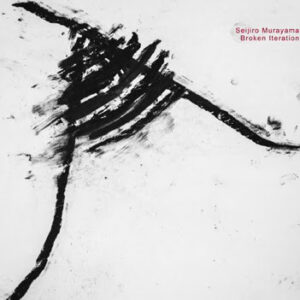
Seijiro MURAYAMA
“Broken iteration”
“The Japanese percussion player who lives in Europe has three fields of interest: 1, non-idiomatic improvisation (that includes idiomatic researches about it, or workshops on it). 2, electro acoustic composition. 3, plural disciplinary collaboration (with words, images, body movements etc) and it would seem to me that these four pieces here are a combination of 1 and 2. […] Murayama’s playing is very minimal and we do recognize indeed the element of percussion instruments, and Murayama explores his instruments with great care.
It has a fine meditative character this music and it explores in depth the textures of the instruments. Murayama doesn’t use his drum parts as a drum kit, but plays one or two separate elements with brushes, sticks or objects and explores them.” FdW in Vital
23,00€
Out of stock

2 CD
RELAY FOR DEATH
“Natural Incapacity”
Relay For Death are the twin sisters Rachal and Roxann Spikula, whose noise mantras transcribe the harsh realities of urban blight that complicate and threaten their own survival. It was in the context of two month medical study that the Spikulas composed their debut album in 2009, amplifying the emptiness of hospital rooms into a ghostly pall worthy of the classic works by Maurizio Bianchi.
Natural Incapacity sprouts from a similar research and development, manifesting from the sonic pollution that proliferates in their current residence of Richmond, California. Clocking in at well over two hours, Natural Incapacity was composed as a seamless, glacial accretion of locomotive grind, subharmonic environmental rumble, nocturnal street sweeping, and the quavering hum of toxic chemicals perpetually leached into the water table. By design, Natural Incapacity’s oil-stained drone is completely relentless, implying neither beginning nor end to this cycle of contamination. Relay For Death’s industrial meditation recognizes abjection, horror, and defeat as the prevalent conditions to existence. Even as a declared rejection to those conditions, Natural Incapacity is engulfed in a bleak nihilism constantly churning back upon itself. Grizzled antecedents can be found in the apocalyptic works of Maurizio Bianchi, Kevin Drumm’s Imperial Distortion, and Organum’s Vacant Lights.
While intended to be a seamless document, Natural Incapacity is split over two CDs and does feature a download of the composition in unedited form. The physical edition features hand-rusted metal covers by the noted corrosion artist Jim Haynes and is strictly limited to 150 copies.
20,00€
Out of stock

2 CD
Christina KUBISH & Annea LOCKWOOD
“The secret life of the inaudible”
CD 1, Annea Lockwood. “Wild Energy” (2016) with Bob Bielecki. “Streaming, swirking, converging” (2017).
CD 2, Christina Kubisch. “Nine magnetic places” (2017). “Below Behind Above” (2017).
“Annea and I first met in New York in 1975. I was writing an article about the experimental music scene in New York for an Italian magazine. We soon found out that we had a lot of common interests and ideas. In 1979 she came to Italy and together we performed her piece “World Rhythms” at a festival in Como. I was deeply impressed by how Annea combined technical skills with intuitive performance.
Sound for her always has been more than just material to bring into a compositional form. It was more than raw material, it had a complex structure of its own and was transporting energy. Annea translated and communicated this energy to the listener and she does this with unusual intensity until today.
Over the years we followed each other’s works but unfortunately did not meet as often as we would have liked. During her stay in Berlin earlier this year we had another chance to discuss our works, materials, researches, concepts, doubts and future projects. The idea of a collaboration was a natural consequence of this exchange. We both investigate soundworlds which normally are not audible. Annea questions how the forces of nature influence us, I question how manmade electromagnetic fields have an impact on our lives. And we both love field recording, especially exploring underwater sounds with hydrophones.
We decided to exchange sound materials and left it open to the other what to choose and how to mix it into a new composition. The two new pieces which were created by this exchange are different but at the same time seem to belong together somehow. Annea sent me extracts from recordings of VLF chorus waves, solar oscillations, earthquakes, gas vents etc. while I transmitted to her a collection of recordings of electromagnetic waves which I had made audible and recorded with special custom designed induction headphones. Annea’s sound material was coming from sonic ultra and infra ranges and was speeded up or shifted down in order to become audible, my recordings are analog and were made directly on site in different cities. The sounds we use are all strange and powerful and they go together as if they were especially made for this collaboration. Until now what kind of influence the sources of these normally hidden waves have on us is not much explored. It is up to the listener to find out more about it.
Thanks to Gruenrekorder who supported our project from the beginning.” Christina Kubisch, November 2017
17,00€
Out of stock

2 CD
Morton FELDMAN
“Crippled Symmetry, live at June in Buffalo”
“2 CD set in slim card package. In 2000, Eberhard Blum (flute, alto flute, bass flute), Nils Vigeland (glockenspiel, vibraphone) and Jan Williams (piano, celesta), Morton Feldman’s close friends and collaborators, came together once more as “The Feldman Soloists” to perform Crippled Symmetry, the trio Feldman composed for them, on the 25th anniversary celebration of June in Buffalo, the festival he founded. The recording of this concert is now finally available on CD, and is destined to become the reference recording of this work. Required listening for all fans of Feldman’s rich, hypnotic world of enigmatic harmony and mnemonic echo. Mastered by Denis Blackham, and presented in a card package which unfolds to reveal the musicians’ "butterfly-like" arrangement on stage.
"This turned out to be one of the best performances that we had ever given together. The rare and indescribable ‘magic moment’ of occasion and ambience seems to have inspired us. The recording of the concert belongs to my most valued sound documents. When I listened to it for the first time, my immediate reaction was: this performance ought to be available on CD. Now, ten years later, it is.” Eberhard Blum
17,00€
In stock
2 CD
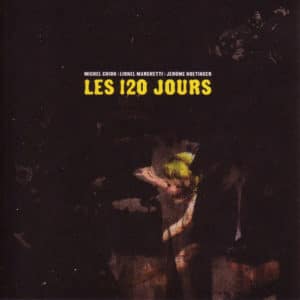
Michel CHION – Lionel MARCHETTI – Jérôme NOETINGER
“Les 120 jours”
We managed to find 150 copies from this 2 CD published in 2004 - left in the room of one coproducer !!!
Musique concrete composed in 1997/98. A collaboration between these three French composers. First they did bring together a kind of bank of sounds, which they each rework. And at the end they did put together all the different parts to create this kind of monster.
Musique concrete composed in 1997/98. A collaboration between these three French composers. First they did bring together a kind of bank of sounds, which they each rework. And at the end they did put together all the different parts to create this kind of monster.
10,00€
Out of stock
2 CD
Sachiko M – Toshimaru NAKAMURA – Otomo YOSHIHIDE
“Good morning – Good night”
Free improvisation has rarely seen significant new movements as influential as the small group of Tokyo musicians once labeled as “onkyo”. Sachiko M, Toshimaru Nakamura and Otomo Yoshihide are three of the scene’s driving forces (along with Taku Sugimoto), and on Good Morning Good Night are documented together as a trio for the first time.
Sachiko M is best known for her innovative use of the sampler, extracting pure, piercing sine waves from the device’s built-in test tones and forging an original and much-imitated sound. More recently, she has expanded her palette through the use of contact mikes. Sachiko has worked extensively as a solo artist, as well as in groups such as Cosmos, Filament, and I.S.O., and in duo with Toshimaru Nakamura. She won the 2003 Prix Ars Electronica, along with Ami Yoshida and Utah Kawasaki, and also founded and runs the groundbreaking Amoebic label.
Since 1998, Toshimaru Nakamura has been exploring the possibilities of his "no-input mixing board" in contexts ranging from solo to collaborations with Keith Rowe, Günter Müller, Sachiko M, Andrea Neumann, and the duo project Repeat (with drummer Jason Kahn). Nakamura was a prominent presence throughout the AMPLIFY 2002 box set, appearing on five of the seven CDs, and will be recording the much-awaited follow up to the highly acclaimed Weather Sky CD with Keith Rowe later this year.
Otomo Yoshihide’s prolific career has been unified by a primary objective: the investigation of the nature of sound from every conceivable angle. In the mid-90’s, he explored the limits of sample-based turntablism, predominantly through his band Ground Zero, as well as in collaborations with Christian Marclay and Yamatsuka Eye. Over the last few years, Otomo has become increasingly interested in minimal wave-based electronics, as heard in his Filament, I.S.O, Cathode and Anode projects. Other projects which he is currently involved in include his New Jazz Quintet, as well as an ongoing duo project with Martin Tétreault. Otomo has also composed many soundtracks for movies, and has written numerous articles and essays for Japanese music publications.
While these three musicians have worked together in countless configurations in recent years, Good Morning Good Night is their first meeting as a trio. Recorded in August of 2003, the 2 CD contains essentially the full recording sessions, four tracks totaling over 100 minutes. Good Morning Good Night is a very conscious step in a new direction, an attempt to create a “vertical” music (as opposed to most music, which moves in a linear, horizontal plane). The pointillistic placement of sounds by these three masters of delicacy results in a music that exists somewhere between foreground and background listening. Friederike Paetzold’s design is inspired by James Turrell’s work, and features four different covers for the four tracks/times of day, which the listener can fold according to their preference.
Sachiko M is best known for her innovative use of the sampler, extracting pure, piercing sine waves from the device’s built-in test tones and forging an original and much-imitated sound. More recently, she has expanded her palette through the use of contact mikes. Sachiko has worked extensively as a solo artist, as well as in groups such as Cosmos, Filament, and I.S.O., and in duo with Toshimaru Nakamura. She won the 2003 Prix Ars Electronica, along with Ami Yoshida and Utah Kawasaki, and also founded and runs the groundbreaking Amoebic label.
Since 1998, Toshimaru Nakamura has been exploring the possibilities of his "no-input mixing board" in contexts ranging from solo to collaborations with Keith Rowe, Günter Müller, Sachiko M, Andrea Neumann, and the duo project Repeat (with drummer Jason Kahn). Nakamura was a prominent presence throughout the AMPLIFY 2002 box set, appearing on five of the seven CDs, and will be recording the much-awaited follow up to the highly acclaimed Weather Sky CD with Keith Rowe later this year.
Otomo Yoshihide’s prolific career has been unified by a primary objective: the investigation of the nature of sound from every conceivable angle. In the mid-90’s, he explored the limits of sample-based turntablism, predominantly through his band Ground Zero, as well as in collaborations with Christian Marclay and Yamatsuka Eye. Over the last few years, Otomo has become increasingly interested in minimal wave-based electronics, as heard in his Filament, I.S.O, Cathode and Anode projects. Other projects which he is currently involved in include his New Jazz Quintet, as well as an ongoing duo project with Martin Tétreault. Otomo has also composed many soundtracks for movies, and has written numerous articles and essays for Japanese music publications.
While these three musicians have worked together in countless configurations in recent years, Good Morning Good Night is their first meeting as a trio. Recorded in August of 2003, the 2 CD contains essentially the full recording sessions, four tracks totaling over 100 minutes. Good Morning Good Night is a very conscious step in a new direction, an attempt to create a “vertical” music (as opposed to most music, which moves in a linear, horizontal plane). The pointillistic placement of sounds by these three masters of delicacy results in a music that exists somewhere between foreground and background listening. Friederike Paetzold’s design is inspired by James Turrell’s work, and features four different covers for the four tracks/times of day, which the listener can fold according to their preference.
22,00€
Out of stock
2 CD
Michael PISARO – Toshiya TSUNODA
“Crosshatches”
“Crosshatches was composed, recorded and assembled by Tsunoda and Pisaro over a period of 14 months, as a single 85 minute work in eight sections.”
21,00€
Out of stock
2 CD
Keith ROWE – Michael PISARO
“13 Thirteen”
13 Thirteen is a 140 minute piece recorded in Nantes in May 2016, partly composed and partly improvised.
“On this two-and-a-half hour, semi-improvised opus, the two guitarists and composers approach finely wrought detail and vast empty space in ways that can warp one’s perception of time itself. The first recorded collaboration between veteran guitarists Keith Rowe and Michael Pisaro is dauntingly ambitious”. Marc Masters
“On this two-and-a-half hour, semi-improvised opus, the two guitarists and composers approach finely wrought detail and vast empty space in ways that can warp one’s perception of time itself. The first recorded collaboration between veteran guitarists Keith Rowe and Michael Pisaro is dauntingly ambitious”. Marc Masters
22,00€
Out of stock

2 CD
Keith ROWE-Sachiko M
“Contact”
Keith Rowe (guitar, electronics) and Sachiko M (sine wave, contact microphone). Recorded by Taku Unami at Kid Ailack Art Hall, Tokyo on september 21 and september 23, 2008. Mixed by Taku Unami. Mastered by Toshimaru Nakamura.
22,00€
Out of stock
2 CD
Jürg FREY – Radu MALFATTI
“II”
The label doesn’t want to do notes anymore about his new releases. So we have to write some with our very good English.
With these two names you can imagine that for sure the music will be closer to silence than to wall of noise. First we must say that no credit is written on the CD, like it was not important to know who is playing what and first what is played. CD1 is an instrumental piece signed by Radu Malfatti. CD2 by Jürg Frey where instruments are mixed with field recordings.
It was recorded by Christoph Amman in Vienna in 2013.
With these two names you can imagine that for sure the music will be closer to silence than to wall of noise. First we must say that no credit is written on the CD, like it was not important to know who is playing what and first what is played. CD1 is an instrumental piece signed by Radu Malfatti. CD2 by Jürg Frey where instruments are mixed with field recordings.
It was recorded by Christoph Amman in Vienna in 2013.
21,00€
Out of stock
2 CD
Graham LAMBKIN
“Community”
Erstwhile is proud to announce the release of Community, the new solo release by Graham Lambkin, his fifth solo record, following 2011’s Amateur Doubles.
“Community is a music steeped in sociological review. It sits as a keen barometer, taking the temperature of the world around it. Community is both willing servant and social mirror - it performs its basic civic duty without fuss, then shatters.” (José Perez)
Mastered by Giuseppe Ielasi and designed by Lambkin, Community arrives in a deluxe matte finish 6-panel digipak with corresponding 8-page booklet. There is a LP version on Kye, which duplicates the material on CD 1 here, and CD 2 is exclusive to the CD edition.
“Community is a music steeped in sociological review. It sits as a keen barometer, taking the temperature of the world around it. Community is both willing servant and social mirror - it performs its basic civic duty without fuss, then shatters.” (José Perez)
Mastered by Giuseppe Ielasi and designed by Lambkin, Community arrives in a deluxe matte finish 6-panel digipak with corresponding 8-page booklet. There is a LP version on Kye, which duplicates the material on CD 1 here, and CD 2 is exclusive to the CD edition.
22,00€
Out of stock
2 CD
Graham LAMBKIN – Taku UNAMI
“The Whistler”
The Whistler consists of material recorded together, then each assembled and mixed their own disc from that.
“What Lawrence English calls “relational listening”: the attempt to transmit an individual auditory experience by reconstructing it according to free associations and personal preferences. The Lambkin/Unami duo is yet another experiment played on the apparently autonomous existence of sound, even when derived from or directly attributable to an external agent; it is also a demonstration of how, starting from different theoretical elements and assumptions, one can reach such a degree of synthesis so as to put them virtually on the same level - at the same time alien and familiar to our common perception.” ondarock.it
“What Lawrence English calls “relational listening”: the attempt to transmit an individual auditory experience by reconstructing it according to free associations and personal preferences. The Lambkin/Unami duo is yet another experiment played on the apparently autonomous existence of sound, even when derived from or directly attributable to an external agent; it is also a demonstration of how, starting from different theoretical elements and assumptions, one can reach such a degree of synthesis so as to put them virtually on the same level - at the same time alien and familiar to our common perception.” ondarock.it
22,00€
Out of stock

2 CD
Graham LAMBKIN – Jason LESCALLEET
“Photographs”
Graham Lambkin and Jason Lescalleet stand side by side in the vanguard of contemporary sound exploration. Since the initiation of their collaborative endeavors in 2006, the duo have crafted a nice combination of audio vérité and musique concrète, together building a highly personal body of work. 2008’s critically acclaimed ’The Breadwinner’ illuminated the artistic potential found in mundane and commonplace circumstances. 2010’s ’Air Supply’ showcased a darker side, nudging the civilian themes of its predecessor into fields of pure abstraction.
“Photographs” brings Lambkin and Lescalleet back again to the questions of self and place. “Photographs” presents a monolithic reappraisal of heritage, both individual and shared, and reevaluates the geographic and societal influence inherent in formative memory. Recorded in Folkestone, England and Worcester, Massachusetts, “Photographs” invites the listener to journey through Lambkin and Lescalleet’s historical registry, places of birth, childhood haunts, locations of enlightenment and kingdoms of despair. “Photographs” welcomes the listener into the houses and homes of Lambkin and Lescalleet’s upbringing. It’s a meet and greet with family and friends, a traipse through ever-changing street scenes, and a document of a fading static past. But “Photographs” is not just a memorial to a time long since spent. Lambkin and Lescalleet take you there and back in celebration of their ancestry, breathing new life into each chapter and event. As a survey of origin and a major artistic statement, “Photographs” proves itself to be a worthwhile investment, and one that brings Lambkin and Lescalleet’s collaboration full circle. The beginning now knows its end, the final part has fallen into place, a plan has worked well and everything is perfect.
Housed in a deluxe UV-varnished 12-panel fold-out digipak, boasting copious site-specific pictorial data, “Photographs” sets the new gold standard for CD design presentation, and provides the music with lavish adornment. Mastered by Jason Lescalleet at Glistening Labs with a running time of over 95 minutes, “Photographs” is an audio/visual treasure trove whose richness and detail will give pleasure enough to last a lifetime.
“Photographs” brings Lambkin and Lescalleet back again to the questions of self and place. “Photographs” presents a monolithic reappraisal of heritage, both individual and shared, and reevaluates the geographic and societal influence inherent in formative memory. Recorded in Folkestone, England and Worcester, Massachusetts, “Photographs” invites the listener to journey through Lambkin and Lescalleet’s historical registry, places of birth, childhood haunts, locations of enlightenment and kingdoms of despair. “Photographs” welcomes the listener into the houses and homes of Lambkin and Lescalleet’s upbringing. It’s a meet and greet with family and friends, a traipse through ever-changing street scenes, and a document of a fading static past. But “Photographs” is not just a memorial to a time long since spent. Lambkin and Lescalleet take you there and back in celebration of their ancestry, breathing new life into each chapter and event. As a survey of origin and a major artistic statement, “Photographs” proves itself to be a worthwhile investment, and one that brings Lambkin and Lescalleet’s collaboration full circle. The beginning now knows its end, the final part has fallen into place, a plan has worked well and everything is perfect.
Housed in a deluxe UV-varnished 12-panel fold-out digipak, boasting copious site-specific pictorial data, “Photographs” sets the new gold standard for CD design presentation, and provides the music with lavish adornment. Mastered by Jason Lescalleet at Glistening Labs with a running time of over 95 minutes, “Photographs” is an audio/visual treasure trove whose richness and detail will give pleasure enough to last a lifetime.
26,00€
Out of stock
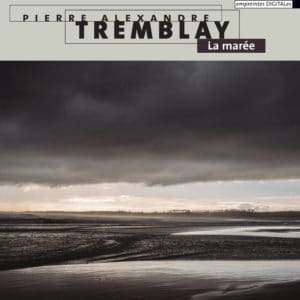
2 CD
Pierre Alexandre TREMBLAY
“La marée”
“All the pieces on this album are mixed-music where the soloist has a complex dynamic with its antagonist, the loudspeaker: a dialogue all made of power games. This uneven relationship is reminiscent of the fragility of sandcastles and other human constructions with their daily facing of the patience of the elements. Are these ephemeral joys many revenges over the ineluctable?”
“La rupture inéluctable” (2010-11) with Heather Roche, bass clarinet. “Le tombeau des fondeurs” (2008) with Sarah Nicolls, Baschet-Malbos piano. “Mono no aware” (2013) with Jean-François Laporte, Babel table. “Still, Again” (2012-13) with Peyee Chen, soprano. “Un clou, son marteau, et le béton” (2008-09) with Sarah Nicolls, piano.
“La rupture inéluctable” (2010-11) with Heather Roche, bass clarinet. “Le tombeau des fondeurs” (2008) with Sarah Nicolls, Baschet-Malbos piano. “Mono no aware” (2013) with Jean-François Laporte, Babel table. “Still, Again” (2012-13) with Peyee Chen, soprano. “Un clou, son marteau, et le béton” (2008-09) with Sarah Nicolls, piano.
13,00€
Out of stock
2 CD
Francisco LÓPEZ
“Machines”
“Elevator Bath is extremely pleased to present this new 2 CD set of thematically-linked works from Francisco López, still unquestionably one of the major figures of contemporary experimental music. "Machines" collects four pieces recorded from 2004-2007, each of which is based upon sounds of machinery (clocks, elevators, and various laboratory and factory equipment) gathered, respectively, in Amsterdam, Leipzig, Barcelona, and Riga. Yes, these compositions are permeated by an “industrial” sound, but these are very subtle arrangements, even with a wide dynamic scope and with silence playing a lesser role than in much of López’ output. There is a strong rhythmic presence in these recordings, heavy with the weight of machinery. Thick sounds held in crisp clarity. Blindfold or no, "Machines" offers an involving listening experience, drawing the listener deep into the various locales of its sources. And with a running time of more than two and a half hours, this is a substantial and important addition to the world of absolute concrète music by one of the most distinguished and distinctive artists in the field. Packaged inside an elegant printed sleeve with a fold-out insert featuring color photography by the composer. Printed with soy-based ink on 100% recycled paper. This double compact disc set has been issued in an edition of 500 copies.”
20,00€
Out of stock
2 CD
Michael PISARO
“Transparent city (volumes 3 and 4)”
“Field recordings, electronic sounds. Field recordings made in greater Los Angeles from October, 2006 to February, 2007. Each recording is an unedited ten-minute take from a single location. Sine tones and mixing completed in Michael Pisaro’s home studio in Santa Clarita, California. Each ten-minute piece is followed by two minutes of silence. Recordings were mastered with home stereo playback in mind. In general, it is best to set the volume control on your system to a normal level (that is, the level at which most of your other music is played) and to let it remain in that position. Volume levels of the pieces vary intentionally over the course of the series.”
10,00€
In stock
2 CD
Maria de ALVEAR
“besando el tiempo”
“Besando el tiempo” for flute solo (1995). Antoine Beuger (flute).
'besando el tiempo' is a piece that was composed in 1995 in the space of four days. It was written in an automatic script that Maria de Alvear uses for many of her pieces. The work was originally composed for the flautist Caren Levine, who also gave it its first performance in Salzau in 1995. 'besando el tiempo' has now been performed several times worldwide by different interpreters.
When Maria de Alvear heard the performance by Antoine Beuger, she asked him to give her a recording for herself.
Maria de Alvear: “For me, Antoine Beuger's interpretation is the most exact reading there is of my piece. It embodies perfect introversion on the part of the interpreter. The interpreter hears music as “the first beholder of the composer”, and that is the way the piece is played here.”
Antoine Beuger: “When I start playing this piece, I embark on a journey into my inmost being and encounter myself. I never know beforehand what it will be like, how it will continue; I am on my way, on my travels … that is the adventure of this piece. You have to expose yourself to this encounter without any protection or reservations, in complete innocence. And that is also what can be heard.”
10,50€
In stock
2 CD
John CAGE
“One 9”
Program: John Cage : One9
Performer: Edwin Alexander Buchholz, Accordion
“sounds brushed into existence as in oriental calligraphy" (Cage)
the sounds in one9 are single tones and chords, up to six part harmonies.
how do sounds come into existence, how do they gain focus, how do they resolve, how do they merge into one another, how can one quietly and attentively, in all modesty, follow their unfolding?
these are the questions that guided edwin alexander buchholz in his interpretation of the piece.
over the years he played one9 time and again - for himself and in concerts. gradually solutions manifested themselves which he never, at first, would have considered.
it is not simply the case, that this music, which was originally written for shô, the japanese mouth organ from gagaku music, may also be played on accordion.
much as the immemorial shô, originated about 4000 years ago, and the modern accordion are related, they are not interchangeable. one9 has been written specifically for shô and first has to find its way to the accordion, in order to become real accordion music.
the accordion is a wind instrument, but also a keyboard instrument, it has stops, its colours are eminently rich and its two sound sources, as long as they are sounding, are always moving: away from each other, towards each other.
for edwin alexander buchholz one9, in the course of time, grew into a music, that integrated all of this, a music entirely for his instrument: the accordion.
traditionally the sound of the shô is connected to the heavens’ gleam. I have no trouble hearing this quality here, in the sound of the accordion.” antoine beuger
17,00€
Out of stock

2 CD
Johan LINDVALL
“Solo – ensemble”
Composer : Johan Lindvall. Performers : Vilde Sandve Alnæs (violin), Kristine Tjøgersen (clarinet), Jan Martin Gismervik (percussion), Henrik Munkeby Nørstebø (trombone), Ina Sagstuen (voice), Fredrik Rasten (guitar), Johan Lindvall (piano).
10,50€
Out of stock
2 CD
Hermann MEIER
“Works for piano 1949 – 1987”
“in this edition we hear for the first time the complete solo piano works from between 1949 and 1987 of the swiss avant-garde composer hermann meier.
before the time of the three movement sonata meier composed several dodecaphonic works some of which were cyclic. these were not considered for this CD,
since the sonata contains structurally a replica of all that meier wrote before. the sonata coincides with the first serial sketches and visions,
together with integral thinking using rows and is as such for meier’s eminent work from the 50s onward, both retrospectively as well as anticipatory, of great importance.
the piano piece hmv* 37 from 1956 exists only as a pencil sketch. why the composer wrote no definitive version is not known.” dominik blum, october 2017
10,00€
Out of stock
2 CD
Eva-Maria HOUBEN
“Works for double bass”
Archipelagos (2006). Nachtstück (2007). Hans Eberhard Maldfeld, double bass.
17,00€
Out of stock
2 CD
Eva-Maria HOUBEN
“Livres d’heures”
Composer : Eva-Maria Houben. Performers : Andreas Feilen (tubular bells), Eva-Maria Houben (piano, violin), Erik Carlson (violin), Bileam Kümper (violin).
a book of hours usually was designed for the private devotion of laymen as a prayer book. they arised in the 13th century and reached heyday during the late 14th century and the 15th century in France and the Flemish Region. very famous the books of hours of the Duc de Berry (1340-1416), including Très riches heures.
here the books of hours examine different kinds of relationship between people. as it is described in the last book (les petites heures):
“being occupied – in a peaceful way, without haste. a balance between intervention and restraint, between doing and not doing. being alone – with others, near to each other. meeting yourself – and each other. perhaps time seems to stand still sometimes.”
10,50€
In stock
2 CD
Emmanuelle WAECKERLÉ
“Ode (owed) to O”
Composer : Emmanuelle Waeckerlé. Performer : Emmanuelle Waeckerlé, André O. Möller, Antoine Beuger, Alissa Cheung, Josten Myburgh, Sylvia Alexandra Schimag, Samuel Vriezen (voices), Antoine Beuger (flute), Samuel Vriezen (melodica).
reading through (CD 1) and reading from (CD 2) a book of words to a single letter, to breath and silence.
picking words attached to her, then caressing her with our breath, just enough to taste her, sometimes distracted, held back even by the flavour of other words, our self-consciousness temporarily abolished by the vertigo of another's language.
each one of us had to find a way among the multiple reading paths created by eye and mind wandering the pages from one O to another, navigating between erotic literature, conceptual writing and verbal score.
(story of) was performed from Pauline Réage’s book Story of O (1954),
(looking for) from (reading) O score in Emmanuelle Waeckerlé’s Reading (story of) O (Uniformbooks , 2015).
10,00€
Out of stock

2 CD
Luigi NONO
“Seguente”
Rerelease of ed. RZ LP Luigi Nono plus three legendary recordings. “A Carlo Scarpa, architetto, ai suoi infiniti possibili” (1984) for orchestra. “A Pierre. Dell’azzurro silenzio, inquietum” (1985), for contrabass flute and clarinet and electronics. “Guai ai gelidi mostri” (1983) for voices, ensemble and electronics. “La terra e la compagna” (1957/58) for voice, choir and instruments. “Caminantes... Ayacucho” (1986/87) for voices, flute, choir and electronics. “No hay caminos, hay que caminar... Andrej Tarkowskij” (1987) for seven orchestra.
24,50€
In stock

2 CD
Josef Anton RIEDL
“Klangregionen 1951-2007”
Josef Anton Riedl born in 1929 discovered musique concrète in 1951 and started composing his own pieces in 1952. He became music director of the Siemens Studio for Electronic Music in Munich in 1959. Available for the first time on CD (after a very long time deleted LP on Wergo), a great collection of electroacoustic pieces. “Paper Music I” (1961-70), “Studie 59 I” (1959), “Zeichnen - Klatschen/Zeichnen - Zeichnen” (1979-81), “Landschaftsbeschreibung I” (1973), “Mix Fontana Mix” (1974-76-79), “Silphium” (1969-70), “Lautgedichtfolge g)” (1977-79-98), “Ausfluss, Niederschlag, Spur, Nachhall I” (2000-02-07), “Douce-Amère” (1972-74-81), “Komposition Nr. 2” (1963-65), “Polygonum” (1968-70), “Leonce und Lena” (1963-64), “Vielleicht - Duo” (1963-68-70), “Musique Concrète - Studie II” (1951-59), “Musique Concrète - Studie I” (1951-59), “Studie 62 I” (1962), “Studie 62 II” (1962). “Klangsynchronie I Studie 59” (1981), “Komposition Nr. 3” (1965-67), “Studie 61 I” (1961), “Ideir notna fesoj” (1993), “Elektronische Musik - Studie II” (1959), “Elektronische Musik - Studie I” (1958).
25,00€
Out of stock

2 CD
Iannis XENAKIS
Iannis Xenakis (1922 - 2001). Collection of historical recordings of essential works : “ST/48-1,240162” for 48 Instruments, 1959-62, “Le Polytope de Montreal” for four Orchestras, 1967, “Nomos Gamma” for large Orchestra scattered among the audience 98 Instruments, 1967-68, “Terretektorh” for large Orchestra scattered among the audience 88 Instruments, 1965-66, “Syrmos” for 18 Strings, 1959, “Achorripsis” for 21 Instruments, 1956-57, and two tape pieces for 8 speakers : “Persepolis” version, 1971, “Polytope de Cluny”, 1972.
25,00€
Out of stock
2 CD
Harley GABER
“The wind rise in the north”
“This is a masterpiece composed between 1973-74 and first performed in 1976 by Linda Cummiskey, Malcolm Goldstein, Kathy Seplow, violin, Stephen Reynolds, viola, David Gibson, violoncello. Liner notes and credits from the original release on Titanic Records 1976. Digisleeve, booklet German-English.”
25,00€
Out of stock

2 CD
Christian WOLFF
“Kompositionen 1950-1972”
“Finally I realized that the kind of sound made in an indeterminate situation includes what could result in no other way; for example, the sound of a player making up his mind, or having to change it. In fact, the indeterminate notation I’ve used is, as far as I know, the only possible one for the kind of sound I should like. And don’t forget, we also like to be surprised. and the rhythm produced by that situation is like no other rhythm.”
“Most of the pieces collected for this portrait of Christian Wolff document the composer’s early activity and were mainly recorded around the time of their composition. Each recording exemplifies the sound gestures from their time.”
“For Pianist”, 1959, Version 1 Frederic Rzewski. “Duo for Violinist and Pianist”, 1961, János Négyesy & Cornelius Cardew. “Lines für Streichquartett”, 1972, for stringquartet. “For Prepared Piano”, 1951 by Frederic Rzewski. “For Piano I”, 1952 Frederic Rzewski. “For 1, 2 or 3 People”, 1964 David Tudor. “Edges”, 1968 Gentle Fire. “For 1, 2 or 3 People”, 1964 by Nelly Boyd, Robert Engelbrecht, Jan Feddersen, Jens Röhm. “Stones” (aus Prose collection), 1968. “Suite (I)” for prepared piano, 1954 by Fuat Kent. “Duo for Violins, 1950 by Biliana Voutchkova, Daniella Strasfogel. “For Pianist”, 1959 by David Tudor. “For Piano I”, 1952 by David Tudor. “Suite (I)” for prepared piano, 1954. “Edges”, 1968 by Keith Rowe.
“Most of the pieces collected for this portrait of Christian Wolff document the composer’s early activity and were mainly recorded around the time of their composition. Each recording exemplifies the sound gestures from their time.”
“For Pianist”, 1959, Version 1 Frederic Rzewski. “Duo for Violinist and Pianist”, 1961, János Négyesy & Cornelius Cardew. “Lines für Streichquartett”, 1972, for stringquartet. “For Prepared Piano”, 1951 by Frederic Rzewski. “For Piano I”, 1952 Frederic Rzewski. “For 1, 2 or 3 People”, 1964 David Tudor. “Edges”, 1968 Gentle Fire. “For 1, 2 or 3 People”, 1964 by Nelly Boyd, Robert Engelbrecht, Jan Feddersen, Jens Röhm. “Stones” (aus Prose collection), 1968. “Suite (I)” for prepared piano, 1954 by Fuat Kent. “Duo for Violins, 1950 by Biliana Voutchkova, Daniella Strasfogel. “For Pianist”, 1959 by David Tudor. “For Piano I”, 1952 by David Tudor. “Suite (I)” for prepared piano, 1954. “Edges”, 1968 by Keith Rowe.
21,50€
Out of stock

2 CD
Dave PHILLIPS
“South Africa recordings”
2CD + 16 page booklet in a 6-panel cardboard sleeve. Edition of 300.
Raw field recordings. Immersion. Listening beyond sound.
Nature speaks languages. we can “hear” them, but do we listen, do we try to understand? floods, tornados, land erosion, global warming, et cetera - these are but the most obvious examples of nature speaking.
these discs contain nature’s sounds with this particular intention/communication in mind. the field recordist in the role of a mediator. aesthetic choices are but departing points. the quality of attention defines the quality of experience. of hearing. of listening and understanding. then the exploration may begin.
tongues speaking, senses responding, resonating and reverberating. altered states. immersion - being part of something. south african wildlife and its soundscapes are in-your-face. but disappearing. forced away by human supremacy/stupidity. hear: night soundscapes with bubbling kassinas in riparian woodland. tremolo sand frogs and anuran night chorales. a semi-dry river bed after sunset. climatic events at the billion year old mmabolela rock. vigorous toad night chanting at a small lake. curious and vocal desert crows. cicada serenades, solos, duets and ensembles - frequency rapture. transpiration, flies and ears. barking geckos ringing in the night. night-insects crooning. howling jackals and roaring lions. hundreds of doves at a waterhole - the magic of avian movement in unison. wandering hyenas meeting family at their den. a mountain forest stream.
primate vocalisations. a morning river walk. the atmosphere of a gorge. swamp forests, wind and clicking katydids. a hippopotami laughing. dung beetles in flight. swamp life. squirrel voices from beyond. an egyptian fruit bat cave.
these recordings have been equalised and arranged. panning is used. no other audio treatments, effects or manipulations have been applied. many tracks are single recordings, a few are layered. each disc is one continuous listening session. alternative playback on headphones is suggested. maximum volume yields maximum effects.
recorded in mmabolela game reserve (‘sonic mmabolela’, limpopo province), kgalagadi transfrontier national park (northern cape province), marloth nature reserve (western cape province), addo national park (eastern cape province), oribi gorge nature reserve (kwazulu-natal province), amatigulu nature reserve (kwazulu-natal province), isimangaliso wetland park (kwazulu-natal province), south africa, november 2015 to january 2016. photos by nathalie dreier and dp complement the soundscapes.
topography: riparian woodlands (mmabolela), sand dune desert (kgalagadi), semi-arid karoo (addo, mmabolela), hilly forests (marloth, oribi), riverine and swamp forests (amatigulu), savannas, subtropical dune forests and wetlands (isimangaliso). day temperatures between 30° and 43°C.
14,00€
Out of stock

2 CD
Keiki MIDORIKAWA
“Complete Grüne Revolution”
“Keiki Midorikaw (cello, bass), Masahiko Togashi (percussion, drums), Masayuki Takayanagi (guitar) et Masahiko Sato (piano). Recorded on January 16, 1976 at Nichi-futsu kaikan, Tokyo. The original LP of this work has duo with Takayanagi on A side and duo with Sato on B side. But in the concert, Midorikawa played duo with Togashi about 40 minutes, afterward he played duo with Takayanagi and with Sato both about 20 minutes actually. It didn’t include Togashi duo on the original LP. This time doubtmusic found a tape of Midorikawa - Togashi duo, 2CD set convey all performance that day as a complete version. The tapes which are used on those CDs are different from the original master tape, and we re-mastered them, so the quality is higher than the original LP. Midorikawa’s free improvisation that playing duo with each Togashi, Takayanagi, Sato is inventive and in consequence, each music is very beautiful. Those music are prime free-jazz that quietness and intensity seem like spindrift.”
20,00€
In stock

2 CD
Michel CHION
“La vie en prose”
A concrete symphony composed between 2006 and 2011. Four parts : “Le chant des heures”, “Le souffle court”, “Dans la chambre”, “Salut au jour”.
“Thanks to musique concrète ways and means, La vie en prose fulfils my childhood dream of composing a Symphony of Energy in four movements of sharp contrasts. The title of the work was inspired by Flaubert, in a sentence explaining how as the era of rhyming poetry ended the age of prose began. There’s no narrative in this one hour and a half long Symphony, but a cast of characters, some vocal instrumental theme and sounds that circulate, disappear, pop up, stretch, decline and lose themselves in time." MC.
Michel Chion is a French composer, director, writer and theoretician. La vie en prose is his first musical work composed in the 2000s. Thanks to musique concrète ways and means, it fulfills his childhood dream of composing a Symphony of Energy in four movements of sharp contrasts. There’s no narrative in this one hour and a half long Symphony, but a cast of characters, some vocal, instrumental themes and sounds that circulate, disappear, pop up, stretch, decline and lose themselves in time. This work features analog and digital sounds that have been carefully collected for 40 years.
“Thanks to musique concrète ways and means, La vie en prose fulfils my childhood dream of composing a Symphony of Energy in four movements of sharp contrasts. The title of the work was inspired by Flaubert, in a sentence explaining how as the era of rhyming poetry ended the age of prose began. There’s no narrative in this one hour and a half long Symphony, but a cast of characters, some vocal instrumental theme and sounds that circulate, disappear, pop up, stretch, decline and lose themselves in time." MC.
Michel Chion is a French composer, director, writer and theoretician. La vie en prose is his first musical work composed in the 2000s. Thanks to musique concrète ways and means, it fulfills his childhood dream of composing a Symphony of Energy in four movements of sharp contrasts. There’s no narrative in this one hour and a half long Symphony, but a cast of characters, some vocal, instrumental themes and sounds that circulate, disappear, pop up, stretch, decline and lose themselves in time. This work features analog and digital sounds that have been carefully collected for 40 years.
20,00€
Out of stock
2 CD
David ROSENBOOM
“Roundup two”
“B.C.-A.D. I (The Moon Landing)” (1969) with Salvatore Martirano, “Musical Intervention” (1979), “Four Soundings from URBOUI” (1968), “Zones of Influence, Part I, The Winding of a Spring” (1984), “Music for Analog Computers” (1968-1969), “Musical Intervention” (1982), “Trio II” (1978) with Michael Byron and William Winant. “Limited 300. For over four decades, composer-performer David Rosenboom has developed unique circuitry and software for making musical models of the wondrous natural world come alive. Traversing the raucous and the sublime, Roundup two presents live performances with vacuum tube analog computers, solid-state manifestations of chaos and harmony, musical interventions on political tunes, virtuoso performers interlinked with hybrid processing, and more. Roundup Two is an essential, historical document containing important examples from a sixteen-year period in this innovative artist’s extraordinary, pioneering work. Acknowledgements and history : Several of these pieces appeared in an audio, cassette package released in 1987 by Slowscan editions, ‘s-Hertogenbosch, The Netherlands, titled Roundup, A Live electro-acoustic retrospective (1968-1984). For Roundup Two, all those pieces have been re-mastered from tapes in audio archives that were in various states of preservation. Several that were originally presented only in excerpts are now presented in complete, unedited versions, and other works not on the original Roundup have been added”. (David Rosenboom)
25,00€