
In stock

LP
VOMIR & Anla COURTIS
“Sin Comentarios”
The dense HNW blocks of sound does not dominate or overpower the more dynamic guitar excursions of Courtis, but instead there is a good balance of the elements, making room for both artists to shine. The two sidelong pieces that makes up “Sin Comentarios” appears to be composed in a considered manner. The first piece is a full-on ferocious hailstorm of electronic shards, like a thousand pieces of scarp metal disappearing into a prehistoric black hole. Midway through piece a metallic drone appears and slowly takes over the music. This leads us into the second part, which feels like the grinding cosmos of part one twisted inside out, like an alternate reality, all elements in an inverted state of weightlessness. The piece is more open, the elements more clearly defined, there’s a different sense of both space and pace, but the piece is no less intense. Towards the end the music slowly builds down, almost like a sonic origami that folds itself into nothing. I’m sure it was not intended as a symbolic Zen-like closure, but it in the context of what happened, it’s hard not let the thought cross your mind when listening to this remarkable last Vomir recording. (extract from Lasse MARHAUG's liner notes)
22,50€
In stock

LP
Z.B. AIDS
“For Franz”
A bad torrent file for the theme from Miami Vice rings in your ears as you struggle to get out of an elevator that’s crashing real fast while you were waiting for a phone call from Bill Orcutt. Enjoy life while it lasts.
– Guy Mercier
22,50€
Out of stock

LP
Michel HENRITZI – Michael MORLEY
“Mirrors”
For their first collaboration as a duo, rather than succumb to the devastating fury that is the hallmark of so-called 'noise' music, Michael Morley (electric guitar) and Michel Henritzi (lapsteel) have opted for the open sea, and the interior landscapes with the ghostly strangeness that is usually associated with them. The emergence of embryonic melodies under their fingers never frightens them. On the contrary, it allows them to delve deeply into the contemplative and hypnotic dimensions of listening, through skilful interweaving of constantly shifting masses of sound. Although they conceived Mirrors at a distance from each other, what emerges is a fascinating maelstrom, sculpted over time like a long blast spread over two sides. The first, in the form of effluvia, relays primitive forces in gestation since the appearance of the blues. The second, majestic and devoid of ostentation, explores a succession of stases that could have been extended ad infinitum, so much so that the suspension that constantly postpones the fall abolishes any notion of time.
(Philippe Robert)
22,50€
Out of stock

LP
ORION MUSIC WORKSHOP
“Mâlemort”
« We left our hero in his previous adventures embarking on a journey to the edges, where the music of a fantasized desert was playing in an outsider art gallery. Percussions of death, flutes leading to a weird ceremony, the new chapter hits hard. We sail in a canoe on a flow of organic sounds, this second volume follows the quest for a cosmic Grail where the dancefloor makes primitive rhyme with pleasurable. A fruitful novelty, the machine invites itself into the ancestral cave, a metronomic pulse plays the spinal column of an exciting and wonky groove. Result, a record taking his source in an after punk under the Bazooka standard. Kind of Throbbing Gristle in the forest of Brocéliande, La Perversita and Neu wandering off in the Atlas… A sonic restlessness which certainly evokes a venerable sensibility. Caught between two stools but the choice of not choosing will be the chosen option. Here and there, today and tomorrow, this music of the future and past is mesmerizing to the highest degree. »
Electronics, flutes, voice, zither, kalimba, glass, percussions (darbuka, hand percussion, balafon) by Tom Val. Recorded and mixed at Bâtiment 8 between October 2022 and December 2022.
200 copies
26,50€
Out of stock

LP
ROEDELIUS / HAUSSWOLFF
“II” [!!damaged cover!!]
Pochette abimée avec au minimum 2 coins pliés.
Damaged cover with at least 2 corners bumped / folded.
Deep and beautiful ambient experimentalism from two true masters. “Roedelius / Hausswolff II”is this duo’s second album. The two met in Vienna in 2016 when Carl Michael invited Hans-Joachim to participate in the collective sound-installation and concert””freq_out ”. Since H-J had been, and still is, organizing the festival “More Ohr Les“ in his home town Baden just outside Vienna it has been natural for him to invite CM to collaborate and perform here. As a result of this iDEAL Recording released the CD “Zurufe“ in 2021 where H-J and CM collaborated with American Tim Story and Brit/Swiss Christopher Chaplin. Like the duo’s first album - ”Nordlicht” (released in the USA in 2017) - this new one follows the path where a dark ambient drone style reveals several epic landscapes and formulas.
Original price was: 23,50€.10,00€Current price is: 10,00€.
In stock

LP
Marja AHTI
“Tender Membranes”
Black Truffle is pleased to announce Tender Membranes, the label’s first release from Swedish-Finnish sound artist and electro-acoustic composer Marja Ahti. Active for a decade in the Finnish underground music scene, in recent years Ahti has developed a distinctive approach to patiently unfolding electro-acoustic constructions, documented on a string of solo releases and collaborative projects with Judith Hamann and her husband Niko-Matti Ahti. Working with concrete and instrumental sounds, field recordings, and electronics, Ahti favours neither disjunctive collage nor monolithic consistency; rather, her work is composed of organically unfolding sequences of details and textures, which, as she says, ‘can stretch out or cut fast as long as they have a sense of inner stillness’, a sense that she connects to moments of heightened attention in everyday life. Tender Membranes consists of four lengthy pieces, partly inspired by the image of the senses and mind as membranes allowing for the passage between inner and outer spaces, sensation and its causes, creating a world. Ahti’s unhurried pacing encourages this sense of listening as an opening or surrender to sound, which can often create the impression that the listener is moving through a space zooming in on details. The opening Shrine (Aether) exemplifies this aspect of Ahti’s approach: a bell clears the air with a single long tone, followed by the ambience of outdoor spaces, crackling electronics, an archival recording of a horsefly on a windowpane. Dozens of these moments, varying in length, density, and intensity, move past the listener’s attention, momentarily brought into focus then slipping away. Like those of the masters of the French musique concrète tradition, Ahti’s sounds are not often recognisable, though they might suggest proximity or distance, open environments or closed spaces, the urban or rural, day or night. In Ahti’s work, we do not encounter spectacular metamorphoses à la Parmegiani but rather a state of ambiguity where the listener is often unsure what is organic and what is inorganic, where the careful productions of the synthesizer might end and sounds discovered in the environment begin. What Ahti calls her ‘poetic way of experiencing and organising the familiar and the unfamiliar’ is sustained throughout Tender Membranes, but each piece has its own character. On Dust / Light, human presence is more overt, as what appear to be whispers, singing, and distant speech thread between high frequencies, untraceable drips and pops, and metallic shimmers. In all this there is a melody that you can sing and to which you may dance makes more prominent use of musical instruments, gaining a sombre beauty from half-buried piano chords and organ tones. On the closing Oh Fragrant Witness, a delicate cloud of subtly bending pitches is repeatedly disrupted by a resounding, almost ominous mass of low tones, at once a strange detour from much of what has gone before and an almost classical finale. Arriving in a sleeve reproducing contemporary Finnish photographer Sini Pelkki’s fragmented visions of the everyday, Tender Membranes is a balm to reawaken tired ears.
26,00€
In stock

LP
Cassandra MILLER
“Traveller Song / Thanksong”
Black Truffle is pleased to announce its first release from celebrated London-based Canadian composer Cassandra Miller. Though her body of mature work stretches back almost twenty years, many listeners were introduced to Miller through the success of her astonishing 2015 Duet for Cello and Orchestra, which sets an imperturbable two-note cello part against a series of increasingly dense orchestrations of an Italian folk melody; in 2019, it was selected by The Guardian as one of the ‘best classical music works of the 21st century’. Traveller Song / Thanksong, the first release of her music on vinyl, presents a pair of compositions for voice and ensemble that exemplify Miller’s gently absurd, strikingly beautiful, and utterly unique work.
Like many of Miller’s compositions, these pieces originate in existing music. Traveller Song (2016/2018) begins from a 1950s song of an anonymous Sicilian cart driver recorded by Alan Lomax and Diego Carpitella, which Miller recorded herself singing along to, going on to then record herself singing to her own layered voices. Miller’s untutored voice is an unsteady, wavering wail that has, in her words, ‘more in common with a quasi-shamanistic keening than anything Sicilian’. Heard sometimes alone, sometimes layered, her pre-recorded voice is accompanied by a chamber sextet drawn from London’s Plus-Minus Ensemble. In the first section, Miller’s exposed warble is set to a spare piano accompaniment, somehow both faintly preposterous and magisterial. Following the voice note for note, the piano part often makes use of almost mechanical sequences of parallel chords, reminiscent both of Satie’s Rosicrucian period and the abrupt harmonic movements of a chord organ. The orchestration then opens up to guitar, clarinet, and sliding strings, a delicate environment for Miller’s voice, which, especially when it begins to be layered, generates a powerful sense of intimacy. In its concluding minutes, the folk roots of the original melody return in the form of a glorious full ensemble setting dominated by accordion, clarinet, and strummed guitar. Thanksong begins from recordings of Miller singing along to the third movement of Beethoven’s late quartet in A minor (Op. 132), the ‘holy song of thanks’ the composer wrote to express his gratitude for (temporarily) recovering from illness. Recording herself singing along repeatedly to each of the individual parts of the quartet, Miller created an aural score where each member of the string quartet listens to their own part on headphones, playing by ear. Performed on this recording by Montreal's Quatuor Bozzini, with whom Miller has a decades-long relationship, they are joined by the British soprano Juliet Fraser, who sings material from the Beethoven quartet ‘as slowly and quietly as possible’. The atmosphere of the opening of Beethoven’s Dankgesang, of hushed reawakening and thoughtful reflection, is sustained throughout the fourteen minutes of Miller’s piece, building at points almost to sentimentality before the five individual parts again fall back into a gentle burble of unsynchronised melodic gestures. Like Traveller Song, here the use of the voice is a long way from the mannered performance of much contemporary music, reaching for a human and bodily presence more connected to the reality of the everyday, albeit suffused with wonder. Presented in a stylish sleeve adorned with photography by Lasse Marhaug and liner notes by Cassandra Miller, this is a key release from a major contemporary composer whose work challenges and dazzles in equal measure.
25,50€
In stock

LP
Joe McPHEE – Mette RASMUSSEN – Dennis TYFUS
“Oblique Strategies”
Black Truffle is pleased to welcome free jazz legend Joe McPhee back to the fold with Oblique Strategies, a wild trio recorded in Antwerp in 2018 in the company of Mette Rasmussen’s fire-breathing alto saxophone and Dennis Tyfus’s post-Fluxus antics on tape, voice, and percussion. Rasmussen and Tyfus have previously recorded together as Bazuinschal, and some similar strategies are on display here: mysterious metallic scrapes, extended tones in which voice and sax become indistinguishable, comic explosions of varispeed tape. With McPhee on board, however, proceedings are more sumptuous, with the two horns moving fluidly from expeditions into the extremes of their instruments’ registers to pointillistic note-splatter and Ayler-esque folk melodies; we even get to bask in some of the slow-motion free blues that McPhee has now been playing for half a century.
McPhee is heard primarily on tenor, Rasmussen mainly on alto, but with Rasmussen doubling on sundry objects, and the whole trio contributing vocals, certainty about who is doing what becomes nigh impossible. The recording and production add to this hazy unclarity. Where much contemporary improvised music aims at dryly clinical hi-fi, the lively reverberant space of Oblique Strategies calls to mind the less-than-pristine sonics of classic free jazz artefacts like John Tchicai’s Afrodisiaca or McPhee’s own Underground Railroad. A further dimension of oblique unpredictability is added by subtle changes in the sense of space: at times merely a reverb tail glimpsed between phrases, at other points the whole mix seems to be momentarily swallowed up in slap-back, blurring the lines between acoustic instruments and the decayed fidelity of Tyfus’ tape playback.
Spread across four pieces ranging from four to nineteen minutes in length, Oblique Strategies moves with anarchic swagger from explosions of clattering cymbals and bellowing horns to near-silent episodes of mysterious rumble and clunk. ‘Death or Dinner?’ opens the record with a lovely duet of climbing melodic patterns shared between the two saxophones, played with a buzzing oboe-like tone. A long, wavering note sung by Tyfus cues the first of countless changes of direction, eventually leading to a crescendo of watery splutters and duelling saxes. At points Tyfus’ keening resemble the signature moves of his friend and collaborator, Ghédelia Tazartès; at others, his tape-sped huffs and puffs possess a rawness reminiscent of Henri Chopin or Gil Wolman. The dialogue between wailing saxophones and vocal cries, punctuated by percussive thuds and crashes, can at times feel less like a musical performance and more like the calls of some mysterious forest creatures, possessing a primordial energy that might remind some listeners of the outdoor antics of Brötzmann and Bennink’s Schwarzwaldfahrt.
Oblique Strategies can also be delicate at times, as on the beautiful third piece, ‘Destilled Edible’, dominated by a slow, microtonal melody played with a breathy tone resembling a shakuhachi. The closing side-long ‘Light My Fire’ ranges across classic improv call and response, skittering trumpet blurts, inept cymbal clatter, mock-operatic vocals, and crude tape manoeuvres. Momentarily pausing at the ten-minute mark for an interlude of ghostly room sound and crackling texture, its closing moments unfurl a glorious dual saxophone finale, the almost epic tone subtly undermined by Tyfus quietly tapping out swing rhythms. Arriving in a striking sleeve adorned with Tyfus’ drawings, Oblique Strategies is an invigoratingly free-spirited blast of improvisation.
25,50€
In stock
LP
MUSICA ELETTRONICA VIVA
“Symphony No. 107 – The Bard”
Black Truffle is pleased to announce Symphony No. 107 –The Bard, a previously unheard archival recording of the legendary improvising ensemble MEV (Musica Elettronica Viva), captured in concert at Bard College, New York in 2012. Formed by a group of American expat composers in Rome in 1966, the MEV ensemble played an important role in the development of free improvisation, bridging the live electronics tradition begun by Cage and Tudor and the high-energy squall of free jazz. Early recordings like Spacecraft or The Sound Pool unleash volleys of metal and glass amplified with contact microphones, howling winds, primitive synthesizer bleep and raucous audience participation, the intensity of which puts much later ‘noise’ to shame. In later decades, the ensemble would go through many iterations, often including legendary free players like Steve Lacy and George Lewis. In its final years, MEV settled into the core trio of founding members heard here: Alvin Curran, Frederic Rzewski, and Richard Teitelbaum, using piano, electronics, and small instruments.
Curran, Rzewski, and Teitelbaum were life-long friends blessed, as Curran says, with ‘incompatible personalities’: major figures in the post-Cagean experimental tradition, they explored countless divergent and even contradictory paths as composers and performers, from agitprop songs to brainwave-controlled synthesis. MEV is the sound of these three personalities coming together, their contributions radically individual yet attaining a state of ‘fundamental unity’ that Rzewski, in a text written in the collective’s earliest years, defined as the ‘final goal of improvisation’. Of course, listeners familiar with aspect of the trio’s individual works might hazard some guesses about who is doing what: the crisp piano figures are probably Rzewski’s, the cut-up hip-hop samples most likely Curran’s, the sliding, squelching synth possibly Teitelbaum’s. But often these identities are dissolved in a constantly shifting hall of mirrors, the listener unable to tell which of these pianos is live and which is a sample of a past virtuoso, or whether a horn blast derives from ethnographic documentation or Curran cutting loose on Shofar.
The two side-long sets here occupy a similar terrain of constantly shifting texture and instrumentation, unexpected interruptions, and moments of sudden beauty. The first set is sparser, at times almost ominous, as a bell repeatedly sounds across wheezing harmonica, seasick orchestral textures, and creaking wood, making room for episodes of yodelling and delicate prepared piano before exploding into a storm of buzzing synth and piano fragments. The second set is more frenetic, moving rapidly across centuries and continents: cars crash into post-serial piano pointillism, wailing voices collide with chopped and screwed hip-hop samples, Hollywood strings are buried under layers of electronic gurgles. The performance slows in its final moments, making way for a sampled voice repeating the phrase ‘protest and the good of the world’, reminding us that MEV’s idea of freedom was always more than musical.
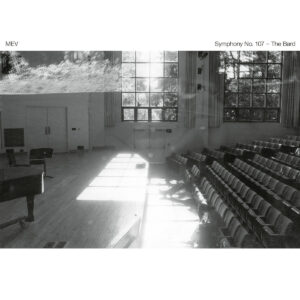
Symphony No. 107 –The Bard is a beautifully recorded example of the endlessly multi-layered later MEV sound, accompanied by new liner notes by Alvin Curran (now the only surviving member of the group) and a selection of previously unseen photographs from across the many decades of the group’s activity. Arriving in an elegant sleeve bearing a beautiful photograph by Francis Zhou of the Olin Hall at Bard College where the concert was recorded, this is an essential document from a major group in the history of experimental music. As Rzewski wrote, this music is ‘like life, unpredictable, sometimes making sense, mostly not’.
28,00€
In stock

LP
Jeanne LEE – Gunter HAMPEL – Michel WAISVISZ – Freddy GOSSEYE – Sven-Åke JOHANSSON
“Scheiße ’71”
Following on from the Bergisch-Brandenburgisches Quartett’s anarchic Live ’82 (BT095), Black Truffle continues its deep dive into the archives of legendary drummer/accordionist/photographer/composer/conceptual prankster Sven-Åke Johansson with Scheisse ’71. Recorded in November 1971 during the Berliner Jazztage at a heavy-hitting concert that also included the Spontaneous Music Ensemble and groups led by Peter Brötzmann, Manfred Schoof, and Masahiko Sato, Scheisse ’71 is the only document of a wild, otherwise unrecorded quintet featuring Johansson on drums, accordion and oboe d’amore, legendary free jazz vocalist Jeanne Lee, her husband Gunter Hampel on vibes, flute and bass clarinet, live electronics pioneer Michael Waisvisz on modified Putney (VCS 3) synthesizer, and the unknown Freddy Gosseye on electric bass. Part of a festival centred on giants of jazz like Duke Ellignton and Dizzy Gillespie, the radical performance shocked its audience, who can be heard heckling and yelling abuse at points, including the titular exclamation of ‘Scheiße!’
Clocking at just over half an hour and recorded in raw but detailed stereo by Johansson himself, the music burns with intensity while also making room for spacious passages and frequent dynamic movement. Beginning with Lee’s voice, Hampel on flute and Johansson on oboe d’amore in a bird-like game of call and response, the unexpected entry of Waisvisz’s tortured, squelching synth bursts prompts the first of many changes in energy and instrumentation, as Gosseye’s busy, roving bass enters and Johansson moves to the kit, his swinging cymbal work and juddering toms extending the approach of Sunny Murray or early Milford Graves.
The presence of synthesizer, electric bass, and Lee’s highly amplified voice moves the quintet away from conventional free jazz textures, at times pushing into zones of abstract free sound reminiscent of what groups like MEV, AMM or Johansson’s MND were exploring in the same years. But the energy and joyful melodicism of the music keep it rooted in the tradition of American fire music and its European inheritors. Capable of changing gears in an instant from ferocious blow outs to fragile tapestries of chiming vibes and fizzing synth, the music finds space for Lee’s post-bop free scat (which integrates shrieks and howls just as a post-Ayler saxophonist might), Gosseye’s virtuosic bass runs (a rare attempt to apply the classic free jazz style of players like Alan Silva or Henry Grimes to the electric instrument), Johansson’s folkish accordion interjections, and even a sustained passage of unison bass clarinet and electric bass riffing in its second half.
Special mention should be made of Waisvisz’s Putney performance, one of the earliest documents of this under-recorded instrument inventor and player, here playing a major role in giving the music its wildly exploratory, primordial air, his buzzing glissandi and bubbling filter sweeps at times howling like a distressed monkey. Arriving in an austerely stylish sleeve with beautiful black and white photographs by Johansson, Scheisse ’71 is an essential recording that adds yet another layer to our appreciation of this golden era of radical free music.
25,50€
In stock

LP
Peter KNIGHT
“Shadow Phase”
From Peter Knight
Most of this record was created in the shadow of COVID and deep in the maw of Melbourne’s 2020 long winter lockdown. It is a meditation on the nature of connection.
Restricted to a 5km zone, one of the only people I saw outside my family during this time was my old friend and teacher, Ania Walwicz. We met in the overlap between our zones on the waterfront near Docklands to walk and talk on bright, cool winter afternoons.
Those conversations became large in my thoughts when Ania suddenly passed away in September. Her voice was in my head as I worked on this music, trawling through threads of ideas, recordings made on my phone, and thoughts jotted down in notebooks.
Ania’s practice as a writer relied on ‘automatic’ processes. Her work was informed by everything she had read (a lot) but it was created in the manner of dreams. In a state where the subconscious might bubble up and the words arrange themselves into meaning bearing forms that resonate more than represent.
I thought a lot about that as I made this music. I recorded everyday using the trumpet, my old Revox reel-to-reel, a couple of synths, a harmonium I lent from a friend, and whatever else was around. I worked mostly on just diving a little deeper each time I sat down to it.
Through the simple process of exhalation, I explored my relationship with the trumpet, which has been through so many twists and turns. I let the tones produced by my breath unfurl on long tape loops and degrade beyond recognition through pedal and plugin chains, until the only imprint of the initial gesture remained.
My process also involved long bike rides during which I’d listen to the work of previous days on ear buds, gliding through familiar streets made slightly strange by the absence of people and movement. Often my rides took me along Footscray Rd next to the port, and as I washed down towards Docklands past the old boat moorings I stopped pedalling to coast. The sounds from my darkened studio mingled with the low rush of air past my helmet, the click and whirr of my bike gears, a squalling bird, a whooshing car. And I remembered my last conversation with Ania. Sitting in the late afternoon sun, squinting against the light that raked across the water, she was telling me about all the different words for they have for blue in Polish and Russian, and how words don’t just change our perception of things, but also actually change the thing being perceived.
As I rode home that afternoon, I felt like anything was possible.
Peter Knight - trumpet, voice, synthesisers, laptop electronics, Revox B77 reel-to-reel
Fia Fiell - synthesiser (Eunoia)
Jacques Emery - bass (The Softened Shore)
Katherine Philp - cello (The Softened Shore)
Rachael Kim - violin (The Softened Shore)
Tamara Saulwick - whispered voice (The Softened Shore)
Tony Buck - percussion (Shadow Phase)
Ania Walwicz - spoken voice
24,00€
In stock

LP
Natalie BERIDZE
“Of Which One Knows”
From Natalie Beridze
“Of Which One Knows”, was written and produced between 2007-2021.
Such unreleased material is a quintessential backdrop to an artist’s processes, as it has obviously never landed in any full bodies of work. It does however gain humble significance, which feels approachable, which is about absence and hence always fresh, drifting somewhere between remembrance and obliviousness.
I see sound in smells, maps and mischievously put random words in poems, as they provoke pivotal subconscious algorithms in me.
Every blissful moment of the divine process of music-making, that goes back to a sacred process of a child at play - a burning response to the intensity of the neigh to invisible blueness of half-formed ice.
The span of time for this music reminds me of my Dad’s studio. Infinite thick wooden drawers that crackle clack, bounce clatter, peal, rattle the same way as before. There is no decay crumbling, perishing or rot in the objects inside. Clippers, liner pens, tracing paper, cutters for grown-ups, unused razors and their tiny spare blade packs, tapes, compasses, leather and metal roll meters, are all intact. Random snapshots, outdated student ids and driving licenses in leather sliders, letters, postmarks, piled up separately in intense small section drawers. All’s in perfect order. All intact.
Layouts, house models with tiny tables and chairs and swimming pools with people inside, others by the fireplace, some holding cocktails, others reading books- are very dusty, smelling of glue and cardboard, all intact. Some stacked one on top of another, others unfinished on the modelling table under the stained swinging arm desk lamp.
24,00€
In stock

LP
Chris ABRAHAMS
“Follower”
On the opening track, Costume, bass piano meanders through a wilderness of de-tuned bells and organ swells; a strange sort of festival. Low frequency sighs evenly punctuate, like a pump or a heartbeat. It’s a procession that takes it time as it wanders the terrain, brought to a close with transcendent distortion. On track 2, New Kind of Border, muscular modal piano surfs among waves of percussion and analogue synthesisers. A buffeting travel.
Follower is Abrahams’ 6th album for Room 40 and showcases his continuing interest in the ambiguous spaces between music and noise; tonality and atonality; rhythm and texture. All four tracks have piano as a key factor: in one instance, high-pitched and atonal; in another, emotive yet distant as if projected on to a screen. Follower presents the listener with a sound world of colourful juxtapositions, rich orchestration and organically open forms.
24,00€
In stock

LP
Thierry MONNIER – Bruce RUSSELL
“Les Français sont les ennemis du Pacifique”
1.
Together with Thierry, just before his departure, we, some of his close friends, decided to realise this record. A promise and a desire to be able to listen to these electric exchanges engraved on vinyl. This record was made possible thanks to a subscription and various donations. Any profits from sales will be donated to 102 rue d'Alembert in Grenoble.
2.
For many he was the person at the other end of the phone or email at Metamkine’s. For others he was the voice of experimental music on Radio Campus and an imaginative, considerate and tenacious programmer at Le 102 in Grenoble. He also was this diligent companion with whom to attend festivals, share enthusiasm about a performance, or the beer and conversation we’d rather have during the next one. He additionally was the hands and brains of Doubtful Sounds, the catalogue of which label demonstrates the highest of eclectic standards, the will to support comrade artists to the further end of their experimentations, and an authentic passion for the record medium. Lastly, he was of course one of the two guitars of Sun Stabbed, a member of La Morte Young, and a solo artist we would not have mind getting more performances and record releases from. In those, he was exploring the possibilities of the prepared guitar with modesty and an infinite patience, occasionally combining it with dictaphone or Revox-size magnetic tape.
[…]
While he would appear as an indoorsy creature, Thierry had developed a passion for New-Zealand that fed off a combine taste for geography, anthropology, and the very distinctive manner of handling guitars that a handful of experimenters have developed since the 1990s. This other side of the world had become the destination of some of his travels, and Bruce Russell (The Dead C), Michael Morley (The Dead C, Gate) or Stefan Neville (Pumice) some of his friends, with whom to spend some time, share an improvisation, or work on a record project.
[…]
For all of us who were around until the end, these notes and gritty vibrations sound even stranger. They resonate with the serenity and temperance with which he was able to reassure us even more than we were able to support him. They resonate with his curiosity and his ability to pick up significance in the detail of a sound, a sentence, or a landscape, against the vast inanity of the world. Thierry had dedicated a lot of his life, attention, and intelligence to music, but he knew, in the end, that music is not that important. Thierry had chosen music as a way of making his own way, building friendships, keeping away from the thickheadedness and lack of imagination of a failing capitalist society. Thierry had chosen guitar against the macho and egotistic postures, just to share his wonderment when a little (or a lot) of electric magic gets out of it. I believe he would have appreciated that some of his relation to life would be seen in his relation to the instrument.
Poroporoaki, Teremoana.
Pali Meursault
(Profile published in Revue & Corrigée #122, September 2022)
3.
Thierry loved New Zealand, and even seemed to find New Zealanders pretty agreeable. Although we first met in France, I'd seen him in NZ a couple of times, so when he suggested we use his summer 2020 visit to record some material it seemed like a nice plan. Of course I had no idea what was ahead. The recording was done in the new sleep-out/studio we had recently finished in the back yard, a simple process that took about an hour. Thierry had to get to grips with the amplifier I lent him, which was not quite what he was used to, but I thought he got some great sounds out of it in the end. After he left for the North Island, COVID suddenly became a massive problem, and he was very lucky to get home before we locked up the whole country for months. But then he got sick again with something much worse than COVID, and it turned out that these sessions were actually a memorial to his last visit to the Antipodes. An entirely fitting memorial to a great friend of New Zealand, and I'm proud to say, a friend of mine too.
Bruce Russell, Lyttelton, Easter 2023
18,00€
Out of stock

LP
Mark VERNON
“Call Back Carousel” [!!damaged cover!!]
Pochette abimée avec au minimum 2 coins pliés (emballage médiocre du label).
Damaged cover with at least 2 corners bumped / folded (poor packaging from the label).
***** “This device isn’t a spaceship, it’s a time machine. It goes backwards, and forwards... it takes us to a place where we ache to go again. It’s not called the wheel, it’s called the carousel. It lets us travel the way a child travels - around and around, and back home again, to a place where we know we are loved.” (Don Draper) Call Back Carousel is an audio time-travelogue, a slideshow of the mind’s eye - projecting Kodachrome memories directly into the listener’s mind by means of sound alone. It is a way of travelling without ever having to leave the home. A vicarious vacation for the imagination. Pure audio escapism. Each episode is based on a found tape of a pre-recorded slideshow commentary. Most of these tapes were made by amateur tape recording enthusiasts and hobbyist photographers of the 60s and 70s. Their recorded commentaries would at one time have been used in conjunction with a sequence of 35mm slides but only the taped voices now remain. The recordings themselves come from Vernon’s own archive of found reel-to-reel tapes that he has collected over the past twenty years. Using these found slideshow commentaries as a framework, a series of musical soundscapes have been created to bring the absent images to life, activating the listeners’ imagination in the classic tradition of ‘cinema for the ears’. It’s a little like looking through a family photo album where only the hand written captions and moun1ng corners remain; the photographs themselves have all been removed. The evocative rattle and clack of the projector shuffles through different slides as the fragile voices of our tour guides accompany us on a sonic journey that fractures time - and through the cracks, the past bleeds through into our present.
Original price was: 23,00€.8,00€Current price is: 8,00€.
In stock

2 LP book
COMPILATION
“Fluxus & NeoFluxus: Stolen Symphony (Part I)”
Double LP version. Gatefold sleeve; includes 24-page large booklet. All in all, there are more than 50 pieces, new and old, live and studio, finished pieces and scores to be performed, acoustic and classical, solos and pieces for ensemble, using classical and special instruments. This Fluxus edition features (in alphabetical order): Eric Andersen, Ay-O, George Brecht, John Cage, Giancarlo Cardini, Giuseppe Chiari, Henning Christiansen, Philip Corner, Öyvind Fahlström, Ken Friedman, Sten Hanson, Geoffrey Hendricks, Toshi Ichiyanagi, Joe Jones, Bengt af Klintberg, Milan Knízák, Alison Knowles, Larry Miller, George Maciunas, Sara Miyamoto, Nam June Paik, Yoko Ono, Opening Performance Orchestra, Benjamin Patterson, Josef Anton Riedl, Terry Riley, Takako Saito, Tomas Schmit, Dieter Schnebel, Mieko Shiomi, Yasunao Tone, Ben Vautier, Yoshi Wada, and La Monte Young. The musicians and performers Anna Clementi, Agnese Toniutti, Deborah Walker, Werner Durand, Luciano Chessa, Miroslav Beinhauer, Petr Bakla, Nicolas Horvath, Petr Ferenc, and Premysl Ondra have played, performed and declaimed the Fluxus pieces, Arditti Quartet and S.E.M. Ensemble provided one piece from their archives. Milan Knízák, Petr Rezek, Petr Kotík, Olaf Hanel, Eric Andersen, Per Brunskog, Peter van der Meijden, Pavlína Morganová, Natasha Lushetich, Joseph Nechvatal, Natilee Harren, Martin Patrick, Diedrich Diederichsen, Christopher M. Reeves, and Hubertus von Amelunxen have written Fluxus-themed texts. Archivio Conz in Berlin provided access to their extensive Fluxus archives and Edizioni Conz provided coproduction. Ursula and René Block made possible the realization of John Cage's historical composition "Rozart Mix" from the Edition Block archive. The photographic material comes from Marie Knízáková and Milan Knízák's private archive, the German photographer Wolfgang Träger, Archivio Conz's Fluxus archive and Opening Performance Orchestra's digital archive. The cover themes are paintings by Milan Knízák, while the graphic design is the work of Jaroslav Buzek.
27,00€
In stock

LP
HASTINGS OF MALAWI
“Choreological Exchanges”
Recorded at the height of the global pandemic, and at a time when remote communication was becoming increasingly prevalent, Choreological Exchanges is part of Hastings Of Malawi's continuing investigations into the medium of communication itself. Prior to telephony becoming digital, all phone calls were routed through mechanical telephone exchanges, and the majority of the sounds on side one are the sounds of these exchanges and some of the voices of the engineers who worked with them. Hastings Of Malawi make strange records and this one is no exception although it has a more linear narrative structure in opposition to what critics have described as their Dadaist approach. Their records certainly resist genre classification and do not really fall into the category of music. Hastings Of Malawi have themselves described previous records as films without light, radio plays and as poems. This one is a dance -- a dance that takes place within the chain, or pipe, that is brain -- mouth -- telephone -- telephone exchange -- telephone -- ear -- brain.
16,00€
In stock

LP
THE DWARFS OF EAST AGOUZA
“High Tide in the Lowlands”
Hailing from the Agouza district of Cairo, Egypt, this brilliant trio consists of Alan Bishop (acoustic bass, vocals, alto sax), Maurice Louca (keyboards, drum machine), and Sam Shalabi (electric guitar). Born in 2012 when the three were living in the same apartment building in Cairo's Agouza district, the trio's instrumental improvisation-based explorations are propelled by Louca's North African percussion loops and shimmering keys, Shalabi's West African tinged free jazz guitar and grounded by Bishop's driving Krautrock-style acoustic bass. High Tide in the Lowlands was recorded in Brussels at Les Ateliers Claus on September 5, 2017 and is quite an intense experience. Most performances and recording sessions are improvised and this set is no different and even though the group opened the show with "Baka of the Future" from their first album Bes, it is almost unrecognizable and everything the trio plays is continually morphing into the next unknown idea. As the sound, energy, and instantaneous composition flows, the trance is growing and growing, ranging from raw shapeshifting "no (un)wave", free jazz, traditional Arabic, and modern experimental explorations to a concrete mystic trip from a universe expanding and contracting constantly. This is earth interrogating the sky, the sky rejoining the earth, an unknown and unwritten cosmogony.
Maurice Louca is an Egyptian musician and composer born in Cairo where he lives and works. As well as being the co-founder of the bands Bikya, Alif, and Lekhfa, Louca lends his sound to numerous other projects, composing for theatre, film, dance and contemporary art. Previous releases on Sub Rosa: Elephantine (SR 474LP), Saet El-Hazz (SR 519LP). Alan Bishop is a founding member of Phoenix/Seattle avant-garde trio Sun City Girls, who, for 27 years, explored the outer reaches of improvisation and composition (from free jazz/post rock psychedelic, and sound collage to outernational Arabic and Asian inspired folk music). As founder of the Sublime Frequencies record label, Bishop has released over 100 records, introducing previously ignored musical genres from Asia, the Middle East, and Africa. Sam Shalabi is a prolific Egyptian-Canadian composer and improviser living between Montreal, Quebec and Cairo, Egypt. As the founder of Land of Kush, Shalabi Effect, and many other projects, he began with punk rock in the late '70s and his work has evolved into a fusion of experimental music that incorporates modern/traditional Arabic, shaabi, noise, and classical music with spoken word, free improvisation and jazz.
16,00€
In stock

2 LP
DEDALUS ENSEMBLE
“Brian Eno Performed by Dedalus Ensemble”
Double LP version. With Discreet Music (1975), Music for Airports (1978), and Thursday Afternoon (1985), Brian Eno invented a new music genre, ambient music, which he defined as "able to accommodate many levels of listening attention without enforcing one in particular; it must be as ignorable as it is interesting." These versions performed and arranged by Dedalus Ensemble, according to the musicians and the critics who listened to it, goes beyond what you expect from it. A mental base that takes you far away. One of the only music without beginning or end in which we want to stay as long as possible.
Dedalus Ensemble: Founded in 1996 by Didier Aschour, Dedalus is a contemporary music ensemble based in Toulouse. Its repertoire includes works by classics of minimalism: Christian Wolff, Phill Niblock, Frederic Rzewski, Tom Johnson, Moondog, or Philip Glass. Personnel: Didier Aschour - guitar, arrangements and artistic direction; Denis Chouillet - piano; Amélie Berson - flute; Fabrice Villard - clarinet; Pierre-Stéphane Meugé - saxophone; Christian Pruvost - trumpet; Thierry Madiot - trombone; Silvia Tarozzi - violin; Cyprien Busolini - viola; Deborah Walker - cello; Eric Chalan - double bass, vibraphone.
Inspired by Erik Satie's furniture music, Cage's indeterminacy and La Monte Young's drones, Eno's series of compositions were based on strict formal protocols bringing the listener into an enthralling world of sounds. Brian Eno was widely seen as a pioneering and influential figure of popular music and worked with icons of pop culture such as David Bowie, U2, etc.
20,00€
In stock

LP
PUCE MOMENT
“Epic Ellipses”
Puce Moment is part of the French contemporary music scene. Their music is climatic, often inhabited by a strong emotional power. A procession of harmonic structures organized in a ritual way, sometimes close to trance. It can be written or improvised, vocal or instrumental. The electronic and electroacoustic arrangements summon new spaces and abstract landscapes, which can go from the purest sound to the rawest distortions. Vast, slower, deeper -- distant echoes of half-faded things -- and when you are lost, voices appear. Voices whose only reference would be the timeless SeeFeel. Nicolas Devos and Pénélope Michel are visual and sound artists, one trained at the Beaux-Arts and the Fresnoy studio national des arts contemporains and the other a classically trained cellist, singer, and multi-instrumentalist. They created Puce Moment, envisaged as a sound research laboratory open to experimentation, to multi-disciplinary encounters and to decompartmentalization. Their work is akin to a fictional ethnology expressed through protean projects and mutant visual, sound and musical creations. Epic Ellipses is their fourth album. They have composed the original soundtracks of more than a dozen dance performance, fiction or documentary films, virtual reality in variable formats (Christian Rizzo, Mylène Benoit, Vania Vaneau, Benjamin Nuel, Laurent Pernot, Carolina Gonçalves). Or in the form of film-concerts including David Lynch's cult film Eraserhead with which they have toured intensively since 2012 in France and Europe, and since 2019 Koyaanisqatsi, the cult experimental documentary by Godfrey Reggio.
16,00€
In stock

2 LP
Julius EASTMAN
“Femenine”
In 2016, frozen reeds published the première release of Julius Eastman’s Femenine, for chamber ensemble. Laying unheard for decades prior, the release documented a 1974 performance by the S.E.M. Ensemble with the composer himself on piano.
It is now available on vinyl for the first time, in a revelatory new remaster by Jim O’Rourke.
The first release of Femenine served as the catalyst that propelled Eastman’s music into the mainstream. Articles on Eastman’s music and its immediate disruptive impact on the classical canon began to appear in every major news organ in the English-speaking world and beyond. His music began to be programmed in major concerts and festivals, several of these entirely themed around his life and work. New recordings sprang up from a fresh generation of musicians engaging with his ideas and interpreting them for a modern audience hungry to hear more.
But the raw, emotionally cascading spirit of the original performance continues to inspire listeners. Joyous, insistent, and immersive, Femenine bathes the listener in surges of tonal colour from intertwining winds, piano, violin, pitched percussion, synthesizer and – uniquely – the composer’s own invention of mechanised sleigh bells, which provide the 72-minute piece with its characteristic pulse.
Femenine was recorded live by Steve Cellum – co-producer of Arthur Russell’s World of Echo – and the new vinyl reissue has been remastered from the original high-definition tape transfer by Jim O’Rourke at his Steamroom studio in the Japanese mountains.
Illuminating sleeve notes are provided by composer and author Mary Jane Leach, key figure of the Eastman revival and co-editor of the Gay Guerrilla collection of essays on his life and music.
35,00€
In stock

LP
Arthur PETRONIO
“Arthur Petronio”
Arthur Petronio:
Born Switzerland 1897.
French-Italian musician, poet and painter.
Lived in Belgium and The Netherlands between 1910 and 1924 and since then in France.
Young violin virtuoso studying with Belgian master violinist Eugène Ysaÿe.
Played solo violin for Belgian King Leopold II, at the age of 9.
Attracted to the avant-garde and visionary ideas of Gesamtkunstwerk.
Develops and presents his “Verbophonie” in 1919, integrating sound poetry into regular music scores.
Friend with Kandinsky, Mondrian, Cocteau and Picasso.
Published several avant-garde journals and poetry books with participation of like minded artists.
Wrote many scores for solo instruments, small ensembles, orchestral works, opera,…
Met Henri Chopin in 1950 and extended his musical ideas with new possibilities of tape composition.
His one and only LP, now reissued by Metaphon, was originally published by the Belgian Igloo label in 1979.
An extravagant DIY montage of musique concrète and sound poetry.
In addition to Petronio’s voice several female readers/performers contribute to this theatre of voices as guest vocalists.
An album as unusual as his lifecycle.
25,00€
Out of stock

LP
SISTER IODINE
“Hollozone”
Paris Noise chiefs, Sister Iodine, return with "Hollozone". Their seventhalbum and second on Nashazphone following the 2018's Double Album, "Venom".
Erik Minkkinen, Lionel Fernandez, and Nicolas Mazet have represented the cutting edge and vanguard of French Noise since the nineties and yet remain as radical and uncompromisingas ever. With "Hollozone", the group manages to confirm the sound and spirit intensity which perfectly embodies their unique world of controlled chaos.
It is with the advent of the 21st century -more than ever -that the decisive path of Sister Iodine has taken a fascinating route.From their debut album, ADN115, released in 1994 which was strongly influenced by the original New York No Wave scene (Mars,DNA, Red Transistor) to their more recent works which have beenaugmented by "newer poisons" such as Black Metal, or the mostabrasive end of Industrial Music and Power Electronics, or Experimental Electronics (Editions Mego has reissued anextended version of "Flame Desastre" on CD), the band has managed to survive through the decades,from theinhospitable French squats of the nineties to nowadays’ established venues and proper tours. Today, the band’s music has changed recipients and has attracted younger generations with their organized radioactive chaos while never conceding anything fromtheir initial intensity. Over the years, Sister Iodine wouldhave also created their own idiosyncratic language, for which soundexploration matters and pure beauty seem to count as much as pure explosive ferocity, while intense violence and energy getsdeployed in live shows.
The last few years witnessed an increasing number of collaborations such as the recent sessions with Meyhna'ch (Mütiilation) orthe ones with Masaya Nakahara (Violent Onsen Geisha / Hair Stylistics). "Hollozone" offers a track featuring the vocalcontribution of Stephen Bessac, the deviant front manof the cult French hardcore band Kickback. Sister Iodine produces today a music that is actually unique and unheard anywhere else. One of eternal youth and audacity.
24,00€
In stock

LP
Andrea BORGHI
“Palsecam”
True to form, Borghi works directly with VHS tapes and the apparatus that plays them, manipulating the exposed mechanisms with the care and curiosity of a dedicated scientist. Drawing from these manual manipulations, Borghi's experiments combine mechanical sounds with mangled tape samples to inspire a mechanised nostalgia inseparably hybridised with human trace. Unlike others who work with old film, he resists the eerie to focus on the intricate crunch and buzz, an electro-acoustic soundscape tangentially related to the field recordings. By highlighting the precise moment that recorded media becomes perceived, a restless, shifting mass of both familiar and unrecognisable sounds results in a unique form of otic chiaroscuro. The result is a complication of inside and outside sounds: distant, gesturing snippets of semi-remembered, half-imagined films compete with TV cathode burn, tracking stutters, mechanical interference, and vérité whirrs and clicks that could only come from that original reproducer of dreams, the VHS player. With Palsecam Borghi gives dignity to an often maligned format, in an engaging mélange that represents the recovery of an object discarded as an objet d'art.
Composed and recorded by Andrea Borghi : VHS, contact microphones, computer.
Mastered by Giuseppe Ielasi. Lacquer cut by Kassian Troyer at D&M, Berlin.
20,00€
In stock

LP
Angélica CASTELLÓ
“Catorce reflexiones sobre el fin”
Catorce reflexiones sobre el fin (Fourteen Reflections On The End) originated from an installation exhibited at the Museo de Arte Contemporáneo de Oaxaca, Mexico, in 2019. Fourteen magnetic bodies of tape that dialogued with the fourteen pieces of electroacoustic music now contained in this album composed from the sound anthology of Angélica Castelló. Thus, Catorce reflexiones sobre el fin is a complex piece consisting of multiple parts that, although articulated with each other, hold a life of their own.
Like every body, these have a unique history made up of mixed fragments spun by Angélica, ranging from field recordings, references, and self-references to previous pieces, experiences, and voice recordings made specifically for these compositions re-recorded in various formats, from lo to high fidelity, analog and digital, composed, decomposed and recomposed (Castelló, A., 2019). Likewise, as any body, they also reflect on their end, whether absolute or temporal, of the many ways of being finite and of saying goodbye.
During the Catorce reflexiones sobre el fin, Castelló takes you on a journey that is difficult to locate. An ethereal space between shattered glass, stridulation of cicadas, war drums, murmurs in French, Italian maledictions, and soft recitations in Spanish. From uproar to solace, all wrapped in a soft abstraction that only allows access to the subtle whisper of these expressions. A gesture between invitation and sharing because who does not recognize oneself in this emotional storm?
20,00€
In stock

LP
Kevin DRUMM
“Battering Rams”
From the viscerally punishing and nerve wrecking, to the wistfully sublime, Kevin Drumm ‘s work often yield a ferocious intensity through the timbres of minute details. Now, throughout this series of archival works dating from 2000 to 2022, his mastery is once again on full display.
On »Battering Rams«, sinister forces interlope with sanguine glimmers of respite and contemplation, while recurring drones ceaselessly crescendo to near paralysing effect, only for the albums final moments to offer a lofty reprise of boundless oscillation, dispelling all the pent up tension into a sanguine state of bliss. Once again underpinning Drums’ genius of turning apparently trivial hums into elongated microtonal worlds that stay etched deeply in your conscious, often long after the works final resonances have already subsided.
22,50€
Out of stock

LP
Dafne VICENTE-SANDOVAL / Lars Petter HAGEN
“Minos Circuit / Transfiguration 4”
DAFNE VICENTE-SANDOVAL - MINOS CIRCUIT (2021)
Minos Circuit is the resonance of a double exploration, that of an instrument, the bassoon - an instrument dear to Dafne Vicente-Sandoval - and that of a listening, of a gaze, almost. The first exploration deconstructs the instrument, tearing it apart, reducing it to an archipelago of sound bodies stimulated by an electro-acoustic device that generates feedback and infiltrates each part of the bassoon, in order to carry out a methodical, systematic examination. The second exploration is the inner one of attention and listening, the one that measures, at each moment, the necessity or not of an intervention in the very act of the musical work, of this subtle balance that is established between composition and observation, between action and contemplation.
LARS PETTER HAGEN - TRANSFIGURATION 4 (2018)
Both a “meditation on musical ruins” and “a study of the material of Richard Strauss’s Metamorphoses”, Transfiguration 4 works on the musical fragment as an expressive and poetic possibility that can be deployed below or beyond simple musical syntax, a syntax that is still too often equated with music itself. What Lars Petter Hagen highlights in this remarkable work is that the power of music lies at its fringes, that is, at the edge of its own disappearance. Transfiguration 4 floats in a particularly moving way in these troubled lands, where nothing is ever resolved, and where everything, however, is suspended, like a stream of blurred memories that memory would summon to form an intuition. A musical intuition.
21,00€
Out of stock

LP
Eve ABOULKHEIR / Lasse MARHAUG
“22/12/2017 Guilin Synthetic Daydream / How to Avoid Ants”
EVE ABOULKHEIR - 22/12/2017 GUILIN SYNTHETIC DAYDREAM (2021)
22/12/2017 Guilin Synthetic Daydream is a perceptual trap. Inspired by an experience of intense perceptive disorientation while crossing a market in China, Eve Aboulkheir reinstantiates, in the field of sounds, the swirling and anamorphic universe of thwarted perceptions, surrounding multitudes and shifted sensations. She thus constructs a dreamlike and artificial universe, suspended and hyperactive, which is both an electronic vortex sucking us in and a mechanical ballet developing its arabesques around us, caught and fascinated by these volutes of sound that fracture like a kaleidoscope in which our eyes-ears are immersed. 22/12/2017 Guilin Synthetic Daydream approaches the musical form in the most direct way possible, i.e. through its effects and its empire on our sensorium.
LASSE MARHAUG - HOW TO AVOID ANTS (2020)
Using concrète techniques to collect, transform and assemble sounds of various origins (sounds of tree branches, leaves, but also guitars or synthesizers), Lasse Marhaug elaborates a dense and subterranean work, which unfolds through the multiple dimensions induced by the great diversity of its sound material. There is a labyrinthine feeling in this work, a feeling that is better understood when the inspiration for the title of the piece How to avoid ants is revealed, a very practical and then poetic undertaking, that of avoiding the anthills lining the path to the forest camp in the kindergarten to which his little girl, who was then frightened of insects, was going. It is such an activity of circumvention, diversion and byways that Lasse Marhaug uses to create an exploratory and evasive music.
21,00€
In stock

LP
Jan JELINEK
“SEASCAPE – polyptych”
One of the most notorious hatemongers in movie history is Captain Ahab from John Huston’s 1956 classic Moby Dick. His manic monologues cast a spell on generations of viewers. Berlin based musician and sound artist Jan Jelinek has now turned the voice of Ahab into a musical instrument.
Faitiche presents Jan Jelinek's soundtrack for SEASCAPE – polyptych, an audio-visual software developed in collaboration with Canadian new media artist Clive Holden in 2022.
SEASCAPE – polyptych is based on image and acoustic source material from Moby Dick. While Holden works on manipulating film sequences, the voice of Ahab plays a central role in Jan Jelinek’s soundtrack. The dynamic volume and tone of the captain's speech control a synthesizer system that turns Ahabs voice into ten abstract soundscapes.
In this production the voice gives the impulse and controls things but is not the sound of spoken word itself that we hear. Only occasionally can snippets of speech be heard so that syllables or sounds are recognisable. Instead we hear compositions made of hissing, soundscapes and eruptive sounds. The atmosphere is dark and sinister. Still every piece has a clear sonic structure and follows an understandable dramatic composition. This music is abstract but not overwhelming. Quite the opposite, SEASCAPE – polyptych is an invitation to listeners to let themselves be carried by the stream of sonic events. Although part of a media art work, the soundtrack can be enjoyed without any of this connecting superstructure. It works with no previous knowledge. But what happens when one does know that it’s the sonic waves of a human voice that is controlling a network of synthesizers?
If you want to hear Ahab, you will hear a choir of Ahabs in every piece of sound. The subliminal threatening as well as the conjuring Ahab. Finally the Ahab who whips up his crew and tears them with him into their downfall. The majestic „on the quay now, waiting and watching“, the oppressive “drawn towards the whirlpools center” - they are all music as well as sonic discourse.
23,50€
In stock

LP
MURMER
“Tether”
Murmer is the long-standing project for Estonian field recordist and composer Patrick McGinley, and in Tether, The Helen Scarsdale Agency welcomes Murmer back to our roster, over a decade since he graced us with his last production for the Agency. His field recordings often center upon the amplification and activation of resonance from a particular space, landscape, or object. Such sounds emerge from a condition as begin fleeting, inconsequential, or ephemeral and explode into that which alien, sublime, and profound. Here lies the tremendous prowess of the contact microphone, as wielded by an accomplished musician! The source material cited by McGinley includes cables, fences, wires, and vents.
There is a heft to many of these sounds as heard throughout all of "Taevast" with deep throbbing pulsations from arctic wind generating subharmonic patterns upon thick high-tension wires. Elsewhere the subtle dissonance from a rasping cooling fan blooms into a brooding ambience that is sublimely rich in its metallic timbres and complex reverberations. McGingley has long been an exemplary artist in the field of phonography even as he is less prolific than others. On Tether, he has produced a majestic if occasionally foreboding work on par with the mythic wire recordings of Alan Lamb, Jacob Kirkegaard's haunted resonance from Chernobyl, and much of the Touch catalogue for that matter!
26,00€
In stock

LP
Giuseppe IELASI
“Down On Darkened Meetings”
Black Truffle is pleased to announce Down On Darkened Meetings, the first solo release on the label from the quietly prolific Giuseppe Ielasi. Recorded at Ielasi’s studio in Monza outside of Milan over two days in February 2022, the seven pieces presented here continue the renewed exploration of the guitar that marks much of his solo work over the last few years. Emerging in the late 1990s as an improviser working primarily with prepared acoustic and electric guitars, the instrument became less prominent in his work over the next decade, ceding to loop-based constructs that would eventually split into abstracted takes on club music and hip-hop (including his work as Inventing Masks), on the one hand, and spectral electroacoustic explorations (such as the stunning triple disc 3 pauses), on the other. Returning to the guitar in recent years, he has approached the instrument as a source of shimmering metallic glissandi (Five Wooden Frames) or as the vehicle of elegiac double-tracked lines that feel almost like Frisell playing Feldman (The Prospect). Here the focus is on electric guitar filtered, looped, and splayed out into fields of irregular echoes through a bank of pedals.
Like many of Ielasi’s releases, Down On Darkened Meetings is structured as a set of short untitled pieces (here ranging between two and six minutes in length) that single-mindedly explore a single instrument or source throughout. The opening track immediately introduced the distinctive timbral world of fizzing, heavily filtered tones, chiming harmonics, and woozy looping bass figures inhabited throughout. At points it becomes near impossible to trace these sounds to the strings of an electric guitar; at others, as on the final two pieces, the instrument is unmistakable, as Ielasi builds up his shifting loops from snatches of almost unintentional sounding half-playing that give these closing tracks a hushed, private atmosphere reminiscent of Tolerance’s Anonym. While the repeating chords and hanging melodic figures present on many tracks call to mind earlier Ielasi classics like Gesine and Untitled, here the music feels less meticulously constructed than played: Ielasi’s lyrical guitar lines obscured by a battery of effects at times come across like a dilated take on the outer-fringe fretwork of improvisers like Henry Kaiser and Raymond Boni, and the muddy, asynchronous fields of pops and hiss at times wander into areas reminiscent of the hand-played dub techno of Vladislav Delay’s Multila.
Like much of Ielasi’s work in recent years, these seven pieces perform a delicate balancing act: between abstraction and immediacy, austerity and abundance. Imbued with Ielasi’s distinctive lightness of touch, considered approach to pacing, and subtly psychedelic approach to the stereo field, Down on Darkened Meetings is a major new work from a quiet master of contemporary experimental music.
25,00€
In stock

LP
Richard YOUNGS
“Modern Sorrow”
The endlessly prolific and unpredictable Richard Youngs returns to Black Truffle with Modern Sorrow. As any Youngs fan knows, one of the great pleasures of following his career comes from not being able to predict what the next entry in his inexhaustible string of releases will bring: Unaccompanied voice? Country songs? Shakuhachi? Guitar pieces played with his feet? Shredding fuzz bass over the top of hyper-speed distorted drum machine beats? Continuing in the grand Youngs tradition of exploring new techniques, instrumentation and approaches while bringing to all of them his idiosyncratic touch, Modern Sorrow serves up two sides of twistedly elegiac, radically stark takes on contemporary pop production. The side-long title track is built from a piano sample, synthetic bass notes and organ swells, and an iterative blurt that seems to have wandered out of a 90s jungle track. Eventually joined by a shuffling drum machine, the track moves very slowly through a series of chords, each delayed long enough that its arrival comes as a major event. Over the top, Youngs’ heavily pitch-corrected voice is heard. The processing paints his signature wandering melodic improvisations with shades of contemporary R&B; at the same time, it cuts the natural swoops and glides of Youngs’ melodies into rapid microtonal trills, giving his voice a quavering, middle eastern feel. Unfolding languorously over more than 17 minutes, the piece’s final minutes make room for an extended drumless coda, returning to the stark palette of its opening moments. On the second side, the two parts of ‘Benevolence’ push this minimalism ever further, its first half consisting of nothing more than a remarkably slow drum machine hit, bass-heavy chords and pitch-corrected voice, here so heavily processed that it starts to resemble a shawn solo. In its second part, the harmonic foundation drops out from under the piece while two more voices join; at some moments the voices pause, leaving nothing more than isolated, metronomic drum hits. Though Youngs has explored the sound worlds associated with dance music and contemporary pop in previous work, here these elements are radically reduced, foregrounding a meditative bed of silence with a boldness equal to any more academically inclined contemporary composer. Embracing the accessible digital tools of contemporary music production just as at another moment he would pick up a kazoo, like much of Youngs’ work Modern Sorrow uses simple DIY tools to generous ends, producing formally radical music that remains both free from pretension and deeply moving.
25,00€