
In stock

LP
Klaus WIESE
“Baraka”
After his participation in a masterpiece such as Popol Vuh's Hosianna Mantra, in the early 1980s Klaus Wiese produced a series of seminal works in the field of ambient-drone and healing music. The first of these, Baraka, was released on tape by Acquamarin in 1981, and already contained all the aspects of his future research into the mysticism of sound. Wiese shares the path with other German explorers such as Hamel, Fricke, Micus, or Deuter, but he focuses his attention on the most essential nature of sounds, on their acoustic purity, which is always infinite spiral, vortex of frequencies and cosmic bath. It takes only a few means (zither, tampoura, cmybals, singing bowls) to reach the absolute through vibration. Like the archaic mood of a great universal harmony, the sound suggests a complete state of otherworldly meditation, an enveloping cloud of peace in the eternity of the present. The musician is only the one who distributes and directs the thickenings of ethereal matter, microtonal agglomerates, cascades of celestial harmonics and emotional floods, petals and stems of devotion.
Special mirroring/olographic cover. Edition of 300 copies.
21,50€
Out of stock

LP
Phill NIBLOCK
“Boston Tenor Index”
Phill Niblock "Boston / Tenor / Index", presents for the first time some of the earliest works by the American composer, inluding the three never before released "Index" (1969), "Tenor" and "Boston III" (both from 1972), thus making it possible to discover Niblock's starting point as a composer.
A filmmaker and photographer, Niblock began composing in the late 60s, while collaborating with the Judson Dance Theater in NY. As a composer his interest and field of research was connected to the layering of pre-recorded acoustic instruments into microtonal drones, which eventually led him to create some of the most unique tape collages in the second half of the 20th century minimal music. His earliest records, "Nothin To Look At Just A Record" and "Niblock For Celli / Celli Plays Niblock" were both issued by India Navigation in the first half of the 80s. Until now, it's been impossible to encounter Niblock's compositions from earlier than that period, a reality thankfully rectified by the long overdue publication of this "Boston / Tenor / Index" LP on alga marghen.
"Tenor" (1972) represents the first evolution of Niblock's musical thought towards the aesthetics of microtones, overtones, and drones which the composer would develop in following decades. The piece was recorded by the photographer Martin Bough on tenor saxophone and gradually dubbed back and forth by the composer in his New York studio. The sounds by the performer are submitted to the composer's techno-imaginative "acoustic optics" and deconstructed on behalf of structure, time and loudness. These specific aspects started to play an extremely important role in the artist's path as a composer.
The audio materials activated in "Tenor" through technologically de- and re-composed sounding textures, became a vehicle for those sound anomalies that would determine Niblock's audio poetics. Performing gestures are deconstructed though disseminating and editing processes by the imperceptible gestures of the composer. With its smooth flowing structure, "Boston III" (1972) stands at the very beginning of this illusion. It was recorded at the Intermedia Sound studio in Boston with Rhys Chatham (flute, voice), Martin Bough (tenor saxophone), Gregory Reeve (viola, voice); the composer himself also contributed with his voice. Using a 16-track Ampex tape recorder, at that time the world's newest recording device, Niblock was able to superimpose the recorded tones obtaining the desired aesthetic result which finally led him to a mesmerizing, immersive sound, a "very big, fat sound at fairly large volumes".
The LP also includes "Index" (1969), an improvised sound performance by the composer himself. The listener is lucky to listen to (and imagine) the movements of the artist's fingers hitting a guitar string and the soundboard in breathtaking tempo. The piece itself represents early minimalism in its virgin state, untouched by distancing technology. Persistent percussive rhythm and corresponding resonances are irregular, the finger beats suffer natural dysrhythmia. Niblock's way of playing is very muscular here. It is more devoted to pure sensuality than to an intelligible order. This music is inscribed in the performer's body, it is a "body in a state of music". Guitar (both its body and strings), fingers and fingering fuse in a vehement action around which barely listenable sounds and resonances vibrate. Considering the extended pulsation as an organic blend of impulse, rhythm, drive, strength, vitality and passion, the end of this sole solo in Niblock's complete oeuvre is not defined by the fixed duration of the piece but as the consequence of the tiredness of the performer.
As Niblock stated "This music is architectural. The intent is to fill the space. It's non-frontal music, non-proscenium space, anti-stage, not about an ensemble sitting in front of an audience, not about a single sound source. At least four speakers systems are desirable, arrayed around the periphery of the room, saturating the total space, engaging the air".
The music changes according to the loudness of playback. The interaction of the upper harmonics changes especially, with much richer overtone patterns being produced at louder levels.
21,50€
Out of stock

LP
Aldo CLEMENTI
“Collage”
Alga Marghen proudly presents the previously unreleased “Collage 2” and “Collage 3 (Dies irae)” for magnetic tape, both realised at the Studio di Fonologia Musicale RAI in Milan with the technical collaboration of Marino Zuccheri. These pieces are precious testimonials to Aldo Clementi’s intense and ongoing interest in electronic music in the 1960s. “Collage”, presents some of the most extreme musics ever issued by the label, at the same level as Robert Ashley's “Wolfman”, Max Neuhaus' “Fontana-Mix Feed” or Philip Corner's “Oracle”. Representing an entirely singular sound and approach to tape music that was unique to Clementi alone, once again Alga Marghen has cracked it wide open and rewritten our understanding of the history of sound
The electronic composition “Collage 2” dates from 1960. It was the first experiment with electronic music for Clementi whose original and consistence adherence to structuralism is reflected in several of his instrumental works written around that time. About this piece the composer has commented: «The title and the technique, both of the same name, are the result of my having conceived the work in terms of compositional planes created independently and later superimposed; this gives rise to absorption or emergence, intersection or isolation, all absolutely and deliberately unpredictable. The difficulties implicit in the acoustics, and consequently in the effect, of this kind of treatment, are taken for granted and accepted from the start». The first idea of “Collage 3” dates back to 1966, in the form of a short electronic collage on the Beatles’ song “Michelle”. The composer wanted to replace old concepts and clichés which had become popular and common, through the use of «natural wells of timbre, live and organic, springing from a world of symmetry and fixed blocks». This original idea underwent a drastic transformation when the RAI (the Italian radio) commissioned Clementi to write a longer work. To his initial desire to start from scratch was added the problem of a longer duration. It was only when Clementi had almost completed the piece that he gave it its final title of “Dies irae”, owing to the extreme tension that accompanied its composition.
This LP is completed by “Fantasia su roBErto FABbriCiAni” (1982) in a brand new realization live recorded on October 13th, 2022 with Alvise Vidolin as sound engineer. Following a practice adopted most famously by Bach, Brahms and Shostakovich, the “Fantasia su roBErto FABbriCiAni” for flute and tape is based on the notes corresponding to the letters in Fabbriciani’s name according to the German musical nomenclature (B flat, E, F, A, B flat, C, A). This is how Clementi describes his approaches to the electronic processing of the pre-recorded tape: «My stylistic purpose was to create a delirious labyrinth around the solo instrument like an enormous growth of vegetation that chokes out a little plant».
«Today it is incumbent on music to ponder anew upon itself, just as music has an urgent need for self-reflection». This is how Adorno expressed himself, at a time long gone but focusing on a need that is perhaps still close to us. It is precisely in this need for “self-reflection”, in this continuous and inexhaustible “questioning” that perhaps one of the most profound teachings of Aldo Clementi compositional mastery resides; a musical legacy of rare coherence and fascination that constitutes an inescapable point of reference for the ethical ideal and the palpable existential tension it testifies to us. In its highest expressions, music allows one to subtly perceive its inherent gnoseological vocation. The work of Aldo Clementi embodies one of the most striking and exemplary demonstrations of this.
21,50€
In stock

LP
Sam DUNSCOMBE
“Two Forests/Oceanic”
Following on from the psychoacoustic concrète of Outside Ludlow/Desert Disco LP (BT 075LP, 2021), Sam Dunscombe returns to Black Truffle with Two Forests/Oceanic. Dunscombe has been active in recent years on multiple fronts, including as a key member of the Berlin community of Just Intonation researchers and practitioners; working with composers like Taku Sugimoto, Mary Jane Leach, and Anthony Pateras; and the release of Horatiu Radulescu - Plasmatic Music Vol. 1 (the result of many years performance research into the thought and music of this seminal Romanian spectralist). "Two Forests" begins in a central Californian sequoia grove. Bird songs and buzzing insect life are treated with a variety of time-based processing methods (slicing and recombination, primitive granular synthesis, delay, and so on), which strip the field recordings of their linear, documentary character, reframing them in an enchanted web of traces and echoes. Analyzing the pitches found in the original recordings, Dunscombe used them to generate a large Just Intonation pitch set. These tones are woven slowly into the field recordings, gradually building in density and complexity until the forest has been transformed into an unreal space of infinite proportions. On "Oceanic," several recordings of different beaches fade in and out to create a texture both homogenous and constantly shifting in both the rhythm of the waves and each recording's sense of depth and distance. Tones relating in simple ratios to the average rhythm of each beach float over each other, coloring the white noise texture of the field recordings with shifting hues. In both pieces, Dunscombe forgoes the easy consonance that bogs down much contemporary ambient music for a richer harmonic array informed by extended tuning practices and spectralism. The end results suggest a hitherto undreamt-of meeting of Radulescu's undulating sonic masses and the discreetly processed location recordings of Irv Teibel's "psychologically ultimate" environments. Looking beyond the insularity that can afflict experimental music culture, Dunscombe's work is a moving argument for the healing power of expanded approaches to sound and music. Even outside of a psychedelics-assisted therapy, frequent immersion in Two Forests/Oceanic is almost guaranteed to produce beneficial psychological results.
26,50€
In stock

LP
Sombat SIMLA
“Master Of Bamboo Mouth Organ – Isan, Thailand”
Black Truffle announces the first LP documenting master khene player Sombat Simla, the label's first collaboration with Japanese sound artist, field recordist, and researcher Yasuhiro Morinaga. Simla is known in Thailand as one of the greatest living players of the khene, the ancient bamboo mouth organ particularly associated with Laos but found throughout East and Southeast Asia. His virtuosic and endlessly inventive renditions of traditional and popular songs have earned him the title "the god of khene," and he is known for his innovative techniques and ability to mimic other instruments and non-musical sound, including, as a writer for the Bangkok Post describes, "the sound of a train journey, complete with traffic crossings and the call of barbecue chicken vendors." Aided by a group of Thai friends, in 2018 Morinaga travelled to the Maha Sarakham province in the Isan region, arranging to meet Simla in a remote spot surrounded by rice fields. Then and there, Morinaga recorded the solo performances heard on the LP's first side. To listeners unfamiliar with Thai music, the pentatonic scales and rhythmic chug of many of the pieces can have surprising echoes of the rawest American blues. The range of Simla's performance is astonishing, moving from compulsive rhythmic workouts on single chords and rapid-fire runs of single notes to gentle sing-song melodies, and using a fascinating array of techniques, including a rapid tremolo that sometimes sounds almost electronic. Later the same day, Morinaga followed Simla to a cattle shed where he met percussionist Mali Moodsansee to play some molam (folk songs found in Isan and neighbouring Laos), with Pattardon Ekchatree joining in on cymbal. At times, these molam songs have a wistful, romantic character quite different from the solo pieces. Backed up by the propulsive hand drums, Simla again dazzles with his melodic fluidity, rhythmic drive, and wild displays of unorthodox technique. As Morinaga writes, "It felt like they had been playing together so long that their breathing was perfectly in sync, and it was like listening to the precision of James Brown's funk." Accompanied by extensive liner notes by Morinaga detailing the day of recording, this is a stunning document of a master musician, seamlessly integrating tradition and innovation.
26,50€
In stock

LP
WOLF EYES
“Dumpsters & Attitude”
Recorded in Pontiac, Michigan, Wolf Eyes Dumpsters & Attitude was unleashed on October 7, 2022. This album showcases the continuing homemade idiosyncratic audio hell - visions of John Olson, who handles electronics, saxophone, and a range of unique mutant reed instruments along with Nate Young, contributing vocals and an array of utterly personalized electronic sordid instruments. While some might view this release as the sequel to "Dreams In Splattered Lines," Wolf Eyes took their usual rugged chaotic route, choosing to launch it before the aforementioned album. Eager to promptly share their most robust immediate material to date outside of the industry, the band aimed to capture and release their creative concepts swiftly and direct from the duo themselves. These recordings amalgamate the concepts from "Difficult Messages" and "Splattered Lines," molding them into a structure akin to an exquisite corpse, intertwined through a network of wormholes, rather than the conventional folding of paper. Wolf Eyes is currently performing and releasing music as a duo consisting of John Olson and Nate Young. They have garnered a reputation as one of the most frightening and weird bands in the world. Their music is not for the faint of heart and is sure to leave a lasting impression on anyone who dares to listen.
Mastered for vinyl by Jack Callahan, this Japanese edition reissue LP comes with Japanese-OBI is pressed in an edition of 700 copies.
30,00€
Out of stock

3 LP
Nicole LACHARTRE
“Mundus”
***Second edition of 300 copies. 3LP set in 7,5mm sealed slipcase sleeve (not a boxset as the first issue) + 12 page booklet. ***
“Let’s try to find sound as a primordial act, both a place of convergence of beings and a vector of self-discovery”
First ever release of female French composer, musicologist and writer Nicole Lachartre (1934-1991). This 3LP set comprises most of her electronic and concrete music compositions recorded in the 60’s and 70’s, all previously unreleased. Lachartre had a classical formation, studied with a.o. Darius Milhaud, Iannis Xenakis and Michel Philippot. Her broad formation and interest as well as her profound commitment and singular vision created a solitary voice even within the field of electronic and concrete music, strangely enough unheard till this day. Her first tape composition from 1968 was recorded in Pierre Henry’s Apsome studio and most of her other electronic and electro-acoustic compositions included in this box set were recorded at the IPEM in Ghent.
It took more than two years to realize this project with some complications along the way but it was all worth it and glad the music is finally available.
50,00€
Out of stock

LP
ILTA HÄMÄRÄ
“Origo”
First meeting of Timo van Luijk and Bart De Paepe.
A free floating psychedelic studio session played, recorded and mixed at Kulta Saha December 2015 – February 2016.
250 copies
23,00€
In stock

LP
EL TIGER COMICS GROUP
“After”
Nicolas Germain, visual artist/musician, has been performing since the 1980s under the name el TiGeR CoMiCs GRoUP, producing "JujuArt Shows, visual and sonic exercises". Influenced by the punk rock and electronic scene of the 70s, he has developed a language that draws its raw material from the history of popular music and its links with the visual arts. In his work, sound becomes visual and images become sound.
Over the last few years he has been developing an artistic and sound research project around the notion of immersive sound spaces and the perception of sounds in movement. He works with a modular synthesiser that enables him to create a unique sound material that can be modulated in real time. He also works on forms of sound visualisation created by spectral analysis (sonograms), creating 3-dimensional forms modulated in real time, in particular from sounds inaccessible to the human ear.
20,00€
Out of stock

LP
Derek BAILEY & Paul MOTIAN
“Duo in Concert”
frozen reeds is proud to present the only recorded duo playing of two legendary musical figures.
Derek Bailey and Paul Motian – two longstanding pioneers of distinct strains of improvised music – came together for a brief period of collaboration in the early 1990s. Tapes of their two known live performances (one at Groningen’s JazzMarathon festival in the Netherlands, the other a year later at New Music Cafe, NYC) were recently unearthed in the Incus archives, and their contents will surprise and delight fans of both supremely idiosyncratic musicians.
The Groningen concert (1990) is released on vinyl, while the New York date (1991) is included with the digital download, free of charge for all purchasers. A conversation between Bill Frisell and Henry Kaiser on Bailey, Motian, their intertwined backgrounds, and the significance of these recordings is included as sleeve-note insert.
Each player bringing decades of crucial experience to their encounters – with histories taking in vast swathes of the development of jazz and free improvisation – these fleeting shared moments provide some of the most riveting playing in the career of either.
There is precious little recorded evidence of Motian as a free improviser, but his mastery is beyond any doubt in these recordings. From knife-edge precision to textural haze, Motian’s palette is astounding, but perhaps even more impressive is his confidence in the non-idiomatic conversation itself. Pushing far beyond the established vocabulary of free percussion, his playing allows a measured degree of repetition to take form, giving rise to almost song-like structures. The covert influence of the drummer’s work on the post-rock genre (just taking its first nascent steps in the early 1990s) is made overt here.
In turn, Bailey allows some of his most unashamedly melodic passages to unfold without a mote of his trademark contrariness or antagonism. Patterns that would be acerbically disrupted elsewhere are allowed to settle, with variations of note and timbre introduced more gradually than is typical of his playing. When forceful changes in dynamics or tone do arrive, they do so in such close tandem with Motian’s rhythmic and textural transitions as to beggar belief. The guitarist’s duos with percussionists (Jamie Muir, Han Bennink, John Stevens…) arguably provide some of the highlights of his discography. ‘Duo in Concert’ represents a strong addition to the list.
An elegant sense of construction pervades the sets, as the duo ably fulfil the promise of free improvisation: carving out hugely compelling, expertly balanced, and thrillingly paced music as if from thin air.
25,50€
In stock

LP
Pierre BASTIEN & Michel BANABILA
“Baba Soirée”
Two visionary maestros, Pierre Bastien and Michel Banabila, unite in their first collaborative album, Baba Soirée. The veterans of electronic music bring their unique expertise to the table, resulting in a captivating fusion of experimental styles. Bastien’s mechanical loops and fantastic instrumental setups merge seamlessly with Banabila's sound design and impeccable skills of sampling collages. It's not a dance party, nor is it an avant-garde intervention. It's a soirée: a cultivated evening of sonic alchemy hosted by these two charismatic gentlemen.
Pierre Bastien is a composer and multi-instrumentalist with a background in French literature. He has spent decades crafting an idiosyncratic world of experimental sound with his self-built mechanical orchestra Mecanium. It was most notably showcased in audiovisual releases on Aphex Twin's Rephlex label. Bastien's creations are a mesmerizing combination of traditional instruments (he has a vast collection) and mechanical automatons. The violin in the track Rotomotor, for example, is physically played by one of his machines. In Baba Soirée, Bastien also plays a prepared cornet (Slow Dance, Banbas Aura), infusing the recordings with a breathy, dreamy dimension.
Michel Banabila, a sound artist, composer and producer, possesses an eclectic musical repertoire that defies genres. His blend of minimal electronica, tribal ambient, and neo-classical influences has earned him a prominent place in the world of experimental music, and an impressive discography (Knekelhuis, Bureau B, Séance Centre, a.o.). Banabila serves as the creative sampling editor for Baba Soirée, expertly weaving together the recordings to craft an evocative sonic tapestry.
The two share a curiosity for traditional instruments from various cultures. The instruments used in the recordings are shown in the cover artwork. A mutual admiration for each other's work paved the way for this fruitful artistic partnership of the Rotterdam-based artists: Collaborating on a single as a fundraiser for Yemen in 2022 set the stage for the creation of Baba Soirée.
For Pierre Bastien, Dada, Fluxus and International Situationism have played a significant role in shaping his artistic vision. The title Baba Soirée is an homage to Kurt Schwitters and Theo van Doesburg's "Kleine Dada Soirée" collaboration which took place exactly a century ago. There's an unmistakable stoicism and an anarchic not-giving-a-f*** attitude in these recordings by Bastien & Banabila, which resonates in the light of this Dada reference.
23,00€
In stock

LP
EYES OF THE AMARYLLIS
“Perceptible to Everyone”
As the mist clears from their Sift LP (hop9) Eyes of the Amaryllis return to Horn of Plenty with the equally enigmatic Perceptible to Everyone.
Recorded in various remote locations around the northeast of the US over a few warm months in 2022, Perceptible to Everyone maps the band's poetry in nebulous song forms that dance on their constant fission between pastoral and ghostly inner galaxies. Its eight tracks utilize a wide range of instruments and techniques to span an alien, ritualistic territory where melodies and rhythms appear from meandering passages of sound and ramshackle sci-fi settings. The culmination leaves Perceptible to Everyone gesturing as if it were an alluring otherworldly ethnographic document.
EotA’s non-idiomatic methods make comparisons difficult but traces of Smegma, early D.D.A.A, Garbage and the Flowers, The Tower Recordings, and Flaming Tunes will get you some of the way there. The rest is uncharted.
25,50€
In stock

LP
IDEA FIRE COMPANY
“Bathroom Electronics”
2023 marks the 35th year of Idea Fire Company’s ongoing commitment to the radical avant-garde. To mark the occasion, Horn of Plenty is proud to present the band’s latest campaign statement Bathroom Electronics.
IFCO’s core members are Scott Foust and Karla Borecky who operate from rural Massachusetts. Early despatches came via Scott’s Swill Radio imprint alongside titles by The Shadow Ring, RLW, and Asmus Tietchens. The last decade or so has seen them work with other notable labels including Kye, Recital, Feeding Tube and Ultra Eczema.
Early IFCO releases included mission statements like the Anti-Naturals manifesto where they outlined their pursuit of a new total-aesthetic to challenge the ongoing pervasion of the Spectacle. Their growing catalogue, although honouring these early intentions, also nodded to the sacrifices undertaken in their pursuit. References to being Lost At Sea, or coming Live From The Impossible Salon acknowledged a wry sense of resignation and a dogged romanticism.
By avoiding sequencers, computers and overdubs and focussing on drawing the most from their instruments and recording equipment their music carries a seductively human character that allows the music to breathe and puts the listener in the room with the band. Although rooted in their formative post-punk / early industrial years, IFCO have incorporated kosmische, minimalism, jazz, classical and avant-garde techniques into their always-the-same-but-always-different sound. Staying true to an original concept yet constantly pushing it in new directions is no easy task but IFCO can claim the mantle and show no signs of tiring.
On Bathroom Electronics Scott and Karla are joined on two of the four tracks by long-term compadres Matt Krefting and Timothy Shortell. As the title implies, the LP consists of electronic instruments recorded in bathrooms. The stark interior certainly plays a role here. Side A’s three tracks have a compellingly unsettling and claustrophobic feel. Side B’s The End of the Line (alternative versions of which appeared on a limited Recital tape in 2018) feels like a long, ambiguous goodbye. It’s what not said here that speaks the loudest though, this is much more of an odyssey than a comfort break.
Bathroom Electronics marks IFCO’s 35th year in confident and uncompromising fashion. Here's to the next 35 years and, as ever, here’s to love!
25,50€
In stock

LP
Francis PLAGNE
“Udge”
Melbourne-based Francis Plagne returns to Horn of Plenty with possibly his strongest statement to date, Udge.
Since his appearance on the Australian scene in the early 2000’s Francis has pursued a unique trajectory, bridging left-field song-craft, experimental electronic composition and improvisation. In addition to solo works issued by Black Truffle, Penultimate Press, and his own Mould Museum imprint, he has worked in various collaborations with Andrew Chalk, crys cole, James Rushford, and Joe Talia. Defining the entirety of his output is the pursuit of radical autonomy, sculpting musical gestures, spanning numerous idioms, which take nothing for granted and manage, in each iteration, to declare their own territory and terms while acknowledging their place within a long continuum of musical practice.
Udge takes us further along the path carved out on the Rural Objects LP. Employing a similar palette of sounds, including that wild guitar synth, and a cameo from Joe Talia on drums. The record takes the form of two untitled side-long suites built from a series of portastudio jams and miniatures. Played against bristling passages of acoustic and electronic textures, fragments of melody and rhythm thread their way across the album’s length only to be broken and undermined by interventions into the tape onto which they were laid. Similar to Teo Macero’s electric Miles tape treatments or John Oswald’s restitching of The Grateful Dead, Udge is a deceptive work of musique concrète that sits adjacent to some of the more singular prog / RIO records by Nascita della Sfera, Albergo Intergalattico Spaziale, Roberts Owen, and Look de Bouk.
27,00€
In stock

LP
William BURROUGHS
“Ali’s Smile”
**2023 stock**
This record is divided into 2 sections. The first part is the title track and takes up most of side 1. Ali’s Smile was first published in 1971 and was privately released as a one sided LP, in an edition of 99 copies. It came in a plain sleeve with a hardback copy of the spoken text, and was sold exclusively through Unicorn Bookshop in Brighton, UK. Bill Butler, the bookshop owner, was still paying off a viciously punitive fine and associated court costs imposed in 1968 after a guilty verdict in an obscenity trial. Burroughs, a ‘fellow American’, was only too happy to help out by letting him have the rights to the recording. Rumours abound as to how many copies of the LP actually sold and how many were damaged after having been left on a heater, but, whatever the facts, this magnanimous gesture would still have been very handy. This is the first official reissue of this lost audio recording. A tale of revenge, heartless cruelty and amulet power, muddied with frequent recourse to Scientological references.
The rest of the LP is taken up with 30 minutes of audio tape supplied by Burroughs in answer to various questions mailed to him by a freelance journalist. It also includes several readings from material he was working on at the time. The recordings date from 1963, which places them as some of (if not the), earliest in depth recordings of his readings and thoughts. As this material dates from just before the publication of Nova Express, much of it serves as a useful companion and commentary on his Nova mythology. In the end only about 10 minutes of this material ever got broadcast, and was used as part of an illustrated talk on the BBC’s Third Programme.
Released in an edition of 1000 with sleeve notes on a numbered insert.
25,00€
In stock
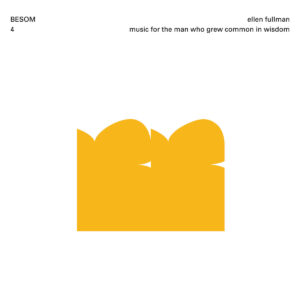
LP
Ellen FULLMAN
“Music for the man who grew common in wisdom”
**2023 stock**
besom presse announces the release of Ellen Fullman’s Music for the Man Who Grew Common in Wisdom. Known prominently for her sculptural Long String Instrument (LSI), these musique concrete pieces showcase an underrecognized side of Fullman’s sound investigations. In two expansive works, Fullman voyages through the comic, the menacing and the blissful all while evoking the unique kinetic and timbral aesthetic for which she is widely praised. Composed between 1987-1989, while living in Austin, Texas, the music originally served as accompaniment to choreographer Deborah Hay's dance piece of the same name. The besom presse release presents the last two movements of the full composition.
In 1985, Hay, a founding member of the Judson Dance Theater, commissioned Fullman to collaborate on a new work. Hay was deeply influenced by her experience as a member of the Merce Cunningham Dance Company and to the way John Cage and Cunningham collaborated. As such, the only relationship planned between Fullman’s music and the choreography was timing. Inspired by Hay’s open-ended approach and encouraged to use a new set of musical implements, Fullman explained, “I found this way of working to be remarkably refreshing and respectful of my process. I felt free to delve into my attraction for absurdity, knowing that I would not be judged.” With a variety of acoustic sound sources, Music for the Man Who Grew Common in Wisdom finds Fullman exploring the possibilities of the Prophet sampler. Describing her experience of using this tool she explains: “I was fascinated by what could be done with the Prophet and worked in a way that could be seen as an outgrowth from the musique concrete approach that I had used with a reel-to-reel tape recorder in earlier years.”
One of the most interesting contextual aspects of Music for the Man Who Grew Common in Wisdom is the flux under which it was created. Recently relocated and using unfamiliar equipment after having dedicated so much of her time and energy to advancing her knowledge of the LSI, this record provides an ultra-rare snapshot of Fullman’s journey as a composer: a suspended moment wherein her earlier phase of sound collaging comes into direct contact with her sensibilities of movement and sound as refined by her work with the LSI.
The excursion rewards careful, repeated listening. Its musical events arrive spontaneously while striking a rare balance between the poetical and unaffected. While the work is time-stamped by its technology, it evades the quaintness that beleaguers so many novel releases from the past. On side A, titled Music for the Gardener, Fullman triggers an assortment of exquisitely recorded acoustic sounds from a variety of quotidian sources including bits of glass dropped on a concrete slab, the gentle clanking of suspended woodscraps, water swishing back and forth, and her own voice. The piece begins with the glass, arranged chromatically, which Fullman playfully improvises with by triggering individual notes from a series of chord shapes. The effervescent chime and bounce is punctuated with sudden cluster chords that explode like a six-pack against a brick wall. This gives way to the round and muted tones of the swinging timber—a generous sonic foil to the icy digital aliasing of the glass samples. Shifting focus again, we hear the hi-fi swishing of water in a tub reproduced in a dazzlingly wide stereo field made possible by microphones arranged at either end of the bath. Fullman’s sampled voice, played in a meditative modal melody, signifies a kind of coda anchored by the rhythmic pulsing of clanking wood.
Side B’s Music for the Aviator is rooted in Deborah’s directive: "We contain the mystery, but we don't know what it is." Like an alternative soundtrack to Jodorowsky’s Santa Sangre, starter guns, percolating bubbles, cheering crowds, and a calliope organ conjure a lysergic day at the circus. More or less abrupt disturbances take place throughout. The circus is consumed by cetaceous blowhole sounds, which in turn fade into something vaguely like the Hindewhu whistle of Ba-Benzélé Pygmy music (think the intro to Herbie Hancock’s Watermelon Man). Eventually the piece settles into a satisfying rhythmic pulse of tuned breath sounds set in a cloud of woozy voice loops while a tightly packed spectrum of overtones springs forth.
The Man Who Grew Common In Wisdom was performed in August 2019 at the Tanz im August Festival, Berlin, in their RE-Perspective Deborah Hay, Works from 1968 to the Present. Eva Mohn of the Cullberg Ballet, Stockholm, was the soloist, and the work has become part of their repertoire. Music from the first movement of this piece, The Navigator (aka “Staggered Stasis”), was made available earlier this year by Superior Viaduct on a reissue of Fullman's 1987 self-released cassette, In The Sea.
25,00€
In stock
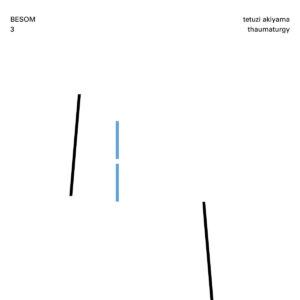
LP
Tetuzi AKIYAMA
“Thaumaturgy”
**2023 stock**
The intimacy of Akiyama’s Thaumaturgy is immense. In nine short through-composed pieces written over a ten-year period, Akiyama captures something melodic, simple, and utterly transfixing. In his first instrumental solo acoustic guitar record in more than a decade, Akiyama, widely known for his improvisatory collaborations as well as his hypnotizing boogie-drone guitar pieces, here works without effects and maintains a strict harmonic palette throughout. Every note is given ample space to ring out and decay, together slowly and deliberately building the frame that is to become the completed structure. The resulting atmosphere of his pared down grammar threads each individual track to the next as the songs work together with the gravity of a single object. In fact, one might think of each track like a room in a house.
The record, as its name hints, is suffused with phenomenological magic. The pieces function architecturally, in a Bachelardian sense, sheltering the daydreamer and encouraging charged stillness. The record envelops like a long-vacant shelter, made sacred by memory. Repeated motifs, like building blocks, waft through the air, exacting the psycho-durational and transportive power of a music box. And while, like a music box, the music lends itself to the tracing of inner landscapes, critical listening reveals that this is no mere background music. The acoustic field is richly ornamented with combination tones that are intensified by a pacing in step with Rothko-philes, Morton Feldman and Loren Connors.
While the enclosure of home serves for many as refuge from the world, Akiyama’s Thaumaturgy speaks to a basic drive for a sense of place in an epoch dominated by the disassociation of global nowhere-culture. The simplicity-bordering naivete of the pieces evokes a discomfiting nostalgia and melancholy pointing us home or, as Bachelard would suggest, to the “miniscule phenomenon of the shimmering consciousness.”
25,00€
In stock

LP
Alvin LUCIER
“Works for the Ever Present Orchestra Vol. II”
Works for the Ever Present Orchestra Vol. II continues Black Truffle’s documentation of the late work of legendary American experimental composer Alvin Lucier, who sadly passed away in 2021 at the age of 90. Like the first volume of the series, the two works recorded here were written for The Ever Present Orchestra, an ensemble founded in Zürich in 2016 to perform Lucier’s work exclusively. At the core of the music Lucier wrote for the ensemble is the electric guitar, an instrument he began to explore in 2013. Played with e-bows, in these works electric lap steel guitars take on roles akin to the slow sweep pure wave oscillators heard in many of Lucier’s works since the early 1980s. This strikingly elegant pair of compositions would serve as an ideal introduction to Lucier’s late music for a listener as yet unfamiliar with its graceful exploration of beating patterns and other acoustic phenomenon.
The two pieces have quite different characters, exemplifying Lucier’s ability to harvest a remarkable range of musical results from closely related compositional procedures and concerns. In Arrigoni Bridge (2019), Lucier uses a technique familiar from earlier works such as Still Lives (1995), where sine waves traced the shapes of household objects. Here, three lap steel electric guitars (played by Oren Ambarchi, Bernhard Rietbrock, and Jan Thoben) follow the form of the Arrigoni Bridge that connects Middletown and Portland, Connecticut. The bridge’s two enormous steel arcs become slowly sweeping pitches, alongside which alto saxophone (Joan Jordi Oliver Arcos), violin (Rebecca Thies) and cello (Lucy Railton) sustain long tones, creating a variety of audible beating patterns depending on their distance from or proximity to the guitars. With its stately pacing, warm middle register tones, and rich timbral variety in the sustaining instruments, Arrigoni Bridge is a beautiful example of compositional reduction producing immersive results. Flips (2020), on the other hand, is more austere. Scored for two lap steel electric guitars (Rietbock and Thoben), double bass (Ross Wightman) and glockenspiel (Trevor Saint), the two acoustic instruments played with bows, the piece zooms in on the range of a major second (two semitones). The two guitars sweep in opposite directions within the range, crossing every four minutes; the double bass and glockenspiel sustain long tones, producing beats of different speeds determined by their distance from the guitar tones. This limitation of the tonal range means the music is often dissonant and forces the phenomenon of audible beating to the surface, resulting in a paradoxical music composed entirely of long tones yet alive with pulsating rhythm. Exemplifying Lucier’s ability to uncover near-infinite complexity within seemingly simple materials, Works for the Ever Present Orchestra Vol. II is a fitting tribute to one of the major figures of the experimental music tradition and a testament to the continuing power of his work.
25,00€
In stock

2 LP
Ustad Zia Mohiuddin DAGAR
“Vrindavan 1982”
Black Truffle is thrilled to present a previously unheard performance by rudra veena master Ustad Zia Mohiuddin Dagar, recorded in the North Indian city of Vrindavan at the Druhpad Samaroh festival in 1982. Z.M. Dagar was a nineteenth-generation descendant of the Dagar family of musicians, famed for their profoundly meditative approach to the tradition of Hindustani court music. Perhaps the most revered members of the family were the brothers Mohinuddin and Aminuddin Dagar, who played a key role in reawakening interest in dhrupad in the mid-20th century. The great exponents of the tradition from whom Z.M. Dagar descended were all singers, and dhrupad is essentially vocal music. However, as Z.M. Dagar explained, the veena family of instruments plays an important role in the education and practice of dhrupad singers, especially as an aid to mastering the fine microtonal nuances of pitch essential to the genre. Introduced as a child by his father to the rudra veena, a large and low-pitched veena amplified by two enormous gourds, Z.M. Dagar became the first modern dhrupad musician to perform with it as an instrumental soloist, giving his first recital at the age of 16. Devoted to the instrument throughout his life, he made innovations to its design and materials, as well as introducing novel techniques (such as playing without the use of the traditional wire plectrum, resulting in the remarkable warmth of his tone). In the great Dagar family tradition, his approach to the various ragas that make up the dhrupad repertoire was stately, slow, and considered, with a great emphasis on the alap, the heavily improvised exposition section. True to form, in this recording of Dagar performing the night raga Yaman Kalyan, the alap section stretches out to more than forty minutes of slow-motion bliss, a frozen tanpura drone hovering above Dagar’s gracefully bent notes and elegantly twisting phrases. In the alap’s first half, Dagar’s figures are so intently focused on the lower reaches of the rudra veena’s range that they register more as shudders and moans than melodic patterns. As the performance continues, he slowly climbs in pitch, though continuing with the same intent focus on the articulation of single notes and subtle microtonal variations. This leads to the jod section of the performance, which, though still accompanied only by the tanpura, gradually takes on a more rhythmic character. Developing almost imperceptibly over the course of nearly thirty minutes, the jod moves from the stillness of the opening alap to a rapid pulse that announces the closing section of the piece, where Dagar is joined by Shrikant Mishra on the pakhawaj (a double headed hand drum). Where many performers use the final section of the raga as an exercise in unrestrained virtuosity, Dagar and Mishra subtly weave a web of finely shifting accents and hypnotic melodic variations, bringing the recording to a fitting conclusion while remaining within the meditative space occupied by the performance as a whole. Adorned with beautiful archival photographs of Dagar taken by Swedish percussion legend Bengt Berger and accompanied by detailed notes from Bradford Bailey, Vrindavan 1982 is a stunning document of music unmatched in its patient focus and mysterious emotional depth.
35,00€
Out of stock

LP
Eiko ISHIBASHI – Jim O’ROURKE
“Lifetime of a Flower”
For the exhibition “Flowers in 20th and 21st Century Art“, Eiko Ishibashi and Jim O‘Rourke had created the installation ”Lifetime of a Flower“ in which they set parameters but allowed the process itself to grow uncontrollably. Literally: in the garden of their Japanese house, they planted seeds and filmed the plant growing and thriving throughout the duration of the exhibition. Visitors were able to watch the stream in real time - and they heard a composition in which Ishibashi and O‘Rourke reflected the organic process in sound. The eponymous composition now available on LP, is an enigmatic and sophisticated layering of sounds, melodies and rhythms, noises from everyday life, all of which are repositories of associations, memories and expectations.
32,00€
In stock

LP
COMPILATION
“In Fractured Silence”
LP version.
Compilation curated by Steven Stapleton (of Nurse with Wound) of creative-experimental-unlikely music, originally released in 1984. Released on his United Dairies label that he had created with John Fothergill, he naturally called on Jean-Jacques Birgé and Francis Gorgé, who were then playing with Bernard Vitet in Un drame musical instantané. The compilation would be named In Fractured Silence. Alongside Nurse With Wound and Un drame musical instantané, could be heard Hélène Sage (whom Birgé introduced to Stapleton) and Sema, a project from the experimental British musician Robert Haigh who had participated in key records in the Nurse With Wound discography, such as Homotopy to Marie and Spiral Insana.
24,00€
In stock
LP
COMPILATION
“In Fractured Silence (Smoke Vinyl)”
LP version. Smoke color vinyl.
Compilation curated by Steven Stapleton (of Nurse with Wound) of creative-experimental-unlikely music, originally released in 1984. Released on his United Dairies label that he had created with John Fothergill, he naturally called on Jean-Jacques Birgé and Francis Gorgé, who were then playing with Bernard Vitet in Un drame musical instantané. The compilation would be named In Fractured Silence. Alongside Nurse With Wound and Un drame musical instantané, could be heard Hélène Sage (whom Birgé introduced to Stapleton) and Sema, a project from the experimental British musician Robert Haigh who had participated in key records in the Nurse With Wound discography, such as Homotopy to Marie and Spiral Insana.
26,00€
In stock

LP
David TOOP & Lawrence ENGLISH
“The Shell That Speaks The Sea”
A note from Lawrence English
I first met David Toop some 20 years ago. I think we were in touch shortly before that, but our first meeting took place when I invited him to Australia to perform and to speak as part of REV, a festival held at Brisbane Powerhouse. It was a memorable meeting, I vividly remember his solo performance and the edition A Picturesque View, Ignored, documents an improvised meeting during that time.
Over the years, David and I have shared an interest in both the material and immaterial implications of sound (amongst other things). Moreover we’ve connected many times on matters which lie at the fringes of how we might choose to think about audition, our interests seeking in the affective realm that haunts, rather than describes, experience. The Shell That Speaks The Sea very much resonates from this shared fascination.
I’m not exactly sure when we first mooted this duet, but I sense its initial trace is now more than a decade ago. I tend to live by the motto of ‘right place, right time’ and I believe David likely also subscribes to this methodology. A couple of years ago, David and I reignited the duet conversation and began exchanging materials. As a jumping off point, I explored a series of field recordings that, for me at least, captured something of this affective haunting that I mentioned previously.
One such recording was of a Tawny Frogmouth at Nugum (White Rock) on the lands of the Yugarabul people. The frogmouth is an utterly elusive creature whose voice is like a modulating low frequency oscillator. They are a magical bird, and like the Potoo, have captivated David and I at various points in our lives. The recording seemed to suggest a whole way of approaching sound and, for me at least, it opened an entirely new range of sound worlds which are present in the final version of this recording.
This edition is the product of spontaneous burst of exchanges, buffered by periods of tempered silence. A patient work, charged with unexpected dynamics.
It’s with great pleasure we share this recording with you.
David Toop - Voice, digital electronics, Spanish, electric and lapsteel guitars, bowing, whistling, percussion, flutes.
Lawrence English - Electronics, field recordings, shortwave radio, bass drum, ghost flute, bamboo, stones.
24,00€
In stock

LP
Francesco FABRIS & Ben FROST
“Vakning”
A Note from Lawrence English on Vakning
Nothing is fixed, nothing is permanent, nothing holds for anyone, any time or anything.
As stable as we might choose to think it is, this planet is anything but that. A paper thin crust, the zone in which we find ourselves, and mostly concern ourselves with, exists as a modest veil cloaking a dynamic seismic turbulence that is as powerful as it is unknowable.
There are moments though where ruptures occur. The pressure from within carves its way to, and through, the surface of the planet simultaneously delivering destruction and virgin landscapes, as primordial as any we might care to imagine. It is here, in these places, where we can literally see the living planet, that geologic time is condensed and world building is made visible, and audible to us, in an unrestrained and provocative detail.
These volcanic ruptures, such as those captured on Vakning by Francesco Fabris and Ben Frost, speak to the very living geology of Earth. These recordings, captured at close range, exist at a nexus where liquid rock becomes solid. They capture moments of transformation, of obliteration and of creation, often all at once.
These are recordings of a living, material planet, dynamic and unrestrained.
24,00€
In stock
LP
PRIMITIVE MOTION
“Portrait Of An Atmosphere”
A Note From Leighton Craig
Portrait of an Atmosphere was recorded with the intention of crafting a long duration work of constituent parts; a suite of related compositions to be listened to as a singular narrative. It focuses on acoustic elements to achieve the kind of sound immersion that is central to our practice, without using the typical palette of reverb and delay. It is rewarding for us, that in the absence of these tools, it still enters the dream-float realm, attaining that sense of something 'other'. It is at once the least and most Primitive Motion-sounding album to date.
The title of the album has been taken from one of Sandra's cut-poems, an ongoing series of work where she reduces/cuts the text on the page of a found book to arrive at a poetic denouement. In this context it seems fitting that some recordings on the album also have the sense of being cut together, although perhaps more as collage than reduction. Most obviously Portrait IV joins a piano track with fragments of studio improvisation, a drifting fog that finally clears by restating the single-string guitar motif of Portrait I. The beginning at the end; mirror in a mirror.
The final track on the album, Trenches of Time (another cut-poem title), sits outside the Portrait suite but shares the same path of call and response intra-studio exchanges and acoustic intervention. But this album is more than a recording project. It represents the ongoing thread of non-verbal conversation that passes between sound makers, and has been exchanged between these band members for over a decade, captured here in an evolving dialect. It's a peculiar language that can be understood through the bowing of a cymbal and the wheezing of a reed organ. It's this conversation that is the joy and otherness of making music.
Recorded and produced by Primitive Motion between 2018 and 2020 at Kindling House and Woodburn Laboratory, Meanjin/Brisbane, Australia.
Sandra Selig: voice, handclap, flute, cymbals, melodica, radio, saxophone, glass bowl, drums, marble in bamboo, zither, wind chimes, bowed cymbal.
Leighton Craig: acoustic guitar, reed organ, cymbals, field recordings (Kyoto Japan), tremolo guitar, miniature saxophone, voice, piano, metal stool, bird call, synthesiser, wind chimes, shaker, timber box.
24,00€
Out of stock

LP
Félicia ATKINSON / Richard CHARTIER
“Ni envers ni endroit … / Recurrence.Expansion”
Félicia Atkinson: »Ni envers ni endroit que cette roche brûlante (Pour Georgia O’Keeffe)« (2021)
Félicia Atkinson’s Ni envers ni endroit que cette roche brûlante (Pour Georgia O’Keeffe) is approached as a meditation, not as meditative music, but as a reflection on the art of creation: how to inhabit one’s creation, how to convey it, domesticate it and live with it. Drawing inspiration from the artist Georgia O’ Keeffe, both in her work as a painter and in the houses in which she lived in New Mexico, and even in the landscapes that surround them, Félicia Atkinson has composed a piece that evokes and celebrates, in a poetic and holistic way, the mystery of art, the somnambulic oscillation that accompanies the act of creating. Blending fragmentary voices, islands of piano, electronic textures and patterns, and field recordings, Félicia Atkinson’s music is sincere and inspired, a meditation, then, but also a lesson we sometimes forget: being an artist is not an activity, even less a profession, it’s a singular way of approaching the world and, in so doing, densifying it.
Richard Chartier: »Recurrence.Expansion« (2020)
Richard Chartier’s music takes up residence at the frontiers of the audible, on the edge where sound diffracts into an inter-dimensionality where sounds, space, listening and silence recombine in an arborescence of becomings that present themselves to us and then disappear. The space-time in which Richard Chartier’s music unfolds is a stretched space-time, barely emerging in the world of sound. The delicacy, precision and accuracy of the composition Recurrence. Expansion lies precisely in this dialogue between a shape that is exposed and developed in an inspired and masterful way, and the sonic biotope in which this shape develops. It is from such an encounter that the singularity of Richard Chartier’s music emerges, music of attentive listening, but also sensitive, inhabited music, a music of discreet metamorphosis.
25,00€
In stock

LP
KMRU
“Dissolution Grip”
The inaugural release on KMRU's own fledgling OFNOT imprint, 'Dissolution Grip' is an ambitious project that emerged from his studies at Berlin's prestigious UDK. The Kenyan composer and sound artist is best known for his field recording work, and as he traveled across Europe and the wider world for regular live performances, he made a point to snapshot each city. But the more he studied and the more he examined his practice, the more KMRU began to wonder what the purpose of these recordings were, and what bearing they might actually have on his self-expression. Simultaneously, he'd begun to dive more wholeheartedly into the world of synthesis. In a way, synthesis is the most basic form of sound, and KMRU started to wonder not just how he could harness these sounds but how he might be able to more dynamically combine them with field recordings.
Guided by Jasmine Guffond at Berlin's Universität der Künste (better known as UDK), KMRU looked at waveforms - the visual representation of sound itself - and embarked on a process where he would write scores from the shapes, gradually turning the scores into raw synth sounds. Considering the spaces he was inspired by and shuttled through, KMRU decided that instead of using environmental recordings as an aesthetic marker, he would use these captured moments to guide the waveforms. So each sound is birthed from a field recording, but none of those recordings are audible in their original form. For example, on the digital bonus track 'Along A Wall', KMRU recorded in an old shack on his family's compound in Nairobi, where wind was shaking the building to its foundations. Listening to the finished piece, we can hear subtle electronic tones that rub and vibrate against each other, slowly saturating and mimicking the erratic motion of the wind. The original recording has been removed, but the feeling remains.
The album's opening side 'Till Hurricane Bisect' is a 15-minute epic that evolves at its own glacial pace, carefully transforming blustering wind sounds into gasping drones, glassy oscillations and choked distortion. Cosmic and meditative, it's a testament to KMRU's skill as a sound engineer and patience as a composer, combining the gentle world building of his acclaimed Editions Mego album 'Peel' with the rumbling energy of 'Limen', last year's collaboration with Aho Ssan. On the title track, KMRU takes the opportunity to flex his orchestral muscle, conducting a cast of warbling synth tones into a durational symphony. Starting as quietly as a whisper, 'Dissolution Grip' expands at its own pace until it's a dense wall of harmony, powerful but never completely overwhelming. It's music embedded with a rich sense of place that informs us of KMRU's past and present, and signals where his musical philosophy might take us in the future.
22,00€
Out of stock

LP
KMRU – Abul MOGARD
“Drawing Water”
In November 2020, KMRU self-released »Drawing Water«. The release contained 3 supple works of porous resonance and intimate motion, giving way to a very heartfelt body of work that peers directly into the fabric of the everyday; gestures, movement, conversation, rendered graciously into waveform.
Now, Vaagner is proud to present a special edition vinyl and cassette reissue of »Drawing Water« via its A Sunken Mall imprint, with the original material spanning the first side of the record in remastered from.
For the second half of the record, the label has taped none other than Abul Mogard, who prepared a new piece by reworking various layers from KMRU’s original compositions.
This new 17 minute long piece, tilted »Drawing Water On Matching Teal Surfaces’« is defined by a continuously cascading and deeply resounding solemnness, which, towards the work’s concluding moments, gradually disperses through a subtle downpour of warm pads, delicately rippling through the fabric of the work, before gently dissolving into thin air.
23,00€
In stock

LP
Maria W HORN & Mats ERLANDSSON
“Celestial Shores”
The music heard on this album was originally the result of a commission to score the second half of the film Nico/Nico Crying made by Andy Warhol in 1966. The commission was made by Art Cinema OFFoff in collaboration with B.A.A.D.M for a screening of the film together with a live presentation of the score in September 2021 at Ancienne Belgique in Brussels. The recording presented here was made in the last week of that year and mixed soon after in January 2022. These recordings are essentially live-recordings performed by the composers together in the same room and recorded in a manner reminiscent of the record making process as it was in the late 1960s. The instrumentation used to make the sounds on this album consists of modular synthesis, zither, voice, contaminated field recordings and metal percussion.
Mats Erlandsson is a composer and musician part of the vibrantly re-emerging field of drone music in Stockholm, Sweden, and is associated with practices characterized by the extensive use of sustained sound. Erlandsson presents his work both as a solo artist and in collaborations, most notably together with Yair Elazar Glotman and Maria W Horn. Recent releases include Gyttjans Topografi on XKatedral, Minnesmärke on Hallow Ground and the collaboration Emanate made with Yair Elazar Glotman on the label 13070. In addition to his own artistic practice Erlandsson holds a position as studio technician and was temporarily, from October 2022 to September 2023, the acting studio director at Elektronmusikstudion in Stockholm.
The compositions of Maria W Horn implement synthetic sound, electroacoustic and acoustic instruments and audiovisual components, often devicing generative and algorithmic processes to control timbre, tuning and texture. She employs a varied instrumentation ranging from analog synthesizers to choir, string instruments, pipe organ and various chamber music formats. Acoustic instruments are often paired with digital synthesis techniques, in order to extend the instruments timbral capacities. Often based on minimalist structures, her music explores the inherent spectral properties of sound and their ability to transcend time and space, reality and dream.
24,00€
In stock

LP
CONTINUITY
“Continuity”
Eponymous first album by ‘Continuity’, the new project of Swedish artist Martin Herterich, whose sonic explorations of memory and imagination have come to full bloom in this atmospheric and elusive narrative of seven intense cityscapes.
Martin Herterich previously released music (as Sand Circles, etc) on labels like Posh Isolation, Not Not Fun Records, iDEAL and Irrlicht.
“Have you ever felt like all you want is to go back?
Continuity is a sonic narrative, a story arc set in a fictional East Asian metropolis. It is not a city you have been to.
When you have fallen in love with a place, you long to go back; but it’s a memory; fiction if you like. You want to catch the fleeting moment of leaves rustling in the wind, the sun reflecting from the glass panels of the roof above.
These memory cycles create emotional patterns. But unlike reality, these spaces are limited. They carry elements of reality in them, narrative components that evoke feelings and signify meaning. Traveling there becomes impossible. Through streetview surfing and 4K walking videos on Youtube, these spaces that are very much real become fictionalized, much like the virtual spaces of video games. Movement is narration. Fiction is something that is, but at the same time isn’t, real. In order to understand an imaginary place, one needs to travel there.” (Martin Herterich, 2023)
24,00€
In stock

LP
MONOPOLY CHILD STAR SEARCHERS
“Barbados Wild Horses”
After the not-quite-reissue of »Prince of Parrot Shooters/The Aqueducts of Cannel Island«, wide-eyed mystic and tireless searcher of the netherworld Spencer Clark returns to the Discrepant fold with »Barbados Wild Horses« under his Monopoly Child Star Searchers moniker. Recorded while Clark was living in the Canary Island's by Tupperware and Lagoss' Dani Tupper, 'Barbados Wild Horses' brims with insular romanticism and escapist bliss, with sunkissed synth-lines interwoven around his trademark hand percussion bouncy rhythms reflecting the scenery of the islands as a liberating utopia.
With track titles taking an almost self explanatory stance, the album starts with the crepuscular vibes of »Upper Romantico«, a poetic meditation on the lovelorn potential of the fading sunlight, setting the tone for the rest of the tour. »Lava Tube Solos on Horseback«, the first of two tracks featuring Sun Araw's Cameron Stallones, sees the latter's guitar noodles riding the cascading rhythms and digital choir harmonies while in »Neopreno Antiguo« he solos freely around an hypnotic synth line. Finishing off the escapade, »Nightcharcos Punta Brava« drifts in ethereal starlit contemplation, with the percussion taking a more backseat approach, setting into a steady pulse for Clark's gliding synth tapestries. Nightswimming as transcendence. Another piece of the fascinating puzzle Clark's been assembling for over two decades now, 'Barbados Wild Horses' glimmers with a laid back sensibility that's as unhinged as enveloping. Not an easy feat by any measure. Clark succeeds again.
24,50€
Out of stock

LP
The PITCH & Julia REIDY
“Neutral Star”
The Pitch is a quartet made up of Boris Baltschun, Koen Nutters, Michael Thieke and Morten Joh. Founded in Berlin in 2009, they play a hypnotic form of structured improvisation full of acoustic exploration and electronic intervention. On Neutral Star, The Pitch are joined by Australian guitarist/composer extraordinaire Julia Reidy for a record of star gazing electro-acoustic jazz.
Reidy's playing and compositional technique between Takoma-style fingerpicking and Glenn Branca'esque microtonality, perfectly complements the loose improvisational framework The Pitch is providing. Endless ≠ Limitless, a recent piece by Reidy and Joh, is transformed from a washed-out/obscured tape delay composition into a colorful, meandering ensemble piece with a swarming character - blooming with intrigue for the patient ear. The B-side strikes a more gentle tone: the 24-minute Neutral Star begins with a siren-like overtone whose drone-like flowing slowly morphs into a deterritorial modality with jazzy undertone. Accompanied by constant eruptions of vibraphone, clarinet, electronics and double bass punctuation – while permanently questioned by Reidy's drippingly pearly steel guitar work. Slowly evolving into new territories through the expansive instrumentation and keen listening between the players.
The fact that Neutral Star was recorded in one take (by Rabih Beaini in his Morphine Raum studio/venue) in front of a live audience and without overdubs is hard to believe, even for the trained ear. The recording appears to be too multilayered for a single snapshot, with its compositional structures constantly shifting and moving against themselves, counterintuitively and anti-cyclically. Reidy´s playing has been described as "unstable harmonic territory, and the collaboration with The Pitch interprets this concept brilliantly - adding further non-places to the territory. And the listener, however, is never left alone in the process of tectonic shifts - at least as long as their listening is attentive and contemplative at once.
28,50€