
In stock
CD
Werner DURAND
“Schwingende Luftsäulen 2”
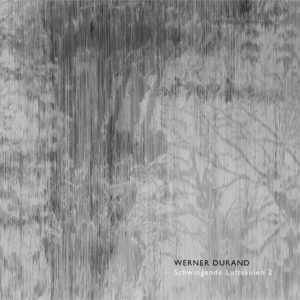
Werner Durand "Schwingende Luftsäulen 2" (CD), the second chapter dedicated to Durand's music applied to the Pan-Ney, the wind instrument of his own invention.
From the liner notes:
"Schwingende Luftsäulen 2 is the second chapter of a trilogy featuring the Pan-Ney with its tubes or columns of vibrating air. This second chapter, in which the Pan-Ney is flanked by the tenor sax, reconnects where the first one ends (ANTS, 2017), and proceeds along a path that is coherent and uniform, and whose imaginative ideas go beyond the strictly musical sphere.
Wald (forest) is the centerpiece of the three works that make up Schwingende Luftsäulen 2. It is the forest with its multiple meanings, real and symbolic, mythological, religious, literary, folkloric. The forest as a place that is sacred or magical, dreamlike or fairy-tale. A place of adventure and misadventure, to trek through with a view toward growth or rebirth.
In Spiegel (Mirror), dedicated to the Tonaliens Ensemble, the Pan-Ney and the tenor saxophone weave a layered dialogue in which they call and respond to each other. Not only. In their 'mirroring conversation' the two instruments seem to suggest a choreography. Durand's music stands out for its ability to make some 'scenes' visible. In the dance evoked in Spiegel, the gestures - and perhaps even the bodies - appear suspended and rarefied, just as the music is suspended and rarefied, while, during listening, time expands beyond the duration of the piece. Music and dance remain there, in midair, even at the end of the ritual.
Panga, for Pan-Ney, tenor sax and digital delay, contains an allusion to nature. Panga (note the morpheme "pan", which refers to Durand's instrument) is the name of a plant that grows in New Zealand but that occurs in the botany of other areas of the planet (for example, in the Amazon) in connection with ancient practices both pharmacological and aphrodisiac. But the plant could easily belong to a manual of imaginary botany, if one thinks that nature, for Durand, is both a source of real inspiration and a place to reinvent according to subjective visions and coordinates."
With gorgeous artworks by Karlheinz Bux and extensive liner notes by Adelio Fusé.
12,00€
Out of stock
CD
Tetuzi AKIYAMA
“Misrepresenting Memory”
A solo album by guitarist Tetuzi Akiyama, who carries out an energetic performance schedule in and out of Japan. Amazingly, this is his first solo album since the 2008 release of The Ancient Balance to Control Death on the U.S. label Western Vinyl. That album included both acoustic guitar and singing, so Misrepresenting Memory is actually Akiyama's first instrumental solo album with guitar in 13 years, since the release of the CD-R Terrifying Street Trees in January 2006 on the Portuguese label Esquilo Records.
Misrepresenting Memory consists of one piece (31 min. 27 sec.) performed in concert at the Tokyo venue Apollo on December 14, 2018. The performance—using electric guitar and tape echo—was recorded directly to cassette tape. Making full use of soft, lo-fi tones and distorted choppy sounds, this extremely high-quality work is a fascinating expression of Akiyama's musical artistry. Limited edition of 200, numbered consecutively.
12,00€
Out of stock
CD
Yasumune MORISHIGE – Yoko IKEDA – Takashi MASUBUCHI
“Shade”
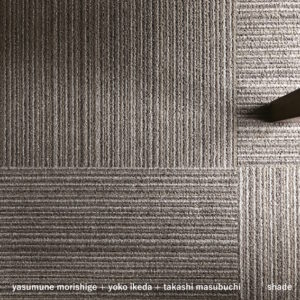
This CD documents the complete first and second sets (each a little over 30 minutes) of a concert at Ftarri on September 29, 2018, performed by Yasumune Morishige (cello) Yoko Ikeda (viola), and Takashi Masubuchi (guitar), three improvisers active mainly in Tokyo. The tones produced by the three acoustic stringed instruments are rich and vivid, and the listener can't help but be mesmerized by the interweaving of the sounds. And although the performances are improvised, they're so superbly structured that they could almost be compositions comprised of several movements. You can listen to this recording again and again and always hear something new. This was the first time the three musicians had ever performed together. That first encounter produced a rare masterpiece.
12,00€
Out of stock

CD
Bruno DUPLANT
“Deux songes (les jours sont faits pour expliquer les nuits)”
French musician Bruno Duplant is one of the most talked-about artists on the experimental music scene today. In recent years he's presented many outstanding composed pieces and released a succession of excellent recordings on labels around the world. The abundance and vitality of his work are remarkable.
On this album, two compositions by Duplant are performed by Ordinary Affects, led by Boston-based musician/composer Morgan Evans-Weiler. Ordinary Affects is an experimental music ensemble with an established reputation for performing works by contemporary composers such as Christian Wolff, Antoine Beuger, Michael Pisaro, Jürg Frey, and Kyoko Akama. Track 1 (21 minutes) is a quintet and Track 2 (26 minutes) is a string quartet. The performers are Laura Cetilia (cello), Jordan Dykstra (viola), Morgan Evans-Weiler (violin), J.P.A. Falzone (Fender Rhodes, Track 1 only), Luke Martin (guitar, Track 1 only), and Ashley Frith (viola, Track 2 only).
Each piece has a highly controlled, spacious tempo throughout. The sounds' overlapping and their successive emergence have a dreamlike quality that gently beckons the listener into a state of abstraction. Bruno Duplant's talent and originality as a composer and Ordinary Affects' excellence as performers are fully on display in this superb recording.
12,00€
In stock

CD
Axel DÖRNER – Toshimaru NAKAMURA
“In Cotton and Wool”
With his innovative performances, Berlin-based trumpeter Axel Dörner has been a leading figure on the improvised music scene since the 1990s. Internationally popular no-input mixing board player/improviser Toshimaru Nakamura structures sound by controlling mixer feedback. These two musicians released the CD Vorhernach on the Ftarri label in 2007, and In Cotton and Wool is their second duo album.
The four tracks on this album (each between 7 and 12 minutes) were recorded in a studio in Berlin in May 2017. Dörner uses electronics in addition to trumpet. In striking contrast with the 2007 first release, which is permeated with delicate sound creation making extensive use of soft tones, this second album is sure to overwhelm listeners with its radical, aggressive musical back-and-forth. What's more, there's never a monotonous moment--the overall structure is diverse and richly varied. This is a powerful masterpiece born of the two musicians' incomparable technique and musicianship.
13,00€
In stock
CD
Zhao CONG
“Rotating, Rotating”
Zhao Cong is a Beijing-based experimental/improvisational musician. In addition to performing in live events in Beijing such as Zooming' Night, organized by composer/performer Zhu Wenbo, she has in recent years been expanding her range of activity, visiting Japan each year and performing in various locations around the country. She has also released solo and duo albums on Zhu Wenbo's cassette label, Zoomin' Night.
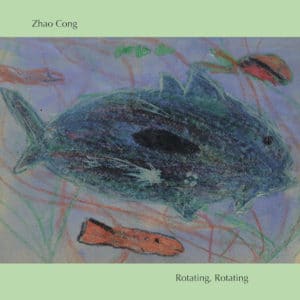
This CD contains three solo tracks by Zhao Cong. Tracks 1 and 2, each about 20 minutes, were recorded at her home in Beijing in June 2016. Track 3 (about 29 minutes) was recorded in concert at Ftarri, Tokyo, in January 2018. Only the second track is previously released--on Zhao Cong's debut solo album, Afternoon, a cassette tape that came out on Zoomin' Night in 2016 and has since sold out. On that album the title was "Twice, or More," and on this CD it has changed to "Electric Rotating." Tracks 1 and 3, respectively called "Acousting Rotating" and "Rotating, Rotating," are previously unreleased works.
Zhao Cong arranges a mixer, a cardboard cylinder, household items, and a hemispherical lamp (whose small light has a visual effect) on the same table, manipulates mixer feedback and contact mike, and produces delicate sustained sounds and (as if inserting them into the sustained sounds) numerous and varied noises. While her performance style and sounds are restrained, listeners drifting along in these sounds and the gentle flow of time are left with an indescribable and vivid impression. A masterpiece.
Mastered by Hiroyuki Ura in January 2019
Artwork and design by Cathy Fishman
13,00€
In stock

CD
NOISE POETRY
“Wolf Rayet”
David Chiesa : double bass. Didier Lasserre : drums. Mathias Pontevia : horizontal drums.
Noise Poetry is a beautiful example of a concrete attitude of improvisors more concerned with collectively constructing a sonic complexity than gestural free expression. All three of them plunge into a universe akin to that of a Japanese garden – where the space between the stones is more important than the stones themselves – inventing an acoustic synthesis in a development of stratified objects that act like a giant mobile.
12,00€
In stock

CD
Zachary PAUL
“A Meditation on Discord”
On Zachary Paul’s debut album for Touch, “A Meditation on Discord” compiles two live recordings from 2018 and a short film score, showcasing his expressive range and unique playing style. Both live recordings — “Premonition” and “Slow Ascent” — were fully improvised on his violin (“The Duke,” 1878), a minimal assortment of pedals (Earthquaker Afterneath, Diamond Memory Lane Jr, and Boss RC-30) and looped vocals.
Original price was: 10,50€.6,00€Current price is: 6,00€.
In stock

CD
Anthony BURR – Charles CURTIS
“Chamber Music: Alvin Lucier & Morton Feldman”
1. Alvin Lucier: August Moon (2015)
2. Morton Feldman: Two Instruments (1958)
3. Alvin Lucier: Trio For Clarinet, Cello & Tuba (2008)
4. Morton Feldman: Three Clarinets, Cello And Piano (1971)
5. Alvin Lucier: Step, Slide and Sustain (2014)
6. Morton Feldman: Durations 2 (1960)
Anthony Burr and Charles Curtis present this collection of curated compositions from Alvin Lucier and Morton Feldman. Two Lucier pieces, August Moon and Trio For Clarinet, Cello & Tuba are presented here for the first time. Liner notes are excerpted from a lecture on Morton Feldman given by Alvin Lucier.
"For Feldman, dynamics serve an acoustical function. When he mitigates a piano attack he reduces that spike of noise that's at the onset of every piano sound leaving only the sinusoidal pure after-sound. It's as if he invented electronic music with the piano." Alvin Lucier from liner notes.
"Lucier manages to hear a layer of acoustical physics in Feldman's music that perhaps no one else would hear. He's hearing something in Feldman that is actually coming from his own musical world; in a way, hearing his own music in Feldman's, and drawing inspiration from that."
14,00€
In stock

CD
Alvin LUCIER
“Orpheus Variations”
Orpheus Variations is a new composition by Alvin Lucier for solo cello and seven wind instruments. It is based on a particular sonority from the first movement of Igor Stravinsky's ballet score, Orpheus; a sonority that has haunted Lucier for decades.
Orpheus Variations is one of eight large-scale compositions made expressly for Charles Curtis by Alvin Lucier in the last 15 years. This performance was conducted by Petr Kotik, with Charles Curtis playing solo cello alongside members of the SEM Ensemble.
"Lucier speaks first of a sonority, and only then of a chord. He discusses the chord, its notes and their disposition, but what haunts him is a "particular sonority." A sonority is the product of physical action on physical materials: the instruments, the registers in which they are activated, the breath of the musicians, the waveforms thus produced, their merging and interfering, and finally the moment and place of these actions. An energy field, certain to vanish completely once the musicians put down their instruments. However concrete and real the actions and materials, the sonority they produce is a phantom."
14,00€
In stock

CD
Maryanne AMACHER
“Petra”
Maryanne Amacher (1938-2009) was a composer of large-scale fixed-duration sound installations and a highly original thinker in the areas of perception, sound spatialization, creative intelligence, and aural architecture. She is frequently cited as a pioneer of what has come to be called "sound art", although her thought and creative practice consistently challenge key assumptions about the capacities and limitations of the genre. Amacher's work anticipates some of the most important developments in network culture, media arts, acoustic ecology, and sound studies, yet due to its expansive interdisciplinary nature, it has rarely been documented. Following two CDs for Tzadik and her inclusion in the monumental collection OHM: The Early Gurus Of Electronic Music (1948-1980), this publication of Amacher's 1991 piece Petra marks her first commercially available instrumental work.
Petra was originally commissioned for the ICSM World Music Days in Boswil, Switzerland. Written for two pianos, the piece is a unique example of Amacher's late work, a direct extension of her working methodologies for electronic composition taken into an acoustic realm that alludes to the music of Giacinto Scelsi and Galina Ustvolskaya. Petra is a sweeping, durational work based on both Amacher's impressions of the church at Boswil and science-fiction writer Greg Bear's short story of the same name, in which gargoyles come to life and breed with humans in a post-apocalyptic Notre Dame.
This solemn interpretation of Petra was recorded at its 2017 American premiere at New York's St. Peter's Episcopal Church with pianists Marianne Schroeder, who originally performed the piece alongside Amacher in 1991, and Stefan Tcherepnin, who performed it alongside Schroeder in 2012 at Hamburger Bahnhof, Berlin. Weighing tranquilizing passages of glacially-paced serenity against stretches of dilapidated, jagged dissonance, the recording illuminates a crucial node in the constellation of Amacher's enigmatic oeuvre.
13,50€
In stock
CD
SEARCH ENSEMBLES
“Prescient / Legend”
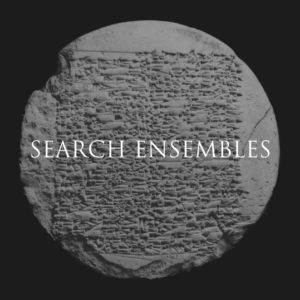
The second Search Ensembles artifact sees the return of Cédric Peyronnet (Toy Bizarre, Kaon / Ingeos, Sechres Mound,), Cyril Herry (Ninth Desert, Sechres Mound), Phil Legard (Xenis Emputae Travelling Band, Hawthonn), Michael Northam, Alan Courtis (Anla Courtis, Reynols), Jani Hirvonen (Uton), Slavek Kwi (Artificial Memory Trace), Jon Tulchin and Dale Lloyd (and/OAR, Seattle Phonographers Union, Lucid), plus first time involvement from Eric Lanzillotta (Eye Music, Ri Be Xibalba, Anomalous Records), Mark Reynolds and Mike Hallenbeck (Archive, Junior Birdman Audio).
Whereas the first album mostly presented unrefined aural snapshots of elusive and impenetrable civilizations and phenomena, the second album continues along similar lines with longer pieces while also presenting an increased utilization of electronic instruments and processes. The title is partially in reference to what were initially two different albums gradually becoming combined into one after a long process of being reworked and revised into one integrated whole. Furthermore, the title points toward a mental state of foretelling and recollection which in turn illustrates the idea that everything really exists in the eternal present (on an infinite number of time lines) rather than on one locked linear time line. Many indigenous people around the world have traditionally perceived life this way.
Limited to 150 copies.
Alan Courtis: field recording
Cedric Peyronnet: bass guitar, electronics, field recording,
objects, percussion, synthesizer, voice
Cyril Herry: objects, voice
Dale Lloyd: bass guitar, field recordings, vocal sounds, objects,
percussion, plexiglass, production, recorder (flute), synthesizer
Eric Lanzillotta: synthesizer
Jani Hirvonen: electronics
Jon Tulchin: field recording
Mark Reynolds: percussion
Michael Northam: field recordings, flute
Mike Hallenbeck: field recording
Phil Legard: flute
Slavek Kwi: percussion, synthesizer
8,50€
Out of stock

CD
Jakob ULLMANN
“Fremde Zeit – 5”
« Solo V für Klavier » (2013/2014) by Lukas Rickli, piano. This piece ends the cycle Fremde Zeit in a very minimal way, like a close-up on all small sounds and resonance of the strings, bringing the sound close to a molecular level.
As addition to Fremde Zeit addendum Box CDs 1–4 with Booklet German/English.
"Do we hear what we know? How, if this is obscured? Sent on a journey of discovery into the audible, at first almost nothing appears here. But once the ear has become accustomed to the intermediate realm of the pianissimo, an abundance of timbres becomes apparent, everyday noises unexpectedly dispersing in their non-spatial aura, then the surprising appearances of short tonal shapes, which enter the flow of time standing still as if they were revelations of the ear itself with no possibility to guess their origin, verifiable on the instrument. After all, it is in fact the tone which is the improbable, out of all that is weaving in and out within the grounding, static sound, like a distant army of constellations below, taking place uneventfully at the level of the permanent. 'solo V' is not an instrumental piece for a soloist in the ordinary sense. The grand piano becomes an unknown sound body. Although there is a soloist, they could hardly carry out the performance on their own, requiring either pre-produced electronic playback or, as in the present recording by Lukas Rickli, the participation of three assistants sustaining a soundscape. Ullmann conceived a sonic space in which sound is subjected to the laws of a specific 'gravity'. Its meridians range continuously from noise to tone and from shortest single event to sustained continuity, but what constitutes the true aura of this space is its reduced dynamics, and a rhythmic sense that is averse to any kind of melody in the usual sense. 'solo V' is also 'solistic' in another way: there is no fixed notated score, it must first be created individually, and so hardly ever will any performance score be the same as another. Rickli and his partner Zora Marti had a variety of graphic and notated material at their disposal for the development of the temporal form. Following the composer's graphically notated glissandi, Rickli and Marti modify the sound of the centers and generate transitions with them. The piece to be heard unfolds in a pulsating, breathing pianissimo. Hardly bringing any instrument to mind, it opens up a harmonic cosmos, urging the listener into it - because other than through listening to the barely recognizable, nothing is revealed."
Rainer Schmusch
14,00€
Out of stock

CD
Turgut ERÇETIN
“Panopticon Specularities”
A native of Istanbul, Turgut Erçetin (1983) studied composition and completed his doctorate studies at Stanford University. In 2016, Erçetin was awarded with DAAD Artists-In-Berlin program for a year-long residency in Berlin, and since then he has been based in Berlin. Erçetin's works engage with issues of sound, not as colors but as sonic entities that interface with time and space. Most of his works, therefore, are involved with acoustics and psychoacoustics as well as computer aided compositional processes. "String Quartet No.2" performed by Arditti Quartet; "Im Keller" performed by Neue Vocalsolisten Stuttgart; "Panopticon Specularities" performed by Ensemble Mosaik, Ensemble Apparat, Ensemble Adapter, and Sonar Quartett.
17,50€
Out of stock
CD
FENNESZ
“Agora”
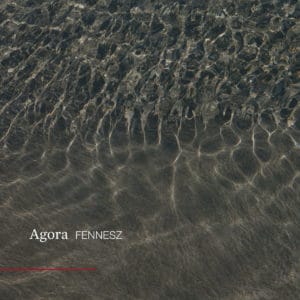
Agora is Christian Fennesz's first solo album since 'Mahler Remixed' [Touch, 2014] and 'Bécs' [Editions Mego, 2014]. Fennesz writes: "Its a simple story. i had temporarily lost a proper studio workspace and had to move all my gear back to a small bedroom in my flat where I recorded this album. It was all done on headphones, which was rather a frustrating situation at first but later on it felt like back in the day when I produced my first records in the 1990s. In the end it was inspiring. I used very minimal equipment; I didn't even have the courage to plug in all the gear and instruments which were at my disposal. I just used what was to hand.
Fennesz uses guitar and computer to create shimmering, swirling electronic sound of enormous range and complex musicality. "Imagine the electric guitar severed from cliché and all of its physical limitations, shaping a bold new musical language." - (City Newspaper, USA). His lush and luminant compositions are anything but sterile computer experiments. They resemble sensitive, telescopic recordings of rainforest insect life or natural atmospheric occurrences, an inherent naturalism permeating each piece. He lives and works in Vienna.
13,00€
In stock

CD
Igor WAKHEVITCH
“Kshatrya, The Eye Of The Bird”
Transversales Disques presents « KSHATRYA, The Eye Of The Bird », never released before recording by french avant-garde electronic composer Igor Wakhevitch, who composed a bunch of major experimental albums in the 70’s such as « Logos », « Docteur Faust » , « Hathor » "Les Fous d'Or", "Nagual" and "Let's Start"
During this 10 years period, Wakhevitch was close to Jean-Michel Jarre, the Pink Floyd, the Soft-Machine, and legendary choreographer Maurice Bejart having with him many conversations around dance and music, human body and soul, spiritual path, collective life, new society, human evolution. As a composer Igor Wakhevitch collaborated with Salvador Dali, Carolyn Carlson, and Terry Riley to name a few. He's considered as one of the first french composer using synthesizers like Synthi AKS, ARP2600 or Moog modular systems.
After spending almost 30 years in India, Igor Wakhevitch digged in his archives this unreleased work recorded in 1999 on his « Mysterious Island 88 » system. Esotheric, sacred and cosmic , « KSHATRYA, The Eye Of The Bird » is the logical follow up of Igor’s early works and a monumental piece of electronic music. A must!
15,50€
Out of stock

CD
Vanessa ROSSETTO
“you & i are earth”
"you & i are earth" begins with the sound of a woman talking. She recalls memories of being a young girl during the London Blitz fire bombings of World War II. She speaks calmly at first, with memories of the event slowly creeping up on her. These impressions soon become illustrated through Rossetto's own collage of mechanized cacophony. Eventually, they develop into her signature Feldman-esque flowing-out of strings.
The woman’s voice belongs to none other than Rossetto’s mother, and was recorded by Rossetto herself. Through this assemblage of recorded and created sources, we span two forms of devastation: the human, conjured in the specter of the recorded voice, and the inhuman, the natural and inorganic matter whose alienation provides a Hitchcock-worthy horror soundtrack.
Vanessa Rossetto is an American composer, improviser and painter based in New York City. She primarily uses field recordings, chamber instrumentation, electronics and a wide array of objects to create structures that expose the web of narrative threads underlying the everyday sound world around us. Rossetto has released material via Erstwhile, Kye, Unfathomless, Another Timbre, No Rent and other labels including her own Music Appreciation, and has been featured in publications such as The Wire, Tiny Mix Tapes, SPIN, Signal to Noise and No Depression.
12,00€
In stock

CD
Massimo PUPILLO & Tony BUCK
“Unseen”
Italian composer and bassplayer Massimo Pupillo (ZU) and Australian drummer Tony Buck (The Necks) colloborate in a beautifully haunting, absorbing ambient set, taking in electronic abstraction and free improvisation.
Pupillo and Buck are well known for their work with their long-running bands, as well as for their collaborations with musicians of the current international avantgarde scene - Pupillo released for instance with Cindytalk, FM Einheit, Ambarchi, Corsano; Buck with Fennesz, Branford Marsalis and Magda Mayas.
In TIME BEING / UNSEEN we see the duo turn toward experimentation which floats between uncanny percussion sounds underlined with heaving subs, sealed in deep and noisy atmospheres.
15,00€
In stock

CD
Magnus GRANBERG & SKOGEN
“Nun, es wird nicht weit mehr gehn”
Label notes : "A really beautiful new release from Skogen, taking a song from Winterreise as its starting point, but transformed in Magnus Granberg's usual magical way into a shifting, shimmering ocean of sounds."
Anna Lindal & Angharad Davies, violin, Leo Svensson Sander, cello, Erik Carlsson, percussion, John Eriksson, vibraphone, Henrik Olsson, percussion, objects, Petter Wästberg, contact microphones, mixing board, d'incise, electronics, objects, Magnus Granberg, prepared piano.
12,50€
Out of stock

CD
Julius EASTMAN
“Femenine”
Label notes :
"Apartment House give new life to Julius Eastman's irrepressible ensemble piece from 1974. Unbounded energy and clarity of sound. Unmissable."
12,00€
In stock

CD
Angharad DAVIES / Rie NAKAJIMA / Alice PURTON
“Dethick”
Label notes :
"Dethick" – another church, another country, and another unique collaboration. Angharad Davies combines with Japanese sound artist Rie Nakajima and the virtuoso cellist from Distractfold ensemble, Alice Purton, in a series of explorations in the small church in the Derbyshire village of Dethick. The trio improvised, then developed and refined ten short pieces across two days, producing music which is as good as improvisation gets.
12,50€
In stock

CD
Klaus LANG & GOLDEN FUR
“Beissel”
Label notes :
Beissel – a collaboration between Austrian composer Klaus Lang and the ensemble Golden Fur (James Rushford, Judith Hamann & Samuel Dunscombe). Together they developed a piece in the abbey at Sankt Lambrecht in Austria, using music by the eighteenth century religious composer Johann Beissel, who developed a compositional system which he claimed to have received from angels, and which has been described as a very early precursor of serialism. The result is an extraordinary piece of music: fragility blown through with tumultuous waves of sound.
Klaus Lang - church organ
Samuel Dunscombe - clarinets
Judith Hamann - cello
James Rushford - viola & harmonium
12,50€
Out of stock

5 CD box
Michael PISARO
“Nature Denatured and Found Again”
Musicians:
Antoine Beuger (flute)
Jürg Frey (clarinet)
Marcus Kaiser (cello)
Radu Malfatti (trombone)
André Möller (electric guitar)
Kathryn Gleasman Pisaro (oboe/english horn)
Composition, field recording, sine tones, noise, mixing, mastering by Michael Pisaro
The piece is derived from field recordings made along the Grosse Mühl River, Neufelden, Austria, from 2011 to 2015 (during the flussaufwärts project created by Joachim Eckl, Marcus Kaiser and Michael Pisaro). Alongside the recordings of the river as it flows down from Neufelden to the Danube, are performances by Antoine Beuger, Jürg Frey, Marcus Kaiser, Radu Malfatti, André Möller, and Kathryn Pisaro. Pisaro has been working on the piece since 2011 and we are very happy to have it finally see the light of day.
The five discs come in an oversized box with cover art by Marcus Kaiser and Yuko Zama. The box set also includes a 24-page full-color booklet containing additional photos by Joachim Eckl, Marcus Kaiser, Emmanuelle Waeckerle, and Michael Pisaro, and liner notes by Michael Pisaro and Joachim Eckl.
65,00€
In stock

CD
Eric LA CASA + Eamon SPROD
“Friche : transition”
"During Spring 2015, Eamon Sprod and Eric La Casa spent one week to record on waste grounds, at the north east of Paris, and along the canal Ourcq. Spaces which are somehow both inside yet apart from the city; waiting spaces from which to listen to the threshold of the city."
11,50€
In stock

CD
INERT/E (AKERLUND – TOEPLITZ)
“Congruences Contrariées”
Since "Congruences Contrariées" is the third release of INERT/E, the duo of Lars Akelund and Kasper T. Toeplitz, we can no more talk about a "meeting" or "ocasionnal collaboration" : it seems that , yes, INERT/E is a "real" project, a long term one. And yes what they present there is what is at the core of this project : long waves of electronic sound architecture - "Congruences Contrariées" the only composition on this CD, last for over one hour, one track of electronic waves, sometimes quiet sometimes more agressive, a balance between the beauty of noise and a static calm. This time INERT/E did not use any fancy synths or any instruments nor "real" sounds : all the music and all the sounds were created on computers ; a "pure" electronic music.
8,00€
In stock

2 CD
Gil SANSÓN / Lance Austin OLSEN
“Works on Paper”
Venezuelan-based composer/artist Gil Sansón and Canadian-based composer/painter Lance Austin Olsen began to work closely together via long distance in 2014. Their collaboration initially began when Olsen painted the CD cover of Sansón's release 'Immanence, A Life' (Makam 003) in 2015. Sharing a similar aesthetic in art and music with deep respect and understanding of each other's work, the two soon started to make music in collaboration through realizations of each other's graphic scores or paintings.
Their first collaborative piece 'A Meditation on the History of Painting (2017)' was published as one of the four tracks of Olsen's notable 2018 release 'Dark Heart' on Another Timbre label. Their collaborative relationship has been rapidly flourishing and deepened with intensity since then. Subsequently, Sansón and Olsen recorded four new collaboration pieces in 2017-2018: two variations of the interpretation of Olsen's painting/graphic score Pra Mim (2016) by Sansón; and two variations of the interpretation of Sansón's graphic score Meditations (2017) by Olsen. This double CD 'Works on Paper' (elsewhere 006-2) contains these four pieces on two discs in nonchronological order.
Sansón said, "At some level, I find no distinction between painting and sound making. The processes are similar in essence and they seem to come from the same place. In the case of Lance's paintings, I find a great example of this. He is able to switch mediums and combine them as if there were no actual distinction. I believe the idea that you can make music that is both radically modern without sacrificing the idea of beauty, which to me remains essential and grounds me in the centuries-old tradition of Western classical music, so dear to me since I was a child."
Their realizations are exquisitely layered collages of sparse sounds of musical instruments, objects, electronics, field recordings, voices, and fragments of their past compositions and early classical music as samples, creating an open, profound expansion of the horizon of the music. The intense, vibrant raw energy and graceful beauty immanent in both artists' pieces are organically integrated into one whole album, forming an epic arch that connects the inner worlds of the two artists poignantly yet meditatively.
23,00€
Out of stock

CD
Fuji YUKI – Harutaka MOCHIZUKI – Michel HENRITZI
“Shiroi Kao”
Winter record, flowers and snowflakes. Here is the blue sky into which the breath evaporates and kisses the white clouds, the crystal voice and the brass notes will fall like a wet snow on a long gone time, something vanished and still…
The breathing of the voice and the alto sax, sonic calligraphies drawn onto the white page of silence, scratched by the strings of a melancholic lapsteel. Ascending curves and whirls, calling the storm out.
Something cries, an alto on the edge of the abyss, you don’t give up on what haunts you, it summons you, holds you at the end of a rope. Harutaka Mochizuki is almost asphyxiated, listen to him !
He plays sad phrases on this tombstone, this wall of noise. The deafening sound of tears and heart, all of this flowing into the estuary, the bell overflown by lean notes, chrysanthemum petals, shrillness, mufflings.
Then, a voice that seems to arise from other times, Fuji Yuki, floating ectoplasm in the whisper of dusk, taking our hand onto her heart, her song of infinite melancholy, her long black hair cloaking her, escaping from the soil that holds us back.
She floats, like a drowned Ophelia, like a female spirit winding towards a relieved melody. Bowed strings, a net of silk and rust wrapping around her voice, and faraway, clouds drift.
The floating body remains, pale face, infinite landscape, devouring shadows spreading. Ancient folk songs played for this forgotten dance, on percussive strings, plaintive glissandi.
A distant banjo recalls the peat of existence. Was it you, these voices ? Sax will come back into the circle dance, the voice kills, tuning to the lapsteel in a broken mirror play, two soliloquies heard through a smog of sadness, with dusk calling us to merge with our shadows.
Michel Henritzi, sitting in the antechamber in front of this white silent face, the bar sliding across the strings, notes dying in the sax breath. A feedback loop dying, or is it our sobs ?
(label notes)
11,00€
Out of stock

6 CD, DVD, box
REYNOLS
“Minecxio Emanations 1993-2018”
Pica Disk is extremely proud to present "Minecxio Emanations 1993-2018" - a box-set dedicated to the cult Argentinian band Reynols that features 52 audio tracks (mostly previously unreleased), 90 minutes of video and extensive liner notes and visuals.
Reynols started in 1993 in Buenos Aires and is famous amongst many things for its unique Down’s syndrome drummer/vocalist Miguel Tomasín, who is the band's spiritual architect. Reynols is also known its musical diversity, which spans everything from cosmic free rock and lo-fi drone electronic music, to conceptual sound art and social/political/esoteric observations. The world of Reynols is a universe completely of its own, and inhabits so much that even an extensive box like this only scratches the surface. Although Reynols have worked with an open-process DIY philosophy and been subject to multiple documentaries the band has still managed to sustain an element of mystery, so the release of "Minecxio Emanations 1993-2018" marks the first time the band has allowed an extensive overview of their work to be made. Fans of the band will also be happy to learn that most of the material is previously unreleased, including two albums from the early 2000s that were completed but never released; the earliest recordings from 1993; collaborations with artists Acid Mother's Temple and Pauline Olivers; conceptual pieces; and more. There's also a DVD with 90 minutes of videos. This box-set shows the full range of Reynols, and has been six years in the making and is the most extensive box-set project by Pica Disk.
Reynols is Miguel Tomasín, Roberto Conlazo and Anla Courtis
Details:
Booklet 1: The story of Reynols
A 3000 word new piece by Marc Masters which covers the history, culled from new interviews with Anla Courtis, Roberto Conlazo and Miguel Tomasín. Also included are shorter text/appreciations by Lasse Marhaug, Oren Ambarchi, Sindre Bjerga, Sixto Fernando, Sigtryggur Berg Sigmarsson, C. Spencer Yeh, John Olson and others.
Booklet 2: Visuals
A full booklet of photos, artwork, press clippings, quotes, flyers and posters. Most of this material have not been published before.
7 x Discs:
Disc 1: Early Reynols
Early recordings from the birth of Reynols in 1993-94, some material from small edition cassettes, some previous unreleased.
Disc 2: Vedeosmas Tecretre
An album made in 2001-2003, but never released.
Disc 3: Jaz Ronco Jits
A selection of the “Jaz Ronco Japi Javas” sessions from 2001-2002, only previously available as very limited CDRs.
Disc 4: Conceptual Mogal
A disc of Reynols conceptual pieces, including performances at the Eiffel Tower in Paris, NASA in Houston, the Atomium in Brussels, outtakes from the 10.000 Chickens Symphony and from public street protests in Buenos Aires during the December 2001 crisis. All previously unreleased.
Disc 5: Roniles Dasa Selebro
Another previously unreleased album from 2000-2001.
Disc 6: Reynols and Friends
A collection of collaborations with artists like Dr.Socolinsky, Pauline Oliveros, Nelson Gastaldi, Jazzy Mel and Acid Mothers Temple. Recorded between 1998 and 2018. Previously unreleased.
Disc 7: DVD
A 90 minute collage of live performances and other videos that offer a rare portal to the world of Reynols.
All discs come in individual printed wallets.
All audio have been remastered from the original masters.
Limited edition of 500 copies.
Digital version available from Bandcamp comes with all booklet and artwork, but DVD material is exclusive to the physical box-set.
A limited amount of t-shirts will also be made to celebrate the release of the box-set.
"Long may they confuse"
- John Olson (Wolf Eyes)
“I know Reynols indeed: they are among the most experimental and wild people I’ve heard”
- Thurston Moore
“Reynols is a super band to me. Someday, I wanna fly to Mars with Anla, Rob and Miguel all together. Let’s do asado there.”
- Mitsuru Tabata (Zeni Geva, Acid Mothers Temple, Boredoms)
“One of the most bizarre musical/social units to function. Ever”
- Muckraker Magazine
"The Reynols frontier is, in terms of sheer sonic, aesthetic, and conceptual creativity, an infinite expanse. It doesn’t break out of barriers so much as it evaporates them. It’s not that the rules don’t apply in Reynols music. It’s that nothing applies. The sound is itself, and everything else." - Marc Masters, from the liner notes of the box
40,00€
Out of stock

CD
Walter MAIOLI & Nirodh FORTINI
“Taraxacum”
An amazing adventure of a musicological and botanical research on the psychoacoustic qualities of the green world. It's the investigation of an organic symbiosis, real and mysterious at the same time, between the pharmacological properties of the plant and the sound emitted by the same material essence. From the single natural element comes the vibration permeating the whole universe; an indissoluble binomial for which "everything that makes up existence contains the information of itself in all its parts". Here, the visionary Walter Maioli (Aktuala, Futuro Antico, Synaulia) collaborates with the music therapist and eclectic composer Agostino Nirodh Fortini, for more than thirty years specialist in the field of sound and video applied to body therapies and meditation. By exposing the archetype breath of the stem, slowing its speed and manipulating and filtering it electronically, the two explorers create a bath of harmonic games with purifying and regenerating powers; a deep and nebulous drone inhabited by insects, alien sounds similar to the vibrates of Fender Rhodes or tonal interludes with plays of stones in water, on the surface of an inner lake, learning to observe and dive into love and awareness.
Original price was: 16,00€.9,00€Current price is: 9,00€.
Out of stock
CD
Simon SCOTT
“Soundings”
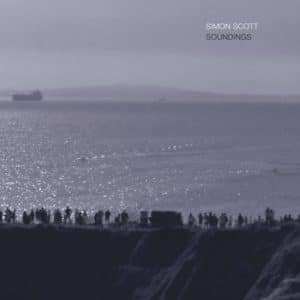
Soundings, his debut studio album for Touch (he previously released the live album 'Floodlines' in 2016 and re-issued "Below Sea Level" in 2017), finds Simon Scott, the composer and sound ecologist, using field recordings from various cities around the globe; modular synthesizer treatments; live strings and laptop electronics to create an album of transition and shifting time zones. The recordings were edited and composed in hotels rooms across the world as Scott was constantly on tour as the drummer for Slowdive, who successfully reformed in 2014.
Hodos, the album opener, begins with 85 mph Storm Barney recordings, ending with the fading sounds of bellbirds and cicadas recorded in Brisbane 2018. "I took a home recording I made of Storm Barney in Cambridge, listening to it on repeat when I was flying from continent to continent. I wanted this to be the starting point of the process of musically documenting how much travelling I was doing". This album was created from the US to Asia, South America to Europe and the Arctic Circle back to the UK via California. "Working in hotel rooms and on flights, listening to and editing the recordings I'd made from all of these distant cities formed the basis of the album. It's the soundtrack to four years of my life in flux with constant change, jet lag, excitement and the seeming perpetual motion of travelling".
All tracks composed by Simon Scott
Strings played by Charlie Campagna & Zachary Paul
Artwork & photography by Jon Wozencroft
Mastered by Denis Blackham
12,50€
In stock
2 CD
LE UN ENSEMBLE
“Ville sauvage”
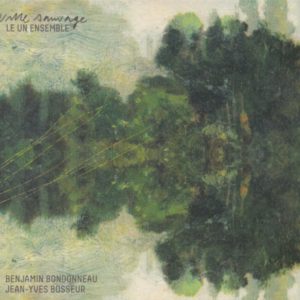
Wild Town - This project was inspired by « La pensée sauvage » de Claude Levi-Strauss.
CD1 : « On the 29th of September, a concert took place at the Manufacture Atlantique in Bordeaux with a piece I designed for the ensemble « UN » with Benjamin Bondonneau's artistic collaboration. Earlier, 24 solos that were induced as an independant series of events in various places in Bordeaux at different times of the day, chosen by the musicians and programmed from June to August 2017. Successive events gave birth to in situ recordings. Following this start-up phase, the September concert September brought together most of the participants and elaborated acoustical features to the 24 unique situations. This encouraged all sorts of interactions and grouping within the ensemble. Indeed, each sequence was polarized on a register, an intrumental family, a type of sound production... very different levels of perfomance were thus acheived. Acting just like a memory, fragments of the 24 solos were injected in the concert. Wild Town consist of two parts that follow smoothly. The first part, the longest one matches a diurnal world in a swarming sound movement. Bordeaux appeared as fragmented and seemed to go back to its natural state. The second part shows a disapering reality. A nocturnal dimension increases meditating, listening and silence.
CD2 : All the sound material was made available to the ensemble for a series of white cards, and the second album was created, orchestrated by the "sound engineer" Loïc Lachaize. We can listen to the proposals of Mathias Pontévia, Christophe Ratier, Guillaume Laidain, Stephane Torré-Trueba, Julia Hanadi, Bruno Laurent. »
Julia-Hanadi Al Abed : electronics ; Tanguy Bernard : sousaphone ; Benjamin Bondonneau : clarinet ; Patrick Charbonnier : trombone ; Paolo Chatet : trompet ; David Chiesa : electric piano frame ; Thomas Lachaize : saxophones ; Loic Lachaize : sound ; Juliette Lacroix : cello ; Delphine Lafon : voice ; Guillaume Laidain : analog synthesis ; Didier Lasserre : snare drum and cymbals ; Bruno Laurent : double bass ; Johann Loiseau : flutes, small percussions, theremin ; Johann Mazé : drume ; Mathias Pontevia : drums ; Christophe Ratier : bass clarinet ; Jean Marc Reilla : analog synthesis, electronics ; Julia Robin : double bass ; Jean Rougier : double bass ; Frédéric Roumagne : electric guitar ; Ian Saboya : electric guitar ; Claude Saubole : acoustic guitar ; Julien Sellam : violin ; Stéphane Torré-Truéba : indian harmonium indien, voice.
17,00€
In stock
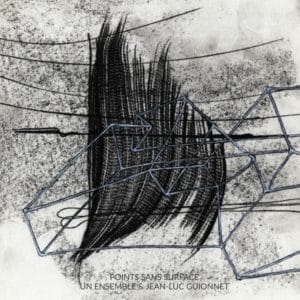
CD
UN ENSEMBLE & JEAN-LUC GUIONNET
“Points sans surface”
Points sans surface is a composition by Jean-Luc Guionnet for the Un Ensemble, a large ensemble created in 2012 under the direction of David Chiesa.
The piece includes a sound system for 25 musicians and 8 speakers.
It is also a visual experience generated by light. The general device consists of an acoustic and electroacoustic spatialization of sound. The audience is surrounded by musicians and speakers. Each instrumentalist is picked up by a microphone connected to a mixing console offering the possibility of amplifying these sources and broadcasting them again, according to the needs of the room. The sound then takes on a three-dimensional dimension: an acoustic distance (musicians), a proximity (loudspeakers), a verticality (musicians and loudspeakers are placed at different heights). Jean-Luc Guionnet indicates partition positions, and sometimes shouts them out. The musicians throw diagonals, correspondences, throws towards the walls, the floor, the ceiling. Sometimes, we perceive blocks or, on the other hand, lost solos. Beyond the autonomies of play, timbres and tempo, an indescribable feeling of sound invasion of the air settles in, disappears, returns, we hear like an orchestra that would scrap with another, elsewhere.
Julia-Hanadi Al Abed : electronics ; Laurie Batista : voice ; Tanguy Bernard : sousaphone ; Benjamin Bondonneau : clarinet ; Christophe Cardoen : lights ; Patrick Charbonnier : trombone ; Eric Camara : double bass and viola ; Paolo Chatet : trompet ; David Chiesa : electric piano frame ; Jean-Luc Guionnet : alto saxophone ; Thomas Lachaize : saxophones ; Loic Lachaize : sound ; Juliette Lacroix : cello ; Delphine Lafon : voice ; Guillaume Laidain : analog synthesis ; Didier Lasserre : snare drum and cymbals ; Bruno Laurent : double bass ; Johann Loiseau : flutes, small percussions, theremin ; Johann Mazé : drume ; Mathias Pontevia : drums ; Christophe Ratier : bass clarinet ; Jean Marc Reilla : analog synthesis, electronics ; Julia Robin : double bass ; Jean Rougier : double bass ; Frédéric Roumagne : electric guitar ; Ian Saboya : electric guitar ; Claude Saubole : acoustic guitar ; Julien Sellam : violin ; Stéphane Torré-Truéba : indian harmonium indien, voice.
12,00€