
In stock
CD
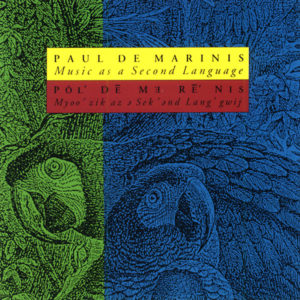
Paul DEMARINIS
“Music as a second language”
***2019 repres***
Paul De Marinis : performer-electronics. “Speech melodies extracted from sources as various as language instruction recordings, hypnotists and televangelists are resynthesized and applied to digital musical instruments, becoming eerily beautiful, "the singing of voices more ancient than language.”
15,00€
Out of stock

CD
CYANOBACTERIA & HÜBSCH
“Are You an Orchid or a Dandelion ?”
"Here's a duo called Cyanobacteria, consisting of Francesco Gregoretti (drums) and Renato Gricco (double bass), teaming up one day in September 2016 with Carl Ludwig Hübsch, a well-known improviser playing the tuba. The duo has a similar background, even when I only heard of Gregoretti before. The five tracks span fifty-two minutes and form an on-going exploration of ideas, textures and all of that within the world of improvisation. It is a meeting of like-minded people, with one foot in a more traditional field of the genre and one firmly planted in something newer. You can recognize each of the instruments pretty easily here, in all of these pieces, but at times they also sound like something completely different; especially the tuba has a dual role in this. Unlike some of the other releases on Toxo Records, this isn't as loud and noisy but with amplification and feedback, there are occasional hints towards that. There is some fine interaction between the players, leaving room for the other to act and react, and none of the players seems to downplay their own role in the overall sound. It is most of the time the sum of three equal parts playing the music and throughout it works very fine. It is mostly an intense listening experience, which doesn't allow any loss of concentration. Not on behalf of the players, nor the listeners." Vital Weekly
9,00€
In stock

CD
Bana HAFFAR
“Genera, Live at AB Salon, Brussels”
A lifelong expatriate, Bana Haffar was born in Saudi Arabia in 1987 and spent much of her childhood in the GCC. Through her switch from 10 years of electric bass, preceded by classical violin, to modular synthesizers in 2014, Bana is attempting to dismantle years of institutional conditioning in traditional systems of music theory and performance. She is interested in exploring sonic disintegration and coalescence into new forms and synthesized experiences. Bana lives in Asheville, North Carolina.
Original price was: 11,00€.6,00€Current price is: 6,00€.
In stock
CD
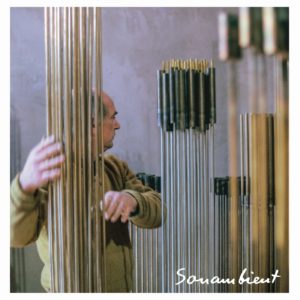
Harry BERTOIA
“Experimental I / Mechanical I”
This LP is cut straight from the original master tapes maintaining a straight analog signal path. The CD version contains a bonus track called Long Sounds.
When Harry Bertoia's Sonambient label was resurrected, our intention was to tell the story of Bertoia's groundbreaking Sonambient work as revealed through his extensive collection of notes and recordings. When the first new LP was released in 2016 we were only in possession of 1/20th of the archive. Now, in 2019, we're excited to release the first LP of new material from the full archive and we present it to increase understanding of what Bertoia was doing in his sound-barn deep in the Pennsylvania woods.
The recordings contained on this LP were selected because of their relationship to Bertoia's body of recorded work. The titles are from from Bertoia's notes which Bertoia placed in each tape box, indicating date and describing briefly. Like his sculptures, Bertoia never titled his recordings but frequently referred to specific concepts he was pursuing. These are among the earliest known examples of Bertoia using terms which would become more common in the years to come: "experimental," "mechanical" and "long sounds."
14,00€
In stock

CD
Shira LEGMANN & Michael PISARO
“Barricades”
This album contains LA-based composer Michael Pisaro's recent composition 'Barricades,' a 63-minute piece for piano and electronics. Consisting of thirteen studies (piano pieces, some with electronics) and two electronic interludes, the piece is performed by Israel-based pianist Shira Legmann, with Pisaro on electronics.
"Barricades has a distant but decisive relationship to the keyboard music of Louis and François Couperin. The title refers to 'Les Barricades Mystérieuses' by François Couperin – and to the technique of overlapping, interlocking voices, creating a thicket or web-like texture. I have loved the music of the Couperins since college, but it was when Shira sent me some of her favorite music to play, and 'Les Barricades Mystérieuses' was among the scores, that the idea for this piece began to crystallize. The process of writing and working on the piece with Shira was one of watching the barricades, which I pictured as a network of twisted vines, unravel." (Michael Pisaro)
15,00€
Out of stock

CD
Reinier VAN HOUDT & Bruno DUPLANT
“Lettres et Replis”
"This album contains six pieces written by French composer/artist Bruno Duplant, all composed and realized by Dutch pianist/composer Reinier van Houdt. Duplant's scores 'Lettres (pour Reinier van Houdt)' (2017) are three letter-form scores personally addressed to van Houdt containing letter sequences distributed across the page. 'Trois replis d'incertitude' (2018) are also three letter-form scores but with the notion of 'repli' (meaning 'fold' in a Deleuzian postmodern baroque sense as well as 'withdrawal' of incertitude and reactionaries toward the neglect of ecology, humanism, and culture). Duplant's scores also reflect Mallarmé's notion of textual space and chance, leaving a large room for the interpreter/performer."
15,00€
Out of stock

CD
Melaine DALIBERT
“Cheminant”
"This is French composer/pianist Melaine Dalibert's third solo piano album, following his well-received 2018 album 'Musique pour le lever du jour' (elsewhere 002) and 2017 album 'Ressac' (at111). 'Cheminant' contains a diverse array of Dalibert's unique compositions for solo piano, ranging from the up-tempo rhythmic 'Percolations' performed masterfully by Dalibert's right hand, to the slow, prolonged meditative 'Music in an octave' and 'Cheminant', to the kaleidoscopic 'Étude II' with the repetitive hammered chords, and lastly his latest piece 'From zero to infinity' dedicated to post-minimal composer Peter Garland."
15,00€
In stock

CD
JUNG AN TAGEN
“Proxy State”
CD version. On Proxy States, his third release on Editions Mego, Jung An Tagen continues to expand his unique vision of oblique electronic music mixed with future dance club sound. On Proxy States techno is evolving into another realm, manifesting as his most formulated attempt to combine modern composition techniques with ritualistic techno aesthetics. Here he takes his obsession with structure to a more narrative build-up, creating new paths and textures around his infectious beats. With this structure, Jung An Tagen develops an emotional relationship between repetition and dissonance -- it's addictive music, music in constant explosion. The 12 seconds of the first track, "Spill (False)" sound like a recreation of The Big Bang, creating the perfect intro for this molecular polyrhythmic adventure. It also creates the connection/disconnection with his previous work, Agent Im Objekt (EMEGO 248LP, 2018), bridging the two but also creating a space to embark on a new sonic trip. This self-contained explosion offers the right coordinates and propels the listener to Jung An Tagen's sonic realm. All of this is done with his usual fearless but mindful approach. His unique exercises with structure, time and sound create an ecstatic familiarity with the sounds while at the same time inducing a creeping physical alienation. In other words, some parts may be rhythmically infectious, others will give you no chance to immerse. The stimulation is astute and continuous, encouraging an out-of-this-world experience. The main arc of Proxy States consists of a 16 against 17 poly-rhythmic synth line that through different intonations of the kick drum always transforms its syntax. This synth line always scales up 1 key, in the middle of the track, foreseeing the upcoming structure. While these tracks (3, 4, 5, 6: "Wreath Products") follow an almost obsessive-compulsive order, the remaining tracks seem to blow up the structure entirely like the last scenes of the 1970 Michelangelo Antonioni's film Zabriskie Point, creating an event inside the event. Proxy States was impossible to press on vinyl but the fast, sharp and wild grooves of Jung An Tagen's new album are incredibly synched with the concept of an ever accelerating future.
Original price was: 14,00€.7,00€Current price is: 7,00€.
Out of stock

CD
Oren AMBARCHI
“Simian Angel”
Oren Ambarchi - guitars & whatnot
Cyro Baptista - percussion & voice
After a trilogy of spectacular explorations of relentlessly driving rhythms – Sagittarian Domain (2012), Quixotism (2014) and Hubris (2016) – Simian Angel finds Oren Ambarchi renewing his focus on his singular approach to the electric guitar, returning in part to the spacious canvases of classic releases like Grapes from the Estate while also following his muse down previously unexplored byways.
Reflecting Ambarchi’s profound love of Brazilian music – an aspect of his omnivorous musical appetite not immediately apparent in his own work until now – Simian Angel features the remarkable percussive talents of the legendary Cyro Baptista, a key part of the Downtown scene who has collaborated with everyone from John Zorn and Derek Bailey to Robert Palmer and Herbie Hancock. Like the music of Nana Vasconcelos and Airto Moreira, Simian Angel places Baptista’s dexterous and rhythmically nuanced handling of traditional Brazilian percussion instruments into an unexpected musical context. On the first side, ‘Palm Sugar Candy’, Baptista’s spare and halting rhythms wind their way through a landscape of gliding electronic tones, gently rising up and momentarily subsiding until the piece’s final minutes leave Ambarchi’s guitar unaccompanied. While the rich, swirling harmonics of Ambarchi’s guitar performance are familiar to listeners from his previous recordings, the subtly wavering, synthetic guitar tone we hear is quite new, coming across at times like an abstracted, splayed-out take on the 80s guitar-synth work of Pat Metheny or Bill Frisell. Equally new is the harmonic complexity of Ambarchi’s playing, which leaves behind the minimalist simplicity of much of his previous work for a constantly-shifting play between lush consonance and uneasy dissonance.
Beginning with a beautiful passage of unaccompanied percussion dominated by the berimbau, the side-long title piece carries on the first side’s exploration of subtle, non-linear dynamic arcs, taking the form of a gently episodic suite, in which distinctive moments, like a lyrical passage of guitar-triggered piano, unexpectedly arise from intervals of drifting tones like dream images suddenly cohering. In the piece’s second half, the piano tones becomes increasingly more clipped and synthetic, scattering themselves into aleatoric melodies that call to mind an imaginary collaboration between Albert Marcoeur and David Behrman, grounded all the while by the pulse of Baptista’s percussion. Subtle yet complex, fleeting yet emotionally affecting, Simian Angel is an essential chapter in Ambarchi’s restlessly exploratory oeuvre.
Recorded by Randall Dunn, Joerg Hiller, Iuri Oriente and Oren Ambarchi.
Edited by Joerg Hiller and Oren Ambarchi at Choose Studios, Berlin.
Mixed by Joe Talia and Oren Ambarchi at Good Mixture, Tokyo.
Cut by Rashad Becker at D&M, Berlin.
Executive Producers: Konrad Sprenger & Dick Wolf.
Photography by Traianos Pakioufakis.
Design by Lasse Marhaug.
Original price was: 14,00€.8,00€Current price is: 8,00€.
In stock

CD
Lee RANALDO / Jim JARMUSH / Marc URSELLI / Balázs PÁNDI
New York based producer Marc Urselli had the idea to bring people together who had never met before and let that meeting of minds create beautiful soundscapes. Film director and musician Jim Jarmusch, Sonic Youth co-founder and guitarist Lee Ranaldo shared space with versatile drummer Balázs Pándi for a night session at Urselli's EastSide Sound studio in downtown NY.
These are the unfiltered results. Absorbing instrumental patterns of cinematic sounds and improvised rhythms. No overdubs, no editing. All was recorded live and analog, produced and mixed by Marc Urselli. The front/back coverfotos were taken by photographer William Semeraro in Norway. That is why Marc Urselli gave all the songs titles inspired by Norwegian mythology.
15,00€
In stock

CD
SCHLEEMM
s/t
« Schleem, appearing here as Lucien Schléèmm and Mister Schléèmm, happens to be one of the four members who make up Micro_Penis, whose nightmarish records have been causing nuits blanches in the house of Sound Proj for many years now. Of course Schleem appears there under his real name of François Heyer, not that that’s much of a comfort under the circumstances. Confused so far? Well, the name-changing strategy is profoundly effective; just ask Xentos Jones, who may or may not be Jim Welton as well as L. Voag and Amos from Amos and Sarah. Indeed the parallels between these Ogrob projects and those incredibly strange post-punk records from the It’s War Boys label is something we really must consider and discuss in more depth some time.
[…]
One of the few contemporaries I can think of who approaches this high degree of dementia would be Kommissar Hjuler, but even he sounds mannered and “arty” compared to the raw vitality of this record. This unprocessed quality is what endears me to many of these Borgo related projects, even if they seem like marginal outliers and the surface may be incredibly repellent; you get a fierce honesty and truth that is hard to find in today’s world of over-mulched culture. If you too are fed up of pabulum, check in here for four pounds of fresh red meat. » (thesoundprojector.com)
12,50€
In stock

CD
David JACKMAN
“Herbstsonne”
A new work by David Jackman (Organum), Herbstsonne consists of a single 47 minutes long track which is the result of recording sessions at RMS Studios South London in 2018. Using the sounds of tanpura, piano, organ and bells the music perfectly captures the title of the piece which translates to Autumn Sun.
[…] « 'Herbstsonne' is one long piece and sounds very spooky. The tanpura drones are in the background, along with, I assume, the organ, and on top, there is the regular bang on the piano and bells. Five times these bangs are louder, like a small cluster of bells and piano tones; the drones continue throughout. It sounds like a funeral march, slow and solemn, a slow march towards the grave, and as such it fits the requiem themed releases of the last years ('Amen', 'Sorow', 'Omega', 'Sanctus' and 'Raven'; all actually under the banner of Organum) and 'Herbstsonne' is no different. Before I already talked about Jackman's advancing age and all of this is perhaps to be seen as a very long farewell soundtrack. That is also one of the big mysteries in the work of David Jackman. I can imagine people going 'oh it's the bloody same thing over and over again', but I like the sheer consistency of it all. It is the same and yet it is also very much different. This is another piece of very sad music and I love it. » (Vital Weekly)
14,50€
Out of stock

CD
Nikos STAVROPOULOS
“Micro-lieux”
Nikos Stavropoulos (Athens, Greece, 1975) is a composer of predominantly acousmatic and mixed music. He read music at the University of Wales (Bangor, Wales, UK), where he studied composition with Andrew Lewis and completed a doctorate at the University of Sheffield (England, UK) under the supervision of Adrian Moore.
His music is performed and broadcast regularly around the world and has been awarded internationally on several occasions. His practice is concerned with notions of tangibility and immersivity in acousmatic experiences and the articulation of acoustic space, in the pursuit of probable aural impossibilities.
Since 2006, he has been a member of the Music, Sound & Performance Group at Leeds Beckett University (Leeds, England, UK), where he is a Reader in Composition and lectures on Electroacoustic Music. He is a founding member of the Echochroma New Music Research Group, a member of the British ElectroAcoustic Network (BEAN) and the Hellenic Electroacoustic Music Composers Association (HELMCA).
« Topophilia » (2016), « Karst Grotto » (2017), « Granicus » (2016), pour percussions et support (avec Alexander Pepelasis, percussions), « Ballistichory » (2015), « Nyctinasty » (2009), « Atropos » (2003), « Granatum » (2011), « Polychoron » (2007).
13,00€
Out of stock

CD
Annie MAHTANI
“Racines”
Annie Mahtani (UK, 1981) is an electroacoustic composer, sound artist and performer working and living in Birmingham (UK). She studied with Jonty Harrison at master’s and doctoral level at the University of Birmingham, completing her PhD in 2008.
Her output encompasses electronic music composition from acousmatic music to free improvisation. As a collaborator, Annie Mahtani has worked extensively with dance and theatre, and on site-specific installations. With a strong interest in field recording, her work often explores the inherent sonic nature and identity of environmental sound, amplifying sonic characteristics that are not normally audible to the naked ear. Her music explores abstract and recognizable sound worlds and all the spaces in between. Annie works extensively with multichannel audio both in fixed medium works and in live performance.
« Past Links » (2008), « Round Midnight » (2010, 18), « Inversions » (2015), « Aeolian » (2015-16), « Racines tordues » (2019).
13,00€
In stock

3 CD
COMPILATION
“Changez Retravaillé”
Changez Les Blockeurs has attained a somewhat mythical / legendary status (Record Collector magazine included it in a list of the rarest, most collectable records ever) and 2017 was the 35th anniversary of its original release. In celebration of this, TNB invited some of their favourite artists to compose a reworking which have been issued collectively as Changez Retravaillé (Changez Reworked.)
Nurse With Wound, Philip Sanderson (Storm Bugs), Mark Durgan (Putrefier), Phil Julian (Cheapmachines), The Prestidigitators, Anomali, Spoils & Relics, Asmus Tietchens, Ralf Wehowsky (a.k.a. RLW), Das Synthetische Mischgewebe, Kommissar Hjuler, Rudolf Eb.er (Schimphluch Gruppe), Frans de Waard (QST), Jerome Noetinger, Giancarlo / Massimo Toniutti, Alexei Borisov, TNM, Thurston Moore, Jim O'Rourke, GX Jupitter-Larsen (The Haters), John Wiese, Idea Fire Company, Irr. App. (Ext.), Merzbow, K2, Toshiji Mikawa (Incapacitants), Kazumoto Endo, Nobuo Yamada, Daisuke Suzuki, Veltz.
Nurse With Wound open the Changez Retravaillé compilation, 30 tracks over three CDs. Consistent with their efforts to forge links with the global Noise community, and indeed a strong influence on it, it’s fair to think of this as a gathering of TNB’s peers. Most people in the market for this could have predicted the appearance of Mark Durgan (Putrefier), Rudolf Eb.er (Schimpfluch Gruppe), GX Jupitter-Larsen (The Haters), Merzbow et al. Durgan submits a rather invigorating aural firework display; Anomali and QST (Frans de Waard)’s Techno leanings feel considerably bolder than noise remixed as noise. With that said, harsh noise tornados like that served up by K2 can still rattle your senses. The Wire
30,00€
In stock

CD
Fred GALES
“Het Jacoba Prieel”
Originally released on tape by Sound Reporters in 1986. Het Jacoba Prieel is a very weird compendium of imaginary soundscapes, in which every coordinate seems lost and totally deviated. Fred Gales, in collaboration with Walter Maioli and Pit Piccinelli, presents his idea of a concrete organic music, a diary of signals and sound impressions inspired by the great tradition of primitive music, an extreme investigation of love on the primordial beauty of sound expression. Travelling into the properties of all matter of the sonic environment, the members of the legendary Sound Reporters generate, transform, mix, filter and modulate natural and electronic sounds in the magical analogical studio of the Utrecht Institute of Sonology. From a single movement of sound fragments are opened catalyst flows and circuits, flickering sequencers and oscillations of luminous channels. Futuristic tribalism, hypnotic fossil percussion, alien sounds, dreamlike trips in the jungle, echoes of rustling and rumbles otherworldly, rain waterfalls and shells in the pond, calls of animals and insects, heart beats and radar waves. Everything is just pure sound and surrounds us.
16,00€
In stock

CD
COMPILATION
“Ethnoelectronics”
Originally released on tape by Sound Reporters in 1986. Ethnoelectronics is a further episode of pioneering fusion between ethnic and electronic music, involving dauntless explorers such as Walter Maioli, Nirodh Fortini, Fred Gales, Raffaele Serra, John Zandijk and the visionary sculptor Edward Luyken. As the soundtrack of an obscure science-fiction saga, the six parts of these recordings retain something profoundly osmotic and sidereal. In these hybridizations, it's the heart of personal spiritual cosmos and stratospheric portals to pulse, but always remains the devotion to wild nature and ethnographic differences. In this way, the sinusoidal movements of electronic synthesizers and radiophonic frequencies interact with the pounding sounds of the jungle, with frogs, sea waves, buzz insects, leaves and rain. From flutes, rattles, steel sound sculptures or rustling idiophones, mysterious samples appeared like weird interferences, with rhythms and ritual voices from Tibet, West Papua, Burundi, Tahiti or the shamanic Japan of the Ainu.
16,00€
Out of stock

CD
Bertrand DENZLER
“Arc”
Arc is a Bertrand Denzler's composition performed by string ensemble CoÔ.
Founded by Félicie Bazelaire, CoÔ is a string ensemble bringing together string players of ONCEIM (Orchestre des Nouvelles Créations, Expérimentations et Improvisations Musicales, created and directed by Frédéric Blondy). CoÔ aims to build new directions in instrument research, and create a new repertoire for bowed strings. Félicie Bazelaire works with musicians who are composers and improvisers such as saxophonist Bertrand Denzler with this composition Arc.
The fruitful collaboration between musicians and composer helps to organize new ways of playing, and produce minimalist and innovative forms. Score gives priority to specific techniques applied to bowed strings, allowing musicians to experiment rich material, and focus on collective sound potentials.
CoÔ: Patricia Bosshard violin, Cyprien Busolini alto, Elodie Gaudet alto, Anaïs Moreau cello, Félicie Bazelaire double bass, Benjamin Duboc double bass, Fred Marty double bass.
Recorded on may 2018.
10,00€
In stock

CD
James ANDEAN
“Assemblance(s)”
James Andean is active as a composer and performer in a range of fields, with primary interests including acousmatic music and improvisation. He is a founding member of several groups and ensembles, including Rank Ensemble, LOS Duo, and VCA. He has degrees from McGill University in Montréal (Québec) and the Sibelius Academy in Helsinki (Finland), and is a lecturer at the Music, Technology and Innovation — Institute for Sonic Creativity of De Montfort University in Leicester (England, UK).
His work has been recognized by the Prix biennal Presque rien (France), Lumen Prize (England, UK), MADATAC (Muestra de Arte Digital Audiovisual y Tecnologías Avanzadas Acontemporáneas, Spain), Sonic Arts Award (Italy), and Destellos Electroacoustic Composition Competition (Argentina).
« Déchirure » (2013), « Hyvät matkustajat » (2012, 14), « Valdrada » (2018), « Psygeío » (2013-14), « Spores » (2014), « Maledetta » (2011), « Medusan Torso » (2010-11), « Between the Leaves » (2012).
13,00€
Out of stock

CD
Sophie DELAFONTAINE
“Accord ouvert”
Studied acousmatic composition at the Conservatoire royal de Mons / Arts2 — École supérieure des arts (Mons, Belgium) with Annette Vande Gorne, Philippe Mion, and Ingrid Drese. She obtained her master’s degree in 2014. In her practice of composition, Sophie Delafontaine likes to recover, recycle, and renew her sonic materials. Her acousmatic works are strongly influenced by her creations for dance and the theatre. She draws inspiration from the ambience, atmospheres, texts, stories and characters found in the various shows for which she makes music.
« Ondiésop » (2015), « Respire marche pars va-t-en » (2013), « Dormir, aujourd’hui » (2018), « Ressort spiral » (2014-16), « Creux-du-Van » (2014), « Tout ça à cause de Junon » (2013).
13,00€
Out of stock

LP + CD
eRikm – Anthony PATERAS
“Albédo”
eRikm : CD-J, Idiosyncrasie system / Anthony Pateras : synth, sampler.
In Autumn 2017, eRikm and Anthony Pateras embarked on an acoustic encounter, a direct dialogue through their machines. Each brought their own experiences and know-how together with a shared desire to explore sound landscapes in complete freedom. From this meeting, Albédo was born. Their material was developed sometimes in the studio, sometimes in concert. This dialogue, articulated within the unpolished depths of the sound’s structure, is captured in Albédo with one side recorded live in Ljubljana and the other in the CCAM studio in Vandoeuvre.
23,00€
Out of stock
LP + CD
Anthony LAGUERRE
“Myotis”
About the release : In Myotis, Anthony Laguerre goes beyond rhythm using improvisation and a free approach as main technical support of invention. In a research based on rhythm and sound material around drums, he expresses sensitivity, softness and power thanks to expert skills and sound recording techniques. The union of these materials create songs made of multiple tones combined with percussions and occasionally harmonica.
About the artist : Anthony Laguerre is a versatile musician, composer, improviser and sound engineer. Growing up listening to modern music such as noise, rock and improvised music, developed his taste for electronics and sound techniques and compeled him to become a studio and live show recording engineer. His work as a musician is based on sound treated as music. The combination of his influences led him to work on audio forms, mixing harmonies and sound materials. His proclivity for produceing developed over the years now allows him to be autonomous in his productions and thus to deepen the research between sounds and music. Anthony collaborates with G.W. Sok, Jérome Noetinger, Isabelle Duthoit, Eric Thomas, Guigou Chenevier, Michel Deltruc and many others.
23,00€
In stock

CD
HELM
“Chemical Flowers”
Luke Younger returns to PAN with an eight-track album of his most direct work to date.
Composed alone at NO studio in the Essex countryside, to start an album with a piece called ‘Capital Crisis (New City Loop)’ seems an intentional misnomer. Long, sustained periods in the rural studio setting see Younger working with an array of fragmented, disassociated sound sourcesto build upon 2015’s ‘Olympic Mess’. It shares a similarly inclined vision of the urban environment, but here ‘Chemical Flowers’ makes reference to paradoxical notions of authenticity and creative practice by way of questioning the structures around us.
Collages are assembled and dismantled, temporal and spatial boundaries fluctuate and movement is an overarching theme. Surrealist drowned world atmospheres sculpted far enough away from the source of inspiration leave plenty of room for ambiguity. The nocturnal nature of the recording process is self-evident, and pieces like ‘Leave Them All Behind’ tap into a deep psychedelic undercurrent. Confused narratives, emotions and aleatory hallucinations ebb and flow throughout. ‘I Knew You Would Respond’ evokes murky soundtrack terrain with eerie repetitive strings and ambient respite, disrupted periodically by brief bursts of granular noise. It’s one of the records most unnerving moments, possibly as it’s one of the most recognisably human.
The album navigates dense passages with recurring signifiers. Hollow percussion, modulating delay and curious field recordings come and go, maintaining a perpetual state of flux where nnothing stays the same for long. The drowned world theatricals return on the swamp-like ‘Lizard in Fear’ whilst string rhythms creep in on the penultimate track to incite momentary electroacoustic harmony. Floating synthesis slowly washes over and the title track unfolds - five minutes of reverb-laced portamento, visions of decay and Editions EG influenced world-building. ‘Movement is key’..
12,50€
In stock

CD
Sholto DOBIE & Mark HARWOOD
“The Blue Horse”
Sholto Dobie is an artist and performer born in Edinburgh and living in London. His solo output is marked by live performances that are characteristically delicate, evocative and absurd. He uses his own instruments, crudely assembled from materials such as reeds, whistles, bin bags, fans and air compressors, alongside loose performative structures, to respond to places and situations. He plays in Al Fresco (with Lia Mazzari & Tom White) and regularly collaborates with Ben Pritchard, he has also worked with Ashley Paul. He continues to run the event series Muckle Mouth which he founded in 2014. Mark Harwood is a musician and performer born in Ferntree Gully and living in London. His output veers towards uncanny audio both delicate and unsettling whilst his performances rely on teasing out and playing with the mood embedded within any given environment and audience situation. He has collaborated with Graham Lambkin, Aine O’Dwyer, Timo Van Luijk and MP Hopkins and runs the Penultimate Press label which brings forth this very release.
The Blue Horse is a beautiful strange journey through a landscape where little is familiar but all are welcome. Made from predominantly acoustic sources, The Blue Horse gracefully hisses, puffs, wheezes, whirls, and clunks it’s way through a series of distinct musical and non musical environments. Sounding both at times like a dark and stormy night… and “an elephant trying to get laid”, the ambiguous style of The Blue Horse conceals the artists’ unsettling, fantastical and quietly humorous sensibility. Whilst The Blue Horse lacks any obvious precursors, it’s elemental and environmental leanings potentially tread a path initially mapped out by Moniek Darge and Godfried-Willem Raes in the works coming out of the Logos Foundation in Ghent, Belgium in the mid 80’s. The Blue Horse is the debut recording from Sholto Dobie and Mark Harwood and features a guest appearance from cellist Judith Hamann.
Original price was: 10,50€.6,00€Current price is: 6,00€.
In stock

CD
Michael RANTA
“Yuen Shan”
16 track composition for pre recorded sounds and live percussion performed by Michael Ranta (entirely different work from the Yuen Shan CD released in 2005).
All material previously unreleased.
Yuen Shan (Round Mountain in Chinese) was conceived in 1972 and finalized in 2014. It’s a musical cosmogony in four cycles based on different levels of ancient Asian spiritual principles and mechanisms. A major work in Ranta’s oeuvre (his first solo release in almost 25 years), highly personal and spiritual.
12,50€
Out of stock
CD
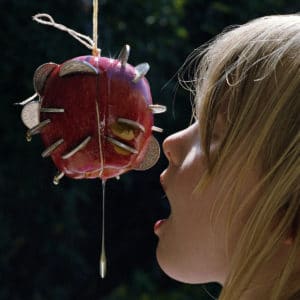
PUCE MARY
“The Drought”
"Bringing together introspective examination with literary frameworks by writers such as Charles Baudelaire and Jean Genet, Puce Mary’s compositions manifest an ongoing power struggle within the self towards preservation. The traumatised body serves as a dry landscape of which obscured memories and escape mechanisms fold reality into fiction, making sense of desire, loss and control. The Drought presents both danger and opportunity; through rebuilding a creative practice centred on first person narrative and a deliberate collage of field recordings and sound sources Puce Mary injects an acute urgency across the album seeking resilience. "
12,50€
Out of stock
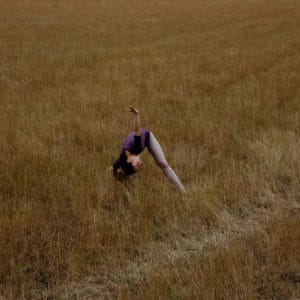
CD
Tujiko NORIKO
“Kuro (OST)”
"Composed and recorded during the editing of the film in Berlin, the Kuro OST by Tujiko Noriko (with contributions from Joji Koyama, Sam Britton and Will Worsely), is a crucial and integral part of the film, acting not only as a glue to bind the layers of the film together, but along with the sonic palette of the film’s sound design, evokes it’s claustrophobic atmospheres and moments of haunting beauty.
I tried to think of the pieces in abstract terms, like moods and atmospheres. In a way, the process was quite similar to how I usually make music, in the sense that I have images in my head. Of course in this case there were actual images and a lot of them very close to me, but I didn't want to get overly conscious about them either—I didn't want to get stuck by trying to be too specific."
-Tujiko Noriko
12,50€
In stock

CD
LE UN ENSEMBLE
“The Coast”
The UN Ensemble is performing « The Coast » by Lionel Marchetti, « 3LS4 » by Mathias Pontevia, « Canicule » and « Attentats » by David Chiesa.
With Julia-Hanadi Al Abed, electronics, Tanguy Bernard, sousaphone, Eric Camara, viola da gamba, Patrick Charbonnier, trombone, Paolo Chatet, trumpet, David Chiesa, electric piano frame, Anouck Genthon, violin, Thomas Lachaize, saxophones, Loic Lachaize, sound, Juliette Lacroix, cello, Delphine Lafon, voice, Guillaume Laidain, analog synthesis, Bruno Laurent, double bass, Johann Loiseau, flutes, small percussions, Johann Mazé, drums, Jean-Luc Petit, contrabas clarinet, Mathias Pontevia, percussions, Jean Marc Reilla, analog synthesis, electronics, Julia Robin, double bass, Jean Rougier, double bass, Frédéric Roumagne, electric guitar, Ian Saboya, electric guitar, Claude Saubole, acoustic guitar, Julien Sellam, violin, Stéphane Torré-Truéba, indian harmonium, voice.
12,00€
Out of stock
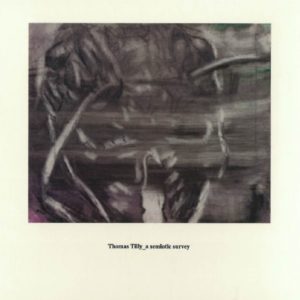
CD
Thomas TILLY
“A Semiotic Survey”
Limited to 200 copies. Field recordings made by Thomas Tilly at Saül and on the Rorota road, French Guiana, May 2015. Composed using field recordings, electronic sounds and microphones dysfunctions, from 2015 to 2018 by Thomas Tilly.
10,50€
Out of stock
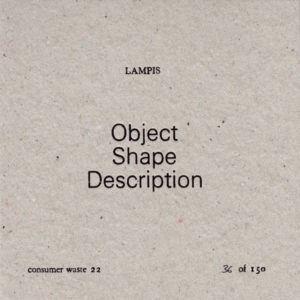
CD
Marco LAMPIS
“Object Shape Description”
Object Shape Description is the debut recording by Brussels based Italian artist Marco Lampis. Lampis works between the visual and auditory disciplines, creating installations both with and without sound, in which discrete sensory perceptions become entangled. How might we understand sound through sight or be able hear by looking? This collection of recordings is inspired by the rhetorical figure of Ekphrasis in which a visual artwork is described verbally. Here, Lampis uses experimental voice process akin to echo location to describe using disjointed phonemes the shape of various vases. Dense clouds of fragmented annunciations ricochet between subject and object.
The CD is released in an edition of 150 in an oversized 7” sleeve accompanied by a 12 page risographed booklet featuring drawings and 3D scans by Lampis, an essay by Elena Biserna, and a letterpressed backpanel.
14,50€
Out of stock
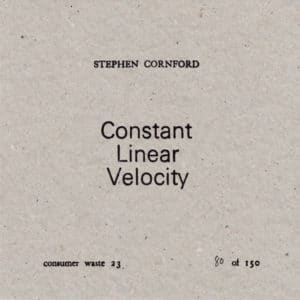
CD
Stephen CORNFORD
“Constant Linear Velocity”
This CD features recordings of a now lost sculptural work that was originally commissioned in 2016 for Colour Out of Space festival. The work consists of over 100 empty computer cases, fitted with 16 customised and automated DVD drives. Between 2016 and 2018 it was exhibited in Brighton, Athens, Croydon, Oxford and Rennes, on each occasion being reconfigured into a new form. The most ambitious of these being at Detritus Festival in 2018, where a new and larger version of the work was constructed at the Onassis Cultural Centre from used computer sourced in the city. The work was sadly lost in transit between France and the UK, returning to the global trade in e-waste which its production initially sought to intervene in, so all that remains are these recordings.
The CD is released in an edition of 150 in an oversized 7” sleeve accompanied by a 16 page risographed booklet featuring photographs and scans of the sculpture, essays by Danae Stefanou and Stephen Cornford, and a letterpressed backpanel.
14,50€
Out of stock

2 CD
COMPILATION
“Troum Transformation Tapes: The 20th Anniversary Celebration (1997-2017)”
For the 20th anniversary of the band, TROUM invited friends and admired artists from their own history to cover, re-interpretate, re-process, collage, morph or just being inspired (by) any TROUM basic material; after one year of collecting masterial the result is a unique compilation of 19 tracks with a wide range of creative approaches - much more than your standard "remix" collection. All material was exclusively recorded for this compilation ! With tracks from Contrastate, Inade, Vance Orchestra, Tarkatak, raison d'etre, Nadja, Martyn Bates, Multer, QST, Ure Thrall, Bad Sector, Cisfinitum, etc
Original price was: 11,50€.6,00€Current price is: 6,00€.