
Out of stock

CD
Bernard PARMEGIANI
“Stries”
Bernard Parmegiani (1927–2013), the grand old man of French electroacoustic music, did not write much music for tape with live performers. Among them is “Stries” for the unusual combination of three live synthesizer players and tape.
Until recently, “Stries” had not been played live for some 30 years. This is the first complete recording, only part of it had been previously released on LP on the INA/GRM label.
“Stries” was written for the three synthesizer players of the Paris-based electroacoustic trio TM+, Yann Geslin, Laurent Cuniot and Denis Dufour, founded at the INA/GRM. Over the span of the ensemble’s lifetime, TM+ used a range of different instruments — analog synthesizers in the late 1970s and early digital synthesizers in the mid-1980s — and amassed a repertoire of about 40 compositions written especially for them.
Fortunately, Yann Geslin, of the INA/GRM, archived the original score by Parmegiani, as well as the parts for the instrumentalists. Also in GRM’s archives was the original analog reel-to-reel tape for the piece, as well as the analog 8-track recordings from the recording session.
Armed with this material, the electronic music trio of Colette Broeckaert, Martin Lorenz and Sebastian Berweck, together with Yann Geslin, recreated the piece with the aim of bringing it back to the stage as well as producing generic scores that could help get the piece into the repertoire of many instrumentalists. Their work is realized on this release.
“Stries” (1980) is a work in three parts based on the tapes of Parmegiani’s “Violostries” for violin & tape from 1963. The tape part is derived completely from recordings of the violin which Parmegiani masterfully alters to create an at times extremely dense, at other times pointillist piece of music.
The first part, “Strilento,” is a piece for tape solo and can as such be played alone, while the second and third movements — “Strio” and the eponymous “Stries” — make direct usage of the old tapes and the analog synthesizers of the players.
Sebastian Berweck’s liner notes detail the reconstruction of “Stries” for both performance and this recording.
Stries (1980) for 3 synthesizers and tape 44:59
1. Strilento 17:26
2. Strio 7:31
3. Stries 20:01
Broeckaert//Berweck//Lorenz, synthesizers
16,50€
Out of stock

CD
John CAGE
“The Works for Piano 11”
Cage – Satie – Feldman – Takahashi sums up the focus of this album. All of these works by Cage are influenced by Satie. Cage’s friend and colleague Morton Feldman made an arrangement of Cage’s solo piano “Cheap Imitation” for a trio of piano, flutes/piccolo and glockenspiel. Feldman’s admiration for the pianist Aki Takahashi caused him to gift this arrangement to her. And, full circle, we have the repertoire of this album.
The major discovery is Feldman’s arrangement of Cheap Imitation for this very Feldmanesque instrumental ensemble. It is unknown why Feldman made this arrangement in 1980. Knowing of Takahashi’s reputation as a pianist specializing in new music, Feldman had invited her to be an artist in residence at the university where he taught. When she was leaving, Feldman gave a musical score to Takahashi as a gift. It was a copy of John Cage’s solo piano piece Cheap Imitation with annotations by Feldman. He told her that this was an instrumental version of this piece: flute, piano, and glockenspiel. He signed the title page, just under the original title:
Instrumental Version (Fl, Pf, Glock)
Morton Feldman
Buffalo, N.Y. Winter 1980
Dedicated to Aki Takahashi
Cage was to create a two-piano transcription of Erik Satie’s Socrate for a Merce Cunningham choreography, but he was unable to get permission from the publisher. Even worse, he could not even get performance rights to use the published piano-vocal score of Socrate. Cage’s creative solution was to make a piano piece that maintained the exact metrical and phrase structure of Socrate, but with different notes to avoid copyright issues. He called this piece Cheap Imitation. Cunningham responded by calling his dance Second Hand.
The recital is completed by three short works under Satie’s influence. Perpetual Tango is derived from the “Tango” movement of Satie’s Sports et divertissements. Cage’s method was to take the rhythm of the original tango and erase parts of it. He does not specify pitches, but instead gives the pitch ranges of the original piece. The pianist chooses which pitches to play in the rhythm given. In 1989 he applied the same procedure on another piece from Sports et divertissements, “The swing;” he titled the result Swinging.
All sides of the small stone… is a composition with a completely unknown history, derived from Satie’s Gymnopédies. All we have is a page of musical manuscript written in the back of a score of a work by American composer James Tenney with the signature “John” and the date “7/78.” The manuscript was discovered when Tenney’s papers were being organized after his death. It has been attributed to Cage, but the handwriting doesn’t look like his. Neither Cage nor Tenney — nor anyone else, for that matter — said a word about this piece, so its definitive composer will remain a mystery. Aki Takahashi gives the first recording of this unpublished work.
Liner notes by James Pritchett.
16,50€
Out of stock

CD
Horatiu RADULESCU
“Works for Cello”
L’Exil Intérieur, op.98 for cello & piano (Ian Pace, piano); Das Andere, op.49 (version for cello); Pre-Existing Soul of Then, op.76 for 2 cellos; Lux Animae, op.97 for cello — Catherine Marie Tunnell, cello
16,50€
Out of stock

CD
Morton FELDMAN
“For Bunita Marcus”
Aki Takahashi, piano.
For Bunita Marcus opens with a clear call to our attention. With these first six notes, we step over the threshold and into the journey of the piece. We know that we are in this for the long haul: Morton Feldman’s late works are notorious for being marathons. He composed For Bunita Marcus in 1985, immediately after his four-hour For Philip Guston, and two years after his six-hour String Quartet (II) These earlier works make an hour-long solo piano piece seem short. Still, it is a long time to sustain a single movement, a single journey, and we inevitably have this in mind as we take the first step: so this is how it starts.
For Bunita Marcus, like all the late Feldman works, is an adventure that takes a relatively long time to play out, but which is remarkably lacking in heaviness. We may expect an epic, but we get something much subtler. Indeed, what we get is the present moment, in all its beauty, over and over again. If we surrender to the musical image that is right in front of us, a piece like For Bunita Marcus is an easy world to enter into and to explore with Feldman. We step into the silence after that first six-note motto, and we wonder: What comes next? The next hour and a quarter is spent doing nothing more than discovering what comes next—and the next thing after that, and the next after that.
For Bunita Marcus is performed here by Aki Takahashi, one of the greatest Feldman intrepreters. After Triadic Memories, Feldman composed all his piano music for Aki Takahashi. In remarks made before the U.S. premiere of Triadic Memories, he described Takahashi as “absolutely still,” “undisturbed, unperturbed, as if in a concentrated prayer.” He found that her concentration was transmitted to the audience; a performance by her was “like a séance.” Ms. Takahashi premiered the work in Middleburg, The Netherlands in 1985. Through her performance, the journey of For Bunita Marcus is rich in color, pacing and poetry.
The cover photo of Feldman, Bunita Marcus and Aki Takahashi was taken around the time of the premiere.
16,50€
Out of stock

CD
Horatiu RADULESCU
“Works for Organ & for Cello”
Works for Organ & for Cello: Christe eleison, op.69; You-tree kalotrope III; Amen, op.88 (Christoph Maria Moosmann, organ); Intimate Rituals III, op.63 for string instrument & sound icons (Catherine Marie Tunnell, cello. Horatiu Radulescu & Petra Junken, sound icons); Immersed in the Wonder II, op.96 (Stanley Clark, trombone. Catherine Marie Tunnell, cello).
16,50€
In stock

CD
Karlheinz STOCKHAUSEN
“Kurzwellen”
Kurzwellen (1968) Premier of the new performing version by C.L.S.I. for 4 instruments, 4 shortwave radios, 6 computers, and conductor — C.L.S.I. Ensemble, Paul Mefano, conductor.
16,50€
Out of stock

CD
Joan LA BARBARA
“The Early Immersive Music of Joan La Barbara”
“as lightning comes in flashes” (1981) for 8 track tape. New 2017 stereo mix. “Autumn Signal” (1978) for 8 track tape, mixed to 4 channels. “Cyclone” (1976-77) for 16 track tape.
Joan La Barbara is a long recognized pioneer of extended vocal techniques and a champion of new music. She emerged from the New York Downtown scene to perform in the ensembles of Steve Reich and Philip Glass, including the premiere of Glass’ Einstein on the Beach. She has performed and recorded works by composers including John Cage, Robert Ashley, Morton Feldman, Philip Glass, Alvin Lucier, and her husband Morton Subotnick. Composer/Vocalist Joan La Barbara has created a rich body of experimental works, many initially produced on analog tape. This collection includes a first release of the award-winning “Cyclone”, first presented at a the ISCM World Music Days festival in Bonn, Germany in 1977. The other two works were initially issued on LP on the Wizard label, but now in new mixes. The reissues offered here remixed to her original surround concept: as lightning comes, in flashes explores a vast array of La Barbara’s signature extended vocal techniques. “Autumn Signal” is a rare example of the composer’s work with Buchla synthesizer, which she utilized for spatialization as well as modification of vocals.
For this release, fresh 96khz/24-bit transfers were made from the original multi-track analog tapes. Then all new stereo and surround mixes were then created under the supervision of the composer.
Liner notes by Bernard Gendron trace La Barbara’s beginnings in the New Music world from the early 1970s Downtown Scene and her evolution as an avant-garde vocalist and composer. In addition, La Barbara contributes detailed notes on the works.
16,50€
Out of stock

CD
George CRUMB
“Metamorphoses (Book I) (2015–17)”
“Metamorphoses (Book I)” (2015–17). First recording. Written for Margaret Leng Tan. “Five Pieces for Piano” (1962). Margaret Leng Tan, piano.
This important release couples George Crumb’s (b. 1929) earliest work for piano, the Five Pieces for Piano (1962) with his most recent piano cycle, Metamorphoses (Book I) (2017). Margaret Leng Tan has long been a champion of Crumb’s music, and he composed Metamorphoses (Book I) for her. This recording is of the German premiere at the legendary Donaueschingen Festival in 2017. Crumb’s Metamorphoses is a natural descendent of his monumental Makrokosmos I & II piano cycle of the early 1970s. With a nod to Mussorgsky’s Pictures at an Exhibition, each movement of the Metamorphoses is inspired by a famous painting. And, like the Makrokosmos, it requires the pianist to be a virtuoso not only at the keyboard but playing inside the piano and vocalizing as well. Ms. Tan is regarded as the “Diva of the Toy Piano,” and Crumb has also incorporated the toy piano and toy percussion instruments into some movements. Crumb says: “I have always been most fortunate to have had outstanding pianists who were willing to tackle the formidable technical and musical innovations in my scores. And among the very finest of these is Margaret Leng Tan for whom I wrote Metamorphoses (Book l). Margaret’s technical prowess and superb artistic sensitivity is a combination that must warm the heart of any composer!”
The CD also includes the early Five Pieces for Piano. All the components of Crumb’s mature compositional language are already evident: a broad palette of coloristic effects along with an extraordinarily sensitive command of nuance, his unmistakable musical gestures, an inherent sense of drama coupled with a magical suspenseful atmosphere and a battery of interior piano effects demanding that the pianist be somewhat of a harpist and percussionist as well. This newly remastered recording is taken from Ms. Tan’s Sonic Encounters recital on Mode (mode 15, from 1988).
Original price was: 16,00€.8,00€Current price is: 8,00€.
In stock

CD
Henry COWELL & Percy GRAINGER
“Works for Saxophones”
Percy Grainger (Australian-American) and Henry Cowell (American) were forward-looking, pioneering composers and close friends. These two men had so much in common, musically and personally, that it is almost as if they were mirror images of one another. Besides having classical training and folk music influences, both were also musical avant-gardists. They experimented with new sounds, new forms of expression, and new notational systems. Most of their saxophone pieces are either folk arrangements or original compositions inspired by British and Celtic folk music. Cowell and Grainger created a rich repertoire for the classical saxophone, but much of it is overlooked, only partially published, and therefore widely unknown until this CD.
22 works are included, 9 by Grainger, 7 by Cowell and 5 by Cowell as arranged by Grainger. Many are first recordings. They are scored for varied instrumentation : sax ensembles, sax & piano and sax & orchestra. Two works are presented in two versions, both for sax piano and sax & orchestra, performed here by the Glens Falls Symphony conducted by Charles Peltz. The uniquely scored pieces are the first recording of Cowell’s Chrysanthemums (1937), a short song for soprano & small ensemble and Cowell’s first chamber music piece featuring saxophones. It was thought to be lost but was rediscovered in 2003. Grainger’s Random Rounds (1912) is technically not a piece for saxes, but is too important a work to leave out. It is a composition for unspecified, soloistic chamber ensemble and probably the first aleatoric piece ever in the history of Western music. Written for flexible instrumentation, it is performed here by a large ensemble including 3 singers, 2 guitars, mandolin, piano, percussion, winds and strings.
Saxophonist/composer Ulrich Krieger lived and worked in Berlin since 1983, then moved to work from CalArts University. His arrangement of Lou Reed’s Metal Machine Music lead to a touring ensemble with Mr. Reed. He has recorded many records for Mode of Bryars, Berio, Cage and his own works.
Percy Grainger (1882–1961), “The Immovable Do” (1939), “Lisbon” ( 3 versions: July – low key with 3 altos; August – high key; July – low key with soprano) (1943). “Ye Banks and Braes O Bonnie Doon” (1932). “The Lonely Desert-Man Sees the Tents of the Happy Tribes” (versions with orchestra and with piano) (1949). “The Merry King” (1936-39). “Molly on the Shore” (1938). “Random Round” (1912-14/43).
Henry Cowell (1897–1965), “Air and Scherzo” (versions with piano & with orchestra) (1961). “Sailor’s Hornpipe” (1949). “Hymn and Fuguing Tune Nr.18” (1964). “Caoine” (arranged Grainger, ca.1937/38). “Sax Quartet” (1961). “60 – For Percy Grainger” (1942). “Chrysanthemums” (1937).
16,00€
Out of stock

CD
John CAGE
“Music for Speaking Percussionist”
John Cage allowed for some of his works to be combined and performed simultaneously. Percussionist Bonnie Whiting has created uniquely virtuosic solo-simultaneous realizations of some of these works for “speaking percussionist.”
“A Flower” (1950).
“51’15.657” for a speaking percussionist (2010), a solo-simultaneous realization of 45’ for a speaker (1954) and 27’10.554” for a percussionist (1956). Realization by Bonnie Whiting.
“Music for Two (By One)” (2011), a solo-simultaneous realization of “Music for _____” (1984-1987) for solo voice and solo percussion. Realization by Bonnie Whiting.
“The Wonderful Widow of Eighteen Springs” (1942)
“Connecting Egypt to Madison through Columbus Ohio, Cage, and the History of the American Labor Movement” (2011) by Allen Otte and John Cage. Incorporating Music for Marcel Duchamp and Variations 2. Allen Otte, voice, prepared piano & frame drums.
Bonnie Whiting, voice, percussion, piano.
Original price was: 16,00€.10,00€Current price is: 10,00€.
In stock

blu-ray
John CAGE
“Music for Speaking Percussionist”
John Cage allowed for some of his works to be combined and performed simultaneously. Percussionist Bonnie Whiting has created uniquely virtuosic solo-simultaneous realizations of some of these works for “speaking percussionist.”
“A Flower” (1950).
“51’15.657” for a speaking percussionist (2010), a solo-simultaneous realization of 45’ for a speaker (1954) and 27’10.554” for a percussionist (1956). Realization by Bonnie Whiting.
“Music for Two (By One)” (2011), a solo-simultaneous realization of “Music for _____” (1984-1987) for solo voice and solo percussion. Realization by Bonnie Whiting.
“The Wonderful Widow of Eighteen Springs” (1942)
“Connecting Egypt to Madison through Columbus Ohio, Cage, and the History of the American Labor Movement” (2011) by Allen Otte and John Cage. Incorporating Music for Marcel Duchamp and Variations 2. Allen Otte, voice, prepared piano & frame drums.
Bonnie Whiting, voice, percussion, piano.
The Blueray version includes full HD video for all of the works directed by Anton Cabaliero, uncompressed PCM 48khz/24-bit audio, 73 minute video interview with Whiting and Otte, discussing Cage and his processes, the works and how they assembled them.
Original price was: 28,00€.12,00€Current price is: 12,00€.
Out of stock

CD
Alvin LUCIER
“Broken line”
“Carbon Copies” (1989) for recordings “of any indoor or outdoor environment” and instrument.
“Risonanza” (1982) for resonant objects and optional electronics.
“Music for Pure Waves, Bass Drums and Acoustic Pendulums” (1980).
“Broken Line” (2006) for flute, piano & vibraphone written for Trio Nexus.
Performed by Trio Nexus (Erik Drescher, Sebastian Berweck, Martin Lorenz).
Alvin Lucier (b.1931) is the great American poet of acoustic phenomena. He has a keen sensitivity to the way objects vibrate, the way sound waves travel to our ears, and to the way our brain processes those vibrations. Trio Nexus is a Berlin based ensemble specializing in New Music.
Carbon Copies seeks the recreation on musical instruments of sounds recorded in the environment. Here, the musicians prepare the piece by making their own 15-minute recordings “of any indoor or outdoor environment.” These are then played back simultaneously. The musicians then mimick the environment which they hear on their instruments; then the recording is faded out and they continue to play via looping, or by anticipating, delaying, truncating or elongating the sounds at will.
Risonanza takes the central idea to find an object that can be excited by sound such that it responds with a sound of its own, as though becoming, in the composer’s words, a “non-breathing player,” a fourth member of the ensemble.
Music for Pure Waves, Bass Drums and Acoustic Pendulum has the concept that electronic sounds - what Lucier calls a “slow sweep oscillator” which makes a slow, continuous glissando movement - excite the skins of four large bass drums, causing them to vibrate and to set in motion extremely light pendulums suspended in front of them. As the bass drums begin to vibrate under excitation from the oscillator, the pendulums begin to swing, as if by magic, more or less actively, gently striking the drumhead in a regular rhythm.
Broken Line, written for Trio Nexus, is about as close as Lucier has ever come to writing chamber music in the traditional sense. The piece consists of a series of flute glissandi spanning the intervals of a semitone, major second and minor third respectively. Vibraphone and piano play long tones during the glissandi, creating either unisons, octaves, or fifths and twelfths against the flute lines. Because the flute tone is continuously in motion this has the effect of creating beats - audible “wah wah” patterns in the sound. These gentle rhythmic fluctuations - which appear of their own accord without the performers needing to do anything - are like the flickering of a candle in the wind.
Liner notes by Bob Gilmore.
16,50€
In stock

CD
Iannis XENAKIS
“La légende d’Eer”
“Crucial reissue of the most important, sonically devastating Xenakis electronic work (previously issued by the now defunct Montaigne label). "New stereo mix from the original master tape. La légende d’Eer is a powerful 7-channel electroacoustic composition which Xenakis created in 1977-78 to be played in ’Le Diatope,’ a curvaceous architectural construction designed by the composer, together with a visual component including laser lights. This ’multi-media’ work was composed for the opening of the Centre Georges Pompidou in Paris, where it was performed for three months and seen by thousands of people. The sound materials of a La légende d’Eer stem from three sources: instrumental sounds, noises, and electronically generated sounds. The work suggests an initial departure, a journey, and a final return. Xenakis surrounds the work with a compilation of five texts, reflecting or reacting upon each other across the distances in time, space, and culture which separate them. This new stereo mix was created by Gerard Pape -- director of Xenakis’ CCMIX studio in Paris -- from the original analog master tape. The analog master was transferred at high-resolution 96khz/24-bit sound for the optimum quality, revealing details not heard in the previous stereo CD release." Richard Scott’s review in The Wire hardly exaggerates: "It is difficult to think of another contemporary composition which carries the sheer force of ’The Legend of Eer.’ It is a gigantic, awesome, staggering piece; certainly I haven’t heard anything to touch it with electronic music’s short, if dense, history.”
17,50€
Out of stock

CD
Iannis XENAKIS
“Works with piano”
“Iannis Xenakis (1922-2001) is among the most important composers of the twentieth century. A musician, architect, engineer, he conceived his music following other criteria than those stemming from the musical tradition. He was inspired not only by mathematics and sciences but also by architecture and philosophy. For these reasons it is difficult to place his original approaches within a musical tradition.” “Aki Takahashi (piano). “Eonta” (1963) for piano, 2 trumpets & 3 trombones. The Callithumpian Consort, Stephen Drury, conductor. “Morsima-Amorsima” (1962) for piano, violin, cello & double-bass. The Callithumpian Consort, Stephen Drury, conductor. “Akea” (1986), for piano and string quartet. The Jack Quartet. “Paille in the Wind” (1992), for piano and cello. Roham de Saram, cello. Program notes (English, German, French) by Benoît Gibson.” “Play loud”.
15,00€
Out of stock
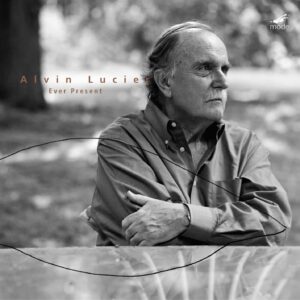
CD
Alvin LUCIER
“Ever Present”
“Piper” (2000) Matt Welch, bagpipe. Fan” (2003) Miki Maruta, Ryuko Mizutani, Kayoko Nakagawa, and Yoko Nishi, kotos. “947” (2001) Jacqueline Martelle, flute. Silver Streetcar for the Orchestra” (1988) Brian Johnson, triangle. “Ever Present” (2002) Drescher-Okabe-Armbruster Trio: Erik Drescher, flute; Akiko Okabe, piano; Sascha Armbruster, alto saxophone. Alvin Lucier’s (b. 1931) works on this CD, for solos and trios, continue to explore his unique sound world, exploration of microtones, and use of unusual instrumentation. Liner notes by the composer: “Piper is probably one of the few avant-garde pieces composed for the bagpipe. The piper is asked to walk slowly around the performance space, sounding his instrument as he does so. From time to time he detunes the chanters, creating beating patterns of slightly varying speeds and minor spatial disturbances (imaginary dopplers). In Fan, 4 koto players play a long series of plucked tones over a 12-minute time span, gradually stepping up to 4 semitones above the starting tone and slowing down to 1 beat every 2, 3, 4, and 5 seconds. As they do so, audible beating at various speeds occurs among the plucked sounds of the instruments. During the course of 947, 4 pure tones are sounded in all their combinations. As they do so a flutist sustains closely tuned long tones against them, creating audible beats at speeds determined by the distances between her tones and those of the pure waves. The farther apart the faster the beating. At unison no beating occurs. Occasionally the flutist bends her pitches a few cycles per second causing the beating patterns to slow down and speed up. In Silver Streetcar, the player dampens the triangle with the thumb and forefinger of one hand while tapping the instrument with the other. The performance consists of moving the geographical locations of these two activities and changing the pressure of the fingers on the triangles as well as the speed and loudness of the tapping. During the course of the performance, the acoustic characteristics of the folded metal bar are revealed. Ever Present is inspired by Robert Irwin’s garden at the Getty Center in Los Angeles. Tone waves in constant motion sweep up and down as the players sustain long tones across them, creating beating patterns at speeds determined by the closeness of the tunings. Four first recordings.”
15,00€
Out of stock

CD
Phill NIBLOCK
“Disseminate”
“Disseminate Ostrava” (1998) In this orchestra piece, the players read from a conventional score. There is no after-recording manipulation of the material. The recording comes from the Ostrava Days Festival in the Czech Republic, where the 41-piece Ensemble OCNM is supplemented by members of the Janacek Philharmonic. “Kontradictionaries” (1999, rev. 2003) This work was written for the KONTRA-trio. The trio (formed in 1992) of Bischof, Mejer and Bachmann concentrates on the sound of low wind instruments. The three wind contrabasses are used as sources for acoustic phenomena.
Here, the musicians recorded "samples" of the notes in a recording studio. Niblock then edited the samples, made pitch shifts of them, and combined this material in a multitrack score. There is no manipulation of the sound of the instruments, the combination of the different microtonal pitches and timbres of the instruments modifies the sound. The musicians later added "live" parts to the Niblock multitrack-mixed-to stereo recording. “Disseminate Q-O2” (1998) the Q-O2 Ensemble. Written for the Belgian ensemble for contemporary and improvised music, Q-O2. The work creates a haze of slowly shifting, vibrating sounds. Phill Niblock (born in Indiana, 1933) is a seminal figure in "drone" music who crosses the Downtown and Improv scenes. A characteristic of Niblock’s drone style is its subtle, gradual alteration of pitch which leads one to loose a sense of "time" and draws one deeper and deeper into the sound itself. The remarkable thing is that Niblock achieves this effect by almost always using traditional acoustic instruments. Niblock is an intermedia artist using music, film, photography, video and computers. He initially was trained in the visual arts and worked as a photographer; he takes inspiration from minimal artists, including Rothko, Judd and Andre.
17,50€
In stock

CD
Alvin LUCIER
“Two Circles”
“Two Circles” (2012) for flute, clarinet, violin, cello, piano and pure wave oscillators. “Fideliotrio” (1986) for viola, cello and piano. “Three Translations of the Works of Maurizio Mochetti” (2008) for flute, clarinet, violin, cello and piano.
All performed by Alter Ego.
“I am Sitting in a Room” (1968) for speaking voice and electronics. Performed by Alvin Lucier.
Alvin Lucier’s (b.1931) work has been more often described in terms of science than of art and his scores often contain experimental procedures. Lucier perfectly represents the fusion of a scientist with an artist. His pieces arise from an inspection of a pure physical phenomenon.
The performers on Mode’s fourth disc of Lucier’s music are the Italian experimental music ensemble Alter Ego — two of the works were written for or dedicated to them — and Alvin Lucier himself.
This new recording of his classic I am Sitting in a Room is from the Biennale Musica 2012 in Italy. This is Lucier’s first new recording of the work since the original from 1980.
The interaction of electronic and acoustic sounds is the central point of Two Circles. These electronic sounds move from the same note in two glissandi, ascending and descending. The acoustic instruments interfere, generating beating (so-called binaural beats) from the interaction of closed frequencies. In some cases, these pulsations give the impression to expand the sonic space, whilst in others they appear to bring to an ending.
In a comparable way, Fideliotrio focuses its attention on the tonal interplays between instruments. In this case, cello, viola and piano form a steady flux: the central note of the piano designs a sort of line around which the string instruments move. When the viola and cello start to drift away from piano’s tone, one may have the impression that the sonic stream is bending and is losing its center of gravity.
Artist Mochetti’s work focuses on light, space, time; it explores the use of materials and often includes a unique conception of the geometry, made of trajectories, lines and surfaces. In the Three Translations of the Works of Maurizio Mochetti, Lucier transfers the exploration of these elements to sound as he literally designs sonic profiles, reflections and music shapes.
The booklet includes an interview with Lucier and flutist Manuel Zurria and liner notes by Riccardo Dillon Wanke and Alvin Lucier.
16,00€
In stock

CD
James TENNEY
“Melody, Ergodicity and Indeterminacy”
Poem (1955). Jos Zwaanenburg, flute. "Ergodos I" (1963) computer music. "Monody" (1959). John Anderson, clarinet. "Ergodos II" (1964) computer music. "Seegersong
1" (1999). John Anderson, clarinet. "String Complement (with Ergodos II)" (1964) computer music with violin, viola, cello, bass. "Seegersong
2" (1999). Jos Zwaanenburg, flute. "Instrumental Responses (with Ergodos I)" (1964) computer music with flute, bass clarinet, trombone, bassoon, violin, viola, cello, bass, percussion, baritone. "Ergodos III" (1994). Frank Denyer and Nora Mulder, pianos. "Percussion Response" (with Ergodos I) (1964) computer music with Tobias Liebezeit, percussion.
Barton Workshop. James Fulkerson & Frank Denyer, directors. First Recordings. “James Tenney (1934-2006) was probably the first composer to develop an aesthetic for computer music, realizing that electronic music almost forced the composer to accept noise as music and to abandon the idea of absolute control over a composition. He came to accept Cage’s passion for randomness, but from a different angle: computer music can be “unpredictable” (rather than “random”). This CD looks at how Tenney persistently asked two questions: “What if?” and “How does it work?” Entitled Melody, Ergodicity and Indeterminacy, it brings an understanding of Tenney’s exploration of the act of listening and the factors of composition, of how materials can be assembled, how a composer creates musical continuity. It contains four solos for flute and clarinet which are taken both from some of his earliest works, Poem (1955) and Monody (1959) and from relatively late in his career, Seegersong
1 & 2 (1999). The cd features Tenney’s Ergodos compositions (forerunners of minimal music or drones) - instead of a fixed object, the listener hears a process and assembles his own experience from the sounds which have enveloped him. The reel-to-reel source tapes for Ergodos I and II are unique in that they may be played in either direction, beginning and ending at any point and-or with any number of super-impositions of parts (channels). On this cd, both Ergodos tape pieces are presented along with the tape and its String complement, Instrumental responses (10 performers) and also with a percussion soloist (Percussion responses). Like so many of Tenney’s pieces, these works walk a line between the composers input and the choices of the performers in order to come to fruition. Tenney’s conscious inclusion of the performer’s input is a consistent characteristic of his music and remains a factor which distinguishes him from many other composers.”
16,00€
Out of stock

CD
David TUDOR
“Rainforest”
“Sounds electronically derived from the resonant characteristics of physical materials. First version (1968), a sound-score for Merce Cunningham’s dance work of the same name, established a means of sound transformations without the use of electronic modulation: the source sounds, when transmitted through the physical materials, will be modified by the resonant nodes of those materials. Fourth version (1973): A collaborative environmental work, spatially mixing the live sounds of suspended sculptures and found objects, with their transformed reflections in an audio system.
"In the first version, I made objects which I could travel with. The object were so small, however, that they didn’t have any sounding presence in the space, so I then amplified the outputs with the use of contact microphones. Then for the second version, I wanted to have a different kind of input... because for the first I had used oscillators that made animal and bird-like sounds. In the second version I wanted to use a vocal input to the system, the natural resonance of the object and its subsequent amplification. Its a kind of mechanical filter. The third version had to deal with the ability to have any input go to any transducer. I made that system for a simultaneous performance with John Cage (Mureau). It was one of those pieces that changes all the time so I needed to have a sort of continuous thing, so I used tape sources, but having the ability to mix them or separate them into different output channels. So the next step was "Rainforest IV"... the object was to make the sculptures sound in the space themselves. Part of that process is that you are actually creating a an environment. The contact mikes on the objects pickup the resonant frequencies which one hears when very close to the object, and then are amplified through a loudspeaker as an enhancement." (this transcription is partially edited from the original)”. David Tudor, form interview by John Fullemann 10/12/85
17,50€
In stock

CD
John CAGE
“Number pieces 5. Two2 for 2 pianos”
The Complete John Cage Edition, Volume 39. The Number Pieces 5. “Two2” (1989). Rob Haskins, piano I. Laurel Karlik Sheehan, piano II. Laurel Karlik Sheehan gave the Canadian premiere of Two2 with Jack Behrens in 1990. Rob Haskins is a respected Cage expert and scholar. Together they bring an authority and expertise to this performance of Two2. In most of the Number Pieces, all the performers have some freedom through Cage’s use of time brackets, flexible measures that show a range of possible starting and ending times. The time bracket system of notation used in these works allows a certain amount of flexibility in the performance: individual notes or chords may always occur in the same general time frame, but their specific order and duration varies slightly and unpredictably from performance to performance. In this way Cage could create a new kind of harmony of "...several sounds...being noticed at the same time." Cage based Two2 on renga, a Japanese poetic design of five, seven, five, seven, and seven syllables expressed at least thirty-six times. Each line of music is divided into five measures, just like the five lines of the poetry. The first measure contains five separate musical events - chords or single tones, usually shared between the two pianists - which correspond to the five syllables of the first line; the second measure has seven events, and so on. There are a total of thirty-six such five-measure sections in the piece. While the pianists can take any amount of time to perform each measure, each pianist must wait until both have finished the same measure before proceeding to the next. Given this flexibility, Haskins and Karlik Sheehan’s performance is the longest of the recordings to date - emphasizing the sense of spaciousness and interest in harmony that marks many of Cage’s late pieces. Liner notes by Rob Haskins.
15,00€
Out of stock

CD
Giacinto SCELSI
“The piano works 2”
“Mode’s Scelsi Edition continues with the second volume devoted to his piano works, consisting of two works from different periods in Scelsi’s oeuvre. The Suite No. 2 is one of the earliest of Scelsi’s published piano works. A highly virtuosic and expressive work, this Suite receives its first recording here. Written in 1955, Action Music is among Scelsi’s last piano works. Action Music was premiered by Geoffrey Douglas Madge in 1986 in Darmstadt. The title Action Music points to the high energy and physical and gestural elements of the music. The work’s vigorous character is underscored by predominantly fast tempi and directions for playing, including violento, con fuoco, martellato, fragroso (deafening!) and come percussione. In Action Music the performers are asked to play the piano in unusual ways by using their palms parallel to the keyboard, and employing fists and forearms to perform single pitches, chords, clusters and glissandi. One of Canada’s leading pianists, Stephen Clarke has performed as a soloist in festivals in Europe, Canada, and the U.S. He has worked with a number of ensembles and has performed as a soloist with the Los Angeles Philharmonic New Music Group, the Toronto Symphony Orchestra and the Composers’ Orchestra. This audiophile quality recording was made using high-resolution 96khz/24-bit technology.”
15,00€
In stock

CD
Giacinto SCELSI
“The piano works 4”
“Hispania “Triptyque pour piano” (1939). Suite No. 5 “Il Circo” (1935). Suite No. 6 “I Capricci di Ty” (1939). Stephen Clarke, piano. Mode’s Scelsi Edition continues with the fourth volume devoted to his piano works - three first recordings of major, large scale works from his early period of the 1930s. The piano plays a role of undeniable importance in Scelsi’s life and work. From 1930 to 1941, and again from 1952 to 1956, the composer produced an enormous repertoire for the instrument, including 40 Preludes, 11 Suites, four Sonatas, and many solo works. The works on this CD attest to his brilliance as an improviser, his sensitivity to rhythm and color, and the originality of his compositional identity. Hispania is a fascinating work, where passages show some signs of Scelsi’s later style, yet other features remain more closely connected to earlier practice. The “tryptique pour piano” is arranged in three distinct movements, fast-slow-fast. While much of Scelsi’s work is highly chromatic, reflecting the influence of Scriabin and Berg, Hispania contains long passages of predominantly diatonic material, using mostly the white keys of the piano with very few accidentals. It also shows the influence of French neoclassicism and impressionism, with certain moments recalling the Spanish-themed works of Ravel and Debussy. Suite No. 5: Il Circo or “The Circus,” an image that is full of possible connotations from the ancient (as in Rome’s Circus Maximus) to the exotic. Rhythm, an aspect of music which Scelsi held as equivalent to vitality, is the true shaping force in these short vignettes. Suite No. 6: I Capricci di Ty takes more steps in the direction of Scelsi’s later minimalistic style, with entire movements focusing on this type of material, some with variable beats in each measure, and time signatures often omitted altogether. Ty was Scelsi’s nickname for his wife, Dorothy. This audiophile quality recording was made using high-resolution 96khz/24-bit technology. Liner notes by Benjamin R. Levy (in English, German & French).” label info
15,00€
In stock

CD
John CAGE
“Complete string quartets, volume 2”
The Complete String Quartets Vol. 2. “String Quartet in Four Parts” (1949-50). “Four” (1989). The Arditti Quartet. The second volume of Cage’s String Quartets features his first and last works in this repertoire. The well known and exquisitely beautiful, serenely Zen-like early quartet receives its first new recording in 16 years. It is a pivotal work in Cage’s oeuvre, showing the composer’s transition between the rhytmically complex percussion works before it and the chance works of the 1950s. Four was written for the Arditti Quartet, its "time-bracket" form opens a world of microtones, the four independent players forming constantly shifting textures. The pairing of these two quartets on this recording offers a striking demonstration that the silent compositional voice which Cage discovered in 1949 has remained with hin ever since. The booklet features another etching by Cage and extensive liner notes by Cage scholar James Pritchett. Composer supervised recordings.
15,00€
Out of stock

CD
John CAGE
“Freeman etudes (books 1 & 2)”
Reissued. By Irvine Arditti, violin. John Cage’s Freeman Etudes are the modern equivalent of Paganini’s virtuoso solo violin etudes. Each etude is completely notated down to the smallest detail, and the composer states "...are as intentionally as difficult as I can make them...So I think that this music, which is almost impossible, gives an instance of the practicality of the impossible." The detail and complexity of these etudes give them a unique and unusual spot in Cage’s oeuvre. These first two books (there are 8 etudes per book) were composed between 1977 and 1980 with the help of Paul Zukofsky, who answered Cage’s questions about what was (and wasn’t) possible to play on the violin. Cage also composed the 17th Etude in 1980, but abandoned writing the remaining fifteen, believing them to be "almost impossible" music. They were abandoned until 1990, that is, when Cage heard Irvine Arditti’s remarkable rendition of the first 16 Etudes. Once again, Cage had the inspiration and the impetus to complete the last two books, which Arditti has recorded on mode 37. A goal of the Etudes is to make each one the same duration: as fast as one can play the most difficult Etude with accuracy. Arditti’s performances are at blistering speed and center around three minutes per Etude, far faster than any other recorded version. Mode had the pleasure to record the first 2 books under Cage’s extremely pleased and helpful supervision. The booklet contains photos from the recording session. Liner notes are by Cage scholar James Pritchett, who helped Cage with the materials to complete books 3 & 4 of the Etudes.
15,00€
Out of stock

CD
Giacinto SCELSI
“The viola works”
“Vincent Royer, viola & voice. “Manto” (1957). First recording with male voice. “Coelocanth” (1955). “Elegia per Ty” (1958). Séverine Ballon, cello. “Three Studies” (1956). First recording. “Xnoybis” (1964). First recording. Volume 9 of Mode’s Scelsi Edition is devoted to the first complete recording of Giacinto Scelsi’s works for viola solo and duo. Manto was a prophet in ancient Greece. Scelsi translated her oracle maxims into cryptic phonemes which the viola player has to sing simultaneously in the third movement. In Manto, the sound of the viola is expanded and explored via experimental playing techniques. This is the first recording of the third movement. In Xnoybis, Scelsi’s exploration “into the inside of the sound” is taken to its extreme. A central tone, variously colored and surrounded, moves in microtonal steps - no melody in the traditional sense, but a sole wandering sound. This is the first recording of the viola version in a transcription by Vincent Royer. Elegia per Ty for viola and violoncello is Scelsi’s tender rememberance of his former wife Dorothy (nicknamed “Ty”). It is among his most important chamber works. Coelocanth and the Three Studies belong to Scelsi’s earlier style of composing. Concise motivic gestures are developed by improvisation. These expressive, virtuoso pieces are overwhelming in their ecstatic ferocity. This is the first recording of the “Three Studies”. Violist Vincent Royer is one of the most outstanding performers of contemporary music today. Mr. Royer, who was born in France but now lives in Cologne, Germany, is among a handful of musicians who have truly mastered the works of the Spectral composers, such as Gerard Grisey. In his hands, these challenging and complex works give way to new forms of musical expression that are mysterious, powerful and filled with beautiful colors. A key to his deep understanding of new music is his close collaboration with living composers, like Horatiu Radulescu and Tristan Murail, two important composers with whom Mr. Royer has enjoyed a close working relationship. Liner notes by Friedrich Jaecker and Sharon Kanach.”
16,00€
Out of stock

2 CD
Cornelius CARDEW
“Treatise”
“Treatise” (1963-67). For any number of musicians with any instruments, may be performed whole or in part. The QUaX Ensemble, directed by Petr Kotik. Live recording from Prague, Czechoslovakia, 1967. Program notes Petr Kotik & John Tilbury. This performance of Cardew’s monumental 193-page graphic score Treatise was recorded live in Prague in 1967 by the Czech QUaX Ensemble, directed by composer, flutist, conductor Petr Kotik. This historical recording offers a unique perspective to hear Treatise as interpreted by Cardew’s contemporaries. Kotik met Cardew in Warsaw in 1962, and they began exchanging scores by mail, including Treatise, which was a work in progress. Upon meeting again in London (1966), Cardew provided Kotik with additional portions of the score and insights. Fresh from this encounter, Kotik started the QUaX Ensemble upon his return to Prague in 1966. The first thing QUaX did was to rehearse Treatise, working through the pages Kotik had: "The piece was very important for getting all of us together, musically speaking, besides having a lot of fun working out individual pages by having all the musicians contribute ideas and suggestions. We worked regularly over a long period of time, ending up with a 2-hour version of the piece ... only performed once, at the concert on October 15, 1967 in Prague." It is presented here. Cardew said: “Treatise is a continuous weaving and combining of a host of graphic elements (of which only a few are recognizably related to musical symbols) into a long visual composition, the meaning of which in terms of sound is not specified in any way. ... Any number of musicians using any media are free to participate in a ’reading’ of this score ... and each is free to interpret it in his own way”. Liner notes by Petr Kotik and Cardew’s friend and colleague John Tilbury. Tilbury says of this performance: "There is much to admire in this 1967 version of Treatise by the QUaX Ensemble from Prague: the feeling of spontaneity, its uninhibitedness, the rough-hewn sounds, the accidental, the half-intended, the blurred." High resolution 96khz, 24-bit remastering from the original analog tape.
26,00€
In stock

CD
John CAGE
“Freeman etudes books 3 & 4”
Reisued. By Irvine Arditti, violin. This CD presents the first recording of the second half of John Cage’s Freeman Etudes for violin. Those familiar with the previously-released volume of this work will already know what to expect: the bewildering complexity of the Etudes and the astonishing virtuosity of Irvine Arditti’s performance. Convinced that the later, more complex etudes were unplayable, Cage abandoned work on the Freeman Etudes in 1980, after completing the first sixteen and beginning the eighteenth Etude. It wasn’t until 1990, after hearing Irvine Arditti’s blistering performances that Cage was encouraged to complete the cycle with the last two books of sixteen etudes. Considering his role in the history of the Freeman Etudes, it is only fitting that Arditti should be the first to record them. This is the second release with Irvine Arditti in his traversal of The Complete Works for Violin by John Cage for Mode Records. Released 1989.
15,00€
Out of stock

2 CD
John CAGE
“44 harmonies from appartment house 1776”
Volume 32 of Mode’s Complete John Cage Edition. Features 2 long works: "Cheap Imitation" (1977, for solo violin; peformed by Irving Arditti); "44 Harmonies from Apartment House 1776" (1976, for string quartet, performed by Arditti Quartet). World Premiere Recording of "44 Harmonies" which is 103 minutes long. "Irvine Arditti completes his complete traversal of Cage’s works for solo violin with ’Cheap Imitation’ in this set. In 1969, John Cage transcribed a two piano version of Erik Satie’s 1918 music drama ’Socrate’ to accompany Merce Cunningham’s choreography ’Second Hand’. At the last minute, the French firm that held the copyright to Satie’s score refused to allow the performance. With an ingenious rewriting, Cage retained the rhythmical architecture of the musical lines, but replaced each note with a new tonal value, creating a melodically original work with an identical rhythmic structure."
26,00€
Out of stock

CD
Giacinto SCELSI
“The orchestral works 1”
“Hymnos” (1963) for organ & 2 orchestras. “Hurqualia” (1960) for large orchestra.
“Konx-Om-Pax” (1968) for large orchestra & chorus. The Carnegie Mellon Philharmonic & Concert Choir. Juan Pablo Izquierdo, conductor. “Canti del Capricorno” for voices & instruments. Pauline Vaillancourt, soprano. Douglas Ahlstedt, tenor. Volume 2 in Mode’s Scelsi Edition presents three of his rarely heard and recorded orchestral works, vividly captured in outstanding sound. Hymnos’ large orchestra is divided antiphonally into two almost identical groups, symmetrically placed on each side of a central axis made up of the organ, timpani, and percussion. About halfway through the piece, as a result of accumulated pedal tones and their harmonics, the aura of a phantom choir miraculously appears-or so it seems-in a spine-tingling sonic revelation. Hurqualia was written at the height of the composer’s maturity. As with Hymnos, Scelsi obsesses on a single note-in this case a different note for each of the four movements. It reveals a shocking Scelsi: violent, impulsive, loud, fast. Konx-Om-Pax is the word ’peace’ in three languages: ancient Assyrian, Sanskrit, and Latin. This 20-minute work for choir and orchestra is his crowning achievement. The orchestra is the largest ever assembled by Scelsi, projected onto an enormous landscape of sound. The joining of ’all’ in the third movement, combining the massive forces of orchestra and choir, makes an inevitable allusion to a previous ’ode to joy.’ The orchestral works are interspersed with selections from Canti del Capricorno. A collection of twenty songs, some of the Canti are written specifically for soprano voice, while for others the exact voice is not specified. Improvisation and ’personal inspiration’ play a large part in the interpretation of the songs. Presented here are some for solo voice and others with instruments, performed by soprano Pauline Vaillancourt and tenor Douglas Ahlstedt. A student of Hermann Scherchen, Juan Pablo Izquierdo’s interpretations of the Viennese masters of the 19th century continue a long-standing European tradition, while also being internationally for his bold interpretations of avant-garde music of the 20th century. His first Mode disc with the superb Carnegie Mellon Philharmonic garnered rave reviews.
17,00€
Out of stock

CD
Luc FERRARI
“Visage 2, Après presque rien, Madame de Shanghai”
“Visage 2” (1955-56) for brass, piano and percussion. Musiques Nouvelles. Jean-Paul Dessy, conductor. First recording. “Après presque rien” (2004) for fourteen instruments and two samplers. Art Zoyd, samplers. Musiques Nouvelles. Jean-Paul Dessy, conductor. First recording. “Madame de Shanghai” (1996) for three flutes and digitally stored sounds. Li Ping Ting as “Madame Shanghai”. Scottish Flute Trio. Although not as well known as some of his composer colleagues in France, Luc Ferrari (1929-2005) was a remarkable French composer who distinguished himself with a wide variety of works from traditionally notated compositions for conventional instruments to indeterminate scores, improvisations, experimental tape works, radio pieces, films and multimedia installations. This CD, Mode Records’ second disc featuring music by Ferrari, vividly confirms this fact. • Après presque rien (after almost nothing) is an unusual, moody musical reaction to Ferrari’s series of six Presque rien works spanning more than three decades of his career (1967-2001), conceived for tape recorder and displaying Ferrari’s concept of “anecdotal” music and love of nature. Après presque rien is a vivid instrumental work interspersed with a broad range of taped environmental sounds. It was a special commission from the avant-garde band Art Zoyd, Musiques Nouvelles and CCMIX. • Visage 2 for two trumpets, trombone, tuba, piano and six percussionists (on this disc) is the second piece in a five-part series of works carrying the same title and spanning the period between 1955 and 1959. While most of the works in this series reflect Ferrari’s fascination with serialism, Visage 2 is a physical confrontation of two sexual bodies, telling gestures with notes, rhythms and instruments. • Madame de Shanghai blends flute sounds with field recordings from the Asian commercial center of Paris (Avenue d’Ivry), including Chinese and Vietnamese voices. At the end of this piece, Ferrari features the voice of Orson Welles, who directed the 1947 film noir The Lady of Shanghai and acted the lover of “The Lady of Shanghai” (Rita Hayworth). Ferrari says “… I can say that this “dramatic comedy” is a bit of a tribute to the film by Orson Welles.”
• Liner notes by Sabine Feisst and Luc Ferrari.” label info
16,50€
In stock

2 CD
John CAGE
“Roaratorio”
“Roaratorio is one of Cage’s most attractive larger assemblages...the piece is a landmark in the composer’s later output, and a credit to all involved in its elaborate realization.” - Peter Dickinson, Gramophone, 1994. Roaratorio was a commission from the West German Radio and IRCAM for Cage to realize a work based on his favorite book, Finnegans Wake by James Joyce. Cage began by making a text from the original (which became Writing for the Second Time Through Finnegans Wake, also issued here in its entirety), and cataloging the many sounds and locations mentioned in the book. A recording of each sound was made at the noted locations - virtually every sound/location was recorded. These were then laid out in the sequence in which they are mentioned in the Wake and mixed, along with Cage’s rendering of the text, into a massive collage of 62 tracks of tape lasting about an hour. Added to this is live accompaniment from leading Irish musicians on traditional instruments, performing traditional Irish music. The result is an enthralling stew of words, sound and music unlike anything you’ve encountered before. Because Cage’s beautiful reading of the text often gets submerged in the density of Roaratorio, the unadorned recording of Writing for the Second Time... is also included. Special insight on the works can be had from Laughtears, with Cage interviewed by Klaus Schöning of the WDR regarding the project. “Roaratorio: An Irish Circus on Finnegans Wake” (1976/79). First CD recording. John Cage, voice. Joe Heaney, singer. Seamus Ennis, Uillean pipes. Paddy Glackin, fiddle. Matt Malloy, flute. Peadher Mercier, Mell Mercier, bodhran with 62 track tape. “Laughtears: Conversation on Roaratorio” (1979). First CD recording. John Cage and Klaus Schöning, speakers. “Writing for the Second Time Through Finnegans Wake” (1976/79). First CD recording. John Cage, speaker.
26,00€
Out of stock

CD
Horatiu RADULESCU
“Piano sonatas & string quartets 1”
Stephen Clarke, piano. The JACK Quartet.
“String Quartet No.5 “before the universe was born”, op. 89” (1990-95).
“’Piano Sonata No.5 “settle your dust, this is the primal identity”, op. 106” (2003)
“Piano Sonata No.2 “being and non-being create each other”, op.82” (1991)
The first volume in a projected series combining Radulescu’s complete Piano Sonatas and String Quartets — there are six of each — on Mode performed by the superb JACK Quartet and Stephen Clarke (piano).
In the 1970s, Horatiu Radulescu (1942 - 2008) began exploring and composing begun composing what he called “plasmatic music,” in which sound was conceived as an “endless ocean of vibrations,” as opposed to the traditional way in which music treats sound as a fabric of discrete scale steps. His music is linked to the “spectral music” school.
Radulescu’s Fifth String Quartet is one of the key works in his output. It is in some ways the richest manifestation of the body of string techniques he had developed for his music. It consists of 29 sections/pages which richly evocative titles, each lasting about 1 minute.
The Second Piano Sonata is inspired by the Tao of Chinese philosopher Lao tzu (6-5 BC). The first movement, “Immanence,” opens with a powerful sonority built from spectral functions which gives a sense of immensity and strength.
The Fifth Piano Sonata makes abundant use — more so than any of the other sonatas — of Romanian folk material, which is absorbed and integrated into Radulescu’s spectral language.
Liner notes by Bob Gilmore.
16,50€