
Out of stock

3 CD
Jürg FREY (Reinier van HOUDT)
“Composer, alone”
‘Composer, alone’ is a collection of twelve solo piano pieces by Swiss composer Jürg Frey, performed by Dutch pianist/composer Reinier van Houdt. It is the sequel to the 2022 triple album 'lieues d'ombres' (elsewhere 020-3) and the third collaboration between Frey and van Houdt on elsewhere music. The two have cultivated a close rapport, first documented on 'l'air, l'instant - deux pianos' (elsewhere 014) in 2020.
This three-disc set features a wide range of Frey's solo piano compositions from 1990 to 2024, including his latest piano pieces 'Composer, alone (1)' and 'Composer, alone (2)'. This three-disc album traces Frey's journey over the past 30 years as he explores his voice as a composer through piano works. It reveals how his compositional style has evolved, while also demonstrating that the underlying essence of his compositions remains consistent.
As a pianist who has a deep connection to the music of Frey, van Houdt skillfully reveals the subtleties hidden in Frey's compositions, as he did in 'lieues d'ombres'. Staying true to the composer's vision, van Houdt captures the essence of Frey's diverse piano pieces from the past 34 years while achieving a perfect balance between fragility, warmth, and clarity.
All twelve pieces were recorded by Micha de Kanter at the Muziekcentrum van de Omroep (MCO) in Hilversum over three days in September 2024, in the presence of the composer, and mastered by Taku Unami.
28,00€
Out of stock

CD
Sarah HENNIES (Richard VALITUTTO)
“SOVT”
'SOVT' is an album containing one 55-minute piece, written for piano by Sarah Hennies in 2017. SOVT stands for Semi-Occluded Vocal Tract which refers to vocal exercises that strengthens the voice by helping the vocal cords vibrate more efficiently. One may practice SOVT exercises by singing with a straw in the mouth which regulates air pressure and reduces strain on the vocal folds. Hennies encountered these exercises in a class on so-called “voice feminization” for transgender women which also inspired her other works “Falsetto” and “Contralto."
Almost all the strings of the piano in this piece are muted with Blu-Tack poster putty and this along with the rhythmic language of the piece results in a sound that is a hybrid piano/percussion-like sound. By connecting all the strings with putty, a dramatically rich sympathetic vibration occurs throughout the piano similar to the way in which one feels increased vibration in the mouth and throat by singing through a straw.
SOVT was originally commissioned by R. Andrew Lee and for this recording was performed by richard valitutto, who recorded the work at the Bard College studio in the spring of 2024 with Hennies engineering.
SOVT (Semi-Occluded Vocal Tract)
(55:27)
richard valitutto - piano
composed, recorded, and mixed by sarah hennies
recorded march 2024 at bard college, new york
14,00€
In stock

CD
Jürg FREY (Keiko SHICHIJO)
“Les Signes Passagers”
'Les signes passagers' is an album of seven pieces for solo fortepiano written by Jürg Frey in 2021, commissioned by the Amsterdam-based pianist Keiko Shichijo. It was premiered by Shichijo on February 5, 2022 at the Concertgebouw Brugge during the SLOW Festival. In the same year, Shichijo performed the piece again at the November Music 2022 and later recorded it for this album in April 2023 at the Concertgebouw Brugge in the presence of the composer.
“As a listener, I have experienced with music played on early piano instruments for many years. And it has become more and more clear to me how delicate the influence of the sound of the instrument is on the inspiration of the composer.
If the modern piano tries to get a constant brilliance over the whole keyboard, in the fortepiano there are worlds between the middle, the high and the low register. The whole construction of the instrument is so subtle, and every movement, the slightest change in registers and density of chords immediately opens a variety of colors, new perspectives and emotions.” – Jürg Frey
14,00€
In stock

CD
Giovanni Di DOMENICO – Silvia TAROZZI – Emmanuel HOLTERBACH
“L’Occhio Del Vedere”
L'Occhio Del Vedere is a one-hour piece by the trio of Giovanni Di Domenico (piano), Silvia Tarozzi (violin, 1/16th-tone violin), and Emmanuel Holterbach (large frame drum). In July 2022, while Di Domenico was working on an artistic residency at the GMEA in Albi, France, he made a trio recording with Tarozzi and Holterbach, which was later completed by Di Domenico as a one-hour piece.
Within the framework of a "triptych" structure, sparse melodies emerge discreetly and repeatedly from the three instruments, each time with slightly different textures. The delicate sounds created by the three musicians intersect, sometimes harmoniously, sometimes distantly, beautifully delineating a multidimensional expanse of space with a wide dynamic range and a mysterious atmosphere.
“We tried to find the perfect balance of tension and release, of consonance and dissonance - all this forms a very suspended feeling albeit the inside, the core of it, has a warm soul.” — Giovanni Di Domenico
Giovanni Di Domenico: piano
Silvia Tarozzi: violin, 1/16th of a tone tuned violin
Emmanuel Holterbach: large frame drum
14,00€
In stock

CD
Michael PISARO-LIU – Barbara DANG & MUZZIX
“Tombstones”
'Tombstones' is a collection of twenty songs composed by American composer Michael Pisaro-Liu between 2006 and 2010, journeying into experimental pop with pieces that are "experimental or indeterminate but still a song". This disc features eleven songs under the artistic direction of the Lille-based pianist Barbara Dang. Dang and six members of the Muzzix collective recorded the pieces in June 2020, with Maryline Pruvost as the primary vocalist.
This disc features the same eleven songs under the artistic direction of the Lille-based pianist Barbara Dang. Dang and six members of the Muzzix collective (Yoann Bellefont, Ivann Cruz, Raphaël Godeau, Peter Orins, Christian Pruvost, Maryline Pruvost) recorded the pieces in June 2020, with Maryline Pruvost as the primary vocalist. While the 2013 ‘Tombstones’ release on Human Ear Music featured four different singers, and had experimental, impromptu arrangements, this new realization, with one main singer (Maryline Pruvost), is poetically nuanced, ethereal, pop-influenced chamber music.
"If Michael Pisaro-Liu is known for the integration of silence in his music, notably within the group of Wandelweiser composers, it is remarkable to see to what extent this composer possesses great knowledge of very varied musical genres (classical, metal, harsh noise, rock, rap, etc.) With Tombstones, Pisaro-Liu links writing modes that are specific to his way of composing - such as experimentation and indeterminacy - to the most widespread form of music: the so-called popular song. The singularity of this collection lies in the fact that the eleven titles that make it up are taken from country or blues songs, and in the fact that the instrumentation, the interpretation as well as the duration of certain titles is left undetermined. This allows the performance to be conceived in different ways: a song can be stretched to the extreme to compose an entire concert, the collection can be interpreted in its entirety, and the orchestration and the number of musicians on stage can also vary from one song to another, or even from one performance to another." (Barbara Dang)
15,00€
In stock

CD
Jordan DYKSTRA – Koen NUTTERS
“In Better Shape Than You Found Me”
'In Better Shape Than You Found Me' is a one-hour piece jointly composed and realized by American composer/violist Jordan Dykstra and Dutch composer/musician Koen Nutters in the year 2020.
Dykstra plays viola, pitch pipe, crotales, piano EBow, electronic programming, field recordings, and Nutters delivers the piano programming and field recordings. The two bring together their sounds and structures in very organic ways, merging into a single, intriguing sound world.
Sparsely created minimal sounds from various instruments and electronics intersect and move organically in a geometric pattern, linearly or ascendingly, while retaining calmness and a sense of spatial expansion over the subtle presence of field recordings, occasionally hovering at the edge of harmonies or assimilating into silences.
A quartet version of the piece was recently premiered by the ensemble of Dykstra, Manuel Lima, Lucy Railton, and Hannes Lingens at KM28 in Berlin on August 7, 2021. Further performances of different versions of the piece are likely to appear in Amsterdam and New York City in the near future.
Mastered by Taku Unami, photography by David Sylvian, design by Yuko Zama.
15,00€
In stock

2 CD
Bruno DUPLANT – Guy VANDROMME
“L’infini des possibles”
"l'infini des possibles" is a set of twelve studies for solo piano, written by French composer Bruno Duplant in 2019. The Belgian pianist/conductor Guy Vandromme intensely studied these 12 pieces via in-depth discussions with Duplant over two years, and realized them for this recording of a double CD in the spring of 2021. Mixed, mastered by Bruno Duplant.
From the liner notes by Michael Pisaro-Liu :
“Let’s begin with a proposition: as finite beings, it is impossible for us to have a real experience of the infinite. If that is the case, how does an artwork create a representation of the infinite?
One way is to introduce an infinite potential in the process of finishing the work. A score is indeterminate when it leaves critical decisions for the performing musician. Those decisions compound and quickly add up to a very large number. If one had to make each decision consciously, through calculation, it would take a lifetime to learn to play an indeterminate piece like 'l’infini des possibles'. Luckily, in practice, the musician is guided, inevitably, by his own instincts. He makes many decisions quickly and unconsciously, adapting patterns he already has in his hands and in his ears.
Bruno Duplant’s score consists primarily of lowercase letters (a, b, c, d, e, f, g). The letters stand for the “white keys” of the piano. Periods and spaces are placed in the letter stream to give a suggestion of phrasing. Occasionally these letters are affected by accents, uppercase shifts, cédilles and apostrophes, with each of these marks open to interpretation. A line of letters should last about one minute. Each étude consists of a single page of eight lines. While the order of the letters is fixed, their combinations and repetitions are determined by the performer. What looks like melody can become harmony; what appears to be simple, can become complex. The performer is asked to play “soberly, slowly and with a sweet melancholy.”
Given the openness of this score, much of the feeling and atmosphere will be the result of a set of substantive artistic determinations made by the pianist. “How much do I use the pedal? Does it sustain, feather or stop completely at the end of this phrase? Precisely how long do I wait before the next note? Are these two letters to be played together or separate? In the same octave or an octave apart? Perhaps three octaves apart? How do I make a rhythm that turns this stream of letters into a figure? Do the a and g ring long enough to harmonize with the e?” There are thousands of such decisions to be made in each of these études.
What begins as a black-and-white figure drawing ends as a hand-colored portrait. Those colors are beautiful: subtle, shaded, nuanced, detailed. Through the sensitive touch of Guy Vandromme, the potentials of the score acquire dimension and expression. In his touch the listener, teetering at the edge of an abyss of sensation, might occasionally feel the hidden specter of the infinite.” - Michael Pisaro-Liu (2021)
22,00€
In stock
CD
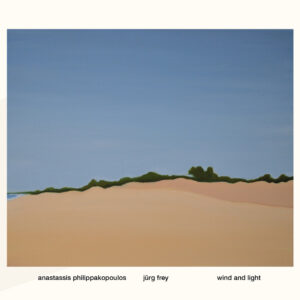
Anastassis PHILIPPAKOPOULOS
“Wind and light”
Greek composer Anastassis Philippakopoulos has been a member of the Wandelweiser composers collective since 2003. He pursues his own compositional style to create a new kind of tonal music, deeply associated with his individuality and the surroundings of his life in Athens, a unique blend of stoic minimalism, the warm colors of modern romanticism, and the introspective depth of Zen.
"For many years I have concentrated my attention on modal monophonic melodies. In my pieces I want to bring a balance between western and eastern musical traditions, but also between remote past and present. This balance is subjective. I care a lot to find a connectedness between the tones of the melodies. The deeper the connectedness I gradually find, the more simple and plain seems the melody." (Anastassis Philippakopoulos)
‘wind and light’ consists of four solo clarinet pieces and three solo piano pieces written by Philippakopoulos, inspired by nature in Greece. The clarinet pieces were performed by Swiss composer/clarinetist Jürg Frey, recorded in Athens in 2016, and the piano pieces were performed by Philippakopoulos himself, recorded in Athens in 2019 to complete this album.
“When I was listening to the seven pieces together, I experienced this feeling of ‘landscape/bell in a distance'. I hear the clarinet as the breath of a human being, and the piano as the sounds in the landscape I hear from a distance. This duality opens a wide space, and I was really surprised when I listened to this for the first time, because I didn't expect something like that in the context of an album, a poetic relationship between the human and the landscape.” (Jürg Frey)
15,00€
Out of stock

CD
Melaine DALIBERT
“Night blossoms”
'night blossoms' is French composer/pianist Melaine Dalibert’s sixth solo album, consisting of new compositions from 2019-2021. Of the six pieces on this album, 'A Rebours', 'Windmill', 'Eolian Scape', and 'Sisters' were written around the same time as most of the pieces for his 2020 album 'Infinite Ascent'. While 'Infinite Ascent' featured his intuitive compositions in a pop style, 'night blossoms' features works further developed with his algorithmic approach, which has been his long-term pursuit as a composer.
'A Rebours', which is a cousin to his 2019 piece 'Litanie', was written based on a binary coding of the retrograde sequence. 'Windmill' was composed based on a cellular automaton that generates patterns on a Lydian scale. 'Eolian Scape' is a toccata-style piece that makes a chain of different polyrhythmic states progressively integrating all the notes of the modal scale. 'Sisters', originally written for two pianos, takes the form of a canon, with the patterns of different periodicities superimposed, creating an undulating polyrhythm that gradually changes harmonic colors. The first three pieces were played on a muted upright piano to control the harmonic saturation which could result from the repetition of the patterns at a fast tempo, creating intimate colors.
The two pieces 'Yin' and 'Yang' are based on a random melodic thread running through the keyboard, with a zigzag of rising and falling musical intervals but following strict rules. Only the notes of the pentatonic mode of F-sharp mode (black keys) were played in 'Yin', while only those of the pentatonic mode of C (white keys) were played in 'Yang'. Deriving from the same algorithm, these two pieces complement each other while having different forms.
“Since my composition of 'ressac', I had the idea in mind to add a kind of electronic shadow, supporting the long moments of resonance, as a free counterpoint to my most minimal algorithmic compositions.” (Melaine Dalibert)
In response to Dalibert’s idea, David Sylvian contributed his sound work to 'Yin' and 'Yang', delicately fluctuating and echoing electronic shadows of piano tones, adding depth and dimensions to Dalibert's algorithmic compositions.
The album title 'night blossoms' was conceived by Sylvian, who also contributed his artwork for the album cover, as he also did for all three of Dalibert’s previous elsewhere CDs: ‘Musique pour le lever du jour’, ‘Cheminant’, and ‘Infinite Ascent’.
15,00€
In stock

CD
Anastassis PHILIPPAKOPOULOS
“Piano works” by Melaine Dalibert
Greek composer Anastassis Philippakopoulos has been a member of the Wandelweiser composers collective since 2003. He pursues his own compositional style to create a new kind of tonal music, deeply associated with his individuality and the surroundings of his life in Athens, which is a unique blend of stoic minimalism, the warm colors of modern romanticism, and the introspective depth of Zen.
In Philippakopoulos' piano works, each tone is closely connected with the previous and the subsequent tones via long resonances, forming a simple yet poignant melody that contains a magnetic power to draw the listener’s ears. The intensity of a single tone of his piano pieces often evokes a beautiful stone, organically formed over the course of a very long time. In fact, Philippakopoulos takes several months to a year to compose one short 2-4 minute piece.
On this album, Philippakopoulos' twelve solo piano pieces (composed from 2005-2018) are performed by a rising French composer/pianist Melaine Dalibert, who is known for a unique algorithmic compositional style as well as his interpretations of works by Giuliano D’Angiolini, Tom Johnson, Peter Garland, and many others. Here Dalibert realized the transient, meditative beauty of Philippakopoulos' piano works by inducing rich harmonics in the tranquil afterglows mysteriously tinged with shadows, brilliantly conveying the immense and profound world of Philippakopoulos' music narratively and poetically.
-----
compositions by Anastassis Philippakopoulos
piano by Melaine Dalibert
15,00€
In stock

CD
THE GIVING SHAPES
“Earth Leaps Up”
The Giving Shapes is a collaborative project between harpist/vocalist Elisa Thorn and pianist/vocalist Robyn Jacob that formed in fall 2017 at the Banff Centre for the Arts. This is the duo’s first release.
This project triangulates aspects of new music, creative music, and song-writing, combining their classical training and their involvement with the Canadian creative and indie music scenes. Though they originally met while both pursuing degrees in classical music at UBC in 2007, they share an interest in many musical styles. Their sound reflects broad influences from artists including Nico Muhly, Bjork, Jonny Greenwood, David Lang, and Caroline Shaw.
Thorn and Jacob are interested in merging the familiar with the new, and draw from their wide range of influences to create music that is honest. Their approach involves equal parts of intellect and feeling, pursuing both accessibility and experimentation equally. The process of songwriting varies from song to song, but usually one of them brings in a kernel, and the two develop parts together, parts on their own, then back to different possibilities together.
“The piano and the harp are a really interesting match because they are so related in timbre and function, but individual enough to offer each unique sound palate. The possibilities of blend, texture, and harmonic depth are really exciting. Robyn is an endless inspiration to me in all the things that she does. We have quite different approaches to writing (Robyn is more rhythm and pattern-based, whereas I am driven mostly by melody and harmony) so the collaborative writing process is really interesting and stimulating.” (Elisa Thorn)
"I like Elisa's integrity and devotion to her artwork, and her attitude in general as a musician and an artist. Also, it is a privilege to be able to make art with one of your best friends." (Robyn Jacob)
The Giving Shapes is a synthesis of their shared musical aesthetic and curiosity with their long-standing relationship as co-curators and presenters. Music from the duo’s projects has been featured in jazz festivals such as the Montreal and Toronto Jazz Festivals, new music festivals like Music on Main, and indie pop festivals including the Campbell Bay Music Festival.
The duo's sincere yet polished, cool yet warm, celestial yet humane approach towards sounds is integrated into a single intimate world of music with everything impeccably balanced. Thorn's and Jacob's ethereal voices convey subtle emotions, gently unfolding the narrative of their personal world into a unique space where the acoustic beauty of classical music and the accessibility of pop music humbly entwine around each other.
15,00€
In stock

CD
Melaine DALIBERT
“Infinite Ascent”
This is French composer/pianist Melaine Dalibert’s fifth solo album since 2015, all featuring his own compositions. This time, the album consists of melodically structured song pieces, an area that Dalibert has been exploring in the last couple of years as a new compositional approach outside his signature algorithmic method of composition. This series of eight short pieces appeal in a new way from his previous music, and shows his maturity as a composer. Dalibert wrote all eight pieces in 2019 and recorded them in December 2019 on a Steinway at the chapel of the Rennes Conservatory where he teaches.
"I wouldn't have thought it two years ago, but I started to step aside from my algorithmic systems to write very intuitive music, kind of pop-songs. It is surely a transient phase, but it seems to me to be necessary so as not to lock myself into certain procedures. It’s very important for me to feel free to write outside of any academy or tradition.” - Melaine Dalibert
‘Litanie’, one of the most evocative pieces on this album, was world premiered by Serbian-American Paris-based pianist Ivan Ilić in October 2019 at Bargemusic in NYC.
The album title 'Infinite Ascent' was conceived by David Sylvian who also contributed his artwork for the album cover, in addition to the two album covers of Dalibert’s previous solo CDs ‘Musique pour le lever du jour’ and ‘Cheminant’ on Elsewhere Music, for which he dedicated two other artworks.
"On listening to the album for first time I felt what I’d describe, for want of better terminology, a 'cosmic expansiveness'. Vibrational waves traversing the universe, a lone satellite, released from earth’s gravitational pull, spinning infinitely into the bright darkness. I ascribed to it a somewhat solitary migration. Not despite, but because of this, I found it a profoundly moving listening experience."
- David Sylvian
15,00€
In stock

CD
Shira LEGMANN
“Giacinto SCELSI: Suite No.9 / Quattro illustrazioni / Un Adieu”
Shira Legmann is an Israeli concert pianist, with a wide repertoire from Baroque to contemporary and experimental music. This album contains three piano works by Italian composer Giacinto Scelsi's: 'Suite No.9 "Ttai"' (1953), 'Quattro illustrazioni' (1953), and 'Un Adieu' (1978/1988).
'Suite No.9' and 'Quattro illustrazioni' were recorded live at two different concerts in 2014, while 'Un Adieu' was recently recorded in a studio in June 2020. This is Legmann's second CD on Elsewhere Music, following the 2019 album 'Barricades' in which she was the pianist for Michael Pisaro's composition for piano/electronics.
"Scelsi's music is something that 'grows' on us both as listeners and musicians. When I first discovered his music about ten years ago, I just dove into studying it, and the connection grew slowly while getting into more and more nuances in the playing. For a few years, I've been fascinated by these three pieces, and have performed them in Israel. It was not an immediate 'crush' but something that has gradually matured in me.
Scelsi was said to be a modest artist. He believed that as a composer, he is merely a mediator. For a substantial period, he composed his piano pieces by improvising: he conceptualized them and then improvised while recording. Later, with the help of friends and assistants, he notated from the recordings and that was his written composition. Since these compositions derive directly from improvisations, I felt the best representation of them would be as recordings of live performances, where there is also an element of risk, surprise, and spirit." (Shira Legmann)
"A whole chapter of recent musical history must be rewritten: the second half of this century is now unthinkable without Scelsi... He has inaugurated a completely new way of making music, hitherto unknown in the West." (Harry Halbreich)
Legmann's clean, supple yet solid piano sounds, which create a perfect balance of coolness and warmth, build a narrative flow with a stunning dynamic range, bringing these rarely performed piano works of Scelsi's back to life into the twenty-first century as timeless masterpieces.
15,00€
In stock

CD
Jürg FREY
“L’air, l’instant – deux pianos”
Jürg Frey’s unique compositional approach places him at the cutting edge of contemporary classical music. Since the late 90's, Frey started to work with 'lists' as a basis of his compositions, sometimes words, sometimes chords, from which he developed and organized musical materials. In recent years, Frey's focus on 'lists' has extended more toward the connections of items with each other, forming melodies.
Frey wrote two compositions for two pianos in 2017-2019: ‘Entre les deux l'instant’ (2017/2018) and 'toucher l’air' (deux pianos) (2019). ‘Entre les deux l'instant’ was world-premiered by Dutch pianists Reinier van Houdt and Dante Boon at Splendor Amsterdam and was later recorded there together with 'toucher l’air' by the same two pianists in the presence of Frey in Amsterdam in 2019.
The first piece on this album,'toucher l’air (deux pianos)', was composed in close connection to Frey’s previous composition 'Entre les deux l'instant'. This piece consists of seven movements, written for two parts for piano 1 and piano 2, in which two pianists play each part at the same time with subtle similarities but in different tempos. The interaction between the two is only vaguely shown in the score, giving this piece a mixed sense of openness and closeness, separation (or aloneness) and intimacy.
The second piece on this album, 'Entre les deux l’instant', consists of two parts: ‘Melody’ and ‘List of Sounds’. Melody starts with pianist 1 (Van Houdt), then continues with pianist 2 (Boon), going back and forth between two pianists to the end. When one pianist plays Melody, the other plays a note(s) from List of Sounds given in order in the score. The pianist can also add extra notes to the Melody, to double these notes, but slightly later and softer than the sounds of Melody, like adding a slightly ‘off’ shade to it. Two parts are played simultaneously by two pianists but the timings are flexible, up to each pianist to decide, not pre-arranged nor intended to coincide precisely.
Van Houdt and Boon conveyed every fine nuance of Frey’s two piano pieces with their extraordinary sensitivity and masterful skills, organically filling the two pieces with clean tranquility and airy feeling.
15,00€
In stock

CD
Shira LEGMANN & Michael PISARO
“Barricades”
This album contains LA-based composer Michael Pisaro's recent composition 'Barricades,' a 63-minute piece for piano and electronics. Consisting of thirteen studies (piano pieces, some with electronics) and two electronic interludes, the piece is performed by Israel-based pianist Shira Legmann, with Pisaro on electronics.
"Barricades has a distant but decisive relationship to the keyboard music of Louis and François Couperin. The title refers to 'Les Barricades Mystérieuses' by François Couperin – and to the technique of overlapping, interlocking voices, creating a thicket or web-like texture. I have loved the music of the Couperins since college, but it was when Shira sent me some of her favorite music to play, and 'Les Barricades Mystérieuses' was among the scores, that the idea for this piece began to crystallize. The process of writing and working on the piece with Shira was one of watching the barricades, which I pictured as a network of twisted vines, unravel." (Michael Pisaro)
15,00€
Out of stock

CD
Reinier VAN HOUDT & Bruno DUPLANT
“Lettres et Replis”
"This album contains six pieces written by French composer/artist Bruno Duplant, all composed and realized by Dutch pianist/composer Reinier van Houdt. Duplant's scores 'Lettres (pour Reinier van Houdt)' (2017) are three letter-form scores personally addressed to van Houdt containing letter sequences distributed across the page. 'Trois replis d'incertitude' (2018) are also three letter-form scores but with the notion of 'repli' (meaning 'fold' in a Deleuzian postmodern baroque sense as well as 'withdrawal' of incertitude and reactionaries toward the neglect of ecology, humanism, and culture). Duplant's scores also reflect Mallarmé's notion of textual space and chance, leaving a large room for the interpreter/performer."
15,00€
Out of stock

CD
Melaine DALIBERT
“Cheminant”
"This is French composer/pianist Melaine Dalibert's third solo piano album, following his well-received 2018 album 'Musique pour le lever du jour' (elsewhere 002) and 2017 album 'Ressac' (at111). 'Cheminant' contains a diverse array of Dalibert's unique compositions for solo piano, ranging from the up-tempo rhythmic 'Percolations' performed masterfully by Dalibert's right hand, to the slow, prolonged meditative 'Music in an octave' and 'Cheminant', to the kaleidoscopic 'Étude II' with the repetitive hammered chords, and lastly his latest piece 'From zero to infinity' dedicated to post-minimal composer Peter Garland."
15,00€
In stock

2 CD
Gil SANSÓN / Lance Austin OLSEN
“Works on Paper”
Venezuelan-based composer/artist Gil Sansón and Canadian-based composer/painter Lance Austin Olsen began to work closely together via long distance in 2014. Their collaboration initially began when Olsen painted the CD cover of Sansón's release 'Immanence, A Life' (Makam 003) in 2015. Sharing a similar aesthetic in art and music with deep respect and understanding of each other's work, the two soon started to make music in collaboration through realizations of each other's graphic scores or paintings.
Their first collaborative piece 'A Meditation on the History of Painting (2017)' was published as one of the four tracks of Olsen's notable 2018 release 'Dark Heart' on Another Timbre label. Their collaborative relationship has been rapidly flourishing and deepened with intensity since then. Subsequently, Sansón and Olsen recorded four new collaboration pieces in 2017-2018: two variations of the interpretation of Olsen's painting/graphic score Pra Mim (2016) by Sansón; and two variations of the interpretation of Sansón's graphic score Meditations (2017) by Olsen. This double CD 'Works on Paper' (elsewhere 006-2) contains these four pieces on two discs in nonchronological order.
Sansón said, "At some level, I find no distinction between painting and sound making. The processes are similar in essence and they seem to come from the same place. In the case of Lance's paintings, I find a great example of this. He is able to switch mediums and combine them as if there were no actual distinction. I believe the idea that you can make music that is both radically modern without sacrificing the idea of beauty, which to me remains essential and grounds me in the centuries-old tradition of Western classical music, so dear to me since I was a child."
Their realizations are exquisitely layered collages of sparse sounds of musical instruments, objects, electronics, field recordings, voices, and fragments of their past compositions and early classical music as samples, creating an open, profound expansion of the horizon of the music. The intense, vibrant raw energy and graceful beauty immanent in both artists' pieces are organically integrated into one whole album, forming an epic arch that connects the inner worlds of the two artists poignantly yet meditatively.
23,00€
In stock

CD
Clara DE ASÍS
“Without”
Clara de Asís is a Spanish composer and guitarist based in Marseille, France. Her intuitive, unconventional composition style utilizes a minimal, spatial framework in which performers can create individual sounds incorporating active listening, attaining a paradoxical but coherent result, "setting a frame could bring out a lot of unexpected possibilities and revelations that come from the sound itself."
De Asís composed 'Without' for the duo of Erik Carlson (violin) and Greg Stuart (percussion) in 2018. In this 43-minute piece, she gave a precise framework for the position and the duration of each sound section and each silence, as well as a rough outline for the texture and the volume of each sound, the use of tone or noise (or tone-noise), and the materials for the percussion, but a large part of the score was open for the two performers' freedom. In the realization of this piece, Carlson and Stuart brought out the unique voice of each instrument by applying various use of bows on violin and various percussive materials (metal, wood, ceramic, clay, glass, etc.) with their attentive, virtuosic skills and great sensitivities for the sound and silence. Moving along in parallel, Carlson and Stuart showed their individual musical personalities while creating an organic flow, with an exquisite balance between preciseness and openness. The duo's introspective approach to the sound and silence evokes the tranquility of a Zen garden while showing a clean contemporary edge, highlighting the simple yet intense beauty of de Asís's minimal composition. David Sylvian's cover photograph of the small stones, each of which has a unique color and texture, faintly illuminating in the pitch-black background, echoes the mysterious depth and the lucidity of de Asís's piece.
14,50€
In stock

CD
Stefan THUT
“About”
Swiss composer and cellist Stefan Thut composed 'about' in 2017 for the sextet of Ryoko Akama (electronics), Stephen Chase (guitar), Eleanor Cully (piano), Patrick Farmer (metal percussion), lo wie (tingsha), and Thut (cello). The six musicians have diverse backgrounds in music, poetry, and literature, as well as comprising a multilingual group. Thut integrated both musical elements and non-musical elements in his piece. His score instructs three performers to make percussive, ringing, and electronic sounds while three other performers play short high register pitches on their musical instruments according to written scores, particularly paying attention to the decay of sound in the subsequent silence. It also instructs parallel activities in between playing the sounds; walking around the space, and uttering monosyllabic words quietly in their own languages.
By going back and forth between these two activities - one with playing the sounds as a group, and the other with individual activities of their own - standing up, making a few steps, and saying a word, the ensemble created a unique openness in the music while each keeping their own contemplative individual experience as a component. Through this piece, Thut also demonstrated the idea that "something vanishing creates a state of pure attentiveness", letting the performers and the listeners experience how the short sounds like hit, plucked, ringing or bowed sounds attribute a meaning to the silences before and after. These silences are soon getting replaced by something else - by the sounds from before, by the sounds in expectation, or by thoughts.
14,50€
Out of stock

CD
Jürg FREY
“120 Pieces of Sound”
Jürg Frey's unique compositional approach places him at the cutting edge of contemporary classical music while simultaneously maintaining a touch of impressionistic/romantic aesthetics in its roots.
The album '120 Pieces of Sound' contains two of Frey's significant compositions: '60 Pieces of Sound' (2009) and 'L'âme est sans retenue II' (1997-2000). Frey and the Boston-based ensemble Ordinary Affects (Laura Cetilia, Morgan Evans-Weiler, J.P.A. Falzone, Luke Martin) performed and recorded '60 Pieces of Sound' in New England in 2017, in which Frey's clarinet and Cetilia's cello played the pitches in the two-part melody written in the score, while the rest played the open instrumentation part with undetermined sounds. The resulting music was a unique series of harmonies created by open instrumental sounds with a faintly recognizable melody hidden in the core of the ensemble's evenly tempered sounds. The impressions of the chords move along at the edge of consonance and dissonance with the afterglows of each chord in the subsequent silence, hovering somewhere between meditative calmness and disquieting shadow, while bringing an organic warmth and a feeling of breathable open air into a minimal musical structure.
'L'âme est sans retenue II' was written for field recordings and bass clarinet. Frey first edited the field recording parts from the materials he recorded in Berlin in 1997, and later added his bass clarinet sound with a certain pitch as an underlying tone that would blend with the field recordings. Frey's bass clarinet is discreet and almost unrecognizable, often hidden under the complex layers of the field recordings, and yet clarifying the harmonization of the field recordings from inside. Presenting these two pieces '60 Pieces of Sound' and 'L'âme est sans retenue II' back to back on this album brings out the fundamental aesthetic of Frey's compositions in regards to how he approaches the 'harmonization' and 'openness' of the music.
14,50€
In stock

CD
Melaine DALIBERT
“Musique pour le lever du jour”
Melaine Dalibert (born 1979), a French composer/pianist, has been increasingly recognized for his compositional piano works as well as his interpretations of works by Gérard Pesson, Giuliano D’Angiolini, Tom Johnson, Peter Garland and many others. Trained as a classical pianist in Rennes (where he teaches now), Dalibert studied a large repertoire of contemporary composers' works at the Paris Conservatories. Being involved with experimental music at a young age, Dalibert found a way to compose music through mathematical concepts.
Fascinated by natural phenomena which are both expected and unpredictable, and also inspired by the work of the Hungarian-born French media artist Véra Molnar, Dalibert has developed his own algorithmic procedures of composition which contain the notion of stretched time evoking Morton Feldman, minimal and introspective, adopting a unique concept of fractal series. His piano music has been released on two recordings to date: Quatre pièces pour piano, self-released in 2015, and Ressac, issued by Another Timbre in 2017. ‘Musique pour le lever du jour’ (the title meaning 'Music for The Daybreak') was composed by Dalibert over two years and completed in 2017, with the concept being an ‘endless piece’ with no beginning or no end. This one-hour piece adopts slow tempi, leaving meditative space for long resonances in which pentatonic coloring gradually modulate in all tones, resulting in complex layers of direct tones, overtones, and prolonged reverberation, all organically subliming into rich sonorities with incredible harmonic clarity. Produced and design by Yuko Zama, artwork by David Sylvian. The single CD is a limited edition of 500.
Fascinated by natural phenomena which are both expected and unpredictable, and also inspired by the work of the Hungarian-born French media artist Véra Molnar, Dalibert has developed his own algorithmic procedures of composition which contain the notion of stretched time evoking Morton Feldman, minimal and introspective, adopting a unique concept of fractal series. His piano music has been released on two recordings to date: Quatre pièces pour piano, self-released in 2015, and Ressac, issued by Another Timbre in 2017. ‘Musique pour le lever du jour’ (the title meaning 'Music for The Daybreak') was composed by Dalibert over two years and completed in 2017, with the concept being an ‘endless piece’ with no beginning or no end. This one-hour piece adopts slow tempi, leaving meditative space for long resonances in which pentatonic coloring gradually modulate in all tones, resulting in complex layers of direct tones, overtones, and prolonged reverberation, all organically subliming into rich sonorities with incredible harmonic clarity. Produced and design by Yuko Zama, artwork by David Sylvian. The single CD is a limited edition of 500.
15,00€
In stock

3 CD
Biliana VOUTCHKOVA / Michael THIEKE
“Blurred Music”
The Berlin-based Bulgarian violinist Biliana Voutchkova and German clarinetist Michael Thieke have worked together intensely within both compositional and improvisational duo and group projects in Berlin since 2011.
In their current project “Blurred Music”, the duo works with musical structures that create a blur; improvised parts alternate with fields of pre-structured material in which digital recordings of the duo are duplicated by live performance. Virtually identical fragments of the live performance synchronize simultaneously with the playback, unavoidably giving rise to blur in the temporal dimension, in the rhythmic, timbral, and motivic variations, and in the microtonal interpretation of individual pitches. The triple CD “Blurred Music” features three of the duo’s live performances, recorded in Chicago, Philadelphia and New York during their USA tour in December 2016. These three live recordings are all very differently structured, factoring in the conditions and the atmosphere of each venue as well as the musicians' own perspective and mindset. This series of three concerts, all occurring within a nine day period, showcase the very wide range of this duo, so all three recordings combine to form a saga of their peak. Using their highly trained virtuosic skills and intense concentration, the duo carefully deconstructs the conventional tones of instruments into fine particles in an organic flow, to create a completely new world of music on their own, somewhere between tonality and atonality, and will hopefully be recognized as one of the most mature accomplishments of improvisational/compositional works of this era. Co-produced by David Sylvian and Yuko Zama, artwork by David Sylvian. The three CD set is a limited edition of 500.
In their current project “Blurred Music”, the duo works with musical structures that create a blur; improvised parts alternate with fields of pre-structured material in which digital recordings of the duo are duplicated by live performance. Virtually identical fragments of the live performance synchronize simultaneously with the playback, unavoidably giving rise to blur in the temporal dimension, in the rhythmic, timbral, and motivic variations, and in the microtonal interpretation of individual pitches. The triple CD “Blurred Music” features three of the duo’s live performances, recorded in Chicago, Philadelphia and New York during their USA tour in December 2016. These three live recordings are all very differently structured, factoring in the conditions and the atmosphere of each venue as well as the musicians' own perspective and mindset. This series of three concerts, all occurring within a nine day period, showcase the very wide range of this duo, so all three recordings combine to form a saga of their peak. Using their highly trained virtuosic skills and intense concentration, the duo carefully deconstructs the conventional tones of instruments into fine particles in an organic flow, to create a completely new world of music on their own, somewhere between tonality and atonality, and will hopefully be recognized as one of the most mature accomplishments of improvisational/compositional works of this era. Co-produced by David Sylvian and Yuko Zama, artwork by David Sylvian. The three CD set is a limited edition of 500.
28,00€