
In stock
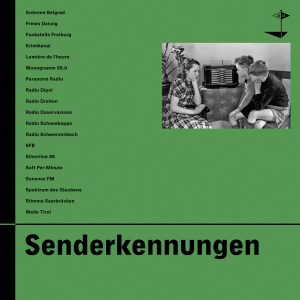
2 LP
Felix KUBIN & Asmus TIETCHENS
“Senderkennungen”
Senderkennungen marks the first ever collaboration between Hamburg veterans of sound art Asmus Tietchens and Felix Kubin, whose friendship began in the early 1990ies. The double album collects 25 original „Senderkennungen“ and their artistic deformation and further processing.
Long wave, mid wave, short wave and ultra short wave – long since disappeared radio waves in forgotten ethers, where lost souls linger on a quest for a music that so far did not exist and essentially cannot exist. They don’t search for cosmic harmony – this is old news – but long for sounds beyond the spheres. Felix Kubin and Asmus Tietchens, corner stones of sound art, are united in the decades long fight for a music of the after tomorrow. With this album they have tried to help those lost souls.
In order to make radio stations acoustically recognizable they need a so called station ID. This audible signal is synonimous to a visible logo. Both logo and station ID create identities. The German word for station ID is „Senderkennung“. For the album Felix Kubin composed a series of unique Senderkennungen - each ca. 5 seconds long – which have been commissioned by various radio stations, who where in need of a station ID or were looking to relaunch their existing acoustic branding. Most of these miniature compositions are tonal but some verge towards an atonal or noisy character. Time and again Kubin and I discussed the possibility of creating pieces out of these ultra compressed and short Senderkennungen. This was realized for the album in applying the rule of keeping Kubin’s original musical material recognizable while at the same time using any form of manipulation, modification, stretching, shortening or expanding in the development of the new pieces. One limitation: Those new pieces should not be longer than three minutes each. From these new works Kubin and Tietchens chose a selection which can now be heard on their album “Senderkennungen“.
Asmus Tietchens
35,00€
In stock
LP
ILLUSION OF SAFETY
“Cancer”
The origianl 1991 album sequence has been edited down from the original 60 minute CD program to fit on an LP and remastered. Additionally the material has been coalesced into 7 specific tracks (instead of the arbitrary and annoying 31 indexes on the CD) as available here A1-B4.
Track 8 (A1-3) and 9 (B1-4) are the full uninterrupted album sides available as such.
This one was mostly a group effort focused on a dark ambient atmospheric environment and experimental minimalism that crawls under your skin. Mark & Thymme’s heavy synth is omnipresent, Mitch & Chris scraping every piece of scrap metal they could find, Jim’s extended piano & tabletop guitar is apparent, the abstract sampling techniques of founding member Daniel Burke appear throughout, & the beautiful solo minimalist piano composition of Thymme’s closes the LP. Soundtrack like in its scope the album is another in the ongoing concept of music without a film providing a dark soundtrack to the nightmares or realities we wish we could forget. The 2025 edit & remaster removes the excess and hones the meat down to 7 essential tracks that show the projects oeuvre at that point in their lengthy history sounding clear & fresh with the newly mastered version by Andrew Weathers.
For IOS: Chris Block, Daniel Burke, Mark Klein, Jim O'Rourke, Mitch Enderle, Thymme Jones.
23,00€
In stock
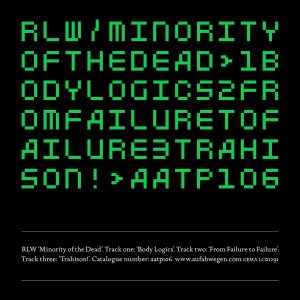
CD
RLW
“Minority Of The Dead”
The backstory: 5 September, 2012 was the day John Cage would have turneed 100. Centenary celebrations for a prominent artist would seem rather conventional. Inappropriate for an extremely unconventional artist. But seemingly inappropriate things can be quite appropriate in unconventional contexts. So why not participate in a 100th birthday commemorative project? No sooner said than done...
Ralf Wehowsky is a german experimental composer, active since the 80s (with the group p16.d4 then). his work is split between solo releases (under the moniker rlw) and collaborations, exploring all fields between media exchange and realtime presence recordings. collaboration partners include among others Lionel Marchetti, Merzbow, Jim O´Rourke, Bruce Russell, Das Synthetische Mischgewebe, Anla Courtis, Contrastate, Kohei Matsunaga, Annette Krebs - and Richard Francis.
14,00€
In stock
2 CD
Bruno DUPLANT
“Terra Incognita”
Two beautiful pieces merging piano, electronics and field recordings.
Bruno Duplant is a prolific composer and musician (piano, organ, double bass, percussion, electronics, field recordings) living in the north of France. He has collaborated with many musicians around the globe and has also made solo works. His recordings habve been published by various labels including Another Timbre, Ftarri, B-Boim, elsewhere, Diafani, Notice Recordings, Moving Furniture, Unfathomless (and more) and his own label co-curated with Pedro Chambel, Rhizome.s.
19,00€
In stock
CD
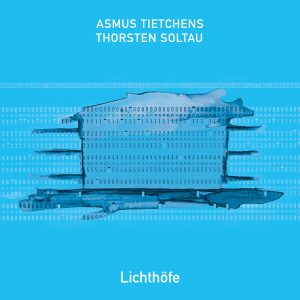
Asmus TIETCHENS – Thorsten SOLTAU
“Lichthöfe”
The musical material on „Lichthöfe“ is based on modular recordings by Thorsten Soltau. Conceptually these recordings deal with the spaciality of sound and the stereo field, while still maintaining an improvisational character. Asmus Tietchens has treated the material to intensive deformations, ranging from reductionist clusters to brittle textures. In each treatment a fragment of the original material remains audible.
Thorsten Soltau
Thorsten Soltau works in the field of sound design and electroacoustics since 2005. Main interests are sonic disintegration, conceptualism and dualism. Thorsten Soltau is a citizen of KonungaRikena Elgaland-Vargaland. He resides in Friesland, Lower Saxony.
Asmus Tietchens
Tietchens was born in Hamburg in 1947. Since 1975 he has been working as an independent musician; in 1980 he released his first solo record Nachtstücke. After producing a series of rhythmic and harmonic albums for the Sky label in the early 1980s he released his first industrial record Formen letzter Hausmusik in 1984 on United Dairies. Here Tietchens articulated his musical interests clearly: everyday noises were treated and at times deformed beyond recognition and placed into new contexts. Until now Asmus Tietchens has released more than 80 albums on international labels where he continues to explore the posibilities presented to him by specific sound sources (ranging from water sounds to pure sine wave tones). He has a more rhythm-oriented fake band project called Hematic Sunsets. Tietchens’ work is rooted in a deeply sceptic gesture, marked by frequent quotes from the works of philosopher E.M. Cioran on his album covers. Asmus Tietchens has been awarded with the prestigious Karl Sczuka Prize of the Südwestrundfunk (SWR) twice: in 2003 for his work Heidelberger Studien 1-6 and in 2006 for Trois Dryades. He lives and works in Hamburg.
14,00€
In stock
CD
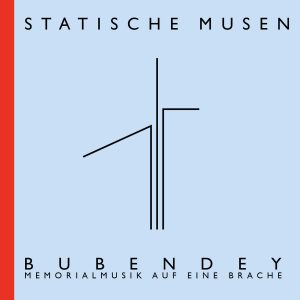
STATISCHE MUSEN (Asmus TIETCHENS)
“Bubendey. Memorialmusik auf eine Brache”
Statische Musen is the follow-up to Asmus Tietchen's Hematic Sunsets project. "Bubendey. Memorialmusik auf eine Brache" was recorded by Tietchens and his three alter egos Ute Massensicht, Ines Schmettsau and Senta Steumisch, who also wrote liner notes on the title-giving fallow land:
"Decades ago, industry withdrew from this site, leaving behind bizarre ruins whose years of decay did not progress quickly, but clearly did. Eventually the ruins were demolished. Grass initially grew on the levelled area. Repeated attempts to establish new industry or even create living space here failed due to the contaminated soil and the remote location of the wasteland. In the meantime, grass and other plants have flourished and small birch trees are already forming a modest copse. The smell of paraffin has faded."
Senta Steumisch, 2024
14,00€
In stock

2 LP
CRANIOCLAST
“Arctic Salon”
Planned in the early 90's executed in the early 20's: The Arctic Salon. Another Cranioclast Expedition, this time to the Pole. A long time between planning and execution, but much shorter than the time between the first fake reports of having reached the North Pole on foot across the ice and the first expedition that really made it without motorization. But also a long time in which things in the Arctic and Antarctic got worse and worse and continue.
Double LP almost completely transparent like ice but hotter or cooler (we hope ;- ).
Cranioclast is a project which produces various artistic endeavours, most commonly music. Active since the 1980ies.
Icy clear vinyl in transparent pvc sleeves with sticker, 300 copies
28,00€
In stock
CD
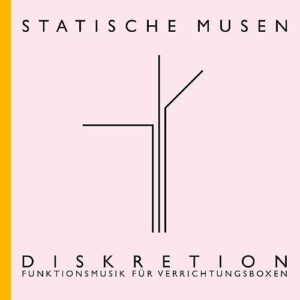
STATISCHE MUSEN (Asmus TIETCHENS)
“Diskretion. Funktionsmusik für Verrichtungsboxen”
TATISCHE MUSEN – New follow-up project to Hematic Sunsets by Asmus Tietchens
Hematic Sunsets are gone - here come the Statische Musen. A new outlet by Asmus Tietchens for musical endeavors that are more formular or genre based. The four long-form tracks of Diskretion explore "ambient" in the broadest sense of the term. Dense layers, slow dynamic progression, moody atmospheres.
Asmus Tietchens
Tietchens was born in Hamburg in 1947. Since 1975 he has been working as an independent musician; in 1980 he released his first solo record Nachtstücke. After producing a series of rhythmic and harmonic albums for the Sky label in the early 1980s he released his first industrial record Formen letzter Hausmusik in 1984 on United Dairies. Here Tietchens articulated his musical interests clearly: everyday noises were treated and at times deformed beyond recognition and placed into new contexts. Until now Asmus Tietchens has released more than 80 albums on international labels where he continues to explore the posibilities presented to him by specific sound sources (ranging from water sounds to pure sine wave tones). He has a more rhythm-oriented fake band project called Hematic Sunsets. Tietchens’ work is rooted in a deeply sceptic gesture, marked by frequent quotes from the works of philosopher E.M. Cioran on his album covers. Asmus Tietchens has been awarded with the prestigious Karl Sczuka Prize of the Südwestrundfunk (SWR) twice: in 2003 for his work Heidelberger Studien 1-6 and in 2006 for Trois Dryades. He lives and works in Hamburg.
14,00€
In stock
LP
N & Bu.d.d.A. (Bund des dritten Auges)
“0hne titel”
Hellmut Neidhardt, Chris Sigdell and Sascha Stadlmeier first met in 2020. They decided to record together and booked a studio in Dortmund. The recording session was spontaneous and somewhat chaotic. Thus it turned out, that only Hellmut’s tracks were really usable. Using some sections as a basis, Chris completely re-recorded his guitar, added a little bit of vocal here and there, and then sent a rough mix to Sascha, who in turn added violin and musique concrete. The final assembly was edited and mixed by Chris Sigdell.
N and Bu.d.d.A. have since toured together, and at three dates even performed as a trio. Future collaborations are a given possibility...
19,50€
Out of stock
LP
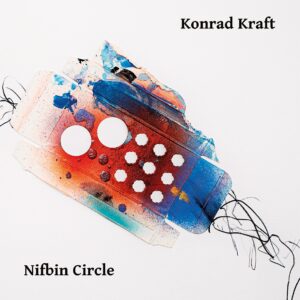
Konrad KRAFT
“Nifbin Circle”
Nifbin Circle is the fourth release by Detlef Funder, aka Konrad Kraft, on the Cologne label Aufabwegen.
Sounds generated with two apps on the iPad,provided the basic structures and the sound space. The strangely enraptured textures created in this way, with a subtle percussive touch, were partly combined with supporting beats in the course of further processing. Thus, after more than 30 years, tracks with rudimentary melodies and rhythms were created again.
19,50€
In stock

LP
Colin Andrew SHEFFIELD
“Don’t Ever Let Me Know”
About "Don't Ever Let Me Know"
Don't Ever Let Me Know is Sheffield's first solo release since 2018's Repair Me Now (Glistening Examples) and is a work in a similar mode to that album in that it comprises two lengthy pieces of multiple movements and moods. For this new work, and as a kind of ode to his late father, Sheffield has employed samples entirely taken from (or inspired by) the city in which both men were born. In this way, the sounds have been utilized as a kind of shorthand for the specific subjects at hand. The two audio assembla ges, meanwhile, mirror the ways in which loss and memory are processed - with both melancholy and wonder in equal measure: at once beautiful and confounding.
The audio has been mastered for vinyl by James Plotkin. The LP has been released in an edition of 200 copies and comes in a lovely jacket featuring photography by the late Allen W. Sheffield and extensive spot gloss printing.
About Colin Andrew Sheffield
Colin Andrew Sheffield (b. 1976, El Paso TX) is a composer whose work is focused on the recontextualization of samples derived from various commercially available recordings - generally those taken from his own expansive collection of records, tapes, and compact discs. Conceptually his output is akin to plunderphonics-style sound collage, though aesthetically it is seemingly closer to soundscapes of ambient drone. Since his earliest recordings from the 1990s, his work has developed into a kind of hybrid of the aforementioned approaches.
19,00€
In stock

CD
Ralf WEHOWSKY – Richard FRANCIS
“R”
On a trip from Auckland over Worpswede to Eggenstein Richard Francis visited Ralf Wehowsky on the weekend of September 28th and 29th, 2013. For the recording sessions taking place during these two days Richard used his analogue synth and electronics, while Ralf had a desktop and a laptop for producing digital electronic sounds at hand. For bridging the anatgonistic sound worlds the input of one sound system was fed with the output of the other and vice versa. For this release two of the tracks (Piece 1, Untitled 1) are presented as they were recorded, with only slight pan and volume adjustments. The third track (Piece 3) is composed of fragments of a longer improvisation, time-shifting the contributions of the two artists against each other to constitute a system of non-simultaneity.
RLW/Ralf Wehowsky
Ralf Wehowsky is a german experimental composer, active since the 80s (with the group p16.d4 then). his work is split between solo releases (under the moniker rlw) and collaborations, exploring all fields between media exchange and realtime presence recordings. collaboration partners include among others Lionel Marchetti, Merzbow, Jim O´Rourke, Bruce Russell, Das Synthetische Mischgewebe, Anla Courtis, Contrastate, Kohei Matsunaga, Annette Krebs - and Richard Francis.
Richard Francis
Richard Francis is a sound artist from New Zealand working with electronics and found recordings. He's released solo and collaborative albums on Senufo Editions, Entr’acte, Glistening Examples, Korm Plastics and Aufabwegen. Recent collaborators include Ralf Wehowsky, Frans De Waard, Anla Courtis, Bruce Russell, Mattin, Jason Kahn and Francisco Lopez.
14,00€
In stock

LP
STRAFE F.R.
“Octagon Sphere”
The new album Octagon Sphere by Duesseldorf duo Strafe F.R. comprises of four pieces recorded in 2020 and 2021 at the group's own studio. The work features heavily treated female vocals and includes rhythmic patterns and electronic sounds contributed by Detlef Klepsch (of the group keit). The overall atmosphere is tense and moody, both dark and uplifting at the same time. Octagon Sphere was mastered by Kai Blankenberg at Skyline Tonfabrik.
Octagon Sphere is the sister release to last year's CD Soundless Sphere – both albums are tied together by rhythmic alchemy and sound manipulation in highest detail.
19,00€
In stock

CD
Thanos CHRYSAKIS
“Manifold Vista”
Manifold Vista is the new album by composer/producer Thanos Chrysakis. Rarely can something so meticulously assembled together sound so fluid. A distinct, disciplined sense for composition emerges from each of these works, displaying formal integrity while at the same time, they are also effervescent, forceful, fiercely idiosyncratic and beautifully shaped and transformed. The album discloses an expanded and detailed vista of sound’s interiority forming a strangely pleasurable, not to mention engaging, experience.
12,00€
In stock

LP
KALLABRIS
“Red Circle”
On “Red Circle”:
Though severely cut, Red Circle doesn't exactly sweep along. It has a deliberate pace as Kallabris sets up the score of thirteen chance acquaintances who plan and carry out the sacking of our acoustic consciousness... Understatement is the method of these compositions for a small modular synthesizer. If there ever was something like heist music, this here surely is. (Vincent Canby, with a few minor changes and adaptions).
Biography:
Kallabris is a musical project that was begun in the mid 1980ies out of the scene around Coitra's Clan. Since ist inception Kallabris has persistently neglected any usage of advanced recording technology. Ever since not technical or compositonal innovation is at the core of the group’s work but, the active engagement with the limitations and the objects of every day life. This sound positivism can result in stylistically varied outputs ranging from chanson or country blues to musique concrète – while all musics live by their surfaces. Save the surface and you save all.
19,00€
In stock
CD
Terry FOX
“Labyrinth of the inner ear”
About Terry Fox: Labyrinth of the inner ear
For the exhibition “Sonambiente", I will produce a new audio work for compact disc. The title of this work will be “Labyrinth of the inner ear" and it will be recorded in Berlin on the 14th and 15th of April, 2006. The compact disc will be produced directly after the recording process and presented, during Sonambiente, in a room of the former Polish Embassy.
This will be a kind of “drone" work consisting of the repetitive tapping of a sightless person (the artist, Siegfried Saerberg) navigating his way through an urban environment and finally returning to the place where the walk began. The sound of the cane, either tapping or sweeping back and forth, would be a constant in this composition. It would cease only when Siegfried stops walking for some reason, for
example: an interesting acoustical space, a ride in a public transport, etc.
Location interpretations could be ascertained by the sounds surrounding the steady central position of the cane; an alley, a busy shopping district, the relative quietness of a back street a park, and so forth. This walk would, itself, finally return to its place of origin.
Terry Fox, Köln 2006
About Terry Fox
Terry Fox (b. 1943 Seattle – d. 2008 Cologne) was one of the leading pioneers of American Body Art and Conceptual art. He became famous in the Seventies with performances in which he used his own body as a medium for exploring often extreme physical and psychological experiences. In numerous installations, actions and street events he directed a heightened attention to everyday phenomena and aspects of social interactions. Fox researched both unknown and little regarded aspects of energy in substances, and the transformative qualities of materials. And from the 1980s on, language, as both substance and meaning, would play an increasingly important role in his space related works and objects.
With his lifelong, innovative exploration of sound and space, Terry Fox is also one of the seminal figures in contemporary Sound Art. He became known worldwide in the 1970s for performances with meters-long piano wires stretched in rooms, often fastened from one wall to an opposite wall. With his understanding of sound as a sculptural material, he has created an impressive body of work located between Visual art and Acoustic Sound art. In his later years quiet sounds at the limit of audibility and silence became more and more prominent.
The ephemeral, the invisible, time, space, the body, words, letters, sound -throughout his entire work Terry Fox used the elemental forms of human existence to explore the possibilities of sculpture and extend its limits..
Fold out embossed DVD sleeve with liner notes and photographs documenting the piece
15,00€
In stock

CD
Dirk SERRIES + Asmus TIETCHENS
“Die Höfner Akten”
“Die Höfner Akten”
Dirk Serries and I have long been colleagues and friends. Since the 1990ies we have exchanged sound materials to be reworked and published on an on and off basis. "Die Höfner Akten" are something new and special to in so far as the source material with its basic structure has been improvised exclusively on an acoustic guitar (of the 'Höfner' brand). Dirk and I had agreed upon the following: I would rework the provided sound material in such a way that the character of his improvisations would remain intact while at the same same time expanding the sound palette through further manipulations. In doing so we hoped the results would sound equally like Serries or Tietchens, or - even better - like none of us. We on our part are happy with the results. It is upon the listener of the "Die Höfner Akten" to decide whether we succeeded in our endeavours.
Asmus Tietchens
14,00€
Out of stock

CD
REYNOLS
“Fire Music Reloaded”
Fire Music was composed by Reynols in 2002 with fire recordings made at Tigre (Río Capitán) and different locations in Buenos Aires city and around. With some of this material, a CD EP appeared in Japan in 2002 through the Digital Narcis label, however the complete version of this piece remained unreleased for decades. In a recent research the masters of the whole work were found and rescued from the group's archives. So twenty years later, finally the full version of this piece is now ready to see the light on a brand new CD album carefully released by German label Aufabwegen. Fire Music Reloaded stands on the most conceptual side of Reynols' catalogue, along with works such as: 10.000 Chickens Symphony, Whistling Kettle Quartet, Computer Music, Gordura Vegetal Hidrogenada or Blank Tapes. In its four parts journey, the group explores a wide range of frequencies coming from fire as the only sound source. A release which pays tribute to the igneous aurality. Let your ears get on fire!
14,00€
In stock

CD
Asmus TIETCHENS
“Seuchengebiete 4”
Seuchengebiete 4, the continuation of Asmus Tietchens’ almost legendary series of treated water sounds, consists of six Hydrophonies. The sonic palette ranges from deep gurgling bass pulses to fragile movements of showering bright particles. The overall mood is ernest, contemplative and dark. Seuchengebiete 4 is perhaps the ultimate soundtrack for our crises-ridden times.
14,00€
Out of stock

2 LP
HEMATIC SUNSETS
“Aroma Club Adieu 5”
Final release by Asmus Tietchens’ death lounge project Hematic Sunsets
Farewell greetings by Michael Rother, Felix Kubin, Heinz Funk, Okko Bekker and more
The Hematic Sunsets shut down the Aroma Club with a final release. The album “Aroma Club Adieu” features 12 exquisite pieces of death lounge electronic pop performed on electronic organs and entertainment devices of various kinds. Under the moniker Hematic Sunsets, legendary avantgarde composer Asmus Tietchens has explored his love of the Darth Vader organ sound – a cheesy, spooky, deranged but still catchy form of electronic pop. The body of work of Hematic Sunsets stands out as unique, displaced and in a sexy way out of fashion. As a bonus to the final album of the project artist friends of Asmus Tietchens have composed short hommages and farewell greetings that are included here in the form of a single sided 12” on white vinyl. Among those saluting are such illustrious musicians as Heinz Funk, Felix Kubin and Michael Rother.
29,00€
Out of stock

10"
Francisco LÓPEZ
“Untitled #205”
“Francisco López states: “Based exclusively on end grooves from vintage
records, ‘untitled
205’ is a straightforward and joyful exploration of the potential for reincarnation of these unintended sonic structures into new life. More a tool than a final product, it delves into static, noise and rhythm with a hopeful perspective.” The untitled
205 mix on the a-side brings us 18 minutes of hissy, textural sound in dissolution, ranging from ryhthm to noise. The b-side has the 20 original loops López constructed out of old vintage 78s so if you buy 20 copies of this 10” you might be able to recreate the track… Clear vinyl in clear plastic sleeve, with 20 locked grooves for DJs on B-side. Limited to 300 copies.” Attention: it’s delivered in a white inner sleeve for protection reasons during transport. Please throw it away and put the record itself in the clear plastic sleeve.
15,00€
Out of stock

CD
NID
“Plate tectonics”
“Crawling back into the wound: NID 1995 - 2007. NID is an experimental group whose aim it is to challenge conventional concepts and structures of electronic music by experimenting with the source of sounds. The music is created on the spot, making each performance a genuine and unrepeatable event. It has been described as moving sound-objects, improvised electronic noise, or brooding ambient music. It has been compared to an underwater-journey, a pathway to the inner self. Given enough volume, it certainly affects the body as well as the mind. In which way remains open to the listener’s psyche. NID was formed in 1995. Over the years the core-members have performed in art-galleries, rock-clubs, bars, water-reservoirs, cinemas, as well as at industrial and electronic festivals and in record shops. In 1998 they were invited to play onboard the MS Stubnitz when it was anchored in the harbour of Stockholm as part of the "European Culture Capital" activities. They were also involved in the 2001 Six And More & R:IP jubilees, improvising with 30 other electronic free-jazz musicians. As for the group name… A “nid” is a curse or insult with homosexual connotation that was frequently in use in the Viking age. It brought a depth to the concept of honour and shame. It could be used as a challenge or simply to ridicule another (which was a challenge per se). It could reveal anyone else to be no better than he was, and it undermined social structures. NID disbanded in 2006. Chris Sidgell continues in various projects, most notably his solo project B-Tong. Jürgen Eberhard releases music under the name Feine Trinkers Bei Pinkels Daheim. This is NID’s one and only proper CD release. The sound on this work may appeal to fans of Lustmord, New Blockaders or collage post-industrial in general-experimental ambient. The music on this CD was recorded live 2004 in Arnheim by Mars Wellink (Vance Orchestra). The cover was done by Katja Wahl. Limited edition of 500 copies, CD in jewel case.”
5,00€
Out of stock

CD
MØHR – MAEROR TRI
“Hafenstadt”
Release date: 27.01.2015. Digipak designed by Tilmann Benninghaus. Limited to 500 copies.
“This music was originally planned to form a part of the third tape box in the Møhr interpretation series of ZNS Tapes. In this series different artists got an individual 30-minutes-piece of basic material by Møhr to be interpreted it in any way: Using it as a backing tape and adding some more tracks, getting inspired and doing something unique in the spirit of the basic material, deconstruct and arrange it anew. The invited artists had any opportunity to re-work the source material. For the actual release the basic material was placed on side A and the interpretation on side B, enabling the listener to compare the basic and the final sound. Three tapes were compiled as one tape box linked by a loose theme. The first box, Bürokratie, contained works by Das Konzentrat, Bestattunginstitut and Suicide Commando (released in 1990), the second, Kulturschock, contained works by Andrew Chalk / Darren Tate, Ectoplasmic Embryo Experience and Flagrants D’eli (released in 1991). The third one, which was to contain Hafenstadt by Maeror Tri (as well as material of PBK and The Haters), has never been released due to the sudden end of ZNS Tapes. We're convinced that this combination of basic stuff plus musical reworking is still an interesting and exciting experience for the audience, maybe especially after more than 20 years in the archives”. (Andreaz Vogel)
Møhr existed between 1986 and 1994 as the solo project of Andreaz Vogel.
Previously he had been active as a bass player and drummer in various post punk and noise rock groups.Since its inception the main aim with Møhr was
to create a dense and energetic sound without the use of conventional instruemnts. With this wall of sound the listeners were almost under attack and forced into a dark and brooding listening environment, both on the recordings and in the live situation. Andreaz also ran the important tape label ZNS recordings.
Maeror Tri existed from April 1988 to the end of 1996, coming from the very
north-western part of Germany. The three members were influenced by (post)
industrial, noise rock and experimental ambient and found a way to establish
their very own drone based style, using often guitars but also other instruments plus all kinds of (self build) objects and masses of sound effects. Their symbol, the triangle “Wheel” stood for “consciousness”, moving & shining in different colours and speed. The sound was meant as a tool for the listener to open the mind for transcension & sensitization: 'We want to transmit a total openness, the bursting and overcoming of all mental barriers, the breaking out of the enforced subject “Tunnel-Reality” of modern society. Out of Maeror Tri evolved the project Troum that is still very active.
5,00€