
Out of stock
CD
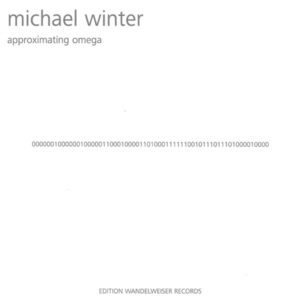
Michael WINTER
“Approximating omega”
approximating omega
text adapted from gregory chaitin's 1994 book the limits of mathematics
muirgen éléonore gourgues (reading), judith hamann (violoncello), with samples contributed by tomás cabado, raven chacon, yiannis christofides, alan courtis, john eagle, carmina escobar, bryan eubanks, jacqueline george, tom johnson, david kant, aj kluth, ulrich krieger, juan sebastián lach lau, ingrid lee, john lely, todd lerew, heather lockie, scott mclaughlin, ezequiel menalled, ian mikyska, pablo riera, dean rosenthal, karen santana, james saunders, marcus schmickler, elliot simpson, mark so, laura steenberge, adrian tenney, philip thomas, samuel vriezen, lucie vítková, manfred werder, byron westbrook, michael winter and melike yersiz
arranged by aidan reynolds and michael winter
for gregory chaitin
michael winter (piano)
a realization of a subset of ‘omega’ (or chaitin’s constant): a maximally complex, incomputable number defined
as the halting probability for some universal, prefix-free turing machine. the subset of omega used for this realization
(given by the bit string on the cover) is presented in the 2002 article by cristian calude et al. entitled computing a glimpse of randomness.
10,00€
In stock
In stock
CD
Eva-Maria HOUBEN
“aus den fliegenden blättern eines fahrenden waldhornisten”
“aus den fliegenden blättern eines fahrenden waldhornisten” (2013) ( “from the flying leaves of a traveling horn player”) for horn in F. Wilfried Krüger, horn.
10,50€
In stock
Out of stock

CD
Christian WOLFF
“Stones”
The score of “Stones” consists of just a few lines of text:
Make sounds with stones, draw sounds out of stones, using a number of sizes and kinds (and colours); for the most part discretely; sometimes in rapid sequences. For the most part striking stones wfth stones, but also stones on other surfaces (inside the open head of a drum, for instance) or other than struck (bowed, for instance, or amplified). Do not break anything. Christian Wolff, STONES, (from: Prose ColIection, 1968-74)
While these instructions contain an abundance of possibilities, they also exclude many things. The score describes a condition under which things may happen, not a process in which things develop.
Seven composers participated in the present realization by the Wandelweiser Komponisten Ensemble: Antoine Beuger, Jürg Frey, Chico Mello, Michael Pisaro, Burkhard Schlothauer, Kunsu Shim und Thomas Stiegler.
For this performance, each prepared, independently of the others, between 10 and 20 events.The solutions, though compatible with the score, were unique. Michael Pisaro, for example, made drawings on stones, producing very gentle sounds. Burkhard Schlothauer sometimes drew a large stone across the floor. Jürg Frey decided, that a single sound might well last long time. Thus, 27 minutes of quietly rubbing two very uneven limestones, is considered as one event. Thomas Stiegler used a violin and violin bow as the surface upon which all of his events took place. Kunsu Shim began performing his nearly inaudible, subtle sounds only after about 55 minutes had elapsed.
While playing this CD you may forget, after a while, that it is playing. All of a sudden you might hear a little stone, sometime, somewhere. After an initial ,,What is that?", you’ll suddenly realize: ,,Oh yes, it’s the CD!".
10,00€
In stock
CD
Cem GÜNEY
“Five compositions”
Antoine Beuger (flute), Germaine Sijstermans (clarinet), Tobias Liebezeit (percussion), Burkhard Schlothauer (violin), Lydia Haurenherm (viola), Marcus Kaiser (violoncello).
Cem Güney was born in Turkey in 1973. Influenced by jazz music, he learned to play the trumpet and later attended the College of San Mateo’s Music Department in San Mateo, California. During the years of playing trumpet, his interaction with music has mostly been with experimental forms of expression. This interaction influenced him to compose electronic music. Currently, he’s also been writing scores for contemporary music.
10,50€
In stock
CD
Burkhard SCHLOTHAUER
“PianoMusic”
Composer: Burkhard Schlothauer. Performers : Jongah Yoon, piano; Reinhold Friedl, Michael Iber, Yungkyung Lee, piano. “As a result of the fascination the unmuted decay of the piano sound held for me, the fading string vibration became the focus of "ab tasten". In each sound of this piece at least one tone fades away unmuted. I also decided to take a given fact (the different fading times: the higher a tone, the shorter it sounds) to form the basis of the music’s temporal organisation. The respective unmuted string determines the overall duration of the sound and as a result, the timing of the composed "muting activities". Having each sound followed by a pause of possibly equal weight is a formal concept I have used in many of my compositions since1995. Each sound stands alone, is a "piece" of music in its own right, an autonomous "image", an individual, that may be perceived in its entire appearance from sounding to dying away. The order of the sounds may be chosen by the musicians themselves. In "ab tasten" I discovered my interest for the moment the sound falls silent, dies away. I noticed, that at some point it is not longer possible to asses whether the strings are still vibrating audibly, or whether it is only the image of the sound which is still in the mind. A sound has a beginning, an existence and an end. These parts, though, cannot be clearly divided: we cannot really say where the beginning is, where beginning turns into continuity, where continuity becomes an ending, where the end is. In "three pianos drumming" from 1999, which I wrote for PianoInsideOut (Reinhold Friedl, Michael Iber, Yunkyung Lee), on the other hand, the piano is used only as a percussion instrument. In three of the Steinway D grand pianos of Sender Freies Berlin the same bass string was taped with adhesive tape, strongly and lastingly muting the string. By this treatment the hammer beating of the piano becomes clearly audible. The piano is treated as what it is in terms of its sound production: as a "hammering machine". Hearing recordings of still existing hunter and gatherer cultures, I kept hearing rhythms which were pure pulse. These musics - no matter from which region of the earth - refrain from any conscious accentuation or division of rhythmic units. To me, this seemed to be an archetype of rhythm, some sort of nucleus to every rhythmic music, in which the hypnotic power of these first man made time forms makes itself felt. In "three pianos drumming" the performers determine a set of parameters (dynamics, tempo, pitch) within a given range and stick to these for the entire piece. Each part has its own sequence of beats and pauses, allowing for the emergence of very subtle spaces and microrhythms between the pianos. What fascinates me about this piece (and also its successor, "drumming for one to many percussionists"), is that it remains the same piece, regardless of whether it is played pianissimo or forte, no matter which tempo between 30 and 120 b.p.m is used. or what order of pages the players select. Different versions take on very different "expressive qualities". To me, it seemed very important for my development to have composed a piece which allows for a strong expressive power, without me as a composer having provided it with expression.” Burkhard Schlothauer
10,50€
In stock
CD
Antoine BEUGER
“Silent harmonies in discrete continuity”
Program: Antoine Beuger: silent harmonies in discrete continuity (fifth music for marcia hafif), series I. Performer: Electronic Music.
“Silence is not an acoustical phenomenon
silent harmonies: three-minute sounds, stationary, quiet, pure waves
each sound has eight frequencies, each from a different octave range
there is silence where depth disappears and expanse emerges: on the surface
in discrete continuity: one soud goes, another one comes and on it goes, step by step, continuously
still waters are said to run deep,
but in reality it is the imperturbability of their surface
that impresses us.
for marcia hafif:
american painter of monochrome paintings
and a quiet person’s silence hides nothing deep -
it hides nothing at all.”
10,50€
Out of stock
CD
André O. MÖLLER
“Musik für orgel und ein(n) tonsetzer(in) …2003…”
Eva-Maria Houben, organ. “What do you do, if you work with just intonation and wish to write a piece for organ? you have to deal with the relation between equally tempered and over or undertonal (just) intonation. 2001 i had several opportunities to make a study of some wonderful instruments. This eventually put me on the path towards this composition. In this piece only those frequencies of the organ sound that have close to whole-numbered ratios (+/- 6 cents) to a fundamental (in this case C’ at about 32 Hz). Because the frequencies are never perfectly tuned - a result of the organ’s tempered tuning - more or less strong beatings and frictions emerge, that rhythmically and timbrally shape the inner life of the sounds. A realisation of this piece strongly depends on the disposition of the instrument and the performance space. The version at hand corresponds approximately to the first performance by Eva-Maria Houben at St. Suitbertus church, Dortmund october 3, 2003. For this cd I tried to record the organ in such a way that the playback, instead of reproducing the church environment, projects the instrument into the listener’s space.” André O. Möller
10,50€
Out of stock
CD
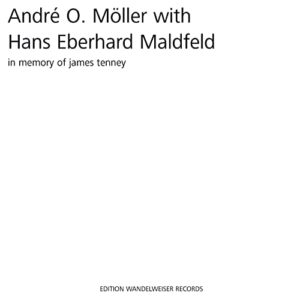
André O. MÖLLER with Hans Eberhard MALDFELD
“In memory of James Tenney”
“I never met james tenney personally.
in 2004, the year of his 70th birthday, tenney was invited to cologne by WDR to honor him. the man held a charming speech and showed an excerpt of his early electronic piece Collage
1 “blue suede”, based upon elvis presley’s version of carl perkins’ song blue suede shoes.
afterwards we heard a beautiful performance of forms I - IV, four pieces for amplified ensemble, each of them dedicated to one of his teachers.
before and since then i listened to a lot of tenney’s music, met and worked with quite a few students and colleagues of his.
therefore, it almost felt like a personal loss, when tenney died in 2006.
the man’s spirit, though, is still around!
2006 i met double bass player hans eberhard maldfeld, when he was invited by antoine beuger to introduce the tromba marina to me and some other composers.
the tromba marina is a single stringed instrument played with a bow.
in addition to the open string one can play harmonics up to the 20th partial and maybe even higher.
the unusual construction of the bridge makes it possible to create sounds reminiscent of the sound of the trumpet or other brass instruments.
since 2003 hans eberhard maldfeld is committed to a renaissance of the instrument.
his explorative drive and his sheer dedication to sound and performance allow the instrument to reveal hitherto unknown qualities.
this dedication, which also led us to collaborate on a double bass piece, i find so compelling and inspiring.” andré o. möller, 2015
14,00€
Out of stock

CD
Rolf JULIUS
“Tanz für zwei blaue Rechtecke”
Small music vol.4. Music and text by Rolf Julius. Production: Saarländischer Rundfunk.
16,50€
Out of stock
CD
Patrick KOSK
“Mondweiß”
“Mondweiß” (2007-2008), “Das Kästchen und Tripitaka” (2005), “Angklung & Ice” (2004-2005), “Distrak - sillalla” (1992), “La boîte” (2005), “Transmissions in a… (system of coordinates)” (1981). Musique concrète.
14,00€
Out of stock
CD
Michael von BIEL
“Streichquartett Nr. 1” (1962; WDR 2003) [Pellegrini-Quartett: Antonio Pellegrini, 1. Violine; Thomas Hofer, 2. Violine; Fabio Maarano, Viola; Helmut Menzler, Violoncello]. “Streichquartett Nr. 2” (Urfassung, 1963; WDR 2003) [Pellegrini-Quartett]. “Quartett mit Begleitung” (Quartett Nr. 3, 1965; WDR 1967) [Egon Mayer, Violine; Dagmar Apel, Violine; Johannes Fritsch, Viola; Magdalene Bröckel, Violoncello; Michael von Biel, Violoncello]. “Jagdstück für Bläserinstrumentalisten und Live-Elektronik” (1966; WDR 1968) [Franz-Willy Neugebauer, Trompete; Kurt Schmidt, Trompete; Gerhard Burdack, Horn und Tenortuba; Konrad Alfing, Horn und Tenortuba; Willy Walther, Posaune; Josef Feck, Posaune; Emil Morneweg, Kontrabaß; Wilhelm Bruck und Michael von Biel, Begleitung; Ltg. Bernhard Kontarsky]. “Fassung” (elektronische Tonbandmusik, 1964; WDR 1964) [Studio für elektronische Musik des WDR].
15,00€
In stock

CD
Klaus LANG
“Trauermusiken”
Two compositions by the young Austrian composer/organist who currently lives in Berlin/Germany. “Der Wind und das Meer for viola” (Barbara Konrad, viola). “The Sea of Despair for String Quartet” (Amras Streichquartett)
17,00€
In stock

CD
John CAGE
“Sonatas and interludes”
’Sonatas and interludes’ (1946-48) performed by Mario Bertoncini, recorded in december 1991.
15,00€
Out of stock

CD
Horatiu RADULESCU
“Streichquartett N°4 opus 33”
“String quartet No 4, opus 33 (1976-87)”. Arditti String Quartet: Irvine Arditti, Graeme Jennings, Garth Knox, Rohan de Saram.
"infinite to be cannot be infinite, infinite anti-be could be infinite" for nine string quartets or one string quartet surrounded by an imaginary Viola da Gamba with 128 strings.
17,00€
Out of stock
CD
Giuliano D’ANGIOLINI
“Simmetrie di ritorno”
“Simmetrie di ritorno” (2000) for 10 instruments. “Ita vita zita rita” (1997) for amplified piano. “Orizzonte fisso, bordoni mobili” (2007) for eight instruments. “Und’ ho d’andà” (1995) for nine horns. “Ho visto un incidente”(1991-92) for voice solo. “Notturno in progressione” (2004) for strin,g quartet. by Ensemble 2e2m, Franck Ollu, Pierre Roullier, Monique Bouvet, Barbara Morihien, Quatuor Parisii: Arnaud Vallin, Jean-Michel Berrette, Dominique Lobet, Jean-Philippe Martignoni.
“Giuliano d’Angiolini is a positively unique figure in contemporary music. His profound, well-conceived and stubborn take on music has led him to what he calls »impersonal« music — music that has fully abandoned the idea of development or form.Through successive states of presentation, which aim to elucidate, d’Angiolini wanted to leave place in sound so that music could become less voluntary«. This led him to favour the surface and present, an approach that was by no means superficial: the surface as the immediacy in the propositional content of sound and the present as the very surface of the criterion of time. In his work, musical process and material are but one and are completely laid bare. What we are to hear is non-discursive, deliberately lacking formal organization. We are even free to turn away and come back of our own will — as if the composer wanted to make positive use of the negative metamorphosis of today’s urban listeners, listeners who are constantly assailed with stimuli.” Gérard Pesson
“Giuliano d’Angiolini is a positively unique figure in contemporary music. His profound, well-conceived and stubborn take on music has led him to what he calls »impersonal« music — music that has fully abandoned the idea of development or form.Through successive states of presentation, which aim to elucidate, d’Angiolini wanted to leave place in sound so that music could become less voluntary«. This led him to favour the surface and present, an approach that was by no means superficial: the surface as the immediacy in the propositional content of sound and the present as the very surface of the criterion of time. In his work, musical process and material are but one and are completely laid bare. What we are to hear is non-discursive, deliberately lacking formal organization. We are even free to turn away and come back of our own will — as if the composer wanted to make positive use of the negative metamorphosis of today’s urban listeners, listeners who are constantly assailed with stimuli.” Gérard Pesson
14,00€
Out of stock

CD
Giacinto SCELSI
“Giacinto Scelsi”
“Pranam I” (1972) for voices, 12 instruments and tape. “Anagamin” (1965) for 12 bows, “Quattro pezzi” (1959) for Orchestra’s chamber, “Quartetto n°4” (1964) for string quartet, “Okanagon” (1968) for harp, gong and doublebass, “Quartetto n°2” (1961) for string quartet.
15,00€
Out of stock
CD
Clara IANNOTTA
“A failed entertainment – Werke 2009-2014”
“Intent on Resurrection - Spring or Some Such Thing” [2014] for 17 musicians. Ensemble Intercontemporain under direction of Matthias Pintscher. “Limun” [2011] for violin, viola. Ensemble Recherche with Melise Mellinger and Barbara Maurer. “D’après Talea” [2012] for 7 musicians. Talea Ensemble. “Àphones” [2011] for 17 musicians. Orchestre des Èlèves du Conservatoire National Supérieur de Paris under the direction of Tito Ceccherini. “A Failed Entertainment” [2013] for string quartet. Quatuor Diotima. “Al di là del bianco” [2009] for Ensemble. Ensemble Garage. “The people here go mad. They blame the Wind” [2013-2014] for bassclarinet, cello, keyboard and 12 musicboxes. Trio Catch.
“I am particularly interested in music as an existential, physical experience - music should be seen as well as heard. This is one of the reasons why I sometimes prefer to talk about the choreography of the sound rather than about orchestration.” Clara Iannotta
“I am particularly interested in music as an existential, physical experience - music should be seen as well as heard. This is one of the reasons why I sometimes prefer to talk about the choreography of the sound rather than about orchestration.” Clara Iannotta
14,00€
Out of stock

CD
Akio SUZUKI
“NA-GI 1997”
Composition and performance: Akio Suzuki. Production: Stadtgalerie Saarbrücken. Performance 17.10.97 & Performance 20.10.97. Composition and Performance: Akio Suzuki. “A CD of minimalist environmental sounds by this Japanese sound-artist, previously known for his fabulous Soundsphere CD on the Dutch Het Apollohuis label. "This music was recorded in Takano, Tango-cho, the northern-most coast of Kyoto, where I live. The bay surrounded by volcanic rock caves is the place where the mighty sounds of waves of the open sea have their muffled echo. Seawater flows into the hollows in the rock again and again like breathing in and breathing out. Spring water constantly drips in the cave, and now and then the wind from the meadow above the chasm brings the sounds of the crickets...the sound spaces of the coast of Takano. A site of a new encounter with the rhythm of the sounds of the sea."
14,00€
Out of stock

CD
Anne-Laure PIGACHE & Pascal THOLLET
“Dyslexie”
Anne-Laure Pigache, voice. Pascal Thollet, sound processing. In the tradition of French sound poetry bases on an observation of daily life. Nice work !
10,00€
Out of stock

CD
COMPILATION
ARKANSAS AT 78 RPM: CORN DODGERS AND HOSS HAIR PULLERS
Description: CD Digipak with 32 page booklet featuring liner notes by Tony Russell and photographs from the collection of Maxine Payne.
Produced by April and Lance Ledbetter utilizing transfers from the Music Memory archive, “Arkansas at 78 RPM: Corn Dodgers and Hoss Hair Pullers” features original recordings made between 1928-1937. The CD and the 32-page booklet serve as a companion album to the newly-released photograph book, “Making Pictures: Three for a Dime” by Maxine Payne. All of the photos in this package are from the same cache of photographs taken by the Massengil family in their mobile photo-booth trailer throughout rural Arkansas in the 1930s-1940s.
“For the traveling recording men of the late 1920s, Arkansas offered enticing pickings. The region was thronged with vigorous, idiosyncratic stringbands. This album carries the listener from the hillbilly music craze of the ‘20s to the song-based country music of the late ‘30s. Scarcely more than a decade, but a period, in music as in all American life, of galvanic change.”, Tony Russell, from the liner notes
Tracklist
1. Ashley’s Melody Men, “Searcy County Rag”. 2. Pope’s Arkansas Mountaineers, “Get Along Home, Miss Cindy”. 3. Fiddling Bob Larkin & His Music Makers, “The Higher up the Monkey Climbs”.4. George Edgin’s Corn Dodgers With Earl Wright & Brown Rich, “My Ozark Mountain Home”. 5. Dr. Smith’s Champion Hoss Hair Pullers, “Just Give Me the Leavings”. 6. Ashley’s Melody Men, “Bath House Blues”. 7. Luke Highnight & His Ozark Strutters, “Fort Smith Breakdown”. 8. Arkansas Barefoot Boys, “Eighth of January”. 9. Bob Larkan & Family, “McLeods Reel”. 10. A. E. Ward & His Plow Boys, “The Old Dinner Pail”. 11. Wonder State Harmonists, “My Castle on the Nile”. 12. Morrison Twin Brothers String Band, “Dry and Dusty”. 13. Pope’s Arkansas Mountaineers, “Jaw Bone”. 14. Lonnie Glosson, “Arkansas Hard Luck Blues”. 15. Fiddling Bob Larkin & His Music Makers, “Paddy, Won’t You Drink Some Good Old Cider?”. 16. George Edgin’s Corn Dodgers With Earl Wright & Brown Rich, “Corn Dodger No. 1 Special”. 17. Bonnie Dodd & Murray Lucas, “Ozark Mountain Rose. 18. Morrison Twin Brothers String Band, “Ozark Waltz. 19. L. O. Birkhead & R. M. Lane, “Robinson County. 20. George Edgin’s Corn Dodgers With Earl Wright & Brown Rich, “The Arkansas Hotel. 21. A. E. Ward & His Plow Boys, “Going to Leave Old Arkansas. 22. Wonder State Harmonists, “Petit Jean Gallop. 23. Bob Larkan & Family, “Silver Nail. 24. Reaves White Country Ramblers, “Drunkard’s Hecups. 25. Wonder State Harmonists, “Turnip Greens. 26. Lonnie Glosson, “Lonnie’s Fox Chase”.
12,00€
Out of stock
CD
COMPILATION
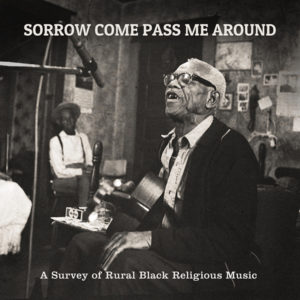
SORROW COME PASS ME AROUND: A SURVEY OF RURAL BLACK RELIGIOUS
A collection of spiritual and gospel songs performed in informal non-church settings between 1965-1973. Most are guitar-accompanied and performed by active or former blues artists. “Most records of black religious music contain some form of gospel singing or congregational singing recorded at a church service. This album, though, tries to present a broader range of performance styles and contexts with the hope of showing the important role that religious music plays in the Southern black communities and in the daily lives of individuals.” - David Evans, from the liner notes
Ephram Carter and His Fife & Drum Band, Willard Artis “Blind Pete” Burrell, Babe Stovall, Annie Lee and Oscar Crawford with Annie Mae Jones, Reverend Rubin Lacy, Robert “Nighthawk” Johnson, Dorothy Lee, Norma Jean and Shirley Marie Johnson with Robert “Nighthawk” Johnson, Katie Mae Young, Eddie Lee “Mustright” Jones, Robert “Nighthawk” Johnson, Chester Davis and Congregation / Compton Jones and Group / Furry Lewis, Willard Artis “Blind Pete” Burrell, Pattie Rosemon with Frank and Odie Rosemon, Babe Stovall, Napoleon Strickland, Willard Artis “Blind Pete” Burrell.
12,00€
Out of stock
CD
COMPILATION
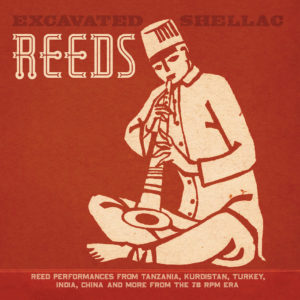
EXCAVATED SHELLAC : REEDS
CD in digipak includes 20-page booklet.
Reed instruments are capable of some of the most impassioned music on the planet, all due to the malleability of the reeds, themselves - historically made of plant tissue, which vibrate when air hits them. The origin of most reed instruments is steeped in rural, pastoral culture. Many insistent, loud, often joyful, reed instruments have always been played outdoors as traditional accompaniment for dancing and celebrations.
This compelling album is the second volume in the Excavated Shellac release series, featuring rare, never-before issued 78rpm records from around the world, centered on a unique theme. The previous volume (Excavated Shellac: Strings) focused on stellar stringed instrument performances. This release examines some of the most intense and hypnotic music set to disc during the early years of international recording, all featuring reed instruments. All previously unreleased on CD, with three bonus tracks not available on the newly-released vinyl LP. All records have been carefully transferred and mastered and are presented with extensive liner notes by Jonathan Ward.
“Jon Ward’s Excavated Shellac focuses on ethnic music on 78’s. He’s one of the smartest obsessive record collectors I know, and the stuff he posts I would gladly pay to download… it is always stuff you would never hear anywhere else, nothing here on CD. This is the rarest of the rare and the best of the best. Stellar!” Steve Roden, Wire Magazine’s Web Exclusive
“Featuring Ward’s informative notes and commentary… (Excavated Shellac is) an astounding selection of music from India, Ireland, Turkey, Burma, Poland, Africa, Japan, Spain, the US, and more…rare treats.” Susanna Bolle, The Boston Phoenix.
1. I Tre Antonio della Basilicata, Tarantella Popolare (Italy)
2. Sylvain Poujouly & Achille Marc, Lou Bolontinou (Auvergne, France)
3. Karzana Oyun Havasi, Zurnacı Mahir and Ali (Turkey)
4. Tufanpur Orchestra, Reng-E Ghafghaz (Iran)
5. Ahn Ki-Ok and Kin Yin Kuan, Janggochum (North Korea)
6. Guangdong Troupe with Da Kai men, Untitled (China)
7. T. Rajarathnam Pillai, Raga Alapana (Todi) (India)
8. Selim, Ekâri Eselimmit (Albania)
9. Obdulia Alvarez, “La Busdonga”, Cantar Bien Neña (Asturias, Spain)
10. Jhande Nath, Lahara Saamp Ke Masta Karneka (India)
11. Hoseynkali was Roofakah, Raqs Jooli, Aroosi (Kurdistan)
12. Mohamed Efendi Baz, Alia Mozmar Khedawi Masr (Upper Egypt)
13. Ngoma Ya Kitokomire, Mimi Naona Haya (Tanzania)
14. Mqonga Sikanise, Into Ezimnandi (South Africa)
Bonus Tracks Not Included on LP
15. Musicians of Radio Studio Skopje, Macedonia, Macedonsko Oro (Macedonia)
16. Uncredited musicians, Raqsi Kalon (Tajikistan)
17. Parush Parushev, Ruchenitsa (Bulgaria)
12,00€
Out of stock
CD
COMPILATION
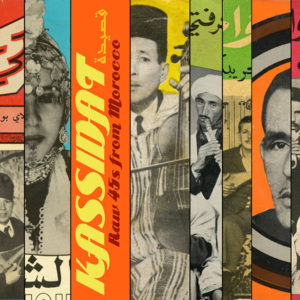
KASSIDAT : RAW 45s FROM MOROCCO
Description: Features six extended tracks from the Golden Age of the Moroccan record industry. “Kassidat”, the Arabic word for poetry, is one of the essential ingredients in Moroccan song. Despite the bewildering array of musical styles in Morocco, the Moroccan sense of poetry is found throughout the music, regardless of the style or language. This isn’t the language of high art, but an often impenetrable vernacular poetry of oblique references, symbols, metaphors, and double entendres that describes the lives of average Moroccans. Mohamed Bergam, Rais Haj Omar Wahrouch, Abdellah el Magana, Jmimi, Lekbir and Fatma Anounya, Bennasser Oukhouya and Cheikha Hadda Ouakki, Cheikh Mohamed Riffi.
14,00€
Out of stock
CD
COMPILATION
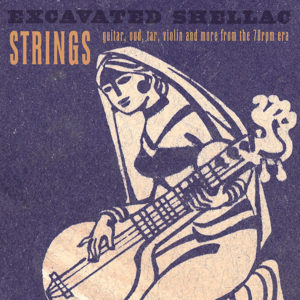
EXCAVATED SHELLAC : STRINGS
CD in digipak with 20-page booklet.
Compiled by Jonathan Ward, Excavated Shellac: Strings features seventeen (including 3 bonus tracks not on LP) outstanding performances from the four corners of the world played on stringed instruments and recorded and released on 78rpm records circa 1920-1950. This vinyl LP features fiddles, shamisen, charango, Paraguyan harp, Indian vina, Lebanese oud, Persian violin, Vietnamese moon guitar, and more. Compiled by Jonathan Ward, all tracks are previously unreissued, carefully transferred and mastered and presented with detailed liner notes by Ward.
“Jon Ward’s Excavated Shellac focuses on ethnic music on 78’s. He’s one of the smartest obsessive record collectors I know, and the stuff he posts I would gladly pay to download… it is always stuff you would never hear anywhere else, nothing here on CD. This is the rarest of the rare and the best of the best. Stellar!” Steve Roden, Wire Magazine’s Web Exclusive
“Featuring Ward’s informative notes and commentary… (Excavated Shellac is) an astounding selection of music from India, Ireland, Turkey, Burma, Poland, Africa, Japan, Spain, the US, and more… rare treats.” Susanna Bolle, The Boston Phoenix
1. Sogoman Seranyan, Eraz (Armenia)
2. Sundaram Balachander, Dayapayonidhe, Pt. 2 (India)
3. Alberto Ruiz y su Lira Incaica, Paceñita (Bolivia)
4. Nzila Joseph et son ensemble, Moleke Mbwa (Congo)
5. T n and ng, Nam Bình (Vietnam)
6. Tatyana Makharadze & G. Bugadze, Lale (Georgia)
7. Abol-hasan Sab , Chaopan (Iran)
8. Trio Tipico Paraguayo de Félix Pérez Cardoso, Pajaro Campana (Paraguay)
9. Bra a Kapugi Tamburica Orchestar i Pjeva ki Zbor, Tko Se Bregom Se e (Croatia)
10. Kjetil Flatin, Jornvrongia-Springar (Norway)
11. Yamaura Toyoko, Ko-uta, Ryukyu Bushi (Japan)
12. Chahadé Effendi Saadé, Taqsim Rast (Lebanon)
13. Galabuzi and Party, Okubulirwa Lupiza Otambula Osopza (Uganda)
14. Kemanî Amâ Recep, Çifte kiri ile Rast Taksim (Turkey)
Bonus Tracks Not Included on Original LP
15. Feliciano Delgado, Ausencia (Panama)
16.Grupo Irmãos Borges Barros, Enchente de Beijos (Brazil)
17.Eyyubi Mustafa Sunar, Isfahan Taksim (Turkey)
12,00€
Out of stock
CD
Lonnie HOLLEY
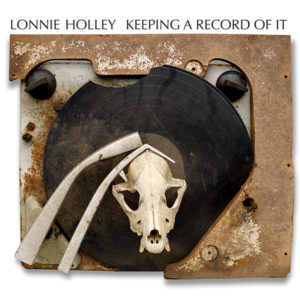
“Keeping a record of it”
Keeping a Record of It is the follow-up to Lonnie Holley’s debut album, Just Before Music. It features recordings made in 2006, 2010 and 2011. Guest performers include Cole Alexander from the Black Lips, Bradford Cox from Deerhunter, and visual artist Lillian Blades. CD Digipak with booklet featuring lyric transcriptions and artwork by Lonnie Holley.
“Last year, at 62, after decades of singing while he worked, Holley released his jarring debut album, Just Before Music, a marriage of improvised keys and the rambling, hollow bellow of his voice, as well as the first original recording put out by the archival folk label Dust-to-Digital. This year, he’ll tour, and he recently starred in a Whitney Museum group show, ‘Blues for Smoke.’” - The Fader
“Lonnie Holley sings with an intense, emotional voice and unleashes lyrics without consistent meter or rhyme over gossamer keyboard lines that hang in the ether. His music is a blues nebula, splotched with riffy word jazz that shares in some rappers’ collagist aesthetics as well as the runaway passion of a gospel preacher enlivened by the Spirit.” - Aquarium Drunkard
12,00€
In stock
CD
Lonnie HOLLEY
“Just before music”
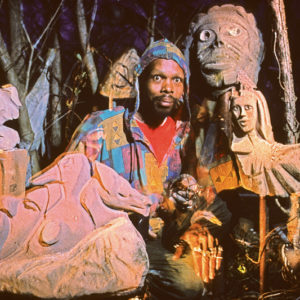
“Lonnie Holley was born on February 10, 1950 in Birmingham, Alabama, the seventh of 27 children. From the age of five, Holley worked various jobs: picking up trash at a drive-in movie theatre, washing dishes, and cooking. He lived in a whiskey house, on the state fairgrounds, and in several foster homes. His early life was chaotic and Holley was never afforded the pleasure of a real childhood.
Since 1979, Holley has devoted his life to the practice of improvisational creativity. His art and music, born out of struggle, hardship, but perhaps more importantly, out of furious curiosity and biological necessity, has manifested itself in drawing, painting, sculpture, photography, performance, and sound. Holley’s sculptures are constructed from found materials in the oldest tradition of African American sculpture. Objects, already imbued with cultural and artistic metaphor, are combined into narrative sculptures that commemorate places, people, and events. Holley did not start making and performing music in a studio nor does his creative process mirror that of the typical musician. His music and lyrics are improvised on the spot and morph and evolve with every event, concert, and recording. In Holley’s original art environment, he would construct and deconstruct his visual works, repurposing their elements for new pieces. This often led to the transfer of individual narratives into the new work creating a cumulative composite image that has depth and purpose beyond its original singular meaning. The layers of sound in Holley’s music, likewise, are the result of decades of evolving experimentation. “Just Before Music” features Holley’s first studio recordings made in 2010 and 2011.” Description: CD Digipak with 20 page booklet featuring lyric transcriptions and artwork by Lonnie Holley.
12,00€
In stock

CD
Blind Alfred REED
“Appalachian Visionary”
Description: CD in hardcover, 84-page book featuring extensive liner notes by Ted Olson. Includes download/streaming code.
“Alfred Reed’s story is that of a man looking within to find a light by which to navigate the darkness within and without.” – Ted Olson
Born blind on June 15, 1880, in Floyd County, Virginia, Alfred Reed grew up on a West Virginia farm. In the 1920s, when radio became available in his area, Alfred listened to and enjoyed performances by several of the era’s popular singers. Alfred would purchase songbooks and hymnbooks, and his wife Nettie would read the lyrics to him. Because the songs he learned from others did not always express aspects of what he was thinking, feeling, and experiencing, Alfred felt compelled to compose his own songs, and he was exceptionally talented in this endeavor—a craftsman with many things to say. Relying upon his talent to generate money for supporting his family, he played music on the streets of nearby towns, gave music lessons, performed at dances and various social and church gatherings, sold printed copies of his own lyrics, and, in 1927 and 1929, made the commercial recordings included on this set.
23,00€
In stock

CD
Thomas TILLY
“Test – Tone documents”
Test/Tone - Installation for plans, recordings and speakers. La Cartonnerie/Palais du Tau, Reims (France), 2007.
“Through the filters constituted by a building's walls and the complex electrical network composing its nervous system, sound appears as a residual matter of the building's activities, eroded by the architecture. The geographical situation of these aucoustical phenomena is representative of this activity’s nature.Test/Tone is a listening space, created through a study of the building that hostes La Cartonnerie, dedicated to amplified music and composed by two concert halls, several studios, technical premises and a reception area. The space is defined by ten loudspeakers wich broadcast a work exclusively composed of sound recordings made in the building. These recordings (vibrations, magnetic fields and sounds from influx of visitors or employees working) put foreward some almost inaudible resonant images of the building. The loudspeakers’ placing inside the device has been determined while picking up sounds by a cartographical work making the place's most important zones of intense sound flows appear.A work of urban phonography, Test/Tone is both a retranscription on a reduced scale of a place’s geography and an enlargement of it's sound environment.” Thomas Tilly, 2007.
14,00€
In stock

CD
SIM + OTOMO
“Monte alto estate”
“This is the collaborative masterpiece of the 3-piece unit, sim (Oshima Teruyuki on guitar and composition, Ootani Yoshio on computer, electronics, etc, and Uemura Masahiro on drums) and Otomo Yoshihide (turntables, self-made synthesizer). The noise of Otomo sharply incises the unique sound of sim, where Uemura’s controlled roaring drumming sets an main axis on Oshima’s precise rhythmical composition, Oshima’s the chord cuttings beats minimally and the electronics of Ootani give extreme voltage. Both of their mastering of some tunes procedure of which once made back into analogue and the exquisite jacket cover seem to simbolize this distinct sound.”
15,00€
Out of stock

CD
Roger TURNER – SATO Masahiko – YOSHIHIDE Otomo
“live at Hall Egg Farm”
English living legend percussionist, Roger Turner plays in Tokyo lin 2015 and this is one of the live performance in Fukaya city, Saitama prefecture. Roger percussion solo, Otomo electric guitar added and Japanese free jazz patriarch, Sato added, then becomes intense and has musical speed. You could not lose interest in this music notwithstanding 1 tunes, 66 minutes.
15,00€