
Out of stock

CD
Toschi ICHIYANAGI
“Shikisokuzekuu-Kuusokuzeshiki – Obscure Tape Music of Japan vol.20”
“Shikisokuzekuu-Kuusokuzeshiki” (1964). “Extended Voices” (tape part, stereo version - 1967).
The details of “Shikisokuzekuu-Kuusokuzeshiki” are unknown except it was created at the NHK electronic music studio. According to Ichiyanagi, there are various discussions for the title, but it seemed to be eventually broadcasted on the radio with the title Kuu after a producer desired and decided to name it. At this time, the original title was used as following the initial intention of Ichiyanagi. In addition, short experimental film “Shikisokuzekuu” (1974) produced by a filmmaker Toshio Matsumoto where Ichiyanagi was also in charge of tape music was a different work so it does not have any relation with this music work.
Note: Shikisokuzekuu-Kuusokuzeshiki means “Form is exactly emptiness. Emptiness is exactly form.”
“Extended Voices” can be enjoyed by listening to the Columbia LP album “Extended Voices” with the collection of voices from the music works. A new version with mixing voices of baritone of Takashi Matsudaira to a monaural tape part was released by Omega Point in 2014, but since the stereo version was found later, it was added as a tape work without voice this time. It can be said that this is a completed work as an independent electronic music. (Provider of the tape recording: Gregor Meyer)
[Translated by Toshiyuki Kawata]
The details of “Shikisokuzekuu-Kuusokuzeshiki” are unknown except it was created at the NHK electronic music studio. According to Ichiyanagi, there are various discussions for the title, but it seemed to be eventually broadcasted on the radio with the title Kuu after a producer desired and decided to name it. At this time, the original title was used as following the initial intention of Ichiyanagi. In addition, short experimental film “Shikisokuzekuu” (1974) produced by a filmmaker Toshio Matsumoto where Ichiyanagi was also in charge of tape music was a different work so it does not have any relation with this music work.
Note: Shikisokuzekuu-Kuusokuzeshiki means “Form is exactly emptiness. Emptiness is exactly form.”
“Extended Voices” can be enjoyed by listening to the Columbia LP album “Extended Voices” with the collection of voices from the music works. A new version with mixing voices of baritone of Takashi Matsudaira to a monaural tape part was released by Omega Point in 2014, but since the stereo version was found later, it was added as a tape work without voice this time. It can be said that this is a completed work as an independent electronic music. (Provider of the tape recording: Gregor Meyer)
[Translated by Toshiyuki Kawata]
18,00€
Out of stock
CD
Takashi MATSUDAIRA
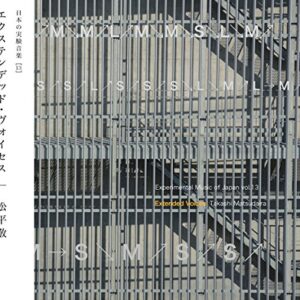
“Extended voices”
Experimental Music of Japan vol. 13.
Extended Voices, a compilation LP album released from Odyssey, a former section of Columbia Records, the U.S., contains works of “extended voices” offered by important authors of the experimental music circle including Pauline Oliveros, Morton Feldman, John Cage and Alvin Lucier [1]. As we had obtained the tape recording of Extended Voices composed by Toshi Ichiyanagi, a number consisting of electronic sounds and modulated voices which is contained in the album, we sought help from Takashi Matsudaira, a baritone singer, and worked on the realization of the piece in a different manner from the original version. By featuring this realization but also adding experimental pieces selected by Matsudaira as well as his own original work, we constructed “an anthology of extended voices” partially as homage to the original LP.
Toshi Ichiyanagi “Extended Voices” (new version
1). Toshi Ichiyanagi “Extended Voices” (new version
2). John Cage “Ryoanji”. Takashi Matsudaira “Shiroi Shojo”. Shigeru Matsui “ ” [partial] (realization by Takashi Matsudaira).
17,00€
Out of stock
CD
Somei SATOH
“Echoes” – Obscure Tape Music of Japan vol.18
“Emerald Tablet” (1978) was recorded at the NHK electronic-music studio in 1978. It is made up of only the sonic ingredients of a tubular bell, cymbals, and “Kin,” a largish-sized bell used for Buddhist memorial services in Japan. The attack of the sound of each instrument was eliminated, and the work was taped through repeated overdubbing. This produced a variety of beautiful harmonics that otherwise could not be produced from a single instrument’s sound, and the interference of harmonics created beats, generating a fantastical melody in the high tone range. Harmonics are one of the most mystic phenomena in the world. The wonder of harmonics led me to produce Emerald Tablet.
“Echoes” (1981) was composed for the “Mist, Sound, and Light Festival,” a 10-day event organized by the hot spring tourist association of Kawaji, Tochigi Prefecture, that was held on May 20-29, 1981. The venue was located at the Kawaji hot spring’s Ojika river valley, which was 50 meters wide and 200 meters long with an area of 7,000 square meters. Eight large loudspeakers were set up on hills surrounding the stream, with music played through an octuple channel-tape system. The combined length of cables connected with the loudspeakers exceeded one kilometers. The audience was amidst dense artificial mists spreading upward from the bottom of the valley, laser light beams projected on the hill surface, and tape music that played in extremely low tone at full blast, echoing in the valley. Echoes consists of the sonic ingredients of the three types of percussion instruments used in Emerald Tablet as well as my own voice. - Somei Satoh
Somei Satoh. Born in Sendai, 1947, composer. He began teaching himself western music and exploring experimental music at the age of eighteen. Since the late 1960s, he has presented several multimedia works. He subsequently spent a year in New York with an invitation from the Asian Cultural Council. Satoh’s works have been widely performed in USA, European countries and many countries in the Pacific basin. His other electronic works are Mandara, Mantra and Tantra.
“Echoes” (1981) was composed for the “Mist, Sound, and Light Festival,” a 10-day event organized by the hot spring tourist association of Kawaji, Tochigi Prefecture, that was held on May 20-29, 1981. The venue was located at the Kawaji hot spring’s Ojika river valley, which was 50 meters wide and 200 meters long with an area of 7,000 square meters. Eight large loudspeakers were set up on hills surrounding the stream, with music played through an octuple channel-tape system. The combined length of cables connected with the loudspeakers exceeded one kilometers. The audience was amidst dense artificial mists spreading upward from the bottom of the valley, laser light beams projected on the hill surface, and tape music that played in extremely low tone at full blast, echoing in the valley. Echoes consists of the sonic ingredients of the three types of percussion instruments used in Emerald Tablet as well as my own voice. - Somei Satoh
Somei Satoh. Born in Sendai, 1947, composer. He began teaching himself western music and exploring experimental music at the age of eighteen. Since the late 1960s, he has presented several multimedia works. He subsequently spent a year in New York with an invitation from the Asian Cultural Council. Satoh’s works have been widely performed in USA, European countries and many countries in the Pacific basin. His other electronic works are Mandara, Mantra and Tantra.
18,00€
Out of stock
CD
Mamoru FUJIEDA
“Radiated falling” – Obscure Tape Music of Japan vol.11
“Both “Radiated Falling” (1980) and “The Art of Fugue” (1981) are tape compositions in which sound materials of a prepared piano are electronically processed and modulated in various ways. “Radiated Falling” is based on “Falling Scale No.2 for piano” (1975). The sound materials were then transformed to layered sonic textures through the ring modulator, the phase shifter, the harmonizer, and various delay processes.
“The Art of Fugue” is based on a simple fugue in four voices from the first piece in The Art of Fugue by J. S. Bach. The four voices were randomly cut into fragments, which were then reassembled to form four new voices. Each of the voices played by a differently prepared piano was recorded in a multi-track recorder to produce sound materials for the piece. The sound materials of the prepared piano was then electronically modulated and spatially processed.” - from liner note
“The Art of Fugue” is based on a simple fugue in four voices from the first piece in The Art of Fugue by J. S. Bach. The four voices were randomly cut into fragments, which were then reassembled to form four new voices. Each of the voices played by a differently prepared piano was recorded in a multi-track recorder to produce sound materials for the piece. The sound materials of the prepared piano was then electronically modulated and spatially processed.” - from liner note
18,00€
Out of stock
CD
Makoto MOROI
“Kusabira” – Obscure Tape Music of Japan vol.13
Obscure tape music of japan vol.13. One of pioneers of japanese electronic music makoto moroi composed “kusabira” for kyogen (traditional comical theater) with electronic sound in 1964. ’kusabira’ means mushroom. a strolling buddhist monk ’yamabushi’ tried to exterminate many mushrooms grew out in garden of a man’s home. however and his magic did not take effect for them but also the mushrooms began to increase. the man and yamabushi were driven out of home by large mushroom finally. in this work and moroi modulated kyogen lines into concrete sound. it’s so noisy and strange! This cd also includes moroi’s important work used japanese traditional instruments. the thought of this work was based on alvin toffler’s “future shock” and was composed as spacephonic music by 4-channel recording system for great player susumu miyashita. he played various kinds of koto, gongs and percussions and indian flute bansuries. sharpness of the performance is so wonderful and also some human voices transformed noise sound are inserted on middle part of this work. both works are most avant-garde of moroi’s works!!
17,50€
Out of stock
CD
Makoto MOROI-Kuniharu AKIYAMA
“Music drama Akai Mayu” – Obscure Tape Music of Japan vol.3
Back in stock. “Akai Mayu” is a short fiction of Koubou Abe (1924-1993). This music drama version was broadcasted by NHK in 1960. Makoto Moroi is a pioneer of Japanese electronic music, and he composed the music used chamber ensemble, mixed chorus and electronic sound on this work. Also this work was performed at Sogetsu Art Center as a part of concert program of Moroi’s works. This different version included a pantomaime by Mamako Yoneyama, abstract image projection and stage setting by Hiroshi Manabe. Also in this concert, Kuniharu Akiyama (about his name, please see note of CD “Music for Puppet Theatre of HITOMI-ZA”) performed his work “Arcana 19”. This work was consisted of text, object sounds, piano and pre-recorded tapes. On this CD includes only some tape parts because live recording source of this performance was lost. Makoto Moroi (music) + Koubou Abe (text) “Akai Mayu” (1960), Kuniharu Akiyama “Arcana 19 (excerpt)” (1960).
18,00€
Out of stock
CD
Kuniharu AKIYAMA
“Tape works-Obscure tape music of Japan vol.6”
Obscure tape music of Japan vol.6. “Kuniharu Akiyama (1929-1996) was well-known as a music critic mainly modern and contemporary. However, his carrier was not only in music field but also was very expanded avant-garde art (especially he related early Fluxus movement). This issue is consisted his three obscure tape music, sound sculpture “Environmental mechanical orchestra” for exhibition, “Demonstration for opening event of Nissei Theater” and unknown work “Music for H.Bomb”.
17,50€
Out of stock
CD
Kuniharu AKIYAMA
“Environmental Music for Dining Room of Athletes’ Village in Tokyo Olympics 1964”
From participation in the early Fluxus to giving an introduction of Futurism, Kuniharu Akiyama (1929-1996), a renowned music critic, was involved in a vast range of activities. Particularly in the 1960s, he recorded a lot of music on tape for himself. To our surprise, the music compiled on this CD was actually discovered from a series of ambient music pieces played in the Athletes’ Village at the Tokyo Olympics! During this period, Akiyama was fascinated by the sound of Sanukite stone from Sanuki, Shikoku island and he composed several ambient music pieces including this one. Despite the detail of the work have been unknown as the composer was already passed away, a guru of electronic musicologist, Koji Kawasaki, managed to reveal everything behind the piece.
About the Works
On this CD, there are two pieces of ambient music, which were composed by Kuniharu Akiyama for the Tokyo Olympics in October 1964. This music was composed with the sound of stones for a pair of stone speakers. To understand how it was developed, we have to go back almost two years from then. Around mid January in 1963, Kuniharu Akiyama was asked to compose Ishi no Uta (Song of Stone) for a TBS’s TV program. It is said that Akiyama was interested in Aji Village, Takamatsu city through a relationship with the sculptor Masayuki Nagare. This village is known for its over hundred-year tradition of granite quarrying. Akiyama planned to compose the piece only by using stones and to do so he decided to visit Aji Village in late January.
At a dinner organized by Masanori Kaneko, the Kagawa Prefecture Governor, Akiyama found out that a beautiful “tone-stone” could be mined at Takamatsu. Akiyama then went to Takamatsu with Mitsuaki Sora, Nagare’s assistant and CEO of the Okada Stone Industry. Akiyama later recalled the moment when he encountered the Sanukite stone, “I was deeply moved when I hit the natural stones of various sizes that had not been modified by artificial elements. Clear beautiful sounds with amazingly long sustain. Each stone had a different tone. Sharp and very powerful. To be honest, I never had thought that stones could have such a beautiful, strong and sharp tone.”
From 1961, under the direction of the architect, Kunio Maekawa, Okada Stone had worked on a project to produce an exterior wall in stonemasonry style for the Japan Pavilion at the New York World Expo held in April 1964. To check its quality, a prototype was supposed to be displayed at a certain space in Takamatsu city. This location became a project of collaborative work and was finally used as a café. A collective formed by an architect Tadashi Yamamoto for construction design, Sora for facade and interior design, Akiyama for music and Junosuke Okuyama, an engineer of Sogetsu Art Center, for in-store sound design, worked on each assignment and the café “Shiro no Me (Eye of the castle)” was opened.
Two huge stone speakers were installed on the left and right side of the entrance to the café. These speakers were invented by Okuyama and produced by Okada Stone. “Enjoy our speaker system that makes it possible to play music in the most musical quality. As only ‘pure sound’ will be projected, the sound is superb” was written on a flyer at the opening of the café. This became possible because all vibration except for the paper speaker cone can be suppressed to the utmost limit by the weight of the stone.
In Sogetsu Studio, Akiyama used the sound of stones as material and composed an ambient music piece called Shiro no Me; Music for Coffee House No.1 for these speakers. This piece was assumed to be created by adding reverberation components to an improvisational performance with Sanukite and slowing down the playback to approximately one-half speed. This very primitive technique was chosen to take a full advantage of the beauty of Sanukite sound.
About one year and a half later, for the Tokyo Olympics held in October 1964, two large dining halls called “Sakura” and “Fuji” were built in the male section of the Yoyogi Athletes' Village by architect Kiyonori Kikutake. It is said that while Akiyama composed an ambient music piece called “Music for eating” they decided to transport the stone speakers from the café “Shiro no Me” to the Fuji hall. Also in the front garden of the Fuji hall, an ambient piece called Music for resting was played. Both pieces, which were in the similar composition style of Music for Coffee House, were recorded at Sogetsu Studio.
In 1965, Akiyama argued, “the purpose of designed music is non other than promoting the composer’s work, who designs music creatively, in a living environment. (omission) The composer would also have to participate in urban planning along with the architects and the artists. As we all know, it is because the composer himself/herself has also a role to dramatically shape a living space for today and tomorrow”. The compositions compiled on this CD can be considered as a practice of Akiyama’s assertion as well as a valuable innovation to the Japanese ambient music scene.” Koji Kawasaki (electronic musicologist)
[English translation by Toshiyuki Kawata]
About the Works
On this CD, there are two pieces of ambient music, which were composed by Kuniharu Akiyama for the Tokyo Olympics in October 1964. This music was composed with the sound of stones for a pair of stone speakers. To understand how it was developed, we have to go back almost two years from then. Around mid January in 1963, Kuniharu Akiyama was asked to compose Ishi no Uta (Song of Stone) for a TBS’s TV program. It is said that Akiyama was interested in Aji Village, Takamatsu city through a relationship with the sculptor Masayuki Nagare. This village is known for its over hundred-year tradition of granite quarrying. Akiyama planned to compose the piece only by using stones and to do so he decided to visit Aji Village in late January.
At a dinner organized by Masanori Kaneko, the Kagawa Prefecture Governor, Akiyama found out that a beautiful “tone-stone” could be mined at Takamatsu. Akiyama then went to Takamatsu with Mitsuaki Sora, Nagare’s assistant and CEO of the Okada Stone Industry. Akiyama later recalled the moment when he encountered the Sanukite stone, “I was deeply moved when I hit the natural stones of various sizes that had not been modified by artificial elements. Clear beautiful sounds with amazingly long sustain. Each stone had a different tone. Sharp and very powerful. To be honest, I never had thought that stones could have such a beautiful, strong and sharp tone.”
From 1961, under the direction of the architect, Kunio Maekawa, Okada Stone had worked on a project to produce an exterior wall in stonemasonry style for the Japan Pavilion at the New York World Expo held in April 1964. To check its quality, a prototype was supposed to be displayed at a certain space in Takamatsu city. This location became a project of collaborative work and was finally used as a café. A collective formed by an architect Tadashi Yamamoto for construction design, Sora for facade and interior design, Akiyama for music and Junosuke Okuyama, an engineer of Sogetsu Art Center, for in-store sound design, worked on each assignment and the café “Shiro no Me (Eye of the castle)” was opened.
Two huge stone speakers were installed on the left and right side of the entrance to the café. These speakers were invented by Okuyama and produced by Okada Stone. “Enjoy our speaker system that makes it possible to play music in the most musical quality. As only ‘pure sound’ will be projected, the sound is superb” was written on a flyer at the opening of the café. This became possible because all vibration except for the paper speaker cone can be suppressed to the utmost limit by the weight of the stone.
In Sogetsu Studio, Akiyama used the sound of stones as material and composed an ambient music piece called Shiro no Me; Music for Coffee House No.1 for these speakers. This piece was assumed to be created by adding reverberation components to an improvisational performance with Sanukite and slowing down the playback to approximately one-half speed. This very primitive technique was chosen to take a full advantage of the beauty of Sanukite sound.
About one year and a half later, for the Tokyo Olympics held in October 1964, two large dining halls called “Sakura” and “Fuji” were built in the male section of the Yoyogi Athletes' Village by architect Kiyonori Kikutake. It is said that while Akiyama composed an ambient music piece called “Music for eating” they decided to transport the stone speakers from the café “Shiro no Me” to the Fuji hall. Also in the front garden of the Fuji hall, an ambient piece called Music for resting was played. Both pieces, which were in the similar composition style of Music for Coffee House, were recorded at Sogetsu Studio.
In 1965, Akiyama argued, “the purpose of designed music is non other than promoting the composer’s work, who designs music creatively, in a living environment. (omission) The composer would also have to participate in urban planning along with the architects and the artists. As we all know, it is because the composer himself/herself has also a role to dramatically shape a living space for today and tomorrow”. The compositions compiled on this CD can be considered as a practice of Akiyama’s assertion as well as a valuable innovation to the Japanese ambient music scene.” Koji Kawasaki (electronic musicologist)
[English translation by Toshiyuki Kawata]
18,00€
Out of stock
CD
Kenichi KANAZAWA
“Solo performance”
Kenichi Kanazawa is a sculptor. He cuts and assembles thick iron plate pieces, and also he remarked the sound of the iron pieces. This CD is live recording of performance at his recent retrospective exhibition in 2011. Oto no Kakera (= Fragments of Sound) was laid by clue that I participated in an exhibition ’Sound Garden’ in 1987. An idea occurred for the work of the exhibition. I cut thick steel plate as like pieces of jigsaw puzzle on theme of relationship of iron, figure and sound. I attacked the pieces by sticks, and then I experienced listening their sounds first. Various pitches, tones and resonances of sounds were made from area and shape of each pieces. They extended world of iron sound richly.
In the ’Sound Garden’ exhibition, artists had to do any performance. I believe it was beginning of Oto no Kakera performance. This CD is recording of performance in exhibition ’Kenichi Kanazawa, iron as a starting point 1982-2011’. - from liner note
track 1: starting by Vibratile Shape - Circle and Square.
track 2: improvisation on Oto no Kakera 5 object.
track 3: I emphasized specific frequencies of sound through bamboo pipe, and I sounded by falling and rolling various materials on Oto no Kakera.
track 4: steel wire vibration on Vibratile Shape - Square.
track 5: rubbing an iron piece by iron bar.
track 6: high tone by hummer attack on iron piece.
track 7: preparation effect by various materials on Oto no Kakera.
In the ’Sound Garden’ exhibition, artists had to do any performance. I believe it was beginning of Oto no Kakera performance. This CD is recording of performance in exhibition ’Kenichi Kanazawa, iron as a starting point 1982-2011’. - from liner note
track 1: starting by Vibratile Shape - Circle and Square.
track 2: improvisation on Oto no Kakera 5 object.
track 3: I emphasized specific frequencies of sound through bamboo pipe, and I sounded by falling and rolling various materials on Oto no Kakera.
track 4: steel wire vibration on Vibratile Shape - Square.
track 5: rubbing an iron piece by iron bar.
track 6: high tone by hummer attack on iron piece.
track 7: preparation effect by various materials on Oto no Kakera.
16,00€
Out of stock
CD
Kenichi KANAZAWA – Shinjiro YAMAGUCHI – Hiroyuki URA
“Fragments of sound, figure of music”
Experimental Music of Japan vol. 9. Kenichi Kanazawa is a sculptor. He cuts and assembles thick iron plate pieces, and also he remarked the sound of the iron pieces. This CD is live recording of performance with young musicians, Hiroyuki Ura and Shinjiro Yamaguchi in 2010. This performance consisted of some fragments, and Yamaguchi planned detail of them. According to his explanation, he tried to catch invisible figure of music through composition by simple rule and style.
track 1: solo performance used self-made steel triangle instrument by Kanazawa.
track 2: each player plays sound 1 time at first 1 minute, plays 2 times at next 2 minutes, and it’s continued until 12 minutes.
track 3: performance used five kinds of plate sculptures. they performed on the rule that each 2 members must not play in same time.
track 4: drumming and rubbing of Oto no Kakera 9 with electronic noise.
track 5: solo performance by Oto no Kakera 9.
track 6: drone sound performance used Vibratile shape - circle 1200 and Vibratile Shape - Square 1200.
track 7: improvisation used Oto no Kakera 9 determined to finish with succession attack by all players.
track 1: solo performance used self-made steel triangle instrument by Kanazawa.
track 2: each player plays sound 1 time at first 1 minute, plays 2 times at next 2 minutes, and it’s continued until 12 minutes.
track 3: performance used five kinds of plate sculptures. they performed on the rule that each 2 members must not play in same time.
track 4: drumming and rubbing of Oto no Kakera 9 with electronic noise.
track 5: solo performance by Oto no Kakera 9.
track 6: drone sound performance used Vibratile shape - circle 1200 and Vibratile Shape - Square 1200.
track 7: improvisation used Oto no Kakera 9 determined to finish with succession attack by all players.
16,00€
Out of stock
CD
Kazuya ISHIGAMI
“Hosshin no Kizashi”
Experimental Music of Japan vol.5. However sound performer Kazuya Ishigami studied at academy of music in Japan and France, he also acts as noise/improvisation unit “Billy” and “Daruin” since 1997. This CD consists of recent 2 works of “Acousmatic electronic music”. I think many works of this style are bored for electronic music fan because they are so academic and confines in the style. But Ishigami’s sound brought from his wide activities and imaginations are so exiting and cool. - OP.
“Hosshin no Kizashi” is a work composed based on the theme “Pray” that the priest of buddhist temple Senkoji (in Osaka) presented.
Hosshin: Meaning of “Departure bodhi mind”. “Hosshin no Kizashi” is a meaning of this side of “Departure bodhi mind” one step. That is, it means there is still a hesitation. “Otokamui no Sasayaki” (Whisper of sound god); “Oto” means “sound” in Japanese. “Kamui” means “god” in Ainu.
Profile of artist: Kazuya Ishigami. Born in 1972, in Osaka. Sound performer, composer and sound engineer. He was graduated from Osaka University Of Arts in 1994. He composed his pieces in INA-GRM in August 1997. His Radiophonic work “Sonic Escapism”, “2nd 49” and “Whisper of Sound God” were broadcasted from Deutschlandradio In 2005-2008. - excerpt from liner note
“Hosshin no Kizashi” is a work composed based on the theme “Pray” that the priest of buddhist temple Senkoji (in Osaka) presented.
Hosshin: Meaning of “Departure bodhi mind”. “Hosshin no Kizashi” is a meaning of this side of “Departure bodhi mind” one step. That is, it means there is still a hesitation. “Otokamui no Sasayaki” (Whisper of sound god); “Oto” means “sound” in Japanese. “Kamui” means “god” in Ainu.
Profile of artist: Kazuya Ishigami. Born in 1972, in Osaka. Sound performer, composer and sound engineer. He was graduated from Osaka University Of Arts in 1994. He composed his pieces in INA-GRM in August 1997. His Radiophonic work “Sonic Escapism”, “2nd 49” and “Whisper of Sound God” were broadcasted from Deutschlandradio In 2005-2008. - excerpt from liner note
17,00€
In stock
CD
Kazuo UEHARA
“Assemblage”
Experimental Music of Japan vol.8. “Music Collage Re-Mix version” (1989-2010), “Pont de l’Alma de Paris” (1998), “OTO Mandala 2” (2009), “Sound Work 1” (1983), “Forest of Gombe” (2005), “Assemblage 2004” (2004), “Meteora version 1.0” (2007). Assemblage is a word from domain of modern art. This is the one of the technique of expression of art. The word means mixture originally. I decide the assemblage as a concept of this CD. The collage by Picasso is similar example. Dadaism is also similar example. I try to express new direction of music by using assemblage technique. Profile of artist : Kazuo Uehara was born in Osaka in 1949. He studied composition in Tokyo and in New York. He is an Professor of Music at the Osaka University of Arts. He gives courses on composition, experimental music and also multi-media performance at the university. His music has been performed in France, Germany, U.S.A., and other countries. He also performed his interactive live music and multi-media pieces at major festivals in Sweden, Bulgalia, Russia, France, Poland, Brasil, China, Korea and other countries. He is the prize winner of Bourge International Electro-acoustic Music competition. In 1990, he was awarded the grant from the New York State Council on the Arts. He had been producing the International Festival for Contemporary Music in Japan from1980s.
17,00€
Out of stock
CD
Kazuo UEHARA
“Early works” – Obscure Tape Music of Japan vol.16
“Seoul” (1982). This piece was composed using the recorded sounds as raw material. It was to reassemble the “historical” soundscape of the Korea’s capital city, Seoul, in the early 1980s. During this time, despite the political chaos and the tension in the city under the Korean military government, I felt the lively energy in its people’s life. The raw material comprised of wide range of different sounds includes the street cries in the downtown, cheerful voices of children in Namsang area, noise of arterial streets, and conversations of the students at the Seoul National University. “Music for Contemporary Dance - dedicate to Takao Kusuno” (1975). In 1970s, the art space “Jean-Jean“ in Shibuya served as a popular venue for experimental music, theatre, dance and others. In this movement, I did collaboration works with Takao Kusuno who performed as the artist and dance director. This piece for the dance was composed in collaboration with Kusuno to explore new approaches for dance. The work has two consecutive parts with the subtitles “Crows Habit” and “I am a Clown”. It was not merely a contemporary dance, nor Butoh, but it indicated the contemporary room for the dance scene of the time. “Science Technology Expo ’85 - Music for Cell Universe” (1985). The piece was specially composed for the Health and Sports Pavilion “Cell Universe“ at the International Exposition, Tsukuba, Japan, 1985. The space was comprised of twenty-seven-multiscreen film and stereophonic space. The uniquely designed space controller, the system for moving sound image, made it possible to control the electronic acoustic sound image to create virtual 3D space. “Homage to Xenakis” (1983). This piece was composed at a UPIC workshop held in Tokyo in 1980s where the composer Iannis Xenakis made remarks on each presented work. The musical composition tool, UPIC, was created by Xenakis. This unique sound synthesis system allows the user to create music by drawing lines on the board. Xenakis originally envisaged this tool to be used for pedagogical purpose. Other than musicians, the workshop drew participants from children to adults from the public. - from liner note by artist.
18,00€
Out of stock
CD
Kazuo UEHARA
“Event’ 73” – Obscure Tape Music of Japan vol.15
“From 1972 to 1973, I was based in New York for my creative activities and live performances. New York at this time was in its golden age of experimental music. Towards the end of my stay, I held a live performance entitled Event ’73 to sum up my creative works in New York. The venue for the performance was The Kitchen of the Mercer Arts Center that provided spaces for innovative and emerging artists. This CD consists of a mixture of sounds that were created at a studio prior to the live performance and the sounds recorded live at the performance. I used the Buckla Synthesizer for electronic sound and also for transformation of the sound. The work has four different segments: 1) Diffusion 2) Condensation 3) Chaos 4) Revolution. Each segment’s meanings and sounds itself doesn’t necessarily correlate to each other. Yet, the images that are evoked by each word express the chaotic world of the day.“”
17,50€
Out of stock
CD
Joji YUASA
“Background sound in textile pavillion of Expo’70” – Obscure Tape Music of Japan vol.14
At the EXPO ’70 in Osaka, many avant-garde artists contributed architectural, space, environmental design and sound works. In the Textile Pavillion ("Sen-i Kan" in Japanese), Japanese composer Joji Yuasa and filmmaker Toshio Matsumoto presented a remarkable experimental event, “Space Projection ’Ako’“ for multi-channel tape music and image projection. Also included in the presentation at the Pavillion was background sound for several spaces and objects, composed by Joji Yuasa, mainly. This original master tape was provided by Yoshimasa Matsumoto, the sound operator at the Pavillion, who was also a sound engineer for ’60s film and television which included “Ultra Q,“ “Ultraman“ and others. For the first track, “Music For ’Pattern-Slide ’Mon’yoh’,“ abstract textile images were projected on the walls of a corridor (“Mon’yoh“ means graphical patterns). This concrete sound was composed specially for this space. “Music For ’Colourful World’“ (by unknown mixer) was played and recorded by three electric guitar players. “White World“ involved the same interior space as “Colourful World,“ except it was painted white, in contrast to “Colourful World.“ Music for this room was made out of sound material from “Projection Esemplastic“ and “Icon For White Noise,“ both important electronic works from Yuasa’s early years. “Voices Of Dolls“ featured a group of tall, gentleman-like dolls set in a lobby space, accompanied by meaningless text in Japanese, English and Portuguese coming out of them. The Japanese version is a part of Yuasa’s concrete work, “Voices Coming.“ An English version (by Joseph Love) and a Portuguese version (by Joaquim M. Benoetez) were recorded for this project. For “Voice Of ’Raven’ Objects“ (by unknown mixer) the artist Masunobu Yoshimura created ravens and arranged them here and there on the Pavillion. The accompanying sound was made from modulated Noh chant and lines from a story coming out of the mouths of the ravens. “Background Sound Of Central Dome“ was taken from events such as “Space Projection ’Ako’” that took place in the dome space of the Pavillion. This background sound was prepared from marimba modulated by a square wave. Premiere recordings on disc, housed in a cardboard paper gatefold sleeve in an original design. Includes newly-written liner notes in Japanese & English. Limited edition of 500 copies.
17,50€
Out of stock
CD
Joji YUASA
“Miniatures of concrete works” – Obscure Tape Music of Japan vol.12
Obscure Tape Music of Japan vol. 12. Edition Omega Point presents work by legendary Japanese composer Joji Yuasa - one of most important composers in Japan after World War II. "Nadja, Twincling in Stars" (1963) is the incidental music, by NHK Radio, based on "Nadja" by Andre Breton who made "Declaration of Sur-Realisme." The actual chart of constellations was played by three players (violin, piano and vibraphone) which was used as the music score. Birdsong, electronics, and sound generated from inside the piano using music concrète techniques were constructed at the NHK Electronic Music Studio where Yuasa’s first so-called pure electronic piece "Projection Esemplastic For White Noise" was made in the same year of 1963. "Music For A Cenotaph For Industrial Victims" (1972) was set in the woods of Tama Hills, in the suburb of Tokyo. The music consists of echoing wooden bells in the woods, made from lowered marimba moderated by square wave, various metamorphosed sounds reminiscent of industrial work to accompany the offering flowers by the attendants, and again, more reverberant sounds of wooden bells. "Music For The Main Pavillion Of The Okinawa Oceanic Expo" (1975) is a musique concrète work which was made for the Oceanic Expo in Okinawa prefecture in 1975. Folk music with an indigenous stringed instrument (Jamisen), voices of various sea birds, the engine sound of a boat, and metamorphosed instrumental sounds reminiscent of the wind and waves combined with orchestral chamber music. Italian folk song "To The Sea" is arranged for chamber orchestra and recorded by the composer as an important sound source of this work. Limited edition of 500 copies only.
18,00€
Out of stock
CD
Joji YUASA
“Music for experimental films”- Obscure Tape Music of Japan vol.7
Many avant-garde composer had made sound tracks for experimental film maker Toshio Matsumoto. This cd consists of Joji Yuasa’s three musique concrete works for his 60-70’s short films - Broken meaningless words of “Andy Warhol : Re-Reproduction”, electronic sound and collage with chamber orchestra for obscure an earliest work “Document of The Long White Line” and strange concrete sound of “Autonomy”. Contents: “Andy Warhol : Re-Reproduction” (1974). “Autonomy” (1972). “Document of The Long White Line” (1960).
17,50€
Out of stock
CD
Joji YUASA
“Music for theatrical drama” – Obscure Tape Music of Japan vol.4
Back in stock ! “Joji Yuasa composed for some theatrical drama in his early years. This CD contains two works of them, “Mittsu no Sekai” (Three Worlds, 1959) and “Oen” (A Woman named ’En’, 1963). “Mittsu no Sekai” is constructed from orchestral composition and tape sound : music concrete. This mid-section seems industrial music. Actually he was influenced upon Edgar Varese in his earliest years. On the work “Oen”, all the metamorphosed sound made from concrete sounds are used and combined for a tragic story of a woman in Edo era, named ’En’ who was put in prison for forty years. This music concrete work aims not only depicting the situation, but also lighting up heroine’s dark passion, conscious and subliminal mind and psychological demension. Their deep sound materials are made from amplified inner-played piano, snapped long coil and others.”
17,50€
Out of stock
CD
Joji YUASA-Kuniharu AKIYAMA
“Music for puppet theatre of Hitomi-Za” – Obscure Tape Music of Japan vol.2
Backin stock.
“Hitomi-za is an experimental puppet theatre group. They had performed in February 13-17 in 1962 at Sogetsu Kaikan Hall. This program was consisted of three parts, and Joji Yuasa, Kuniharu Akiyama and Naozumi Yamamoto composed background sound for each parts. This CD contains two works made from magnetic tape from among them. Both works are world premiere issue. Limited 500 copies.
Joji Yuasa: “Moment Grand-Guignolesques” (1962)
“This "puppet" theatre, however all the puppets were made of cutting out thin and filmy paper, which gave me an idea of using all kind of sound out of various kinds of paper for this composition-musique concrete.”
Kuniharu Akiyama (1929-1996): “Noh-Miso” (a brain) (1962)
“"Noh-Miso" was the 2nd part of this Hitomi-za show. Akiyama composed background sound for the part by musique concrete, and he used modulated sound of inner-played piano by Yuji Takahashi in this work.”
“Hitomi-za is an experimental puppet theatre group. They had performed in February 13-17 in 1962 at Sogetsu Kaikan Hall. This program was consisted of three parts, and Joji Yuasa, Kuniharu Akiyama and Naozumi Yamamoto composed background sound for each parts. This CD contains two works made from magnetic tape from among them. Both works are world premiere issue. Limited 500 copies.
Joji Yuasa: “Moment Grand-Guignolesques” (1962)
“This "puppet" theatre, however all the puppets were made of cutting out thin and filmy paper, which gave me an idea of using all kind of sound out of various kinds of paper for this composition-musique concrete.”
Kuniharu Akiyama (1929-1996): “Noh-Miso” (a brain) (1962)
“"Noh-Miso" was the 2nd part of this Hitomi-za show. Akiyama composed background sound for the part by musique concrete, and he used modulated sound of inner-played piano by Yuji Takahashi in this work.”
18,00€
Out of stock
CD
Hiroaki MINAMI
“Kumo no ito” – Obscure Tape Music of Japan vol.19
“Kumo no Ito (The Spider’s Thread)” (1977). In 1977. I started the project of a musical piece for a female narrator and 4-channel electronic sounds with the text of the well-known Akutagawa novel. I worked with the hand-made analogue synthesizer which had been installed two years before in my home studio in Tokyo. Needless to say, the editing task was proceeded without the digital machines. I worked with the recorded tapes together with the scissors and the splicing tape. It was the resonance adding apparatus that I operated the resonance which was very important as sound effect. The part for the synthesizer was made manually ; recording the short fragments and collecting them onto one tape through several tape recorders. My studio was full of a lot of tape fragments. I think the situation in those days was stupendous but I didn’t feel distress. The manual procedure was usual at that time, so I could rather enjoy the process of advancing towards the goal step by step.
“Chaos” (1966-2012). In 1966 I composed a piece of concrete music titled Taiyo-fu (Solar Wind). It was to be staged as a performance of Tokyo-based Mieko Fuji Dance Company. The dance performance participated in the National Arts Festival of Agency for Cultural Affairs. The stage concept was to create a new modern dance, which suggest that the sun would be perpetually pouring all the energy of light, heat and wind to the earth. I made the music by manipulating the materials of the recorded instrumental sounds, not of the concrete sounds. With the idea of applying the editing and modifying methods of concrete music to the recorded instrumental sounds, I had started with composing a lot of fragments, and then I played them and recorded in our recording studio. Some students of Tokyo College of Music, where I worked as a teacher, helped me as musical performers. The recorded sound materials were operated in my private studio. Manipulating several tape recorders, I tried to produce the sounds that could not be identified as the original instruments. Thus I created out the seventy minute stage music. Fifty years have passed and the digital technology is now easy to access. But I remember the process of my manual operation and I can’t wipe the commitment to the music of Taiyo-fu. Nevertheless, I think the music is too monotonous to be appreciated without dance. So I re-constructed a piece with the sound materials of Taiyo-fu. The basic idea concerns the cosmic world and the title of the piece is Chaos. This Chaos comes from my illusion about the primordial universe.
“Chaos” (1966-2012). In 1966 I composed a piece of concrete music titled Taiyo-fu (Solar Wind). It was to be staged as a performance of Tokyo-based Mieko Fuji Dance Company. The dance performance participated in the National Arts Festival of Agency for Cultural Affairs. The stage concept was to create a new modern dance, which suggest that the sun would be perpetually pouring all the energy of light, heat and wind to the earth. I made the music by manipulating the materials of the recorded instrumental sounds, not of the concrete sounds. With the idea of applying the editing and modifying methods of concrete music to the recorded instrumental sounds, I had started with composing a lot of fragments, and then I played them and recorded in our recording studio. Some students of Tokyo College of Music, where I worked as a teacher, helped me as musical performers. The recorded sound materials were operated in my private studio. Manipulating several tape recorders, I tried to produce the sounds that could not be identified as the original instruments. Thus I created out the seventy minute stage music. Fifty years have passed and the digital technology is now easy to access. But I remember the process of my manual operation and I can’t wipe the commitment to the music of Taiyo-fu. Nevertheless, I think the music is too monotonous to be appreciated without dance. So I re-constructed a piece with the sound materials of Taiyo-fu. The basic idea concerns the cosmic world and the title of the piece is Chaos. This Chaos comes from my illusion about the primordial universe.
17,50€
Out of stock
CD
Hiroaki MINAMI
“Electronic symphony N°1”- Obscure Tape Music of Japan vol.10
Electronic Symphony No.1 (1977). “This unknown composer (not only for foreign fans, but also for domestic) is a pioneer of synthesizer music in Japan. However he was a professor of the top of academy of art university in Japan ’Tokyo Geidai’, actually he had a class of electronic music in there firstly. Also he built a private studio for self-made synthesizer in his home in 1976. This "Electronic Symphony No.1" is the earliest composition of the series. The spacy and very noisy sounds of analog synthesizer are like Roland Kayn’s 60’s concrete works.” (label note). “At the age of 15, having more of an interest in technology than music, I began to build radio sets and vacuum tube amplifiers. In the next 20 years, electronics advanced into the realm of transistors and integrated circuits creating a huge potential for the use of the synthesizer for musical applications. In the 70’s as knowledge about experiments in transistors, integrated circuit oscillators, and filter technology became available in electronic technology magazines, I attempted IC even though I only had vacuum tubes to completed an analog synthesizer, and purchased 2-channel and 4-channel tape recorders. I was finally equipped with the necessary equipment to create electronic music when tragedy struck my family: my eight-year-old daughter died from liver disease. It compelled me to compose the fifth movement "Sorrow Song the Stars Sang" of the Electronic Symphony No.1 as the requiem for my daughter. The piece, created from my own analog synthesizer, was distributed throughout the world as an individual work, and only later did I compose the rest of the movements in order to complete Symphony No. 1.” Hiroaki Minami.
18,00€
Out of stock
CD
SOLAR RETURN
“2Rats&4Stars”
Solar Return is Jenny Pickett and Julien Ottavi, both members of APO33 and working on electromagnetic waves, oscilators, noise and analog modular synth. It’s like listening the sound of machines and electricity ! Very nice work
8,00€
Out of stock
CD
MOONDOG
“Round The World Of Sound”
Moondog’s music performed by Dedalus & Muzzix. WithDidier Aschour, guitar and artistic director; Christian Pruvost, trumpet and co-director; Stéphane Garin, percussion, glockenspiel; Peter Orins, drums; Vincent Bouchot and Nathalie Duong, voice; Sakina Abdou, alto & baritone saxophones, recorder, spinet; Julien Favreuille, sopranino & tenor saxophones, flute; Denis Chouillet, piano, toy piano; Barbara Dang, spinet, organ; Deborah Walker, cello; Sébastien Beaumont, classical & electric guitars, banjo; Nicolas Mahieux, double bass; Maxime Morel, saxhorn, trombone.
“To reduce the music of Louis Thomas Hardin (1916-1999) to the legendary figure of Moondog would be to pass over the real work of the composer. The melodic invention, the prodigious rhythms, and the mixture of genres, as original as they are obvious, all come together to form a music that merits consideration strictly as music. To interpret Moondog’s Madrigals, we wanted to develop aspects of the original recording of 1970, but also to produce a “live” version, one that would express the vitality and energy of ensemble music, and in order to enrich the instrumentation we chose a different combination of instruments for each piece. Round the World of Sound is an album of songs, and the singers were employed in many ways: alone or in duets, polyphonic (sometimes a capella) or in chorus, and sometimes the musicians added their own voices to those of Vincent Bouchot and Nathalie Duong. When we were invited to play this music in a festival that contained many types of music, the organizer asked to try to define the genre, and we answered, “Well, let’s just call it pop chamber music”.” -Didier Aschour, music director, Dedalus.
This twenty-five piece selection is entitled Madrigal Book 1, and is a nod to the system Johann Sebastian Bach used for his Well-Tempered Clavier. Here, Moondog passes through all the major and minor tonalities, following the cycle of fourths. Thus, the opening Bells Are Ringing is in C major, followed by Voices of Spring in A minor, What's the Most Exciting Thing in F major and so on until the return to C major with Sparrows. The album spans twenty years of composing and bohemian life in the very heart of Manhattan, on its streets and under its porches. The record features pieces from the early 1950s (All Is Loneliness, Be a Hobo) as well as later canons written in June 1968. All are autobiographical, or at least reflect the state of mind of their author. As such, they are either melancholic or cheerful, and can evoke the everyday life (Coffee Beans) or a longing for recognition (Maybe), at all times vibrant with his good turns of phrase and his distinctive philosophy. This collection constitutes a marvelous window on Moondog’s universe.
“To reduce the music of Louis Thomas Hardin (1916-1999) to the legendary figure of Moondog would be to pass over the real work of the composer. The melodic invention, the prodigious rhythms, and the mixture of genres, as original as they are obvious, all come together to form a music that merits consideration strictly as music. To interpret Moondog’s Madrigals, we wanted to develop aspects of the original recording of 1970, but also to produce a “live” version, one that would express the vitality and energy of ensemble music, and in order to enrich the instrumentation we chose a different combination of instruments for each piece. Round the World of Sound is an album of songs, and the singers were employed in many ways: alone or in duets, polyphonic (sometimes a capella) or in chorus, and sometimes the musicians added their own voices to those of Vincent Bouchot and Nathalie Duong. When we were invited to play this music in a festival that contained many types of music, the organizer asked to try to define the genre, and we answered, “Well, let’s just call it pop chamber music”.” -Didier Aschour, music director, Dedalus.
This twenty-five piece selection is entitled Madrigal Book 1, and is a nod to the system Johann Sebastian Bach used for his Well-Tempered Clavier. Here, Moondog passes through all the major and minor tonalities, following the cycle of fourths. Thus, the opening Bells Are Ringing is in C major, followed by Voices of Spring in A minor, What's the Most Exciting Thing in F major and so on until the return to C major with Sparrows. The album spans twenty years of composing and bohemian life in the very heart of Manhattan, on its streets and under its porches. The record features pieces from the early 1950s (All Is Loneliness, Be a Hobo) as well as later canons written in June 1968. All are autobiographical, or at least reflect the state of mind of their author. As such, they are either melancholic or cheerful, and can evoke the everyday life (Coffee Beans) or a longing for recognition (Maybe), at all times vibrant with his good turns of phrase and his distinctive philosophy. This collection constitutes a marvelous window on Moondog’s universe.
14,00€
Out of stock
CD
Richard MAXFIELD – Harold BUDD
“The oak of the golden dreams”
“Important reissue of two historic minimalist albums, originally released on LP via the Advance label and out of print for decades now. Mastered from original tapes according to the composers original specifications. Packaged with informative liner notes by Kyle Gann, including an overview discography for seminal works within the field of minimalism. "This timely CD reissue combines two LPs from the Advance label -- Richard Maxfield’s Electronic Music and Harold Budd’s The Oak Of The Golden Dreams -- both containing seminal works which are key to a better understanding of the complex origins of minimalism. A mostly forgotten figure, Richard Maxfield (1927-1969) exerted a powerful influence over a broad range of composers through his classes at The New School. The works here predate the minimalist movement while forecasting a wide range of developments in the future of electronic work. The prophetic ’Pastoral Symphony’ (1960) is composed of continuously generated electronic tones; while ’Bacchanale’ (1963) is a musique concrète collage juxtaposing jazz with Korean folk music, spoken word, and various instrumental contributions, including Terry Jennings on saxophone. ’Piano Concert for David Tudor’ (1961) draws its multifarious noises from a single source -- antedating in that respect Stockhausen’s ’Mikrophonie I’ for amplified tam-tam (1964). Tudor plays live alongside a three-channel montage constructed from sounds made on the inside of the piano with chains, spinning a gyroscope on the strings, showering the strings with tiddlywink discs, and other unusual operations. ’Amazing Grace’ (1960) mixes tape loops from two sources which are played back at various speeds, causing the fragments to overlap in complex ways, predating both Riley’s and Reich’s tape-loop pieces. If the Maxfield pieces represent the state of new music in the months before minimalism was born, Harold Budd’s (b. 1936) works from 1970 reflect minimalism’s initial impact. ’The Oak Of The Golden Dreams’ was made on the Buchla Box which Budd uses here as an electric organ capable of the kind of fast modal improv, over an unchanging E-flat drone, that Terry Riley and La Monte Young had been doing on saxophone and piano. ’Coeur D’Orr’ features a soprano sax improv against an electronic background on organ comprised of two tracks, one of which is another 1970 Budd work, the famous ’Candy Apple Revision’."
15,00€
Out of stock
CD
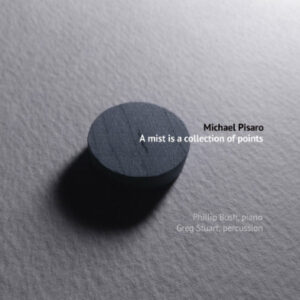
Michael PISARO
“a mist is a collection of points”
Phillip Bush, piano; Greg Stuart, percussion; Michael Pisaro, sine tones.
Michael Pisaro (b. 1961) is a member of the Wandelweiser collective, an international organization of musicians which he has defined as “a particular group of people who have been committed, over the long term, to sharing their work and working together.” Its members have shared an interest in John Cage and experimental music, and extended durations, indeterminacy, and silence have featured in many works they have made; but Pisaro is quick to point out that the members of the collective have a far from uniform aesthetic stance. Pisaro’s work over the past decade bears little surface resemblance to the pieces made by other members of the collective apart from a commitment to experimental music and to deeply collaborative processes. Many of the recent trajectories of his work intersect in A mist is a collection of points (2014).
“A mist is a collection of points”, while a grid is an organized collection of points. There is the unspoken tension in this work between regular and aperiodic, solid and vague, artificial and organic, order and sprawl. This interplay takes place from one section to the next, and also in the interactions between the parts: between the pianist (Phillip Bush), the percussionist (Greg Stuart), and the sine tones (by Michael Pisaro). It affects the melody and the resonance, the timing and the coordination between parts. The intermingling of shadow pitches and extended resonances creates effects that are at least as vivid as any articulation.
Gradual change is a feature of the entire work, on the most local scale (measure by measure) and on the macro scale as well. Timing, resonance, melody, register, and dynamics are all intertwined in these slow transformations. “The work is essentially about the morphology and topography of this resonance.” This recording, like the piece itself, best reveals itself when it is “let loose in an environment,” played on speakers rather than headphones, in order to continue to develop its shape.
15,00€
Out of stock
CD
Julius EASTMAN
“The Zürich concert”
“The composer is therefore enjoined to accomplish the following: she must establish himself as a major instrumentalist, he must not wait upon a descending being, and she must become an interpreter, not only of her own music and career, but also the music of her contemporaries, and give a fresh new view of the known and unknown classics”. Julius Eastman
Just when you think you are grasping the breadth and quality of the music of Julius Eastman (1940–1990), a recording such as Julius Eastman: The Zürich Concert shows up, and you have to go back and reassess his work and wonder what will show up next. This recording is from a 1980 solo seventy-minute improvisatory concert in Zürich, a cherished cassette made by a friend of Eastman’s, who recently realized its uniqueness and decided that he should share it. The Zürich Concert was performed on October 25, 1980 in the Aula R.mibühl gallery. Eastman was in Europe participating in The Kitchen tour, and a Swiss friend, Dieter Hall, a painter who had been living in the East Village, arranged the concert. Hall recorded it on a cassette machine, so there is the inevitable gap when the tape had to be turned over, as Eastman played non-stop for seventy minutes. Simply put, The Zürich Concert is a revelation. Listening to this recording, one is overwhelmed by the cascades of sound, the power of the playing. It almost seems as if the piano will start bouncing across the floor like an out-of-control washing machine. But there is also space and delicacy in the playing. As a whole, the music never flags, and your attention doesn’t wane, as you are drawn in by the intensity of the playing and the coherence and wonder of the music being made.
Just when you think you are grasping the breadth and quality of the music of Julius Eastman (1940–1990), a recording such as Julius Eastman: The Zürich Concert shows up, and you have to go back and reassess his work and wonder what will show up next. This recording is from a 1980 solo seventy-minute improvisatory concert in Zürich, a cherished cassette made by a friend of Eastman’s, who recently realized its uniqueness and decided that he should share it. The Zürich Concert was performed on October 25, 1980 in the Aula R.mibühl gallery. Eastman was in Europe participating in The Kitchen tour, and a Swiss friend, Dieter Hall, a painter who had been living in the East Village, arranged the concert. Hall recorded it on a cassette machine, so there is the inevitable gap when the tape had to be turned over, as Eastman played non-stop for seventy minutes. Simply put, The Zürich Concert is a revelation. Listening to this recording, one is overwhelmed by the cascades of sound, the power of the playing. It almost seems as if the piano will start bouncing across the floor like an out-of-control washing machine. But there is also space and delicacy in the playing. As a whole, the music never flags, and your attention doesn’t wane, as you are drawn in by the intensity of the playing and the coherence and wonder of the music being made.
14,00€
Out of stock
CD
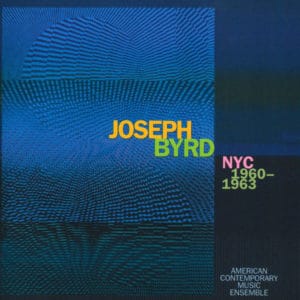
Joseph BYRD
“NYC 1960-63”
American Contemporary Music Ensemble. Clarice Jensen, Artistic Director and Alan Zimmerman, percussion. The imaginative and carefully crafted music of Joseph Byrd (b. 1937) assumes an astonishing variety of guises: he was an integral part of the experimental arts scene in New York and Los Angeles in the 1960s and he founded the psychedelic rock band The United States of America, and its successor Joe Byrd and the Field Hippies, to name just the most salient. Byrd’s career resists easy categorization because his collective activities encompass a broader sound world than is typically admitted within the confines of a single genre. In this sense, Byrd possesses the spirit of radical exploration that has long characterized composers of the American experimental tradition. He initially moved to New York in 1960 to study with John Cage, but among the most influential of his experiences during this period were his two lessons with Morton Feldman, whose delicately floating music enchanted the young composer. The works on this recording provide a rich musical document of Byrd’s activities in New York between 1960 and 1963, when he studied with Feldman, served as an apprentice to Cage, and participated in the Fluxus group. Crafted with technical precision, all of the works were designed to explore the “singularity of sound” that was central to Byrd’s lessons with Feldman. When Byrd’s music was performed at Carnegie Recital Hall in the spring of 1962, Eric Salzman of The New York Times described the concert as a “thimbleful of tiny sounds” that were “generally just this side of the threshold of inaudibility.” Initially, the “thimbleful of tiny sounds” assembled on this recording may not appear to anticipate the extraordinary diversity of Byrd’s subsequent work, but they reveal the key to his early studies and the foundation of his artistic development. As with much of Feldman’s music, the low dynamic levels and subtly shifting timbres and textures persuade the listener to attend to the sounds more carefully, thereby enriching the perceptual experience.
13,00€
In stock
CD
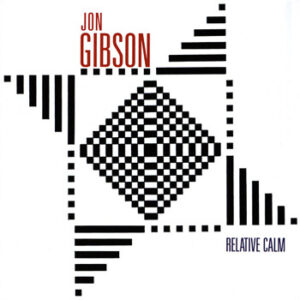
Jon GIBSON
“Relative Calm”
Jon Gibson, saxophone, soprano saxophones (overlaid), winds, keyboards, autoharp, ambient recording; Joseph Kubera, keyboards; David Van Tieghem, percussion.
Relative Calm (Rise) (1981), Q-Music (Race) (1981), Extensions RC (Reach) (1981), Return (Return) (1981)
“Gibson stakes out a small but verdant territory more satisfying than the concrete landscapes of many more ambitious minimalist oeuvres.” Kyle Gann
“In Relative Calm, I am very much involved with texture and collage, and it is mainly intuitive. I don’t want to be compulsive about the concepts that may inspire a piece. An idea may look wonderful on paper, and may feature an exciting and innovative formula, but the music must sound. Some composers care only about the idea … but I care only about the actual sound of the music”.Jon Gibson
“Some of the harmonies in Gibson’s music—its ringing organ tones rising, smearing, melting, tumbling above the piano’s hammered rhythms—make me think of fine old hymn tunes, now iced by repetition into components of an intergalactic anthem.” Deborah Jowitt, Village Voice (1981)
“[Jon] uncovered some multitracks of four pieces he recorded in 1980 and 1981 and I am honored to be mixing them now. These tapes are like a time capsule of the late 1970s New York Minimalist movement: dense, claustrophobic and yet so open. Sculptural in composition and texture, they reveal an entirely different way of seeing music, and are possibly more effective today in their stark contrast than they would have been had they been released 34 years ago.” Chuck Zwicky
Jon Gibson (b. 1940) is one of the less frequently mentioned pioneering composers of minimal music and is probably best known as a founding member of the Philip Glass Ensemble. Gibson also holds the unique distinction of having performed with Steve Reich, Terry Riley, and La Monte Young (as a member of the Theatre of Eternal Music), in addition to Glass, the four composers widely regarded as the founding fathers of minimal music. Gibson also has a track record of composing for modern and post-modern dance and Relative Calm (1981) is the fruit of one of his numerous collaborations with well known choreographers, in this case Lucinda Childs, who commissioned the work. The rediscovery of Relative Calm, one of Gibson’s major works, is cause for rejoicing among aficionados of minimalist music.
14,00€
Out of stock
CD
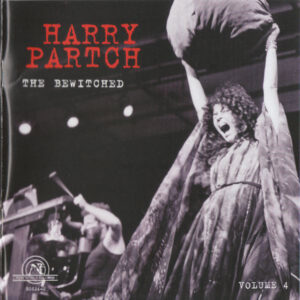
Harry PARTCH
“Volume four”
2005 remaster, from original mono master tapes (recorded in 1957). The Bewitched was Partch’s first work solely intended for dance (and mime-dance at that; he was not overly enamored in his lifetime of so-called ’modern dance’). Drawing heavily from his deep affection for the music-theatrical performance traditions of Greek theater, as well as those from Africa, Bali, and Chinese opera, Partch conceived of a contemporary American music ritual-theater where musicians not only play, but also function at times as movers-singers-actors. Such is the case of The Bewitched, where the instruments are the set, in front of (and around) which dancers ’dance,’ but where the onstage musicians also move and sing. Partch’s masterpiece has been lovingly remastered from the original mono masters and the 24-page booklet includes never-before-published photographs from productions of The Bewitched. This is the definitive document of this very important work." "The Bewitched is in the tradition of world-wide ritual theatre. It is the opposite of specialized. I conceived and wrote it in California in the period 1952-55, following the several performances of my version of Sophocles’ Oedipus. In spirit, if not wholly in content, it is a satyr-play. It is a seeking for release -through satire, whimsy, magic, ribaldry -- from the catharsis of tragedy. It is an essay toward a miraculous abeyance of civilized rigidity, in the feeling that the modern spirit might thereby find some ancient and magical sense of rebirth. Each of the 12 scenes is a theatrical unfolding of nakedness, a psychological strip-tease, or - a diametric reversal, which has the effect of underlining the complementary character, the strange affinity, of seeming opposites." Harry Partch.
13,00€
Out of stock
CD
Harry PARTCH
“Volume three”
“The four works on this newly remastered are eloquent testimony to Harry Partch’s aesthetic of corporeality. The music he composed for “The Dreamer That Remains” (1972), for “Rotate the Body in All its Planes” (1961), for “Windsong” (1958),and for“Water! Water!” (1961), was intended as only one component in the total artistic experience. In this works music joins with drama, with film, with dance, even gymnastics, as integral parts of the composer’s vision.”
13,00€
Out of stock
CD
Harry PARTCH
“Volume two”
The Harry Partch Collection, Volume 2 : “The Wayward”: “US Highball” (1943, rev. 1955), “San Francisco” (1943, rev. 1955), “The Letter” (1943, rev. 1972), “Barstow” (1941, rev. 1968); “And on The Seventh Day…” (1963-64, rev. 1966).
Harry Partch’s compositions of the 1940s-and to some extent his work in general-have remained until recently an unwritten chapter in the history of American music. And yet it was these very pieces-the collection of four works he would later collectively entitle The Wayward-that brought him to the attention of the New York musical world. His concert of these pieces for the League of Composers (April 22, 1944) established for him a small but permanent reputation as a musical maverick who had wandered off well-worn tracks and had developed a sort of lateral extension of his art, independently of any of the main circles of American music.
The musical starting point of the compositions of The Wayward is the inflections and rhythms of everyday American speech. From the beginnings of his mature output in 1930 Partch had been devoted to what he called “the intrinsic music of spoken words,” and these four works capture something of the spontaneous musicality of the conversations of the hoboes he befriended during the Depression. In their original form these pieces used only the small collection of instruments Partch had built or customized by 1943: Adapted Viola, Adapted Guitar, Chromelodeon, and Kithara. The versions recorded here are all later reworkings, sometimes with only small changes (as in the case of San Francisco), and sometimes involving a substantial amount of recomposition (as in the case of U.S. Highball).
The final work on this disc dates from twenty years later than the compositions of The Wayward, and represents one of the high points of Partch’s later instrumental idiom. And on the Seventh Day Petals Fell in Petaluma was composed in Petaluma, California, in March-April 1964, and revised at various times and places until the completion of the final copy of the score in San Diego in October 1966. It marks a radical departure from the theater works he had written at the University of Illinois in the early 1960s, and shows a renewed concentration on technical innovation and on fusing his activities as composer and instrument-builder within the context of a single composition. Newly remastered.
Harry Partch’s compositions of the 1940s-and to some extent his work in general-have remained until recently an unwritten chapter in the history of American music. And yet it was these very pieces-the collection of four works he would later collectively entitle The Wayward-that brought him to the attention of the New York musical world. His concert of these pieces for the League of Composers (April 22, 1944) established for him a small but permanent reputation as a musical maverick who had wandered off well-worn tracks and had developed a sort of lateral extension of his art, independently of any of the main circles of American music.
The musical starting point of the compositions of The Wayward is the inflections and rhythms of everyday American speech. From the beginnings of his mature output in 1930 Partch had been devoted to what he called “the intrinsic music of spoken words,” and these four works capture something of the spontaneous musicality of the conversations of the hoboes he befriended during the Depression. In their original form these pieces used only the small collection of instruments Partch had built or customized by 1943: Adapted Viola, Adapted Guitar, Chromelodeon, and Kithara. The versions recorded here are all later reworkings, sometimes with only small changes (as in the case of San Francisco), and sometimes involving a substantial amount of recomposition (as in the case of U.S. Highball).
The final work on this disc dates from twenty years later than the compositions of The Wayward, and represents one of the high points of Partch’s later instrumental idiom. And on the Seventh Day Petals Fell in Petaluma was composed in Petaluma, California, in March-April 1964, and revised at various times and places until the completion of the final copy of the score in San Diego in October 1966. It marks a radical departure from the theater works he had written at the University of Illinois in the early 1960s, and shows a renewed concentration on technical innovation and on fusing his activities as composer and instrument-builder within the context of a single composition. Newly remastered.
14,00€
Out of stock
CD
Harry PARTCH
“Volume one”
The Harry Partch Collection: Volume 1 : “Eleven Intrusions” (1949-50), “Plectra & Percussion Dances” (1952), Ulysses at the Edge” (1955). This newly remastered reissue marks a welcome return to the catalog of the first volume of the classic 4-CD collection that was formerly available on the CRI label. The works recorded on this disc span the first six years of what Harry Partch (1901-1974), slightly tongue-in-cheek, called the “third period” of his creative life. They show him moving away from the obsession with “the intrinsic music of spoken words” that had characterized his earlier output (the vocal works of 1930-33 and 1941-45) and towards an instrumental idiom, predominantly percussive in nature. This path was to take him through the “music-dance drama” King Oedipus (1951)-the culmination of his “spoken word” manner-to the “dance satire” The Bewitched (1954-55), in which his new percussive idiom manifests itself. The three works on this disc show Partch before, during, and after this period of transition. In their quiet, forlorn way, the Eleven Intrusions are among the most compelling and beautiful of Partch’s works. The individual pieces were composed at various times between August 1949 and December 1950, and only later gathered together as a cycle. Nonetheless they form a unified whole, with a nucleus of eight songs framed by two instrumental preludes and an essentially instrumental postlude. Although foreshadowed by the dance sequences of King Oedipus, the Plectra and Percussion Dances (1952) are the first of Partch’s major works to be wholly instrumental in conception. They stand in relation to Oedipus as a satyr play in relation to a Greek tragedy-hence the work’s subtitle, “Satyr-Play Music for Dance Theater.” He felt that after the prolonged period of composition and production of Oedipus it was “almost a necessity to give vent to feelings and ideas, whims and caprices, even nonsense, that seem to have no place in tragedy.”
The final work on this disc is Ulysses at the Edge, written at Partch’s studio at Gate 5 in July 1955. Ulysses, which Partch describes as a “minor adventure in rhythm,” is unique among his mature compositions in that, in its original form, it did not call for any of his own instruments. The version recorded here, for alto and baritone saxophones, Diamond Marimba, Boo, Cloud-Chamber Bowls, and speaking voice, is considered the third version of the piece.
The final work on this disc is Ulysses at the Edge, written at Partch’s studio at Gate 5 in July 1955. Ulysses, which Partch describes as a “minor adventure in rhythm,” is unique among his mature compositions in that, in its original form, it did not call for any of his own instruments. The version recorded here, for alto and baritone saxophones, Diamond Marimba, Boo, Cloud-Chamber Bowls, and speaking voice, is considered the third version of the piece.
15,00€