
In stock
CD
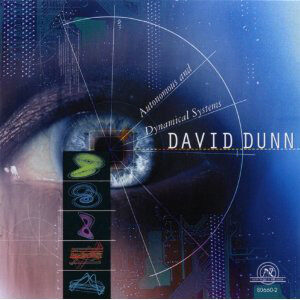
David DUNN
“Autonomous and dynamical systems”
A relentless explorer, composer, performer and theorist, David Dunn (born 1953) uses electro-acoustic resources, voice, non-human living systems, as well as traditional instruments. This CD features four new compositions, all for electronic sound makers of one sort or another, and all four reveal his innate musicality. “Lorenz” (2005) is a collaboration between Dunn and chaos scientist James Crutchfield. In this piece, Crutchfield’s program for exploring chaos equations, MODE (Multiple Ordinary Differential Equations), is linked through an interface program called OSC into a sound synthesis program. The sound synthesis program feeds information back through OSC into MODE, so the whole thing is not only a use of chaos to control sound-it’s a feedback loop itself, embodying the principles of chaos not only in its mathematics, but also in its very structure. Another aspect of Dunn’s work has been setting up interactive systems within nature, whereby humans, machines, and the environment interact with each other. In the mid-1980s, as the technology became smaller, and cheaper, he began a series of works where he tried to set up interactive systems in which the environment could interact with itself. “Autonomous Systems: Red Rocks” (2003) is the latest in this series of works, and possibly the most elegant realization of the idea yet. In “Nine Strange Attractors” (2006), Dunn guides us through a whole zoo of chaotic attractions. Each one has different behavior, and each produces a different sound world. This is a work that is not simply about playing with new mathematical toys-it’s a work that exemplifies the structure of those toys, placing human, computer, and sound-making machine into a feedback loop that embodies the essential characteristics of that new science (chaos), and then lets us live within it for an extended period of time. Gradients (1999) is a work Dunn made with a freeware graphics-to-sound conversion program. In this program, graphic lines become sounding sines, each single pixel-wide line being realized as one sounding pure electronic sine wave. If the sound world of Red Rocks represents nature at her messiest, and the attractor pieces show the slightly less messy world of mathematical abstractions of natural processes, in this piece we have the clean lines and simple shapes of man-made geometry. It is best heard at high volume, where the dynamism of the sound is revealed-gloriously.
12,00€
Out of stock

CD
Christian WOLFF
“Ten exercises”
“Exercises 18 (two versions), 7, 16, 8, 14b, 3, 1, 15, 10 (two versions), 11”. Natacha Diels, Garrett List, Larry Polansky, Michael Riessler, Frederic Rzewski, Robyn Schulkowsky, Chiyoko Szlavnics, Christian Wolff. “This marvelous recording of these elusive works features composer-supervised performances by a hand-picked group of renowned new-music exponents”. “Your first encounter with the music of Christian Wolff leaves you with the impression you’ve just heard (or played, or read) something totally strange, unlike anything else you know. And yet, upon reflection, you realize it is at the same time something completely ordinary and normal, as familiar in its way as any number of repetitive actions characteristic of everyday life, getting up in the morning, going to school, work, church, washing the dishes, performing the daily tasks of home and family. Weird little tunes, sounding as if they had been beamed at some remote point in the universe and then bounced back again as a kind of intergalactic mutant music; recognizable melodic and rhythmic patterns, somehow sewn together in monstrous pairings, sometimes reminiscent of the demons of Hieronymus Bosch, composites of animals, fish, flowers, and common household objects: there is order, but also constant interruption, intrusions of disorderly reality upon regularity and lawfulness, combining to create an effect of both familiarity and strangeness: Shklovsky’s ostranenie. You could say this music is surrealist-not reproducing familiar forms, but revealing, behind these, life’s unpredictability. You could say it is political; improvisatory; concerned with collaborative, non-hierarchical forms of social organization; but you can’t really say what it is like (although John Cage came close when he said, after a performance of the Exercises in New York, that it was like the classical music of an unknown civilization).” Frederic Rzewski
15,00€
In stock
CD
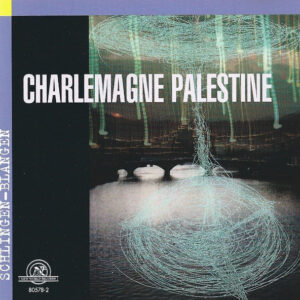
Charlemagne PALESTINE
“Schlingen-Blängen”
Schlingen Blängen is an invaluable addition to the slender but precious discography of Charlemagne Palestine, one of the legendary figures of the amazingly fertile New York and West Coast experimental music/art scene of the sixties and seventies. He is considered to be a seminal figure of early minimalism-as important as his better-documented contemporaries. His performances on the giant bells at St. Thomas Church and his evening-length Bösendorfer shows are still spoken of with awe by those who were present. Palestine left the music scene in the mid-seventies to focus on his visual art; he eventually moved to Europe where he still resides.
Schlingen Blängen-a 70-minute long perambulation through the organ’s sonic landscape-was recorded in 1988 (ten years after its initial performance) in a small Dutch church near the North Sea. It is difficult to describe because so little happens in it, yet at the same time an immensity of activity is going on and there is so much of it that it boggles the mind. We experience sounds set into motion by the initial choosing of a chord and its timbres (the setting of the registers or stops); the melodic changes that occur are subtle and few. In short, it is a relentless and uncompromising exploration of the physicality of sound as well as its spiritual dimensions. Palestine’s music left its mark on a number of slightly younger composer-performers, among them Rhys Chatham and Glenn Branca. Absolutely essential for a comprehensive understanding of the roots of minimalism and its offshoots.
15,00€
Out of stock

CD
Alvin LUCIER
“Orchestral works”
“Diamonds for 1, 2, or 3 orchestras” [for three orchestras] (1999), “Slices” [for cello and orchestra] (2007), “Exploration of the house” (2005).
Janá ek Philharmonic Orchestra, Christian Arming, Petr Kotik, and Zsolt Nagy,
conductors; Charles Curtis, cello solo, with members of the San Diego
Symphony.
For nearly fifty years the work of Alvin Lucier (b. 1931) has marked off a space unlike any other in American music. By now a hero to three generations of experimentalists, Lucier continues to make work at a brisk pace, finding new, surprising and radical approaches to the same artistic concerns. His subject is the human as listener, and his music can be understood as a detailed, exhaustive investigation into the complexities of the act of listening. The results are often uncanny, but the approach is through the familiar and the ordinary; and the production is invariably of rare composerly discipline and exactness of execution. The three works presented on this album set forth three perspectives on the orchestra, monument of the European concert tradition. In each work we hear unmistakable echoes of the familiar iconography of the orchestra, associations with the past that are the bearers of complex meanings. Yet in a kind of tandem reality, sound itself pushes forward, bringing us back to the present, to our immediate presence as listeners, and to meanings independent of association. The world construed as what is known, as a set of received notions, is gently put in question; another world, the one we live in moment to moment, is briefly illuminated.
Janá ek Philharmonic Orchestra, Christian Arming, Petr Kotik, and Zsolt Nagy,
conductors; Charles Curtis, cello solo, with members of the San Diego
Symphony.
For nearly fifty years the work of Alvin Lucier (b. 1931) has marked off a space unlike any other in American music. By now a hero to three generations of experimentalists, Lucier continues to make work at a brisk pace, finding new, surprising and radical approaches to the same artistic concerns. His subject is the human as listener, and his music can be understood as a detailed, exhaustive investigation into the complexities of the act of listening. The results are often uncanny, but the approach is through the familiar and the ordinary; and the production is invariably of rare composerly discipline and exactness of execution. The three works presented on this album set forth three perspectives on the orchestra, monument of the European concert tradition. In each work we hear unmistakable echoes of the familiar iconography of the orchestra, associations with the past that are the bearers of complex meanings. Yet in a kind of tandem reality, sound itself pushes forward, bringing us back to the present, to our immediate presence as listeners, and to meanings independent of association. The world construed as what is known, as a set of received notions, is gently put in question; another world, the one we live in moment to moment, is briefly illuminated.
14,00€
Out of stock
CD
Alvin LUCIER
“Vespers and other early works”
Alvin Lucier (b. 1931) is best known for his pioneering work in the mid-sixties in the exploration of sonic environments, particularly sounds that we would never perceive under ordinary circumstances. Vespers and Other Early Works restores to the catalog several of his key works from that time. In ’Vespers’ (1969) performers with Sondols (sonar-dolphin), hand-held pulse wave oscillators, explore the acoustic characteristics of given indoor or outdoor spaces by monitoring the echoes of the pulse waves off the walls, floors and ceilings, as well as any objects or obstacles in range of the sound waves. Over time, the listener receives an acoustic signature of the room. In ’Chambers’ (1968), battery-operated radios, tape recorders, and electronically powered toys of various kinds are hidden in paper bags, shoes, kettles, and small suitcases and other small resonant environments. As performers carry these small ’rooms’ into larger ones, such as concert halls, football stadiums and underground cisterns, the sounds, already altered by the acoustics of the small environments, are altered a second time by the acoustics of the larger ones. This version was recorded in 2002. ’North American Time Capsule’ (1967), for voices and vocoder, is described metaphorically by Lucier as a message to listeners who don’t know about us. ’(Middletown) Memory Space’ (1970) is a reenactment of the composition called ’(Hartford) Memory Space’, for any number of instrumental players with recordings of environmental sounds. ’Elegy for Albert Anastasia’ (1961-1963) is described as composed ’for electromagnetic tape using very low sounds most of which are below human audibility.”
13,00€
In stock
CD
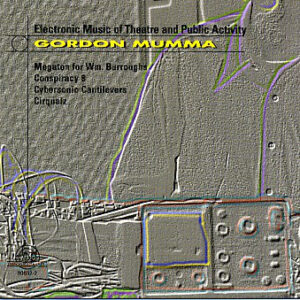
Gordon MUMMA
“Electronic music of theatre and public activity”
Gordon Mumma (born 1935) has played a pioneering role in the development and evolution of ’live-electronic’ music. ’Live-electronics’ as a concept and practice appears to have originated in the United States in the late 1950s, outside the few institutional electronic studios and often in the context of innovative theatre activity. From its inception, it frequently involved two processes: (1) live performance with accompanying or interacting sound materials on magnetic tape; and (2) the use of electronic circuitry as sound-modifying and sound-producing instruments. Beginning with his classic ’Megaton for Wm. Burroughs’ of 1963, Mumma’s live-electronic and cybersonic works of the 1960s and 1970s, especially ’Medium Size Mograph’ (1963) and ’Hornpipe’ (1967), display his resourceful use of both live-electronic processes. ’Cybersonic Cantilevers’ (1973) extends them to include the active participation of audience members, many of them children and teenagers who were quick to grasp the artistic potential of cybersonic technology, while ’Conspiracy 8’ (1969-70) is an early example of live interaction between performers and computer. A major addition to the contemporary music discography, this is essential listening for anyone interested in the history of electronic music.
13,00€
In stock
CD
TREE
s/t
Chris Abrahams, dx7, analog synth, pump organ. Burkhard Beins, percussion, objects, zither, analog synth. Andrea Ermke, sampler, field recordings. Recorded on a rainy winter’s day in Berlin, December 2011. CD edition of 200.
“I wonder about the trees.
Why do we wish to bear
Forever the noise of these
More than another noise
So close to our dwelling place?”
Robert Frost
13,00€
Out of stock
CD
Yoko HIGASHI – Lionel MARCHETTI
“Okura 73°N-42°E”
“Musica Genera presents another album from French musique concrète composer Lionel Marchetti (in 2005 MG had released the CD “Docteur Kramer (you are not you)” by Lionel Marchetti and Emmanuel Petit), this time realised together with his artistic partner Yôko Higashi, Japanese performer, dancer and vocalist. The album contains three compositions of musique concrète, one by Marchetti, one by Higashi and a collaborative work by both artists. Each of the tracks is an elaborate sound construction of individual characteristics and unique sound aura. “Pétrole 73” is the artistic fruit of Marchetti’s stay at the “Stubnitz” trawler, the one of a kind ship rebuilt as a floating cultural centre. Analogue drones, radio voices and mechanical sounds of working hull create the atmosphere that contrasts with next composition. “Okura” was realised by Higashi basing on the sound material gathered in Mozambique. Field recordings of African nature and surprising electronic interventions interweave with fragments of ethnic music, leading the listener towards the final, collaborative track. “Pétrole 42” captivates with it’s sonic depth and uncanny, ethereal aura created by delicate synthesiser passages, distant, unearthly voices, chants, breaths, punctuated with disturbing, aggressive concrète sounds.”
12,00€
In stock
CD
Anna ZARADNY
“Mauve cycles”
“Mauve Cycles by Anny Zaradny is a significant release. It is the first solo CD by the artist with already considerable output including improvised music, composing for theatres, collaborations with visual artists and sound installations. Also, the involvement of women in the contemporary experimental music still seems to be perceived as unusual (hence the compilation releases such as “Women in Electronic Music” from 1977 or “Her Noise” exhibition from 2005) and in Poland it is a marginal phenomena. What immediately captures attention in Anna’s music is the diversity of colour and texture: noisy, harsh, prepared, digitally manipulated. The unusual thing is the almost baroque ornamentation. The production of the recording, emphasising the dynamics of sound, reveals the remarkable abundance of textural detail, especially at high volume. The rich arrangements make one think of orchestral momentum, which is not surprising in the context of Zaradny’s classical music education. Sensitivity rooted in the aesthetics of ’60 sonoristic avant-garde Pauline Oliveros, David Tudor, Gordon Mumma), combined with years of experience and collaborations with world’s leading free-improv and sound artists (Tony Buck, Burkhard Stangl, Cor Fuhler, Zbigniew Karkowski) result in the two parts of “Mauve Cycles”. At structural level, Anna’s music is built of interweaving, constantly evolving sound and rhythm blocks, organised into the title cycles.
Even if the elements of this sound mosaic can be categorised (drone, field recordings, extreme sonoristics, oscillator rhythms), every now and then the order is shattered by violent, out of context sound intrusions. The feeling of constant unease, both at compositional and sound levels, is one thing that makes the record stand out. The other
is the focus on compositional aspect of the music, which distinguishes Anna’s ideas from many other recordings in similar sound convention. The multilayer, spatial nature of the recordings resemble sound sculptures of Harry Bertoia, Christina Kubisch or Kaffe Matthews. “Mauve Cycles” seems to correspond with the output of these artists as well as Eliane Radigue’s or Delia Debyshire’s, contributing to women’s voice in the field of electronic preparations. Anna is also responsible for the cover design, including the
surprisingly romantic contribution from famous Polish graphic artist Marek Raczkowski. Recent musical activities indicated Anna’s growing sensibility in the field of sound art, and this latest recording is the full expression of her experiences. It is another gem in the
compositional series of Musica Genera label.” Daniel Brozek
12,00€
Out of stock
CD
Jacques LEJEUNE
“Cantus tenebrarum”
Cantus tenebrarum (1984), "Portrait de jeune fille au miroir ou Étude aux silences" (1998), "Le cantique de la résonance" (1985).
12,00€
Out of stock
CD
Jacques LEJEUNE
“L’invitation au départ”
“L’invitation au départ” (1983), “Symphonie romantique ou Étude d’après Berlioz” (1982).
12,00€
Out of stock
CD
Dieter KAUFMANN
“Symphonie acousmatique”
Dieter Kaufmann born in 1941 in Vienna did study electroacoustic composition with François Bayle and Pierre Schaeffer. His piece “Symphonie acousmatique” (1969-2007) is like a travelling in 40 years of musical works. “Lui comme elle” (2009) is an acousmatic monodrama based upo fragments from Elfriede Jelinek’s play “Him not himself” with the voice from Gunda König and trombonist Renate Slepicka. CD + notes in french, English and German.
12,00€
In stock

CD
Denis DUFOUR
“Bocalises”
Born in Lyon in 1953, studied composition at the Paris Conservatory with Claude Ballif, Michel Philippot, Ivo Malec, Guy Reibel and Pierre Schaeffer. He has composed numerous instrumental and electroacoustical works. He was a member of INA-GRM until 2000. Composer, professor, producer of concerts and events, he has founded several instrumental ensembles : TM+, Les Temps Modernes, and in 2004, the ensemble Syntax in Perpignan. He is the principal instigator of the festival Futura and artistic director of Motus. He has taught instrumental and acousmatic composition for more than 25 years at the Lyon’s and Perpignan’s conservatories in France. “Bocalises (grande suite)” (1978), “Le Lis vert” (1983).
12,00€
In stock

CD
Denis DUFOUR
“Où est maintenant la forêt?”
“Leçon rigole” (1996) ; “Dimanche matin” (1995) ; “Où est maintenant la forêt ? ”(1992-93). Three pieces of electroacoustic works with french childrens at school.
8,00€
In stock

CD
Denis DUFOUR
“La terre est ronde”
Suite en trois mouvements (1981), "Exil" (1995), "Hélice" (1995), "Élixir" (1996), "La terre est ronde" (2002).
12,00€
Out of stock
CD
Christine GROULT
“Étincelles”
Christine Groult studied at the GRM, at the Experimental Conservatory of Pantin, directed by Michel Decoust, at the Sorbonne in the department of musicology. From 1976 to 1986, she was an assistant in the department of pedagogy at IRCAM under the direction of Pierre Boulez. From 1985 to 1990 she was responsible for the electroacoustical studio of the National Music School in Chalon-sur-Saône. In 1989, she passed her CA (Certificat d’Aptitude) in electroacoustical music. Since 1990 she teaches electroacoustical composition at the National Music School of Pantin. In 2002 she founded the association Music in situ, the mission of which is the proposition of scenographies. “Les frontières de l’autre” (2001), “Étincelles” (2005), “L’Heure alors s’incline…” (1991), “Canal instantané” (2004), “Le Temps du ciel : entropie” (2000), “Passagers imminents” (1993).
12,00€
Out of stock
CD
Beatriz FERREYRA
“La rivière des oiseaux”
“Les rivières du rêve” (1998-2000), “Médisances” (1968), “L’orvietan” (1970), “Vivencias” (2001), “Cantos de Antes” (2002).
12,00€
In stock
CD
eRikm & Natacha MUSLERA
“Cartouche”
“Cartouche is a mixed duet featuring eRikm and Natacha Muslera, active since 2010. Fragments that break off of a body, like a shattering windshield. The electronics and the voice trigger eruptive sound phenomena, either rushed or stretched, in which the listener is immersed in a physical experience that is transversal to music itself. Leaving only debris and brilliant ruins. With malice, Cartouche is freed of all semantic background and takes delight in this. An untamed and convulsive distanciation essay, both natural and forceful. eRikm : electronics. Natacha Muslera : vocals.”
10,00€
In stock
CD
eRikm – Michel DONEDA
“Razine”
eRikm, turntable, electronic, live-sampling. Michel Doneda, soprano and sopranino saxophones. Live in March 2009 in Albi, France.
“Razine by eRikm and Michel Doneda At the very beginning of the year 1900, Velimir Khlebnikov is listening to the new century on the banks of the Caspian Sea. In the gyrations of the Dervishes he conceives his Futurian equations. He creates the coming models of "modern" art. He is the first to write poems from mathematical series and in the form of the palindrome. Fourty years later this will become the system behind twelve-tone serialism. Velimir spreads his writings in different points in space, materialising the cut-up technique. He creates ZAOUM, his transreason language which speaks of the Unconscious mind before its revelation by Freud. Later, well after his death, he would influence surrealists and lettrists. And to us improvisers he has given RAZINE, the wild horseman of sound. This very recording recounts how the ride went that evening : sliding, breaking of rhythmical lines, sudden transformations, textures, and who knows, maybe the listener will hear the ring of the "Trumpet of the Martians", the one that Khlebnikov caught through his utopian poetry.” Michel Doneda 2011
10,00€
In stock
CD
MIRT + TER
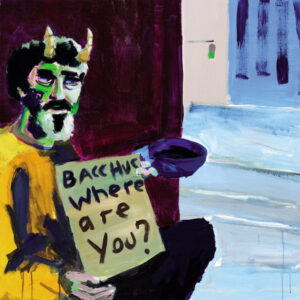
“Bacchus where are you ?”
The two staples of Polish electronica are on it again. Mirt and TER, after solo releases are back together with their next offering.
Culled from hours of “live-in-the-studio” improvisation, these 45 minutes stand out among the contemporaneous albums with a one-of-a-kind mix of post-ambient electronica having as diverse roots as techno, minimal music, krautrock electronica and afrobeat.
Based on sounds created with modular synthesizers with a dash of Prophet 12, Mirt and TER venture on a journey into thick textures obscuring lace melodies. Instead of typical four-on-the-floor rhythms they draw inspirations from African music and translate them into rich yet subtle digital structure. Subtlety is in fact the key word here. Instead of immediacy of many present-day acts they prefer their music to unravel in a leisurely manner. Each of the five tracks here has a different focus. “Bacchus Theme” is a rhythmic-oriented, almost tribal 5-minute piece, whereas “Disaster Reworked” is a floating composition carrying dense drone structures. The centrepiece seems to be “Wooden Object” closing in at 14 minutes, where Mirt and TER seem to play with their toys, but at the same time not losing focus on creating a cohesive piece of work. You can say the same thing about the whole album: it’s varied, each fragment stands on its own, but at the same time all five of them create one coherent record.
The album is released on an old-school CD, hip LP and omnipresent download. Each of them is adorned with a cover by Mirt himself.
13,00€
Out of stock
CD
S4
“Cold duck”
John Butcher, Christian Kobi, Hans Koch, Urs Leimgruber. 4 soprano saxophones and 4 friends in an unveiling and resonating output of creative energy in a form of improvised structure. There is no miss here. Experienced musicians and excellent skills connected with talent build up sonorous structures which surround the listener as an evolving ambience. The clichees of free-improvised music luckily steer away from this disc but I still feel that almost naked open form of such interesting compositions can be spoiled by lack of proper surrounding as for the time space situation which is needed to truly appreciate this form.
12,00€
In stock
CD
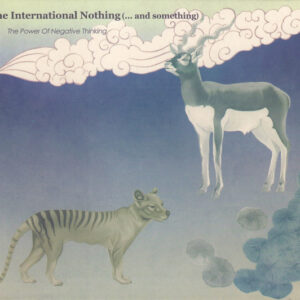
The INTERNATIONAL NOTHING (…AND SOMETHING)
“The power of negative thinking”
Kai Fagaschinski, clarinet. Michael Thieke, clarinet. Christian Weber, double-bass. Eric Schaefer, drums & percussion.
In case it doesn’t ring a bell, The International Nothing is the psycho-acoustic clarinet duo of Mr. Thieke and Mr. Fagaschinski. Since 2000 the two clarinetists have been collectively composing multilayered sound sculptures using multiphonics, beat frequencies and difference tones as an integral part of their unique language. They have released three duo albums on the Japanese Ftarri Label.
There have been collaborative extensions in the past – check out their avant pop band The Magic I.D. with Margareth Kammerer and Christof Kurzmann – and when they first met with drummer Eric Schaefer and bass player Christian Weber in 2006 it was obvious this was also asking to become a band on its own terms: The International Nothing (… and something).
Mr. Weber and Mr. Schaefer lent not only their individual instrumental skills to the fold - it was a true collective effort which brought these seven quartet compositions into being. And though you might regularly find each of the four musicians happily involved in context of improvised music, like anything previously produced by The Nothin’ the music heard here is precisely determined, created through an extensive process of rubbing sounds and ideas against each other, long before entering the stage or pressing the record button.
The aesthetic foundation of the clarinet duo is undeniable throughout the album, but Weber and Schaefer extend the sonic spectrum strikingly. The low end explorations of the bass and drums add a mysterious darkness. A moment of pulse is no longer provided solely as a secret message within the clarinet twin’s microtonal beatings. Rhythmical figures sneak in gently, and at times you may even be boldly struck by a shameless groove.
Name a band which sounds similar and you’ll win … something.
13,00€
Out of stock
CD
Toshimaru NAKAMURA – John BUTCHER
“Dusted machinery”
“Butcher and Nakamura first played together in 2002 at “Super Deluxe” in Tokyo at the invitation of promoter Hisashi Teruchi. The concert was released as half of “Cavern with Nightlife” prompting Jason Bivins (Dusted Magazine) to write : “Not only is Nakamura one of the worlds great improvisers working today, I am hugely impressed with Butchers ability to work in concert with him. Whisper soft soprano squeaks and gently coaxed feedback saxophone meld fluidly, seamlessly with the stripped-metal tones from Nakamura. And Butchers occasional crackles and sizzling flareups from his electronics derail some of Nakamuras more restrained inclinations in provocative ways, especially in the pieces wonderfully nasty conclusion. Let’s hope there’s more to come from this duo”. Further chances to develop the duo have happenend back in Japan, and in London and France. When the two musicians were invited to record in London for David Sylvian’s “When we return you won’t recognise us” project they set the next afternoon aside to visit Dave Hunt’s Shepherd’s Bush studio and made the recording that is now “Dusted Machinery”.”
10,00€
In stock

CD
Steve REICH
“WTC 9-11”
32 pages & Notes in English ans French.
Performed by Quatuor Tana.
Steve Reich composed WTC 9/11 in 2010 in homage to the victims of the attack on the World Trade Center, September 11th, 2001. First performed on March 19, 2011 at Duke University in North Carolina by the Kronos Quartet, WTC 9/11 would be played for the first time in New York, at Carnegie Hall, in late April of the same year.
WTC 9/11 is written for a string quartet playing live, on which are juxtaposed pre-recorded voices and two string quartets. With a playing time of 16 minutes, the work is in three movements played without a break: “9/11”, “2010” and “WTC”.
The first movement, “9/11”, is moving, disturbing and even stressful. Deliberately bruitist, it begins and develops to the haunting rhythm of the alarm of a telephone left off the hook: an F played on the violin with the superimposed archive voices of the NORAD (North American Aerospace Defense Command) air traffic controllers and the FDNY (Fire Department City of New York).
The second movement, entitled “2010”, uses interviews of memories from 2001. In it, we hear Steve Reich’s neighbors, an officer of the FDNY and the first ambulance driver to arrive at the scene.
In the third movement, Steve Reich takes inspiration from his friend the composer David Lang, creator in 2003 of World To Come, “WTC” being the common acronym of both their works. Steve Reich’s is concerned with metaphysical and spiritual preoccupations. Brought up in the Jewish faith, he knows that it imposes the ritual of presence around the body to accompany the deceased from the time of death to burial, thus accompanying the soul, which floats above the body until inhumation. It was impossible for the composer to ignore the fact that after the 9-11 attacks, the problem of identifying the bodies lasted seven months...
In 2011, for the release of WTC 9/11, the cover photo showing the Twin Towers at the moment of the attack created such a shock and controversy that it was replaced by another visual showing a cloud of smoke.
Steve Reich, who was a neighbor of the World Trade Center for 25 years, wrote on his label’s website: “I believed… that a piece of music with documentary material from an event would best be matched with a documentary photograph of that event”.
Serge Thomassian, the producer of the Megadisc Classics label - whose offices, four blocks from the Twin Towers, were destroyed during the 2001 attack - now proposes an unambiguous cover photo of the World Trade Center being struck by the plane.
DIFFERENT TRAINS
The idea for this work comes from Steve Reich’s childhood. He was a year old when his parents separated, his mother going to live in Los Angeles, his father staying in New York. Thus, accompanied by his nanny, the young Steve was going to make frequent trips between the East and West Coasts. Those pleasant train trips, taking four days, doubtless did not prevent him from knowing that, between 1939 and 1942, European Jewish children his age were getting into very different trains…
This is what would result in Different Trains (1988), a 27-minute work laid out in three movements: “America-Before the War”, “Europe-During the War” and “After the War”. The composition uses and superimposes conversations on tape and the instruments of the string quartet. The retrieval of numerous sonorities of daily life, voices like announcements, recorded sounds of trains from the 1930s and ‘40s make up the musical material of Different Trains. To his composition he adds recorded interviews of witnesses from his childhood: his nanny, Virginia Mitchell, who evokes their train trips; Lawrence Davis, an employee of the New York-Los Angeles railroad line, who relates his life; and finally, testimony collected from Rachella, Paul and Rachel, Holocaust survivors.
Different Trains opened new directions and new perspectives for Steve Reich. Although he brings together four string quartets, one playing live, the three others being added to the pre-recorded tape, it is above all the taped voices that make for the work’s originality. The spoken language thus becomes a full-fledged musical material, and after Different Trains, this technique would lead to The Cave, composed in 1990, Three Tales (2002) then WTC 9/11 (2010)…
Steve Reich, born October 3, 1936, is one of the most important and influential composers of today’s music, his impact on his contemporaries being considerable. Since the Minimalism of his beginnings, he has remained faithful to repetitive writing (patterns), even though his latest creations have become more harmonic and thereby richer and more delightful, tinged with the fantastic.
20,00€
In stock
CD
Christian ZANÉSI
“Paysage électronique avec train”
“Audio visage” (2004). “Ambiance Matisse” (2010-12). “Paysage électronique avec train” (2006-14).
“My current artistic propensity has been drawn to electronic sound. Far from being soft and appeasing, it is a rather tense sound; almost acidic: the sound of an alert. I reached it thanks to a very old synthesiser; build at the GRM in the sixties by the engineer Francis Coupigny. A modular synthesiser with its own audio matrix – it might have been the first of its kind – discarded (forgotten) in a basement, but still fully operational. I have shaped this ‘today’ sound by combining it with materials charged with emotions: train noises and signals, blasts, breaths, etc, the very sonorities that have been lingering inside me as available memories. The original title of the piece was «2006, l’aube rouge» (2006, Red Dawn) because when I finished this work, a few hours before the 2006 New Year, I might have wanted to talk about a world that had become terribly disquieting and dangerous: a red dawn was rising. Eight years later, around the same period, towards the end of the year, I worked again on the piece by simplifying it, only keeping (I hope) its essential elements.”
Former student of Guy Maneveau and Marie-Françoise Lacaze at the Pau University (South of France) (1974-1975), of Pierre Schaeffer and Guy Reibel at the Paris Conservatory (1976-1977), he joined the Groupe de Recherches Musicales (GRM) in 1977. There, he learnt and practised all the technical skills linked to sound, thanks to a wide range of experiences, productions and encounters. He has initiated many projects in the field of radio, publications and musical events.
20,00€
In stock

CD
Charlemagne PALESTINE
“Nothing to tell, only listen”
Born in Brooklyn, New York in 1947, Palestine began by singing sacred Jewish music and studying accordion and piano. At the age of 12 he started playing backup conga and bongo drums for Alan Ginsberg, Gregory Corso, Kenneth Anger, and Tiny Tim. Throughout the seventies Palestine created records, videos, abstract expressionist visual scores and performed regularly in the company of his stuffed animals! This new release entitled Nothing to Tell, only Listen explores his unique soundscape.
Recorded at Boghossian Foundation Villa Empain January 26, 2015.
20,00€
Out of stock
CD
AMM
“Spanish fighters”
John Tilbury, piano. Eddie Prévost, percussion. Recorded at the festival Neposlusno (Sound Disobedience) in Ljubljana, Slovenia in 2012, the AMM duo of Eddie Prevost on percussion and John Tilbury on piano perform an extend improvisation of tension and dynamic, delicately balancing sound in a rich dialog.
12,00€
Out of stock
CD
AMM
“Place sub.v.”
John Tilbury, piano. Eddie Prévost, percussion. An AMM concert in Lublin, Poland, May 16, 2012. Atmosphere of place pervades the music - place from the Latin platea and Greek plateia - ‘open space’. Open space is what AMM music thrives upon. New open spaces offer new challenges. Acoustics too are different, as is the piano and often the percussion. Materially they can be different. Sense of place is also coloured by cultural context.[…] A poetic whisper of what may be possible i human creativity and affairs.
12,00€
Out of stock
CD
AMM
“Two London concerts”
John Tilbury, piano and Eddie Prévost, percussion. Two London concerts recorded in 2011.
14,00€
Out of stock
CD
AMM
“Uncovered Correspondence”
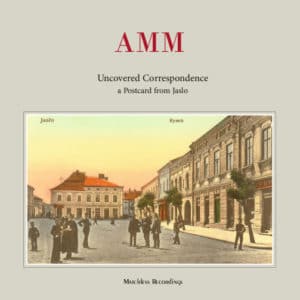
“John Tilbury - piano. Eddie Prévost - percussion. Recorded at the concert hall of the Jasielski Dom Kultury (Jaslo Cultural Centre) in southern Poland on 15th May 2010. The performance represented by this CD took place on 15th of May 2010 in the concert hall of the Jas o Cultural Centre in southern Poland. I had spoken to John Tilbury in 2007 about the possibility of AMM performing in Jas o, but for various reasons the project did not come to fruition until three years later. We had not planned for a CD release of the concert; in fact, we only spoke about recording the day before. There was no opportunity for the usual setup procedures. The recording was only intended as a document of the occasion.
The concert began with John Tilbury using the piano to produce a gamelan-like quality, which was quickly followed by Eddie Prévost bowing a cymbal producing subtle metallic sounds. One could feel an electric atmosphere of concentration and note the exceptional care and elegance with which the performers selected even the tiniest details of the complex sound structure. Intriguing phrases from the prepared piano and sonorous tones from percussion instruments wafted around the huge expanse of the hall - whose excellent acoustics let the audience immerse themselves in the music - savouring the subtle sounds emerging from the silence. The changes within the slow stream of improvisation occurred in such a natural way introduced by either musician by turn. Sometimes a highly abstract motif seemed to be a logical development rather than a step into the unknown — which in reality it was. The dominant impression was that such an advanced level of intuitive understanding between the two performers was the result of many years of collaboration. In my view each sound produced during the concert was not only ‘desirable’ but also essential (inevitable) and created its own profound aesthetic justification. Especially noteworthy was the compelling way in which both musicians made use of silence, whose role in AMM is as important as sound. The performance of a shorter or longer period of silence entailed the same creative intervention as did playing a sound or motif. The moments when the sound structure intensified and thickened became less frequent yet did not disappear completely. Particularly embedded in my memory are two moments: one was an exceptionally loud and shattering fragment of sound when dust could be seen rising out of the piano. And, when Eddie got up from his percussion and went to the wood-panelling, playing the wall with a beater generating a very low and vibrating sound —
a convincing demonstration that any object may be used as a means to create music. It is only because I attended the concert, and can recall it in my mind, that now when listening to the recording I can identify the sources of those extraordinary sounds. The music presented on this CD requires a serious commitment from the listener. However, anyone familiar with the music of AMM would expect nothing else.
To uncover the hidden beauty of these lovingly crafted improvised sound abstractions requires an appropriate level of concentration on the part of the listener. Such effort will be rewarded by a profound aesthetic experience. In organising this concert I feel honoured I have been able to contribute, albeit inadvertently, to the release of another AMM CD. Andrzej Serwa — August 2010” label info
The concert began with John Tilbury using the piano to produce a gamelan-like quality, which was quickly followed by Eddie Prévost bowing a cymbal producing subtle metallic sounds. One could feel an electric atmosphere of concentration and note the exceptional care and elegance with which the performers selected even the tiniest details of the complex sound structure. Intriguing phrases from the prepared piano and sonorous tones from percussion instruments wafted around the huge expanse of the hall - whose excellent acoustics let the audience immerse themselves in the music - savouring the subtle sounds emerging from the silence. The changes within the slow stream of improvisation occurred in such a natural way introduced by either musician by turn. Sometimes a highly abstract motif seemed to be a logical development rather than a step into the unknown — which in reality it was. The dominant impression was that such an advanced level of intuitive understanding between the two performers was the result of many years of collaboration. In my view each sound produced during the concert was not only ‘desirable’ but also essential (inevitable) and created its own profound aesthetic justification. Especially noteworthy was the compelling way in which both musicians made use of silence, whose role in AMM is as important as sound. The performance of a shorter or longer period of silence entailed the same creative intervention as did playing a sound or motif. The moments when the sound structure intensified and thickened became less frequent yet did not disappear completely. Particularly embedded in my memory are two moments: one was an exceptionally loud and shattering fragment of sound when dust could be seen rising out of the piano. And, when Eddie got up from his percussion and went to the wood-panelling, playing the wall with a beater generating a very low and vibrating sound —
a convincing demonstration that any object may be used as a means to create music. It is only because I attended the concert, and can recall it in my mind, that now when listening to the recording I can identify the sources of those extraordinary sounds. The music presented on this CD requires a serious commitment from the listener. However, anyone familiar with the music of AMM would expect nothing else.
To uncover the hidden beauty of these lovingly crafted improvised sound abstractions requires an appropriate level of concentration on the part of the listener. Such effort will be rewarded by a profound aesthetic experience. In organising this concert I feel honoured I have been able to contribute, albeit inadvertently, to the release of another AMM CD. Andrzej Serwa — August 2010” label info
13,00€
Out of stock
CD
AMM
“Sounding music”
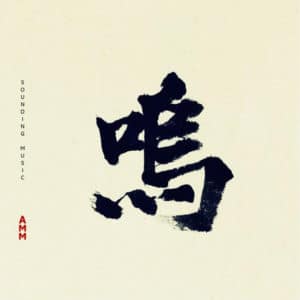
“John Butcher (tenor & soprano saxophones), Ute Kanngiesser (cello), Eddie Prévost (percussion), John Tilbury (piano) and Christian Wolff (piano, bass guitar, melodica). Recorded at the “Freedom of the City” festival, Conway Hall, London on Sunday 3rd May 2009. Calligraphy from Qu Lei Lei and text from Harry Gilonis.
12,00€
Out of stock
CD
FREE JAZZ QUARTET
“Memories for the future”
“The late Paul Rutherford (trombone), Harrison Smith (saxophones, bass clarinet), Tony Moore (cello) and Eddie Prevost (drums); this is a newly discovered recording of a concert given in Bristol in 1986.” “A lazier title would have been Memories Of The Future, a predictable contradiction that succeeds as word-play but flirts with nostalgia. The ‘for’ is important because it implies effort, a conscious decision to store up something for later use. Here is, or are, momentary occasions that resist the temporal sift and refuse to be blown away. Here is, to adapt the title of a fine book on architectural heritage, a future for the past. In its first incarnation, now twenty years ago, the Free Jazz Quartet cast its music in an urgent future tense. The track titles on Premonitions, the group’s only previous CD, were all cast as warnings: ‘Roman Geese’, ‘Tocsin’, ‘Eddystone’, which is not just the name of a great lighthouse that warns of dangerous sands, but a pun on the drummer’s name and his sound, and ‘Red Flags’, which neatly combines a beach warning with the bloodied shirt of demonstrators turned into banners of protest. ‘Old Moore’s’ referred to a famous annual publication which offers predictions for the year ahead, but also to an old LP by the trombonist, which went out as Old Moers Almanac. Paul Rutherford is no longer with us, but the music here captures him, as well as saxophonist Harrison Smith, cellist Tony Moore and percussionist Eddie Prévost in one of their finest performances. Each has moved along individual paths over the years, sometimes converging, sometimes deliberately not. Each has taken a step away from jazz, sometimes away from music altogether. Prévost has committed his ideas to writing; Moore to the visual and plastic arts. Smith has refined a saxophone voice that is not so much a vehicle for self-expression as an aspect of personality, which is a far more difficult and disciplined route. ” extract from liner notes by Brian Morton.
12,00€