
Out of stock

LP
DIATRIBES
“Great stone – Blood dunza”
d’incise & Cyril Bondi: melodica & bass melodica, louspeakers, objects, electronic, microphones.
“In the 70’s, a few adventurous jamaican sound engineers developed a revolutionary approach to the deconstruction of their mixes with a very playful use of, at that time, new technological effects, the dub, that would become a major influence on every beat based dance music.
Amongst them, Osbourne Ruddock aka King Tubby added his unique touch to hundred of productions, recognizable by his trademark colors, spring reverbs, filters and tape delays. Already in “Augustus” the diatribes duo tried to invoke some of these dub characters, the presence of heavy subs, the melodicas, repetitive percussive elements, but those ended-up buried in a post-improv attitude and form.
On this latest record, the attempt continues with the deconstruction of two classical roots reggae tunes from the 70’s that passed by the dub master King Tubby’s genius’ hands. Obviously once again the sources are extented to an electroacoustic approach. The bass lines and melodic themes are stretched, the “effects” themselves treated as sound material.
“Great Stone” focuses more on the melodic aspects, with an echo/delay/tape ghost reference as d'incise and Cyril Bondi overdub the piece on its previous rehearsal recordings, while basses evoke the trembling walls at sound system parties.
“Blood dunza” is perhaps more “dub” the subtraction of “tracks” leads to silences, the basses act as a central pillar. Spring reverbs/noises, “chords” and even rhythm fragments appear and disappear.
As far as these two Diatribes pieces are from their supposed sources, the working process behind them, the circulation between conceptual or sometimes metaphorical elements, allows things to happen that in an other context would perhaps not have been dared.
300 copies on 180g vinyl, cut by Flo Kaufmann.
12,00€
Out of stock

LP
Thomas TILLY
“Le Cébron – Statics and sowers”
French sound artist Thomas Tilly uses unique field recordings as material for compositions. This LP presents two pieces: Le Cébron is based on recordings done on a frozen lake. Statics and sowers uses recordings from beehives as well as feedback from a mixing board. Edition limited to 300 copies on transparent 180g Vinyl. Drawings by Jean-Luc Guionnet. Mastered by Giuseppe Ielasi. Cut by Flo Kaufmann.
12,00€
In stock

LP
Kasper T. TOEPLITZ & Anna ZARADNY
“Stacja nigdy w zyciu”
NEVER-NEVER-NEVER: The ultimate cry for freedom, not a revindication, not a position, but the fullness of dreams: the will to do it, do whatever, the way I want. Not even do, no hopes, no future, just the state of “NOW” will not change will not move, you can do whatever you want I NEVER - JAMAIS! - will and not even shall I listen to you. You can torture me, don’t feel the pain, don't even care. NEVER never even was a close cousin to “NO”, NO is statement NO is rebellion, NO is a position, against, not good, try something else, no good, a proposition, when NEVER is just pure dreaming, alone in space, no past, no nothing - NEVER lets you change your mind as often you only want, no consequences, since NEVER made it happened, I NEVER said anything like this and who are you and what are you talking about? NEVER puts this sound, any sound, in front of that one, or follows it, just because, no rules, no esthetics, concerts for empty rooms - JAMAIS de la vie! - you have not seen it and maybe there was nothing to see and when was it after all. NIGDY w zyciu, and you can't prove it anyhow. You can't argue with a dream. Never, never in (your) life.
Two pieces, seemingly appearing out of the void, culminate - and fade away. It’s at “Station Never in Life” (“Stacja Nigdy w Zyciu” in Polish) where Kasper T. Toeplitz and Anna Zaradny meet for their first duo LP. At the station we experience their music like giant wagon trains slowly passing by. Incredible rich textures emerge and disappear again - a permanent reconstruction, an architecture of loss. The recording features Anna Zaradny on saxophone, playing the instrument in her unique way emanating sounds you might have never heard before and Kasper T. Toeplitz on bass as well as both of them using computers. This is at the same time and old project and a brand new one, or perhaps one in perpetual becoming: the two artists have already played together in many occasions in the past, but this time it is a project for a long-term collaboration, a way to explore the passing of time, trying new forms each time, working on the architecture of the proposed music but also the one of the venue in which the sounds will exist: a perpetual reconstruction of a crushed architecture.
300 copies on 180g vinyl, cut by Flo Kaufmann, cover by Coste-nine.
12,00€
Out of stock

LP
Jim HAYNES
“Electrical injuries”
Jim Haynes on the album: “electrical injuries was designed as an intense record. Something akin to a sustained self-immolation. The themes of corrosion and dislocation central to the research. Similarly, the source material and the means of production also maintains a lineage that dates back to my earlier compositions and designs. I still use shortwave radio, electric disruptions and varispeed motors along with a smattering of synthesized sound that have recently blossomed from a long-term residency at the recombinant media labs. I find myself deliberately pushing these tools to engage with more volatile frequencies and to pursue more aggressive strategies for upheaval. The ruptures are more acute. The harmonic dissonance is more pronounced. In this context, the concepts mentioned above become more existentially stark, eschewing the poetics of residues in favor of an accelerated disintegration. Torn, ripped, blown apart, dissolved in acid, left to rot, atomized, electrocuted.”
200 copies on 180g vinyl, cut by Flo Kaufmann, mastered by Giuseppe Ielasi.
12,00€
Out of stock

LP
Francisco MEIRINO and Kiko C. ESSEIVA
“Focus on nothing on focus”
A unique work stemming from a studio collaboration between Francisco Meirino and Kiko C. Esseiva. Using the same source material each artist composed one side of the LP. Assembled in 2012 and 2013 from hours of multitrackrecordings using reel-to-reel tape recorders, emf detectors, piezo transducers, analogue synths and various homemade sound objects. Discover, compare, enjoy the work of these two sound artists ! High Quality 180g Vinyl with excellent sound - not at least due to the cut done by Flo Kaufmann. Numbered edition of 300 copies.
12,00€
Out of stock

LP
Bruno DUPLANT
“Fictions”
Two major nuclear disasters, Tchernobyl and Fukushima, left its traces in our collective memory. Their devastating impact on the immediate environment left behind the ghost towns of Prypiat and Futaba. French sound artist Bruno Duplant never visited these exclusion zones. He took their existence as a starting point for an electroacoustic composition to investigate the relationship between fiction and reality. Sonic journalism like Peter Cusack’s “Sounds from dangerous places” documents the reality of exclusion zones. Bruno Duplant tries to translate the reality of such zones into fiction by using sounds which originally had no relation with these places. Two compositions of same length, one on Prypiat, the other on Futaba. Fiction as testimony of a reality easily forgotten, buried in silence. Fiction as recollection. Cover by Walter Methlagl, mastered by Giuseppe Ielasi. 300 copies on 180g vinyl.
12,00€
Out of stock

LP
Jóhann JOHANNSSON & BJNILSEN
“I am here”
Based on the original score for the film “I Am Here” (2014), written and directed by Anders Morgenthaler, starring Kim Basinger, Jordan Prentice and Sebastian Schipper. This is the first collaboration between Jóhann Jóhannsson and BJ Nilsen… very much a mix between their two worlds, you can hear both their signatures, and with the help of additional musicians, including Hildur Gu nadóttir on cello and the remarkable voices of Elfa Margrét Ingvadóttir and Gu mundur Vignir Karlsson, they together create a world of great beauty and
mystery.
Recording information: Cello: Hildur Gu nadóttir. Violin and viola: Daniella
Strasfogel. Vocals: Elfa Margrét Ingvadóttir and Gu mundur Vignir Karlsson. Piano, guitar and ;electronics: Jóhann Jóhannsson. Electronics: BJNilsen. Recorded and mixed by Jóhann Jóhannsson and BJNilsen in Berlin, December
2013/January 2014. Mastered and cut by Jason at Transition
13,00€
In stock

LP
Vincent EPPLAY
“Brève Retraite au Couvent Sainte-Marie de la Tourette”
“This recording documents a sound-performance curated by Franck Ancel in homage to Varese’s “Poème Electronique”. This musical milestone was commissioned for the Philips Pavilion created by Le Corbusier and Xenakis on the occasion of Expo’58, the Brussels World’s Fair that was held from 17 April to 19 October 1958. Le Corbusier envisioned an “art total” utopia involving space, music and images all at once. As soon as he was hired by the dutch company, he announced his intent to create an “electronic poem” in a bottle. That bottle would be the Pavilion. While Xenakis’ piece Concrèt PH could be heard at the entrance and the exit of the Pavilion, Varese’s composition, based on a complex spatialization scheme, was displaid through hundreds of speakers, prefiguring the concept of acousmonium. Xenakis and Le Corbusier collaborated again on Tourette’s Convent, a dominican community located in the suburbs of Lyon. Both Philips’ Pavilion and Tourette’s Convent opened universal and meditative gates, linking musical composition and architecture with a scientific precision. From Varese’s audiovisual journey through space and time to Xenakis architecture of sound builded in wave-like glass, those avant-gardist creations were among the first attempts to interlink artistic disciplines within a building specifically designed by Le Corbusier for this purpose. Sound as architecture, sound as environment, sound as timeless meditation.
At Franck Ancel’s invitation, Vincent Epplay restored the acoustic properties of this one-of-a-kind church. The featured recording is the edit of a 24-hours live session inside the big nave of its chapel. The sound is determined and guided by the whole shape of the building, especially the pieces of undulatory glass that were builded under the directive of Xenakis’ architectural score. Epplay’s musical equipment (mixing desk, EMS synthi AKS suitcase synthetizer, effects and electronic filters) was settled in the center of the nave and “tuned” in order to reveal the specific resonance of this geometrical building made out of glass and concrete.” White vinyl limited to 300 copies.
17,00€
Out of stock

LP
Nicolas MONTGERMONT
“Radioscapes”
Picture disc 12”, booklet, insert.
Radio recordings from 3 GHz to 30 kHz.
Radioscapes is a disc that invites to discover the electromagnetic landscapes that surround us. The two sides of the vinyl propose to listen and to observe two very different radio contexts: the Paris ring road (side A) and a farm isolated in the French countryside (side B). In each location, the whole radio spectrum was methodically recorded during two weeks and then transcribed into a single audio track. On each side, an image representing the levels of the received frequencies is printed under the groove in synchronization with the sound.
Radioscapes is an exploration of existing artificial and natural signals. As the disk rotates, the frequencies follow one another, as on a radio whose button would slowly rotated: one successively travels across Wi-Fi waves, mobile phones, hydrogen lines observed in astronomy, satellites exchanges, military and aeronautical communications, FM and AM radios, thunderstorm residues …
The disc is accompanied by a silk-screened booklet that brings together a text by astrophysicist Eric Chassefière detailing the physical properties of radio waves and their utility in radio astronomy and the protocol used to carry out the recording of waves.
21,00€
Out of stock

LP
Richard RUPENUS & Nobuo YAMADA
“81-44”
Side A: 20% heavily armed with random discharges of radio-wave theatre and metal noise. Multiple blows with a heavy hatchet along the time axis, but no blood flows. From the speakers, the right and left wing exchange blows but reconciliation remains eternally unreachable. Steeped in idle repetition in a comfortably heated secret chamber. With several random passers-by, sounds like those made by slapping a wet towel alternate between life and death but in a continual state of existence. However, it was all meaningless.
Side B: Misshapen metal objects roll around randomly, 100% liberated in their movement. Junk noise flies about in every direction, howling at distant objects, wildly spasming, rolling around on the floor, having sudden heart failures, and constantly apologizing for its own violent impulses. Yes, finally the expression of those capricious modulations begins to show its charm, and losing none of its freshness rusted fragments fly up into the air in Japan and the UK.
Handmade jacket consisting of a decorated transparent acrylic sheet (each one is different). The background color changes according to the light conditions. Limited edition of 150. Mastered by Lily Vice at Sacred Lust Studio.
26,00€
In stock

LP
TARAB
“An incomplete yet fixed idea”
Tarab explores re-contextualised collected sounds and tactile gestures formed into dynamic, psycho-geographical compositions inspired by discarded things, found things, crawling around in the dirt, junk, the ground, rocks, dust, wind, walking aimlessly, scratchy things, decay and most if not all the things he hears and sees.
More than simply documenting a given site, tarab is interested in a direct engagement with our surrounds, teasing out half narratives, visceral sensation, false leads and heightened awareness.
Edition of 300. Includes download code. Composed and recorded by Tarab / Eamon Sprod. Sounds collected 2011-16 arranged 2016. Mastered by Giuseppe Ielasi. Cut by CGB at D&M.
20,00€
Out of stock

LP
Tomoko SAUVAGE
“Ombrophilia”
Ombrophilia is a collection of sound experiments I made with porcelain bowls filled with water between 2006 and 2008. Inspired by Jalatarangam, traditional Indian instrument, I started to play the ‘waterbowls’ with wooden spoons and metal wire (Mylapore, Jalatarangam Revisited). Since I immersed hydrophones in them, I have tried various ways of resonating the bowls without touching their surface : flicking, stirring, waving and dripping water… All the compositions here are multitracked and edited on computer. I also inserted thin layers of field recordings I made in South India, notably in beautiful Mylapore of Chennai, where I met one of the last masters of Jalatarangam, Aanayampatti Ganesan. (Tomoko Sauvage. 2011). Vinyl re-issue of “Ombrophilia”. Aposiopèse 2012. Tomoko sauvage Ombrophilia, previously released by and/OAR cd 2009.
17,00€
In stock

LP
MOHAMMAD
“Zo Rel Do”
Zo Rèl Do is the first volume of a trilogy that explores the sounds of the geographical area between 34° - 42° & 19° - 29° . In this new adventure Mohammad further enrich their monolithic, resonant and deep-dark melodic sound with rhythmic shreds, seismic vibrations that echoes past and future rituals. Volume 2 entitled Lamnè Gastama and Volume 3 Segondè Saleco will be released later in 2014 - early 2015. Edition of 450 copies.
17,00€
In stock

LP
MOHAMMAD
“Segondè Saleco”
34°N - 42°N / 19°E - 29°E study vol.3
Mohammad proudly present Segondè Saleco, the third and final installment of a trilogy that explores the sounds of the geographical area between 34° - 42° & 19° - 29°. Segondè Saleco is the final catharsis which signals a dramatic change of atmosphere in the trio's signature sound. It includes “Sagaraki” featuring Erifili Giannakopoulou on vocals. The first and second volumes, Zo Rèl Do (Lp/Cd) and Lamnè Gastama (Lp/Cd) were released in spring and fall 2014 respectively.
Chamber doom, Sonic rape, Religious, Extremely Dark, Harrowing, Monolithic, Born in Heaven, Electrocution, The opposite of a nightmare: Words used to describe Mohammad’s music. Mohammad produce their sound through custom made instruments, bringing together low frequencies, inter-modulations, dark textures, and distant folk nuances. Mohammad are Nikos Veliotis, Coti k & ILIOS. They operate as Mohammad since 2009.
17,00€
In stock

LP
MOHAMMAD
“Lamne gastama”
Lamnè Gastama is the second volume of a trilogy that explores the sounds of the geographical area between 34° - 42° & 19° - 29° .
In this second volume Mohammad descend further down into the bowels of darkness unleashing sonic monoliths and Promethean melodies and rhythms. Lamnè Gastama, a veritable tour de force including Hapsía the first ever vocal track by the trio so far featuring Sakis Tolis of Rotting Christ.
Segondè Saleco, the third volume and final catharsis is expected in spring 2015. Tirage limité de 450 copies.
17,00€
In stock

LP
OPERA MORT
“Dédales”
Dédales is the second LP from Opera Mort following a debut for the inhouse label of the sadly defunct Parisian record shop Bimbo Tower. The project is an ongoing collaboration between Jo Tanz and Laurent Gerard, two figures from France’s contemporary avant garde underground; Jo with his Tanzprocesz label and Laurent with his Élg project (Élg’s ‘Mil Pluton’ album appeared on Alter in 2012). They also form two thirds of the trio Reines D’Angleterre with the legendary French artist Ghedalia Tazartés who will be returning to live performance later in 2014. The 8 tracks on Dédales were edited down from a series of improvised live takes of abstract and other-worldy electronics, shifting the Opera Mort sound into more focussed territory and creating a musical language that’s uniquely singular and a direct result of their close collaborative relationship.
18,00€
In stock

LP
SMEGMA
“Look’n for Ya”
In 1973 when Smegma (The Band) was born they had only one rule… NO MUSICIANS! That way they could re-invent the musical wheel with a new Primitive, suburban, anti-hippie approach. 44 years later perhaps the world is ready for their previously unpublished first full LP of original and uncompromising sounds.
At the time we they thought they were on a solitary journey, but shortly after these recordings it was discovered that there was another local group, the Los Angeles Free Music Society, that we shared that we shortly became a part of to this day.
Originally recorded in 1973-75 at the house in Pasadena they all lived in by Ju Suk Reet Meate and Dr. Id. These previously unreleased tracks feature vocals of a different kind with no overdubs or mixing. Including the 1960’s L.A. Freak and street singer Wild Man Fischer reprising his dance tune “The Taster”, a straightforward Memphis/rockabilly slow dance ballad “Red Cadillac and a Black Moustache” and examples of their unique “Group-singing-style” that has to be heard to be believed. Opening and closing their first LP are vocals by someone they had never met, a local C.B. Radio operator who’s handle was Turkey Mon who had such a hi power transmitter that his signal was picked-up by the Tape-head as they recorded!
On this record Smegma is: Ace Farren Ford, Ju Suk Reet Meate, Cheez-it-Ritz, Chuck-O-Fats (D.K.), Amazon Bambi, Dennis Duck, the Rev. Toad-Eater, Paul Rioux, Cheezbro, Reed Burns, Binky Brown, Craig, Jason, Peter, Bev, Turkey Mon, and few others…
Smegma as you never heard them before!
White silkscreened sleeve on black cardboard paper reproducing the original artwork from 1973. This previously unpublished Smegma first LP classic is available now in an edition of 200 numbered copies!
23,00€
In stock

LP
TAKIS
“Pendules magnétiques-Le siècle de Kafka”
“alga marghen proudly presents one of the highlights of his catalogue, an exclusive LP edition with the recordings of Takis electro-magnetic sculptures. Takis is the originator of this new approach to the musicality of sound, which consists in laying bare the repetitious structure of musical form and its functional derivation, thus rejecting the symbolism of representation. Takis was born in 1925 in Athens. Preferring, as a matter of principle, to teach himself rather study in a institution, he left Greece in 1954 and lived as a citizen of the world, traveling through Europe and the USA. Some of his earliest manifestations in the 1940s consisted of explosions carried out in open places. His first “Signals” date from 1954: they were rods consisting of piano wires which created musical vibrations as they stuck against each other in the wind. In fact they constituted the first appearance in his work and in contemporary art history of a form of musical expression in which sounds are called forth in an un-programmed way, owing to the action of natural forces. In 1961 Takis meets Marcel Duchamp in New York. Duchamp’s perpetual moving bicycle wheels inspired Takis’ hydromagnetic sculptures. In the period between 1964 and 1965 Takis conceives his “Pendules magnètiques” and constructs his first Sound Sculptures. After the exhibition of Takis titled “Electro-musical relief” at Indica Gallery in London in 1966, the New Scientist magazine in an article entitled "The sounds of tomorrow" commented that Takis, Iannis Xenakis and John Cage are the most promising musicians of the century. Takis’ “Pendules magnétiques” are based on the simple concept of using magnetic waves caused by electricity as a means to activate repeated musical sounds: the latter are to be heard every time a needle strikes a string, when attracted by a magnet. The sounds reproduced in this edition were recorded in 1993 by Samon Takahashi at Takis’ retrospective at Jeu de Paume in Paris. Takis participates in 1984 at the exhibition titled “The Century of Kafka” at Centre Pompidou in Paris and sound work with the same title is also reproduced on this LP edition. As an artist he seeks a natural origin for the construction of sound, and in particular that origin which is furthest removed from the artist’s arbitrary decision. For about forty years now, it has been Takis’s purpose to investigate language as a natural function, conceiving function as a form of work. Furthermore, he has broken down the frontiers between sculpture and music in a number of pieces which can only be read by identifying their functionalism as structured units, with their morphological, visual and acoustic aspects.Edition limited to 380 copies with full-color sleeve, printed inner-sleeve reproducing a testimony by Marcel Duchamp and insert with photos of the “Pendules magnètiques” and a testimony by William Burroughs.”
22,00€
In stock

LP
INTERSYSTEMS
“Peachy”
The sound work of Intersystems cannibalized stray bits of McLuhanism, psychedelia, Cagean experimentalism, and even the modernist gestural strains of nascent electronic music, yet it was all couched within a very particular DIY ethos.
“Peachy” (early 1968) pushes the meticulousness of “Number One Intersystems” even further and, as such, represents a more balanced amalgam of Intersystems’ various disparate stylistic and emotional elements. The truncated opening cut “Experienced Not Watched” is deceptive, beginning with lush, tuneful organ swells that almost border on the ecclesiastical and washed-out metallic pulsations. Yet this world is suddenly sealed off, as the track comes to an abrupt end. What follows is thinner and more gestural, imbued with both poise and awkward buoyancy, owing more to musique concrète than anything on “Number One Intersystems”. Each sound is framed within ample negative space, inviting listeners to savour each moment, yet its dynamism, and boisterousness, mischievous character steer it well away from being too precious. This impression is reinforced by the decidedly rugged and opaque timbre of much of the sonic activity – one of the (not so many elements) retained from “Number One Intersystems”. This is not to undercut the newfound lustre of higher spectra, which seems haunted by brilliant flickers of auditory light.
“Peachy”’s balance can also be attributed to its consistent flow. The album may superficially be divided into discrete tracks yet the pieces follow one another seamlessly, conveying a single arc, with many continuities and recurring motives. Many of these motives are just mere pithy jolts or shudders of white noise that dart in and out of the aural scenery. Even strains of the aforementioned organ prelude resurface at the beginning of “So They Took The Guns” and on the final cut of record albeit in drastically altered forms. In the former case, it matches the gestural profile of the opening cut – it’s suddenly lopped off, shifting decisively back toward a slice of Parker’s grim narrative, planted squarely in the foreground amidst various percolating abstract chatter.
Just as the musical textures have a more unified logic, Parker’s texts are also more integrated into the total picture, both aurally and thematically. The most discernible fragments unfold like a series of variations on the same twisted fable. The sardonic storybook tone with which he speaks the prose is eerily congruent with this fact. Despite its sharp veerings into death and violence, the abrupt leaps have a more absurd timbre, than one of abjection and morbidity. And the sudden shifts, of course, are complemented well by the restless intensity of Mills-Cockell’s contributions.
Parker’s voice is subject to a wider spectrum of electronic treatments than before. They’re also situated in various places, both spatially and within the mix. Sometimes it’s a hushed smear of voice within Mills-Cockell’s nimble collages, at other points a vaguely smutty phrase might sneak into the foreground, only to be smothered by a swarm of other peculiar sounds. Where his text is most legible, the electronics punctuate his sentences and follow their contours in playful counterpoint.
This edition of “Peachy” LP includes the correct tracks separations, timings and titles. Re-mastered by John Mills-Cockell. Mastered for cutting by Giuseppe Ielasi.
Edition limited to 300 copies.
20,00€
Out of stock

LP
INTERSYSTEMS
“Free Psychedelic Poster Inside”
Drawing on huge array of different sources, Intersystems occupied a difficult-to-reach critical nook between the many tropes that had established to frame the various artistic trends of 1960’s.
Announcing itself with a quivering beam of fluorescent sound, the beginning of Intersystems’ “Free Psychedelic Poster Inside” feels as though it’s slowly piercing right through your frontal lobe. As suggestive of hypnosis as it is of a sonic lobotomy, it makes a foreboding complement to Blake Parker’s poetry, this time a dark glimpse into mundane domesticity and the suburbs. One can’t help but sense that they’re being brainwashed: the slow metamorphosis of sound is juxtaposed against Parker’s even-tempered yet electronically-tampered-with speech.
There are occasional hints at the twitchy energy of “Peachy”, but everything is braced by a spine of lean, cool tones, making “Free Psychedelic Poster Inside” a far more stark outing than either of its predecessors. Yet the sense of impending danger and general volatility found in the rest of the catalogue is still present – if not amplified because of this more severe approach. In contrast to “Peachy”, the shapes the music cuts are smooth rather than jagged, but one is never sure just when Parker’s strangely uninflected voice will emerge from the blinding aggregates of pure colour. While these clusters of glowing sustain assert an aggressive mesmerism, they serve as a primer for the ears, ominously readying them for virtually anything to happen.
When something does, there’s often a sense mild alarm on the listener’s part even when said change comes in the form of a reprieve from the relentless swarms of high frequency – cascades of synthetic giggles, sliding slow elastic melodies, vigorous strobing modulations and bubbling passages of electronic fizz.
Musician and insatiable collector Julian Cope, on his exhaustive online chronicle of all things rare and psychedelic, “Head Heritage” calls Intersystems third LP “one of the densest, most oblique collections of sound ever”. While it’s hard not to feel smothered by its slow concentrated seep, there’s also a vague air of contemplation that permeates its gradual unfolding.
This edition of “Free Psychedelic Poster Inside” LP presents the original (double) title-tracks. Re-mastered by John Mills-Cockell. Mastered for cutting by Giuseppe Ielasi.
Edition limited to 300 copies with original LP graphics as well as a new insert .
20,00€
Out of stock

LP
Michel POTAGE
“Occupé”
“alga marghen presents one of the treasures of the French avant scene of the 1970s, published now for the first time. An ideal parallel to Jac Berrocal cult LP “Paralleles”, the realization of these pieces recorded by Daniel Deshays and produced by d’Avantage in 1977 that also conceived a very elaborated sleeve design, was mysteriously discontinued making this record one of the lost jewels of the French underground. Together with Michel Potage (voice and various instruments) and Jac Berrocal (trumpet, valve trombone, tibetal oboe, percussions), the same ensemble that recorded Berrocal’s “Paralleles”, or Pierre Bastien of Nu Creative Methods fame (bass, tibetan reed instruments, trumpet, voice), the father of French free jazz Bernard Vitet (bugle, trumpet, reed instruments, violin, voice), Roger Ferlet (trumpet, slide trombone, voice), Claude Parle (accordion, reed instruments, voice), Françoise Achard (voice, chant, lao mouth organ, balano, rainstick), the legendary produced and sound engineer Daniel Deshays (voice), poet Jean-Marie Gibbal (voice) and a Ford Break (engine, speed, brakes, light, etc.), everyone is here following Michel Potage vision and enters into a magic sound territory. Michel Potage was co-founder with Berrocal of the d’Avantage label in 1976, he played in the first Catalogue band (with Jac Berrocal and Jean-François Pauvros), a performer close to Julian Beck’s Living Theatre on one side and to James Change no-wave Contortions on the other, musique concrete avant-gardist and poet of destroyed lyrism. After 3 years of elaboration in close connection with the author, alga marghen conceived a new layout with original photos of the recording sessions and proudly co-released this production with d’Avantage. The sound was restored from the original masters by Daniel Deshays. Edition limited to 385 copies (the first 35 copies are pressed on blue vinyl), including an LP-size 8-page booklet with complete lyrics and photos from the recording session.” label info
23,00€
Out of stock
LP
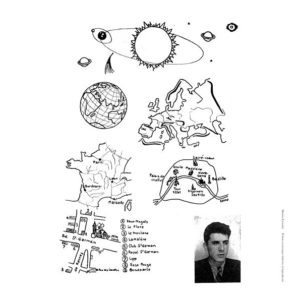
Maurice LEMAÎTRE
“Poèmes et musiques lettristes et hyperphonie”
alga marghen proudly presents an exceptionally wild sonic art and poetry document, Maurice Lemaître “Poémes et musiques lettristes et hyperphonie” recorded between 1952 and 1968. What does Lemaître contribute to the Isouian poetic creation? What… music as background to “lettries”? These are heretic hyperphonies forming such a specific corpus in the lettric sphere. Neither Isou, nor Pomerand, Dufrêne, Wolman, or Spacagna achieved what Lemaître did… Lemaître dares the unthinkable: neo-yéyé rhythmic muzak destroyed by "lettries" disseminated with the biggest care. One more treasure: the very "pop music" oriented Lemaître with his “I wanna go home mister” blues, here in a version with a borderline insane companion: Isidore Isou. Never a bluesman, thanks only to his irradiant genius, has ever been such a stoned sideman as Isou. This record includes an improvisation held at the Museum of Modern Art, Paris, 1961, in the context of a reading by Isidore Isou. Also included on this LP is a previously unreleased torrid “concerto” titled “L’alcove” for a lettrist male chorus and female solo orgasms, followed by “L’ascension du Phénix M.B.”, a sound collage from 1967 (predating more than 10 years M.B. first primitive concrete music assemblages under the name Sacher Pelz). No need of Yoko Ono’s loops for another “Revolution 9”… one year before Lemaître cuts the tape with a scalpel, leaving the cuts exposed: home revolution in between two manifestos and three hypergraphic paintings. Offer yourself the joy of listening to these recordings that alas Lemaître, whose hearing stops precisely at 250Hz, can no longer have the pleasure to taste. Edition limited to 240 copies, with liner notes by Frederic Acquaviva and a fantastic front cover drawing by Maurice Lemaître.
23,00€
In stock
LP
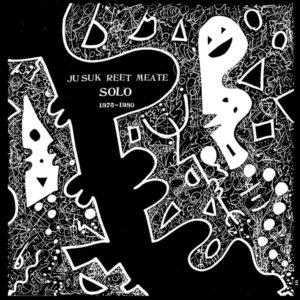
Ju Suk REET MEATE
“Solo 1975-1980”
Side-stepping all normal expectations on this album, Ju Suk Reet Meate
(founding member of Smegma) directly goes about casting musical spells utilizing primitive “inner-mind” techniques on Hammered Dulcimer, Tape Loops, Thrift store records, Homemade Synthesizer, Electric Guitar, Saxophone, mouth sounds and manipulated Christian radio broadcasts.
Recorded in Portland, Oregon, between 1975 and 1980 these recordings reflect a similar inner-mind-over-limited-technique-matter aesthetic as his highly acclaimed (but seldom heard) classic Ju Suk Reet Meate “Solo 1978-1979” issued on Pigface Records in 1980.
Side One presents “Something New: Opus I-IV” recorded between 1975 and 1977 while on Side Two you find “Or Feets: Opus I-III” recorded in 1980. Both sides contain only previously unreleased sounds with no remixing or overdubs.
White silkscreened sleeve on black cardboard paper. Cover art and layout by Ju Suk Reet Meate. Issued in an edition limited to 188 copies, the first 50 with handmade sleeve by the artist.
23,00€
Out of stock
LP
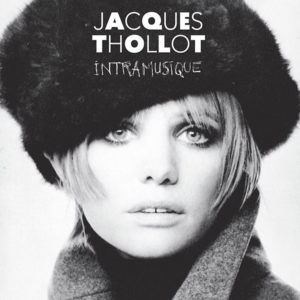
Jacques THOLLOT’S INTRA MUSIQUE
“Intra Musique”
There are records that stimulate curiosity to the extreme, records that make you want to dissolve yourself into the intense and beautiful surprise this music will bring. It is undeniable to the delighted ear that this exhumed document contains all the assets of the historical output, of the record that one would dream of waiting for long if one had known it existed.
This rough edit, done within urgency by Jacques Thollot, testifies of a unique experience: the concert of Intra Musique at the Faculty of Law in Paris, an uncertain evening of 1969. The devastating gab of the two acolytes Jacques Thollot and Eddie Gaumont made the concert take place, on the ploughed earth of May 68, in the same faculty where so much was discussed and thanks to the success of the previous concerts of the association of students that allowed the risk of hiring the thundering dream team.
Unique because there will never be another replica of what Jacques Thollot called "a movement”, involving Michel Portal (tenor sax), Mimi Lorenzini (guitar), the rare Daniel Laloux (tambour), Jacques Thollot (drums and tapes of recorded experiments, those that will build the skeleton of the magnificent “Quand le son devient aigu jeter la girafe à la mer” LP on Futura), and Eddie Gaumont (guitar / piano), the instigators of this journey. Captain Eddie Gaumont will capsize shortly after, sunk by a too intensely dark life; sad coda putting an end to the project.
Let us add the undeniable whirling of the mentors' and companions' spirits of Jacques Thollot, such Don Cherry, Steve Lacy, Bernard Vitet and Jean-François Jenny Clark, and we fail a little further at attempting to describe this succession of precious moments: that oblique spiritual-jazz, that other staggering ballad or that primitive fever of essential nervous flights, that almost psychedelic proto rock; alternations of radical free music to those magnificently classic, overwhelming achievements.
Jacques Thollot is not just one of the greatest abandoned jazz composers: he is the one who abandons himself to all its forms.
Edition of 350 copies in full-color gatefold sleeve, co-produced with Jac Berrocal historical d’Avantage label (whose catalogue includes Michel Potage “Occupé” LP, also co-produced with alga marghen).
23,00€
In stock
LP
Gil J WOLMAN
“Wolman et son double”
Might it be as a ‘détournement’ of Artaud’s famous collection and masterpiece “Le theâtre et son double” that Gil J Wolman calls this recording “Wolman et son double”? Artaud’s conference at the Vieux Colombier theater on January 13, 1947 had a major impact on the future sound poets François Dufrêne, Jean-Louis Brau and Gil J Wolman. Wolman’s ‘mégapneumie’ appeared as early as 1950 and eventually developed into an improvisation for breath and organic sounds originating from the throat. The whole body seems to be mobilized to perturb the human appearance of any possible speech.
“Wolman et son double”, a previously unreleased recording probably from the end of the 70’s, is Wolman’s most theatrical, musical and lyrical piece, his most accomplished and extreme. This is due both to its duration and above all to its experimental recording techniques: Wolman records a series of improvisations on a 30 minute track, then mixes them with a new series of ‘mégapneumes’, mixing and manipulations with echo and larsen!
The first track begins with a hum, immediately overlaid by Wolman’s ‘poésie physique’: hoarseness, cough, strangulation, twisting, wheeze, rumbling, hiccups, asphyxia, a whole set of grips against himself and his speech. Wolman breaths and winces, he mimes the impacts, the scars of the blows by an invisible fighter… actually his double.
Antonin Artaud observed that ‘actors in France no longer know how to do anything but talk’… “Wolman et son double” may well be the national strike of that show, of masterpiece art.
Edition of 350 copies.
19,00€
Out of stock
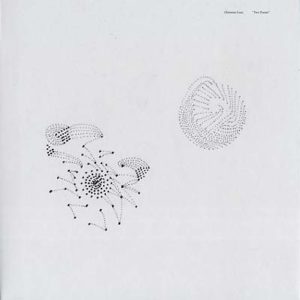
LP
Ghérasim LUCA
“Two poems”
“Alga Marghen proudly presents an LP edition including two experimental sound works by Ghérasim Luca, created in close connection to Sten Hanson who invited the Rumenian artist at Fylkingen in the very beginning of the 1970s and made him discover the possibilities of the advanced EMS electronic music studio of Stockholm. The two recordings presented here are quite unique as they are the only poems by Gherasim Luca created through the use of electronic manipulations. As Henri Chopin wrote some years later in his legendary "Poésie Sonore Internationale" book, Ghérasim Luca made a big impression at the Third Stockholm Festival in 1970. Luca was born in Bucarest in 1913. Before leaving to Israel he had a leading role among the Roumanian Surrealist group. He eventually moved to Paris where he lived untill the end of his life in 1992. Ghérasim Luca work is very personal, giving his poems a very uncommon and ironic character. Again Henri Chopin underlines that "in his recordings, which are not many, he superimposes his very warm voice, marked by his Roumanian accent; it’s a sound wonder. In fact Luca is not a sound poet. He is more a speaker who managed, without complex, to enter into the Fylkingen studio vortex. On 4 tracks and with 32 loudspeakers, thanks to his superb voice and his instinctive knowledge of the electronic studio which amplifies words, he gives great pleasure to the listener, even if the latter can not understand French". “Autres secrets du vide et du plein” (April 1971) and “Crimes sens initiales” (April 1972) were both recorded one track at the time on a 4 track tape and afterwards subjected to electronic treatments. They were recorded in Sweden at EMS and first performed at the 1971 and 1972 Text-Sound Festivals of Stockholm. Edition limited to 385 copies, also including the reproduction of a worderful drawing by Ghérasim Luca on the front cover, a photo portrait of the author by Gilles Ehrmann from 1959 and an essay by Henri Chopin.”
19,00€
Out of stock

LP
Eduardo KAC PORN ART MOVEMENT
“Pornéia”
Edition limited to 270 copies.
These previously unissued recordings from the Porn Art Movement (1980-1982) include five performances recorded live on Ipanema Beach in 1982, as well as a selection of previously unheard studio recordings of Eduardo Kac yell-poems. Kac fused existing coarse and curse words with parts of words, neologisms, salacious buffoonery, the antinormative scribblings of toilet-wall graffiti, commonplaces, blasphemy, expletives, agrammatisms, incorrect orthography, slangy expressions, lexical exorbitance, general obscenities, the gross and the grotesque, into a new whole. His use of stigmatizing words in these Porn-poems transformed them from denigratory to empowering, through political critique and defiance.
The LP also includes the Manifesto Pornô (1980) and four recordings of Flatographic Poems from 1982, in which Kac uses the flatus as a compositional unit and the mellifluous flatal flow as material. Flatographic poems have visual scores—one of which can be seen on the cover—for metabolic performances that combine meticulous precision with gaseous explosiveness of scatological resonance. Demanding a high level of self-mastery on the part of the performer, this anal poetry was the only series of works produced in the Movement to literally explore the internal side of the body.
Edition limited to 270 copies, also including an LP-size 40-page full-color book with full documentation on the Porn Art Movement.
23,00€
Out of stock

LP
David BEHRMAN
“Music With Memory”
alga marghen proudly introduce you to “Music With Memory”, a new record LP by David Behrman focused on his 70s work with new small, inexpensive devices then known as “microcomputers” equipped with “memory” to be used in live performances and installations.
Side A presents “Interspecies Smalltalk” with Takehisa Kosugi (Violin) and David Behrman (Electronics). A wild intertwine of two worlds of resonance, structure and tonal which is decades ahead of its time. Commissioned by John Cage and Merce Cunningham as music for the 1984 Cunningham Company dance titled “Pictures”, it was made to be performed by Takehisa Kosugi playing violin in his uniquely personal style.
Side B includes “Circling Six”, an earlier version of a more extended piece titled “Leapday Night”. “Circling Six” had six looping synthesizer phrases which could be played along with by the acoustic instrumentalist, on this recording by Werner Durand on saxophone.
“Interspecies Smalltalk” and “Circling Six” were pieces for instrumental performers and a small computer-controlled music system that Behrman assembled during the 1980s. The electronic gear consisted of pitch sensors (“ears” with which it listened to the performing musicians), various music synthesizers (some homemade), a video display and a personal computer. The pieces were made with computer programs governing interaction between performers and the electronics. The software created situations rather than set pieces. The performers had options rather than instructions, and the exploration of each situation as it unfolded was up to them.
Also on side B a short track titled “All Thumbs” for two electrified mbiras (African instruments of ancient origin also known as thumb pianos, kalimbas or zanzas). This piece grew out of a collaborative sound and video installation that George Lewis and David Behrman made for the opening of the Paris science museum La Villette in the spring of 1986. The metal tines of the mbiras were linked to sensors and to a computer music system. In this concert version, played together with Fast Forward, the piece was in several sections. All the sounds in “All Thumbs” were electronically generated.
Edition of 400 copies with liner notes by David Behrman and photos by the performances as well as original programs of the Music With Memory Festival.
19,00€
In stock
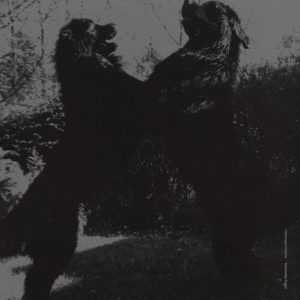
LP
Charlemagne PALESTINE
“Relationship studies”
“Relationship Studies LP includes 2 seminal electronic music radical realizations by Charlemagne Palestine, or "Relationship Study No. 1" (1967) and the generally titled "Electronic" from the same year. Sounds in motion like race cars, motor cycles, war planes, rocket ships excited Charlemagne sonic imagination when we was still a young teenager. Then came the experience of listening to the electronic music of Tod Dockstader, Alwyn Nikolais, Pierre Henry and Pierre Schaffer, Xenakis and "Poème Electronique" by Edgar Varese. Immediately fascinated Charlemagne Palestine bought a primitive electronic equipment and started to experiment, creating his original electronicesque language. The two previously unreleased 18 minute masterpieces presented here directly come from this early period of intense experimentations in a fluid ever-changing mix of adding and filtering white noise and simple sine tone generators. Both pieces are late night compositions created at the electronic music studio of the New York N.Y.U. Intermedia Center using Buchla 100 and Buchla 200 systems. Even if dating back from the mid-1960s these intense sonorities might very much recall the best early power electronic scene from the late 1970s, in particular to the first brut music works created by Maurizio Bianchi. For sure they represent a very unique and inspiring approach to electronic creation, sounding more and more actual and surprising nowadays. Edition limited to 350 copies.” label info
23,00€
In stock
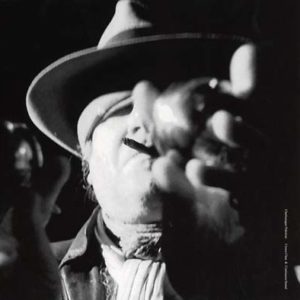
LP
Charlemagne PALESTINE
“Two electronic sonorities”
alga marghen proudly presents two seminal electronic music radical realizations by Charlemagne Palestine. These previously unpublished pieces confirm once more how advanced was his Golden Research already in the 1960s, a very personal approach to sound which would have later become so influential for future generations. Continuous Sound, built by an ever-changing mix of adding and filtering white noise and simple sine tone generators, is the most solid sound construction that Charlemagne created in preparation of his lost electronic masterpiece L’Avventura, inspired by the Michelangelo Antonioni movie with the same title. Continuous Sound pre-dates L’Avventura of just a few months and with its suspended atmospheres and its deep sense of mystery represent one of the most fascinating sonic works by Charlemagne Palestine. Crown Chan is an electronic music piece created for a dance by Gus Solomon in 1970. Conceiving music for dancers gave Charlemagne the possibility to experiment and manipulate the reel tapes of some of his electronic sonorities. In a previous collaboration with Gus Salomon, Charlemagne created a new sound by simply superimposing two already existing and accomplished electronic drones. Holy1 and Holy2 thus became a completely new sonority titled Holy1+2 (these works were included in the CD titled Alloy, also issued by alga marghen). In the case of Crown Chan Charlemagne worked in a more structural way, shaping his electronic sound materials into two stereo reel tapes (titled Crown Chan 1&2 and Crown Chan 3&4) which also integrated silent parts and were meant to be played back simultaneously, thus providing a powerful live music for the dancers. Edition limited to 380 copies, with an institutional portrait of the composer on front and back sleeve for you consumers to enjoy.
19,00€
Out of stock
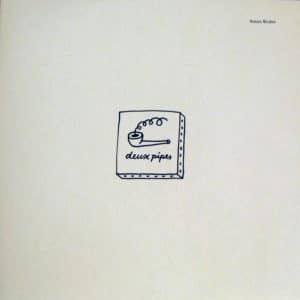
LP
Anton BRUHIN
“Deux pipes”
“In the past few years alga marghen successfully released on CD some of Anton Bruhin more experimental works. “InOut”, “Rotomotor” and the CD version of his first LP masterpiece from 1969 “Vom goldabfischer”, made many of you become familiar with the eccentric creations of this obscure Swiss artist. But for this new release alga marghen decided to concentrate on Anton Bruhin favorite instrument, the jews harp. Included in this LP record are six breathtaking jews harp pieces of pure genius. On Side 1 “Apocalypt Rb- with sampling loop” and “Chor H+ with sampling loop and solo reverb pot”, recorded in January 2000 while testing some modified jews harp self-made instruments created by Zoltan Szilagyi. This virtuoso performance is improvised over to a loop-continuum sampled through a Casio child synth. On Side 2 the all-time-classic titled “Maultrommel und Sprache” (i.e. Jews Harp and Speaking) where Bruhin is scientifically investigating the use of jews harp in rendering human voice. Recorded in 1994 this piece, divided in five short paragraphs, move from the very basic structure of language (vocals, diptongues, triptongues) and constructs a perfectly accomplished sonic statement. Also on Side 2 are three pieces from 1995 for Electric-Trumpi-2, the only existing second generation electric jews harp, constructed specially by Szilagyi for Anton Bruhin. “Towards the G-Spot”, “ET2 with fly and cough” and “ET2 extreme filling” grandly complete the collection of limousine musics selected for this record. Gatefold sleeve with large 8 page booklet reproducing four mind-blowing drawings released between 1969 and 2006 that well proof Anton Bruhin ultra-modernistic talent of the most refined nature. Also included in the booklet is the complete score of “Maultrommel und Sprache”. Edition limited to 330 copies.” label info
23,00€
Out of stock
LP
COMPILATION
THE GAMELAN OF THE WALKING WARRIORS
A fascinating immersion in the heart of a funeral ceremony live recorded in Bali, where gongs, cymbals, and drums give rhythm to the bewitching atmosphere of this mortuary procession.
The international audience’s interest into Balinese music and its gamelan orchestras dates back to the edition of large ethnographic series in the 1950s, 60s and 70s which largely encouraged the discovery of this music beyond Indonesia’s borders. Taking advantage of a more advanced technology compared to the vinyl golden era, the present field recordings produced in 2011 render at the closest the power of gamelans. They are presented here in two forms. The first one offers a display of Beleganjur music out of the ritual context, which can be differentiated by a more melodic form and a more dramatic and hypnotic aspect of the compositions. The second one presents the Beleganjur style in the ceremonial context of the Ngaben funerary rite in the village of Peliatan. The utmost vitality of these orchestras springs out throughout the different stages of these funerals, and the sound environment surrounding the musicians immerse the listener in the very heart of the procession following the corpse.
With The Gamelan of The Walking Warriors, Akuphone carries on its exploration of ritual and ceremonial music with those materials of rare intensity. These recordings were collected by Vincenzo Della Ratta, PhD in Ethnomusicology from the Sapienza University (Rome). As a specialist of the gongs music from the Austronesian cultures of Southeast Asia, Vincenzo Della Ratta is the author of numerous articles on the subject. His field researches have already been edited as a vinyl entitled Kwangkay: Funerary Music Of The Dayak Benuaq Of Borneo (Sublime Frequencies, 2016).
18,50€