
Out of stock

LP
SECOND WOMAN
“S-W”
Future music duo Second Woman’s sophomore full-length for Spectrum Spools further hones their distinctive fusion of shapeshifting software sculpture and tessellated footwork. Shivering digital textures oscillate with and against algorithmically mapped percussion samples; smeared synthetic chords levitate in the distance; stabs of digital noise punctuate the mix in twitchy, time-distorting patterns.
Their anamorphosis verges on ascetic: stark, splintered waveforms rendered into unique fiber optic hieroglyphs. Multi-instrumentalists Josh Eustis and Turk Dietrich share a deep history going back to their days in the New Orleans ambient electronic community, as part of Telefon Tel Aviv and Belong, respectively.
Even so, S/W pushes beyond their combined discographies to date, flexing impossibilities, building rhythms from arrhythmia, teasing veiled emotion from bold iterations of cold code. Digital version includes remix by experimental composer Gábor Lázár.
15,00€
In stock

LP
Michael POLLARD
“Translations 01”
Material Study 01 (Sand) is a recording from a stereo hydrophone buried under the sand in a lake. Standing on top of the transducer, holding the MiniDisc recorder in my hand, and monitoring the feed with a pair of in-ear earphones, I slowly shifted my weight and the sand beneath my feet. My younger brother was on the shore throwing firecrackers into the water; this was an ‘accidental’ aspect of the recording. Material Study 02 (Cello and jacket) is made from a cello as it is dropped onto a carpeted floor with a contact microphone taped to it’s bridge. The moment of impact was ‘frozen’ with an infinite sustain effect pedal. Both the sustained tone and the live feed from the contact microphone were played into the room at high volume while the contact mic was still attached to the cello. This was recorded. Roughly one year later year later this cello drop’ recording was amplitude modulated in a computer audio synthesis environment by a pair of stereo contact microphones taped to a wind breaker being blown by an air circulator as it hung from the ceiling by a string. Spatialisation Study 01 (One freeze from seven positions in a house) is made from four frozen tones generated from a file on my computer in a computer audio synthesis environment. The four tones were played back simultaneously in an arbitrary stereo spread at a high volume on a home entertainment system in the living room of a house with high ceilings. The stereo and computer were both left undisturbed for an afternoon, and their output was recorded to a portable SD card recorder via a matched pair of stereo omnidirectional condenser microphones mounted on a homemade disk baffle (for accurate stereo imaging) from seven positions within the house order of presentation: 01 in the dining room, 02 on the second floor landing, 03 in the middle of the upstairs hallway, 04 in the middle of the upstairs hallway close to the floor, 05 in the front room close to the floor, 06 in the living room facing the speakers close to the floor, 07 in the living room facing away from the speakers close to the floor). Using a DAW, two minutes from each recorded position in the house were combined into the eight minute track here; identical overlapping envelopes were superimposed on each two minute segment, fading in for one minute and then fading out for one minute, with the subsequent segment beginning to rise in amplitude as the previous begins to fall. Spatialisation Study 02 (Forty-nine tracks of isolated and overlayed clicks generated from the material and positions of the previous study) is made from the convolution of randomly generated stereo ‘clicks’ with the seven two minute segments (mentioned above) in a computer audio synthesis environment. Each of these seven tracks were individually convolved and played back into the house. The output was recorded to a portable SD card recorder via a matched pair of stereo omnidirectional condenser microphones mounted on a homemade baffle disk (for accurate stereo imaging). A recording was made from each of the seven source tracks in each of the seven positions (mentioned above), for a total of forty-nine recordings. Using a DAW, one second was excerpted from each of the forty-nine tracks, playing one click from each source-position pair; all forty-nine tracks then play simultaneously. A pencil rubbing for the album cover is made from a pencil rubbing of the texture of a wall. A 7 ” x 11” piece of rice paper was taped onto a wall with stereo contact microphones taped to the wall along the top and bottom edges of the paper. A pencil was slowly rubbed against the paper in vertical lines from top to bottom (or L to R according to the stereo configuration of the microphones) and recorded direct to computer. The rubbing produced from this process was scanned into the computer and can be seen on the cover of the album. Translations 01 was written, produced and recorded by Michael Pollard in the time between June 2011 and October 2012 in a variety of locations. The audio was mastered by Russell Haswell on October 2nd 2012 and cut by Rashad Becker at Dubplates and Mastering on October 17th 2012. It is intended for playback in a room via loudspeakers. Spectrum Spools released in association with Editions Mego.
9,00€
In stock

LP
Max EILBACHER
“Red anxiety tracers”
Max Eilbacher’s “Red Anxiety Tracers” is the debut long player from the multi-talented Baltimore, Maryland stalwart. Eilbacher has performed with various projects such as Matmos, Horse Lords, and the mind-altering underground Needle Gun aktionist unit. Despite years of busy touring and recording, “Red Anxiety Tracers” is the first vinyl artifact from this young mastermind. Crafted over the course of a year, “Tracers” is a labyrinth of shapes and sounds which glide through a complex and arcane environment of found sounds and synthesis. An expertly crafted maze of deja-vu, audio hallucinations, and dislocating atmospheric forms an audio obstacle course for the listener. Complex editing techniques and sound structures recalls the works of J.D. Robb or Owl Records era Tod Dockstader albeit with a radically fresh perspective and educated hindsight. “Red Anxiety Tracers” exhumes impeccable flow and careful attention to dynamic range, with it’s surgical placement of sound events challenging the deep listening abilities of it’s audience. Raw and manic tension overloads are cut with alien float and abstract aether transmissions with a constantly shifting palette of sounds spun from blasted modular electronics, vocoded terrestrialspeak, and glowing mellotron clouds. Eilbacher communicates a strange and beautiful dialect conceived through disciplined compositional structure and an intuitive improvisational style unparalleled in the current landscape. "Red Anxiety Tracers" breathes new life into modern electronic composition. Spectrum Spools released in association with Editions Mego.
15,00€
Out of stock
LP
COMPILATION
SOUNDS OF SILENCE
NEW EDITION limited to 200 copies !
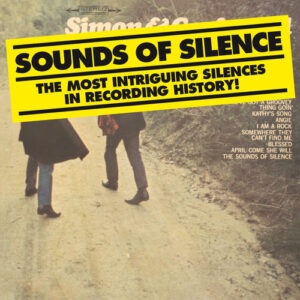
“Sounds of Silence” is an anthology of some of the most intriguing silent tracks in recording history and includes rare works, among others, by Andy Warhol, John Lennon, Maurice Lemaitre, Sly & the Family Stone, Robert Wyatt, John Denver, Whitehouse, Orbital, Crass, Ciccone Youth, Afrika Bambaataa and of course Yves Klein. In their own quiet way, these silences speak volumes: they are performative, political, critical, abstract, poetic, cynical, technical, absurd… They can be intended as a memorial or a joke, a special offer, or something entirely undefined. The carefully chosen silences of this anthology are intrinsically linked to the medium of reproduction itself and reveal it’s nude materiality. They expose their medium in all its facets and imperfections, including the effect of time and wear. At the most basic level, these silences are surfaces. And it is in their materiality that they distinguish themselves from the conceptual experiments of John Cage with “4’33”. From the 1950s silence has found a place in the economic structure of the record industry and since then it would increasingly be appropriated by a vast array of artists is a vast array of contexts. Indeed, the silent tracks seems to know no boundaries. The LP presents the silences as they were originally recorded, preserving any imperfection that the hardware conferred upon the enterprise, without banning the possibility to satisfying the ear. The liner notes provide historical background for each track, revealing the stated (or presumed) motivations for these silences, while providing novel sound correspondences or interferences. This album is meant to be played loud (or not), at any time, in any place: a true aural experience ! Co-produced by alga marghen with Sound-Houses-FRAC Franche Comté.
22,00€
Out of stock
LP
Alessandro BOSETTI
“Renard”
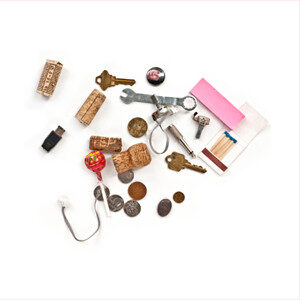
Composed by Alessandro Bosetti. With Alessandro Bosetti (voice, oscillator), Laurent Bruttin (clarinet, bass clarinet), Seth Josel (classical guitar). Recorded at Börne45 by Roy Carroll, June 2012. Mixed by Alessandro Bosetti. Mastered Giuseppe Ielasi. A chamber music project on LP by the Italian composer, sound artist and performer, inspired by an African divination ritual. Renard is a chamber music project by composer Aleassandro Bosetti, commissioned on the occasion of this LP release by the regional fond for Contemporary art FRAC Franche-comté. The inspiration for the collection of pieces comprised in Renard came from a video that Alessandro Bosetti saw at the ethnological museum quai Branly in Paris. The video was showing an african woman divining the future by mean of throwing handfuls of objects on a table and reading their configuration in a relentless sequence of questions and answers to herself. Fascinated by the ritualized simplicity of this practice Bosetti and designer Annette Stahmer, selected a new pool of objects, devised an interpretation code and recorded several divination sessions with a few invited participants. Participants had been instructed on how to "read" the objects and they were able to elaborate answers to each other questions on matters as love, health, family, money, travels and whatever else they may have wished to receive advice on. Distilled fragments of those intimate and emotional exchanges were portrayed in this series of pieces for voice, guitar and clarinet. The ephemeral and conversational nature of the original recordings eventually transformed into its opposite and got frozen into stylized music compositions. All material was derived from the spoken interactions —as it is common practice in Bosetti’s work—although this time speech is often not heard as such but rather used as root material for the creation of geometric melodic patterns that eventually proliferate into thematic constructions.
While Alessandro Bosetti is used to incorporate fragments du reel in his compositions—in the tradition of composer and radio makers like Luc Ferrari and Yann Paranthoen—the particularity of his method this time resides in his avoidance of sampling and recorded reproduction while creating life size casts of the portrayed scenes for voice and instruments in a sort of hand made hyperrealism.
The chosen form is a chamber trio with classical guitar, clarinet and voice with the occasional insertion of sinusoidal waves. It that may loosely remind of Anton Webern’s three songs op. 18 (with piccolo clarinet and soprano swopping roles with bass clarinet and tenor voice ) or of Jimmy Giuffre trio explorations in the 60’s.
The instrumentalists—both adopted Berliners by now - are New Yorker Seth Josel - one of the most in demand new music interpreters on the guitar that has been closely collaborating with composers as Tristan Murail, Helmut Lachenmann, Richard Barret and Phill Niblock and Laurent Bruttin from Lausanne mostly know for his work with the Ensemble Contrechamps in Geneva.
The music—thoroughly notated—is naked, cristalline, highly formal and stripped down to the bone with instruments and voice completely exposed in both fragility and virtuosistic precision. The focus is shifted away from noise and extended techniques and pointed towards the unfolding of melodic and prosodic possibilities as if a speech-melody section would have been added to Nichlas Slonimsky’s thesaurus of scales and melodic patterns.
The name of the project, Renard, reminds of another african divination technique, that of the Dogon people, where the white fox, Renard pale in French, is interrogated overnight by tracing coded drawings on the sand and reading it’s tracks in the following morning.
12,00€
Out of stock
LP
MAHJUN
“Mahjun (1973)”
500 copies on Black Vinyl. 350 gr. Gatefold Sleeve With Obi Strip – Matt Printing.
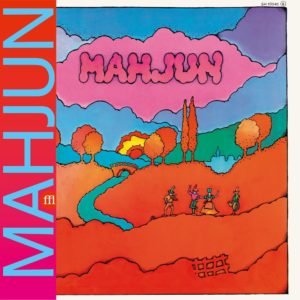
Mahjun, one of the most innovative French prog underground band, made their eponymous classic debut album on the very productive Saravah label in 1973. Their music, as you can hear on such tracks as « Les Enfants Sauvages » or « Chez Planos », is a subtle mix of spiritual jazz, pop music, folk and avant-garde reminding Full Moon Ensemble, Brigitte Fontaine or the Thêatre du Chêne Noir. First time vinyl reissue licenced by Saravah.
17,00€
Out of stock
LP
BIRGÉ GORGÉ
“Avant toute”
Have you ever imagined what a meeting between the Silver Apples and Sonny Sharrock would sound like?
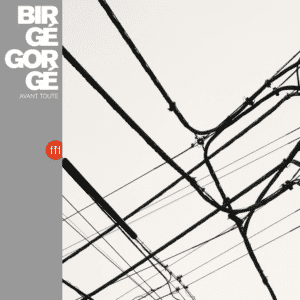
In 1974, Jean-Jacques Birgé, one of the first French synthesizer players (ARP 2600) along with Francis Gorgé, virtuoso guitarist, created some unique improvised pop music. These unreleased and flamboyant recordings would be the source for the cult 1975 « Défense de » album by Birgé, Gorgé, Shiroc before founding “Un Drame Musical Instantané” with Bernard Vitet.
Ltd Edition 700 Black & White Vinyl, 350 gr. Sleeve – Reverse Printing- Obi Strip. Insert with photos + liner notes by Jean-Jacques Birgé & Francis Gorgé.
18,00€
Out of stock
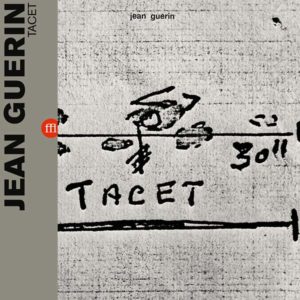
LP
Jean GUERIN
“Tacet”
Fourth in a reissue series of the cult French underground Futura label.
Highly surreal and wonderfully futuristic, “Tacet”, one of the best kept secrets of the Futura catalogue is the soundtrack work of Jean Guérin for Claude Faraldo’s anarchic film “BOF, anatomie d’un livreur”. This avant-garde psychedelic jazz masterpiece is a blend of abstract vocals, unusual electronics, twisted sound envelopes and nervous brass instruments. First official vinyl reissue fully licenced by Futura founder Gérard Teronnès. Ltd Edition. 500 Black Vinyl. 350 gr. Gatefold Sleeve With Obi Strip.
16,50€
Out of stock

LP
Harry BERTOIA
“Clear Sounds – Perfetta”
Vinyl version reissued.
After nearly 40 years of silence, Harry Bertoia's Sonambient label has been resurrected in order to release the best of Bertoia’s unheard recordings from his recently preserved archive of 1/4" tapes. “Clear Sounds” b/w “Perfetta” (F/W 1033) was cut straight from the original reels and is a true analog pressing (AAA).
These two pieces were selected for their minimal, meditative and lush harmonic qualities; lacking in the abundance of dynamics and contrasts found on the original Sonambient records, these pieces show another approach to performance. Slow washes of shimmering metallic sculpture rustle thickly like the leaves of a white birch or tall grass in the summer sun. Gorgeous harmonics hover overhead, making audible measurements of the length and purity of Bertoia’s metal rod sculptures.
Both Harry Bertoia and his brother Oreste composed extensively in the Sonambient Barn deep in the woods of rural Pennsylvania where Harry kept over 100 Sonambient sculptures and gongs. The first Sonambient LP, released in 1970, contains a Harry Bertoia composition on side A and an Oreste Bertoia composition on side B. As an homage to the original Sonambient LP, Clear Sounds is a Harry Bertoia piece from June 30, 1973 and Perfetta is an Oreste Bertoia piece from June 28, 1971.
Background:
Harry Bertoia first came into artistic prominence in the late 1930’s and his sculptural, ergomonic chairs , produced by Knoll Furniture beginning in 1952, were soon modernist furniture classics. Inspired by the resonant sounds emanating from metals as he worked them and encouraged by his brother Oreste, whose passion was music, Harry restored a fieldstone "Pennsylvania Dutch" barn as the home for this experiment in sounding sculptures which he had begun in the 1950’s. Bertoia was an obsessive composer and relentless experimenter, often working late into the night and accumulating hundreds of tapes of his best performances; Oreste, too, would explore and record the sculptures’ sounds during his annual visits to his brother’s home in rural Pennsylvania.
Harry Bertoia’s recently dismantled Sonambient barn collection was an attentive listener’s paradise full of warm, expressive instruments that were gorgeous visually and audibly. Nothing could prepare you, even on return visits, for the overwhelming experience of entering the spacious wood and plaster interior where gongs, some of them giant, hung among the ranks of standing sculptures of various metals. Over nearly twenty years, adding, culling and rearranging, Bertoia carefully selected nearly 100 harmonious pieces ranging in height from under a foot to more than fifteen feet. He considered this barn a full experience, sights and sounds comprising not a collection of works, but one piece unto itself. It was here, deep in the woods, that his Sonambient recording work took place.
Learning by experimentation was common for Bertoia and he mastered the art of tape recording, turning the Sonambient barn into a sound studio with four overhead microphones hanging from the rafters in a square formation. He would experiment with overdubbing by performing along to previous recordings, sometimes backwards, constantly improving his methods while also honing his performance skills. Bertoia was a careful editor of his own work and only chosen recordings remained, each with a date and carefully considered observations written on a note included with each tape. Through these pieces of paper a greater logic can be uncovered, a careful approach to composition, ideas, feelings and forms. The story of Sonambient barn collection will slowly be told through the release of recordings from the archive as well as installations and performances built from Bertoia’s own recordings, lectures and a book.
22,00€
Out of stock
LP
IN CAMERA
Back in stock! “In Camera, another duo project with Af Ursin’s Timo Van Luyck was started in 2004 and has produced two albums so far, the self titled first album (Some fine legacy) and Open Air (Robot), presenting yet another facet of Heemann’s ideas of textural electroacustica, this time with a focus on improvisation.”
16,00€
In stock

LP
MICROTUB
“Bite of the Orange”
Robin Hayward, Microtonal F-tuba. Peder Simonsen, Microtonal C-tuba. Martin Taxt, microtonal C-tuba.
Bite of the Orange is Microtub’s third album on SOFA. On ‘Bite of the Orange’ the three tuba players dig deeper into the sphere of just intonation. Robin Hayward has composed two new pieces for the group focusing on the 11th and 13th harmonics, resulting in a strong microtonal character. The canadian music critic Stuart Broomer picked Microtub as one of the highlights of the FIMAV festival inVictoriaville last year, and wrote
(…)Together they explored compositions that created tremendous temporal space using long tones, then found in their rare instruments very specific, previously unheard pitch intervals, distances that took close listening into new territory(…)
Bite of the Orange was recorded during Microtub’s one week residency at the Palazzo Stabile Art Center in Piemonte, Italy in January 2016. Mixed by Peder Simonsen and mastered by Mike Grinser at Dubplates & Mastering in Berlin.
17,00€
In stock

LP
Martin KÜCHEN
“Lieber Heiland, laß uns sterben”
Martin Küchen, saxophones, radio, iPod, electronic tambura.
“Poetry and reality.
The music goes in and out of, and away from, and into again. Reality and poetry. The music is uninterested in genre denominations and ideological markers. Music grows and is shaped by and out of realities, living and artistic. Sound is an audible reflection of you. Even you in silence. And you from sound, from the particular music that invaded your way of life; the ever-increasing global audible pressure chamber in which your spirit falls again and again in a Sisyfonian way ...
Titles, on the other hand, are single-living creatures. Sometimes pointing to other titles, other phenomena, but usually standing entirely solitary, like pillars of stone in a desert, like rocks in a forest area.
Over, under and around, the music is moving and moving unobtrusively.
On Leiber Heiland, Laß uns Sterben historical events intersect right into the contemporary sound making, slit through their titles sharp cuts in our listening present era and pry our eyes towards the seemingly inexplicable backyard of history; which nevertheless created the plateau of disintegration and opportunity that we now seem to live on. At the same time all the sounds on this recording - all the scrunching, the breathing, all the tones, all the composed-processed material - completely and fully give themselves to the listener, escaping all human epithet making and denominations, as the sound becomes manifest, becomes apparent.
This is my wish. To contemplate names and sounds, around music and the name of music.
A couple of measured hours during a wondrous and almost tropical evening in May 2016, Jakob Riis and myself were in the Crypt of the Lund Cathedral, while student orchestras rehearsed with open windows near the old monastery park, birds were screaming and hot spring -high people raved just outside the crypt’s small, low windows. The crypt is perhaps Sweden’s oldest room still existing.
And precisely in this mysteriously echoing room, we were still in a hair-rasing now, rinsed clean by the music as big and tiny sounds ran in rays along the stone floor from the year 1121 providing some relief.”- Martin Küchen, April 2017
17,00€
In stock
LP
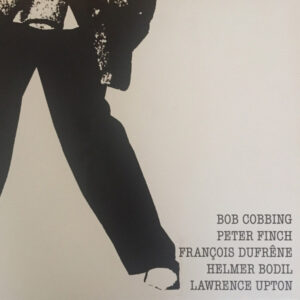
Bob COBBING – Peter FINCH – François DUFRÊNE – Helmer BODIL – Lawrence UPTON
Bob Cobbing & Helmer Bodil.
Bob Cobbing & Lawrence Upton.
Bob Cobbing & François Dufrêne
Peter Finch & Bob Cobbing
Peter Finch
Artwork cover taken from Big Band Dance Music by Peter Finch. Originally published as 3 separate cassettes on Balsam Flex (1977-1980). Edition of 220 copies + 30 AP.
25,00€
Out of stock
LP
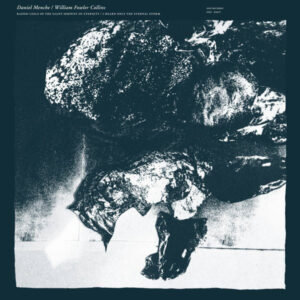
Daniel MENCHE – William FOWLER COLLINS
“I traversed the worlds, I ascended into the suns, and soared with the Milky Ways through the wastes of heaven; but there is no God. I descended to the last reaches of the shadows of Being, and I looked into the chasm and cried: ‘Father, where art thou?’ But I heard only the eternal storm ruled by none, and the shimmering rainbow of essence stood without sun to create it, trickling above the abyss.” So declares Christ in the opening section of Jean Paul’s 1796 text “Speech of the Dead Christ”. The text served as inspiration for the music presented on this split album by Daniel Menche and William Fowler Collins, and in the instance of the above quote, also functions as an apt description for it - immense, harrowing, and numinous. Like the procession of images conjured in Jean Paul’s twisting passages, the sounds made by Collins and Menche unfurl in a trail of drifting shadow punctuated by convulsive spasms of light.
Opening the album with a harmonious set of gently spiraling tones, Daniel Menche’s piece “Raised Coils of the Giant Serpent of Eternity” offers only this brief moment of serenity before a headlong dive into a cacophonous abyss of darker dimensions. Suspended in pools of liquid bass, layers of molten brass hover, dissolve and reappear. Pitches rise and fall, intersecting for brief periods of melodic convergence before crumbling again into heaving slabs of rumbling dissonance. Closing out the piece a low and solemn tone emerges from the roar of Menche’s spectral orchestra, seeming less like resolve, than the final flickering breath of a dying star.
Conversely, William Fowler Collins’ offering on the second side remains in a state of subdued tension for much of its duration. Primarily constructed around the emanations of decayed strings, these glimmering filaments seem in perpetual retreat from comfortable stasis or momentous upheaval. Swaying over a backdrop of inky black, disharmonious clusters gradually pile one over the other, pulling apart and recombining, eventually forming a jagged and unsettling crest. From here bilious clouds of humming static overtake the disintegrating strings, appearing long enough to set the stage for the conclusion of the narrative. Much like the opening Menche’s piece on the reverse side, Collins’ gently cascading sheaves of brushed guitar that close out the album serve as a small enclave of comfort in the otherwise lightless caverns through which he and Menche have driven the listener.
20,00€
In stock
LP
Aaron TURNER & Daniel MENCHE
“Nox”
Daniel Menche is a prolific musician whose work in the fields of noise and experimentalism displays both savage tactile expressionism and masterful studio
manipulations. Aaron Turner is an equally prolific artist whose output veers from
violent guitar architectures to textural meditations. Consequently, their collaborative album Nox could have been a brutish exercise in punishing frequencies and aural assaults. Instead, Nox is what Turner describes as “a combo of Daniel s more free-flowing form of impulsive music making and my more contemplative composition.”
Consisting of one lone track over the course of two sides of an LP, Nox uses its allowance of time to patiently wind and unravel around Menche s intuitive and free-associative vocal and drum treatments. Manipulated and wrought to the point of abstraction, this spontaneous underpinning served as the narrative backbone to Turner s orchestral vocal arrangements. Over the course of the year-long development process, the two musicians maintained a continual dialogue on the direction of the album, taking turns adding their accents and embellishments to the composition. Field recordings, found sounds, and auxiliary instrumentation fleshed out the recording until Nox developed into a final ruminative experience.
Menche and Turner had previously worked together on the Mamiffer/Menche collaborative album Crater, though Nox bears closer sonic relations to other endeavors in both artists canons. One can hear vestiges of Menche s more percussion-based albums like Concussions or Turner s more ethereal vocal-based work with Jodis on their most recent offering. And while the tactics and tools used for creating the album are very much of the modern age, the duo conjure the timeless elements of the transcendental hymns of Arvo Pärt or the tonal clusters of György Ligeti through their patient, economical approach. Ultimately, Nox creates a lush, inviting, and deeply dimensional world that belie the cold basements of Portland, OR and Vashon, WA where it was slowly brought to fruition.
LP edition of 400 copies. The LP is housed in a letterpressed jacket designed by Daniel Castrejon with photography by Faith Coloccia. Turner and Menche worked over a period of 2 years to complete the album using voice, field recordings, electronics, guitar, etc. The album was then mixed by Mell Dettmer (Earth, Eyvind Kang, Jessika Kenney, Sunn0))), etc).
18,00€
Out of stock
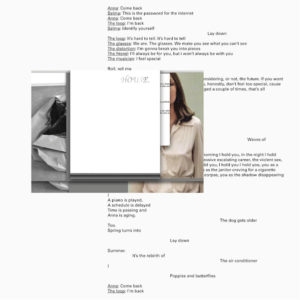
LP
Felicia ATKINSON
“A readymade ceremony”
Edition of 500 copies.
Relocated in the french Alps following a 5 years exile in Belgium, Felicia Atkinson returns on Shelter Press with A Readymade Ceremony, a concrete / post-digital oratorio in 5 parts.
Composed and recorded at home and on the Oregon coast, the opus documents a full range of bridges happening in Atkinson’s work. It documents the gather of her early-musical studies with her actual musical practice, the reunion of her two main projects - under her own name and Je Suis Le Petit Chevalier - and finally affirms the obvious link between her visual and sonic body of work.
Felicia Atkinson is a visual artist, a writer and musician graduated from Les Beaux-Arts de Paris. Her visual works - sculptures, paintings, installations and collages - includes a variety of media gathered together through the use of improvisation and its patterns such as delay, loop and saturations, with a chosen list of special tools : clay, silk, spray paint, watercolor, wood, or digital images…
Using the improvisation as a main technique to play music, write poetry and make art, her latest output is the book Improvising Sculpture as Delayed Fiction, a fiction / play published by Shelter Press in the fall of 2014.
Pursuing a radical position in the art world with the use of a publishing / economical autonomy as a very crucial element driving her carrier, this LP has been entirely recorded on her laptop using a super basic software. Felicia Atkinson reaffirms here the importance of the DIY in her creating process : the artist-run space as a place to exhibit, the studio space as a whole territory to record, the book as a score, the record itself as a proper documentation for a possible sculpture.
A readymade as the migration of one thing to another one’s context, involving a change of status, of genre, of politics. A ceremony as a possible gathering, a community shared moment, a happening, a celebration, a protest.
The first foundation of A Readymade Ceremony is the text, spread along the 5 tracks building the record. The text is a collage of extracts of Improvising Sculpture as Delayed Fictions (Félicia Atkinson, 2014), Recherche de la Base et du Sommet (René Char, 1955), and Madame Edwarda (Georges Bataille, 1937), and some random texts lying around while Atkinson was playing, mostly picked in the italian magazine Mousse.
16,00€
In stock
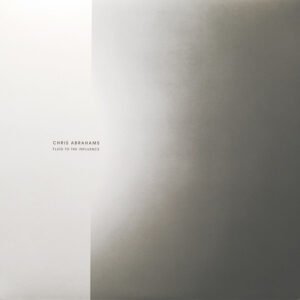
LP
Chris ABRAHAMS
“Fluid to the influence”
Chris Abrahams returns in 2016 with a new edition for Room40, Fluid To The Influence. Building upon the foundation of his previous three editions, Abrahams charts out a divergent course through lilting piano flows, distended organ passages, thunderous electronic eruptions and focused concrète explorations. Fluid To The Influence spans a huge spectrum of sound, each movement calling forward to the next in a flowing motion that demonstrates Abrahams’ commitment to and interest in the album as an artistic form.
Known widely for his piano work with post-everything trio The Necks, Abrahams output as a composer orbits an otherly sonic sphere. Piano is just one element he draws upon, creating a deliberately expansive sound field within which the listener is invited to become lost. He is one of the most significant voices in Australian music, and arguably one of the most restless and original artists creating work today.
20,00€
In stock
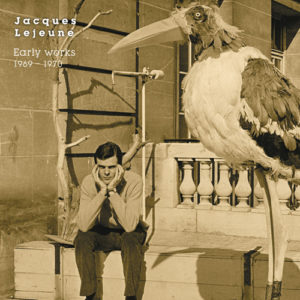
LP
Jacques LEJEUNE
“Early Works 1969-1970”
This LP of early compositions by Jacques Lejeune features three seminal works: “D’une Multitude En Fête” and “Petite Suite”, originally released on the Perspective Musicales series in 1970, and a previously unpublished composition, “Géodes”, from the same period. These three pieces (not included in the recent Parages and other electroacoustic works 3CD set) are some of Lejeune's earliest music for tape and may be considered a "prequel" to his later, more thematic works. Still, his concise musical narrative is ever-present in these first recordings. The sidelong D'une Multitude En Fête (1969) refers to multitude, number, celebration and any crowd situation as a form of ceremony—all evoking a circular gaze, as topics of the different aural events and their anecdotal development emerge, leading to the dream, as a story we tell to ourselves. Géodes (1970) features percussion improvisations by Lauréat Dionne with Jacques' tapework inflecting prisms deep into its thundering, rhythmic core. This concert version appears on vinyl for the first time. Concluding the album is Petite Suite (1970), with each section referencing a traditional musical form using both anecdotal as well as instrumental flourishes. The original drum and guitar elements performed here by Michel Foudrinoy and Jean-Pierre Vassout. These pieces have been compared to Pierre Henry's bold rock themes in Messe Pour Le Temps Present and also recall the peculiar atmospheres of some of the great, early Nurse With Wound records that would follow. In contrast, Lejeune's early approach was heavily steeped in sonic narratives, combining unusual and ambiguous events to create a sound world uniquely his own. Early Works 1969-1970 explores the first precision splices by one of the true visionaries in musique concrète.
25,00€
Out of stock

LP
Luc FERRARI
“Hétérozygote – Petite symphonie…”
Cut by Rashad Becker at Dubplates & Mastering, Berlin, October 2016. Digital Transfer: Jonathan Fitoussi. Translations: Valérie Vivancos. Layout: Stephen O’Malley. Coordination GRM: Daniel Teruggi & François Bonnet.
“Hétérozygote” (1963–1964).
Composed between December 1963 and March 1964. In the field of biology Heterozygous (Hétérozygote) means: a plant whose heredity is mixed. It implies that this composition is an attempt to engineer a language located both on the musical and on the dramatic plane. You could call this music “Anecdotal Music” for if the organisation of events is purely musical, their choice suggests situations justified at two levels: the music and the anecdote. However, the anecdote is hardly formulated and is open to plural interpretations. The listener is then asked to imagine their own story by rejecting – if necessary – the one suggested by the author. More specifically, the author suggests an anecdotal complex, potentially bearing several meanings. The work preceded by an opening is made of eight scenes, separated (or not) by interludes. And if we wished to push the paradox further, we could say that the titles of the scenes are optional and the interludes are also scenes, etc.
Petite symphonie intuitive pour un paysage de printemps (1973–1974), 25’09
“This electroacoustic music is part of a series that could be called “imaginary soundscape”. Unlike ‘Presque rien ou le lever du jour au bord de la mer (almost nothing or daybreak by the seaside)’, where the landscape narrates itself, here a traveller discovers a landscape which he tries to convey as a musical landscape.
Brunhild and I were in the Gorges du Tarn area. We chose to take a small path that was going up a rocky mountain for about ten kilometres. After a last turn, a totally unexpected landscape opened before my eyes. It was sunset. Before us, a vast plateau spread open with soft curves up to the horizon, up to the sun. The colours ranged from dry grass yellow to purple, in the distance, with the darkness of a few small groves punctuating the space. The almost bare nature was presenting itself to the eye, free from any obstacle. We could see everything. Later, when I recollected this place and the sensations I had experienced there, I tried to compose a music that could revive this memory. The "Causse Méjean" is a high plateau, about 1000 m high, in the Massif Central mountain range. It is dotted by scattered farms. A few people bring their flocks of sheep home. I thought about evoking this solitary and hazy human presence by including snippets of conversations I had had with some of the shepherds. Human language is woven into the musical texture; the sound of the voice says more than its actually meaning. Once, a shepherd told me “... I am never bored. I listen to the landscape. Sometimes I play my flute and then I listen to the echo responding...” Thinking of him, I used the flute and its echo in my music.” Luc Ferrari. October 18, 2002
————
Ten years separate Hétérozygote, a concrete piece regarded as the first to use “anecdotal sound materials” from the Petite symphonie intuitive pour un paysage de printemps, an “attempt to musically reproduce the impression of a landscape.” Ten years out of the fifty during which Luc Ferrari’s truly unique body of work unfolded, a work free from dogma which, through a singular type of listening, wrought a hymn to the living world, to the exploration and discovery of things, men and women who inhabit it. François Bonnet, Paris, 2016
15,50€
Out of stock

LP
François BAYLE
“Tremblements…”
“Tremblement de terre très doux” (1978).
The familiar generates the strange. These rolls, these hums, these sudden rushes; this song, these peaceful circlings; these sudden outbursts, these returns to quiescence – what do they remind us of?
This piece’s trajectory could also be a representation of the dramatic unfolding of a day - of a life - from sunrise (climate 1) to night-time (landscape 4) via restless encounters, transitions (1 to 3) that announce the drama climaxing in landscape 3, before reaching its denouement in climate 4… A whole concrete ‘story’.
The subterranean properties inherent to listening gently shift our ideas…
François Bayle
First performance: 19 March 1979 – Grand Auditorium of Radio-France,
Ina-GRM’s Cycle Acousmatique. .
“Toupie dans le ciel” (1979)
A wave is swaying on two minors thirds. This constantly uniform yet constantly varied swaying revolves in a swarm of sharp designs that blink on and off in a layer of growing density and mobility. Distance, speed, pressure, density, temperature, colour, intensity, are the “themes” of the 27 short interconnected cells flowing together though this seemingly unified movement. Occasionally, a breach in the texture reveals skyes dotted with little comets. In the centre, a slow
gliding picks up the distant harmonics of a basic chord. Toward the end, this gliding returns with a fiery burst.
Fine lines and whirs are generated from the song of a spinning antique top.
To end on a lighter note the title Toupie dans le ciel – Spinning Top in the Sky reminds us of Lucy in the Sky with Diamonds by The Beatles as well as Lucy, the oldest Australopithecine (3 million years), our African grandmother in the Erosphere…The overall title Erosphere alludes to the desire inherent to the listening experience, and to the very primitive cues that sustain the auditory attention and are the basis of all musical pleasure.
François Bayle
First performance: 21 January 1980 – Grand Auditorium of Radio-France,
Ina-GRM’s Cycle Acousmatique.
15,50€
Out of stock

LP
Christian ZANÉSI
“Grand Bruit – Stop! l’horizon”
“Grand Bruit” (1991).
The great mobile sound bodies have an ordinary yet amazing ability to place the listener-traveller within, as if he or she was inside a giant double bass, in this case a train stroked by a double bow: the rails and the air.
In 1991, I explored this phenomenon during my daily commute from the studio to my home. I used only a 21 minutes recording and treated it as a single sound object. I then processed and enhanced it as a photographer would have done, immersing it in successive 'baths'. The title I chose for this singular form was Grand Bruit.
“Stop ! l’horizon” (1983).
Saturday morning, nine o’clock as I reach the studio. No one here. I only turn on the spotlights as the fluorescent tubes are too noisy. I switch the power on, shut the door, unplug the telephone. I then switch the mixing desk on, which sends an electronic impulse into the amps. The four speakers react individually with a very brief and low hiss. A kind of presence. I haven’t listened to anything since the evening before and my ear is refreshed by a night’s sleep.
I feed the original mix into the master recorder and sit down in the centre.
Remote control: PLAY. With the first sound I close my eyes. The studio instantly vanishes. Another place, a much larger space opens up. I enter it. I have the very distinct feeling that music is merely a “great noise”, chiselled inside with a thousand details. It opens up like a living organism to let my hearing wander across it. A magnetic relation quickly occur and all the sounds that constitute this great noise draw me towards the East. I accept this direction. Later, much later, I reach a distant point on the horizon which pulls me towards it.
15,50€
Out of stock
LP
The GUERILLA ART ACTION GROUP
“Action-Interview at WBAI Radio Station-N.Y.”
The participants making up The Guerrilla Art Action Group on this recording were Jon Hendricks, Poppy Johnson, Jean Toche. They were joined by Laurin Raiken, a member of the New York Free Theater and Art Workers Coalition.
The recording documents a liven bonne et dûe formee action/interview by the group on January 5, 1970 on the progressive radio station WBAI.
Action-Interview at WBAI Radio Station-N.Y. was first published in 1983 by Edizioni Lotta Poetica and Studio Morra as part of their Radio Taxi series. The gatefold sleeve contains the complete text of the performance. The LP is produced in an edition of 500.
The LP consists of a series of spoken statements describing the problematic relationship between art and business, art and the military, art and class, art and community, and art and race. Some of these statements are directed to an open public, but others are questions addressed to artists, forcing them to question their role in a dehumanizing, repressive, and corrupt system:
“How long will you accept being the repressed lackey of society’s manipulations?”
“Are you guilty of being a repressor?”
“Is it more important to you to sell your painting, or help human beings?”
“What is more important to you? To exhibit in a museum, or to fight for the human rights of the oppressed?”
These questions, like many of the group’s activities, undermine the notion that there is a separation between art and life or that art can enjoy an exemption from the systemic discrimination and corruption that permeates all aspects of American society. The group sought an artist model that could enact political and social change and they encouraged their fellow artists to follow suit by focusing less on aesthetic abstractions and more on direct personal experiences and expression. They believed that artists had become dehumanized through their willingness to operate inside of a racist and sexist cultural system that relied on corporate money while aiding and abetting a military that used art to distract people from wartime atrocities.
18,00€
Out of stock
LP
C Spencer YEH
“RCA Mark II”
The RCA Mark II is a follow-up to Yeh’s recent vocal work and is focused solely on the non-musical operation of the famed RCA Mark II synthesizer. Built and installed in 1959 at Columbia University, it was the first programmable synthesizer and became the bedrock upon which the Columbia-Princeton Electronic Music Center was founded. The machine has not worked since 1997.
While visiting a friend at the university, Yeh discovered the synthesizer and began to make regular trips to work with it acoustically: flipping switches, rubbing surfaces, turning knobs, and plugging/unplugging cables. Using contact and room microphones, Yeh recorded these operations over the course of several sessions, and the recordings became the basis from which he composed this 12-track LP. The artist then further manipulated and processed the material through a series of live performances, which were recorded and edited to complete the album.
The finished tracks are jagged, sparse, and hypnotically rhythmic. In listening to the record, one does not so much hear the original synthesizer, but rather an artist dismantling the historical weight of the source through a composition of its transformation from a legendary machine to a one-ton hunk of scrap metal no longer operational. It is here perhaps that Yeh finds virtuosity and spectacle in the most basic acts of instrumentation, the movement and clank of mechanical parts.
The album was designed by Robert Beatty and includes liner notes by Andy Battaglia.
500 copies.
18,00€
In stock
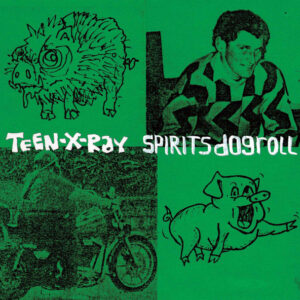
LP
TEEN-X-RAY
“Spirits Dogroll”
Edition limited to 300 copies.
A dogroll is a cheap giant sausage of bad meat to feed your pets. It’s a magic wand and it is a pizzle.
Teen-X-Ray came from Hamilton, NZ, which is known for agricultural innovation, frosts, fog and Taniwha in the Waikato river. Live cows with windows permanently inserted into their bodies for research live on the edge of town.
As Stefan ‘Smetal’ Neville recalls: “Glen Frenzy asked me to join his new ‘rock n roll’ band Teen-X-Ray at a ska concert at the Hillcrest Tavern in Hamilton in 1993. He had probably already recorded most of the first cassette ‘The Ballad Of Vince Neil’ using the karaoke sound on sound function of his flat-mates stereo. Then & now I would do anything Glen asked of me so I’ve been in X-Ray ever since”.
Glen also recruited Dusk, his girlfriend’s German Shepard who howled when she heard sirens. She would bite and claw at Casio keyboards. She didn’t share her dogroll. Teen-X-Ray recorded their music on cassette decks, performed on top of kitchen tables and released many tapes on the Plop, M60 and Stabbies And The Rocket labels.
Glen and Dusk got a reel-to-reel tape machine, moved to Upper Hutt and could make noise long into the night. Dusk got into Neil Young and killing mice while Glen got into home brewing beer and computers. Stefan Neville moved to Dunedin but Upper Hutt became his favorite holiday destination and each visit would result in new albums. Upper Hutt is known for its pig hunting and for producing NZ’s first Hip Hop group.
Spirits Dogroll was compiled from recordings from 1994-1996. Teen-X-Ray is still active today.
LP in full color sleeve issued in an edition of 300 copies.
19,50€
In stock
LP
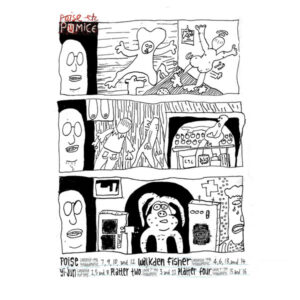
PUMICE
“Poise etc”
A collection of Pumice recordings from 1993-99 when teenagers Sugar Jon Arcus and Stefan Neville learned about music by doing it. The album covers the earliest days of the band recording on ghetto blasters with untuneable guitars at home in Whatawhata and Hamilton, NZ. There are a couple of recordings from their first public performance with drummer Ugly Dog Davies where their friends yelled at them relentlessly. There is material from the years living in Dunedin, NZ with cassette 4 track machines. Living cheaply in a cheap city with pet dogs and all the time in the world. Finally the album includes music from the move back north to Hamilton and Auckland. Material that was released in microscopic editions as lathe cut 7 inches and cassettes and the last times Jon participated in Pumice activities. The LP features trio, duo and solo recordings by both Jon and Stefan.
The basic multi-directional creative impulse that Pumice is known for today is there from the beginning. One chord pop songs, crumbling folk music and smeared organ sound sculptures. Small speakers shitting themselves with distortion and tape saturation. Acoustic guitars twanging and Stefan and Jon clearly learning to write songs of real quality. This music making manages to be bold, reckless and stupid, as well as delicate, sad and instinctive. Pumice has always done whatever the fuck it wants to.
Edition of 300 copies in silkscreened sleeve.
19,00€
In stock
LP
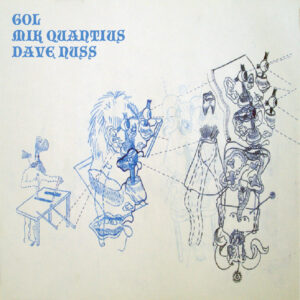
GOL – Mik QUANTIUS – Dave NUSS
“Bruxelles”
Drinking Belgian beer in a moisty cellar after an exhausting night might be the best situation to jump on the instruments that surround you and gig over and over again until you barely find the way to gather your legs together and improve the tricky exercise of wasted walking. This is what seems to have happened that frozen night of September 19th, 2009 when Dave Nuss (No Neck Blues Band, Sabbath Assembly) wrung from his Amolvacy concert and accompanied by mate Mik Quantius (Embryo) accepted GOL’s perverse invitation to pursue the darkness of Brussels abusing of the aforementioned liquid. Warped and deep bass lines support the disturbed vocalisms and spontaneous words of Mister Quantius shaped by a shamanistic percussive Nuss while the crispy electronics and whatsoever instruments by the french GOL combo reach out for a "blues" extravaganza that says it all with lyrics such as "I have sex on Christmas" or “Tomorrow maybe not”. Gollaboration No.5, recorded at 2 am by Yann Leguay. LP cover and insert with drawings by Mattia Denisse giving a hint of this twisted and skittish psychedelic must have. One-time pressing edition limited to 300 copies.
19,00€
In stock
LP
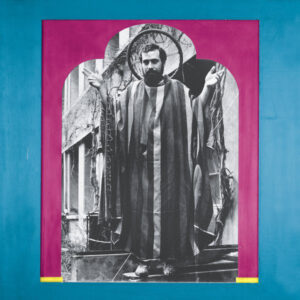
PAPIRO
“Teopatia”
The subtitle of this album describes it as “Messa in scena arcaica per strumenti elettronici e voci ingannevoli” - a play of words which could be translated as “Mass in an archaic scene (or archaic enactment) for electronic instruments and deceptive voices”. The italian graphic designer and musician Marco Papiro deliberately plays with different forms of religious music, and loosely oscillates between the spiritual and the illusory world, starting on the cover where we can see a self-portrait of his father disguised as a saint with a steering wheel in place of the halo. As for the voices, they are deceptive in a double sense... Not only because they seem to promise eternal bliss, but also because they are completely artificial, and have been masterfully created - like everything here - from scratch with an array of aged modular synthesizers. It’s the thin line between the human warmth and the eeriness of its simulation that makes up the fascination of the music on “Teopatia”, which by the way is the term used to describe an indirect divine contact. Though this record might be too odd to become a religious classic, it might very well help future generations understand the turmoil of an early 21st-century youth converting to synthesizers after growing up with catholicism. First pressing limited to 300 copies of which only the half are available for distribution outside Switzerland.
19,00€
Out of stock
LP
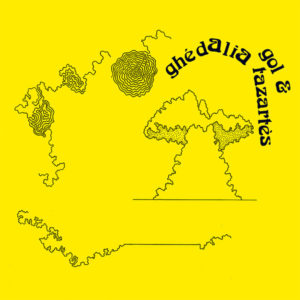
GOL – TAZARTES
“Alpes”
The sixth Gollaberration features a rather odd encounter indeed! It all happened when matchless vocalist Ghedalia Tazartes challenged GOL dada-style quartet. Ghedalia threw in the game his pan-africanasian singing techniques blending gypsy, jewish and trans-continental flavor. GOL exceeded on Electric Mandoline, Jew’s Harps, Percussions, Janotron, Flutes, Electric Guitar, Bass Guitar, Electronic Garage and Voice. Together with Ghedalia they developed into what became a "bal musette" for mentally disabled. Reaching at some points the sides of rock that doesn’t roll, this sonic attack jumps from topic to topic as a ritualistic anthology of unknown "ritournelles". Such a decadence was hardly contained in the neutral environment of the Swiss Cultural Center in Paris where the recording took place on Feb 22nd and 23rd, 2011. Tired liver resonances accurately rendered by the acid yellow cover created by Dennis Tyfus of Ultra Eczema. A mountain peaks journey below the very heart of no-where Europe to be consumed gently without skis on. One-time pressing edition limited to 400 copies.
20,00€
In stock
LP
THEE IDEAL GUS
“99”
Thee Ideal Gus began in Hamilton, New Zealand in the early 90’s and sprung from the same gene pool and time as Armpit, Gfrenzy and Pumice. Its participants include Sugar Jon Arcus, Clayton Noone, Indira Neville, Kaatarama “Motty” Morehu, Stefan Neville, Witcyst, Dan “Eemonk” Powell and Rachel Garbott but membership has never been settled or defined. The band have released numerous cassettes and lathe cut records on cult labels such as Plop, Root Don Lonie For Cash, Extemporaneous and Stabbies And The Rocket Recordings.
Thee Ideal Gus love double barrelled year numbers so during the year 1999 daily recordings were conducted in Whangarei and Wellsford in the far north of New Zealand, and Dunedin in the far south. Diaries were kept, artwork was assembled and tapes were posted up and down the country. The resulting material was released in an edition of 20 lathe cut 2 LP’s as “1999” by Stabbies And The Rocket Recordings.
This “99” LP is a selection of material compiled from that ridiculous obscurity by Clayton Noone & Stefan Neville. The music Thee Ideal Gus made that year documented the days as they happened. It charted weather patterns, prophesized the future and celebrated team sports. Eddie Murphy and Yoko Ono are held in equal high regard. Nude drunk partying and the New Zealand general election of 1999 are all there in this record where a rusted clothes line is played alongside a primary school xylophone, sampled techno records and ukulele through a heavy metal pedal. It is mundane and marvelous.
Edition of 200 copies in very elaborate packaging, including prints on acetate, xerox inserts and several hand-drawn original artworks.
19,00€
In stock
LP
ARMPIT
“Leisure & The Elderly”
Edition limited to 300 copies.
As reported by Stefan Neville…
Clayton “CJA” Noone and Jon “Sugar Jon” Arcus are some of my oldest and dearest friends. I’ve been listening to their band Armpit pouring out infinite sweat and toe jams for 20+ years and I still can’t work out what Armpit even is. They are the wrongest band I’ve ever heard.
We were all part of the same gang in early 1990s Hamilton, New Zealand. Armpit would always happen in rooms next door. They would keep me awake with the eternal strumming of bad guitars through bad equipment, bottles falling over, people falling over, things catching fire and always lots of giggling. I saw them play at a party once where they were too wasted to plug in their guitar pedals. They wrestled with them giggling for about ten minutes and then gave up. They didn’t make a sound but it’s one of the greatest concerts I’ve ever seen.
Their recordings are always confusing. They display their deepest awful humanity and their sweet sweet heart’s all in the same mouthful. Scorched hateful noise, incompetent absurdity, smoochy crooning folk songs with poignant words & brutal sausage fingered editing to highlight the horror and hilarity.
“Leisure & The Elderly“ was recorded in Dunedin in the mid 1990’s. Jon was doing a Nursing foundation course and learnt to simulate giving a skinhead a sponge bath. A classmate gave him some of her tortured poetry so Armpit blended it with a Nursing textbook and disappeared into the room next door to record the album in one go ping ponging recordings with two tapedecks.
It was originally released on cassette in an edition of just 3 copies.
Edition limited to 300 copies in silkscreened sleeve.
19,50€
In stock
LP
WITCYST
“Soibiast Anti-Culler”
Edition limited to 300 copies
Recorded in 1995 by the winterless north of New Zealand’s Witcyst. Another monolithic skid mark serving of crackers plucked from the man’s vast lifetime archive of sound making and beard.
Witcyst makes his music with oceans of constant daily mutation. Machines get used upside down and back to front and inside out. Layers of string, tin foil and expired medicine are saved up to dazzle the eye. Parcels in the post come and go full of nostril hair and pamphlets and wool. What would that sound like through a funnel and a heavy metal pedal? Is the room shrinking? One knock for yes. Two for no.
This audio is severely distressed and swollen. It is particularly buried and murky and howling here. Are they voices or organs? Meat or musical instruments? Is that a drum solo or decades of tape degradation? Are the hums musical or malfunction? It starts to sound like it was recorded inside your brain and has always been there. I wonder if it means us any harm? And then it starts to sound like a basket full of wise puppies.
“Soibiast Anti-Culler” is one of the most relevant works among at least a thousand albums Witcyst has originally released on cassettes and CDR’s on his own Extemporaneous and Lifespace labels since the early 1990s.
Edition limited to 300 copies in silkscreened sleeve.
19,50€
In stock
LP
MENSTRUATION SISTERS
“Glass walking”
Pica Disk is proud to release “Glass Walking” - an LP of recently unearthed recordings by the infamous Australian noise band Menstruation Sisters.
Over the years the Menstruation Sisters have through a selective, but incredibly varied output of albums steadily built a reputation among music fans as a unique band. It was never a secret who the members of Menstruation Sisters were, yet the band’s aura was shrouded in mystery and confusion, possibly because they would completely reinvent themselves with every new recorded statement. As a fan of the Menstruation Sisters you had to abandon everything you knew with each new piece of the puzzle.
And now we can go back to the beginning, the birth of the Sisters, as by pure luck early previously unreleased material from 1995 was recently discovered in the vaults in Perth’s Endless Studios archives. On these recordings the band was the duo of Oren Ambarchi and Nik Kamvissis, but with producer Anthony Maher assisting and performing on some tracks. Ambarchi and Kamvissis would continue as a duo until Brendan Walls joined in 2001
The material heard on “Glass Walking” has a different flavor to the albums that would follow. Fans will immediately be struck by the almost total absence of drums and guitars, as the music on “Glass Walking” is built around electronics and vocals. This makes the music feel more immediate, urgent and desperate. Tracks like “Give Blood” and “Don’t Fuck” reveals the missing link between Hanatarash, Maurizio Bianchi and the monkeys in the Evolution Revolution band. This is noise music history in reverse.
The album also contains the first Menstruation Sisters live concert, which documents that the band’s ferocious performance antics were also fully developed from the very first time they set foot on stage. This is the complete set, all glorious 9 minutes and 35 seconds of it.
“Glass Walking” will only be available on vinyl and comes with liner notes and archival photos that explains everything.
14,00€