
In stock

LP
COMPILATION
“Miao Mouthorgans & Other Rare Instruments In Guizhou, Sichuan, China”
"The term 'Miao' is a very ancient Chinese misleading pseudo-ethnic categorization, the Hmong in western languages, a term recognized by colonial French Indochina. Miao became a generic term which does not reveal the diversity of 38 subgroups or 9 million people, mostly in Southern China Guizhou Province. China, since having moved towards the market economy, now includes a large number of minority regions that are marketed a commodity available only to them: their ethnicity itself. Ethnic tourism has developed in a big way in China since the 1990s, for both Chinese and foreign tourists, and it is often promoted as the way to generate income in those areas for development. I usually stay away from Ethnotouristic shows and try to get music that is not a commodity! I was based in Dali, Yunnan, China between 2006 and 2013." --Laurent Jeanneau
Recorded by Laurent Jeanneau and Shi Tanding. Notes By Laurent Jeanneau. "Miao Three Mouthorgans In Guizhou China" features three men each using a different size lushen or gué and four women each blowing in a different mantong. Recorded in Paisha village. "Hua Miao Wedding Dance In Sichuan China" features an instrument called the lushen, the predominant kind of mouth organ being used for entertainment. "Hmoob Dongliang In Guizhou China" was recorded in Biasha village, composed of two reeds instruments and male and female singers, intended as love songs. "Hua Miao Hulushen In Sichuan China" was performed by one man. The main music instrument is the small mouth organ, hulushen, the predominant mouth organ used for entertainment, where the long tubes lushen is mounted on a wooden resonance box. "Hmoob Mouthorgans In Guizhou China" was recorded in Biasha village, and features a Miao (they call themselves Hmoob). This is part of musical demonstration for tourists. Armed with heavy cameras, six men using six lushen of various sizes. "Gelao Gupiaoqin In Guizhou China" was recorded in Songlong village, where people identify themselves not as Miao but as Gelao, using a very rare string instrument called the Gupiaoqin. "Gelao Canon Singing In Guizhou China" features two old ladies performing canon singing in Songlong village. "Shui Miao Travelling Song Guizhou China" features the Shui Miao (water Miao), a sub group of the Miaos of Guizhou, based in the Shidong area outside of Kali in Guizhou.
17,00€
In stock

2 LP
DEDALUS ENSEMBLE – Philip GLASS
“Music with Changing Parts”
Founding work of minimalism, Music with Changing Parts is a piece with free instrumentation. The musicians choose which part to play among the eight staves of the score. At each indicated cue, the musicians can change part, which produces an abrupt change of instrumentation. While the music is based on a melodic material limited to a few notes that are repeated in patterns that expand or contract, the changes in orchestration refresh the listening experience by producing sonic contrasts. These techniques at work in Music with Changing Parts, written in 1970, will lead Philip Glass to renew his language and move from the monochromatic works that precede it to more dramatic works such as music in 12 parts and especially the opera Einstein on the Beach. When Philip Glass began rehearsing the piece, he was surprised to hear long notes when everything was written in eighth notes. After making sure that none of the musicians were playing held notes, he realized that the fact that the same notes were played by all the instruments in the ensemble produced, through a psycho-acoustic effect, a harmonic substrate of resonant frequencies. He then decided to add to the score the possibility of playing long notes to reinforce this effect. "For this recording, we chose to record first the eighth notes, then the long notes in re-recording. This utopian version, with each musician playing short and long notes at the same time (!), illustrates the minimalist aesthetic that plays with our perception and allows us to reconcile opposites and cultivate the apparent paradox of a music that moves forward without Moving and changes constantly while remaining the same." --Dedalus Ensemble
20,00€
Out of stock
CD
DEDALUS ENSEMBLE – Philip GLASS
“Music with Changing Parts”
Founding work of minimalism, Music with Changing Parts is a piece with free instrumentation. The musicians choose which part to play among the eight staves of the score. At each indicated cue, the musicians can change part, which produces an abrupt change of instrumentation. While the music is based on a melodic material limited to a few notes that are repeated in patterns that expand or contract, the changes in orchestration refresh the listening experience by producing sonic contrasts. These techniques at work in Music with Changing Parts, written in 1970, will lead Philip Glass to renew his language and move from the monochromatic works that precede it to more dramatic works such as music in 12 parts and especially the opera Einstein on the Beach. When Philip Glass began rehearsing the piece, he was surprised to hear long notes when everything was written in eighth notes. After making sure that none of the musicians were playing held notes, he realized that the fact that the same notes were played by all the instruments in the ensemble produced, through a psycho-acoustic effect, a harmonic substrate of resonant frequencies. He then decided to add to the score the possibility of playing long notes to reinforce this effect. "For this recording, we chose to record first the eighth notes, then the long notes in re-recording. This utopian version, with each musician playing short and long notes at the same time (!), illustrates the minimalist aesthetic that plays with our perception and allows us to reconcile opposites and cultivate the apparent paradox of a music that moves forward without Moving and changes constantly while remaining the same." --Dedalus Ensemble
13,50€
In stock

LP
Ahmed ESSYAD
“Moroccan Electroacoustic Music 1972-74”
Composer Ahmed Essyad was born in Salé, Morocco, in 1938. After studying music at the Rabat Conservatoire (Morocco) he moved to Paris in 1962, where he became a student of Max Deutsch and, later, his assistant. Trained in the avant-garde practices of Western musical composition, he also claimed the Amazigh folk music of Morocco as a fundamental source of inspiration for his work. In 1965, he was already incorporating elements of oral tradition in his work so as to question the language of his time, and therefore had to cope with the limits of musical notation and communication with musicians who did not share his cultural references. It was difficult to agree on what was implicit, "behind the notes," especially regarding the management of musical time and micro-intervals. In search of new compositional tools, he turned to electro-acoustic music. Working in a studio made it possible for him to be the interpreter of his own work, which ensured a certain continuity with music of oral tradition. The pieces presented here were produced between 1972 and 1974 in a studio dedicated to electro-acoustic music, the S.M.E.C.A, which was part of the Music Workshop founded by Jorge Arriagada in Paris. The studio was equipped with EMS and Minimoog synthesizers, a piano, a marimba, a xylophone, as well as various percussion instruments and a tape delay system. The practice of electro-acoustics may have been a mere parenthesis in Ahmed Essyad's long and prolific career as a composer of contemporary music, but the works presented here are nonetheless important. They show how strongly he both supported North African popular forms of expression and opposed its folklorizing through simplistic and "exotic" representations. It's not about fusing together East and West -- impossible, he says: "the real point is to open up an imaginary space where another modernity can exist outside the largely Eurocentric framework of avant-garde music. Synthesis means anticipation, knowledge. As for me, I'm increasingly ignorant. I write to discover what I don't know. Music feeds me, it pollinates me. It's my daily wine."
17,00€
In stock
CD
Ahmed ESSYAD
“Moroccan Electroacoustic Music 1972-74”
Composer Ahmed Essyad was born in Salé, Morocco, in 1938. After studying music at the Rabat Conservatoire (Morocco) he moved to Paris in 1962, where he became a student of Max Deutsch and, later, his assistant. Trained in the avant-garde practices of Western musical composition, he also claimed the Amazigh folk music of Morocco as a fundamental source of inspiration for his work. In 1965, he was already incorporating elements of oral tradition in his work so as to question the language of his time, and therefore had to cope with the limits of musical notation and communication with musicians who did not share his cultural references. It was difficult to agree on what was implicit, "behind the notes," especially regarding the management of musical time and micro-intervals. In search of new compositional tools, he turned to electro-acoustic music. Working in a studio made it possible for him to be the interpreter of his own work, which ensured a certain continuity with music of oral tradition. The pieces presented here were produced between 1972 and 1974 in a studio dedicated to electro-acoustic music, the S.M.E.C.A, which was part of the Music Workshop founded by Jorge Arriagada in Paris. The studio was equipped with EMS and Minimoog synthesizers, a piano, a marimba, a xylophone, as well as various percussion instruments and a tape delay system. The practice of electro-acoustics may have been a mere parenthesis in Ahmed Essyad's long and prolific career as a composer of contemporary music, but the works presented here are nonetheless important. They show how strongly he both supported North African popular forms of expression and opposed its folklorizing through simplistic and "exotic" representations. It's not about fusing together East and West -- impossible, he says: "the real point is to open up an imaginary space where another modernity can exist outside the largely Eurocentric framework of avant-garde music. Synthesis means anticipation, knowledge. As for me, I'm increasingly ignorant. I write to discover what I don't know. Music feeds me, it pollinates me. It's my daily wine."
13,50€
In stock

2 CD
Marc NAMBLARD
“L’autre rive”
14-track album + 15-track bonus album
20-page booklet with translations of Wayãpi songs and dialogues into French / Booklet also available in English
At the end of 2023, Marc Namblard set out to record sounds in French Guiana for the purposes of a documentary film. Through a series of circumstances, he found himself in Bas-Oyapock with director Kevin Brunet to meet Sara and Saraka, a couple of Wayãpi originally from Brazil. They both shared the lives of their hosts for two weeks, engaging in traditional activities (preparing cachiri and cassava, maintaining the garden, singing, dancing...) along with «troubling» experiences and daily gestures...
From this stay, The Other Bank was born, a sound piece where the forest, the river, and both human and non-human voices intertwine and merge, inseparable, without any hierarchy, while simultaneously offering a testimony of a relationship with the world on the brink of vanishing...
17,00€
Out of stock

CD
Marc NAMBLARD
“Arctic Summer”
2025 was declared the International Year of Glaciers’ Preservation by the United Nations, accompanied by the proclamation of March 21st of each year as the World Day for Glaciers starting this year. As they put it, “this is an opportunity to raise global awareness about the critical role of glaciers, snow and ice in the climate system and the hydrological cycle, and the economic, social and environmental impacts of the impending changes in the Earth’s cryosphere.” To celebrate this decision forms of minutiae presents a series of albums dedicated to glaciers and the acoustic multiplicity of the ice with field recording works by Marc Namblard, Ludwig Berger, Yoichi Kamimura, Pablo Diserens, and Cheryl E. Leonard.
Sprinkled throughout the year, the series launches on World Day of Glaciers with the album arctic summer, a journey across the sonic ecologies of Iceland and Svalbard, by wildlife sound recordist and nature guide Marc Namblard.
Arctic summer and its 12 tracks form a long continuous piece which unfolds in a documentary fashion. Here, Namblard’s pristine recordings invite listeners into the estival effervescence of the two polar islands. Scenes follow one another in a delicate but bustling volcanic, animal, and glacial tapestry, whose dimensions materialize through the artist’s play on perspective and space. This meticulous composition enables us to eavesdrop both on the vastness and the minute of the cryosphere and the life it fosters. Birds and mammals cadence the album with distinct acoustic behaviors. The air is filled with puffin wing flutters, arctic tern shrills, golden plover sharp pings, kittiwake nasal cries, and the uncanny winnowing sound of common spines. Below, an arctic fox calls in the twilight, a whale spouts off the coast, and walruses growl, grunt, and exhale like washed up steaming engines. Yet these animal voices aren’t sounding alone. They are enveloped by the voices of geologies. Pebble-laden tides lead us to the beating volcanic heart that lies beneath the ground. Geothermal mud pools bubble in viscous drummings, while sulphur vents whistle in perpetual sighs. There are whispers in the slurry. The scorched soil swells. The Earth sizzles. Geyser!
This scalding soundscape gradually evaporates into the heat of summer, bringing about the melting of the ice. In doing so, the ice shares a splendid variety both in form and sound. Glaciers crash in thundering calvings, icebergs drift in fizzling growls, while the moraine trickles in curtains of drops. The landscape thaws and leaks. The glaciers thin. The Earth oozes.
This melting pot of arctic bioacoustics weaves into an imaginary sound walk across the tundra, making Namblard’s profound affection for the environment palpable. His uncompromising delicacy is an invitation to listen to the cryosphere in order to better understand and nurture it. A cinema for the ears, arctic summer is a time capsule that maps the fragile soundscapes and ecosystems of a changing world.
12,00€
In stock

CD
Marc NAMBLARD
“Brames”
Brames brings together a series of recordings on the theme of the bellowing of the red deer, collected in different forest areas of France (in the Vosges, Loiret and Lozère) between 2011 and 2023.
12,00€
In stock

2 LP
SISSY SPACEK
“Entrance”
Entering its 26th year of activity, the morphing, Los Angeles based experimental outfit, Sissy Spacek, joins Shelter Press with Entrance, among the project’s most captivating outings to date. Encountering the duo of John Wiese and Charlie Mumma joined in various configurations by an incredible cast of collaborators - Tim Barnes, Marco Fusinato, Aaron Hemphill, Brad Laner, Katsura Mouri, Ralf Wehowsky, and C Spencer Yeh - collectively transformed into a series a deeply intimate and delicate gestures of musique concrète, Entrance radically repositions the possibilities presented by group improvisation outside of time and place.
Founded at the end of the last millennium, the Los Angeles based project, Sissy Spacek, initially emerged from the knotted, fiery context 1990s American noise and grindcore, producing sheets of visceral sonority that quickly set the scene on its head. Going through numerous evolutions, before eventually settling as a duo of John Wiese and Charlie Mumma - joined by a rotating and often recurring cast collaborators - over the last 25 years the band has continuously entered states of evolution that have defied the expectations of its own context, seeding the sonic extremes noise with subtle and sophisticated approaches to free improvisation and musique concrète.
Fiercely positioning its efforts within the outer reaches of contemporary experimental music, while resisting the constraints of a singular sound or proximity, Wiese regards Sissy Spacek as being primarily centred around the practice of musique concrète and the pursuit of extremes. From its earliest releases - collage treatments of material gathered from the band’s full throttle practice sessions - the project’s conceptual framework has continuously evolved within a deeply engaged process of experimentation, not only reworking tactical approaches, but also definitions and perception regarding the location and action of their work. In recent years, this has led to an increasingly varied and diverse output. Percolating within, is a thread marked by a striking sense of delicacy and intimacy, driving forward while doubling as an unexpected challenge, in real time, to perceptions connected to the band’s past. Entrance is the most recent of these.
Embarking upon the four compositions that comprise the finalized four sides of Entrance, Wiese and Mumma enlisted longstanding collaborators, Tim Barnes, Marco Fusinato, Aaron Hemphill, Brad Laner, Katsura Mouri, and C Spencer Yeh, as well as new initiate, Ralf Wehowsky (of the seminal German electronic noise collective P16.D4), requesting a contribution of sounds from each, determined by a general set guidelines that dictated certain qualities the given sonorities, while allowing for the expression of each player’s distinct creative voice. The sets of resulting recordings were then chopped, harvested, manipulated, and reassembled as the four tape compositions that make up the album - Web Of Unfolding Appearance, Figure Of Reflected Light, Trancher And The Inheritors, True Dimension (From The Opaque - Spike) - each blurring the lines of authorship and clear creative proximity in remarkable ways.
Where historical gestures of musique concrète tend to draw upon non-instrumental sound sources - regarding its sonorous material as raw elements, unburdened by inherent meaning or association, to be transformed and imbued with musicality - Sissy Spacek turns this position on its head. Entrance comprises works of musique concrète that not only draw upon instrumental sound sources, with all their possible meanings or associations, but also individual characters and personalities of their players, crediting each resulting piece to its respective configuration of contributors.
As such, Entrance is an effort of sound collage defined by a rare sense of intimacy and humanity: four pieces that often take on the resemblance of group improvisation, but have, in fact, been assembled outside of time and place. Bent under the ever-present hand of Wiese’s tape treatments and manipulation, each of the album’s four compositions unfurl startling states of sonic abstraction and percolating texture, marked by a striking sense of hard-shifting structure, that culminate as tense, driven manifestations of ambient music: scrapes, squeals, rattles feedback, rolling drums, bouncing tones, whispers, bent electronics, electric artefacts, and seemingly everything else under the sun, configured into immersive, sublime mediations in sound from the most improbable events.
33,00€
In stock
CD
SISSY SPACEK
“Entrance”
Entering its 26th year of activity, the morphing, Los Angeles based experimental outfit, Sissy Spacek, joins Shelter Press with Entrance, among the project’s most captivating outings to date. Encountering the duo of John Wiese and Charlie Mumma joined in various configurations by an incredible cast of collaborators - Tim Barnes, Marco Fusinato, Aaron Hemphill, Brad Laner, Katsura Mouri, Ralf Wehowsky, and C Spencer Yeh - collectively transformed into a series a deeply intimate and delicate gestures of musique concrète, Entrance radically repositions the possibilities presented by group improvisation outside of time and place.
Founded at the end of the last millennium, the Los Angeles based project, Sissy Spacek, initially emerged from the knotted, fiery context 1990s American noise and grindcore, producing sheets of visceral sonority that quickly set the scene on its head. Going through numerous evolutions, before eventually settling as a duo of John Wiese and Charlie Mumma - joined by a rotating and often recurring cast collaborators - over the last 25 years the band has continuously entered states of evolution that have defied the expectations of its own context, seeding the sonic extremes noise with subtle and sophisticated approaches to free improvisation and musique concrète.
Fiercely positioning its efforts within the outer reaches of contemporary experimental music, while resisting the constraints of a singular sound or proximity, Wiese regards Sissy Spacek as being primarily centred around the practice of musique concrète and the pursuit of extremes. From its earliest releases - collage treatments of material gathered from the band’s full throttle practice sessions - the project’s conceptual framework has continuously evolved within a deeply engaged process of experimentation, not only reworking tactical approaches, but also definitions and perception regarding the location and action of their work. In recent years, this has led to an increasingly varied and diverse output. Percolating within, is a thread marked by a striking sense of delicacy and intimacy, driving forward while doubling as an unexpected challenge, in real time, to perceptions connected to the band’s past. Entrance is the most recent of these.
Embarking upon the four compositions that comprise the finalized four sides of Entrance, Wiese and Mumma enlisted longstanding collaborators, Tim Barnes, Marco Fusinato, Aaron Hemphill, Brad Laner, Katsura Mouri, and C Spencer Yeh, as well as new initiate, Ralf Wehowsky (of the seminal German electronic noise collective P16.D4), requesting a contribution of sounds from each, determined by a general set guidelines that dictated certain qualities the given sonorities, while allowing for the expression of each player’s distinct creative voice. The sets of resulting recordings were then chopped, harvested, manipulated, and reassembled as the four tape compositions that make up the album - Web Of Unfolding Appearance, Figure Of Reflected Light, Trancher And The Inheritors, True Dimension (From The Opaque - Spike) - each blurring the lines of authorship and clear creative proximity in remarkable ways.
Where historical gestures of musique concrète tend to draw upon non-instrumental sound sources - regarding its sonorous material as raw elements, unburdened by inherent meaning or association, to be transformed and imbued with musicality - Sissy Spacek turns this position on its head. Entrance comprises works of musique concrète that not only draw upon instrumental sound sources, with all their possible meanings or associations, but also individual characters and personalities of their players, crediting each resulting piece to its respective configuration of contributors.
As such, Entrance is an effort of sound collage defined by a rare sense of intimacy and humanity: four pieces that often take on the resemblance of group improvisation, but have, in fact, been assembled outside of time and place. Bent under the ever-present hand of Wiese’s tape treatments and manipulation, each of the album’s four compositions unfurl startling states of sonic abstraction and percolating texture, marked by a striking sense of hard-shifting structure, that culminate as tense, driven manifestations of ambient music: scrapes, squeals, rattles feedback, rolling drums, bouncing tones, whispers, bent electronics, electric artefacts, and seemingly everything else under the sun, configured into immersive, sublime mediations in sound from the most improbable events.
17,00€

CD
Jean-Claude ELOY
“Faisceaux-Diffractions – Macles – Boucle et Séquence”
A series of instrumental pieces documenting the years before the switch to the long electroacoustic compositions more characteristic of the composer.
Faisceaux-Diffractions
(1970) for 28 instrumentalists including a Hammond organ, and two electric guitars.
Recording of the world premiere, on October 30, 1970, in Washington D.C. (USA) by the New York Contemporary Chamber Ensemble.
"The instrumental ensemble is subdivided into three strongly isomorphic orchestras, allowing the treatment in the space of similar musical structures. This tone-color isomorphism allows sometimes to leave "floating" the synchronization between the three orchestras, the conductor being able to combine the "tiling" of the orchestras, following a large number of possibilities, but within strictly defined temporal proportions."
Macles (1966 - short version)
extracts of the music of the film La Religieuse (The Nun) by Jacques Rivette
For various groups of instruments including a solo Zarb and a Cymbalum.
Ensemble Musique Vivante under the conducting of Boris de Vinogradov. Zarb solo played by Jean-Pierre Drouet.
"At the time of the realization of this work, in 1966, I was a teacher at the University of Berkeley, and I was trying to find a theory to unify the modal music (repetitive, with uses of fixed harmonic fields and use of notes poles, etc.) to atonal chromatic music, serial or not (variational, fluctuating, ornamented, etc.): this by directly organizing the structural blocks, and not by deducing them from a serie."
Loop and Sequence (1968) for 19 instrumentalists
Very short musical sequences for the film l'Amour fou (Mad love) by Jacques Rivette.
"These two very short musics were written in 1968 at the request of Jacques Rivette for his film l'Amour Fou (Mad love), which he was shooting (Sequence is the music of the very last scene of the film - in its oriiginal version - when Jean-Pierre Kalfon leaves walkking alone in the streets of Paris...). In hindsight, they constitute a sort of "premonition" of the writing and aesthetics, which will then be affirmed, in 1970 and 1971, with Faisceaux-Diffractions and Kâmakalâ (use of repetitive loops; mass heterophony; intervals filled in active aggregates; etc.)."
13,00€
In stock

LP
Chris ABRAHAMS – Oren AMBARCHI – Robbie AVENAIM
“Placelessness”
Following nearly 20 years of working together as a trio, and numerous cross-collaborations in different configuration between them, Ideologic Organ presents Placelessness, the debut full-length by Chris Abrahams, Oren Ambarchi, and Robbie Avenaim, comprising two long-form works at juncture of ambient music, minimalism, rigorous experimentalism and improvisation, and machine music.
Having carved distinct pathways across a diverse number of musical idioms for decades, Chris Abrahams, Oren Ambarchi, and Robbie Avenaim are each, respectively, among the most noteworthy and groundbreaking figures to have emerged from Australia’s thriving experimental music scene. Ambarchi and Avenaim first encountered Abrahams when seeing the Necks - the project that has served as the primary vehicle for his singular approach to the piano since its founding in 1987 - together during the late 1980s, not long after having met in Sydney’s underground music community. The pair’s collaborations date back more than 35 years, criss-crossing Ambarchi’s pioneering solo and ensemble work for guitar and Avenaim’s visionary efforts for SARPS (Semi Automated Robotic Percussion System), robotic and kinetic extensions to his drum kit.
In 2004, fate brought the three together in a trio performance at the What Is Music? Festival, the annual touring showcase of experimental music founded and run by Ambarchi and Avenaim between 1994-2012. For the nearly two decades since, Abrahams, Ambarchi, and Avenaim have intermittently reformed in exclusively live contexts, in Australia and abroad, cultivating and refining the fertile ground first tilled in that early meeting. Placelessness is the first album to present this remarkable trio’s efforts in recorded form.
Placelessness is the joining of three highly individualised streams, working in perfect harmony; the point at which friendship, mutual respect, and decades of creative exploration produce a singular spectrum of sound. Featuring Abrahams on piano, Ambarchi on guitar, and Avenaim on drums, the album’s two sides draw on each artist’s enduring dedication to long-form composition. Its two pieces, Placelessness I and Placelessness II, initially began as a single, 40 minute work, before being divided and reworked into distinct, complimentary gestures for the corresponding sides of the LP.
Beginning with restrained clusters of reverberant piano tones, Placelessness I progresses at an almost glacial pace, with Abrahams’ interventions increasing met by sparse responses, darting within vast ambiences, on guitar and percussion by Ambarchi and Avenaim. Remarkably conversational within its convergences of tonal, rhythmic, and textural abstraction, over the work’s duration a progressive sense of tension unfurls and contracts, refusing release, as each of the ensemble’s members contribute to an increasingly tangled sense of density at its resolve.
While an entirely autonomous work, Placelessness II rapidly realises a distillation of the energy hinted at across the length of its predecessor. Following a luring passage of harmonious calm, Abrahams’ launches into shimmering lines of repeating arpeggios, complimented at each escalation of tempo by Avenaim’s machine gun fire percussion work and Ambarchi’s masterful delivery of tonality and texture, as the trio collectively generate dense sheets of pointillistic ambience within which individual identity is almost lost, before slowly unspooling into unexpected abstractions and dissonances that deftly intervene with the work’s inner logic and calm.
What could easily be termed a maximalist take on Minimalism, Placelessness is a masterstroke of contemporary, real time composition, that blurs the boundaries between ambient music, experimentalism, free improvisation, and machine music. Drawing on Chris Abrahams, Oren Ambarchi, and Robbie Avenaim’s decades of respective solo and collaborative practice, and the culmination of nearly twenty years of working together as a trio, it’s two durational pieces - Placelessness I and Placelessness II - take form with a startling sense of effortlessness and grace, neither shying away from explicit beauty or rigorously tension within their forms.
29,50€
In stock

CD
MERZBOW
“Red Magnesia Pink”
First released by Extreme in the massive, infamous 'Merzbox,' "Red Magnesia Pink" is extracted and recontextualized as a standalone release for the first time. Recorded in 1995, "Red Magnesia Pink" sees Merzbow in peak form. A psychedelic whirlwind of synthetic transmissions; harsh, wet, screeching sounds that could only be produced by Masami Akita. Featuring two previously unreleased bonus tracks from the same era.
15,00€
In stock

2 LP
Kali MALONE
“The Sacrificial Code (2025 edition)”
Kali Malone’s landmark album The Sacrificial Code emerged from a momentous confluence of dedication and inspiration. In 2019, Malone was finishing a master's thesis in electroacoustic composition at The Royal College of Music in Stockholm, having spent several years studying how sound and space interact, both academically and as a part of Sweden’s underground music community. An apprenticeship with the organ tuner Jan Börjeson opened up the instrument’s history as a laboratory for the development of various tuning systems, resonating with her interest in the sublime, uncanny soundworlds that exist beyond equal temperament. Countless hours were spent imagining new ways to conceptualize archaic compositional forms like canons, embracing their limitations as a way to peel away dramatic flourishes so only a stark core remains. A vision of music began to crystalize that was instilled with koan-like dualities of restraint and spectacle, stasis and variation, intimacy and grandeur.
Six years after its initial release, Ideologic Organ has reissued The Sacrificial Code, adorned with striking archival organ photography by Malone and including a new arrangement of the titular composition recorded in 2023 on the 16th-century meantone organ at Malmö Konstmuseum. The album remains one of the defining works of 21st-century minimalism, singular in its approach and impact. Its legacy has been defined by the revelatory experiences of those who encountered it, passed from listener to listener by word of mouth. The intensely personal experience of taking in these sounds, sitting with them for over an hour, absorbing each chordal shift in countless repetitions and finding oneself within them, became the driver of its slow cultural saturation. As she began regularly performing these pieces in churches and concert halls around the world, their impact deepened.
To produce the reissue, Malone went so far as to return to the copy machine at the legendary EMS studios in Stockholm to lay out the typography, revisiting the physical spaces in which it was created and remaining faithful to its DIY roots. The album’s first three pieces - “Spectacle of Ritual,” “Sacrificial Code,” and “Rose Wreath Crown (for CW)” - were captured voice by voice, each in single takes, on the Mats Arvidsson organ in Kirnberger III temperament as a part of her thesis. They were realized in isolation, and were originally presented as electroacoustic works on multi-channel speaker arrays in acousmoniums, speaker domes, and an abandoned iron mine. “Sacer Profanare,” “Litanic Cloth Wrung,” and “Fifth Worship II” were all recorded within two-hours of borrowed studio time on the Woehl organ at Studio Acusticum in Piteå; their patient and deliberate nature cutting through the hasty timeline of their capture. With each, Malone was developing and deploying self-taught close micing techniques to reproduce the most granular, air-filled sound of the instrument, bringing the listener into its stoically heaving guts.
The effect of all this careful work is a sense of time dilation, the physicality of the sound itself - the thunderous rolls of bass, the pitched hiss of the flue, the quivering dance of air molecules animated by dissonance - drawing attention away from the clock. Each piece cycles through purposefully constructed chord progressions, the repetition creating moments that can feel anthemic or mournful depending on the harmonic resonance and duration of the piece. These reiterations become so steady and expected that at the end of “Fifth Worship II,” when Malone switches off the organ mid-stream and the harmonics wither and fall, it feels like the ground slips away from under us. Repetition becomes the magnetic force shaping and stabilizing space and time.
Recurrence has also been a hallmark of Malone’s work on a larger scale, as evidenced by the third, new iteration of “Sacrificial Code” included on this reissue. She frequently returns to compositions, including multiple versions across various releases (“Fifth Worship” was originally heard on Organ Dirges 2016-2017, an experimental precursor to The Sacrificial Code), and they often change as they are performed over successive years and on different organs. Recorded five years after the two versions originally included on the album, “Sacrificial Code III” is absent the sense of sorrowful gravity heard in the previous versions, replaced by a sense of relative tranquility and performed in a higher register - an expressive shift that naturally occurred through years of repeated live performances. As The Sacrificial Code resurfaces, it retains its power but feels rejuvenated in this new context, inevitably changed by the years between then and now. Like any highly personal work, how those changes manifest depend on the listener, how they meet the sounds, and how those years have changed them in return.
–Jonathan Williger, February 2025
37,00€
In stock
CD
Kali MALONE
“The Sacrificial Code (2025 edition)”
Kali Malone’s landmark album The Sacrificial Code emerged from a momentous confluence of dedication and inspiration. In 2019, Malone was finishing a master's thesis in electroacoustic composition at The Royal College of Music in Stockholm, having spent several years studying how sound and space interact, both academically and as a part of Sweden’s underground music community. An apprenticeship with the organ tuner Jan Börjeson opened up the instrument’s history as a laboratory for the development of various tuning systems, resonating with her interest in the sublime, uncanny soundworlds that exist beyond equal temperament. Countless hours were spent imagining new ways to conceptualize archaic compositional forms like canons, embracing their limitations as a way to peel away dramatic flourishes so only a stark core remains. A vision of music began to crystalize that was instilled with koan-like dualities of restraint and spectacle, stasis and variation, intimacy and grandeur.
Six years after its initial release, Ideologic Organ has reissued The Sacrificial Code, adorned with striking archival organ photography by Malone and including a new arrangement of the titular composition recorded in 2023 on the 16th-century meantone organ at Malmö Konstmuseum. The album remains one of the defining works of 21st-century minimalism, singular in its approach and impact. Its legacy has been defined by the revelatory experiences of those who encountered it, passed from listener to listener by word of mouth. The intensely personal experience of taking in these sounds, sitting with them for over an hour, absorbing each chordal shift in countless repetitions and finding oneself within them, became the driver of its slow cultural saturation. As she began regularly performing these pieces in churches and concert halls around the world, their impact deepened.
To produce the reissue, Malone went so far as to return to the copy machine at the legendary EMS studios in Stockholm to lay out the typography, revisiting the physical spaces in which it was created and remaining faithful to its DIY roots. The album’s first three pieces - “Spectacle of Ritual,” “Sacrificial Code,” and “Rose Wreath Crown (for CW)” - were captured voice by voice, each in single takes, on the Mats Arvidsson organ in Kirnberger III temperament as a part of her thesis. They were realized in isolation, and were originally presented as electroacoustic works on multi-channel speaker arrays in acousmoniums, speaker domes, and an abandoned iron mine. “Sacer Profanare,” “Litanic Cloth Wrung,” and “Fifth Worship II” were all recorded within two-hours of borrowed studio time on the Woehl organ at Studio Acusticum in Piteå; their patient and deliberate nature cutting through the hasty timeline of their capture. With each, Malone was developing and deploying self-taught close micing techniques to reproduce the most granular, air-filled sound of the instrument, bringing the listener into its stoically heaving guts.
The effect of all this careful work is a sense of time dilation, the physicality of the sound itself - the thunderous rolls of bass, the pitched hiss of the flue, the quivering dance of air molecules animated by dissonance - drawing attention away from the clock. Each piece cycles through purposefully constructed chord progressions, the repetition creating moments that can feel anthemic or mournful depending on the harmonic resonance and duration of the piece. These reiterations become so steady and expected that at the end of “Fifth Worship II,” when Malone switches off the organ mid-stream and the harmonics wither and fall, it feels like the ground slips away from under us. Repetition becomes the magnetic force shaping and stabilizing space and time.
Recurrence has also been a hallmark of Malone’s work on a larger scale, as evidenced by the third, new iteration of “Sacrificial Code” included on this reissue. She frequently returns to compositions, including multiple versions across various releases (“Fifth Worship” was originally heard on Organ Dirges 2016-2017, an experimental precursor to The Sacrificial Code), and they often change as they are performed over successive years and on different organs. Recorded five years after the two versions originally included on the album, “Sacrificial Code III” is absent the sense of sorrowful gravity heard in the previous versions, replaced by a sense of relative tranquility and performed in a higher register - an expressive shift that naturally occurred through years of repeated live performances. As The Sacrificial Code resurfaces, it retains its power but feels rejuvenated in this new context, inevitably changed by the years between then and now. Like any highly personal work, how those changes manifest depend on the listener, how they meet the sounds, and how those years have changed them in return.
–Jonathan Williger, February 2025
17,50€
Out of stock

4 CD box
Joshua BONNETTA
“The Pines”
4xCDs housed in oversized digisleeves.
Hardcover slipcase.
12pp booklet with original text by Robert Macfarlane and foreward by jake moore
Sound artist and filmmaker Joshua Bonnetta wants to know what happens when a human listener exits a landscape. How might the soundscape differ? How is our presence affecting the recording? His ambitious long-form work The Pines I-IV, released on February 28, 2025 via Shelter Press and The Dim Coast, looks to interrogate some of these questions, capturing the sonic life of a single pine tree in upstate New York over the course of a year via remote recordings, edited into four hours of audio which will be released as a 4CD set with essay by acclaimed nature writer Robert Macfarlane and a foreword by curator jake moore, who suggests the forest knows when it is being listened to.
Macfarlane’s luminous essay proposes that this project offers an answer to the question of whether a tree in a forest makes any sound at all if nobody is there to hear it. Bonnetta turns that question around – entangling it in the surrounding environment, to ask what sort of noise it and other plants and animals make when there is no human listener; asking what sounds come to the fore when we step out of the frame, and in what ways a microphone might alter the way we listen in the environment.
A total of 8760 hours of audio were captured by a microphone strapped 10ft up a tree’s trunk in Tioga County, which was then reworked into a single hour of sound for each season, each of which captured events in and around the tree’s branches and immediate environment. We hear weather and wildlife; coyotes and owls; the creaking of branches under the weight of snow and ice – all act as a window into the sound of this place absent of humans; a time lapse of the audible world around the circumference of a single tree. The microphones used, and the methods of editing, are tech borrowed from conservation bioacoustics and passive acoustic monitoring, which offered Bonnetta a way to engage much more deeply than any standard field recording would.
The Pines I-IV is not bombastic sonic work, but is subtle, often contemplative and sometimes soothing, as when rushes of rain sweep over the landscape, or a flock of geese pass overhead. It is not about exotic renderings of place or or mythically veiled field recording, but about accessing a new way of listening to something familiar, by removing a human presence and extending the listening window beyond usual human capacities. Bonnetta purposefully chose a site he already knew, and which he had easy access to, but which might show itself differently when captured with durational sound recording technology. "For over a decade I taught in Ithaca" he says "and spent a lot of time exploring southern central New York, but never made any projects there. We decided to relocate to Munich a couple years back and before I left I wanted to document the sounds of this environment that I spent so much time in and had come to love. This technology afforded me the opportunity to be able to keep a record across a year and when I started to listen back I was surprised with results and began to devise a system to edit the work. There are several great bioacoustics applications which can analyze and interpret the data but I wanted to manually browse and edit the materials so that I could collect sounds outside of what the applications might traditionally identify: mainly weather and the sounds of the tree itself. The Dim Coast saw the potential in the work as an installation and publication and helped me realize that there might be a project outside of it just being a personal document."
He returned every few weeks to collect and replace storage cards and batteries, editing lengthy audio files using a combination of listening and looking at the visualized audio spectrum. He spent time listening to re-familiarize himself with the soundscape and then scanned the visual data for ‘events’ in the files, a method of analysis more typically used by scientists mapping bird and wildlife populations.
The draw of this type of recording Bonnetta locates in a childhood memory, of wolves captured on tape: “I grew up in a rural area in Ontario, and I have a very early memory of two brothers from our small school who had said they had made a recording of wolves, which were only rumoured to be as far south as we were. The previous evening they had taken their portable cassette recorder to the edge of their lane, which backed on to a large forest preserve, and claimed to have recorded wolves howling. They played it back at school the next day and I remember that the sound was primarily noise and hiss, but we were all listening intently and straining to hear something as they kept playing back the tape. Whether they were really there or this was just the collective imagination of a group of children, we started to hear wolves – or more likely coyotes. This project feels rooted in the initial wonder of that listening experience”.
45,00€
In stock

LP
Michelle Helene MACKENZIE & Stefan MAIER – Olivia BLOCK
“Orchid Mantis – Breach”
Orchid Mantis, by Michelle Helene Mackenzie and Stefan Maier, is a work that draws its inspiration from the history of the Sanzhi Pod City, in northern Taiwan. Sanzhi Pod City was built from 1978 onwards, made up of buildings constructed from assemblages of ‘pods’ inspired by the futuro houses of Finnish architect Matti Suuronen. The project was abandoned in 1980, following a number of accidents during construction and persistent rumours that the site was haunted. However, this wasteland of a city has allowed insects to proliferate, in particular five species of orchid mantis. It is this strange environment, made up of utopian buildings, proliferating insects and vegetation reclaiming the site, that serves as the imaginary space for Michelle Helene Mackenzie and Stefan Maier’s music, a music of carefully designed pace and progression, drawing, through resonance and stridulation, subtle sonic materials that guide and accompany us into multiple worlds with admirable ease and grace.
—
Breach, by American composer Olivia Block, engages in a dialogue between field recordings and synthesised sounds, creating a vibrant plea for wild spaces that face an ever-growing threat to their survival from human activities. The work is based on recordings collected in the San Ignacio lagoon in the Mexican part of Southern California. This lagoon is known as a breeding ground for eastern Pacific grey whales. With the help of precise electronics, the music unfolds like a drift, depicting the subjective soundscape of whales caught up in the noise of the Anthropocene. The composer uses otoacoustic emissions in particular, representing the sound saturation caused by humans in the habitat of these large marine mammals. Going beyond a merely descriptive dimension, Olivia Block manages to transcend her subject to offer a fascinating musical form that engages the listener in a constantly renewed way.
24,00€
In stock

LP
François J. BONNET – Sarah DAVACHI
“Banshee – Basse Brevis”
François J. Bonnet – Banshee
Banshee is an ear directed towards the edges of the old world, where these infinite fines terrae cut and fractalize into coasts, harbours, fjords, peninsulas and archipelagos. Drawing its raw material from recordings made in the Inner Hebrides, Banshee tightly weaves a fabric where the sonic avatars of fauna, flora and climate merge with the human presence, its tools and its culture. Thus, a small boat cleaving through a loch becomes the voice of the mountains and wilderness, and the howling of the wind on the moors becomes the lament of a Banshee, harbinger of death, messenger of the Other World.
Sarah Davachi – Basse Brevis
Co-commissioned by Radio France and INA grm, Basse Brevis by Canadian composer Sarah Davachi was premiered at the Présences 2024 festival, which was dedicated to Steve Reich. Drawing on her own minimalist approach, Sarah Davachi explores, with extreme care, the weavings and complex relationships between the timbral, spatial and durational components of music. Using developments that can be appreciated over time, the composer manages to create music that is extremely precise, subtle and lively. But what is striking, and particularly evident in Basse Brevis, is that such an approach, both abstract and restrained, is nonetheless at times utterly poignant. The work combines moments of formal exploration with moments of pure emotion in a perfectly mastered fashion, creating a gentle tension as it swings between two modes of listening that navigate indecisively within both instrumental and concrete approaches, tracing, in parallel, a diagonal of sound that unfolds around perception, sensation and feeling.
24,00€
In stock

LP
Lucy RAILTON
“Blue Veil”
The first release to document the solo cello work of musician and composer Lucy Railton, the 40-minute composition Blue Veil recorded at Église du Saint-Esprit in Paris invites listeners into the realm of precision-tuned states of resonance: states made manifest through Railton’s careful traversal of her cello's most subtle acoustic characteristics as they harmonically interlock with mind’s embodied modalities of attention and imagination.
Blue Veil arises out of, is sustained in and finally dissolves back into Railton’s momentary presence with her intimate connection to the cello, a way of hearing that allows for a deeper engagement with harmonic resonance, one that opens a space for immediate encounters of mind and sound.
Railton’s exploratory practice of harmonic perception emerges from a focus on the physical qualities of intervallic and chordal sounds, their textural qualities, degrees of friction, and inner pulsations. Composing in the moment guided by resonances within the cello’s body, her own, and their shared vibrational space, Railton moves through Blue Veil by giving sounds what they ask for: sounds of pure texture manifesting as a move through temporal transparency, sounds of rough texture marking regions of dimensionally dense space.
Railton’s creative and highly refined use of just intonation harmony deforms sound's inner movements in ways that suggest a mode of listening that actively supplies imagery of sounds implied or completely absent rather than merely savouring those fully present. This active mode of “listening-with”, playfully and semi-metaphorically referred to by Railton as “sing-along music”, allows listening to reflexively participate in the music’s movement as it gradually passes through richly saturated domains of harmonic imagination. And just as the precision-tuned tones of Blue Veil lose their individuality when fusing multifaceted uniformity, listening’s structures of reference and recognition dissolve into nameless waves of intensity, continuously unfolding themselves upon and merging with the listener.
Blue Veil is the result of a deep exploration of the inner worlds of tuning, an undertaking in turn informed by and emerging out of Railton’s realisations of the music of Catherine Lamb and Ellen Arkbro, her collaborative work with Kali Malone and Stephen O’Malley as well as her interpretive practice in performing the work of Maryanne Amacher, Morton Feldman and others.
29,50€
In stock
CD
Lucy RAILTON
“Blue Veil”
The first release to document the solo cello work of musician and composer Lucy Railton, the 40-minute composition Blue Veil recorded at Église du Saint-Esprit in Paris invites listeners into the realm of precision-tuned states of resonance: states made manifest through Railton’s careful traversal of her cello's most subtle acoustic characteristics as they harmonically interlock with mind’s embodied modalities of attention and imagination.
Blue Veil arises out of, is sustained in and finally dissolves back into Railton’s momentary presence with her intimate connection to the cello, a way of hearing that allows for a deeper engagement with harmonic resonance, one that opens a space for immediate encounters of mind and sound.
Railton’s exploratory practice of harmonic perception emerges from a focus on the physical qualities of intervallic and chordal sounds, their textural qualities, degrees of friction, and inner pulsations. Composing in the moment guided by resonances within the cello’s body, her own, and their shared vibrational space, Railton moves through Blue Veil by giving sounds what they ask for: sounds of pure texture manifesting as a move through temporal transparency, sounds of rough texture marking regions of dimensionally dense space.
Railton’s creative and highly refined use of just intonation harmony deforms sound's inner movements in ways that suggest a mode of listening that actively supplies imagery of sounds implied or completely absent rather than merely savouring those fully present. This active mode of “listening-with”, playfully and semi-metaphorically referred to by Railton as “sing-along music”, allows listening to reflexively participate in the music’s movement as it gradually passes through richly saturated domains of harmonic imagination. And just as the precision-tuned tones of Blue Veil lose their individuality when fusing multifaceted uniformity, listening’s structures of reference and recognition dissolve into nameless waves of intensity, continuously unfolding themselves upon and merging with the listener.
Blue Veil is the result of a deep exploration of the inner worlds of tuning, an undertaking in turn informed by and emerging out of Railton’s realisations of the music of Catherine Lamb and Ellen Arkbro, her collaborative work with Kali Malone and Stephen O’Malley as well as her interpretive practice in performing the work of Maryanne Amacher, Morton Feldman and others.
17,50€
In stock
In stock
LP
Willem de RIDDER & the RADIO ART FOUNDATION
“Radiola”
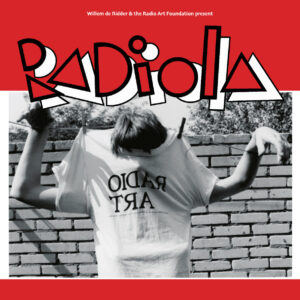
Between 1978 and 1984, Fluxus artist Willem de Ridder did a weekly radio show called De Radiola Improvisatie Salon. Listeners were invited to send in cassettes recorded at home and would get guaranteed airtime. Willem never listened to any of the tapes in advance. No censorship or personal taste were involved, just total artistic freedom. Long before social media existed, he understood that just providing a platform could ignite boundless creativity. Willem was a visionary, always pushing the boundaries of art and mainstream culture, while his interactive radio shows were breaking down the barriers between listeners and producers.
Unknown home tapers and independent artists would share their freshly recorded bedroom experiments with the world and Radiola became a catalyst for the rising Dutch tape scene. When the show gained popularity, broadcasts became open to the public and people would visit the salon to submit their latest cassettes in person. From these live events a network of independent labels emerged, releasing and exchanging cassettes. Punk was fading away but a new alternative to the mainstream was born.
Nobody seems to know what happened to the Radiola master cassettes, but somehow a few boxes survived and were archived by Marco van Dalfsen in 2022. We went through hours and hours of material and eventually compiled this album. A few names might sound slightly familiar, but our goal was to unearth the most obscure hidden gems of Dutch home taping culture. The result is an eclectic mix of ambient, industrial, lo-fi weirdness and experimental music and offers a unique glimpse into a very specific, but still relevant piece of the past.
23,00€
Out of stock

CD
FANATIC (FNTC)
“Europe in Flames”
The word Fanatic comes from the Latin fanum, temple. A fanatic is someone possessed, by God or the Devil. From 1985 until 1989 Willem de Ridder, Hessel Veldman, Cora Emens and Nick Nicole were the members of post-art ensemble FANATIC (or later FNTC). Willem and Hessel already worked together in the late 70s and early 80s on various radio shows and performed with musicians like Alvin Curran, Francis Marie Uitti and Jon Rose. Together with Cora and Nick they started FANATIC to focus on field recordings, intimate happenings and theatrical storytelling.
As a multi-media project FANATIC was not just obsessed by sound but dedicated to live rituals, producing videos, cassettes and radio plays like Europe in Flames, the pinnacle of this album. It’s a multi-layered piece for which the foundation was recorded by Willem on a boat trip to England. One of his spontaneous field recordings that sounded more like an intricate studio production. In a house near the North Sea on a windswept Autumn evening in 1985 percussion, voices, synthesizer and sound effects were added and when their friend and collaborator William Levy arrived, he listened to the freshly recorded wall of sound, took a short poem from 1978 out of his pocket and started reciting. This final layer of sound complemented the audio perfectly and the result was published on the Neuropa cassette in 1986 and is still chillingly relevant in 2025.
Their haunting, meditative and immersive audio pieces and challenging performances evoke comparisons with groups like COUM Transmissions and Throbbing Gristle. Bleak and raw, but also sensual and poetic. FANATIC released 3 cassettes in the 80s with more material to be discovered in the EXART archives. In addition to the classic Europe in Flames, we dug up 2 unreleased pieces from 87 for a long overdue conspectus.
200 copies. CD wallet with 8 page booklet including photos from a scrapbook, found in Willem de Ridder’s archive.
14,50€
In stock

LP
Robert TURMAN
“Distant Dosage”
2025 repress
Turman first came onto the industrial scene in the late 70’s as the ominous ‘other half’ of legendary noise outfit NON. Shortly after recording the classic 1977 single Mode of Infection, Turman went on to pursue his own unique vision as a solo artist. Fusing every possible influence at his disposal while laying his ideas down on self-released cassettes like Flux (1981), Spirals of Everlasting Change (1987), Way Down (1987) and the massive Chapter Eleven cassette box set (1988). After a hiatus Turman resurfaced in 2005 to team up with seminal noise musician Aaron Dilloway. Since then, he has been gradually adding new titled to his already impressive discography.
For this archival release Turman selected 7 tracks that were recorded between 1980 and 1984. A welcome supplement to his library of avantgarde music that was released in the 80s. This album fits in nicely between the early industrial noise, the long-form minimalism of Flux and the rhythmic industrial of Way Down. Focusing on slowly shifting hypnotic loop-based layers of sound, it covers a specific side of Turman. It feels like there’s a direct link to his earliest works but it’s also a precursor to some pieces that were recorded much later. A missing link that finally gives us the opportunity of a complete overview of his early audio work.
All 7 tracks on this album have a connection to the written word in the form of a poem. Scans of the original typewriter poems are included together with collages and drawings from this specific time frame to create an essential and singular piece of art.
250 copies on clear vinyl with insert.
21,00€
In stock

LP
NEUTRAL
“Lågliv”
Neutral is the no wave / anti-rock duo of Dan Johansson (Sewer Election, Ättestupa, Amateur Hour, etc.) and Sofie Herner (Leda, Enhet För Fri Musik), both with deep connections to the Swedish noise scene. As Neutral, the two smear voice, guitar, organ, and smoldering noise into narcoleptic songs that rewire the strategies of Dome by way of Gate and Mars. Lågliv translates to ‘lowlife,’ an apt metaphor for neutral’s subterranean murk and shambolic discontent that they languidly manifest as a punk dourness emptied of all rock ’n’ roll theatrics. Desperate, demolished, and dejected.
Lågliv was originally published as part of the instantly out of print boxset, On Corrosion - a 10 cassette anthology from 2019 that was housed in a handcrafted wooden box and featuring full albums from Kleistwahr, Neutral, Pinkcourtesyphone, Alice Kemp, She Spread Sorrow, G*Park, Relay For Death, Francisco Meirino, Fossil Aerosol Mining Project, and Himukalt. The collection also stood as the 50th release for The Helen Scarsdale Agency.
27,00€
In stock

CD
The DEAD MAURIACS
“L’énigme Du Parc”
"The mechanical gate, a rattling turnstile, opened onto the park, enclosed by symbolic gates just under a metre high, lined with hedges. Inside the park, sounds underwent a strange metamorphosis: they seemed muffled, as if unable to penetrate, as if repelled by the gates, the trees and the groves.
Outside, fireworks bounced between the buildings. The short duration of the reverberation gave the sound a tremor that derealised it, a short, stuttering vibration that isolated it and gave it a cold splendour.
The clamour of a parade showed the same alterations; snatches of voices emerged, a syllable, a word. The horizon of sound spiked, bristled, underwent a choppy friction that the wind shaped into jagged, torn jerks."
Music, daylife sounds & artworks by Olivier Prieur.
13,00€
In stock

LP
Tózé FERREIRA
“Música de Baixa Fidelidade”
Two records came out in 1988 that forever changed the perception of "experimental" or "serious" music produced in Portugal. These were "Plux Quba" by Nuno Canavarro and "Música de Baixa Fidelidade" by Tózé (António) Ferreira. Both were released by the same label - Ama Romanta -, an influential independent imprint closely linked to avantgarde pop band Pop Dell'Arte. Because those records appeared in what could be perceived as an "alternative pop" framework, they rescued this difficult music from Academia. It helps that Canavarro played in a successful new wave pop band (Street Kids) during the period 1980-83. By association, being a friend since 1976, António was in close contact with many of the musicians and bands that were part of the equally celebrated and detested Portuguese Rock Boom (roughly 79-82).
He was not a musician then but through his friendship with Canavarro, who had the means to acquire electronic equipment, António became involved with that equipment and shared Canavarro's passion for experimentation and curiosity for knowledge. They tried to get hold of as many technical magazines as possible and learn while testing ideas. In 1983, Street Kids were about to break up, young lives drafted into the Army and maybe, in Canavarro's case, a whole new passion for challenging music similar to his bandmate Nuno Rebelo, by then in the process of discovering a wide range of "other" music mainly through Jorge Lima Barreto. Barreto, who had started Telectu with Vítor Rua, possessed a huge book and record collection and, like Rua before them, Canavarro, Rebelo and Ferreira became fascinated by the pool of knowledge they now had access to by frequenting Barreto's house in Lisbon. He was roughly a decade older, had published several books and other writings throughout the 1970s, cultivated an anarchic stance and a penchant for cultural indoctrination. Rebelo was the first to be introduced via his contact with Rua (who had invited him to play in his other band GNR).
Overwhelmed, he felt the need to share his enthusiasm with friends and eventually took a few to the house in true pilgrimage fashion. To see the Light. Among the few he led there was even João Peste, founder of Ama Romanta. Canavarro and Ferreira preceded him.
Ferreira recalls an exciting learning process added to his experiments with Canavarro's array of synths such as the Korg Ms 20, Korg polysix, ARP Axxe, Roland SH-01, the Ensoniq Mirage sampler... He read in a magazine article about someone who had studied at the Institute of Sonology (then in Utrecht, Netherlands) and went there during a vacation trip in the Summer of 1983. He became excited by the prospect of studying at the Institute but money was a problem. Canavarro, on the other hand, was admitted there in the following year. Back in Portugal, Ferreira eventually abandoned his Chemical Engineering studies in Lisbon's Technical Institute in favour of a more focused music practice. He collaborated with Telectu during 1984 and 85 as a sort of technical engineer, implementing some recording solutions and background tapes and went to work at a thermoelectric power plant in Sines, hoping to make enough money to fund his musical studies. He did and proceeded with the paperwork for admission at the Institute of Sonology, now based in The Hague. António studied there in 1986-87 and the present album includes two compositions developed at the Institute: "More Adult Music" and "This Is Music, As It Was Expected", both featuring the voice of Rodney Waschka II. Among other activities and talents, Rodney is an expert in computer music and to António his voice sounded similar to Robert Ashley's, whose work he admired.
What happened at the Institute was a systematization of António's self-taught practice. Computer software, Musique Concrète, noise and silence, organisation of abstract ideas and sounds. The original notes on the back sleeve of the LP give some indication of process and thinking, but a more detailed account was given by António in the liner notes of the CD reissue in 2002, which are also included in this 2025 LP reissue.
The music sounds deep and detailed, despite the fact of António calling it low-fi ("Baixa Fidelidade"). It flows like an improvised performance where several musicians might be responding to each other, respectful of their mutual space. Drama occurs, as a natural emotional connection is sought by the listener. Piano, bells, drone, processed voices, even the clear narrative of Rodney Waschka II, contribute to create a sort of alternative perceptual reality. The sounds are almost tangible, more a part of the physical world than ethereal manifestations and thus it would not be correct to invoke "ambient music" as a selling point. But although "physical" and distinct, this music is still alien, more so in Portugal's 1988 environment. In March, helped by Canavarro, António set up a home studio and there he recorded the remaining material for this album: "Algumas Pessoas Olharam O Sul E Viram Deserto", "Um Som, Seguido De Uma Cena Negra E Malva" and "O Verão Nasceu Da Paixão De 1921".
"Música de Baixa Fidelidade" stands not only as a proof of great resilience but as one of those magnificent works of art coming from someone who balanced technical inclination and emotional sensibility. Because of that, Tózé Ferreira is able to decode the phantom world of sound for anyone who cares to experience the sensation of inhabiting a version of the Future. First ever vinyl reissue, reproduction of the original artwork with an additional insert. Made in collaboration with the artist and the support of Paulo Menezes (Plancton Music), who provided valuable assistance. Remastered by Taylor Deupree.
24,00€
In stock

7 CD box
Meredith YOUNG-SOWERS
“Agartha: Personal Meditation Music”
Agartha, Personal Meditation Music is a 7CD box set, originally released on cassette in 1986, at the height of New Age, as an aid for meditation and alignment. Bringing to mind 20th century composers like Eliane Radigue, La Monte Young or even Brian Eno's Shutov Assembly, the time-stopping, enveloping, electronic music contained in this series sounds eerily modern, mysterious and moving. Characterized by deep analog drones, rising overtones, floating frequencies surfing on sine-waves and intervals with mystic modulation, this is truly moving, vibrational music.
In Agartha, the individual notes of each Harmonic Triad proceed in a fashion that is neither improvisational nor chance-based, nor is it generative. Instead the music flows outward as if being transmitted— or channeled — from a place outside human consciousness. There is a profound sense of cosmic depth expanding ever outward as the music fills the listener with waves of emotion, and a palpable somatic response is felt, although there are subtle differences with each unique Triad.
Each disc is individually packaged in original replica sleeves and housed in a heavy duty cardboard clamshell box. Digitized and remastered by Jessica Thompson. Liner notes include extensive instructions for use from the original text and an essay by library music scholar David Hollander.
The original edition of Agartha, Personal Meditation Music, featured one 30 minute track per tape repeated on both sides. Subsequent editions had unique Side B tracks on all but two of the 7 volumes. We have included all tracks in this boxed set.
48,00€
In stock

LP
FLUTTER RIDDER
“Flutter Ridder”
Flutter Ridder is the duo of Norwegian multidisciplinary artists Espen Friberg and Jenny Berger Myhre, both of whom play important roles in Oslo’s contemporary art and music underground. The pair first collaborated during the production of Friberg’s debut solo record, “Sun Soon” (Hubro, 2022), quickly recognizing in one another a creative kinship rooted in a playful, intentionally naive approach towards making art. In November of 2023, the pair decamped to the coastal town of Hvisten in southeastern Norway to record what would become this debut, self-titled album in an ancient wooden church. Drawing from a palette of Friberg’s idiosyncratic Serge modular system and the church’s resident pipe organ and intoxicating acoustic reverb, they began recording and sculpting music informed by the notion that air and electricity share a common flow, a continuous current that can be directed through valves and potentiometers. The pair came to think of the Serge and pipe organ as sibling instruments, the former yielding characteristically unpredictable and complex timbres that complement the wooly, reedy drones and strange, microtonal overtones of the latter. At once sublime, liturgical, and whimsical, Flutter Ridder offers its listener a series of moving, cinematic natural landscapes, affirming the sensibilities of its makers and the indelible influence of the environment in which it was produced.
25,00€
In stock
LP
KMRU
“Forge”
On his new album 'forge’, ambient artist KMRU explores the blend of melody and noise, rhythm and drone. ‚forge’ marks the third release on Seil Records for the Nairobi born and Berlin based producer. Made up of 10 tracks, the album effortlessly wanders from intimate compositions over field recordings to deep and rich soundscapes.
The result feels like a living, breathing organism. Music you can immerse yourself in. Like few others, the 27 year old producer carved a niche of his own, capturing the essence of his raw live performances to form a highly unique listening experience that transcends what ambient music is known for.
'forge‘ can both exist in the background as well as front and center. Filled with intricate details and vast sonic vistas, it invites the listeners to lose themselves in the music. It’s gentle, yet uncompromising; soft and warm, yet growly and dense.
28,00€
In stock
LP
Hüma UTKU
“Dracones”
Hüma Utku returns to Editions Mego with her new album. The title Dracones makes reference to the mediaeval latin term "Hic sunt dracones" (Here be dragons), marking the unexplored, dangerous places on world maps, expressing the fear of chaos, the unexpected and the unknown.
This new work by the Istanbul sound artist is a sonic journal of an expedition into uncharted territory, one which occupies self and domesticity. Inspired by Utku’s experience of matrescence, Dracones explores the themes of familial demonology, metamorphosis and homecoming as well as human relationship to the experience of love woven layers of euphoria, alienation and consumption.
Musically, Dracones traverses a wide array of sonic tools whereby industrial sounds are imbedded with certain psychological angles, this is an album where, all matter meshes into a sly snapshot of the human experience with a tension and release exposure occurring frequently with dark corners opening up to bright layers of electronic experimentation.
The haunting opening track ‘A World Between Worlds’ tackles pregnancy, of which Utku was experiencing when making this record. The emotional, physical, spiritual and mental experience of this journey is all documented here.. This track features the ‘Lyraei’, an electromagnetic string instrument and modern interpretation of the ancient lyre, that was built and played by Mihalis Shammas. ‘Comfort of The Shadows’ moves from within to without, what was once hidden is now exposed. Utku’s ability to conjure the visual in the sonic is at the forefront as howling electronics give a distinct impression of movement. ‘A Familial Curse’ presents a desire to break the cycle of generational trauma with a creeping sense of dread that rolls into an industrial rhythm prior to landing in a beautiful place represented with shimmering guitar tones. ‘Here be Dragons’ is a rich and dark evocation, a spooked surrender to the themes of the record whereby Utku’s wildly distorted voice beckons all manner of phantasmagoria over cello and recordings of her ultrasound. ‘Care in Consume’ engages in further sonic exploration as a means of conjuring ‘matriphagy’, with its unique psychic energy coursing through electronic veins. ‘A House within a House’ could also be read as a body within a body as the pulse of ultrasound audio rattle amongst a cage of thudding rhythms and swirling electronics, one also ending in optimism as an exquisite melody is born from the prior fire. The striking journey ends with the more soothing ‘Ayaz’a’, a track embracing love and all the hardships that a period of fundamental metamorphosis brings, this is a heartfelt dedication to her son and concludes an album draped in life, experience, joy and pain.
Dracones is a deeply visual journey through inner and outer worlds, a space where symbolic evocation is supreme and passive listening is not an option.
26,00€
In stock
LP
HASWELL & HECKER
“UPIC Diffusion Session #23”
Russell Haswell and Florian Hecker have both a long history with Mego/Editions Mego. Individual releases have peppered the Mego catalogue since Haswell’s Live Salvage 1997->2000 cd release (MEGO 012) in 2001 and the debut Hecker release IT ISO161975 (MEGO 014) in 1998.
The individual exploration of sonic phenomena by these two practitioners has resulted in both being highly regarded for their uncompromising approach to sound as matter. Russell Haswell and Florian Hecker came together as a collaborative duo with the now-legendary record Blackest Ever Black, somewhat inexplicably, on the classical imprint of Warner Brothers.
In 2025, Hecker and Haswell return with a new album featuring the two-channel edit produced initially for their UPIC DIFFUSION SESSION #23, performed as a live diffusion across 8-channels at the X100 Festival, Berlin, 2023, celebrating the 100th anniversary of Xenakis' birth.
This record furthers the duo's exploration of Xenakis's UPIC system as the sole instrument. The UPIC is a computer music system that generates sound from visual input. The original intention of the system developed by Xenakis was to make a utopian tool for producing new sounds accessible to all, independent of formal training. One can locate footage of Xenakis and a group of children making drawings for the system in the 70's.
The duo set off experimenting with a diverse array of hand-drawn images to feed the UPIC system including news photographs of disasters and atrocities, "food porn" through to depictions of the natural world and microscopic images of molecular structures (including 'the blackest ever black'). The resulting eccentric audio from these images is claimed by the artists to heighten synaesthesia and is as mysterious as it is baffling.
Throughout UPIC DIFFUSION SESSION #23 frequency clusters move and morph in the most unusual manner, shifting and stretching into shapes that hint at some kind of magical process. What starts out deceptively simple soon unravels into a large array of sonic mayhem. Symbolic jet planes are shredded by a swarm of insects, a metal bowl howls into the void, a tiny tin toy crawls into a thicket with the resolute aura of a black hole. A burning geyser of laser forms liquid shrapnel. This is sound as an alchemical process, a constant chimerical flow into the netherworld and is the net result of the decades long radical investigations by the two artists involved. UPIC DIFFUSION SESSION #23 is a direct, rich and rewarding listen for those willing to invest time into the outer limits.
26,00€