
In stock
In stock

CD
Richard FRANCIS
“Combinations (3)”
6 electronic pieces recorded between May 2016 and February 2018 in Auckland, New Zealand. Mastered by Giuseppe Ielasi. Richard Francis (aka Eso Steel) has been active as an experimental music composer and improviser since 1996. His work over the years has explored different techniques of sound generation and processing, with a focus on the collection and digital processing of various natural and artificially produced sounds from the surrounding environment. He has released solo and collaborative sound works on labels such as Drone Records, Stateart, Celebrate Psi Phenomenon, Digitalis Industries, Absurd and Scarcelight, as well as his own label CMR. Currently CMR is focused on documenting the blossoming Auckland music scene on lathe cut record.
12,00€
Out of stock

CD
Luciano MAGGIORE
“9 enclosures”
Luciano Maggiore (Palermo 1980) lives and works in London. Active musician in the field of electroacoustic music, in recent years he has developed a strong interest in the mechanisms of sound diffusion, using speakers and several analogue and digital devices (walkmans, CD players, tape recorders) as principal instruments. His interest is focused on the architectural and psychoacoustic as well as dynamic and directional values of sound with a strong emphasis on fixed sounds.
His works are published by Balloon & Needle, Boring Machines, Consumer Waste, Hideous Replica, Palustre, Senufo editions, 1000Füssler, Triscele Registrazioni and Tulip records.
12,00€
In stock
CD
Giuseppe IELASI
“Even when they speak of space”
Music for whistling, microphone and digital degradation.
Recorded in november 2016 and august 2017.
To be played at low volume.
300 copies
12,00€
Out of stock

LP
ORGUE AGNES
“A Une Gorge “
**** Back in stock, our favourite record since months ****
This is electrified ping-pong music. This music pings and pongs.
Ping-pong balls are commonly used in experimental piano music.
They are chancey things. And they are cheap; you can buy a wack of them for next to nothin’.
Orgue Agnès bounces in loose time and dances and reflects. It is reflective bouncing dance music.
With little effort - or little to no intention – ping-pong balls set off a derive of small detailed sounds.
They are lit alive - light and lighthearted.
They jump for joy. I am talking about Orgue Agnès and ping-pong balls.
A lot of A Une Gorge sounds like it was made with electrifc ping-pong balls bouncing inside of a throat or
a mouth.
A mouth-full of electricity.
A throat (like a mouth) is a filter.
« wah wah woah wow-wah. »
A mouth-throat is a wah. Une gorge is a dancehall.
Orgue Agnès A Une Gorge and this music sounds like it was made inside of one.
As strange and wonderful as it sounds."
Eric Chenaux
15,50€
In stock
CD, Book
John WALL – Alex RODGERS
“Soar”
CD and book, 210×148 mm, 20pp; foil-blocked cover.
John Wall : Arranging/composition/sampling/voice manipulation
Alex Rodgers : Voice/texts
Limited edition of 200 copies
Mastered by Paul Richardson
"John Wall’s granular textures once again manipulate and
augment the oblique poetics of Alex Rodgers. The two
have been collaborating for well over a decade now, in a
gambit for Wall to reshape his creative process through
improvisational strategies. Wall’s once meticulously edited
samples have become serpentine, liquid, yet unmistakably
digital. On Soar, his constructions look back to the glitch-
worship electronica of Vladislav Delay, Oval and Pole in
their attempts to shed themselves of the trappings of
techno. A lounge lizard slink is evident throughout Wall’s
brief compositions, allowing plenty of space for Rodgers
to gruffly articulate his existential profundities."
Jim Haynes in The Wire
14,50€
In stock
LP
3 RENSA
“Redrum”
Merzbow: drums/electronics
Nyantora: guitar/electronics
Duenn: electronics
Recorded at Red Bull Studios in Tokyo on 3 August 2017
over the course of three hours. All the music on this LP
was improvised and only edited for length.
Limited edition of 250 copies
Out of print at the label.
(all the copies we have are very lightly bumped at one corner)
16,00€
In stock

CD
Morgan EVANS-WEILER and Michael PISARO
“Lines and tracings”
Two wonderful works for ensemble by two of the most interesting US composers. Michael Pisaro's remarkable ' Helligkeit, die Tiefe hatte, nicht keine Fläche', followed by Morgan Evans-Weiler's exquisite 'lines and tracings'. (Another Timbre)
12,50€
In stock

CD
Mark R TAYLOR
“Aftermaths”
Works for solo piano by Mark R Taylor, beautifully played by Teodora Stepančić. First CD release by a remarkable but neglected English composer, featuring works dating between 1979 and 2018. (Another Timbre)
12,50€
In stock

CD
Ferran FAGES
“Un lloc entre dos records”
Extended solo work for guitar and sinewaves, composed and performed by the brilliant Catalan musician Ferran Fages. (Another Timbre)
12,00€
Out of stock

LP
SMALL CRUEL PARTY
“Resin, Parched, Chthonic”
Cassette released in 1991 on the label A State Of Flux, reworked and rebuilt so that it can match the duration of a vinyl.
The ambience of this album is noisy, drone, abstract, shamanic.
Mastering by Giuseppe Ielasi. 300 copies.
18,00€
Out of stock

2 CD, Book
NURSE WITH WOUND
“Homotopy to Marie”
Deluxe silver hardcover book with the 2CD version + 24 pages of artworks by Steven Stapleton.
20,00€
Out of stock

6 CD box
Lionel MARCHETTI
“Jeu du monde”
"Jeu du monde" is a collection of around twenty musique concrète pieces which spreads over more than six hours of music.
Each CD has been designed as an audio film which tells a full story. The box set includes previously released works which have long been unavailable, reworked versions of digital releases, as well as unreleased pieces especially composed for this occasion.
With the use of a complex sound palette ( synthesizers, analog and digital manipulation, percussion, low fidelity samplers, radios, Revox, vocals, prepared piano, field recordings... ), Lionel Marchetti takes us through an audio landscape in which the acoustic imagination feeds on nature and its diversity: the desert, the upper atmosphere -mankind - night and day, fire, death, until we disappear into the ocean space...
Includes: 32 page booklet illustrated by Adèle Marchetti
Presentation texts by Denis Boyer, Régis Poulet, Frédéric Neyrat, Yann Leblanc and the composer himself.
Some compositions were co written with Yôko Higashi and Olivier Capparos. Seijiro Murayama, Sébastien Églème, Isabelle Duthoit, Patrick Charbonnier are also featured.
Lionel Marchetti is a French composer of musique concrète and an improviser (various analog and digital electronic instruments and modified speakers ). He also writes poetry and essays on the art of Musique Concrète, as an artist working within the genre.
His musique concrète works follow in the steps of composers such as Pierre Henry, Bernard Parmegiani and Michel Chion.
40,00€
Out of stock

2 LP
Julius EASTMAN
“Crazy Nigger / Evil Nigger / Gay Guerrilla”
Only a handful of years ago, the name Julius Eastman would have been met by a unanimous blank look. The legacy of this once darling of the New York post-minimal avant-garde had, since his untimely death at the age of 49, in 1990, been almost entirely lost. Eastman's story is as fascinating as they come – black, angry, and queer in an all too polite, straight white musical world. A prodigy and genius whose music took him to astounding heights, and whose unwillingness to conform and play by the rules took him to overwhelming lows, leading down the path of drug abuse, homelessness, and with it the loss of his scores and body of work. Even before his death, he was already a forgotten name.
Eastman belongs to a generation of composers who inherited the mantel left by 1970's Minimalism, making it their own – sometimes more simple and direct, others with tonal and structural complexity which bent the ear. Despite composing rigorously and being highly respected by his peers, was only given a slim number of chances to record his work, relegating most of voice as singer and pianist to the realization of others's work. It was Eastman who conducted the iconic recording of Arthur Russell's Tower of Meaning, an whose piano cuts its way across the 1976 recording of Morton Feldman's For Frank O'hara, not to mention a slew of recordings by Peter Maxwell Davies and Meredith Monk. Other than a single work, found on an obscure cassette complication, Tellus
4, his singular voice was no where to be found. It's likely that Eastman's would have been entirely lost, had it not been for rigorous efforts of a few close friends, the most persistent of whom was the composers, Mary Jane Leach, who spent years tracking down his lost scores. These efforts eventually led to the comprehensive cd collection, Unjust Malaise, issued by New World Records in 2005. It was the beginning of the turning tide, over the 13 years since, Eastman's singular voice has slowly returned to the audience he always deserved. It also represented the recorded debut of some his most thrilling and controversial work, three compositions for piano from what he called the Nigger Series - Gay Guerrilla, Evil Nigger, and Crazy Nigger, all proofs of his creative brilliance and contentious politics in a single force. Now issued across two LPs in their first ever vinyl release by Blume Editions, offering extensive liner notes by Mary Jane Leach and Bradford Bailey, these three seminal works by one of the most important, but neglected, American composers of the 1970s and 80s, return to the light once more. Not only are Gay Guerrilla, Evil Nigger, and Crazy Nigger an entire rethinking of Musical Minimalism, but they ferociously blow the doors of what classical music can be seen to be.
42,00€
Out of stock

LP
Julius EASTMAN
“Evil Nigger / Gay Guerrilla”
« Gay Guerrilla » and « Evil Nigger », both composed in 1979, with a third work, « Crazy Nigger », make up what Eastman called The Nigger Series. Some of themost challenging and beautiful works composed for piano during their era, they double as a window into the intricate thought process and contentiousness of their creator. When the composer was asked to perform the series at Northwestern University in 1980, due to protests by African American students, their titles were censored in the event's program. His response was a flamboyant foreshadowing of the sentiments toward bigoted language which later arose within hip-hop culture – to publicly take back these words, assert ownership of them, and deploy their power for positive change.
What Eastman was early to recognize, was that there is a fundamental difference in what happens when these words are spoken by white people toward people of color, and when people of color deploy them toward a white audience. The balance of power shifts. Eastman's audience was largely heterosexual and white. He knew exactly what he was doing, and to whom he spoke.
The object in your hands contains some of the most striking and important music composed during the later decades of the 20th century - music which remained lost and unheard for years, not because of what it is, but because of who its composer was. It is music, doubling as the voice of a man, which, because it refused to be oppressed, was suppressed or ignored. Eastman's work is a conscious act of intervention, plowing into a context defined by heterosexual whiteness, attacking its unjust demands from within. It is Christ like – metaphor and beauty which is impossible to separate from the evils of the world.
It is a music which carries the body of a man. As it speaks to our hearts, as it offers an glimpse of the freedoms implied by the sublime, a shackle is bound – a consciousness of our complicity with unforgivable sin.
Edition of 300 copies.
21,00€
Out of stock

LP
Julius EASTMAN
“Crazy Nigger”
It's little wonder that Julius Eastman (who died in 1990 under unexplained circumstances), remained the supreme underground composer. He was Afro-American and gay, a composer who rocked the cerebral world of process music with his explosions of free improvisation. This is
first time any of Eastman's music has been available on LP, with the three extended pieces for four pianos, « Gay Guerrilla », « Evil Nigger » and « Crazy Nigger », all written and preformed around 1980. All three works generate their epic soundscapes through adamantly restated patterns and interlocking canons, not fragmenting now, but preaching urgent truths. To quote brilliant Mary Jane Leach liner notes: "He wrote what can be categorized as minimal music, but also wrote
"post-minimal" music before minimal music was fully established. His pieces straddle the two main styles of minimal music—rhythmic/pulse driven music (Steve Reich and Philip Glass) and spectral drone music (La Monte Young and Phill Niblock). While using process and rhythmic patterns, there is a flexibility that lends a breathing, organic feel to his music, a muscularity missing in a lot of other music from that time ith the re-emergence of his powerful music, a missing gap in the history
of contemporary music has been filled. Created in the late 1970s, these three pieces should have been released on vinyl at the time they were written. However, that was not to be, and they, and other pieces of Eastman's, were unavailable commercially. Instead, they were shared on cassettes, copied and passed from one admirer to another, a kind of underground musical distribution by aficionados. Unlike today's instant access to music, at that time each new copy represented a time
commitment, since it took as long to copy a piece as it was long, while also removing itself further from the original recording with a resultant deterioration in sound quality.
« Crazy Nigger, Evil Nigger, and Gay Guerrilla » form a trio of pieces that occupies a high point in
Eastman's compositions. They were the culmination of his mature style.
Crazy Nigger is a sprawling sonic study, the last section exploring canonic form both harmonically and rhythmically, using the same process as James Tenney's Spectral Canon for Conlan Nancarrow, but notated in a more intuitive way.
In the most transcendent sense, it's music that occupies its very own place, a magical soundworld all of its own. Now issued across two LPs in their first ever vinyl release by Blume Editions, offering extensive liner notes by Mary Jane Leach and Bradford Bailey, these three seminal works by one of the most important, but neglected, American composers of the 1970s and 80s, return to the light once more. Not only are Gay Guerrilla, Evil Nigger, and Crazy Nigger an entire rethinking of Musical Minimalism, but they ferociously blow the doors of what classical music can be seen to be.
Edition of 300 copies. Color Vinyl. 180gr Audiophile pressing. Including printed inner sleeve housing a Nagaoka anti-static record sleeve, plus an original insert that functions as Obi. Housed in a fold-out outer sleeve. Vinyl Mastering by Giuseppe Ielasi.
21,00€
In stock

2 LP
Takako SAITO
“Spontaneous Music”
Takako Saito (born 1929) is a Japanese artist closely related with Fluxus. In the 1950s, she participated in the "Creative Art Education" movement where she met later Fluxus fellow Ay-O. In 1963, she moved to New York where she was introduced to George Maciunas and became an important member of the Fluxus movement. She remained part of it throughout the 1960s and 1970s and collaborated with numerous Fluxus artists. Since 1968, Saito has been living mostly in Europe. In 1979, she moved to Germany and now lives in Düsseldorf.
Much of her work revolves around everyday life and everyday things, to which she adds her unique artistic gesture through small but deliberate and carefully crafted interventions. Many of her pieces involve the participation of viewers and only become complete when the audience fills a co-designing role. A sense of playfulness is evident throughout her work, seen in many of her performances and particularly in her various "free" chess games that come in a multitude of different shapes and moreover display a high level of craftsmanship.
In line with her general artistic approach, Saito recorded a number of musical pieces between 1982 and 1992. Retrospectively, she called these recordings "Spontaneous Music" because they involved very simple actions with voice and everyday objects that happened spontaneously. Some recordings have become part of sound pieces in her exhibition "Games" at Emily Harvey Gallery in New York in 1990, but none of them have been released so far. A selection from the recordings is published here for the first time.
This double LP is released in an edition of 300 and includes two solo vocal pieces – "Tarori Po Po Po" and "Isokono Pasokono" –, two more vocal pieces in which Saito's voice interacts with the sounds of an everyday event – "Toro während des Naturreiskochens" (Toro while cooking brown rice) and "Mit Elektrohammer" (With electric hammer) –, and two non-vocal sound pieces: "Kugeln" (Balls) and "Am Rhein mit Hammer" (At the Rhine with hammer). It is housed in a full-color sleeve and includes one insert with liner notes by Saito, a poster, and four postcards. The sleeve, the poster, and the postcards were designed by Takako Saito specifically for this release and relate to the notion of the music having been created simply with one's mouth and hands. All recordings have been carefully digitized and mastered by Dirk Specht.
"Around me, there are many things that make beautiful sounds. When I look outside through the window in front of my desk, I see a big Platanus tree whose leaves are shaking. When you stick a microphone into the leaves, it should made beautiful sounds. Then sometimes a dog passes by and barks. [...] That is music to me. No matter if one notices it or not: it's different but it's there." (from the liner notes by Takako Saito)
31,00€
In stock

LP
Luigi NONO
“Musica manifesto n. 1”
First ever repress of this seminal work. LP version, edition of 300 copies on black vinyl. This edition is on black vinyl, it is hosted in an outstanding shiny/refelecting silver cover (a hommage to the notorious Philips Prespective Series of the same period) and features the tabloid/poster with unpublished photos of the Venice Biennale riots of 1968
Long considered, with Pierre Boulez and Karlheinz Stockhausen, to be one point in the trinity of the post-war avant-garde, Luigi Nono was, without question, one of the most important and singular composers to emerge in the years following the Second World War – defining the zeitgeist, taking the his idiom into startling new territories, while standing decidedly apart. Nono's music infused the avant-garde with a sense of emotion and moral consciousness which had been previously unheard, seeking to join advanced forms of music in the social struggles of every day life. Unlike most of his peers, the composer was political in everything he did. His music is a rallying call of the left. Originally issued in 1969, none of Nono's works illuminate this radical consciousness and concern better than his seminal Musica-Manifesto N.1. Now reissued for the first time by die Schachtel in collaboration with Archivo Storico Ricordi, it is revolution led by one man – a window into the creative and political potential of sound.
Nono's music emerged from the ashes of war – a voice in a social and intellectual landscape trying to cope with what had been, and build itself anew. While most of his contemporaries divorced themselves from the political forum, focusing themselves on more abstract concerns, Nono's work was vocally political from its earliest days – first as explicitly anti-fascist, pointedly embracing Marxism (he officially joined the Communist Party in 1952), before, as 60s and 70s unfolded, becoming a voice in the international worker and student struggles and the fight against the Vietnam War.
It's hardly coincidental that a work as important and powerful as Musica-Manifesto N.1 emerged at the time it did. It is among the greatest sonic culminations of 1960's, composed and released just before the decade's end – emotion, empathy, and politic, manifesting as some of the most forward thinking and radical sounds and structures of their day. Nearly half a century on, what is says, and how its says, remain startling fresh.
Musica-Manifesto N.1, original intended to be the first part in a suite which never appeared, was commissioned by the communist administrated town of Chatillon-sous-Bagneux, in France, during the Spring of 1969. The work, manifesting in two parts, can be understood as snapshot of its moment – incorporating texts taken from the walls of Paris in May, 68, read by Edmonda Aldini against the voices of Communist leaders like Che Guevara, Ho Chi Minh, and Mao, as well as recordings of the riots and protests which occurred at the Venice Biennale in June, 68 – the materiality of the streets and political struggle taking form as the sounds whistles, howls, shouts through a megaphone, and battles with the police, joined with the history of the movement from which those events sprang via a lyrical poem, Mattino (Morning) by Cesare Pavese, one of most important Italian anti-fascist intellectual voices during Second World War, sung under the instruction of the composer by Liliana Poli and Kadigia Bove. Both sides of Musica-Mainifesto N.1, Un volto, e del mare and Non consumiamo Marx, are works for magnetic tape, the first archived through careful editing to achieve a singular polyphonic complexity, while the second utilizes manipulation of its source material through filters and modulators, played against electronically generated sounds. The cumulative result remains a legendary culmination of avant-garde practice and political struggle – an astounding, immersive, and thought proving body of sound, which remains as relevant today as the day it was made.
24,00€
Out of stock
CD
Luigi NONO
“Musica manifesto n. 1”
Long considered, with Pierre Boulez and Karlheinz Stockhausen, to be one point in the trinity of the post-war avant-garde, Luigi Nono was, without question, one of the most important and singular composers to emerge in the years following the Second World War – defining the zeitgeist, taking the his idiom into startling new territories, while standing decidedly apart. Nono's music infused the avant-garde with a sense of emotion and moral consciousness which had been previously unheard, seeking to join advanced forms of music in the social struggles of every day life. Unlike most of his peers, the composer was political in everything he did. His music is a rallying call of the left. Originally issued in 1969, none of Nono's works illuminate this radical consciousness and concern better than his seminal Musica-Manifesto N.1. Now reissued for the first time by die Schachtel in collaboration with Archivo Storico Ricordi, it is revolution led by one man – a window into the creative and political potential of sound.
Nono's music emerged from the ashes of war – a voice in a social and intellectual landscape trying to cope with what had been, and build itself anew. While most of his contemporaries divorced themselves from the political forum, focusing themselves on more abstract concerns, Nono's work was vocally political from its earliest days – first as explicitly anti-fascist, pointedly embracing Marxism (he officially joined the Communist Party in 1952), before, as 60s and 70s unfolded, becoming a voice in the international worker and student struggles and the fight against the Vietnam War.
It's hardly coincidental that a work as important and powerful as Musica-Manifesto N.1 emerged at the time it did. It is among the greatest sonic culminations of 1960's, composed and released just before the decade's end – emotion, empathy, and politic, manifesting as some of the most forward thinking and radical sounds and structures of their day. Nearly half a century on, what is says, and how its says, remain startling fresh.
Musica-Manifesto N.1, original intended to be the first part in a suite which never appeared, was commissioned by the communist administrated town of Chatillon-sous-Bagneux, in France, during the Spring of 1969. The work, manifesting in two parts, can be understood as snapshot of its moment – incorporating texts taken from the walls of Paris in May, 68, read by Edmonda Aldini against the voices of Communist leaders like Che Guevara, Ho Chi Minh, and Mao, as well as recordings of the riots and protests which occurred at the Venice Biennale in June, 68 – the materiality of the streets and political struggle taking form as the sounds whistles, howls, shouts through a megaphone, and battles with the police, joined with the history of the movement from which those events sprang via a lyrical poem, Mattino (Morning) by Cesare Pavese, one of most important Italian anti-fascist intellectual voices during Second World War, sung under the instruction of the composer by Liliana Poli and Kadigia Bove. Both sides of Musica-Mainifesto N.1, Un volto, e del mare and Non consumiamo Marx, are works for magnetic tape, the first archived through careful editing to achieve a singular polyphonic complexity, while the second utilizes manipulation of its source material through filters and modulators, played against electronically generated sounds. The cumulative result remains a legendary culmination of avant-garde practice and political struggle – an astounding, immersive, and thought proving body of sound, which remains as relevant today as the day it was made.
300 copies
15,50€
Out of stock
LP
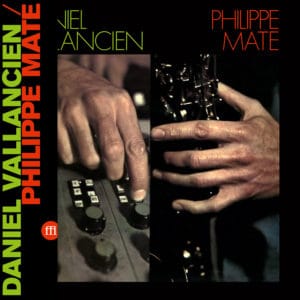
Philippe MATÉ / Daniel VALLANCIEN
s/t
Although discrete, the career of saxophonist Philippe Maté includes nonetheless several indispensable albums: be it with the Acting Trio, Jean Guérin (Tacet) or Jef Gilson (Workshop), his collaborations in a big band or quartet with Lawrence "Butch" Morris, his presence in the Saxophone Quartetand also on the brilliant L'Enfant assassin des mouche by Jean-Claude Vannier.
As for the man in the background, Daniel Vallancien, a sound engineer rarely featuring on the sleeves, the collection Actuel on the BYG label owes much to him (he is at the controls behind Anthony Braxton, Don Cherry, Sonny Sharrock or Steve Lacy), the same goes for Saravah for who he notably recorded Areski, Brigitte Fontaine, Maurice Lemaître or the Cohelmec Ensemble: not bad for starters! What is more, Daniel Vallancien is one of a prestigious group of French recording engineers with open ears and often themselves musicians, even if only occasionally for some, including Bruno Menny, Daniel Deshays or Jean-Marc Foussat, who have all recorded remarkable albums as leaders. Behind this collaboration was the idea ofcreating music which was free, direct and spontaneous, while having also a minimum of advance planning. Music, according to the brief liner notes desirous to "remove itself from long and patient laboratory experiments ". So, there can be found here none of the sophisticated tools associated withelectroacoustic research, but mainly a recording mixer console, which, in the hands of Daniel Vallancien acts directly on the original instrumental sound in real time, modifying and multiplying it while respecting the natural flow. Be it Paul Méfano, Betsy Jolas, Gérard Grisey or Jacques Lejeune, many contemporary composers working in France have, at one time or another, includedthe saxophone in their work. Michel Redolfi, for example, with the GRIM and then the CIRM , experimented with saxophonist André Jaume on a convincing recording (Hardscore). Nothing, however, can compare to the singularity of the dialogue between Philippe Maté and Daniel Vallancien, which they themselves describe as being "serious, sarcastic orhumorous", with, here and there, "disturbing sounds". Words, however, even those used by the protagonists themselves, are insufficient to describe such a sonic object, difficult to identify and, it has to be said, extraordinary.
First ever vinyl reissue
500 copies – Gatefold sleeve – Obi strip
Licensed from Saravah
20,00€
Out of stock
2 CD
Áine O’DWYER / Graham LAMBKIN
“Green Ways”
Green Ways documents a collection of live recordings, drawn from in situ performances given in Doon, Dungarvan, Plaistow, Shoreditch, Singö and Stratford across 2018. It celebrates the filíocht of rural and urban acoustic environments with a playful economy of means, and offers a special salute to the rich heritage of Carnahalla.
Mastered by Taku Unami
Layout by Matthew Revert
23,00€
Out of stock

CD
Pierre JODLOWSKI & LES PERCUSSIONS DE STRASBOURG
“Ghostland”
"The Percussions de Strasbourg embark on a journey through the enigmatic universe of Pierre Jodlowski’s ghosts. Ghostland
is a troubling, intimate, uncertain, unstable and obscure territory in which a complex entity travels to the light. The voice of
Katharina Muschiol, the electronic music and the four percussionists merge thanks to a subtle and precise writing. They compose a complex organism of sound
evoking calm, anxiety, euphoria and madness at the same time.The delicacy of this work relies on a daring and masterful performance, with whispers, squeaks,
clatter of metal rods, synchronized gestures, grooves playful drums, pulsed soundtracks and saturated guitars.
Vibrant and full of sensations, this recording perfectly reflects the pleasure that this adventure represents for the Percussions de Strasbourg."
Minh-Tâm Nguyen
Original price was: 15,00€.7,00€Current price is: 7,00€.
Out of stock
LP
Pierre JODLOWSKI & LES PERCUSSIONS DE STRASBOURG
“Ghostland”
"The Percussions de Strasbourg embark on a journey through the enigmatic universe of Pierre Jodlowski’s ghosts. Ghostland
is a troubling, intimate, uncertain, unstable and obscure territory in which a complex entity travels to the light. The voice of
Katharina Muschiol, the electronic music and the four percussionists merge thanks to a subtle and precise writing. They compose a complex organism of sound
evoking calm, anxiety, euphoria and madness at the same time.The delicacy of this work relies on a daring and masterful performance, with whispers, squeaks,
clatter of metal rods, synchronized gestures, grooves playful drums, pulsed soundtracks and saturated guitars.
Vibrant and full of sensations, this recording perfectly reflects the pleasure that this adventure represents for the Percussions de Strasbourg."
Minh-Tâm Nguyen
Original price was: 18,50€.10,00€Current price is: 10,00€.
In stock

CD
Pascal LE GALL
“Returns”
"RETURNS is a suite in four parts. At the beginning each part was a musical composition as such but finaly after a while the idea of an organisation of this different parts was introduced. The first part, mixed with the sound of different broken glasses, is a musical overture and introduce with his rhythms and his melodies the following parts. The three following parts are mixed with different sounds from records played on turntables with variable-speed drives.
With the intense focus of a scientist fed up with pointless repetition, Pascal takes a scalpel to composition, improvisation and performance, and (with the most basic means) examines their sameness, and their miniscule but important differences."
Original price was: 12,00€.6,00€Current price is: 6,00€.
In stock
LP
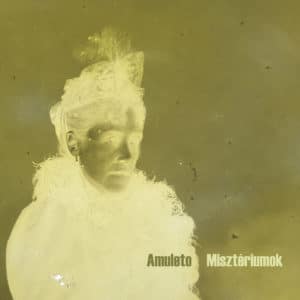
AMULETO
“Misztériumok”
"Misztériumok is the third full-length record - their first on three:four - of Italian duo Amuleto, composed of Francesco Dillon and his cousin and three:four’s artist Riccardo Wanke.
Following the route of previous releases this new album emerges as the fusion of composed and improvised forms and moves between contemporary and electronic music mixing acoustic, electronic and real world sounds. The music takes shapes from a progressive disclosure of sonic material that gradually manifests its nature: at times aggressive and distorted, other times ephemeral and intimate. Cello, electronics, field recordings and a large variety acoustic timbre merge into a unique sound. More intensively than before, Amuleto in these five pieces condenses their aesthetic within intense evolutions, concrete attacks and tight musical constructions.
This work takes inspiration from a series of old photos (as negative silver bromide glass plates) found in the 'Feira da Ladra' flea market in Lisbon. They depict scenes of middle-European family life at the start of the 20th century mixing what seems an ephemeral serenity with an imminent sense of crisis and loss."
15,50€
In stock
CD
LA TÈNE & Jacques PUECH et Louis JACQUES & Jérémie SAUVAGE et Guilhem LACROUX
“Abandonnée/Maléja”
"La Tène is back with a double invitation to its third full length LP.
The hurdy-gurdy/harmonium/percussions trio welcomes two bagpipes (cabrettes and 23” to be exact), and a combo of string instruments (12-string guitar and electric bass).
Beyond the instrumentation, we’re looking at a gang of high esteemed guests: Jacques Puech, Louis Jacques, Guilhem Lacroux and Jérémie Sauvage, whom works are given their due credit (with the La Novià collective and its multiple variations, the France group, Super Parquet, the Standard-In-Fi label, etc.), are at ease with fuelling the traditional ball dance floor (literally in its wooden meaning) as well as questioning it, confortable with sparking dance moves as well as pushing instruments and their sound to their ultimate limits.
La Tène’s music doesn’t alter itself, it is always at the conjuncture between obsessive repetition and fragmented traditional music, hence developing a mineral depth on an obstinate pulse. Where one hears an instrument, its mirror unburdens until the confusion. One lies breathless, only whishing the end becomes an eternal resumption."
10,00€
Out of stock
2 LP
LA TÈNE & Jacques PUECH et Louis JACQUES & Jérémie SAUVAGE et Guilhem LACROUX
“Abandonnée/Maléja”
"La Tène is back with a double invitation to its third full length LP.
The hurdy-gurdy/harmonium/percussions trio welcomes two bagpipes (cabrettes and 23” to be exact), and a combo of string instruments (12-string guitar and electric bass).
Beyond the instrumentation, we’re looking at a gang of high esteemed guests: Jacques Puech, Louis Jacques, Guilhem Lacroux and Jérémie Sauvage, whom works are given their due credit (with the La Novià collective and its multiple variations, the France group, Super Parquet, the Standard-In-Fi label, etc.), are at ease with fuelling the traditional ball dance floor (literally in its wooden meaning) as well as questioning it, confortable with sparking dance moves as well as pushing instruments and their sound to their ultimate limits.
La Tène’s music doesn’t alter itself, it is always at the conjuncture between obsessive repetition and fragmented traditional music, hence developing a mineral depth on an obstinate pulse. Where one hears an instrument, its mirror unburdens until the confusion. One lies breathless, only whishing the end becomes an eternal resumption."
23,50€
Out of stock

CD
FOSSIL AEROSOL MINING PROJECT
“The Recounting Of Night Time”
"For over three decades now, the Fossil Aerosol Mining Project has patiently sifted through the damaged remains and bygone refuse from the late 20th century pop culture of America. Mining the snippets of audio found from abandoned drive-in theaters, mangled VHS tapes, and discarded cassettes, Fossil Aerosol studiously pieces together empathic, haunted abstractions of their original source material. their cryptic sound collages address the continued ramifications of the inherent paranoia from the cold war dissonance of stark morality and nuclear apocalypse.
The Recounting of Night Time begins and ends with the scratchy melodies from a well-worn violin. echoes and their amplifications from this instrument gradually subsume the original amidst cascades of tape manipulations and time-delay techniques. This motif repeats through the album with profound emotional torpor through fossil aerosol's hypnotic cycles of foggy ambience and back-masked rhythmic events that intertwine with varispeed-pitched dilations of melancholy melody. It makes for a beautifully corroded smear of sound, recalling the works of William Basinski and Fossil Aerosol's occasional collaborators :zoviet*france:
Fossil Aerosol addresses the album this way:
The Recounting of Night Time was composed and mixed in October of 2014. The source material focuses principally on a certain piece of German gothic cinema made during the late 1970s. This material was culled from both VHS audio tracks, as well a “field recording” made at a poorly-attended screening of the film in a decaying theater in St. Louis, Missouri sometime during the mid-1980s. Evidence of video control track glitches are present, while the scent of the acutely mildewed theater is recollected and implied.
A special edition of the CD, limited to only 50 copies, will also be available via Helen Scarsdale, and also from Afterdays Media. This edition consists of shrink-wrapped CDs overpainted in chalkboard resurfacing paint, erased chalk, acrylic, and a hand-lettered Bandcamp download code for an additional 18+ minute track."
14,50€
Out of stock

LP
MARIACHI
“s/t”
Mariachi is the solo project of the french guitarist Nina Garcia. She played with bands such as Mamiedragon and Quincho B! but also in duo with Maria Bertel or Augustin Bette.
This LP was recorded by Frédéric Alstadt in the Brasserie Atlas, Bruxelles, in march 2018.
16,50€
In stock

LP
Takehisa KOSUGI
“Catch-Wave”
"Composer, multi-instrumentalist and mixed-media artist, Takehisa Kosugi has stood on the forefront of the Japanese avant-garde for over six decades. In the 1960s, he was part of Japan's first improvisational music collective, Group Ongaku, and contributed to Fluxus in New York. In 1969, he founded the influential, experimental ensemble The Taj Mahal Travellers, and in 1975 he would release his first solo album, Catch-Wave.
"Mano-Dharma '74" features improvised violin drones and voice with various oscillators, echo delays and layered tape experiments that the artist made in New York in 1967. While Kosugi's continuously changing spectrum of sound shifts gradually (almost imperceptibly), photocell synthesizers create ultra-low frequencies to disturb the crestless sound waves. The brighter the light is, the harsher the noise becomes.
Catch-Wave's second sidelong piece, "Wave Code
E-1," is a three-part performance for solo vocalist. As Kosugi describes in the liner notes (translated into English for this edition), the concept of onomatopoeia played an essential role in the type of sounds he generates with his voice, manipulated through customized electronic circuits and at times recalling Gregorian chant, throat singing and cosmic soundscapes. This first-time vinyl reissue is recommended for fans of Tony Conrad, Eliane Radigue and Fennesz."
24,50€
In stock

LP
Gerritt WITTMER
“I Believe”
Created 2012-2018, mastered by Giuseppe Ielasi
Gerritt Wittmer is a sound and performance artist based in Houston, Texas. His work often articulates abstract narratives through vocal expression, body performance, and intense theatrical lighting. He is half the black noise group Deathroes and the vocalist for the band Names.
13,50€
Out of stock

CD
Minami SAEKI / Wakana IKEDA / Yoko IKEDA / Taku SUGIMOTO / Stefan THUT / Manfred WERDER
“Sextet”
While touring Europe in autumn 2017, Minami Saeki (voice), Wakana Ikeda (flute), Yoko Ikeda (viola), and Taku Sugimoto (guitar) visited Switzerland and joined up with Swiss composer/musicians Stefan Thut and Manfred Werder. This CD is a recording of five pieces they performed at the concert venue Theater Delly in Solothurn, Switzerland, on October 9, 2017. Thut played cello, and Werder used glockenspiel and typewriter. Each of the five musicians other than Saeki provided a composition of his or her own, and the five pieces were performed by all six. While Sugimoto's composition is just a minute and a half long, each of the Ikedas' respective compositions is 14 minutes, and those by Thut and Werder are over 20 minutes each. All the compositions call for effectively controlled, minimalistic playing. Maintaining a high level of concentration, the six musicians gave sensitively synchronized, truly superb ensemble performances.
11,90€