
Out of stock
LP
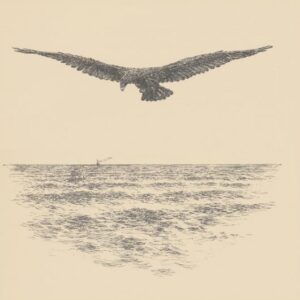
WERKBUND
“Scalpafloi”
From Discogs: "Enigmatic industrial/experimental band from Hamburg, Germany. The sound deals mainly with marine tales and myths from Northern Germany. So far it is not known who the artists are. It has been guessed that Felix Kubin and Uli Rehberg and other artists from Hamburg might be involved. Some people speculate that both Werkbund and Mechthild Von Leusch involve the collaboration of Asmus Tietchens and Uli Rehberg, though Asmus Tietchens has repeatedly denied any participation in the band."
The presentation once again suggests a maritime theme, immersed in mythical-historical fog, as we know it from all previous publications of the project.
25,00€
Out of stock
LP
COMPILATION
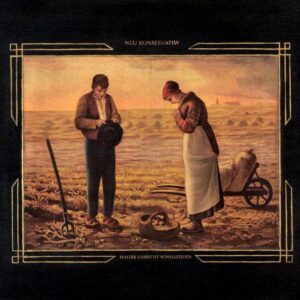
“Neu Konservatiw”
2024 stock
Originally released to celebrate the 33rd anniversary of Walter Ulbricht Schallfolien back in 2015, Neu Konservatiw comes in a beautifully designed sleeve with insert and postcards. The album features two unreleased Asmus Tietchens tracks plus other exclusive contributions by Werkbund, Column One, Evapori, Hyph, Pierce Warnecke, Ditterich von Euler-Donnersperg and Margitt Holzt.
23,00€
In stock

2 CD
NURSE WITH WOUND / irr. app. (ext)
“A Topography of Lucid Confusion”
A double CD in a deluxe 6-panel digipak, with gorgeously mind blowing new art from Mrs Santini and MS Waldron. Just under 3 hours of insane sonic exploration to fry your synapses. Constructed/reconstructed from hours & hours of live & 'rehearsal' recordings, featuring a cast of thousands. Meticulous & amazing.
25,00€
In stock

2 CD
NURSE WITH WOUND
“She And Me Fall Together in Free Death”
The long awaited reissue of the legendary She and Me Fall Together In Free Death album, with over 45 minutes extra material, most previously unreleased. Housed in a deluxe 2 CD digipak gloss heavy gauge, on United Dairies, with new art by Babs Santini, remastered by Colin Potter.
25,00€
Out of stock
2 CD
The DEAD C
“Deux nuit à Paris”
Emerging from the ethereal realms of sonic mastery, New Zealand’s most audacious experimental outfit, The Dead C, presents ‘Deux nuits à Paris’, two complete live sets that ensnares and exemplifies their ever-evolving sonic journey. From the pulsating metaphysical city of Dunedin, the band - Bruce Russell, Michael Morley, and Robbie Yeats - became a testament to the country’s under ground music scene, stirring the waters with their unorthodox sound landscapes since the late ‘80s. Profoundly philosophical and unapologetically experimental, The Dead C gracefully brush strokes onto the canvas of sound that are those recordings.
This double live album is not merely a recollection of a time and place but an exhibition of raw energy, spontaneous creativity, and the irreplaceable reverberations of improvisation and somehow, songs. The Dead C places the listener at the center of a spiraling vortex of fractured guitar notes, sprawling feedback, cathartic drums manipulations and enigmatic, submerged lyrics -- a complete immersion into their aural architecture. Each night is a journey towards the unknown, challenging the listener to embrace the implicit tension between the familiar and the strange. Experiencing this double live recording which happened in Paris at the iconic venue Les Instants Chavires, is wading through streams of consciousness, where every moment springs forth a new sensory revelation, the echoes of sonic experimentation ricocheting off the walls of reality.
The atmosphere thickens and lightens, enveloped in the three-piece’s enthralling ability to balance raw chaotic dissonance with a overwhelming overall flow of unfiltered expression.
19,50€
In stock
CD
Francisco MEIRINO – VOMIR – Roro PERROT
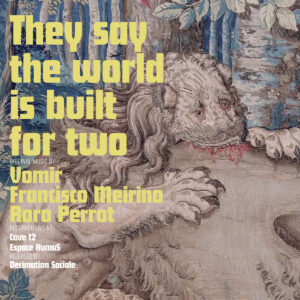
“They say the world is built for two”
Two live sets of collaborations: One set is Vomir/Meirino collaboration electro-acoustics heavy-textured noise, the other one is Roro's shit-folk altered live by Meirino's machines...
"Ghosts, baby goats, vacuum cleaners, a sad sleepy world"
100 copies
11,00€
Out of stock
In stock

LP
Anne GILLIS
“Vhoysee”
The first Manon Anne Gillis release was a single-sided mini-album titled “Angebiguë”, which was Manon’s self-release in 1983. “Angebiguë” was 6-track mini-album in a cold-minimal-synth vein, and any track from “Angebiguë” were not included in her retrospective 5CD Box “Archives Box 1983-2005”, which Art into Life released in 2015. “Angebiguë” was privately released in tiny edition for her friends only and has been a highly sought-after item among collectors. “Vhoysee” is Manon’s long-awaited new album, and the album collects her latest six pieces and four re-worked / re-mixed tracks from “Angebiguë”. The latest six pieces are physical subject-based composition with minimum elements, whereas re-worked / re-mixed tracks from “Angebiguë” are simple rhythm-oriented pieces with her glacial sound texture. In “Vhoysee”, the past and present are interwoven and linked together in a kind of labyrinth.
29,00€
In stock
CD
Anne GILLIS
“Vhoysee”
The first Manon Anne Gillis release was a single-sided mini-album titled “Angebiguë”, which was Manon’s self-release in 1983. “Angebiguë” was 6-track mini-album in a cold-minimal-synth vein, and any track from “Angebiguë” were not included in her retrospective 5CD Box “Archives Box 1983-2005”, which Art into Life released in 2015. “Angebiguë” was privately released in tiny edition for her friends only and has been a highly sought-after item among collectors. “Vhoysee” is Manon’s long-awaited new album, and the album collects her latest six pieces and four re-worked / re-mixed tracks from “Angebiguë”. The latest six pieces are physical subject-based composition with minimum elements, whereas re-worked / re-mixed tracks from “Angebiguë” are simple rhythm-oriented pieces with her glacial sound texture. In “Vhoysee”, the past and present are interwoven and linked together in a kind of labyrinth.
16,50€
In stock

2 CD, book
Akio SUZUKI
“Only Just Once, Space in the sun”
Space in the Sun was one of Akio Suzuki’s major sound projects, a unique construction completed in 1988 and located on the merdian line, which took around 18 months to build. Its purpose was to allow Suzuki to spend one day, on the autumnal equinox, purifying his sense of hearing in nature. This release comprises a 44 page book containing plans and materials from the time alongside texts, and two CDs of environmental recordings created on site at Space in the Sun. To date only tiny fragments of the recordings made between those massive clay brick walls have been used in performances and no environmental recordings of the objective of the project, i.e. the space itself, have been released. The first disk consists of the first release of “person-less” field recordings made at the same spot that Akio sat at during the event (recorded in 1993, 60 minutes). The second disk consists of a performance that took place in the space. Space in the Sun’s earthen walls have since been demolished, so these recordings represent a return to life of their soft echo, an experience accessible nowhere else.
CD1: A record of the space (60:00)
An unedited one hour cut, taken from one of the three different recordings of Space in the Sun. Recorded by Yoshihiro Kawasaki.
CD2: Playing in the space: Throwing and Following (41:30)
A record of a performance by Suzuki at Space in the Sun using tree branches and small pebbles.
26,00€
Out of stock

CD
Anne GILLIS + XT
“Our-s Bouture(s)”
Anne Gillis (Paris) is a composer and performer since the eighties, Paul Abbott (Antwerp ) is a musician, drummer, writer, and Seymour Wright (London) is a saxophonist and writer. In 2021, during Covid restrictions, the trio of Anne Gillis and XT (Paul Abbott and Seymour Wright) developed a piece remotely together for Café Oto online radio broadcast program. A one-hour piece titled “Our/s Bouture(s)” was ‘broadcast’ on 1 June 2021 to online audinece, and we present a complete program with careful CD mastering by Giuseppe Ielasi. The trio’s concept for “Our/s Bouture(s)” is to ‘plant’ sounds and movements, which will grow and evolve through broadcasting, and what you will hear is not a 'performance' but a one-hour journey of organic sonic sound structure.
16,50€
In stock

CD
ORGANUM ELECTRONICS
“Quietude”
Organum Electronics ‘Quietude’ is another intense aural experience. A dense work, consisting of buzzing washes of electronic sounds, reminiscent of the very first Organum recordings. In common with other recent works, the piece uses a carefully chosen set of sound sources, overlaid and structured to form a tapestry of shifting textures. Recorded in 2021 and edited by Alan Jones at RMS Studios South London, the CD comes in a 4-panel Digisleeve with graphic artwork by Jonathan Coleclough. UK-based composer and visual artist David Jackman began his career in the late 1960s in the experimental group Scratch Orchestra, co-founded by Cornelius Cardew. He started recording solo work in the late 1970s, mostly on self-released cassettes in very small numbers. In the early 1980s he established his main project, Organum, which evolved into a new version under the name Organum Electronics in 2019. Five OE albums have been released by Japanese imprint Siren Records. ‘Quietude’ (DS128) is the first OE release on Die Stadt.. This is the second of seven albums scheduled for release on Die Stadt up until the end of 2024. As well as several albums under the OE moniker these will include works under David Jackman’s own name.
14,50€
In stock

CD
ORGANUM ELECTRONICS
“Darcknes”
Organum Electronics ‘Darcknes’ is the sibling album of ‘Quietude’ (DS128). It is a similarly dense work, consisting of buzzing washes of electronic sounds, reminiscent of the very first Organum recordings. In common with other recent works, the piece uses a carefully chosen set of sound sources, overlaid and structured to form a tapestry of shifting textures. Recorded in 2021 and edited by Alan Jones at RMS Studios South London, the CD comes in a 4-panel Digisleeve with graphic artwork by Jonathan Coleclough. UK-based composer and visual artist David Jackman began his career in the late 1960s in the experimental group Scratch Orchestra, co-founded by Cornelius Cardew. He started recording solo work in the late 1970s, mostly on self-released cassettes in very small numbers. In the early 1980s he established his main project, Organum, which evolved into a new version under the name Organum Electronics in 2019. Five OE albums have been released by Japanese imprint Siren Records. ‘Darcknes’ (DS130) is the second OE release on Die Stadt. This is the second of seven albums scheduled for release on Die Stadt up until the end of 2024. As well as several albums under the OE moniker these will include works under David Jackman’s own name.
14,50€
In stock

CD
Marc BARON – Mark VERNON
“Post-chance”
Recorded by Marc Baron and Mark Vernon between June 2022 and October 2023
Mastered by Taku Unami
The initial idea was that this collaboration should reflect a dialogue between two artists who have not yet met and that it should express something about the gulf between them, both literally and metaphorically. In the exchange of materials and ideas something is inevitably lost along the way – whether it be misunderstandings due to interpretation, language, slippage of meaning or simply things going astray. From the outset we decided to make a feature out of what might be lost in this interchange due to physical distance and the passage of time, and to devise a process that would make this evident.
Sending batches of unspooled quarter inch tape to each other in the post we made the decision to include a magnet in the package that, over the time it took for it to be delivered, would randomly erase parts of the tapes that it came into close proximity with. Each fragment of tape included a self-determined sound miniature – a short audio sketch or recording experiment. Over the course of a year we accrued heaps of these degraded, partially eroded tape fragments. We would each make a copy of the tapes prior to sending, and on receiving them weeks later the other would decrypt what remained of the sounds at the other end, playing back and recording the tapes digitally.
To further open the process up to chance it was decided that whatever minute past the hour the tape was recorded at would be noted and that in the final arrangement of materials it would appear at that exact point within an hour-long timeline. In the compositional stage the changes in state between the original recording and its degraded ‘ghost’ counterpart were highlighted through extreme stereo separation and hard panning. The bringing together of these fragments on the timeline to mix and arrange the piece was also the first time we met in person after a year of this remote sound correspondence. Up until this point, neither of us had any clue about how these elements would sit together, whether the juxtapositions would work or not, whether the process would bear fruit or turn out to be a complete disaster.
Mark Vernon, winter 2023
15,00€
In stock
3 CD
Taku UNAMI
“Bot box boxes”
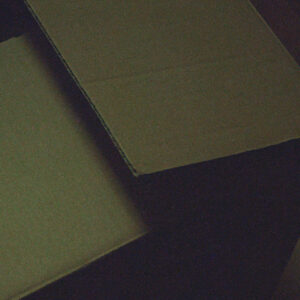
"After several years of not doing anything since Erstwhile first asked me to do a solo album, I suddenly had the idea to record it last week and it was released within a week or so.
I know some of you are thinking "Anyone can do this...", but in the DIY spirit of doing what anyone can do with what anyone can get, and without any special skills or funds, I tackled improvisation head on, using mostly newspapers and cardboard boxes, which turned out to be this triple CD set."
-- Taku Unami
28,00€
Out of stock
2 CD
Graham LAMBKIN – James RUSHFORD
“Gondolas”
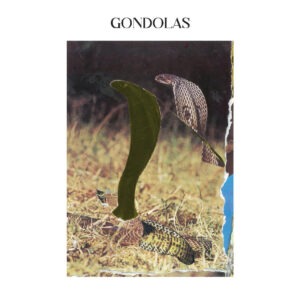
First collaborative work between Graham Lambkin and James Rushford. Mastered by Stephan Mathieu, artwork/design by Graham Lambkin. Double CD, eight-panel digipak.
22,00€
In stock
CD
Moniek DARGE – Vanessa ROSSETTO
“Dream Soundies”
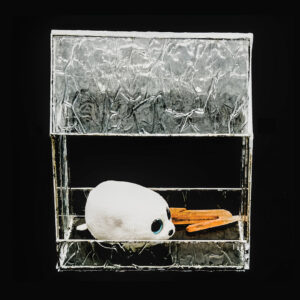
First collaborative work between Moniek Darge and Vanessa Rossetto. Mastered by Giuseppe Ielasi, designed by Matthew Revert. Six-panel digipak.
15,00€
In stock
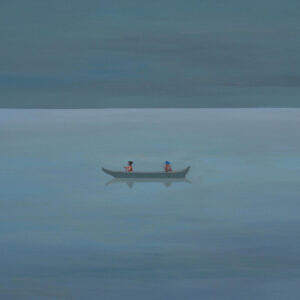
CD
Antoine BEUGER – Anastassis PHILIPPAKOPOULOS
“Floating”
A 74-minute collaboration piece by Antoine Beuger and Anastassis Philippakopoulos. Cover painting by Maria Filippakopoulou. 6-panel digipak. Mastered by taku unami
15,00€
In stock
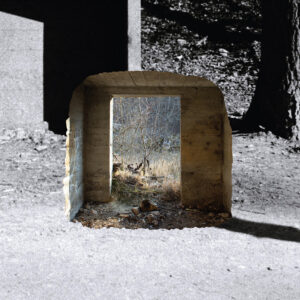
CD
Clara de ASIS – Ryoko AKAMA
“Sisbiosis”
Clara de Asís - electronics, percussion, field recordings
Ryoko Akama - amplified objects, field recordings
Track 1, 2: recorded and mixed by Clara de Asís in Leymen, France in May 2022
Track 3, 4, 5: materials recorded by Ryoko Akama and Clara de Asís in Leymen, France and Hofstetten-Flüh, Switzerland in March 2022, assembled and mixed by Ryoko Akama
Track 6: materials recorded by Clara de Asís and Ryoko Akama in Leymen, France and Hofstetten-Flüh, Switzerland in March 2022, assembled and mixed by Clara de Asís
Mastered by Taku Unami
15,00€
In stock
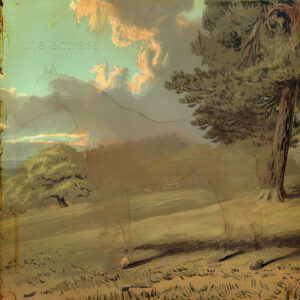
2 CD
Vanessa ROSSETTO
“The Actress”
Vanessa Rossetto's solo album. Mastered by Giuseppe Ielasi
Designed by Matthew Revert. Double CD, six-panel digipak.
24,00€
In stock
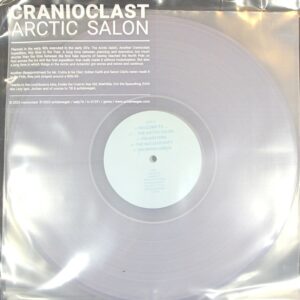
2 LP
CRANIOCLAST
“Arctic Salon”
Planned in the early 90's executed in the early 20's: The Arctic Salon. Another Cranioclast Expedition, this time to the Pole. A long time between planning and execution, but much shorter than the time between the first fake reports of having reached the North Pole on foot across the ice and the first expedition that really made it without motorization. But also a long time in which things in the Arctic and Antarctic got worse and worse and continue.
Double LP almost completely transparent like ice but hotter or cooler (we hope ;- ).
Cranioclast is a project which produces various artistic endeavours, most commonly music. Active since the 1980ies.
Icy clear vinyl in transparent pvc sleeves with sticker, 300 copies
28,00€
In stock
CD
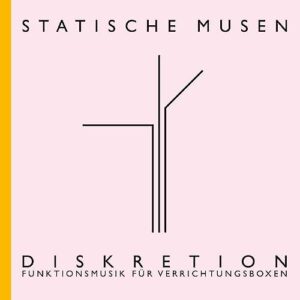
STATISCHE MUSEN (Asmus TIETCHENS)
“Diskretion. Funktionsmusik für Verrichtungsboxen”
TATISCHE MUSEN – New follow-up project to Hematic Sunsets by Asmus Tietchens
Hematic Sunsets are gone - here come the Statische Musen. A new outlet by Asmus Tietchens for musical endeavors that are more formular or genre based. The four long-form tracks of Diskretion explore "ambient" in the broadest sense of the term. Dense layers, slow dynamic progression, moody atmospheres.
Asmus Tietchens
Tietchens was born in Hamburg in 1947. Since 1975 he has been working as an independent musician; in 1980 he released his first solo record Nachtstücke. After producing a series of rhythmic and harmonic albums for the Sky label in the early 1980s he released his first industrial record Formen letzter Hausmusik in 1984 on United Dairies. Here Tietchens articulated his musical interests clearly: everyday noises were treated and at times deformed beyond recognition and placed into new contexts. Until now Asmus Tietchens has released more than 80 albums on international labels where he continues to explore the posibilities presented to him by specific sound sources (ranging from water sounds to pure sine wave tones). He has a more rhythm-oriented fake band project called Hematic Sunsets. Tietchens’ work is rooted in a deeply sceptic gesture, marked by frequent quotes from the works of philosopher E.M. Cioran on his album covers. Asmus Tietchens has been awarded with the prestigious Karl Sczuka Prize of the Südwestrundfunk (SWR) twice: in 2003 for his work Heidelberger Studien 1-6 and in 2006 for Trois Dryades. He lives and works in Hamburg.
14,00€
Out of stock
10CD box
COMPILATION
“The Complete Obscure Records Collection 1975-1978”
Over the last few years, the Italian imprint, Dialogo, has showed a remarkable dedication to the history of experimental music via reissues of seminal artefacts from the Cramps catalog, and important albums by Piero Umiliani, Ennio Morricone, Bruno Nicolai, Enrico Rava, and others. This initiative now takes on a towering scale with the first ever box set gathering the entire ten album collection of Brian Eno's Obscure Records, originally issued between 1975 and 1978. A truly groundbreaking body of recordings - many of which have remained out of print and difficult to find for decades - it contains some of the most important, influential, and enduring music to emerge during the second half of the 20th Century, which collectively reconfigured the terms of minimalism and laid the groundwork for the emerging movement of ambient music over its short, three-year run. Issued in a deluxe CD edition of 1,000 copies, each box set contains all of Obscure's albums, completely remastered by Andrea Marutti and housed in faithful mini-replicas of their original covers and liner notes, as well as a 130-page booklet, this historic collection marks the first time such a seminal series has received a complete repress. This is certainly one of the year's most interesting, essential, and widely anticipated releases, stunningly produced with the complete involvement of all the artists or their estates. When viewed collectively, the Obscure catalog reveals a remarkable, and previously unexplored counterpoint -- bridging the United Kingdom and the American West Coast -- to the dominant threads of minimal and experimental music, centered in New York that had long dominated the public consciousness. This historic collection marks the first time the seminal Obscure catalog has received a complete repress; simply a dream come true. Featuring Gavin Bryars, Christopher Hobbs, John Adams, Brian Eno, David Toop, Max Eastley, Jan Steele, John Cage, Michael Nyman, The Penguin Café Orchestra, John White, Tom Phillips, Gavin Bryars, Fred Orton, and Harold Budd.
140,00€
Out of stock
CD
Phill NIBLOCK
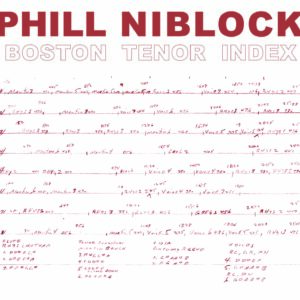
“Boston Tenor Index”
Phill Niblock "Boston / Tenor / Index", presents for the first time some of the earliest works by the American composer, inluding the three never before released "Index" (1969), "Tenor" and "Boston III" (both from 1972), thus making it possible to discover Niblock's starting point as a composer.
A filmmaker and photographer, Niblock began composing in the late 60s, while collaborating with the Judson Dance Theater in NY. As a composer his interest and field of research was connected to the layering of pre-recorded acoustic instruments into microtonal drones, which eventually led him to create some of the most unique tape collages in the second half of the 20th century minimal music. His earliest records, "Nothin To Look At Just A Record" and "Niblock For Celli / Celli Plays Niblock" were both issued by India Navigation in the first half of the 80s. Until now, it's been impossible to encounter Niblock's compositions from earlier than that period, a reality thankfully rectified by the long overdue publication of this "Boston / Tenor / Index" now on CD on alga marghen.
"Tenor" (1972) represents the first evolution of Niblock's musical thought towards the aesthetics of microtones, overtones, and drones which the composer would develop in following decades. The piece was recorded by the photographer Martin Bough on tenor saxophone and gradually dubbed back and forth by the composer in his New York studio. The sounds by the performer are submitted to the composer's techno-imaginative "acoustic optics" and deconstructed on behalf of structure, time and loudness. These specific aspects started to play an extremely important role in the artist's path as a composer.
The audio materials activated in "Tenor" through technologically de- and re-composed sounding textures, became a vehicle for those sound anomalies that would determine Niblock's audio poetics. Performing gestures are deconstructed though disseminating and editing processes by the imperceptible gestures of the composer. With its smooth flowing structure, "Boston III" (1972) stands at the very beginning of this illusion. It was recorded at the Intermedia Sound studio in Boston with Rhys Chatham (flute, voice), Martin Bough (tenor saxophone), Gregory Reeve (viola, voice); the composer himself also contributed with his voice. Using a 16-track Ampex tape recorder, at that time the world's newest recording device, Niblock was able to superimpose the recorded tones obtaining the desired aesthetic result which finally led him to a mesmerizing, immersive sound, a "very big, fat sound at fairly large volumes".
"Index" (1969) is an improvised sound performance by the composer himself. The listener is lucky to listen to (and imagine) the movements of the artist's fingers hitting a guitar string and the soundboard in breathtaking tempo. The piece itself represents early minimalism in its virgin state, untouched by distancing technology. Persistent percussive rhythm and corresponding resonances are irregular, the finger beats suffer natural dysrhythmia. Niblock's way of playing is very muscular here. It is more devoted to pure sensuality than to an intelligible order. This music is inscribed in the performer's body, it is a "body in a state of music". Guitar (both its body and strings), fingers and fingering fuse in a vehement action around which barely listenable sounds and resonances vibrate. Considering the extended pulsation as an organic blend of impulse, rhythm, drive, strength, vitality and passion, the end of this sole solo in Niblock's complete oeuvre is not defined by the fixed duration of the piece but as the consequence of the tiredness of the performer.
The CD also includes "Boston I" (1972), or the first chapter of the "Boston" series. This 25 minute bonus track is less massive than "Boston III"; still this version is much richer in dynamics and presents a more recognizable voice of each instrument.
As Niblock stated "This music is architectural. The intent is to fill the space. It's non-frontal music, non-proscenium space, anti-stage, not about an ensemble sitting in front of an audience, not about a single sound source. At least four speakers systems are desirable, arrayed around the periphery of the room, saturating the total space, engaging the air".
The music changes according to the loudness of playback. The interaction of the upper harmonics changes especially, with much richer overtone patterns being produced at louder levels.
Edition of 300 copies in digipak sleeve, including an 8-page booklet with photos and liner notes.
16,00€
In stock
LP
N & Bu.d.d.A. (Bund des dritten Auges)
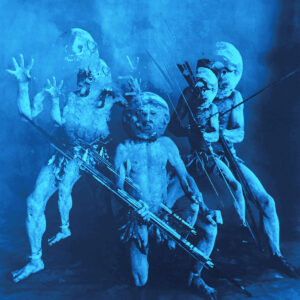
“0hne titel”
Hellmut Neidhardt, Chris Sigdell and Sascha Stadlmeier first met in 2020. They decided to record together and booked a studio in Dortmund. The recording session was spontaneous and somewhat chaotic. Thus it turned out, that only Hellmut’s tracks were really usable. Using some sections as a basis, Chris completely re-recorded his guitar, added a little bit of vocal here and there, and then sent a rough mix to Sascha, who in turn added violin and musique concrete. The final assembly was edited and mixed by Chris Sigdell.
N and Bu.d.d.A. have since toured together, and at three dates even performed as a trio. Future collaborations are a given possibility...
19,50€
Out of stock
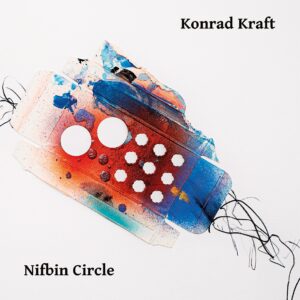
LP
Konrad KRAFT
“Nifbin Circle”
Nifbin Circle is the fourth release by Detlef Funder, aka Konrad Kraft, on the Cologne label Aufabwegen.
Sounds generated with two apps on the iPad,provided the basic structures and the sound space. The strangely enraptured textures created in this way, with a subtle percussive touch, were partly combined with supporting beats in the course of further processing. Thus, after more than 30 years, tracks with rudimentary melodies and rhythms were created again.
19,50€
In stock

LP
Robert CAHEN
“La nef des fous”
In the 1970s, Robert Cahen turned to the burgeoning field of video art, where he became a pioneering artist. He was originally trained in musique concrète, his creative background, and joined the Groupe de Recherches Musicales in 1972. The pieces on this record were composed in the GRM studios between 1971 and 1974. They testify to a lively inspiration and imagination combined with a precocious formal mastery that already carries the seeds of later developments, which the artist cleverly and inventively deployed in the field of visual arts. (François Bonnet, Paris, 2022)
--
«La nef des fous» (1974), 12’00
There are pieces of music whose title is obviously a mere label given afterwards to a finished product. And others, on the contrary, which develop in spiral around a bundle of images and impressions condensed into a few words. This is the case indeed with La nef des fous. However, this work by Robert Cahen oddly wraps itself around its title, with bends, breaks, and an impetus driven further every time to close a new circle, for such is the very essence of the spiral. This, at least, is the way I perceive the form of the work, with its theme-chorus which, in part one, both ponctuates and disrupts the emerging musical curve in various ways and at irregular intervals, as well as its broader and more open second part, which closes with a recollection of the beginning of the work. The challenge of a musical form justified by the topic it illustrates, right down to its gaps, its wanderings and its twists, and which would confer upon it the necessity of a profound logic, that of insanity, is the challenge attempted by Robert Cahen. In such a genre as tape music, so careful with respect to form, one can appreciate its audacity. La nef des fous, or Unity through heterogeneity, or Each to their own madness, but all in the same boat. This means that if we can listen to each of these sound characters, “broken chants”, which create the work for themselves, through the singularity of their delirium, we can also, from one to the other, trace the continuous chanting of a music that is inherently and spontaneously poetic, a music that carries “the unconscious under its skin” (Christiane Sacco). (Michel Chion, January 1976)
«Masques 2» (1973), 08’34
Concert version (for tape only) of an audiovisual work entitled Masques, in which the faces of old dolls and «masks», filmed during the Basel Carnival, were projected in 16mm. Masques 2 is a metaphorical version of Masques in which music is featured in its arcane musicality.
Through its concrete and suggestive music Masques 2 aims to bring to light hidden memories, buried within us, thus enabling an awakening, the resurgence of events from our own history. (R. C.)
«Plurielles» (1971), 08’35
Premiered at the Paris Biennale, 24 September 1971. Suite based on the score of a TV film directed by Sophie Talmon.
«Persona» (1971), 08’34
Premiered at the Paris Biennale, 24 September 1971.
«Passé composé» (1971), 05’29
23,50€
In stock

LP
Horacio VAGGIONE
“Schall / Rechant”
A discreet but essential figure in the field of musical creation, Horacio Vaggione has been crafting an ambitious, precise and highly significant body of work for over the last fifty years, coupled with a demanding research activity. This disc offers four purely electroacoustic pieces which illustrate, each in their own way, this singular and fascinating grammar developed by Horacio Vaggione, a complex but fertile grammar which establishes a very special relationship between structure and texture, between matter and formula, to create a fascinating musical space, made up of polyphonies and metamorphoses. (François Bonnet, Paris, 2022)
--
«Schall» (1994), 07’30
Schall exclusively uses piano sounds sampled and processed with various digital techniques. The sound palette focuses on several shapes of various sizes which reiterate, altered to varying degrees, throughout the process. The granular paradigm is clearly assumed here, as is also that of the interactions between various temporal scales. Basically, there is a concern for the articulation of micro-events. The piece essentially plays with low-intensity frames, composed of various planes and punctuated by stronger objects, in a kind of polyphonic dialogue between proximity and distance. (H. V.)
«Rechant» (1995), 15’51
Initially, a few brief sounds of instrumental origin — percussions, flutes, strings. Processed by means of various digital techniques, projected on various temporal scales, analyzed and re-synthesized, worked in their parts (in their saliences), articulated in their edges as well as in their interactions, these sounds show, as Bachelard would say, «pluralism under identity». I thus tried to compose morphologies by targeting properties contained in the material and by projecting them on temporal perspectives of all sizes. The title, an allusion to the old polyphonic technique, refers to the iterative content of these morphologies as well as to the modalities of their interweaving. (H. V.)
«24 Variations» (2001), 09’50
The word «variations» applies here to the morphological transformations of the material, as well as to the various contexts in which these transformations appear. The result can be heard as a continuous interaction between sound particles of different sizes, composed of several layers, reflecting a preoccupation with detailed articulation spanning different time scales. (H. V.)
«Gymel» (2002), 09’25
In Gymel I tried to compose a space-trajectory using layered sounds, produced by morphological operations (splits, clusterings) that spread out from location to location in variously dense objects. The space was treated through phase-decorrelation, a technique which I use extensively, both to create spaces and to locate sounds and movements within a polyphonic (stratified) context. (H. V.)
26,00€
In stock

LP
Pierre BASTIEN & Mike COOPER
“Aquapelagos Vol.2: Índico”
Presenting the second thematic volume on the »Aquapelagos« series - a collection of split LPs where selected artists offer their own take into water surrounded cultures and communities. After the initial release of the Anthology compilation Aquapelago in 2022 (Discrepant ,CREP91) and the split LP Atlantico by Lagoss & Banha da Cobra (Keroxen, KRXN027) we proudly introduce an unique collaboration in the series in the shape of no other than two improvising giants, Mike Cooper and Pierre Bastien.
This second volume blows the lid wide open with a sound journey inspired by the equally majestic and mysterious Indian Ocean, a wide space of open ocean bounded by Africa, to the west, Asia to the north and north-west and Australia, to the south west.
From Philip Hayward and Matt Hill’s liner notes:
»The album opens with Return To Chagos by emphasising human presence in the oceanic space, opening with gentle percussive taps and distant looped male vocalisation that gradually come into sharper focus, layered and thickened, accompanied by thicker percussion and mouth harp. The sense of departure is taken up in Trincomalee, which lifts over the oceanic textures, opening with slow, struck and scraped metallic sounds before thick low pitched wind instrument sounds enter, oscillating around shifting microtonal frequencies. The shore returns on Side 2, with the miniature epic of Nicobar elaborated over looped ‘atmos’ sounds of birds and insects over which tonal, slightly distorted electric guitar lines enter before looped high pitched feedback squeals join the texture. Summoning tropical storms and the disruption to the region caused by western intrusion, strong and startling brass accents appear, melding with the looping guitar feedback, creating eeriness and a sense of alarm. Tuangku is permeated by restrained dynamics and an expressive, breathy, low pitched, animalistic melodic voice that offers intermittent and ambiguous utterances, as if rendered in a language essential to and evocative of a place and time but impossible to precisely comprehend – coming from an ocean-aquapelagic beyond that can only be glimpsed and rendered by affect.« Philip Hayward and Matt Hill, March 2022
24,50€
In stock

LP
Jim HAYNES
“Inauspicious”
In a recent interview, the California artist Jim Haynes was asked to name his top five noise albums. In quick fashion, he listed off Kill The King, Send, Desnos, Persona, and Carcinosi. Since then, he's equivocated on which albums to choose, but the artists behind such works remain as the adjacent signposts and landmarks to his own constructions of industrial noise. How those records connect to the output from Haynes is found in their unique combination of smoldering dynamism and psychological inquest. For over twenty five years, Haynes has been an autodidactic clinician into the processes of corrosion, decay, and rust, turning his attention away from visual practices and more to the metaphoric crucible of noise and sound. By now, it seems like a cliche that the pandemic changed everything; but since that viral encroachment, there is a noticeable shift in Haynes' work post 2020. It's more aggressive and yet more controlled: a rarification and telescoping of the research into decay for more potent noise and more potent metaphor.
The tools for Haynes' work remain limited: motors, electronics, shortwave radio, found objects, all applied with considerable pressure. Compositionally, Inauspicious is a very rough moire pattern from overlapping elliptical structures that can negate and obfuscate just as easily as they can compound and aggregate. The album surges and collapses upon the two twenty minute chunks of controlled noise that follow an internal logic that snakes from brooding power drones, spectral radio transmission, and an aktionist demolition cast upon metal, glass, and unfortunate wooden objects. Rupture and release. Purge and pulse.
26,00€
Out of stock

3 LP
Keiji HAINO – Jim O’ROURKE – Oren AMBARCHI
“With pats on the head, just one too few is evil …”
The heavyweight trio of Keiji Haino, Jim O’Rourke and Oren Ambarchi return with their 12th and most epic release to date, the triple LP With pats on the head, just one too few is evil one too many is good that's all it is. Documenting the entirety of their final performance at the dearly departed Roppongi home of Tokyo underground institution SuperDeluxe in November 2018, the music spread across these six sides splits the difference between the guitar-bass-drums power trio moves and experiments with novel instrumentation that have defined the trio’s decade of working together. Containing some of the most delicate music the three have committed to wax since the gorgeous 12-string acoustic guitar and dulcimer tones of Only wanting to melt beautifully away is it a lack of contentment that stirs affection for those things said to be as of yet unseen (BT011), this wide-ranging release also offers up some of their most blistering free rock performances yet.
The side-long opening piece finds Haino on a single snare drum in duet with O’Rourke on unamplified electric guitar, playing in the lovely post-Bailey vein heard on his classic 90s recordings with Henry Kaiser and Mats Gustafsson. Spiky dissonance and ringing harmonics interweave with flowing melodic fragments as Haino single-mindedly explores the resonance of the snare like an untutored Han Bennink. On ‘Right brain, left brain; right, left; right wing, left wing. Just how many combinations can be made from these?’, O’Rourke moves to synth and electronics, joined by Ambarchi on drums, who at first focuses on sizzle cymbals before hypnotic cycles of gentle tom rhythms combine with electronic burbles and flutters to suggest a dream collaboration between Masahiko Togashi and Jean Schwarz. Ambarchi’s percussion is then joined by Haino on wandering, overblown flute, before the man in black switches back to the snare for a bizarre, stuttering drum duet.
For the first trio performance, Haino makes another new addition to his seemingly infinite catalogue of instruments, this time a homemade contraption he refers to as ‘Strings of Dubious Reputation’. Joined by O’Rourke on increasingly spaced-out electric guitar and Ambarchi on skittering percussion, Haino’s wonky, slack strings adds a definite ‘musique brut’ edge to this side-long performance, certainly one of the most enchantingly odd in the trio’s discography. When the group reconvene for the second set, spread out across the final three sides, they seem ready to breathe fire from the first instant. O’Rourke slashes distorted chords on the six-string bass, Ambarchi breaks into his signature irregular caveman thump, and Haino squeals and squawks on heavily delayed oboe before unleashing an overpowering electrical storm when he first picks up the guitar. For over half an hour, the trio pound out one of their most relentless performances, a constantly rearranging kaleidoscope of tortured fuzz guitar, insanely busy bass riffing and propulsive, tumbling drums. A hushed atmosphere initially reigns on the final long piece, given the mournful title ‘There are always things I wish to say but I can only convey them in this language August 6 August 9’. Haino’s clean guitar strumming calls up the shimmering tones of his PSF classic Affection, gradually building to a surging wall of sound, bass and drums lumbering through a roar of jet-engine guitar. Arriving in a deluxe trifold package with photos by Lasse Marhaug alongside inner sleeves with extensive live images, this epic release is perhaps the most remarkable document yet of this unique trio’s stamina and continuing inventiveness.
48,00€
In stock

CD
ILLUSION OF SAFETY
“Pastoral”
While Korm Plastics publishes books these days, this is a surprise CD only release. We sent him this demo in 2011 & we all forgot about it. Pastoral is a welcome edition to the catalog showcasing a less aggressive stance from the project, a more organic subdued presentation, sounds to make a clearing, & open space. The recordings history is a bit blurred now but it is very likely tracks 1, 2, 3, & 5 are Kurt Griesch and Daniel Burke, post 1995 tour work. Track four uses an instance of Reaktor 5 VCS-3 software emulation.
Illusion of Safety
Since 1983, Daniel Burke and his many conspirators under the Illusion Of Safety banner have over the course of 40+ full length releases traversed most every facet of the avant sound plane, from early industrial pop deconstruction to blindingly minimal sound art to densely surreal found-sound collage, each unique approach bending and reconstituting the expectations and possibilities of each realm, creating uneasy music that is dense and dystopian and yet also beautiful. Performing over 300 live concerts throughout Europe and the states included No Fun 2008, the Wroclaw Industrial Music Festival 2009, Sonic Circuits in 2010, with Shen Wei Dance Arts in 2011 at the Metropolitan Museum of Art in NYC, and at the Crisis Data Transfer Pre-Party October 2023. Outside of IOS Burke has collaborated with Jim O'Rourke, Jon Mueller, Randy Greif, Darin Gray, Z'EV, Cheer-Accident, Thomas Dimuzio, Kevin Drumm, Bill Horist, and others.
10,00€