
In stock
2 CD
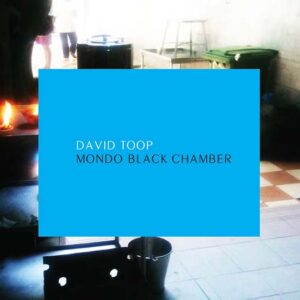
David TOOP
“Mondo Black Chamber”
Sub Rosa recordings 1996-2003: the complete series of works made by David Toop for their label. David Toop (born May 5, 1949) is an English musician and author, and as of 2001, was visiting Research Fellow in the Media School at London College of Communication. He was notably a member of The Flying Lizards. He released New and Rediscovered Musical Instruments (with Max Eastley) on Brian Eno's Obscure label (1975) plus many solo albums including 37th Floor at Sunset (2000) and Black Chamber (2003) on Sub Rosa. He was a prominent contributor to the British magazine The Face. He is a regular contributor to The Wire. Toop published his pioneering book on hip-hop, Rap Attack, in 1984. Eleven years later, Ocean of Sound appeared, described as Toop's "poetic survey of contemporary musical life from Debussy through ambient, techno, and drum 'n' bass."
17,00€
In stock

CD
ETANT DONNES
“Cinq Portes Soudées”
Etant Donnes is a French duo named after Marcel Duchamp's last major work. The group consists of brothers Marc and Eric Hurtado, born in Morocco and working mainly as performance artists and musicians. Their sound can be described as a mix of field recordings, found sounds and sometimes whispered, sometimes violent vocals. They describe their sounds like this: "Through Marc and Eric, it is the volume of each word that becomes an object-sculpture, together with the power of their bodies expressing their voices. Each event is a scream - indeed even the glissando - of the strength of the word that sometimes abruptly becomes a rock, a solid surface, not in the least fluvial, as is the narrative of a tale, novel or poetic epic. With both of them, there is no more trace of ancient prosodies, no more trace of the incomprehensible Sainte-Beuve who could claim: "I have to collect a volume of prose". The word, the voice, the volume take shape with each other, unveiling a theatre that theatre usually ignores, which has given it such things as a Samuel Beckett's Fin de Partie." Over the years Etant Donnes have collaborated with people like Lydia Lunch, Michael Gira, Alan Vega and Genesis P-Orridge. Cinq Portes Soudées was the band's fifth album, originally released on Die Form's Bain Total label in 1984 on cassette only. For this CD re-issue we have added a long bonus track not on the original album.
12,50€
In stock

CD
Massimo TONIUTTI
“The Clear Observatory – Eyepiece Musique”
Massimo Toniutti is an Italian sound designer and experimental musician. He is the brother of Giancarlo Toniutti who is best known for his electroacoustic masterpiece La Mutazione which was originally released on the Broken Flag label in the UK and later re-issued by Klanggalerie. Massimo started working with sound when he was a teenager, collecting and playing recordings of all kinds. In the 1980s he released four cassettes on his own label, all heavily influenced by the experimental music scene of that time. He soon developed a strong relation to electroacoustic structures, space/environment and silence. In the 1990s, he began investigating radio, creating his own sound archive and producing unusual broadcasts. He released an album entitled Il Museo Selvatico, which was re-issued in Australia in 2018 on Oren Ambarchi's label Black Truffle. A documentation of his radio work can be heard on the CD Le Gabbiette Di Faraday, collecting radio pieces from 1996 to 1998. On his new album, Toniutti deals once more with space and silence with an immersive, spacious long track. A loose-knit sound structure moves in a cyclic but unpredictable way embracing macro shapes, empty spaces and sound dust. While running crystal clear it invites you to observe it in depth and focus on distances. Details/events are spread along the piece like in a landscape, still and changing at the same time. A deep listening that can easily become “my personal musique d’ameublement”, to quote the composer himself. A model of this work has been part of a permanent installation in a museum since 2013. The Clear Observatory is a sort of never ending piece, the enlargement/development of a bunch of seeds. Sound sources (acoustic material and field recordings) are treated in a specific configuration of reverbs and delays to create this roomy “eyepiece musique”.
12,50€
Out of stock

CD
GEINS’T NAÏT
“Get’s”
Geins't Naït was founded in Nancy, France, in 1986 by Thierry Merigout and Vincent Hachet, both students at the Architecture School of Nancy. A year later Laurent Petitgrand joined the band. Their sound is often described as an equivalent of bands like Einstürzende Neubauten, Coil or Test Dept., but Geins't Naït is not pure classic Industrial. While Geins't Naït offers rough pieces of music as an extension of its punk attitude, Petitgand refines them to create some musicality within the post-industrial collages, adding guitars, piano, and classical instruments. Geins't Naït and Laurent Petitgand sharpen sounds, giving them a kind of balance and density and ensuring that the musical language evokes a deep experience. Their music is raw and fascinating, and largely influenced by Surrealists and Situationists. Their early albums were released by French label Permis De Construire, with Get's being the band's third album, originally released on cassette in 1988. It features 17 tracks that have been carefully remastered for CD by Martin Bowes.
12,50€
In stock

CD
HASTINGS OF MALAWI
“Live In Vienna”
Originally, Hastings of Malawi were Heman Pathak, David Hodes and John Grieve. They recorded their first album in one night in 1981 with no plan and no idea of what they were doing. They played drums, clarinet, synthesiser and piano but also made use of things that they found lying around the studio – old records, cookery books, telephone directories and a telephone. The recordings were played down the phone to randomly dialled numbers and the reactions added to the recording. All three had been involved in the recording of the first Nurse with Wound album Chance Meeting On A Dissecting Table Of A Sewing Machine And An Umbrella and had contributed metal scrapings, piano, effects, clarinet and guitar during the session. The band split up after the first album but reformed 35 years later with a string of new albums and a lot more experience and plan. In June 2023, Hastings Of Malawi were invited to play the Klang 30 festival in Vienna, Austria. This was only the second time the band graced a stage, 38 years after the first performance. This outstanding rare opportunity was recorded and is now presented on CD. Maybe your only ever chance to find out what they sound like live!
12,50€
In stock

CD
Kevin TOMKINS
“Her Favourite Distance Was That Between A Cough And A Dying Horse”
Kevin Tomkins is best known for his work in Whitehouse and his own group Sutcliffe Jugend, now called Sutcliffe No More. He also worked with Bodychoke, Inertia and Patient K. Most of his music has its background in the power electronics scene that evolved in Great Britain around the label Come Organisation and the group Whitehouse. Power electronics is a style of noise music that typically consists of static, screeching waves of feedback, analogue synthesizers making sub-bass pulses or high frequency squealing sounds; with screamed and distorted vocals. The genre is noted for its influence from industrial. It is generally atonal, like most noise music and also features a lack of conventional melodies or rhythms. To match its sonic excess, power electronics relies heavily upon extreme thematic and visual content: whether in lyrics, album art, or live performance actions. For his solo work, Kevin sometimes uses a very different style to his group work. An autoharp or chord zither is a string instrument belonging to the zither family. It uses a series of bars individually configured to mute all strings other than those needed for the intended chord. In summer 2023, Kevin played a rare solo show in Vienna at Klanggalerie's 30th birthday bash. It was based on his autoharp album using that very instrument plus voice and an arrangement of gimmicks and tools. A week later, he created an album based on the performance and his time in Vienna.
12,50€
In stock

CD
CLUB OF ROME (Asmus TIETCHENS)
“Große Statik”
Asmus Tietchens is a sound artist and composer from Hamburg, Germany. He got interested in Musique Concrete by listening to a German radio programme when he was 10 years old. In 1965, at the age of 18, Asmus started experimenting with tape loops and turned them into musical collages. Soon, the use of synthesizers was added. In 1980 his debut album Nachtstücke was released, produced by Peter Baumann of Tangerine Dream. This was soon followed by a series of albums of electronic pop music for the Sky label, home of many Krautrock bands. Tietchens often uses special source materials for his compositions such as water (Seuchengebiete), human voices (Von Mund zu Mund), paper (Papier ist geduldig). He is associated with the Industrial music scene through his collaborations and releases on labels such as United Dairies, Esplendor Geometrico or Dom Records. Tietchens never studied composition, he has no academic background, everything he does is self taught or learning by doing. Nevertheless, he was professor for sound design in Hamburg in recent years. Club of Rome was a pseudonym for Asmus Tietchens used on this cassette only release on ADN Records, 1985.
13,00€
In stock

CD
Philip SANDERSON
“Underneath The Underneath – A Vienna Souvenir”
Philip Sanderson first started releasing music as part of Storm Bugs in the late 1970s as captured on the A Safe Substitute CD (Klang gg378). He also set up his own Snatch Tapes cassette label releasing music by David Jackman and Alien Brains amongst others. Reviews in the Wire magazine of the instrumental tracks described them as being akin to “a boiling vat of electronic music that occasionally sounds like the work of a mad scientist”, whilst the songs have a “flavour of what Kevin Ayers might cook up if he were alive and forced to work with the Residents”. Philip has also released music under the names of Claire Thomas & Susan Vezey, Ice Yacht, Maids Of The Marsh and Vote Police. In summer 2023, Philip played one of his very rare concerts at the Klang 30 festival in Vienna, Austria. This album presents you the music played at the gig, plus music that was influenced by or created in Vienna while his stay.
12,50€
Out of stock

LP
Kathy ACKER & NOX
“Love, Emily”
The restored and remastered vinyl reissue of a sound performance by American writer Kathy Acker and French noise/experimental band Nox, published in 1987, with a poster and a previously unpublished set of documents, letters, texts and photos.
Originally released in a long sold-out edition of 50 cassette tapes, Love, Emily (Acte 3) was the third and final album of Michel Henritzi's industrial label AKT Production. Recorded in a Paris studio in 1987, this 25-minute collage of spoken word and noise saturations intersects two radical voices from literature and experimental music of the time: American author Kathy Acker reading excerpts from her book My Death My Life by Pier Paolo Pasolini, and Nox, mainstay of the French noise and industrial scene. Pulled from oblivion, restored and remastered for vinyl by Slow Moves, this archive gem crosses the clashing worlds of poetry and industrial music, melding Acker's thought-provoking words to absolute and inflexible industrial sounds. A lot of it is noise, but a lot of it is also play; research for a new mystique, generating unusual forms and unknown languages.
Published in a limited edition of 400 copies, this vinyl also comes with a long printed panel of previously unpublished photographs and letters from Kathy Acker, tracing the background exchanges that led to the collaboration between the groundbreaking writer, Henritzi and Nox, a poster of Kathy Acker with French translations and a download code featuring both music and extra archival material (interview and articles).
25,50€
In stock

LP
Michel HENRITZI
“Flowers Of Romance”
Listening to Harold Melvin & The Blue Notes’ “Wake Up Everybody”I get a sudden striking flash of Michel Henritzi at work. To me Michel is first and foremost a working man, be it in Dustbreeders the Metz originating so called “noise” outfit, or in his collabs with a wide and varied range of Japanese comrades such as Tetuzi Akiyama, Fukuoka Rinji and of course Junko, always retaining his name as the anchor point of a free man. Freed from the salaried workers yoke, the worker can claim his own name, Michel Henritzi; and paint the world and its ugly oppressive separation morphing into the future of an indescribable liberation. It takes time to do so and the work unravels here over 2 full sides recorded in a live situation. Against the “abat faim” (Guy Debord in “the Encyclopedia of Nuisances”) of canned music the work of Michel Henritzi creates a lived in situation that, in praxis, embodies the grinding destruction of exploitation and the struggle against it. Michel Henritzi works as Penelope hunched over his tool, a lapsteel, protected by his workers cap which is also a military attribute. When the work is done is it now made possible to be done again, always different, unlike mass produced commodities it is the work of a sole man working within the frame of a disjointed society, trying to weave it back together.
Michel Henritzi - Lapsteel & effects.
17,00€
Out of stock
CD
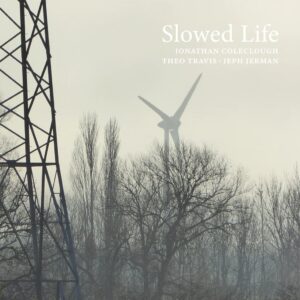
Jonathan COLECLOUGH – Theo TRAVIS – Jeph JERMAN
“Slowed Life”
We are delighted to announce the release on ICR of Jonathan's first physical album in a long time. A 72 minute long piece housed in a beautiful 6-panel Ecopack.
This monumental work, which took many years to construct, sees Jonathan working with samples of the flute playing of Theo Travis, weaving repeating phrases harmonising and looping around each other, moving towards an unusual break in the flow provided by a field recording by Jeph Jerman. After which the flute based sounds return to form a vast shifting drone. It is a quite unique piece, very much in the tradition of Jonathan's other long-form works & is highly recommended.
13,00€
In stock

CD
Steve PARRY – Colin POTTER
“Womb”
"WOMB" by Steve Parry (Neu Elektrikk / Hywl Nofio) and Colin Potter. Recorded on 1/4'' tape in 1981, it has remained unreleased in any format until now. Limited to 500 copies in a digipak CD with an 8-page booklet containing detailed information about the recordings.
''When it was mixed, I don’t think either of us knew what to do with it, as it was unlike any other music that was around at that time. So it languished….
Due to various house moves, Steve & I lost touch & I eventually moved away from Yorkshire, my favourite part of the world. Several years ago, on a short holiday in York I wandered into a pub that I’d never visited before & there was Steve, who I hadn’t seen for over 20 years. Full circle. We decided that the lost album should be released & Steve had the original ¼’’ tapes baked & I’ve now remastered the recordings. Listening to it was a strange experience. Many times I had to try to remember what some of the strange sounds were, or why we did this or that. The sound of convention & caution being thrown to the wind.
I’m glad we did it & I hope you like it.
Colin Potter, London 2021
"Womb remained unreleased other than a few cassette tapes given to friends. The Ampex 406 master tapes were severely damaged due to natural deterioration, so the original tape had to undergo a time-consuming restoration process. Thankfully the project was salvageable and the music was transferred to digital. I must admit listening now to these recordings I am reminded of the creative surge and ebullient enthusiasm for making the music. It was indeed an exciting time."
Steve Parry
Recorded: (1981) at Integrated Circuit Studio, Sutton–on-the-Forest, York & Wern Studio, York. Field recordings (1981) by Steve Parry on a Sony portable cassette tape recorder.
• Engineered by: Colin Potter
• All Instruments / sounds – Steve Parry & Colin Potter
• Producer – Steve Parry, Colin Potter
Instruments/devices used in the recording included: saw, plastic bucket and plastic tube, water, alarm clock, cotton rags, metal bars, electric drill, drum machine, bongo drums, analogue synth & sequencer, field recordings, electric, acoustic & bass guitars, flute, keyboards, found sounds, comb & voice.
13,00€
In stock

LP
Anne GILLIS – Jac BERROCAL – Vincent EPPLAY – Timo van LUIJK
“Si()six”
Several years of mutual appreciation and encounters on- and off-stage have been the root of this chance meeting, resulting in an unplanned mysterious collaboration album where the aura of each individual is augmented by the magic osmosis of united forces. The 12-tracks display a collage of dreamy musique concrète with desolate instrumental and vocal interventions, masterfully balanced out by Vincent Epplay.
Anne Gillis: words, voice, noises
Jac Berrocal: words, voice, trumpet
Vincent Epplay: field recording, percussion, Synthi AKS
Timo van Luijk: sounds, strings
24,50€
In stock

LP
ANIMA MUSICA & R. CARLOS NAKAI
“Atlantic Crossing”
The strange thing about the music of Anima is that it’s often considered as strange, while it’s actually very natural. It has a free spirit, analog to nature. For this release the natural spirit is strengthened by the participation of indigenous American flute player and composer R. Carlos Nakai who did a series of concerts in the US and Europe with Paul and Limpe Fuchs in the 1980’s. As with almost all Anima work, the natural feel manifests itself not only by the musical approach but also through sounds generated by natural materials as metal, wood, stone and air, and of course the absence of electronic devices. This LP is a reissue of a rare privately released cassette from 1988 and was recorded by the Bayerischer Rundfunk. May this slice of timeless free spirit be a trigger to more awareness concerning our decaying freedom.
Performers: Limpe Fuchs, R. Carlos Nakai, Paul Fuchs
Recorded by Bayerischer Rundfunk at Münchener Freies Musikzentrum, October 8, 1988
22,00€
In stock

LP
Anne GILLIS
“Aha”
Since more than 40 years, Anne Gillis has discreetly unfolded her proper singular universe without any compromise. She playfully moves with determined restrictions, excavating contrasting forces; sensual and visceral, mechanical and organical, black and white, … She extends this personal expression in her visuals using self-portrait photos, handwritten text and her theatrical performances are equally aligned with this spirit. Her music can be considered as musique concrète using the tape machine as compositional tool, manipulating her recorded sources, mainly consisting of extended voice and different (instrumental) sounds with addition of electronics and treatments. In both her photography and her music, Anne Gillis works fully analog.
24,50€
In stock
LP
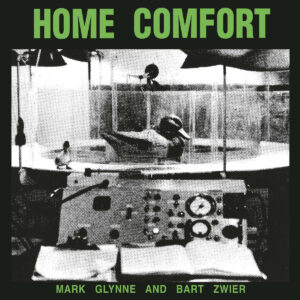
Mark GLYNNE & Bart ZWIER
“Home Comfort”
Small 2024 repress.
Very pleased and grateful to announce this ‘Home Comfort’ reissue by Mark Glynne and Bart Zwier, originally self-released in 1980.
Maybe a bit of an unexpected title to appear in the LSD catalog but my love for this album goes back to my late teenage years and has had an addictive effect since, like a spleen infused magnet.
With this album Glynne and Zwier, based in the Netherlands and connected to the Ultra scene, drew an insular blend of intimate post-punk and chamber (bedroom) songs with surreal scenic reflections. Probably its naked singularity defying categorization has left it so unnoticed, even 43 years after the making. It also features a reciting Marlène Dumas still quite unknown at the time.
With biggest gratitude to Mark Glynne who instantly felt confident with my proposal to reissue this silent witness of lasting beauty.
My long time Japanese friend You Ishihara (White Heaven, The Stars) who bought the LP when it came out in 1980 still considers it as one of his all-time favourites. This is what he writes about ‘Home Comfort’:“Resignation and fear in a desolate mental landscape. This album, which exists like a shelter for those who have quietly escaped through the backdoor of the world, vividly reflects the inner depths of the devastated Amsterdam of the early 80’s. A beautiful and sad, unmistakable masterpiece.”
22,00€
Out of stock

LP
Laurel HALO / Jessica EKOMANE
“Octavia / Manifolds”
Laurel Halo: Octavia
Octavia, a piece for piano and electronics, explores the relationship between melodic motifs and textures in a singular way, intermittent moments of melody, harmony and sound materials connecting and disconnecting, to indicate a series of nets or webs, swaying in and out of one another. These sonic nets gently float, spin and merge, and the effect is one of gently floating over an abyss. The work is inspired by the “spiderweb city” of the same name in Italo Calvino’s Invisible Cities: “Below there is nothing for hundreds of feet: a few clouds glide past; further down you can glimpse the chasm’s bed....Suspended over the abyss, the life of Octavia’s inhabitants is less uncertain than in other cities. They know the net will last only so long.”
Jessica Ekomane: Manifolds
Entirely computer-generated, Manifolds is a work that explores the multiple possibilities of polyphonic writing, extending it to the “multiphonic” universe where sources and timbres diffract themselves in the listening space. The different voices of the composition no longer follow the traditional parallel trajectories of musical dialogue, but find themselves propelled as if into a particle accelerator, a “collider” freed from all formal rhetoric to reach a state of liberation of energies that is truly confounding. It is then that, in the multi-layered universe of sonic electrons, as if against its own will, a “chant” of overwhelming humanity is revealed.
—François J. Bonnet, 2023
23,00€
Out of stock
LP
Maria BERTEL & Nina GARCIA
“Knækket Smil”
In an exhilarating convergence of sonic exploration, experimental noise guitarist Nina Garcia and danish trombone virtuoso Maria Bertel have teamed up to create a heavy-hitting, collaborative record that pushes the boundaries between extreme improvisation and harsh noise. Both renowned in their respective fields, Garcia and Bertel bring their unique styles and influences to create a masterpiece of collaborative improvisation.
Known for her fearless approach to the guitar and her ability to conjure otherworldly sounds, Nina Garcia has carved a niche for herself in the experimental music scene. With a minimal setup consisting of only guitar, pedal & amp, constantly touring, collaborating and evolving, Garcia has established herself as a trailblazer, challenging conventional norms and redefining the possibilities of the guitar beyond tonality. There‘s as much free improvisation in her playing as it is informed by no wave and the energy of free jazz, but most of all, this is kinetic music.
And this might be the intersection where Garcia and Maria Bertel meet.
Bertel, an accomplished trombonist active in the free noise rock monolith Selvhenter and in the duo Gud Er Kvinde (God Is A Woman), is no stranger to pushing the limits of her instrument. Known for her dynamic performances and innovative approach, Bertel has earned international acclaim for her ability to seamlessly blend genres and traverse musical landscapes - from delivering the low end in Selvhenter to the drone explorations of G.E.K., or joining the Vladislav Delay Quintet on stage - together with Nina, she focuses on rhythmic possibilities of her instrument. The distorted, feedbacking trombone is as controlled and precise as it is sonically explorative.
KNÆKKET SMIL (meaning „broken smile“) is a living, breathing, moving entity. It‘s a testament to the raw and emotive power of these two players. Bertel and Garcia‘s practice of mutual listening, reacting and merging is as radically tender as lovers exploring each other‘s scars.
This approach to collaboration is also reflected in every other part of that record. It‘s a joint effort of three labels, french label No Lagos, which is a home to many of Garcia‘s ventures (and the graphic work of Helene Marian), germany‘s Otomatik Muziek, where Maria perviously released with G.E.K., and belgian experimental stalwarts Kraak as focal point.
25,00€
In stock
LP
Giuseppe IELASI
“Rhetorical Islands”
First vinyl edition of the album Rhetorical Islands, originally released by Giuseppe Ielasi in 2012 as a limited-edition CD on his Senufo Editions label, with recordings made in 2011 as a commission for l’Audible Festival, Paris.
The album’s ten tracks have neither titles nor accompanying text, standing for themselves as what Ielasi himself has called “isolated sound worlds”. They are nonetheless unparalleled in their plasticity, acoustic events with a rare degree of tangibility. Ielasi evokes physical objects, some of which seem to have been constructed out of paper and cardboard, others based on a mechanics of elastic materials. Of course these objects are hallucinations, and precisely because Ielasi constructs them so masterfully there’s no need for any further information. Here’s to everyone creating their very own sculptures while listening to Rhetorical Islands!
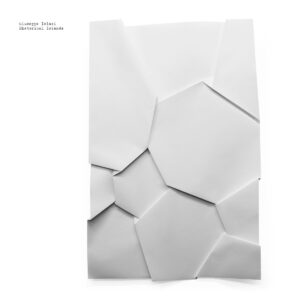
The front and back cover features 0.058, a work on paper by the artists Thomas & Renée Rapedius. They make sculptures whose form and artistic inspiration are defined by their materials. Like Ielasi’s acoustic islands, their impact derives from self-referentiality, resulting in paradoxical objects that embody both a detailed material study and a potential for free association.
24,50€
In stock
LP
Hanno LEICHTMANN
“Outerlands”
A quietly influential figure among electronic and experimental circles since the late 90s, Berlin based sound artist Hanno Leichtmann has been developing a sprawling and idiosyncratic vision both as a creator and curator.
With a keen sense for charting new territories, Leichtmann's work spawns a multitude of languages that go from delicate ambient excursions to techno explorations or abstract sceneries on numerous sound installations, releases on such esteemed labels like Entr’acte, Karl Records, Arbitrary or The Tapeworm and collaborations with artists like Valerio Tricoli or Jan Jelinek. A reflection of his keen sense of discovery.
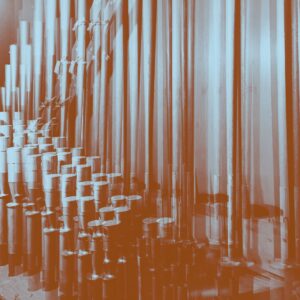
Centered around the Villa Aurora Organ, an intriguing and mostly unknown instrument built in 1928/29 by the Artcraft Organ Company in Santa Monica, California, 'Outerlands' presents a deeply personal approach to the instrument's particular properties, very much in line with Discrepant's ethos. Consisting of a pipe organ, a wall mounted marimba and a two octave tubular bells/chimes ensemble, remotely controllable by MIDI, the Villa Aurora Organ's rich palette of sounds is translated into 12 short tracks capable of conveying the mesmerising spirits of minimalism, exotica and devotional music.
Starting with the ecstatic sound of the pipe organ, 'Lucero' sets up the hypnotic mood for 'Outerland's excursions through moments of spiralling repetition - 'Tramonto' -, blissful contemplation - 'Sunset' or 'Notteargenta' - or underlying tension - ‘Coperto’. 'Espera' amps up the unease, with queasy organ tones lurking beneath marimba harmonic motifs that wouldn't sound out of of place on some survival horror movie, while 'Miramar' or 'Revello' bring an uncanny sense of familiarity through its repetitive melodies. Drifting seamlessly through a variety of moods that somehow feel connected - the outerlands are within you, if you allow yourself to let go.
25,00€
In stock

LP
NPVR
“33 34”
NPVR is the avant garde duo made up of the late Peter Rehberg and Nik Void. Editions Mego is proud to present their second and final release. No this is not some kind of Beatles synthetic AI that raises the dead reconstructed recordings but rather a new album made by the humans and their machines.
The initial meeting of Rehberg and Void was in London in 2016 and despite or due to their mutual awkwardness found solace and compatibility in the fact that they both had a similar electronic modular set up, along with matching cases to transport all. The idea to collaborate was an obvious and organic process as a means to connect their individual gear together and observe the outcome. The fruits of these initial experiments, recorded in London, resulted in the playful experimentation of their acclaimed 2017 release 33 33 (eMego 251).
Now in 2024 Editions Mego presents the logically titled follow up, 33 34. These sessions were recorded six months after the initial recordings at Peter’s home in Vienna. This was planned out as a mirror city release to the original London recordings. With Peter having access to his full studio set up this time around we encounter a rich audio landscape which organically folds together a variety of musical genres blurring any distinction between these forms so the resulting music hovers as a new cloud of sound. Any musical form, be it industrial, electro-acoustic, ambient, drone and techno all coexist and melt into the other as the ensuing result unveils a hypnotic swarm of divergent sounds (music). When active there were no lines or contexts with NPVR, either between sound or genre within these recordings or live where NPVR were at home playing at a techno club one night and an avant garde venue the next.
The initial session of these recordings was edited by Rehberg and sent to Void to further develop. Over time the final versions were agreed on and then shelved as other outside projects took over. The awkwardness had been surmounted and the two had become close friends. NPVR performed at a range of venues such as Tresor, Sutton House, Corsica, Blitz, Paris GRM #Focus2, LEV Festival and Rigas Skanumezs Festival. Following Rehberg’s untimely passing Void had difficulty listening back to the sessions but eventually thought it fit to complete and release this album, of which even the artwork (like 33 33, an image from Zurich photographer, Georg Gatsas) had been decided upon prior to Rehberg parting ways.
There is an unmistakable joy to these recordings. One encounters an enthralling exploration of their chosen machines which conveys the excitement of what can be randomly conjured when people speak through such devices. There is no grand statement or argument here, just the sheer thrill of creation and the recorded results of random encounters. The art of collaboration was always a mainstay of Rehberg’s practice from the advent of the MEGO adventure. Rehberg & Bauer was an initial collaboration with former business partner Ramon Bauer. Even at this stage one can hear a relaxed sense of delight in the sheer discovery of sound.
A mix made for the Wire magazine following the release of 33 33 hints at the freedom that comes with endless urge for exploration and discovery. Abstract tracks from Z'EV. Jérôme Noetinger and Jung An Tagen are included alongside British stalwarts The Fall and New Order. There were no lines between pop / academic / underground or mainstream in Rehberg’s world. All of it sat at the same table. It is just matter in the atmosphere, like the diverse exploration found in these recordings that comprise 33 34.
Towards the end of his life Rehberg was obsessing over the immense output of the German ambient musician Pete Namlook. An artist renowned for not only his sprawling catalogue of ambient masterpieces but one who often said his main inspiration was nature. This is apt with regards to the work of NPVR which also aligns with such thought as the intertwining of the two individual artists and their machines results in a natural symbiotic flow, as it happens, just like in the world around us.
24,50€
In stock
LP
COMPILATION
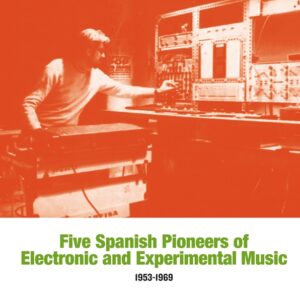
“Five Spanish Pioneers of Electronic and Experimental Music: 1953-1969”
This LP reveals the extraordinary diversity of research -- almost all hidden -- by Spanish musicians in the '50s and '60s. Those pieces were composed while the country was under the tyranny of Francisco Franco. It is truly the ultimate grail, developed by musicologist Miguel Álvarez-Fernández: he is its curator, editor and commentator. This undoubtedly marks a major step in the approach and understanding of this music which had to fight to exist before the death of Franco in 1975. Miguel Álvarez-Fernández (Madrid, 1979) is a writer. He hosts the weekly radio broadcast Ars Sonora -- dedicated to sound art and experimental music, and offering hundreds of freely available podcasts on Radio Clásica (Spanish National Radio). Five Spanish Pionniers of Eletronic and Experimental Music aims to present five composers who most often work outside the rules and without the possibility of help from their own country. Jose Val del Omar (1904-1982) is essentially a creator, a filmmaker developing a dreamlike art -- not without links with Federico Garcia Lorca or Luis Buñuel. Eduardo Polonio (b. 1941) has published, in forty years, more than a hundred works. Josep Maria Mestres Quadreny (1929-2011) joined the Manuel de Falla Circle in 1952 and in 1974 he founded the Laboratori de Música Electroacústica Phonos. During his life he collaborated with Joan Miró and Antoni Tàpies. Juan Hidalgo (1927-2018) participated in the music festival XII Internationale Ferienkurse Fur Neue Musik in Darmstadt in 1957. The following year he met the American composers John Cage and David Tudor. A member of Fluxus, in 1966 he participated with Gustav Metzger, Otto Muehl, Wolf Vostell, and Hermann Nitsch in the Destruction in Art Symposium in London. Cristóbal Halffter (1930-2021) was soon considered one of the most important composers of his generation. As a lecturer at the Internationale Ferienkurse für Neue Musik in Darmstadt, he worked with Pierre Boulez, Karlheinz Stockhausen, and Luciano Berio.
16,00€
In stock
CD
COMPILATION
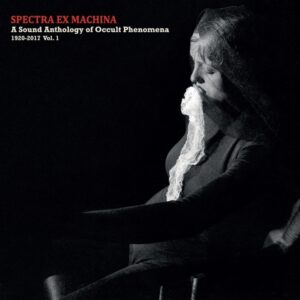
“Spectra Ex Machina: A Sound Anthology of Occult Phenomena, 1920-2017 Vol.1”
The anthology Spectra Ex Machina brings together rare documents pertaining to so-called occult phenomena, most of them taken from little-known archives. In the course of three volumes, this series traces an audio history of parapsychology through the exploration of spiritualism and haunted houses (Vol. 1); musician mediums (Vol. 2); experiences of extrasensory perceptions (clairvoyance, psychokinesis, etc.) and electronic voice phenomena (Vol. 3). The documents gathered here are, by their extravagance and far-fetched aspects, more than the mere objects of belief one would be tempted to reduce them to. They are vestiges of aberrant phenomena, fossils of an unknown civilization buried in the depths of the unconscious that are revived, in a way, when audiences listen to them. They can be understood as "works," in the full artistic sense of the word, and constitute a kind of "cabinet of sound curiosities" that is worthy of aesthetic interest. Sometimes imbued with a disconcerting dramatic intensity, these documents bear the features of an authentic time machine, placing the listener in the position of a witness of the time immersed in the dim darkness of the experimental hall. And it is at that precise moment that the aesthetic power of these archives takes precedence over their probative value. Their somewhat old-fashioned charm, maintained by the surface noise of magnetic tapes and old wax disks, gets stronger with each listen. Comes with 32-page booklet.
14,50€
In stock
CD
COMPILATION
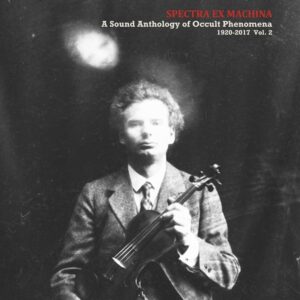
“Spectra Ex Machina: A Sound Anthology of Occult Phenomena 1920-2017 Vol. 2”
The anthology Spectra Ex Machina brings together rare documents pertaining to so-called occult phenomena, most of them taken from little-known archives. In the course of three volumes, this series traces an audio history of parapsychology through the exploration of spiritualism and haunted houses (Vol. 1); musician mediums (Vol. 2); experiences of extrasensory perceptions (clairvoyance, psychokinesis, etc.) and electronic voice phenomena (Vol. 3). The link between music, sound and the paranormal is manifested in many different ways. Gerard van der Leeuw, the Dutch historian and philosopher, wrote "Music represents the great struggle of reaching the wholly other, which it can never express." Furthermore, "The effect of music on the emotions is so mysterious as to seem magical. There is no logical explanation why a particular combination of musical notes, whether in the form of a tune or of a simple chord, can affect the heart. Nothing in nature has perhaps so persistently resisted explanation," as said Derek Parker, the British journalist. Since music is arguably the most intangible of the arts and since the paranormal, in all its manifestations, continues to intrigue people, the placing of these two subjects together seems obvious. This second volume of musical and audio anomalies continues and expands upon the works initially reproduced in the latter. Rosemary Brown makes a welcome re-appearance, especially with a performance of Grübelei via Liszt, as well as the Caruso-inspired tenor Leo May making a repeat performance. Few people realize that both Anton LaVey and Aleister Crowley were quite fine musicians and Alex Sanders was also interested in music. The background music of Wagner's Tannhäuser used by the latter combines both pagan and Christian elements. So close your eyes and let the magic of sound take over! Also featuring David Behr, Jack Webber, Robert, Rita Goold, Leslie Flint, Leo, Carmen Rogers, Uri Geller, Jean-Louis Victor, Joe Meek, Howard Menger, Barbara The Gray Witch, and Rev. Patrick J. Berkery, Ph. D.
14,50€
In stock

LP
COMPILATION
“Funeral Gongs Ceremonies in Ratanakiri, Cambodia”
Those recordings of gongs orchestras were produced in 2003 and 2004 during funeral ceremonies in two Kung villages and one Jaraï village in Ratanakiri province, Cambodia by Laurent Jeanneau (Kink Gong), during a time when the jungle had not been replaced by rubber plantations. Focusing on funeral ceremonies, these hypnotics pieces are intense and haunting sonic experiments.
16,00€
In stock
2 CD
Milan KNIZAK & PHAERENTZ & OPENING PEFORMANCE ORCHESTRA
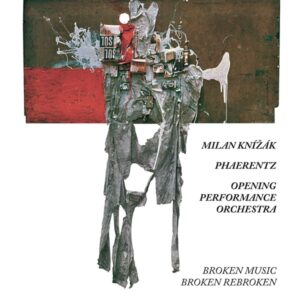
“It’s Not Quite That Inventive (Sixty Years with Broken Music)”
The album, featuring Milan Knizak, Petr Ferenc (aka Phaerentz) and Opening Performance Orchestra, includes Knizak's 1973 private recording Broken Music, released as a multiple of forty copies by Armin Hundertmark in 1983 on Edition Hundertmark, and a live version of Broken Rebroken, performed in January 2020 at the Museum of Czech Music in Prague. The album comes with a comprehensive 24-page booklet that includes an interview with Milan Knizak on the topic of Broken Music, an extended essay by Petr Ferenc that originally appeared in Czech Music Quarterly, visual documentation from the archives of Maria Knizakova and Opening Performance Orchestra, as well as Anna Bastyrova photographic documentation from the 2020 performance of Broken Rebroken. The cover of the album consists of photographs of Milan Knizak's now-defunct 1963 assemblage. Mastering was done by Stephan Mathieu and Gabriel Séverin, who also made the audio restoration of the archival recording Broken Music.
15,00€
Out of stock
CD
CONTRASTATE
“Life without Agriculture”
An album "re-imagining" some of the dadaist, futurist, and surrealist clubs of the 20th century, from Moscow 1918 over Tehran 1966 to Münster 1997; a wonderfully surprising and experimental work by the British post-industrial and ambient performance trio.
CONTRASTATE have created an amazing new work that is inspired by some historical, but also newer places (cafes, clubs, cabarets - including fantasised venues that could / should have existed), relating to the glorious times of the 'true' avantgarde.
"The arc that links them all is the experimentation, the exchange of ideas, and the platform to perform free from the “social norms” of the time." [Stephen Meixner of Contrastate]
The dreamy first half of the album establishes a very sombre and melancholic mood, but when the central pieces "London 1912" and "Zurich 1916" enter it leads to more collagenous and experimental areas, using guitar and bass harmonics, pulsing analogue electronics, spoken words, and all kinds of samples and weird processed sounds. The versatility especially of the second half allows for a fully immersive listening experience, with a vast array of details and twists.
"Imagination is subversive, because it puts the possible against the real. That's why you should always use your wildest imagination. Imagination is the biggest gift humanity has received. Imagination makes people human, not work..." [Jan Švankmajer, "Decalogue", Touch Movements, 2017].
CONTRASTATE, formed in 1987, are a trio from London that have operated on the edge of experimental ambient, dark post-industrial, and performative art areas, often using spoken word lyrics with a strong political, anti-imperialistic approach/agitation. Their early 7" for Drone Records "English Embers" (DR-05) became one of the highlights in the series.
13,00€
In stock
CD
MOLJEBKA PVLSE
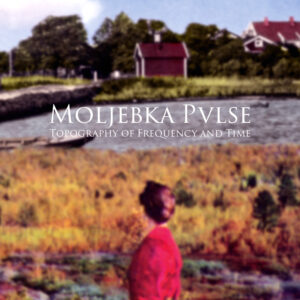
“Topography of Frequency and Time”
The Swedish ambient experimental and electro-acoustic "multidimensional drone"project with the sixth release in our new CD series, applying the concept of TOPOGRAPHY to sounds and time, which can be interpretated "geographically" like a landscape in a similar way.. - "an expedition through expansive sonic landscapes that stretch beyond our daily awareness...an open invitation to transcend the visual confines of physical space, encouraging a deep dive into the unexplored realms.."
13,00€
In stock
10"
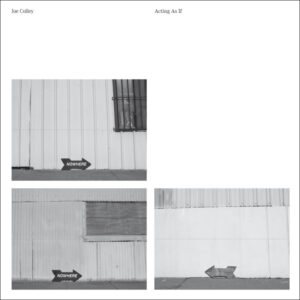
Joe COLLEY
“Acting As If”
*** 2022 release ***
Joe Colley is a master of using mechanical object sounds and electronic static, but also strange lo-fi found sources and field recordings, creating alienating, surrealistic effects, similar to the likes of Small Cruel Party, Jim Haynes, Das Synthetische Mischgewebe, or even the more experimental side of Zoviet France.
His newer compositions are filled with electro-magnetic hummings, strange hissing and the pourings of metallic objects as a basis, but you never find the use real instruments, synths, or masses of effect procession. Thus a very own scent of mystery appears, as all of these radiations are not really from this planet, without any "cosmic" connotations.
For the creator, these sounds are connected with unreal emotions of "Being Lost", a mistrust in what may be called reality, and a general feeling of alienation. You can only wonder how this can result in such beautiful droning expanses. Through these strange 30 minutes of drones, the mind is thrown inside an unrecognizable and confusing realm of broken electricity and something like audible-made atmospheric pressure.
"His swarming masses, throttled rumbling, and smoldering tension are all encircling and folding in on themselves. Rhizomes of sound that speak poison. Drink up, if it doesn't kill you, it will only make you stronger" (Jim Haynes). Ltd x 300 copies with artwork by MEEUW, featuring special silver print on reverse board sleeve.
18,00€
In stock
CD
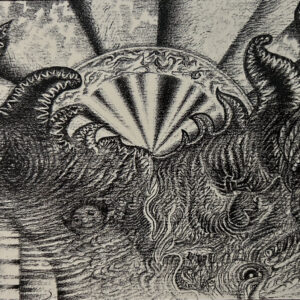
HOLLYWOOD DREAM TRIP ( C. HEEMANN & CELER)
“Second Album”
*** 2023 release ***
The project of CHRISTOPH HEEMANN and CELER (WILL LONG) with their second somnambulant collaboration, recorded and mixed in Heemann's studio in Aachen in 2013... a 42+ min. movement
13,00€
Out of stock
CD
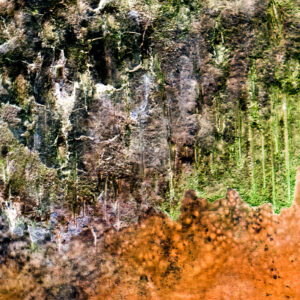
Francisco LOPEZ & Daniel MENCHE
“Sacrificed Phloem (Zannec Line)”
*** 2022 release ***
For the first time both long active artists from the experimental / post industrial / field recording scene have collaborated, creating a mesmerizing one-tracker (56+ min.) with many breathtaking moments and passages from the very beginning... an incredible intense new sonic reality arises, full of surrealistic (almost psychoactive) drones capturing your whole body, taking you on a journey to the microworlds of the "more than human" lifeforms... a "Phloem" is the part of plants that transports organic compounds = photosynthates.
13,00€
Out of stock
CD
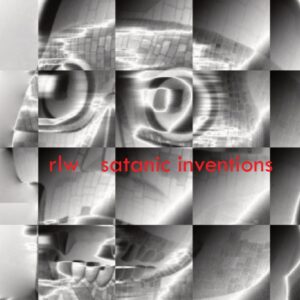
RLW
“Satanic Inventions”
*** 2022 release ***
Black Rose Recordings are proud to present the stunning new solo release by Ralf Wehowsky. He is currently one of the most respected electronic composers of our day. With this release his starting point is the comparison of the black plague and covid-19 as there are some astonishing similarities of how people dealt with the diseases. Denial of reality, conspiracy theories, searching for scapegoats, etc: Surely satanic inventions are the source of all calamities? Extracts from documentary recordings and a few fragments of ars nova/subtilior compositions have been transformed, extended, fragmented and re-contextualised, from which the 15 pieces of this release are built.
Ralf Wehowsky was one of the founder members of the seminal German group P16.D4 and the label Selektion whose ground-breaking releases influenced many working in today’s experimental music scene. Previous releases have seen him collaborate with such well known and diverse artists such as Merzbow, Bernhard Guenter, Jim O’Rourke, Achim Wollscheid and Lionel Marchetti. His music is impossible to pigeonhole into one simple bracket. It is neither industrial or musique concrete, nor computer music nor improvisation.
13,00€