
Out of stock

CD
MUZIEKKAMER
“I – Kamermuziek”
Originally a private release in 1982 by two brothers, Martin and Cees van den Oever and a friend, Martin Keuning on guitars and synthesizer, working along Brian Eno's 'tape delay' system, as explained on his 'Discreet Music'. Arguably the best ambient cassette released in The Netherlands in the 1980s. Remastered from the original master by Peter van Vliet (Mekanik Kommando) and Raymond Steeg.
10,00€
Out of stock

Book
Frans de WAARD
“This Is Supposed To Be a Record Label”
In 1992, Frans de Waard (of Kapotte Muziek, Beequeen and the Korm Plastics label) was asked to work for Staalplaat, then one of the biggest independent labels for experimental and electronic music. Staalplaat was the home for bands like Muslimgauze, :zoviet*france:, Rapoon, O Yuki Conjugate as well as Jaap Blonk, Normally Invisible and Kingdom Scum. With an average of three new releases every month, Staalplaat remained a major player for the next eleven years. Hired to set-up a database and to sell and buy new music, Frans de Waard over the years also assumed a role as (unofficial) business director and A&R man, and came to be regarded as the
head honcho. In 2003 he’d had enough and decided to quit.
This book tells his story about those eleven years, the many high and as many lows of working for a small independent record label, which also functioned as a shop, mail order, radio programme, news outlet, and concert organiser. It’s about embarrassing confrontations with musicians, labels, distributors, and the endless spending on the most unique packaging
CD-Land ever saw.
Including an interview with Staalplaat founder Geert-Jan Hobijn, a transcript of a radio interview with Muslimgauze, a 1980’s account of Staalplaat’s activities, and a discography, among others.
For everyone with an interest in the experimental music scene, and anyone else who wants to read a crazy, funny and sad story about a small struggling record label.
Anyone who is interested in a manual of how (not) to run your record label might want to take notes.
18,00€
Out of stock

LP
NURSE WITH WOUND
“The Little Dipper Minus Two Plus (Echo Poeme Sequences)”
An editon of 300 copies on marbled green vinyl, in a spectacular Santini sleeve with a full-colour 12'' insert.
Back in 2005, 3 special performances took place featuring Steve Stapleton, Colin Potter, Andrew Liles, Matt Waldron and Diana Rogerson. The gigs were held on 6 & 7 May at The Anatomical Museum / Narrenturm, Vienna (Austria). Each concert was limited to 50 seats. Fun was had. Lab coats optional. To commemorate the event, a limited edition of 200 CDRs was released by ICR and Klanggalerie, only available at the Vienna live shows.
In 2023, ICR re-issued this on CD expanded to include 2 new tracks, adding an extra 54minutes. These 2 tracks were constructed from the original source material with some extra sounds & they have been editied to form the 2 sides of this record.
The download includes the track that appeared on the original CDR edition.
Thanks to Petr Vastl, Amantine, Isabelle, Doris & Walter Robotka of Klanggalerie.
Voices - Amantine, Isabelle & Doris. Recorded at IC Studio, Preston & London, 2005 & 2023 by Steven Stapleton & Colin Potter.
Mastered by Colin Potter at IC Studio.
Photography & graphic alterations by Sarah Redpath
Cover by Santini
28,00€
Out of stock

2 CD
NURSE WITH WOUND
“The Sylvie And Babs Hi-Fi Companion”
Re-press of the long sold out deluxe re-issue of this 80’s classic from NWW. Expertly re-mastered by Denis Blackham. Now packaged in 6 panel matt laminated digipac, with special matt 12 page booklet with artwork by Babs Santini.
Includes a bonus disc of outtakes, unreleased material and remixes.
18,50€
In stock

CD
Colin POTTER
“We Couldn’t Agree on a Total”
This is the 100th release by ICR. The first was the compilation LP ‘We Couldn’t Agree on a Title’ in 1981. Back in those days, I never imagined – no, wait – that’s so long ago, I really can’t remember what I imagined. I know that I did think Integrated Circuit Records was a good name for a label that was ‘integrated’ (?!) and vaguely electronic. Which is why it’s now called ICR, much less of a mouthful. But it is slightly surprising to have made it to 100 releases, although I doubt we’ll make it to 200, which partly explains the title of this CD.
3 tracks totalling over 74 minutes, 2 were recorded live at London's Cafe Oto. The third is a studio mix of the music I played live a number of times, but never managed to get a decent recording.
Colin Potter, London 2023
Cover artwork of performance confusion by Jonathan Coleclough,
Review by Frans de Waard, Vital Weekly :
In 1981, Colin Potter released a compilation LP, 'We Couldn't Agree on a Title', the inaugural release on Integrated Circuit Records. 'We Couldn't Agree On A Total' is the 100th release, but it's not a compilation. To celebrate this milestone, Potter selected two live recordings from his concerts at Cafe Oto in 2018 and 2016 and one studio piece of something he played live a couple of times but never managed to get a great recording of. The cover shows Potter and a plethora of instruments; I am sure this photo is some construction of various images, but it's an impressive display of gear. Next to playing as a musician, solo and with Nurse With Wound, Potter runs the ICR studio, so I am sure he knows all about gear, cobbling these together and making them sound simultaneously, with Captain Potter at the controls. The mixing board is the big audio canvas to paint sounds, add effects, change frequencies, and do whatever people do behind big mixing consoles to produce great music. In the April 2018 concert, Potter goes for a take on cosmic music, with arpeggios and rhythm in slow motion, and once that train leaves the station, it majestically rolls about. It has that cosmic Krautrock idea, and it works very well. In 2016, he did something similar, but the arpeggios come in later here, and it takes some time to get there. Potter needs some time to get his stuff brewing from below the surface, but it erupts like a volcano with clockwork precision. In the studio construction, none of these arpeggios are rolling about but a slow melodic touch over drone-like synthesiser tapestries. Maybe also a bit on the cosmic side, but less urgent and more ambient. To me, it seems Potter exercises more control in this piece, whereas in the live pieces, he's wilder and lets things run wild. Two sides of the master, and while I slightly prefer the controlled constructions, it's a great release.
13,00€
In stock

CD
CHOEUR TAC-TIL
“Blind ecosystem”
« We are nine voices, sighted and blind, who have been singing and exploring together for 11 years. Our practice consists of listening to and imitating sound ecosystems. We become the sounds of biotopes, machines, endangered species, humans and non- humans. Our songs blend ancestral and experimental vocal practices. We are the stumbling blocks of a memory populated by tunes, buried melodies that emerge and carry us away for hybridizations, mutations. »
In 2012, Natacha Muslera (vocalist, improviser, composer, researcher) breathes life into a choir of sighted and blind people. Choeur tac-til is a choir without a conductor, wherein Natacha proposes a composition mode far from the visual field, developped in partnership in an ever-changing practice of free improvisation.
This album retraces ten years of shared practice in which vocal explorations indoors (in residence at The Gmem, National centre for music creation) and outdoors are intertwined, with the sound ecosystems of the Calanques massif, the city of Marseille and the Sainte-Baume forest.
12,00€
In stock

LP
MP HOPKINS
“Coupla Triples”
Coupla Triples is a collection of two recordings made by MP Hopkins in 2014. The first piece, "Spins, Groans, Tones," was previously self-released as part of a CDR/chapbook edition, while the second piece "Waves, Feedback, Thoughts," has remained unreleased until now. Both pieces were created using a simple compositional method, in which random word prompts were selected from a list of sounds and "interpreted' in an immediate manner with only basic recording equipment -- a microphone, a tape loop, a voice recorder and an amp. Three sounds, twice. Arranged carelessly but carefully. A coupla triples, nothing fancy. Recorded and mixed on the land of the Gadigal people, Sydney, 2014. Pressing info: 200 copies, black vinyl, A2 poster.
22,50€
Out of stock

LP
Henning CHRISTIANSEN
“Mediterranean Music Water”
Edition of 350 copies, 16 page book. Previously unreleased.
Mediterranean Music Water (Mare nostrum in moedium terrae) Op. 203, a never before issued tape composition, belongs to a body of work embarked upon during the 1980s and '90s connected to Sicily, the other most notable and available being Op. 201 L'Essere Umano Errabando, La Voca Errabando, issued by The Henning Christiansen Archive in 2020. These works were an extension of Ursula and Henning Christiansen's meeting and befriending the Sicily based couple Carlo Quartucci and Carla Tatò, with whom they regularly visited and collaborated. Like its predecessor, the aforementioned Op. 201, Mediterranean Music Water Op. 203 is a conceptualization of abstract theatricality at the connection of place and its relationship to the sea. Performed by Ursula Reuter Christiansen and Henning Christiansen and recorded at a small performing arts theatre in Erice, Sicily -- Teatro Gebel Hamed -- during December of 1991, the abstract for this work reads: "In the morning (after the storm), on the beach. The sea has thrown some things on the beach. Blue light -- some mist? On the ground. Ursula's slides on the wall. Henning is rolling from the background of the stage slowly, very slowly, towards, in a fish net. I come in looking for the things the sea has left and discover him. I roll him out of the net, he's nearly dead, and try to get life in him. Light in the background in rainbow colours. Ursula wears a partlett dress, as a siren." These images lay a foundation and context for the sounds that emerge over the album's two sides, a fascinating conjunction between the power of water and the human spirit. Through the processing of heavy delay and reverb, we encounter the howling utterances of violin tones, vocalizations, and countless unplayable instrumental and non-instrumental sound sources, gathering in a vast and sprawling serious of sonorous expanses that seem to echo the power, movements, and myths tied to the Mediterranean.
24,00€
In stock

LP
Henning CHRISTIANSEN
“Schafe statt Geigen – Verena Vogelzymphon”
Second edition of 250 copies, 20 page photographic book
“I have worked together with sheep before” - says Henning Christiansen - introducing the performance he did in front of the Brucknerhaus in Linz in July 1988. But this time he went beyond, building a “Concert-Castle” with hay blocks where thirty sheep could perform music. Another time the animals - Christiansen’s obsession and passion - become the musical instruments used for his compositions: “Originally most of instrumental sounds derived from animal voices or other sounds of natural phenomena. The violins, for instance: someone found out that stretched intestines, dried bowels, could produce a sound. This has simply been civilized, refined”.
Schafe statt Geigen (Sheep Instead of Violins, 1988) and “Verena” Vogelzymphon (Bird Symphony, 1990) first appeared as a small CD edition issued by Galerie Bernd Klüser in 1991. Both works, each one occupying a full side of this LP edition, extend from one of Christiansen’s long standing conceptual strategies - deploying recordings of animals as stand-ins for musical instruments, sheep and birds respectively. While each work allows these source to take the natural lead, at times masquerading as field recordings, both feature subtle tonal and electronic interventions by the composer, creating strange and brilliant compositions which shift the terms and subjects of music as they were long understood. Accompanied by a twenty page booklet featuring drawings and texts by Henning Christiansen, as well as pictures of the performance by René Block.
“The background, the space where music happens is what I want to put into the foreground.”
24,00€
In stock

LP
Giovanni Di DOMENICO
“Superlike”
Giovanni Di Domenico has now achieved a personal and unmistakable style within contemporary minimalism. His music always expresses a state of concentration, of recollection and contemplation toward a focal node. Repetition is experienced as alchemical state, as truth contained in the small nuances of change, in a crescendo that never reaches a climax. The atmosphere is intuition and is made up of a few compositional touches. To compose is to make synthesis, to unearth purity, simplicity and exactness. This new work for solo piano is almost an imaginary novel... the notes seem to tell of deserted streets, lonely walks in the night or runs down stairs. In this sense the musician is the writer of silence and the fleeting moment. And so, amid slow chords like Chopin or Satie, moods oscillate between brio and allegro, evoking the lightness of love, greater sadness and melancholy, as well as more restless and agitated ostinatos, the product of a more cathartic worldview.
21,50€
In stock

LP
Klaus WIESE
“Baraka”
After his participation in a masterpiece such as Popol Vuh's Hosianna Mantra, in the early 1980s Klaus Wiese produced a series of seminal works in the field of ambient-drone and healing music. The first of these, Baraka, was released on tape by Acquamarin in 1981, and already contained all the aspects of his future research into the mysticism of sound. Wiese shares the path with other German explorers such as Hamel, Fricke, Micus, or Deuter, but he focuses his attention on the most essential nature of sounds, on their acoustic purity, which is always infinite spiral, vortex of frequencies and cosmic bath. It takes only a few means (zither, tampoura, cmybals, singing bowls) to reach the absolute through vibration. Like the archaic mood of a great universal harmony, the sound suggests a complete state of otherworldly meditation, an enveloping cloud of peace in the eternity of the present. The musician is only the one who distributes and directs the thickenings of ethereal matter, microtonal agglomerates, cascades of celestial harmonics and emotional floods, petals and stems of devotion.
Special mirroring/olographic cover. Edition of 300 copies.
21,50€
Out of stock

LP
Phill NIBLOCK
“Boston Tenor Index”
Phill Niblock "Boston / Tenor / Index", presents for the first time some of the earliest works by the American composer, inluding the three never before released "Index" (1969), "Tenor" and "Boston III" (both from 1972), thus making it possible to discover Niblock's starting point as a composer.
A filmmaker and photographer, Niblock began composing in the late 60s, while collaborating with the Judson Dance Theater in NY. As a composer his interest and field of research was connected to the layering of pre-recorded acoustic instruments into microtonal drones, which eventually led him to create some of the most unique tape collages in the second half of the 20th century minimal music. His earliest records, "Nothin To Look At Just A Record" and "Niblock For Celli / Celli Plays Niblock" were both issued by India Navigation in the first half of the 80s. Until now, it's been impossible to encounter Niblock's compositions from earlier than that period, a reality thankfully rectified by the long overdue publication of this "Boston / Tenor / Index" LP on alga marghen.
"Tenor" (1972) represents the first evolution of Niblock's musical thought towards the aesthetics of microtones, overtones, and drones which the composer would develop in following decades. The piece was recorded by the photographer Martin Bough on tenor saxophone and gradually dubbed back and forth by the composer in his New York studio. The sounds by the performer are submitted to the composer's techno-imaginative "acoustic optics" and deconstructed on behalf of structure, time and loudness. These specific aspects started to play an extremely important role in the artist's path as a composer.
The audio materials activated in "Tenor" through technologically de- and re-composed sounding textures, became a vehicle for those sound anomalies that would determine Niblock's audio poetics. Performing gestures are deconstructed though disseminating and editing processes by the imperceptible gestures of the composer. With its smooth flowing structure, "Boston III" (1972) stands at the very beginning of this illusion. It was recorded at the Intermedia Sound studio in Boston with Rhys Chatham (flute, voice), Martin Bough (tenor saxophone), Gregory Reeve (viola, voice); the composer himself also contributed with his voice. Using a 16-track Ampex tape recorder, at that time the world's newest recording device, Niblock was able to superimpose the recorded tones obtaining the desired aesthetic result which finally led him to a mesmerizing, immersive sound, a "very big, fat sound at fairly large volumes".
The LP also includes "Index" (1969), an improvised sound performance by the composer himself. The listener is lucky to listen to (and imagine) the movements of the artist's fingers hitting a guitar string and the soundboard in breathtaking tempo. The piece itself represents early minimalism in its virgin state, untouched by distancing technology. Persistent percussive rhythm and corresponding resonances are irregular, the finger beats suffer natural dysrhythmia. Niblock's way of playing is very muscular here. It is more devoted to pure sensuality than to an intelligible order. This music is inscribed in the performer's body, it is a "body in a state of music". Guitar (both its body and strings), fingers and fingering fuse in a vehement action around which barely listenable sounds and resonances vibrate. Considering the extended pulsation as an organic blend of impulse, rhythm, drive, strength, vitality and passion, the end of this sole solo in Niblock's complete oeuvre is not defined by the fixed duration of the piece but as the consequence of the tiredness of the performer.
As Niblock stated "This music is architectural. The intent is to fill the space. It's non-frontal music, non-proscenium space, anti-stage, not about an ensemble sitting in front of an audience, not about a single sound source. At least four speakers systems are desirable, arrayed around the periphery of the room, saturating the total space, engaging the air".
The music changes according to the loudness of playback. The interaction of the upper harmonics changes especially, with much richer overtone patterns being produced at louder levels.
21,50€
Out of stock

LP
Aldo CLEMENTI
“Collage”
Alga Marghen proudly presents the previously unreleased “Collage 2” and “Collage 3 (Dies irae)” for magnetic tape, both realised at the Studio di Fonologia Musicale RAI in Milan with the technical collaboration of Marino Zuccheri. These pieces are precious testimonials to Aldo Clementi’s intense and ongoing interest in electronic music in the 1960s. “Collage”, presents some of the most extreme musics ever issued by the label, at the same level as Robert Ashley's “Wolfman”, Max Neuhaus' “Fontana-Mix Feed” or Philip Corner's “Oracle”. Representing an entirely singular sound and approach to tape music that was unique to Clementi alone, once again Alga Marghen has cracked it wide open and rewritten our understanding of the history of sound
The electronic composition “Collage 2” dates from 1960. It was the first experiment with electronic music for Clementi whose original and consistence adherence to structuralism is reflected in several of his instrumental works written around that time. About this piece the composer has commented: «The title and the technique, both of the same name, are the result of my having conceived the work in terms of compositional planes created independently and later superimposed; this gives rise to absorption or emergence, intersection or isolation, all absolutely and deliberately unpredictable. The difficulties implicit in the acoustics, and consequently in the effect, of this kind of treatment, are taken for granted and accepted from the start». The first idea of “Collage 3” dates back to 1966, in the form of a short electronic collage on the Beatles’ song “Michelle”. The composer wanted to replace old concepts and clichés which had become popular and common, through the use of «natural wells of timbre, live and organic, springing from a world of symmetry and fixed blocks». This original idea underwent a drastic transformation when the RAI (the Italian radio) commissioned Clementi to write a longer work. To his initial desire to start from scratch was added the problem of a longer duration. It was only when Clementi had almost completed the piece that he gave it its final title of “Dies irae”, owing to the extreme tension that accompanied its composition.
This LP is completed by “Fantasia su roBErto FABbriCiAni” (1982) in a brand new realization live recorded on October 13th, 2022 with Alvise Vidolin as sound engineer. Following a practice adopted most famously by Bach, Brahms and Shostakovich, the “Fantasia su roBErto FABbriCiAni” for flute and tape is based on the notes corresponding to the letters in Fabbriciani’s name according to the German musical nomenclature (B flat, E, F, A, B flat, C, A). This is how Clementi describes his approaches to the electronic processing of the pre-recorded tape: «My stylistic purpose was to create a delirious labyrinth around the solo instrument like an enormous growth of vegetation that chokes out a little plant».
«Today it is incumbent on music to ponder anew upon itself, just as music has an urgent need for self-reflection». This is how Adorno expressed himself, at a time long gone but focusing on a need that is perhaps still close to us. It is precisely in this need for “self-reflection”, in this continuous and inexhaustible “questioning” that perhaps one of the most profound teachings of Aldo Clementi compositional mastery resides; a musical legacy of rare coherence and fascination that constitutes an inescapable point of reference for the ethical ideal and the palpable existential tension it testifies to us. In its highest expressions, music allows one to subtly perceive its inherent gnoseological vocation. The work of Aldo Clementi embodies one of the most striking and exemplary demonstrations of this.
21,50€
In stock

Book, miniCD
Renée VIVIEN – NURSE WITH WOUND
“Le Christ”
The story of Jesus, or that of a fin-de-siècle anarchist, by the sapphic poet Renée Vivien, accompanied by a new piece by Nurse With Wound on CD.
Renée Vivien (born Pauline Mary Tarn, 1877-1909), alias "Sapho 1900", is a British poetess of French language. Prolific despite her short life, she is the author of more than five hundred poems of autobiographical nature singing lesbian love, translations of Greek poetesses including Sappho, several volumes of prose and a dozen novels, and correspondence with Colette, Natalie Clifford Barney, Kérimé Turkhan Pacha, Amédée Moullé and Jean Charles-Brun.
A British music project formed in 1978 by Steven Stapleton, John Fothergill and Heman Pathak, Nurse With Wound (now Stapleton's variable geometry project) is an essential figure of English experimental and industrial music since the early 80's. With more than 150 releases, alone or with other musicians, Stapleton has swept widely different musical styles, from industrial music to mambo, through electronics, improvisation, electroacoustics, with a lot of humor.
14,00€
Out of stock
Book, miniCD
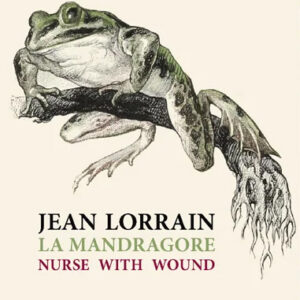
Jean LORRAIN – NURSE WITH WOUND
“La Mandragore”
The most accomplished tale of Jean Lorrain (1855-1906), decadent dandy, ardent erotomaniac and corrosive pen, accompanied by a new piece by Nurse With Wound.
Jean Lorrain (Paul Alexandre Martin Duval, 1855-1906) was a French writer, parnassian poet and art critic, a flamboyant and scandalous figure of the Belle Époque and of "decadent" literature.
A British music project formed in 1978 by Steven Stapleton, John Fothergill and Heman Pathak, Nurse With Wound (now Stapleton's variable geometry project) is an essential figure of English experimental and industrial music since the early 80's. With more than 150 releases, alone or with other musicians, Stapleton has swept widely different musical styles, from industrial music to mambo, through electronics, improvisation, electroacoustics, with a lot of humor.
13,00€
In stock

Book, miniCD
Alphonse RABBE – NURSE WITH WOUND
“Du suicide”
An excerpt from the Album of a Pessimist by the suicidal writer Alphonse Rabbe, whose exaltation and licentiousness were made for Nurse With Wound, who musically accompanies the text.
Alphonse Rabbe (1784-1829) was a French journalist, historian, biographer, romantic writer and poet.
A British music project formed in 1978 by Steven Stapleton, John Fothergill and Heman Pathak, Nurse With Wound (now Stapleton's variable geometry project) is an essential figure of English experimental and industrial music since the early 80's. With more than 150 releases, alone or with other musicians, Stapleton has swept widely different musical styles, from industrial music to mambo, through electronics, improvisation, electroacoustics, with a lot of humor.
12,00€
Out of stock

2 CD, book
Stefan ROIGK
“de—COMPOSED”
An artist's book by Berlin-based sound artist Stefan Roigk, documenting acousmatic compositions, sound installations, musical graphics and text-sound compositions of the years 2005 to 2023 on 144 pages and 2 audio CDs.
Sound as a mark to place ephemeral splinters in the surroundings—Sound as a gesture to draw with invisible lines and pervasions (forms)—Sound as a color to paint environments with transparent atmospheres—Sound as a volume to determine or fill space in time.
A complex assemblage, composed of documentation photos, texts and drawings, becomes an interlocking whole in its dynamic flows and fields and animates the paper as a vibrantly structured visual composition. A piece of music for the eyes, in which the boundaries between documentation, draft and work become blurred in a surreal mesh of the concrete and fictional. Here, the reader generates their own individual temporal axis based on their speed of observation and focus on the optical elements, thus becoming a mixing board for a composition realized as a catalogue. Three text pieces give a deeper insight into Roigk's understanding of sound as material and the translation of sound events into other media.
As an equivalent to the visual approach of the catalogue and in order to adequately convey the sonic dimension of the artistic work, (sound) fragments of all the works covered in the catalogue were transferred into a dynamic collage-like arrangement with Roigk's typical aesthetics and are included with the catalogue as an independent listening experience in the form of two audio CDs.
The catalogue is published in the format 21 x 26 cm with gatefold softcover and includes 180 color illustrations on a total of 144 pages. Besides the catalogue itself, the publication contains 2 audio CDs with 33 tracks and a total playing time of 141 minutes, 2 A5 postcards and a bandcamp download code to enjoy the release also digitally.
Stefan Roigk (born 1974) is a sound artist based in Berlin. He studied fine art with a focus on sound art in Hannover under Professor Ulrich Eller. In his work, Roigk pursues the intermedial interweaving of sound collage, installation, musical graphics and text-sound composition. The resulting works approach sound as a field for artistic and aesthetic research, taking it as both their departure point and central medium. Roigk's artistic focus lies on the dynamic staging of context-related fragments of everyday existence, which he imbues, in the sense of visual music, with an extraordinarily developed, visually poetic formal language. In realizing these aims, Roigk uses compositional and deconstructivist techniques of collage and assemblage for the development of stage-like spatial compositions with an implicit underlying narrative sense, in which the diverse media blend together like the instruments of an orchestra. In his work, Roigk reflects on his own living and production conditions, while investigating the political potential of aurality and tracing the subjective construction of reality. Since 2010, he has worked regularly in co-operation with visual artist Daniela Fromberg on intermedial installations and compositions.
28,00€
Out of stock

CD, Book
eRikm
“Douze horizons”
A sound postcard by eRikm: an instant composition recorded on CD, somewhere between sound performance and radio creation, accompanied by a booklet of photographs.
Since 1992, eRikm, a Marseilles based artist, has extended the field of artistic experimentation on the international scene.
Maintaining a constant fusion between thought, instinct and sensitivity, he pursues a simultaneity of practices and addresses the interplay between various compositional modes, relating to and using all languages.
From his early experience as a guitarist through to his later visual work, he is a maverick genre-bender who breaks down anyone's attempts to conveniently classify him.
Quickly recognised as a virtuoso turntablist and sound artist (1996), eRikm has made a longlife habit of crossing all territories and “world-systems” deemed “independent”, “institutional”.
12,00€
Out of stock

CD
Sam DUNSCOMBE & Michiko OGAWA
“Expended Desert”
Ferns Recordings presents Expended Desert, a collaboration between Sam Dunscombe and Michiko Ogawa.
Sam Dunscombe (field recordings, synthesis)
Michiko Ogawa (shō, hammond organ)
December 2022
Locations:
Roadside, Joshua Tree National Park
Railway siding, Ludlow
North Shore Yacht Club, Salton Sea
Soundwalk, Slab City
Adelanto Solar Park, Victorville
11,00€
Out of stock

CD
David JACKMAN
“Sekihi Oidori”
Organum ‘Raven’ CD, which was released by Siren Records in 2018 was the last piece that Jackman released under the name Organum. He changed the name Organum to Organum Electronics in 2019 and has released five volumes of the albums on Siren Records since then. ‘Sekihi Oidori’ is a development of the quiet nature of earlier Organum works and Jackman decided to release the album under his own name because of a very personal essence. ‘Sekihi Oidori’ is composed of low-key church organ drones, airy tanpura sounds, occasional church bell chimes and chirping birds. It is the most minimal, the most quiet and the most powerful composition Jackman has ever created. The drones continue uninterrupted and you may feel little change in partial listening, but you’ll appreciate the increasing internal dynamic energy that Jackman infused with mindful listening. ‘Sekihi Oidori’ means ‘Stone Tomb Old Bird’ in English translation but the piece is neither an elegy nor a lamentation.
15,00€
In stock

LP
Sam DUNSCOMBE
“Two Forests/Oceanic”
Following on from the psychoacoustic concrète of Outside Ludlow/Desert Disco LP (BT 075LP, 2021), Sam Dunscombe returns to Black Truffle with Two Forests/Oceanic. Dunscombe has been active in recent years on multiple fronts, including as a key member of the Berlin community of Just Intonation researchers and practitioners; working with composers like Taku Sugimoto, Mary Jane Leach, and Anthony Pateras; and the release of Horatiu Radulescu - Plasmatic Music Vol. 1 (the result of many years performance research into the thought and music of this seminal Romanian spectralist). "Two Forests" begins in a central Californian sequoia grove. Bird songs and buzzing insect life are treated with a variety of time-based processing methods (slicing and recombination, primitive granular synthesis, delay, and so on), which strip the field recordings of their linear, documentary character, reframing them in an enchanted web of traces and echoes. Analyzing the pitches found in the original recordings, Dunscombe used them to generate a large Just Intonation pitch set. These tones are woven slowly into the field recordings, gradually building in density and complexity until the forest has been transformed into an unreal space of infinite proportions. On "Oceanic," several recordings of different beaches fade in and out to create a texture both homogenous and constantly shifting in both the rhythm of the waves and each recording's sense of depth and distance. Tones relating in simple ratios to the average rhythm of each beach float over each other, coloring the white noise texture of the field recordings with shifting hues. In both pieces, Dunscombe forgoes the easy consonance that bogs down much contemporary ambient music for a richer harmonic array informed by extended tuning practices and spectralism. The end results suggest a hitherto undreamt-of meeting of Radulescu's undulating sonic masses and the discreetly processed location recordings of Irv Teibel's "psychologically ultimate" environments. Looking beyond the insularity that can afflict experimental music culture, Dunscombe's work is a moving argument for the healing power of expanded approaches to sound and music. Even outside of a psychedelics-assisted therapy, frequent immersion in Two Forests/Oceanic is almost guaranteed to produce beneficial psychological results.
26,50€
In stock

LP
Sombat SIMLA
“Master Of Bamboo Mouth Organ – Isan, Thailand”
Black Truffle announces the first LP documenting master khene player Sombat Simla, the label's first collaboration with Japanese sound artist, field recordist, and researcher Yasuhiro Morinaga. Simla is known in Thailand as one of the greatest living players of the khene, the ancient bamboo mouth organ particularly associated with Laos but found throughout East and Southeast Asia. His virtuosic and endlessly inventive renditions of traditional and popular songs have earned him the title "the god of khene," and he is known for his innovative techniques and ability to mimic other instruments and non-musical sound, including, as a writer for the Bangkok Post describes, "the sound of a train journey, complete with traffic crossings and the call of barbecue chicken vendors." Aided by a group of Thai friends, in 2018 Morinaga travelled to the Maha Sarakham province in the Isan region, arranging to meet Simla in a remote spot surrounded by rice fields. Then and there, Morinaga recorded the solo performances heard on the LP's first side. To listeners unfamiliar with Thai music, the pentatonic scales and rhythmic chug of many of the pieces can have surprising echoes of the rawest American blues. The range of Simla's performance is astonishing, moving from compulsive rhythmic workouts on single chords and rapid-fire runs of single notes to gentle sing-song melodies, and using a fascinating array of techniques, including a rapid tremolo that sometimes sounds almost electronic. Later the same day, Morinaga followed Simla to a cattle shed where he met percussionist Mali Moodsansee to play some molam (folk songs found in Isan and neighbouring Laos), with Pattardon Ekchatree joining in on cymbal. At times, these molam songs have a wistful, romantic character quite different from the solo pieces. Backed up by the propulsive hand drums, Simla again dazzles with his melodic fluidity, rhythmic drive, and wild displays of unorthodox technique. As Morinaga writes, "It felt like they had been playing together so long that their breathing was perfectly in sync, and it was like listening to the precision of James Brown's funk." Accompanied by extensive liner notes by Morinaga detailing the day of recording, this is a stunning document of a master musician, seamlessly integrating tradition and innovation.
26,50€

CD
Mark VERNON
“Sheet Erosion”
Audio Archaeology Series Volume 3: Brest
Sheet Erosion is the third episode in a series of works based around ideas of audio archaeology and found sounds. The setting this time is the city of Brest in France.
It is composed of field recordings made in early 2020 during the storms Ciara and Desmond plus a batch of found open-reel tape recordings dating from the 70s and 80s. The tapes include domestic home recordings but mostly document the recordist, Michel's tastes in music and radio programmes of the time. Daily life bleeds into these lo-fi recordings of radio and TV shows. Captured with a mic in front of a speaker rather than directly cabled, ambiguous activities can be heard in the background; babies crying, feedback, chairs scraping and muffled conversations.
In the composition family histories and musical tastes are transposed over a more contemporary soundscape of Brest. Over-saturated tape distorts time as well as sounds. Speeds change. Chronologies become confused. Different instances in time are blended and fused. What seeps through these chronological crevices are events and incidents unmoored from linear time taking place in a chimerical non-space.
***
Mark Vernon is a Glasgow based artist who explores concepts of audio archaeology, magnetic memory and nostalgia through his sound works. At the core of his practice lies a fascination with the intimacy of the radio voice, environmental sound, obsolete media and the reappropriation of found recordings. A rich collection of domestic tape recordings; audio letters, dictated notes, answer-phone messages and other lost voices often find their way into his unorthodox soundworlds. These diverse elements are distilled into radiophonic compositions for broadcast, multi-channel diffusion, fixed media and live performances.
His solo music projects have been published through labels including Kye, Glistening Examples, Flaming Pines, Discrepant, Entr’acte, 3Leaves, Misanthropic Agenda, Canti Magnetici, Granny, Calling Cards Publishing, Psyché Tropes, Persistence of Sound and Gagarin Records, as well as a series of small CDR and LP editions on his own Meagre Resource imprint.
12,00€

CD
Ralf WEHOWSKY & Kohei MATSUNAGA
“Spuren & Gegenworte”
"Spuren & Gegenworte" began with a quasi-telepathic collaboration between KM and RW. Both recorded a track on May 3, 2021, from 8:00 PM to 8:10 PM. These recordings were subsequently transformed, combined, juxtaposed, and further modified over the course of several months, resulting in the completion of the four pieces on the CD.
"Spuren & Gegenworte" can be translated as "traces & antonyms", opening up a wide range of interpretations. "Traces" may refer to the remnants of the original sounds that have been transformed in the process of reworking, or it can symbolize the cultural and musical influences that can be discerned. "Antonyms" oscillates between contrasting/contradictory and complementary meanings. Of course, other interpretations are also possible.
The 4 titles are indicated as Japanese terms on the cover: 痕跡、対立、変動、補完. They stand for the themes of traces, confrontation, fluctuation, completion.
***
Kohei Matsunaga is a musician and illustrator, born in Osaka in 1978. He has been actively making music since 1992, with notable releases on labels such as Raster Noton, Wordsound, Mille Plateaux, Important Records and PAN. He has collaborated with many artists, including Mika Vainio, Sean Booth from Autechre, Conrad Schnitzler, Merzbow and Asmus Tietchens. He lives in Osaka and Berlin.
Ralf Wehowsky is one of the most respected electronic composers of our day and was also a founder member of the seminal German group P16.D4 and label Selektion whose ground-breaking releases influenced many working in today's experimental music scene. His work is split between solo releases (under the moniker RLW) and collaborations, exploring all fields between media exchange and realtime presence recordings. His music is impossible to pigeonhole into one simple bracket. It is neither industrial or musique concrete, nor computer music nor improvisation. In fact, it could be all of these.
12,00€
In stock

LP
WOLF EYES
“Dumpsters & Attitude”
Recorded in Pontiac, Michigan, Wolf Eyes Dumpsters & Attitude was unleashed on October 7, 2022. This album showcases the continuing homemade idiosyncratic audio hell - visions of John Olson, who handles electronics, saxophone, and a range of unique mutant reed instruments along with Nate Young, contributing vocals and an array of utterly personalized electronic sordid instruments. While some might view this release as the sequel to "Dreams In Splattered Lines," Wolf Eyes took their usual rugged chaotic route, choosing to launch it before the aforementioned album. Eager to promptly share their most robust immediate material to date outside of the industry, the band aimed to capture and release their creative concepts swiftly and direct from the duo themselves. These recordings amalgamate the concepts from "Difficult Messages" and "Splattered Lines," molding them into a structure akin to an exquisite corpse, intertwined through a network of wormholes, rather than the conventional folding of paper. Wolf Eyes is currently performing and releasing music as a duo consisting of John Olson and Nate Young. They have garnered a reputation as one of the most frightening and weird bands in the world. Their music is not for the faint of heart and is sure to leave a lasting impression on anyone who dares to listen.
Mastered for vinyl by Jack Callahan, this Japanese edition reissue LP comes with Japanese-OBI is pressed in an edition of 700 copies.
30,00€
Out of stock

3 LP
Nicole LACHARTRE
“Mundus”
***Second edition of 300 copies. 3LP set in 7,5mm sealed slipcase sleeve (not a boxset as the first issue) + 12 page booklet. ***
“Let’s try to find sound as a primordial act, both a place of convergence of beings and a vector of self-discovery”
First ever release of female French composer, musicologist and writer Nicole Lachartre (1934-1991). This 3LP set comprises most of her electronic and concrete music compositions recorded in the 60’s and 70’s, all previously unreleased. Lachartre had a classical formation, studied with a.o. Darius Milhaud, Iannis Xenakis and Michel Philippot. Her broad formation and interest as well as her profound commitment and singular vision created a solitary voice even within the field of electronic and concrete music, strangely enough unheard till this day. Her first tape composition from 1968 was recorded in Pierre Henry’s Apsome studio and most of her other electronic and electro-acoustic compositions included in this box set were recorded at the IPEM in Ghent.
It took more than two years to realize this project with some complications along the way but it was all worth it and glad the music is finally available.
50,00€
Out of stock

LP
ILTA HÄMÄRÄ
“Origo”
First meeting of Timo van Luijk and Bart De Paepe.
A free floating psychedelic studio session played, recorded and mixed at Kulta Saha December 2015 – February 2016.
250 copies
23,00€
In stock

CD
François BAYLE
“Le Projet Ouïr”
Digipack CD including a 24-page booklet in French and English
INA grm is pleased to present Le Projet « Ouïr » by François Bayle, a 62’ minute piece composed between 2015 and 2019, published for the first time on CD digipak.
The French language can hear (entendre), listen (écouter), grasp (comprendre). “Comprendre” aims too far. What is grasped has already been digested by the mind, away from the ear. “Entendre” is poorly distinguished from it—mainly because of “entendement”, which is virtually the same as “raison” (reason). That leaves us with “écouter”: the only one amongst the three that exclusively refers to the ear. Whoever listens stretches out his or her ear and expects to hear something and understand its ins and outs. However, this is still too nice, too urban. The idea is to break out of these customary dimensions and enter more difficult and risky territories. This is the “Ouïr” Project (Le Projet « Ouïr »). This archaic verb, which is now obsolete and that we can’t conjugate properly anymore, invites us to exercise a proto-listening, awkward, uncomfortable and unsure of its aims—yet with the promise of new horizons.
- Regis Renouard Larivière
21,00€
In stock

LP
EL TIGER COMICS GROUP
“After”
Nicolas Germain, visual artist/musician, has been performing since the 1980s under the name el TiGeR CoMiCs GRoUP, producing "JujuArt Shows, visual and sonic exercises". Influenced by the punk rock and electronic scene of the 70s, he has developed a language that draws its raw material from the history of popular music and its links with the visual arts. In his work, sound becomes visual and images become sound.
Over the last few years he has been developing an artistic and sound research project around the notion of immersive sound spaces and the perception of sounds in movement. He works with a modular synthesiser that enables him to create a unique sound material that can be modulated in real time. He also works on forms of sound visualisation created by spectral analysis (sonograms), creating 3-dimensional forms modulated in real time, in particular from sounds inaccessible to the human ear.
20,00€
Out of stock

LP
Derek BAILEY & Paul MOTIAN
“Duo in Concert”
frozen reeds is proud to present the only recorded duo playing of two legendary musical figures.
Derek Bailey and Paul Motian – two longstanding pioneers of distinct strains of improvised music – came together for a brief period of collaboration in the early 1990s. Tapes of their two known live performances (one at Groningen’s JazzMarathon festival in the Netherlands, the other a year later at New Music Cafe, NYC) were recently unearthed in the Incus archives, and their contents will surprise and delight fans of both supremely idiosyncratic musicians.
The Groningen concert (1990) is released on vinyl, while the New York date (1991) is included with the digital download, free of charge for all purchasers. A conversation between Bill Frisell and Henry Kaiser on Bailey, Motian, their intertwined backgrounds, and the significance of these recordings is included as sleeve-note insert.
Each player bringing decades of crucial experience to their encounters – with histories taking in vast swathes of the development of jazz and free improvisation – these fleeting shared moments provide some of the most riveting playing in the career of either.
There is precious little recorded evidence of Motian as a free improviser, but his mastery is beyond any doubt in these recordings. From knife-edge precision to textural haze, Motian’s palette is astounding, but perhaps even more impressive is his confidence in the non-idiomatic conversation itself. Pushing far beyond the established vocabulary of free percussion, his playing allows a measured degree of repetition to take form, giving rise to almost song-like structures. The covert influence of the drummer’s work on the post-rock genre (just taking its first nascent steps in the early 1990s) is made overt here.
In turn, Bailey allows some of his most unashamedly melodic passages to unfold without a mote of his trademark contrariness or antagonism. Patterns that would be acerbically disrupted elsewhere are allowed to settle, with variations of note and timbre introduced more gradually than is typical of his playing. When forceful changes in dynamics or tone do arrive, they do so in such close tandem with Motian’s rhythmic and textural transitions as to beggar belief. The guitarist’s duos with percussionists (Jamie Muir, Han Bennink, John Stevens…) arguably provide some of the highlights of his discography. ‘Duo in Concert’ represents a strong addition to the list.
An elegant sense of construction pervades the sets, as the duo ably fulfil the promise of free improvisation: carving out hugely compelling, expertly balanced, and thrillingly paced music as if from thin air.
25,50€
In stock

LP
Pierre BASTIEN & Michel BANABILA
“Baba Soirée”
Two visionary maestros, Pierre Bastien and Michel Banabila, unite in their first collaborative album, Baba Soirée. The veterans of electronic music bring their unique expertise to the table, resulting in a captivating fusion of experimental styles. Bastien’s mechanical loops and fantastic instrumental setups merge seamlessly with Banabila's sound design and impeccable skills of sampling collages. It's not a dance party, nor is it an avant-garde intervention. It's a soirée: a cultivated evening of sonic alchemy hosted by these two charismatic gentlemen.
Pierre Bastien is a composer and multi-instrumentalist with a background in French literature. He has spent decades crafting an idiosyncratic world of experimental sound with his self-built mechanical orchestra Mecanium. It was most notably showcased in audiovisual releases on Aphex Twin's Rephlex label. Bastien's creations are a mesmerizing combination of traditional instruments (he has a vast collection) and mechanical automatons. The violin in the track Rotomotor, for example, is physically played by one of his machines. In Baba Soirée, Bastien also plays a prepared cornet (Slow Dance, Banbas Aura), infusing the recordings with a breathy, dreamy dimension.
Michel Banabila, a sound artist, composer and producer, possesses an eclectic musical repertoire that defies genres. His blend of minimal electronica, tribal ambient, and neo-classical influences has earned him a prominent place in the world of experimental music, and an impressive discography (Knekelhuis, Bureau B, Séance Centre, a.o.). Banabila serves as the creative sampling editor for Baba Soirée, expertly weaving together the recordings to craft an evocative sonic tapestry.
The two share a curiosity for traditional instruments from various cultures. The instruments used in the recordings are shown in the cover artwork. A mutual admiration for each other's work paved the way for this fruitful artistic partnership of the Rotterdam-based artists: Collaborating on a single as a fundraiser for Yemen in 2022 set the stage for the creation of Baba Soirée.
For Pierre Bastien, Dada, Fluxus and International Situationism have played a significant role in shaping his artistic vision. The title Baba Soirée is an homage to Kurt Schwitters and Theo van Doesburg's "Kleine Dada Soirée" collaboration which took place exactly a century ago. There's an unmistakable stoicism and an anarchic not-giving-a-f*** attitude in these recordings by Bastien & Banabila, which resonates in the light of this Dada reference.
23,00€
In stock

LP
EYES OF THE AMARYLLIS
“Perceptible to Everyone”
As the mist clears from their Sift LP (hop9) Eyes of the Amaryllis return to Horn of Plenty with the equally enigmatic Perceptible to Everyone.
Recorded in various remote locations around the northeast of the US over a few warm months in 2022, Perceptible to Everyone maps the band's poetry in nebulous song forms that dance on their constant fission between pastoral and ghostly inner galaxies. Its eight tracks utilize a wide range of instruments and techniques to span an alien, ritualistic territory where melodies and rhythms appear from meandering passages of sound and ramshackle sci-fi settings. The culmination leaves Perceptible to Everyone gesturing as if it were an alluring otherworldly ethnographic document.
EotA’s non-idiomatic methods make comparisons difficult but traces of Smegma, early D.D.A.A, Garbage and the Flowers, The Tower Recordings, and Flaming Tunes will get you some of the way there. The rest is uncharted.
25,50€