
Out of stock

2 LP
MAMIFFER – CIRCLE
“Enharmonic intervals (For Paschen organ)”
A fully collaborative effort between Mamiffer and Circle : shininhg heavenly light onto the wan, academic corpse of avant-garde minimalism. “Too often, “collaborations” are little more than different musicians each independently playing their obvious parts. The ego does not retreat; even as every voice gets their say, there is no conversation happening. It’s all a lot of yelling and trying to be heard. It’s a humbling thing then to hear different musicians make conversation seem so effortless and genuine, and to hear them strike such an elegant balance between distinction and disappearance.
I had the privilege of talking with Mamiffer and Locrian about this very thing last year. I didn’t learn much about the technicality of collaborations. I only learned that it takes particular personalities, that is, those fundamentally open to the very possibility of collaboration. The situation - the recording studio, the equipment, and even the talent - only determines so much. It really is, instead, a posture of openness, an “ethic of conversation,” that clears the way for making something truly effective, collaboratively.
What I then mean to say - with absolutely shameless, uncritical praise and admiration - is that it’s no surprise to me (at all) that Mamiffer and Circle were able to make this work, together. Below is only one stunning example of this extraordinary collaboration. And believe me when I say that you should look forward to hearing the others as well.” (Max Power, tinymixtapes.com)
I had the privilege of talking with Mamiffer and Locrian about this very thing last year. I didn’t learn much about the technicality of collaborations. I only learned that it takes particular personalities, that is, those fundamentally open to the very possibility of collaboration. The situation - the recording studio, the equipment, and even the talent - only determines so much. It really is, instead, a posture of openness, an “ethic of conversation,” that clears the way for making something truly effective, collaboratively.
What I then mean to say - with absolutely shameless, uncritical praise and admiration - is that it’s no surprise to me (at all) that Mamiffer and Circle were able to make this work, together. Below is only one stunning example of this extraordinary collaboration. And believe me when I say that you should look forward to hearing the others as well.” (Max Power, tinymixtapes.com)
12,00€
Out of stock
2 LP
MAMIFFER
“Mare descendrii”
A Sige Records repress of Mamiffer’s second full length Mare Decendrii.
Artwork is different from the original pressing. Edition of 600.
Credits : Recorded from September 2009 to September 2010 at: Studio Litho, Aleph Studio, and London Bridge in Washington State. Produced by Randall Dunn. Co-produced by Mamiffer. Engineered by Randall Dunn. Assistant engineers: Mell Dettmer and Shawn Simmons. Mixed at London Bridge Studio by Randall Dunn. Mixing assistant: Mell Dettmer. Mastered by Mell Dettmer.
Tape samples recorded by Faith Coloccia 2008-2009. String arrangements by Eyvind Kang. Piano tuned by Hak Bo Lee. Lyrics by Faith Coloccia and Aaron Turner. The bonus track Dead Settlers was recorded by Faith Coloccia and Aaron Turner in WA. 2008-2010. Mixed by Aaron Turner. Mastered by James Plotkin. Tape samples recorded by Faith Coloccia in Chicago Il. 2008.
For this recording Mamiffer is Faith Coloccia: piano, vocals, bass synthesizer, prepared piano, organ, auxiliary percussion and tape samples. Aaron Turner: guitar, vocals, effects. Additional performances by Don McGreevy: drums, tubular bells, and auxiliary percussion. Brian Cook: bass. Eyvind Kang: viola, violin, cello and overtones. Timb Harris: viola, and violin. Moriah Neils: double bass. Additional vocals by Mika Rättö, Jussi Lehtisalo, Parvaneh Daneshvar, Jessika Kenney, Sera Timms, and Joe Preston. Additional auxiliary percussion by Aaron Harris, Travis Rommereim, and Randall Dunn. Photos 39/40 and 20/40, extract of the series : "”0 Portraits - 2003-2008”. Dolls and photography by Gisèle Vienne. Ash paintings, forest photography and design by Faith Coloccia. Design assistance: Aaron Turner.
Artwork is different from the original pressing. Edition of 600.
Credits : Recorded from September 2009 to September 2010 at: Studio Litho, Aleph Studio, and London Bridge in Washington State. Produced by Randall Dunn. Co-produced by Mamiffer. Engineered by Randall Dunn. Assistant engineers: Mell Dettmer and Shawn Simmons. Mixed at London Bridge Studio by Randall Dunn. Mixing assistant: Mell Dettmer. Mastered by Mell Dettmer.
Tape samples recorded by Faith Coloccia 2008-2009. String arrangements by Eyvind Kang. Piano tuned by Hak Bo Lee. Lyrics by Faith Coloccia and Aaron Turner. The bonus track Dead Settlers was recorded by Faith Coloccia and Aaron Turner in WA. 2008-2010. Mixed by Aaron Turner. Mastered by James Plotkin. Tape samples recorded by Faith Coloccia in Chicago Il. 2008.
For this recording Mamiffer is Faith Coloccia: piano, vocals, bass synthesizer, prepared piano, organ, auxiliary percussion and tape samples. Aaron Turner: guitar, vocals, effects. Additional performances by Don McGreevy: drums, tubular bells, and auxiliary percussion. Brian Cook: bass. Eyvind Kang: viola, violin, cello and overtones. Timb Harris: viola, and violin. Moriah Neils: double bass. Additional vocals by Mika Rättö, Jussi Lehtisalo, Parvaneh Daneshvar, Jessika Kenney, Sera Timms, and Joe Preston. Additional auxiliary percussion by Aaron Harris, Travis Rommereim, and Randall Dunn. Photos 39/40 and 20/40, extract of the series : "”0 Portraits - 2003-2008”. Dolls and photography by Gisèle Vienne. Ash paintings, forest photography and design by Faith Coloccia. Design assistance: Aaron Turner.
12,00€
Out of stock
2 LP
Daniel MENCHE
“Vilke”
Vilké: of Lithuanian origin, a word for the female wolf. An avid and voracious hiker, Menche found great inspiration in the beautiful lament of howling wolves during his overnight expeditions; and ultimately chose these sounds as the core sonic elements for Vilké. By layering and distending wolves voices, a choir of howls was constructed - a massive sound wall colliding with layers of poly-rhythmic drums, abstracted guitar and piano.
“(Menche) eschews classification as a noise artist, and while many of his techniques suggest similarities to musicians who work within that realm, he works within specific structures, with a meticulous sense of the relationships between sounds and the overall development of a piece”- Dusted
“(Menche’s) honed style thrives on subtleties, crescendos, sublimation, and locomotive transformation. One can easily become immersed in his web of carefully sculpted sound hip-gnosis.” - Tiny Mix Tapes
“...proof of Menche’s uncanny talent for mutating common sounds into tracks that are dizzyingly unworldly. A tour of his universe is unlike any other and well worth the time and attention invested in attentive listening.” - brainwashed.com
“(Menche) eschews classification as a noise artist, and while many of his techniques suggest similarities to musicians who work within that realm, he works within specific structures, with a meticulous sense of the relationships between sounds and the overall development of a piece”- Dusted
“(Menche’s) honed style thrives on subtleties, crescendos, sublimation, and locomotive transformation. One can easily become immersed in his web of carefully sculpted sound hip-gnosis.” - Tiny Mix Tapes
“...proof of Menche’s uncanny talent for mutating common sounds into tracks that are dizzyingly unworldly. A tour of his universe is unlike any other and well worth the time and attention invested in attentive listening.” - brainwashed.com
24,00€
Out of stock
2 LP
Stephen O’MALLEY
“Eternelle idole”
Second edition.
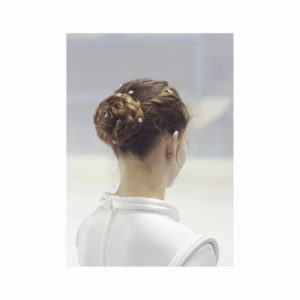
September 2015 marks the release of Stephen O’Malley’s “Eternelle Idole” (SP060), long awaited documentation of the score of Paris based choreographer Gisèle Vienne’s eponymous artistic ice skating choreographic piece of the same name.
Composed of 47 minutes of music spread over 2 vinyls and enhanced by a elegant and chilling photoset by Estelle Hanania, the record features some - familiar - O’Malley collaborators such as Steve Moore, Daniel O’Sullivan, Peter Rehberg, Jesse Sykes, Bill Herzog & Randall Dunn.
Recorded between Brest (FR), Seattle (USA), and Rotterdam (NL), the score sees Stephen O’Malley taking several creative detours, utilizing modular synthesizers and programming as key elements for much of the composition. And while a 3 minutes hole will extract the music from any temporality, emerging eerie phrases of keyboards and piano draw a white monochrome stage for a young girl’s stark and emotive elegy.
Not to worry then… clavichord and guitars weave the darkness, supported by Jesse Sykes prophetical voice, summoning the utter walls of the threats from the external world.
Mirroring the music score, Estelle Hanania presents 16 photographs from the choreographic piece, enlightening how much ice-skating can be about grace and sustain, geometry, telemetry, distance and perfection, as well as possible falls, gloomy shadows.
Metal against ice, tights and knots, spirals and scratches, shouts and winds : field recordings mold a crispy atmosphere while instruments draws some ovals shapes such as lakes, ice skating ring, cosmos belt… and a terrestrial cloud passage and eventual landing platform for a flying saucer.
Second edition of 300 copies. 160grm vinyl, 350gsm cover with gloss varnish. 16 pages 30 x 30 cm saddle stitched booklet
28,00€
Out of stock

2 LP
Luc FERRARI
“Presque rien”
Reissue.
“Presque rien n°1, le lever du jour au bord de la mer” (1967-1970). Following the complete disappearance of abstract sounds, we can regard this piece as a sonic snapshot and the culmination of an evolution. This is a realistic rendering (as faithful as possible) of a fishing village waking up. The first idea of minimalism.
“Presque rien n°2, ainsi continue la nuit dans ma tête multiple” (1977). Description of a landscape at night that a soundman attempts to define through microphones, but the night surprises the "hunter" and creeps inside his head. It then becomes a double description: The inner landscape transforms the outer night and by composing it, adds its own reality (a fantasy of reality) or, perhaps, a
psychoanalysis of his ’nightscape’?
“Presque rien avec filles” (1989). Within paradoxical landscapes, a photographer/composer is hidden whilst girls are having a sort of picnic on the grass. Without being aware of it, they offer him the spectacle of their intimacy.
“Presque rien n°4, la remontée du village” (1990-1998). I always hesitated before releasing a Presque rien. For instance, it took two years for the first one to come out and things went on this way. The fourth one, took nine years of hesitating. But here it is. Perhaps because this is a real Presque rien fake where reality and lies mix. This is the ascend into the old town of Ventimiglia.
“Presque rien n°1, le lever du jour au bord de la mer” (1967-1970). Following the complete disappearance of abstract sounds, we can regard this piece as a sonic snapshot and the culmination of an evolution. This is a realistic rendering (as faithful as possible) of a fishing village waking up. The first idea of minimalism.
“Presque rien n°2, ainsi continue la nuit dans ma tête multiple” (1977). Description of a landscape at night that a soundman attempts to define through microphones, but the night surprises the "hunter" and creeps inside his head. It then becomes a double description: The inner landscape transforms the outer night and by composing it, adds its own reality (a fantasy of reality) or, perhaps, a
psychoanalysis of his ’nightscape’?
“Presque rien avec filles” (1989). Within paradoxical landscapes, a photographer/composer is hidden whilst girls are having a sort of picnic on the grass. Without being aware of it, they offer him the spectacle of their intimacy.
“Presque rien n°4, la remontée du village” (1990-1998). I always hesitated before releasing a Presque rien. For instance, it took two years for the first one to come out and things went on this way. The fourth one, took nine years of hesitating. But here it is. Perhaps because this is a real Presque rien fake where reality and lies mix. This is the ascend into the old town of Ventimiglia.
21,00€
In stock
2 LP
PBK & Jim O’ROURKE
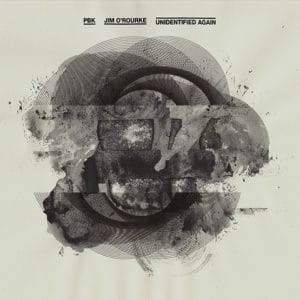
“Unidentified again”
All music by Phillip B. Klingler (PBK) and Jim O'Rourke, 2014-15.
About “Unidentified Again” : “I first met Jim O'Rourke in 1989. We corresponded by mail and would talk on the phone frequently. Jim was in college at that time and he was very excited about music. He sent me mixtapes, we would talk about his love of Van Dyke Parks, his work with KK Null or Henry Kaiser. I also remember he sent me Godflesh’ “Streetcleaner” album which he likened to
King Crimson’s “Red”. Jim’s soundwork was always special and I released one of his compositions on my Assemblage” compilation tape in 1990. We talked about collaborating, but then my situation changed suddenly and in 1992 I moved to Puerto Rico with my family. My life got complicated and I fell out of touch with a lot of friends while there. By the time I got back to the States things had changed for Jim as well, and he was in a nomadic phase, drifting around, performing a lot of concerts around the world, but a letter I sent to his parents’ address eventually reached him and in 1997 he wrote back and replied that he was only able to finish about ten minutes of electronic music a year. Still, the interest in collaboration was there, though Jim was very busy and things did not materialize in the collaborative direction for us.
That was the last time I heard from Jim for 15 years, until something coincidental happened in 2012. My cousin runs a label and put out a record by Merzbow. One day my cousin informed me that my old buddy Jim O’Rourke had ordered the album. As I was assisting him with shipping copies of the album, I wrote a note to Jim and threw in a couple of my CDs along with the LP.
Not too long after that, Jim and I were in contact again. As is always the case with us, we fell into vigorous conversations about music and everything else - and again the idea of collaborating occurred. Rather suddenly Jim surprised me with source material I could use. I immediately went to work on it, with the idea that approximately 40 minutes would just about be ideal for an LP project. The sound material Jim sent was likely composed on his Serge modular synth. We’d been discussing synthesizer heroes of ours - Jim sharing his love of Roland Kayn’s expressive work and I’m always going on about David Tudor. I worked on the first two mixes, but I dug Jim’s sources so much I didn’t do any kind of manipulation on them. I built audio environments for his sounds to live in, and they do sound alive, like synthetic landscapes with birds or animals of some primitive, or alien, origin and, of course, also huge drones that could be electrical storms. I sent Jim my own sources and he came up with two beautiful mixes, each quite different from the other.
I’m very pleased we finally got to do our collaboration - even if it took a quarter of a century to make it happen.” Phillip B. Klingler, April 2015.
About “Unidentified Again” : “I first met Jim O'Rourke in 1989. We corresponded by mail and would talk on the phone frequently. Jim was in college at that time and he was very excited about music. He sent me mixtapes, we would talk about his love of Van Dyke Parks, his work with KK Null or Henry Kaiser. I also remember he sent me Godflesh’ “Streetcleaner” album which he likened to
King Crimson’s “Red”. Jim’s soundwork was always special and I released one of his compositions on my Assemblage” compilation tape in 1990. We talked about collaborating, but then my situation changed suddenly and in 1992 I moved to Puerto Rico with my family. My life got complicated and I fell out of touch with a lot of friends while there. By the time I got back to the States things had changed for Jim as well, and he was in a nomadic phase, drifting around, performing a lot of concerts around the world, but a letter I sent to his parents’ address eventually reached him and in 1997 he wrote back and replied that he was only able to finish about ten minutes of electronic music a year. Still, the interest in collaboration was there, though Jim was very busy and things did not materialize in the collaborative direction for us.
That was the last time I heard from Jim for 15 years, until something coincidental happened in 2012. My cousin runs a label and put out a record by Merzbow. One day my cousin informed me that my old buddy Jim O’Rourke had ordered the album. As I was assisting him with shipping copies of the album, I wrote a note to Jim and threw in a couple of my CDs along with the LP.
Not too long after that, Jim and I were in contact again. As is always the case with us, we fell into vigorous conversations about music and everything else - and again the idea of collaborating occurred. Rather suddenly Jim surprised me with source material I could use. I immediately went to work on it, with the idea that approximately 40 minutes would just about be ideal for an LP project. The sound material Jim sent was likely composed on his Serge modular synth. We’d been discussing synthesizer heroes of ours - Jim sharing his love of Roland Kayn’s expressive work and I’m always going on about David Tudor. I worked on the first two mixes, but I dug Jim’s sources so much I didn’t do any kind of manipulation on them. I built audio environments for his sounds to live in, and they do sound alive, like synthetic landscapes with birds or animals of some primitive, or alien, origin and, of course, also huge drones that could be electrical storms. I sent Jim my own sources and he came up with two beautiful mixes, each quite different from the other.
I’m very pleased we finally got to do our collaboration - even if it took a quarter of a century to make it happen.” Phillip B. Klingler, April 2015.
28,00€
In stock
2 LP
PANCRACE
“Pancrace”
500 copies
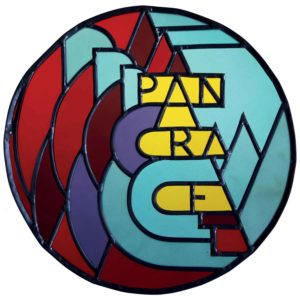
Penultimate Press is proud to present the debut recording from French outfit Pancrace. Music for pipe organ Stiehr-Mockers 1848, Bird Calls, Baroque Violin, Tin Whistle, Boîtes à Bourdons, Landscape Piano, Motorised Bow, Standuino Pi Synth, Microphones, Hurgy Toys, AM radio, Church Bells, Uilleann Pipes and Hulusi. Pancrace is an improvising quintet comprising French, British and Austrian performers. The members include Prune Bécheau, Arden Day, Julien Desailly, Léo Maurel and Jan Vysocky. Pancrace is also the name of the church in Dangolsheim Alsace located next to where the instrument inventor Léo Maurel lives. Maurel makes ingeniously designed instruments inspired by the hurdy gurdy. The recording emerged from a disruption of the traditional elements within the church, namely the church organ which was prepared inside out whilst the performers challenged it’s gregarious authority with an array of constructed and modified instruments. In Pancrace one can hear many of these shape-shifting instruments and devices being twiddled without quite knowing which are bowed,
plucked, hammered or rubbed. The results are a maelstrom of sound and song which see-saw between the harrowing and the sublime with incredible detail to sonic content. Pancrace instigates proceedings in the confinement of an organ; a Cyclops puffing its continuous and raucous breath only to be woken by instruments who, like horseflies, mischievously start tormenting proceedings with microtones and striated polyrhythms. The journey ends four sides later with the language of the birds imposing an unadorned silence on the church.
Penultimate Press is proud to present the debut recording from French outfit Pancrace. Music for pipe organ Stiehr-Mockers 1848, Bird Calls, Baroque Violin, Tin Whistle, Boîtes à Bourdons, Landscape Piano, Motorised Bow, Standuino Pi Synth, Microphones, Hurgy Toys, AM radio, Church Bells, Uilleann Pipes and Hulusi. Pancrace is an improvising quintet comprising French, British and Austrian performers. The members include Prune Bécheau, Arden Day, Julien Desailly, Léo Maurel and Jan Vysocky. Pancrace is also the name of the church in Dangolsheim Alsace located next to where the instrument inventor Léo Maurel lives. Maurel makes ingeniously designed instruments inspired by the hurdy gurdy. The recording emerged from a disruption of the traditional elements within the church, namely the church organ which was prepared inside out whilst the performers challenged it’s gregarious authority with an array of constructed and modified instruments. In Pancrace one can hear many of these shape-shifting instruments and devices being twiddled without quite knowing which are bowed,
plucked, hammered or rubbed. The results are a maelstrom of sound and song which see-saw between the harrowing and the sublime with incredible detail to sonic content. Pancrace instigates proceedings in the confinement of an organ; a Cyclops puffing its continuous and raucous breath only to be woken by instruments who, like horseflies, mischievously start tormenting proceedings with microtones and striated polyrhythms. The journey ends four sides later with the language of the birds imposing an unadorned silence on the church.
26,00€
In stock
2 LP
Jacques BRODIER
“Xhos De Villemahu”
Penultimate Press is proud to present the second full length release by the acclaimed French inventor, instrument builder, musician, visual artist, researcher and writer Jacques Brodier. Following up the 2012 release Filtre De Réalité, Xhos De Villemahu expands Brodier’s vision tenfold with two LP’s worth of inexplicable audio recorded between 2009 – 2016.
Operating from Le Havre (France) since the 1970s Jacques Brodier has created a uniquely personal vision that incorporates music writings, paintings and drawings. Over the years he has amassed a large amount of material in all of these fields. The music he conjures from his self built instrument, the Filtre De Réalité (Filter of Reality), harnesses the energies found in shortwave radio, harmonic strings, sensors, sheet metal and rotating glass spheres of sand. The resulting audio shatters time and space with voices of the deep past slamming up against a fantastic present. Frequencies dance in a whirl of frenzied excitement whilst elements of a cosmic science fiction leave a trail of neon lit bewilderme
A vast amount of writings, painting and drawings support the enormous world Brodier has constructed over the years. Xhos De Villemahu is an attempt to capture this substantial and significant world view into a complete package. Xhos De Villemahu arrives as a deluxe 2 LP in a gloss gatefold sleeve featuring a 32 page A4 booklet of images, essays and texts written by Brodier for the occasion.
Utterly unique in vision and scope, Xhos De Villemahu is absolutely an experience unlike any other.
500 copies.
Operating from Le Havre (France) since the 1970s Jacques Brodier has created a uniquely personal vision that incorporates music writings, paintings and drawings. Over the years he has amassed a large amount of material in all of these fields. The music he conjures from his self built instrument, the Filtre De Réalité (Filter of Reality), harnesses the energies found in shortwave radio, harmonic strings, sensors, sheet metal and rotating glass spheres of sand. The resulting audio shatters time and space with voices of the deep past slamming up against a fantastic present. Frequencies dance in a whirl of frenzied excitement whilst elements of a cosmic science fiction leave a trail of neon lit bewilderme
A vast amount of writings, painting and drawings support the enormous world Brodier has constructed over the years. Xhos De Villemahu is an attempt to capture this substantial and significant world view into a complete package. Xhos De Villemahu arrives as a deluxe 2 LP in a gloss gatefold sleeve featuring a 32 page A4 booklet of images, essays and texts written by Brodier for the occasion.
Utterly unique in vision and scope, Xhos De Villemahu is absolutely an experience unlike any other.
500 copies.
28,00€
In stock
2 LP
Lee GAMBLE
“Koch”
Following up from the success of his emphatic PAN releases “Dutch Tvashar Plumes” and “Diversions 1994-1996” in 2012, PAN is excited to announce “Koch” (pronounced “cotch”), the new album from London’s Lee Gamble.
Sharing some stylistic affinity with his previous records, which excavated his deeply personal history with UK jungle and rave, and techno, this new work dives even deeper to reveal a singu- lar and intimate musical vantage point, shifting to approaching music as projection, state, hallucination, an other place. In ‘Koch’, we experience an artist constructing a future after time spent deconstructing the past.
In the music we witness such dimensional abstraction, zooming between epic macro scenery and claustrophobically close detail, disorientation and absolute focus. Rhythms fuse together and phase apart, club tracks tunnel into an anxious wilderness, with themes and textures emerging as threads throughout the record, wormholing between each track.
There is a sense of the seen and the unseen, an honest tension between music as function (for this world) and as artistic exploration (for another world) as cracks in the surface appear to reveal the odd and alien minutiae within.
‘Koch’ represents an intimate and revelatory new phase in Lee Gamble’s practice. Producing tracks that can live and grow on their own in a club or personal listening environment, the artist’s exploratory framework creates threads of consistency and tension between disparate spaces, locations, and mental states.
28,00€
Out of stock
2 LP
Steve RODEN
“Small songs for Kack Jirby”
“Small songs for Kack Jirby began in 2014, when i stopped performing with the tools I had used since 1993 (pedals, contact mics, cassettes, etc.). As I was trying to find a way to some “new” tools, various friends had suggested I work with a modular synthesizer. At the time, I didn’t know anything about the modular, but it offered me the thing I wanted - something I didn’t understand, and to begin again as a musical child. Instead of working for several years to master the instrument I simply tried to work with the materials, while trying to make something that had the “feel” of my work. The recordings on small songs for kack jirby come from the very first months when myself and the machine tried very hard to become friends - and it seemed that after years of working in a specific mode, these first steps with a new instrument along with a new sound pallette should be documented, and so, these little pieces are the beginning of a new phase of my work. (Also, the name “Kack Jirby” is a play on the name of my favorite childhood comic book artist - Jack Kirby).” Steve Roden.
350 copies. Full color gatefold cover + inserts.
350 copies. Full color gatefold cover + inserts.
24,00€
Out of stock

2 LP
SISTER IODINE
“Venom”
New limited pressing on transparent vinyl !
“Sister Iodine’s Venom is a pure and raw, energy-powered album performed like an audio exorcism. Each track contains its own intense physicality to radiate sound illuminations of light inside of darkness. Venom is a powerful album of potent spells that Sister Iodine have conjured and captured as sonic shamans.” Cameron Jamie. Paris, France. January 2018.
French noise scene spearheads, Sister Iodine, return with their sixth album; “Venom”. Active since the Nineties, Sister Iodine which involve Erik Minkkinen, Lionel Fernandez, and Nicolas Mazet, have not lost one milligram of their radical and uncompromised approach in sound exploration and limits stretching. Following two studio albums on Parisian Label, Premier Sang, released in 2009 and 2013 respectively, it took almost 5 years to shape up “Venom”.
It is with the advent of the 21st century - more than ever - that the decisive path of Sister Iodine has taken a fascinating route. From their debut album, ADN115, released in 1994 which was strongly influenced by the original New York No Wave scene (Mars, DNA, Red Transistor) to their more recent works which are augmented by “newer poisons” such as black metal, or the most abrasive end of industrial music and power electronics, as well as experimental electronics (Editions Mego has reissued an extended version of Premier Sang’s “Flame Desastre” on CD), the band has managed to survive through the years from the inhospitable French squats of the nineties to nowadays’ established venues and proper tours. Today, the band’s music has changed recipients and has attracted younger generations with their organized radioactive chaos, never conceding anything from their initial intensity. Over the years, Sister Iodine will have also created their own idiosyncratic language, for which sound exploration matters and pure beauty seem to count as much as pure explosive ferocity, while intense violence and energy gets deployed in live shows.
The last few years witnessed an increasing number of collaborations such as the recent sessions with Meyhna’ch (Mütiilation) or the ones with Masaya Nakahara (Violent Onsen Geisha / Hair Stylistics). “Venom” includes two tracks featuring the vocal contribution of Stephen Bessac, the deviant frontman of the cult French hardcore band Kickback.
Sister Iodine produces today a music that is actually unique and unheard anywhere else. One of eternal youth and audacity.
“Sister Iodine’s Venom is a pure and raw, energy-powered album performed like an audio exorcism. Each track contains its own intense physicality to radiate sound illuminations of light inside of darkness. Venom is a powerful album of potent spells that Sister Iodine have conjured and captured as sonic shamans.” Cameron Jamie. Paris, France. January 2018.
French noise scene spearheads, Sister Iodine, return with their sixth album; “Venom”. Active since the Nineties, Sister Iodine which involve Erik Minkkinen, Lionel Fernandez, and Nicolas Mazet, have not lost one milligram of their radical and uncompromised approach in sound exploration and limits stretching. Following two studio albums on Parisian Label, Premier Sang, released in 2009 and 2013 respectively, it took almost 5 years to shape up “Venom”.
It is with the advent of the 21st century - more than ever - that the decisive path of Sister Iodine has taken a fascinating route. From their debut album, ADN115, released in 1994 which was strongly influenced by the original New York No Wave scene (Mars, DNA, Red Transistor) to their more recent works which are augmented by “newer poisons” such as black metal, or the most abrasive end of industrial music and power electronics, as well as experimental electronics (Editions Mego has reissued an extended version of Premier Sang’s “Flame Desastre” on CD), the band has managed to survive through the years from the inhospitable French squats of the nineties to nowadays’ established venues and proper tours. Today, the band’s music has changed recipients and has attracted younger generations with their organized radioactive chaos, never conceding anything from their initial intensity. Over the years, Sister Iodine will have also created their own idiosyncratic language, for which sound exploration matters and pure beauty seem to count as much as pure explosive ferocity, while intense violence and energy gets deployed in live shows.
The last few years witnessed an increasing number of collaborations such as the recent sessions with Meyhna’ch (Mütiilation) or the ones with Masaya Nakahara (Violent Onsen Geisha / Hair Stylistics). “Venom” includes two tracks featuring the vocal contribution of Stephen Bessac, the deviant frontman of the cult French hardcore band Kickback.
Sister Iodine produces today a music that is actually unique and unheard anywhere else. One of eternal youth and audacity.
27,00€
Out of stock

2 LP
Michael RANTA
“Yuen Shan”
16 track composition for pre recorded sounds and live percussion performed by
Michael Ranta (entirely different work from the Yuen Shan CD released in 2005).
All material previously unreleased.
LP version : 2 LP’s in gatefold sleeve with insert. Edition of 300 copies.
Yuen Shan (Round Mountain in Chinese) was conceived in 1972 and finalized in
2014. It’s a musical cosmogony in four cycles based on different levels of ancient
Asian spiritual principles and mechanisms. A major work in Ranta’s oeuvre (his
first solo release in almost 25 years), highly personal and spiritual.
34,00€
Out of stock
2 LP
Steve REICH
“WTC 9-11”
Vinyl version. WTC 9/11 on one side A and Different Trains on sides C and D. 180g, limited and numbered 500 copies + postal card.
Performed by Quatuor Tana.
Steve Reich composed WTC 9/11 in 2010 in homage to the victims of the attack on the World Trade Center, September 11th, 2001. First performed on March 19, 2011 at Duke University in North Carolina by the Kronos Quartet, WTC 9/11 would be played for the first time in New York, at Carnegie Hall, in late April of the same year.
WTC 9/11 is written for a string quartet playing live, on which are juxtaposed pre-recorded voices and two string quartets. With a playing time of 16 minutes, the work is in three movements played without a break: “9/11”, “2010” and “WTC”.
The first movement, “9/11”, is moving, disturbing and even stressful. Deliberately bruitist, it begins and develops to the haunting rhythm of the alarm of a telephone left off the hook: an F played on the violin with the superimposed archive voices of the NORAD (North American Aerospace Defense Command) air traffic controllers and the FDNY (Fire Department City of New York).
The second movement, entitled “2010”, uses interviews of memories from 2001. In it, we hear Steve Reich’s neighbors, an officer of the FDNY and the first ambulance driver to arrive at the scene.
In the third movement, Steve Reich takes inspiration from his friend the composer David Lang, creator in 2003 of World To Come, “WTC” being the common acronym of both their works. Steve Reich’s is concerned with metaphysical and spiritual preoccupations. Brought up in the Jewish faith, he knows that it imposes the ritual of presence around the body to accompany the deceased from the time of death to burial, thus accompanying the soul, which floats above the body until inhumation. It was impossible for the composer to ignore the fact that after the 9-11 attacks, the problem of identifying the bodies lasted seven months...
In 2011, for the release of WTC 9/11, the cover photo showing the Twin Towers at the moment of the attack created such a shock and controversy that it was replaced by another visual showing a cloud of smoke.
Steve Reich, who was a neighbor of the World Trade Center for 25 years, wrote on his label’s website: “I believed… that a piece of music with documentary material from an event would best be matched with a documentary photograph of that event”.
Serge Thomassian, the producer of the Megadisc Classics label - whose offices, four blocks from the Twin Towers, were destroyed during the 2001 attack - now proposes an unambiguous cover photo of the World Trade Center being struck by the plane.
DIFFERENT TRAINS
The idea for this work comes from Steve Reich’s childhood. He was a year old when his parents separated, his mother going to live in Los Angeles, his father staying in New York. Thus, accompanied by his nanny, the young Steve was going to make frequent trips between the East and West Coasts. Those pleasant train trips, taking four days, doubtless did not prevent him from knowing that, between 1939 and 1942, European Jewish children his age were getting into very different trains…
This is what would result in Different Trains (1988), a 27-minute work laid out in three movements: “America-Before the War”, “Europe-During the War” and “After the War”. The composition uses and superimposes conversations on tape and the instruments of the string quartet. The retrieval of numerous sonorities of daily life, voices like announcements, recorded sounds of trains from the 1930s and ‘40s make up the musical material of Different Trains. To his composition he adds recorded interviews of witnesses from his childhood: his nanny, Virginia Mitchell, who evokes their train trips; Lawrence Davis, an employee of the New York-Los Angeles railroad line, who relates his life; and finally, testimony collected from Rachella, Paul and Rachel, Holocaust survivors.
Different Trains opened new directions and new perspectives for Steve Reich. Although he brings together four string quartets, one playing live, the three others being added to the pre-recorded tape, it is above all the taped voices that make for the work’s originality. The spoken language thus becomes a full-fledged musical material, and after Different Trains, this technique would lead to The Cave, composed in 1990, Three Tales (2002) then WTC 9/11 (2010)…
Steve Reich, born October 3, 1936, is one of the most important and influential composers of today’s music, his impact on his contemporaries being considerable. Since the Minimalism of his beginnings, he has remained faithful to repetitive writing (patterns), even though his latest creations have become more harmonic and thereby richer and more delightful, tinged with the fantastic.
Performed by Quatuor Tana.
Steve Reich composed WTC 9/11 in 2010 in homage to the victims of the attack on the World Trade Center, September 11th, 2001. First performed on March 19, 2011 at Duke University in North Carolina by the Kronos Quartet, WTC 9/11 would be played for the first time in New York, at Carnegie Hall, in late April of the same year.
WTC 9/11 is written for a string quartet playing live, on which are juxtaposed pre-recorded voices and two string quartets. With a playing time of 16 minutes, the work is in three movements played without a break: “9/11”, “2010” and “WTC”.
The first movement, “9/11”, is moving, disturbing and even stressful. Deliberately bruitist, it begins and develops to the haunting rhythm of the alarm of a telephone left off the hook: an F played on the violin with the superimposed archive voices of the NORAD (North American Aerospace Defense Command) air traffic controllers and the FDNY (Fire Department City of New York).
The second movement, entitled “2010”, uses interviews of memories from 2001. In it, we hear Steve Reich’s neighbors, an officer of the FDNY and the first ambulance driver to arrive at the scene.
In the third movement, Steve Reich takes inspiration from his friend the composer David Lang, creator in 2003 of World To Come, “WTC” being the common acronym of both their works. Steve Reich’s is concerned with metaphysical and spiritual preoccupations. Brought up in the Jewish faith, he knows that it imposes the ritual of presence around the body to accompany the deceased from the time of death to burial, thus accompanying the soul, which floats above the body until inhumation. It was impossible for the composer to ignore the fact that after the 9-11 attacks, the problem of identifying the bodies lasted seven months...
In 2011, for the release of WTC 9/11, the cover photo showing the Twin Towers at the moment of the attack created such a shock and controversy that it was replaced by another visual showing a cloud of smoke.
Steve Reich, who was a neighbor of the World Trade Center for 25 years, wrote on his label’s website: “I believed… that a piece of music with documentary material from an event would best be matched with a documentary photograph of that event”.
Serge Thomassian, the producer of the Megadisc Classics label - whose offices, four blocks from the Twin Towers, were destroyed during the 2001 attack - now proposes an unambiguous cover photo of the World Trade Center being struck by the plane.
DIFFERENT TRAINS
The idea for this work comes from Steve Reich’s childhood. He was a year old when his parents separated, his mother going to live in Los Angeles, his father staying in New York. Thus, accompanied by his nanny, the young Steve was going to make frequent trips between the East and West Coasts. Those pleasant train trips, taking four days, doubtless did not prevent him from knowing that, between 1939 and 1942, European Jewish children his age were getting into very different trains…
This is what would result in Different Trains (1988), a 27-minute work laid out in three movements: “America-Before the War”, “Europe-During the War” and “After the War”. The composition uses and superimposes conversations on tape and the instruments of the string quartet. The retrieval of numerous sonorities of daily life, voices like announcements, recorded sounds of trains from the 1930s and ‘40s make up the musical material of Different Trains. To his composition he adds recorded interviews of witnesses from his childhood: his nanny, Virginia Mitchell, who evokes their train trips; Lawrence Davis, an employee of the New York-Los Angeles railroad line, who relates his life; and finally, testimony collected from Rachella, Paul and Rachel, Holocaust survivors.
Different Trains opened new directions and new perspectives for Steve Reich. Although he brings together four string quartets, one playing live, the three others being added to the pre-recorded tape, it is above all the taped voices that make for the work’s originality. The spoken language thus becomes a full-fledged musical material, and after Different Trains, this technique would lead to The Cave, composed in 1990, Three Tales (2002) then WTC 9/11 (2010)…
Steve Reich, born October 3, 1936, is one of the most important and influential composers of today’s music, his impact on his contemporaries being considerable. Since the Minimalism of his beginnings, he has remained faithful to repetitive writing (patterns), even though his latest creations have become more harmonic and thereby richer and more delightful, tinged with the fantastic.
40,00€
In stock

2 LP
ZEITKRATZER
“Lou Reed Metal Machine Music”
About 10 years after their first, critically acclaimed performances of Lou Reed’s adventurous album, zeitkratzer presents an audacious new interpretation of this 20th century avant-garde classic. Here, for the first time ever, all four parts of Metal Machine Music played by zeitkratzer on one recording! Seriously “clangorous”!
This new version of Metal Machine Music is even more transparent, instrumentally pure and radical than the shortened 2007 release; live recordings from concerts in Rome and Reggio Emilia, Italy, mixed and mastered by Rashad Becker. A real sound experience!
After their first performances in 2002 (documented on the 2007 CD release on Asphodel) zeitkratzer gave Reed’s album a new thorough listen and transcribed the sounds to create an acoustic score for the ensemble to play live. Those familiar with the oft-criticized two-disc album might wonder how they pulled this off, but they did and their interpretation of the work brought it to the attention of a wider audience. It is therefore partly thanks to the zeitkratzer version that Lou Reed’s Metal Machine Music has been rediscovered as a classic of the Twentieth Century. It was at the live performance with zeitkratzer in Berlin, that Lou Reed spoke for the first time in public about the musical details of his composition, in an interview with Diedrich Diedrichsen.
zeitkratzer was clearly ready for the challenges of performing Metal Machine Music live, and drew packed houses for their presentation of the work. This confirmed their assertion that rock’n’roll as serious contemporary music has been ignored for too long, in too arrogant a way. The relentless sound forces the mind to put aside its preconceptions about what music is supposed to sound like, or feel like, or look like. The brain starts to implode, or explode, or dissolve Zen-like into the controlled chaos of the performance, discovering a strange exhilaration, accepting an invitation to explore the outer reaches of texture and timbre, to experience a sonic freedom that’s rare in any art form. These recordings from the Metal Machine Music has become even more intense and worked out during the ten years of zeitkratzer playing it live at numerous international festivals - contemporary music festivals, noise festivals, improvisation festivals, - it’s impossible to limit this music to one genre. Metal Machine Music has gained a new quality of clarity, sound transparence and musical intensity. Real radical contemporary chamber noise music! These recordings from the Festival Romaeuropa in Rome and the Festival Aperto in Reggio Emilia (2012) present zeitkratzer not only at their very best, the splendid mix by Rashad Becker also reveals new aspects of this 20th century avant-garde classic!
zeitkratzer directed by Reinhold Friedl. Frank Gratkowski, clarinets. Matt David, trumpet. Hilary Jeffery, trombone. Reinhold Friedl, piano. Marc Weiser, guitar. Maurice de Martin, percussion. Burkhard Schlothauer, violin. Anton Lukoszevieze, cello. Uli Phillipp, doublebass.
This new version of Metal Machine Music is even more transparent, instrumentally pure and radical than the shortened 2007 release; live recordings from concerts in Rome and Reggio Emilia, Italy, mixed and mastered by Rashad Becker. A real sound experience!
After their first performances in 2002 (documented on the 2007 CD release on Asphodel) zeitkratzer gave Reed’s album a new thorough listen and transcribed the sounds to create an acoustic score for the ensemble to play live. Those familiar with the oft-criticized two-disc album might wonder how they pulled this off, but they did and their interpretation of the work brought it to the attention of a wider audience. It is therefore partly thanks to the zeitkratzer version that Lou Reed’s Metal Machine Music has been rediscovered as a classic of the Twentieth Century. It was at the live performance with zeitkratzer in Berlin, that Lou Reed spoke for the first time in public about the musical details of his composition, in an interview with Diedrich Diedrichsen.
zeitkratzer was clearly ready for the challenges of performing Metal Machine Music live, and drew packed houses for their presentation of the work. This confirmed their assertion that rock’n’roll as serious contemporary music has been ignored for too long, in too arrogant a way. The relentless sound forces the mind to put aside its preconceptions about what music is supposed to sound like, or feel like, or look like. The brain starts to implode, or explode, or dissolve Zen-like into the controlled chaos of the performance, discovering a strange exhilaration, accepting an invitation to explore the outer reaches of texture and timbre, to experience a sonic freedom that’s rare in any art form. These recordings from the Metal Machine Music has become even more intense and worked out during the ten years of zeitkratzer playing it live at numerous international festivals - contemporary music festivals, noise festivals, improvisation festivals, - it’s impossible to limit this music to one genre. Metal Machine Music has gained a new quality of clarity, sound transparence and musical intensity. Real radical contemporary chamber noise music! These recordings from the Festival Romaeuropa in Rome and the Festival Aperto in Reggio Emilia (2012) present zeitkratzer not only at their very best, the splendid mix by Rashad Becker also reveals new aspects of this 20th century avant-garde classic!
zeitkratzer directed by Reinhold Friedl. Frank Gratkowski, clarinets. Matt David, trumpet. Hilary Jeffery, trombone. Reinhold Friedl, piano. Marc Weiser, guitar. Maurice de Martin, percussion. Burkhard Schlothauer, violin. Anton Lukoszevieze, cello. Uli Phillipp, doublebass.
26,00€
Out of stock
2 LP
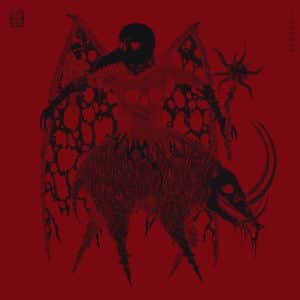
GRAVETEMPLE
“Ambient-Ruin”
Attila: chants & percussion & Fuji sounds recorded on location in Kamakura May 08. Stephen: guitars & korg polysix recorded in Paris & Saalfelden June 08. Matt: drums were recorded at 3 Phase studios, Melbourne by Sam Johnson March 06. Oren: guitars, motorised cymbal, electronics, bells, tympani, atmos recorded at Jerker House, Melbourne & BJB, Sydney 06-08. Track IV live recordings: Levontin 7, Tel Aviv by Kostya Gervis July 06. A/D Editing & Mix by Oren June 08 at Jerker House. Mastered by Joe Talia at Chinatown, Melbourne November 012.
Cut by Rashad Becker at Dubplates & Mastering, Berlin February 013.
Gravetemple was formed in 2006 as a side-project of the band Sunn O))) by Oren Ambarchi, Stephen O’Malley and Attila Csihar. The group formed initially to tour in Israel summer 06, creating several recordings which eventually became “The Holy Down” album, which was released on Southern Lord recordings in 2007. At the time of the Israel tour, the Lebanon War started and was in action. In Summer 08 the trio reformed together with the addition of Australian drummer Matt "Skitz" Sanders for a short European tour culminating at a headlining performance at Supersonic Festival in Birmingham. In late 2009 the original trio reconvened for a special one-off concert at London’s Institute of Contemporary Arts. April 2013 marks the first set of live action since that period, and a new chapter in the ongoing system of the related network. “Ambient/Ruin” was created with the 2008 quartet, elements of tape collage, concrete, field recordings blend within a strong geographically diverse (parts were recorded in Japan, Australia, Paris and Israel) suite of heavy minimalist/maximalist music, black/death metal and drone. The culmination of these efforts become the music, literally, of Sadistik Exekution meeting Phill Niblock.
Gravetemple clearly adapted the aspects more abstract and experimental related to Sunn O))) and has continued from that point, with continued ongoing focus on metaphysical construction of free music and will. The music became a geographically and metaphysically based effort.
Cut by Rashad Becker at Dubplates & Mastering, Berlin February 013.
Gravetemple was formed in 2006 as a side-project of the band Sunn O))) by Oren Ambarchi, Stephen O’Malley and Attila Csihar. The group formed initially to tour in Israel summer 06, creating several recordings which eventually became “The Holy Down” album, which was released on Southern Lord recordings in 2007. At the time of the Israel tour, the Lebanon War started and was in action. In Summer 08 the trio reformed together with the addition of Australian drummer Matt "Skitz" Sanders for a short European tour culminating at a headlining performance at Supersonic Festival in Birmingham. In late 2009 the original trio reconvened for a special one-off concert at London’s Institute of Contemporary Arts. April 2013 marks the first set of live action since that period, and a new chapter in the ongoing system of the related network. “Ambient/Ruin” was created with the 2008 quartet, elements of tape collage, concrete, field recordings blend within a strong geographically diverse (parts were recorded in Japan, Australia, Paris and Israel) suite of heavy minimalist/maximalist music, black/death metal and drone. The culmination of these efforts become the music, literally, of Sadistik Exekution meeting Phill Niblock.
Gravetemple clearly adapted the aspects more abstract and experimental related to Sunn O))) and has continued from that point, with continued ongoing focus on metaphysical construction of free music and will. The music became a geographically and metaphysically based effort.
19,00€
In stock

2 LP
KONSTRUKT and Alexander HAWKINS
“Live at Cafe OTO”
Istanbul-based free music ensemble Konstrukt perform alongside special guest Alexander Hawkins building the perfect groove in a sweaty Cafe OTO on August 10th 2015. Two sets from the same night, each a 40 minute long improvisation. First set is a psychedelic warm-up where the Turkish quartet welcomes Hawkins in a whirlwind of hypnotic funky tunes going electric in the Miles way. The second set starts with Hawkins piano keys bouncing along a silent background soon to be filled with a groovy odd drum tempo leading to a wall of sound where all parts build a perfectly unpredictable dialogue.
Pressing info: 200 copies on black.
28,00€
In stock

2 LP
Hartmut GEERKEN’S ROCK AND FREE JAZZ GROUP KABUL
“Live in Kabul 1976”
An incredible live recording of a concert hosted by the Goethe Institut of Kabul on September 22, 1976. More than sixty minutes of convulsive jams - and hypnotic obscure interludes to loop your head to - captured on reel-to-reel tape, edited and mastered for the best vinyl listening experience that will definitely prove you how free Afghanistan once was. The public too has never been this reactive, shouting and clapping to the music of the quartet directed by our beloved Hartmut Geerken, who also plays piano using both the keys and the chords. Cardboard album edition, first twenty copies come with an original copy of the program, signed and numbered on pink paper. ressing info: 250 copies on black.
24,00€
In stock

2 LP
Philip JECK
“Vinyl Coda III-IV”
‘In his hands, a tool as simple as a hammer that blocks the arm of the record
player creates a loop with a taste of eternity. Two or three such hammers can create musical galaxies far beyond the reach of traditional instruments, where no human ear has ever been before. From unidentifiable rumble and grinding to brilliant instrument-snippets and comical voice fragments, Philip Jeck glues sounds together as if they where never meant to exist on their own. Whether it be Pachelbel's Canon or some mid-90s dance music that's on Philip’s vinyl, but what we hear in the Vinyl Coda is his very unique musical voice – articulated with a perfect sense for structure, suspense and sound.” dieb13
31,00€
Out of stock
2 LP
Philip JECK
“Vinyl Coda I-II”
Philip Jeck works as composer, multimedia artist, choreographer... but above all, he is most well known as turntable manipulator. At the end of 90s, he produced something which later would be accepted as cult piece - his four part masterpiece Vinyl Coda. It is probably his most important work and peak of his art: it defines not only his musical language, but also the entire turntable culture, as well as deconstruction of vinyl. The work is nothing less than powerful low-fi symphony, which through magical looping allows us to hear to things we otherwise wouldn’t...
30,00€
In stock
2 LP
Eli KESZLER
“Last Signs of Speed”
Empty Editions is proud to present Eli Keszler’s Last Signs of Speed as our inaugural release. This release, our first vinyl record, has represented a labor of love for both Eli and ourselves.
Last Signs is Eli’s first solo release since 2012’s Catching Net (PAN Records) and explores a very different side of his unique acoustic universe. One in which the macrocosmic percussive collisions of his earlier work give way to a gradual unfolding of dub-influenced rhythmic constellations. Eli has described Last Signs as his response to playing in club environments over the last few years; an attempt to negotiate a delicate balance between the materiality of his acoustic
instrument and the hyper-mediated sonic ecosystem of the club sound system. Coming off like an inspired synthesis between Scientist and Xenakis, Last Signs of Speed is a truly unique work by an artist at the height of his powers.
Eli Keszler plays drums, percussion, fender rhodes, piano, mellotron, celeste, vibraceleste, glockenspiel, rocks, gravel. String Orchestra of Brooklyn. Leila Bordreuil, cello. Geoff Mullen, glass, metal, wood fragments. Recorded at
Bunker Studio, Seaside Lounge, and Ohio, NY, 2014-2016. Engineered by nolan thies and mitch rakin. Mastered by rashad becker. Cover Illustration by eli keszler
Liner Notes by david grubbs.
26,00€
In stock
2 LP
Nicolas COLLINS
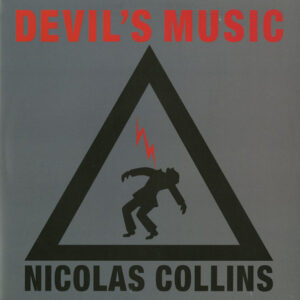
“Devil’s music”
“LP version: Two LP set in gatefold sleeve. “Devil’s Music” and more! We presents the vinyl reissue of Nicolas Collins’ live radio sampling masterpiece, originally released on vinyl in 1986, served up in all its stuttering glory, a time capsule of the mid-80s New York City airwaves, acclaimed by Philip Sherburne as “an early template for techno”, with a feel somewhat akin to scratching turntablist madness, a block-rocking party put through a blender and reassembled by body-popping demons. And more: “Real Landscape”, a 1987 “remix” recorded in Europe (originally released on cassette).”
25,00€
Out of stock

2 LP
Terry FOX
“552 Steps Through 11 Pairs of Strings”
When Terry Fox went from San Francisco to Europe in 1972, he discovered the great pavement labyrinth at Chartres Cathedral. It consists of 11 concentric rings with 552 steps and 34 turns leading into the center. The discovery of the labyrinth became a revelation to him. He saw it as a metaphor for his own life, the numbers of rings and turns corresponding to cycles of health and sickness he had undergone. Thus he decided to base all of his works until 1978 on the labyrinth. These include two major sound works, one of which – “The Labyrinth Scored for the Purrs of 11 Cats” – was later released on cassette and LP, while the other has remained unreleased so far.
“552 Steps Through 11 Pairs of Strings” was a performance made in Fox’s loft in San Francisco on August 14, 1976, starting at 10 pm and lasting 4 1/2 hours. He stretched 11 pairs of piano wires of 11 different thicknesses across the floor, attached them to turnbuckles at each end which he hooked to eye-screws into the wooden floor. Each pair of wires passed over a wooden bridge at both ends. He played this instrument with a soft mallet in one hand and a score in the other. The score was a 34-foot string tied with 552 knots. Each knot represented a step in the labyrinth with the 34 turns indicated by either a piece of wire in a knot (a move to the next longer pair of wires) or a rubber band around a knot (a move to the next shorter pair). The audience was in the dark loft of the floor below.
“We were all mesmerized by the beauty of the piece and lost in its grace. Around midnight a light rain began to fall outside the windows completing the piece’s perfection. He played for another two hours or so. It also happened to be my birthday. It was the best birthday I ever had.” (from the liner notes by Alan Scarritt)
This 2 LP includes four selections from the performance. A gatefold sleeve reproduces the score, a photograph and a drawing of the instrument, and the invitation card to the performance. Texts by Terry Fox and Alan Scarritt. Edition of 300.
“552 Steps Through 11 Pairs of Strings” was a performance made in Fox’s loft in San Francisco on August 14, 1976, starting at 10 pm and lasting 4 1/2 hours. He stretched 11 pairs of piano wires of 11 different thicknesses across the floor, attached them to turnbuckles at each end which he hooked to eye-screws into the wooden floor. Each pair of wires passed over a wooden bridge at both ends. He played this instrument with a soft mallet in one hand and a score in the other. The score was a 34-foot string tied with 552 knots. Each knot represented a step in the labyrinth with the 34 turns indicated by either a piece of wire in a knot (a move to the next longer pair of wires) or a rubber band around a knot (a move to the next shorter pair). The audience was in the dark loft of the floor below.
“We were all mesmerized by the beauty of the piece and lost in its grace. Around midnight a light rain began to fall outside the windows completing the piece’s perfection. He played for another two hours or so. It also happened to be my birthday. It was the best birthday I ever had.” (from the liner notes by Alan Scarritt)
This 2 LP includes four selections from the performance. A gatefold sleeve reproduces the score, a photograph and a drawing of the instrument, and the invitation card to the performance. Texts by Terry Fox and Alan Scarritt. Edition of 300.
32,00€
Out of stock
2 LP
Michael MOSER
“Antiphon Stein”
“Antiphon Stein” is a site-specific sound installation in the nave and choir of Minoritenkirche in Krems-Stein that engages with the architecture and sound of this church space. The material used are hanging and lying flat objects of glass and metal that are played with sound pressure transducers. These objects thus become membranes that resonate in their entire surface and mass, exuding sound to the surrounding space. The initial sounds for the installation are largely generated using a special four-channel recording technique; after the digital editing, they are left in their special four-channel arrangement, since capturing the sound from various spatial perspectives and distances allows an acoustic image of the existing space to emerge. The sound of the specific space thus plays a central role in the overall acoustic image. By way of the stringency of the early Gothic architecture, the placement or hanging of the surface objects leads to the bipartite, responsorial form of the work. Below in the nave, the eight glass plate objects, each hanging between the powerful columns, above in the former choir the tripartite metal work, arranged on the floor on white felt, thus not visible, but only audible from below. The intimacy of the apse with its triptych of metal objects contrasts with the expansiveness of the nave, with the glass surfaces hanging at a great distance. The light design, from the dark nave to the apse flooded in light, seeks to continue this dialogue. The sounds - small compositional miniatures of a duration of three to seven minutes, above more organ, below more cymbal sounds, percussion, resonant glass - are combined by the computer on the basis of a precise score into ever new constellations: aleatory in part, sometimes in fixed series and interrupted by interludes that represent in temporal intervals of thirty minutes the only moment in which an individual sound file can access all surface objects in both spaces.
35,00€
Out of stock
2 LP
Peter BRÖTZMANN – Harry MILLER – Louis MOHOLO
“Opened but hardly touched”
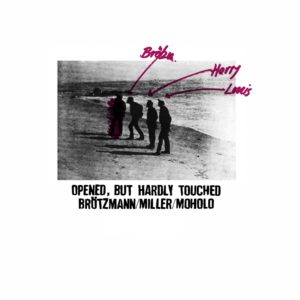
Peter Brötzmann, alto, tenor & baritone saxophone, e-flat clarinet, tarogato. Harry Miller, double bass. Louis Moholo, drums. Recorded live by Jost Gebers on November 5th & 6th,1980 in Berlin. Produced by Brötzmann and Gebers. Cover: design by Peter Brötzmann, photos by Hans Reichel. “(...) On Opened, But Hardly Touched, the Brötzmann-Miller-Moholo combination, displays the most accessible approach of the live trio recordings surveyed. An extemporaneous master who puts the spur in the spur of the moment, reedman Peter Brötzmann is surely one of Albert Ayler’s most vital sons for his blowing stamina and savage sense of humor. Bassist Harry Miller and drummer Louis Moholo lend the muscle needed to anchor and counterpoint the saxophonist’s wildest flights. Elsewhere associated with projects having a decidedly ethnic flavor, the two South Africans show off an earthiness that swings hard, in meter and out. The clarity of FMP’s November 1980 recording beautifully underlines their contributions. The boundaries between composition and improvisation are intentionally blurred. (...) The music’s design suggests a certain inevitability as it effects pendular swings between quietness and intensity, solos and duets, microtones and staunch collective blowing. On the attractive opener, Eine Kleine
Nachtmarie, Miller and Moholo pull rhythmically in and out of sync, juggling time against free sections, against the bleat of Brötzmann’s soprano stand-in, the tarogato.
Special Request For Malibu perhaps best reveals the sonic extremes. The spasmodic throes of Brötzmann on clarinet and tenor contrast with his big soft “flaps” of breath in duet with arco bass - as Miller plays sinuous near-electronic sonorities, between notes and white noise. Through all of the performances Moholo pushes, restless and jabbing, but with flexible touch.” from: Down Beat 1983.
30,00€
Out of stock

2 LP
Keiji HAINO – Jim O’ROURKE – Oren AMBARCHI
“I wonder if you noticed “I’m sorry” is such a lovely sound It keeps things from getting worse”
2LP document of the complete set performed by Keiji Haino, Jim O’Rourke and Oren Ambarchi at Tokyo’s legendary SuperDeluxe on March 2, 2014.
This 2LP set marks the seventh chapter in this remarkable series of releases from this acclaimed trio.
Continuing to explore new instrumental and dynamic possibilities while remaining grounded in the trio’s previous work, this set also brings with it a unique pleasure for the non-Japonophone listener: for the first time Haino sings many of his metaphysically brooding lyrics in English.
Deluxe 2LP set with a gatefold sleeve with gorgeous photographs by Jim O’Rourke and design by Stephen O’Malley.
Vinyl cut by Rashad Becker at Dubplates & Mastering, Berlin.
The remarkable series of releases from the trio of Keiji Haino, Jim O’Rourke and Oren Ambarchi continues with I wonder if you noticed “I'm sorry” Is such a lovely sound It keeps things from getting worse , which presents the entirety of an 80 minute set performed at Tokyo’s SuperDeluxe in March 2014. Where their 2012 performance (BT011 and BT012) was divided into two releases, one continuing their exploration of the guitar/bass/drums power trio format and the other emphasizing new instrumental configurations, the single extended performance presented here ranges widely over terrain both new and familiar, from acoustic strings and collective chants to thunderous power trio moves.
Throughout all of its transformations, the music here is some of the riskiest and most abstract the trio have yet committed to record. Beginning with chiming percussion reminiscent of Haino’s classic Tenshi No Gijinka, the first side is dominated by Haino’s impassioned vocals and performance on the bulgari, a traditional Turkish string instrument. Together with the woozy, sliding foundation of O’Rourke FX-laden bass and Ambarchi’s ritualistic percussion, the trio craft a sort of epic, abstracted song that moves through its spontaneous episodes with all of the fluidity of the best free improvisation.
After a haunting passage in which Haino’s voice, descending from angelic high notes to guttural growls, is accompanied only by O’Rourke’s roaming bass, Haino turns to electronics, gradually building a thick cloud of cosmic sludge as Ambarchi’s drumming goes into free fall. The end of the second side presents a special treat: Haino’s first recorded outing on the contrabass harmonica, from which he coaxes bizarre, wheezing textures against a backdrop of spacious bass and percussion. When Haino eventually picks up the guitar midway through the epic performance, the spaciousness and sense of volatility remain, with the trio often moving in an instant from crescendos of ecstatic noise to near-silence.
O’Rourke and Ambarchi rarely adopt here the classic rock roles essayed on earlier releases. O’Rourke’s bass, which takes centre stage surprisingly often, is sometimes so heavily processed by his array of pedals that it becomes a shifting electronic mass; at other times his roving chromaticism suggests a sort of fuzzed-out free jazz. Ambarchi spends much of the set exploring areas of tumbling free pulse; and even when he locks into a constantly repeated figure on the set’s third side, he gestures as much toward Ronald Shannon Jackson’s stuttering marching band funk as toward any classic rock moves.
When the trio finally move in the final quarter of the performance into an extended passage of rock riffing, the payoff is immense, as they craft a thudding one-chord epic reminiscent of some of the early Fushitsusha classics, before Haino returns to the bulgari, bringing the set back to where it began. Continuing to explore new instrumental and dynamic possibilities while remaining grounded in the trio’s previous work, this set also brings with it a unique pleasure for the non-Japonophone listener: for the first time Haino sings many of his metaphysically brooding lyrics in English.
This 2LP set marks the seventh chapter in this remarkable series of releases from this acclaimed trio.
Continuing to explore new instrumental and dynamic possibilities while remaining grounded in the trio’s previous work, this set also brings with it a unique pleasure for the non-Japonophone listener: for the first time Haino sings many of his metaphysically brooding lyrics in English.
Deluxe 2LP set with a gatefold sleeve with gorgeous photographs by Jim O’Rourke and design by Stephen O’Malley.
Vinyl cut by Rashad Becker at Dubplates & Mastering, Berlin.
The remarkable series of releases from the trio of Keiji Haino, Jim O’Rourke and Oren Ambarchi continues with I wonder if you noticed “I'm sorry” Is such a lovely sound It keeps things from getting worse , which presents the entirety of an 80 minute set performed at Tokyo’s SuperDeluxe in March 2014. Where their 2012 performance (BT011 and BT012) was divided into two releases, one continuing their exploration of the guitar/bass/drums power trio format and the other emphasizing new instrumental configurations, the single extended performance presented here ranges widely over terrain both new and familiar, from acoustic strings and collective chants to thunderous power trio moves.
Throughout all of its transformations, the music here is some of the riskiest and most abstract the trio have yet committed to record. Beginning with chiming percussion reminiscent of Haino’s classic Tenshi No Gijinka, the first side is dominated by Haino’s impassioned vocals and performance on the bulgari, a traditional Turkish string instrument. Together with the woozy, sliding foundation of O’Rourke FX-laden bass and Ambarchi’s ritualistic percussion, the trio craft a sort of epic, abstracted song that moves through its spontaneous episodes with all of the fluidity of the best free improvisation.
After a haunting passage in which Haino’s voice, descending from angelic high notes to guttural growls, is accompanied only by O’Rourke’s roaming bass, Haino turns to electronics, gradually building a thick cloud of cosmic sludge as Ambarchi’s drumming goes into free fall. The end of the second side presents a special treat: Haino’s first recorded outing on the contrabass harmonica, from which he coaxes bizarre, wheezing textures against a backdrop of spacious bass and percussion. When Haino eventually picks up the guitar midway through the epic performance, the spaciousness and sense of volatility remain, with the trio often moving in an instant from crescendos of ecstatic noise to near-silence.
O’Rourke and Ambarchi rarely adopt here the classic rock roles essayed on earlier releases. O’Rourke’s bass, which takes centre stage surprisingly often, is sometimes so heavily processed by his array of pedals that it becomes a shifting electronic mass; at other times his roving chromaticism suggests a sort of fuzzed-out free jazz. Ambarchi spends much of the set exploring areas of tumbling free pulse; and even when he locks into a constantly repeated figure on the set’s third side, he gestures as much toward Ronald Shannon Jackson’s stuttering marching band funk as toward any classic rock moves.
When the trio finally move in the final quarter of the performance into an extended passage of rock riffing, the payoff is immense, as they craft a thudding one-chord epic reminiscent of some of the early Fushitsusha classics, before Haino returns to the bulgari, bringing the set back to where it began. Continuing to explore new instrumental and dynamic possibilities while remaining grounded in the trio’s previous work, this set also brings with it a unique pleasure for the non-Japonophone listener: for the first time Haino sings many of his metaphysically brooding lyrics in English.
20,00€
In stock
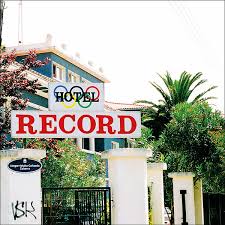
2 LP
Crys COLE & Oren AMBARCHI
“Hotel Record”
Hotel Record is the second release from the duo/couple of crys cole and Oren Ambarchi, following on from Sonja Henies Vei 31 (Planam, 2014). Where their debut recording presented a disquieting portrait of the erotic dimension of romantic intimacy, the follow-up continues to explore the pair’s simultaneously musical and romantic relationship in a more subtle fashion, presenting four long-form pieces that touch on the variety of forms the life of this couple takes: as a musical duo, as a pair of travelers to exotic locations, as opponents in a game of cards…
Each of the 2 LP’s four sides presents a distinct sound-world, yet each manages to attain the same suspended, half-sleeping feeling, outlining a space where improbable combinations of the electronic and the acoustic, of extreme closeness and amorphous distance, occur with the gentle insistence of a dream.
The opening Call Myself calmly unfolds a fabric of long tones from electronic organ and guitar, combining the sliding, aleatoric effects of classic David Behrman with a more hands-on feel. Over the top of this slowly shifting tonal bed, cole’s voice mutters unintelligibly into a Buchla synth, teasing the listener by suggesting a meaning that remains always out of the ear’s reach. Francis Debacle (Uno) builds on the foundations of a heavily amplified session of the titular card game, overlaying vocal murmurs and exhalations and mysterious room-sounds to create an impossible aural environment. On Burrata, a palette of vintage 1980s digital synthesizer sounds combined with guitars create an irregular texture of lush chords and bubbling melodic details, into which cole’s voice processed by a vocoder, is interwoven, reading fragments of romantic correspondence. Finally, on Pad Phet Gob, field recordings made in Thailand become an ambiguously acoustic/electronic rainforest, eventually giving way to a mysterious, wavering electronic tone-field punctuated by sibilant, popping mouth-sounds.
Carving out an intimate and human sonic space across a diverse array of compositional approaches, sound sources, fidelities and textures, Hotel Record is the latest dispatch from the continuing explorations of a unique duo. Ambarchi and cole reimagine electro-acoustic music, not simply as ‘abstract’ sound, but as a diary, a love poem, a dream.
Deluxe gatefold sleeve with photography by crys cole and LP design via Stephen O’Malley.
Mastered and cut by Rashad Becker at D&M, Berlin February 2017
Each of the 2 LP’s four sides presents a distinct sound-world, yet each manages to attain the same suspended, half-sleeping feeling, outlining a space where improbable combinations of the electronic and the acoustic, of extreme closeness and amorphous distance, occur with the gentle insistence of a dream.
The opening Call Myself calmly unfolds a fabric of long tones from electronic organ and guitar, combining the sliding, aleatoric effects of classic David Behrman with a more hands-on feel. Over the top of this slowly shifting tonal bed, cole’s voice mutters unintelligibly into a Buchla synth, teasing the listener by suggesting a meaning that remains always out of the ear’s reach. Francis Debacle (Uno) builds on the foundations of a heavily amplified session of the titular card game, overlaying vocal murmurs and exhalations and mysterious room-sounds to create an impossible aural environment. On Burrata, a palette of vintage 1980s digital synthesizer sounds combined with guitars create an irregular texture of lush chords and bubbling melodic details, into which cole’s voice processed by a vocoder, is interwoven, reading fragments of romantic correspondence. Finally, on Pad Phet Gob, field recordings made in Thailand become an ambiguously acoustic/electronic rainforest, eventually giving way to a mysterious, wavering electronic tone-field punctuated by sibilant, popping mouth-sounds.
Carving out an intimate and human sonic space across a diverse array of compositional approaches, sound sources, fidelities and textures, Hotel Record is the latest dispatch from the continuing explorations of a unique duo. Ambarchi and cole reimagine electro-acoustic music, not simply as ‘abstract’ sound, but as a diary, a love poem, a dream.
Deluxe gatefold sleeve with photography by crys cole and LP design via Stephen O’Malley.
Mastered and cut by Rashad Becker at D&M, Berlin February 2017
26,00€
Out of stock
2 LP
The DEAD C
“Trouble”
There’s a reason why our relationship with The Dead C is Ba Da Bing’s longest running. It’s not because they are the hardest working band we’ve ever met. It’s not because they are the largest selling band we’ve ever released. It’s not because we’re inspired to support our local music scene.
Yes, there’s definitely a reason....please give me a minute...oh ok, I got it (just put on this record). Like every time I hear their recordings, I’m reminded that they are one of the greatest rock bands to ever pick up a guitar and attempt to play it wrong. Listening to The Dead C causes me to think differently. It brings up emotions of which I’m otherwise unfamiliar. It strikes to the essence of my being and reveals that which otherwise remains hidden. I take solace in knowing that one out of every thirty of you reading this know exactly what I’m talking about.
On the spectrum of The Dead C’s sound output, Trouble could very well be seen as springing from the same realm as the massive “Driver UFO,” one of the band’s greatest tracks ever, off Harsh ‘70s Reality. There’s a youthful aggression here, a churning anger, deadened by pounding drone. Much like H70s, this record serves as a gateway drug - if you were ever looking for an album to play to a newbie curious about experimental rock, this would be it. The visceral strength of their performance trembles out of the speakers. The magnificence of their stamina survives each album side.
We are in a creative highpoint for the trio at the moment. Bruce Russell has just released a captivating solo album on Feeding Tube, while Michael Morley’s solo project Gate just put out a release on MIE. Robbie Yeats has been performing of recent as backup for Alastair Galbraith. The fact that there are still means to commute between Lyttelton and Port Chalmers on the South Island of New Zealand means these three can still find time to get together, and allows for what we have here today. And it’s fucking glorious.
Yes, there’s definitely a reason....please give me a minute...oh ok, I got it (just put on this record). Like every time I hear their recordings, I’m reminded that they are one of the greatest rock bands to ever pick up a guitar and attempt to play it wrong. Listening to The Dead C causes me to think differently. It brings up emotions of which I’m otherwise unfamiliar. It strikes to the essence of my being and reveals that which otherwise remains hidden. I take solace in knowing that one out of every thirty of you reading this know exactly what I’m talking about.
On the spectrum of The Dead C’s sound output, Trouble could very well be seen as springing from the same realm as the massive “Driver UFO,” one of the band’s greatest tracks ever, off Harsh ‘70s Reality. There’s a youthful aggression here, a churning anger, deadened by pounding drone. Much like H70s, this record serves as a gateway drug - if you were ever looking for an album to play to a newbie curious about experimental rock, this would be it. The visceral strength of their performance trembles out of the speakers. The magnificence of their stamina survives each album side.
We are in a creative highpoint for the trio at the moment. Bruce Russell has just released a captivating solo album on Feeding Tube, while Michael Morley’s solo project Gate just put out a release on MIE. Robbie Yeats has been performing of recent as backup for Alastair Galbraith. The fact that there are still means to commute between Lyttelton and Port Chalmers on the South Island of New Zealand means these three can still find time to get together, and allows for what we have here today. And it’s fucking glorious.
25,00€
Out of stock

2 LP
ENSEMBLE BABEL – Christian MARCLAY
“Screenplay”
EnsemBle baBel has been collaborating with Christian Marclay since 2012. On this 2 LP we can hear three compositions: Screen Play, Shuffle and Graffiti Composition. Screen Play is a moving image musical score in which found film footage is combined with computer animation to create a visual projection to be interpreted by live musicians. One of the ways that performing a visual score differs from performing tradition musical notation is that the musician cannot read ahead to anticipate what comes next. With Graffiti Compositions ensemble baBel interprets a graphical score. End of the last century Christian Marclay posted blank music sheets around the streets of Berlin. After they had been covered with graffiti 150 sheets had been assembled to form a graphical music score. Finally, with Shuffle Christian Marclay explores the presence of music as graphics in our daily lives - a musical score compromised of photographs printed onto a deck of cards.
300 copies 180g Vinyl 2 LP, cut by Flo Kaufmann, cover by Francis Baudevin and Nicolas Eigenheer.
21,00€
In stock

2 LP
WUNDERLITZER
“Wolfed up and down”
“Wunderlitzer is a radical sonic super-imposition process, conducted since 2004 by Michael Sellam, Benoît Durandin and Christophe Degoutin, between the fields of music, sound, noise and art. Wolfed up and down”, their debut album, sees them construct a giant jukebox, whose component sound materials are drawn from six decades of recorded amplified music (1950-2010). The Wunderlitzer method consists of superimposing all the tracks from a cd, creating a soundblock as a result, then heading towards pure noise, mixing together different soundblocks obtained from the same process. Within the ensuing maelstrom, strains of the original textures remain discernible without being entirely recognisable. 2x12” white vinyl LPs housed in silkscreened cardboard inner sleeves and fold out art print, housed in silkscreened plastic jacket, strictly limited to 300 hand-numbered copies.
25,00€
Out of stock
2 LP
Terry RILEY
“Persian Surgery Dervishes”
This classic minimal music album is now available again on vinyl for the first time since the 70s.
Californian composer Terry Riley’s In C, first issued on vinyl in 1968, is widely acknowledged as a Minimalist landmark that altered the course of twentieth-century music. His influential album A Rainbow In Curved Air, which appeared the following year, is a vivid fusion of rock and raga, jazz and psychedelia realised through overdubbing on an 8-track machine which had recently been installed at the studios of Columbia Records.
In recent decades Riley has composed a series of critically acclaimed pieces for string quartet. He has also written for full orchestra and explored a variety of instrumental combinations. But during the 1970s, he concentrated on solo keyboard performances, continuing to make music yet writing down almost nothing. Riley selected a mode, chose a few motifs or basic patterns and then, seated on the floor in front of his audience, improvised on electronic keyboard. That instrument became an essential part of his musical identity for a while, although it was chosen in part for practical reasons. The electric organ, superseded at later concerts by a synthesizer, was portable and consistent. This enabled him to avoid unreliable pianos in venues which were less formal and more variable than the standard concert hall circuit.
By the early 70s Riley had come to feel that scores were a distraction. Faithful interpretation of an already written piece was a deviation from the true purpose of making music, which was spiritual quest. Fortunately, some of those live performances, personal journeys towards a state of transcendence, were captured on tape. Persian Surgery Dervishes, issued initially on the French label Shandar, features two such concerts for electric organ and reel-to-reel delay, one recorded in Los Angeles on 18th April 1971, the other in Paris on 24th May 1972.
At the start of that decade Riley became a dedicated student of the great Hindustani singer Pandit Pran Nath. Looking into North Indian classical tradition he found correspondences to modal and cyclic ideas that he was already working on. In 1971, as a way to learn more, Riley himself started teaching Indian music at Mills College, in Oakland. That experience fed directly into his solo keyboard performances, but other influences were also shaping the music heard on Persian Surgery Dervishes. Personal research into ancient Persian culture and the poetry of Rumi lit up his imagination, while the repetitive swirling of Sufi devotional music from North Africa, which Riley had first encountered in Europe during the early 60s, reverberates through these performances. Jazz, as conceived by such masters such as Bill Evans and John Coltrane, is also present as an enduring source of inspiration.
The Californian version of Persian Surgery Dervishes starts with low dark tones, dense and brooding like a huddled human figure, deep in introspection. But as the improvisation unfolds Riley’s buoyant spirit asserts itself, spiralling out in ecstatic coils, as though liberated from the grip of body consciousness. The Parisian concert conveys a different mood, brighter and more open in texture, more relaxed from the outset and breathing with greater freedom as it takes flight.
Echoes of Terry Riley’s inspired music have spread far and wide - into progressive rock, New Age and ambient soundings, film soundtracks, blissed-out electronica and dance-floor trance. His fluent and hypnotic keyboard playing can be heard as part of a continuum, transmitting energies from ancient and distant musical sources into the living here and now. Persian Surgery Dervishes is a significant part of that picture, a mesmerising record of a vital stage in Riley’s ongoing quest for connection with the universal mind and the sublime music that flows ceaselessly from it.
“Music is my spiritual path. It’s my way of finding out who I am.” Terry Riley, in 1976
28,00€
Out of stock
flexi disc
Michael ESPOSITO – Per SVENSSON
“The ghosts of Ogilvie Station”
“Sound localization relates to the listener being able to identify the origin of a specific sound signal by direction and distance. This passive acoustic location is based on a sound or vibration created is the object being detected. Active acoustic location creates a sound or vibration producing an echo, which can be measured for location. This is also known as echo location. One of the characteristics of Electronic Voice Phenomena is the lack of sound localization. In most recordings, human voice, sounds from animals, machines and nature have a sense of sound localization. Sound localization as we know it is a well studied biological effect. The human auditory system uses many cues for sound source localization such as spectral information, correlation information, timing analysis and analysis between time and level changes between both ears. This lateral information is analyzed by our ears in a very specific manner. Time changes are mainly observed in frequencies below 800 Hz. As sound from the right side reaches the right ear sooner than the left ear the interaural time difference is measured in phase delays for low frequencies and group delays at higher frequencies. Level changes are mainly observed in frequencies above 1600 Hz. As sound from the right side reaches the right ear sooner than the left ear the interaural level difference is measured at a higher level. Both time and level differences come into play for sounds between 800 Hz and 1600 Hz.
Human voices are roughly in the range of 80 Hz to 1100 Hz. The voice frequency or audio frequency used for the transmission of speech is between 300 Hz and 3400 Hz. Below 80 Hz on the auditory level, it is virtually impossible to use either time or level difference to determine a sound’s lateral source. The directional evaluation between the phase difference between the left and right ears becomes too small to tell any difference. Intelligible speech, where we should be able to speak words that can be heard, starts at about 200Hz. Human speech is a known spectrum and with the help of the perceived sound distance can be roughly estimated. In determining sound localization in the median plane; front, above, back and below, the shape of the outer ear plays a keen role. The outer ear, including the external ear canal, creates direction-selective filters that create filter resonances. These outer ear transfer functions create and implant resonance based direction-specific patterns to determine localization. One of the main auditory system clues we use to determine sound localization is reflection. The listener is subjected to two types of sound. The direct sound is a sound that a listener hears without being reflected off of some type of surface. A reflected sound is a sound that has reflected off of at least one object. Sound localization can be gained by the ratio of the direct sound to the reflected sound or echo. If the reflective object is too close to the direct sound and the listener, the sound created will be a reverberation versus an echoic reflection. In the case of reverberation, the phase difference overlaps with the direct sound and the difference will be too small to gain any useful localization information. An echo on the other hand, creates an independent sound, completely separate from the direct sound. Our auditory system will only analyze the direct sound, which arrives first, for sound localization. This is known as the law of the first wave front. This echo cancellation physically occurs in the Dorsal Nucleus of the Lateral Lemniscuses, allowing sound localization even in echoic environments.
In EVP, there is no direct sound source. Atmosphere is manipulated creating interference and air pressure too small to register a direct sound. Is it possible that it does create a reflected or echoic sound that can be picked up by recording devices? If an entity can only push wavelength towards an object and all we register is the reflected sound, then echo cancellation would cause the sound we hear upon playback to appear to have no sound localization. In order to determine direction, a strong attack in several critical bands of our hearing range must be experienced. This strong attack from a direct sound must prevail over reflections, which arrive later. Directional cues from the direct sound become unstable from the reflected sounds, which add no loudness inside the critical bands. So, no new directional information is triggered by the auditory system. One of the reasons the voices we capture seem to come from everywhere at once may be because what we are listening to is their echo and without the direct sound response with which to measure it, we cannot determine any sound localization. These psycho acoustical phenomena would be akin to an anti-audio masking where the absence of one sound affects the perception of another sound. In Ghosts of Ogilvie Station, Per Svensson and I look at just these phenomena. In the Ogilvie Station, Chicago, originally built in 1911, there are many ghosts. There is a great deal of sound localization also. Each of the 16 tracks has an individual speaker that allows a female voice to repeatedly call out the track number. By walking in front of, behind, in between and among the different speakers at varying paces, I was able to generate an almost unearthly sense of binaural simulated sound localization. In different areas of the station, I was able to capture EVP. This was well away from the speakers calling out the track identities. On the recording, the EVPs sound flat and as if coming from no direction at all, while the almost Vocoder like female voices of the loud speakers sound not only very specific in their direction but crash into each other and compete for the listener’s attention often creating new sounds and even a sort of musical sound. To further illustrate the purity of difference between the sounds with the passive acoustic location and the EVP seemingly without, Per uses an Oscilloscope, OSCILLOGRAPH UO963 NORDMENDE, to measure the frequency relationships and provide an audio output through its tone generator. The result is a very clear exercise in how we experience the audible and inaudible world around us.” Michael Esposito
Human voices are roughly in the range of 80 Hz to 1100 Hz. The voice frequency or audio frequency used for the transmission of speech is between 300 Hz and 3400 Hz. Below 80 Hz on the auditory level, it is virtually impossible to use either time or level difference to determine a sound’s lateral source. The directional evaluation between the phase difference between the left and right ears becomes too small to tell any difference. Intelligible speech, where we should be able to speak words that can be heard, starts at about 200Hz. Human speech is a known spectrum and with the help of the perceived sound distance can be roughly estimated. In determining sound localization in the median plane; front, above, back and below, the shape of the outer ear plays a keen role. The outer ear, including the external ear canal, creates direction-selective filters that create filter resonances. These outer ear transfer functions create and implant resonance based direction-specific patterns to determine localization. One of the main auditory system clues we use to determine sound localization is reflection. The listener is subjected to two types of sound. The direct sound is a sound that a listener hears without being reflected off of some type of surface. A reflected sound is a sound that has reflected off of at least one object. Sound localization can be gained by the ratio of the direct sound to the reflected sound or echo. If the reflective object is too close to the direct sound and the listener, the sound created will be a reverberation versus an echoic reflection. In the case of reverberation, the phase difference overlaps with the direct sound and the difference will be too small to gain any useful localization information. An echo on the other hand, creates an independent sound, completely separate from the direct sound. Our auditory system will only analyze the direct sound, which arrives first, for sound localization. This is known as the law of the first wave front. This echo cancellation physically occurs in the Dorsal Nucleus of the Lateral Lemniscuses, allowing sound localization even in echoic environments.
In EVP, there is no direct sound source. Atmosphere is manipulated creating interference and air pressure too small to register a direct sound. Is it possible that it does create a reflected or echoic sound that can be picked up by recording devices? If an entity can only push wavelength towards an object and all we register is the reflected sound, then echo cancellation would cause the sound we hear upon playback to appear to have no sound localization. In order to determine direction, a strong attack in several critical bands of our hearing range must be experienced. This strong attack from a direct sound must prevail over reflections, which arrive later. Directional cues from the direct sound become unstable from the reflected sounds, which add no loudness inside the critical bands. So, no new directional information is triggered by the auditory system. One of the reasons the voices we capture seem to come from everywhere at once may be because what we are listening to is their echo and without the direct sound response with which to measure it, we cannot determine any sound localization. These psycho acoustical phenomena would be akin to an anti-audio masking where the absence of one sound affects the perception of another sound. In Ghosts of Ogilvie Station, Per Svensson and I look at just these phenomena. In the Ogilvie Station, Chicago, originally built in 1911, there are many ghosts. There is a great deal of sound localization also. Each of the 16 tracks has an individual speaker that allows a female voice to repeatedly call out the track number. By walking in front of, behind, in between and among the different speakers at varying paces, I was able to generate an almost unearthly sense of binaural simulated sound localization. In different areas of the station, I was able to capture EVP. This was well away from the speakers calling out the track identities. On the recording, the EVPs sound flat and as if coming from no direction at all, while the almost Vocoder like female voices of the loud speakers sound not only very specific in their direction but crash into each other and compete for the listener’s attention often creating new sounds and even a sort of musical sound. To further illustrate the purity of difference between the sounds with the passive acoustic location and the EVP seemingly without, Per uses an Oscilloscope, OSCILLOGRAPH UO963 NORDMENDE, to measure the frequency relationships and provide an audio output through its tone generator. The result is a very clear exercise in how we experience the audible and inaudible world around us.” Michael Esposito
5,00€
In stock
7"
John WIESE – Lasse MARHAUG
“Continous Loop Sheep”
The 7” it took 20 years to make: In 1997 Lasse Marhaug and John Wiese arranged to record a split cassette for Norwegian label Komkol Autoprod. The music was recorded on June 6th at the exact same time on opposite side of the Atlantic, as a form of musical telepathy. They also agreed to base the recordings on continous loops. The recordings were made, but the cassette was never released and the material remained forgotten until Marhaug found and digitized the master in 2014. It was agreed to wait until the recording was exactly 20 years and edit each other’s material down to 7” length, making it a 20 year long telepathic collaboration.
9,00€