
In stock

LP
INTERSYSTEMS
“Peachy”
The sound work of Intersystems cannibalized stray bits of McLuhanism, psychedelia, Cagean experimentalism, and even the modernist gestural strains of nascent electronic music, yet it was all couched within a very particular DIY ethos.
“Peachy” (early 1968) pushes the meticulousness of “Number One Intersystems” even further and, as such, represents a more balanced amalgam of Intersystems’ various disparate stylistic and emotional elements. The truncated opening cut “Experienced Not Watched” is deceptive, beginning with lush, tuneful organ swells that almost border on the ecclesiastical and washed-out metallic pulsations. Yet this world is suddenly sealed off, as the track comes to an abrupt end. What follows is thinner and more gestural, imbued with both poise and awkward buoyancy, owing more to musique concrète than anything on “Number One Intersystems”. Each sound is framed within ample negative space, inviting listeners to savour each moment, yet its dynamism, and boisterousness, mischievous character steer it well away from being too precious. This impression is reinforced by the decidedly rugged and opaque timbre of much of the sonic activity – one of the (not so many elements) retained from “Number One Intersystems”. This is not to undercut the newfound lustre of higher spectra, which seems haunted by brilliant flickers of auditory light.
“Peachy”’s balance can also be attributed to its consistent flow. The album may superficially be divided into discrete tracks yet the pieces follow one another seamlessly, conveying a single arc, with many continuities and recurring motives. Many of these motives are just mere pithy jolts or shudders of white noise that dart in and out of the aural scenery. Even strains of the aforementioned organ prelude resurface at the beginning of “So They Took The Guns” and on the final cut of record albeit in drastically altered forms. In the former case, it matches the gestural profile of the opening cut – it’s suddenly lopped off, shifting decisively back toward a slice of Parker’s grim narrative, planted squarely in the foreground amidst various percolating abstract chatter.
Just as the musical textures have a more unified logic, Parker’s texts are also more integrated into the total picture, both aurally and thematically. The most discernible fragments unfold like a series of variations on the same twisted fable. The sardonic storybook tone with which he speaks the prose is eerily congruent with this fact. Despite its sharp veerings into death and violence, the abrupt leaps have a more absurd timbre, than one of abjection and morbidity. And the sudden shifts, of course, are complemented well by the restless intensity of Mills-Cockell’s contributions.
Parker’s voice is subject to a wider spectrum of electronic treatments than before. They’re also situated in various places, both spatially and within the mix. Sometimes it’s a hushed smear of voice within Mills-Cockell’s nimble collages, at other points a vaguely smutty phrase might sneak into the foreground, only to be smothered by a swarm of other peculiar sounds. Where his text is most legible, the electronics punctuate his sentences and follow their contours in playful counterpoint.
This edition of “Peachy” LP includes the correct tracks separations, timings and titles. Re-mastered by John Mills-Cockell. Mastered for cutting by Giuseppe Ielasi.
Edition limited to 300 copies.
“Peachy” (early 1968) pushes the meticulousness of “Number One Intersystems” even further and, as such, represents a more balanced amalgam of Intersystems’ various disparate stylistic and emotional elements. The truncated opening cut “Experienced Not Watched” is deceptive, beginning with lush, tuneful organ swells that almost border on the ecclesiastical and washed-out metallic pulsations. Yet this world is suddenly sealed off, as the track comes to an abrupt end. What follows is thinner and more gestural, imbued with both poise and awkward buoyancy, owing more to musique concrète than anything on “Number One Intersystems”. Each sound is framed within ample negative space, inviting listeners to savour each moment, yet its dynamism, and boisterousness, mischievous character steer it well away from being too precious. This impression is reinforced by the decidedly rugged and opaque timbre of much of the sonic activity – one of the (not so many elements) retained from “Number One Intersystems”. This is not to undercut the newfound lustre of higher spectra, which seems haunted by brilliant flickers of auditory light.
“Peachy”’s balance can also be attributed to its consistent flow. The album may superficially be divided into discrete tracks yet the pieces follow one another seamlessly, conveying a single arc, with many continuities and recurring motives. Many of these motives are just mere pithy jolts or shudders of white noise that dart in and out of the aural scenery. Even strains of the aforementioned organ prelude resurface at the beginning of “So They Took The Guns” and on the final cut of record albeit in drastically altered forms. In the former case, it matches the gestural profile of the opening cut – it’s suddenly lopped off, shifting decisively back toward a slice of Parker’s grim narrative, planted squarely in the foreground amidst various percolating abstract chatter.
Just as the musical textures have a more unified logic, Parker’s texts are also more integrated into the total picture, both aurally and thematically. The most discernible fragments unfold like a series of variations on the same twisted fable. The sardonic storybook tone with which he speaks the prose is eerily congruent with this fact. Despite its sharp veerings into death and violence, the abrupt leaps have a more absurd timbre, than one of abjection and morbidity. And the sudden shifts, of course, are complemented well by the restless intensity of Mills-Cockell’s contributions.
Parker’s voice is subject to a wider spectrum of electronic treatments than before. They’re also situated in various places, both spatially and within the mix. Sometimes it’s a hushed smear of voice within Mills-Cockell’s nimble collages, at other points a vaguely smutty phrase might sneak into the foreground, only to be smothered by a swarm of other peculiar sounds. Where his text is most legible, the electronics punctuate his sentences and follow their contours in playful counterpoint.
This edition of “Peachy” LP includes the correct tracks separations, timings and titles. Re-mastered by John Mills-Cockell. Mastered for cutting by Giuseppe Ielasi.
Edition limited to 300 copies.
20,00€
Out of stock

LP
INTERSYSTEMS
“Free Psychedelic Poster Inside”
Drawing on huge array of different sources, Intersystems occupied a difficult-to-reach critical nook between the many tropes that had established to frame the various artistic trends of 1960’s.
Announcing itself with a quivering beam of fluorescent sound, the beginning of Intersystems’ “Free Psychedelic Poster Inside” feels as though it’s slowly piercing right through your frontal lobe. As suggestive of hypnosis as it is of a sonic lobotomy, it makes a foreboding complement to Blake Parker’s poetry, this time a dark glimpse into mundane domesticity and the suburbs. One can’t help but sense that they’re being brainwashed: the slow metamorphosis of sound is juxtaposed against Parker’s even-tempered yet electronically-tampered-with speech.
There are occasional hints at the twitchy energy of “Peachy”, but everything is braced by a spine of lean, cool tones, making “Free Psychedelic Poster Inside” a far more stark outing than either of its predecessors. Yet the sense of impending danger and general volatility found in the rest of the catalogue is still present – if not amplified because of this more severe approach. In contrast to “Peachy”, the shapes the music cuts are smooth rather than jagged, but one is never sure just when Parker’s strangely uninflected voice will emerge from the blinding aggregates of pure colour. While these clusters of glowing sustain assert an aggressive mesmerism, they serve as a primer for the ears, ominously readying them for virtually anything to happen.
When something does, there’s often a sense mild alarm on the listener’s part even when said change comes in the form of a reprieve from the relentless swarms of high frequency – cascades of synthetic giggles, sliding slow elastic melodies, vigorous strobing modulations and bubbling passages of electronic fizz.
Musician and insatiable collector Julian Cope, on his exhaustive online chronicle of all things rare and psychedelic, “Head Heritage” calls Intersystems third LP “one of the densest, most oblique collections of sound ever”. While it’s hard not to feel smothered by its slow concentrated seep, there’s also a vague air of contemplation that permeates its gradual unfolding.
This edition of “Free Psychedelic Poster Inside” LP presents the original (double) title-tracks. Re-mastered by John Mills-Cockell. Mastered for cutting by Giuseppe Ielasi.
Edition limited to 300 copies with original LP graphics as well as a new insert .
Announcing itself with a quivering beam of fluorescent sound, the beginning of Intersystems’ “Free Psychedelic Poster Inside” feels as though it’s slowly piercing right through your frontal lobe. As suggestive of hypnosis as it is of a sonic lobotomy, it makes a foreboding complement to Blake Parker’s poetry, this time a dark glimpse into mundane domesticity and the suburbs. One can’t help but sense that they’re being brainwashed: the slow metamorphosis of sound is juxtaposed against Parker’s even-tempered yet electronically-tampered-with speech.
There are occasional hints at the twitchy energy of “Peachy”, but everything is braced by a spine of lean, cool tones, making “Free Psychedelic Poster Inside” a far more stark outing than either of its predecessors. Yet the sense of impending danger and general volatility found in the rest of the catalogue is still present – if not amplified because of this more severe approach. In contrast to “Peachy”, the shapes the music cuts are smooth rather than jagged, but one is never sure just when Parker’s strangely uninflected voice will emerge from the blinding aggregates of pure colour. While these clusters of glowing sustain assert an aggressive mesmerism, they serve as a primer for the ears, ominously readying them for virtually anything to happen.
When something does, there’s often a sense mild alarm on the listener’s part even when said change comes in the form of a reprieve from the relentless swarms of high frequency – cascades of synthetic giggles, sliding slow elastic melodies, vigorous strobing modulations and bubbling passages of electronic fizz.
Musician and insatiable collector Julian Cope, on his exhaustive online chronicle of all things rare and psychedelic, “Head Heritage” calls Intersystems third LP “one of the densest, most oblique collections of sound ever”. While it’s hard not to feel smothered by its slow concentrated seep, there’s also a vague air of contemplation that permeates its gradual unfolding.
This edition of “Free Psychedelic Poster Inside” LP presents the original (double) title-tracks. Re-mastered by John Mills-Cockell. Mastered for cutting by Giuseppe Ielasi.
Edition limited to 300 copies with original LP graphics as well as a new insert .
20,00€
Out of stock

LP
Michel POTAGE
“Occupé”
“alga marghen presents one of the treasures of the French avant scene of the 1970s, published now for the first time. An ideal parallel to Jac Berrocal cult LP “Paralleles”, the realization of these pieces recorded by Daniel Deshays and produced by d’Avantage in 1977 that also conceived a very elaborated sleeve design, was mysteriously discontinued making this record one of the lost jewels of the French underground. Together with Michel Potage (voice and various instruments) and Jac Berrocal (trumpet, valve trombone, tibetal oboe, percussions), the same ensemble that recorded Berrocal’s “Paralleles”, or Pierre Bastien of Nu Creative Methods fame (bass, tibetan reed instruments, trumpet, voice), the father of French free jazz Bernard Vitet (bugle, trumpet, reed instruments, violin, voice), Roger Ferlet (trumpet, slide trombone, voice), Claude Parle (accordion, reed instruments, voice), Françoise Achard (voice, chant, lao mouth organ, balano, rainstick), the legendary produced and sound engineer Daniel Deshays (voice), poet Jean-Marie Gibbal (voice) and a Ford Break (engine, speed, brakes, light, etc.), everyone is here following Michel Potage vision and enters into a magic sound territory. Michel Potage was co-founder with Berrocal of the d’Avantage label in 1976, he played in the first Catalogue band (with Jac Berrocal and Jean-François Pauvros), a performer close to Julian Beck’s Living Theatre on one side and to James Change no-wave Contortions on the other, musique concrete avant-gardist and poet of destroyed lyrism. After 3 years of elaboration in close connection with the author, alga marghen conceived a new layout with original photos of the recording sessions and proudly co-released this production with d’Avantage. The sound was restored from the original masters by Daniel Deshays. Edition limited to 385 copies (the first 35 copies are pressed on blue vinyl), including an LP-size 8-page booklet with complete lyrics and photos from the recording session.” label info
23,00€
Out of stock
LP
Maurice LEMAÎTRE
“Poèmes et musiques lettristes et hyperphonie”
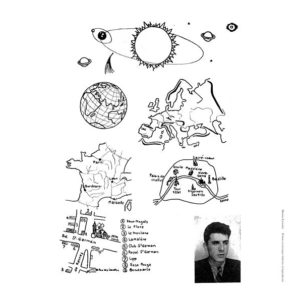
alga marghen proudly presents an exceptionally wild sonic art and poetry document, Maurice Lemaître “Poémes et musiques lettristes et hyperphonie” recorded between 1952 and 1968. What does Lemaître contribute to the Isouian poetic creation? What… music as background to “lettries”? These are heretic hyperphonies forming such a specific corpus in the lettric sphere. Neither Isou, nor Pomerand, Dufrêne, Wolman, or Spacagna achieved what Lemaître did… Lemaître dares the unthinkable: neo-yéyé rhythmic muzak destroyed by "lettries" disseminated with the biggest care. One more treasure: the very "pop music" oriented Lemaître with his “I wanna go home mister” blues, here in a version with a borderline insane companion: Isidore Isou. Never a bluesman, thanks only to his irradiant genius, has ever been such a stoned sideman as Isou. This record includes an improvisation held at the Museum of Modern Art, Paris, 1961, in the context of a reading by Isidore Isou. Also included on this LP is a previously unreleased torrid “concerto” titled “L’alcove” for a lettrist male chorus and female solo orgasms, followed by “L’ascension du Phénix M.B.”, a sound collage from 1967 (predating more than 10 years M.B. first primitive concrete music assemblages under the name Sacher Pelz). No need of Yoko Ono’s loops for another “Revolution 9”… one year before Lemaître cuts the tape with a scalpel, leaving the cuts exposed: home revolution in between two manifestos and three hypergraphic paintings. Offer yourself the joy of listening to these recordings that alas Lemaître, whose hearing stops precisely at 250Hz, can no longer have the pleasure to taste. Edition limited to 240 copies, with liner notes by Frederic Acquaviva and a fantastic front cover drawing by Maurice Lemaître.
23,00€
In stock
LP
Ju Suk REET MEATE
“Solo 1975-1980”
Side-stepping all normal expectations on this album, Ju Suk Reet Meate
(founding member of Smegma) directly goes about casting musical spells utilizing primitive “inner-mind” techniques on Hammered Dulcimer, Tape Loops, Thrift store records, Homemade Synthesizer, Electric Guitar, Saxophone, mouth sounds and manipulated Christian radio broadcasts.
Recorded in Portland, Oregon, between 1975 and 1980 these recordings reflect a similar inner-mind-over-limited-technique-matter aesthetic as his highly acclaimed (but seldom heard) classic Ju Suk Reet Meate “Solo 1978-1979” issued on Pigface Records in 1980.
Side One presents “Something New: Opus I-IV” recorded between 1975 and 1977 while on Side Two you find “Or Feets: Opus I-III” recorded in 1980. Both sides contain only previously unreleased sounds with no remixing or overdubs.
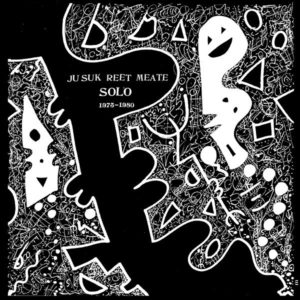
White silkscreened sleeve on black cardboard paper. Cover art and layout by Ju Suk Reet Meate. Issued in an edition limited to 188 copies, the first 50 with handmade sleeve by the artist.
(founding member of Smegma) directly goes about casting musical spells utilizing primitive “inner-mind” techniques on Hammered Dulcimer, Tape Loops, Thrift store records, Homemade Synthesizer, Electric Guitar, Saxophone, mouth sounds and manipulated Christian radio broadcasts.
Recorded in Portland, Oregon, between 1975 and 1980 these recordings reflect a similar inner-mind-over-limited-technique-matter aesthetic as his highly acclaimed (but seldom heard) classic Ju Suk Reet Meate “Solo 1978-1979” issued on Pigface Records in 1980.
Side One presents “Something New: Opus I-IV” recorded between 1975 and 1977 while on Side Two you find “Or Feets: Opus I-III” recorded in 1980. Both sides contain only previously unreleased sounds with no remixing or overdubs.
White silkscreened sleeve on black cardboard paper. Cover art and layout by Ju Suk Reet Meate. Issued in an edition limited to 188 copies, the first 50 with handmade sleeve by the artist.
23,00€
Out of stock
LP
Jacques THOLLOT’S INTRA MUSIQUE
“Intra Musique”
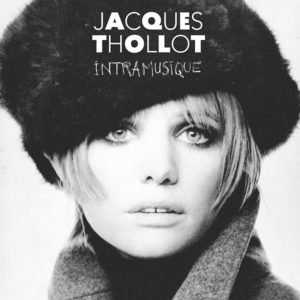
There are records that stimulate curiosity to the extreme, records that make you want to dissolve yourself into the intense and beautiful surprise this music will bring. It is undeniable to the delighted ear that this exhumed document contains all the assets of the historical output, of the record that one would dream of waiting for long if one had known it existed.
This rough edit, done within urgency by Jacques Thollot, testifies of a unique experience: the concert of Intra Musique at the Faculty of Law in Paris, an uncertain evening of 1969. The devastating gab of the two acolytes Jacques Thollot and Eddie Gaumont made the concert take place, on the ploughed earth of May 68, in the same faculty where so much was discussed and thanks to the success of the previous concerts of the association of students that allowed the risk of hiring the thundering dream team.
Unique because there will never be another replica of what Jacques Thollot called "a movement”, involving Michel Portal (tenor sax), Mimi Lorenzini (guitar), the rare Daniel Laloux (tambour), Jacques Thollot (drums and tapes of recorded experiments, those that will build the skeleton of the magnificent “Quand le son devient aigu jeter la girafe à la mer” LP on Futura), and Eddie Gaumont (guitar / piano), the instigators of this journey. Captain Eddie Gaumont will capsize shortly after, sunk by a too intensely dark life; sad coda putting an end to the project.
Let us add the undeniable whirling of the mentors' and companions' spirits of Jacques Thollot, such Don Cherry, Steve Lacy, Bernard Vitet and Jean-François Jenny Clark, and we fail a little further at attempting to describe this succession of precious moments: that oblique spiritual-jazz, that other staggering ballad or that primitive fever of essential nervous flights, that almost psychedelic proto rock; alternations of radical free music to those magnificently classic, overwhelming achievements.
Jacques Thollot is not just one of the greatest abandoned jazz composers: he is the one who abandons himself to all its forms.
Edition of 350 copies in full-color gatefold sleeve, co-produced with Jac Berrocal historical d’Avantage label (whose catalogue includes Michel Potage “Occupé” LP, also co-produced with alga marghen).
This rough edit, done within urgency by Jacques Thollot, testifies of a unique experience: the concert of Intra Musique at the Faculty of Law in Paris, an uncertain evening of 1969. The devastating gab of the two acolytes Jacques Thollot and Eddie Gaumont made the concert take place, on the ploughed earth of May 68, in the same faculty where so much was discussed and thanks to the success of the previous concerts of the association of students that allowed the risk of hiring the thundering dream team.
Unique because there will never be another replica of what Jacques Thollot called "a movement”, involving Michel Portal (tenor sax), Mimi Lorenzini (guitar), the rare Daniel Laloux (tambour), Jacques Thollot (drums and tapes of recorded experiments, those that will build the skeleton of the magnificent “Quand le son devient aigu jeter la girafe à la mer” LP on Futura), and Eddie Gaumont (guitar / piano), the instigators of this journey. Captain Eddie Gaumont will capsize shortly after, sunk by a too intensely dark life; sad coda putting an end to the project.
Let us add the undeniable whirling of the mentors' and companions' spirits of Jacques Thollot, such Don Cherry, Steve Lacy, Bernard Vitet and Jean-François Jenny Clark, and we fail a little further at attempting to describe this succession of precious moments: that oblique spiritual-jazz, that other staggering ballad or that primitive fever of essential nervous flights, that almost psychedelic proto rock; alternations of radical free music to those magnificently classic, overwhelming achievements.
Jacques Thollot is not just one of the greatest abandoned jazz composers: he is the one who abandons himself to all its forms.
Edition of 350 copies in full-color gatefold sleeve, co-produced with Jac Berrocal historical d’Avantage label (whose catalogue includes Michel Potage “Occupé” LP, also co-produced with alga marghen).
23,00€
In stock
LP
Gil J WOLMAN
“Wolman et son double”
Might it be as a ‘détournement’ of Artaud’s famous collection and masterpiece “Le theâtre et son double” that Gil J Wolman calls this recording “Wolman et son double”? Artaud’s conference at the Vieux Colombier theater on January 13, 1947 had a major impact on the future sound poets François Dufrêne, Jean-Louis Brau and Gil J Wolman. Wolman’s ‘mégapneumie’ appeared as early as 1950 and eventually developed into an improvisation for breath and organic sounds originating from the throat. The whole body seems to be mobilized to perturb the human appearance of any possible speech.
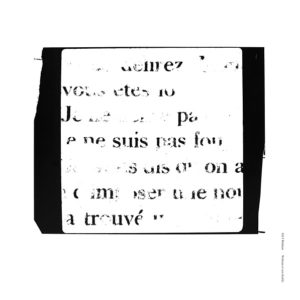
“Wolman et son double”, a previously unreleased recording probably from the end of the 70’s, is Wolman’s most theatrical, musical and lyrical piece, his most accomplished and extreme. This is due both to its duration and above all to its experimental recording techniques: Wolman records a series of improvisations on a 30 minute track, then mixes them with a new series of ‘mégapneumes’, mixing and manipulations with echo and larsen!
The first track begins with a hum, immediately overlaid by Wolman’s ‘poésie physique’: hoarseness, cough, strangulation, twisting, wheeze, rumbling, hiccups, asphyxia, a whole set of grips against himself and his speech. Wolman breaths and winces, he mimes the impacts, the scars of the blows by an invisible fighter… actually his double.
Antonin Artaud observed that ‘actors in France no longer know how to do anything but talk’… “Wolman et son double” may well be the national strike of that show, of masterpiece art.
Edition of 350 copies.
“Wolman et son double”, a previously unreleased recording probably from the end of the 70’s, is Wolman’s most theatrical, musical and lyrical piece, his most accomplished and extreme. This is due both to its duration and above all to its experimental recording techniques: Wolman records a series of improvisations on a 30 minute track, then mixes them with a new series of ‘mégapneumes’, mixing and manipulations with echo and larsen!
The first track begins with a hum, immediately overlaid by Wolman’s ‘poésie physique’: hoarseness, cough, strangulation, twisting, wheeze, rumbling, hiccups, asphyxia, a whole set of grips against himself and his speech. Wolman breaths and winces, he mimes the impacts, the scars of the blows by an invisible fighter… actually his double.
Antonin Artaud observed that ‘actors in France no longer know how to do anything but talk’… “Wolman et son double” may well be the national strike of that show, of masterpiece art.
Edition of 350 copies.
19,00€
Out of stock
LP
Ghérasim LUCA
“Two poems”
“Alga Marghen proudly presents an LP edition including two experimental sound works by Ghérasim Luca, created in close connection to Sten Hanson who invited the Rumenian artist at Fylkingen in the very beginning of the 1970s and made him discover the possibilities of the advanced EMS electronic music studio of Stockholm. The two recordings presented here are quite unique as they are the only poems by Gherasim Luca created through the use of electronic manipulations. As Henri Chopin wrote some years later in his legendary "Poésie Sonore Internationale" book, Ghérasim Luca made a big impression at the Third Stockholm Festival in 1970. Luca was born in Bucarest in 1913. Before leaving to Israel he had a leading role among the Roumanian Surrealist group. He eventually moved to Paris where he lived untill the end of his life in 1992. Ghérasim Luca work is very personal, giving his poems a very uncommon and ironic character. Again Henri Chopin underlines that "in his recordings, which are not many, he superimposes his very warm voice, marked by his Roumanian accent; it’s a sound wonder. In fact Luca is not a sound poet. He is more a speaker who managed, without complex, to enter into the Fylkingen studio vortex. On 4 tracks and with 32 loudspeakers, thanks to his superb voice and his instinctive knowledge of the electronic studio which amplifies words, he gives great pleasure to the listener, even if the latter can not understand French". “Autres secrets du vide et du plein” (April 1971) and “Crimes sens initiales” (April 1972) were both recorded one track at the time on a 4 track tape and afterwards subjected to electronic treatments. They were recorded in Sweden at EMS and first performed at the 1971 and 1972 Text-Sound Festivals of Stockholm. Edition limited to 385 copies, also including the reproduction of a worderful drawing by Ghérasim Luca on the front cover, a photo portrait of the author by Gilles Ehrmann from 1959 and an essay by Henri Chopin.”
19,00€
Out of stock
LP
Eduardo KAC PORN ART MOVEMENT
“Pornéia”
Edition limited to 270 copies.
These previously unissued recordings from the Porn Art Movement (1980-1982) include five performances recorded live on Ipanema Beach in 1982, as well as a selection of previously unheard studio recordings of Eduardo Kac yell-poems. Kac fused existing coarse and curse words with parts of words, neologisms, salacious buffoonery, the antinormative scribblings of toilet-wall graffiti, commonplaces, blasphemy, expletives, agrammatisms, incorrect orthography, slangy expressions, lexical exorbitance, general obscenities, the gross and the grotesque, into a new whole. His use of stigmatizing words in these Porn-poems transformed them from denigratory to empowering, through political critique and defiance.
The LP also includes the Manifesto Pornô (1980) and four recordings of Flatographic Poems from 1982, in which Kac uses the flatus as a compositional unit and the mellifluous flatal flow as material. Flatographic poems have visual scores—one of which can be seen on the cover—for metabolic performances that combine meticulous precision with gaseous explosiveness of scatological resonance. Demanding a high level of self-mastery on the part of the performer, this anal poetry was the only series of works produced in the Movement to literally explore the internal side of the body.
Edition limited to 270 copies, also including an LP-size 40-page full-color book with full documentation on the Porn Art Movement.
These previously unissued recordings from the Porn Art Movement (1980-1982) include five performances recorded live on Ipanema Beach in 1982, as well as a selection of previously unheard studio recordings of Eduardo Kac yell-poems. Kac fused existing coarse and curse words with parts of words, neologisms, salacious buffoonery, the antinormative scribblings of toilet-wall graffiti, commonplaces, blasphemy, expletives, agrammatisms, incorrect orthography, slangy expressions, lexical exorbitance, general obscenities, the gross and the grotesque, into a new whole. His use of stigmatizing words in these Porn-poems transformed them from denigratory to empowering, through political critique and defiance.
The LP also includes the Manifesto Pornô (1980) and four recordings of Flatographic Poems from 1982, in which Kac uses the flatus as a compositional unit and the mellifluous flatal flow as material. Flatographic poems have visual scores—one of which can be seen on the cover—for metabolic performances that combine meticulous precision with gaseous explosiveness of scatological resonance. Demanding a high level of self-mastery on the part of the performer, this anal poetry was the only series of works produced in the Movement to literally explore the internal side of the body.
Edition limited to 270 copies, also including an LP-size 40-page full-color book with full documentation on the Porn Art Movement.
23,00€
Out of stock
LP
David BEHRMAN
“Music With Memory”
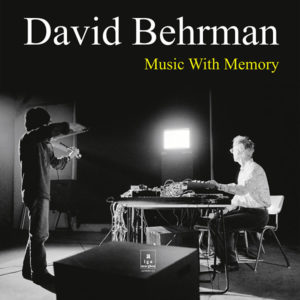
alga marghen proudly introduce you to “Music With Memory”, a new record LP by David Behrman focused on his 70s work with new small, inexpensive devices then known as “microcomputers” equipped with “memory” to be used in live performances and installations.
Side A presents “Interspecies Smalltalk” with Takehisa Kosugi (Violin) and David Behrman (Electronics). A wild intertwine of two worlds of resonance, structure and tonal which is decades ahead of its time. Commissioned by John Cage and Merce Cunningham as music for the 1984 Cunningham Company dance titled “Pictures”, it was made to be performed by Takehisa Kosugi playing violin in his uniquely personal style.
Side B includes “Circling Six”, an earlier version of a more extended piece titled “Leapday Night”. “Circling Six” had six looping synthesizer phrases which could be played along with by the acoustic instrumentalist, on this recording by Werner Durand on saxophone.
“Interspecies Smalltalk” and “Circling Six” were pieces for instrumental performers and a small computer-controlled music system that Behrman assembled during the 1980s. The electronic gear consisted of pitch sensors (“ears” with which it listened to the performing musicians), various music synthesizers (some homemade), a video display and a personal computer. The pieces were made with computer programs governing interaction between performers and the electronics. The software created situations rather than set pieces. The performers had options rather than instructions, and the exploration of each situation as it unfolded was up to them.
Also on side B a short track titled “All Thumbs” for two electrified mbiras (African instruments of ancient origin also known as thumb pianos, kalimbas or zanzas). This piece grew out of a collaborative sound and video installation that George Lewis and David Behrman made for the opening of the Paris science museum La Villette in the spring of 1986. The metal tines of the mbiras were linked to sensors and to a computer music system. In this concert version, played together with Fast Forward, the piece was in several sections. All the sounds in “All Thumbs” were electronically generated.
Edition of 400 copies with liner notes by David Behrman and photos by the performances as well as original programs of the Music With Memory Festival.
Side A presents “Interspecies Smalltalk” with Takehisa Kosugi (Violin) and David Behrman (Electronics). A wild intertwine of two worlds of resonance, structure and tonal which is decades ahead of its time. Commissioned by John Cage and Merce Cunningham as music for the 1984 Cunningham Company dance titled “Pictures”, it was made to be performed by Takehisa Kosugi playing violin in his uniquely personal style.
Side B includes “Circling Six”, an earlier version of a more extended piece titled “Leapday Night”. “Circling Six” had six looping synthesizer phrases which could be played along with by the acoustic instrumentalist, on this recording by Werner Durand on saxophone.
“Interspecies Smalltalk” and “Circling Six” were pieces for instrumental performers and a small computer-controlled music system that Behrman assembled during the 1980s. The electronic gear consisted of pitch sensors (“ears” with which it listened to the performing musicians), various music synthesizers (some homemade), a video display and a personal computer. The pieces were made with computer programs governing interaction between performers and the electronics. The software created situations rather than set pieces. The performers had options rather than instructions, and the exploration of each situation as it unfolded was up to them.
Also on side B a short track titled “All Thumbs” for two electrified mbiras (African instruments of ancient origin also known as thumb pianos, kalimbas or zanzas). This piece grew out of a collaborative sound and video installation that George Lewis and David Behrman made for the opening of the Paris science museum La Villette in the spring of 1986. The metal tines of the mbiras were linked to sensors and to a computer music system. In this concert version, played together with Fast Forward, the piece was in several sections. All the sounds in “All Thumbs” were electronically generated.
Edition of 400 copies with liner notes by David Behrman and photos by the performances as well as original programs of the Music With Memory Festival.
19,00€
In stock
LP
Charlemagne PALESTINE
“Relationship studies”
“Relationship Studies LP includes 2 seminal electronic music radical realizations by Charlemagne Palestine, or "Relationship Study No. 1" (1967) and the generally titled "Electronic" from the same year. Sounds in motion like race cars, motor cycles, war planes, rocket ships excited Charlemagne sonic imagination when we was still a young teenager. Then came the experience of listening to the electronic music of Tod Dockstader, Alwyn Nikolais, Pierre Henry and Pierre Schaffer, Xenakis and "Poème Electronique" by Edgar Varese. Immediately fascinated Charlemagne Palestine bought a primitive electronic equipment and started to experiment, creating his original electronicesque language. The two previously unreleased 18 minute masterpieces presented here directly come from this early period of intense experimentations in a fluid ever-changing mix of adding and filtering white noise and simple sine tone generators. Both pieces are late night compositions created at the electronic music studio of the New York N.Y.U. Intermedia Center using Buchla 100 and Buchla 200 systems. Even if dating back from the mid-1960s these intense sonorities might very much recall the best early power electronic scene from the late 1970s, in particular to the first brut music works created by Maurizio Bianchi. For sure they represent a very unique and inspiring approach to electronic creation, sounding more and more actual and surprising nowadays. Edition limited to 350 copies.” label info
23,00€
In stock
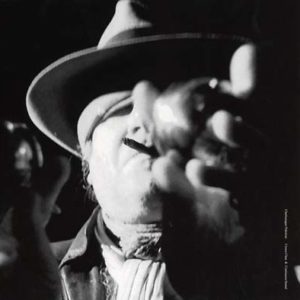
LP
Charlemagne PALESTINE
“Two electronic sonorities”
alga marghen proudly presents two seminal electronic music radical realizations by Charlemagne Palestine. These previously unpublished pieces confirm once more how advanced was his Golden Research already in the 1960s, a very personal approach to sound which would have later become so influential for future generations. Continuous Sound, built by an ever-changing mix of adding and filtering white noise and simple sine tone generators, is the most solid sound construction that Charlemagne created in preparation of his lost electronic masterpiece L’Avventura, inspired by the Michelangelo Antonioni movie with the same title. Continuous Sound pre-dates L’Avventura of just a few months and with its suspended atmospheres and its deep sense of mystery represent one of the most fascinating sonic works by Charlemagne Palestine. Crown Chan is an electronic music piece created for a dance by Gus Solomon in 1970. Conceiving music for dancers gave Charlemagne the possibility to experiment and manipulate the reel tapes of some of his electronic sonorities. In a previous collaboration with Gus Salomon, Charlemagne created a new sound by simply superimposing two already existing and accomplished electronic drones. Holy1 and Holy2 thus became a completely new sonority titled Holy1+2 (these works were included in the CD titled Alloy, also issued by alga marghen). In the case of Crown Chan Charlemagne worked in a more structural way, shaping his electronic sound materials into two stereo reel tapes (titled Crown Chan 1&2 and Crown Chan 3&4) which also integrated silent parts and were meant to be played back simultaneously, thus providing a powerful live music for the dancers. Edition limited to 380 copies, with an institutional portrait of the composer on front and back sleeve for you consumers to enjoy.
19,00€
Out of stock
LP
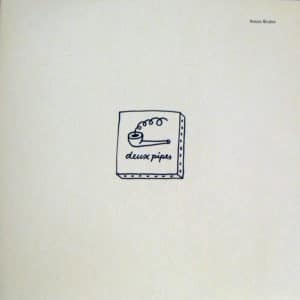
Anton BRUHIN
“Deux pipes”
“In the past few years alga marghen successfully released on CD some of Anton Bruhin more experimental works. “InOut”, “Rotomotor” and the CD version of his first LP masterpiece from 1969 “Vom goldabfischer”, made many of you become familiar with the eccentric creations of this obscure Swiss artist. But for this new release alga marghen decided to concentrate on Anton Bruhin favorite instrument, the jews harp. Included in this LP record are six breathtaking jews harp pieces of pure genius. On Side 1 “Apocalypt Rb- with sampling loop” and “Chor H+ with sampling loop and solo reverb pot”, recorded in January 2000 while testing some modified jews harp self-made instruments created by Zoltan Szilagyi. This virtuoso performance is improvised over to a loop-continuum sampled through a Casio child synth. On Side 2 the all-time-classic titled “Maultrommel und Sprache” (i.e. Jews Harp and Speaking) where Bruhin is scientifically investigating the use of jews harp in rendering human voice. Recorded in 1994 this piece, divided in five short paragraphs, move from the very basic structure of language (vocals, diptongues, triptongues) and constructs a perfectly accomplished sonic statement. Also on Side 2 are three pieces from 1995 for Electric-Trumpi-2, the only existing second generation electric jews harp, constructed specially by Szilagyi for Anton Bruhin. “Towards the G-Spot”, “ET2 with fly and cough” and “ET2 extreme filling” grandly complete the collection of limousine musics selected for this record. Gatefold sleeve with large 8 page booklet reproducing four mind-blowing drawings released between 1969 and 2006 that well proof Anton Bruhin ultra-modernistic talent of the most refined nature. Also included in the booklet is the complete score of “Maultrommel und Sprache”. Edition limited to 330 copies.” label info
23,00€
Out of stock

LP
COMPILATION
THE GAMELAN OF THE WALKING WARRIORS
A fascinating immersion in the heart of a funeral ceremony live recorded in Bali, where gongs, cymbals, and drums give rhythm to the bewitching atmosphere of this mortuary procession.
The international audience’s interest into Balinese music and its gamelan orchestras dates back to the edition of large ethnographic series in the 1950s, 60s and 70s which largely encouraged the discovery of this music beyond Indonesia’s borders. Taking advantage of a more advanced technology compared to the vinyl golden era, the present field recordings produced in 2011 render at the closest the power of gamelans. They are presented here in two forms. The first one offers a display of Beleganjur music out of the ritual context, which can be differentiated by a more melodic form and a more dramatic and hypnotic aspect of the compositions. The second one presents the Beleganjur style in the ceremonial context of the Ngaben funerary rite in the village of Peliatan. The utmost vitality of these orchestras springs out throughout the different stages of these funerals, and the sound environment surrounding the musicians immerse the listener in the very heart of the procession following the corpse.
With The Gamelan of The Walking Warriors, Akuphone carries on its exploration of ritual and ceremonial music with those materials of rare intensity. These recordings were collected by Vincenzo Della Ratta, PhD in Ethnomusicology from the Sapienza University (Rome). As a specialist of the gongs music from the Austronesian cultures of Southeast Asia, Vincenzo Della Ratta is the author of numerous articles on the subject. His field researches have already been edited as a vinyl entitled Kwangkay: Funerary Music Of The Dayak Benuaq Of Borneo (Sublime Frequencies, 2016).
The international audience’s interest into Balinese music and its gamelan orchestras dates back to the edition of large ethnographic series in the 1950s, 60s and 70s which largely encouraged the discovery of this music beyond Indonesia’s borders. Taking advantage of a more advanced technology compared to the vinyl golden era, the present field recordings produced in 2011 render at the closest the power of gamelans. They are presented here in two forms. The first one offers a display of Beleganjur music out of the ritual context, which can be differentiated by a more melodic form and a more dramatic and hypnotic aspect of the compositions. The second one presents the Beleganjur style in the ceremonial context of the Ngaben funerary rite in the village of Peliatan. The utmost vitality of these orchestras springs out throughout the different stages of these funerals, and the sound environment surrounding the musicians immerse the listener in the very heart of the procession following the corpse.
With The Gamelan of The Walking Warriors, Akuphone carries on its exploration of ritual and ceremonial music with those materials of rare intensity. These recordings were collected by Vincenzo Della Ratta, PhD in Ethnomusicology from the Sapienza University (Rome). As a specialist of the gongs music from the Austronesian cultures of Southeast Asia, Vincenzo Della Ratta is the author of numerous articles on the subject. His field researches have already been edited as a vinyl entitled Kwangkay: Funerary Music Of The Dayak Benuaq Of Borneo (Sublime Frequencies, 2016).
18,50€
Out of stock
LP
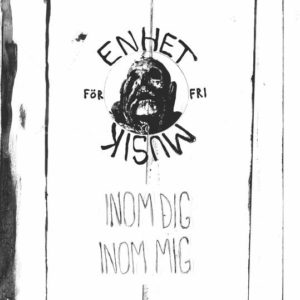
ENHET FÖR FRI MUSIK
“Inom Dig, Inom Mig”
Swedish outsider anti-folk.
Folk unit originated in the Swedish underground Enhet för Fri Musik -- featuring members of Sewer Election, Ättestupa, Neutral, Makthaverskan, and Blod - continually re-inventing what music is about through free improvisation and lengthy folk meanderings.
Embedded in the ever exciting Swedish underground scene Enhet För Fri Musik continues the quest for innovation numerous legendary Swedish bands started during the 70s, Pärson Sound, Trad Gras Och Stenar, Arbete Och Fritid. Taking the ideas of communal music craft and experimentation, on this album the group comes to a unique combination of Jandek-like atonal guitar, organ, tape effects, field recordings, saxophone and Sofie Herner’s amazing loner voice running over it. Adding another inspiring document to the world of open-minded music.
Silkscreened sleeves by Marijke Loozen. Music by Dan Johansson, Gustaf Dicksson, Hugo Randulv, Sofie Herner. Mastered by Kris Delacourt. Artwork by Dan Johansson. Edition of 150.
21,00€
In stock
LP
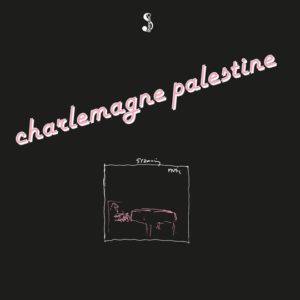
Charlemagne PALESTINE
“Strumming Music”
This classic minimal music album is now available again on vinyl for the first time since the 70s.
Primed with a glass of cognac Charlemagne Palestine sits at the keyboard of a Bösendorfer Imperial grand piano. One foot firmly holds down the sustain pedal while both hands perform an insistent strum-like alternation on the keys. Soon Palestine and his Bösendorfer are enveloped in sound and bathed in a shimmering haze of multi-coloured overtones. For 45 minutes this rich pulsating music swells and intensifies, filling the air.
When Strumming Music first appeared on the adventurous French label Shandar during the mid-1970s, it seemed a straightforward matter to place Charlemagne Palestine in the so-called Minimalist company of La Monte Young, Terry Riley, Steve Reich and Philip Glass, whose work also featured in the Shandar catalogue. Palestine too used a deliberately restricted range of materials and a repetitive technique, but as he has often pointed out in more recent times the opulent fullness of his music would more accurately be described as Maximalist.
Strumming Music, recorded in Palestine’s own loft in Manhattan, has no written score. In an age of recorded sound he still feels no need for traditional notation. The surging energy of this particular recording stands comparison with the improvising of jazz visionaries who impressed and inspired him while living in New York, as a young man. But, as Palestine himself has made clear, primarily he brings to music-making the sensibility of an artist rather than a musician.
Although the technique of the piece has roots in Palestine’s daily practice, when a teenager, of playing the carillon at a church, hammering sonorous chimes from a rack of tuned bells, it also draws on his later work as a body artist, staging vigorously muscular, physically demanding and often reckless performances. In addition, Strumming Music can be heard as a sculptural tour de force, while its textures connect with the colour moods, plastic rhythms and tactile space of Mark Rothko’s Abstract Expressionist canvases.
At the time when Philip Glass, Steve Reich and Terry Riley were becoming well-respected and widely heard composers, welcomed in concert halls and opera houses around the world, Charlemagne Palestine actually stopped making music altogether. He relocated to Europe and devoted his creative energies to the making of stuffed animal sculptures including the mighty God Bear, three-headed and six metres high. His involvement with music was revived and renewed during the 1990s, when younger generations of musicians and listeners, attuned to immersive noise and sensual sounds, were rediscovering Strumming Music and recognising that Palestine had blazed an idiosyncratic trail into their emerging world.
Since then he has returned enthusiastically to musical performance and his formerly meagre discography has steadily grown. Still Strumming Music remains the essential index of Palestine’s singular creative vision. Fundamentally this fascinating piece is a collaboration between an artist and an instrument. Palestine had first encountered the Bösendorfer Imperial back in 1969. He had already been playing church organs for several years, relishing their power and presence. Now he had found a piano that satisfied his need for sonic depth and weight. “The Bösendorfer at its best is a very noisy, thick molasses piano,” he has remarked. Charlemagne Palestine embraced its clinging sonorousness, its clangorous resonance and out of that embrace came the voluptuous sonic fabric of Strumming Music.
“My rhythms are sexual, not machine-like.” Charlemagne Palestine, in 2013.
Insert with liner notes by Julian Cowley. Comes with download code. Lacquer cut by Rashad Becker. Lay-out by Jeroen Wille. Re-mastered by Equus. Licensed from FGL Productions. Edition of 1000 copies
20,00€
In stock

LP
Lionel MARCHETTI + SOIXANTE ÉTAGES
Working with old cassettes from the French free experimental rock group Soixante Étages, the composer of concrete music Lionel Marchetti build a very special sound environment in seven parts. Archive and also new recording sessions are mixed with Lionel Marchetti own sounds to create a beautiful composition going through rock, poetry, songs and of course concrete music.
With sound participation from Bruno F., Dominique Répécaud, Hugo Roussel, Ernest Mollo, Hugues Reinert, Jean-Guillaume Legrand, Lionel Marchetti, Hélène Corre, Virginie Gabriel, Yôko Higashi, Emmanuel Petit, E. M. Kubilhaïkhan.
Limited to 500 copies.
13,00€
Out of stock
5 LP
GRUPPO DI IMPROVVISAZIONE NUOVA CONSONANZA
“Azioni-Reazioni 1967-1969”
5LP box, edition of 500 copies. The year 2007 saw one of the most remarkable findings in the long treasure-hunting history of Die Schachtel: the complete set of recordings of the early manifestation (1967-1969) of one of the most legendary improv group of all times, the Gruppo di Improvvisazione Nuova Consonanza. Rescued by the private archives of Mr. Walter Branchi, one of the original founding members – alongside with Franco Evangelisti, Ennio Morricone, Ivan Vandor, Roland Kayn, Egisto Macchi, Mario Bertoncini and John Heineman – the tapes were then restored in their entirety, but only a part of them were published in an epic 500 copies -CD-only boxset titled "Azioni 1967-1969", which also featured a DVD with the original film "Nuova Consonanza" shot by Theo Gallher during the rehearsal and the concert that the group held on March 19th and 20th, 1967, at the Galleria d'arte Moderna in Rome. Spanning from free-jazz to total abstract noise to wild electronic sounds (thanks mainly to the wizardry of Roland Kayn and Walter Branchi), their music was – and remains – one of the most dynamic, original and uncompromising expression of a period defined by intense experimentation and musical bravery, that anticipated a lot of the experiments to come in later years. Or, to put it simple, "They were utterly unique", as per the words that John Zorn – a long time admirer of the Gruppo – expressely wrote for this edition.
To mark the 10-years anniversary of its original release, and to finally make it available for the vinyl aficionados throughout the world, Die Schachtel is proud to present AZIONI/REAZIONI 1967-1969, the complete cycle of improvisations (which in fact means thirteen additional pieces never published before, spanning over 2 and a half LPs and two CDs ), taken from the original tapes, lovingly remastered by Mr. Giuseppe Ielasi and masterly cut to five black vinyls, with a new design and an even more complete information apparatus, that includes a 64 page LP-size book in English and Italian, complete with essays, memories from the members of the Group, a new article by Valentina Bertolani exploring in detail the techniques of the group (based on the enclosed DVD), a chronology and a collection of original reviews by Maurizio Farina, and – to add an additional cherry on the almost rather juicy cake - a set of stunning (and unpublished) black and white photos of the group playing in the glorious Venice "Teatro della Fenice" in 1968, taken from the archives of the Venice Biennale.
The "AZIONI/REAZIONI" LP boxset includes:
- 5 vinyl LPs
- 1 DVD (with English and Italian subtitles)
- a 64-page sewn-bound large book
To mark the 10-years anniversary of its original release, and to finally make it available for the vinyl aficionados throughout the world, Die Schachtel is proud to present AZIONI/REAZIONI 1967-1969, the complete cycle of improvisations (which in fact means thirteen additional pieces never published before, spanning over 2 and a half LPs and two CDs ), taken from the original tapes, lovingly remastered by Mr. Giuseppe Ielasi and masterly cut to five black vinyls, with a new design and an even more complete information apparatus, that includes a 64 page LP-size book in English and Italian, complete with essays, memories from the members of the Group, a new article by Valentina Bertolani exploring in detail the techniques of the group (based on the enclosed DVD), a chronology and a collection of original reviews by Maurizio Farina, and – to add an additional cherry on the almost rather juicy cake - a set of stunning (and unpublished) black and white photos of the group playing in the glorious Venice "Teatro della Fenice" in 1968, taken from the archives of the Venice Biennale.
The "AZIONI/REAZIONI" LP boxset includes:
- 5 vinyl LPs
- 1 DVD (with English and Italian subtitles)
- a 64-page sewn-bound large book
95,00€
Out of stock
4 LP
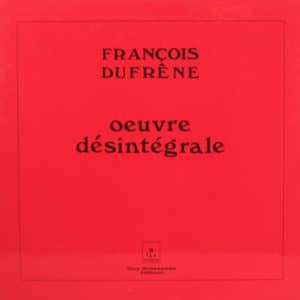
François DUFRÊNE
“Œuvre désintégrale – 4LP”
These are almost the last copies ! “Alga marghen presents one of the most impressive sound poetry anthologies ever published, introducing you to the sound works of the Nouveau Realiste artist Francois Dufrêne. His work, along with that of Gil J Wolman and Brion Gysin, was a strong influence for experimental poets like Henri Chopin, Bernard Heidsieck and Ake Hodell. François Dufrêne could be considered the younger of the first generation sound poets. Already in the Lettrist Group when he was only 16 years old, with his own style marked by an hyper-powerful voice. In 1953, at the age of 23, he became Ultra-Lettrist, starting his first Crirhythms by overpassing the alphabet in the perspective of the physical improvised scream. With the Crirhythms sound poetry enters for the first time in the factory of projective sounds. In the beginning Dufrene uses the tape recorder only to document his creations. These recordings show him that through the tape machine his poems could reached deeper and wider creative dynamics. Since the mid-1950s the tape-machine becomes for him a poetical and experimental tool and Dufrene fully develops its potentials with stereophonic recordings as well as with the superimposition of his Crirhythms. The loudspeakers amplifies sounds while the microphone captures even the most detailed concrete sound produced by his voice. The physical tempest he produces is a real concrete electronic sound attack. Dufrêne produced primitive, brutal poems opening the path of vocal sounds to contemporary composers: it’s known that Pierre Henry was deeply inspired by Dufrêne. The anthology presented here includes 10 Crirhythms from different periods dating from 1965 to 1976. Also included is "Osmose-Art", a long piece from 1969 divided in two suites where Dufrene superimposes his crirhythms to classical music. A similar technique was applied a few years earlier adding jazz music (specially drum and percussion pieces) to poems marked by strong lettristic esthetic. Two of those “Lecture-collage” dating from 1965 are presented here, as well as two “Comptinuum” from his early on-progress works started in 1958. François Dufrêne also developed unique performances, with live reading of his written text. The most famous is Tombeau de Pierre Larousse, published in 1958. This is a work half way between the written text and the sound poem whose unity is achieved through Dufrene performing it. It’s a masterpiece of synthesis of active poetry. “Eryximaque, suite choreographique au Tombeau Pierre Larousse” is also included in this anthology. Apart from the crirythmes that Henri Chopin issued on his Revue OU disc magazine (the complete OU anthology is available from alga marghen as a 4CD set) and a few short pieces issued on obscure sound poetry anthologies in the end of the 1960’s, François Dufrene work is practically unavailable. This 4LP anthology, conceived by the same author and privately issued as a 3 cassette edition in the mid-1970s, includes only previously unpublished sound works that finally fully documents the creativity of such a radical artist. De-luxe heavy boxset edition limited to 345 copies.”
65,00€
In stock

3 LP
Ferdinand KRIWET
“Hörtexte”
“Six radio texts by Ferdinand Kriwet in a beautifully designed 3 LP Picture Discs Luxury Box. Ferdinand Kriwet (born in Duesseldorf in 1942) is a multimedia artist and poet who has produced many seminal films and sound works for radio and television, in particular throughout the 1960’s and 1970’s. His works ’Apollo Amerika’ 1969 and ’Campaign’ 1973, rank today as outstanding artistic documents of these spectacular events in the history of mankind. Kriwet created the work ’Apollo Amerika’ whilst in America at the time of the moon launch, his aim being to compose a work of perception derived from all information he gathered on radio and television about the Apollo 11 launch. He describes these as "Hörtexts, Radio Texts" - radio pieces composed of noise and sound bite and samples. Kriwet’s works are an attempt at communicating an idea of listening to something that constantly surrounds us on short, medium and long wave frequencies. His politically engaged and avant-garde approach was influenced by aesthetic and Conceptual currents in Constructivism, New Music, Beat Generation and Pop. Six of Kriwets legendary ’Sehtexts’ (visual texts) reproduced on six picture disc LPs combined with six of his legendary Hörspiel works / sound collages originally broadcast on German radio and previously unreleased: ’Apollo America’ (1969), ’Voice of America’ (1970), ’Campaign’ (1973), snapshots of American media at the beginning of the 1970s; ’Radioball’ (1975) and ’Ball’ (1974), reflecting soccer sports in Germany in the 1970s; and ’Radio’ (1983)”.
55,00€
Out of stock

3 LP
Joris DE LAET
“Sem etc.”
Joris de Laet (Belgium, 1947) is a fully autodidact composer of electroacoustic music. Between 1972 and 1975 he worked at the IPEM along with Lucien Goethals and Karel Goeyvaerts and in 1973 he founded the SEM (Studio for Experimental Music) where he organised plenty of group sessions, live performances, lectures... De Laet’s work is adventurous, complex and difficult to classify, due to many interesting contrasts in his style and approach academic vs intuitive, modern composition vs free improvisation, acoustic vs electronic, sound vs noise... This selection (10 tracks) of his early recordings (1972 1979) represents an overview of his intriguingly radical and highly personal work which includes solo tape experiments, live electronics with Karel Goeyvaerts and group performances with experimental instrumentalists from the SEM ensemble : Pieter Kuyl (chapmanstick), Leo Verheyen (trombone), Paul Adriaenssens (flute and amplified objects), Maurice Verstuyft (flute). All material has been mastered from the original tapes and is previously unreleased. Edition of 300 copies.
55,00€
Out of stock

3 LP
Else Marie PADE
“Electronic Works 1958-1995”
Back in stock.
Else Marie Pade’s Electronic Works 1958-1995 is a heavy duty three LP set which was restored, mastered and cut at Dubplates in Berlin under the watchful ears of curator Jacob Kirkegaard. These monumental works are presented, for the first time, pressed on audiophile grade heavy duty vinyl where they belong. 3LP is pressed in an edition of 500 copies.
“The sounds outside became concrete music, and in the evening I could imagine that the stars and the moon and the sky uttered sounds and those turned into electronic music.” Else Marie Pade
Else Marie Pade (born 1924 in Aarhus, Denmark; currently living in Copenhagen) is a precious golden gem in the world of contemporary electro-acoustic music. She is a true pioneer of Musique Concrete and electronic music recorded on tape. She is Denmarks first lady of electronic music and her piece Syc Cirkler (Seven Circles) became Denmark’s first electronic piece to be performed on the radio.
EMP’s search for sound began in early childhood when she was isolated in her bed for long periods of time due to illness. There she would lie and listen to the sounds around her just as she did years later when she was imprisoned for spying on Nazi compounds in Arhus. Once released from prison she became a piano student at the Royal Danish Conservatory in Copenhagen but chose to instead pursue the nuances of her inner sound world after hearing Pierre Schaeffer in 1952. She began studying with him not too soon thereafter. Her first electronic composition premiered in 1955.
53,00€
Out of stock
2 LP
Jean-Marie MASSOU
“La citerne de Coulanges”
After “Sodorome”, Jean-Marie Massou is back with a 2 LP of incredible and beautifull songs (through an empty water tank) !
If you like outsider artists, you will love him !
It’s once again an incredible record highly recommended.
22,00€
Out of stock
2 LP
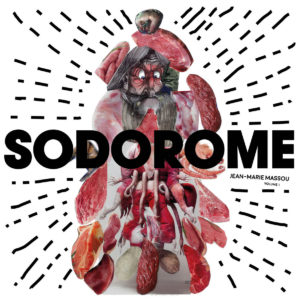
Jean-Marie MASSOU
“Sodorome Vol. 1”
Some of you may have discovered Jean-Marie Massou in the film from Antoine Boutet, “Le Plein Pays”. We can see him gathering big stones, trying to clean the earth, and building an incredible cave. We also can see him working with different tape recorders. He likes recording his voice, some of his texts, mixing with some musics and local noises.
If you like outsider artists, you will love him !
It’s an incredible record highly recommended.
20,00€
Out of stock

2 LP
Hermann NITSCH
“Orgelkonzert Jesuitenkirche”
Hermann Nitsch playing the church organ in the Jesuit church of Vienna, 20.11.2013. 4 heavy drone pieces, mastered by Martin Siewert. Different cover-artwork on CD and vinyl.
25,00€
Out of stock
2 LP
LUSTMORD
“Dark matter”
Double vinyl version limited to 1100 copies. Coporoduced with Hydra Head label.
Conceived and produced by B.Lustmord. Recorded in Los Angeles October-December 2015. Artwork & Photography by Jon Wozencroft.
Derived from an audio library of cosmological activity collected between 1993 and 2003. It was gathered from various sources including NASA (Cape Canaveral, Ames, The Jet Propulsion Laboratory and Arecibo), The Very Large Array, The National Radio Astronomy Observatory and various educational institutions and private contributors throughout the USA.
Lustmord writes: “The Universe we inhabit is a vast expanse far larger than we are able to comprehend. As we attempt to understand its underlying structure and as we gain new insight into the nature of matter, new questions arise and further gaps in our understanding are revealed.
Behind the world that we experience lies a veil of darkness and much is hidden between, beyond and unseen.
We are limited by our inability to truly grasp the infinite breadth of the Universe, the time scales involved in its measure and our insignificant position within.
Some things will always be unknowable, and existence does not begin or end with man's conception.
Everything that has ever been observed by man, even with our most sophisticated instruments amounts, to less than five percent of the Universe.
Approximately sixty-eight percent of the Universe is unseen dark energy and approximately twenty-seven percent is unseen dark matter. We have yet to discover what dark matter is, and only know the things it is not. Although it has not been directly observed, its existence and properties are inferred from its effects on visible matter, its influence on the Universe's large-scale structure, and its effects in the cosmic microwave background.
The universe began of darkness, not of light.
While space is a virtual vacuum, it does not mean there is no sound in space. It exists in space as naturally occurring electromagnetic vibrations, many well within the range of human hearing while others exist at different regions of the electromagnetic spectrum and these can be adjusted with software to bring them within our audio range.
The recordings of these interactions in space come from several different environments including radio, ultra violet, microwave and X-ray data and within these spectra a wide range of sources including interstellar plasma and molecules, radio galaxies, pulsars masers and quasars, charged particle interactions and emissions, radiation, exotic astrophysical objects, cosmic jets and flares from magnetars.”
About Lustmord: Widely credited as the originator of the “Dark Ambient” genre. Credits on over forty motion pictures including The Crow and Underworld. One of the two composers for the Turtle Rock/2K game Evolve. Worked with John Balance, Chris & Cosey, Clock DVA, Current 93, Paul Haslinger, Maynard James Keenan, Melvins, Nurse With Wound, Tool and Wes Borland amongst others.
Conceived and produced by B.Lustmord. Recorded in Los Angeles October-December 2015. Artwork & Photography by Jon Wozencroft.
Derived from an audio library of cosmological activity collected between 1993 and 2003. It was gathered from various sources including NASA (Cape Canaveral, Ames, The Jet Propulsion Laboratory and Arecibo), The Very Large Array, The National Radio Astronomy Observatory and various educational institutions and private contributors throughout the USA.
Lustmord writes: “The Universe we inhabit is a vast expanse far larger than we are able to comprehend. As we attempt to understand its underlying structure and as we gain new insight into the nature of matter, new questions arise and further gaps in our understanding are revealed.
Behind the world that we experience lies a veil of darkness and much is hidden between, beyond and unseen.
We are limited by our inability to truly grasp the infinite breadth of the Universe, the time scales involved in its measure and our insignificant position within.
Some things will always be unknowable, and existence does not begin or end with man's conception.
Everything that has ever been observed by man, even with our most sophisticated instruments amounts, to less than five percent of the Universe.
Approximately sixty-eight percent of the Universe is unseen dark energy and approximately twenty-seven percent is unseen dark matter. We have yet to discover what dark matter is, and only know the things it is not. Although it has not been directly observed, its existence and properties are inferred from its effects on visible matter, its influence on the Universe's large-scale structure, and its effects in the cosmic microwave background.
The universe began of darkness, not of light.
While space is a virtual vacuum, it does not mean there is no sound in space. It exists in space as naturally occurring electromagnetic vibrations, many well within the range of human hearing while others exist at different regions of the electromagnetic spectrum and these can be adjusted with software to bring them within our audio range.
The recordings of these interactions in space come from several different environments including radio, ultra violet, microwave and X-ray data and within these spectra a wide range of sources including interstellar plasma and molecules, radio galaxies, pulsars masers and quasars, charged particle interactions and emissions, radiation, exotic astrophysical objects, cosmic jets and flares from magnetars.”
About Lustmord: Widely credited as the originator of the “Dark Ambient” genre. Credits on over forty motion pictures including The Crow and Underworld. One of the two composers for the Turtle Rock/2K game Evolve. Worked with John Balance, Chris & Cosey, Clock DVA, Current 93, Paul Haslinger, Maynard James Keenan, Melvins, Nurse With Wound, Tool and Wes Borland amongst others.
25,00€
In stock
2 LP
KINK GONG
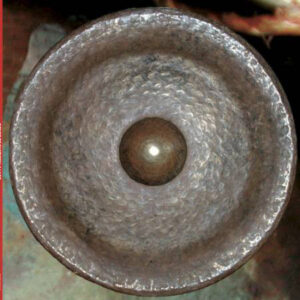
“Gongs of Cambodia and Laos”
A compilation of gongs of ethnic minorities in Ratanakiri and Mondolkiri provinces of Cambodia and in Champasak and Attapeu provinces of Laos, recorded between 2003 and 2007, released for the first time on a double vinyl, mastered by Rashad Becker at dubplates Berlin. Georges Condominas had released end of the 50s on the french label Ocora a vinyl containing recordings of gong ceremonies “musiques Mnong gar du Vietnam”, in between so much has happened and more than 50 years later it’s time for the world to discover those fantastic minimalist metallic beats, the true music of animist ceremonies of this part of south east Asia. Kink Gong & Tiger Gong are proud to reveal the exciting and rare music of gong orchestras.
26,00€
Out of stock
2 LP
THE THING
“Shake”
Mats Gustafsson, tenor & baritone saxophones. Ingebrigt Håker Flaten, electric & double bass. Paal Nilssen-Love, drums, percussion. Additional guests on one track, Anna Högberg: alto saxophone, Goran Kajfes: cornet. Recorded June 1st and 2nd 2015 by Jørgen Træen at Duper studio, Bergen, Norway.
Two years after their The Thing Records label-debut with the legendary Boot album, the Scandinavian freejazz vikings release another heavy and wonderful monster of a studio-album! Intense, passionate and accurately defined, they clearly mark their own genre within a genre!
Two years after their The Thing Records label-debut with the legendary Boot album, the Scandinavian freejazz vikings release another heavy and wonderful monster of a studio-album! Intense, passionate and accurately defined, they clearly mark their own genre within a genre!
25,00€
In stock

2 LP
Tony CONRAD
“Ten Years Alive On The Infinite Plain”
Ten Years Alive On The Infinite Plain is the quintessential work of artist/filmmaker/composer Tony Conrad. Comprised of both film installation and minimalist score for amplified strings, Ten Years leaps across genre and medium to connect his revolutionary structural filmmaking with the experiments in long-duration sound that Conrad had begun in the 1960s as part of the Theatre of Eternal Music.
“Ten Years began with image before sound,” writes Andrew Lampert, “a row of quadruple projections arranged side-by-side, all the shuffling stripes cascading into each other. Over the next two hours the music throbbed and the projectors incrementally shifted inwards, their beams gradually uniting to form one pulsating, overlapping picture.”
For its 1972 premiere at New York's The Kitchen, Ten Years included Conrad on violin as well as Rhys Chatham and Laurie Spiegel performing on instruments of the composer’s own making. Chatham played the Long String Drone – a 6-foot long strip of wood with bass strings, electric pickup, tuning keys, tape, rubber band and metal hardware – while Spiegel carried out an arrhythmic bass pulse throughout.
Superior Viaduct is honored to present this previously unreleased recording of Ten Years Alive On The Infinite Plain's breathtaking premier performance. As Chatham recounts in the liner notes, “When I first listened to this recording after not hearing it for over 40 years, it transported me back to the early Kitchen and the heyday of early minimalism, played outside the Dream Syndicate.”
“Ten Years began with image before sound,” writes Andrew Lampert, “a row of quadruple projections arranged side-by-side, all the shuffling stripes cascading into each other. Over the next two hours the music throbbed and the projectors incrementally shifted inwards, their beams gradually uniting to form one pulsating, overlapping picture.”
For its 1972 premiere at New York's The Kitchen, Ten Years included Conrad on violin as well as Rhys Chatham and Laurie Spiegel performing on instruments of the composer’s own making. Chatham played the Long String Drone – a 6-foot long strip of wood with bass strings, electric pickup, tuning keys, tape, rubber band and metal hardware – while Spiegel carried out an arrhythmic bass pulse throughout.
Superior Viaduct is honored to present this previously unreleased recording of Ten Years Alive On The Infinite Plain's breathtaking premier performance. As Chatham recounts in the liner notes, “When I first listened to this recording after not hearing it for over 40 years, it transported me back to the early Kitchen and the heyday of early minimalism, played outside the Dream Syndicate.”
30,00€
Out of stock

2 LP
NEEL
“Phobos”
All tracks produced, written and mixed by Giuseppe Tillieci a.k.a. Neel. Recorded in Rome and Curinga between summer 2013 spring 2014. Track 4 contains elements recorded in Rome, courtesy of Filippo Scorcucchi. Mastered by Giuseppe Tillieci at EnissLab Studio in Rome. There’s a large empty space on your record shelf, in between Nurse With Wound’s “Space Music” and Pete Namlook & Tetsu Inoue’s “Shades of Orion”: a gap between the cold, lifeless experimentations of Steven Stapleton-space heard as a largely silent void punctuated by the sudden and infrequent arrival of massive objects-and the romantic imaginings of 90’s space ambient which filled space with idealistic longings of earth. There aren’t many records to put right between those two. But now Neel has given us one, Phobos, and it’s both a lustrous and shadowy beauty. After debuting stellar live performances at Mutek in Montreal as well as Berlin Atonal, the time to release an album documenting the material has arrived.
Phobos is the debut LP from Neel, well-known as the sonic mastermind behind the Voices from the Lake project, together with his fellow Italian DJ, friend, and cosmic joker Donato Dozzy. Neel is a young mastering engineer with golden ears, and through Voices from the Lake, he and Dozzy have brought a level of immaculate sound production to techno which, to be honest, simply hasn’t existed before. Alone, however, you might feel Neel sounds even better.
Phobos is a carefully cut gem, reflecting layers of patient detail and filling the full frequency range with a perfect balance. Voices from the Lake is an organic project, with a tight focus on water and life, but Phobos has leapt to the opposite end of the spectrum. You cannot take a samplers magnifying glass to a place that does not transmit sound-another kind of imagination and technique is required. The sonic results are a real treat. This album more than most, will benefit from whatever outrageous hi-fi you can swing at it. Don’t just play it loud-play it well. Legend has it Neel constructed Phobos out of an elaborate narrative concerning Phobos, the larger of Mars’s two moons, Fear and its brother Dread, the son of Aries and Aphrodite, the moon which sets twice across the Martian sky each day, and which each century draws closer to its red parent by one earthly meter, in a 50-million year gravitational tease that can only end in destruction. Further investigators will have to tease out the real details of that story from Neel, but for us the album slowly traverses through deep space over the course of a single hour-long track, patiently passing slow-turning objects and desolate plains, until the final minutes where it unpacks itself-presenting all the pent-up emotions from a long trip-in a blissful moment that marks the end and beginning of this voyage into space alone.” Russell Moench, Tokyo, Japan - September 2014.
19,00€
Out of stock
2 LP
Richard MAXFIELD
2014.
Interview with Richard Maxfield + “Fermentation” (1960) For Tape, “Cough Music” (1959) For Tape, “Perspectives II For La Monte Young” (1961) For Violin performed by La Monte Young, “Piano Sonata No. 2” (1948/49) performed by Marie L. St. Gaudens, “Structures” (1951) For 10 Wind Instruments performed by Chalumeau Wind Ensemble Of London, directed by Richard Maxfield, “For Sonny Wilson” (Ca. 1966) For Tape.
Interview with Richard Maxfield + “Fermentation” (1960) For Tape, “Cough Music” (1959) For Tape, “Perspectives II For La Monte Young” (1961) For Violin performed by La Monte Young, “Piano Sonata No. 2” (1948/49) performed by Marie L. St. Gaudens, “Structures” (1951) For 10 Wind Instruments performed by Chalumeau Wind Ensemble Of London, directed by Richard Maxfield, “For Sonny Wilson” (Ca. 1966) For Tape.
30,00€
Out of stock
2 LP
The DEAD C
“Harsh 70s reality”
Originally seeing the light of day in April of 1992, Harsh 70s Reality was not just a high water mark for that year, but for the ages. Technically this was the band’s fourth long-play outing, and as a double-album, it followed (and was ever so slightly informed by) two formidable juggernauts that preceeded it: Twin Infinitives and Lake. But it was Harsh 70s Reality that left the decade stronger and more resonant than it came in. People say that rock music died with the passing of Kurt Cobain. But The Dead C slaughtered it in its sleep with this tremendous set of grinding thud. It is in every sense the ultimate post-rock album. To hear it is to understand why one scribe back in the day referred to their sound as “a garbage truck backing over the abyss.” A legendary release from a legendary band on a legendary label.
23,00€