
Out of stock

2 CD
Bernard PARMEGIANI
“Violostries”
“Violostries” (1964), “Pour en finir avec le pouvoir d’Orphée” (1972), “Dedans-Dehors” (1977), “Rouge-Mort” (1987), “Exercisme 3” (1986), “Le Présent Composé” (1991).
15,00€
Out of stock
2 CD
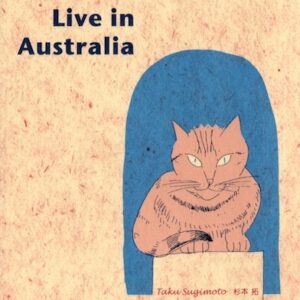
Taku SUGIMOTO
“Live in Australia”
“Taku Sugimoto is an extremely restrained guitarist who produces very few sounds in performance, allowing silence to be the controlling force. As an improviser and composer, he’s garnered international acclaim, and also provoked strong reactions, both positive and negative. This two-CD set documents Sugimoto’s live performances, in Australia in September 2003, of two of his own compositions (one per CD): "Dot (73)" and "Music for Amplified Guitar." Environmental sounds-listeners’ coughs, footsteps, and chair scraping, as well as noises from outside-make their way clearly and naturally into Sugimoto’s live concerts. Occasionally there’s a sound from his guitar; it’s as if he were collaborating with the sounds around him. This is very much the case on Live in Australia, and particularly on Disc 1. As the performance began, so did a rain shower, which grew more intense, filling the space with a sound like white noise. Over this background noise, Sugimoto quietly plucked a handful of short sounds. The set includes a long (1,000+-word) essay by Sugimoto that sheds new light on his musical ideas.” All composed by Taku Sugimoto. Taku Sugimoto: guitar. Packaged in a cardboard jacket. Mastered by Taku Unami. Drawing by Taku Sugimoto. Design by che chat. Includes liner notes by Taku Sugimoto in Japanese, and English.
16,00€
Out of stock

2 CD
COMPILATION
CULTURES ÉLECTRONIQUES 13
1999. Elzbieta Sikora “Aquamarina”, “La tête d’Orphée”, Patrick Kosk “Ice bice”, Jacky Merit “Emphase”, Kent Olofsson “Il liuto d’Orfeo”, Frédéric Kahn “Les fleurs, ces bouquets d’agonie”, Frank Corcoran “Sweeney’s vision”, Patrick Kosk “Nebula prospekt”, Tereasa Rampazzi “Atmen noch”, John Melby “Chor der Steine”.
15,00€
Out of stock
2 CD
COMPILATION
CULTURES ÉLECTRONIQUES 12
Joseph Hyde “Rhiannon”, Philippe Auclair “Spirale”, Akemi Ishijima “Solark”, Karl Friedrich Gerber “Beautiful numbers”, Jean Piché “Préceptes pour Attica”, Eduardo Reck Miranda “Electroacoustic samba II & III”, Michael Jude Bergeman “Hershe tube rundown”, William Brunson “Inside Pandora’s box”, Matt Ingalls “Silent cacophony”, Henri Demilecamps “Manège blues”, Ulrich Suesse “Klangbild AE 7”, Yves Coffy “Ys”, Philippe Blanchard “Casimir”.
15,00€
In stock
2 CD
COMPILATION
CULTURES ÉLECTRONIQUES 10 #Prix Magisterium et quadrivium Bourges 1997
Ludger Brümmer “Phrenos”, Frances White “Winter Aconites”, Mathew Adkins “Pagan Circus”, Elio Martusciello “Proiezioni”, Andrew Lewis “Ascent”, Eduardo Kusnir “Juegos I”, Joseph L. Anderson “ChAnGE’S MUSIC”, Joseba Torre “Mas libre y mas cautivo”, YeeOn Lo “Portrait of timbre as a wild wooddove”, Roger Doyle “Spirit Levels”.
15,00€
Out of stock
2 CD
COMPILATION
CULTURES ÉLECTRONIQUES 9 – Lauréats Bourges 1996
Francesco Boschetto ’Trasumanar’ pour violon et bande, Erik Mikaël Karlsson ’Interiors and Interplays’, Luigi Ceccarelli ’Birds for bass clarinet and magnetic tape’ pour clarinette basse et bande, Daniel Zimbaldo ’Cartas desde el real hospital de lunaticos’ pour soprano, ensemble instrumental et bande, Mark Wingate ’Klang, Kar und Melodie’, Mario Verandi ’Figuras Flamencas’, Lothar Voigtlaender ’Atemlos’, John Christopher Nelson ’They Wash their Ambassadors in Citrus and Fennel’ pour voix et bande, Jonty Harrison ’Sorties’, Jukka Ruohomaki ’Scratches’, Alain Michon ’Lutte au-delà’, Garnet Willis ’Clusterflux’.
15,00€
In stock
2 CD
COMPILATION
CULTURES ÉLECTRONIQUES 8
Eduardo Polonio ’ChC’, René Uylenhoet ’Wedge’, Christian Calon ’Les corps éblouis’, Joseph Hyde ’Songlines’, Ake Parmerud ’Kren’, Pablo Cetta ’ Que me hiciste mal’, Stephen Montague ’String Quartet n¡1’ pour quatuor à cordes et bande, John Palmer ’Beyond the Bridge’, Elio Martusciello ’Limite inferiore sinistro’ + Patrick Ascione ’Métamorphose d’un jaune citron’, Ivan Patachich ’Metamorfosis per marimbafono e magnetofon’.
15,00€
Out of stock
2 CD
COMPILATION
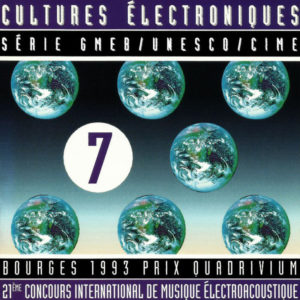
CULTURES ÉLECTRONIQUES 7
1993. Erik Mikael Karlsson “La disparition de l’azur”, Shuya Xu “Taiyi II” pour flûte et bande, Bernard Fort “L’impatience des limites” et “12 Haïkus”, Werner Cee “Droptrap”, Erik Mikael Karlsson/Jens Hedman “Anchorings/Arrows” + Marcelle Deschênes “Moll” (1978).
15,00€
In stock
2 CD
COMPILATION
CULTURES ÉLECTRONIQUES 6 – Lauréats
Justice Olsson: “Up!”, Cort Lippe: “Music for Harp and Tape” for harp and tape, David Arzouman: “Precipitation”, Alicyn Warren: “Longing for the Light”, Åke Parmerud: “Alias”, Roderik De Man: “Chordis Canam” for harpsichord and tape, Andrew Lewis: “Time and Fire”, Mike Vaughan: “Ensphered”for soprano saxophone and tape, Jon Appleton: “Stereopticon” (1973), Georg Katzer: “Rondo” (1976),
15,00€
In stock
2 CD
COMPILATION
CULTURES ÉLECTRONIQUES 5
Competition from 1990. With Kjell Johnsen: “Mura-Iki” for flute and tape, Paul Dolden: “Below the Walls of Jericho”, Robert Rowe: “Flood Gate” pour violon, piano et ordinateur interactif, Frances White: “Valdrada”, Carmelo Saitta: “La Maga o el angel de la Noche”, Frances White: “Still Life with piano” pour piano et bande, Gabriel Valverde: “Cumulos” + four pieces from the first competition, Eugeniusz Rudnik: “Mobile” (1973), Zohtan Pongracz: “Mariphonia” (1974), Jose Vicente Asuar: “Guararia Repano” (1975), Eduardo Kusnir: “La Panaderia” (1975).
15,00€
In stock
2 CD
COMPILATION
CULTURES ÉLECTRONIQUES 4
Leo Kupper: “Litanea”, Francisco Kropfl: “Orillas”, Richard Karpen: “Il Nome” pour soprano et bande, Gilles Gobeil: “Voix blanche” pour ondes Martenot et bande, Julio D’Escrivan: “Salto Mortal”, Christian Calon: “Minuit”, Takayuki Rai: “Four Inventions for piano and a signal processing computer”, Alistair MacDonald / Nicholas Virgo: “Busk”, Andrew Lewis: “Arrivals”.
15,00€
In stock
2 CD
COMPILATION
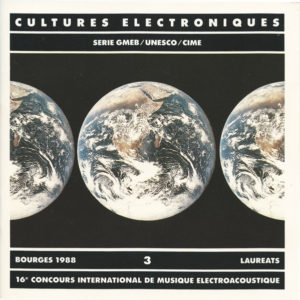
CULTURES ÉLECTRONIQUES 3 – Lauréats
SPECIAL CLEARANCE PRICES. Paul Dolden: ‘In the natural Doorway I crouch’, Robert Normandeau: ’Rumeurs, Place de Ransbeck’, Horacio Vaggione: ’Tar’ pour clarinette basse et bande, James Aikman / Armando Tranquilino: ’Tragoida / Komoidia’, Vivian Adelberg Rudow: ‘With Love’ pour violoncelle et bande, Ake Parmerud: ’Repulse’, Gabriel Poulard: ’La Mémoire des Pierres’, Ake Parmerud: ’Yan’ pour percussions et bande, Ricardo Mandolini: ’Microrreflexiones’, Lothar Voigtlaender: ’Maikfer Flieg’.
15,00€
Out of stock
2 CD
Ragnar JOHNSON assisted by Jessica MAYER
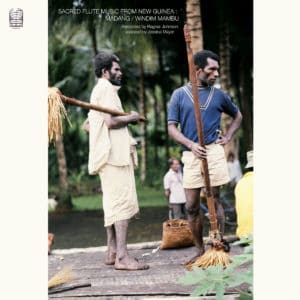
“Sacred Flute Music from New Guinea: Madang – Windim Mambu”
Recorded by Ragnar Johnson & assisted by Jessica Mayer, Papua New Guinea, April-August 1976.
Tape to digital transfer by Dave Hunt at Dave Hunt Audio, London 0715.
Mastered & cut by Rashad Becker at Dubplates & Mastering, Berlin 0815.
Notes and photographs by Ragnar Johnson & Jessica Mayer.
Thanks to Dave Hunt for transferring the original magnetic tape recordings onto digital media and to Stephen O’Malley, David Toop and Evan Parker for assistance.
Sacred flutes are blown (“Windim Mambu”) to make the cries of spirits by adult men in the Madang region of Papua New Guinea. Pairs of long bamboo male and female flutes are played for ceremonies in the coastal villages near the Ramu River. The Ravoi Flutes from Bak are accompanied by two garamut carved wooden slit gongs. The Waudang Flutes from Manam Island are accompanied by two large and two small slit gongs and six singers. The Jarvan Flutes from Awar are accompanied by a shell rattle. The Mo-mo resonating tubes were recorded in the Finisterre Range. There are the cries of six different pairs of flutes and one pair of conch shells from the Ramu coast, two pairs of Waudang Flutes from Manam Island with singing and Mo-mo resonating tubes from the Finisterre Range. Occasional percussion is provided by wooden slit gongs and hand drums.
These recordings were made in 1976.
Originally released on LP 1977 as !Quartz 001 & 1979 as !Quartz 002.
Publications by David Toop with the assistance of Sue Steward, Evan Parker, Robert Wyatt and Alfreda Benge.
Re-released on CD 1999 as Rounder Records 5154 & 5155.
Tape to digital transfer by Dave Hunt at Dave Hunt Audio, London 0715.
Mastered & cut by Rashad Becker at Dubplates & Mastering, Berlin 0815.
Notes and photographs by Ragnar Johnson & Jessica Mayer.
Thanks to Dave Hunt for transferring the original magnetic tape recordings onto digital media and to Stephen O’Malley, David Toop and Evan Parker for assistance.
Sacred flutes are blown (“Windim Mambu”) to make the cries of spirits by adult men in the Madang region of Papua New Guinea. Pairs of long bamboo male and female flutes are played for ceremonies in the coastal villages near the Ramu River. The Ravoi Flutes from Bak are accompanied by two garamut carved wooden slit gongs. The Waudang Flutes from Manam Island are accompanied by two large and two small slit gongs and six singers. The Jarvan Flutes from Awar are accompanied by a shell rattle. The Mo-mo resonating tubes were recorded in the Finisterre Range. There are the cries of six different pairs of flutes and one pair of conch shells from the Ramu coast, two pairs of Waudang Flutes from Manam Island with singing and Mo-mo resonating tubes from the Finisterre Range. Occasional percussion is provided by wooden slit gongs and hand drums.
These recordings were made in 1976.
Originally released on LP 1977 as !Quartz 001 & 1979 as !Quartz 002.
Publications by David Toop with the assistance of Sue Steward, Evan Parker, Robert Wyatt and Alfreda Benge.
Re-released on CD 1999 as Rounder Records 5154 & 5155.
18,00€
2 CD
Jean-Claude ELOY
“A l’approche du feu méditant…”
“Approaching the meditative flame…” (1983).
Theater Music for a sound and visual ceremonial. A tribute to the goddess of the light, the sun, and the stars.
For 27 instrumentalists from the Gagaku Orchestra (divided in three separate ensembles), two choruses of Buddhist monk singers (Shômyo singing traditionnal school - Tendai and Shingon sects - divided in four separated ensembles, with four monk singer soloist voices), six percussionists, five Bugaku dancers.
Extracts of this piece were published by Harmonia Mundi on a double vinyl in 1985.
18,00€
2 CD
Jean-Claude ELOY
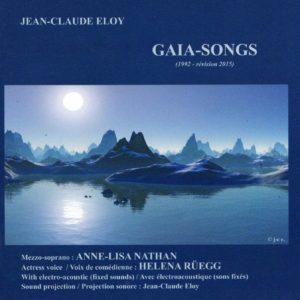
“Gaia-Songs”
“Gaia-Songs” (1992 - revision 2015). Songs for the other half of the sky n° V - VI. For a soprano (or mezzo-soprano) solo and an actress voice (Sprechgesang technique) with electro-acoustic (fixed sounds).
Anne-Lisa Nathan, mezzo-soprano. Helena Rüegg, actress voice.
“First there’s this relation between sung voices and spoken voices with regard to the electro-acoustic parts. The sung voice is quite often separated from the electro-acoustical parts accompanying it. They may sometimes overlap each other but rather briefly. Those parts often highlight octave ratios, fifth ratios, thirdratios, etc. Hence more harmonious and consonant acoustic ratios. By contrast the spoken voice fully covers the electro-acoustic parts dedicated to it and made out of more complex material. Hence more dissonant acoustic ratios turned towards noises spectrums.” JC Eloy from the liner notes
18,00€

2 CD
Jean-Claude ELOY
“Le minuit de la foi”
“Le minuit de la foi” (“The midnight of the faith”) (2014) for electronic and concrete sounds, around selected sentences by Edith Stein recorded by German actress Gisela Claudius. New work from Jean-Claude Eloy, a long piece under the power of expanded sounds and sacred words.
“Le minuit de la foi” is a double album, each CD of which forms a stand-alone entity. Each CD can therefore be listened to separetly. However, you do need to liSten to the full album for it to become meaningful through its complementary balances, and to grasp its very essence.
18,00€

2 CD
Jean-Claude ELOY
“Electro-Anâhata”
“Electro-Anâhata” (1986-1994). Fully electro-acoustic version of Anâhata realized on the composer’s personal computer from the original electro-acoustic recordings of this work.
Electronic music studios where the original Anâhata was produced (1984-86) : Studio of the Sweelinck Conservatory of Music, Amsterdam (1984 and 1986): the entire production (pre-recorded material processing, new material generation, premixing) and all final mixing processes. Tokyo-Gakuso studio, Tokyo (1983): for the Shô and Ô-Shô (traditional mouth organs from Japan) sampling with Mayumi Miyata. Conny’s Studio, Neuenkirchen, near Cologne (1984) with Asian Sound and Michael W. Ranta: metal percussion instrument sampling, including Bonshôs (Buddhist temple bells from Japan) sampling. INA-GRM, Paris (1985): pre-recorded material processing. Studio ART, Geneva (1985): pre-recorded material processing and pre-mixing. Studio of Technische Universität (TU), Berlin (1985-86): pre-recorded material processing, new material production, pre-mixing.
CD 1 Metal metamorphoses. Five electro-acoustic works of a contemplative nature. Electro-acoustic parts alone of Âhata-Anâhata (struck sound - unstruck sound) including a new unreleased part.
CD 2 The Bird-Mirror in the Magic Forest (a tribute to Paul Klee). Electro-acoustic parts alone of Akshara-Kshara (unchanging-changing). “The Reed, the Sea and the Stars” (1986-1994). Electro-acoustic parts alone of Nimîlana-Unmîlana (that which awakens - that which slumbers) among which a new unreleased part.
Jean-Claude Eloy: “In the past composers would often arrange or adapt their works themselves, often for practical or economic reasons. Let us take a look at the most prestigious examples… Take Wagner: Prelude and Love Death (Tristan and Isolde) is played two different ways. Sometimes the orchestral part alone is played as a concert piece. Other times the voice solo part is added as it is in the original opera (which then becomes the magnificent Liebestod). Such examples could be repeated endlessly among the greatest composers.
In the early 1990s I faced a challenging situation: the Japanese Gagaku musicians who had performed my work Anâhata for the first time in 1986 (for the Sigma Festival of Bordeaux and the Autumn Festival in Paris), and had performed it again in 1990 (for the Donaueschingen Festival) were not able to find time in their schedule to accept an important invitation to the Warsaw Autumn Festival. Only the two Buddhist monk singers were able to fit it in.
Before that and to complete the Anâhata project and its electro-acoustic parts I had to travel across part of Europe and spend two whole years commuting between Paris and Amsterdam several times, later between Paris and Berlin, then between Paris and Geneva… even within Paris, thanks to my friends from the GRM who had kindly let me use their studio for several weeks during night hours. Those were very precious nights for me.
During those two years I would always carry boxes of tapes and Betamax or U-Matic cassettes with two PCM Sony and two Betamax cassette decks that I had purchased a little earlier. For the first time I was then able to arrange digital recording sequences and carry out several mixing, recording and reading processes without compromising signal quality. I also had to carry boxes of multitrack bands of all types: the Amsterdam studio was equipped with a two-speed 16-track Studer, the Geneva studio with a three-speed 24- track Otari; the Berlin studio with two 8-track Telefunkens including a variable-speed one.”
During those two years I would always carry boxes of tapes and Betamax or U-Matic cassettes with two PCM Sony and two Betamax cassette decks that I had purchased a little earlier. For the first time I was then able to arrange digital recording sequences and carry out several mixing, recording and reading processes without compromising signal quality. I also had to carry boxes of multitrack bands of all types: the Amsterdam studio was equipped with a two-speed 16-track Studer, the Geneva studio with a three-speed 24- track Otari; the Berlin studio with two 8-track Telefunkens including a variable-speed one.”
18,00€

2 CD
Jean-Claude ELOY
“Chants pour l’autre moitié du ciel : III – Erkos. IV – Galaxies.”
Songs for the other half of the sky. With “Erkos” (1990-91) and “Galaxies” (1986-1996). Performed by Junko Ueda (satsuma biwa and voice) and Jean-Claude Eloy (sound projection).
Erkos is a word from the Indo-European language and means song, praise. It is close to the Sanskrit word Arkas (hymn, chant, radiance) and to the Tokharien term Yarke (reverence, homage). The texts consist of extracts from the Devî-Upanishad and Devî-Mâhâtmya writings, in Sanskrit. In those texts, an homage is paid to the Goddess who, in Indian philosophy, is considered as the mother of all energies. For this work, I have been inspired by Junko Ueda, a particularly gifted young musician whom I met in Japan in 1987, mastering at the same time the traditional technics : those from Japan (Shômyô and Satsuma-Biwa), those of the other countries of Asia (Gamelan), as well as the western technics (piano, composition). It was possible, with a performer of such a vast background, to translate these ancient and original techniques into a free contemporary creation without distorting their original nature. Erkos was commissioned by the Cologne Westdeutscher Rundfunk (WDR), at the invitation of Karlheinz Stockhausen, in collaboration with the Institut Français de Cologne and was produced in its entirety in 1990-91 at the WDR Electronic Studio.
The electroacoustic materials are essentially concrete in nature and have been drawn from three sources Junko Ueda’s voice, Satsuma Biwa (plucked string instrument with plectrum), Unban (metallic plate with complex resonance). Consequently, the recording studio is not used here as a generator but as a “multiplier-transformer” to the soloist, who is the real origin of all sounds. Symbolically, she is the source, the Goddess-mother as written about in the Sanskrit texts I have used here.
“Galaxies” is an electroacoustic work composed of two large groups of elements, contrasting with each other in function, construction, etc. but still unified as they are born from the same sources of timbre and treatment : the Japanese Shô (traditionnal mouth organ) from which all of the work’s sound material is taken, to which are added an ensemble of five Bonshô’s (temple bells from Japan and Korea).
18,00€

2 CD
Jean-Claude ELOY
“Shânti (1972-73)”
“Shânti” (1972-73) for electronic and concrete sounds. Electronic music studio, WDR, Cologne, Germany, 1972-73. Digitalized and revised version from 2001.
“The term “meditation music” triggered many conflicting comments including
positive ones (“... let us say that Shânti belongs to those very rare works that change you after listening to them. You are not exactly the same before and after.” - Gérard Mannoni, Le Quotidien de Paris, 1974). Others, wondering at the strong sound presence of the piece, consider such aspect as hardly helpful to their own meditation... Let us be clear: “what meditates” here (”that” who meditates) is the composer. He is the one who takes you on his journey and guides you through his work like in a classic or romantic symphony. As a listener you are invited to follow “his” meditation... The composition is the meditation.”
positive ones (“... let us say that Shânti belongs to those very rare works that change you after listening to them. You are not exactly the same before and after.” - Gérard Mannoni, Le Quotidien de Paris, 1974). Others, wondering at the strong sound presence of the piece, consider such aspect as hardly helpful to their own meditation... Let us be clear: “what meditates” here (”that” who meditates) is the composer. He is the one who takes you on his journey and guides you through his work like in a classic or romantic symphony. As a listener you are invited to follow “his” meditation... The composition is the meditation.”
18,00€
In stock
2 CD
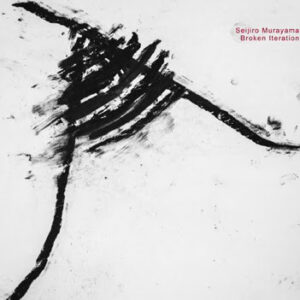
Seijiro MURAYAMA
“Broken iteration”
“The Japanese percussion player who lives in Europe has three fields of interest: 1, non-idiomatic improvisation (that includes idiomatic researches about it, or workshops on it). 2, electro acoustic composition. 3, plural disciplinary collaboration (with words, images, body movements etc) and it would seem to me that these four pieces here are a combination of 1 and 2. […] Murayama’s playing is very minimal and we do recognize indeed the element of percussion instruments, and Murayama explores his instruments with great care.
It has a fine meditative character this music and it explores in depth the textures of the instruments. Murayama doesn’t use his drum parts as a drum kit, but plays one or two separate elements with brushes, sticks or objects and explores them.” FdW in Vital
23,00€
Out of stock

2 CD
RELAY FOR DEATH
“Natural Incapacity”
Relay For Death are the twin sisters Rachal and Roxann Spikula, whose noise mantras transcribe the harsh realities of urban blight that complicate and threaten their own survival. It was in the context of two month medical study that the Spikulas composed their debut album in 2009, amplifying the emptiness of hospital rooms into a ghostly pall worthy of the classic works by Maurizio Bianchi.
Natural Incapacity sprouts from a similar research and development, manifesting from the sonic pollution that proliferates in their current residence of Richmond, California. Clocking in at well over two hours, Natural Incapacity was composed as a seamless, glacial accretion of locomotive grind, subharmonic environmental rumble, nocturnal street sweeping, and the quavering hum of toxic chemicals perpetually leached into the water table. By design, Natural Incapacity’s oil-stained drone is completely relentless, implying neither beginning nor end to this cycle of contamination. Relay For Death’s industrial meditation recognizes abjection, horror, and defeat as the prevalent conditions to existence. Even as a declared rejection to those conditions, Natural Incapacity is engulfed in a bleak nihilism constantly churning back upon itself. Grizzled antecedents can be found in the apocalyptic works of Maurizio Bianchi, Kevin Drumm’s Imperial Distortion, and Organum’s Vacant Lights.
While intended to be a seamless document, Natural Incapacity is split over two CDs and does feature a download of the composition in unedited form. The physical edition features hand-rusted metal covers by the noted corrosion artist Jim Haynes and is strictly limited to 150 copies.
20,00€
Out of stock

2 CD
Christina KUBISH & Annea LOCKWOOD
“The secret life of the inaudible”
CD 1, Annea Lockwood. “Wild Energy” (2016) with Bob Bielecki. “Streaming, swirking, converging” (2017).
CD 2, Christina Kubisch. “Nine magnetic places” (2017). “Below Behind Above” (2017).
“Annea and I first met in New York in 1975. I was writing an article about the experimental music scene in New York for an Italian magazine. We soon found out that we had a lot of common interests and ideas. In 1979 she came to Italy and together we performed her piece “World Rhythms” at a festival in Como. I was deeply impressed by how Annea combined technical skills with intuitive performance.
Sound for her always has been more than just material to bring into a compositional form. It was more than raw material, it had a complex structure of its own and was transporting energy. Annea translated and communicated this energy to the listener and she does this with unusual intensity until today.
Over the years we followed each other’s works but unfortunately did not meet as often as we would have liked. During her stay in Berlin earlier this year we had another chance to discuss our works, materials, researches, concepts, doubts and future projects. The idea of a collaboration was a natural consequence of this exchange. We both investigate soundworlds which normally are not audible. Annea questions how the forces of nature influence us, I question how manmade electromagnetic fields have an impact on our lives. And we both love field recording, especially exploring underwater sounds with hydrophones.
We decided to exchange sound materials and left it open to the other what to choose and how to mix it into a new composition. The two new pieces which were created by this exchange are different but at the same time seem to belong together somehow. Annea sent me extracts from recordings of VLF chorus waves, solar oscillations, earthquakes, gas vents etc. while I transmitted to her a collection of recordings of electromagnetic waves which I had made audible and recorded with special custom designed induction headphones. Annea’s sound material was coming from sonic ultra and infra ranges and was speeded up or shifted down in order to become audible, my recordings are analog and were made directly on site in different cities. The sounds we use are all strange and powerful and they go together as if they were especially made for this collaboration. Until now what kind of influence the sources of these normally hidden waves have on us is not much explored. It is up to the listener to find out more about it.
Thanks to Gruenrekorder who supported our project from the beginning.” Christina Kubisch, November 2017
17,00€
Out of stock

2 CD
Morton FELDMAN
“Crippled Symmetry, live at June in Buffalo”
“2 CD set in slim card package. In 2000, Eberhard Blum (flute, alto flute, bass flute), Nils Vigeland (glockenspiel, vibraphone) and Jan Williams (piano, celesta), Morton Feldman’s close friends and collaborators, came together once more as “The Feldman Soloists” to perform Crippled Symmetry, the trio Feldman composed for them, on the 25th anniversary celebration of June in Buffalo, the festival he founded. The recording of this concert is now finally available on CD, and is destined to become the reference recording of this work. Required listening for all fans of Feldman’s rich, hypnotic world of enigmatic harmony and mnemonic echo. Mastered by Denis Blackham, and presented in a card package which unfolds to reveal the musicians’ "butterfly-like" arrangement on stage.
"This turned out to be one of the best performances that we had ever given together. The rare and indescribable ‘magic moment’ of occasion and ambience seems to have inspired us. The recording of the concert belongs to my most valued sound documents. When I listened to it for the first time, my immediate reaction was: this performance ought to be available on CD. Now, ten years later, it is.” Eberhard Blum
17,00€
In stock
2 CD
Michel CHION – Lionel MARCHETTI – Jérôme NOETINGER
“Les 120 jours”
We managed to find 150 copies from this 2 CD published in 2004 - left in the room of one coproducer !!!
Musique concrete composed in 1997/98. A collaboration between these three French composers. First they did bring together a kind of bank of sounds, which they each rework. And at the end they did put together all the different parts to create this kind of monster.
Musique concrete composed in 1997/98. A collaboration between these three French composers. First they did bring together a kind of bank of sounds, which they each rework. And at the end they did put together all the different parts to create this kind of monster.
10,00€
Out of stock
2 CD
Sachiko M – Toshimaru NAKAMURA – Otomo YOSHIHIDE
“Good morning – Good night”
Free improvisation has rarely seen significant new movements as influential as the small group of Tokyo musicians once labeled as “onkyo”. Sachiko M, Toshimaru Nakamura and Otomo Yoshihide are three of the scene’s driving forces (along with Taku Sugimoto), and on Good Morning Good Night are documented together as a trio for the first time.
Sachiko M is best known for her innovative use of the sampler, extracting pure, piercing sine waves from the device’s built-in test tones and forging an original and much-imitated sound. More recently, she has expanded her palette through the use of contact mikes. Sachiko has worked extensively as a solo artist, as well as in groups such as Cosmos, Filament, and I.S.O., and in duo with Toshimaru Nakamura. She won the 2003 Prix Ars Electronica, along with Ami Yoshida and Utah Kawasaki, and also founded and runs the groundbreaking Amoebic label.
Since 1998, Toshimaru Nakamura has been exploring the possibilities of his "no-input mixing board" in contexts ranging from solo to collaborations with Keith Rowe, Günter Müller, Sachiko M, Andrea Neumann, and the duo project Repeat (with drummer Jason Kahn). Nakamura was a prominent presence throughout the AMPLIFY 2002 box set, appearing on five of the seven CDs, and will be recording the much-awaited follow up to the highly acclaimed Weather Sky CD with Keith Rowe later this year.
Otomo Yoshihide’s prolific career has been unified by a primary objective: the investigation of the nature of sound from every conceivable angle. In the mid-90’s, he explored the limits of sample-based turntablism, predominantly through his band Ground Zero, as well as in collaborations with Christian Marclay and Yamatsuka Eye. Over the last few years, Otomo has become increasingly interested in minimal wave-based electronics, as heard in his Filament, I.S.O, Cathode and Anode projects. Other projects which he is currently involved in include his New Jazz Quintet, as well as an ongoing duo project with Martin Tétreault. Otomo has also composed many soundtracks for movies, and has written numerous articles and essays for Japanese music publications.
While these three musicians have worked together in countless configurations in recent years, Good Morning Good Night is their first meeting as a trio. Recorded in August of 2003, the 2 CD contains essentially the full recording sessions, four tracks totaling over 100 minutes. Good Morning Good Night is a very conscious step in a new direction, an attempt to create a “vertical” music (as opposed to most music, which moves in a linear, horizontal plane). The pointillistic placement of sounds by these three masters of delicacy results in a music that exists somewhere between foreground and background listening. Friederike Paetzold’s design is inspired by James Turrell’s work, and features four different covers for the four tracks/times of day, which the listener can fold according to their preference.
Sachiko M is best known for her innovative use of the sampler, extracting pure, piercing sine waves from the device’s built-in test tones and forging an original and much-imitated sound. More recently, she has expanded her palette through the use of contact mikes. Sachiko has worked extensively as a solo artist, as well as in groups such as Cosmos, Filament, and I.S.O., and in duo with Toshimaru Nakamura. She won the 2003 Prix Ars Electronica, along with Ami Yoshida and Utah Kawasaki, and also founded and runs the groundbreaking Amoebic label.
Since 1998, Toshimaru Nakamura has been exploring the possibilities of his "no-input mixing board" in contexts ranging from solo to collaborations with Keith Rowe, Günter Müller, Sachiko M, Andrea Neumann, and the duo project Repeat (with drummer Jason Kahn). Nakamura was a prominent presence throughout the AMPLIFY 2002 box set, appearing on five of the seven CDs, and will be recording the much-awaited follow up to the highly acclaimed Weather Sky CD with Keith Rowe later this year.
Otomo Yoshihide’s prolific career has been unified by a primary objective: the investigation of the nature of sound from every conceivable angle. In the mid-90’s, he explored the limits of sample-based turntablism, predominantly through his band Ground Zero, as well as in collaborations with Christian Marclay and Yamatsuka Eye. Over the last few years, Otomo has become increasingly interested in minimal wave-based electronics, as heard in his Filament, I.S.O, Cathode and Anode projects. Other projects which he is currently involved in include his New Jazz Quintet, as well as an ongoing duo project with Martin Tétreault. Otomo has also composed many soundtracks for movies, and has written numerous articles and essays for Japanese music publications.
While these three musicians have worked together in countless configurations in recent years, Good Morning Good Night is their first meeting as a trio. Recorded in August of 2003, the 2 CD contains essentially the full recording sessions, four tracks totaling over 100 minutes. Good Morning Good Night is a very conscious step in a new direction, an attempt to create a “vertical” music (as opposed to most music, which moves in a linear, horizontal plane). The pointillistic placement of sounds by these three masters of delicacy results in a music that exists somewhere between foreground and background listening. Friederike Paetzold’s design is inspired by James Turrell’s work, and features four different covers for the four tracks/times of day, which the listener can fold according to their preference.
22,00€
Out of stock
2 CD
Michael PISARO – Toshiya TSUNODA
“Crosshatches”
“Crosshatches was composed, recorded and assembled by Tsunoda and Pisaro over a period of 14 months, as a single 85 minute work in eight sections.”
21,00€
Out of stock
2 CD
Keith ROWE – Michael PISARO
“13 Thirteen”
13 Thirteen is a 140 minute piece recorded in Nantes in May 2016, partly composed and partly improvised.
“On this two-and-a-half hour, semi-improvised opus, the two guitarists and composers approach finely wrought detail and vast empty space in ways that can warp one’s perception of time itself. The first recorded collaboration between veteran guitarists Keith Rowe and Michael Pisaro is dauntingly ambitious”. Marc Masters
“On this two-and-a-half hour, semi-improvised opus, the two guitarists and composers approach finely wrought detail and vast empty space in ways that can warp one’s perception of time itself. The first recorded collaboration between veteran guitarists Keith Rowe and Michael Pisaro is dauntingly ambitious”. Marc Masters
22,00€
Out of stock

2 CD
Keith ROWE-Sachiko M
“Contact”
Keith Rowe (guitar, electronics) and Sachiko M (sine wave, contact microphone). Recorded by Taku Unami at Kid Ailack Art Hall, Tokyo on september 21 and september 23, 2008. Mixed by Taku Unami. Mastered by Toshimaru Nakamura.
22,00€
Out of stock
2 CD
Jürg FREY – Radu MALFATTI
“II”
The label doesn’t want to do notes anymore about his new releases. So we have to write some with our very good English.
With these two names you can imagine that for sure the music will be closer to silence than to wall of noise. First we must say that no credit is written on the CD, like it was not important to know who is playing what and first what is played. CD1 is an instrumental piece signed by Radu Malfatti. CD2 by Jürg Frey where instruments are mixed with field recordings.
It was recorded by Christoph Amman in Vienna in 2013.
With these two names you can imagine that for sure the music will be closer to silence than to wall of noise. First we must say that no credit is written on the CD, like it was not important to know who is playing what and first what is played. CD1 is an instrumental piece signed by Radu Malfatti. CD2 by Jürg Frey where instruments are mixed with field recordings.
It was recorded by Christoph Amman in Vienna in 2013.
21,00€
Out of stock
2 CD
Graham LAMBKIN
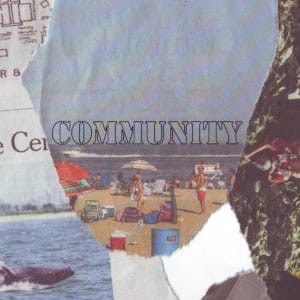
“Community”
Erstwhile is proud to announce the release of Community, the new solo release by Graham Lambkin, his fifth solo record, following 2011’s Amateur Doubles.
“Community is a music steeped in sociological review. It sits as a keen barometer, taking the temperature of the world around it. Community is both willing servant and social mirror - it performs its basic civic duty without fuss, then shatters.” (José Perez)
Mastered by Giuseppe Ielasi and designed by Lambkin, Community arrives in a deluxe matte finish 6-panel digipak with corresponding 8-page booklet. There is a LP version on Kye, which duplicates the material on CD 1 here, and CD 2 is exclusive to the CD edition.
“Community is a music steeped in sociological review. It sits as a keen barometer, taking the temperature of the world around it. Community is both willing servant and social mirror - it performs its basic civic duty without fuss, then shatters.” (José Perez)
Mastered by Giuseppe Ielasi and designed by Lambkin, Community arrives in a deluxe matte finish 6-panel digipak with corresponding 8-page booklet. There is a LP version on Kye, which duplicates the material on CD 1 here, and CD 2 is exclusive to the CD edition.
22,00€
Out of stock
2 CD
Graham LAMBKIN – Taku UNAMI
“The Whistler”
The Whistler consists of material recorded together, then each assembled and mixed their own disc from that.
“What Lawrence English calls “relational listening”: the attempt to transmit an individual auditory experience by reconstructing it according to free associations and personal preferences. The Lambkin/Unami duo is yet another experiment played on the apparently autonomous existence of sound, even when derived from or directly attributable to an external agent; it is also a demonstration of how, starting from different theoretical elements and assumptions, one can reach such a degree of synthesis so as to put them virtually on the same level - at the same time alien and familiar to our common perception.” ondarock.it
“What Lawrence English calls “relational listening”: the attempt to transmit an individual auditory experience by reconstructing it according to free associations and personal preferences. The Lambkin/Unami duo is yet another experiment played on the apparently autonomous existence of sound, even when derived from or directly attributable to an external agent; it is also a demonstration of how, starting from different theoretical elements and assumptions, one can reach such a degree of synthesis so as to put them virtually on the same level - at the same time alien and familiar to our common perception.” ondarock.it
22,00€
Out of stock

2 CD
Graham LAMBKIN – Jason LESCALLEET
“Photographs”
Graham Lambkin and Jason Lescalleet stand side by side in the vanguard of contemporary sound exploration. Since the initiation of their collaborative endeavors in 2006, the duo have crafted a nice combination of audio vérité and musique concrète, together building a highly personal body of work. 2008’s critically acclaimed ’The Breadwinner’ illuminated the artistic potential found in mundane and commonplace circumstances. 2010’s ’Air Supply’ showcased a darker side, nudging the civilian themes of its predecessor into fields of pure abstraction.
“Photographs” brings Lambkin and Lescalleet back again to the questions of self and place. “Photographs” presents a monolithic reappraisal of heritage, both individual and shared, and reevaluates the geographic and societal influence inherent in formative memory. Recorded in Folkestone, England and Worcester, Massachusetts, “Photographs” invites the listener to journey through Lambkin and Lescalleet’s historical registry, places of birth, childhood haunts, locations of enlightenment and kingdoms of despair. “Photographs” welcomes the listener into the houses and homes of Lambkin and Lescalleet’s upbringing. It’s a meet and greet with family and friends, a traipse through ever-changing street scenes, and a document of a fading static past. But “Photographs” is not just a memorial to a time long since spent. Lambkin and Lescalleet take you there and back in celebration of their ancestry, breathing new life into each chapter and event. As a survey of origin and a major artistic statement, “Photographs” proves itself to be a worthwhile investment, and one that brings Lambkin and Lescalleet’s collaboration full circle. The beginning now knows its end, the final part has fallen into place, a plan has worked well and everything is perfect.
Housed in a deluxe UV-varnished 12-panel fold-out digipak, boasting copious site-specific pictorial data, “Photographs” sets the new gold standard for CD design presentation, and provides the music with lavish adornment. Mastered by Jason Lescalleet at Glistening Labs with a running time of over 95 minutes, “Photographs” is an audio/visual treasure trove whose richness and detail will give pleasure enough to last a lifetime.
“Photographs” brings Lambkin and Lescalleet back again to the questions of self and place. “Photographs” presents a monolithic reappraisal of heritage, both individual and shared, and reevaluates the geographic and societal influence inherent in formative memory. Recorded in Folkestone, England and Worcester, Massachusetts, “Photographs” invites the listener to journey through Lambkin and Lescalleet’s historical registry, places of birth, childhood haunts, locations of enlightenment and kingdoms of despair. “Photographs” welcomes the listener into the houses and homes of Lambkin and Lescalleet’s upbringing. It’s a meet and greet with family and friends, a traipse through ever-changing street scenes, and a document of a fading static past. But “Photographs” is not just a memorial to a time long since spent. Lambkin and Lescalleet take you there and back in celebration of their ancestry, breathing new life into each chapter and event. As a survey of origin and a major artistic statement, “Photographs” proves itself to be a worthwhile investment, and one that brings Lambkin and Lescalleet’s collaboration full circle. The beginning now knows its end, the final part has fallen into place, a plan has worked well and everything is perfect.
Housed in a deluxe UV-varnished 12-panel fold-out digipak, boasting copious site-specific pictorial data, “Photographs” sets the new gold standard for CD design presentation, and provides the music with lavish adornment. Mastered by Jason Lescalleet at Glistening Labs with a running time of over 95 minutes, “Photographs” is an audio/visual treasure trove whose richness and detail will give pleasure enough to last a lifetime.
26,00€