
Out of stock
2 CD
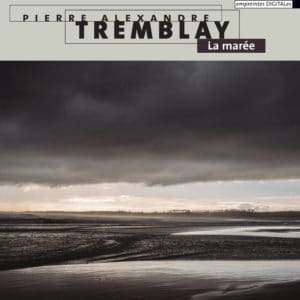
Pierre Alexandre TREMBLAY
“La marée”
“All the pieces on this album are mixed-music where the soloist has a complex dynamic with its antagonist, the loudspeaker: a dialogue all made of power games. This uneven relationship is reminiscent of the fragility of sandcastles and other human constructions with their daily facing of the patience of the elements. Are these ephemeral joys many revenges over the ineluctable?”
“La rupture inéluctable” (2010-11) with Heather Roche, bass clarinet. “Le tombeau des fondeurs” (2008) with Sarah Nicolls, Baschet-Malbos piano. “Mono no aware” (2013) with Jean-François Laporte, Babel table. “Still, Again” (2012-13) with Peyee Chen, soprano. “Un clou, son marteau, et le béton” (2008-09) with Sarah Nicolls, piano.
“La rupture inéluctable” (2010-11) with Heather Roche, bass clarinet. “Le tombeau des fondeurs” (2008) with Sarah Nicolls, Baschet-Malbos piano. “Mono no aware” (2013) with Jean-François Laporte, Babel table. “Still, Again” (2012-13) with Peyee Chen, soprano. “Un clou, son marteau, et le béton” (2008-09) with Sarah Nicolls, piano.
13,00€
Out of stock
2 CD
Francisco LÓPEZ
“Machines”
“Elevator Bath is extremely pleased to present this new 2 CD set of thematically-linked works from Francisco López, still unquestionably one of the major figures of contemporary experimental music. "Machines" collects four pieces recorded from 2004-2007, each of which is based upon sounds of machinery (clocks, elevators, and various laboratory and factory equipment) gathered, respectively, in Amsterdam, Leipzig, Barcelona, and Riga. Yes, these compositions are permeated by an “industrial” sound, but these are very subtle arrangements, even with a wide dynamic scope and with silence playing a lesser role than in much of López’ output. There is a strong rhythmic presence in these recordings, heavy with the weight of machinery. Thick sounds held in crisp clarity. Blindfold or no, "Machines" offers an involving listening experience, drawing the listener deep into the various locales of its sources. And with a running time of more than two and a half hours, this is a substantial and important addition to the world of absolute concrète music by one of the most distinguished and distinctive artists in the field. Packaged inside an elegant printed sleeve with a fold-out insert featuring color photography by the composer. Printed with soy-based ink on 100% recycled paper. This double compact disc set has been issued in an edition of 500 copies.”
20,00€
Out of stock
2 CD
Michael PISARO
“Transparent city (volumes 3 and 4)”
“Field recordings, electronic sounds. Field recordings made in greater Los Angeles from October, 2006 to February, 2007. Each recording is an unedited ten-minute take from a single location. Sine tones and mixing completed in Michael Pisaro’s home studio in Santa Clarita, California. Each ten-minute piece is followed by two minutes of silence. Recordings were mastered with home stereo playback in mind. In general, it is best to set the volume control on your system to a normal level (that is, the level at which most of your other music is played) and to let it remain in that position. Volume levels of the pieces vary intentionally over the course of the series.”
10,00€
In stock
2 CD
Maria de ALVEAR
“besando el tiempo”
“Besando el tiempo” for flute solo (1995). Antoine Beuger (flute).
'besando el tiempo' is a piece that was composed in 1995 in the space of four days. It was written in an automatic script that Maria de Alvear uses for many of her pieces. The work was originally composed for the flautist Caren Levine, who also gave it its first performance in Salzau in 1995. 'besando el tiempo' has now been performed several times worldwide by different interpreters.
When Maria de Alvear heard the performance by Antoine Beuger, she asked him to give her a recording for herself.
Maria de Alvear: “For me, Antoine Beuger's interpretation is the most exact reading there is of my piece. It embodies perfect introversion on the part of the interpreter. The interpreter hears music as “the first beholder of the composer”, and that is the way the piece is played here.”
Antoine Beuger: “When I start playing this piece, I embark on a journey into my inmost being and encounter myself. I never know beforehand what it will be like, how it will continue; I am on my way, on my travels … that is the adventure of this piece. You have to expose yourself to this encounter without any protection or reservations, in complete innocence. And that is also what can be heard.”
10,50€
In stock
2 CD
John CAGE
“One 9”
Program: John Cage : One9
Performer: Edwin Alexander Buchholz, Accordion
“sounds brushed into existence as in oriental calligraphy" (Cage)
the sounds in one9 are single tones and chords, up to six part harmonies.
how do sounds come into existence, how do they gain focus, how do they resolve, how do they merge into one another, how can one quietly and attentively, in all modesty, follow their unfolding?
these are the questions that guided edwin alexander buchholz in his interpretation of the piece.
over the years he played one9 time and again - for himself and in concerts. gradually solutions manifested themselves which he never, at first, would have considered.
it is not simply the case, that this music, which was originally written for shô, the japanese mouth organ from gagaku music, may also be played on accordion.
much as the immemorial shô, originated about 4000 years ago, and the modern accordion are related, they are not interchangeable. one9 has been written specifically for shô and first has to find its way to the accordion, in order to become real accordion music.
the accordion is a wind instrument, but also a keyboard instrument, it has stops, its colours are eminently rich and its two sound sources, as long as they are sounding, are always moving: away from each other, towards each other.
for edwin alexander buchholz one9, in the course of time, grew into a music, that integrated all of this, a music entirely for his instrument: the accordion.
traditionally the sound of the shô is connected to the heavens’ gleam. I have no trouble hearing this quality here, in the sound of the accordion.” antoine beuger
17,00€
Out of stock

2 CD
Johan LINDVALL
“Solo – ensemble”
Composer : Johan Lindvall. Performers : Vilde Sandve Alnæs (violin), Kristine Tjøgersen (clarinet), Jan Martin Gismervik (percussion), Henrik Munkeby Nørstebø (trombone), Ina Sagstuen (voice), Fredrik Rasten (guitar), Johan Lindvall (piano).
10,50€
Out of stock
2 CD
Hermann MEIER
“Works for piano 1949 – 1987”
“in this edition we hear for the first time the complete solo piano works from between 1949 and 1987 of the swiss avant-garde composer hermann meier.
before the time of the three movement sonata meier composed several dodecaphonic works some of which were cyclic. these were not considered for this CD,
since the sonata contains structurally a replica of all that meier wrote before. the sonata coincides with the first serial sketches and visions,
together with integral thinking using rows and is as such for meier’s eminent work from the 50s onward, both retrospectively as well as anticipatory, of great importance.
the piano piece hmv* 37 from 1956 exists only as a pencil sketch. why the composer wrote no definitive version is not known.” dominik blum, october 2017
10,00€
Out of stock
2 CD
Eva-Maria HOUBEN
“Works for double bass”
Archipelagos (2006). Nachtstück (2007). Hans Eberhard Maldfeld, double bass.
17,00€
Out of stock
2 CD
Eva-Maria HOUBEN
“Livres d’heures”
Composer : Eva-Maria Houben. Performers : Andreas Feilen (tubular bells), Eva-Maria Houben (piano, violin), Erik Carlson (violin), Bileam Kümper (violin).
a book of hours usually was designed for the private devotion of laymen as a prayer book. they arised in the 13th century and reached heyday during the late 14th century and the 15th century in France and the Flemish Region. very famous the books of hours of the Duc de Berry (1340-1416), including Très riches heures.
here the books of hours examine different kinds of relationship between people. as it is described in the last book (les petites heures):
“being occupied – in a peaceful way, without haste. a balance between intervention and restraint, between doing and not doing. being alone – with others, near to each other. meeting yourself – and each other. perhaps time seems to stand still sometimes.”
10,50€
In stock
2 CD
Emmanuelle WAECKERLÉ
“Ode (owed) to O”
Composer : Emmanuelle Waeckerlé. Performer : Emmanuelle Waeckerlé, André O. Möller, Antoine Beuger, Alissa Cheung, Josten Myburgh, Sylvia Alexandra Schimag, Samuel Vriezen (voices), Antoine Beuger (flute), Samuel Vriezen (melodica).
reading through (CD 1) and reading from (CD 2) a book of words to a single letter, to breath and silence.
picking words attached to her, then caressing her with our breath, just enough to taste her, sometimes distracted, held back even by the flavour of other words, our self-consciousness temporarily abolished by the vertigo of another's language.
each one of us had to find a way among the multiple reading paths created by eye and mind wandering the pages from one O to another, navigating between erotic literature, conceptual writing and verbal score.
(story of) was performed from Pauline Réage’s book Story of O (1954),
(looking for) from (reading) O score in Emmanuelle Waeckerlé’s Reading (story of) O (Uniformbooks , 2015).
10,00€
Out of stock

2 CD
Luigi NONO
“Seguente”
Rerelease of ed. RZ LP Luigi Nono plus three legendary recordings. “A Carlo Scarpa, architetto, ai suoi infiniti possibili” (1984) for orchestra. “A Pierre. Dell’azzurro silenzio, inquietum” (1985), for contrabass flute and clarinet and electronics. “Guai ai gelidi mostri” (1983) for voices, ensemble and electronics. “La terra e la compagna” (1957/58) for voice, choir and instruments. “Caminantes... Ayacucho” (1986/87) for voices, flute, choir and electronics. “No hay caminos, hay que caminar... Andrej Tarkowskij” (1987) for seven orchestra.
24,50€
In stock

2 CD
Josef Anton RIEDL
“Klangregionen 1951-2007”
Josef Anton Riedl born in 1929 discovered musique concrète in 1951 and started composing his own pieces in 1952. He became music director of the Siemens Studio for Electronic Music in Munich in 1959. Available for the first time on CD (after a very long time deleted LP on Wergo), a great collection of electroacoustic pieces. “Paper Music I” (1961-70), “Studie 59 I” (1959), “Zeichnen - Klatschen/Zeichnen - Zeichnen” (1979-81), “Landschaftsbeschreibung I” (1973), “Mix Fontana Mix” (1974-76-79), “Silphium” (1969-70), “Lautgedichtfolge g)” (1977-79-98), “Ausfluss, Niederschlag, Spur, Nachhall I” (2000-02-07), “Douce-Amère” (1972-74-81), “Komposition Nr. 2” (1963-65), “Polygonum” (1968-70), “Leonce und Lena” (1963-64), “Vielleicht - Duo” (1963-68-70), “Musique Concrète - Studie II” (1951-59), “Musique Concrète - Studie I” (1951-59), “Studie 62 I” (1962), “Studie 62 II” (1962). “Klangsynchronie I Studie 59” (1981), “Komposition Nr. 3” (1965-67), “Studie 61 I” (1961), “Ideir notna fesoj” (1993), “Elektronische Musik - Studie II” (1959), “Elektronische Musik - Studie I” (1958).
25,00€
Out of stock

2 CD
Iannis XENAKIS
Iannis Xenakis (1922 - 2001). Collection of historical recordings of essential works : “ST/48-1,240162” for 48 Instruments, 1959-62, “Le Polytope de Montreal” for four Orchestras, 1967, “Nomos Gamma” for large Orchestra scattered among the audience 98 Instruments, 1967-68, “Terretektorh” for large Orchestra scattered among the audience 88 Instruments, 1965-66, “Syrmos” for 18 Strings, 1959, “Achorripsis” for 21 Instruments, 1956-57, and two tape pieces for 8 speakers : “Persepolis” version, 1971, “Polytope de Cluny”, 1972.
25,00€
Out of stock
2 CD
Harley GABER
“The wind rise in the north”
“This is a masterpiece composed between 1973-74 and first performed in 1976 by Linda Cummiskey, Malcolm Goldstein, Kathy Seplow, violin, Stephen Reynolds, viola, David Gibson, violoncello. Liner notes and credits from the original release on Titanic Records 1976. Digisleeve, booklet German-English.”
25,00€
Out of stock

2 CD
Christian WOLFF
“Kompositionen 1950-1972”
“Finally I realized that the kind of sound made in an indeterminate situation includes what could result in no other way; for example, the sound of a player making up his mind, or having to change it. In fact, the indeterminate notation I’ve used is, as far as I know, the only possible one for the kind of sound I should like. And don’t forget, we also like to be surprised. and the rhythm produced by that situation is like no other rhythm.”
“Most of the pieces collected for this portrait of Christian Wolff document the composer’s early activity and were mainly recorded around the time of their composition. Each recording exemplifies the sound gestures from their time.”
“For Pianist”, 1959, Version 1 Frederic Rzewski. “Duo for Violinist and Pianist”, 1961, János Négyesy & Cornelius Cardew. “Lines für Streichquartett”, 1972, for stringquartet. “For Prepared Piano”, 1951 by Frederic Rzewski. “For Piano I”, 1952 Frederic Rzewski. “For 1, 2 or 3 People”, 1964 David Tudor. “Edges”, 1968 Gentle Fire. “For 1, 2 or 3 People”, 1964 by Nelly Boyd, Robert Engelbrecht, Jan Feddersen, Jens Röhm. “Stones” (aus Prose collection), 1968. “Suite (I)” for prepared piano, 1954 by Fuat Kent. “Duo for Violins, 1950 by Biliana Voutchkova, Daniella Strasfogel. “For Pianist”, 1959 by David Tudor. “For Piano I”, 1952 by David Tudor. “Suite (I)” for prepared piano, 1954. “Edges”, 1968 by Keith Rowe.
“Most of the pieces collected for this portrait of Christian Wolff document the composer’s early activity and were mainly recorded around the time of their composition. Each recording exemplifies the sound gestures from their time.”
“For Pianist”, 1959, Version 1 Frederic Rzewski. “Duo for Violinist and Pianist”, 1961, János Négyesy & Cornelius Cardew. “Lines für Streichquartett”, 1972, for stringquartet. “For Prepared Piano”, 1951 by Frederic Rzewski. “For Piano I”, 1952 Frederic Rzewski. “For 1, 2 or 3 People”, 1964 David Tudor. “Edges”, 1968 Gentle Fire. “For 1, 2 or 3 People”, 1964 by Nelly Boyd, Robert Engelbrecht, Jan Feddersen, Jens Röhm. “Stones” (aus Prose collection), 1968. “Suite (I)” for prepared piano, 1954 by Fuat Kent. “Duo for Violins, 1950 by Biliana Voutchkova, Daniella Strasfogel. “For Pianist”, 1959 by David Tudor. “For Piano I”, 1952 by David Tudor. “Suite (I)” for prepared piano, 1954. “Edges”, 1968 by Keith Rowe.
21,50€
Out of stock

2 CD
Dave PHILLIPS
“South Africa recordings”
2CD + 16 page booklet in a 6-panel cardboard sleeve. Edition of 300.
Raw field recordings. Immersion. Listening beyond sound.
Nature speaks languages. we can “hear” them, but do we listen, do we try to understand? floods, tornados, land erosion, global warming, et cetera - these are but the most obvious examples of nature speaking.
these discs contain nature’s sounds with this particular intention/communication in mind. the field recordist in the role of a mediator. aesthetic choices are but departing points. the quality of attention defines the quality of experience. of hearing. of listening and understanding. then the exploration may begin.
tongues speaking, senses responding, resonating and reverberating. altered states. immersion - being part of something. south african wildlife and its soundscapes are in-your-face. but disappearing. forced away by human supremacy/stupidity. hear: night soundscapes with bubbling kassinas in riparian woodland. tremolo sand frogs and anuran night chorales. a semi-dry river bed after sunset. climatic events at the billion year old mmabolela rock. vigorous toad night chanting at a small lake. curious and vocal desert crows. cicada serenades, solos, duets and ensembles - frequency rapture. transpiration, flies and ears. barking geckos ringing in the night. night-insects crooning. howling jackals and roaring lions. hundreds of doves at a waterhole - the magic of avian movement in unison. wandering hyenas meeting family at their den. a mountain forest stream.
primate vocalisations. a morning river walk. the atmosphere of a gorge. swamp forests, wind and clicking katydids. a hippopotami laughing. dung beetles in flight. swamp life. squirrel voices from beyond. an egyptian fruit bat cave.
these recordings have been equalised and arranged. panning is used. no other audio treatments, effects or manipulations have been applied. many tracks are single recordings, a few are layered. each disc is one continuous listening session. alternative playback on headphones is suggested. maximum volume yields maximum effects.
recorded in mmabolela game reserve (‘sonic mmabolela’, limpopo province), kgalagadi transfrontier national park (northern cape province), marloth nature reserve (western cape province), addo national park (eastern cape province), oribi gorge nature reserve (kwazulu-natal province), amatigulu nature reserve (kwazulu-natal province), isimangaliso wetland park (kwazulu-natal province), south africa, november 2015 to january 2016. photos by nathalie dreier and dp complement the soundscapes.
topography: riparian woodlands (mmabolela), sand dune desert (kgalagadi), semi-arid karoo (addo, mmabolela), hilly forests (marloth, oribi), riverine and swamp forests (amatigulu), savannas, subtropical dune forests and wetlands (isimangaliso). day temperatures between 30° and 43°C.
14,00€
Out of stock

2 CD
Keiki MIDORIKAWA
“Complete Grüne Revolution”
“Keiki Midorikaw (cello, bass), Masahiko Togashi (percussion, drums), Masayuki Takayanagi (guitar) et Masahiko Sato (piano). Recorded on January 16, 1976 at Nichi-futsu kaikan, Tokyo. The original LP of this work has duo with Takayanagi on A side and duo with Sato on B side. But in the concert, Midorikawa played duo with Togashi about 40 minutes, afterward he played duo with Takayanagi and with Sato both about 20 minutes actually. It didn’t include Togashi duo on the original LP. This time doubtmusic found a tape of Midorikawa - Togashi duo, 2CD set convey all performance that day as a complete version. The tapes which are used on those CDs are different from the original master tape, and we re-mastered them, so the quality is higher than the original LP. Midorikawa’s free improvisation that playing duo with each Togashi, Takayanagi, Sato is inventive and in consequence, each music is very beautiful. Those music are prime free-jazz that quietness and intensity seem like spindrift.”
20,00€
In stock

2 CD
Michel CHION
“La vie en prose”
A concrete symphony composed between 2006 and 2011. Four parts : “Le chant des heures”, “Le souffle court”, “Dans la chambre”, “Salut au jour”.
“Thanks to musique concrète ways and means, La vie en prose fulfils my childhood dream of composing a Symphony of Energy in four movements of sharp contrasts. The title of the work was inspired by Flaubert, in a sentence explaining how as the era of rhyming poetry ended the age of prose began. There’s no narrative in this one hour and a half long Symphony, but a cast of characters, some vocal instrumental theme and sounds that circulate, disappear, pop up, stretch, decline and lose themselves in time." MC.
Michel Chion is a French composer, director, writer and theoretician. La vie en prose is his first musical work composed in the 2000s. Thanks to musique concrète ways and means, it fulfills his childhood dream of composing a Symphony of Energy in four movements of sharp contrasts. There’s no narrative in this one hour and a half long Symphony, but a cast of characters, some vocal, instrumental themes and sounds that circulate, disappear, pop up, stretch, decline and lose themselves in time. This work features analog and digital sounds that have been carefully collected for 40 years.
“Thanks to musique concrète ways and means, La vie en prose fulfils my childhood dream of composing a Symphony of Energy in four movements of sharp contrasts. The title of the work was inspired by Flaubert, in a sentence explaining how as the era of rhyming poetry ended the age of prose began. There’s no narrative in this one hour and a half long Symphony, but a cast of characters, some vocal instrumental theme and sounds that circulate, disappear, pop up, stretch, decline and lose themselves in time." MC.
Michel Chion is a French composer, director, writer and theoretician. La vie en prose is his first musical work composed in the 2000s. Thanks to musique concrète ways and means, it fulfills his childhood dream of composing a Symphony of Energy in four movements of sharp contrasts. There’s no narrative in this one hour and a half long Symphony, but a cast of characters, some vocal, instrumental themes and sounds that circulate, disappear, pop up, stretch, decline and lose themselves in time. This work features analog and digital sounds that have been carefully collected for 40 years.
20,00€
Out of stock
2 CD
David ROSENBOOM
“Roundup two”
“B.C.-A.D. I (The Moon Landing)” (1969) with Salvatore Martirano, “Musical Intervention” (1979), “Four Soundings from URBOUI” (1968), “Zones of Influence, Part I, The Winding of a Spring” (1984), “Music for Analog Computers” (1968-1969), “Musical Intervention” (1982), “Trio II” (1978) with Michael Byron and William Winant. “Limited 300. For over four decades, composer-performer David Rosenboom has developed unique circuitry and software for making musical models of the wondrous natural world come alive. Traversing the raucous and the sublime, Roundup two presents live performances with vacuum tube analog computers, solid-state manifestations of chaos and harmony, musical interventions on political tunes, virtuoso performers interlinked with hybrid processing, and more. Roundup Two is an essential, historical document containing important examples from a sixteen-year period in this innovative artist’s extraordinary, pioneering work. Acknowledgements and history : Several of these pieces appeared in an audio, cassette package released in 1987 by Slowscan editions, ‘s-Hertogenbosch, The Netherlands, titled Roundup, A Live electro-acoustic retrospective (1968-1984). For Roundup Two, all those pieces have been re-mastered from tapes in audio archives that were in various states of preservation. Several that were originally presented only in excerpts are now presented in complete, unedited versions, and other works not on the original Roundup have been added”. (David Rosenboom)
25,00€
Out of stock

2 CD
Morton FELDMAN
“Two pianos and other pieces, 1953-1969”
A 2 CD of music for multiple pianos from what is arguably the most experimental and interesting period of Morton Feldman’s development as a composer. Some of the pieces have been very rarely performed or recorded, and have probably never been in better hands.
John Tilbury, Philip Thomas, Catherine Laws & Mark Knoop, pianos. Anton Lukoszevieze & Seth Woods, cellos. Mira Benjamin & Linda Jankowska, violins. Rodrigo Constanzo & Taneli Clarke, percussion. Barrie Webb, trombone. Naomi Atherton, horn.
“Two Pianos (1957). “Four Instruments” (1965). “Vertical Thoughts 1” (1963), “Between Categories” (1969), “Piece for Four Pianos” (1957). “Piano Four Hands” (1958). “Intermission 6” (1953), “De Kooning” (1963), “Two Pieces for Three Pianos” (1966), “Piano Three Hands” (1957), “False Relationships and the Extended Ending” (1968), “Two Pianos second version” (1957).
Notes on Morton Feldman’s “Two Pianos and other pieces” by Philip Thomas. The music featured on these two discs testifies to the intensity of Feldman’s experimentation with notation and sound during the 1950s and 60s. Considering the works chronologically one senses the composer trying out, teasing and developing means of notation to get close to his desired elasticity of time and duration. His experiments with indeterminacy of pitch - whereby Feldman specified only the register (high, middle, low) of sound rather than the exact notes themselves - do not feature here; after trying this method in a series of works in the early 1950s he abandoned the technique, with a few notable exceptions straying into the 1960s, because he was too ‘attached’ to the pitches he wanted.
All notes are specified exactly in the pieces on these discs - the experiments are instead with duration and time. Durations of sounds are variously free, dependent upon the decay of the sound, worked out in coordination with other players, as well as at times exactly and complexly notated within a specific tempo. Sometimes the freedoms of notating time are worked through in combination with listening closely to the sounds of other players, allowing patterns to emerge without forcing the situation, whilst at other times different ways of notating time are combined, creating false alignments in the score and thus placing greater emphasis upon the individual performer’s journey.
The piano is an inherently indeterminate instrument - any given note will have a very different afterlife dependent upon the touch of the performer, the register of the note, the type and size of the piano, the acoustic of the space in which the piano is situated, and so forth. Put six or seven of these notes together as a chord and the situation becomes complex. In all these pieces Feldman specifies the dynamics to be quiet, or as quiet as possible, or very quiet. However the notion that Feldman’s music is ‘about’ quiet-ness is a misconception: the subject is sound, and in order for that subject to be properly attended to those sounds are quiet. The range of pieces presented here depict very many different types of quietness - from the delicate sounds of Piano Three Hands and Piano Four Hands to the massed complexities of Two Pieces for Three Pianos. Quietness in Feldman’s piano music is a performance instruction which is everything to do with touch and the desire to really hear the instrument. As such these recordings are a celebration of the piano (its tone and its decay) and piano playing, for all its frustrations and challenges - an instrument which is at the heart of Feldman’s music.
23,00€
Out of stock

2 CD
Linda CATLIN SMITH
“Drifter”
The first in the Canadian Composers Series of CDs is a double album of chamber works by Linda Catlin Smith, who was born in New York, but studied in Canada and has lived in Toronto for over 25 years. The album ‘Drifter’ contains ten pieces dating from 1995 to 2015 played by Quatuor Bozzini and Apartment House. In his introductory essay to the booklet accompanying the Canadian Composers CDs, Nick Storring says that “One of the primary tensions in Linda Catlin Smith’s music is between its equal and simultaneous drive toward abstraction and lyricism… Those who gravitate to the alluring melodic contours of Smith’s music and expect it to unfold along familiar lines will struggle when confronted with its lack of dramatic arc or formalised development. Conversely, those who are initially repelled by this same appearance are apt to be won over by its singular lucid-dream atmospherics.”
“Cantilena” (2013) by Emma Richards (viola), Simon Limbrick (vibraphone). “Piano Quintet” (2014) by Quatuor Bozzini with PhilipThomas (piano). “Drifter” (2009) by Philip Thomas (piano), Diego Castro Magas (guitar). “Gondola” (2007) by Quatuor Bozzini. “Moi Qui Tremblais” (1999) by Philip Thomas (piano), Mira Benjamin (violin), Simon Limbrick (percussion). “Ricercar” (2015) by Anton Lukoszevieze (cello). “Far From Shore” (2010) by Philip Thomas (piano), Anton Lukoszevieze (cello), Mira Benjamin (violin). “Galanthus” (2011) by Mira Benjamin (violin). “Poire” (1995) by Philip Thomas (piano). “Folkestone” (1999) by Quatuor Bozzini.
“Cantilena” (2013) by Emma Richards (viola), Simon Limbrick (vibraphone). “Piano Quintet” (2014) by Quatuor Bozzini with PhilipThomas (piano). “Drifter” (2009) by Philip Thomas (piano), Diego Castro Magas (guitar). “Gondola” (2007) by Quatuor Bozzini. “Moi Qui Tremblais” (1999) by Philip Thomas (piano), Mira Benjamin (violin), Simon Limbrick (percussion). “Ricercar” (2015) by Anton Lukoszevieze (cello). “Far From Shore” (2010) by Philip Thomas (piano), Anton Lukoszevieze (cello), Mira Benjamin (violin). “Galanthus” (2011) by Mira Benjamin (violin). “Poire” (1995) by Philip Thomas (piano). “Folkestone” (1999) by Quatuor Bozzini.
23,00€
In stock

2 CD
Laurence CRANE
“Chamber Works 1992-2009”
2 CD of composer-supervised recordings of 14 chamber pieces by a truly unique and individual voice in contemporary composition. Performed by the UK’s leading experimental music ensemble Apartment House, who have championed Crane’s music since the mid-90’s.
“This is not minimalism. It does not take justification in “less is more” or “only what is necessary”. It takes us beyond those points: it is less than necessary. It says, basically, nothing is necessary. And perhaps, also, “let’s be happy with this.” Michael Pisaro
23,00€
Out of stock

2 CD
Jurg FREY
“Collection Gustave Roud”
2 CD of pieces engaging with the work of the French-Swiss poet Gustave Roud.
“Paysage pour Gustave Roud” (2007 / 2008), Jürg Frey clarinet, Stefan Thut cello, Dante Boon piano. “Haut-Jorat” (2009), Andrew McIntosh violin, Jürg Frey clarinet, Dante Boon piano. “La présence, les silences” (2013-2016), Dante Boon piano. “Farblose Wolken, Glück, Wind” (2009-2011). Regula Konrad soprano, Stephen Altoft trumpet, Stefan Thut cello, Lee Ferguson percussion. “Ombre si fragile” (2007 / 2008 / 2010). Andrew McIntosh violin, Stefan Thut cello, Dante Boon piano.
“Paysage pour Gustave Roud” (2007 / 2008), Jürg Frey clarinet, Stefan Thut cello, Dante Boon piano. “Haut-Jorat” (2009), Andrew McIntosh violin, Jürg Frey clarinet, Dante Boon piano. “La présence, les silences” (2013-2016), Dante Boon piano. “Farblose Wolken, Glück, Wind” (2009-2011). Regula Konrad soprano, Stephen Altoft trumpet, Stefan Thut cello, Lee Ferguson percussion. “Ombre si fragile” (2007 / 2008 / 2010). Andrew McIntosh violin, Stefan Thut cello, Dante Boon piano.
23,00€
Out of stock

2 CD
Jurg FREY
“Grizzana and other pieces 2009-2014”
A 2 CD of beautiful chamber pieces by the wonderful Swiss composer and clarinetist Jurg Frey, who will be composer in residence at this year’s Huddersfield Contemporary Music Festival. Played by Ensemble Grizzana: Jurg Frey (clarinet), Ryoko Akama (organ & electronics), Mira Benjamin (violin), Richard Craig (flute), Emma Richards (viola), Philip Thomas (piano) and Seth Woods (cello).
The CD cover features a watercolour by Giorgio Morandi, whose work is one of the inspirations for the music.
The CD cover features a watercolour by Giorgio Morandi, whose work is one of the inspirations for the music.
23,00€
In stock

2 CD
Antoine BEUGER
“Cantor quartets”
Played by Jurg Frey (clarinet), Sarah Hughes (e-bow zither), Dominic Lash (contrabass) and Radu Malfatti (trombone). A 2 CD presenting 4 pages from Antoine Beuger 2003 composition which ingeniously adapts the musical form of the round to Wandelweiser music. Beautiful recording in a church in Oxfordshire, UK from June 2012.
23,00€
Out of stock

2 CD
Walter MARCHETTI
“Utopia andata e ritorno”
“Music: the foundation of that presence in which we find ourselves shows itself as pure negatin. Everyting is founded on a demonstration of its own negativity: as awareness of its being negative, and does not look for an escape into a future presence, that is an objective future. But, accepting its negativity, makes of this self-negation the real act, the true reality - the true foundation, the real and actual continuity: this is music’s sense.
"Utopia andata e ritorno" is the title of the new composition by Walter Marchetti, recorded in MIlano in 2005. It has two parts, each one CD long. The first part, "L’andata", puts together two former recordings of Marchetti. The recording of a real storm and a recital for solo piano. This is not the first time that Marchetti mixes a piano solo recital with the recording of a natural live event, thus creating a "piano concert". The second CD, "Il ritorno", reverses the direction of the first record and literally destroys itself.
In the first part of this work, Marchetti puts music successfully in the place it has to have today: on the road to renewal in contact with reality, a reality that is a synonym for vacuity, that is the interdependence of phenomena, music, reality, technology. There is nothing mimetic or anecdotical in this work. The storm is a real storm and the solo piano recital is a modern work of pure music, without the excesses that the society expects of a piano recital from composer and virtuoso player. Pure music, in the best sense of the word. "L’andata" is one of the great works of music of our time, or, as José Luis Castillejo remarked, "it may be the best modern piano concert since Brahms".
In the second part, "Il ritorno", sound waves are deformed when one tries a reverse hearing and the turn around trip becomes an aural nightmare. Of course, avant-gardism has made us accustomed to noises and silences and to the arbitrary idea that anything is music. "Il ritorno" announcs the end of musical avant-gardism and its technocratic aspirations. It points the end of music avant-gardism because it exposes the technological manipulation not only of technology beyond its powers, but also the manipulation of both music and sound. "Il ritorno" is such a problematic work also because its subject is failure and impossibility.
Three-folded digipack 2CD edition. It includes a 32 pges booklet with essays by Water Marchetti, Gabriele Bonomo and José Luis Castillejo. First edition limited to 500 copies.”
"Utopia andata e ritorno" is the title of the new composition by Walter Marchetti, recorded in MIlano in 2005. It has two parts, each one CD long. The first part, "L’andata", puts together two former recordings of Marchetti. The recording of a real storm and a recital for solo piano. This is not the first time that Marchetti mixes a piano solo recital with the recording of a natural live event, thus creating a "piano concert". The second CD, "Il ritorno", reverses the direction of the first record and literally destroys itself.
In the first part of this work, Marchetti puts music successfully in the place it has to have today: on the road to renewal in contact with reality, a reality that is a synonym for vacuity, that is the interdependence of phenomena, music, reality, technology. There is nothing mimetic or anecdotical in this work. The storm is a real storm and the solo piano recital is a modern work of pure music, without the excesses that the society expects of a piano recital from composer and virtuoso player. Pure music, in the best sense of the word. "L’andata" is one of the great works of music of our time, or, as José Luis Castillejo remarked, "it may be the best modern piano concert since Brahms".
In the second part, "Il ritorno", sound waves are deformed when one tries a reverse hearing and the turn around trip becomes an aural nightmare. Of course, avant-gardism has made us accustomed to noises and silences and to the arbitrary idea that anything is music. "Il ritorno" announcs the end of musical avant-gardism and its technocratic aspirations. It points the end of music avant-gardism because it exposes the technological manipulation not only of technology beyond its powers, but also the manipulation of both music and sound. "Il ritorno" is such a problematic work also because its subject is failure and impossibility.
Three-folded digipack 2CD edition. It includes a 32 pges booklet with essays by Water Marchetti, Gabriele Bonomo and José Luis Castillejo. First edition limited to 500 copies.”
20,00€
Out of stock
16 CD
Roland KAYN
“A Little Electronic Milky Way of Sound
Roland Kayn’s truly epic ‘A Little Electronic Milky Way of Sound’ is both a major late opus and a summation of his vast contribution to the fields of electronic music and composition. Hearing the briefest passage of this piece, assembled in 2009 and totalling almost fourteen hours in length, is enough to date the material it is comprised of back to the era of his noteworthy LP boxed sets, released on the Colosseum label in the late 70s and early 80s.
Kayn’s so-called “cybernetic music”, to use the term he preferred, resolutely refuses to showcase the methods employed in its creation. The mass of logical interactions and correspondences underpinning the sounds we hear are submerged so deeply below the surface as to defy analysis. We are left only with the results, which grant the listener a profound and unique experience.
With ‘A Little Electronic Milky Way of Sound’, Kayn provides both a vast sonic territory and the invitation to explore it. From glacial, drone-like vistas to violent staccato sequences, the piece’s twenty-two movements chart the length and breadth of electronic music in as comprehensive a manner as has ever been attempted.
The resurgence of the modular synthesizer as a popular musical tool in recent years belies the possibility that its boldest virtuosi may already lie in the instrument’s past. In his work in Europe’s electronic music studios alongside colleagues such as Leo Küpper and Jaap Vink, Kayn created sonic textures in such abundant variety as to make genre categorisation redundant. Photographs
of the one-off, hand-built systems upon which they were realised have inspired the awe of electronic-music connoisseurs for years, but their output has been all too little heard and appreciated.
In 2017, Roland Kayn represents perhaps one of the last titanic figures of 20th-century music to receive their due recognition, and to have their vital music restored to availability.
Sixteen-CD boxed set. Edition of 750. Audio restoration by Jim O’Rourke. Artwork by Robert Beatty.
Kayn’s so-called “cybernetic music”, to use the term he preferred, resolutely refuses to showcase the methods employed in its creation. The mass of logical interactions and correspondences underpinning the sounds we hear are submerged so deeply below the surface as to defy analysis. We are left only with the results, which grant the listener a profound and unique experience.
With ‘A Little Electronic Milky Way of Sound’, Kayn provides both a vast sonic territory and the invitation to explore it. From glacial, drone-like vistas to violent staccato sequences, the piece’s twenty-two movements chart the length and breadth of electronic music in as comprehensive a manner as has ever been attempted.
The resurgence of the modular synthesizer as a popular musical tool in recent years belies the possibility that its boldest virtuosi may already lie in the instrument’s past. In his work in Europe’s electronic music studios alongside colleagues such as Leo Küpper and Jaap Vink, Kayn created sonic textures in such abundant variety as to make genre categorisation redundant. Photographs
of the one-off, hand-built systems upon which they were realised have inspired the awe of electronic-music connoisseurs for years, but their output has been all too little heard and appreciated.
In 2017, Roland Kayn represents perhaps one of the last titanic figures of 20th-century music to receive their due recognition, and to have their vital music restored to availability.
Sixteen-CD boxed set. Edition of 750. Audio restoration by Jim O’Rourke. Artwork by Robert Beatty.
100,00€
Out of stock

11 CD
Harry BERTOIA
“Sonambient: Recordings Of Harry Bertoia”
“I don’t hold onto terms like music and sculpture anymore. Those old distinctions have lost all their meaning.” Harry Bertoia, 1976
Harry Bertoia's Complete Sonambient Collection features all 11 of Bertoia's original records newly restored from their master tapes and housed in replica jackets. A heavy duty box, printed with metallic inks, holds the 11 discs as well as a 100 page book containing a lengthy historic essay, Smithsonian interview with Harry Bertoia, exclusive Sonambient era material from the Bertoia archive, modern and archival photos of the Bertoia barn as well as reflections on Bertoia from David Sefton, Tom Welsh, David Harrington (Kronos Quartet) and all three of Bertoia's children. The Complete Sonambient Collection celebrates 100 years of Harry Bertoia in 2015, the centennial of his birth.
In the late 1950's Harry Bertoia (1915-1978), already a renowned American sculptor, began creating long-form, improvised pieces of music utilizing pure acoustic tones evoked from his sound sculptures. Around this time Bertoia came up with the term “Sonambient” to describe the music and environment created by his tonal sculptures and their lush harmonic overtones. In a renovated barn on his property deep in the Pennsylvania woods Harry curated a harmonious selection of his sculptures and gongs, often recording his frequent, intuitive sound experiments using 4 overhead microphones and a 1/4” tape recorder. Bertoia dedicated the last twenty years of his life to his Sonambient work and in 1970 he released the first Sonambient LP. In 1978, in the final months of his life, he selected recordings from his archive and produced 10 more Sonambient records. He would not live long enough to see or hear these records himself. Bertoia died in 1978, at age 63, and was buried beneath a giant gong behind his Sonamient barn.
Bertoia's recordings are as much a celebration of sustained tones, slow decay, healing vibrations and shimmering harmonics as Indian Classical music, singing bowls, The Well Tuned Piano or Benjamin Franklin's glass armonica. Through these rich harmonics, pulsing tones and pure gongs Bertoia was able to more clearly articulate his inner spirit than he could with sculpture alone – a point he made himself many times in interview. Harry’s single greatest piece of art is the totality of his life which is nearly impossible to measure but easy to feel. It’s our hope that somehow this box set evokes some of the same sacred, personal feeling that one has in Bertoia’s barn.
85,00€
Out of stock

CD
Iannis XENAKIS
“Works with piano”
“Iannis Xenakis (1922-2001) is among the most important composers of the twentieth century. A musician, architect, engineer, he conceived his music following other criteria than those stemming from the musical tradition. He was inspired not only by mathematics and sciences but also by architecture and philosophy. For these reasons it is difficult to place his original approaches within a musical tradition.” “Aki Takahashi (piano). “Eonta” (1963) for piano, 2 trumpets & 3 trombones. The Callithumpian Consort, Stephen Drury, conductor. “Morsima-Amorsima” (1962) for piano, violin, cello & double-bass. The Callithumpian Consort, Stephen Drury, conductor. “Akea” (1986), for piano and string quartet. The Jack Quartet. “Paille in the Wind” (1992), for piano and cello. Roham de Saram, cello. Program notes (English, German, French) by Benoît Gibson.” “Play loud”.
15,00€
Out of stock
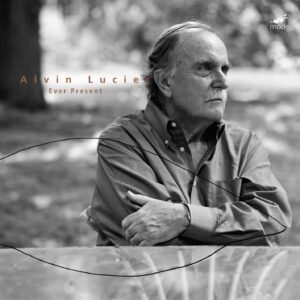
CD
Alvin LUCIER
“Ever Present”
“Piper” (2000) Matt Welch, bagpipe. Fan” (2003) Miki Maruta, Ryuko Mizutani, Kayoko Nakagawa, and Yoko Nishi, kotos. “947” (2001) Jacqueline Martelle, flute. Silver Streetcar for the Orchestra” (1988) Brian Johnson, triangle. “Ever Present” (2002) Drescher-Okabe-Armbruster Trio: Erik Drescher, flute; Akiko Okabe, piano; Sascha Armbruster, alto saxophone. Alvin Lucier’s (b. 1931) works on this CD, for solos and trios, continue to explore his unique sound world, exploration of microtones, and use of unusual instrumentation. Liner notes by the composer: “Piper is probably one of the few avant-garde pieces composed for the bagpipe. The piper is asked to walk slowly around the performance space, sounding his instrument as he does so. From time to time he detunes the chanters, creating beating patterns of slightly varying speeds and minor spatial disturbances (imaginary dopplers). In Fan, 4 koto players play a long series of plucked tones over a 12-minute time span, gradually stepping up to 4 semitones above the starting tone and slowing down to 1 beat every 2, 3, 4, and 5 seconds. As they do so, audible beating at various speeds occurs among the plucked sounds of the instruments. During the course of 947, 4 pure tones are sounded in all their combinations. As they do so a flutist sustains closely tuned long tones against them, creating audible beats at speeds determined by the distances between her tones and those of the pure waves. The farther apart the faster the beating. At unison no beating occurs. Occasionally the flutist bends her pitches a few cycles per second causing the beating patterns to slow down and speed up. In Silver Streetcar, the player dampens the triangle with the thumb and forefinger of one hand while tapping the instrument with the other. The performance consists of moving the geographical locations of these two activities and changing the pressure of the fingers on the triangles as well as the speed and loudness of the tapping. During the course of the performance, the acoustic characteristics of the folded metal bar are revealed. Ever Present is inspired by Robert Irwin’s garden at the Getty Center in Los Angeles. Tone waves in constant motion sweep up and down as the players sustain long tones across them, creating beating patterns at speeds determined by the closeness of the tunings. Four first recordings.”
15,00€
Out of stock

CD
Phill NIBLOCK
“Disseminate”
“Disseminate Ostrava” (1998) In this orchestra piece, the players read from a conventional score. There is no after-recording manipulation of the material. The recording comes from the Ostrava Days Festival in the Czech Republic, where the 41-piece Ensemble OCNM is supplemented by members of the Janacek Philharmonic. “Kontradictionaries” (1999, rev. 2003) This work was written for the KONTRA-trio. The trio (formed in 1992) of Bischof, Mejer and Bachmann concentrates on the sound of low wind instruments. The three wind contrabasses are used as sources for acoustic phenomena.
Here, the musicians recorded "samples" of the notes in a recording studio. Niblock then edited the samples, made pitch shifts of them, and combined this material in a multitrack score. There is no manipulation of the sound of the instruments, the combination of the different microtonal pitches and timbres of the instruments modifies the sound. The musicians later added "live" parts to the Niblock multitrack-mixed-to stereo recording. “Disseminate Q-O2” (1998) the Q-O2 Ensemble. Written for the Belgian ensemble for contemporary and improvised music, Q-O2. The work creates a haze of slowly shifting, vibrating sounds. Phill Niblock (born in Indiana, 1933) is a seminal figure in "drone" music who crosses the Downtown and Improv scenes. A characteristic of Niblock’s drone style is its subtle, gradual alteration of pitch which leads one to loose a sense of "time" and draws one deeper and deeper into the sound itself. The remarkable thing is that Niblock achieves this effect by almost always using traditional acoustic instruments. Niblock is an intermedia artist using music, film, photography, video and computers. He initially was trained in the visual arts and worked as a photographer; he takes inspiration from minimal artists, including Rothko, Judd and Andre.
Here, the musicians recorded "samples" of the notes in a recording studio. Niblock then edited the samples, made pitch shifts of them, and combined this material in a multitrack score. There is no manipulation of the sound of the instruments, the combination of the different microtonal pitches and timbres of the instruments modifies the sound. The musicians later added "live" parts to the Niblock multitrack-mixed-to stereo recording. “Disseminate Q-O2” (1998) the Q-O2 Ensemble. Written for the Belgian ensemble for contemporary and improvised music, Q-O2. The work creates a haze of slowly shifting, vibrating sounds. Phill Niblock (born in Indiana, 1933) is a seminal figure in "drone" music who crosses the Downtown and Improv scenes. A characteristic of Niblock’s drone style is its subtle, gradual alteration of pitch which leads one to loose a sense of "time" and draws one deeper and deeper into the sound itself. The remarkable thing is that Niblock achieves this effect by almost always using traditional acoustic instruments. Niblock is an intermedia artist using music, film, photography, video and computers. He initially was trained in the visual arts and worked as a photographer; he takes inspiration from minimal artists, including Rothko, Judd and Andre.
17,50€
In stock

CD
Alvin LUCIER
“Two Circles”
“Two Circles” (2012) for flute, clarinet, violin, cello, piano and pure wave oscillators. “Fideliotrio” (1986) for viola, cello and piano. “Three Translations of the Works of Maurizio Mochetti” (2008) for flute, clarinet, violin, cello and piano.
All performed by Alter Ego.
“I am Sitting in a Room” (1968) for speaking voice and electronics. Performed by Alvin Lucier.
Alvin Lucier’s (b.1931) work has been more often described in terms of science than of art and his scores often contain experimental procedures. Lucier perfectly represents the fusion of a scientist with an artist. His pieces arise from an inspection of a pure physical phenomenon.
The performers on Mode’s fourth disc of Lucier’s music are the Italian experimental music ensemble Alter Ego — two of the works were written for or dedicated to them — and Alvin Lucier himself.
This new recording of his classic I am Sitting in a Room is from the Biennale Musica 2012 in Italy. This is Lucier’s first new recording of the work since the original from 1980.
The interaction of electronic and acoustic sounds is the central point of Two Circles. These electronic sounds move from the same note in two glissandi, ascending and descending. The acoustic instruments interfere, generating beating (so-called binaural beats) from the interaction of closed frequencies. In some cases, these pulsations give the impression to expand the sonic space, whilst in others they appear to bring to an ending.
In a comparable way, Fideliotrio focuses its attention on the tonal interplays between instruments. In this case, cello, viola and piano form a steady flux: the central note of the piano designs a sort of line around which the string instruments move. When the viola and cello start to drift away from piano’s tone, one may have the impression that the sonic stream is bending and is losing its center of gravity.
Artist Mochetti’s work focuses on light, space, time; it explores the use of materials and often includes a unique conception of the geometry, made of trajectories, lines and surfaces. In the Three Translations of the Works of Maurizio Mochetti, Lucier transfers the exploration of these elements to sound as he literally designs sonic profiles, reflections and music shapes.
The booklet includes an interview with Lucier and flutist Manuel Zurria and liner notes by Riccardo Dillon Wanke and Alvin Lucier.
16,00€