
Out of stock
CD
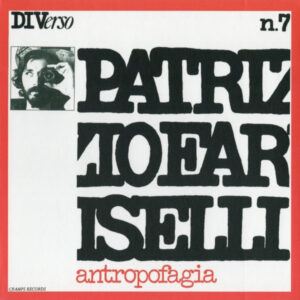
Patrizio FARISELLI
“Antropofagia”
Patrizio Fariselli was playing with Area. In 1977 he did record this very nice piano solo record with or without preparations. Another very good reissue from Cramps.
13,00€
Out of stock
CD
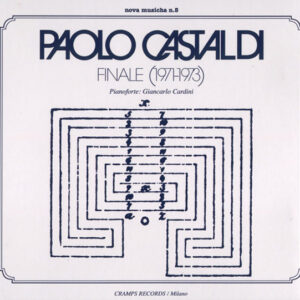
Paolo CASTALDI
“Finale (1971-1973)”
“Awesome piano release on the legendary ’nova musicha’ series, brand new remastered-digipack edition for this italian master of the post-avantgard scene. Originally recorded in 1975.”
13,00€
In stock
CD
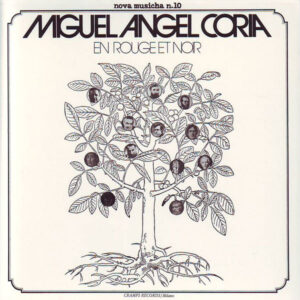
Miguel Angel CORIA
“En rouge et noir”
“An excellent and breathy recording with lush piano elegies awash in a radical sonic realm that is profoundly reminiscent of Charlemagne Palestine but in a very hectic-spirited way, truly an excellent and underrated recording that explores new piano possibilities. Digipack edition.”
13,00€
Out of stock
CD
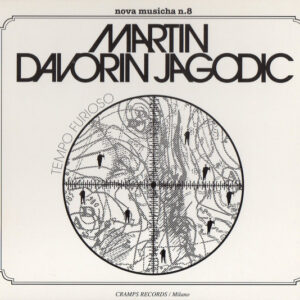
Martin DAVORIN JAGODIC
“Tempo furioso”
“Davorin-Jagodic was a Yugoslavic-Croatian composer who realized this great album in 1975 appearing in the Nurse With Wound List. Featuring some creepy, sometimes droning, electronic musique concret. Should make fans of musique concret (especially the early stuff) very happy.”
13,00€
Out of stock
CD
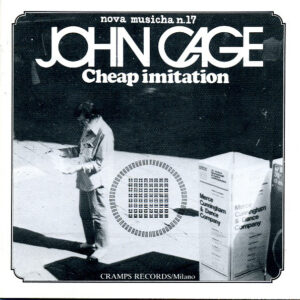
John CAGE
“Cheap imitation”
“Humbly engaged but never over-determined, Cheap Imitation remains John Cage’s most devotional and enduring homage to a lifelong contract between the Maestro of Stony Point and Erik Satie. Composed when he was refused permission to use the arrangement for Satie’s “Socrates” as the “accompaniment” to Merce Cunningham’s choreography, Cheap Imitation is a tempered, harmonically rich and wryly simple melodic examination. This newly remastered edition marks the first US release of this historic recording.”
13,00€
Out of stock

CD
Giusto PIO
“Motore immobile”
“Giusto Pio’s Motore immobile was his debut LP. On the first title track, he uses a droning organ and moves from triad to triad, superimposing the next one briefly before moving on, occasionally expanding the sound with octave doubling and then just as quickly subtracting the lower tones. Intermittent humming and violin provide additional notes. On “Ananta”, he uses a piano flourish to introduce each triad, landing on the tonic note each time. Very calm, and very mysterious, this record is as overlooked as they come (part of the appeal, of course).”
13,00€
Out of stock
CD
Demetrio STRATOS
“Cantare la voce”
Digipack CD with 16 pages booklet. Reissue of a 1978 LP out on Cramps Records.
13,00€
Out of stock
CD
Demetrio STRATOS-Lucio FABBRI
“Recitarcantando”
“Of all of Demetrio Stratos’ recordings, this 1978 live date with violinist Lucio Fabbri is easily the most accessible and least adventurous. That said, Recitarcantando is also perhaps the most songlike and beautiful of Stratos’ albums and deserves recognition for showcasing the vocalist as a singer of uncommon power and originality.”
13,00€
Out of stock
CD
David TUDOR
“Microphone”
“Originally released on LP in 1973 as number 16 in the Nova Musicha series. Recorded at Center for Contemporary Music, Mills College, Oakland, California. Includes 12-page booklet with photographs, score and liner notes in Italian.”
13,00€
Out of stock

CD
Alvin CURRAN – Paolo TOFANI – Mauro TESPIO
“Segments”
New release for Alvin Curran, Paolo Tofani and Mauro Tespio : Electrifying all the objects is the common interest of those three artists. We could say that represents the bridge between the ancient music experience and the present music technology : "Technology is one of those myths that return cyclically to haunt all of us, now then and surely in the future... ... with the later I began to record the world or sound around me, knowing intuitively that it was an on-going and never-ending symphony of immense beauty...". Alvin Curran: piano, prepared piano, sampling keyboard, percussion, shell, tube, Shofar. Paolo Tofani: Trikanta Veena connected to a Axon Ax 50 Apple MacBook Pro midi converter by a GK-2 esaphonic Roland. Mauro Tespio: trumpet, tibetan bells, percussion, Balaphone, Synth EMS Aks.
13,00€
Out of stock
CD
Mika VAINIO & Franck VIGROUX
“Peau froide, léger soleil”
“Peau froide, lèger soleil”, is the result of a three year recording process, initiated by Mika Vainio and Frank Vigroux after a series of shared live experiences.
Sprawling after a show in Paris in 2012, their collaboration is an exercise in sensitive intensity, drifting the whole space between minimalist meditations and maximalist kinetics. Vainio’s signature brutalist production resonates all throughout the record, constructing a psychic scenario for Vigroux’s researches in spatial abstraction and tonal radicalism. Densely built though free-from structural limitation this album is an intense 9track motion serving as the third installment in Cosmo Rhythmatic’s catalog and acting as new chapter in the label’s construction an uncompromising sonic identity.
Mastered by Dennis Blackham at Sky mastering. Lacquer cut at D&M, Berlin.
Photography By Umut Ungan (Front Cover), Diego Jr. (Back Cover)
Sprawling after a show in Paris in 2012, their collaboration is an exercise in sensitive intensity, drifting the whole space between minimalist meditations and maximalist kinetics. Vainio’s signature brutalist production resonates all throughout the record, constructing a psychic scenario for Vigroux’s researches in spatial abstraction and tonal radicalism. Densely built though free-from structural limitation this album is an intense 9track motion serving as the third installment in Cosmo Rhythmatic’s catalog and acting as new chapter in the label’s construction an uncompromising sonic identity.
Mastered by Dennis Blackham at Sky mastering. Lacquer cut at D&M, Berlin.
Photography By Umut Ungan (Front Cover), Diego Jr. (Back Cover)
12,00€
Out of stock
CD
VELTZ
“Broken TV Audio Report”
In the last 10 years Akira Matsuoka (aka Veltz) has established himself as a key figure in the next generation of Tokyo noise artists. His work covers a wide range: metal junk noise, erased tapes, field recording and audio dedications to analogue television. Analogue broadcasting in Japan was switched of in 2011, an event recorded by Matsuoka and presented at the end of this album. The collection of CRT televisions he has since amassed have become his primary instrument, used in numerous performances and on his CD for edition omega point. The tracks on this disc demonstrate the range of this instrument. Recorded over a 6 year period, they comprise a catalogue of the sound fields Matsuoka is capable of provoking from these abandoned screens.
Released in oversized 7” package with letterpress back panel and a 16 page risograph booklet of macro photographs of analogue television noise.
Limited and numbered to 150 copies.
15,00€
In stock
CD
SUTCLIFFE JÜGEND
“Pigdaddy”
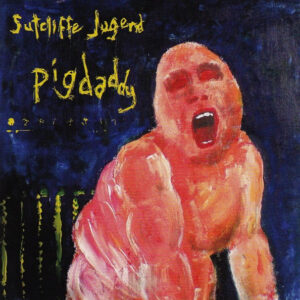
“Six stories of mind-fucking depravity. Pigdaddy contains some of the most fucked up, histrionic and downright bizarre vocals ever recorded. The music is created using the most basic sound sources. The overwhelming sense of moral decay makes this Sutcliffe Jügend’s most original album yet. Pigdaddy is beyond perverse. Sexual transgression never sounded so dirty. Hear Pigdaddy and you will never feel clean again. Over 45 minutes of music. Cover painting by Kevin Tomkins.”
5,00€
Out of stock
CD
LOUIS MINUS XVI
“De Anima”
Alto Sax : Adrien Douliez. Tenor Sax : Jean-Baptiste Rubin. Bass : Maxime Petit. Drums : Frédéric L’Homme.
“It’s been almost 10 years since Louis Minus XVI reigned over the free jazz of the Flandres. Fortunately for us, his reign is not ready to stop with this new album “De Anima”.
This Art Ensemble of Lille is hyperactive. In addition to three albums and a split with the Berber artist Lahcen Akil, we find members of the quartet in equally ambitious projects, such as Unik Ubik, M.Thibault, Hook, L’Atelier d’Education Musicale du Centre Social Raymond Poulidor, but also in the company of avant-garde cult figures such as Daniel Carter or Pascal Comelade.
The music of Louis Minus XVI is revolutionary, humanist scaffold jazz whose alto and tenor saxophones Adrien Douliez and Jean Baptiste Rubin are the breath of life. They mix, accompany each other, clash stereophonically, and systematically fall back on their legs like a gutter cat skirmish.
Frederic L’Homme’s abrasive drum play, from which chaos emanates, adds depth to this dialogue, and airs the space with world music incursions reminiscent of Okay Temiz’s work.
This twilight jazz, sometimes composed of afrobeat, is led by the stretchy and incisive bass of Maxime Petit, whose aggressiveness fades with a soft groove finesse, evoking the chaâbi sounds.
The experience is total live, in perfect symbiosis, Louis Minus XVI guarantee a trance at the crossroads of Post-Punk and Be-Bop.
The icing on the cake, they happen mostly in small places, close to people, reflecting the state of mind that unites them. ”
Sam Nolin
“It’s been almost 10 years since Louis Minus XVI reigned over the free jazz of the Flandres. Fortunately for us, his reign is not ready to stop with this new album “De Anima”.
This Art Ensemble of Lille is hyperactive. In addition to three albums and a split with the Berber artist Lahcen Akil, we find members of the quartet in equally ambitious projects, such as Unik Ubik, M.Thibault, Hook, L’Atelier d’Education Musicale du Centre Social Raymond Poulidor, but also in the company of avant-garde cult figures such as Daniel Carter or Pascal Comelade.
The music of Louis Minus XVI is revolutionary, humanist scaffold jazz whose alto and tenor saxophones Adrien Douliez and Jean Baptiste Rubin are the breath of life. They mix, accompany each other, clash stereophonically, and systematically fall back on their legs like a gutter cat skirmish.
Frederic L’Homme’s abrasive drum play, from which chaos emanates, adds depth to this dialogue, and airs the space with world music incursions reminiscent of Okay Temiz’s work.
This twilight jazz, sometimes composed of afrobeat, is led by the stretchy and incisive bass of Maxime Petit, whose aggressiveness fades with a soft groove finesse, evoking the chaâbi sounds.
The experience is total live, in perfect symbiosis, Louis Minus XVI guarantee a trance at the crossroads of Post-Punk and Be-Bop.
The icing on the cake, they happen mostly in small places, close to people, reflecting the state of mind that unites them. ”
Sam Nolin
8,00€
In stock
CD
Thomas TILLY & Jean-Luc GUIONNET
“Stones air axioms”
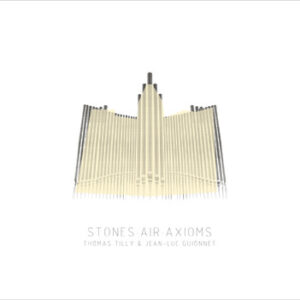
Thomas Tilly : recordings, measurements, composition. Jean-Luc Guionnet : church organ, measurements. “Nowadays, information is circulating through cables and codes, however, before the advent of technology, the very acoustics of amphitheatres and religious buildings fulfilled this transmission function. The cathedral is one example. Partly conceived to enhance voice and music, it offers a wide resonance to support the religious discourse. These unique acoustics are part of its characteristics. This massive air volume is being enclosed and defined by stone. It acts as an amplifier of noise and forces listening and attention. The behaviour of the visitor/audience going through the building is thus being altered. The architecture constraining this air volume is complex and ruled by doctrine. The shape it is drawing constitutes both a symbol and an element of hierarchy for the listening situation within the space. Stones, Air, Axioms” is a sound work based on the relationship between the architecture and acoustics of St Pierre Cathedral in Poitiers. It is articulated around informal acoustic experiments and a study of the site. It is restricted by the range of noises potentially generated by the site : on one hand the specific sonic environment of the building and on the other hand the organ used here as a sound generator. The use of the instrument has been defined by calculations combining metric measurements collected on site and the speed of sound in the air. Each time, the instrumental performance is being recorded on location and constitutes a great part of the material the piece is made of. This work has been developed into four distinct parts, each dealing with one aspect of the relation between sound and architecture. This piece has been specifically created as part of the MicroClima festival in 2010. It has been supported by the Poitou-Charentes council, the Espace Mendès-France and the MicroClima festival.”
12,00€
Out of stock
CD
Olivier BENOIT
“Serendipity”
“Olivier Benoit - guitar. Recorded in 2006 at La Malterie, Lille, France. Olivier Benoit plays solo since 1998. He has developed since those years specific work on the instrument, at the edge of prepared guitar or otherwise “effects” guitar, preferring to take advantage of the instrument “as it is” and as expressed.
The material and the acoustic space
In his solo, he developed a large timbral vocabulary, although he uses very few utensils and very little effect. Because he focused his research on intrinsic properties of the instrument, turning it into an ultra sensitive plate, seeking a mastery and ever greater precision. The music, though made of high feedback controlled, raw sounds, frictions of silence, stillness, tension or in the contrary relaxation, extreme speed, does not want to be a music of “effects” or a “catalog of sounds.”
Musical discourse
Musical form, whatever the project he works with (with la Pieuvre or solo here) is an absolutely essential factor in his speech, which makes music sometimes close to contemporary music, as the structure takes on a prominent place. The improvised aspect of his work allows him to maintain this state of emergency, this freedom, this opportunity to seize on the elements / events / bumps / accidents that may occur in situ, whether due to the acoustics of a room, the quality of the amplifier, the mental state or even the ambient humidity.” label info
The material and the acoustic space
In his solo, he developed a large timbral vocabulary, although he uses very few utensils and very little effect. Because he focused his research on intrinsic properties of the instrument, turning it into an ultra sensitive plate, seeking a mastery and ever greater precision. The music, though made of high feedback controlled, raw sounds, frictions of silence, stillness, tension or in the contrary relaxation, extreme speed, does not want to be a music of “effects” or a “catalog of sounds.”
Musical discourse
Musical form, whatever the project he works with (with la Pieuvre or solo here) is an absolutely essential factor in his speech, which makes music sometimes close to contemporary music, as the structure takes on a prominent place. The improvised aspect of his work allows him to maintain this state of emergency, this freedom, this opportunity to seize on the elements / events / bumps / accidents that may occur in situ, whether due to the acoustics of a room, the quality of the amplifier, the mental state or even the ambient humidity.” label info
12,00€
In stock
CD
Jean-Luc GUIONNET
“Plugged inclinations”
“I work since 1993 to an experimental approach of the church organ (CD “Pentes”, “Tirets”) :
1) we control a machine
2) the organ is halfway between vehicle and artificial intelligence : it is a public transport : a ship, a barque, a boat, a building within a building
3) passing the machinery to the filter of listening, gesture and architecture
4) bringing the blast into the space : ventilate
5) make this organ sound not like this other one
6) express the organ as one says about lemon.
The blast is endless.
And since 2005, to an extension of the results to the electric organ (CD “Gezurrezko Joera”) :
1) find ways to get into the experience with an electric vehicle
2) arranging keyboards as we used to assemble organs (great, récit, positive, choir)
3) consider the functional state of each keyboard and play with it
4) go back in the machine as we go back in a train of thought
5) transplant of an helpful member, a mixing desk is added to the keyboards : carburetor, distributor, central nervous system
6) microphones take care in examining the device
7) no other effects than these : organic device.
And the electric current is endless too.
Neither the blast nor the current do need me.”
Jean-Luc Guionnet
10,00€
In stock
CD
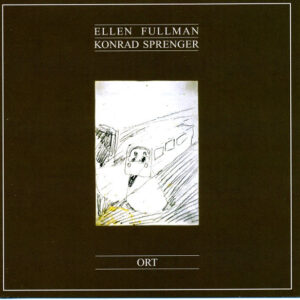
Ellen FULLMAN-Konrad SPRENGER
“Ort”
“Truly an exercise in shifting contexts, Fullman’s haunting voice blends eerily with the sonorities of her “Long String Instrument”, which seems to function as a kind of cosmic fiddle. Konrad Sprenger has created a "wall of sound" behind Fullman with a potpourri of acoustic instruments, including Dreyblatt’s own “excited strings bass”, a zither, violin, electric bass and even tympani along with the Long String Instrument. The pieces on "Ort" range from covers of Woody Guthrie and the traditional John Hardy to new versions of Fullman’s original recordings from the early 1980’s and more recent song-compositions; each marked by Fullman’s evocative textual lyricism and innovative chordal and timbral transformations. "Ort" represents a unique blend of musical styles, from hillbilly-country & western to contemporary minimal, with shades of art-rock. This record is impossible to categorize easily, it fits in many “places”, which is as it should be.” (Arnold Dreyblatt)
15,00€
Out of stock
CD
Yann PARANTHOËN – Christian ZANÉSI
“Un visage apparaît”
“Portrait d’Irène Zack” by Yann Paranthoën. “Portrait sans visage” by Christian Zanési. “Initially, Yann Paranthoën, disappeared in 2005, had the idea to produce a short play “Portrait of Irene Zack” radio portrait of a sculptor at work. This piece is part of a larger work that addresses the possible loss of touch in artistic creation. He works as usual with his Nagra slung his pole in hand to record the sounds but also with tape recorders for editing and mixing. Anxious to show what could be compared to the sound of a musician, he asks Christian Zanési, a composer friend who works at the GRM to produce a short work too from the sounds he recorded. Zanési will work with the computer that will allow mounting the mix but also all the transformations of matter sound.” Notes from the label (in a very bad translation !).
10,00€
Out of stock
CD
Sophie AGNEL – Olivier BENOIT
“Reps”
Sophie Agnel, piano. Olivier Benoit, guitare. Recorded at Césaré, July 2011. Highly recommended !
“In my mind, the music of Sophie Agnel and Olivier Benoit has always contained something like a disclosure of the intimate. They are not overly prolific when it comes to phonographic output. They have no time for superfluous chit-chat. This is their second opus in almost fifteen years of collaboration, and in this sense, Reps is a finely selected jewel bearing witness to the sensitivity that animates both its creators”. Cathy Heyden
“In my mind, the music of Sophie Agnel and Olivier Benoit has always contained something like a disclosure of the intimate. They are not overly prolific when it comes to phonographic output. They have no time for superfluous chit-chat. This is their second opus in almost fifteen years of collaboration, and in this sense, Reps is a finely selected jewel bearing witness to the sensitivity that animates both its creators”. Cathy Heyden
12,00€
Out of stock
CD
Luc FERRARI-ENSEMBLE LABORINTUS & eRikm
“Et tournent les sons”
A coproduction Césaré, La Muse en Circuit, Ensemble Laborintus.
Ensemble Laborintus : Hélène Breschand : harp. Philippe Cornus : percussions. Sylvain Kassap : clarinets. Adeline Lecce : cello. Franck Masquelier : flutes.
& eRikm : cd player on ’Archives sauvées des eaux’.
1.’Et tournent les sons dans la garrigue (1977) (Réflexion sur l’écriture n°1)’.
("and sounds are spinning in the garigue")
For tape and instrumental ensemble.
The idea here is to propose a score of intentions and desires of sound - a tape part that indicates materials, forms and general ideas that combine to create meaning. Communication among the musicians is key as they choose the way they realise or "invent" the piece.
2. ’Archives sauvées des eaux (2000-2005) (Exploitation des concepts n°3)’.
("Archives rescued from the waters (exploitation of concepts
3)")
Version for two cds and instrumental ensemble.
Two Cds contain sequences over which the instruments improvise - little bits of magnetic memory rescued from a flood. The ensemble must stay together, but can otherwise do as it pleases, occasionally slipping in quotes from Patajaslocha, a dance suite composed in 1984. This version was prepared with Luc Ferrari during the summer of 2005. He was to perform the CDs part himself, but he passed away six days before the recording.
Ensemble Laborintus : Hélène Breschand : harp. Philippe Cornus : percussions. Sylvain Kassap : clarinets. Adeline Lecce : cello. Franck Masquelier : flutes.
& eRikm : cd player on ’Archives sauvées des eaux’.
1.’Et tournent les sons dans la garrigue (1977) (Réflexion sur l’écriture n°1)’.
("and sounds are spinning in the garigue")
For tape and instrumental ensemble.
The idea here is to propose a score of intentions and desires of sound - a tape part that indicates materials, forms and general ideas that combine to create meaning. Communication among the musicians is key as they choose the way they realise or "invent" the piece.
2. ’Archives sauvées des eaux (2000-2005) (Exploitation des concepts n°3)’.
("Archives rescued from the waters (exploitation of concepts
3)")
Version for two cds and instrumental ensemble.
Two Cds contain sequences over which the instruments improvise - little bits of magnetic memory rescued from a flood. The ensemble must stay together, but can otherwise do as it pleases, occasionally slipping in quotes from Patajaslocha, a dance suite composed in 1984. This version was prepared with Luc Ferrari during the summer of 2005. He was to perform the CDs part himself, but he passed away six days before the recording.
12,00€
Out of stock

CD
Lionel MARCHETTI
“Noord five Atlantica”
A new piece of musique concrete from French composer Lionel Marchetti composed in 2003-2005. ’Noord five Atlantica’ is working around the world of the sea, animals and humans using sounds of birds, voices (haïkus), melotron (a keyboard instrument manufatured in the 60s and 70s that uses pre-recorded tape as it´s soundsource), foghorns…
Lionel Marchetti has compositions on differents labels like Metamkine, Selektion, Crouton, Absurd, Auscultare, Ground Fault, Musica Genera… He is also an improvisor working a lot with Jérôme Noetinger among others. And he’s part of the Quintet Avant.
Lionel Marchetti has compositions on differents labels like Metamkine, Selektion, Crouton, Absurd, Auscultare, Ground Fault, Musica Genera… He is also an improvisor working a lot with Jérôme Noetinger among others. And he’s part of the Quintet Avant.
12,00€
Out of stock
CD
DIATRIBES & Barry GUY
“Multitude”
“Barry Guy : doublebass. D’Incise : laptop, objects. Cyril Bondi : drums, percussions. Benoît Moreau : clarinet on track 3. Nervous encounter between the doublebass master-improv-virtuoso Barry Guy and a young Geneva entity called Diatribes. A tense and rich mix-testimony of strings, drums-percussion and electronics.” label info
15,00€
Out of stock
CD
DARLING
Serie Cave12 fetish. Adrien Kessler : bass, voice (compositions, texts). Vincent Hänni (Young Gods), guitar. Andrea Valvini (ex. Goz of Kermeur), drums. Anne Cardinaud, keyboards. “Adrien Kessler, former bass player and singer of the band “Goz of Kermeur”who toured their three albums between 1992 and 2000, comes back full of fantastic strenght with this new super-power band and their first cd release. Darling is what you need ! A rabid pop mood, hypnotic, violent and grinding, somewhere between the young Bowie’s glam rock, the obscure violence of Birthday Party, the craziness of Pere Ubu or Beefheart and this unique little touch, free and indescribable that will encompass Darling and make them an impressive outstanding band. Darling, baby, IS WHAT YOU NEED !”
12,00€
Out of stock
CD
PATERAS – BAXTER – BROWN
“Live at l’Usine”
Serie Cave12 Alive.
“Anthony Pateras : prepared piano. Sean Baxter : drums. David Brown : prepared guitar. Recorded live in concert at l’Usine, Geneva, December 2006 by Adrien Kessler. “Percussive prepared piano... Percussive prepared guitar... Percussive drums... Dense and fascinating progressive pile & tangle of percussive sonorities by one of the best improv trios around, caught live during a dense concert on the black & rock building of l’Usine in Geneva. Great “Percussive” Impro !” Formed in 2002 Pateras-Baxter-Brown have performed countless concerts throughout Australia, New Zealand and Europe, developing a worldwide reputation for their uncompromising, intensely focused and remarkably fluid live shows. Using the unique combinations of prepared piano, prepared guitar and percussion, Pateras-Baxter-Brown allude to numerous traditions of percussive contemporary and traditional music, including contemporary classical chamber music, rarefied improvisation and non-western percussive traditions such as gamelan.”
“Anthony Pateras : prepared piano. Sean Baxter : drums. David Brown : prepared guitar. Recorded live in concert at l’Usine, Geneva, December 2006 by Adrien Kessler. “Percussive prepared piano... Percussive prepared guitar... Percussive drums... Dense and fascinating progressive pile & tangle of percussive sonorities by one of the best improv trios around, caught live during a dense concert on the black & rock building of l’Usine in Geneva. Great “Percussive” Impro !” Formed in 2002 Pateras-Baxter-Brown have performed countless concerts throughout Australia, New Zealand and Europe, developing a worldwide reputation for their uncompromising, intensely focused and remarkably fluid live shows. Using the unique combinations of prepared piano, prepared guitar and percussion, Pateras-Baxter-Brown allude to numerous traditions of percussive contemporary and traditional music, including contemporary classical chamber music, rarefied improvisation and non-western percussive traditions such as gamelan.”
8,50€
Out of stock
CD
Francisco MEIRINO
“Untitled phenomenas in concrete”
Composed between 2008 and 2011, “Untitled Phenomenas In Concrete” is a piece made out of 85 HighC/UPIC* sessions and 18 external sounds (recordings of snow falling, bones cracking, magnetic fields and insects). *UPIC is a computerised musical composition tool, devised by the composer Iannis Xenakis. It consists of a digitising tablet linked to a computer, which has a vector display. Interested by Xenakis’ approach and wanting to draw the sound before hearing it, Francisco Meirino spent nearly four years composing/drawing line by line “Untitled Phenomenas In Concrete”, listening to every line, gradually adding on lines and sounds, erasing, reassembling, gathering and discreetly weaving recorded sounds into the piece to “humanise” the whole. As a final touch, the piece was transferred on reel-to-reel tape to add some warmth to the cold digital processing of the UPIC. In short, this is a meticulously created album, the result of which is a completely coherent sound arrangement. Made with great care, “Untitled Phenomenas In Concrete” is a captivating and dense piece, a new gem in the already impressive discography of Francisco Meirino.
15,00€
Out of stock

CD
Marc BARON
“ ”
A seven part composition involving saxophone, silence, guttaral splutters and a few other items aside. Individual, unusual music by one of the most intriguing musicians around today.
10,00€
Out of stock
CD
Sarah HENNIES
“Gather & Release”
The 10 last copies !
Gather & Release is the result of years worth of composer Sarah Hennies’ exploration of the vibraphone in synthesis with her experiences of identity, obsession, anxiety, tension, grief, and loss.
Over the course of an hour, Hennies entangles highly focused percussion playing with field recordings, sine waves, signifiers from her personal & family history (including a 20+ year old recording of her grandfather reciting poetry), and bilateral stimulation, a tool for anxiety release and a major component of EMDR therapy (a branch of psychotherapy that focuses on relieving the patient of disturbing memories as a treatment for psychopathology).
Gather & Release is personal, immediate, yet reserved. Coppice welcomes Sarah Hennies to Category of manifestation: with this challenging new work of reclaim.
Sarah Hennies (b. 1979, Louisville, KY) is a composer and percussionist currently residing in Ithaca, NY. Her work is primarily concerned with an immersive, psychoacoustic presentation of sound brought about by an often grueling, endurance-based performance practice that Nathan Thomas of Fluid Radio described as, “a highly sophisticated and refined performance technique…that starts and ends with listening and encourages a different way of listening from its audience.”
Gather & Release is the result of years worth of composer Sarah Hennies’ exploration of the vibraphone in synthesis with her experiences of identity, obsession, anxiety, tension, grief, and loss.
Over the course of an hour, Hennies entangles highly focused percussion playing with field recordings, sine waves, signifiers from her personal & family history (including a 20+ year old recording of her grandfather reciting poetry), and bilateral stimulation, a tool for anxiety release and a major component of EMDR therapy (a branch of psychotherapy that focuses on relieving the patient of disturbing memories as a treatment for psychopathology).
Gather & Release is personal, immediate, yet reserved. Coppice welcomes Sarah Hennies to Category of manifestation: with this challenging new work of reclaim.
Sarah Hennies (b. 1979, Louisville, KY) is a composer and percussionist currently residing in Ithaca, NY. Her work is primarily concerned with an immersive, psychoacoustic presentation of sound brought about by an often grueling, endurance-based performance practice that Nathan Thomas of Fluid Radio described as, “a highly sophisticated and refined performance technique…that starts and ends with listening and encourages a different way of listening from its audience.”
5,00€
Out of stock
CD
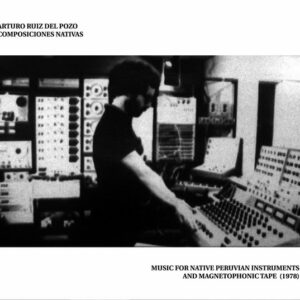
Arturo RUIZ DEL POZO
“Composiciones nativas”
Set of Concrete Music works composed in solo mode by Arturo Javier Ruiz del Pozo, Mmus. Music for Native Peruvian instruments and Magnetophonic Tape created in the Electronic Music Studio of the Royal College of Music of the University of London between 1976 and 1978. Arturo Ruiz del Pozo composed each work as an independent and different sound texture from the others by the characteristic timbres of each native instrument executed properly.
For example in “Parantara” develops a blown melodic and harmonic tissue with Sikus (Zampoñas or Pan Flutes), while in “Lake of Totoras” also uses Sikus but rubbed. A sample of creative freedom is “Despegue” (Takeoff), where Ruiz del Pozo sums and merges all previous works by playing them at full speed generating a multiple white sound crescendo ending in sudden silence.
Compositional concrete music techniques as loops (repetitive tape fragments), variable speed (faster or slower playback of tape), superimposition (several channels recording), polyrhythm (simultaneous execution of fragments with different tempos), polytonality (simultaneous execution of fragments with different tonality looking for harmonization), aleatory mix (fusion of melodies, rhythms, textures, etc. produced randomly.) Microtonality (use of variable tuning microtones), tape echo ; coupled with creative techniques as free improvisation, classic and twelve-tone harmony, leitmotiv, dynamics, structure, etc.; were used with a coherent elaborated logic trying to create a unifying style of works that arose with spontaneous enthusiasm during the course of time.
The expressive character of Native Compositions, while being own and unique in the development of each work, can be defined as relaxing because the set of works conveys a meditative state of consciousness that brings us to the longing for inner peace so important and necessary in our lives.
By the encounter of the special sonority of Native Peruvian Instruments with academic techniques of musical composition at that time (management, development and process of sound elements physical and specifically recorded at tape), Native Compositions achieves a unique result in form, style, and artistic expression; driving us to a contemplative state of the amazement of existence.
Bonus tracks : “D” and “Kanon expansivo”.
Arturo Ruiz del Pozo, was born in Lima, Peru, in 1949, he studied with Miguel Donoso, Lily Rosay, Andres Sas, Edgar Valcárcel, Kenneth Jones and Lawrence Casserley. Studies in Lima: National School of Music. At the University of London: Royal College of Music. Academic Degree: Master of Music in Composition 1978.
16,00€
In stock
CD
Jonas KOCHER
“Plays Christian Kesten & Stefan Thut”
Jonas Kocher, accordion. Christian Kesten & Stefan Thut, composition. Recorded at Studioboerne 45 Berlin in July 2014 by Christoph Schlimbach.
Mixed by Jonas Kocher and mastered by Ilia Belorukov. Ekopack single CD. Photography by Lucas Dubuis, design by Ilia Belorukov.
Christian Kesten “Untitled (solo for accordion)” (2014). Written for Jonas Kocher and premiered in Paris in April 2014. “The accordion contains some remarkable mechanical characteristics. In the highest register of the right hand, the last few buttons don’t play the expected tones. The pitches are simply too high. The necessary reeds would be too small and fragile to produce them. These buttons transpose the tones an octave down. The buttons in the neighbouring octave do play the expected tones. One might assume that the two octave registers would actually play the same pitches. But as they play them on different reeds, there is a slight microtonal difference.” - ck2016
Stefan Thut “Eine/r 1-6” (2007).
“If the full set of chromatic pitches within a wide range is randomly generated the probability of new pitches appearing decreases. Repeated events become silences. A group of two or three pitches is represented here by the variables y and z, single events by the variable x, reminiscent of a single point in Euclidean space. The present score mirrors the concluding section of the above procedure.” - st2016
14,00€
Out of stock

CD
ON
“Second souffle”
ON was born in July 2003 with the meeting of Chicago-based Steven Hess and French musician Sylvain Chauveau when they joined for a lowercase improv session recorded by Jeremy Lemos (member of White-Light, collaborator of Jim O’Rourke, Town and Country, Sonic Youth...). Their first album, “Your Naked Ghost Comes Back At Night” was mixed by Helge Sten aka Deathprod, the illustrious member-producer of Supersilent, and then released in 2004 by French label Les Disques du Soleil et de l’Acier. The album appeared as a brilliant collection of dense, monochromatic layers. Second Souffle is now built upon the same recording session, but with new mixes and editing by French musician Pierre-Yves Macé (Sub Rosa, Tzadik). The album is a slick display of ambient, improv and concrete music; a rich electro-acoustic composition made of piano, prepared guitar, vibes and percussion. It has the post-rock surgical flair of early Pluramon along with the sumptuous cadences of Gastr del Sol’s Upgrade & Afterlife. ON has played live in the USA, France, Italy, Austria and Germany. The duo even joined Christian Fennesz for the 2004 edition of the French Musique Action festival.”
15,00€
Out of stock
CD
MINIZZA
“Hotel Monterey”
“Hotel Monterey is Minizza’s second album, following Music for girls (2005) and collaborations with various artists like Erlend Oye (The Kings of Convenience), Edward Ka-Spel (The Legendary Pink Dots) and Erik Arnaud. But Minizza has been active during these last six years. Hotel Monterey, inspired by Chantal Akerman’s movie, was commissioned by the festival Electroni[k] (Saint-Brieuc, France), recorded on Radio France studios in May 2009, then reworked, remixed and mastered at Minizza studio. For the realization of this project, Rainier Lericolais and David Sanson (That Summer) joined the original band members Franck Marguin and Geoffroy Montel. Hotel Monterey is a one hour long, dark, ambient instrumental piece, close to experimental music from the 90s (such as first Jim O’Rourke records, Christoph Heemann or Coil).”
15,00€