
Out of stock

CD
Michael von BIEL
“Streichquartett Nr. 1” (1962; WDR 2003) [Pellegrini-Quartett: Antonio Pellegrini, 1. Violine; Thomas Hofer, 2. Violine; Fabio Maarano, Viola; Helmut Menzler, Violoncello]. “Streichquartett Nr. 2” (Urfassung, 1963; WDR 2003) [Pellegrini-Quartett]. “Quartett mit Begleitung” (Quartett Nr. 3, 1965; WDR 1967) [Egon Mayer, Violine; Dagmar Apel, Violine; Johannes Fritsch, Viola; Magdalene Bröckel, Violoncello; Michael von Biel, Violoncello]. “Jagdstück für Bläserinstrumentalisten und Live-Elektronik” (1966; WDR 1968) [Franz-Willy Neugebauer, Trompete; Kurt Schmidt, Trompete; Gerhard Burdack, Horn und Tenortuba; Konrad Alfing, Horn und Tenortuba; Willy Walther, Posaune; Josef Feck, Posaune; Emil Morneweg, Kontrabaß; Wilhelm Bruck und Michael von Biel, Begleitung; Ltg. Bernhard Kontarsky]. “Fassung” (elektronische Tonbandmusik, 1964; WDR 1964) [Studio für elektronische Musik des WDR].
15,00€
In stock

CD
Klaus LANG
“Trauermusiken”
Two compositions by the young Austrian composer/organist who currently lives in Berlin/Germany. “Der Wind und das Meer for viola” (Barbara Konrad, viola). “The Sea of Despair for String Quartet” (Amras Streichquartett)
17,00€
In stock

CD
John CAGE
“Sonatas and interludes”
’Sonatas and interludes’ (1946-48) performed by Mario Bertoncini, recorded in december 1991.
15,00€
Out of stock

CD
Horatiu RADULESCU
“Streichquartett N°4 opus 33”
“String quartet No 4, opus 33 (1976-87)”. Arditti String Quartet: Irvine Arditti, Graeme Jennings, Garth Knox, Rohan de Saram.
"infinite to be cannot be infinite, infinite anti-be could be infinite" for nine string quartets or one string quartet surrounded by an imaginary Viola da Gamba with 128 strings.
17,00€
Out of stock
CD
Giuliano D’ANGIOLINI
“Simmetrie di ritorno”
“Simmetrie di ritorno” (2000) for 10 instruments. “Ita vita zita rita” (1997) for amplified piano. “Orizzonte fisso, bordoni mobili” (2007) for eight instruments. “Und’ ho d’andà” (1995) for nine horns. “Ho visto un incidente”(1991-92) for voice solo. “Notturno in progressione” (2004) for strin,g quartet. by Ensemble 2e2m, Franck Ollu, Pierre Roullier, Monique Bouvet, Barbara Morihien, Quatuor Parisii: Arnaud Vallin, Jean-Michel Berrette, Dominique Lobet, Jean-Philippe Martignoni.
“Giuliano d’Angiolini is a positively unique figure in contemporary music. His profound, well-conceived and stubborn take on music has led him to what he calls »impersonal« music — music that has fully abandoned the idea of development or form.Through successive states of presentation, which aim to elucidate, d’Angiolini wanted to leave place in sound so that music could become less voluntary«. This led him to favour the surface and present, an approach that was by no means superficial: the surface as the immediacy in the propositional content of sound and the present as the very surface of the criterion of time. In his work, musical process and material are but one and are completely laid bare. What we are to hear is non-discursive, deliberately lacking formal organization. We are even free to turn away and come back of our own will — as if the composer wanted to make positive use of the negative metamorphosis of today’s urban listeners, listeners who are constantly assailed with stimuli.” Gérard Pesson
“Giuliano d’Angiolini is a positively unique figure in contemporary music. His profound, well-conceived and stubborn take on music has led him to what he calls »impersonal« music — music that has fully abandoned the idea of development or form.Through successive states of presentation, which aim to elucidate, d’Angiolini wanted to leave place in sound so that music could become less voluntary«. This led him to favour the surface and present, an approach that was by no means superficial: the surface as the immediacy in the propositional content of sound and the present as the very surface of the criterion of time. In his work, musical process and material are but one and are completely laid bare. What we are to hear is non-discursive, deliberately lacking formal organization. We are even free to turn away and come back of our own will — as if the composer wanted to make positive use of the negative metamorphosis of today’s urban listeners, listeners who are constantly assailed with stimuli.” Gérard Pesson
14,00€
Out of stock

CD
Giacinto SCELSI
“Giacinto Scelsi”
“Pranam I” (1972) for voices, 12 instruments and tape. “Anagamin” (1965) for 12 bows, “Quattro pezzi” (1959) for Orchestra’s chamber, “Quartetto n°4” (1964) for string quartet, “Okanagon” (1968) for harp, gong and doublebass, “Quartetto n°2” (1961) for string quartet.
15,00€
Out of stock
CD
Clara IANNOTTA
“A failed entertainment – Werke 2009-2014”
“Intent on Resurrection - Spring or Some Such Thing” [2014] for 17 musicians. Ensemble Intercontemporain under direction of Matthias Pintscher. “Limun” [2011] for violin, viola. Ensemble Recherche with Melise Mellinger and Barbara Maurer. “D’après Talea” [2012] for 7 musicians. Talea Ensemble. “Àphones” [2011] for 17 musicians. Orchestre des Èlèves du Conservatoire National Supérieur de Paris under the direction of Tito Ceccherini. “A Failed Entertainment” [2013] for string quartet. Quatuor Diotima. “Al di là del bianco” [2009] for Ensemble. Ensemble Garage. “The people here go mad. They blame the Wind” [2013-2014] for bassclarinet, cello, keyboard and 12 musicboxes. Trio Catch.
“I am particularly interested in music as an existential, physical experience - music should be seen as well as heard. This is one of the reasons why I sometimes prefer to talk about the choreography of the sound rather than about orchestration.” Clara Iannotta
“I am particularly interested in music as an existential, physical experience - music should be seen as well as heard. This is one of the reasons why I sometimes prefer to talk about the choreography of the sound rather than about orchestration.” Clara Iannotta
14,00€
Out of stock

CD
Akio SUZUKI
“NA-GI 1997”
Composition and performance: Akio Suzuki. Production: Stadtgalerie Saarbrücken. Performance 17.10.97 & Performance 20.10.97. Composition and Performance: Akio Suzuki. “A CD of minimalist environmental sounds by this Japanese sound-artist, previously known for his fabulous Soundsphere CD on the Dutch Het Apollohuis label. "This music was recorded in Takano, Tango-cho, the northern-most coast of Kyoto, where I live. The bay surrounded by volcanic rock caves is the place where the mighty sounds of waves of the open sea have their muffled echo. Seawater flows into the hollows in the rock again and again like breathing in and breathing out. Spring water constantly drips in the cave, and now and then the wind from the meadow above the chasm brings the sounds of the crickets...the sound spaces of the coast of Takano. A site of a new encounter with the rhythm of the sounds of the sea."
14,00€
Out of stock

CD
Anne-Laure PIGACHE & Pascal THOLLET
“Dyslexie”
Anne-Laure Pigache, voice. Pascal Thollet, sound processing. In the tradition of French sound poetry bases on an observation of daily life. Nice work !
10,00€
Out of stock

CD
COMPILATION
ARKANSAS AT 78 RPM: CORN DODGERS AND HOSS HAIR PULLERS
Description: CD Digipak with 32 page booklet featuring liner notes by Tony Russell and photographs from the collection of Maxine Payne.
Produced by April and Lance Ledbetter utilizing transfers from the Music Memory archive, “Arkansas at 78 RPM: Corn Dodgers and Hoss Hair Pullers” features original recordings made between 1928-1937. The CD and the 32-page booklet serve as a companion album to the newly-released photograph book, “Making Pictures: Three for a Dime” by Maxine Payne. All of the photos in this package are from the same cache of photographs taken by the Massengil family in their mobile photo-booth trailer throughout rural Arkansas in the 1930s-1940s.
“For the traveling recording men of the late 1920s, Arkansas offered enticing pickings. The region was thronged with vigorous, idiosyncratic stringbands. This album carries the listener from the hillbilly music craze of the ‘20s to the song-based country music of the late ‘30s. Scarcely more than a decade, but a period, in music as in all American life, of galvanic change.”, Tony Russell, from the liner notes
Tracklist
1. Ashley’s Melody Men, “Searcy County Rag”. 2. Pope’s Arkansas Mountaineers, “Get Along Home, Miss Cindy”. 3. Fiddling Bob Larkin & His Music Makers, “The Higher up the Monkey Climbs”.4. George Edgin’s Corn Dodgers With Earl Wright & Brown Rich, “My Ozark Mountain Home”. 5. Dr. Smith’s Champion Hoss Hair Pullers, “Just Give Me the Leavings”. 6. Ashley’s Melody Men, “Bath House Blues”. 7. Luke Highnight & His Ozark Strutters, “Fort Smith Breakdown”. 8. Arkansas Barefoot Boys, “Eighth of January”. 9. Bob Larkan & Family, “McLeods Reel”. 10. A. E. Ward & His Plow Boys, “The Old Dinner Pail”. 11. Wonder State Harmonists, “My Castle on the Nile”. 12. Morrison Twin Brothers String Band, “Dry and Dusty”. 13. Pope’s Arkansas Mountaineers, “Jaw Bone”. 14. Lonnie Glosson, “Arkansas Hard Luck Blues”. 15. Fiddling Bob Larkin & His Music Makers, “Paddy, Won’t You Drink Some Good Old Cider?”. 16. George Edgin’s Corn Dodgers With Earl Wright & Brown Rich, “Corn Dodger No. 1 Special”. 17. Bonnie Dodd & Murray Lucas, “Ozark Mountain Rose. 18. Morrison Twin Brothers String Band, “Ozark Waltz. 19. L. O. Birkhead & R. M. Lane, “Robinson County. 20. George Edgin’s Corn Dodgers With Earl Wright & Brown Rich, “The Arkansas Hotel. 21. A. E. Ward & His Plow Boys, “Going to Leave Old Arkansas. 22. Wonder State Harmonists, “Petit Jean Gallop. 23. Bob Larkan & Family, “Silver Nail. 24. Reaves White Country Ramblers, “Drunkard’s Hecups. 25. Wonder State Harmonists, “Turnip Greens. 26. Lonnie Glosson, “Lonnie’s Fox Chase”.
12,00€
Out of stock
CD
COMPILATION
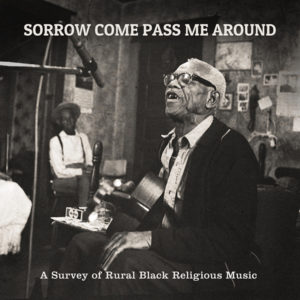
SORROW COME PASS ME AROUND: A SURVEY OF RURAL BLACK RELIGIOUS
A collection of spiritual and gospel songs performed in informal non-church settings between 1965-1973. Most are guitar-accompanied and performed by active or former blues artists. “Most records of black religious music contain some form of gospel singing or congregational singing recorded at a church service. This album, though, tries to present a broader range of performance styles and contexts with the hope of showing the important role that religious music plays in the Southern black communities and in the daily lives of individuals.” - David Evans, from the liner notes
Ephram Carter and His Fife & Drum Band, Willard Artis “Blind Pete” Burrell, Babe Stovall, Annie Lee and Oscar Crawford with Annie Mae Jones, Reverend Rubin Lacy, Robert “Nighthawk” Johnson, Dorothy Lee, Norma Jean and Shirley Marie Johnson with Robert “Nighthawk” Johnson, Katie Mae Young, Eddie Lee “Mustright” Jones, Robert “Nighthawk” Johnson, Chester Davis and Congregation / Compton Jones and Group / Furry Lewis, Willard Artis “Blind Pete” Burrell, Pattie Rosemon with Frank and Odie Rosemon, Babe Stovall, Napoleon Strickland, Willard Artis “Blind Pete” Burrell.
12,00€
Out of stock
CD
COMPILATION
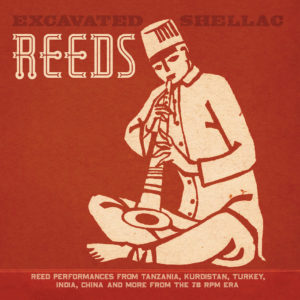
EXCAVATED SHELLAC : REEDS
CD in digipak includes 20-page booklet.
Reed instruments are capable of some of the most impassioned music on the planet, all due to the malleability of the reeds, themselves - historically made of plant tissue, which vibrate when air hits them. The origin of most reed instruments is steeped in rural, pastoral culture. Many insistent, loud, often joyful, reed instruments have always been played outdoors as traditional accompaniment for dancing and celebrations.
This compelling album is the second volume in the Excavated Shellac release series, featuring rare, never-before issued 78rpm records from around the world, centered on a unique theme. The previous volume (Excavated Shellac: Strings) focused on stellar stringed instrument performances. This release examines some of the most intense and hypnotic music set to disc during the early years of international recording, all featuring reed instruments. All previously unreleased on CD, with three bonus tracks not available on the newly-released vinyl LP. All records have been carefully transferred and mastered and are presented with extensive liner notes by Jonathan Ward.
“Jon Ward’s Excavated Shellac focuses on ethnic music on 78’s. He’s one of the smartest obsessive record collectors I know, and the stuff he posts I would gladly pay to download… it is always stuff you would never hear anywhere else, nothing here on CD. This is the rarest of the rare and the best of the best. Stellar!” Steve Roden, Wire Magazine’s Web Exclusive
“Featuring Ward’s informative notes and commentary… (Excavated Shellac is) an astounding selection of music from India, Ireland, Turkey, Burma, Poland, Africa, Japan, Spain, the US, and more…rare treats.” Susanna Bolle, The Boston Phoenix.
1. I Tre Antonio della Basilicata, Tarantella Popolare (Italy)
2. Sylvain Poujouly & Achille Marc, Lou Bolontinou (Auvergne, France)
3. Karzana Oyun Havasi, Zurnacı Mahir and Ali (Turkey)
4. Tufanpur Orchestra, Reng-E Ghafghaz (Iran)
5. Ahn Ki-Ok and Kin Yin Kuan, Janggochum (North Korea)
6. Guangdong Troupe with Da Kai men, Untitled (China)
7. T. Rajarathnam Pillai, Raga Alapana (Todi) (India)
8. Selim, Ekâri Eselimmit (Albania)
9. Obdulia Alvarez, “La Busdonga”, Cantar Bien Neña (Asturias, Spain)
10. Jhande Nath, Lahara Saamp Ke Masta Karneka (India)
11. Hoseynkali was Roofakah, Raqs Jooli, Aroosi (Kurdistan)
12. Mohamed Efendi Baz, Alia Mozmar Khedawi Masr (Upper Egypt)
13. Ngoma Ya Kitokomire, Mimi Naona Haya (Tanzania)
14. Mqonga Sikanise, Into Ezimnandi (South Africa)
Bonus Tracks Not Included on LP
15. Musicians of Radio Studio Skopje, Macedonia, Macedonsko Oro (Macedonia)
16. Uncredited musicians, Raqsi Kalon (Tajikistan)
17. Parush Parushev, Ruchenitsa (Bulgaria)
12,00€
Out of stock

CD
COMPILATION
KASSIDAT : RAW 45s FROM MOROCCO
Description: Features six extended tracks from the Golden Age of the Moroccan record industry. “Kassidat”, the Arabic word for poetry, is one of the essential ingredients in Moroccan song. Despite the bewildering array of musical styles in Morocco, the Moroccan sense of poetry is found throughout the music, regardless of the style or language. This isn’t the language of high art, but an often impenetrable vernacular poetry of oblique references, symbols, metaphors, and double entendres that describes the lives of average Moroccans. Mohamed Bergam, Rais Haj Omar Wahrouch, Abdellah el Magana, Jmimi, Lekbir and Fatma Anounya, Bennasser Oukhouya and Cheikha Hadda Ouakki, Cheikh Mohamed Riffi.
14,00€
Out of stock
CD
COMPILATION
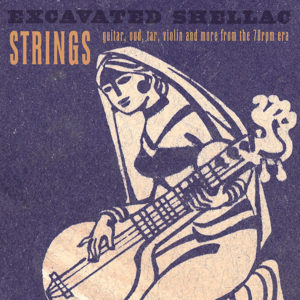
EXCAVATED SHELLAC : STRINGS
CD in digipak with 20-page booklet.
Compiled by Jonathan Ward, Excavated Shellac: Strings features seventeen (including 3 bonus tracks not on LP) outstanding performances from the four corners of the world played on stringed instruments and recorded and released on 78rpm records circa 1920-1950. This vinyl LP features fiddles, shamisen, charango, Paraguyan harp, Indian vina, Lebanese oud, Persian violin, Vietnamese moon guitar, and more. Compiled by Jonathan Ward, all tracks are previously unreissued, carefully transferred and mastered and presented with detailed liner notes by Ward.
“Jon Ward’s Excavated Shellac focuses on ethnic music on 78’s. He’s one of the smartest obsessive record collectors I know, and the stuff he posts I would gladly pay to download… it is always stuff you would never hear anywhere else, nothing here on CD. This is the rarest of the rare and the best of the best. Stellar!” Steve Roden, Wire Magazine’s Web Exclusive
“Featuring Ward’s informative notes and commentary… (Excavated Shellac is) an astounding selection of music from India, Ireland, Turkey, Burma, Poland, Africa, Japan, Spain, the US, and more… rare treats.” Susanna Bolle, The Boston Phoenix
1. Sogoman Seranyan, Eraz (Armenia)
2. Sundaram Balachander, Dayapayonidhe, Pt. 2 (India)
3. Alberto Ruiz y su Lira Incaica, Paceñita (Bolivia)
4. Nzila Joseph et son ensemble, Moleke Mbwa (Congo)
5. T n and ng, Nam Bình (Vietnam)
6. Tatyana Makharadze & G. Bugadze, Lale (Georgia)
7. Abol-hasan Sab , Chaopan (Iran)
8. Trio Tipico Paraguayo de Félix Pérez Cardoso, Pajaro Campana (Paraguay)
9. Bra a Kapugi Tamburica Orchestar i Pjeva ki Zbor, Tko Se Bregom Se e (Croatia)
10. Kjetil Flatin, Jornvrongia-Springar (Norway)
11. Yamaura Toyoko, Ko-uta, Ryukyu Bushi (Japan)
12. Chahadé Effendi Saadé, Taqsim Rast (Lebanon)
13. Galabuzi and Party, Okubulirwa Lupiza Otambula Osopza (Uganda)
14. Kemanî Amâ Recep, Çifte kiri ile Rast Taksim (Turkey)
Bonus Tracks Not Included on Original LP
15. Feliciano Delgado, Ausencia (Panama)
16.Grupo Irmãos Borges Barros, Enchente de Beijos (Brazil)
17.Eyyubi Mustafa Sunar, Isfahan Taksim (Turkey)
12,00€
Out of stock

CD
Lonnie HOLLEY
“Keeping a record of it”
Keeping a Record of It is the follow-up to Lonnie Holley’s debut album, Just Before Music. It features recordings made in 2006, 2010 and 2011. Guest performers include Cole Alexander from the Black Lips, Bradford Cox from Deerhunter, and visual artist Lillian Blades. CD Digipak with booklet featuring lyric transcriptions and artwork by Lonnie Holley.
“Last year, at 62, after decades of singing while he worked, Holley released his jarring debut album, Just Before Music, a marriage of improvised keys and the rambling, hollow bellow of his voice, as well as the first original recording put out by the archival folk label Dust-to-Digital. This year, he’ll tour, and he recently starred in a Whitney Museum group show, ‘Blues for Smoke.’” - The Fader
“Lonnie Holley sings with an intense, emotional voice and unleashes lyrics without consistent meter or rhyme over gossamer keyboard lines that hang in the ether. His music is a blues nebula, splotched with riffy word jazz that shares in some rappers’ collagist aesthetics as well as the runaway passion of a gospel preacher enlivened by the Spirit.” - Aquarium Drunkard
12,00€
In stock
CD
Lonnie HOLLEY
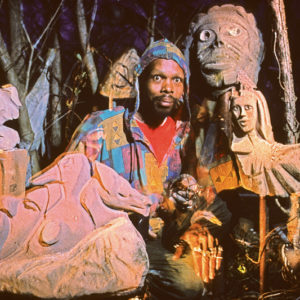
“Just before music”
“Lonnie Holley was born on February 10, 1950 in Birmingham, Alabama, the seventh of 27 children. From the age of five, Holley worked various jobs: picking up trash at a drive-in movie theatre, washing dishes, and cooking. He lived in a whiskey house, on the state fairgrounds, and in several foster homes. His early life was chaotic and Holley was never afforded the pleasure of a real childhood.
Since 1979, Holley has devoted his life to the practice of improvisational creativity. His art and music, born out of struggle, hardship, but perhaps more importantly, out of furious curiosity and biological necessity, has manifested itself in drawing, painting, sculpture, photography, performance, and sound. Holley’s sculptures are constructed from found materials in the oldest tradition of African American sculpture. Objects, already imbued with cultural and artistic metaphor, are combined into narrative sculptures that commemorate places, people, and events. Holley did not start making and performing music in a studio nor does his creative process mirror that of the typical musician. His music and lyrics are improvised on the spot and morph and evolve with every event, concert, and recording. In Holley’s original art environment, he would construct and deconstruct his visual works, repurposing their elements for new pieces. This often led to the transfer of individual narratives into the new work creating a cumulative composite image that has depth and purpose beyond its original singular meaning. The layers of sound in Holley’s music, likewise, are the result of decades of evolving experimentation. “Just Before Music” features Holley’s first studio recordings made in 2010 and 2011.” Description: CD Digipak with 20 page booklet featuring lyric transcriptions and artwork by Lonnie Holley.
12,00€
In stock

CD
Blind Alfred REED
“Appalachian Visionary”
Description: CD in hardcover, 84-page book featuring extensive liner notes by Ted Olson. Includes download/streaming code.
“Alfred Reed’s story is that of a man looking within to find a light by which to navigate the darkness within and without.” – Ted Olson
Born blind on June 15, 1880, in Floyd County, Virginia, Alfred Reed grew up on a West Virginia farm. In the 1920s, when radio became available in his area, Alfred listened to and enjoyed performances by several of the era’s popular singers. Alfred would purchase songbooks and hymnbooks, and his wife Nettie would read the lyrics to him. Because the songs he learned from others did not always express aspects of what he was thinking, feeling, and experiencing, Alfred felt compelled to compose his own songs, and he was exceptionally talented in this endeavor—a craftsman with many things to say. Relying upon his talent to generate money for supporting his family, he played music on the streets of nearby towns, gave music lessons, performed at dances and various social and church gatherings, sold printed copies of his own lyrics, and, in 1927 and 1929, made the commercial recordings included on this set.
23,00€
In stock

CD
Thomas TILLY
“Test – Tone documents”
Test/Tone - Installation for plans, recordings and speakers. La Cartonnerie/Palais du Tau, Reims (France), 2007.
“Through the filters constituted by a building's walls and the complex electrical network composing its nervous system, sound appears as a residual matter of the building's activities, eroded by the architecture. The geographical situation of these aucoustical phenomena is representative of this activity’s nature.Test/Tone is a listening space, created through a study of the building that hostes La Cartonnerie, dedicated to amplified music and composed by two concert halls, several studios, technical premises and a reception area. The space is defined by ten loudspeakers wich broadcast a work exclusively composed of sound recordings made in the building. These recordings (vibrations, magnetic fields and sounds from influx of visitors or employees working) put foreward some almost inaudible resonant images of the building. The loudspeakers’ placing inside the device has been determined while picking up sounds by a cartographical work making the place's most important zones of intense sound flows appear.A work of urban phonography, Test/Tone is both a retranscription on a reduced scale of a place’s geography and an enlargement of it's sound environment.” Thomas Tilly, 2007.
14,00€
In stock

CD
SIM + OTOMO
“Monte alto estate”
“This is the collaborative masterpiece of the 3-piece unit, sim (Oshima Teruyuki on guitar and composition, Ootani Yoshio on computer, electronics, etc, and Uemura Masahiro on drums) and Otomo Yoshihide (turntables, self-made synthesizer). The noise of Otomo sharply incises the unique sound of sim, where Uemura’s controlled roaring drumming sets an main axis on Oshima’s precise rhythmical composition, Oshima’s the chord cuttings beats minimally and the electronics of Ootani give extreme voltage. Both of their mastering of some tunes procedure of which once made back into analogue and the exquisite jacket cover seem to simbolize this distinct sound.”
15,00€
Out of stock

CD
Roger TURNER – SATO Masahiko – YOSHIHIDE Otomo
“live at Hall Egg Farm”
English living legend percussionist, Roger Turner plays in Tokyo lin 2015 and this is one of the live performance in Fukaya city, Saitama prefecture. Roger percussion solo, Otomo electric guitar added and Japanese free jazz patriarch, Sato added, then becomes intense and has musical speed. You could not lose interest in this music notwithstanding 1 tunes, 66 minutes.
15,00€
Out of stock

CD
Jim SAUTER – Kid MILLIONS
“Boanerges”
Duo of Jim Sauter from Borbetomagus and Kid Millions from the Boadoms and Oneida ! The sound of saxophone turning into an extreme noise and brutal raging percussion! Such is the latest “NOISE JAZZ” from NYC! (JOJO Hiroshige / Hijokaidan). Jim’s sax playing is impulsively domineering in Borbetomagus, which is based on a usually percussion-less trio formation of two saxophones and one guitar; and I was really curious to hear what would happen when it encountered a drummer who is often described in terms of "stamina." Truly, the answer is in this album. --T. Mikawa ( Incapacitants, Hijokaidan ) from linernote
“...something struck me immediately, the slight slap-back delay on the sax, the SAX! Yes, of course it’s Jim Sauter, and a long long time since I had heard him with drums, but also, with a new rhythmical sense to his use of effects, not just altering the timbre, and the threshold, of his horn, but also changing the space it was in, the relation to a new space that Kid Millions drums propelled him into head forward”. -Jim O’Rourke, from linernote. obi text : Jojo Hiroshige (Hijokaidan), linernotes : T.Mikawa (Incapacitants, Hijokaidan), Jim O’Rouke in English and Japanese, digipack with 16 page booklet.
14,00€
In stock

CD
Christian ZANÉSI
“Soixante dix-huit tours”
“Sémaphores” (2009). “Music commission from the Eole studio in Toulouse. For Yann Geslin. The choice of title became obvious towards the end of the compositional work, when a whole series of electronic signals, initially in the background, appeared as essential elements of the piece. Even though they are heard in the distance, or very eroded, the presence of these sounds is sustained. To come through the noise is part of the very nature of a signal. The title is therefore to be understood as a metaphor for the signal as matter. There is another layer in this work, linked to old sounds I dug up and that were made in the ‘80s on the "non-real-time" computer of the GRM. These sounds considerably renewed the materials of electroacoustic music at the time, giving new impetus to composers working in the studio. “Tours et détours en 78 tours” (2009). It is down to chance, (so convenient at times), that in spring 2007 a famous 78 rpm record fell into my hands: pressed by Pierre Schaeffer in 1949, it is essentially made up of basic instrumental sounds (including oboes, flutes, metallic percussions, "radio" voice...) presented as closed grooves, that is to say identically repeated over a short time span. This is one of the two records containing basic material used for composing the « Suite Pour 14 Instruments » heard for the first time on the radio station Paris Inter in November 1949. I was impressed by the tenuous softness emanating from these sounds and I felt like a child, discovering a very old family film in a forgotten box. I took just a few of these fragments, and I worked on them by associating electronic materials relevant to me today. I also kept - whilst slightly altering it - this famous 78 rpm beat (78 at the black) which I believe is one of the keys of the success of concrete music in its early days. Gradually, I understood that I was working on the idea of fragility with the feeling of the ineluctable passing away of things and beings.” “Christian Zanési currently is the artistic director of the Ina GRM. He has initiated many projects in the field of radio, publications and musical events including: the Electromania radio show on France Musique, the festival Présences électronique and the CD box sets “Archives GRM”, “Bernard Parmegiani, l’œuvre musicale”, “Luc Ferrari, l’œuvre électronique”.”
13,00€
In stock

CD
John DUNCAN-KONTAKT DER JÜNGLINGE-CM von HAUSSWOLFF
“A compilation of live recordings specially released for a Die Stadt label night feat. All artists, at Argos in Brussels on 18. October 2007. The John Duncan recording was made at The Compound, San Francisco on 21 July 2007. Kontakt der Junglinge (Asmus Tietchens & Thomas Koner) “Montreal Solution 1” is an excerpt from their live performance at Mutek Festival, Montreal on 28 May, 2003. The final track on this CD is by C.M. Von Hausswolff and was recorded at “Easy To Swallow”, All Tomorrows Parties, SEOne Club, London, cursted by Russel Haswell, on 2 June 2005. Released in a limited edition of 500 numbered copies.”
13,00€
Out of stock
CD
ASMUS TIETCHENS
“Geboren, um zu dienen”
8th part in the ongoing re-release series of all early Tietchens albums between 1980-1991. Described by Tietchens himself as his ’Industrial’ album, “Geboren, um zu Dienen” was originally released on the spanish Esplendor Geometrico label in 1986. The CD version incl. three unreleased bonus tracks from the same period and comes with a full colour fold-out booklet incl. liner notes by Tietchens himself.
“If I’d ever recorded an ’Industrial’ solo album, it must be “Geboren, um zu dienen”. Although I obviously wasn’t one of the inventors of ’Industrial Music’, I clearly felt an affinity to it. So I tried to learn my lessons well adding my own musical aspects to the general apocalyptic noises of this genre. My main concern was to dive deep into the canonical topics of fear, hysteria, claustrophobia, machine and threat. The end was imminent as hundreds of Pershings and SS20 all pointed in the direction of the march up area called West Germany, the seals of the read buttons were already broken. Even the conventional alternative - a tank war between NATO and the Warsaw Pact - sounded like utter apocalypse. Would we really have welcomed our brothers from the east with open arms ? This particular background has to be seen as the main influence on “Geboren, um zu dienen”. I believe that many of my colleagues also recording ’Industrial’ albums felt the same at that time. IF there would have been a ’Bang’ it - without doubt - would have been global. Fear, emptiness and the futility of the aesthetical, were not alien to me, but until then I moved inside a carefully tested zone which was defined by a spectrum of experimental forms. “Geboren, um zu dienen” was an experiment in itself which first fruits I set free immediately. As if I’d to work under a deadline I recorded the tracks hastily, not wasting much thoughts about dynamics, duration, precision and construction. In the same way I resolutely did rough mixes of the seperate tracks of the pieces: what sounded dirty stayed dirty. Essentially the raw and the unsculptured were a part of the dogma of ’Industrial’. The original nine tracks plus five more (three which appear as Bonustracks on this CD) all developed in a very short period of time. The album was released on the spanish ’Esplendor Geometrico’ label, run by Andres Noarbe, in the same year. Originally a tape only label EG released a series of radical albums during the mid 80’s, also albums by the ’Industrial’ group of the same name, many which are much sought after items today. Of course only 500 copies of the album were pressed, which still meant a considerable financial risk given the small circle of potentionally interested listeners. But the enthusiasm and dedication of everyone involved lead to a self-evident ’Nevertheless’.
Looking back at these years it has to be noted that I established a daring attitude then, which luckily developed positively and stayed with me until today. The fact that a german attorneys general confiscated a small number of the LP in 1990 deeming the cover as being immoral (”A Call for abortion”), was registered with satisfaction. A case like this corresponds with the mark of quality granted by the ’Stiftung Warentest’. Go on Germany !” Asmus Tietchens, 2006
“If I’d ever recorded an ’Industrial’ solo album, it must be “Geboren, um zu dienen”. Although I obviously wasn’t one of the inventors of ’Industrial Music’, I clearly felt an affinity to it. So I tried to learn my lessons well adding my own musical aspects to the general apocalyptic noises of this genre. My main concern was to dive deep into the canonical topics of fear, hysteria, claustrophobia, machine and threat. The end was imminent as hundreds of Pershings and SS20 all pointed in the direction of the march up area called West Germany, the seals of the read buttons were already broken. Even the conventional alternative - a tank war between NATO and the Warsaw Pact - sounded like utter apocalypse. Would we really have welcomed our brothers from the east with open arms ? This particular background has to be seen as the main influence on “Geboren, um zu dienen”. I believe that many of my colleagues also recording ’Industrial’ albums felt the same at that time. IF there would have been a ’Bang’ it - without doubt - would have been global. Fear, emptiness and the futility of the aesthetical, were not alien to me, but until then I moved inside a carefully tested zone which was defined by a spectrum of experimental forms. “Geboren, um zu dienen” was an experiment in itself which first fruits I set free immediately. As if I’d to work under a deadline I recorded the tracks hastily, not wasting much thoughts about dynamics, duration, precision and construction. In the same way I resolutely did rough mixes of the seperate tracks of the pieces: what sounded dirty stayed dirty. Essentially the raw and the unsculptured were a part of the dogma of ’Industrial’. The original nine tracks plus five more (three which appear as Bonustracks on this CD) all developed in a very short period of time. The album was released on the spanish ’Esplendor Geometrico’ label, run by Andres Noarbe, in the same year. Originally a tape only label EG released a series of radical albums during the mid 80’s, also albums by the ’Industrial’ group of the same name, many which are much sought after items today. Of course only 500 copies of the album were pressed, which still meant a considerable financial risk given the small circle of potentionally interested listeners. But the enthusiasm and dedication of everyone involved lead to a self-evident ’Nevertheless’.
Looking back at these years it has to be noted that I established a daring attitude then, which luckily developed positively and stayed with me until today. The fact that a german attorneys general confiscated a small number of the LP in 1990 deeming the cover as being immoral (”A Call for abortion”), was registered with satisfaction. A case like this corresponds with the mark of quality granted by the ’Stiftung Warentest’. Go on Germany !” Asmus Tietchens, 2006
13,00€
Out of stock

CD
Asmus TIETCHENS
“Aus Freude am Elend”
“11th part in the ongoing re-release series of all early Tietchens albums between 1980-1991. Aus Freude Am Elend is based on the human voice as a primary sound source and was originally released in edition of 500 copies on Dom America in 1988. The CD includes two previously unreleased tracks and comes in a jewel case with full color artwork and poster booklet also feat. The original front and back cover. First edition of 600 copies”. “Following my research of piano and water sounds (DS102, DS88) it didn’t come as a surprise that my next project was about the human voice as a sound source. The great masters of Plunderphonics already showed the way in the early 80’s, when they plundered the gigantic junk-shops packed full of already recorded material, which was stolen by them to use it for their own aesthetic targets. This album only consists of such stolen goods. Each track with the exception of ’In memoriam P.F.’) was based on voices of people who I naturally didn’t ask their permission to use these recordings in the first place. So you can hear the voices of ecstatic religious people as well as other people making love. You’ll also hear someone singing to Annette and Peggy out of the trash bin of a publishing company. Even the screams of furious teachers came in handy while I made loops from them. Especially loops: Rarely before this album and only once after it (on Stupor Mundi) did I made use of the structural means of loops to such an extent. I was fascinated by the rhythmical and harmonic permanence, in the same way as many of my musical colleagues at the time. The aspect of the ’Ritual’ was a self-evident common formulation in difficult music during the 80s, so loops and tape voices, monotonous rhythms and LoFi became obvious means to shape the music. AUS FREUDE AM ELEND too was strongly spiced with these ingredients and therefore can be seen as a prototype album of this specific view of music during the time. This tendency was supported - even partly inspired - by a new generation of sound machines, which also made it possible for new aesthetic goals to appear at the horizon. The 90s were near at hand and sound art music would develop drastically in many ways in the years to follow. Samplers, digital editing, hard-disc recording and the first PC’s opened new doorways. Half of the material on AUS FREUDE AM ELEND was already created with these digital tools. I never quite understood how the labels Dom America (run by Jon Carlson) and Dom here in Germany were connected. Did Carlson used to be a fan of Dom which was founded by Christoph Heemann and Achim Flaam. Did he simply liked the release politics of this label. And what became of Dom America ? Actually I don’t know. I guess it was one of the small enthusiastic independent labels which released a handful of titles and which disappeared after being active for a couple of years during the 80s. However AUS FREUDE AM ELEND had vanished shortly after its release. I only used ’stolen’ voices twice again (’Stupor Mundi’, 1990 and ’Das Fest ist zu Ende. Aus’, 1993) after this album by the way.” Editorial notes : All the tracks were copied from the original tapes which I found to be still in very good condition. The final track "Weiter nicht" on Side-B of the LP ended with a lock groove. It’s presented here in its original length and therefore stops abruptly. The bonus track "Doch noch weiter" was recorded almost one year after the release of the LP.
15,00€
In stock

CD
Asmus TIETCHENS & Okko BEKKER
“E”
2015
This is part 15 in the Tietchens reissue series of vinyl releases from the 1980ies. E was a joint work with Okko Bekker that was originally released on DOM in 1988. The CD reissue includes both tracks from the bonus 7” U that came with the first pressing of the LP. Furthermore there are two extra unreleased pieces from the same period. As always the original LP cover artwork is reproduced in the CD booklet as a fold out poster; the booklet also has some editorial remarks. Edition of 600 copies, joint release with Auf Abwegen.
15,00€
Out of stock
CD
Mario BERTONCINI
“Arpe eolie”
CD only. The CD presents the complete selection of his compositions for aeolian objects, from 1973 to more recent days. “Chanson pour instrument à vent” (1974), “Istantanee” (1995), “Istantanee II” (2006), “Chanson pour instrument à vent” (1974 - 2000), “Chain reaction” (1973), “Fuochi (introduzione” (1982).
16,00€
Out of stock
CD
Lino Capra VACCINA
“Antico Adagio”
Before an aberrant idea of progress and workaholic ethic ludicrously sped up our daily lives, even in the hectic city of Milan it was possible to “play slowly” - with no pressure, simply following the path your art was showing you. After a classic artistic journey and an experimental stint with Aktuala and other brilliant fellow musicians (like Franco Battiato, above all), Lino Capra Vaccina, near the end of the 70s, recorded Antico Adagio. It was an amazing album, anticipating countless future experiments in the field of new age and world music but also in avantgarde and electronic music. Apart from a few violin parts and the extraordinary vocal lines (sung by Vaccina himself and Juri Camisasca), Antico Adagio is an album fully built on percussions. But, at the same time, it’s the farthest thing from the typical idea of percussions. You won’t find a single trace of African or primitive beats: instead, this is a collection of rather long, subtle and thoughtful compositions, crafted with vibraphones, marimbas and gong. Together they create a work which will remain unique - both in Capra Vaccina’s discography as well as in a more general sense.
From Kieran Hebden/FourTet liner notes: «There are records I have found in my life that I was almost wishing existed before hearing them. Recordings with new combinations of sound and atmosphere I knew could be wonderful to me if I ever discovered them, and then on discovery the sound was even better than I could have imagined. I felt this way when first hearing music by Alice Coltrane (Journey to Satchidananda) and Don Cherry (Organic Music Society) and I also felt it with Antico Adagio. The combinations of the rhythms and melodies resonate with me in a very clear way and I feel transported by this music every time I hear it.… I first heard this record when it was posted on the Mutant Sounds blog a few years ago and am very happy to see it get another release. The music is timeless and brilliant and maybe there are other people out there wishing for a sound like this too who will now have chance to find it».
Available as two individual LPs: Antico Adagio (DS27/1LP) and Frammenti da Antico Adagio (DS27/2LP), which features previously unreleased material from the original 1978 sessions. The deluxe CD edition (Antico Adagio, DS27CD) contains both albums.
From Kieran Hebden/FourTet liner notes: «There are records I have found in my life that I was almost wishing existed before hearing them. Recordings with new combinations of sound and atmosphere I knew could be wonderful to me if I ever discovered them, and then on discovery the sound was even better than I could have imagined. I felt this way when first hearing music by Alice Coltrane (Journey to Satchidananda) and Don Cherry (Organic Music Society) and I also felt it with Antico Adagio. The combinations of the rhythms and melodies resonate with me in a very clear way and I feel transported by this music every time I hear it.… I first heard this record when it was posted on the Mutant Sounds blog a few years ago and am very happy to see it get another release. The music is timeless and brilliant and maybe there are other people out there wishing for a sound like this too who will now have chance to find it».
Available as two individual LPs: Antico Adagio (DS27/1LP) and Frammenti da Antico Adagio (DS27/2LP), which features previously unreleased material from the original 1978 sessions. The deluxe CD edition (Antico Adagio, DS27CD) contains both albums.
18,00€
In stock

CD
Fabio SELVAFIORITA – Valerio TRICOLI
“Death by water”
“Die Schachtel is proud to present Death by Water: a four-hand musique concrète composed by Fabio Selvafiorita and Valerio Tricoli. This one track disc has been realized between Milan, where it has been composed, and Giudecca Island, in Venice, the location of the field recordings and reel-to-reel tape treatments. The music stresses and questions the dramatic and alchemical potential of a musical landscape marked by water, as the work is intended to approach the fourth movement of T. S. Eliot’s poem “The waste Land”. Fabio Selvafiorita e Valerio Tricoli created a work full of narrative suggestions, visceral and metaphysical at same time.” label info
15,00€
Out of stock
CD
Pauline OLIVEROS
“Lion’s eye-Lion’s tale”
“Lion’s Eye for Gamelan was commissioned in 1985 by Barbara Benary for Gamelan Son of Lion. Lion’s Eye for Synthesizer was commissioned concurrently by Neil Rolnick for iEAR Presents at Rensselaer Polytechnic Institute. Both versions were performed in 1985. The intention to combine both pieces in order to expand the tempo range of the Gamelan was first realized in May of 1989 in performances by the Berkeley Gamelan in Oakland and San Francisco, California under the direction of Daniel Schmidt. This version of Lion’s Eye is recorded on this disc. The duration of “Lion’s Eye” is forty-five minutes. “Lion’s Tale” (1989) is composed of layered polymetrical, polyrhythmical patterns. The patterns are played at speeds ranging up to 1800 per minute. The composer designed patterns are generated by the computer program. “Lion’s Tale” may be created in a new version every time the program is run. “Lion’s Tale” also exists in a MIDI version for a keyboard performer. Both versions are available from Deep Listening Publications. Known internationally as a composer, accordionist and teacher, Pauline Oliveros’s work in improvisation, electronic techniques, teaching methods, myth and ritual, and meditative and physical consciousness raising has changed the course of American music. She left the University of California at San Diego in 1981, at the rank of full professor, in order to support her ideas, creative projects and collaborations. All of her work emphasizes attentional strategies, musicianship and improvisational skills. Oliveros’ compositions have been performed worldwide.”
14,00€
In stock

CD
VOMIR
“Les escaliers de la cave”
Core harsh noise wall. Artwork by Jacques Noel (Un regard moderne). No compromise ! No remorse ! New CD lim. 200 (corelease w/ Narcolepsia & Skumrex).
8,50€
In stock

CD
Kevin DRUMM
“Impish tyrant”
“A CD repress of a cassette that was released on the Spite label in 2004. Guitar and electronics. Processed guitar riffs and screeching electronics.”
9,00€