
Out of stock
CD
Elainie LILLIOS
“Entre espaces”
“Elainie Lillios’s music reflects her fascination with listening, sound, space, time, immersion and anecdote. Her music explores many sound worlds; sometimes referential ones such as the human voice, cars, wind chimes, or water. Other times her materials are less obvious, like crunching branches, walking through snow, or pebbles shuffling in water. Her compositional output includes electroacoustic works, music for instruments with live interactive electroacoustics, and collaborative immersive multimedia audiovisual installation environments. Her research interests include sound diffusion as the performance practice of electroacoustic music, audio spatialization employing Ambisonics, critical listening as a creative aid and Deep Listening.” “Dreams in the Desert” (2001), “Arturo” (1998), “Hastening Toward the Half Moon” (2004), “Backroads” (2002), “Threads” (1998), “Stumbling Dance” (1998-99), “Listening Beyond…” (2007).
13,00€
Out of stock
CD
Denis SMALLEY
“Sources – scènes”
“Base metals” (2000), “Empty vessels” (1997), “Tides” (1984), “Pentes” (1974).
“The idea of a principal sound source as provider of the central material and concept unites three works on this CD, and is embodied in their titles - Tides, Empty Vessels, and Base Metals. In each case a characteristic sound acts as a central reference as well as ‘irrigating’ the piece. But it also inspires and guides the choice of other sounds and the play of relationships among them, thereby influencing musical form. In Empty Vessels it is the sound of air resonating in large garden pots along with recordings of the surrounding environment. In Tides it is two water recordings - a closely recorded water texture which furnishes the ‘pool’ sequences, and a recording of the approaching sea which gives the second movement (Sea Flight) its wave forms. Finally, in Base Metals, the resonances of a family of metal sound sculptures provide the rich reservoir of colorful sound spectra which enable harmonic and timbral evolutions.
This idea of sources and their musical development is central to the more abstract preoccupations of the composer’s agenda, as a vehicle for creating families of relationships, and as a means for building musical logic and coherence. But the invisible world of acousmatic imagery also conjures up scenes in the imagination. Such ‘scenes’ can be quite close to reality. This is the case with Empty Vessels where nature, environment, the elements and broad exterior spaces are graphically featured, often without much alteration. However, recording techniques can considerably transform our aural view of the sounds: exaggerated magnification can turn peaceful bees into a threatening swarm, or allow us to perceive the finer timbral changes of raindrops falling on a hollow ceramic pot. Empty Vessels can be regarded a series of episodes which have a visual and experiential logic as a well as making musical sense. This is the closest my music gets to composition based on the soundscape. In Tides the water-based proposition is clear enough, but the more literal references are left behind as the concepts of ‘pool,’ ‘current,’ and wave-shaped morphologies are developed more abstractly. With Pentes the only clear link with the real world is the Northumbrian pipes, and so this piece is only scenic by analogy and metaphor - its spectral energies and motions. With Base Metals, too, the imagery is evoked by spaces and motion, quite remote from reality, although the energetic metallic impacts, which act as reference-points, are a type of sound we are all familiar with.
Quite noticeable in all these works is the absence of a human presence in the sonic fabric. With the exception of the pipes in Pentes, a few distant traces of human activity near the start of Empty Vessels, and possibly some reminders of instrumentally instigated timbres in Base Metals, the listener-spectator is left to observe and experience the scenes and spaces, alone. Between and beyond the loudspeakers virtual, metaphorical worlds approach and encroach in sonic flow, and are revealed for imaginative contemplation.” Denis Smalley
“The idea of a principal sound source as provider of the central material and concept unites three works on this CD, and is embodied in their titles - Tides, Empty Vessels, and Base Metals. In each case a characteristic sound acts as a central reference as well as ‘irrigating’ the piece. But it also inspires and guides the choice of other sounds and the play of relationships among them, thereby influencing musical form. In Empty Vessels it is the sound of air resonating in large garden pots along with recordings of the surrounding environment. In Tides it is two water recordings - a closely recorded water texture which furnishes the ‘pool’ sequences, and a recording of the approaching sea which gives the second movement (Sea Flight) its wave forms. Finally, in Base Metals, the resonances of a family of metal sound sculptures provide the rich reservoir of colorful sound spectra which enable harmonic and timbral evolutions.
This idea of sources and their musical development is central to the more abstract preoccupations of the composer’s agenda, as a vehicle for creating families of relationships, and as a means for building musical logic and coherence. But the invisible world of acousmatic imagery also conjures up scenes in the imagination. Such ‘scenes’ can be quite close to reality. This is the case with Empty Vessels where nature, environment, the elements and broad exterior spaces are graphically featured, often without much alteration. However, recording techniques can considerably transform our aural view of the sounds: exaggerated magnification can turn peaceful bees into a threatening swarm, or allow us to perceive the finer timbral changes of raindrops falling on a hollow ceramic pot. Empty Vessels can be regarded a series of episodes which have a visual and experiential logic as a well as making musical sense. This is the closest my music gets to composition based on the soundscape. In Tides the water-based proposition is clear enough, but the more literal references are left behind as the concepts of ‘pool,’ ‘current,’ and wave-shaped morphologies are developed more abstractly. With Pentes the only clear link with the real world is the Northumbrian pipes, and so this piece is only scenic by analogy and metaphor - its spectral energies and motions. With Base Metals, too, the imagery is evoked by spaces and motion, quite remote from reality, although the energetic metallic impacts, which act as reference-points, are a type of sound we are all familiar with.
Quite noticeable in all these works is the absence of a human presence in the sonic fabric. With the exception of the pipes in Pentes, a few distant traces of human activity near the start of Empty Vessels, and possibly some reminders of instrumentally instigated timbres in Base Metals, the listener-spectator is left to observe and experience the scenes and spaces, alone. Between and beyond the loudspeakers virtual, metaphorical worlds approach and encroach in sonic flow, and are revealed for imaginative contemplation.” Denis Smalley
13,00€
Out of stock
CD
David BEREZAN
“Allusions sonores”
“Buoy” (2011), “Thumbs” (2011), “Badlands” (2008), “Galungan” (2010), “Nij ” (2009).
After completing a BA in History (1988) at the University of Calgary, a Diploma in Composition (1996) at Grant MacEwan College (Edmonton) and a MMus in Composition (2000) at the University of Calgary, David Berezan moved to the UK and completed a PhD in Electroacoustic Composition (2003) at the University of Birmingham (UK). In 2012 he was appointed Professor in Electroacoustic Music Composition at The University of Manchester (UK), where he has acted, since 2003, as Director of the Electroacoustic Music Studios and MANTIS (Manchester Theatre in Sound).
Since 2000 he has primarily composed acousmatic music, though he has also composed and performed solo and ensemble live-electronics works. He is a practitioner and proponent of sound diffusion performance and the interpretation of fixed-media work.
After completing a BA in History (1988) at the University of Calgary, a Diploma in Composition (1996) at Grant MacEwan College (Edmonton) and a MMus in Composition (2000) at the University of Calgary, David Berezan moved to the UK and completed a PhD in Electroacoustic Composition (2003) at the University of Birmingham (UK). In 2012 he was appointed Professor in Electroacoustic Music Composition at The University of Manchester (UK), where he has acted, since 2003, as Director of the Electroacoustic Music Studios and MANTIS (Manchester Theatre in Sound).
Since 2000 he has primarily composed acousmatic music, though he has also composed and performed solo and ensemble live-electronics works. He is a practitioner and proponent of sound diffusion performance and the interpretation of fixed-media work.
13,00€
In stock
CD
Daniel LEDUC
“Le voyage d’hiver”
“The four pieces on this compact disc mark an important stage (dating from 1994 to 1997) in the dozen years that I have been involved in sound production. They were realized in the middle of the period of aesthetic and technical transition that confirmed my compositional style, which is one that draws from a range of influences and approaches to sound work. These include the transition from analogue to digital techniques, the confirmation of a compositional style that draws on the sources of acousmatics, from techniques used in radio and from the sound environment, and the choice of a fixed sound medium, be it magnetic tape or the digital file in its many forms, including the compact disc. It was through a process of ‘active’ listening to my sound work that I produced the pieces presented here. They are miniatures intended for the stereophonic medium. While in Die Winterreise (The Winter’s Journey), the main work, the contribution of the speaking voice in all of its forms is important, references to, evocations of and inspiration from the sound landscape are absolute, above all as metaphorical illustrations. The same is true for the other pieces on the disc, where the spoken voice gives way to the singing voice or to the voice transformed, and to the sound landscape. Regarding matters of style, my affinities run to the minimalist and the impressionistic. The ultimate goal of such a preference is to allow the fusion of the various sound elements selected to take place. These components will finally retain their character even as they give birth to something quite different and autonomous. Finally, my method of composing relies on portable sound-sampling equipment and synthesizers for the pre-production stage (sound generation) and on a computer for production (composition and processing) and post-production (mixing). Current work in sound creation sets up a dynamic that is very different from the one created in the past, when we were using analogue tools. Nevertheless, a few minor variations aside, composition technique remains completely unchanged; it is rather the technical precision that is unequaled today.”
12,00€
Out of stock
CD
Christian BOUCHARD
“Broken Ground”
Broken Ground was realized in 2011-12 at the composer’s studio in Montréal (Québec) and premiered on February 11, 2012 during the exhibition Broken Ground by Derek Besant at Phoenix Brighton in Brighton (England, UK); the work was revised in 2013 and premiered on April 18, 2013 during the 55th Vienna Biennale at the Künstlerhaus in Vienna (Austria).
About the Exhibition Broken Ground
“The exhibition Broken Ground looks at seven cities over ten years, and how redevelopment infrastructure changes our perception of cityscapes. These cities could be anywhere (everywhere). Reconstructed from the opportunities of street level construction, I treat the sites more like stage sets, where there are props, actors, entries and exits, and evidence through the debris, disarray, shadows of figures and randomness throughout.
In our contemporary world the works have taken on hybrid references of displaced people from war zones, or natural disasters that fill nightly newscasts in the media.
The collision of my imaging with Christian Bouchard's electronic soundtrack builds the exhibition installation into a hypothetical representation of the constant change cities are in over time, and how components leave traces or clues to the ones that might have existed here…
Even in destruction, there lies the possibility for beauty and reinterpretation. Broken Ground invites reconsiderations into how our surroundings decompose around us and the phoenix-like reconfigurations that grow out of such interferences. Cities exist as ideas that we consistently negotiate our ways through and look for signposts to traverse the artificial landscape. Yet, at the heart of the exhibition is a recognition of things that feel familiar to us in our exposure to media and events that are particular to other parts of the world.”Derek Besant, Calgary [xi-16]
About the Exhibition Broken Ground
“The exhibition Broken Ground looks at seven cities over ten years, and how redevelopment infrastructure changes our perception of cityscapes. These cities could be anywhere (everywhere). Reconstructed from the opportunities of street level construction, I treat the sites more like stage sets, where there are props, actors, entries and exits, and evidence through the debris, disarray, shadows of figures and randomness throughout.
In our contemporary world the works have taken on hybrid references of displaced people from war zones, or natural disasters that fill nightly newscasts in the media.
The collision of my imaging with Christian Bouchard's electronic soundtrack builds the exhibition installation into a hypothetical representation of the constant change cities are in over time, and how components leave traces or clues to the ones that might have existed here…
Even in destruction, there lies the possibility for beauty and reinterpretation. Broken Ground invites reconsiderations into how our surroundings decompose around us and the phoenix-like reconfigurations that grow out of such interferences. Cities exist as ideas that we consistently negotiate our ways through and look for signposts to traverse the artificial landscape. Yet, at the heart of the exhibition is a recognition of things that feel familiar to us in our exposure to media and events that are particular to other parts of the world.”Derek Besant, Calgary [xi-16]
12,00€
Out of stock
CD
Bernard FORT
Lumière dans la nuit
by Alison Melville in The WholeNote (Canada), April 1, 2004
“Another in empreintes DIGITALes’s series of excellent electroacoustic CDs, this disc features three “essential” works by France’s Bernard Fort. The composer’s self-described modus operandi is “to fix time on media, then to penetrate it through slow motion, to experiment with duration, [and] to explore the depth of acoustic images.” The results of his work recorded here, written between 1992 and 2002, are striking and provocative.The program opens with L’impatience des limites, an electroacoustic reflection on the nature of time. It’s rather like a sonic answer to some Zen koan which asks, “what is the sound of life passing by?” - in fact all three pieces are Fort’s responses to this question - and its breadth and spaciousness is mesmerizing. La paix de l’entendre, for which the composer manipulated a recording made in a small boat as it sat for hours in the middle of an enormous lake, provides a different sort of aural meditation. Given the many ornithological contributions throughout the piece, it is perhaps worth mentioning that its premiere, most appropriately, took place in the Salle Olivier Messiaen in Paris. For the third work, Silence radieux, Fort’s original material was recorded on a winter’s walk and on the same route taken- in summer. Perhaps the most ethereal work on the disc, it explores an abstract sound world just underneath the surface of a “real” one; and again the results are philosophically provocative. While some readers might not consider this to be “music” as it is more strictly defined, Fort’s works are his own unique explorations of the “music of life”, and provide many terraced moments of wonderment.”
“Another in empreintes DIGITALes’s series of excellent electroacoustic CDs, this disc features three “essential” works by France’s Bernard Fort. The composer’s self-described modus operandi is “to fix time on media, then to penetrate it through slow motion, to experiment with duration, [and] to explore the depth of acoustic images.” The results of his work recorded here, written between 1992 and 2002, are striking and provocative.The program opens with L’impatience des limites, an electroacoustic reflection on the nature of time. It’s rather like a sonic answer to some Zen koan which asks, “what is the sound of life passing by?” - in fact all three pieces are Fort’s responses to this question - and its breadth and spaciousness is mesmerizing. La paix de l’entendre, for which the composer manipulated a recording made in a small boat as it sat for hours in the middle of an enormous lake, provides a different sort of aural meditation. Given the many ornithological contributions throughout the piece, it is perhaps worth mentioning that its premiere, most appropriately, took place in the Salle Olivier Messiaen in Paris. For the third work, Silence radieux, Fort’s original material was recorded on a winter’s walk and on the same route taken- in summer. Perhaps the most ethereal work on the disc, it explores an abstract sound world just underneath the surface of a “real” one; and again the results are philosophically provocative. While some readers might not consider this to be “music” as it is more strictly defined, Fort’s works are his own unique explorations of the “music of life”, and provide many terraced moments of wonderment.”
12,00€
In stock
CD
Benjamin THIGPEN
“Flux”
“Still” (2007-09). “pulse” (2010-15).
Benjamin Thigpen, nomad, born in the United States of America, naturalized in France. After dropping out of conservatory, he studied literature and aesthetics, travelled extensively and lived…
He returned to music through electronic composition, moved to Europe and abandoned his doctoral studies. He taught computer music at IRCAM (Paris, France), at the University of Washington (USA), and at the Conservatorio di Cuneo (Italy); he currently teaches at the Conservatoire royal de Mons / Arts2 (Belgium).
He creates music for loudspeakers — as a composer and as a performing electronic musician. He composes in various European electroacoustic studios (GRM, EMS, VICC, STEIM) and gives concerts throughout the world.
He performs in the duo Rust with instrument inventor and composer Jean-François Laporte, in Les Frères Bobine with composer and electronic musician Stefano Bassanese, and in Fluid Identities with cellist Benjamin Carat.
He thinks that music is not a language but a lived visceral experience, and that it is not the art of sound but the art of the transcendence of sound.
Benjamin Thigpen, nomad, born in the United States of America, naturalized in France. After dropping out of conservatory, he studied literature and aesthetics, travelled extensively and lived…
He returned to music through electronic composition, moved to Europe and abandoned his doctoral studies. He taught computer music at IRCAM (Paris, France), at the University of Washington (USA), and at the Conservatorio di Cuneo (Italy); he currently teaches at the Conservatoire royal de Mons / Arts2 (Belgium).
He creates music for loudspeakers — as a composer and as a performing electronic musician. He composes in various European electroacoustic studios (GRM, EMS, VICC, STEIM) and gives concerts throughout the world.
He performs in the duo Rust with instrument inventor and composer Jean-François Laporte, in Les Frères Bobine with composer and electronic musician Stefano Bassanese, and in Fluid Identities with cellist Benjamin Carat.
He thinks that music is not a language but a lived visceral experience, and that it is not the art of sound but the art of the transcendence of sound.
13,00€
In stock
CD
Andrew LEWIS
“Au-delà”
“Lexicon” (2012), “Dark Glass” (2009-11, 13), “Ascent” (1994, 97), “Time and Fire” (1987-90, 2013), “Cân” (1997), “Scherzo” (1992, 93).
Andrew Lewis read music at the University of Birmingham (UK) between 1981 and ’84, and subsequently studied composition there with Jonty Harrison, completing a doctorate in 1991. He was one of the original members of BEAST, and throughout the 1980s and early ’90s worked with them on many electroacoustic concerts and events.
He is Professor of Music at Bangor University (Wales, UK), where he heads composition studies and directs the work of the Electroacoustic Music Studios. He also directs Electroacoustic Wales, which acts as a focus for the creation and dissemination of electroacoustic music throughout Wales.
Andrew Lewis newest release presents a captivating showcase of acousmatic compositions created over a decade, between 1992 and 2012. The works of Lewis have this exceptional quality to musicalize specific concepts: “Lexicon” approaches dyslexia; “Dark Glass” reveals the unsuspected harmonies of broken glass; “Ascent” translates into sounds the mountainous landscape around the Bangor University studios; at the speed of light, “Time and Fire” reveals and consumes its sound elements; “Cân” reinvents Wales’s sonic culture; and “Scherzo” brings the listener back to the world of childhood. Thus, each piece reveals a unique color that puts all these concepts within new perspectives that strikes by their depths.
Andrew Lewis read music at the University of Birmingham (UK) between 1981 and ’84, and subsequently studied composition there with Jonty Harrison, completing a doctorate in 1991. He was one of the original members of BEAST, and throughout the 1980s and early ’90s worked with them on many electroacoustic concerts and events.
He is Professor of Music at Bangor University (Wales, UK), where he heads composition studies and directs the work of the Electroacoustic Music Studios. He also directs Electroacoustic Wales, which acts as a focus for the creation and dissemination of electroacoustic music throughout Wales.
Andrew Lewis newest release presents a captivating showcase of acousmatic compositions created over a decade, between 1992 and 2012. The works of Lewis have this exceptional quality to musicalize specific concepts: “Lexicon” approaches dyslexia; “Dark Glass” reveals the unsuspected harmonies of broken glass; “Ascent” translates into sounds the mountainous landscape around the Bangor University studios; at the speed of light, “Time and Fire” reveals and consumes its sound elements; “Cân” reinvents Wales’s sonic culture; and “Scherzo” brings the listener back to the world of childhood. Thus, each piece reveals a unique color that puts all these concepts within new perspectives that strikes by their depths.
13,00€
Out of stock
CD
Ake PARMERUD
“Jeu d’ombres”
“Strings & shadows” (1993) pour harpe et bande, “Stringquartett” (1988), “Renaissance” (1994), “Retur” (1992-93) pour quatuor de saxophones et bande, “Les flûtes en feu” (1999), “Repulse” (1986).
12,00€
Out of stock
CD
Ake PARMERUD
“Nécropolis”
“Dreaming in Darkness” (2005), “Crystal Counterpoint” (2009), “ReVoiced” (2009), “Necropolis - City of the Dead” (2011).
“Dreaming in Darkness is forged primarily from small sounds, spaced apart from one another. A chime, a chink or a clunk, and then silence before a scrape or a click or a bump. It’s fragmentary, the origins of the sounds unclear. Taking the question of what a person who cannot see dreams about, Parmerud explains that the piece is an attempt to create surrealistic fragments of a blind person’s dreams. As the piece progresses, the sounds become increasingly densely packed, and with longer durations and overlaid, building sinister abstract scenes: in fact, not so much scenes as shifting shadows and variations in light.
The bubble of conversation marks the opening moments of Crystal Counterpoint: a recording which sounds like a restaurant or party, the chinking of classes and general hubbub of people grows and stops abruptly with the chime of a glass. Inspired by the sounds of the parties Åke’s parents used to host, and which he would hear from upstairs, the piece uses the very same glasses to create a wealth of sounds, from long, low drones to higher hums, elongated undulations and quick, bright glissandos. Grand swells of sound rise and cease suddenly, replaced by strange, quiet drifts of sound: it’s very easy to forget exactly what you’re listening to. But if anything, awareness of the origin of the sounds only heightens the experience, as you’re likely to marvel and wonder just how glasses could sound like an oboe or high winds across mountain tops. In his notes, Parmerud notes that there already exist a large number of recordings which explore glass sounds, and it is, indeed, an interesting piece to place alongside Miguel Frasconi’s Standing Breakage (for Stan Brakhage) (clang records, 2016).
ReVoiced moves away from musical abstraction and instead uses the voice as its instrument. A single voice is layered up on top of itself exponentially until a whole crowd of one voice is speaking. It’s actually quite a disconcerting experience. Voices are subject to all kinds of manipulation: sped up, slowed down, pitch adjusted, stretched, overlaid, echoed and delayed, in myriad permutations. Chants and dialogue and ululations, crowds and multiple languages meld together, and gradually, extraneous sounds — hard, heavy slabs of sound — crash in, while sharp-edged sounds slash for create a dull, percussive element to the slow-building torture of the familiar becoming twisted, distorted, abstracted and unfamiliar.
The final track, Necropolis — City of the Dead, is a musical tour through the catacombs of an imaginary city which contain the remains of some of the greatest music of all time. ‘But the condition of the musical bodies that rest in the crypts is unfortunately in various states of decomposition’. As such, in combining a well-worn joke (which is usually about Mozart when I’ve heard it) with a project to assimilate and deconstruct fragments of existing works, Necropolis is a sort of a collage. Classical, jazz, film soundtracks, many renowned and bordering on recognisable, at least in essence, all fade in and out and collide against one another.
While the title track may pick over the bones of musical history, it equally breathes new life, and the same is very much true of the work as a whole: the parts are disparate, fragmentary, scattered in origin from around the globe and individually amount to not very much at all. But the sum is spectacular, an experience which is thought-provoking and which has the capacity to be quite unexpectedly affecting.” By Christopher Nosnibor in Aural Aggravation, May 3, 2016
“Dreaming in Darkness is forged primarily from small sounds, spaced apart from one another. A chime, a chink or a clunk, and then silence before a scrape or a click or a bump. It’s fragmentary, the origins of the sounds unclear. Taking the question of what a person who cannot see dreams about, Parmerud explains that the piece is an attempt to create surrealistic fragments of a blind person’s dreams. As the piece progresses, the sounds become increasingly densely packed, and with longer durations and overlaid, building sinister abstract scenes: in fact, not so much scenes as shifting shadows and variations in light.
The bubble of conversation marks the opening moments of Crystal Counterpoint: a recording which sounds like a restaurant or party, the chinking of classes and general hubbub of people grows and stops abruptly with the chime of a glass. Inspired by the sounds of the parties Åke’s parents used to host, and which he would hear from upstairs, the piece uses the very same glasses to create a wealth of sounds, from long, low drones to higher hums, elongated undulations and quick, bright glissandos. Grand swells of sound rise and cease suddenly, replaced by strange, quiet drifts of sound: it’s very easy to forget exactly what you’re listening to. But if anything, awareness of the origin of the sounds only heightens the experience, as you’re likely to marvel and wonder just how glasses could sound like an oboe or high winds across mountain tops. In his notes, Parmerud notes that there already exist a large number of recordings which explore glass sounds, and it is, indeed, an interesting piece to place alongside Miguel Frasconi’s Standing Breakage (for Stan Brakhage) (clang records, 2016).
ReVoiced moves away from musical abstraction and instead uses the voice as its instrument. A single voice is layered up on top of itself exponentially until a whole crowd of one voice is speaking. It’s actually quite a disconcerting experience. Voices are subject to all kinds of manipulation: sped up, slowed down, pitch adjusted, stretched, overlaid, echoed and delayed, in myriad permutations. Chants and dialogue and ululations, crowds and multiple languages meld together, and gradually, extraneous sounds — hard, heavy slabs of sound — crash in, while sharp-edged sounds slash for create a dull, percussive element to the slow-building torture of the familiar becoming twisted, distorted, abstracted and unfamiliar.
The final track, Necropolis — City of the Dead, is a musical tour through the catacombs of an imaginary city which contain the remains of some of the greatest music of all time. ‘But the condition of the musical bodies that rest in the crypts is unfortunately in various states of decomposition’. As such, in combining a well-worn joke (which is usually about Mozart when I’ve heard it) with a project to assimilate and deconstruct fragments of existing works, Necropolis is a sort of a collage. Classical, jazz, film soundtracks, many renowned and bordering on recognisable, at least in essence, all fade in and out and collide against one another.
While the title track may pick over the bones of musical history, it equally breathes new life, and the same is very much true of the work as a whole: the parts are disparate, fragmentary, scattered in origin from around the globe and individually amount to not very much at all. But the sum is spectacular, an experience which is thought-provoking and which has the capacity to be quite unexpectedly affecting.” By Christopher Nosnibor in Aural Aggravation, May 3, 2016
13,00€
Out of stock
CD
Ake PARMERUD
“Growl”
“La vie mécanique” (2004), “Grooves” (2011), “Electric Birds” (2014), “Growl!” (2014-15), “Transmissions II” (2015).
Åke Parmerud has successfully pursued a professional career in contemporary music and multimedia art since the late 70s. Although he originally trained as a photographer (1972-74) he went on to study music at the University and later at the Conservatory of Music in Göteborg (Sweden). In addition to his electroacoustic and instrumental music, his work includes a broad cross-section of modern experimental music in the fields of dance, film, interactive art, multimedia, theatre, and video.
The last ten years have seen Åke Parmerud working as an innovative sound and software designer for interactive audiovisual installations at home and through several creative international collaborations. From 1999 to 2006 he worked closely with Boxiganga (Denmark) developing interactive video installations, exploring telematic concepts and interactive solutions for live performance. In 2000, ’01, and ’02 he worked as composer, sound designer, and software designer with choreographer Pierre-Paul Savoie (Québec). Finally, with Olle Niklasson, he formed AudioTechture, a project specialized in acoustic interior design for diverse environments, from private houses to public spaces.
He is a member of Kungliga Musikaliska Akademien (Royal Swedish Academy of Music) since 1998.
Åke Parmerud has successfully pursued a professional career in contemporary music and multimedia art since the late 70s. Although he originally trained as a photographer (1972-74) he went on to study music at the University and later at the Conservatory of Music in Göteborg (Sweden). In addition to his electroacoustic and instrumental music, his work includes a broad cross-section of modern experimental music in the fields of dance, film, interactive art, multimedia, theatre, and video.
The last ten years have seen Åke Parmerud working as an innovative sound and software designer for interactive audiovisual installations at home and through several creative international collaborations. From 1999 to 2006 he worked closely with Boxiganga (Denmark) developing interactive video installations, exploring telematic concepts and interactive solutions for live performance. In 2000, ’01, and ’02 he worked as composer, sound designer, and software designer with choreographer Pierre-Paul Savoie (Québec). Finally, with Olle Niklasson, he formed AudioTechture, a project specialized in acoustic interior design for diverse environments, from private houses to public spaces.
He is a member of Kungliga Musikaliska Akademien (Royal Swedish Academy of Music) since 1998.
13,00€
Out of stock
CD
Adrian MOORE
“Séquences et tropes”
“The Battle” (2013), “Counterattack” (2014), “Nebula Sequence” (2012), “Strings and Tropes” (2012).
Adrian Moore first came into contact with electroacoustic music in his hometown of Nottingham at a concert given by Denis Smalley. His undergraduate study was at City University (London, UK) where he began to compose in the studio as well as assist the Electroacoustic Music Association of Great Britain (EMAS) — which became Sonic Arts Network (SAN), now Sound and Music) with concerts. The performance of tape pieces using multiple loudspeakers interested him and his further study under Jonty Harrison at the University of Birmingham offered the opportunity of composing for and working with the Birmingham ElectroAcoustic Sound Theatre (BEAST). He graduated in 1998 but his seven years in Birmingham were interspersed with trips to CNSM (Lyon, France, 1991-92) and ZKM (Karlsruhe, Germany, 1995).
His works have been performed and broadcast around the world and have received prizes and mentions in numerous competitions, including Musica Nova (Prague, Czech Republic, 1996, 2010), Noroit-Léonce Petitot (Arras, France, 1996), EAR’97 (Budapest, Hungary, 1997), Prix Ars Electronica (Linz, Austria, 1998), Bourges (Bourges, France, 1990, 2002) and Musica Viva (Lisbon, Portugal, 2004).
Having always held an interest in bringing the power of the tape medium into the live performance situation as well as to sound diffusion, Adrian Moore sees the technology of today as an ideal tool with which to work as a composer, teacher and performer. He is currently Reader in Music at University of Sheffield where he is the director of the University of Sheffield Sound Studios (USSS).
His motivations remain ‘acousmatic’ and current work includes multichannel (5.1) composition, laptop improvisation, and large spatialisation concerts using software developed at USSS.
Adrian Moore first came into contact with electroacoustic music in his hometown of Nottingham at a concert given by Denis Smalley. His undergraduate study was at City University (London, UK) where he began to compose in the studio as well as assist the Electroacoustic Music Association of Great Britain (EMAS) — which became Sonic Arts Network (SAN), now Sound and Music) with concerts. The performance of tape pieces using multiple loudspeakers interested him and his further study under Jonty Harrison at the University of Birmingham offered the opportunity of composing for and working with the Birmingham ElectroAcoustic Sound Theatre (BEAST). He graduated in 1998 but his seven years in Birmingham were interspersed with trips to CNSM (Lyon, France, 1991-92) and ZKM (Karlsruhe, Germany, 1995).
His works have been performed and broadcast around the world and have received prizes and mentions in numerous competitions, including Musica Nova (Prague, Czech Republic, 1996, 2010), Noroit-Léonce Petitot (Arras, France, 1996), EAR’97 (Budapest, Hungary, 1997), Prix Ars Electronica (Linz, Austria, 1998), Bourges (Bourges, France, 1990, 2002) and Musica Viva (Lisbon, Portugal, 2004).
Having always held an interest in bringing the power of the tape medium into the live performance situation as well as to sound diffusion, Adrian Moore sees the technology of today as an ideal tool with which to work as a composer, teacher and performer. He is currently Reader in Music at University of Sheffield where he is the director of the University of Sheffield Sound Studios (USSS).
His motivations remain ‘acousmatic’ and current work includes multichannel (5.1) composition, laptop improvisation, and large spatialisation concerts using software developed at USSS.
12,00€
In stock
CD
Yoshi WADA
“Singing in unison”
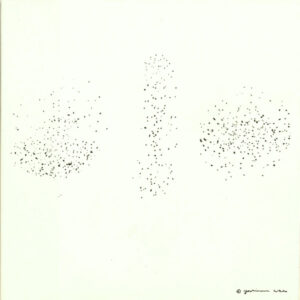
Singing in Unison is the latest in a series of recordings from acclaimed sound artist, composer and performer Yoshi Wada. Recorded live over two nights, March 14 and 15, in 1978, at New York City’s legendary performance space The Kitchen, "Singing in Unison" is a dramatic yet meditative work: modal improvisations for three male voices, singing, with great gravitas, in purposeful unison. These previously unreleased recordings, featuring vocalists Richard Hayman, Imani Smith and Wada himself are extremely powerful, with a glacial majesty and a sense of timeless wonder. Wada’s earliest musical memories are of hearing Zen Buddhist ritual chants in his native Japan, and those memories are reflected in the deep vocalisations here; also evident is Wada’s period of intense study with Indian master singer Pandit Pran Nath. Thus there is a definite "Eastern" feeling to "Singing in Unison", with further elements added by Imani Smith’s Sufi background and Wada’s interest in Eastern European vocal styles, but the music is also informed by Wada’s experiences in the Fluxus movement and as a member of the New York avant-garde community. The edgy atmosphere of 1970s New York City pervades these recordings, adding a hint of menace. Despite the fact that this is purely vocal music, fans of the slow-moving heaviosity of Sunn 0))) will appreciate “Singing in Unison”. It is available in two formats: a single CD of the March 15 performance, with gatefold sleeve; or a triple LP set featuring a complete version of both performances, March 14 and 15. “Singing in Unison” is a massive, monumental, monolith of vocal sound. Unstoppable! CD version: Single CD for the March 15 performance. Cardboard /gatefold paper jacket + liners.
16,00€
Out of stock
CD
Luc FERRARI
“Dialogue ordinaire avec la machine-Sexolidad”
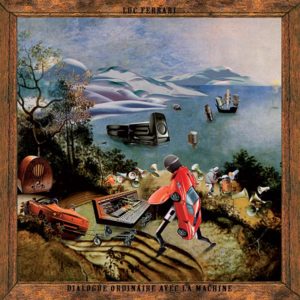
“Dialogue ordinaire avec la machine, ou trois fables pour bande doucement philosophiques” (1984). Ordinary dialogue with the machine or thrre gently philosophical tales for tape. Luc Ferrari in conversation with the machine and Yannick Gornet (stereo magnetic tape). Song: Michel Musseau. “Sexolidad” (1982-83). in six parts: eyes, hands, sight, mouth and tongue, sex and ears and for 15 instruments: flute, oboe, bass clarinet, bassoon, trumpet, trombone, violin, viola, cello, doublebass, piano, 2 percussion, celesta-glockenspiel. Live recording by the Ives Ensemble.
15,50€
In stock
CD
COH
“Music vol.”
Written and recorded in jan-dec 2015. All music by Ivan Pavlov/COH.
Artwork by Tina Frank.
Opening a sonic space that leads into delicate subconscious spheres, Ivan Pavlov aka COH has created his most sophisticated work up to date. “Music vol.” is a piece of gentle acoustic excitement. Evolving around concepts of silence and sound in a profound sense, each track reveals to the listener a different emotional chamber. The intimacy provoked is deriving from the fact that VOL. is meant literally here. Similar to classical music, Pavlov is putting variations of volume and soft progressions of sound to the fore. It is these gentle, silent tones that force us to pay attention to the inner qualities of each sound, its colour and vibration, while simultaneously revealing its tactile and corporeal qualities. At the same time, COH is creating atmospheric settings that invite us into complete immersion. A condition, close to meditation is provoked, making us intuitively aware of slight alterations. Subtle sensations arise from the exquisite affective dramaturgy that is operating here. Reminiscent of minimalistic film scores, COH is elaborating a very sparse sounddesign, creating a painstakingly continuous arc of suspense, never to be dissolved.
Artwork by Tina Frank.
Opening a sonic space that leads into delicate subconscious spheres, Ivan Pavlov aka COH has created his most sophisticated work up to date. “Music vol.” is a piece of gentle acoustic excitement. Evolving around concepts of silence and sound in a profound sense, each track reveals to the listener a different emotional chamber. The intimacy provoked is deriving from the fact that VOL. is meant literally here. Similar to classical music, Pavlov is putting variations of volume and soft progressions of sound to the fore. It is these gentle, silent tones that force us to pay attention to the inner qualities of each sound, its colour and vibration, while simultaneously revealing its tactile and corporeal qualities. At the same time, COH is creating atmospheric settings that invite us into complete immersion. A condition, close to meditation is provoked, making us intuitively aware of slight alterations. Subtle sensations arise from the exquisite affective dramaturgy that is operating here. Reminiscent of minimalistic film scores, COH is elaborating a very sparse sounddesign, creating a painstakingly continuous arc of suspense, never to be dissolved.
12,50€
Out of stock
CD
Oren AMBARCHI
“Quixotism”
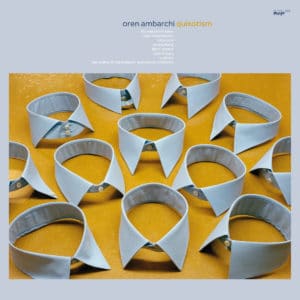
Recorded with a multitude of collaborators in Europe, Japan, Australia and the USA, Quixotism presents the fruit of two years of work in the form of a single, LP-length piece in five parts. Ambarchi’s work in recent years has evinced an increasing fascination with the possibilities of combining abstract sonic textures with rhythm and pulse, whether in his drumming with Keiji Haino, the subtly driving ride cymbals provided by drummer Joe Talia in their work together, or the motorik grooves of Sagittarian Domain (Editions Mego, 2012). Quixotism takes this aspect of Ambarchi’s recent work to the next level: the entirety of this long-form work is built on a foundation of pulsing double-time electronic percussion provided by Thomas Brinkmann. Beginning as almost subliminal propulsion behind cavernous orchestral textures and John Tilbury’s delicate piano interjections, the percussive elements (elaborated on by Ambarchi and Matt Chamberlain) slowly inch into the foreground of the piece before suddenly breaking out into a polyrhythmic shuffle around the halfway mark, being joined by master Japanese tabla player U-zhaan for the piece’s final, beautiful, passages. The pulse acts as thread leading the listener though a heterogeneous variety of acoustic spaces, from the concert hall in which the Icelandic Symphony Orchestra were recorded to the intimacy of Crys Cole’s contact-mic textures. Ambarchi’s guitar itself ranges over this wide variety of acoustic spaces, from airless, clipped tones to swirling, reverberated fog. Within the complex web Ambarchi spins over the piece’s steadily pulsing foundation, elements approach and recede, appear and reappear, in a non-linear fashion, even as the piece plots an overall course from the grey, almost Nono-esque reverberated space of its opening section to the crisp foreground presence of Jim O’Rourke’s synth and Evyind Kang’s strings in its final moments. Formally indebted to the sidelong workouts of classic Cologne techno, the long-form works of composers such as Eliane Radigue, and the organic push and pull of improvised performance, Quixotism is constantly in motion, yet its transitions happen slowly and steadily, so that they are often nearly imperceptible, the diverse elements which make up the piece succeeding one another with the logic of a dream.
Anyone who follows Ambarchi’s work knows that it has many facets: explorations of the outer limits of rock with Keiji Haino, psychoacoustic interference and sizzling harmonics in his solo performances, delicate improvisations with Keith Rowe or John Tilbury. To all these projects, Ambarchi brings his particular sensibility, patiently allowing sounds to develop on their own terms without forsaking their intrinsic physical and emotional power. Similarly,
although Quixotism is shaped by its many contributors, the resulting sound world is unmistakably Ambarchi’s own. His most substantial solo release since Audience of One (Touch, 2012), Quixotism represents the summation of Ambarchi’s work over the last few years while also pointing to the future.
Oren Ambarchi, guitars and percussion with Thomas Brinkmann, computable drums with an application to the Entscheidungsproblem, Matt Chamberlain, drums & electronics, Crys Cole, contact mics & brushes, Eyvind Kang,bowed gender & violas, Jim O’Rourke, synths, John Tilbury, piano, U-zhaan, tabla,
Ilan Volkov & the Icelandic Symphony Orchestra. Recorded 2012-2014 in Cologne (Max Ernst Studios), Reykjavik (Harpa), Melbourne, Seattle (Avast! Studios- session co-produced & engineered by Randall Dunn, London, Los Angeles (Cyclops Sound Studio) and Tokyo (Steamroom, engineered by Jim O’Rourke). Mixed Dec 2013 & March 2014 at Chinatown, Melbourne by Joe Talia and Oren Ambarchi. Mastered at Moose, Melbourne March-April 2014 by Byron Scullin. Vinyl cut by Rashad Becker & D&M, Berlin, June 2014. Photography by Estelle Hanania. Design by Stephen O'Malley.
Anyone who follows Ambarchi’s work knows that it has many facets: explorations of the outer limits of rock with Keiji Haino, psychoacoustic interference and sizzling harmonics in his solo performances, delicate improvisations with Keith Rowe or John Tilbury. To all these projects, Ambarchi brings his particular sensibility, patiently allowing sounds to develop on their own terms without forsaking their intrinsic physical and emotional power. Similarly,
although Quixotism is shaped by its many contributors, the resulting sound world is unmistakably Ambarchi’s own. His most substantial solo release since Audience of One (Touch, 2012), Quixotism represents the summation of Ambarchi’s work over the last few years while also pointing to the future.
Oren Ambarchi, guitars and percussion with Thomas Brinkmann, computable drums with an application to the Entscheidungsproblem, Matt Chamberlain, drums & electronics, Crys Cole, contact mics & brushes, Eyvind Kang,bowed gender & violas, Jim O’Rourke, synths, John Tilbury, piano, U-zhaan, tabla,
Ilan Volkov & the Icelandic Symphony Orchestra. Recorded 2012-2014 in Cologne (Max Ernst Studios), Reykjavik (Harpa), Melbourne, Seattle (Avast! Studios- session co-produced & engineered by Randall Dunn, London, Los Angeles (Cyclops Sound Studio) and Tokyo (Steamroom, engineered by Jim O’Rourke). Mixed Dec 2013 & March 2014 at Chinatown, Melbourne by Joe Talia and Oren Ambarchi. Mastered at Moose, Melbourne March-April 2014 by Byron Scullin. Vinyl cut by Rashad Becker & D&M, Berlin, June 2014. Photography by Estelle Hanania. Design by Stephen O'Malley.
12,50€
Out of stock

CD
NONO – FREY
Back in stock with new cover.
Performers: Joanna Becker, Clemens Merkel, violin. “Ohne Titel (Zwei Violinen)” is emblematic for much of Jürg Frey‘s work, because here, as elsewhere, the idea of two runs very deep. A piece begins with something - some group of similar sounds, or some manner of performance; and then, without warning, reason, or justification, simply changes to something else. These are moments in which all lies open, where the imminent need to decide threatens to become almost a kind of panic. “In Ohne Titel (Zwei Violinen)” two means not just two moments in time (i.e., before and after), but two persons. Throughout most of the piece the players play the same part, exactly the same notes. And here there is an interesting principle: the more similar the musicians actually sound, the more one senses their separation. This implies that, in this work, two is most visible at the border of one, where an infinite proximity reveals a fundamental difference.How strange and interesting that this kind of music would be ‚paired‘ with Nono‘s duo "Hay que caminar" sognando ! Every thing in this piece seems to move from one extreme to the other: by leaps or sudden contrasts. In each case the physical limit of the instrument is approached in way that suggests that the music would continue, beyond the realm of the physical and audible. With the emphasis on boundaries, we are strongly directed towards a metaphorical kind of space, enclosed not with walls but with windows, which allow us a view to the horizon. And still, this music is a song. But this song either speaks with gestures of great intensity or hardly at all. There is just the slightest echo of melody: Verdi‘s ‚scala enigmatica‘, itself an echo of melody. In this piece we hear song as pure longing, reaching for something that will forever remain just out of our grasp.”
Performers: Joanna Becker, Clemens Merkel, violin. “Ohne Titel (Zwei Violinen)” is emblematic for much of Jürg Frey‘s work, because here, as elsewhere, the idea of two runs very deep. A piece begins with something - some group of similar sounds, or some manner of performance; and then, without warning, reason, or justification, simply changes to something else. These are moments in which all lies open, where the imminent need to decide threatens to become almost a kind of panic. “In Ohne Titel (Zwei Violinen)” two means not just two moments in time (i.e., before and after), but two persons. Throughout most of the piece the players play the same part, exactly the same notes. And here there is an interesting principle: the more similar the musicians actually sound, the more one senses their separation. This implies that, in this work, two is most visible at the border of one, where an infinite proximity reveals a fundamental difference.How strange and interesting that this kind of music would be ‚paired‘ with Nono‘s duo "Hay que caminar" sognando ! Every thing in this piece seems to move from one extreme to the other: by leaps or sudden contrasts. In each case the physical limit of the instrument is approached in way that suggests that the music would continue, beyond the realm of the physical and audible. With the emphasis on boundaries, we are strongly directed towards a metaphorical kind of space, enclosed not with walls but with windows, which allow us a view to the horizon. And still, this music is a song. But this song either speaks with gestures of great intensity or hardly at all. There is just the slightest echo of melody: Verdi‘s ‚scala enigmatica‘, itself an echo of melody. In this piece we hear song as pure longing, reaching for something that will forever remain just out of our grasp.”
10,50€
Out of stock
CD
Michael PISARO
“Hearing metal 1”
Performer: Greg Stuart (tam-tam). “The 60-inch ("Mikrophonie") tam-tam is a large piece of metal, a proto-sculpture. Brancusi might have altered it: rounding and tapering the edges, making an oval instead of a circle, polishing the surface into smooth gold. The tam-tam is also a vast sound landscape-an instrument that makes noise at the slightest provocation. A resonance is created just in the act of walking past the instrument or breathing on it ... that is, if your ear (or a microphone) is close enough to hear it. Wherever it is touched with a bow or a hand, it responds with chaotic, unpredictable complexity, never producing the same sound twice.I have attempted to work within the givens of this landscape, to allow some of its implicit contours to reveal themselves-by collecting sounds, giving them a duration, putting them into a clear structure, and cutting a path through them with pure tones. Sleeping Muse is something like a four-part chorale of bowed sounds, with a melody made up of long sine tones buried in the sounds. The Endless Column is a collection of sixty extremely light, close recorded strikes, randomly ordered, but with a rising scale of sine tones mixed in, more or less within the central frequency range of the tam-tam (from 50 to 671 hz). Sculpture for the Blind arranges eight layers of bowed sounds (which are then released) along a pattern of lengthening durations and combined with a sine tone trio, again woven into the sounds of the tam-tam. Hearing Metal 1 is the product of close collaboration between composer and performer. The piece evolved as Greg made test recordings based on my suggestions and then sent them to me. As it happened we feel we fell into its world, in order to move it slightly towards our own.” Michael Pisaro
10,50€
Out of stock
CD
Michael PISARO
“Harmony series 11-16”
Composer Michael Pisaro. Performer: Johnny Chang (violin), James Orsher (harmonium), Kathryn Pisaro (oboe-english horn), Michael Pisaro (guitar-sine tones), Marc Sabat (violin), Mark So (piano), Greg Stuart (percussion). “Any tone, any tuning. The world of Michael Pisaro’s Harmony Series revolves around the process of translation. In this collection of thirty-four pieces (nine of which are presented here) the composer translates a wide variety of poems into text scores. The first step is to literally trace each poem, as if one were making a stencil. A five-line poem might become a five-minute piece through this procedure. This kind of action is direct and purposely simple and it will provide a stable space from which each piece will develop. Call this architecture.
In the second step the composer seeks out the internal forces of the text. For example, a text suggesting proliferation is read as a shift from a barely to a clearly audible, multi-faceted sound. As the poem is already in motion, the composer seeks to harness energy rather than block flow. Evocative readings are eschewed in favor of direct transmutation. Asymptotes are drawn to the poem, resulting is an extremely fine mist of possibilities for the performers to tune (and detune) in performance. Call this material.
A piece is set in motion when the mist is sprayed - always lightly - through the stencil (think pathway, pinprick, or filter). This action creates a dynamic situation. As performers our ears focus as a version begins to take shape - it is unmistakable when this happens. A small flutter appears in the fabric of the piece. We notice sounds that cannot be traced back to any of the individual performers. Drawn in by the fluttering, one starts to know (or sense) what sounds are correct to play, even when there are no explicit rules for how they are to be chosen. The piece is thinking. Call this the point of contact. To the performers the distance between score and realization will often seem impossibly large. To travel this distance is the defining experience of this music. Along the way, each realization establishes its own kind of weather system wherein complex relationships are created not only between (and within) the sounds but also the performers. On the other side of the stencil we are in unknown world - sun-distant, alive - immersed in a gently spinning mixture of tone, noise and silence, the radio having been tuned to a previously unheard channel. Call this harmony.” Greg Stuart
In the second step the composer seeks out the internal forces of the text. For example, a text suggesting proliferation is read as a shift from a barely to a clearly audible, multi-faceted sound. As the poem is already in motion, the composer seeks to harness energy rather than block flow. Evocative readings are eschewed in favor of direct transmutation. Asymptotes are drawn to the poem, resulting is an extremely fine mist of possibilities for the performers to tune (and detune) in performance. Call this material.
A piece is set in motion when the mist is sprayed - always lightly - through the stencil (think pathway, pinprick, or filter). This action creates a dynamic situation. As performers our ears focus as a version begins to take shape - it is unmistakable when this happens. A small flutter appears in the fabric of the piece. We notice sounds that cannot be traced back to any of the individual performers. Drawn in by the fluttering, one starts to know (or sense) what sounds are correct to play, even when there are no explicit rules for how they are to be chosen. The piece is thinking. Call this the point of contact. To the performers the distance between score and realization will often seem impossibly large. To travel this distance is the defining experience of this music. Along the way, each realization establishes its own kind of weather system wherein complex relationships are created not only between (and within) the sounds but also the performers. On the other side of the stencil we are in unknown world - sun-distant, alive - immersed in a gently spinning mixture of tone, noise and silence, the radio having been tuned to a previously unheard channel. Call this harmony.” Greg Stuart
14,00€
Out of stock
CD
Michael PISARO
“Mind is moving I”
Composer : Michael Pisaro. Performer : Michael Pisaro, guitar.
“Many pieces created today are written for specific places or opportunities (whether for the concert hall or a special performance), and then fulfill the function intended for them in that place. However, in a piece like mind is moving (I) the prevailing impression is that the piece itself must first create the site where it can sound. It seems that there is not simply a container into which the music is fit. The piece does not create a site by, so to say, standing its ground and asserting itself: its presence is much more subtle. The extremely delicate contact with the guitar strings (mostly harmonics, encompassing a wide range, up to the17th partial) corresponds to a temporal organization which just as delicately places these sounds in the expanse of time. The site thus created is not a self-contained place through which time flows in a definite direction. Here at times an astounding sensation is felt, where time passes perpendicular to the music, or where time may come and go from all directions. Thus the site which comes into being is without walls, and along with this comes a permeability which leaves room for individual thought and for other tones. For that reason, in this music other things quite simply turn up: like the occasional whistling or soft scraping of the strings; not effects, but pure matters of course. Perhaps there is here the faintest reminiscence of the image of a folk singer, who whistles along with his guitar playing, and uses the noises to clarify the rhythm. But above all, these are sounds which in their lack of tension leave nothing behind but the memory that they were there at all. In this piece, expanse and openness, rather astoundingly, go along with precision, which is concealed within the compositional craftsmanship and finds its most beautiful counterpart in the precise locating of the harmonics on the fret board of the guitar. Both of these qualities can only succeed when work and play are without arbitrariness. Thereupon, within the listener, silence and listening meet, allowing a sense of expanse and openness to develop. So the piece gently unfolds, and creates, all by itself, over the course of its long resounding, its own site: a place where it can live.” Jürg Frey
10,50€
Out of stock
CD
Michael WINTER
“Approximating omega”
approximating omega
text adapted from gregory chaitin's 1994 book the limits of mathematics
muirgen éléonore gourgues (reading), judith hamann (violoncello), with samples contributed by tomás cabado, raven chacon, yiannis christofides, alan courtis, john eagle, carmina escobar, bryan eubanks, jacqueline george, tom johnson, david kant, aj kluth, ulrich krieger, juan sebastián lach lau, ingrid lee, john lely, todd lerew, heather lockie, scott mclaughlin, ezequiel menalled, ian mikyska, pablo riera, dean rosenthal, karen santana, james saunders, marcus schmickler, elliot simpson, mark so, laura steenberge, adrian tenney, philip thomas, samuel vriezen, lucie vítková, manfred werder, byron westbrook, michael winter and melike yersiz
arranged by aidan reynolds and michael winter
for gregory chaitin
michael winter (piano)
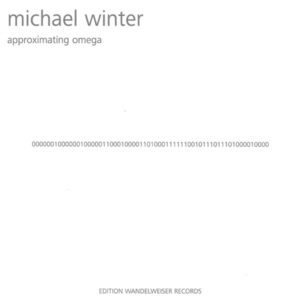
a realization of a subset of ‘omega’ (or chaitin’s constant): a maximally complex, incomputable number defined
as the halting probability for some universal, prefix-free turing machine. the subset of omega used for this realization
(given by the bit string on the cover) is presented in the 2002 article by cristian calude et al. entitled computing a glimpse of randomness.
10,00€
In stock
In stock
CD
Eva-Maria HOUBEN
“aus den fliegenden blättern eines fahrenden waldhornisten”
“aus den fliegenden blättern eines fahrenden waldhornisten” (2013) ( “from the flying leaves of a traveling horn player”) for horn in F. Wilfried Krüger, horn.
10,50€
In stock
Out of stock

CD
Christian WOLFF
“Stones”
The score of “Stones” consists of just a few lines of text:
Make sounds with stones, draw sounds out of stones, using a number of sizes and kinds (and colours); for the most part discretely; sometimes in rapid sequences. For the most part striking stones wfth stones, but also stones on other surfaces (inside the open head of a drum, for instance) or other than struck (bowed, for instance, or amplified). Do not break anything. Christian Wolff, STONES, (from: Prose ColIection, 1968-74)
While these instructions contain an abundance of possibilities, they also exclude many things. The score describes a condition under which things may happen, not a process in which things develop.
Seven composers participated in the present realization by the Wandelweiser Komponisten Ensemble: Antoine Beuger, Jürg Frey, Chico Mello, Michael Pisaro, Burkhard Schlothauer, Kunsu Shim und Thomas Stiegler.
For this performance, each prepared, independently of the others, between 10 and 20 events.The solutions, though compatible with the score, were unique. Michael Pisaro, for example, made drawings on stones, producing very gentle sounds. Burkhard Schlothauer sometimes drew a large stone across the floor. Jürg Frey decided, that a single sound might well last long time. Thus, 27 minutes of quietly rubbing two very uneven limestones, is considered as one event. Thomas Stiegler used a violin and violin bow as the surface upon which all of his events took place. Kunsu Shim began performing his nearly inaudible, subtle sounds only after about 55 minutes had elapsed.
While playing this CD you may forget, after a while, that it is playing. All of a sudden you might hear a little stone, sometime, somewhere. After an initial ,,What is that?", you’ll suddenly realize: ,,Oh yes, it’s the CD!".
10,00€
In stock
CD
Cem GÜNEY
“Five compositions”
Antoine Beuger (flute), Germaine Sijstermans (clarinet), Tobias Liebezeit (percussion), Burkhard Schlothauer (violin), Lydia Haurenherm (viola), Marcus Kaiser (violoncello).
Cem Güney was born in Turkey in 1973. Influenced by jazz music, he learned to play the trumpet and later attended the College of San Mateo’s Music Department in San Mateo, California. During the years of playing trumpet, his interaction with music has mostly been with experimental forms of expression. This interaction influenced him to compose electronic music. Currently, he’s also been writing scores for contemporary music.
10,50€
In stock
CD
Burkhard SCHLOTHAUER
“PianoMusic”
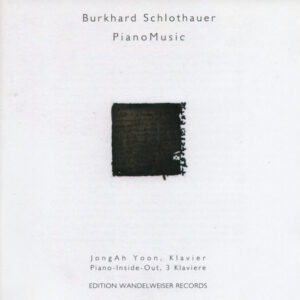
Composer: Burkhard Schlothauer. Performers : Jongah Yoon, piano; Reinhold Friedl, Michael Iber, Yungkyung Lee, piano. “As a result of the fascination the unmuted decay of the piano sound held for me, the fading string vibration became the focus of "ab tasten". In each sound of this piece at least one tone fades away unmuted. I also decided to take a given fact (the different fading times: the higher a tone, the shorter it sounds) to form the basis of the music’s temporal organisation. The respective unmuted string determines the overall duration of the sound and as a result, the timing of the composed "muting activities". Having each sound followed by a pause of possibly equal weight is a formal concept I have used in many of my compositions since1995. Each sound stands alone, is a "piece" of music in its own right, an autonomous "image", an individual, that may be perceived in its entire appearance from sounding to dying away. The order of the sounds may be chosen by the musicians themselves. In "ab tasten" I discovered my interest for the moment the sound falls silent, dies away. I noticed, that at some point it is not longer possible to asses whether the strings are still vibrating audibly, or whether it is only the image of the sound which is still in the mind. A sound has a beginning, an existence and an end. These parts, though, cannot be clearly divided: we cannot really say where the beginning is, where beginning turns into continuity, where continuity becomes an ending, where the end is. In "three pianos drumming" from 1999, which I wrote for PianoInsideOut (Reinhold Friedl, Michael Iber, Yunkyung Lee), on the other hand, the piano is used only as a percussion instrument. In three of the Steinway D grand pianos of Sender Freies Berlin the same bass string was taped with adhesive tape, strongly and lastingly muting the string. By this treatment the hammer beating of the piano becomes clearly audible. The piano is treated as what it is in terms of its sound production: as a "hammering machine". Hearing recordings of still existing hunter and gatherer cultures, I kept hearing rhythms which were pure pulse. These musics - no matter from which region of the earth - refrain from any conscious accentuation or division of rhythmic units. To me, this seemed to be an archetype of rhythm, some sort of nucleus to every rhythmic music, in which the hypnotic power of these first man made time forms makes itself felt. In "three pianos drumming" the performers determine a set of parameters (dynamics, tempo, pitch) within a given range and stick to these for the entire piece. Each part has its own sequence of beats and pauses, allowing for the emergence of very subtle spaces and microrhythms between the pianos. What fascinates me about this piece (and also its successor, "drumming for one to many percussionists"), is that it remains the same piece, regardless of whether it is played pianissimo or forte, no matter which tempo between 30 and 120 b.p.m is used. or what order of pages the players select. Different versions take on very different "expressive qualities". To me, it seemed very important for my development to have composed a piece which allows for a strong expressive power, without me as a composer having provided it with expression.” Burkhard Schlothauer
10,50€
In stock
CD
Antoine BEUGER
“Silent harmonies in discrete continuity”
Program: Antoine Beuger: silent harmonies in discrete continuity (fifth music for marcia hafif), series I. Performer: Electronic Music.
“Silence is not an acoustical phenomenon
silent harmonies: three-minute sounds, stationary, quiet, pure waves
each sound has eight frequencies, each from a different octave range
there is silence where depth disappears and expanse emerges: on the surface
in discrete continuity: one soud goes, another one comes and on it goes, step by step, continuously
still waters are said to run deep,
but in reality it is the imperturbability of their surface
that impresses us.
for marcia hafif:
american painter of monochrome paintings
and a quiet person’s silence hides nothing deep -
it hides nothing at all.”
10,50€
Out of stock
CD
André O. MÖLLER
“Musik für orgel und ein(n) tonsetzer(in) …2003…”
Eva-Maria Houben, organ. “What do you do, if you work with just intonation and wish to write a piece for organ? you have to deal with the relation between equally tempered and over or undertonal (just) intonation. 2001 i had several opportunities to make a study of some wonderful instruments. This eventually put me on the path towards this composition. In this piece only those frequencies of the organ sound that have close to whole-numbered ratios (+/- 6 cents) to a fundamental (in this case C’ at about 32 Hz). Because the frequencies are never perfectly tuned - a result of the organ’s tempered tuning - more or less strong beatings and frictions emerge, that rhythmically and timbrally shape the inner life of the sounds. A realisation of this piece strongly depends on the disposition of the instrument and the performance space. The version at hand corresponds approximately to the first performance by Eva-Maria Houben at St. Suitbertus church, Dortmund october 3, 2003. For this cd I tried to record the organ in such a way that the playback, instead of reproducing the church environment, projects the instrument into the listener’s space.” André O. Möller
10,50€
Out of stock
CD
André O. MÖLLER with Hans Eberhard MALDFELD
“In memory of James Tenney”
“I never met james tenney personally.
in 2004, the year of his 70th birthday, tenney was invited to cologne by WDR to honor him. the man held a charming speech and showed an excerpt of his early electronic piece Collage
1 “blue suede”, based upon elvis presley’s version of carl perkins’ song blue suede shoes.
afterwards we heard a beautiful performance of forms I - IV, four pieces for amplified ensemble, each of them dedicated to one of his teachers.
before and since then i listened to a lot of tenney’s music, met and worked with quite a few students and colleagues of his.
therefore, it almost felt like a personal loss, when tenney died in 2006.
the man’s spirit, though, is still around!
2006 i met double bass player hans eberhard maldfeld, when he was invited by antoine beuger to introduce the tromba marina to me and some other composers.
the tromba marina is a single stringed instrument played with a bow.
in addition to the open string one can play harmonics up to the 20th partial and maybe even higher.
the unusual construction of the bridge makes it possible to create sounds reminiscent of the sound of the trumpet or other brass instruments.
since 2003 hans eberhard maldfeld is committed to a renaissance of the instrument.
his explorative drive and his sheer dedication to sound and performance allow the instrument to reveal hitherto unknown qualities.
this dedication, which also led us to collaborate on a double bass piece, i find so compelling and inspiring.” andré o. möller, 2015
14,00€
Out of stock
CD
Rolf JULIUS
“Tanz für zwei blaue Rechtecke”
Small music vol.4. Music and text by Rolf Julius. Production: Saarländischer Rundfunk.
16,50€
Out of stock
CD
Patrick KOSK
“Mondweiß”
“Mondweiß” (2007-2008), “Das Kästchen und Tripitaka” (2005), “Angklung & Ice” (2004-2005), “Distrak - sillalla” (1992), “La boîte” (2005), “Transmissions in a… (system of coordinates)” (1981). Musique concrète.
14,00€