
Out of stock
CD
KSIEZYC
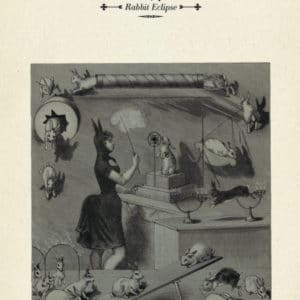
“Rabbit eclipse”
Rabbit Eclipse is the second full length recording from the legendary Ksi yc following on from their self titled debut from 1996.
The Moon never went away.
The 2013 the Penultimate Press reissue of Ksi yc’s timeless debut exposed the band to a large new audience resulting in a return to live performance and the subsequent development of new material.
Rabbit Eclipse was recorded in Warsaw throughout May to September 2015 within the idyllic Palladian palace Królikarnia (The Rabbit House). All original members gathered to conjure the peculiar hybrid of the the ancient and the contemporary unique to the band.
Rabbit Eclipse presents a rich and subtle environment of beguiling narratives hanging in suspended tension. This opens up an entire new phase in the cycle of the band where an enchanting discrete musical continuum of rich and subtle sound excursions are enveloped in a mysterious melancholia.
Another exemplary presentation from one of Poland’s most idiosyncratic and respected outfits.
Rabbit Eclipse is packaged in a 4 page DVD format digipack inverted in an edition of 500 copies.
Line up: Agata Harz vocals, objects. Katarzyna Smoluk-Moczyd owska, vocals, keyboards, objects. Lechos aw Polak accordion, keyboards, synthesizers. Remigiusz Mazur Hanaj tapes, hurdygurdy, violin. Robert Nizi ski clarinet, keyboards, objects. Pawe Roma czuk Fidel, StösselLaute, objects.
The Moon never went away.
The 2013 the Penultimate Press reissue of Ksi yc’s timeless debut exposed the band to a large new audience resulting in a return to live performance and the subsequent development of new material.
Rabbit Eclipse was recorded in Warsaw throughout May to September 2015 within the idyllic Palladian palace Królikarnia (The Rabbit House). All original members gathered to conjure the peculiar hybrid of the the ancient and the contemporary unique to the band.
Rabbit Eclipse presents a rich and subtle environment of beguiling narratives hanging in suspended tension. This opens up an entire new phase in the cycle of the band where an enchanting discrete musical continuum of rich and subtle sound excursions are enveloped in a mysterious melancholia.
Another exemplary presentation from one of Poland’s most idiosyncratic and respected outfits.
Rabbit Eclipse is packaged in a 4 page DVD format digipack inverted in an edition of 500 copies.
Line up: Agata Harz vocals, objects. Katarzyna Smoluk-Moczyd owska, vocals, keyboards, objects. Lechos aw Polak accordion, keyboards, synthesizers. Remigiusz Mazur Hanaj tapes, hurdygurdy, violin. Robert Nizi ski clarinet, keyboards, objects. Pawe Roma czuk Fidel, StösselLaute, objects.
12,00€
Out of stock
CD
KARUNA KHYAL
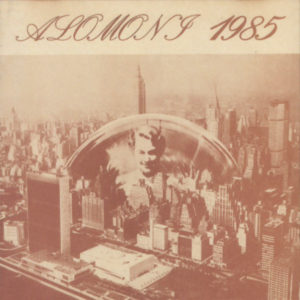
“Alomoni 1985”
“Alomoni 1985” was originally released on Voice Records, VO-1002. Reissued 1998. On this occasion Paradigm Discs has decided to reissue 2 LP’s of what can only be described as rock music, minus the drum kit. These two records are something of a mystery. No group information was ever given, and no production date or location is indicated. It would seem though, that these records are both by the same group of Japanese people and that they were recorded in the mid seventies in Japan. In common with Magical Power Mako, the musical influences here are much more Germanic than anything Japanese, with long hypnotic free form rock hysteria, comparable to Faust in the use of experimentation and heavily fuzzed electric guitar. The emotional wordless vocals echo those of Damo Suzuki from Can. But unlike Can the rhythms are wrought from hand drums, sleigh bells, tambourine, bass drum and other simple means. Hard blown harmonica is a strong feature on this somewhat crazed mantric rock along with recorder, flute, zither, mandolin, acoustic guitar and synth. There is also a strong use of tape loops, electronics, environmental sounds, backwards tapes and what sounds distinctly like the hysterical laughter of Stan Laurel.
15,00€
In stock
CD
GRAVITY ADJUSTERS EXPANSION BAND
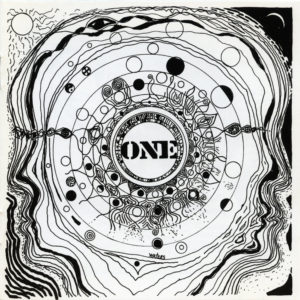
“One”
The GAEB started in 1967 and remains one of the the America’s long lost and underestimated groups who explored the areas of free jazz, improvisation and experimental music. Drummer Lee Charlton shifts moods from jazzy phrasing to more abstract sound sculpture; in this world the GAEB mainly reside, using the self-invented percussive and bowed instruments of multimedia artist Richard Waters, many of which incorporate water filled resonators to bend and tune. Other improvisers at the time--AMM, MEV, Sonde and Taj Mahal Travellers--made extensive use of homemade and adapted instruments, but the GAEB are a very different concern with their own unmistakable identity. Their first LP One appeared in 1973 on Nocturne Records, a small Californian label (the first of their two LPs, the second appearing some eight years later). Paradigm Discs’ CD edition contains the entire first LP, plus fifteen minutes of extra material from the time.
13,00€
In stock
CD
Trevor WISHART
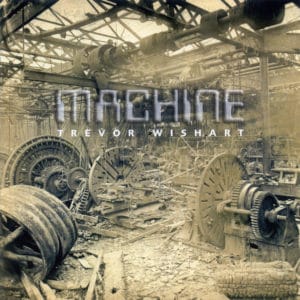
“Machine”
“Although Machine was completed in 1971 it was not released until 1972, shortly after the release of Journey Into Space. Machine is therefore the first major composition by Trevor Wishart. It was composed at York University and was originally issued on vinyl as 3 sides of a highly adventurous 3LP box set called Electronic Music From York, released by the University’s own record label. In common with Journey Into Space (also on Paradigm Discs), Machine makes use of a large number of volunteer contributors, mostly from the student body at York. With this recording, however, there are no instruments used. Instead, the music of Machine is made up entirely from a combination of spoken text and carefully directed improvising choirs that take their lead from prerecorded factory sounds. These are extensively mixed and edited with yet more collected machine sounds and other sources of musique concrète, as well as occasional use of basic electronic sources. The scale of this work, and the degree of preparation involved in scoring it, seem to have more resonances with the world of theatre or film rather than tape composition. Much of Wishart’s early work involved the use of musicians and artists being directed to perform in new ways, outside of their usual remit. A combination of late 60s openness, detailed scores that provide frameworks for improvisation and slavish editing have resulted in an incomparable sound work. With a continuous playing time of one hour, the wild and previously unexplored terrain covered by this pioneering work of British experimental music moves in turn through the full range of possible audio landscapes from the oceanic calm of the doldrums to earsplitting factory mayhem. Jewel case cd with 12 page booklet.”
13,00€
Out of stock
CD
Trevor WISHART
“Journey into space”
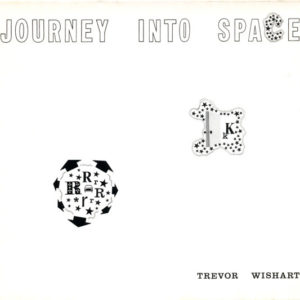
York University’s music department houses one of the UK’s first ever electronic music studios, and during the early seventies it was a hotbed of creative activity. Much of the released output from the studio at this time revolved around the work of the dynamic composer Trevor Wishart. Journey Into Space was his first release, composed between 1970 and 72, and was privately pressed (shortly before the formation of YES records), as two separate LP’s in 1973. (The CD cover amalgamates the 2 original designs). Along with other early private releases of experimental music in the UK (ie the LP of sound poems by Cobbing/Jandl, or the LP of musique concrète by Desmond Leslie), this record is also a total anomaly in the canon of British experimental music and has little to do with the current, or even subsequent work by Wishart. The vast length of this piece has many different styles. There are acoustic sections, mostly of junk and toys (bike bells, squeeze horns, bottles, metal tubes, combs etc.) as well as flute and brass sections that are used as raw material. There are also sections of everyday field recordings, scraps of NASA Apollo transmissions, as well as plenty of multitracking, editing, vocal acrobatics and musique concrète. Among the 48 participants credited on the original sleeve are a whole roster of York University alumni including nearly all the artists who were showcased on the then unreleased 3LP box set ’Electronic Music From York’, along with other noteworthy students as diverse as Steve Beresford, Jonty Harrison, Roger Marsh, Dominic Muldowney, Bernard Rands and Jan Steele. The co-operative spirit of York’s music and drama departments, plus the raw enthusiasm and open attitude of the participants involved in the project gave this music an immediacy, similar to the later LAFMS scene.
14,00€
Out of stock

CD
Pauline OLIVEROS
“Electronic works”
Released 1997. I of IV was made in July 1966 at the University of Toronto Electronic Music Studio and was first released by CBS alongside works by 2 other young composers - ’Come out’ by Steve Reich and ’Night music’ by Richard Maxfield. It is really only in recent years (born out of the more radical elements of dance music, electronica and ambient music) that music like this is being rediscovered by a growing number of people interested in all manner of experimental electronics. Track 2 was also made in the summer of 1966 at the University of Toronto Electronic Music Studio, and track 3 was made at the San Francisco Tape Music Center in 1965. The 3 pieces on this CD are all live experiments, which at the simplest level use either an array of oscillators or filters, a mixer and one spool of tape feeding a series of (variously set up) stereo tape machines. Long delay lines, pile ups of noise and rich sonorities are the stuff of this music. The third piece also samples a chunk of Pucini’s ’Madame Butterfly’, which only makes this music seem even more contemporary.
11,50€
Out of stock

CD
Yoshihide OTOMO – Sachiko M – Evan PARKER – John EDWARDS – Tony MARSH – John BUTCHER
“Quintet – Sextet”
Otomo Yoshihide, guitar. Sachiko M, sine waves. Evan Parker, saxophones.
John Edwards, double bass. Tony Marsh, drums. John Butcher, saxophones.
10,00€
Out of stock

CD
Peter BROTZMANN – John EDWARDS – Steve NOBLE
“…The Worse The Better”
2016 RePress.
Recording of the stunning first set performed by the trio of Peter Brötzmann, Steve Noble and John Edwards at Cafe OTO in January 2010 during Brotzmann's first residency at the venue. This was also the first time the trio had played together. Recorded at Cafe OTO by Shane Browne, mixed by John Edwards and Mastered by Andres [LUPO] Lupich at Dubplates & Mastering,
Berlin.
REVIEWS
“...a 40minute splurge of sax, drums and bass skronk, live at the venue in 2010, from the German freejazz giant Brötzmann and two stars of the London improv scene. Unrepeatable moments of collective inspiration and sudden sunlit shafts of modal near melody punctuate the continuing energy blur. Business as usual down Dalston Junction.” Stewart Lee, The Sunday Times
“These two extended improvisations, recorded in January 2010 during Brötzmann’s first residency at OTO, finds the group attaining neartelepathic
modes of interconnectedness, despite this being the trio’s first outing together. From the off, Brötzmann’s gills are gurning, throwing up torrents of molten
roar, while Noble’s mulekicking at the traps reels out ride hits like a baby sporting a bonnet of bees.” Spencer Grady, BBC Music
“All three are on outstanding form, from the opening yelp when it comes to Big Bang beginning, nobody does it better than Brötzmann to Edwards’s snarling drone 38 minutes later. Shame engineer Shane Browne slammed thos faders down so brutally: for once, you feel like joining in with the whoops and hollers of the punters.” Dan Warburton, The WIRE
12,00€
Out of stock
CD
Keiji HAINO – John BUTCHER
“Light Never Bright Enough”
Keiji Haino: Vocal, Guitars, etc. John Butcher: Saxophones and Feedback. Keiji Haino, one of the foremost exponents of the Japanese avant-garde, always provides a masterclass in constantly shifting improvisation. John Butcher is a saxophonist of rare grace and power, who has expanded the vocabulary of the saxophone far beyond the conventions of jazz and other musics, to encompass a staggering range of multiphonics, overtones, percussive sounds, and electronic feedback. Haino and Butcher met when Butcher opened for Fushitsusha at the show Cafe Oto arranged at St. John, Hackney - 5 years ago. In 2016 they were invited to play two duo concerts – at The Empty Gallery in Hong Kong and at Cafe Oto in London.
Otoroku is proud to present the audio documentation of their first UK meeting. Recorded live at Cafe Oto in July 2016 the results are an uncompromising milieu of swirling sound played out as a total union of these two legendary performers. Haino’s blues drenched guitar entices skittering notes from Butcher’s sax playing as numerous sonic clues unravel over the course of of this unique and compelling journey.
13,00€
In stock

CD
Kan MIKAMI – John EDWARDS – Alex NIELSON
“Live at Cafe Oto”
Japanese bluesman Kan Mikami is nothing less than an unalloyed force of nature. A skin-shredding blast of frozen wind from the poor, rural north of Japan that he calls home. In the late 1960s, like thousands of other Japanese young people Mikami made his way to Tokyo in search of a life different from that of his parents. Since then he has forcefully carved out a space for himself in the culture as a modernist poet, a raging folk singer, an author, a actor, an engaging TV personality, and one of Japan’s most uniquely powerful performers.
For most of Mikami’s career as a singer, he has performed solo. Just him and his electric guitar against the world, creating jagged A-minor vamps to drive along the surreal wisdom of his lyrics. But he’s equally at home in more demanding improvisational contexts such as those provided here by John Edwards on bass and Alex Nielson on drums. Their dense propulsive textures seem to spur on Mikami, his voice arcing powerfully into fragmented spaces, his guitar darting, colliding, shedding jagged and angular splinters of sound. A pulsing, raging maelstrom of serrated-edged energy. Gruff, rough, honest and very, very real.
13,00€
Out of stock
CD
Toshimaru NAKAMURA
“No input mixing board #8”
Letterpress impression. Limited to 200 copies. Co-Released by Oral and The Dim Coast. “Here’s my new (in 2013) solo album. I hope you find it worthy enough to take your time and have a listen. It was recorded in one day. Compared to previous releases, “Maruto” on Erstwhile Records (2 years to produce), “Egrets” on Samadhisound (5 years), it came to life quite quickly. Almost like it popped out. But it took three men’s great support to realise it this way. Eric Mattson was an initiator. He ignited this project by inviting me to Quebec City, made me talk and play music, and kept me in a good mood with a lot of tricks. Steve Bates kindly offered me a newly furnished studio, his time and work (then he became the one who encouraged me the most to put out this record). And David Sylvian drove up from his home in New Hampshire to join us. We worked collaboratively for two days. After David left, the studio looked completely different from when I arrived. Around my no-input mixing board was a mess of cables, microphones and loud speakers, a set up suggested by David, and there I was very tempted to stay for another day to do some more recordings by myself. The result of all this is here. Thanks very much to Eric, Steve and David.”- Toshimaru Nakamura
16,50€
In stock
CD
Bernard BONNIER
“Casse-tête”
Composed in 1979 and edited on LP in 1984 by Amaryllis. Reissue on CD by Oral, 2008. “Contrary to an electronic music delighting itself in soaring above reality in self abstraction, the concrete music of Bernard Bonnier has a down on earth hearing, and a dancing too, altough now and then out of beat. Bernard Bonnier has defined chameleon-music as: “...a mime* trying to beat its parth through the puzzle (casse-tête: literally “head-breaker”) of soliciting madness, sundowns, violence, science, love, death, velveeta* cheese, competition, sex, zen, and mandragora.” This must be true as well of soldier boy, an issue to the motion: “nothing lost, everything regained”. Each and every single sound hear trough this piece has been made from the loop “tell me why...” by means of electro-acoustic manipulations, the mark of Bernard Bonnier’s concrete music. Following the steps of Pierre Henry, Bernard Bonnier has been a forerunner to new-wave, and other “underground rock” music.” Aulnes Périn February 79
13,00€
Out of stock
CD
VELTZ
“Hommage to home electronics”
“I have interested in junk materials and have made sound works since several years ago. Before then, I listened experimental music as a fan, but my border of music and non music became meaningless by encounter with Fluxus, sound-art, media-art and others. Since then, I love texture of “sound” itself. I remarked abandoned analog televisions when transmitting system of broadcast signal was changed to digital format in 2011. They are one of my favorite instrument at present, and I hold live performance and installation used them. In this CD, I used analog TV, cassette tape recorder and video player. However, their sounds are not manipulated, and I recorded their spontaneous machine noise only. Are These one of “experimental music”? I think it may be “discovered music”. Obviously, I cannot leave from the fascination of ordinary equipments in my life.” Profile of artist : Born in 1974 Akira Matsuoka established VLZ Produkt in 2008 for produce of live show and release of himself and related artists (T. Mikawa, Keitetsu Murai, Nobuo Yamada and others). His installation work for analog TV was opened at Gendai Hights gallery in 2011. He was participated in exhibition of Fluxus artist AY-O in 2012.
17,00€
In stock
CD
COMPILATION
HOMMAGE FOR SPACE – Experimental Music of Japan vol.1
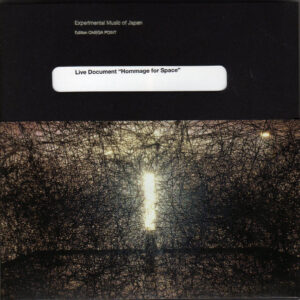
This is the live recording of the music performance held at the installation exhibition of Chiharu Shiota in the gallery of Kanagawa Kenmin Hall in Yokohama Japan last October. The performance was defined as Art Complex by Toshi Ichiyanagi from the music stand point of view. The content of music consists of live computer improvisation as well as some acoustic programed pieces by piano performance by Akiko Samukawa, Toshi Ichiyanagi and computer electronics by Tomomi Adachi to create the interpenetration of temporal and spacial situation in the gallery space. Morton Feldman “2 Pianos”. Toshi Ichiyanagi “Time Sequence”. Michal Kleofas Oginski - Toshi Ichiyanagi “Polonaise in A minor "ojczyzny"” Improvisation, Hommage for Space. Avec Akiko Samukawa, Toshi Ichiyanagi, piano and Tomomi Adachi, live electronics.
16,00€
In stock
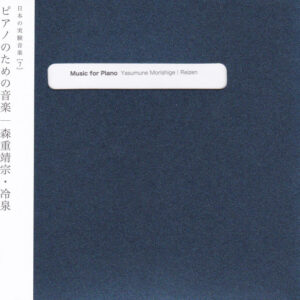
CD
Yasumune MORISHIGE – REIZEN
“Music for Piano”
This new recording is collaboration by Yasumune Morishige and Reizen. Yasumune Morishige is one of Japan’s most unique voices of the cello, improvising musician. His sound is not only hard edge and deep but also sensitive, however, he has played with other artists almost than solo. Reizen has acted as ambient unit Nerae until several years ago. He plays guitar drone now, and the sound was released on PSF and Fylkingen. In this recording, they played inside (and prepared) piano only. Especially Morishige’s solo piano play is extremely rare. Reizen’s sound is made from wires of piano vibrated by handy fan. All tracks consists of their solo playing. Recorded in March and October 2015.
200 copies.
16,00€
In stock
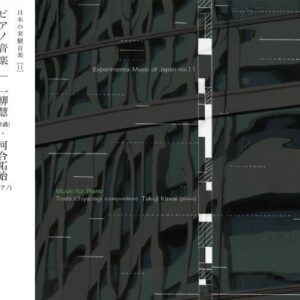
CD
Toshi ICHIYANAGI
“Music for piano (1959-1961)”
Experimental Music of Japan Vol. 11. The Music for Piano series was written under John Cage’s influence in his New York years. This CD is the premiere complete recording without simultaneous playing. The series was played and recorded by pianist Takuji Kawai at KEN in Tokyo in October 27, 2012. "Music for Piano No. 1-No. 7" was composed between 1959 and 1961. All the works were written using graphic notations (No. 1, No. 2, No. 5 and No. 6) and instructions (No. 3, No. 4 and No. 6). "This period of my compositions such as ’Music for Electric Metronomes,’ ’Stanzas for String Instrument,’ ’Duet for Piano and String Instrument,’ and ’Sapporo’ were all written by graphic notations, which expanded my idea of space in music in later compositions. The premiere of ’Music for Piano No.2’ took place in 1959, performed by David Tudor at Living Theatre in New York. No. 5 was by Yuji Takahashi, No. 4, No. 6 and No. 7 were by myself. This is the first time collecting all seven pieces played open to the public and recorded at the same time. Various techniques as well as different qualities of the sounds were created in an amazing manner by pianist Takuji Kawai through my graphic notations. He played all the noises and concrète sounds without using any electronic device but with live natural sounds only to reflect 1950s to early ’60s social situations." --Toshi Ichiyanagi
17,00€
Out of stock
CD
Toshi ICHIYANAGI
“Funakakushi” – Obscure Tape Music of Japan vol.17
“Funakakushi” (1963). This electronic work was composed for opening ceremony of hotel “Funakakushi-en” in Kagawa prefecture in 1963. It was realized like sound installation used many speakers built-in stone sculpture. They were designed by sculptor Mitsu-aki Sora (b. 1933) and were arranged here and there at main garden of the hotel. The sound was made from modified Japanese traditional instrument Biwa and sea wave sound. Engineer Junosuke Okuyama [3] assisted for electronic devices.
“Life Music (tape version)” (1964). Life Music was composed as tape version originally in 1964. After then, this work was played as another version with electronic modified orchestra (contact microphones were put on al instruments of the orchestra at Nissei Theatre in 1966. Junosuke Okuyama designed special effect machine named Electronics Sound Breaker (=ESB) for the concert. Kuniharu Akiyama, music critic, wrote about this machine on liner notes of “Orchestral Space” LP as follows, “…amplified sound of the orchestra was sent to some effect machines and ESB, and they were driven by tape version. Just then, electronic amplification was cut off synchronously by silent parts of the tape, and only non-effect live sound was played…”
“Life Music (tape version)” (1964). Life Music was composed as tape version originally in 1964. After then, this work was played as another version with electronic modified orchestra (contact microphones were put on al instruments of the orchestra at Nissei Theatre in 1966. Junosuke Okuyama designed special effect machine named Electronics Sound Breaker (=ESB) for the concert. Kuniharu Akiyama, music critic, wrote about this machine on liner notes of “Orchestral Space” LP as follows, “…amplified sound of the orchestra was sent to some effect machines and ESB, and they were driven by tape version. Just then, electronic amplification was cut off synchronously by silent parts of the tape, and only non-effect live sound was played…”
18,00€
In stock
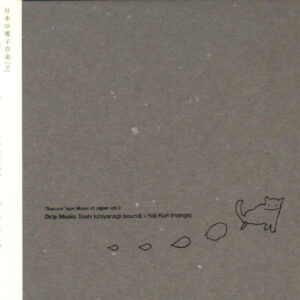
CD
Toshi ICHIYANAGI + Yoji KURI
“Drip music” – Obscure Tape Music of Japan vol.9
Toshi Ichiyanagi (sound) + Yoji Kuri (manga). Yoji Kuri is an experimental animation artist in Japan has acted since early 60’s. His name is well-known not only by many works full of ’black humour’ in 60’s-70’s, but also the sound materials were made by avant-garde composers (Toru Takemitsu, Yoko Ono, and others). This new edition is combined Ichiyanagi’s unpublished tape work (it was sleeping at Kuri’s studio 30 years) with Kuri’s written off fantastic manga work (16pp) inspired by the sound. In 1966, "Yabunirami no Concert" (manga book with 7" single) was published by Kuri privately. This "Drip Music" is similar style issue since then.
19,00€
Out of stock
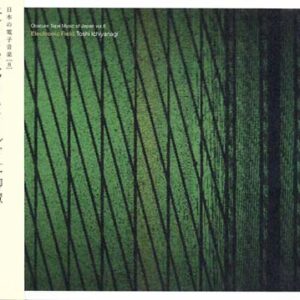
CD
Toshi ICHIYANAGI
“Electronic field”- Obscure Tape Music of Japan vol.8
This performance is a part of concert series “Japanese Experimental Music 1960’s” carried out at Art Tower Mito in Ibaraki. Toshi Ichiyanagi played improvisation on prepared piano and the sound was modulated by live-electronics. However he is a ’maestro’ of contemporary music now, his quite non-declined experimentalism is appeared by this great and deep sound. Also painter Sadamasa Motonaga (b.1922, a member of Gutai) projected abstruct figures to walls of the space. “Electronic Field” (1997).
18,00€
Out of stock
CD
Toshi ICHIYANAGI
“Music for Tinguely” – Obscure Tape Music of Japan vol.5
“Ichiyanagi is the best known composer for domestic and foreign avant-garde music fans. Especially in his brilliant 60’s, he made many great tape music. But most of them has not published on discs or issued for very small edition. This CD consists of his obscure three tape works. “Music for Tinguely” was made from junk objects of kinetic sculptor Jean Tinguely. “Appearance” is live electronic music. It’s not only premiere performance but also John Cage and David Tudor participated in performance. Very noisy and hard core!! “Music for Living Space” was composed for inner space of “Sun Tower” of World Expo in Osaka. Computer generated voice reads architect Kisyo Kurokawa’s manifest. Strange!!”
18,00€
Out of stock
CD
Toschi ICHIYANAGI
“Shikisokuzekuu-Kuusokuzeshiki – Obscure Tape Music of Japan vol.20”
“Shikisokuzekuu-Kuusokuzeshiki” (1964). “Extended Voices” (tape part, stereo version - 1967).
The details of “Shikisokuzekuu-Kuusokuzeshiki” are unknown except it was created at the NHK electronic music studio. According to Ichiyanagi, there are various discussions for the title, but it seemed to be eventually broadcasted on the radio with the title Kuu after a producer desired and decided to name it. At this time, the original title was used as following the initial intention of Ichiyanagi. In addition, short experimental film “Shikisokuzekuu” (1974) produced by a filmmaker Toshio Matsumoto where Ichiyanagi was also in charge of tape music was a different work so it does not have any relation with this music work.
Note: Shikisokuzekuu-Kuusokuzeshiki means “Form is exactly emptiness. Emptiness is exactly form.”
“Extended Voices” can be enjoyed by listening to the Columbia LP album “Extended Voices” with the collection of voices from the music works. A new version with mixing voices of baritone of Takashi Matsudaira to a monaural tape part was released by Omega Point in 2014, but since the stereo version was found later, it was added as a tape work without voice this time. It can be said that this is a completed work as an independent electronic music. (Provider of the tape recording: Gregor Meyer)
[Translated by Toshiyuki Kawata]
The details of “Shikisokuzekuu-Kuusokuzeshiki” are unknown except it was created at the NHK electronic music studio. According to Ichiyanagi, there are various discussions for the title, but it seemed to be eventually broadcasted on the radio with the title Kuu after a producer desired and decided to name it. At this time, the original title was used as following the initial intention of Ichiyanagi. In addition, short experimental film “Shikisokuzekuu” (1974) produced by a filmmaker Toshio Matsumoto where Ichiyanagi was also in charge of tape music was a different work so it does not have any relation with this music work.
Note: Shikisokuzekuu-Kuusokuzeshiki means “Form is exactly emptiness. Emptiness is exactly form.”
“Extended Voices” can be enjoyed by listening to the Columbia LP album “Extended Voices” with the collection of voices from the music works. A new version with mixing voices of baritone of Takashi Matsudaira to a monaural tape part was released by Omega Point in 2014, but since the stereo version was found later, it was added as a tape work without voice this time. It can be said that this is a completed work as an independent electronic music. (Provider of the tape recording: Gregor Meyer)
[Translated by Toshiyuki Kawata]
18,00€
Out of stock
CD
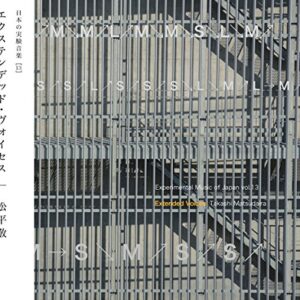
Takashi MATSUDAIRA
“Extended voices”
Experimental Music of Japan vol. 13.
Extended Voices, a compilation LP album released from Odyssey, a former section of Columbia Records, the U.S., contains works of “extended voices” offered by important authors of the experimental music circle including Pauline Oliveros, Morton Feldman, John Cage and Alvin Lucier [1]. As we had obtained the tape recording of Extended Voices composed by Toshi Ichiyanagi, a number consisting of electronic sounds and modulated voices which is contained in the album, we sought help from Takashi Matsudaira, a baritone singer, and worked on the realization of the piece in a different manner from the original version. By featuring this realization but also adding experimental pieces selected by Matsudaira as well as his own original work, we constructed “an anthology of extended voices” partially as homage to the original LP.
Toshi Ichiyanagi “Extended Voices” (new version
1). Toshi Ichiyanagi “Extended Voices” (new version
2). John Cage “Ryoanji”. Takashi Matsudaira “Shiroi Shojo”. Shigeru Matsui “ ” [partial] (realization by Takashi Matsudaira).
17,00€
Out of stock
CD
Somei SATOH
“Echoes” – Obscure Tape Music of Japan vol.18
“Emerald Tablet” (1978) was recorded at the NHK electronic-music studio in 1978. It is made up of only the sonic ingredients of a tubular bell, cymbals, and “Kin,” a largish-sized bell used for Buddhist memorial services in Japan. The attack of the sound of each instrument was eliminated, and the work was taped through repeated overdubbing. This produced a variety of beautiful harmonics that otherwise could not be produced from a single instrument’s sound, and the interference of harmonics created beats, generating a fantastical melody in the high tone range. Harmonics are one of the most mystic phenomena in the world. The wonder of harmonics led me to produce Emerald Tablet.
“Echoes” (1981) was composed for the “Mist, Sound, and Light Festival,” a 10-day event organized by the hot spring tourist association of Kawaji, Tochigi Prefecture, that was held on May 20-29, 1981. The venue was located at the Kawaji hot spring’s Ojika river valley, which was 50 meters wide and 200 meters long with an area of 7,000 square meters. Eight large loudspeakers were set up on hills surrounding the stream, with music played through an octuple channel-tape system. The combined length of cables connected with the loudspeakers exceeded one kilometers. The audience was amidst dense artificial mists spreading upward from the bottom of the valley, laser light beams projected on the hill surface, and tape music that played in extremely low tone at full blast, echoing in the valley. Echoes consists of the sonic ingredients of the three types of percussion instruments used in Emerald Tablet as well as my own voice. - Somei Satoh
Somei Satoh. Born in Sendai, 1947, composer. He began teaching himself western music and exploring experimental music at the age of eighteen. Since the late 1960s, he has presented several multimedia works. He subsequently spent a year in New York with an invitation from the Asian Cultural Council. Satoh’s works have been widely performed in USA, European countries and many countries in the Pacific basin. His other electronic works are Mandara, Mantra and Tantra.
“Echoes” (1981) was composed for the “Mist, Sound, and Light Festival,” a 10-day event organized by the hot spring tourist association of Kawaji, Tochigi Prefecture, that was held on May 20-29, 1981. The venue was located at the Kawaji hot spring’s Ojika river valley, which was 50 meters wide and 200 meters long with an area of 7,000 square meters. Eight large loudspeakers were set up on hills surrounding the stream, with music played through an octuple channel-tape system. The combined length of cables connected with the loudspeakers exceeded one kilometers. The audience was amidst dense artificial mists spreading upward from the bottom of the valley, laser light beams projected on the hill surface, and tape music that played in extremely low tone at full blast, echoing in the valley. Echoes consists of the sonic ingredients of the three types of percussion instruments used in Emerald Tablet as well as my own voice. - Somei Satoh
Somei Satoh. Born in Sendai, 1947, composer. He began teaching himself western music and exploring experimental music at the age of eighteen. Since the late 1960s, he has presented several multimedia works. He subsequently spent a year in New York with an invitation from the Asian Cultural Council. Satoh’s works have been widely performed in USA, European countries and many countries in the Pacific basin. His other electronic works are Mandara, Mantra and Tantra.
18,00€
Out of stock
CD
Mamoru FUJIEDA
“Radiated falling” – Obscure Tape Music of Japan vol.11
“Both “Radiated Falling” (1980) and “The Art of Fugue” (1981) are tape compositions in which sound materials of a prepared piano are electronically processed and modulated in various ways. “Radiated Falling” is based on “Falling Scale No.2 for piano” (1975). The sound materials were then transformed to layered sonic textures through the ring modulator, the phase shifter, the harmonizer, and various delay processes.
“The Art of Fugue” is based on a simple fugue in four voices from the first piece in The Art of Fugue by J. S. Bach. The four voices were randomly cut into fragments, which were then reassembled to form four new voices. Each of the voices played by a differently prepared piano was recorded in a multi-track recorder to produce sound materials for the piece. The sound materials of the prepared piano was then electronically modulated and spatially processed.” - from liner note
“The Art of Fugue” is based on a simple fugue in four voices from the first piece in The Art of Fugue by J. S. Bach. The four voices were randomly cut into fragments, which were then reassembled to form four new voices. Each of the voices played by a differently prepared piano was recorded in a multi-track recorder to produce sound materials for the piece. The sound materials of the prepared piano was then electronically modulated and spatially processed.” - from liner note
18,00€
Out of stock
CD
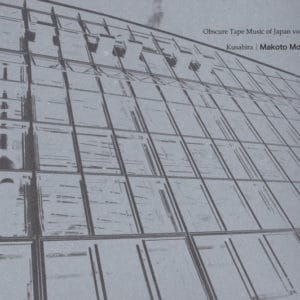
Makoto MOROI
“Kusabira” – Obscure Tape Music of Japan vol.13
Obscure tape music of japan vol.13. One of pioneers of japanese electronic music makoto moroi composed “kusabira” for kyogen (traditional comical theater) with electronic sound in 1964. ’kusabira’ means mushroom. a strolling buddhist monk ’yamabushi’ tried to exterminate many mushrooms grew out in garden of a man’s home. however and his magic did not take effect for them but also the mushrooms began to increase. the man and yamabushi were driven out of home by large mushroom finally. in this work and moroi modulated kyogen lines into concrete sound. it’s so noisy and strange! This cd also includes moroi’s important work used japanese traditional instruments. the thought of this work was based on alvin toffler’s “future shock” and was composed as spacephonic music by 4-channel recording system for great player susumu miyashita. he played various kinds of koto, gongs and percussions and indian flute bansuries. sharpness of the performance is so wonderful and also some human voices transformed noise sound are inserted on middle part of this work. both works are most avant-garde of moroi’s works!!
17,50€
Out of stock
CD
Makoto MOROI-Kuniharu AKIYAMA
“Music drama Akai Mayu” – Obscure Tape Music of Japan vol.3
Back in stock. “Akai Mayu” is a short fiction of Koubou Abe (1924-1993). This music drama version was broadcasted by NHK in 1960. Makoto Moroi is a pioneer of Japanese electronic music, and he composed the music used chamber ensemble, mixed chorus and electronic sound on this work. Also this work was performed at Sogetsu Art Center as a part of concert program of Moroi’s works. This different version included a pantomaime by Mamako Yoneyama, abstract image projection and stage setting by Hiroshi Manabe. Also in this concert, Kuniharu Akiyama (about his name, please see note of CD “Music for Puppet Theatre of HITOMI-ZA”) performed his work “Arcana 19”. This work was consisted of text, object sounds, piano and pre-recorded tapes. On this CD includes only some tape parts because live recording source of this performance was lost. Makoto Moroi (music) + Koubou Abe (text) “Akai Mayu” (1960), Kuniharu Akiyama “Arcana 19 (excerpt)” (1960).
18,00€
Out of stock
CD
Kuniharu AKIYAMA
“Tape works-Obscure tape music of Japan vol.6”
Obscure tape music of Japan vol.6. “Kuniharu Akiyama (1929-1996) was well-known as a music critic mainly modern and contemporary. However, his carrier was not only in music field but also was very expanded avant-garde art (especially he related early Fluxus movement). This issue is consisted his three obscure tape music, sound sculpture “Environmental mechanical orchestra” for exhibition, “Demonstration for opening event of Nissei Theater” and unknown work “Music for H.Bomb”.
17,50€
Out of stock
CD
Kuniharu AKIYAMA
“Environmental Music for Dining Room of Athletes’ Village in Tokyo Olympics 1964”
From participation in the early Fluxus to giving an introduction of Futurism, Kuniharu Akiyama (1929-1996), a renowned music critic, was involved in a vast range of activities. Particularly in the 1960s, he recorded a lot of music on tape for himself. To our surprise, the music compiled on this CD was actually discovered from a series of ambient music pieces played in the Athletes’ Village at the Tokyo Olympics! During this period, Akiyama was fascinated by the sound of Sanukite stone from Sanuki, Shikoku island and he composed several ambient music pieces including this one. Despite the detail of the work have been unknown as the composer was already passed away, a guru of electronic musicologist, Koji Kawasaki, managed to reveal everything behind the piece.
About the Works
On this CD, there are two pieces of ambient music, which were composed by Kuniharu Akiyama for the Tokyo Olympics in October 1964. This music was composed with the sound of stones for a pair of stone speakers. To understand how it was developed, we have to go back almost two years from then. Around mid January in 1963, Kuniharu Akiyama was asked to compose Ishi no Uta (Song of Stone) for a TBS’s TV program. It is said that Akiyama was interested in Aji Village, Takamatsu city through a relationship with the sculptor Masayuki Nagare. This village is known for its over hundred-year tradition of granite quarrying. Akiyama planned to compose the piece only by using stones and to do so he decided to visit Aji Village in late January.
At a dinner organized by Masanori Kaneko, the Kagawa Prefecture Governor, Akiyama found out that a beautiful “tone-stone” could be mined at Takamatsu. Akiyama then went to Takamatsu with Mitsuaki Sora, Nagare’s assistant and CEO of the Okada Stone Industry. Akiyama later recalled the moment when he encountered the Sanukite stone, “I was deeply moved when I hit the natural stones of various sizes that had not been modified by artificial elements. Clear beautiful sounds with amazingly long sustain. Each stone had a different tone. Sharp and very powerful. To be honest, I never had thought that stones could have such a beautiful, strong and sharp tone.”
From 1961, under the direction of the architect, Kunio Maekawa, Okada Stone had worked on a project to produce an exterior wall in stonemasonry style for the Japan Pavilion at the New York World Expo held in April 1964. To check its quality, a prototype was supposed to be displayed at a certain space in Takamatsu city. This location became a project of collaborative work and was finally used as a café. A collective formed by an architect Tadashi Yamamoto for construction design, Sora for facade and interior design, Akiyama for music and Junosuke Okuyama, an engineer of Sogetsu Art Center, for in-store sound design, worked on each assignment and the café “Shiro no Me (Eye of the castle)” was opened.
Two huge stone speakers were installed on the left and right side of the entrance to the café. These speakers were invented by Okuyama and produced by Okada Stone. “Enjoy our speaker system that makes it possible to play music in the most musical quality. As only ‘pure sound’ will be projected, the sound is superb” was written on a flyer at the opening of the café. This became possible because all vibration except for the paper speaker cone can be suppressed to the utmost limit by the weight of the stone.
In Sogetsu Studio, Akiyama used the sound of stones as material and composed an ambient music piece called Shiro no Me; Music for Coffee House No.1 for these speakers. This piece was assumed to be created by adding reverberation components to an improvisational performance with Sanukite and slowing down the playback to approximately one-half speed. This very primitive technique was chosen to take a full advantage of the beauty of Sanukite sound.
About one year and a half later, for the Tokyo Olympics held in October 1964, two large dining halls called “Sakura” and “Fuji” were built in the male section of the Yoyogi Athletes' Village by architect Kiyonori Kikutake. It is said that while Akiyama composed an ambient music piece called “Music for eating” they decided to transport the stone speakers from the café “Shiro no Me” to the Fuji hall. Also in the front garden of the Fuji hall, an ambient piece called Music for resting was played. Both pieces, which were in the similar composition style of Music for Coffee House, were recorded at Sogetsu Studio.
In 1965, Akiyama argued, “the purpose of designed music is non other than promoting the composer’s work, who designs music creatively, in a living environment. (omission) The composer would also have to participate in urban planning along with the architects and the artists. As we all know, it is because the composer himself/herself has also a role to dramatically shape a living space for today and tomorrow”. The compositions compiled on this CD can be considered as a practice of Akiyama’s assertion as well as a valuable innovation to the Japanese ambient music scene.” Koji Kawasaki (electronic musicologist)
[English translation by Toshiyuki Kawata]
About the Works
On this CD, there are two pieces of ambient music, which were composed by Kuniharu Akiyama for the Tokyo Olympics in October 1964. This music was composed with the sound of stones for a pair of stone speakers. To understand how it was developed, we have to go back almost two years from then. Around mid January in 1963, Kuniharu Akiyama was asked to compose Ishi no Uta (Song of Stone) for a TBS’s TV program. It is said that Akiyama was interested in Aji Village, Takamatsu city through a relationship with the sculptor Masayuki Nagare. This village is known for its over hundred-year tradition of granite quarrying. Akiyama planned to compose the piece only by using stones and to do so he decided to visit Aji Village in late January.
At a dinner organized by Masanori Kaneko, the Kagawa Prefecture Governor, Akiyama found out that a beautiful “tone-stone” could be mined at Takamatsu. Akiyama then went to Takamatsu with Mitsuaki Sora, Nagare’s assistant and CEO of the Okada Stone Industry. Akiyama later recalled the moment when he encountered the Sanukite stone, “I was deeply moved when I hit the natural stones of various sizes that had not been modified by artificial elements. Clear beautiful sounds with amazingly long sustain. Each stone had a different tone. Sharp and very powerful. To be honest, I never had thought that stones could have such a beautiful, strong and sharp tone.”
From 1961, under the direction of the architect, Kunio Maekawa, Okada Stone had worked on a project to produce an exterior wall in stonemasonry style for the Japan Pavilion at the New York World Expo held in April 1964. To check its quality, a prototype was supposed to be displayed at a certain space in Takamatsu city. This location became a project of collaborative work and was finally used as a café. A collective formed by an architect Tadashi Yamamoto for construction design, Sora for facade and interior design, Akiyama for music and Junosuke Okuyama, an engineer of Sogetsu Art Center, for in-store sound design, worked on each assignment and the café “Shiro no Me (Eye of the castle)” was opened.
Two huge stone speakers were installed on the left and right side of the entrance to the café. These speakers were invented by Okuyama and produced by Okada Stone. “Enjoy our speaker system that makes it possible to play music in the most musical quality. As only ‘pure sound’ will be projected, the sound is superb” was written on a flyer at the opening of the café. This became possible because all vibration except for the paper speaker cone can be suppressed to the utmost limit by the weight of the stone.
In Sogetsu Studio, Akiyama used the sound of stones as material and composed an ambient music piece called Shiro no Me; Music for Coffee House No.1 for these speakers. This piece was assumed to be created by adding reverberation components to an improvisational performance with Sanukite and slowing down the playback to approximately one-half speed. This very primitive technique was chosen to take a full advantage of the beauty of Sanukite sound.
About one year and a half later, for the Tokyo Olympics held in October 1964, two large dining halls called “Sakura” and “Fuji” were built in the male section of the Yoyogi Athletes' Village by architect Kiyonori Kikutake. It is said that while Akiyama composed an ambient music piece called “Music for eating” they decided to transport the stone speakers from the café “Shiro no Me” to the Fuji hall. Also in the front garden of the Fuji hall, an ambient piece called Music for resting was played. Both pieces, which were in the similar composition style of Music for Coffee House, were recorded at Sogetsu Studio.
In 1965, Akiyama argued, “the purpose of designed music is non other than promoting the composer’s work, who designs music creatively, in a living environment. (omission) The composer would also have to participate in urban planning along with the architects and the artists. As we all know, it is because the composer himself/herself has also a role to dramatically shape a living space for today and tomorrow”. The compositions compiled on this CD can be considered as a practice of Akiyama’s assertion as well as a valuable innovation to the Japanese ambient music scene.” Koji Kawasaki (electronic musicologist)
[English translation by Toshiyuki Kawata]
18,00€
Out of stock
CD
Kenichi KANAZAWA
“Solo performance”
Kenichi Kanazawa is a sculptor. He cuts and assembles thick iron plate pieces, and also he remarked the sound of the iron pieces. This CD is live recording of performance at his recent retrospective exhibition in 2011. Oto no Kakera (= Fragments of Sound) was laid by clue that I participated in an exhibition ’Sound Garden’ in 1987. An idea occurred for the work of the exhibition. I cut thick steel plate as like pieces of jigsaw puzzle on theme of relationship of iron, figure and sound. I attacked the pieces by sticks, and then I experienced listening their sounds first. Various pitches, tones and resonances of sounds were made from area and shape of each pieces. They extended world of iron sound richly.
In the ’Sound Garden’ exhibition, artists had to do any performance. I believe it was beginning of Oto no Kakera performance. This CD is recording of performance in exhibition ’Kenichi Kanazawa, iron as a starting point 1982-2011’. - from liner note
track 1: starting by Vibratile Shape - Circle and Square.
track 2: improvisation on Oto no Kakera 5 object.
track 3: I emphasized specific frequencies of sound through bamboo pipe, and I sounded by falling and rolling various materials on Oto no Kakera.
track 4: steel wire vibration on Vibratile Shape - Square.
track 5: rubbing an iron piece by iron bar.
track 6: high tone by hummer attack on iron piece.
track 7: preparation effect by various materials on Oto no Kakera.
In the ’Sound Garden’ exhibition, artists had to do any performance. I believe it was beginning of Oto no Kakera performance. This CD is recording of performance in exhibition ’Kenichi Kanazawa, iron as a starting point 1982-2011’. - from liner note
track 1: starting by Vibratile Shape - Circle and Square.
track 2: improvisation on Oto no Kakera 5 object.
track 3: I emphasized specific frequencies of sound through bamboo pipe, and I sounded by falling and rolling various materials on Oto no Kakera.
track 4: steel wire vibration on Vibratile Shape - Square.
track 5: rubbing an iron piece by iron bar.
track 6: high tone by hummer attack on iron piece.
track 7: preparation effect by various materials on Oto no Kakera.
16,00€
Out of stock
CD
Kenichi KANAZAWA – Shinjiro YAMAGUCHI – Hiroyuki URA
“Fragments of sound, figure of music”
Experimental Music of Japan vol. 9. Kenichi Kanazawa is a sculptor. He cuts and assembles thick iron plate pieces, and also he remarked the sound of the iron pieces. This CD is live recording of performance with young musicians, Hiroyuki Ura and Shinjiro Yamaguchi in 2010. This performance consisted of some fragments, and Yamaguchi planned detail of them. According to his explanation, he tried to catch invisible figure of music through composition by simple rule and style.
track 1: solo performance used self-made steel triangle instrument by Kanazawa.
track 2: each player plays sound 1 time at first 1 minute, plays 2 times at next 2 minutes, and it’s continued until 12 minutes.
track 3: performance used five kinds of plate sculptures. they performed on the rule that each 2 members must not play in same time.
track 4: drumming and rubbing of Oto no Kakera 9 with electronic noise.
track 5: solo performance by Oto no Kakera 9.
track 6: drone sound performance used Vibratile shape - circle 1200 and Vibratile Shape - Square 1200.
track 7: improvisation used Oto no Kakera 9 determined to finish with succession attack by all players.
track 1: solo performance used self-made steel triangle instrument by Kanazawa.
track 2: each player plays sound 1 time at first 1 minute, plays 2 times at next 2 minutes, and it’s continued until 12 minutes.
track 3: performance used five kinds of plate sculptures. they performed on the rule that each 2 members must not play in same time.
track 4: drumming and rubbing of Oto no Kakera 9 with electronic noise.
track 5: solo performance by Oto no Kakera 9.
track 6: drone sound performance used Vibratile shape - circle 1200 and Vibratile Shape - Square 1200.
track 7: improvisation used Oto no Kakera 9 determined to finish with succession attack by all players.
16,00€
Out of stock
CD
Kazuya ISHIGAMI
“Hosshin no Kizashi”
Experimental Music of Japan vol.5. However sound performer Kazuya Ishigami studied at academy of music in Japan and France, he also acts as noise/improvisation unit “Billy” and “Daruin” since 1997. This CD consists of recent 2 works of “Acousmatic electronic music”. I think many works of this style are bored for electronic music fan because they are so academic and confines in the style. But Ishigami’s sound brought from his wide activities and imaginations are so exiting and cool. - OP.
“Hosshin no Kizashi” is a work composed based on the theme “Pray” that the priest of buddhist temple Senkoji (in Osaka) presented.
Hosshin: Meaning of “Departure bodhi mind”. “Hosshin no Kizashi” is a meaning of this side of “Departure bodhi mind” one step. That is, it means there is still a hesitation. “Otokamui no Sasayaki” (Whisper of sound god); “Oto” means “sound” in Japanese. “Kamui” means “god” in Ainu.
Profile of artist: Kazuya Ishigami. Born in 1972, in Osaka. Sound performer, composer and sound engineer. He was graduated from Osaka University Of Arts in 1994. He composed his pieces in INA-GRM in August 1997. His Radiophonic work “Sonic Escapism”, “2nd 49” and “Whisper of Sound God” were broadcasted from Deutschlandradio In 2005-2008. - excerpt from liner note
“Hosshin no Kizashi” is a work composed based on the theme “Pray” that the priest of buddhist temple Senkoji (in Osaka) presented.
Hosshin: Meaning of “Departure bodhi mind”. “Hosshin no Kizashi” is a meaning of this side of “Departure bodhi mind” one step. That is, it means there is still a hesitation. “Otokamui no Sasayaki” (Whisper of sound god); “Oto” means “sound” in Japanese. “Kamui” means “god” in Ainu.
Profile of artist: Kazuya Ishigami. Born in 1972, in Osaka. Sound performer, composer and sound engineer. He was graduated from Osaka University Of Arts in 1994. He composed his pieces in INA-GRM in August 1997. His Radiophonic work “Sonic Escapism”, “2nd 49” and “Whisper of Sound God” were broadcasted from Deutschlandradio In 2005-2008. - excerpt from liner note
17,00€
In stock
CD
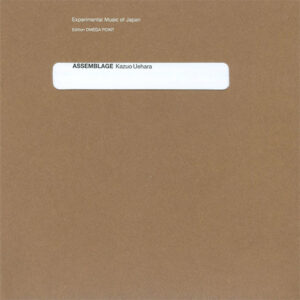
Kazuo UEHARA
“Assemblage”
Experimental Music of Japan vol.8. “Music Collage Re-Mix version” (1989-2010), “Pont de l’Alma de Paris” (1998), “OTO Mandala 2” (2009), “Sound Work 1” (1983), “Forest of Gombe” (2005), “Assemblage 2004” (2004), “Meteora version 1.0” (2007). Assemblage is a word from domain of modern art. This is the one of the technique of expression of art. The word means mixture originally. I decide the assemblage as a concept of this CD. The collage by Picasso is similar example. Dadaism is also similar example. I try to express new direction of music by using assemblage technique. Profile of artist : Kazuo Uehara was born in Osaka in 1949. He studied composition in Tokyo and in New York. He is an Professor of Music at the Osaka University of Arts. He gives courses on composition, experimental music and also multi-media performance at the university. His music has been performed in France, Germany, U.S.A., and other countries. He also performed his interactive live music and multi-media pieces at major festivals in Sweden, Bulgalia, Russia, France, Poland, Brasil, China, Korea and other countries. He is the prize winner of Bourge International Electro-acoustic Music competition. In 1990, he was awarded the grant from the New York State Council on the Arts. He had been producing the International Festival for Contemporary Music in Japan from1980s.
17,00€