
In stock
CD
Michel DONEDA – Tetsu SAÏTOH
“Spring road 01”
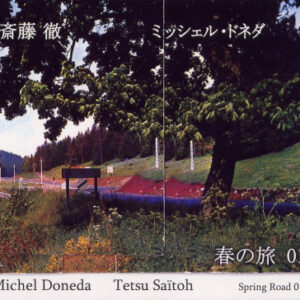
2001. Michel Doneda, soprano and sopranino saxophones. Tetsu Saïtoh bass, harmonium, Korean gong… “Saturday June 2nd”, "Lettres de Rodez", letters from Antonin Artaud lead us through the town of Rodez, with the Théatre2 l’Acte - Rodez Cathedral featuring Michel Mathieu, Chantal Riotte and Nadia Mouëza. “Wednesday June 6th”, small library in the suburbs of Blois with the children of the projects. “Sunday June 3rd”, Nightfall on the Île de Lavoule featuring the Théatre2 l’Acte. “Thursday June 7th” concert at the festival "les Improbables" - Horlieu - Lyon. “Tuesday May 28th”, an afternoon in the Alps near Gérald’s house, featuring Gérald Zbinden on guitar and Shunichiro Hisada on kotsuzumi and voice. “Saturday June 2nd”, concert at the Chapelle Royale - Rodez dedicated to Marie-Thérèse. Recorded on the Spring Road tour 10 May - 8 June 2001. Post card collage by Michel Doneda.
13,00€
Out of stock

CD
JOHANSSON – DELIUS – TAKASE – RODER
“Tune up”
Tobias Delius, tenorsaxophone. Sven-Åke Johansson, drums. Jan Roder, double bass. Aki Takase, piano. Recorded in 2011.
17,00€
In stock
CD
Norbert EISBRENNER – Conrad SCHNITZLER – Sven-Ake JOHANSSON
“Mariental tapes”
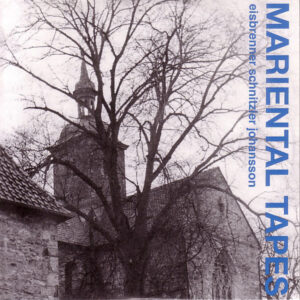
Norbert Eisbrenner, electric guitar. Conrad Schnitzler, analog synth. Sven-Ake Johansson, percussion. Incredible recording from 1970.
17,00€
In stock
CD
Andrew LAFKAS
“1+1=year zero (water-moon)”
Jason Brogan, electric guitar. Adam Diller, bass clarinet. Tucker Dulin, trombone. Sean Meehan, percussion. Ron Stabinsky, piano. Leif Sundstrom, percussion. Karen Waltuch, viola. Barry Weisblat, radio. Andrew Lafkas, bass. Composed by Andrew Lafkas, recorded in concert, Brooklyn, NY, May 2013. Glass mastered CD in digipack, edition of 150.
12,00€
In stock
CD
MURAL
“Live at the Rothko Chapel”
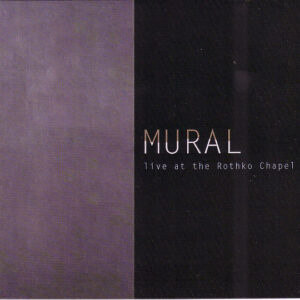
“Mural’s lush and inviting sound-world incorporates a wide range of percussive, harmonic, and timbral effects and suggests the vastness and mystery of time, as do Rothko’s paintings. With Jim Denley on flute and saxophone, Kim Myhr on acoustic guitar, and Ingar Zach on percussion, the trio created a site-specific and improvisational work relating to, and inspired by, the Rothko murals in the Chapel. Recorded at the Rothko Chapel, March 4, 2010.”
16,00€
In stock

CD
eRikm
“Stème”
“Between his reputation as swift shifting improviser, concréte composer and turntable deconstructionist, Marseilles based artist eRikm has earned himself an enviable position in the European music community. With Stéme, his most ambitious and fully realised compositional work to date, he devolves and recontextualises the boundaries between sound source and sound media. In essence, Stème originates from a selection of ten one minute long sound pieces burned on a cd which was deliberately damaged. These media (music on modified media or field recording) formed the basis of multiple improvised session including multiple stages of construction and destruction of these acoustic matters using my different electronic real time live music systems (3k-pad system & md or cd-dj and electronics). The resulting sounds are truly distinctive - filigree like sonic details are brought into sharp focus, tuning the ears with their paced spatial movements. Occasional grabs of the source sound material appear and are erased equally as quickly. A genuinely powerful statement of compositional intent. eRikm has instinctively followed a relatively unusual, even risky, career path. Stemming from his interest in visual arts and his first musical experience as a rock guitarist, he has for some years now become steadily more and more renowned for his virtuoso turntabling and his use of electronic instruments and tools in an integrated scenic set-up eRikm has followed up musical collaborations with Voice Crack, Christian Marclay, Luc Ferrari, among others. He is certainly one of the better equipped artists of the new generation to actually demonstrate a relationship between rock music (in its widest sense) and contemporary music; hiding behind neither cultural camouflage nor an easy pandering to his audience. Note! Copies ordered direct from ROOM40 include a special 12 page fold out score edition from eRikm. An elegant flow chart of opportunity, chance and compositional choice.”
12,00€
In stock
CD
eRikm (Luc FERRARI) & Thomas LEHN
“Les protorythmiques”
This recording is taken from a live concert which took place at the Musique Action Festival in France on Thursday the 26 of May 2005. Initially Luc Ferrari and eRikm were invited to present Les Protorythmiques" at Musique Action 2005, a work composed around a new ’open working process’ in which sounds and compositional parts could be substituted and transformed in an almost improvisational setting, this however was not to pass due to Luc Ferrari’s health, at which point Thomas Lehn was invited to join erik.m in the concert setting. The resulting performance saw erik.m utilise a range of audio samples, sounds and ’musique concrete’ he had developed with Luc Ferrari whilst working on "Les Archives Sauvées Des Eaux", and Thomas Lehn invigorating the electro-acoustic palette and musical texture with his analogue synthesizer. eRikm - CDs, Concréte - Luc Ferrari - Concréte sound - Thomas Lehn - Synthi A" (label info)
12,00€
Out of stock
CD
Chris ABRAHAMS
“Memory night”
Chris Abrahams’ Memory Night is his third edition for Room40 - Play Scar and Thrown preceding this album. Widely recognised as the pianist for Australian liminal improvisation trio The Necks, Chris Abrahams’ solo work etches out an entirely different universe. It’s a place that is entirely his own, unashamedly unique and at times startling - yet always alluring.
On Memory Night, Abrahams’ expands his sonic palette, building on the uneasy frontiers of the highly regarded Play Scar. Never content to revisit past glories, Abrahams’ charts course into unfamiliar sound spaces, where electronics and instruments meet in a constant state of tension and release. Nothing is quite what it appears upon first listen and as a result Memory Night demands an attentive ear.
Recorded across 2011 and 2012, Memory Night is a haunted series of compositions that provoke and compel. Chris Abrahams has created what can only be described as a profound rendering of contemporary composition - a powerful, yet delicate evocation of sound, where instruments and electronics melt and are reformed.
12,00€
In stock
CD
Chris ABRAHAMS
“Fluid to the influence”
Chris Abrahams returns in 2016 with a new edition for Room40, Fluid To The Influence. Building upon the foundation of his previous three editions, Abrahams charts out a divergent course through lilting piano flows, distended organ passages, thunderous electronic eruptions and focused concréte explorations. Fluid To The Influence spans a huge spectrum of sound, each movement calling forward to the next in a flowing motion that demonstrates Abrahams’ commitment to and interest in the album as an artistic form.
Known widely for his piano work with post-everything trio The Necks, Abrahams output as a composer orbits an otherly sonic sphere. Piano is just one element he draws upon, creating a deliberately expansive sound field within which the listener is invited to become lost. He is one of the most significant voices in Australian music, and arguably one of the most restless and original artists creating work today.
13,00€
In stock
CD
AF URSIN
“Murrille”
A long overdue CD edition of Timo van Luijk’s first full-length album, originally released in 2002 as a small private edition LP on La Scie Dorée (Belgium). “Murrille” features a collection of extraordinary “songs” integrating a palette of acoustic instruments such as glass harmonium, flute, hand percussion, as well as voice with real time synthesis. With a host of bizarre inflections and aural investigations, Van Luijk’s music recalls some of the of the great experimentation of early krautrock, otherworldly atmospheres of the infamous Futura label, and a pure love of the moments when it all just falls into place. This newly remastered edition sounds fantastic and includes an additional track not included on the original LP release. Mixed by Christoph Heemann. Packaged in a Japanese style tip-on mini jacket that carefully reproduces the original album artwork.
18,00€
In stock

CD
ORGANUM
“Sanctus”
The first album in a trilogy of new material, Sanctus represents the new architecture of the Organum sound. Recorded utilizing an implicit graphic score, the album is comprised of four discrete parts, each a variant of the others. These are not parts as in a movement or continuation of the composition, but rather four distinct audio canvases that represent a continuum of the elements at large. Composed in the spirit of the early Organum material, David Jackman has resurrected the droned-based, percussive turbulence of earlier years with a distinct new form of compositional systems. These new systems are scored for grand piano, Hammond organ, tower bell, and gong. While each element retains its distinct acoustic quality, the whole of each piece resonates the art of its totality. The results convey an ecstatic sense of presence, vast expanse, and, ultimately, infinitude.
18,00€
In stock

CD
Luc FERRARI
“Archives génétiquement modifiées. Société II”
Archives Génétiquement Modifiées (2000). Société II (1967). Robot Records is honored and pleased to present two historic compositions for the first time on CD by the late, great Luc Ferrari. The programme opens with "Archives Génétiquement Modifiées" (Genetically Modified Archives), a work for "memorized sounds" from 2000. This composition (subtitled: Exploitation of the Concepts 3) was the third in a series of later pieces in which Mr.Ferrari revisited aspects of his early concepts and compositional strategies to create wholly new works. The result here is a very bizarre, sensual, and beautifully-paced electroacoustic work of aural memories and (re)collections created by Mr. Ferrari utilizing sounds from his vast archive of musical activities. After a short intermission, the programme continues with a true highlight of Mr.Ferrari’s early instrumental work entitled "Société 2" from 1968. Subtitled "And if the piano were a body of a woman" (for 4 soloists and 16 instruments), this composition appeared opposite "Presque Rien" on the legendary Deutsche Grammophon LP. "Société 2" may be viewed as an erotically charged piece of musical theatre where the soloists "compete" for the attention of a woman (the piano). This concerto with its gestures and a fantastic kaleidoscope of styles and color shows the extravagant qualities of the piano in its "harmony, imagination, and brutality". Packaged in a full color digipak with 20 page bilingual booklet featuring Mr. Ferrari’s early artwork, notations, and programme notes along with an extensive commentary by Jim O’Rourke and Jay Sanders. Remastered sound with audio restoration by fellow INA GRM alumnus Jean Schwarz. A wonderful glimpse into the world of one of the most legendary, unique, and inspiring musical figures of the 20th Century.
15,00€
In stock
CD
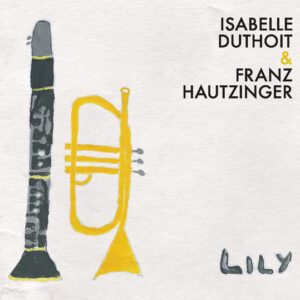
Isabelle DUTHOIT & Franz HAUTZINGER
“Lily”
Recorded March 12th, 2015 at Park West Studios, Brooklyn. Recorded, mixed, and mastered by Jim Clouse. Bill Houston recorded the Live at Philly track Crossroads Music, Philadelphia on March 21, 2015.
“Featuring Isabelle Duthoit on clarinet & vocal and Franz Hautzinger on trumpet. This duo has been active for a few years and has played in New York on several occasions. They were here a few weeks ago (early May of 2017) and have been garnering accolades from those of us who savor the more extreme sounds of extended experimentation. Although Ms. Duthoit can be found on a few recordings with Georg Graewe, Johannes Bauer and Luc Ex, there is quite a buzz about her unique vocal abilities. Microtonal trumpeter, Franz Hautzinger, has been around longer and has recorded with: Derek Bailey, Keith Rowe, Otomo Yoshihide and is a member of the Zeitkratzer ensemble. ‘Lily’ is a studio date, all the sounds closely mic’d with extreme attention to detail. Since both of these musicians work in extended techniques, it is often hard to tell who is doing what. Breathy vocal sounds or radiator-like hissing from the trumpet? What is the difference? If you are a fan of the Erstwhile or Another Timbre labels, this disc is for you. Ms. Duthoit also plays clarinet although it is also hard to tell what is being played or manipulated. Ms. Duthoit is a master of altering her voice and twisting it into an array of odd shapes and weird sounds. Ghost-like, disembodied vocals, whispers, sometimes scary and often mesmerizing is what she specializes in. I have listened to much lower case (quieter, focused) improvisations in a while so it was indeed wonderful to sit back and listen closely to this outstanding excursion. The Relative Pitch label remains on the cutting edge of sonic explorations. You best check this gem out as it is one of this month’s most eagerly awaited items”. - Bruce Lee Gallanter, Downtown Music Gallery
14,00€
In stock
CD
AKERLUND – TOEPLITZ
“Inert-e”
Lars Akerlund : electronics. Kasper T. Toeplitz : bass & electronics.
After years of navigating in similar musical idioms - somewhere between noise, contemporary or experimental music - using as well traditional instruments that electronic or digital devices - Lars used to be a classical guitarist, Kasper composed many orchestral or ensemble pieces, now both work a lot on their computers - and having worked with the same musicians, such as Dror Feiler or Zbigniew Karkowski, among others, Those two musicians met during the summer of 2013 in Paris, at the GRM studios to create their INERT/E project, made of an organic accumulation of complex structures, an architecture of an electronic nature, made of different temporalities, with apparently no causalities, and in very slow, almost static, evolution - an electronic ecosystem.
A CD of two long tracks : 1. Les masses sont l’inertie, la puissance du neutre
and
2. To Describe the overwhelming life of a tropical forest just in terms of inert biochemistry and DNA didn’t seem to give a very full picture of the world.
8,00€
Out of stock
CD
Kasper T. TOEPLITZ
“Gris”
Music for live electronics, bass and lithophone. Played by Kasper T. Toeplitz (composition, live-electronics, bass) and Philippe Foch (lithophone). This music was written (and played live) for the dance piece named “GRIS” choreographed by Myriam Gourfink. Immobility by Margot Dorleans, Carole Garriga, Deborah Lary and Véronique Weil.
14,00€
Out of stock
CD
Kasper T. TOEPLITZ
“DATA_Noise”
Kasper T. Toeplitz, live electronics, generative video, lights. Myriam Gourfink, stillness.
Electronic composition played live by Kasper T. Toeplitz and Myriam Gourfink. Noise and stillness. Also generative video, and the noise of circulating data.
What it is not : DATA_Noise is certainly not a dance piece with musical accompaniment, using some sort of the so-called “new technology” - sensors, computers - to be more “modern”. DATA_Noise is a musical project, a composition written for synthesized electronic sounds, and meant to be played live, using the computer as the main instrument which creates by many means such as different synthesis or transformation techniques (scanned, granular, wave- terrain synthesis, waveshaping etc...). One of those techniques will be the use of a dancer, performing an extremely slow dance (of an entierely written choregraphy), and whose minimal movements, as seen by different sensors, will have a disruptive function on the behavior of the music-making computer - a way to introduce some “noise” in this very often too precise a machine, a way to maybe re-introduce some of the noisiness of the world into this electronic composition.
Electronic composition played live by Kasper T. Toeplitz and Myriam Gourfink. Noise and stillness. Also generative video, and the noise of circulating data.
What it is not : DATA_Noise is certainly not a dance piece with musical accompaniment, using some sort of the so-called “new technology” - sensors, computers - to be more “modern”. DATA_Noise is a musical project, a composition written for synthesized electronic sounds, and meant to be played live, using the computer as the main instrument which creates by many means such as different synthesis or transformation techniques (scanned, granular, wave- terrain synthesis, waveshaping etc...). One of those techniques will be the use of a dancer, performing an extremely slow dance (of an entierely written choregraphy), and whose minimal movements, as seen by different sensors, will have a disruptive function on the behavior of the music-making computer - a way to introduce some “noise” in this very often too precise a machine, a way to maybe re-introduce some of the noisiness of the world into this electronic composition.
14,00€
In stock

CD
Éliane RADIGUE
“Elemental II”
“Elemental II is the first ever piece Eliane Radigue wrote for an instrument, without any pre-recorded sounds, without the use of her ARP synthesiser. I took a very long time to convince her to do so, the piece was some two years or more in the making - discussing about the sound a mountain makes after the rain. The first recording was released just after the premiere of the piece, in 2004. In 2011, seven years later, after having played the piece more 30 times in concert, after having spend a long time with it, after having “domesticated” it, it seemed interesting to rerecord it - something very common in classical music, but almost inexistant in those “other”, electronic, musics. However those musics also live, change, evolve ; the same score another point of wiev”.
10,00€
Out of stock
CD
DÉFICIT DES ANNÉES ANTÉRIEURES
“Défragmentation Des Pierres Qui Chauffent”
“When stones get warm, they go into fragmentation. When world goes warm things go into War. So that DDAA decides to develop a plan of defragmentation.”
Déficit Des Années Antérieures (DDAA) – the legendary French artists who helped pave the way for the modern Avant-garde movement, have teamed up with Psychofon Records for their latest release! Defragmentation Des Pierres Qui Chauffent breaks down the walls between tense atmosphere and bouncing industrial beats to create a truly bizarre textural experience. Comes in a custom printed folding DVD box covered in artwork that provides the perfect visual element to your listening experience. This one is limited to 300 copies, so act while supplies last!
17,00€
Out of stock

CD
Evan PARKER
“Monoceros”
Soprano saxophone solos originally recorded direct-to-disc in 1978 at Nimbus Studios, Wyastone Leys, Monmouth by Michael & Gerald Reynolds. Originally issued as Incus LP 19 and previously reissued as Chronoscope CPE 2002-2.
12,00€
In stock
CD
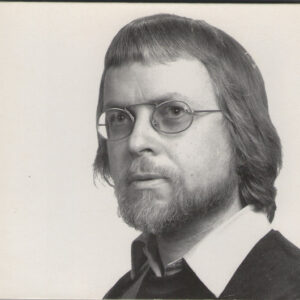
Kare KOLBERG
“Omgivelser & portando”
“Kåre Kolberg (b.1936) is one of Norway’s foremost contemporary composers and is regarded as one of the pioneers of early electronic music and multi-disciplinarity art in Scandinavia. He has composed music for film, theatre and chamber orchestras to jazz acts such as Svein Finnerud Trio and Jan Garbarek.
Kolberg’s Omgivelser (Surroundings) was a commissioned piece made for the Norwegian Broadcasting Corporation (NRK) in 1970. It was made as a soundtrack for a short TV-film of the same name that was made by director Jan Horne. The idea was to melt abstract film impressions that showcased different sides of the environmental debate of the 1970s, together with experimental electronic music in order to create a singular expression. Kolberg travelled to the famous Studio Eksperymentalne in Warsaw, run by Jósef Patowski, to record the music. Together with sound engineer Bohdan Mazurek Kolberg crafted the piece using the studio’s vast sound archives and two pre-recorded tapes that he had brought from Norway. One tape consisted of different sound recordings Kolberg had made with experimental jazz singer Karin Krog and the other contained different field recordings by Kolberg, including a Norwegian nursery rhymes sung by Kolberg’s eldest son. In the studio they processed this material with ring modulators and filters, and added different modified instruments created by an engineer at the studio. The piece was recorded using what were at the time the Rolls Royce of tape machines: two Telefunken Magnetophon M10s. The piece was originally broadcast to Norwegian homes in 1970. Since the standard TV-volume levels are set so low, the dynamic range of Kolberg’s music was not optimal. Kolberg kept the original master tape and over the years Omgivelser was presented several times at different electronic music concerts. Portando, (meaning to transport or carry in Italian) was a commissioned piece for the Henie Onstad Art Centre in 1987. The centre’s music coordinator at that time, Åse Hedstrøm asked Kolberg to write the piece especially for the art centre. Kolberg worked together with the studio founder and sound-engineer Mats Claesson using Norway’s first micro-processors and Mac based Studio Technology. The piece is written for electronic tapes and two live percussionists, which were played by Bjørn Rabben and Einar Fjævoll. The CD release of Omgivelser & Portando is an important addition to the history of Norwegian electronic music, and should be of great interest to fans of Arne Nordheim and Kåre Kolberg.”
14,50€
Out of stock

CD
Marc BARON
“Un salon au fond d’un lac”
After the highly-acclaimed Hidden Tapes released on Potlatch in 2014, Marc Baron puts another solo recording forward. Un salon au fond d’un lac is the new opus by this composer engaged in reel-to-reel tapes experimentation and using cut-up, noise, found sound, pre-recorded and degraded tapes. As always, Marc Baron uses analog tape techniques only. Composed on 2014.
10,00€
Out of stock

CD
Marc BARON
“Hidden tapes”
Hidden Tapes is composed from old cassette tapes, with addition of some other sources from movies soundtracks and classical or liturgical music extracts which were retrieved in closets. These sound documents were accelerated or slowed down, layered and transformed with analog devices. No digital effect, no plugin. Computer was only used for editing and mixing. Composed on 2013.
About Marc Baron : Between 2000 and 2010, Marc Baron was an improviser on saxophone. He made concerts and performances in solo or ensembles (mainly duo Narthex, quartet Propagations). Concerts in France, Italy, Switzerland, Portugal, Australia. Collaborations with Loïc Blairon, Seijiro Murayama, Jean-Luc Guionnet, Jean- Sébastien Mariage, Bertrand Denzler, Pascal Le Gall and Stéphane Rives. Since 2010 he works as a composer for speakers: sound diffusion, installations, live performances. Performances in festivals: 104, Umlaut and Parisonic (Paris), Villa Savoye (Poissy), Mulhouse. "Now, now" (Sydney, Australia), Parisonic (Melbourne, Australia).
About Marc Baron : Between 2000 and 2010, Marc Baron was an improviser on saxophone. He made concerts and performances in solo or ensembles (mainly duo Narthex, quartet Propagations). Concerts in France, Italy, Switzerland, Portugal, Australia. Collaborations with Loïc Blairon, Seijiro Murayama, Jean-Luc Guionnet, Jean- Sébastien Mariage, Bertrand Denzler, Pascal Le Gall and Stéphane Rives. Since 2010 he works as a composer for speakers: sound diffusion, installations, live performances. Performances in festivals: 104, Umlaut and Parisonic (Paris), Villa Savoye (Poissy), Mulhouse. "Now, now" (Sydney, Australia), Parisonic (Melbourne, Australia).
10,00€
In stock

CD
Pauline OLIVEROS – Francisco LÓPEZ – Doug VAN NORT – Jonas BRAASCH
“Quartet for the end of space”
“This recording consists of 8 electro-acoustic compositions. 2 pieces by each of the 4 composers. The works span a vast sonic terrain, challenging listener and performer alike through a seamless blend of Deep Listening and Absolute Noise, moving between ever-fluid improvisation and carefully controlled sound manipulation.
The quartet convened for two improvisational sessions between February and May of 2010, with López sitting in on a Triple Point (Oliveros-Van Nort-Braasch) recording session and bringing his finely crafted sonic objects-as-instruments, further spanning the electro-acoustic divide that has become Triple Point’s calling. The four later re-formed for their debut concert at the Deep Listening Institute in Kingston, NY in September of 2010. These sessions have since become raw material for the individual artists to construct new visions of this shared sonic body through extensive and thorough evolution of the recordings - personal reflections culled from a collective tapestry.
Pauline Oliveros has influenced American music extensively in her career spanning more than 60 years as a composer, performer, author and philosopher. She pioneered the concept of Deep Listening, her practice based upon principles of improvisation, electronic music, ritual, teaching and meditation, designed to inspire both trained and untrained musicians to practice the art of listening and responding to environmental conditions in solo and ensemble situations.
Francisco López is internationally recognized as one of the major figures of the sound art and experimental music scene. Over the past 30 years he has developed an astonishing sonic universe, absolutely personal and iconoclastic, based on a profound listening of the world. Destroying boundaries between industrial sounds and wilderness sound environments, shifting with passion from the limits of perception to the most dreadful abyss of sonic power, proposing a blind, profound and transcendental listening, freed from the imperatives of knowledge and open to sensory and spiritual expansion.
Doug Van Nort is an experimental musician and digital music researcher whose work is dedicated to personal and collective creative expression through noise, free improvisation and generally electro-acoustic means of production, from the lo-fi of broken electronics to the hi-tech of custom signal processing algorithms. Recent projects have spanned telematic music, laptop ensemble compositions,, immersive electro-acoustic works, interactive sonic installations and machine listening systems.
Jonas Braasch is an experimental soprano saxophonist and acoustician with interests in Telematic Music and Intelligent Music Systems. He has performed with Curtis Bahn, Chris Chafe, Michael Century, Mark Dresser, Pauline Oliveros, Doug van Nort and Stuart Dempster among others. His saxophone style expands the traditional repertoire by incorporating various non-western elements and extended techniques.” label info
14,00€
Out of stock

CD
Pauline OLIVEROS
“No mo”
In the summer of 1966 I worked in the classical Electronic Music Studio at the University of Toronto for six weeks. The system I used to create No Mo and Something Else consisted of Layfette tone generators, noise source and tape delay. In the Fall of 1966 I was the newly appointed director of the Mills Tape Music Center formerly the San Francisco Tape Music Center and now the Center for Contemporary Music at Mills College. Bog Road was created at the Mills Tape Music Center in the Summer of 1967 with the Buchla Series 100 Box. The studio overlooked a pond where frogs were singing a chorus that inspired a series of Bog pieces.
14,50€
Out of stock

CD
Pauline OLIVEROS
“Alien bog – Beautiful soop”
Pauline Oliveros completed Beautiful Soop (1966) and Alien Bog (1967) utilizing the original Buchla Box 100 series created for the Tape Music Center by Don Buchla and her tape delay system. “I was deeply impressed by the sounds from the frog pond outside the studio window at Mills. I loved the accompaniment as I worked on my pieces. Though I never recorded the frogs I was of course influenced by their music.”
14,50€
In stock

CD
David ROSENBOOM
“Invisible gold”
“David Rosenboom (b. 1947) has been widely acclaimed as a pioneer in American experimental music since the 1960’s. He is a composer, performer, conductor, interdisciplinary artist, author, and educator having explored ideas in his work about the spontaneous evolution of forms, languages for improvisation, new techniques for ensembles, cross-cultural collaborations, performance art, computer music systems, interactive multi-media, compositional algorithms, and the structure of the brain and nervous system. These two works, “Portable Gold and Philosophers Stones” (1972) and “On Being Invisible” (1976-77), are classics of live electronic music involving extended musical interface with the human nervous system.”
14,00€
In stock

CD
Annea LOCKWOOD
“Thousand year dreaming-floating world”
“Performers on Thousand Year Dreaming: Art Baron, conch shell, trombone, didjeridu; Libby Van Cleve, oboe, English horn; Jon Gibson, didjeridu; Annea Lockwood, voice; J.D. Parran, clarinet, contrabass clarinet; Michael Pugliese, tam-tam, clapping sticks; N. Scott Robinson, conch shell, frame drums, pod rattle, tam-tam; John Snyder, didjeridu, waterphone; Charles Wood, tam-tam, stones; Peter Zummo, trombone, didjeridu
Thousand Year Dreaming (1990) was commissioned by Essential Music and was written with the musicians on this recording, their particular strengths and inclinations, very much in mind. It grew out of an improvisatory piece, Nautilus, which Art Baron, Scott Robinson and Lockwood realised in 1989. They found that the sound of conch shell trumpets, didjeridu and frame drums really flowered in the resonant spaces they were using for the piece. Lockwood started imagining the sonorities possible with four didjeridus, gongs, conches and trombones and frame drums, all shaped by the penetrating and sensuous edge of oboes and clarinets. Four sections emerged to which she gave the subtitles: breathing and dreaming; the Chi stirs; floating in mid-air; in full bloom. While most of the work is fully scored, it contains two improvisations: a duet for John Snyder (didjeridu) and Scott Robinson (frame drum), and a section for all four didjeridus. In performance, at this point the four players wander amongst the audience, exploring the space s acoustics, playing into a listener’s shoulder here, a foot there - sonic massage. When close to completing the piece Lockwood realised that its underlying, generative idea was the gradual awakening and release of sonic energy, energy which I think of as coiled and latent, in breathing and dreaming, but with an embedded power which will nourish when summoned. Floating world (1999) is an immersion in place and transience. The composer invited friends who work with environmental sounds themselves, and who have a strong sense of place, to make recordings for her in places of personal, spiritual significance to them, so it is a collaborative work. From their field recordings (edited but not processed), and other sounds Lockwood wove the slowly shifting texture forming floating world.”
12,00€
In stock
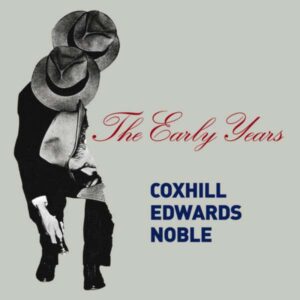
CD
COXHILL-EDWARDS-NOBLE
“The early years”
Lol Coxhill (soprano sax), John Edwards (double bass) and Steve Noble (drums). Recorded London 11 January 2004 by Mick Ritchie at Barefoot Studios.
15,00€
In stock
CD
Okkyung LEE
“Dahl-Tah-Ghi”
Okkyung Lee is a cellist, composer, and improviser who moves freely between of artistic disciples and contingencies. Since moving to New York in 2000 she has worked in disparate contexts as a solo artist and collaborator with creators in a wide range of disciplines. A native of South Korea, Lee has taken a broad array of inspirations—including noise, improvisation, jazz, western classical, and the traditional and popular music of her homeland—and used them to forge a highly distinctive approach. Her curiosity and a determined sense of exploration guide the work she has made in disparate contexts. Lee has appeared on more than 30 albums, including a diverse variety of recordings as a leader, but she is perhaps known best for her improvisational work, where she draws upon visceral extended techniques, in both solo and collaborative contexts. Not content with static performance approaches, Lee routinely explores the spaces she performs in, responding to atmosphere, audience, or objects surrounding her, to produce an immersive experience.
“Dahl-Tah-Ghi” was recorded at the Emanuel Vigelang Mausoleum in Oslo in June 2013 for a limited audience of 30 people. The artist Emanuel Vigeland (1875-1948) erected the building in 1926, intended as a future museum for his sculptures and paintings. He eventually decided that the museum should also serve as a mausoleum. All the windows were closed and his ashes were to rest in an urn above the entrance door. The mausoleum is completely covered with fresco paintings that depict human life from conception till death, in dramatic and often explicitly erotic scenes. The mausoleum also has an extraordinary reverb of up to 18 seconds, and has become a desirable space for artists to perform intimate concerts because of its special accoustic character.
“Dahl-Tah-Ghi” was recorded at the Emanuel Vigelang Mausoleum in Oslo in June 2013 for a limited audience of 30 people. The artist Emanuel Vigeland (1875-1948) erected the building in 1926, intended as a future museum for his sculptures and paintings. He eventually decided that the museum should also serve as a mausoleum. All the windows were closed and his ashes were to rest in an urn above the entrance door. The mausoleum is completely covered with fresco paintings that depict human life from conception till death, in dramatic and often explicitly erotic scenes. The mausoleum also has an extraordinary reverb of up to 18 seconds, and has become a desirable space for artists to perform intimate concerts because of its special accoustic character.
12,00€
In stock
CD
Don & Camille DIETRICH
“Dietrichs”
Simultaneously with the reissue of the “Dietrich” solo album, Pica Disk is proud to release a contemporary recording of Don Dietrich – which is also the debut of the duo with his daughter Camille Dietrich.
Having grown up exposed to her father’s playing since birth Camille Dietrich has been in a unique position as a musician, being subjected to a method of free playing that takes most artists years of exploration to locate. Yet as a cellist Camille has not grown up a copy of her father, and while she shares his unforgiving intensity in her playing, there is an individual confidence and playfulness to how she approaches her instrument, especially when considering that she was 19 years old at the time of the recording. Camille’s fresh approach also feeds back to Don, and the trust the two have in each other makes for a dynamic that usually takes years to achieve, making their duo album not just a father/daughter novelty one-off record, but a fully fledged musical statement that marks the start of a collaboration to reckon with.
Having grown up exposed to her father’s playing since birth Camille Dietrich has been in a unique position as a musician, being subjected to a method of free playing that takes most artists years of exploration to locate. Yet as a cellist Camille has not grown up a copy of her father, and while she shares his unforgiving intensity in her playing, there is an individual confidence and playfulness to how she approaches her instrument, especially when considering that she was 19 years old at the time of the recording. Camille’s fresh approach also feeds back to Don, and the trust the two have in each other makes for a dynamic that usually takes years to achieve, making their duo album not just a father/daughter novelty one-off record, but a fully fledged musical statement that marks the start of a collaboration to reckon with.
9,00€
In stock
CD
Don DIETRICH
“Dietrich”
For four decades Don Dietrich has been one of the three musicians that makes Borbetomagus, a band that somewhere in the crossing point between loud rock, free improvisation and electronic noise music carved their own unique place in the musical landscape. Often overlooked and underappreciated Borbetomagus kept going like a steam train, slowly building a cult following that appreciates them for their uncompromising vision. Few bands can look back at a career with as much integrity as Borbetomagus, and if the term “no compromise” ever meant something in music, they embody it.
Alongside his time in the band with Donald Miller and Jim Sauter, saxophonist Don Dietrich has also ventured into doing solo work a few times. In 2002 he recorded his debut full-length album “Dietrich”, released on the French label Élevage De Poussière in 2003. This was a small run edition LP with limited underground distribution, yet over the years the album grew to be considered a classic of the noise music field. It became a cult record, which its fans would champion to like-minded adventurous music lovers.
Outside the trio format Dietrich’s lone amplified saxophone appeared even more direct and unforgiving, like a force of nature that is both ripping itself apart and regenerating immediately. The intensity of Dietrich’s physical playing isn’t as much helped by the electric amplification as bringing it to its knees. A whole history of how to play the saxophone is killed off and reanimated over the course of the album’s six pieces.
The “Dietrich” album has been out-of-print for years, and is now being reissued in remastered form on CD by Pica Disk. As an added bonus the 1994 “Chinese Root Letter/Tabulae Sex” 7”, originally released on Thurston Moore's Ecstatic Peace Records, is also included.
Alongside his time in the band with Donald Miller and Jim Sauter, saxophonist Don Dietrich has also ventured into doing solo work a few times. In 2002 he recorded his debut full-length album “Dietrich”, released on the French label Élevage De Poussière in 2003. This was a small run edition LP with limited underground distribution, yet over the years the album grew to be considered a classic of the noise music field. It became a cult record, which its fans would champion to like-minded adventurous music lovers.
Outside the trio format Dietrich’s lone amplified saxophone appeared even more direct and unforgiving, like a force of nature that is both ripping itself apart and regenerating immediately. The intensity of Dietrich’s physical playing isn’t as much helped by the electric amplification as bringing it to its knees. A whole history of how to play the saxophone is killed off and reanimated over the course of the album’s six pieces.
The “Dietrich” album has been out-of-print for years, and is now being reissued in remastered form on CD by Pica Disk. As an added bonus the 1994 “Chinese Root Letter/Tabulae Sex” 7”, originally released on Thurston Moore's Ecstatic Peace Records, is also included.
9,00€
In stock
CD
Benjamin NELSON
“First”
Following numerous small run releases and years of private development First is the debut CD release by Benjamin Nelson. Recorded and mixed in the summer and fall of 2015 in Oslo First represents the culmination of Nelson’s live and studio practice since 2008 focused on long form, reductionistic, and near-static electronic music. First explores the perception of time, interference patterns, room reflection and hearing fatigue as primary compositional elements. Favoring textural over tonal development First is equal parts immersive environment and sound object. Nelson encourages listeners to observe sound in a sculptural manner – listening as a process of observing slow changes as one would to those of a physical object and its environment.
With influences stemming from early minimalism and composers such as Eliane Radigue and Maryanne Amacher the influence of 80s home taper works such as those of Jeph Jerman’s Hands To and John Hudak can also be heard in Nelson’s work; eschewing the elements of pseudo-spirituality, passive listening and pastoral subject matter often associated with minimal oriented sound for a focus on rougher textures and objective listening. Not every room is easy to be in, and those that are not are usually more interesting.
Available only on CD in an edition of 300 copies. UV varnish print on black paper in plastic wallet.
With influences stemming from early minimalism and composers such as Eliane Radigue and Maryanne Amacher the influence of 80s home taper works such as those of Jeph Jerman’s Hands To and John Hudak can also be heard in Nelson’s work; eschewing the elements of pseudo-spirituality, passive listening and pastoral subject matter often associated with minimal oriented sound for a focus on rougher textures and objective listening. Not every room is easy to be in, and those that are not are usually more interesting.
Available only on CD in an edition of 300 copies. UV varnish print on black paper in plastic wallet.
10,00€