
In stock
CD
Oren AMBARCHI
“Audience of one”
“On Audience of One, Oren Ambarchi, presents a four-part suite which moves from throbbing minimalism to expansive song-craft to ecstatic free-rock. While his previous solo albums for Touch have exhibited a clear progression towards augmenting and embellishing his signature bass-heavy guitar tones with fragile acoustic instrumentation, Audience of One, while also existing in clear continuity with his previous recordings, opens the next chapter in his catalogue of solo works. Remarkable in its confidence and breadth, but also in the sensuous immediacy of its details, this is the first time a single record has come close to encapsulating Ambarchi’s musical personality in its full range and singularity; as, among other guises in addition to the guitar based solo-works he is best known for, electro-acoustic improviser with Keith Rowe, explorer of the outer limits of rock with Sunn O))) and Keiji Haino, and, in the epic yet faithful Ace Frehley cover which closes the record, classic rock enthusiast. The album features a multitude of different collaborators, who, far from appearing in incidental roles, are integral to the pieces on which they perform: on the opening ‘Salt’, Ambarchi paints a hypnotic, chiming backdrop for Paul Duncan’s (Warm Ghost) vocals, and Joe Talia’s virtuoso drumming and driving cymbals are at the core of the epic ‘Knots’, in which Ambarchi, alongside a chamber arrangement by Eyvind Kang, weaves a net of frequencies and textures with the organic push and pull of a 70s psych jam, the bass response of a doom metal ritual and the psycho-acoustic precision of an Alvin Lucier composition. Where on his previous records, Ambarchi’s signature guitar tone was the ever-present bedrock over which other elements of the arrangements sounded, at moments on Audience of One it even disappears entirely, as on the beautiful ‘Passage’, which, recalling the 70’s Italian minimalism of Roberto Cacciapaglia and Giusto Pio, is composed of overlapping tones from Hammond organ and wine glasses, Jessika Kenney’s voice, various acoustic instruments, and the delicate amplified textures of Canadian sound-artist Crys Cole. Rather than being provided by any particular sound, the unified experience of listening to Audience of One stems simply from the unique, patient sensibility Ambarchi has developed over twenty years of abstracting musical forms into their barest forms, while somehow always managing to leave their emotive power intact. [Francis Plagne]” Artwork & photography: Jon Wozencroft. Mastered by Francois Tetaz at Moose, Melbourne.
13,00€
In stock
CD
Chris WATSON & Marcus DAVIDSON
“Cross-Pollination”
“1.Chris Watson - Midnight at the Oasis 28:08. The piece is a 28 minute time compression from sunset to sunrise in South Africa’s Kalahari desert and features the dense and harmonic mosaic of delicate animal rhythms recorded in this remote habitat.” Midnight at the Oasis was first performed at the Marquee in Parliament Street, York, on 13th September 2007 as part of SightSonic’s contribution to the BA Festival of Science.
13,50€
Out of stock
CD
Chris WATSON
“El tren fantasma”
Reissue.
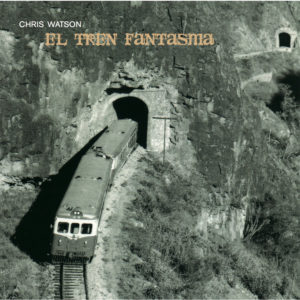
“Take the ghost train from Los Mochis to Veracruz and travel cross country, coast to coast, Pacific to Atlantic. Ride the rhythm of the rails on board the Ferrocarriles Nacionales de México (FNM) and the music of a journey that has now passed into history.” El Tren Fantasma (The Ghost Train) is Chris Watson’s 4th solo album for Touch, and his first since Weather Report in 2003, which was named as one of the albums you should hear before you die in The Guardian. A Radio programme was broadcast on BBC Radio 4 on Saturday 30 Oct, 2010, produced by Sarah Blunt, and described as "a thrilling acoustic journey across the heart of Mexico from Pacific to Atlantic coast using archive recordings to recreate a rail passenger service which no longer exists. It’s now more than a decade since FNM operated its last continuous passenger service across country. Chris Watson spent a month on board the train with some of the last passengers to travel this route. As sound recordist he was part of the film crew working on a programme in the BBC TV series Great Railways Journeys. Now, in this album, the journey of the ‘ghost train’ is recreated, evoking memories of a recent past, capturing the atmosphere, rhythms and sounds of human life, wildlife and the journey itself along the tracks of one of Mexico’s greatest engineering projects.
13,00€
Out of stock
CD
Chris WATSON
“Weather report”
Ryoji is constantly touring as part of the Japanese performance group Dumb Type, who are shortly to undertake a tour of Japan, and also as a solo artist.”
13,00€
In stock

CD
ZEITKRATZER
“Grand orchestra”
Grand Orchestra, for mixed orchestra and bagpipes. Composed and directed by Reinhold Friedl. Performed by zeitkratzer & guest at Haus der Kulturen der Welt, Berlin, August 21, 2011. “The score for Grand Orchestra has been developed for musicians, laymen, old people, children, adolescents, for anyone who likes to join in. Grand Orchestra is not for education. It’s not about explaining, intellectual understanding or the training of cultural values; rather it’s about having faith in the abilities and intuition of the players and their performance. The musicians of zeitkratzer and additional guests took over the voice-leading of the instrumental groups, distributed in the space and enabling their amplification. In this way it was possible to create not only pure intensity but also dense and complex sound aggregates, through the blurring of playing techniques inside the different instrumental groups. Which orchestra is capable of playing such complex sounds as this group of forty wind players, chorally building a simultaneous crescendo of breaths? Who can play more ecstatically and wilder than a group of sixty musicians, playing against and doing their best to keep up with a Scottish bagpipe ensemble? It’s precisely due to unclearly played single sounds, unfolding from an orchestra dominated by amateurs. Unique sounds with a complex character that no professional orchestra could reproduce.” - Reinhold Friedl, from the liner notes. zeitkratzer is sound made visible, tangible, bodily - a truly unforgettable corporal experience of live music. The physicality of sound is celebrated through extended instrumental techniques, mutual understanding and amplification of traditional instruments. A midpoint between instrumental and electronic music turns out to be more bizarre and surprising than either of these. It will make you expect more from music than you did before! zeitkratzer is a soloist ensemble. Its strength comes from its members. Founded in 1999, it gathers nine musicians, light and sound engineers living in different European cities from Amsterdam to London to Oslo meeting for working phases in Berlin. zeitkratzer have performed critically acclaimed versions of classical music by composers such as Karlheinz Stockhausen, Helmut Lachenmann and James Tenney, as well as orchestral versions of electronic/noise music by Whitehouse, Merzbow, John Duncan, Dror Feiler and Lou Reed’s ’Metal Machine Music’.
13,00€
In stock
CD
SELTEN GEHÖRTE MUSIK
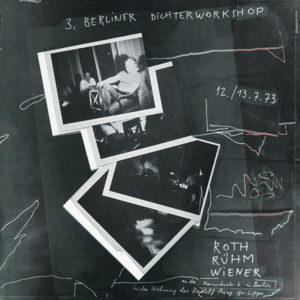
“3. Berliner Dichterworkshop”
First part in the reissue series of all Selten Gehörte Musik records. CD in printed CD sleeve packaged in fullcolour 12” LP sleeve (reproduction of the original artwork) and printed 12” innersleeve featuring rare photos and an English text on “Selten gehörte Musik” by Gerhard Rühm. This is the reissue of the first SGM release from 1973. Recordings of the 3rd Berliner Poetsworkshop (First Berliner Musicworkshop) with Dieter Roth, Gerhard Rühm, and Oswald Wiener, Berlin 12th & 13th July 1973. Edition of 500 copies.
17,00€
In stock
CD
SELTEN GEHÖRTE MUSIK
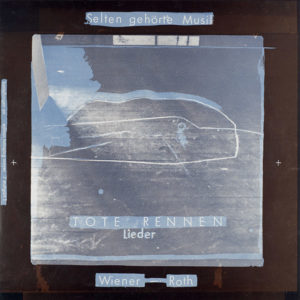
“Tote rennen – Lieder”
Fifth part in the Selten Gehörte Musik reissue series. Recorded by Dieter Roth and Oswald Wiener at Mosfellssveit, Iceland, May 28 - 30, 1976. Packaged in fullcolour LP cover (reproduction of the original), with printed innersleeve featuring a new text about “Tote Rennen Lieder” by Michel Roth (with the English translation as an insert), as well as a rare drawing / “liner notes” by Dieter Roth. Edition of 500 copies.
“The tense relationship between Wiener and Roth, borne by great mutual admiration and argumentative rivalry, left a major mark on the Rarely Heard Music. In 1974 they had a fierce argument in Iceland that almost led to Roth pulling out of his part in the Munich Concert and Berlin Concert. The record that they made together in Iceland some two years later, with their “conversations as songs” (Roth) is thus all the more remarkable. (…) They intentionally recorded it during a hangover. Roth took particular pleasure, he said, in the vacillating nature of the conversation, with music in the background that had been recorded subsequently, when they were both sober again. (…) In the context of their rivalry, however, it is significant that they both struggle to formulate their ideas precisely, and – even when the conversation partner has already understood what was said – they often subsequently offer a yet more succinct version of it. (…)”
17,00€
Out of stock

CD
Wolf VOSTELL
“Dé-coll-age musik”
“CD-Reissue of the Vinyl-LP originally released 1983 by Fondazione Mudima (Multhipla M20137). Comes in high-gloss fullcolour 6-panel Digipak with 16 page illustrated booklet. Wolf Vostell (1932-1998) was a German painter, sculptor, noise music maker and happening artist. He is one of the pioneers of video art, environment-sculptures, happenings and the Fluxus Movement. Together with Nam June Paik and George Maciunas he organised the Festival ’Festum Fluxorum’ in Wiesbaden, Germany in 1962. This festival is considered to be the birth of the Fluxus movement. Vostell was the first artist in history to integrate a television set into a work of art (’Deutscher Ausblick’ from 1958).”
9,00€
In stock
CD
Mario DE VEGA
“Smells like Teen Spirit”
This latest addition to the Tochnit Aleph catalogue is premised in a haptic interrogation of each of the label’s previous editions (TA001-147). Berlin-based, and Mexico City-born, multi-disciplinary artist Mario de Vega occupied the gallery space of Rumpsti Pumsti (Musik) for three consecutive days in October 2016 with a hitherto complete Tochnit Aleph catalogue, sanding machines, hammer, and recording equipment. Conflating acts of 'playing' with destruction, de Vega took to the recorded works and assorted medias with his spartan toolset, producing a discordant document of his repurposing of the complete archive. Reducing the material to a collection of detritus for exhibition, the sound object is presented as both a conceptual remainder of the site-specific process, and an agitated extension to the label.
Edition of 300 copies.
14,00€
In stock
CD
Antoine CHESSEX
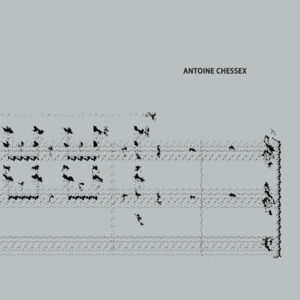
“Selected chamber music works 2009-2013”
Edition of 300 copies. Four chamber music pieces by Swiss composer Antoine Chessex. Including: Angst Miniature (2009, for strings and tape), Metakatharsis (2010, for ensemble, live-electronics and tape), Ritournelle Fulgurante (2013, for ensemble), Schichten (2011, for ensemble). Comes with 12 page booklet.
11,00€
Out of stock
CD
MANINKARI
“L’océan rêve dans sa loisiveté”
Around the theme of the ocean symbolising the subconscious, the hidden world and a very personal concept of “loisiveté” a combination of idleness “oisiveté” and law “loi”, Maninkari continues exploring a weird and dreamlike world.
As usual, the Charlot brothers (Frédéric & Olivier) resort almost exclusively to the use of acoustic instruments with oriental origins (bodhran, cymbalom, santoor, zurna).
Percussion instruments especially the bodhran play melodic or textural figures, whereas stringed instruments become repetitive to a point where they embody the rythmics.
The combination of repetition and oriental tones create a heady sound continuum providing the 10 nameless tracks with a mantra-like resonance. A short breathing in the middle of the album with an organ and birdsong is the only quiet moment of this tormented (but without violence), and meditative (but without bliss) record.
The permanent state of tension recalls the rigours of law and repetition provides the calm alternative of idleness “l’oisiveté”. (...)
7,00€
In stock
CD
Tom DISSEVELT – Kid BALTAN
“Song of the second moon”
Original album Remastered and Expanded with 12 extra tracks. Perhaps the most influential recording in the history of electronic music, Song Of The Second Moon is far more than an historical curiosity. For the very first time electronic music was conceived as popular music, an incredibly listenable mélange of jazz and concrete stylings. Composed by Dutch Philips Research Laboratories employees Tom Dissevelt and Dick Raaijmakers (Kid Baltan) between 1957 and 1961, Song Of The Second Moon’s dynamic and playful futurism would inspire legendary figures from Jean Jacques Perrey to Glenn Gould. Indeed, Stanley Kubrick would at one point consider the LP as the soundtrack for his epic film "2001: A Space Odyssey". For its premiere reissue we present the rare stereo version of the album with a multitude of outtakes, alternate and mono versions. Remastered from the original Philips-Limelight mastertapes 2012. 20 page full colour booklet with exclusive liner notes and rare photos. The original ground-breaking album plus outtakes, alternate and mono versions!
16,00€
Out of stock

CD
SOURDURE
“La virée”
Sourdure is a project from Ernest Bergez, from the group Kaumwald. A mix of folk, songs and psychedelic dérives !
10,00€
Out of stock

CD
Tony CONRAD with FAUST
“Outside the dream syndicate”
Violinist, composer and filmmaker Tony Conrad started his career in New York in the early 1960s. As a member of the Theatre of Eternal Music (a.k.a. the Dream Syndicate) alongside John Cale, La Monte Young, Marian Zazeela and Angus MacLise, he participated in now-legendary and often legendarily loud drone performances with many pieces having no beginning and no end. During a fateful trip to Germany in 1972, Conrad met with avant-rock visionaries Faust and made the very first record to bear his name.
Outside The Dream Syndicate, originally released in Europe only in 1973, is a stunning debut. Two side-long tracks – “The Side Of Man And Womankind” and “The Side Of The Machine” – show just how far Conrad had moved beyond his minimalist peers. Werner Diermaier’s repetitive drum beat and Jean-Hervé Peron’s stripped-down bassline conjure a tense, ascetic groove, while Conrad’s seamless violin, initially so controlled, reveals a surprising adaptability. The music shifts almost on a subliminal level, pushing and pulling to the drone's internal pulse.
It is hard to imagine Conrad’s trajectory from downtown Manhattan to a farmhouse in the German countryside that ultimately resulted in Outside The Dream Syndicate, yet no other record captures – so completely and instantly – the intersection of avant-garde and rock forms. Outside The Dream Syndicate remains ahead of and bracingly outside of its time.
This first-time vinyl reissue has been carefully mastered from the original master tapes and includes liner notes by musician Jim O’Rourke and author Branden W. Joseph.
16,00€
Out of stock

CD
Henry FLYNT
“You Are My Everlovin’”
Philosopher, musician and anti-art activist, Henry Flynt has long foregone the academicism often associated with “serious music” in favor of a uniquely intuitive, emotional approach to composition. In the 1960s and 1970s he was a part of NYC’s vibrant avant-garde scene, studying with Hindustani singer Pandit Pran Nath and developing his own proprietary technique on violin.
You Are My Everlovin’, Flynt’s first published musical work, finds the composer in peak form at a lower Manhattan loft in late spring 1981. Featuring solo electric violin and pre-recorded tambura, this sinuous performance elegantly brings together disparate vernaculars – Southern blues, modal jazz, Appalachian fiddle, North Indian raga – into a new and bracing whole.
As Flynt writes in the liner notes, “The electric violin timbre is crucial; it allows me to crush the diverse styles into a unity. I imagined the genre as open, radiant improvisation… an open plain that could absorb anything.”
Incorporating themes and melodic phrases from his earlier work, Everlovin’ becomes Flynt’s own Gesamtkunstwerk – a work that is at once rooted in and liberated by the drone, revealing the profound mutability and utter singularity of this American iconoclast.
15,00€
In stock
CD
Jim O’ROURKE & Christoph HEEMAN
“Plastic palace people vol.2”
The departure from Volume 1 starts here ! Found sounds, field recordings and more, echoing to you from way back in 1992. Straight out of Aachen!
12,00€
Out of stock

CD
Robert TURMAN
“Flux”
CD version. “Flux” is the 1981 debut solo outing of Robert Turman, an American multi-instrumentalist and avant-garde composer. Until recently, Turman was perhaps best known for his contributions to the ballistic NON project with Boyd Rice, as well as other obscured U.S. industrial acts such as Z.O. Voider. In the summer of 1981 Turman decided he would take a drastic turn from the noisy/electronic/industrial work of his compatriots, and began work on what is now the classic "Flux" cassette. "Flux" was originally self-released in extremely limited numbers. Weary of the noisescapes of old, he set out to create long-form minimalism utilizing kalimba, piano, "Mini-Pops Jr." drum machine, and tape loops to create a complex bed of interweaving micro-stasis’. The results of these new experiments were as beautiful as they were perplexing. A curious dusty fidelity carries these classic tracks across four sides of vinyl, including all of the original "Flux" content. These compositions glow with a sprawling, slow motion haze that’s light years ahead of its time. "Flux" reveals wide spectrums of sound from melancholic kalimba and percussion patterns to slowed down, syrupy Exotica. Turman had complex ideas in his mind yet only the simple technologies of the day were at hand. Hear the click of the stopping and starting Tascam 3340 open-reel tape machine as one hand presses the "record" and "play" buttons and the other plays piano phrases. While there are similarities in style to Classical Minimalism, Turman’s sound and vision is his own and is exclusive to his limited discography. Original cassette artwork and scans provided by Aaron Dilloway.”
7,50€
In stock

CD
David BORDEN
“Music for amplified keyboard instruments”
David Borden was is in the room where the pitch wheel was invented, when it happened. He was one of the first people to beta-test Bob Moog’s Modular Synthesizer systems and MiniMoog instruments. His Earthquack Records imprint inspired Mimi Johnson to begin the legendary Lovely Records label with Robert Ashley. Borden formed the first all synthesizer ensemble, Mother Mallard’s Portable Masterpiece Company, in 1969 after Bob Moog graciously lent out his prototype synthesizers and allowed them to be blown up and repaired repeatedly in the process of learning patching techniques. If there was ever a missing link in American Minimalism, David Borden is that link. He not only composed, innovated and performed in the peak years of this imperative movement, but did so on his own terms, with a startling lack of recognition for his revelatory contributions to contemporary musical history.
David Borden, born Christmas Day 1938, in Boston, Massachusetts, is an American Minimalist composer and electronic music pioneer. Music for Amplified Keyboard Instruments is his unsung masterpiece, released in 1981 on the now defunct Red Records based in Holland. After Mother Mallard disbanded in 1978, many of Borden’s solo compositions were not performed or recorded until long after the works had been completed. Music For Amplified Keyboard Instruments was released with little fanfare upon release, and suffered from seemingly limited distribution making the album an obscure classic from its earliest days. Those not lucky enough to obtain original pressings have had to settle for compressed YouTube clips and poor vinyl-to-digital transfers, while original copies of the album today are increasingly sparse and expensive on the used market.
Spectrum Spools is proud to announce that 33 years after it’s original release, and after searching the archives of Borden’s private reel-to-reel tapes and recovering the one safety master known to exist, we are able to present this reissue of Music For Amplified Keyboard Instruments.
Music for Amplified Keyboard Instruments contains four pieces each utilizing three players, and six keyboard instruments. The opening “Etsy Point, Summer 1978” begins with a mournful, ominous mood and slowly blossoms into an immense and humid labyrinth of colorful buzzing textures and howling melodies. “The Continuing Story of Counterpoint” is a 12 part cycle for synthesizers, acoustic instruments and voice that was labored upon for over 11 years. Parts nine and six, included here, are miraculous achievements in prodigious playing technique, remarkable mosaic-like structure and aural magnitude, operating in the relative terrain of Steve Reich and his “Music for 18 Musicians” or some of the “Dervish” works of Terry Riley. Borden’s compositions, however, are singular renderings of his own creative style, prying open new spaces of technique and expression that remained uninhabited by the minimalist composers of the day. The “Counterpoint” pieces here are rigidly arranged with breakneck key changes and intricate time signature manoeuvring. The resulting audio conjures kaleidoscopic patterns of beautiful melodies and compositional anatomy unparalleled in much of the American Minimalism we know. “Enfield in Winter” displays some of Borden’s more ambient leanings, with slow morphing drones and gentle pad sounds that erupt into shimmering patterns backed by a grandiose chord progression. Though this wouldn’t be the only solo release by David Borden, Music For Amplified Keyboards represents a veritable zenith in Borden's corpus - a radiant achievement in sonic elegance, experimentation, and ambitious composition technique, deeming it a work of the highest archival significance. Borden went on to found the Digital Music Program (now known as the Electroacoustic Music Center) at Cornell and is now retired. He resides in Ithaca, New York with his wife Rebecca Godin. Music for Amplified Keyboard Instruments was remastered with love and transparency by Giuseppe Tillieci at Enisslab, Rome. These newly remastered works are superior to the original vinyl master, giving the world a chance to hear this remarkable work in highest possible fidelity across multiple formats. Extensive liner notes and photos by Borden are included to unlock the mysteries surrounding this elusive work. Spectrum Spools in cooperation with Editions Mego is proud to provide a definitive edition of a widely influential album to those in the know, as well as for those who are always on the lookout for a special recording they’ve not yet heard.
David Borden, born Christmas Day 1938, in Boston, Massachusetts, is an American Minimalist composer and electronic music pioneer. Music for Amplified Keyboard Instruments is his unsung masterpiece, released in 1981 on the now defunct Red Records based in Holland. After Mother Mallard disbanded in 1978, many of Borden’s solo compositions were not performed or recorded until long after the works had been completed. Music For Amplified Keyboard Instruments was released with little fanfare upon release, and suffered from seemingly limited distribution making the album an obscure classic from its earliest days. Those not lucky enough to obtain original pressings have had to settle for compressed YouTube clips and poor vinyl-to-digital transfers, while original copies of the album today are increasingly sparse and expensive on the used market.
Spectrum Spools is proud to announce that 33 years after it’s original release, and after searching the archives of Borden’s private reel-to-reel tapes and recovering the one safety master known to exist, we are able to present this reissue of Music For Amplified Keyboard Instruments.
Music for Amplified Keyboard Instruments contains four pieces each utilizing three players, and six keyboard instruments. The opening “Etsy Point, Summer 1978” begins with a mournful, ominous mood and slowly blossoms into an immense and humid labyrinth of colorful buzzing textures and howling melodies. “The Continuing Story of Counterpoint” is a 12 part cycle for synthesizers, acoustic instruments and voice that was labored upon for over 11 years. Parts nine and six, included here, are miraculous achievements in prodigious playing technique, remarkable mosaic-like structure and aural magnitude, operating in the relative terrain of Steve Reich and his “Music for 18 Musicians” or some of the “Dervish” works of Terry Riley. Borden’s compositions, however, are singular renderings of his own creative style, prying open new spaces of technique and expression that remained uninhabited by the minimalist composers of the day. The “Counterpoint” pieces here are rigidly arranged with breakneck key changes and intricate time signature manoeuvring. The resulting audio conjures kaleidoscopic patterns of beautiful melodies and compositional anatomy unparalleled in much of the American Minimalism we know. “Enfield in Winter” displays some of Borden’s more ambient leanings, with slow morphing drones and gentle pad sounds that erupt into shimmering patterns backed by a grandiose chord progression. Though this wouldn’t be the only solo release by David Borden, Music For Amplified Keyboards represents a veritable zenith in Borden's corpus - a radiant achievement in sonic elegance, experimentation, and ambitious composition technique, deeming it a work of the highest archival significance. Borden went on to found the Digital Music Program (now known as the Electroacoustic Music Center) at Cornell and is now retired. He resides in Ithaca, New York with his wife Rebecca Godin. Music for Amplified Keyboard Instruments was remastered with love and transparency by Giuseppe Tillieci at Enisslab, Rome. These newly remastered works are superior to the original vinyl master, giving the world a chance to hear this remarkable work in highest possible fidelity across multiple formats. Extensive liner notes and photos by Borden are included to unlock the mysteries surrounding this elusive work. Spectrum Spools in cooperation with Editions Mego is proud to provide a definitive edition of a widely influential album to those in the know, as well as for those who are always on the lookout for a special recording they’ve not yet heard.
12,50€
Out of stock
CD
Sidsel ENDRESEN
“One”
“Sidsel Endresen has been at the forefront of the Norwegian music-scene for more than two decades. Her work has spanned genres from fusion and jazz-rock in the -80’s - to free improvisation and “new music” in the -90’s and the new millennium. Through her two solo-records on ECM Records (”So I Write” and “Exile”), three duo-recordings with Bugge Wesseltoft, as well as other releases on the Jazzland label (“Merriwinkle”, “Undertow” a.o.) - she has received wide international recognition and critical acclaim. In international media she has been labelled «the Grand Dame of Nordic, poetic chamber-jazz and Europe’s most innovative jazz singer - yet she does not consider herself a jazz-singer per se. She is influenced by many sources, including the ethnic and contemporary vocal expressions. Sidsel Endresen has always moved in new directions - constantly renewing her music and her approach - and challenging the traditional role and function of the singer. She is today considered a major influence on a new generation of singers, both at home and abroad. She has worked extensively with the voice as solo-instrument - and has developed her own, distinctive improvisational style - and her own abstract, phonetic language based on her exploration of the pure sound-aspects of the human voice. Her solo-concerts are intimate, minimalistic - with complete focus on the voice - and with no use of electronic devises or effects. She occasionally accompanies herself on a few simple instruments (a small kalimba, and old mini tape-recorder, a glass.)The repertoire for her solo-concerts is a mixture of improvisations and her own, pre-organised material.”
14,00€
In stock

CD
Rutger ZUYDERVELT with Ilia BELORUKOV and René AQUARIUS
“The Red Soul”
Sofa is proud to present Rutger Zuydervelt’s new album The Red Soul, a soundtrack of a movie by Jessica Gorter with the same name, featuring saxophonist Ilia Belorukov and percussionist René Aquarius.
After making several films without music, director Jessica Gorter went for a different approach for her recent film ‘The Red Soul’. Rutger Zuydervelt (aka Machinefabriek) was brought in to make the soundtrack for the documentary. They quickly agreed that the score needed to be very subtle, and not cliché-driven or overdramatic. An old bakelite record with a speech from Stalin and a few old LPs with Soviet songs became the starting point for the music. Fragments of these were sampled, transformed and combined with the saxophone of Ilia Belorukov and percussion by René Aquarius (of Dead Neanderthals). The result is a series of textural and tonal collages that evokes a sense of decay as well as (false) nostalgia, perfectly fitting the theme of the film. On the soundtrack album, the various parts of the score are assembled to be heard as one seamless piece - as a story in itself.
12,00€
In stock
CD
Taku SUGIMOTO
“13 & 14 for guitars”
Composed by Taku Sugimoto. Tetuzi Akiyama: guitar. Recorded live at Loop-Line on October 23, 2009. Recorded by Taku Sugimoto. Mastered by Taku Unami. Drawing by Taku Sugimoto.
12,00€
In stock
CD
Taku SUGIMOTO
“26 (2009) Electronic version”
Composition named “26” : different sequences of electronic sounds and silences on the left and right channels. Realized by Taku Unami, 2009 in Tokyo.
12,00€
Out of stock
CD
Taku SUGIMOTO – Minami SAEKI
“Songs”
All composed by Taku Sugimoto. Words by Ikuhiro Yamagata, Taku Sugimoto, Minami Saeki, and Kamenosuke Ogata. Minami Saeki: vocal, triangles, wooden chair. Taku Sugimoto: guitar, ratchet. Wakana Ikeda: flute.
Recorded outside at Hanegi Park and on a street in Shimokitazawa, Tokyo, December 19, 2016, and at and around Koganei Park, Tokyo, December 30 and 31, 2016. Includes liner notes by Taku Sugimoto in Japanese and English (translation by Ryoko Akama). Released in February 2017.
Recorded outside at Hanegi Park and on a street in Shimokitazawa, Tokyo, December 19, 2016, and at and around Koganei Park, Tokyo, December 30 and 31, 2016. Includes liner notes by Taku Sugimoto in Japanese and English (translation by Ryoko Akama). Released in February 2017.
12,00€
In stock
CD
Taku SUGIMOTO – Manfred WERDER
Recorded live by Taku Sugimoto at Kid Ailack Art Hall, Tokyo, October 27, 2014
Edited and mastered by Simon Roy Christensen. Photos by Lo Wie. Released in March 2015.
12,00€
Out of stock
CD
Michael PISARO – Taku SUGIMOTO
“D minor – Bb major”
Composed by Michael Pisaro and Taku Sugimoto. Performed by Casey Anderson: computer, Matt Barbier: trombone, Eric KM Clark: violin, Devin Disanto: clarinet, Paul Fraser: trumpet, Kristin Haraldsdottir: viola, Stefan Kac: tuba, Ingrid Lee: piano, Daniel Letourneau: guitar, Heather Lockie: viola, Sepand Shahab: keyboards, Cassia Streb: viola, Christine Tavolacci: flute, Chaz Underriner: guitar, Michael Pisaro: guitar, Taku Sugimoto: guitar. Recorded by Michael Pisaro at the Wulf, Los Angeles, February 5, 2012. Mastered by Taku Unami. Drawings by Taku Sugimoto. Includes an insert with liner notes in English by Michael Pisaro.
12,00€
In stock
CD
Xavier GARCIA – Lionel MARCHETTI
“Machine lyrique”
Xavier Garcia, laptop, sampler… Lionel Marchetti, tape recorder Revox B77… Electroacoustic improvisations with two different set up more complementary than opposite.
Nice work !
15,00€
Out of stock

CD
Luigi NONO
“Risonanze erranti. Liederzyklus a Massimo Cacciari”
SACD authoring. DDD 5.1 channel surround sound, DSD converted from PCM 48 khz/24 bit. Multichannel hybridsacd can be played on any compact disc player.
Luigi Nono (1924-1990)
“Risonanze erranti. Liederzyklus a Massimo Cacciari” (1985-87) for contralto, flute, tuba, six percussion and live electronics.
1. Parma, Italy, 2014.
Ensemble Prometeo: Katarzyna Otczyk, contralto; Mario Caroli, flute; Gianluigi Paganelli, tuba; Flavio Tanzi, Aurelio Scudetti, Pietro Pompei, Alberto Toccaceli, Sara de Cicco, Pedro Perini, percussion; Marco Angius, conduction; Luca Richelli, live electronics; Alvise Vidolin, sound.
2. “Risonanze erranti. Liederzyklus a Massimo Cacciari” forth definitive version recorded in Paris, Théàtre National de Chaillot, 1987.
Susanne Otto, contralto; Roberto Fabbriciani, bass flute, piccolo; Giancarlo Schiaffini, tuba; Carlos Beresi, Konrad Graf, Richard Lepetit, Isao Nakamura, Rüdiger Pawassar, Gregory Riffel, percussion; Friedrich Goldmann, conduction; experimentalstudio from SWF, live electronics; Luigi Nono, Hans-Peter Haller, sound.
“The poetic significance of Risonanze Erranti (1985-87) should be interpreted in the light of the reflections developed since the summer of 1975 with the venetian friend and philosopher Massimo Cacciari, to whom the work is dedicated.
after “al gran sole carico d”amore” (in the bright sunshine heavy with love) (1972-74) Nono, obsessed by a sense of anguish owed to his solitude and his activism frustrated by the stagnation of italian music institutions, felt the need to re-examine his work as a composer, in the gramscian sense of an “organic intellectual in the society”. His meeting with the philosopher revived his interest in the critical and artistic activity in the Vienna of Ludwig Wittgenstein’s tractatus logico-philosophicus, and more broadly in the mitteleuropean culture between the 19th and 20th centuries, which he perceived as a “higher” commitment to the quest for truth, as opposed to the falsehood of political, scientific, religious, logical-mathematical thought and the misleading implications of language.
as regards the past his protest is intensely isolated, reflecting the anxiety of modern man who seeks comfort in the solitude of his own inward space to evade the “storm” and the caducity of time and listen to the “breathing limpidity” of the freedom of the infinite, as in the verses of the seventh of Rainer Maria Rilke’s “duino elegies”, chosen by Cacciari and used by Nono in “das Atmende Klarsein” [the breathing being-clear] (1981), a work that contains in a nutshell the poetics of his production in the 1980s.” Marinella Ramazzotti
Luigi Nono (1924-1990)
“Risonanze erranti. Liederzyklus a Massimo Cacciari” (1985-87) for contralto, flute, tuba, six percussion and live electronics.
1. Parma, Italy, 2014.
Ensemble Prometeo: Katarzyna Otczyk, contralto; Mario Caroli, flute; Gianluigi Paganelli, tuba; Flavio Tanzi, Aurelio Scudetti, Pietro Pompei, Alberto Toccaceli, Sara de Cicco, Pedro Perini, percussion; Marco Angius, conduction; Luca Richelli, live electronics; Alvise Vidolin, sound.
2. “Risonanze erranti. Liederzyklus a Massimo Cacciari” forth definitive version recorded in Paris, Théàtre National de Chaillot, 1987.
Susanne Otto, contralto; Roberto Fabbriciani, bass flute, piccolo; Giancarlo Schiaffini, tuba; Carlos Beresi, Konrad Graf, Richard Lepetit, Isao Nakamura, Rüdiger Pawassar, Gregory Riffel, percussion; Friedrich Goldmann, conduction; experimentalstudio from SWF, live electronics; Luigi Nono, Hans-Peter Haller, sound.
“The poetic significance of Risonanze Erranti (1985-87) should be interpreted in the light of the reflections developed since the summer of 1975 with the venetian friend and philosopher Massimo Cacciari, to whom the work is dedicated.
after “al gran sole carico d”amore” (in the bright sunshine heavy with love) (1972-74) Nono, obsessed by a sense of anguish owed to his solitude and his activism frustrated by the stagnation of italian music institutions, felt the need to re-examine his work as a composer, in the gramscian sense of an “organic intellectual in the society”. His meeting with the philosopher revived his interest in the critical and artistic activity in the Vienna of Ludwig Wittgenstein’s tractatus logico-philosophicus, and more broadly in the mitteleuropean culture between the 19th and 20th centuries, which he perceived as a “higher” commitment to the quest for truth, as opposed to the falsehood of political, scientific, religious, logical-mathematical thought and the misleading implications of language.
as regards the past his protest is intensely isolated, reflecting the anxiety of modern man who seeks comfort in the solitude of his own inward space to evade the “storm” and the caducity of time and listen to the “breathing limpidity” of the freedom of the infinite, as in the verses of the seventh of Rainer Maria Rilke’s “duino elegies”, chosen by Cacciari and used by Nono in “das Atmende Klarsein” [the breathing being-clear] (1981), a work that contains in a nutshell the poetics of his production in the 1980s.” Marinella Ramazzotti
25,00€
Out of stock
CD
Ivan WYSCHNEGRADSKY
“La journée de l’existence”
“Ivan Wyschnegradsky (1893-1979). "The Day of Existence". Confession of life before life. For orchestra and narrator. Text and music by Ivan Wyschnegradsky. With Mario Haniotis (speaker), Nouvel Orchestre Philharmonique de Radio-France under the direction of Alexandre Myrat. "Ivan Wyschnegradsky had to wait sixty years to hear the first performance of his masterwork, La Journée de l’Existence, which he had conceived and composed beginning in 1916 in Saint Petersburg. And we have had to wait another thirty years to have it on disc and be able to listen to it as we please. This is also the outcome of twenty-five years of work within the Association Ivan Wyschnegradsky, founded in 1983 under the chairmanship of Claude Ballif. The emotion was tremendous the evening of the premiere, which took place in the Large Auditorium of Radio-France. Listeners were swept away by the work’s intensity, the conviction and dramatic power of the narrator, Mario Haniotis, and the presence of the composer, who, in the dusk of his life, had come to attend the realization of the score conceived in his youth in a moment of illumination and exaltation. We’ve come full circle, and miraculously, the emotion of the premiere is fully intact on the disc. This work in itself is a veritable alchemy of speech and sound." After the piece, the CD also offers two interviews. Excerpts come from nine half-hour programmes recorded in 1976 by Robert Pfeiffer and broadcast on France-Culture during the summer of 1977. At the head of these excerpts, we are publishing the beginning of Daniel Charles’s interview with the composer the day of the premiere of La Journée de l’Existence. We endeavoured to present essentially the remarks directly concerning this work, followed by several childhood and youthful memories. Moreover, in the course of this series of interviews, Ivan Wyschnegradsky analysed several of his works and evoked with Robert Pfeiffer his attempts at building quartertone pianos, his theory of non-octaviating spaces and inaudible spaces, his vision of ultra-chromaticism, rhythm, the sound continuum and the cosmic conscience, his ’ultra-chromatic’ drawings, the problems of notation, the need for new instruments, spatial densities... all thoughts relating to the research undertaken immediately after the composition of La Journée de l’Existence and continuing throughout his whole life.”
19,00€
Out of stock
CD
Ivan WYSCHNEGRADSKY – Alain BANCQUART – Alain MOËNE
“Pianos quart de ton”
Works for 2 and 4 pianos tuned a 1/4 tone apart, ondes Martenot and cello.
Ivan Wyschnegradsky, “4e Fragment symphonique op.38c” for ondes Martenot and 4 pianos (1956), “Ainsi parlait Zarathoustra op.17” for 4 pianos (1930/1936). World premiere recording. “Méditation sur deux thèmes de la Journée de l’Existence op.7” for cello and piano 1/2 ton (1918/1976).
Alain Moëne, “De l’ange for 2 pianos” (2015). First performance.
Alain Bancquart, “Racines for 4 pianos” (2014). First performance.
Performed by Matthieu Acar, Hiroko Arimoto, Jean-François Ballèvre, Dominique Ciot, Cyrille Guion, Martine Joste, Manon Lonchamp, Emiri Wada, Guanlan Xu, Li Xie, Yoko Yamada, pianos, Cécile Lartigau, ondes Martenot, Noé Natorp, cello, Léo Margue conducting.
19,00€
Out of stock
CD
Fritz HAUSER
“Schraffur for gong solo”
Almost one hour of gong solo. A perfect continuum ! An incredible performance. Gong recorded at casa delle masche, piedmont, italy on april 28, 2011. voice recordings at the same location on several days in summer 2011. performed, recorded and mixed by fritz hauser. mastered by martin pearson at platinum one, zürich, switzerland.
19,00€
Out of stock

CD
Éliane RADIGUE
“L’île re-sonante”
Reissue. Composed in 2000 at CCMIX (Alfortville, near Paris). “The success of a piece such as ‘L’Île re-sonante’ lies in the fact that, more than he happy outcome of a synthesis of the composer’s earlier work, it now seems to be the result of a natural osmosis. It is a perfectly autonomous work which, in accordance with her wishes, ends up be escaping fromm its author because of the infinitely varied interpretations that can be placed on it every time is heard.” Daniel Caux
19,00€
Out of stock
CD
Charlemagne PALESTINE
“The golden mean”
“The golden Mean” for two bösendorfer imperial pianos. Chapelle de la Sorbonne, Paris, November 2, 1979, festival d’automne. Recorded by Radio France for a broadcast by Daniel Caux for France Culture (Atelier de Création Radiophonique). Very luxurious object (which explains the price !) : each CD is hand-made, one by one, and each box is fully covered by the velvet material ! The first 1,000 copies will be a limited and numbered edition with a velvet cover specifically designed by Charlemagne himself ! Five different colours will be available, 200 CDs for each colour.
36,00€