
In stock

CD
ZEITKRATZER
“(Old school) John Cage”
“Four6” (1992), “Five” (1988), “Hymnkus” (1986). Zeitkratzer directed by Reinhold Friedl: Frank Gratkowski (bassclarinet, clarinet), Hayden Chisholm (clarinet), Franz Hautzinger (trumpet), Reinhold Friedl (piano), Maurice de Martin (percussion), Burkhard Schlothauer (violin), Anton Lukoszevieze (cello), Uli Phillipp (doublebass), Ralf Meinz (sound). Recorded live at Huddersfield Contemporary Music Festival, UK, November 26, 2006. Recorded and mixed by Ralf Meinz and Reinhold Friedl, produced by Burkhard Schlothauer, executive producer: Reinhold Friedl.”
“The internationally acclaimed “hilarious releases” [vital weekly] of zeitkratzer records will continue with the new series [old school]. The first two CDs, dedicated to the music of John Cage [zkr0009] and James Tenney [zkr0010] are now released together. The collaboration of zeitkratzer with William Bennett (Whitehouse) [zkr0007], recorded live in 2009 in Marseille, France and Den Haag, Netherlands, will follow this summer. Later in 2010, the [old school] series will continue with two more releases, dedicated to the music of Alvin Lucier [zkr0011] and Morton Feldman [zkr0012] respectively. John Cage’s compositions have been part of zeitkratzer’s repertoire since the very first day. The pieces presented here justify zeitkratzer’s reputation as sound specialists. Avant-garde composer Cage is played in a conservative, precise and sensual way, apart from all philosophical ambitions, and hopefully as seductive as a Schubert quintet! The “Wire Magazine” acclaimed: zeitkratzer convinced us that Cage‘s music can still live with all its complexities, stripped of the debris of its iconic-ironic status, if we only give ourselves time, space and ears to hear !”
15,00€
Out of stock

CD
ZEITKRATZER & Keiji HAINO
“Electronics”
“The Berliner Zeitung wrote about zeitkratzer’s cooperation with Keiji Haino, one of the most renowned japanese noise artist: the result was mind-blowing. Haino made music on the guitar and on the drums, on electronic devices, on two Theremins and with his wunderfully changeable tenor; zeitkratzer infolded him, pushed him away, embedded him in noise and carried him through the sound space like on atomising waves. Only one thing did not exist: the reconciliation between the soloist and his ensemble, which would have denied the differences in traditions and styles; The greatness of the sound, the richness of his textures was a result purely of the contrast and its dynamic.” zeitkratzer continued the cooperation with Keiji Haino and performed with him also at Donaufestival Krems. This CD contains the music from the legendary Volksbühne concert - ending in standing ovations.”
15,00€
In stock

CD
ZEITKRATZER
“performs songs from the albums “Kraftwerk” and “Kraftwerk 2”
Founded in 1997 by Reinhold Friedl, Zeitkratzer have since been creating an impressive catalogue of recordings that embraces 20th century avant-garde composers (Cage, Stockhausen, Lucier) as well as electronic artists (Carsten Nicolai, Terre Thaemlitz) or underground experimentalists like Throbbing Gristle or Column One. In their 20th anniversary year, the critically acclaimed ensemble will release a series of diverse albums that will explore new grounds in the typical, adventurous zeitkratzer way – the first of these albums is dedicated to Kraftwerk and their early, kraut-esque albums “Kraftwerk” and “Kraftwerk 2”. As Kraftwerk never re-released these albums, Zeitkratzer gave its best to cover the first tranche of the songs (second tranche to come…).
Recorded in Marseille, France in May 2016, the six tracks reveal a bucolic and even psychedelic aspect of the ensemble that’s mostly known (or feared) for its interpretatory and aesthetic acerbity. And yet there’s no doubt that “Songs From The Albums “Kraftwerk“ And “Kraftwerk 2“ turned out a true Zeitkratzer recording in the best and full meaning!
Zeitkratzer directed by Reinhold Friedl with Frank Gratkowski, flute, clarinets, Elena Kakaliagou, French horn, Hilary Jeffer, trombone, Reinhold Friedl harmonium, piano, Didier Ascour, guitar, Maurice de Martin, drums, Lisa Marie Landgraf, violin, Burkhard Schlothauer, violin, Elisabeth Coudoux, violoncello, Ulrich Phillipp, double bass.
Recorded and mixed by Martin Wurmnest. Mastered by Mike Grinser at D&M, Berlin.
15,00€
In stock
CD
ZEITKRATZER + Keiji HAINO
“Live at Jahrhunderthalle Bochum”
One of the most prolific artists of the Japanese experimental / noise scene, Keiji Haino teams up for his 2nd album with the critically acclaimed ensemble Zeitkratzer. Frenetic musical material, wild and beautiful.
On his second release with Zeitkratzer, the enigmatic icon of the Japanese noise / experimental scene Keiji Haino concentrates solely on his voice. No electronics are used except for amplification. Nevertheless, this live recording is even more radical than the first one (“Electronics”, 2008). Radical is the concentration on the very limited but frenetic musical material, worked out in detail, which is rarely heard in the noise context - enabling Keiji Haino to sit on it, fly over, to merge or just to oppose. Zeitkratzer’s amplified instruments, played with extended techniques as developed by the group and its outstanding musicians over more than a decade and Haino’s incredible richness in voice timbres and noises complement each other perfectly. It’s one of the closest and most natural cooperations zeitkratzer ever had. Wild and beautiful.
Shouting, scratching, screaming, piping, chattering, crying, rumbling, oscillating, roaring, clashing, juttering, tinkling, singing… and at the end it’s one hilarious powerful music, pure noise and pure melody! As the Chicago Reader noted: “The supernova finally occurs!” and The Wire agreed: “A real highlight, with Zeitkratzer enfolding Keiji Haino in its grasp like some tentacular kraken of the deep. Haino effectively becomes another member of the group.” Rock-a-Rolla cheered: “Forcefull and utterly compelling!” Nothing left to say than: listen!
zeitkratzer directed by Reinhold Friedl. Frank Gratkowski, clarinets. Hild Sofie Tafjord, french horn. Hilary Jeffery, trombone. Reinhold Friedl, piano. Marc Weiser, acoustic noises. Maurice de Martin, percussion. Burkhard Schlothauer, violin. Anton Lukoszevieze, violoncello + Keiji Haino, voice. Recorded live at Jahrhunderthalle Bochum, Ruhrtriennale. Recorded & mixed by Martin Wurmnest.
LP version available on Karl records.
15,00€
In stock
CD
Ignaz SCHICK ELECTROACOUSTIC SEXTET
“The Return of the Old School”
Ignaz Schick (alto saxophone, flutes). Matthias Müller (trombone). Toshi Nakamura (no-input-mixer). Marta Zapparoli (tapes, electronics). Werner Dafeldecker (ac. guitar, live-electronics). Paul Lovens (selected drums & percussion).
Recorded live at Radialsystem V Berlin during A L’ARME! Festival 2013.Recorded by Ignaz Schick. Mixed by Toshi Nakamura. Mastered by Werner Dafeldecker.
In early 2013 Berlin based pianist & curator Louis Rastig gave Ignaz Schick a “carte blanche” to put together an ensemble project for that year’s 2nd edition of A L’Arme! Festival in Berlin. Schick decided for a carefully mixed group consisting of both electronic and acoustic players. Besides the well balanced instrumentation Schick chose an unusual blend of both Berlin based and international players - all of them have been ground breaking figures in the recent and not so recent history of creative music & improvisation. In addition to the very well selected and highly unique players Schick himself in this group decided to switch roles and perform on his primal acoustic instruments (alto sax and flute) and leave his usual role of being a live-electronics player to three different minds. The group came together in Berlin for a two day rehearsal phase and worked themselves through two stacks of loosely notated graphic scores and instructions Schick had prepared for the occasion. The scores were soon taken away after the rehearsal days and the group improvised the two parts of „The Return of the Old School“ only relying on what each player could vaguely memorize from the original sheets. There were no instructions given how to relate to the original piece and the musicians where completely free how to proceed. The resulting music is an obscure blend of minimal improvisation, cool jazz quotes and contemporary electronics. An understated non-virtuoso music which blends various different musical influences with clear reminiscences to Third Stream Music, European Improvisation, EAI, Glitch & Noise.
This album is the first volume of a planned series of releases documenting Ignaz Schick’s current acoustic works (on alto saxophone) and also functions as and marks a direct link to his recent conceptual graphic & verbal compositional output for improvising ensembles (i.e. the Circuit Training series) which will also be released pretty soon.
Ignaz Schick (born in 1972) is a Berlin based turntablist, sound artist, performer, composer and visual artist. After meeting Don Cherry in his childhood he studied the saxophone and performed in free jazz and avant rock bands. At the same time he was getting obsessed with multitrack tape machines, record players and effect boxes and he started experimenting with many different instruments and sound making devices. After college he briefly studied at the Academy of Fine Arts in Munich and worked for several years as an assistant for the contemporary composer Josef Anton Riedl.
Since 1995 he lives & works in Berlin where he became an active and integral force of the so-called "Berlin Nouvelle Vague" and the blossoming “experimental" music scene. He has been also prolific as curator (Festival für Andere Musik, Erase & Reset, Time Shifts, TITO, Echtzeitmusiktage 2010, ...) and runs the experimental music label Zarek.
Schick has toured worldwide solo or with groups like Perlonex, Phosphor, Berlin Sound Connective, Nighthawk Kitchen, Tree People, Splitter Orchestra, Ilog and many more (...). He has released music on several labels like Absinth, Boomslang Records, Charhizmha, Irrah, Le Petit Mignon, Mikroton, Nexsound, Non Visual Objects, Potlatch, Staalplaat and his own imprint Zarek and collaborated with more than a hundred international sonic artists - amongst others with such iconoclasts like Mwata Bowden, Don Cherry, Sven-Ake Johansson, Paul Lovens, Toshi Nakamura, Charlemagne Palestine, Andrea Parkins, Keith Rowe, Akira Sakata, Matthias Spahlinger or Martin Tetreault. Since 2012 he focusses on conceptual composition and experimental radio pieces. In parallel he has started several new projects with a new generation of Berlin experimentalists (Ilog, Yemen Breakfast, Radio Nightmares, Hawking, Overdue, KUDU, …) and composes & works a lot for/with his large workshop ensemble Circuit Training.
13,00€
In stock
CD
Phill NIBLOCK
“Music by”
Music by Phill Niblock features The Soldier String Quartet performing in Five More String Quartets, a piece for five multi-tracked string quartets and in Early Winter for flute, bass flute, string quartet and synthesizer, also featuring Susan Stenger-flute and Eberhard Blum-bass flute.
In Five More String Quartets the musicians are tuned to specific pitches by calibrated sine tones as they play and the sound they produce is recorded, unprocessed, to multitrack tape. The piece is built up by means of multitrack recording. Early Winter has a different structure: a mixing of recorded instruments, computer controlled electronic instruments, and live instruments in the studio.
12,00€
In stock
CD
Phill NIBLOCK
“Four full flutes”
Phill Niblock’s music has no precedents, invites no comparisons, and doesn’t even suggest any metaphors to me. It is simply itself and must be heard to be believed," wrote Tom Johnson in The Village Voice a decade ago. The same is true today--no one is doing what Phill Niblock is doing. Niblock takes the building blocks of music and stacks them in inimitable formations. In Four Full Flutes, adjacent tones beat violently against one another while clouds of harmonics hover above the wavering drone....When the piece ends, it takes the listener a few moments to recover. This physiological experience, when the ossicles slow their vibrating and the membrane hairs come to a standstill, is probably the only aspect of the music not regulated by the score....Playing this compact disc in a different room or moving around the room while the disc is being played actually alters the outcome. Similarly, the music can be experienced anew through different combinations, extra speakers, home stereo pyrotechnics, and volume level alterations. The effects intensify with louder levels of volume. The higher the volume goes, the higher you go.
12,00€
In stock
CD
Ellen FULLMAN
“Body music”
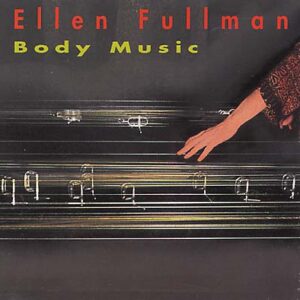
Body Music is music for Ellen Fullman’s unique Long String Instrument, an eighty-foot long instrument with approximately eighty strings. Fullman has been developing this instrument for longitudinally vibrating long strings over the past thirteen years. Having received a BFA in sculpture, her interest in music began with the resonance of materials used in making sculpture. When she started making the Long String Instrument, she saw it as "sculpture as music;" now she has come full circle in conceiving "music as sculpture." For the most part, the music in Body Music relies harmonically on the diatonic scale. Because of the prominence of overtone content, more complex harmony is suggested. Through her studies of extended harmony, Fullman has come to realize that harmony is "dimensional."
14,00€
Out of stock
CD
Annea LOCKWOOD – Ruth ANDERSON
“Sinopah”
World Rhythms originated as a ten-channel live improvisation in which the audience was surrounded by ten loudspeakers. The recorded sounds include volcanic eruptions, earthquakes, radio waves, geysers and pools, and tree frogs. These sounds are a physical manifestation of energies which shape us and our environment constantly, energies of which we are not always aware, but which powerfully influence and interact with the rhythms of our bodies.
15,00€
Out of stock
CD
Jean-Marie MASSOU
“Sodorome Vol. 1”
CD version + one track !!!
Some of you may have discovered Jean-Marie Massou in the film from Antoine Boutet, “Le Plein Pays”. We can see him gathering big stones, trying to clean the earth, and building an incredible cave. We also can see him working with different tape recorders. He likes recording his voice, some of his texts, mixing with some musics and local noises.
If you like outsider artists, you will love him !
It’s an incredible record highly recommended.
12,00€
In stock
CD
Aude ROMARY – Jérôme NOETINGER
“Discordes”
Aude Romary, cello. Jérôme Noetinger, electroacoustic devices.
This duo started in 2014 with the idea to transform the acoustic instrument into a real electroacoustic one.
Transducers, springs and microphones are attached to the cello which is then processed through electronic and tape.
This CD comes from several hours of improvisations recorded in studio and reorganised to build six pieces of abstract electroacoustic music.
10,00€
Out of stock
CD
John WALL
“Alterstill”
1995. “Samples, but very very interesting recompositions. Not media debris, scrap-irony, pick ’n’ mix, but solid, thorough compositions that have great tension and fascination in their structural unfolding. Great sensitivity to the minutiae of sound. First piece is a classic.”
12,00€
Out of stock
CD
John WALL
“Constructions I-IV”
1999. Compositions by John Wall using sounds from John Edwards, double bass; Mark Sanders, percussion; Andrew Sparling, clarinet; Mark Wastell, cello; Axel Dörner, trumpet.
11,00€
In stock
CD
Yannis KYRIAKIDES-Andy MOOR
“Folia”
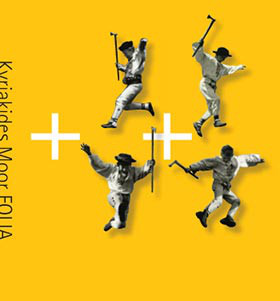
““Folia” is the third CD collaboration of Andy Moor (guitar) and Yannis Kyriakides (computer) created in 2009 and performed in numerous festivals and concerts that year. It is an epic reworking of the famous tune from the 16th and 17th centuries called “La Folia”. Fusing influences from this and South American folk music, they create a unique sound world of slowly evolving soundscapes, fluctuating beats, and rich oscillating harmonies.” label info
12,00€
Out of stock
CD
Robert ASHLEY
“Tap dancing in the sand”
A selection of pieces by the great musical pioneer Robert Ashley performed by the Dutch Ensemble MAE. Some of the works were especially written for the Ensemble in the last few years, and have never been recorded before, namely the title work “Tap Dancing in the Sand” featuring Ashley’s voice and “Hidden Similarites”. Other works presented on the CD are “Outcome Inevitable”, “in memoriam Esteban Gomez” and “She was a Visitor”.
12,00€
In stock
CD
Jacqueline HUMBERT & David ROSENBOOM
“Daytime viewing”
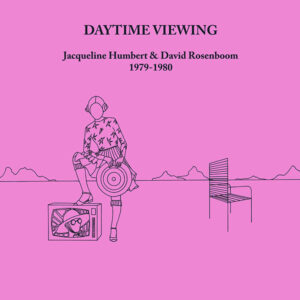
“Daytime Viewing (1979-80) is an extended narrative song, based on a casual analysis of daytime television drama and the audience phenomena such programming addresses. The piece explores the use of fantasy as a survival mechanism against loneliness, illustrating the human compulsion to inflate the mundane to mythological proportions. A central female character weaves tales, using threads of personal experience and the idea of TV as friend, as mantra, and as transformational window between imagined spectacle and the pedestrian plane.
Originally released as a private cassette edition documenting the collaborative performance piece of the same name by Jacqueline Humbert & David Rosenboom, this heady, thoroughly enjoyable work is available for the first time ever on CD and LP. Jacqueline Humbert (aka J. Jasmine) is a songwriter of brains and wit on par with Robert Ashley, with whom she’s worked extensively. David Rosenboom’s complex, harmonic electronic arrangements are accentuated brilliantly by percussion from William Winant. Daytime Viewing can happily be added to a small but significant group of work that, through lesser-known paths, engaged in an equally revelatory reexamination of the Great American Songbook as Minimalism did with 20th Century composition. Mastered by David Rosenboom.
13,00€
In stock

CD
Peter BRÖTZMANN – Sony SHARROCK
“Whatthefuckdoyouwant”
Peter Brötzmann, alto, tenor, bass saxophones, tarogato. Sonny Sharrock, electric guitar. Recorded: 09-03-1987.
15,00€
In stock

CD
Peter BRÖTZMANN & Johannes BAUER
“Blue City”
Peter Brötzmann, tenor & alto saxophone, tarogato, b-flat clarinet. Johannes Bauer, trombone.
It was of Peter Brötzmann’s great concern to pay his tribute to many years of comraderie and much music together - from Globe Unity times in the 70s, the PB Group, until the Chicago Tentet. In one of Brötzmann’s boxes this beautiful tape - live in Osaka 1997 - was sitting and waiting for a release!
It was of Peter Brötzmann’s great concern to pay his tribute to many years of comraderie and much music together - from Globe Unity times in the 70s, the PB Group, until the Chicago Tentet. In one of Brötzmann’s boxes this beautiful tape - live in Osaka 1997 - was sitting and waiting for a release!
15,00€
In stock

CD
Joe MCPHEE & Raymond BONI
“Live from the Magic City”
Joe McPhee, Soprano saxophone, electronics and voice. Raymond Boni, Electric guitar and electronics. The complete concert inspired by the words of Eric Dolphy. Recorded at Hulsey Recital Hall on the University of Alabama at Birmingham (UAB) campus. April 20,1985.
“When you hear music,
After it's over,
It's gone,
In the air,
You can never
Capture it
Again.”
Eric Dolphy
15,00€
Out of stock
CD
Hermann NITSCH
“Orgelkonzert Jesuitenkirche”
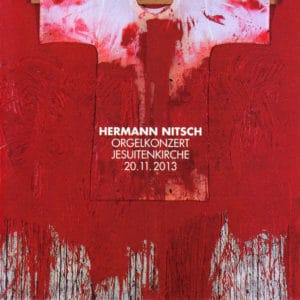
Hermann Nitsch playing the church organ in the Jesuit church of Vienna, 20.11.2013. 4 heavy drone pieces, mastered by Martin Siewert. Different cover-artwork on CD and vinyl. CD comes with 8 page booklet with artworks and essay by Nitsch about music (in German).
15,00€
In stock
CD
Christof KURZMANN – Mats GUSTAFSSON
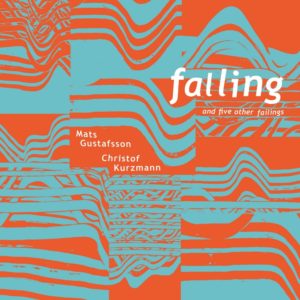
“Falling and five other Failings”
Mats Gustafsson plays slide, tenor, baritone, bass saxophones. Christof Kurzmann uses special ppooll software and voice, live processing. Recorded,mixed & mastered at Garnison 7, Vienna by Martin Siewert. Artwork by Jimmy Draht. Linernotes by Ken Vandermark.
The limited vinyl edition of 300 with screenprinted covers will come later.
15,00€
Out of stock

CD
Michèle BOKANOWSKI
s/t
“After “L’Ange” in 2003 and “Pour un Pianiste” in 2005, TraceLabel continues to explore the music of Michèle Bokanowski. This new release contains three pieces that were composed between 1975 and 1988. The first two works have already been the object of a discographic edition, however, the last piece “Phone Variations” has remained unpublished until today. Here you will find all the elements that are the mark of Michèle Bokanowski’s work: concrete sounds, obsessional mechanisms, the consideration of space, the underlining of the medium by a scriptwriting of the edit cuts, the primacy of expressiveness… In “Trois Chambres d’Inquiétude” (1975-1976), the minimalist sound materials (a child laughing, toys, women’s breath and voices, various looped sounds of machinery), serve a diffuse narrative dimension.The reference to the title of a series of etchings by the Danish artist, Lars Bo, confirms this illustrative lead. "Tabou" (1983-1984), on the other hand, reveals a more direct musicality, space and energy are opened out and developed with subtlety and skill. This piece, used by several choreographers (such as Hideyuki Yano in 1985 and Marceline Lartigue in 1993) introduced Michèle Bokanowski to the dance world. Lastly, with “Phone Variations” (1986-1988), the vocal messages and the music borrowed from telephone answering machines significantly expand the composer’s sound material and, in a sort of “found footage” approach, shed light upon the domestic and intimate dimension of these messages by staging them in the public musical space. The entire CD gives to the notion of “musique sur support” (music fixed on a medium) all it’s meaning. In fact, Michèle Bokanowski’s music brings into play an analogical and magnetic tape aesthetic, reminding us of the existence of electroacoustic music despite the hegemonic reign of digitalization and computers.”
13,00€
Out of stock

CD
Michèle BOKANOWSKI
“L’ange”
Original Music for the 1982 film “L’Ange” by Patrick Bokanowski. Composed in 1976-79. Coming from a family of musicians (professionals on her mother’s side, amateurs on her father’s side), she read, at the age of 22, À la recherche d’une musique concrète (In Search of a Concrete Music) by Pierre Schaeffer and decided to study composition. After a classical education in harmony, she met Michel Puig, a student of René Leibowitz, who taught her composition and analysis according to Schönbergian Principles. In September 1970, she began a two-year course at the Research Department of the ORTF under the direction of Pierre Schaeffer. At the same time, she participated in a sound synthesis research group, studied computer music at the Faculté de Vincennes as well as electronic music with Éliane Radigue. Between 1972 and 1984, she composed essentially for the concert - Korè, Pour un pianiste, Trois chambres d’inquiétude, Tabou - and for film - music for the short films by Patrick Bokanowski as well as his feature film L’Ange. Since 1985, she has composed for television, for theatre - with Catherine Dasté - and for dance, with choreographers Hideyuki Yano, Marceline Lartigue and Bernardo Montet.
13,00€
Out of stock
CD
Beatriz FERREYRA – Christine GROULT
“Nahash”
Beatriz Ferreyra on tape recorders and speed control. Christine Groult on samplers and effects. This duo was created for a GRM event. Prerecorded elements are used into different electroacoustic devices in the idea of creating complex sound in a playful way.
“The adventure began in 2011. Christian Zanesi, art director of the INA-GRM has the weird idea to order to Beatriz Ferreyra and Christine Groult an improvised duet with tape recorders within the framework of a « Weekend retro actif » at the Gaité lyrique,in Paris.
Beatriz Ferreyra brought its analog studio of the Seventies with four Revox tape recorders, an analog matrix and a sync box with vari speed, specially designed for her. The use of the magnetic tape is very manual and connects the energy of the movements of the body with the shaped sound. The use of the sampler, major instrument of the Nineties, is very particular and playful, it tends to be abandoned. However it allows to use audio recording with a singular and personal collection of sounds.
The interaction between these two very different technologies have rained to the two composers and stimulated them. But first, they seek the musical expression. They worked together to the building of the improvisation. Some common themes and some meaningful images guide them to the research of the sounds and to the configuration of the device for playing.
Why two versions ? It seemed interesting to offer an experience to the listener: two different improvisations are proposed, using the same sounds, the same devices and the same set of themes, but by permuting the various moments of the structure and by adding new sounds. What about the perception of these differences in electroacoustic ?”
12,00€
In stock
CD
SEC_
“Mefite”
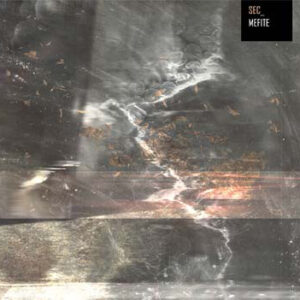
Composed, recorded, mixed and mastered by SEC_ between 2014 and 2015. Voice by M.DellaMorte. Words from Peter Liechti’s film “The Sound of Insects”, inspired by M. Shimada’s book “Diary of a mummy”. Premiered in Napoli as a live multichannel diffusion for several radios and speakers, with live voice. Thanks to Stefano Perna for radio broadcast technology and to M.DellaMorte for inspiring the concept.
Mefite is an Italic Goddess venerated in central and southern Italy, especially in the Irpinia Region. Goddess of fertility, she presides over the passage from life to death. Tremendous Goddess who has her cult-place located in the Ansanto Valley, the mortal moat, where horrible gas emissions coming out from a cave, carried by the wind, kill who goes too close.
A mortal air that governs the complex articulation of this cult: to ingratiate the Goddess it is forbidden to come too close to her, because you could die; to go through the Netherworld, instead, the same caution is requested, because the Death could enter the lungs before the way through is reached.
Through the words of “Diary of a mummy”, that already inspired the dearly departed film maker Peter Liechti, it was possible to approach this mysterious and unsettling subject. Here the passage between “this and the other world” is described almost literally, through the detailed diary of a death by starvation. A kind of suspension in the middle of the two, where death hits without a single touch, but, in doing it, gives also the opposite of what desired: nightmares instead of peace, pain instead of relief. A challenge that invites to move forward, towards the unfathomable zone that divides Life and Death.
12,00€
In stock
CD
BIOSPHERE
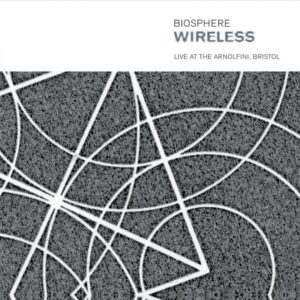
“Wireless-Live at the Arnolfini, Bristol”
Back in stock! “Recorded live at The Arnolfini, Bristol, 27th October 2007 by the doyen of sound recordists, Chris Watson, using 2 x Sony ECM 77s with a Nagra P11 Ares flash card recorder, and from desk to hard drive. The recording was mixed, edited and mastered by Touch stalwart BJNilsen, in Berlin during March 2009. This concert was part of Touch 25 Live, which also featured a performance of Storm [by Chris Watson & BJNilsen]. Biosphere is Norwegian composer and performer , and this is his sixth release for Touch. In the early 1990s he was a pioneer of so-called “ambient techno”, but since then, he has refined his sound into something more magnetic and enduring. His last album, Dropsonde, wasn’t a soundtrack like the interwoven Substrata, nor an episodic journey in the way that Autour de la Lune is. It pushed new directions towards the jazz colors of Miles Davis and Jon Hassell, while re-invigorating the pulse and projection of his signature sound: a hypnotic combination of pleasure and dread. Here Geir Jenssen takes this further, incorporating samples of field recordings by Jony Easterby and trumpet by Anders Karlskås, invoking a sparser, more arresting sound. A landmark release for Biosphere, his first live album, heralding new beginnings without jettisoning the past…” label info
13,00€
Out of stock
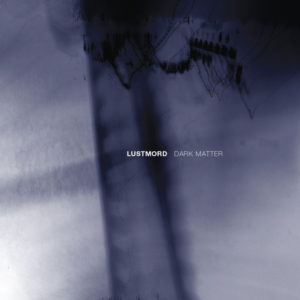
CD
LUSTMORD
“Dark matter”
Conceived and Produced by B.Lustmord. Recorded in Los Angeles October-December 2015. Artwork & Photography by Jon Wozencroft.
Derived from an audio library of cosmological activity collected between 1993 and 2003. It was gathered from various sources including NASA (Cape Canaveral, Ames, The Jet Propulsion Laboratory and Arecibo), The Very Large Array, The National Radio Astronomy Observatory and various educational institutions and private contributors throughout the USA.
Lustmord writes: “The Universe we inhabit is a vast expanse far larger than we are able to comprehend. As we attempt to understand its underlying structure and as we gain new insight into the nature of matter, new questions arise and further gaps in our understanding are revealed.
Behind the world that we experience lies a veil of darkness and much is hidden between, beyond and unseen.
We are limited by our inability to truly grasp the infinite breadth of the Universe, the time scales involved in its measure and our insignificant position within.
Some things will always be unknowable, and existence does not begin or end with man's conception.
Everything that has ever been observed by man, even with our most sophisticated instruments amounts, to less than five percent of the Universe.
Approximately sixty-eight percent of the Universe is unseen dark energy and approximately twenty-seven percent is unseen dark matter. We have yet to discover what dark matter is, and only know the things it is not. Although it has not been directly observed, its existence and properties are inferred from its effects on visible matter, its influence on the Universe's large-scale structure, and its effects in the cosmic microwave background.
The universe began of darkness, not of light.
While space is a virtual vacuum, it does not mean there is no sound in space. It exists in space as naturally occurring electromagnetic vibrations, many well within the range of human hearing while others exist at different regions of the electromagnetic spectrum and these can be adjusted with software to bring them within our audio range.
The recordings of these interactions in space come from several different environments including radio, ultra violet, microwave and X-ray data and within these spectra a wide range of sources including interstellar plasma and molecules, radio galaxies, pulsars masers and quasars, charged particle interactions and emissions, radiation, exotic astrophysical objects, cosmic jets and flares from magnetars.”
About Lustmord: Widely credited as the originator of the “Dark Ambient” genre. Credits on over forty motion pictures including The Crow and Underworld. One of the two composers for the Turtle Rock/2K game Evolve. Worked with John Balance, Chris & Cosey, Clock DVA, Current 93, Paul Haslinger, Maynard James Keenan, Melvins, Nurse With Wound, Tool and Wes Borland amongst others.
12,00€
In stock
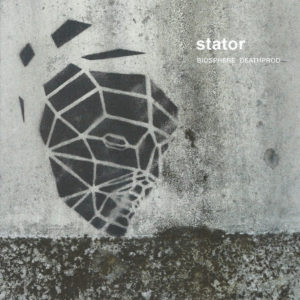
CD
BIOSPHERE DEATHPROD
“Stator”
Available on March 30.
stator ( ste t ) n
1. (Electrical engineering) The stationary part of a rotary machine or device, esp of a motor or generator.
2. (Aeronautics) A system of nonrotating radially arranged parts within a rotating assembly, esp the fixed blades of an axial flow compressor in a gas turbine
[C20: from Latin: one who stands (by), from st re to stand]
Biosphere is the main recording name of Geir Jenssen, a Norwegian musician who has released a notable catalogue of ambient electronic music.
He is well known for his “ambient techno” and “arctic ambient” styles, his use of music loops, and peculiar samples from sci-fi sources. His track “Novelty Waves” was used for the 1995 campaign of Levi’s. His 1997 album Substrata is generally seen as one of the all time classic ambient albums. Biosphere regularly performs live during electronic music festivals and in clubs throughout Europe and various other locales around the world. Live performances usually consist of Jenssen performing improvisations or variations on newer tracks on a laptop while video art is projected behind him; for example, full-screen video art was projected in his Picturehouse cinema tour in April 2006. Although these performances are rarely tied specifically to a recent album release, the uptempo material from the Bleep and Microgravity/Patashnik era is rarely featured in Biosphere performances. He has been working with Touch since 1999…
Deathprod is a musical pseudonym used by Norwegian artist Helge Sten. Sten began creating music under this name starting in 1991, culminating with a box set of most of his recorded work being released in 2004. Simply titled Deathprod, the collection contains three albums along with a bonus disc of previously unreleased, rare, and deleted tracks. On recordings, Sten is usually credited with “Audio Virus”, a catchall term for “homemade electronics, old tape echo machines, ring modulators, filters, theremins, samplers and lots of electronic stuff”. Sten also did the mixing of the album “PB” by the Norwegian artist Per Bergersen. Sten is a member of Supersilent and works as a producer on many releases on the Norwegian label Rune Grammofon. He has also produced Motorpsycho and has worked with Biosphere on an Arne Nordheim tribute album called Nordheim Transformed. Mastered by Helge Sten at Audio Virus LAB. This work was commissioned by Tape To Zero.
13,00€
Out of stock
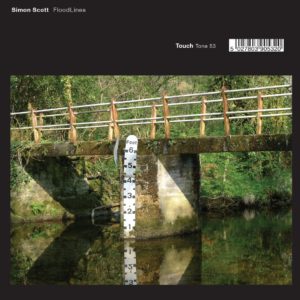
CD
Simon SCOTT
“Floodlines”
Recorded live at Cafe Oto as part of “Touch presents…” on 31st January 2016
Simon Scott is a sound ecologist and multi-instrumentalist from Cambridge, England. His albums ‘Insomni’ (Ash International) and ‘Below Sea Level’ (12k / TouchLine) are out now (see above). His work explores the creative process of actively listening, the implications of recording the natural world using technology and the manipulation of natural sounds used for musical composition. He plays the drums in Slowdive and has recently collaborated with artists James Blackshaw, Spire, Taylor Deupree (Between), Isan + many more.
This is his first physical release for Touch.
Source material recorded in The Fens, East Anglia.
Simon Scott's blistering live set from London follows his 2015 album ‘insomni’ but features his field recordings of areas of The Fens in East Anglia that cartographically are below mean sea level. They’re complimented by underwater hydrophone recordings taken on field research trips, making the unheard audible and brings the unseen to the surface. It’s a flat landscape that was devastated by the draining of The Fens in the 17th century. The ecosystem was damaged but these areas have been left to reflood and re-establish it’s vernacular wildlife, replete with its own instrumentation and orchestras. Tapping into these, Scott's vision encourages us to explore the fertility of the flatlands of England.
Simon Scott is a sound ecologist and multi-instrumentalist from Cambridge, England. His albums ‘Insomni’ (Ash International) and ‘Below Sea Level’ (12k / TouchLine) are out now (see above). His work explores the creative process of actively listening, the implications of recording the natural world using technology and the manipulation of natural sounds used for musical composition. He plays the drums in Slowdive and has recently collaborated with artists James Blackshaw, Spire, Taylor Deupree (Between), Isan + many more.
This is his first physical release for Touch.
Source material recorded in The Fens, East Anglia.
Simon Scott's blistering live set from London follows his 2015 album ‘insomni’ but features his field recordings of areas of The Fens in East Anglia that cartographically are below mean sea level. They’re complimented by underwater hydrophone recordings taken on field research trips, making the unheard audible and brings the unseen to the surface. It’s a flat landscape that was devastated by the draining of The Fens in the 17th century. The ecosystem was damaged but these areas have been left to reflood and re-establish it’s vernacular wildlife, replete with its own instrumentation and orchestras. Tapping into these, Scott's vision encourages us to explore the fertility of the flatlands of England.
9,00€
Out of stock
CD
Ryoji IKEDA
“Matrix”
“This is Ryoji Ikeda’s fifth solo CD and his third for Touch, following the highly acclaimed +/- [1996] and 0*C [1998]. He previously released 1000 Fragments on his own cci recordings, and Time and Space, a double 3” CD, for Staalplaat.
15,00€
Out of stock
CD
Ryoji IKEDA
“+–”
Back in stock. 4th edition. This is Ryoji Ikeda’s 1st CD for Touch. Released originally in 1996, a new version for the Millennium was released in 2000. +/- has a particular sonority whose quality is determined by one’s listening point in relation to the loudspeakers. Furthermore, the listener can experience a particular difference between speaker playback and headphone listening. The sound signals can be thought of in the same way as spotlights. Lastly, a high frequency sound is used that the listener only becomes aware of upon its disappearance.
12,00€
Out of stock
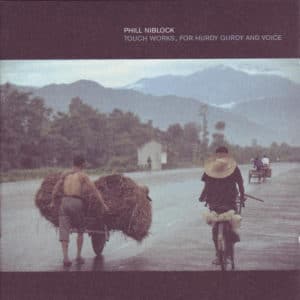
CD
Phill NIBLOCK
“Touch works, for hurdy gurdy and voice”
This is the first CD by Phill Niblock for Touch. Thomas Buckner, baritone voice (samples and live) All were completed with Protools software in a Macintosh computer, and are 24 tracks mixed to stereo. There are two versions of the voice piece, one the original tape piece, the other a version with three added voices, live, plus four tracks of pitch shift on each, done in Robert Poss’s (Trace Elements) studio. Samples and live elements were recorded by Robert Poss at Trace Elements Studios in New York. The pieces were constructed and mixed in ProTools by Phill Niblock at Experimental Intermedia in New York. [AYU was commissioned by Thomas Buckner] Track Listing: "Hurdy Hurry" (October 1999) Jim O’Rourke, hurdy gurdy (samples). "A Y U", aka "as yet untitled" (October 1999) Thomas Buckner, baritone voice (samples). "A Y U, Live" (October 1999/2000).
12,00€