
Out of stock
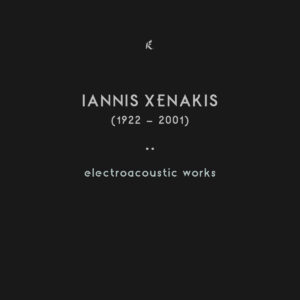
5 CD box
Iannis XENAKIS
“Electroacoustic Works”
2024 repress
The 5 CD box set „Electroacoustic Works“ celebrates the 100th anniversary of IANNIS XENAKIS (on May 29th, 2022), one of the most influential 20th century avantgarde composers. All tracks have been newly mixed by longtime zeitkratzer sound engineer MARTIN WURMNEST and mastered by RASHAD BECKER and finally reveal their full sonic range and dynamics. Booklet with English / German liner notes by REINHOLD FRIEDL (zeitkratzer) and rare photos from the Xenakis archive.
IANNIS XENAKIS (1922-2001) is one of the most important composers of the 20th century avantgarde whose influence on music can be traced to the present day – not only in the world of conservatory-trained composers but also in various streams of current non-academic underground aesthetics such as experimental electronic music, noise and industrial.
After he arrived in Paris in 1947, XENAKIS not only studied composition with MESSIAEN and later became a member of the famous GRM (Groupe de recherches musicales), he also worked as assistant to the famous architect LE CORBUSIER and realized a.o. the Philips Pavilion for the World Exhibition in Brussels 1958. His compositions often are based on mathematical principles which give his music an unprecedented aesthetic and “shocking otherness” (The Guardian).
Although XENAKIS also composed for orchestra (his most famous works are “Metastasis“, “Pithoprakta” and “Terretektorh”), electronic music became his way for exploring new ideas and concepts and to develop new techniques like a graphic interface for sound synthesis or later, when computers were easier accessible, his so-called "stochastic synthesis" (Gendy 3, S.709 > Disc V, Late Works).
XENAKIS’ first electroacoustic pieces (Disc I) like “Diamorphoses” or “Bohor” turned out groundbreaking works while the latter even caused, as MICHEL CHION put it, the “greatest scandal of electroacoustic music” on the occasion of its performance 1968 at the GRM in Paris.
His so-called „Polytopes“ (Discs II - IV) were overwhelming multimedia performances with especially designed architectures, laser and light shows etc. where sometimes up to several hundred loudspeakers were used to move the sounds in space. For example his most famous composition “Persepolis”, commissioned by the Persian Shah, premiered in 1971 in Shiraz-Persepolis (Iran) as a performance including light-tracks, laser beams, groups of children walking around with torches and 59 loudspeakers to project the music in an open-air situation.
The most radical aspects of sound can be found in Xenakis' late work and its merciless reduction to harsh, almost ruthless sound synthesis. In the early nineties, he devoted himself to the concept of a composing machine: a machine that designs everything independently and calculates the finished piece, the algorithm is the work.
For the first time, the complete electroacoustic works of XENAKIS are now available on record – the truly overdue testimony and legacy of a restless investigator and explorer of sound. Years of source studies and comparative research by zeitkratzer director REINHOLD FRIEDL, in collaboration with sound engineer MARTIN WURMNEST, made these critically reflected stereo mixes possible, which were appropriately mastered by RASHAD BECKER and which, in addition to the aspect of fidelity to the source, put the listener in the center. Xenakis' adventurous music can now finally be enjoyed in its full sonic range and dynamic.
To quote The Wire’s review from May 2018:
“This is the definitive Persepolis“
45,00€
In stock
LP
Phill NIBLOCK – Anna CLEMENTI – Thomas STERN
“Zound Delta 2”
A new piece by minimalist / experimental composer Phill Niblock (1933 – 2024), co-composed and performed by Anna Clementi & Thomas Stern. Intense, menacing layers of thick drones and alien sounds.
In summer 2022, within just a few weeks and by pure coincidence, 2 proposals regarding Phill Niblock albums arrived: one suggesting an overdue vinyl reissue of a CD release (more on that when the time has come for it), the other email was from Anna Clementi saying she and Thomas Stern were working on new pieces that Phill Niblock has written for her … when „Zound Delta 2“ was complete, Phill sent photographs for the two artworks, we met twice to discuss details, but unfortunately he died unexpectedly early january this year so the album now is, sad as it is, a posthumous release … an intense goodbye from one of 20th century most iconic composers.
Anna Clementi: voice
Thomas Stern: slide guitar, bass and soundprocessing
20,50€
In stock
CD
Phill NIBLOCK – Anna CLEMENTI – Thomas STERN
“Zound Delta 2”
A new piece by minimalist / experimental composer Phill Niblock (1933 – 2024), co-composed and performed by Anna Clementi & Thomas Stern. Intense, menacing layers of thick drones and alien sounds.
In summer 2022, within just a few weeks and by pure coincidence, 2 proposals regarding Phill Niblock albums arrived: one suggesting an overdue vinyl reissue of a CD release (more on that when the time has come for it), the other email was from Anna Clementi saying she and Thomas Stern were working on new pieces that Phill Niblock has written for her … when „Zound Delta 2“ was complete, Phill sent photographs for the two artworks, we met twice to discuss details, but unfortunately he died unexpectedly early january this year so the album now is, sad as it is, a posthumous release … an intense goodbye from one of 20th century most iconic composers.
Anna Clementi: voice
Thomas Stern: slide guitar, bass and soundprocessing
14,00€
In stock
CD
Reinhold FRIEDL / Martin SIEWERT
“Lichtung”
Reinhold Friedl (piano) meets Radian member Martin Siewert (guitar, electronics): three spontaneous sonic explorations – subtle and explosive!
With over a dozen releases on Karlrecords, and a total output of more than 100 albums in general, Reinhold Friedl doesn’t need much of an introduction to anyone interested in contemporary music / avantgarde: his ensemble zeitkratzer is as respected as it is feared for its radical approach on music, and it seems redundant to mention all collaborators and projects. Friedl is known for his unique piano sound, his advanced techniques, and his musical intensity paired with precise exuberant sound constructions and consistent compositional thinking. He cooperated with musicans from Phil Niblock to Lou Reed, Mario Bertoncini (Gruppo di Improvvisazione Nuova Consonanza) to Whitehouse, Laurie Anderson to Rashad Becker and works as guest professor at various universities across Europe. The “multi-talented renaissance man” (as Naut Human turned it) is also known as a specialist for Iannis Xenakis, and curates the Perihel series on Karlrecords.
„Lichtung“ is the collaboration of Friedl and no other than Vienna-based Martin Siewert, himself a highly prolific and reputated innovative guitar player and producer in groups like Radian or Trapist. Martin Siewert played with the who is who in experimental and improvised music and celebrated his strong musical identity in international collaborations with Otomo Yoshihide to Oren Ambarchi, Meg Stuart to Christian Fennesz, Sainkho Namtchylak to The Necks. Siewerts guitar play at the intersection of acoustic / electronic generated sounds is unique, evoking echoes of krautrock and musique concrete to electronic jazz and avantgarde.
“Lichtung” was recorded in Vienna: Several studio meetings condensed to three intense tracks, a statement and musical adventure between noise and silence, subtle and explosive! Two musicians, who couldn’t be more diverse, here – in every sense – they act in concert.
14,00€
In stock

2 LP
PITA / FRIEDL
“Pita / Friedl”
Electronic music legend and head of Editions Mego, Peter Rehberg, teams up with zeitkratzer mastermind Reinhold Friedl. 3 side-long pieces melting electronic / contemporary avantgarde. Uncompromising.
When Peter "Pita" Rehberg and Reinhold Friedl first met each other, they did not like each other "at all," as Friedl emphasises with a hearty laugh. The two would however eventually bond over the years thanks to a mutual respect for each other's music. In the summer of 2021, they entered the studio together for the first time. Their joint album for Berlin's Karlrecords is a faithful document—no editing, no overdubs—of their improvisations during two recording sessions shortly before Rehberg's sudden and untimely passing on July 22nd of that year. The three pieces see Rehberg working with electronics and Friedl with his inside piano, proving that they had indeed managed to find a common ground—up to a point where it at times becomes hard to tell who plays what on this record.
27,00€
In stock

LP
ZEITKRATZER
“James Tenney”
By zkr director Reinhold Friedl’s personal request now available on vinyl for the first time: Zeitkratzer's critically acclaimed interpretations of groundbreaking compositions by James Tenney.
James Tenney (1934 - 2006) was a composer, music theorist and pioneer especially in the field of microtonal music, being an influential part of the so-called New York avantgarde scene (Cage, Feldman). Besides his compositonal work, Tenney was teacher at various universities with students like Charlemagne Palestine, Carl Stone Or Catherine Lamb, and a close friend with Eliane Radigue.
This album by Zeitkratzer presents three compostions by Tenney whose music has been part of zeitkratzer’s repertoire since their beginning:
- « Critical Band » – Tenney’s late classic – with maximum clarity and precision of bearing tone rhythms and microtonal tuning as light effect.
- the first recording of « Harmonium #2 ».
Both works demonstrate the remarkable power and resplendent sharpness which Tenney achieved with his microtonal settings.
Zeitkratzer’s approach to Tenney’s music as a sensual sound adventure, finally available on vinyl.
20,50€
In stock
LP
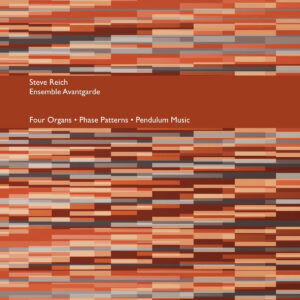
Steve REICH – Ensemble AVANTGARDE
“Phase Patterns / Pendulum Music / Piano Phase / Four Organs”
2022 repress
Three early compositions (1968-1970) by Steve Reich, one of the most prolific exponents of minimal music, in stunning interpretations by the critically acclaimed Ensemble Avantgarde. Available on vinyl (180gr, gatefold sleeve incl. download code) for the first time ever!
Steve Reich (born 1936) is undoubtedly one of the key figures in 20th century contemporary music and along with Terry Riley or Philip Glass one of the founding fathers of so-called minimal music. With classics like “Music For 18 Musicians”, “Drumming” or “Different Trains” the American composer proved himself one of "a handful of living composers who can legitimately claim to have altered the direction of musical history" (The Guardian). The four pieces on this collection date back to the time before his famous master pieces (1967-1970): “Four Organs” and “Phase Patterns” build on short, repeated patterns that gradually go in and out of phase with each other, creating “a shimmering matrix of sound that is both hypnotic and fascinating in detail” (Allmusic.com) and anticipate Reich’s later trademark sound. “Pendulum Music” is a process piece where only a few starting parameters are given: four microphones are suspended within an array of amplifiers and speakers, then set in motion - the shifts in feedback as they move in space create the music, the results differ with each new performance (as can be experienced listening to the 2 versions here). Reich’s early works are presented on this LP in stunning interpretations by Leipzig based Ensemble Avantgarde whose dedicated, inspired renditions of essential masterpieces of modernism (documented on CDs on reputated labels such as Wergo or Hat Hut Records) won them the Ernst von Siemens Foundation Prize and the Schneider-Schott Prize of Mainz.
20,50€
In stock
LP
MIMICOF
“Distant Symphony”
New album by the Berlin-based musician, composer and producer Midori Hirano aka MimiCof, entirely recorded using the EMS SYNTHI100 at Electronic Studio Radio Belgrade during an artist residency: contemporary electronic music / ambient for the advanced listener.
Midori Hirano is a Japanese musician, composer and producer based in Berlin. She started learning the piano as a child and later studied classical piano at university. Therefore the music she releases under her own name is based on the use of piano, but yet experimental and an eclectic mixture of modern digital sounds with subtle electronic processing and field recordings. So far, Hirano released 7 solo albums under her civilian name on labels such as Sonic Pieces and DAUW.
Under the moniker MimiCof she explores the realm of more experimental music and detailed rhythmic patterns, combined with an idea of drawing melodic shapes and harmonies.
While the last MimiCof album “Moon Synch” (2017, Alien Transistor) was recorded on the Buchla analogue modular Synthesizer at EMS Elektronmusikstudion in Stockholm, her latest effort “Distant Symphony” (the 4th as MimiCof) was created on a different synthesizer: the EMS SYNTHI 100 Synthesizer at Radio Belgrade. All sounds from this instrument were recorded as single sound samples at first, then mixed and modified into three long pieces of music, so that the audience can experience the machine’s uniqueness and versatility of sound. Hirano understands this work as a gesture of respect for the SYNTHI 100’s character: though a vintage instrument, it has never lost the beauty of its modern sound.
20,50€
In stock
2 LP
KONSTRUKT & Peter BRÖTZMANN
“Dolunay”
The ongoing series / tradition of a Konstrukt release in august this time returns to the early beginning: the overdue double vinyl reissue of the turkish free-formers’ studio meeting with the german free jazz titan Peter Brötzmann from 2008. Remastered by Kassian Troyer at D&M, Berlin.
As written in several info sheets before, the Istanbul-based collective led by multi-instrumentalist Umut Çağlar (also member of Karkhana) and reeds player Korhan Futaci has since its formation in 2008 created an impressive catalogue including collaborations / performances with significant musicians like Keiji Haino, Joe Mcphee, William Parker, Akira Sakata, Marshall Allen, Evan Parker, Thurston Moore, Michael Zerang, Alfred Harth Or Alexander Hawkins – and Peter Brötzmann. The German Free Jazz titan was invited to the Deneyevi Studio in the Turkish capital in november 2008 where they recorded „Dolunay“, an album that was released three years later on a small label in Turkey only. Back then a quartet with drums and percussion, guitar, reeds but no bass player, Konstrukt and their iconic guest took off on a session full of fire and fury: shrieking reeds, thundering drums andandand … Free Jazz of the wildest, most energetic and kathartic (afterwards) kind!
27,00€
In stock

LP
ZEITKRATZER
“Alvin Lucier”
By zkr director Reinhold Friedl’s personal request now available on vinyl for the first time: zeitkratzer's critically acclaimed interpretations of compositions by Alvin Lucier.
Alvin Lucier (1931 – 2021) was one of the most influential american minimalists. Some call him „sound physician“ as his compositions are often based on acoustic research settings. His pieces tend to turn inside-out the properties of space and instruments: poems based on acoustic settings!
Zeitkratzer worked with the composer in Dijon, France in 2008, and presented his music in various places. These recordings have been realized at Philharmonie Luxembourg that turned out to be the ideal space for this music.
On this album you can hear how Lucier enables zeitkratzer to create sounds a lot of people have never heard before. Ringing overtones, a singing piano, a thrilling concert triangle, pencils on little objects, and how irritating a violoncello, a viola and a piano can sound together creating shifting sonic interferences. Sound phenomenology, evoking a sensual listening experience.
20,50€
In stock

LP
Iannis XENAKIS
“Taurhiphanie / Voyage Absolu Des Unari Vers Andromède / Gendy 3 / S.709”
A1/ Taurhiphanie (1988)
A2/ Voyage Absolu Des Unari Vers Andromède (1989)
B1/ Gendy 3 (1991)
B2/ S.709 (1992)
20,50€
In stock

LP
Iannis XENAKIS
“Hibiki Hana-Ma / Mycenae Alpha / Polytope de Cluny”
A1/ Hibiki Hana-Ma (1962)
A2/ Mycenae Alpha (1696)
B/ Polytope De Cluny (1978)
20,50€
In stock

LP
Iannis XENAKIS
“Diamorphoses / Concret PH / Orient Occident / Bohor”
A1/ Diamorphoses (1957)
A2/ Concret PH (1958)
A3/ Orient Occident (1961)
B/ Bohor (1962)
20,50€
In stock

LP
Iannis XENAKIS
“Persepolis”
2022 repress.
After “La Légende d’Eer” in 2016, the Perihel series presents one of the milestones of electroacoustic music: Iannis Xenakis’ mindblowing 54-minutes oeuvre “Persepolis”, mixed from the original 8 track tapes by Martin Wurmnest and mastered / cut by Rashad Becker.
“Persepolis” is the longest electroacoustic composition by Iannis Xenakis (1922-2001) who ranks among the most influential 20th century avantgarde composers. Commissioned by the Persian Shah, the piece was part of a multimedia performance – Xenakis’ so-called “polytopes” – which premiered in 1971 in Shiraz-Persepolis (Iran) as a performance including light-tracks, laser beams, groups of children walking around with torches and 59 loudspeakers to project the music in an open-air situation.
Xenakis had realized “Persepolis” on 8-track analogue tape in the Studio Acusti in Paris and released a stereo reduction on vinyl in the famous Philips series “Prospective 21e Siècle” in 1972, adding the new subtitle “We bear the light of the earth”, his most hymnal title ever.
Out of print for decades now, the LP became – especially the Japanese edition from 1974 – one of the most expensive collector’s item of electroacoustic music. There were some later CD versions with different durations – too long due to a wrong sample rate, others shortened by 3 minutes due to other reasons. The Perihel series now presents a new version: mixed from the original (!) master 8 track tapes by longtime zeitkratzer sound engineer Martin Wurmnest and mastered by Rashad Becker at D&M, Berlin – the same experts who had already taken care of the 2016 KarlRecords release of “La Légende d’Eer”, another milestone composition among the works of the Greek-French avant-garde composer.
20,50€
In stock

LP
Iannis XENAKIS
“La légende d’Eer”
2022 repress.
180gr LP incl. 4c insert + download code, 1000 items.
Release
2 in the Perihel series is one of the most famous electroacoustic compositions by Iannis Xenakis. Mixed by Martin Wurmnest, mastered & cut by Rashad Becker, “La Légende d’Eer” is available as vinyl (180gr, DL code, insert with liner notes by Reinhold Friedl) and download for the very first time.
When Iannis Xenakis (1922-2001), who had fought against the occupation as part of the communist Resistance, moved to Paris in 1947 it was the start of a highly creative and impressive career. Xenakis not only studied composition with Messiaen and became one of the most innovative composers of the 20th century, he also worked as assistant to Le Corbuser and realized a.o. the Philips Pavilion for the World Exhibition in Brussels 1958. His compositions often are based on mathematical principles (in 1966 he founded the CEMAMu - Centre d'Etudes de Mathématique et Automatique Musicales), which give his music an unprecedented aesthetic and “shocking otherness” (The Guardian). The most famous works of Xenakis, who won the Polar Music Prize (considered the unofficial Nobel Prize for music) in 1999, are his compositions for orchestra Metastasis, Pithoprakta and Terretektorh (where the 88 musicians are spread within the audience) and the electroacoustic compositions Persepolis (to be re-released later on as part of the Perihel series), Concret PH, Bohor and La Légende d’Eer where Xenakis integrated his stochastic synthesis sounds for the first time. As legendary as this piece itself is the impenetrable thicket of versions and stories around La Légende d’Eer - it exists in different releases, wrong sample rates, digitized backwards… this now is a new version, using the 8-track-version that Xenakis himself presented at Darmstädter Ferienkurse in August 1978. As the automatic spatialization is lost, this became the only original version of this composition and is presented here (mixed down to stereo by Martin Wurmnest who tried to preserve the spatial movements as perceptible as possible – mastered by Rashad Becker at D&M) for the very first time. La Légende d’Eer not only became a milestone of electroacoustic music but is also an important reference for noise and industrial musicians up to the present day!
20,50€
In stock
LP
Mesias MAIGUASHCA
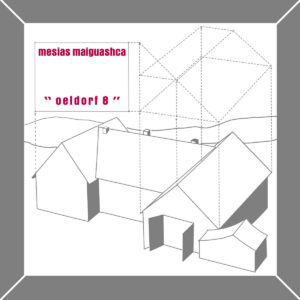
“Oeldorf 8”
First-ever official re-issue of the Ecuadorian composer’s stunning electroacoustic composition “Oeldorf 8” on vinyl and CD. Remastered by KASSIAN TROYER at D&M, Berlin.
MESÍAS MAIGUASHCA (b. December 24th, 1938 in Quito / Ecuador) is a composer of Neue Musik, especially electroacoustic music, who studied at the Conservatorio Nacional de Quito, at the Eastman School of Music in Rochester, NY (1958–65), with ALBERTO GINASTERA at the Instituto di Tella in Buenos Aires, at the Hochschule für Musik in Cologne and, after a short return to Ecuador, attended the Internationale Ferienkurse für Neue Musik in Darmstadt and the Fourth Cologne Courses for New Music in 1966–67 where he studied with KARLHEINZ STOCKHAUSEN. From 1968 to 1972, MAIGUASHCA worked closely with STOCKHAUSEN in the Electronic Music Studio of the Westdeutscher Rundfunk in Cologne and joined STOCKHAUSEN's ensemble for performances at the German Pavilion at the Expo '70 in Osaka. In 1971 he became a founding member of the OELDORF GROUP of composers and performers, and began work at the Centre Européen pour la Recherche Musicale in Metz, at IRCAM in Paris, and at the ZKM in Karlsruhe. From 1990 – 2004 MAIGUASHCA was Professor of Electronic Music at the Musikhochschule of Freiburg im Breisgau where he still lives today.
The OELDORF GROUP, named after the small village 40 km away from Cologne where they lived and worked in a rented farmhouse where they set up their own studio for electronic music and studio productions, was a musicians' collective active during the 1970s. In the adjacent barn, the group held concerts for audiences up to 300 people with an emphasis on live-electronic music and other kinds of new and avant-garde music. Thanks to a long-standing contact with the Westdeutscher Rundfund, the core members of the OELDORF GROUP (PETER EÖTVÖS - electronics and keyboards, the violinist/violist and composer JOACHIM KRIST, electronics specialist and composer MESÍAS MAIGUASHCA, who also played keyboards, and his wife GABY SCHUMACHER – cello) received commissions for compositions, invitations to perform in the Musik der Zeit concert series, as well as having many of their summer concerts recorded for the late-night broadcasts of WDR3.
One of these commissioned compositions is „Oeldorf 8“: a retrospective portrait of the OELDORF GROUP consisting of a series of ten short pieces for four instrumentalists (clarinet, violin, cello, electric organ/synthesizer) and tape which may be played either simultaneously or continuously without a break. It premiered in 1974 at the Darmstädter Ferienkurse and was released on LP two years later and turned into a sought-after, but not very well-known rarity achieving collector‘s prices., and was later unofficially reissued on KEITH FULLERTON-WHITMAN’s Creep Pone CDr label.
Conceived as a sonic diary with an edge to encompass radical electronic synthesis, the 48 minute composition proves „ … a thing of wonder; from the outset, MAIGUASHCA's spoken introduction of the players & concept gets slowly eroded by errant, pointillist electronic sound … which then lets loose for a good 10 minutes before a swarm of slowly rising held tones c/o the players acoustic arsenal slowly comes to the fore. On the second side, the acoustic sounds - patiently, elegantly state their cases across a good half of the segment until a rising pulse-wave drone essentially annihilates the more nuanced phrasing & slowly builds to an almost ROLAND KAYN-esque climax of raw oscillator gristle” (Soundohm).
44 years after its original release, MAIGUASHCA’s stunning album finally sees its deserved and overdue re-release on CD and LP, carefully remastered by KASSIAN TROYER at D&M, Berlin.
„Maiguashca … is part of the first generation of South American maverick sound explorers that in the 1960s paved the way for a tradition of innovation that persists in the present noise and psychedelic scenes of the continent. Along with Edgar Valcárcel, César Bolaños, Beatriz Ferreyra, Mauricio Kagel or José Vicente Asuar, he contributed to expand the possibilities of musical language beyond the dominant Western canon …“ David Jarrin / Kraak Festival
19,00€
In stock
CD
Mesias MAIGUASHCA
“Oeldorf 8”
First-ever official re-issue of the Ecuadorian composer’s stunning electroacoustic composition “Oeldorf 8” on vinyl and CD. Remastered by KASSIAN TROYER at D&M, Berlin.
MESÍAS MAIGUASHCA (b. December 24th, 1938 in Quito / Ecuador) is a composer of Neue Musik, especially electroacoustic music, who studied at the Conservatorio Nacional de Quito, at the Eastman School of Music in Rochester, NY (1958–65), with ALBERTO GINASTERA at the Instituto di Tella in Buenos Aires, at the Hochschule für Musik in Cologne and, after a short return to Ecuador, attended the Internationale Ferienkurse für Neue Musik in Darmstadt and the Fourth Cologne Courses for New Music in 1966–67 where he studied with KARLHEINZ STOCKHAUSEN. From 1968 to 1972, MAIGUASHCA worked closely with STOCKHAUSEN in the Electronic Music Studio of the Westdeutscher Rundfunk in Cologne and joined STOCKHAUSEN's ensemble for performances at the German Pavilion at the Expo '70 in Osaka. In 1971 he became a founding member of the OELDORF GROUP of composers and performers, and began work at the Centre Européen pour la Recherche Musicale in Metz, at IRCAM in Paris, and at the ZKM in Karlsruhe. From 1990 – 2004 MAIGUASHCA was Professor of Electronic Music at the Musikhochschule of Freiburg im Breisgau where he still lives today.
The OELDORF GROUP, named after the small village 40 km away from Cologne where they lived and worked in a rented farmhouse where they set up their own studio for electronic music and studio productions, was a musicians' collective active during the 1970s. In the adjacent barn, the group held concerts for audiences up to 300 people with an emphasis on live-electronic music and other kinds of new and avant-garde music. Thanks to a long-standing contact with the Westdeutscher Rundfund, the core members of the OELDORF GROUP (PETER EÖTVÖS - electronics and keyboards, the violinist/violist and composer JOACHIM KRIST, electronics specialist and composer MESÍAS MAIGUASHCA, who also played keyboards, and his wife GABY SCHUMACHER – cello) received commissions for compositions, invitations to perform in the Musik der Zeit concert series, as well as having many of their summer concerts recorded for the late-night broadcasts of WDR3.
One of these commissioned compositions is „Oeldorf 8“: a retrospective portrait of the OELDORF GROUP consisting of a series of ten short pieces for four instrumentalists (clarinet, violin, cello, electric organ/synthesizer) and tape which may be played either simultaneously or continuously without a break. It premiered in 1974 at the Darmstädter Ferienkurse and was released on LP two years later and turned into a sought-after, but not very well-known rarity achieving collector‘s prices., and was later unofficially reissued on KEITH FULLERTON-WHITMAN’s Creep Pone CDr label.
Conceived as a sonic diary with an edge to encompass radical electronic synthesis, the 48 minute composition proves „ … a thing of wonder; from the outset, MAIGUASHCA's spoken introduction of the players & concept gets slowly eroded by errant, pointillist electronic sound … which then lets loose for a good 10 minutes before a swarm of slowly rising held tones c/o the players acoustic arsenal slowly comes to the fore. On the second side, the acoustic sounds - patiently, elegantly state their cases across a good half of the segment until a rising pulse-wave drone essentially annihilates the more nuanced phrasing & slowly builds to an almost ROLAND KAYN-esque climax of raw oscillator gristle” (Soundohm).
44 years after its original release, MAIGUASHCA’s stunning album finally sees its deserved and overdue re-release on CD and LP, carefully remastered by KASSIAN TROYER at D&M, Berlin.
„Maiguashca … is part of the first generation of South American maverick sound explorers that in the 1960s paved the way for a tradition of innovation that persists in the present noise and psychedelic scenes of the continent. Along with Edgar Valcárcel, César Bolaños, Beatriz Ferreyra, Mauricio Kagel or José Vicente Asuar, he contributed to expand the possibilities of musical language beyond the dominant Western canon …“ David Jarrin / Kraak Festival
14,00€
In stock
LP
KONSTRUKT & Otomo YOSHIHIDE
“Eastern Saga: Live at Tusk”
Turkish free jazzers Konstrukt continue their series of exciting collaborations with Otomo Yoshihide, highly reputated multi-instrumentalist and composer in the experimental world.
# 4 in the continuing series of Konstrukt collaborations on Karl is a live document of the concert by the Turkish freeform group with the Japanese experimental musician Otomo Yoshihide from the Tusk Festival 2018. Konstrukt, the Istanbul based free jazz / freeeform group founded and led by Umut Çağlar and Korhan Futacı, are known for their openness to and interest in collaborations – and regularly meet up and perform with new partners that range from Joe McPhee, William Parker, Akira Sakata, Marshall Allen, Evan Parker, Thurston Moore, Alexander Hawkins or Ken Vandermark. This latest release sees the quintet join forces with Otomo Yoshihide who entered the scene in the 1990s with his group Ground Zero and his since worked in all fields of adventurous music, from EAI to improv to turntablism, modern composition, jazz and soundtrack, documented on labels like Tzadik or Erstwhile and featuring collaborateurs such as Jim O’Rourke, John Zorn, Merzbow, Bill Laswell and endless more ...
"Eastern Saga: Live at Tusk" shows the multi-instrumentalist on his 2 key instruments guitar and turntables, while Konstrukt feature 2 drummers besides Korhan Futacı’s saxophone / flute , Umut Çağlar on guitar, synth, double reeds, flutes and double bass player Apostolos Sideris.
A furious gig, and a furious album!
Korhan Futacı: alto saxophone, flute, loops
Umut Çağlar: guitar, synth, double reeds, flutes
Apostolos Sideris: double bass
Erdem Göymen: drums
Ediz Hafızoğlu: drums
+
Otomo Yoshihide: guitar, turntables
19,00€
Out of stock
2 LP
Bérangère MAXIMIN
“Land of waves”
On her 6th album, the French electroacoustic composer Bérangère Maximin explores the idea of a kaleidoscopic world – a sonic aggregation of living creatures, plants, minerals, nature and buildings, using various sound objects, small percussions, synths, electric gui-tar, voice and electronics.
Working out of her private studio since 2008, Bérangère Maximin has developed her own ap-proach to sound art and electronic music, composing dense, immersive pieces with immediate im-pact. On five albums – released to critical acclaim on Tzadik, Sub Rosa, Crammed Discs and Craig Leon’s Atlas Realisations label – she has revealed a taste for mixing disparate sounds together with a sense of detail, effusive, lyrical playings with the digital material and tight nuanced writing. Bérangère Maximin’s music engages the listener in consideration of space and textures, the sound ambivalence and its independence from its original source being at the center of her work.
During her career, the French composer has obtained commissions and residencies in National Music Research Centres such as Paris‘ Ina-GRM, Stockholm’s EMS and received a grant from the ‘Villa Medicis Hors Les Murs’ program in New York City (Cultures France). She has performed in notable festivals, venues and concert halls from Paris’ Présences Electronique festival, London’s Hayward gallery, NYC’s Roulette, Hamburg’s Elbphilharmonie’s e-Phil series to major international festivals in Eastern Europe. Beside her solo performances, she also regularly shares the stage in duo with Fred Frith.
“Land of Waves”: three words evoking territories of plains and curves connected with each other by canals, footpaths, tunnels. The four parts of the album lead the listener into a hybrid land where the jungle meets the city … a succession of reliefs, surfaces, textures, layers create a large mosaic as if on a concrete wall which seems solid and definitive but is in fact penetrable, alterable.
For “Land of Waves”, Bérangère Maximin took inspiration from recordings she did in various city parks, abandoned properties and limits with the suburbs during her travels in Europe, the di-versity of sources, the variations of events and the contrasts between day and night they offered, and reinterpreted them in the studio.
Recorded, composed, arranged, mixed and produced by Bérangère Maximin at the Home Sweet Home Studio/BM and Studio Polyphone, France, 2019/2020.
Sound objects, small percussions, analog and digital synths, guitar, digital chimeras, voice.
Mastered by Kassian Troyer at D&M, Berlin, 2020.
25,00€
In stock

LP
die ANGEL
“Utopien I”
die ANGEL, the duo project of Ilpo Väisänen (ex-Pan Sonic) & Dirk Dresselhaus aka Schneider TM, starts its 3rd decade of sonic explorations with the release of album #10 which bears the programmatic title “Utopien I”.180g LP and DL on Karl.
die ANGEL (or just ANGEL in the early days) was born in 1999 during a joint European tour of Pan Sonic and Schneider TM with the aim to use electronics, string instruments and effect loops to develop a sonic world that goes beyond fixed structures and clearly defined genres. Coming from different musical backgrounds proved quite an advantage for the duo as it meant that Ilpo Väisänen & Dirk Dresselhaus had to find their particular modus operandi: communication through noise and action, instant composition, spirit.
Over the course of over 2 decades now, die ANGEL crafted a catalogue of 9 albums released on labels like Edition Mego or Edition Telemark that were recordings of either the core duo or featured like-minded artists like cellist Hildur Gudnadottir, Oren Ambarchi, Lucio Capece or BJ Nilsen. die ANGEL delve deep into the microcosms of tones, shaping nuanced layers of abstract sound that integrate elements of Musique Concrète, Minimal Music, Industrial, Noise, Blues and Psychedelia, and yet bear the unmistakable die ANGEL signature.
“Utopien I” is not only the duo’s latest effort (feat. Oren Ambarchi) but also a clear political call: in a world of a general decline, we need new ideas and approaches to design the future.
All tracks performed & recorded December 2015 – January 2016 by Ilpo Väisänen & Dirk Dresselhaus at ZONE, Berlin
Overdubs on ‚Cargo Cult’ by Oren Ambarchi (Milano, Italy) April – May 2016
Edited & mixed by Dirk Dresselhaus May 2016 at ZONE, Berlin
Mastered by Helmut Erler at D&M, Berlin, December 2019
Ilpo Väisänen : electronics & effects
Dirk Dresselhaus : electric guitar & effects
Oren Ambarchi : electric guitar & effects
19,00€
Out of stock
LP
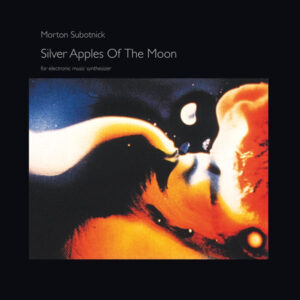
Morton SUBOTNICK
“Silver apples of the moon”
*** 2020 repress ***
Re-issued on vinyl for the first time since its original 1967 release! Morton Subotnick’s truly visionary electronic master piece “Silver Apples Of The Moon” on an audiophile 180gr LP, especially mastered for vinyl.
As composer, musician and initiator of the San Francisco Tape Music Center which he co-founded with Pauline Oliveros and Ramon Sender in 1961, Morton Subotnick (born 1933) has propelled the progress of electronic music in several significant ways. From 1963 on he worked with Don Buchla on the development of the early synthesizer “Buchla Series 100” before moving to New York where the artist-in-residence at the newly established Tisch School Of The Arts of the New York University was enabled to set up his own studio. That’s where Subotnick’s most popular work “Silver Apples Of The Moon” was commissioned by Nonesuch as the first electronic composition ever that was especially conceived for a vinyl release (in opposition to the common practice of performing live). Till the current day this seminal album has not lost his visionary power, has since long been considered one of the essential milestones in electronic music with great effect on later generations of artists – starting from the cult formation Silver Apples to Laika who titled their debut “Silver Apples Of The Moon” too. Now for the first time since its original 1967 release, Subotnick’s masterpiece (which was selected for the Library Of Congress in 2009) has finally been made available on vinyl at last: a new audiophile 180gm LP that was cautiosly remastered for vinyl.
19,00€
In stock
LP
Aidan BAKER & Gareth DAVIS
“Invisible Cities II”
Aidan Baker and bass clarinetist Gareth Davis continue their fruitful collaboration with "Invisible Cities II" – five new tracks of finest ambient / chamber jazz / subtle drones of a highly meditative quality. Available as 180gr LP and download.
2 years ago, the Canadian guitar player Aidan Baker and clarinetist Gareth Davis from Belgium released their duo debut "Invisible Cities" that surprised many by its quiet, even meditative quality. Davis had made himself a name in a wide range of fields, from the postrock of A-Sun Amissa or Oiseaux-Tempête, new music (Peter Ablinger, Bernhard Lang), or experimentation with the likes of Elliot Sharp, Merzbow or Scanner, while Baker is mostly known for his drone / postmetal duo Nadja, but that‘s just one out of several steady projects and a multitude of solo albums.
On "Invisible Cities" the duo explored the calmer side of things – from chamber jazz to ambient / drone and back, giving much space and air to breathe to their respective instrument. Subtle guitar drones, sonore clarinet sounds, a sonic scenery of peacefullness and meditative introspection – all this you‘ll also find on the new album "Invisible Cities II" which is an accomplished continuation and refinement of the duo‘s first collaborative effort from 2018.
Recorded between 2018 and 2019 in Berlin and Amsterdam, mastered and cut at D&M Berlin.
19,00€
In stock

LP
ZEITKRATZER
“performs songs from Kraftwerk 2 and Kraftwerk”
2nd volume of "modern composition supergroup" (The Wire) Zeitkratzer's re-interpretations of early compositions by electronic pioneers Kraftwerk.
In more than two decades Zeitkratzer has created an astonishing broad catalogue from the obligatory (20th century avant-garde composers like Cage or Stockhausen) to the unexpected (electronic artists such as Carsten Nicolai, Terre Thaemlitz or underground experimentalists like Throbbing Gristle and Keiji Haino) – but hardly anyone was prepared for the ensemble’s choice of early Kraftwerk pieces! When volume 1 was released in 2017, Zeitkratzer founder and director Reinhold Friedl announced that there'll be a volume 2 of course – and here it is : from the opening drony horns of "Harmonika" to the subtle guitar of the album closer "Wellenlänge", the 4 tracks own all the interpretatory and aesthetic acerbity the ensemble is known and praised for.
19,00€
In stock
LP
Audrey CHEN
“Runt Vigor”
Audrey Chen’s long-awaited new solo album “Runt Vigor” is an adventurous sonic exploration of the voice, cello and analog electronics.
Audrey Chen began her relationship with sound through the cello and voice over 30 years ago and since the past 15 years, her predominant focus has been her solo work, joining together the extended and inherent vocabularies of the cello, voice and analog electronics (with all sounds created without electronic effect or enhancement other than amplification).
More recently, she has begun to shift back towards the exploration of the voice as a primary instrument, delving even more deeply into her own version of narrative and non-linear storytelling. She derives her sound material in continuous process, championing the "in-between" and overlooked. Regardless of instrument, Chen’s mode of experimentation touches both the abstractly beautiful and the aggressively unsettling, creating a kind of curiously imagined architecture, non-prosaic song or ritual that reaches beyond gravity or language.
Recent projects, aside from performing solo, include her long running voices duo with Phil Minton, duos Hiss & Viscera with modular synth player Richard Scott, Beam Splitter with Norwegian trombonist Henrik Munkeby Norstebo, and the “romantic noise duo” Afterburner with Doron Sadja (electronics/light projection). Past projects include work with German conceptual artist John Bock, a duo with NYC abstract turntablist Maria Chavez, and a quartet with Nate Wooley, C. Spencer Yeh and Todd Carter that released a LP on Monotype.
Format: 180gr LP + DL code / download.
18,50€
In stock
LP
R.A.N.
“eb-i Yelda”
Hailing from stanbul and based in Berlin for a couple of years now, Hüma Utku has been a prolific artist lately: as R.A.N. (Roads At Night) she released her debut album “Her Trembling Ceased”, followed by the remix album “Remixed: Stories Retold” (both 2015, Partapart Records), and contributed several tracks and remixes to various compilations. Besides studio production, she travels the planet to perform live or as DJ, and in November / December 2017 UTKU was Artist in Residency at Yara Mekawei’s Submarine Studio, Cairo.
The title of her debut on Karl, “ eb-i Yelda” (pronounced Shab-e Yalda in English), is a Persian term that signifies ‘the longest night’. Inspired by the Ottoman poet Bosnian Sabit Efendi’s verses, R.A.N. created four new, very personal tracks, developing further her musical language by fusing traditional instruments with deep electronic sounds, distortion and dark ambience, in order to create intense atmospheres of anger, anxiety, grief – but also empowerment and hope. These compositions are Utku’s personal reflections on the long lasting devastation and turmoil in the Middle East as well as witnessing the individual experiences related to these happenings. The titles translate as: “ eb-i Yelda” (The Longest Night), “Ay” (The Moon), “Sabah” (The Morning) and “Kul” (The Servant).
The title of her debut on Karl, “ eb-i Yelda” (pronounced Shab-e Yalda in English), is a Persian term that signifies ‘the longest night’. Inspired by the Ottoman poet Bosnian Sabit Efendi’s verses, R.A.N. created four new, very personal tracks, developing further her musical language by fusing traditional instruments with deep electronic sounds, distortion and dark ambience, in order to create intense atmospheres of anger, anxiety, grief – but also empowerment and hope. These compositions are Utku’s personal reflections on the long lasting devastation and turmoil in the Middle East as well as witnessing the individual experiences related to these happenings. The titles translate as: “ eb-i Yelda” (The Longest Night), “Ay” (The Moon), “Sabah” (The Morning) and “Kul” (The Servant).
13,00€
In stock

LP
Nicolas WIESE
“Unrelated”
Born 1976, Nicolas Wiese studied design, illustration sound art, philosophy and sociology and has since been working on various fields: his (audio-)visual art has been presented in galleries and at exhibitions in Teheran, Gent, London, Vienna, St. Louis, Istanbul, Madrid a.o. As musician / composer, he released a number of solo and collaborative albums under the [-Hyph-] moniker and his civilian name on labels like Walter Ulbricht Schallfolien or Corvo Records. Wiese’s latest effort “Unrelated” contains seven new pieces, constructed from sonic elements of various compositions, audiovisual works, fragments, remixes and experiments from a time span of 6 years, drawn from different contexts and a wide range of international musicians and collaborators. Wiese’s trademark working method is to combine complex sample-based layers with modulated feedback which is triggered by the samples, their overtones and harmonic properties. This playing technique, using the mixing board as a feedback-instrument, adds a special live feel to the meticulous musique concrète constructions based on the original acoustic source material.
Rich in details, “Unrelated” is a vital proof of Wiese’s artistic skills and a highly entertaining concern, melting electro-acoustic, musique concrète and sampledelia!
3 in the Periklas series comes from Nicolas Wiese, a Berlin based electronic and audio-visual artist. Mastered & cut by Rashad Becker, artwork by Joe Gilmore, format LP (200 handnumbered items, silk-screened sleeve, DL code, clear vinyl).
3 in the Periklas series comes from Nicolas Wiese, a Berlin based electronic and audio-visual artist. Mastered & cut by Rashad Becker, artwork by Joe Gilmore, format LP (200 handnumbered items, silk-screened sleeve, DL code, clear vinyl).
Original price was: 22,00€.10,00€Current price is: 10,00€.
In stock

LP
ZEITKRATZER
“performs songs from the albums “Kraftwerk” and “Kraftwerk 2”
Founded in 1997 by Reinhold Friedl, Zeitkratzer have since been creating an impressive catalogue of recordings that embraces 20th century avant-garde composers (Cage, Stockhausen, Lucier) as well as electronic artists (Carsten Nicolai, Terre Thaemlitz) or underground experimentalists like Throbbing Gristle or Column One. In their 20th anniversary year, the critically acclaimed ensemble will release a series of diverse albums that will explore new grounds in the typical, adventurous zeitkratzer way – the first of these albums is dedicated to Kraftwerk and their early, kraut-esque albums “Kraftwerk” and “Kraftwerk 2”. As Kraftwerk never re-released these albums, Zeitkratzer gave its best to cover the first tranche of the songs (second tranche to come…).
Recorded in Marseille, France in May 2016, the six tracks reveal a bucolic and even psychedelic aspect of the ensemble that’s mostly known (or feared) for its interpretatory and aesthetic acerbity. And yet there’s no doubt that “Songs From The Albums “Kraftwerk“ And “Kraftwerk 2“ turned out a true Zeitkratzer recording in the best and full meaning!
Zeitkratzer directed by Reinhold Friedl with Frank Gratkowski, flute, clarinets, Elena Kakaliagou, French horn, Hilary Jeffer, trombone, Reinhold Friedl harmonium, piano, Didier Ascour, guitar, Maurice de Martin, drums, Lisa Marie Landgraf, violin, Burkhard Schlothauer, violin, Elisabeth Coudoux, violoncello, Ulrich Phillipp, double bass.
Recorded and mixed by Martin Wurmnest. Mastered & cut by Mike Grinser at D&M, Berlin.
Recorded in Marseille, France in May 2016, the six tracks reveal a bucolic and even psychedelic aspect of the ensemble that’s mostly known (or feared) for its interpretatory and aesthetic acerbity. And yet there’s no doubt that “Songs From The Albums “Kraftwerk“ And “Kraftwerk 2“ turned out a true Zeitkratzer recording in the best and full meaning!
Zeitkratzer directed by Reinhold Friedl with Frank Gratkowski, flute, clarinets, Elena Kakaliagou, French horn, Hilary Jeffer, trombone, Reinhold Friedl harmonium, piano, Didier Ascour, guitar, Maurice de Martin, drums, Lisa Marie Landgraf, violin, Burkhard Schlothauer, violin, Elisabeth Coudoux, violoncello, Ulrich Phillipp, double bass.
Recorded and mixed by Martin Wurmnest. Mastered & cut by Mike Grinser at D&M, Berlin.
19,00€
In stock

2 LP
ZEITKRATZER
“Lou Reed Metal Machine Music”
About 10 years after their first, critically acclaimed performances of Lou Reed’s adventurous album, zeitkratzer presents an audacious new interpretation of this 20th century avant-garde classic. Here, for the first time ever, all four parts of Metal Machine Music played by zeitkratzer on one recording! Seriously “clangorous”!
This new version of Metal Machine Music is even more transparent, instrumentally pure and radical than the shortened 2007 release; live recordings from concerts in Rome and Reggio Emilia, Italy, mixed and mastered by Rashad Becker. A real sound experience!
After their first performances in 2002 (documented on the 2007 CD release on Asphodel) zeitkratzer gave Reed’s album a new thorough listen and transcribed the sounds to create an acoustic score for the ensemble to play live. Those familiar with the oft-criticized two-disc album might wonder how they pulled this off, but they did and their interpretation of the work brought it to the attention of a wider audience. It is therefore partly thanks to the zeitkratzer version that Lou Reed’s Metal Machine Music has been rediscovered as a classic of the Twentieth Century. It was at the live performance with zeitkratzer in Berlin, that Lou Reed spoke for the first time in public about the musical details of his composition, in an interview with Diedrich Diedrichsen.
zeitkratzer was clearly ready for the challenges of performing Metal Machine Music live, and drew packed houses for their presentation of the work. This confirmed their assertion that rock’n’roll as serious contemporary music has been ignored for too long, in too arrogant a way. The relentless sound forces the mind to put aside its preconceptions about what music is supposed to sound like, or feel like, or look like. The brain starts to implode, or explode, or dissolve Zen-like into the controlled chaos of the performance, discovering a strange exhilaration, accepting an invitation to explore the outer reaches of texture and timbre, to experience a sonic freedom that’s rare in any art form. These recordings from the Metal Machine Music has become even more intense and worked out during the ten years of zeitkratzer playing it live at numerous international festivals - contemporary music festivals, noise festivals, improvisation festivals, - it’s impossible to limit this music to one genre. Metal Machine Music has gained a new quality of clarity, sound transparence and musical intensity. Real radical contemporary chamber noise music! These recordings from the Festival Romaeuropa in Rome and the Festival Aperto in Reggio Emilia (2012) present zeitkratzer not only at their very best, the splendid mix by Rashad Becker also reveals new aspects of this 20th century avant-garde classic!
zeitkratzer directed by Reinhold Friedl. Frank Gratkowski, clarinets. Matt David, trumpet. Hilary Jeffery, trombone. Reinhold Friedl, piano. Marc Weiser, guitar. Maurice de Martin, percussion. Burkhard Schlothauer, violin. Anton Lukoszevieze, cello. Uli Phillipp, doublebass.
This new version of Metal Machine Music is even more transparent, instrumentally pure and radical than the shortened 2007 release; live recordings from concerts in Rome and Reggio Emilia, Italy, mixed and mastered by Rashad Becker. A real sound experience!
After their first performances in 2002 (documented on the 2007 CD release on Asphodel) zeitkratzer gave Reed’s album a new thorough listen and transcribed the sounds to create an acoustic score for the ensemble to play live. Those familiar with the oft-criticized two-disc album might wonder how they pulled this off, but they did and their interpretation of the work brought it to the attention of a wider audience. It is therefore partly thanks to the zeitkratzer version that Lou Reed’s Metal Machine Music has been rediscovered as a classic of the Twentieth Century. It was at the live performance with zeitkratzer in Berlin, that Lou Reed spoke for the first time in public about the musical details of his composition, in an interview with Diedrich Diedrichsen.
zeitkratzer was clearly ready for the challenges of performing Metal Machine Music live, and drew packed houses for their presentation of the work. This confirmed their assertion that rock’n’roll as serious contemporary music has been ignored for too long, in too arrogant a way. The relentless sound forces the mind to put aside its preconceptions about what music is supposed to sound like, or feel like, or look like. The brain starts to implode, or explode, or dissolve Zen-like into the controlled chaos of the performance, discovering a strange exhilaration, accepting an invitation to explore the outer reaches of texture and timbre, to experience a sonic freedom that’s rare in any art form. These recordings from the Metal Machine Music has become even more intense and worked out during the ten years of zeitkratzer playing it live at numerous international festivals - contemporary music festivals, noise festivals, improvisation festivals, - it’s impossible to limit this music to one genre. Metal Machine Music has gained a new quality of clarity, sound transparence and musical intensity. Real radical contemporary chamber noise music! These recordings from the Festival Romaeuropa in Rome and the Festival Aperto in Reggio Emilia (2012) present zeitkratzer not only at their very best, the splendid mix by Rashad Becker also reveals new aspects of this 20th century avant-garde classic!
zeitkratzer directed by Reinhold Friedl. Frank Gratkowski, clarinets. Matt David, trumpet. Hilary Jeffery, trombone. Reinhold Friedl, piano. Marc Weiser, guitar. Maurice de Martin, percussion. Burkhard Schlothauer, violin. Anton Lukoszevieze, cello. Uli Phillipp, doublebass.
26,00€