
Out of stock

3 LP
Keiji HAINO – Jim O’ROURKE – Oren AMBARCHI
“With pats on the head, just one too few is evil …”
The heavyweight trio of Keiji Haino, Jim O’Rourke and Oren Ambarchi return with their 12th and most epic release to date, the triple LP With pats on the head, just one too few is evil one too many is good that's all it is. Documenting the entirety of their final performance at the dearly departed Roppongi home of Tokyo underground institution SuperDeluxe in November 2018, the music spread across these six sides splits the difference between the guitar-bass-drums power trio moves and experiments with novel instrumentation that have defined the trio’s decade of working together. Containing some of the most delicate music the three have committed to wax since the gorgeous 12-string acoustic guitar and dulcimer tones of Only wanting to melt beautifully away is it a lack of contentment that stirs affection for those things said to be as of yet unseen (BT011), this wide-ranging release also offers up some of their most blistering free rock performances yet.
The side-long opening piece finds Haino on a single snare drum in duet with O’Rourke on unamplified electric guitar, playing in the lovely post-Bailey vein heard on his classic 90s recordings with Henry Kaiser and Mats Gustafsson. Spiky dissonance and ringing harmonics interweave with flowing melodic fragments as Haino single-mindedly explores the resonance of the snare like an untutored Han Bennink. On ‘Right brain, left brain; right, left; right wing, left wing. Just how many combinations can be made from these?’, O’Rourke moves to synth and electronics, joined by Ambarchi on drums, who at first focuses on sizzle cymbals before hypnotic cycles of gentle tom rhythms combine with electronic burbles and flutters to suggest a dream collaboration between Masahiko Togashi and Jean Schwarz. Ambarchi’s percussion is then joined by Haino on wandering, overblown flute, before the man in black switches back to the snare for a bizarre, stuttering drum duet.
For the first trio performance, Haino makes another new addition to his seemingly infinite catalogue of instruments, this time a homemade contraption he refers to as ‘Strings of Dubious Reputation’. Joined by O’Rourke on increasingly spaced-out electric guitar and Ambarchi on skittering percussion, Haino’s wonky, slack strings adds a definite ‘musique brut’ edge to this side-long performance, certainly one of the most enchantingly odd in the trio’s discography. When the group reconvene for the second set, spread out across the final three sides, they seem ready to breathe fire from the first instant. O’Rourke slashes distorted chords on the six-string bass, Ambarchi breaks into his signature irregular caveman thump, and Haino squeals and squawks on heavily delayed oboe before unleashing an overpowering electrical storm when he first picks up the guitar. For over half an hour, the trio pound out one of their most relentless performances, a constantly rearranging kaleidoscope of tortured fuzz guitar, insanely busy bass riffing and propulsive, tumbling drums. A hushed atmosphere initially reigns on the final long piece, given the mournful title ‘There are always things I wish to say but I can only convey them in this language August 6 August 9’. Haino’s clean guitar strumming calls up the shimmering tones of his PSF classic Affection, gradually building to a surging wall of sound, bass and drums lumbering through a roar of jet-engine guitar. Arriving in a deluxe trifold package with photos by Lasse Marhaug alongside inner sleeves with extensive live images, this epic release is perhaps the most remarkable document yet of this unique trio’s stamina and continuing inventiveness.
48,00€
In stock
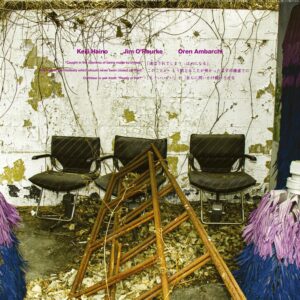
2 LP
Keiji HAINO – Jim O’ROURKE – Oren AMBARCHI
“Caught in the dilemma of being made to choose”
The renowned trio of Keiji Haino, Jim O’Rourke and Oren Ambarchi return to Black Truffle with their 11th release, “Caught in the dilemma of being made to choose” This makes the modesty which should never been closed off itself Continue to ask itself: “Ready or not?” Demonstrating once again their commitment to continual experimentation in instrumentation and approach, the record begins with a long-distance collaboration made in response to a commission from New York’s Issue Project Room in 2021 during widespread lockdowns and travel limitations. A unique piece in the trio’s extensive body of work, this side-long epic finds Haino performing on metal percussion, O’Rourke on electronics and Ambarchi on gongs and bells. Initially dominated by rapid patterns on resonant, high-pitched tuned percussion, the piece sets Haino’s dynamic and dramatic performance against a calm backdrop of cycling electronics, thrumming gong strikes and hanging bell tones. The performance develops a heightened, intensely concentrated atmosphere reminiscent of Haino’s classic Tenshi No Ginjinka or his Nijiumu project; when Haino moves to clashing hand cymbals in its second half, the piece’s ritualistic energy suggests aspects of the music of Tibetan Buddhism.
The remainder of the double LP documents the trio live at Tokyo’s SuperDeluxe (the location of all but their very first recording) in a wide-ranging set recorded in December 2017. The concert opens, in another first for the trio, with Haino on drums, O’Rourke on Hammond organ and Ambarchi on his signature Leslie cabinet guitar tones. Haino’s explosively untutored approach to the drumkit will be familiar to some listeners from the radical duo iteration of Fushitsusha heard on Origin’s Hesitation. Setting flurries of rapid activity against moments of silence, his drumming here at times suggests Milford Graves in its tumbling toms and thudding kick-drum propulsion. Accompanied by O’Rourke’s organ and Ambarchi’s guitar, which in their shared use of long tones and shifting modulation speeds almost blend into a single voice, the opening sections of this performance are some of the most magical music the trio has committed to tape thus far.
After an interlude of spoken vocals in both Japanese and English, Haino makes a dramatic entrance on guitar. Against O’Rourke and Ambarchi’s increasingly intense electronic backdrop, Haino unleashes a stunning passage of slowly moving chromatic melodies and sudden shrieking explosions bathed in distortion and reverb. By the time we reach the third side, the guitar/bass/drums power trio is established and lurches into a passage of massive, lumbering rock that threatens to fall apart at every beat, O’Rourke’s strummed chordal work on six string bass creating a harmonic density equivalent to a second guitar. An abrupt edit throws the listener in media res into a frantic locked groove grounded by fuzzed out bass patterns and caveman drums. As Haino moves through a variety of approaches, from massive edifices of stuttering fuzz to ominous swarms of feedback, the trio eventually stumble into a kind of Harmolodic military tattoo, Haino’s guitar weaving and slashing across the rhythm section’s irregular accents. Moving through an epic opening duet for O’Rourke on Hammond and Haino’s wailing guitar, the fourth side eventually ramps up into a frenetic finale of mad bass riffing, crackling snare hits and guitar squall.“Caught in the dilemma of being made to choose” This makes the modesty which should never been closed off itself Continue to ask itself: “Ready or not?” is a testament to the continuing power and invention of this trio, who continue to seek out new terrain after over a decade working together. 2LP set presented in a lavish gatefold sleeve on heavy stock along with inner sleeves containing live pics by Tsuyoshi Kamaike. Photography by Jim O’Rourke, design by Lasse Marhaug and translation by Alan Cummings.
32,00€
Out of stock

LP
Keiji HAINO – Jim O’ROURKE – Oren AMBARCHI
“Each side has a depth of 5 seconds”
The trio of Keiji Haino, Jim O’Rourke, and Oren Ambarchi return to Black Truffle with their 10th release, recorded live in Tokyo in February, 2017. While many of the trio’s recent works have seen them focussing primarily on their core guitar/bass/drums power trio format, on Each side has a depth of 5 seconds A polka dot pattern in horizontal array A flickering that moves vertically these three multi-instrumentalists strike into new territory, utilising an almost entirely electronic set-up, with Haino on electronics, drum machine and suona (a Chinese double-reed horn), O’Rourke on synth, and Ambarchi on pedal steel and electronics.
Dedicated to the memory of legendary Tokyo underground figure Hideo Ikeezumi, founder of PSF Records and the Modern Music shop and a long-term collaborator with Haino, the LP, (recorded the night Ikeezumi passed away), begins in a sombre, meditative space of rippling, burbling electronics and distant jets of white noise. Though much of the ‘Introduction’ that occupies the record’s first side is spacious and at times almost hushed, the performance is full of unexpected twists and turns, momentary events, and fleeting impressions. The trio conjures up a free-flowing surge of sound in which individual contributions are often difficult to distinguish, calling up echoes of vintage live-electronic sizzle like It’s Viaje or the cavernous expanse of David Behrman’s Wave Train.
The LP’s second side opens in a similarly reflective realm, before Haino’s suona enters, taking the music in a more austere, hieratic direction, as the reed’s piercing tones are accompanied by O’Rourke’s uneasy, sliding synth figures and Ambarchi’s shimmering Leslie cabinet tones. On the side’s second piece, Haino’s signature hand-played drum machine takes centre-stage, at first sounding out massive, isolated strikes, before eventually building to a tumbling, Milford Graves-esque wall of thunder. As O’Rourke’s synth squelches and stutters and Ambarchi’s heavily effected pedal steel somehow begins to sound like a kind of hellish blues harmonica, this passage offers up one of the most electrifying and bizarre moments in the trio’s catalogue to date.
Containing some of the most abstract music the trio have waxed since their very first collaboration over a decade ago (Tima Formosa, BT04), this new missive from underground experimental music’s preeminent power trio shows them restless and risk-taking, clearly enjoying their remarkable improvisational chemistry while also continuing to push themselves into new directions.
Presented in a deluxe gatefold sleeve with artwork and design by Lasse Marhaug and an inner sleeve with live pics by Ujin Matsuo.
20,00€
Out of stock

2 LP
Keiji HAINO – Jim O’ROURKE – Oren AMBARCHI
“In the past only geniuses were capable of staging”
For its 50th release, Black Truffle presents the ninth album from one of the label’s core ensembles, the power trio of Keiji Haino, Jim O’Rourke, and Oren Ambarchi. Drawn from a November 2015 performance at Tokyo’s now-defunct SuperDeluxe, the record’s opening piece drops us immediately into the maelstrom, abruptly cutting into an extended episode of Ambarchi’s pummeling drums, O’Rourke’s fuzzed-out six-string bass, and Haino’s roaring guitar and electronics. Eventually settling into a hypnotic bass and drum groove over which Haino unleashes some almost Ray Russell-eque skittering atonal screech, these opening 13 minutes act as a potent reminder of the trio’s power.
Alongside showcasing the steady development of a unique language for the guitar-bass-drums power trio, the group’s succession of releases over the last decade has demonstrated a constant experimentation with new instruments, which continues here with O’Rourke use of Hammond organ (played at the same time as his roaming, sometimes knotty basslines). On the album’s second piece, the organ plays a key role, furnishing a harmonically rich shimmer over O’Rourke’s angular six-string bass chords, Haino’s distant, chirping electronics and Ambarchi’s crisp cymbal work; arriving somewhere halfway between Albert Marcoeur and Terje Rypdal, this piece is undoubtedly a highlight in the trio’s catalog so far.
The second and third sides are slow-burning, multi-part epics that range from spacious reflection to furious tumult. Where the trio’s previous double-LP set — This Dazzling, Genuine “Difference” Now Where Shall It Go? (BT 030LP, 2017) — was primarily instrumental in focus, here you find Haino’s voice taking the spotlight on the expansive third side, intoning, wailing. and exhorting in Japanese and English over a backdrop that moves from hushed bass and organ atmospherics to rolling toms and cymbal crashes before arriving at an ecstatic finale of searing guitar, tumbling drums and reverb-saturated bass. The fourth side returns to the hypnotic grooves of the opening piece, fixing on a relentless riff and riding it into oblivion under Haino’s roaming psychedelic soloing and jagged chordal slashes.
25,00€
Out of stock
CD
Keiji HAINO – Jim O’ROURKE – Oren AMBARCHI
“In the past only geniuses were capable of staging”
For its 50th release, Black Truffle presents the ninth album from one of the label’s core ensembles, the power trio of Keiji Haino, Jim O’Rourke, and Oren Ambarchi. Drawn from a November 2015 performance at Tokyo’s now-defunct SuperDeluxe, the record’s opening piece drops us immediately into the maelstrom, abruptly cutting into an extended episode of Ambarchi’s pummeling drums, O’Rourke’s fuzzed-out six-string bass, and Haino’s roaring guitar and electronics. Eventually settling into a hypnotic bass and drum groove over which Haino unleashes some almost Ray Russell-eque skittering atonal screech, these opening 13 minutes act as a potent reminder of the trio’s power.
Alongside showcasing the steady development of a unique language for the guitar-bass-drums power trio, the group’s succession of releases over the last decade has demonstrated a constant experimentation with new instruments, which continues here with O’Rourke use of Hammond organ (played at the same time as his roaming, sometimes knotty basslines). On the album’s second piece, the organ plays a key role, furnishing a harmonically rich shimmer over O’Rourke’s angular six-string bass chords, Haino’s distant, chirping electronics and Ambarchi’s crisp cymbal work; arriving somewhere halfway between Albert Marcoeur and Terje Rypdal, this piece is undoubtedly a highlight in the trio’s catalog so far.
The second and third sides are slow-burning, multi-part epics that range from spacious reflection to furious tumult. Where the trio’s previous double-LP set — This Dazzling, Genuine “Difference” Now Where Shall It Go? (BT 030LP, 2017) — was primarily instrumental in focus, here you find Haino’s voice taking the spotlight on the expansive third side, intoning, wailing. and exhorting in Japanese and English over a backdrop that moves from hushed bass and organ atmospherics to rolling toms and cymbal crashes before arriving at an ecstatic finale of searing guitar, tumbling drums and reverb-saturated bass. The fourth side returns to the hypnotic grooves of the opening piece, fixing on a relentless riff and riding it into oblivion under Haino’s roaming psychedelic soloing and jagged chordal slashes.
14,00€
Out of stock

LP
Keiji HAINO – Jim O’ROURKE – Oren AMBARCHI
“This Dazzling, Genuine “Difference” Now Where Shall It Go?”
With This Dazzling, Genuine “Difference” Now Where Shall It Go, Black Truffle presents the 8th full-length release from the trio of Keiji Haino, Jim O’Rourke and Oren Ambarchi. Over the course of four LP sides, the October 2014 concert documented here ranges from rock power trio dynamics to maelstroms of analogue electronics. Once again, the three demonstrate their commitment to pushing into new areas of instrumental exploration and group interaction. Where previous releases from the trio have often featured extended vocal workouts from Haino, at times suggesting abstracted folk song, Haino’s vocalizations here are restricted to the occasional impassioned cry, putting the focus squarely on instrumental interplay. More than ever before, this feels like the work of three equals, with O’Rourke or Ambarchi taking the lead role as often as Haino does.
The four pieces presented here each focus on extended development. The first side is propelled by Ambarchi’s busy, Jack DeJohnette-esque cymbal and tom work, which provides a skittering yet insistent pulse over which Haino and O’Rourke’s FX-saturated strings rise and fall, momentarily converging for passages of near stasis before again pulling apart to continue wandering through areas of gently sour discord; O’Rourke’s use of a six-string bass here boosts the harmonic density of the music and often makes his contribution difficult to distinguish from Haino’s guitar. On the second side, O’Rourke uses his pedals to make his bass near unrecognizable, generating a squelching, harmonically unstable riff that Ambarchi accompanies with a semi-martial snare pattern, the two driving home the idea for the duration of the side while Haino moves between frenetic octave-doubled fuzz riffing and streams of feedback.
The third side presents some of the most abstract music heard from the trio since their first release (Tima Formosa, BT04). Continuing Haino’s explorations of new instruments, the side opens with a long passage of toy piano, an instrument that in his hands is at once childlike and imbued with a mysterious gravity. Alongside occasional vocal interjections from Haino (singing in English), Ambarchi creates delicate textures on cymbals and metallic percussion while O’Rourke, for the first time in this group, performs on the EMS Synthi. In a long passage in the middle of the side, he provides ample evidence of his mastery of the instrument, crafting a complex texture from pointillist stabs and rapid sweeps that possesses the same unpredictable yet controlled feeling of classic live-electronics documents like Pierre Henry’s ‘Corticalart’ series. With Haino joining in with his own electronics, the side eventually builds to a chaotic climax.
Beginning with a sequence of ‘fourth world’ drums and flute, the final side unfolds an epic build-up over a hypnotic foundation of pounding toms. Moving from flute to vocals to electronics, Haino eventually picks up the guitar in the second half of the piece, igniting a spectral blur over driving rhythms from bass and drums that eventually builds to a frenzied climax.
The four pieces presented here each focus on extended development. The first side is propelled by Ambarchi’s busy, Jack DeJohnette-esque cymbal and tom work, which provides a skittering yet insistent pulse over which Haino and O’Rourke’s FX-saturated strings rise and fall, momentarily converging for passages of near stasis before again pulling apart to continue wandering through areas of gently sour discord; O’Rourke’s use of a six-string bass here boosts the harmonic density of the music and often makes his contribution difficult to distinguish from Haino’s guitar. On the second side, O’Rourke uses his pedals to make his bass near unrecognizable, generating a squelching, harmonically unstable riff that Ambarchi accompanies with a semi-martial snare pattern, the two driving home the idea for the duration of the side while Haino moves between frenetic octave-doubled fuzz riffing and streams of feedback.
The third side presents some of the most abstract music heard from the trio since their first release (Tima Formosa, BT04). Continuing Haino’s explorations of new instruments, the side opens with a long passage of toy piano, an instrument that in his hands is at once childlike and imbued with a mysterious gravity. Alongside occasional vocal interjections from Haino (singing in English), Ambarchi creates delicate textures on cymbals and metallic percussion while O’Rourke, for the first time in this group, performs on the EMS Synthi. In a long passage in the middle of the side, he provides ample evidence of his mastery of the instrument, crafting a complex texture from pointillist stabs and rapid sweeps that possesses the same unpredictable yet controlled feeling of classic live-electronics documents like Pierre Henry’s ‘Corticalart’ series. With Haino joining in with his own electronics, the side eventually builds to a chaotic climax.
Beginning with a sequence of ‘fourth world’ drums and flute, the final side unfolds an epic build-up over a hypnotic foundation of pounding toms. Moving from flute to vocals to electronics, Haino eventually picks up the guitar in the second half of the piece, igniting a spectral blur over driving rhythms from bass and drums that eventually builds to a frenzied climax.
24,00€
Out of stock

2 LP
Keiji HAINO – Jim O’ROURKE – Oren AMBARCHI
“I wonder if you noticed “I’m sorry” is such a lovely sound It keeps things from getting worse”
2LP document of the complete set performed by Keiji Haino, Jim O’Rourke and Oren Ambarchi at Tokyo’s legendary SuperDeluxe on March 2, 2014.
This 2LP set marks the seventh chapter in this remarkable series of releases from this acclaimed trio.
Continuing to explore new instrumental and dynamic possibilities while remaining grounded in the trio’s previous work, this set also brings with it a unique pleasure for the non-Japonophone listener: for the first time Haino sings many of his metaphysically brooding lyrics in English.
Deluxe 2LP set with a gatefold sleeve with gorgeous photographs by Jim O’Rourke and design by Stephen O’Malley.
Vinyl cut by Rashad Becker at Dubplates & Mastering, Berlin.
The remarkable series of releases from the trio of Keiji Haino, Jim O’Rourke and Oren Ambarchi continues with I wonder if you noticed “I'm sorry” Is such a lovely sound It keeps things from getting worse , which presents the entirety of an 80 minute set performed at Tokyo’s SuperDeluxe in March 2014. Where their 2012 performance (BT011 and BT012) was divided into two releases, one continuing their exploration of the guitar/bass/drums power trio format and the other emphasizing new instrumental configurations, the single extended performance presented here ranges widely over terrain both new and familiar, from acoustic strings and collective chants to thunderous power trio moves.
Throughout all of its transformations, the music here is some of the riskiest and most abstract the trio have yet committed to record. Beginning with chiming percussion reminiscent of Haino’s classic Tenshi No Gijinka, the first side is dominated by Haino’s impassioned vocals and performance on the bulgari, a traditional Turkish string instrument. Together with the woozy, sliding foundation of O’Rourke FX-laden bass and Ambarchi’s ritualistic percussion, the trio craft a sort of epic, abstracted song that moves through its spontaneous episodes with all of the fluidity of the best free improvisation.
After a haunting passage in which Haino’s voice, descending from angelic high notes to guttural growls, is accompanied only by O’Rourke’s roaming bass, Haino turns to electronics, gradually building a thick cloud of cosmic sludge as Ambarchi’s drumming goes into free fall. The end of the second side presents a special treat: Haino’s first recorded outing on the contrabass harmonica, from which he coaxes bizarre, wheezing textures against a backdrop of spacious bass and percussion. When Haino eventually picks up the guitar midway through the epic performance, the spaciousness and sense of volatility remain, with the trio often moving in an instant from crescendos of ecstatic noise to near-silence.
O’Rourke and Ambarchi rarely adopt here the classic rock roles essayed on earlier releases. O’Rourke’s bass, which takes centre stage surprisingly often, is sometimes so heavily processed by his array of pedals that it becomes a shifting electronic mass; at other times his roving chromaticism suggests a sort of fuzzed-out free jazz. Ambarchi spends much of the set exploring areas of tumbling free pulse; and even when he locks into a constantly repeated figure on the set’s third side, he gestures as much toward Ronald Shannon Jackson’s stuttering marching band funk as toward any classic rock moves.
When the trio finally move in the final quarter of the performance into an extended passage of rock riffing, the payoff is immense, as they craft a thudding one-chord epic reminiscent of some of the early Fushitsusha classics, before Haino returns to the bulgari, bringing the set back to where it began. Continuing to explore new instrumental and dynamic possibilities while remaining grounded in the trio’s previous work, this set also brings with it a unique pleasure for the non-Japonophone listener: for the first time Haino sings many of his metaphysically brooding lyrics in English.
This 2LP set marks the seventh chapter in this remarkable series of releases from this acclaimed trio.
Continuing to explore new instrumental and dynamic possibilities while remaining grounded in the trio’s previous work, this set also brings with it a unique pleasure for the non-Japonophone listener: for the first time Haino sings many of his metaphysically brooding lyrics in English.
Deluxe 2LP set with a gatefold sleeve with gorgeous photographs by Jim O’Rourke and design by Stephen O’Malley.
Vinyl cut by Rashad Becker at Dubplates & Mastering, Berlin.
The remarkable series of releases from the trio of Keiji Haino, Jim O’Rourke and Oren Ambarchi continues with I wonder if you noticed “I'm sorry” Is such a lovely sound It keeps things from getting worse , which presents the entirety of an 80 minute set performed at Tokyo’s SuperDeluxe in March 2014. Where their 2012 performance (BT011 and BT012) was divided into two releases, one continuing their exploration of the guitar/bass/drums power trio format and the other emphasizing new instrumental configurations, the single extended performance presented here ranges widely over terrain both new and familiar, from acoustic strings and collective chants to thunderous power trio moves.
Throughout all of its transformations, the music here is some of the riskiest and most abstract the trio have yet committed to record. Beginning with chiming percussion reminiscent of Haino’s classic Tenshi No Gijinka, the first side is dominated by Haino’s impassioned vocals and performance on the bulgari, a traditional Turkish string instrument. Together with the woozy, sliding foundation of O’Rourke FX-laden bass and Ambarchi’s ritualistic percussion, the trio craft a sort of epic, abstracted song that moves through its spontaneous episodes with all of the fluidity of the best free improvisation.
After a haunting passage in which Haino’s voice, descending from angelic high notes to guttural growls, is accompanied only by O’Rourke’s roaming bass, Haino turns to electronics, gradually building a thick cloud of cosmic sludge as Ambarchi’s drumming goes into free fall. The end of the second side presents a special treat: Haino’s first recorded outing on the contrabass harmonica, from which he coaxes bizarre, wheezing textures against a backdrop of spacious bass and percussion. When Haino eventually picks up the guitar midway through the epic performance, the spaciousness and sense of volatility remain, with the trio often moving in an instant from crescendos of ecstatic noise to near-silence.
O’Rourke and Ambarchi rarely adopt here the classic rock roles essayed on earlier releases. O’Rourke’s bass, which takes centre stage surprisingly often, is sometimes so heavily processed by his array of pedals that it becomes a shifting electronic mass; at other times his roving chromaticism suggests a sort of fuzzed-out free jazz. Ambarchi spends much of the set exploring areas of tumbling free pulse; and even when he locks into a constantly repeated figure on the set’s third side, he gestures as much toward Ronald Shannon Jackson’s stuttering marching band funk as toward any classic rock moves.
When the trio finally move in the final quarter of the performance into an extended passage of rock riffing, the payoff is immense, as they craft a thudding one-chord epic reminiscent of some of the early Fushitsusha classics, before Haino returns to the bulgari, bringing the set back to where it began. Continuing to explore new instrumental and dynamic possibilities while remaining grounded in the trio’s previous work, this set also brings with it a unique pleasure for the non-Japonophone listener: for the first time Haino sings many of his metaphysically brooding lyrics in English.
20,00€
Out of stock

CD
Keiji HAINO – Jim O’ROURKE – Oren AMBARCHI
“now while it’s still warm let us pour in all the mystery”
CD version. Keiji Haino, guitar, flute, voice. Jim O’Rourke, bass. Oren Ambarchi, drums. Special guests on first track, Charlemagne Palestine and Eiko Ishibashi, wineglasses. "Following on from 2012’s acclaimed Imikizushi (BT 007CD/LP), Now While It’s Still Warm Let Us Pour in All the Mystery is the fourth release from the established power trio of Keiji Haino, Jim O’Rourke, and Oren Ambarchi, recorded in January 2012 at their yearly concert at SuperDeluxe, Tokyo. While the trio’s two previous 2 LP releases featured sprawling, side-long performances, the music here is presented in six shorter pieces, each one displaying a different side of the trio’s interactions, from holy minimalism to cave-man rock. The record begins with the trio joined by special guests Charlemagne Palestine and Eiko Ishibashi, conjuring ghostly tones from wine glasses as an accompaniment to Haino’s angelic vocals. This 10-minute piece, which moves from near silence and the sound of onstage footsteps to a stunning passage of clean guitar work from Haino, is steeped in the same mysterious atmospherics as Haino’s great folk-drone project, Nijumu. When Haino turns to the flute on the LP’s second track, a performance that clearly demonstrates the importance of the special concept of space and silence (ma) that Haino has developed from traditional Japanese aesthetics, O’Rourke and Ambarchi transform into the delicate and probing rhythm section of a classic ’70s fusion side. When the trio returns to the crushing free-rock of their last two records, O’Rourke’s heavily effected bass rolling alongside Ambarchi’s tumbling rhythms as Haino’s guitar squeals and slashes above them, their performances display a new purposefulness and concision. Now truly operating as a band after a number of years of playing together, the pieces here feel like instant rocks songs -- O’Rourke and Ambarchi instantly locking into solid riffs over which Haino alternates between jarring no-wave chords, intense soloing and his signature vocalizations. When the trio slow down and stretch out, the rhythm section plods like an abstracted Crazy Horse on the brink of collapse, and Haino elicits long, mournful solos reminiscent of the first classic Fushitsusha double live LP. Perhaps more accessible than the trio’s previous recordings because of its range and concision, Now While It’s Still Warm... exudes the dark, alien quality of Haino’s greatest recordings and testifies to the strength of the musical bond that has developed between these three players. --Francis Plagne, Jan 2013." Limited edition LP in a lavish gatefold with a printed inner sleeve. Design by Stephen O’Malley with high quality live shots by Ujin Matsuo and stunning artwork by Shunichiro Okada.
15,50€