
Out of stock

CD
Kasper T. TOEPLITZ
“Arche”
Composition & solo bass: Kasper T Toeplitz
Vital weekly:
His other new release is a solo affair, music-wise, as it was commissioned by the dance company Loldanse. The recording on CD was recorded live on November 25, 2021, during one of the performances. This piece is for solo electric bass and, so I assume, electronics. Even when the score is in French, it is easier to follow, as Toeplitz made some notes concerning timing this time.
Much of the piece doesn't sound like electric bass and is more like a piece of processed recordings of whatever kind. I wouldn't know what had I not known this is an electric bass. At seventy-one minutes, this is quite a long piece of music, and because of one heavy noise section (from the twenty-four to thirty-minute mark, not an easy-to-digest release. I admit that I skipped these sections a few times I played this piece. After thirty-five minutes, the high-frequency piece was also loud, but something that I enjoyed all the same. When it is dark, it is dark. Toeplitz once again proves that he is a fine master of radical music. Not that I needed more proof. Just like his disc with Zinc & Copper, the modern music version of Toeplitz is entirely different from many of his peers, and I wonder how such pieces are received. (FdW)
8,50€
Out of stock
CD
Kasper T. TOEPLITZ
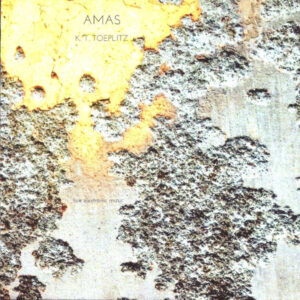
“Amas”
AMAS is one lengthy composition, played live on a computer consisting of long electronic parts; as described by Toeplitz, it is “a growing organism: my idea when working on it was to take some ideas from Don Buchla’s “philosophy” as a starting point - ideas from the “West-Coast” school of music: in building the “engines” which produce sounds, the shaping of the sounds is rather made by modulations and adding harmonics (by distortion or rather waveshaping) than the more “classical” (East-Coast) method of using filtering. But the Buchla/West-Coast influence is also on the structure of the music itself, the work considered as a living organism rather than a strict composition; or perhaps rather like a fixed time and a walk with a given direction, but all the steps are not fixed.”
Kasper T. Toeplitz is a French composer and musician of Polish origin, born in 1960. He lives in Paris. He has worked with academic research organisations, such as GMEM, GRM, IRCAM, and Radio-France, as well as with experimental musicians, such as Éliane Radigue, Zbigniew Karkowski, Dror Feiler, Tetsuo Furudate, Phill Niblock and Art Zoyd. Citing Giacinto Scelsi, Gyorgy Ligeti and Iannis Xenakis as influences, his early work was mostly written for traditional instruments. He received several prizes and distinctions for these works: 1st prize in composition for orchestra at the festival of Besançon, 1st prize in the Opéra Autrement/Acanthes competition, Villa Médicis Hors-les-Murs in New York, prize Léonard de Vinci in San Francisco, Villa Kujoyama in Kyoto, and DAAD in Berlin. He has also written for his electric guitar orchestra, Sleaze Art. He then integrated computers into his work, via the programming language MAX.
Please note: This release packaging comes folded into quarters, ending up as a 5 ” x 5 ” brochure style booklet (liner notes inside), with the CD in a paper sleeve, all inserted into re-sealable plastic sleeves. There is no jewel case, tray card etc.
Original price was: 14,00€.7,00€Current price is: 7,00€.
In stock

CD
Kasper T. TOEPLITZ
“Inoculate ?”
nstability between sound and silence, between stagnation and air pressure; or else digital phantoms, remanences of what has not occurred - and the live electronics that sculpt this matter. Instruments increased to excess or, to the contrary, reduced to the flimsiest breath, distorted and exploited by themselves as much as by the teeming immobility of the dancer, body to hear. A slowness always in imbalance with abrupt accelerations, a stasis filled with electricity, a wall of sound.
8,00€
In stock

CD
Kasper T. TOEPLITZ
“Capture”
“A very micro-tonal score, played by 3 dancers/musicians whose infinitesimally slow movements are “captured” by web-cams and “mapped” to all the parameters of a real-time digital synthesis engine - frequency, amplitude, ambitus… No samples, no pre-recorded sounds, the sole sound source is a white noise generator, sculpted by filters, producing a polyphony of drones, oscillations, movements of electricity - a long electronic ascension”.
8,00€
In stock

CD
Kasper T. TOEPLITZ
“Almasty”
Solo bass played and composed by Kasper T. Toeplitz.
Layers of noise full of details like the voice of dead machines !
“A purely formal présentation of ALMASTY would point that it is a composition for solo bass – electric bass, which implies a few electric/electronc machines around the string instrument, which change or modifiy its résonances somehow, but nothing more that what is seen those days around any electric instrument. And ALMASTY is also a solo composition, as it is recorded and presented as it was played, live, one evening of november 2015, in Bagnolet, just outside of Paris (even if it was not the first time the piece was played) : no overdubs, re-recordings, no samples of the instrument replaced later in the final mix, no compositional work in the studio, except of the reduction of the original 4 tracks in a stereo, as the piece is written to be played on 4 speakers disposed in an arc in front of the audience.
And of course all this has no importance at all, it is not an "instrumental solo" which hopes to show a supposed virtuosity, nor is it an introspection of the musician facing himself : ALMASTY is best defined as a composition originating from an "electronic thought" of the music, which happens to be played on a basse just because the composer, which happens to also be the interpréter of the piece has some pleasure, or just a familiarity resulting from the years spend with the instrument, when playing the bass. But what Almasty is, is an electronic architecture, lasting just about one hour, layers of sounds, noises, textures, a constant attention to détails of the resulting sounds, dust or splinters, from the macroscopic to the powerful breathing of some machine, a never revealed presence – the Almasty. And the cover, a painting executed by Daria Gabriel, is of a similar density of texture.”
8,00€
Out of stock

CD
Kasper T. TOEPLITZ
“Gris”
Music for live electronics, bass and lithophone. Played by Kasper T. Toeplitz (composition, live-electronics, bass) and Philippe Foch (lithophone). This music was written (and played live) for the dance piece named “GRIS” choreographed by Myriam Gourfink. Immobility by Margot Dorleans, Carole Garriga, Deborah Lary and Véronique Weil.
14,00€
Out of stock
CD
Kasper T. TOEPLITZ
“DATA_Noise”
Kasper T. Toeplitz, live electronics, generative video, lights. Myriam Gourfink, stillness.
Electronic composition played live by Kasper T. Toeplitz and Myriam Gourfink. Noise and stillness. Also generative video, and the noise of circulating data.
What it is not : DATA_Noise is certainly not a dance piece with musical accompaniment, using some sort of the so-called “new technology” - sensors, computers - to be more “modern”. DATA_Noise is a musical project, a composition written for synthesized electronic sounds, and meant to be played live, using the computer as the main instrument which creates by many means such as different synthesis or transformation techniques (scanned, granular, wave- terrain synthesis, waveshaping etc...). One of those techniques will be the use of a dancer, performing an extremely slow dance (of an entierely written choregraphy), and whose minimal movements, as seen by different sensors, will have a disruptive function on the behavior of the music-making computer - a way to introduce some “noise” in this very often too precise a machine, a way to maybe re-introduce some of the noisiness of the world into this electronic composition.
Electronic composition played live by Kasper T. Toeplitz and Myriam Gourfink. Noise and stillness. Also generative video, and the noise of circulating data.
What it is not : DATA_Noise is certainly not a dance piece with musical accompaniment, using some sort of the so-called “new technology” - sensors, computers - to be more “modern”. DATA_Noise is a musical project, a composition written for synthesized electronic sounds, and meant to be played live, using the computer as the main instrument which creates by many means such as different synthesis or transformation techniques (scanned, granular, wave- terrain synthesis, waveshaping etc...). One of those techniques will be the use of a dancer, performing an extremely slow dance (of an entierely written choregraphy), and whose minimal movements, as seen by different sensors, will have a disruptive function on the behavior of the music-making computer - a way to introduce some “noise” in this very often too precise a machine, a way to maybe re-introduce some of the noisiness of the world into this electronic composition.
14,00€
Out of stock

CD
Kasper T. TOEPLITZ
“Fluster”
Composition for electric bass from Zbigniew Karkowski performed by Kasper T. Toeplitz. One hour of extreme sound divided into 3 parts between sub-bass, wall of noise and high frequencies. A commission from GRM.
10,00€