
In stock

2 LP
COMPILATION
“Ethnoelectronics”
Originally released on tape by Sound Reporters in 1986. Ethnoelectronics is a further episode of pioneering fusion between ethnic and electronic music, involving dauntless explorers such as Walter Maioli, Nirodh Fortini, Fred Gales, Raffaele Serra, John Zandijk and the visionary sculptor Edward Luyken. As the soundtrack of an obscure science-fiction saga, the six parts of these recordings retain something profoundly osmotic and sidereal. In these hybridizations, it's the heart of personal spiritual cosmos and stratospheric portals to pulse, but always remains the devotion to wild nature and ethnographic differences. In this way, the sinusoidal movements of electronic synthesizers and radiophonic frequencies interact with the pounding sounds of the jungle, with frogs, sea waves, buzz insects, leaves and rain. From flutes, rattles, steel sound sculptures or rustling idiophones, mysterious samples appeared like weird interferences, with rhythms and ritual voices from Tibet, West Papua, Burundi, Tahiti or the shamanic Japan of the Ainu.
30,00€
In stock
CD
COMPILATION
“Ethnoelectronics”
Originally released on tape by Sound Reporters in 1986. Ethnoelectronics is a further episode of pioneering fusion between ethnic and electronic music, involving dauntless explorers such as Walter Maioli, Nirodh Fortini, Fred Gales, Raffaele Serra, John Zandijk and the visionary sculptor Edward Luyken. As the soundtrack of an obscure science-fiction saga, the six parts of these recordings retain something profoundly osmotic and sidereal. In these hybridizations, it's the heart of personal spiritual cosmos and stratospheric portals to pulse, but always remains the devotion to wild nature and ethnographic differences. In this way, the sinusoidal movements of electronic synthesizers and radiophonic frequencies interact with the pounding sounds of the jungle, with frogs, sea waves, buzz insects, leaves and rain. From flutes, rattles, steel sound sculptures or rustling idiophones, mysterious samples appeared like weird interferences, with rhythms and ritual voices from Tibet, West Papua, Burundi, Tahiti or the shamanic Japan of the Ainu.
16,00€
Out of stock

2 CD
COMPILATION
“Troum Transformation Tapes: The 20th Anniversary Celebration (1997-2017)”
For the 20th anniversary of the band, TROUM invited friends and admired artists from their own history to cover, re-interpretate, re-process, collage, morph or just being inspired (by) any TROUM basic material; after one year of collecting masterial the result is a unique compilation of 19 tracks with a wide range of creative approaches - much more than your standard "remix" collection. All material was exclusively recorded for this compilation ! With tracks from Contrastate, Inade, Vance Orchestra, Tarkatak, raison d'etre, Nadja, Martyn Bates, Multer, QST, Ure Thrall, Bad Sector, Cisfinitum, etc
Original price was: 11,50€.6,00€Current price is: 6,00€.
Out of stock

CD
COMPILATION
SUR LES RAILS
A compilation made under the collectif Transports en commun. Artists working with disabled or autistic people in the field of experimentral and improvised musics. With Atelier Mediterrannée, Creahm, Wild Classical Music Ensemble, Les Harry’s, Adam Shelton, Phil Minton, Amplified Elephants, DNA, AND?, Électrogène.
Original price was: 12,00€.6,00€Current price is: 6,00€.
In stock
CD
COMPILATION
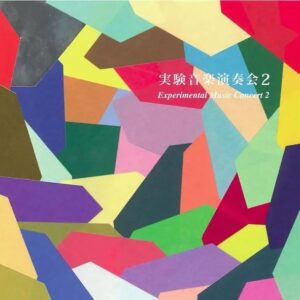
EXPERIMENTAL MUSIC CONCERT 2
Atsushi Yonemoto: unamplified electric guitar. Hirohiko Yamada: unamplified electric guitar, synthesizer, conductor. Hisayo Kobayashi: bottled water, conductor. Mamoru Nakajo: metronome, co-conductor. Masayuki Takano: triangle, conductor, direction, co-conductor. Toshihisa Hirano: synthesizer, electric guitar.
Guests : Hikaru Yamada: alto saxophone, water measurement. Ikuhiro Yamagata: voice, triangle, water measurement. Yoko Ikeda: viola, triangle. Tetuzi Akiyama: unamplified electric guitar, triangle, electric guitar. Taku Sugimoto: bowed guitar, tuning, electric guitar. Wakana Ikeda: flute.
Recorded by Taku Sugimoto at l-e, Tokyo, December 4, 2016.
Includes an insert with scores and liner notes by Wakana Ikeda, Yoko Ikeda, and Masayuki Takano in Japanese and English (English translation by Atsushi Yonemoto).
Original price was: 12,00€.6,00€Current price is: 6,00€.
In stock
CD
COMPILATION
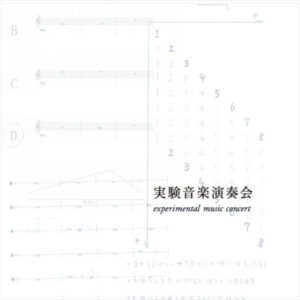
EXPERIMENTAL MUSIC CONCERT
“All the composers appearing on this CD are the participants in my experimental music school, the series of which washeld ibn the summer of 2013. It is essentially impossible to teach any kind of art; you can only learn voluntary how to do it. I myself had never intended to become a teacher. Nevertheless, I conceived an idea that it would be useful to do a kind of school.” Taku Sugimoto.
With pieces from Atsushi Yonemoto, Hisayo Kobayashi, Masayuki Takano, Hirohiko Yamada, Mamoru Nakajyo, Rei Sasaki, Toshihisa Hirano.
Original price was: 12,00€.6,00€Current price is: 6,00€.
Out of stock
CD
COMPILATION
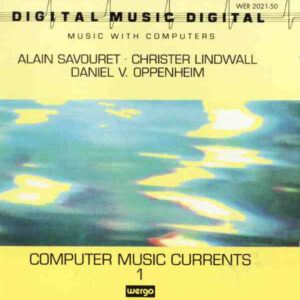
COMPUTER MUSIC CURRENTS 1
1989.
Alain Savouret, “Don Quixotte Corporation” (1980-81). Christer Lindwall, “Points” (1986). Daniel V. Oppenheim, “Round the Corners of Purgatory” (1987).
More than 50 composers from 13 different countries contributed to this collection of music with computers. Their pieces represent major directions of how avantgarde composers utilize the potential of new technology.
Original price was: 15,00€.8,00€Current price is: 8,00€.
In stock

LP
COMPILATION
DANSKE BÄNDAMATORER // DANISH TAPE AMATEURS 1959-1976
The tape amateurs – a piece of forgotten Danish music history. The Institute for Danish Sound Archaeoloy is releasing a collection of tape works and electronic compositions, created by people who had reel-to-reel tape recorders as their hobby. The vinyl release Danish Tape Amateurs 1959-1976 brings to light a completely overlooked and unheard chapter of Danish music and sound history, making these amazing works available for the first time.
A swarm of tape hobbyists.
When the reel-to-reel tape recorder became commercially available in Denmark in the 1950s, having the tape recorder as a hobby became a widespread phenomenon and in the following decades thousands of people recorded sounds and music, and experimented with cutting and splicing tape, both at home and together in so-called tape amateur clubs. Some also made sound collages and experimental music, exploring the tape recorder as a musical instrument in itself.
On June 26th the Institute for Danish Sound Archaeology is releasing the compilation Danish Tape Amateurs 1959-1976. The release uncovers the history of the tape amateurs with a selection of tape works, as well as an extensive essay by Danish composer Jonas Olesen, who through a comprehensive work of ‘sonic excavation’ and countless phone calls has assembled the history of the tape amateur clubs and the sonic and musical experiments.
With Jesper Hendze, Mads-Erik Michaelsen, Ole Steen Petersen, Benny Jensen, Kaj Ellermann Christensen, Carsten Elbro, Arne Juul Jacobsen, Peter Henriksen & Carsten Elbro, Anders Møller, Poul Otto Udsen, Holger Sindbæk, Arne Juul Jacobsen.
24,00€
In stock

DVD
COMPILATION
LIQUIFIED SKY
Line is pleased to announce its latest edition featuring astoundingly detailed audio/visual works by six internationally recognized artists: Evelina Domnitch + Dmitry Gelfand, COH, Paul Prudence, Francisco López, and Asmus Tietchens.
The fluidity and even the granularity of light can be unfolded by the senses through active attunement coupled with meticulously orchestrated conditions. Though formerly considered impossible to imagine, let alone perceive, recently, a variety of quantum behavior
has been observed on macroscopic scales, from colloidal liquids to biological systems. Liquified Sky documents a series of artworks that pierce this slippery, mesoscopic threshold, departing from the antiquated cult of the illusory, solid-state image.
1. “Mucilaginous Omniverse, part 1”, installation & video documentation: Evelina Domnitch & Dmitry Gelfand / sound: COH.
2. “Mucilaginous Omniverse, part 2”, installation, video documentation & sound: Evelina Domnitch & Dmitry Gelfand.
3. “Hydro Acoustic Study”, video: Paul Prudence / sound: Francisco López.
4. “Memory Vapor”, installation & video documentation: Evelina Domnitch & Dmitry Gelfand / sound: Asmus Tietchens.
The sensorial demands of processing quantum behavior incite adaptive resonances, comprising a multidimensional perceptual navigator. Though brains have been compared to clocks, telegraphs, computers and holograms, they are “not like any artificial machine. If anything, they are like natural self-organizing processes such as stars and hurricanes.” [W. Freeman, Neurodynamics: An Exploration in Mesoscopic Brain Dynamics] Occurring on many different scales of time and space, cascades of standing and traveling waves outline the adaptively resonating lattice of intercellular communication. These resonances can be finely tuned through a mesoscopic self-observation system, which translates quantum harmonic pattern, phase and amplitude recognition across the cerebrospinal sea of neuromodulators.
Due to the detailed nature of these works, this edition is a data DVD containing high resolution audio-visual files. To ensure proper playback, these files will need to be transferred from the data dvd to a hard drive. They can then be viewed in a variety of programs including Itunes and Quicktime.
Original price was: 17,00€.9,00€Current price is: 9,00€.
Out of stock

CD
COMPILATION
PANGEA NOISE
“A follow-up to Beyond ignorance and borders including noise artists from Puerto Rico (Cornucopia), Indonesia (Aneka Digital Safari), Singapore (Mindfuckingboy), China (Osci-Vibra-Tor, Li Jianhong), Algeria (Nihil Humanum), Slovenia (Aluviana), Iran (Nyctalllz), Luxembourg (Switchonoff), Tunisia (Heart Burnt To Ashes), Switzerland (Dave Phillips), South Korea-Japan (10), Equador (Industria Masoquista), Canada (Szkieve), France-Belgium (Planet Aldol & C-drík), Belgium ( rno klank), Malta (Grosz Ear), Latvia (Error), Everywhere-Nowhere (Zbigniew Karkowski), Bulgaria (Gokkun). Limited to 500 copies.”
Original price was: 10,00€.5,00€Current price is: 5,00€.
In stock

CD
COMPILATION
LES ECHOS DE L’ÉTALE. ECHOES FROM THE FORESHORE. VOL.1
SPECIAL CLEARANCE PRICES ! With Leif Elggren et Carl Michael von Hausswolff, Edvard Graham Lewis, BJ Nilsen et Hildur Gudnadóttir. “Echoes from the foreshoreb is a new collection "entre-deux / à deux" (in between / two of us) organized by the French embassy of the Elgaland~Vargaland Kingdoms, a co-production between the Editions Cactus and Optical Sound. On the 27th of may 2007, at 15.05 a foreshore in Normandy was annexed by the French ambassador of the Kingdoms of Elgaland and Vargaland, and initiated a musical experimental project. Each volume of the collection gathers various authors whose work is an original creation, using the concept of utopian territories and fluctuating spaces. Each listening of the records therefore becomes a sonic journey investigating Elgaland Vargaland, capturing the echoes of the foreshore. The collection’s graphic was conceived by Samuel Ruchot, who created playful graphics, integrating the shape of the kingdom’s flag. Hence, the floating flag, distorted, is associated with different background colours, each one corresponding to a different volume, allowing an easy identification of the various ones. Each cover is also conceived as a way of exhibiting the intimist images of the photographs of Ludivine Mabire, which can be seen when one removes the disk. Each disk from the collection is an experimental space encapsulating the poetic representation of the Elgaland Vargaland territories.”
Original price was: 12,00€.7,00€Current price is: 7,00€.
Out of stock

CD
COMPILATION
OTO NO HAJIMARI WO MOTOMETE 8. Inamura, Tokuono, Sasaki, Ohtsu’s works
Brand new issue of archve series of NHK electronic music studio. Contents: Toshira Mayuzumi : “Princess Hollyhock” (1957), Shinichi Matsushita : “Le Cloitre Noir” for voice and electronic music (1959), Toshi Ichiyanagi : “Parallel Music” (1962), Shiro Ima : “Music for 12 players and Electronic sounds” (1965)”.
29,00€
Out of stock

CD
COMPILATION
OTO NO HAJIMARI WO MOTOMETE 7. TSUTOMU KOJIMA.
Recent issue of Japanese electronic music made by NHK electronic music studio after EXPO’70. This CD consists of 4 works assisted by engineer Tsutomu Kojima since vol.5. Conrtents: Kiyotomi Yoshizaki "Palace of Green Space for Electronic Music" (1979). Akira Nishimura "Ode for Ekstasis" (1981). Shoko Shida "Lazy Garnet" (1974). Michio Kitazume "Reincarnation" (1982).
29,00€
Out of stock

CD
COMPILATION
OTO NO HAJIMARI WO MOTOMETE 6. NISHITA SHIOTANI TAKAYANAGI
Contents: unknown engineer “Electronic Music for stereophonic-broadcast” (1960). Minao Shibata: “Music Concrete for stereophonic-broadcast” (1955). Ryohei Hirose: “Flora 1971” (1971). Yori-Aki Matsudaira: “Assemblages for Tape” (1968) - collage work. Toru Takemitsu: “Sky, Horse and Deth” (1958) - great concrete work. Toshiro Mayuzumi: “Campanology for electronic music” (1959).
29,00€
Out of stock

CD
COMPILATION
OTO NO HAJIMARI WO MOTOMETE 5. Tsutomu Kojima’s works.
“5th issue of Japanese electronic music made by NHK electronic music studio after engineer Kojima assisted many electronic works of avant-garde composers. (Jean Claude Eloy’s well known concrete music “Gaku-no-Michi” was also assisted by Tsutomu Kojima). Contents : Keiki Okasaka “Beyond the Cloud”(1975), Joji Yuasa “My Blue Sky”(1975), Jo Kondo “Never Return”(1971), Sessyu Kai “Music for Tape”(1978), Katsuhiro Tsubonoh “Requiem”(1978,) Hifumi Shimoyama “Fumon IV”(1983).”
29,00€
Out of stock
CD
COMPILATION
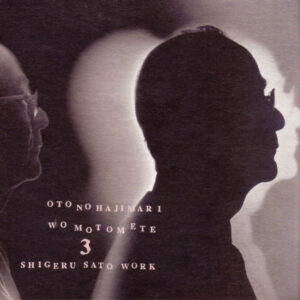
OTO NO HAJIMARI WO MOTOMETE 3. Sigeru Satou’s works
“The 3rd issue of early Japanese electronic music made by NHK (Nippon Housou Kyoukai : National Broadcasting association) electronic music studio. Engineer Satou assisted many electronic works of avant-garde composers. Contents : Makoto Moroi “Shosange” (1967), Minao Shibata “Display ’70” (1969), Toshiro Mayuzumi “MANDARA with source of Voice and Electric sound” (1969), Joji Yuasa “Voices Coming” (1969), Makoto Shinohara “Broadcasting” (1973).
29,00€
In stock

CD
COMPILATION
OTO NO HAJIMARI WO MOTOMETE 1. Hiroshi Shiotani’s works
(issued 1993-2001, 2nd edition) “Hiroshi Shiotani was an engineer of NHK (Nippon Housou Kyoukai: National Broadcasting association) electronic music studio, and then he cooperated with some avant-garde composers of Japan. This CD get Shiotani’s works together, and released several years ago as a memorial of him when he died. It was repressed 500 copies by a private studio. All tracks are legendary early electronic works of Toshiro Matuzumi and Makoto Moroi. These works had originally released in ’50s-’60s, but we have not been able to listen long time because all LPs was out of print long ago. This repress edition included the original source of Stockhausen’s "Telemusik" (he had come to Japan and made this work at NHK studio. Shiotani helped him).” Contents : Toshiro Matuzumi "Music for sine wave by propotion of prime number" (1954), "Music for modulated wave by propotion of prime number" (1954), "Invention for square wave and saw-tooth wave" (1954), "Olympic Campanology"(1964). Toshiro Matuzumi & Makoto Moroi "Variations on numerical principle of 7" (1956), Makoto Moroi "Stars of Pythagoras" (1959), "Variete"(1962), Karlheinz Stockhausen "Telemusik"(1966).
32,00€
Out of stock
CD
COMPILATION
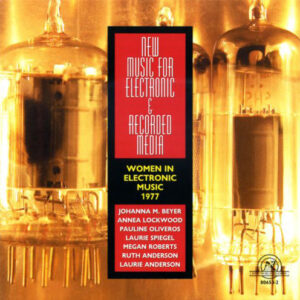
WOMEN IN ELECTRONIC MUSIC
“This is a long-awaited reissue of the CRI CD of the classic 1750 Arch LP. "The music on this album exhibits an exciting, wide-open, freewheeling approach to the medium of electronic music which has come to be typical of this genre in the late 1970s. No longer are composers obsessively concerned with the agonizing, expressionistic, and purely “electronic” (synthesized) sound formulas which marked much of this music composed between the mid Fifties and the late Sixties. Instead, today we have composers willing to mix media and sonic materials in thoroughly inventive ways to achieve ends which are new-sounding, and often more engaging, than that of the “academic” avant-garde. This is the outgrowth of a fundamental change in concerns which has been evolving not only among the composers on this album but also in a growing segment of the musical avant-garde, of which these members are some of the most fecund and inspired. These new sources of inspiration certainly were not as widely shared fifteen years ago. Several composers represented here are deeply concerned with Eastern influences: meditation, healing, trance, states of serenity. Others are inspired by traditional (or “ethnic”) musics and their subsequent metamorphoses into such popular forms as rock and roll. Still others bring to bear a sense of wit and satire, rarely a prominent feature of avant-garde music in the early 1960s. This first anthology of women’s electronic music demonstrates great refinement and skill at work in a variety of different styles, several of which are unfamiliar or new even to those who follow contemporary music. The fact that these pieces are more listenable than that of the Sixties avant-garde does not point to a musical regression as some critics have overeagerly assumed when discussing modern works using, say, consonant harmonic structures. Rather, and I think this is common denominator for these pieces and something which women composers and artists have been instrumental in legitimizing again for this period in time, these works signify a new consciousness of the relationship of art to human life and the important and positive interaction which can be the role of a more personalized art in our day-to-day experience.” Charles Amirkhanian, August 1977. “Music of the Spheres” (1938) (Johanna M. Beyer), “World Rhythms” (1975) (Annea Lockwood), “Bye Bye Butterfly” (1965) (Pauline Oliveros), “Appalachian Grove I” (1974) (Laurie Spiegel), “I Could Sit Here All Day” (1976) (Megan Roberts), “Points” (1973-74) (Ruth Anderson), “New York Social Life” (1977), “Time to Go” (1977) (Laurie Anderson).
15,00€
Out of stock
2 LP
COMPILATION
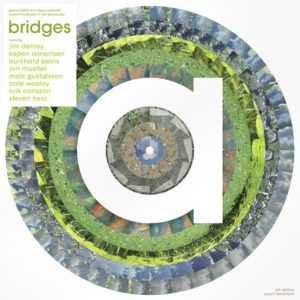
BRIDGES
Concept by Gerco Hiddink and Rutger Zuydervelt. Graphic design and photography by Gerco Hiddink. Field recordings and coordination by Rutger Zuydervelt. Mastered by Giuseppe Ielasi. Featuring Jim Denley and Espen Reinertsen, Burkhard Beins and Jon Mueller, Mats Gustafsson and Nate Wooley, Erik Carlsson and Steven Hess. Limited to 250.
“Bridges is an audiovisual project involving four pairs of improv players reacting to field recordings made at four bridges between Sinderen and Nijmegen in The Netherlands. Eight musicians were paired not to play together, but to react separately to the field recordings, which where then mixed together with the primary field recordings. The four pieces are released as a double 12" picture disc, with the artwork printed with a zoetropic series of images of the bridges”.
“Like music, film is time-based. Print is static. I thought that if I could find a way to translate the video into print, some element of time and movement would remain within the design… I edited dozens of small film loops per bridge, and placed frames of these in rings on vinyl, so that when the record is played, the film comes alive again in stop-motion. It’s a moving photograhic score.”
“Bridges is an audiovisual project involving four pairs of improv players reacting to field recordings made at four bridges between Sinderen and Nijmegen in The Netherlands. Eight musicians were paired not to play together, but to react separately to the field recordings, which where then mixed together with the primary field recordings. The four pieces are released as a double 12" picture disc, with the artwork printed with a zoetropic series of images of the bridges”.
“Like music, film is time-based. Print is static. I thought that if I could find a way to translate the video into print, some element of time and movement would remain within the design… I edited dozens of small film loops per bridge, and placed frames of these in rings on vinyl, so that when the record is played, the film comes alive again in stop-motion. It’s a moving photograhic score.”
Original price was: 38,00€.20,00€Current price is: 20,00€.
In stock
CD
COMPILATION
RESONANCIAS
This CD gathers the electroacoustic pieces awarded by Fondation Destellos and Mexican Center for Sound Art between 2008 and 2013. Basilio Del Boca, “Viscuap” (2008), Diana Salazar, “Papyrus” (2009), Adam Stansbie, “one time one” (2010), Panayiotis Kokoras, “Magic” (2011), David Hindmarch, “Golden Bowls” (2011), Christian Helm, “Aporie 2011” (2013), Daniel Judkovski, “El exilio infinito” (2013).
Original price was: 9,00€.4,00€Current price is: 4,00€.
In stock

CD
COMPILATION
COMPROMIZE
This compilation contains 13 tracks representing the state of things in SELEKTION’s audio production in 1991 / 92 and the diverse approaches to sound organization by the SELEKTION members at that time. Featuring among others: Stefan E. Schmidt, Charly Steiger & Cornelia Franke, Joachim Pense, Markus Caspers, RLW, A. Wollscheid, P16.D4… - released 1992
5,00€
In stock

CD
COMPILATION
ZELPHABET VOL. F
With Failing Lights: “The Submarine Twilight”, Fin: “Works for Magnetic Tape”, Francisco Lopez: “untitled
210” and Frans de Waard: “Meet Melt”.
4,00€
In stock

CD
COMPILATION
MOLE’S MILK AND OTHER PIECES
For many years now there is a strong connection between the three members of Kapotte Muziek - Frans de Waard, Roel Meelkop & Peter Duimelinks - and Rotterdam based visual artist Ben Schot. The first time they worked together was when Schot asked Kapotte Muziek to perform at a festival about Detroit, MC5, etc festival in 1998 (released on ‘Praag/Rotterdam’ CD by Kapotte Muziek) and since then there have been various collaborations and constellations. This CD, while technically a compilation, collects four of these pieces.
- As Wieman De Waard and Meelkop provided the musical backing for a performance by Schot as an introduction for a screening of Jodorowski’s film ‘El Topo’, which takes the musical score into the land of plunderphonics, noise, improv and techno (2010-2012)
- Kapotte Muziek performed a rare laptop concert when Ben Schot received the Pendrecht Cultuur Prize in 2003.
- The Whi was a quartet of Meelkop, De Waard, Ben Schot and his daughter Puck Schot playing the game ‘Rockband Wii’, on real amplifiers and computer distortion, much the hilarious reaction of the audience - as can be heard here.
- With DMDN (Jacques van Bussel), Duimelinks, De Waard and Meelkop played a final concert (?) as Death Pact in 1999, probably the loudest concerts they ever performed as part of a programme called ‘Withdrawel’. 250 copies.
This is a long CD, clocking in at just under 80 minutes and contains a rare example of the more noisy works of these artists. It comes in a retro vinyl gatefold sleeve and is co-released with Ben Schot’s own publishing house Sea Urchin.
5,00€

9 CD
COMPILATION
9 TRAJECTOIRES
9 CD with 9 composers of electroacoustic music who did work at INA-GRM.
Ludger Brümmer, “Deconstructing Double District” (2011), “Xronos” (2002), “Glasharfe” (2006), “Spin” (2014).
Philippe Leroux, “La guerre du faire” (1992), “M.É” (1998), “Objets trouvés… posés” (2009).
Diego Losa, “Cronicas del tiempo” (2005), “Historias de dos mundos” (2007), “Sortie d’un rêve dans une nuit étrange très loin d’ici…” (2012), “Horizons ou le récit d’un voyageur” (2015).
Mario Mary, “Signes émergents”v (2003), “2261” (2009), “Une bouffée d’air” (2006), “Portraits témoins” (1997).
Luis Naon, “La sphère et la pierre” (1993-94), “Perspectives” (2004 - 2017), “Lascaux rbana” (2004).
Ake Parmerud, “Les objets obscurs” (1991), “Renaissance” (1994), “Dreaming in darkness” (2005), “Electric birds” (2012).
Elzbieta Sikora, “Axerouge V” (2011), “Chicago Al Fresco” (2009), “Flashback” (1968-1997), “Derrière son double” (1982-83).
Kees Tazelaar, “Chatoyance” (2013), “Chroma” (2006), “Sternflüstern” (2003), “Sérénade” (2016).
Hans Tutschku, “Extrémités lointaines” (1998), “Distance liquide” (2007), “Monochord” (2008), “Migration pétrée” (2001).
55,00€

5 CD
COMPILATION
ARCHIVES GRM
For the 30th birthday of INA, the GRM has decided to present in this CD box some of his archives. CD1 “les visiteurs de la musique concrète” : André Hodeir - Pierre Boulez - Jean Barraqué - Darius Milhaud - Roman Haubenstock-Ramati - Henri Sauguet - Edgar Varèse - André Boucourechliev - Claude Ballif - Iannis Xenakis - Olivier Messiaen. CD2 “L’art de l’étude : Pierre Schaeffer - Monique Rollin - Michel Philippot - Philippe Arthuys - Luc Ferrari - François-Bernard Mâche - Mireille Chamass-Kyrou - Ivo Malec - Philippe Carson - Akira Tamba - Beatriz Ferreyra - Alain Savouret. CD3 “Le son en nombres » : François Bayle - Dieter Kaufmann - Jean-Claude Risset - Ivo Malec - Denys Smalley - Gilles Racot - Yann Geslin - Bénédict Maillard - Jean Schwarz - Francis Dhomont. CD4 “Le temps du temps réel” : Bernard Parmegiani - Åke Parmerud - Denis Dufour - Horacio Vaggione - Alain Savouret - François Bayle - Gilles Racot - Daniel Teruggi - Ramon Gonzales-Arroyo - Michel Redolfi. CD5 “Le grm sans le savoir” : Bernard Parmegiani - Robert Wyatt/F. Bayle - François Bayle - Alain Savouret - Jean Schwarz - Michel Portal/J. Schwarz - Boris Vian/B. Parmegiani - Robert Cohen-Solal - Guy Reibel - Edgardo Canton - Christian Zanési.
30,00€
In stock
book + CD
COMPILATION
TOUCH MOVEMENTS
Touch MOVEMENTS has been compiled over the course of 3 years. It is a response to many requests for Touch to publish a fuller account of Jon Wozencroft’s photography for the cover art of the project. The book follows the music, which was compiled step-by- step, like a jigsaw – there was not an “open call” to the artists, rather a sequential development which gives the CD a special narrative quality. And since our last Touch 30 compilation in 2012, the accuracy of the music has grown and rises to the challenge of what sound can do to transform perceptions about the immediate emotion of musical work and its more dif cult, longer term evolution.
Following Touch Folio 001 in 2015, this series is a dedication to finding new ways of audiovisual publishing, somewhere between the twin peaks of a jewel-cased CD and a lavish box-set. The two elements of sound and the visual work in parallel to create the idea of an “Ear-book”, whose interdependency reveals itself over time, and allows the richest of listening and viewing experiences. The music and the photography is fully annotated, alongside a rarely-seen manifesto by the Surrealist film-maker Jan vankmajer which celebrates the spirit of the creative act.
With tracks from Mika Vainio, AER, Bethan Kellough, Wire, Carl Michael Von Hausswolff, Chris Watson, Jana Winderen, The Magical Land of the North, Claire M Singer, Hildur Gudnadottir, Three 20, Philip Jeck, Simon Scott, Eleh, Russell Haswell, Heitor Alvelos, Johann Johannsson, Mark Van Hoen, Fennesz, Sohrab, Strafe FR, Jim O’Rourke, Situation Stabilised / BJ Nilsen, Peter Rehberg, Oren Ambarchi.
76pp full colour book + CD. Limited edition of 1000.
Following Touch Folio 001 in 2015, this series is a dedication to finding new ways of audiovisual publishing, somewhere between the twin peaks of a jewel-cased CD and a lavish box-set. The two elements of sound and the visual work in parallel to create the idea of an “Ear-book”, whose interdependency reveals itself over time, and allows the richest of listening and viewing experiences. The music and the photography is fully annotated, alongside a rarely-seen manifesto by the Surrealist film-maker Jan vankmajer which celebrates the spirit of the creative act.
With tracks from Mika Vainio, AER, Bethan Kellough, Wire, Carl Michael Von Hausswolff, Chris Watson, Jana Winderen, The Magical Land of the North, Claire M Singer, Hildur Gudnadottir, Three 20, Philip Jeck, Simon Scott, Eleh, Russell Haswell, Heitor Alvelos, Johann Johannsson, Mark Van Hoen, Fennesz, Sohrab, Strafe FR, Jim O’Rourke, Situation Stabilised / BJ Nilsen, Peter Rehberg, Oren Ambarchi.
76pp full colour book + CD. Limited edition of 1000.
37,00€
In stock
book
COMPILATION
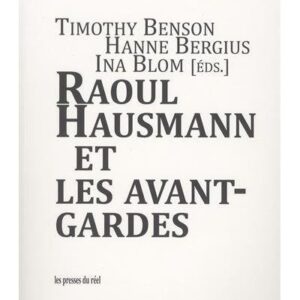
RAOUL HAUSMANN ET LES AVANT-GARDES
Published in February 2015. French edition. 17 x 24 cm (softcover). 512 pages (80 b/w ill.).
Edited by Timothy Benson, Hanne Bergius, Ina Blom. Texts by Timothy Benson, Hanne Bergius, Ina Blom, Jean-François Chevrier, Bertrand Clavez, Michel Giroud, Andreas Haus, Adelheid Koch-Didier, Ghislain Lauverjat, Arndt Niebisch, Pascal Rousseau, Adrian Sudhalter, Hubert Van Den Berg & Lidia G uchowska, Michael White.
This publication aims to explore how the multiple production of Raoul Hausmann, a central figure of Dada, has helped to shape the art of modernity.
26,00€
Out of stock

book
COMPILATION
EREWHON CALLING : EXPERIMENTAL SOUND IN NEW ZEALAND
Erewhon Calling: experimental sound in New Zealand is a lavishly-illustrated new publication from the Audio Foundation and CMR. It is a survey of how a bunch of antipodean misfits and malcontents have forged new ways and new reasons to make noise, here at the end of the earth. Edited by Bruce Russell (the Dead C.), in association with Richard Francis and Zoe Drayton; the aim of this volume is to survey the full range of ‘non-standard’ audio practices in contemporary NZ culture. The book’s remit runs from the borders of composed art music, through improvised noise, to deconstructed rock’n pop filth’; and every genre, every scene, every permutation of unconventional audio practice,in-between. The aim is not to be comprehensive, there is literally too much vitality and diversity for,any book!). The hope is to ‘throw a good handful of gravel into the pool’. While not every eel will have been hit, the surface will have been rippled from shore to shore, which is more than anyone else has even attempted before. Erewhon Calling makes room for many voices, allowing multiple and possibly conflicting voices and points of view. A range of artists and informed commentators mainly tell their own stories, describe their own work, and outline their own goals in working on the fringes of audio culture. The readers of this important new source book will be able to discern their own meanings and make their own connections from this thought-provoking and unique publication. Edited by Bruce Russell in association with Richard Francis and the Audio Foundation. Text / page works by Branden W. Joseph, Phil Dadson, Bruce Russell, Michael Morley, Byron Coley, Alastair Galbraith, Empirical, White Saucer, Clayton Noone, Andrew
Clifford, Jeff Henderson, Daniel Beban and Nell Thomas, Su Ballard, Jon Bywater, Dan Vallor, Clinton Watkins, Witcyst, Andrew Scott, Campbell Kneale and Antony Milton, Vitamin S, Jon Dale, Mark Williams, Lee Noyes, Nathan Thompson, Beth Dawson, Sean O’Reilly, Kraus, Sean Kerr, Peter Stapleton, Stephen Clover, Dugal McKinnon, Omit, Peter Wright, Jo Burzynska, Ian-John
Hutchinson, Kim Pieters, Paul Winstanley, Gentle Persuasion, Zoe Drayton, Simon Cuming, Stevie Kaye, Rachel Shearer, Richard Francis, Rosy Parlane, Kiran Dass, None Gallery, Zita Joyce, mr sterile Assembly, Ben Spiers. Designed by Richard Francis. Co-published by Audio Foundation and CMR, August 2012. Soft-cover. 192 pages (black and white). Edition of: 900. Dimensions: 170mm x 240mm x 16mm. Individually shrinkwrapped.
27,00€
Out of stock
book
COMPILATION
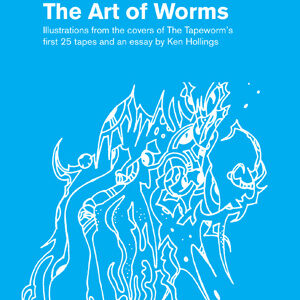
THE ART OF WORMS
The first publication from The Bookworm. Contents: “Parasitic Infestation”, an essay by Ken Hollings. Illustrations from the first 25 Tapeworm tapes, including works by SavX, Derek Jarman and Leif Elggren. 66pp, 110mm x 117mm, soft cover, thread bound booklet - no ISBN. Edition of 250 copies only.
5,50€
In stock
book + CD
COMPILATION
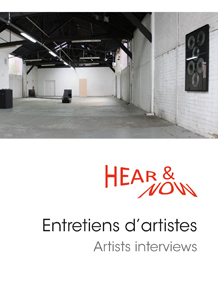
HEAR & NOW – ENTRETIEN D’ARTISTES
2013, bilingual edition (English / French), 14 x 19 cm (softcover), 168 pages (+audio CD). A series of interviews with 27 international artists/musicians, centered on the relation of sound to space. The book includes interviews with the 27 artists of Parisonic 2011 in an original way: each artist states The question he would like to be asked on his work. The set of questions is then proposed to each artist. Thus, Hear & Now, artists interviews emphasizes the words of the artists themselves rather than outside comment. A text by Laurent Catala, published in 2011 in the journal Mouvement, and photographs illustrating the book provide an overview of the exhibition. The included CD presents the works shown in the listening room Magnetic Traces (with Loic Blairon, Thomas Tilly, Camilla Hannan & Eamon Sprod, Eric La Casa & Philip Samartzis, Jean-Luc Guionnet, Marc Baron, Anthea Caddy & Thembi Soddell, Lizzie Pogson, Geoff Robinson, Yannick Dauby, Rosalind Hall & Alice Hui-Sheng Chang, Cédric Peyronnet, Kristian Mark Roberts, Rainier Lericolais, Pali Meursault). Published following the Parisonic sound art exhibition in 2011. Interviews with Marc Baron, Mélanie Berger, Loic Blairon, Dominique Blais, Charlotte Charbonnel, Yannick Dauby, Jean-Luc Guionnet, Luc Kerléo, Eric La Casa, Rainier Lericolais, Nicolas Maigret, Pali Meursault, Nicolas Montgermont, Cédric Peyronnet, Philippe F. Roux, Thomas Tilly, Anthea Caddy, Alice Hui-Sheng Chang, Rosalind Hall, Camilla Hannan, Marcia Jane, Lizzie Pogson, Kristian Mark Roberts, Geoff Robinson, Philip Samartzis, Thembi Soddell, TARAB/Eamon Sprod.
23,00€
In stock
2 CD + book
COMPILATION
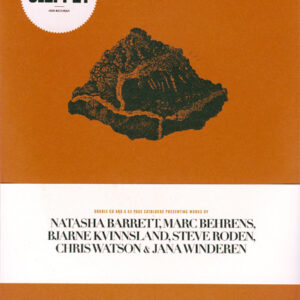
SLEPPET
’Natasha Barrett, Marc Behrens, Bjarne Kvinnsland, Steve Roden, Chris Watson and Jana Winderen. Six artists toured western Norway in april and may 2007, to experience and record its nature and rural culture. The itinerary included the small town of Sandane, the Jostedal glacier, Utvær - Norways westernmost island and the fjord city of Bergen. The works created out of the sonic input from this tour made out the components of Sleppet - a sound art exhibition curated by J¿rgen Larsson and presented by Grieg07, Lydgalleriet, Galleri 3.14 and Ultima. +3dB records is proud to present a series of works based on the materials from Sleppet. ’in my art I could not help but search for a way to express the wild music of the ocean’s roar, - but alas, in vain. I felt most deeply the impossibility of conveying that mighty chord in music. There was in that rushing and roaring something so infinite that it seemed presumptuous to dwell even for a moment on the idea of being able to reproduce it. Nonetheless I found some comfort in that it is the artist’s responsibility not to convey its material effect, but the reflection of the emotions it awakens; if this is done with genius then the impression can be equally divine despite the lack of the mass effect which is nature’s own.’ Edvard Grieg.’ label info
18,00€
Out of stock

4 CD + book
COMPILATION
OPIKA PENDE : AFRICA AT 78RPM
Compiled and edited by Jonathan Ward. 112 page book with 4 CDs. Dozens of full-color images from the era. The CDs feature 100 never-before-reissued recordings from the 1920s-1960s. “It is truly astonishing to consider the tremendous variety of music that was pressed to shellac discs on the continent of Africa. Popular songs, topical songs, work songs, comic songs, songs of worship, ritual, dance, and praise-the sheer range of musical styles resists any easy categorization. Further, African geography itself resists boundaries. The boundaries of cultures and languages are often far more complex than political boundaries. Complicating things further, entire countries seem to have been skipped over by both commercial 78 rpm record companies and ethnographers during the 78 rpm era. No doubt it was the same with many cultures. But that doesn’t mean that 78s weren’t everywhere, even in remote parts of the continent. By the mid-1960s, 78s were still a popular if not preferred medium in much of Africa, as a significant amount of the population still used wind-up gramophone players. I have created this compilation with one simple goal in mind: to showcase a diverse amount of long-forgotten music from Africa that transports me as a listener. It is one person’s offering of music that is wholly unavailable except in its original elusive and fragile format. While it is not definitive, nor am I attempting to construct or invent a narrative, there are important connections to be made. Around one musical corner is another corner, and another. Within these 100 tracks, traditional music stands side by side with popular music as traditional culture coexists with so-called modernity. As a non-African, I offer this set as an example of the riches that lay in waiting when considering the tens of thousands of phenomenal African 78 rpm discs that were issued, played, dispersed, and in large part, forgotten.” “Opika Pende,” is a saying in the Lingala language that means “be strong” or “stand firm.” It can also mean “resist.” Jonathan Ward, 2011
52,00€