
Out of stock

book
COMPILATION
ECHTZEITMUSIK BERLIN
“Shaped by the perspectives of participants and various observers, the book Echtzeitmusik Berlin - Self-Defining a Scene investigates, documents, and reflects on a multilayered phenomenon within Berlin’s musical culture, a phenomenon whose influence and meaning has effects that extend far beyond Berlin itself. Having emerged in the open spaces of the city’s east side after the fall of the Berlin Wall, and rooted in a cultural coordinate system made up of squats and free improvisation, punk and New Music, social experimentation and performance art, the Echtzeitmusik scene has passed through an eventful history of musical and social development and matured into a wide spectrum of predominantly experimental forms of music, bordering on fields as varied as noise, electronica, trash pop, free jazz, and contemporary composed music, not to mention performance and sound art.
This book is a theoretical approach to a scene that constituates itself through practice, that describes itself with every single contribution here, that invents, defines, and positions itself through writing. It is a verbal act of uncovering. There is not the history, but a myriad of histories, not the theory, but the widest range of somewhat discordant conceptions and approaches. Echtzeitmusik - Self-Defining a Scene mirrors this multiperspectivity. It is more than a mere documentation of the history of Echtzeitmusik, it might be considered a part of this history. Theoretical texts, memories, statements and artwork by Thomas Ankersmit, Harald Ansorge, Serge Baghdassarians, Boris Baltschun, Jürg Bariletti, Johannes Bauer, Burkhard Beins, Marta Bla anovi , Nicholas Bussmann, Lucio Capece, Diego Chamy, Clare Cooper, Werner Dafeldecker, Rhodri Davies, Bertrand Denzler, Bill Dietz, Axel Dörner, Phil Durrant, Ekkehard Ehlers, Sabine Ercklentz, Andrea Ermke, Kai Fagaschinski, Fernanda Farah, Kerstin Fuchs, Björn Gottstein, Matthias Haenisch, Hanna Hartman, Franz Hautzinger, Robin Hayward, Teresa Iten, Sven-Åke Johansson, Margareth Kammerer, Christian Kesten, Annette Krebs, Christof Kurzmann, Greg Malcolm, Thomas Meadowcroft, Chico Mello, Thomas Millroth, Toshimaru Nakamura, Gisela Nauck, Vered Nethe, Andrea Neumann, Nina Polaschegg, Michael Renkel, Ana Maria Rodriguez, Adeline Rosenstein, Arthur Rother, Olaf Rupp, Ignaz Schick, Ulf Sievers, Stefan Streich, T. Turner, Michael Vorfeld, Antje Vowinckel and Steffi Weismann”.
29,00€
In stock

CD
COMPILATION
ZELPHABET VOL. J
“The tenth installment in Zelphabet’s new series of 26 alphabetically oriented compilations of noise. Volume J makes its mark with cuts from John Duncan, John Wiese, Jon Rose, Joseph Hammer and Justice Yeldham.” label info
4,00€
In stock

LP monoface
COMPILATION
FYLOOP
One-sided LP in white vinyl with 360 locked grooves by Fylkingen artists!
Irina Anufrieva, Jan Carleklev, David Linnros, Henrik Rylander, Fredrik Olofsson,
Dr. Robin McGinley, Jacek Smolicki, Christian Bock, Girilal Baars, Jan Carleklev,
Ida Lundén, Jocke Roséen, Daniel Borgegård Älgå, Daniel Rozenhall, Jan Liljekvist, Dinka Pignon, Iwo Myrin, Johan Boberg, Hanna Hartman, David Bremer, Gunnel Pettersson & Amit Sen, Ingrid Engarås in collaboration with Karl Ture Rydby, Joel Dittrich, Charlotte Engelkes, Bo Leth, Adrian Knigth, Johan Lindvall, Helene Hedsund, Daniel Wiklander.
17,00€
In stock

LP
COMPILATION
YOKOMONO 03.5
“Staalplaat Soundsystem is releasing a series of artist vinyl release used in our own sound installations. This record is a second atempt to create random vinyl release. Our first atemt was the release of Yokomono 03 where we hoped to cut two tracks, one spiraling from outside in and the others from inside out. So that the nedle would move in different directions. This atempt failed (for reasons that we will not go in to at this moment). This is a record with three paralel soundtracks where the cutting needle was lifthen twice with short intervals, in order to make the nadle used during “wiedergabe” to jump tracks randomly. To play this record you must not see your turntable as a reproduction machine that reproduces the music on the record. You can not put it on and sit down to listen. You should see the record and turntable much more as a music instrument that with each turntable model and with each setting if your machine you will create a different sound and mix of this record. As with any instrument you have to learn how to play your turntable and find what setting you like best. Of vital influence are the skate settings en the wait on the tone arm, these and others you must very to experience the options of the record. Side A : Pure brown noise. Cynthia Zaven. Merzbow. Side B : Pure white noise. Mika Vainio. Jaap Blonk. Limited edition of 500.”
11,00€
Out of stock
LP
COMPILATION
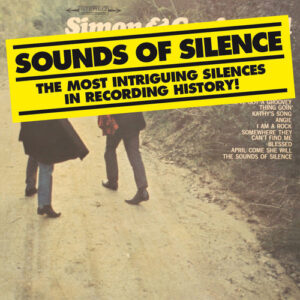
SOUNDS OF SILENCE
NEW EDITION limited to 200 copies !
“Sounds of Silence” is an anthology of some of the most intriguing silent tracks in recording history and includes rare works, among others, by Andy Warhol, John Lennon, Maurice Lemaitre, Sly & the Family Stone, Robert Wyatt, John Denver, Whitehouse, Orbital, Crass, Ciccone Youth, Afrika Bambaataa and of course Yves Klein. In their own quiet way, these silences speak volumes: they are performative, political, critical, abstract, poetic, cynical, technical, absurd… They can be intended as a memorial or a joke, a special offer, or something entirely undefined. The carefully chosen silences of this anthology are intrinsically linked to the medium of reproduction itself and reveal it’s nude materiality. They expose their medium in all its facets and imperfections, including the effect of time and wear. At the most basic level, these silences are surfaces. And it is in their materiality that they distinguish themselves from the conceptual experiments of John Cage with “4’33”. From the 1950s silence has found a place in the economic structure of the record industry and since then it would increasingly be appropriated by a vast array of artists is a vast array of contexts. Indeed, the silent tracks seems to know no boundaries. The LP presents the silences as they were originally recorded, preserving any imperfection that the hardware conferred upon the enterprise, without banning the possibility to satisfying the ear. The liner notes provide historical background for each track, revealing the stated (or presumed) motivations for these silences, while providing novel sound correspondences or interferences. This album is meant to be played loud (or not), at any time, in any place: a true aural experience ! Co-produced by alga marghen with Sound-Houses-FRAC Franche Comté.
22,00€
Out of stock
LP
COMPILATION
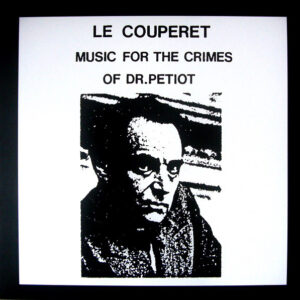
LE COUPERET
A vinyl reissue of the legendary Broken Flag compilation cassette from 1983. Featuring tracks by Ramleh, Vortex Campaign, The New Blockaders, Sir Ashleigh rove, Citipati and the Depilate Corps. Limited to
300 copies. Complete with printed inner sleeve. Released with the authorization of every contributing artist.
17,00€
Out of stock

LP
COMPILATION
TEXT-SOUND COMPOSITIONS 9
During the years from 1968-70, Fylkingen Records released series of 7 LPs in collaboration with the Swedish Radio, all of which contained material that was presented during the yearly festivals for Text-Sound Composition that Fylkingen arranged during those three years. The yearly festivals continued from 1971-71. A series of records that documented these festivals was planned but, due to economic reasons at that time, they were never made. Fylkingen Records has now, over 40 years later, found the material that was presented at these festivals and continues the series with vol. 8-11 - one record for each year’s festival during the years 1971-74.
Volume 9 (1972) with Christer Grewin, Bob Cobbing, Maud Reuterswärd & Bengt Nyquist, Öyvind Fahlström, Charles Amirkhanian.
Volume 9 (1972) with Christer Grewin, Bob Cobbing, Maud Reuterswärd & Bengt Nyquist, Öyvind Fahlström, Charles Amirkhanian.
18,00€
Out of stock
LP
COMPILATION
TEXT-SOUND COMPOSITIONS 8
During the years from 1968-70, Fylkingen Records released series of 7 LPs in collaboration with the Swedish Radio, all of which contained material that was presented during the yearly festivals for Text-Sound Composition that Fylkingen arranged during those three years. The yearly festivals continued from 1971-71. A series of records that documented these festivals was planned but, due to economic reasons at that time, they were never made. Fylkingen Records has now, over 40 years later, found the material that was presented at these festivals and continues the series with vol. 8-11 - one record for each year’s festival during the years 1971-74.
Side A
Bengt Emil Johnson - 1/1971: under publikens jubel
Gust Gils - Making Out In Windy Stockholm
Side B
Herman Damen - Magic
Bob Cobbing - Trilogy Three
Side A
Bengt Emil Johnson - 1/1971: under publikens jubel
Gust Gils - Making Out In Windy Stockholm
Side B
Herman Damen - Magic
Bob Cobbing - Trilogy Three
18,00€
Out of stock
LP
COMPILATION
5 SEPTEMBER 1982 – A TRIBUTE TO JOHN CAGE
1983. This is Fylkingen’s contribution to the celebration of John Cage´s 70th birthday. The album presents works - all commissioned by Fylkingen on this special occasion - by composers from the 1960´s generation and shows their relations to an important percursor. Lars-Gunnar Bodin "For Jon III", Leo Nilsson "Early Ear", Folke Rabe "To the Barbender", Sten Hanson "The Flight of the Bumble Bee", Arne Mellnäs "31 Variations on CAGE".
16,00€
Out of stock
LP
COMPILATION
STOCKHOLMS ELEKTRONMUSIKFESTIVAL 1982
In October 1982 a festival for electronic music was arranged cooperatively by The Swedish Radio Company, Electronic Music Studio (EMS) and the Culture House in Stockholm for the fourth consecutive year. The festival, which was held in the concert hall of the Culture House included works for tape alone, instruments and tape, live electronics and text-sound composition. As previous years, both recent and older works of Swedish and international composers were presented at the three well- attended concerts. Stanley Haynes “Prisms for piano and tape”, Anders Hillborg “Rite of Passage”, Ingvar Karkoff “The Dogs”, Ilmar Laaban “Chien d’absolu”, Charles Amirkhanian “Hypothetical moments”.
16,00€
In stock
LP
COMPILATION
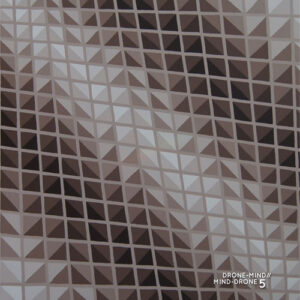
DRONE-MIND – MIND-DRONE VOL.5
The series shows the various sides of todays experimental drone-music, especially focusing on newcomers and less well known acts from the world wide scene.
“In an era when so much content is driven by personality, we offer instead the challenge, or the respite, of interacting with sound on its own terms.” [CLADE,]
This LP-series from Drone Records is dedicated to the Drones of the World, and the Drones of our Minds. A kind of continuation of the Drone 7”-series, with artwork based on huge paintings by British artist Pete Greening. Drone Music is seen as more than a mere ‘music style’, it expresses an approach to perceive and understand the world. Drone-Mind and Mind-Drone build a circle of diverse inter-relations. The Drone as a metaphor for everything that vibrates, that releases energy - from atoms and elementary particles to the hum of the earth and the universe. The Drone as an entity that connects everthing that exists within our own “mind-space”, perception and self.
Gydja (New Zealand). Enchanting female drone esoterica by an artist who is also known through her stunning artworks for Cold Spring and other labels. Through magnetic winds and metallic clouds the long track “Gjallarbru” creates a wonderful secretful and sensitive atmosphere; very lonely and frosty, like a cold and clear consciousness released on a high mountain, on top of the world...
Clade (Scotland / USA). Named after a notion taken from biology science (=Monophylum), this duo is based in Scotland and USA, alluring with very focused minimal drones on so far four releases. The two tracks presented here stand out with their use of somehow refractional, fibrous sounds, placed on monotonus drones with a very sedative and insistent effect...
Monocube (Ukraine). This “ethereal drone” discovery from Ukraine moves musically through endless spaces, creating choral-like aural clouds and strange melodies => self-supporting drones with an incredible width, when even the smallest particles of concrete microsound encountering are exciting, entering into a heavenly “song of the sirens” choir..
Yrsel (France). Another bi-national project is this French-Swedish collaboration of Julien Louvet (2:13 PM, etc.) and C-J Larsgarden (Ondo),who released three albums so far. Their track “Krstnhmnbrtncrt” consists of very heavy, swallowing drones with atonal elements coming to the surface, diffus and poisonous but also lulling you into a deep (dead) sleep., slowly drowning in dense humming waves of cryptic drones...
Solid silver coloured vinyl, graphic design by Abby Helasdottir, using two paintings by British painter Pete Greening; limited ed. of 400 copies.
16,00€
Out of stock
LP
COMPILATION
THE GAMELAN OF THE WALKING WARRIORS
A fascinating immersion in the heart of a funeral ceremony live recorded in Bali, where gongs, cymbals, and drums give rhythm to the bewitching atmosphere of this mortuary procession.
The international audience’s interest into Balinese music and its gamelan orchestras dates back to the edition of large ethnographic series in the 1950s, 60s and 70s which largely encouraged the discovery of this music beyond Indonesia’s borders. Taking advantage of a more advanced technology compared to the vinyl golden era, the present field recordings produced in 2011 render at the closest the power of gamelans. They are presented here in two forms. The first one offers a display of Beleganjur music out of the ritual context, which can be differentiated by a more melodic form and a more dramatic and hypnotic aspect of the compositions. The second one presents the Beleganjur style in the ceremonial context of the Ngaben funerary rite in the village of Peliatan. The utmost vitality of these orchestras springs out throughout the different stages of these funerals, and the sound environment surrounding the musicians immerse the listener in the very heart of the procession following the corpse.
With The Gamelan of The Walking Warriors, Akuphone carries on its exploration of ritual and ceremonial music with those materials of rare intensity. These recordings were collected by Vincenzo Della Ratta, PhD in Ethnomusicology from the Sapienza University (Rome). As a specialist of the gongs music from the Austronesian cultures of Southeast Asia, Vincenzo Della Ratta is the author of numerous articles on the subject. His field researches have already been edited as a vinyl entitled Kwangkay: Funerary Music Of The Dayak Benuaq Of Borneo (Sublime Frequencies, 2016).
The international audience’s interest into Balinese music and its gamelan orchestras dates back to the edition of large ethnographic series in the 1950s, 60s and 70s which largely encouraged the discovery of this music beyond Indonesia’s borders. Taking advantage of a more advanced technology compared to the vinyl golden era, the present field recordings produced in 2011 render at the closest the power of gamelans. They are presented here in two forms. The first one offers a display of Beleganjur music out of the ritual context, which can be differentiated by a more melodic form and a more dramatic and hypnotic aspect of the compositions. The second one presents the Beleganjur style in the ceremonial context of the Ngaben funerary rite in the village of Peliatan. The utmost vitality of these orchestras springs out throughout the different stages of these funerals, and the sound environment surrounding the musicians immerse the listener in the very heart of the procession following the corpse.
With The Gamelan of The Walking Warriors, Akuphone carries on its exploration of ritual and ceremonial music with those materials of rare intensity. These recordings were collected by Vincenzo Della Ratta, PhD in Ethnomusicology from the Sapienza University (Rome). As a specialist of the gongs music from the Austronesian cultures of Southeast Asia, Vincenzo Della Ratta is the author of numerous articles on the subject. His field researches have already been edited as a vinyl entitled Kwangkay: Funerary Music Of The Dayak Benuaq Of Borneo (Sublime Frequencies, 2016).
18,50€
In stock
CD
COMPILATION
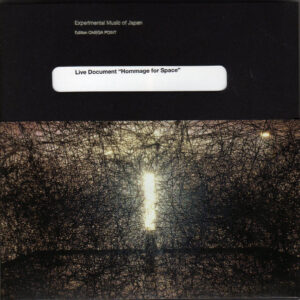
HOMMAGE FOR SPACE – Experimental Music of Japan vol.1
This is the live recording of the music performance held at the installation exhibition of Chiharu Shiota in the gallery of Kanagawa Kenmin Hall in Yokohama Japan last October. The performance was defined as Art Complex by Toshi Ichiyanagi from the music stand point of view. The content of music consists of live computer improvisation as well as some acoustic programed pieces by piano performance by Akiko Samukawa, Toshi Ichiyanagi and computer electronics by Tomomi Adachi to create the interpenetration of temporal and spacial situation in the gallery space. Morton Feldman “2 Pianos”. Toshi Ichiyanagi “Time Sequence”. Michal Kleofas Oginski - Toshi Ichiyanagi “Polonaise in A minor "ojczyzny"” Improvisation, Hommage for Space. Avec Akiko Samukawa, Toshi Ichiyanagi, piano and Tomomi Adachi, live electronics.
16,00€
In stock
CD
COMPILATION
RYTHMÉ BRUT
“With Dragibus, Guylain Damonneville, Jaber, Fred Thabaut, André Robillard, Paul Bourre, Jean Clerembaux, Mordysabbath, Michel Dalmaso, Donna Collins. Does “raw” music exist? Is there any correlation with Raw Art? Don’t be afraid, this cd does not give any clue. One could find everything he wants in these recordings: musicians which could belong to the “Neuve Invention”, improvisers of noisy belches on a microphone, outstanding technicians accumulating several keyboards like other obsessionaly accumulate things (I think of the puppets of Michel Nedjar), soft and-or violent musicians. But from what I have listened to, there were sincere people, an essential quality for the raw approach. For some of them, their music was never “exported” before. This cd has the defaults and the advantages of a compilation. Default of heterogeneity and advantage of heterogeneity. Everybody can pick what he needs to imagine... Fullishly destroyed.”
12,00€
Out of stock
CD
COMPILATION
CULTURES ÉLECTRONIQUES 11
Prix Magisterium Bourges 1998. Wlodzimierz Kotonski “Tierra caliente”, “Alea”. Jean-Claude Risset “Invible” for soprano and tape, “Attracteurs étranges” for clarinet and tape.
8,00€
Out of stock
CD
COMPILATION
CULTURES ÉLECTRONIQUES 9 – Magistères Bourges 1996
1996. Larry Austin “BluesAx” pour saxophone et bande, “Quadrants”, Lars Gunnar Bodin “Halsningar Fran Syrenbersan”, “For Jon - Fragments of a time to come”.
8,00€
In stock
CD
COMPILATION
CULTURES ÉLECTRONIQUES 3 – Magistères
Back in stock.
Dieter Kaufmann: “Le Voyage au Paradis”, Francis Dhomont: “Chiaroscuro… ou les jeux de l’ambiguïté”, Zoltan Pongracz: “Contrastes Polaires et Successifs”, Dieter Kaufmann: “Le Ciel et la Terre”, Zoltan Pongracz: “Histoire d’un Accord de Do Dièze Majeur”.
8,00€
In stock
CD
COMPILATION
VETERANS OF THE FRENCH UNDERGROUND MEET LA JEUNE GARDE
“Veteran musicians from the ‘post-1968’ movement, still in activity, and their relatively young ‘heirs’ are gathered here for thirteen exclusive collaborations. Showing that continuity exists despite the changes of period and generation, and that passing the baton is possible and necessary. With Daevid Allen, Gilbert Artman, Pierre Bastien, Jac Berrocal, Philippe Bolliet, Guigou Chenevier, Pascal Comelade, eRikm, David Fenech, Lionel Fondeville, Dominique Grimaud, Etienne Jaumet, Kawaii, Klimperei, Cyril LeFebvre, Dominique Lentin, Madame Patate, Bérangère Maximin, My Favourite Sideburns Orchestra, Jean-François Pauvros, Richard Pinhas, Joseph Racaille, Dominique Répécaud, Christophe Sorro, Ghédalia Tazartès, Jo Thirion, Toupidek Limonade, Tycho Brahé.”
15,00€
Out of stock
CD
COMPILATION
FORERUNNERS SWEDISH ELECTRONIC AND CONCRETE MUSIC 1955-65
With Karl-Birger Blomdahl: Mimamusik (1959). Bengt Hambraeus: Doppelrohr 2 (1955). Rune Lindblad: Formation (1958-59), Optica 2 (1960). Arne Mellnäs: Nite Music (1964). Sten Hanson: Fruits de mer (1962). Åke Karlung: Antihappening (1962). Leo Nilsson: Skorpionen (1964). Ralph Lundsten: Atomskymning (1964). Bengt Emil Johnson: Enmans Gubbdrunkning (1964). Lars-Gunnar Bodin: Den heter ingenting, den heter nog “Seans 2” (1965). The cd includes a 16 page booklet with texts by Sten Hanson.
15,00€
In stock

CD
COMPILATION
FTARRI AFTER TOMORROW
It’s been five years since Ftarri, an online CD shop and record label specializing in improvised music, opened a physical store of the same name in Suidobashi, Tokyo.
This is the first title in a four-CD series celebrating the store's fifth anniversary.
It consists of four performances (three solos and one duo) by a total of five musicians.
The first track is an electronic sound piece by Hideki Umezawa (born in 1986) in which myriad wriggling, slithering sounds are released little by little in an enjoyable way.
In track 2, Yoko Ikeda (violin, etc.) and Wakana Ikeda (flute, etc.)--both members of Suidobashi Chamber Ensemble--perform a composition by Wakana. This work, in which sound parts using instruments and other objects alternate with silences, conveys a sense of Wakana's unique ideas.
In track 3, Yoichi Kamimura (born in 1982) takes field recordings gathered in various locations, seasons them with electronic sounds, and processes and edits the work with superb artistry.
Tracks 4 and 5 are improvised performances by Takashi Masabuchi (acoustic guitar). Both proceed in a relaxed way, with beautiful sound sequencing and resonance.
Limited edition of 200, consecutive numbering.
11,00€
Out of stock
CD
COMPILATION
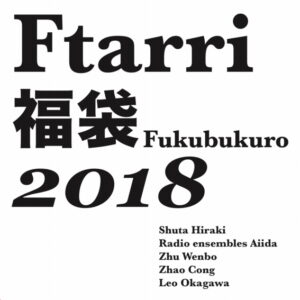
FTARRI FUKUBUKURO 2018
Fukubukuro are special surprise gift bags sold at stores in Japan at the New Year. This fukubukuro CD is being released by the CD shop/label Ftarri to celebrate its fresh start for 2018. Each of the 5 tracks is a solo piece by a different musician. Shuta Hiraki is an electronics musician who creates mainly drone music. He released the CD Unicursal on Kyou Records in 2017. Radio ensembles Aiida, a solo project by A. Mizuki, presents unique performances using shortwave radios as “instruments.” Her 2017 CD In a Room (Radio of the Day
1) was released on VLZ Produkt. Leo Okagawa takes field recordings and concrete sounds and processes them electronically to create music. He released the CD-R The Notional Terrain on Glistening Examples in 2017. Beijing residents Zhu Wenbo and Zhao Cong have for several years been carrying out musical exchanges with Yan Jun, one of China's leading experimental/improvisational musicians. Zhu Wenbo specializes in conceptual creative styles; his track on this CD is a composition consisting entirely of hand claps. Zhao Cong constructs works of music by amplifying the sounds produced by an array of small objects.
11,00€
Out of stock

CD
COMPILATION
ARKANSAS AT 78 RPM: CORN DODGERS AND HOSS HAIR PULLERS
Description: CD Digipak with 32 page booklet featuring liner notes by Tony Russell and photographs from the collection of Maxine Payne.
Produced by April and Lance Ledbetter utilizing transfers from the Music Memory archive, “Arkansas at 78 RPM: Corn Dodgers and Hoss Hair Pullers” features original recordings made between 1928-1937. The CD and the 32-page booklet serve as a companion album to the newly-released photograph book, “Making Pictures: Three for a Dime” by Maxine Payne. All of the photos in this package are from the same cache of photographs taken by the Massengil family in their mobile photo-booth trailer throughout rural Arkansas in the 1930s-1940s.
“For the traveling recording men of the late 1920s, Arkansas offered enticing pickings. The region was thronged with vigorous, idiosyncratic stringbands. This album carries the listener from the hillbilly music craze of the ‘20s to the song-based country music of the late ‘30s. Scarcely more than a decade, but a period, in music as in all American life, of galvanic change.”, Tony Russell, from the liner notes
Tracklist
1. Ashley’s Melody Men, “Searcy County Rag”. 2. Pope’s Arkansas Mountaineers, “Get Along Home, Miss Cindy”. 3. Fiddling Bob Larkin & His Music Makers, “The Higher up the Monkey Climbs”.4. George Edgin’s Corn Dodgers With Earl Wright & Brown Rich, “My Ozark Mountain Home”. 5. Dr. Smith’s Champion Hoss Hair Pullers, “Just Give Me the Leavings”. 6. Ashley’s Melody Men, “Bath House Blues”. 7. Luke Highnight & His Ozark Strutters, “Fort Smith Breakdown”. 8. Arkansas Barefoot Boys, “Eighth of January”. 9. Bob Larkan & Family, “McLeods Reel”. 10. A. E. Ward & His Plow Boys, “The Old Dinner Pail”. 11. Wonder State Harmonists, “My Castle on the Nile”. 12. Morrison Twin Brothers String Band, “Dry and Dusty”. 13. Pope’s Arkansas Mountaineers, “Jaw Bone”. 14. Lonnie Glosson, “Arkansas Hard Luck Blues”. 15. Fiddling Bob Larkin & His Music Makers, “Paddy, Won’t You Drink Some Good Old Cider?”. 16. George Edgin’s Corn Dodgers With Earl Wright & Brown Rich, “Corn Dodger No. 1 Special”. 17. Bonnie Dodd & Murray Lucas, “Ozark Mountain Rose. 18. Morrison Twin Brothers String Band, “Ozark Waltz. 19. L. O. Birkhead & R. M. Lane, “Robinson County. 20. George Edgin’s Corn Dodgers With Earl Wright & Brown Rich, “The Arkansas Hotel. 21. A. E. Ward & His Plow Boys, “Going to Leave Old Arkansas. 22. Wonder State Harmonists, “Petit Jean Gallop. 23. Bob Larkan & Family, “Silver Nail. 24. Reaves White Country Ramblers, “Drunkard’s Hecups. 25. Wonder State Harmonists, “Turnip Greens. 26. Lonnie Glosson, “Lonnie’s Fox Chase”.
12,00€
Out of stock
CD
COMPILATION
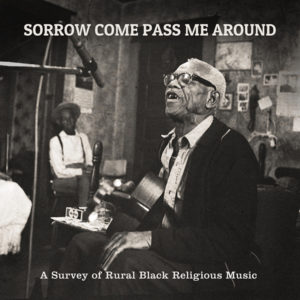
SORROW COME PASS ME AROUND: A SURVEY OF RURAL BLACK RELIGIOUS
A collection of spiritual and gospel songs performed in informal non-church settings between 1965-1973. Most are guitar-accompanied and performed by active or former blues artists. “Most records of black religious music contain some form of gospel singing or congregational singing recorded at a church service. This album, though, tries to present a broader range of performance styles and contexts with the hope of showing the important role that religious music plays in the Southern black communities and in the daily lives of individuals.” - David Evans, from the liner notes
Ephram Carter and His Fife & Drum Band, Willard Artis “Blind Pete” Burrell, Babe Stovall, Annie Lee and Oscar Crawford with Annie Mae Jones, Reverend Rubin Lacy, Robert “Nighthawk” Johnson, Dorothy Lee, Norma Jean and Shirley Marie Johnson with Robert “Nighthawk” Johnson, Katie Mae Young, Eddie Lee “Mustright” Jones, Robert “Nighthawk” Johnson, Chester Davis and Congregation / Compton Jones and Group / Furry Lewis, Willard Artis “Blind Pete” Burrell, Pattie Rosemon with Frank and Odie Rosemon, Babe Stovall, Napoleon Strickland, Willard Artis “Blind Pete” Burrell.
12,00€
Out of stock
CD
COMPILATION
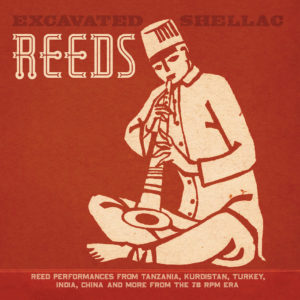
EXCAVATED SHELLAC : REEDS
CD in digipak includes 20-page booklet.
Reed instruments are capable of some of the most impassioned music on the planet, all due to the malleability of the reeds, themselves - historically made of plant tissue, which vibrate when air hits them. The origin of most reed instruments is steeped in rural, pastoral culture. Many insistent, loud, often joyful, reed instruments have always been played outdoors as traditional accompaniment for dancing and celebrations.
This compelling album is the second volume in the Excavated Shellac release series, featuring rare, never-before issued 78rpm records from around the world, centered on a unique theme. The previous volume (Excavated Shellac: Strings) focused on stellar stringed instrument performances. This release examines some of the most intense and hypnotic music set to disc during the early years of international recording, all featuring reed instruments. All previously unreleased on CD, with three bonus tracks not available on the newly-released vinyl LP. All records have been carefully transferred and mastered and are presented with extensive liner notes by Jonathan Ward.
“Jon Ward’s Excavated Shellac focuses on ethnic music on 78’s. He’s one of the smartest obsessive record collectors I know, and the stuff he posts I would gladly pay to download… it is always stuff you would never hear anywhere else, nothing here on CD. This is the rarest of the rare and the best of the best. Stellar!” Steve Roden, Wire Magazine’s Web Exclusive
“Featuring Ward’s informative notes and commentary… (Excavated Shellac is) an astounding selection of music from India, Ireland, Turkey, Burma, Poland, Africa, Japan, Spain, the US, and more…rare treats.” Susanna Bolle, The Boston Phoenix.
1. I Tre Antonio della Basilicata, Tarantella Popolare (Italy)
2. Sylvain Poujouly & Achille Marc, Lou Bolontinou (Auvergne, France)
3. Karzana Oyun Havasi, Zurnacı Mahir and Ali (Turkey)
4. Tufanpur Orchestra, Reng-E Ghafghaz (Iran)
5. Ahn Ki-Ok and Kin Yin Kuan, Janggochum (North Korea)
6. Guangdong Troupe with Da Kai men, Untitled (China)
7. T. Rajarathnam Pillai, Raga Alapana (Todi) (India)
8. Selim, Ekâri Eselimmit (Albania)
9. Obdulia Alvarez, “La Busdonga”, Cantar Bien Neña (Asturias, Spain)
10. Jhande Nath, Lahara Saamp Ke Masta Karneka (India)
11. Hoseynkali was Roofakah, Raqs Jooli, Aroosi (Kurdistan)
12. Mohamed Efendi Baz, Alia Mozmar Khedawi Masr (Upper Egypt)
13. Ngoma Ya Kitokomire, Mimi Naona Haya (Tanzania)
14. Mqonga Sikanise, Into Ezimnandi (South Africa)
Bonus Tracks Not Included on LP
15. Musicians of Radio Studio Skopje, Macedonia, Macedonsko Oro (Macedonia)
16. Uncredited musicians, Raqsi Kalon (Tajikistan)
17. Parush Parushev, Ruchenitsa (Bulgaria)
12,00€
Out of stock
CD
COMPILATION
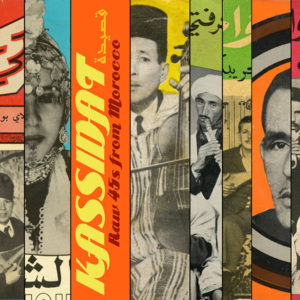
KASSIDAT : RAW 45s FROM MOROCCO
Description: Features six extended tracks from the Golden Age of the Moroccan record industry. “Kassidat”, the Arabic word for poetry, is one of the essential ingredients in Moroccan song. Despite the bewildering array of musical styles in Morocco, the Moroccan sense of poetry is found throughout the music, regardless of the style or language. This isn’t the language of high art, but an often impenetrable vernacular poetry of oblique references, symbols, metaphors, and double entendres that describes the lives of average Moroccans. Mohamed Bergam, Rais Haj Omar Wahrouch, Abdellah el Magana, Jmimi, Lekbir and Fatma Anounya, Bennasser Oukhouya and Cheikha Hadda Ouakki, Cheikh Mohamed Riffi.
14,00€
Out of stock
CD
COMPILATION
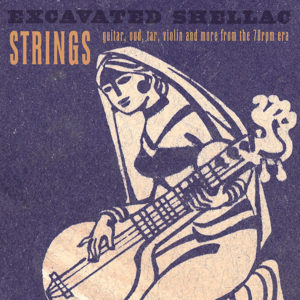
EXCAVATED SHELLAC : STRINGS
CD in digipak with 20-page booklet.
Compiled by Jonathan Ward, Excavated Shellac: Strings features seventeen (including 3 bonus tracks not on LP) outstanding performances from the four corners of the world played on stringed instruments and recorded and released on 78rpm records circa 1920-1950. This vinyl LP features fiddles, shamisen, charango, Paraguyan harp, Indian vina, Lebanese oud, Persian violin, Vietnamese moon guitar, and more. Compiled by Jonathan Ward, all tracks are previously unreissued, carefully transferred and mastered and presented with detailed liner notes by Ward.
“Jon Ward’s Excavated Shellac focuses on ethnic music on 78’s. He’s one of the smartest obsessive record collectors I know, and the stuff he posts I would gladly pay to download… it is always stuff you would never hear anywhere else, nothing here on CD. This is the rarest of the rare and the best of the best. Stellar!” Steve Roden, Wire Magazine’s Web Exclusive
“Featuring Ward’s informative notes and commentary… (Excavated Shellac is) an astounding selection of music from India, Ireland, Turkey, Burma, Poland, Africa, Japan, Spain, the US, and more… rare treats.” Susanna Bolle, The Boston Phoenix
1. Sogoman Seranyan, Eraz (Armenia)
2. Sundaram Balachander, Dayapayonidhe, Pt. 2 (India)
3. Alberto Ruiz y su Lira Incaica, Paceñita (Bolivia)
4. Nzila Joseph et son ensemble, Moleke Mbwa (Congo)
5. T n and ng, Nam Bình (Vietnam)
6. Tatyana Makharadze & G. Bugadze, Lale (Georgia)
7. Abol-hasan Sab , Chaopan (Iran)
8. Trio Tipico Paraguayo de Félix Pérez Cardoso, Pajaro Campana (Paraguay)
9. Bra a Kapugi Tamburica Orchestar i Pjeva ki Zbor, Tko Se Bregom Se e (Croatia)
10. Kjetil Flatin, Jornvrongia-Springar (Norway)
11. Yamaura Toyoko, Ko-uta, Ryukyu Bushi (Japan)
12. Chahadé Effendi Saadé, Taqsim Rast (Lebanon)
13. Galabuzi and Party, Okubulirwa Lupiza Otambula Osopza (Uganda)
14. Kemanî Amâ Recep, Çifte kiri ile Rast Taksim (Turkey)
Bonus Tracks Not Included on Original LP
15. Feliciano Delgado, Ausencia (Panama)
16.Grupo Irmãos Borges Barros, Enchente de Beijos (Brazil)
17.Eyyubi Mustafa Sunar, Isfahan Taksim (Turkey)
12,00€
Out of stock
CD
COMPILATION
THE GAMELAN OF THE WALKING WARRIORS
A fascinating immersion in the heart of a funeral ceremony live recorded in Bali, where gongs, cymbals, and drums give rhythm to the bewitching atmosphere of this mortuary procession.
The international audience’s interest into Balinese music and its gamelan orchestras dates back to the edition of large ethnographic series in the 1950s, 60s and 70s which largely encouraged the discovery of this music beyond Indonesia’s borders. Taking advantage of a more advanced technology compared to the vinyl golden era, the present field recordings produced in 2011 render at the closest the power of gamelans. They are presented here in two forms. The first one offers a display of Beleganjur music out of the ritual context, which can be differentiated by a more melodic form and a more dramatic and hypnotic aspect of the compositions. The second one presents the Beleganjur style in the ceremonial context of the Ngaben funerary rite in the village of Peliatan. The utmost vitality of these orchestras springs out throughout the different stages of these funerals, and the sound environment surrounding the musicians immerse the listener in the very heart of the procession following the corpse.
With The Gamelan of The Walking Warriors, Akuphone carries on its exploration of ritual and ceremonial music with those materials of rare intensity. These recordings were collected by Vincenzo Della Ratta, PhD in Ethnomusicology from the Sapienza University (Rome). As a specialist of the gongs music from the Austronesian cultures of Southeast Asia, Vincenzo Della Ratta is the author of numerous articles on the subject. His field researches have already been edited as a vinyl entitled Kwangkay: Funerary Music Of The Dayak Benuaq Of Borneo (Sublime Frequencies, 2016).
The international audience’s interest into Balinese music and its gamelan orchestras dates back to the edition of large ethnographic series in the 1950s, 60s and 70s which largely encouraged the discovery of this music beyond Indonesia’s borders. Taking advantage of a more advanced technology compared to the vinyl golden era, the present field recordings produced in 2011 render at the closest the power of gamelans. They are presented here in two forms. The first one offers a display of Beleganjur music out of the ritual context, which can be differentiated by a more melodic form and a more dramatic and hypnotic aspect of the compositions. The second one presents the Beleganjur style in the ceremonial context of the Ngaben funerary rite in the village of Peliatan. The utmost vitality of these orchestras springs out throughout the different stages of these funerals, and the sound environment surrounding the musicians immerse the listener in the very heart of the procession following the corpse.
With The Gamelan of The Walking Warriors, Akuphone carries on its exploration of ritual and ceremonial music with those materials of rare intensity. These recordings were collected by Vincenzo Della Ratta, PhD in Ethnomusicology from the Sapienza University (Rome). As a specialist of the gongs music from the Austronesian cultures of Southeast Asia, Vincenzo Della Ratta is the author of numerous articles on the subject. His field researches have already been edited as a vinyl entitled Kwangkay: Funerary Music Of The Dayak Benuaq Of Borneo (Sublime Frequencies, 2016).
14,50€
Out of stock
8 CD
COMPILATION
MUSICA FUTURISTA – A CURA DI DANIELE LOMBARDI
“A stunner of an 8CD box set dedicated to the history of Italian futurist music - put together by Daniele Lombardi - the most complete collection of music ever assembled in reverence of the historical Futurismo movement of the Italian avant garde! Disc 1 features Daniele Lombardi at the piano performing material by FB Pratella, Silvio Mix, F. Casavola and others, plus the first recording of L Russolo’s Intonarumori and Arco Enarmonico. Disc 2 features Metropolis - a three part composition by Lombardi, where intonarumori (noisemaker) samples are processed digitally. Disc 3 is the second collection of works by Daniele Lombardi with Gabriella Bartolomei, featuring recordings made for radio. Disc 4 features “vocal writing” performed by Gabriella Bartolomei and other works. Disc 5 is a tribute to Luigi Russolo. Disc 6 is a complete collection of all FT Marinetti’s “declamazioni”, from 1920 to 1935. Disc 7 features “Zavod”, a famous orchestral score by A. Mossolov and a collection of famous songs and piano compositions by H. Cowell. Disc 8 features Roberto Fabbricianni’s futuristic scores for solo flute.” label info
39,00€
Out of stock
7 CD
COMPILATION
FTARRI COLLECTION
This 7-CD set contains 19 selected performances from the Ftarri Festival, held in April 2008 (Kyoto / Tokyo), and the Ftarri doubtmusic Festival, held in September 2010. The 7 CDs, together with a sequentially numbered Ftarri Collection card, come in a special handmade felt bag about 18 cm high and 17 cm wide. Each bag has a different design.
Ftarri Collection 1 with Opera Southern Cross (Taku Sugimoto: composition, images. Katsuaki Iida: words, reading. Toshimaru Nakamura: no-input mixing board. Taku Unami: computer). John Butcher / Toshimaru Nakamura / Tetuzi Akiyama. Otomo Yoshihide / Toshimaru Nakamura / Ryu Hankil.
Ftarri Collection 2 with Noid / Kai Fagaschinski / Axel Dörner / Taku Unami. Eddie Prévost / Sachiko M.
Ftarri Collection 3 with gnu (Masahiko Okura: compositions, bass clarinet, alto saxophone. Shinichi Tsukamoto: keyboards. Yukiya Taneishi: electric bass. Tadashi Kumada: drums. Itoken: drums). Ami Yoshida. Tim Olive / Anthony Guerra / Makoto Oshiro.
Ftarri Collection 4 with Los Glissandinos (Klaus Filip: lloopp + Kai Fagaschinski: clarinet). Bunsho Nishikawa / Tim Olive / Haco. Katsura Yamauchi / Ko Ishikawa / Tetsu Saitoh.
Ftarri Collection 5 with Naoaki Miyamoto. Chie Mukai / Tetragrammaton.
Ftarri Collection 6 with Chihei Hatakeyama / Kiyoshi Mizutani. Hello (Takahiro Kawaguchi: composition, bass guitar. Shinjiro Yamaguchi: guitar. Satoshi Kanda: bass guitar).
Ftarri Collection 7 with Seiichi Yamamoto / Umeda Tetsuya, VOIMA (Yasufumi Suzuki: computer. Tetsuro Yasunaga: computer). Tetuzi Akiyama / Utah Kawasaki / Katsura Yamauchi.
Numbered limited edition of 300
69,00€
Out of stock

6 LP
COMPILATION
MICHIGAN
“Hanson & RRRecords present: Michigan, a 6LP box-set featuring a full side each from twelve Michigan noise projects. Full LP sides from: Princess Dragonmom, Raven Strain, Redrot, Aaron Dilloway, Tovah D-Day, Charlie Draheim, Hive Mind, Mammal, Evenings, Cotton Museum, Sick Llama and Wolf Eyes. Compiled by Greh Holger and Aaron Dilloway. Limited to 600 copies. Packaged in fully silkscreened record mailers.”
50,00€
Out of stock
6 CD
COMPILATION
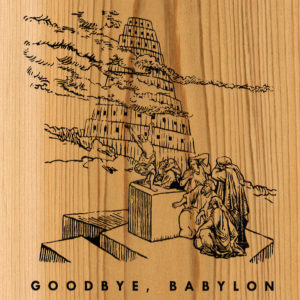
GOODBYE, BABYLON
Back in stock.
2003.
“In February 1999 a college radio disc jockey named Lance Ledbetter set out on a mission to compile rare and essential recordings of vintage religious music. Four and a half years later the result of this journey was released as a box set called Goodbye, Babylon. The set consists of five CDs featuring 135 Songs (1902-1960) and one CD featuring 25 Sermons (1926-1941). Accompanying the CDs is a 200 page book with Bible verses, complete lyric transcriptions, and notes for each recording. All of the components is reverently packed with raw cotton and housed in a deluxe 8" x 11" x 2.5" cedar box. Six CDs. 200 page book. Cedar box. Raw cotton.” 160 tracks with among others, Rev. T. T. Rose and Singers, Blind Lemon Jefferson, Carter Family, Frank Palmes, Brother Claude Ely, Stanley Brothers, Skip James, Johnson Family Singers, Blind Roger Hays, Blind Willie Johnson, Washington Phillips, Hank Williams, Sam Jones, Famous Blue Jay Singers, Dock Reed and Vera Hall Ward, Jimmie Strothers, Elder Otis Jones…
95,00€
Out of stock

6 CD
COMPILATION
WANDELWEISER UND SO WEITER
“Wandelweiser und so weiter” is a 6-CD box set with 8 hours of music by a wide range of composers in or around the Wandelweiser collective. The box brings together previously unissued works by the most well-known composers in the Wandelweiser collective (Michael Pisaro, Antoine Beuger, Radu Malfatti and Manfred Werder), pieces by other Wandelweiser composers (Johnny Chang, Sam Sfirri, Eva-Maria Houben, Stefan Thut, Taylan Susam), as well as music by other composers whose work relates to Wandelweiser in some way, such as James Saunders, Dominic Lash, Anett Németh and John Cage. A central focus of the collection is the way in which Wandelweiser music has in recent years come together with the ’post-reductionist’ strand within improvisation. Many of the pieces on the box set are realisations of Wandelweiser scores by musicians who are better known as improvisers, but who have recently been drawn to the soundworld of Wandelweiser. All the tracks on the box set are new recordings played by different groupings of over 50 musicians including Angharad Davies, Radu Malfatti, Lee Patterson, Jurg Frey, Philip Thomas, Patrick Farmer, Rhodri Davies, Phil Durrant, Sarah Hughes, Dominic Lash, Anton Lukoszevieze, Tim Parkinson and many more.”
CD1, Confluences. Sam Sfirri, “natural at last” (2010) with Neil Davidson, guitar & objects, Rhodri Davies, harp, Jane Dickson, piano, Patrick Farmer, amplified objects / open CD players, Dimitra Lazaridou-Chatzigoga, zither. Antoine Beuger, “Lieux de Passage” (2008) with Jürg Frey, clarinet + Angharad Davies, violin, Phil Durrant, electronics, Anton Lukoszevieze, cello, Radu Malfatti, trombone, Lee Patterson, amplified objects, Philip Thomas, piano. Manfred Werder”2011(4)” with Anett Németh, recording, instruments, objects. Sam Sfirri “natural at last” (2010) with Angharad Davies, violin, Phil Durrant, electronics, Jürg Frey, clarinet, Anton Lukoszevieze, cello, Radu Malfatti, trombone, Lee Patterson, amplified objects, Philip Thomas, piano. James Saunders, “various distinct spatial or temporal locations” (2011) with Simon Reynell, coffee carton. Radu Malfatti, “Heikou” (2010) with Angharad Davies, violin, Phil Durrant, electronics, Jürg Frey, clarinet, Joseph Kudirka, double bass, Anton Lukoszevieze, cello, Radu Malfatti, trombone, Lee Patterson, amplified objects, Philip Thomas, piano.
CD2, Crosscurrents. Sam Sfirri, “the undulating land” (2010) with NMC Chamber Ensemble: Jason Brogan, electric guitar, Bill Carson, acoustic guitar, Jared Sinclair, flute, Kim Larson, clarinet, Ron Wiltrout, percussion, Sam Sfirri, melodica. John Cage, “Three2” (1991) with Simon Allen, Chris Burn & Lee Patterson, percussion. Pierre Borel / Johnny Chang / Derek Shirley, “Etchings” (2012) with Pierre Borel, alto saxophone, Johnny Chang, viola, Derek Shirley, double bass. Phil Durrant, “Sowari for Ensemble” (1997) with Phil Durrant, electronics, Lee Patterson, amplified objects & processes, Philip Thomas, piano. Michael Pisaro, “fields have ears (3b)” (2010) with Set Ensemble:
55,00€