
Out of stock

Book + CD
NURSE WITH WOUND
“Gyllensköld, Geijerstam And I At Rydberg’s”
Art Book CD – Silver Collection 24 page Deluxe Art Book with augmented CD album. All artworks by Babs Santini.
22,00€
In stock

Book + CD
Steve RODEN
“Oionos”
Notes from Steve Roden on Oionos:
Oionos was created for the exhibition The Grand Promenade, in Athens, Greece.
The exhibition took place in various archaeological and historical sites in central Athens, creating a situation for contemporary site specific works to be in dialogue with their historical surroundings.
While it was not originally offered as a possible site, I pleaded with the curator to allow me to work with architect Dimitris Pikionis’s Church of St. Dimitris Loumbardiardis, about a 10-minute walk from the main path of the Grand Promenade. Pikionis designed the original promenade which is still visible in several areas, but much of the area’s original designs were altered during the “restoration” before the 2004 Olympics. The small path that leads to the church gives a much stronger impression of Pikionis’s vision for the entire promenade as it was; so i wanted to use my work to draw viewers/listeners into his world.
When I first saw the small church it totally took my breath away, and I immediately began to think about a work that could exist in resonance with it — but not distract from it. The church itself is still in use, and I wanted to the work to be gentle and out of the way of the people who worship there. I decided to use the large tree in the front of the church for a hanging work that would a little bit of visual presence as well as sound which could blend with all of the insect noises and the overall quiet of the area.
The audio was built from field recordings and small “poor” objects such as tin whistles, toy harmonicas, and the like. These “instruments” suggested by the museum of musical instruments in Athens, where the proper instruments take up most of the museum, but there is a wonderful display case in the basement with musical toys, religious objects, and other sounding devices not considered musical instruments. I felt that these simple things related to Pikionis’s ideas about architecture and craft, and his interests in indigenous culture in conjunction with intellectual and modern culture. I felt there could be a relationship.
Oionos was created in 2006 for the exhibition The Grand Promenade, in Athens, Greece.
18,00€
In stock

Book + CD
Mike COOPER
“Oceans Of Milk And Treacle”
From Mike Cooper
This is a soundtrack for an otherwise silent film. The title of the album, and of course the film, is borrowed from my late friend Fred Hardy’s book The Religious Culture of India - Power, Love and Wisdom, considered to be one of the most important books on the subject. In this book Fred wrote...
Mike Cooper plays Electric Lap Steel Guitar. Acoustic Brazilian Viola Ciapira and Virtual Pedal Steel Guitar, Double Bass, Koto, Strings, Percussion and Drums.
Viv Corringham - Voice.
Tim Hill - Baritone Saxophone.
Aaron Hawkins - Tenor Saxophone.
Geoff Hawkins - Tenor Saxophone.
Lol Coxhill - Soprano Saxophone.
Roger Turner - Percussion.
Ambient and Field Recordings from Bali, Cambodia, Vietnam, Martinique, Crete, Sri Lanka, Australia.
18,00€
In stock

Book + CD
Marina ROSENFELD
“Index”
For over two decades, New York-based artist and composer Marina Rosenfeld has pioneered a specific language for turntable music, based on an ever-expanding collection of dub plates she creates.
The dubplate is a one-off, hand-cut record. Each dubplate can be made to contain any array of sounds decided on by its creator. For Rosenfeld, her discovery of the dubplate in the late 1990s was a pivotal moment, when she recognised the material instability of the medium as critical tool for performance and composition.
On Index, the investigation of this materiality is paramount. The physical intimacy that colors the relation between the hand and the plate is revealed through a very particular reading of the turntable, one which sits in parallel to the more recognised ways in which that technology has been deployed as a performative tool.
This edition features a series of live recordings and related materials that trace the development of Rosenfeld’s tactile approach and her shifting collection of sound materials. The recordings are published alongside a book featuring extensive archival documentation, photography and a long-form conversation between Marina Rosenfeld and Lawrence English.
18,00€
In stock

Book + CD
Magda MAYAS & Tina DOUGLAS
“Objects of Interest”
From Magda Mayas
Tina and I met around 10 years ago in Melbourne through mutual musician friends.
Tina has heard me perform in various context and I have visited her studio and seen her perform on multiple occasions. There was an immediate personal and aesthetic connection and conversations over the years revealed shared ways of working - a collaboration seemed natural and exciting.
We are both drawn to improvisational and intuitive processes and we both use individualised objects or tools to create and develop close relationships with these. For me, it’s a symbiotic process: the objects generate ideas, they afford and limit what I do and structure a piece in a fundamental way. Tina’s scores are very sculptural and tactile - the piano and my objects and preparations in them likewise feel sculptural, tactile, embodied -objects, materials and relationships crossing over.
When I started recording music to respond to Tina’s scores, I had a wish to slowing things down, to expose a certain fragility or imperfection and to let one melody or one chord or one little noise be enough. With the piano you can have such an orchestral approach, and I often do that, but with this collaboration I didn’t feel like I wanted this kind of complexity.
There is a certain fragility that I like about the project and the scores: the fact that they are thin paper scores and I transported them from Australia to Berlin, the cut-outs… it’s all very fragile and beautiful and I kind of felt that I wanted to allow the music to be like that too.
Tina Douglas: scores, 2019 -2020
Magda Mayas: piano, clavinet, rhodes, objects
Recorded in Berlin January 2021
Tony Buck: Recording and Mixing
Lawrence English: Mastering
18,00€
In stock

Book + CD
Philip SAMARTZIS + Eugene UGHETTI
“Polar Force”
From Eugene Ughetti
As Philip was preparing to leave for his second Australian Antarctic Division residency, he invited me to lunch to discuss the possibility of collaborating on a new work. He recounted his first experience on the ice, where the surrounding landscapes seemed to articulate avant-garde percussion works of an epic scale. On this visit, he wanted his field work to explicitly shape the formation of a new performance work with a particular focus on katabatic winds in and around Casey Base station.
Intrigued, I accepted the challenge provided I could create a live performance utilising the same recorded materials of ice, air and water. We undertook an ambitious collaboration with sound, instrument, lighting and industrial designers, a dramaturg and percussionist.
For Polar Force we built an environment, a white inflatable structure reminiscent of a remote research station on the ice. Emanating from outside the space come the complex and foreboding sounds of the natural environment, inside, a live event akin to scientific research in sound occurs. This hour-long performance installation work gives rise to a hyper-realistic sensing of Antarctica, bursting with natural beauty, power and the audible evidence of human impact.
Concept, Composition & Instrument Design - Eugene Ughetti
Direction - Clare Britton and Eugene Ughetti
Field Recordings - Philip Samartzis
Performance - Matthias Schack-Arnott & Eugene Ughetti
18,00€
In stock

Book + CD
Lawrence ENGLISH
“A Mirror Holds The Sky”
From Lawrence English
In late months of 2008, I had the great fortune to spend some weeks in the Amazon. The visit, facilitated through Francisco Lopez’s Mamori Artlab residency, remains one of the most deeply affecting experiences I have had. Each time I hear a Screaming Piha, which many would identify instantly thanks to their prevalence in Werner Herzog’s Aguirre Wrath Of God and Fitzcarraldo, I am transported back into a place that, to this day, features regularly in my daydreams.
The reason this place made such an impression is simple; the Amazon dwarfs us. This is not some vulgar display of power on its behalf, rather its a tangible reminder of our place in, and on, this planet. Once you step into the Amazon it prompts us (strongly) to refocus the perspective we hold of ourselves, of our ways of being, of our understandings and it (not so gently) reminds us that we are but one very minor function in an equation that extends in all directions across time, and space.
Living in Australia, tropical rainforests are not foreign to me. I would even say I am rather at home in them. My family, who lived and worked on the land of the Ngajanji people, had an admiration for, or in the very least a respect of, the rainforest. What makes time spent in the jungles of the Amazon different however is the scale and sheer volume (metaphoric and literal) of the life that inhabits it. Hundreds of thousands of narratives are in play moment to moment, their interactions flow together forming a perpetual cascade of arrival and departure, fertility and decay - these fundamental states are intrinsically linked and constantly informing one another.
The jungle is never silent. Even when you might expect the Amazon to be hushed, in those hours before dawn or in the heat of the midday sun, it is hardly what could be described as quiet. What might be true to say though is during these moments where the chorus of insects takes a step back, the jungle opens just a little. To listen in the jungle is to listen in close relief - in every square metre, thousands of insect cry out, their voices reducing the horizon of listening to a matter of centimetres at certain times of the day (and night). The sensation is sensorially disorienting and frankly, overpowering.
In those moments where you can get a sense of dimension and depth, the dynamism of the environment comes to the for. The abundance of birds, mammals, beetles, flies, ants and so many other creatures are a source of constant and evolving fascination. In the lakes and rivers too, the hydro-sonic environments are perpetual and effortlessly deep. It’s humbling to acknowledge how little we come to know of that which lies just below us.
A Mirror Holds The Sky is in some ways an act of acoustic and temporal compression. It is a rendering down of the lived in moments and environments that became points of intense listenership. If I am to be honest, it has taken me the better part of a decade to know how to approach this archive of materials. I owe a debt of gratitude to Chico Dub at Festival Novas Frequências, who very gently encouraged me to realise a piece for diffusion as part of his program in 2019. That invitation retuned my ears and in the process unlocked a way of approaching the mammoth 50+ hours of recordings I had gathered during my time there. I also owe a special debt of gratitude to my wife Rebecca, who was instrumental in gathering some of these recordings. Her ears reflected an entirely other set of interests than my own and without that, this piece would be substantially less than what it is.
Recorded in Dec 2008, Lago Mamori, Amazonas.
18,00€
Out of stock

Book + CD
David TOOP – Akio SUZUKI – Lawrence ENGLISH
“Breathing Spirit Forms”
From Lawrence English
I am ceaselessly fascinated by how memory operates and, I’m regularly struck by how individually subjective a collective experience can be when recalled by its participants. Lynch’s Lost Highway comes to mind here, specifically Bill Pullman’s character Fred Madison who says “I like to remember things my own way. How I remembered them, not necessarily the way they happened.” Like Madison, I can’t help but sense that memory takes shape through an accumulative process that reflects how each of us have lived (and maybe even wanted to live) up to that point in time.
Going back to listen again to these recordings of which I was a part with David and Akio, I was surprised by what elements had stayed with me and what others had slipped into the eternal greying of my mind. I have vivid recollections of listening to a Lyre bird before recording the pieces together at Witches Falls. I remember both Akio and David finding musicality in decaying palm fronds. I remember Akio’s voice, amplified through his Analpos, bouncing off the stones and trees. I remember David’s flute, so quiet in the pitch black of the night forest as to appear like a hushed tone of wind or a distant animal calling. I also remember trying to match my modest hand held electronics with the pulsing and pitching of the insects around me.
Reading David’s text, which is included in the book published alongside this edition, he recounts several things I had forgotten. Conversations about memory, ironically enough, had vanished from my mind until reading his words. I also didn’t really remember my role as tick surgeon, removing a living insect from David’s ear. I do remember his cooking though, as does Akio (captured aptly in his drawings), no doubt a testament to David’s improvisational culinary expertise.
Breathing Spirit Forms represents a distinctive exchange between friends and collaborators. Tamborine commands a special presence and encourages a deep patience from those who are willing to give time to its varied environments. For the three of us, we were fortunate to share these moments together, fleeting in our lives as they might be, to sense the mountain’s unique qualities, to respond to them through our exchanges and to form memories (as disparate as they might be) we carry forward with us in time.
David Toop - Flutes, sticks
Akio Suzuki - Analapos, flutes, stones, sponge & hand mirror, pocket bottle & mallet
Lawrence English - Shortwave radio, handheld electronics, percussion.
18,00€
In stock

Book + CD
Akio SUZUKI
“Analapos”
In 1979, Akio Suzuki recorded a performance, ’New Sense Of Hearing’, at the Nagoya American Centre. During the performance, Suzuki used voice, turntables, glass harmonica and his self-designed instrument the Analapos to create a series of improvised pieces that effectively charted out his sonic investigations for the proceeding decades.
In 1980 these recordings were issued by ALM records as Analapos, the first work made publicly available by Akio Suzuki.
For going on six decades now, Akio Suzuki has been responsible for creating amongst the most otherworldly, yet deeply affective sound works of his generation. As a musician, sculptor and sound artist, Suzuki’s work threads an important linkage between Eastern and Western sound art practices. His approaches, that focus primarily on intense states of listening, ’throwing and following’ and a relentless sense of open curiosity, have allowed him to continuously deepen his work.
Originally published in an edition of just 200 copies in 1980, Analapos has been out of print literally since its release. Clocking in an over an hour, the original pressing of the recordings to a single LP, presented some technical limitations.
This 40th anniversary edition of Analapos is entirely remastered and is published with a booklet that includes a long form interview with Akio Suzuki conducted by sound artist and collaborator Aki Onda, plus extensive photographic documentation of the development of the Analapos. The publication of this edition is announced in conjunction with the Sense Of Ekō retrospective exhibition which opens at The Substation in Melbourne late January.
18,00€
Out of stock

Book + CD
Yannick DAUBY
“Fushan & Taipingshan”
A project (Book+CD) by Yannick Dauby about sounds and stories of low and middle altitude mountains of Yilan, North East of Taiwan.
The book (in English and Chinese) features interviews with five persons who have special knowledge and experience about the forests of Taipingshan and Fushan : Lue Kuang-Yang, Kacuzi Hacyo, Wu Chiu-Hsiang, Lai Chun-Piao, Lai Bo-Shu. Notes about listening and sound recording practice by Yannick Dauby. Identification of animal sounds with Chinese, English and Latin names.
The 75 minutes audio CD contains field recordings realized in Fushan Botanical Garden and Taipingshan Forest Area between 2013 and 2015, edited and mixed in 2016.
15,00€
In stock

Book + CD
David TOOP
“Field Recording and Fox Spirits”
Field Recording and Fox Spirits is a collection of personal recordings -- from the field, from performance, from interviews -- that sketch out the breadth of David Toop's work over the past five decades. The recordings exist both as individual memories and as a hazy auditory daydream-like collage woven together by Lawrence English. Additionally, the edition includes a 40-page book, consisting of an extended in conversation with David Toop, which features extensive visual works and photographs from his archive.
From David Toop: "What are field recordings? 'My memory is not what it used to be, David,' my grandfather, Syd Senior, said to me as we huddled round a fireplace in 1979. Thanks to a cassette tape I have the memory of his gradual loss of memory, hearing him speak of Queen Victoria's funeral and the severity of patriotism back in those old days, 1901. Syd Senior is long dead, no longer part of the field of living relations but still within the field of memories that can be revived by technology, albeit an old one that squeaks like a mouse, hisses like a cat. Where is the field? The field is populated by all the ravishing, painful, poignant, nondescript moments of remembered life. Field recordings forget, just as memories forget. My recording of Ornette Coleman forgets that he fell asleep as we were talking together. I sat quietly, waiting for him to wake; the tape machine continued its work, oblivious. During lockdown, a warm spring day, I sat working in the garden. A small fox appeared close to me, started, retreated into the shelter of plants by my pond. I took a photo with my phone but when I looked at the image no fox was visible. Earlier that day I had been reading Strange Tales from a Chinese Studio, a collection of short stories written by Pu Songling during the course of his life in the late seventeenth/early eighteenth century. In many of these tales, fox spirits inhabit the physical spaces of living humans in a variety of guises. Some are malicious; some benign. Their presence in the material world is wrong and yet accepted as either a temporary nuisance or a blessing that would later be regretted..."
18,00€
In stock

Book + CD
Steve RODEN
“Gradual small fires (and a bowl of resonant milk)”
From Steve Roden:
"gradual small fires (and a bowl of resonant milk), was commissioned by the university of hong kong’s new media school, and more specifically, the work was created initially for daniel libeskind’s building for the university’s cmc (creative media center). for the grand opening of the building, several sound and new media artists were invited to create works on site.
the work consisted of 5 different pieces – each object constructed of plexiglass, and each sound work anchored by a recording of a fire that i had made in denmark 10 years or so ago. i added sounds (such as bells, rocks, guitar, field recordings), and everything was manipulated, for the most part with analog guitar pedals.
each sound/sculpture was placed in a discreet location, generally a space that seemed to have no use. the pieces were relatively quiet, and the hope was that a student or visitor would happen upon these works accidentally, and that the piece would then offer a diversion.
my goal was to complete a piece for every photo in ruscha’s book.
along with the five works exhibited at the cmc in hong kong, a 6th piece, gradual small fire 5, was commissioned for the exhibition “sound art. sound as a medium of art” at the zkm in karlsruhe."
60-page A5 colour sewn-bound book plus CD in a cardboard wallet.
Edition of 300 copies.
25,00€
In stock
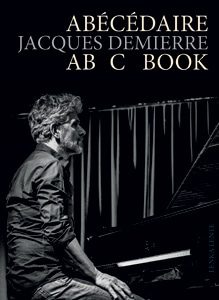
Book + CD
Jacques DEMIERRE
“Abécédaire”
Foreword by Guillaume Belhomme. Bilingual edition (English / French), 15 x 19,5 cm (softcover), 256 pages + CD.
An ABC book with which the pianist, composer and improviser recounts his experience of sound (with the score and recording on CD of an unpublished piece).
20,00€
Out of stock

book + CD
VIVENZA
“Réalités servomécaniques”
Deluxe CD book, 32 pages, pictures & texts in three languages: French, English, Japanese.
“Réalités servomécaniques” is an improved version faithful to the original recordings with visuals specially reworked, answering to a categorical assertion, theoricaly and practicaly on Vivenza’s bruitist point of view, who presents sounds, “noises”, under their rawest and genuine aspect: sounds are machines / machines are sounds. Thus Vivenza captured the essence of factories with a strong sense of austerity, radicality, verticality, including thick smokes and intense darkness of industrial landscapes, as Réalités servomécaniques directly refers to the triumph but also decline of heavy industries in the 80s. The mechanics, cogwheels, forges and machines smash us in the face in a radically powerful way, being at the same time under our eyes and inside us, at the heart of our selves, in an ultra realistic way while listening. We are then, with Réalités servomécaniques, plunged in the midst the machines, and in the machines, with a surprising and striking strength. “Machines are sounds / sounds are machines!”
15,00€
In stock
book + CD
COMPILATION
TOUCH MOVEMENTS
Touch MOVEMENTS has been compiled over the course of 3 years. It is a response to many requests for Touch to publish a fuller account of Jon Wozencroft’s photography for the cover art of the project. The book follows the music, which was compiled step-by- step, like a jigsaw – there was not an “open call” to the artists, rather a sequential development which gives the CD a special narrative quality. And since our last Touch 30 compilation in 2012, the accuracy of the music has grown and rises to the challenge of what sound can do to transform perceptions about the immediate emotion of musical work and its more dif cult, longer term evolution.
Following Touch Folio 001 in 2015, this series is a dedication to finding new ways of audiovisual publishing, somewhere between the twin peaks of a jewel-cased CD and a lavish box-set. The two elements of sound and the visual work in parallel to create the idea of an “Ear-book”, whose interdependency reveals itself over time, and allows the richest of listening and viewing experiences. The music and the photography is fully annotated, alongside a rarely-seen manifesto by the Surrealist film-maker Jan vankmajer which celebrates the spirit of the creative act.
With tracks from Mika Vainio, AER, Bethan Kellough, Wire, Carl Michael Von Hausswolff, Chris Watson, Jana Winderen, The Magical Land of the North, Claire M Singer, Hildur Gudnadottir, Three 20, Philip Jeck, Simon Scott, Eleh, Russell Haswell, Heitor Alvelos, Johann Johannsson, Mark Van Hoen, Fennesz, Sohrab, Strafe FR, Jim O’Rourke, Situation Stabilised / BJ Nilsen, Peter Rehberg, Oren Ambarchi.
76pp full colour book + CD. Limited edition of 1000.
Following Touch Folio 001 in 2015, this series is a dedication to finding new ways of audiovisual publishing, somewhere between the twin peaks of a jewel-cased CD and a lavish box-set. The two elements of sound and the visual work in parallel to create the idea of an “Ear-book”, whose interdependency reveals itself over time, and allows the richest of listening and viewing experiences. The music and the photography is fully annotated, alongside a rarely-seen manifesto by the Surrealist film-maker Jan vankmajer which celebrates the spirit of the creative act.
With tracks from Mika Vainio, AER, Bethan Kellough, Wire, Carl Michael Von Hausswolff, Chris Watson, Jana Winderen, The Magical Land of the North, Claire M Singer, Hildur Gudnadottir, Three 20, Philip Jeck, Simon Scott, Eleh, Russell Haswell, Heitor Alvelos, Johann Johannsson, Mark Van Hoen, Fennesz, Sohrab, Strafe FR, Jim O’Rourke, Situation Stabilised / BJ Nilsen, Peter Rehberg, Oren Ambarchi.
76pp full colour book + CD. Limited edition of 1000.
37,00€
Out of stock
book + CD
Lionel MARCHETTI – YAN Jun
“23 formes en élastique” – “The only authentic work”
“23 formes en élastique”
New work of Lionel Marchetti. 23 tracks. Length more than 77 minutes. Materials went through last 23 years of his field recording, composition, experiments and musiques concrètes composition studies. A backward looking by a forward creating. By this CD Lionel Marchetti built a labyrinth of elasticity, empty space, reality and its metamorphose. A material world of sound.
“The only authentic work” (Chinese and English)
Yan Jun’s writing with inspiration of Marchetti’s music. 23 essays on music, literature, art and everything. The writing has a musical style as it also sampled and modurated sentences, thoughts and works of Gerhard Richter, Guy Debord, Pythagoras, Pierre Schaeffer, Cioran, Baudrillard, Glenn Gould, Duchamp, Foucalt, Proust, Maurice Blanchot, Rimbaud, Aristote and Artaud…
25,00€
In stock

book + CD
eRikm
Bilingual edition (English - French), 17 x 23 cm, 176 pages (color ill.). Edited by Maud Chavaillon and eRikm. Texts by Yann Beauvais, Christophe Kihm, Louis-José Lestocart, Jean-Luc Nancy, Leïla Quillacq, Graeme Thomson. Published by Sextant et plus, with the Gantner multimedia centre. Audio CD included with “Arrow” (1999, “Feedback & Ficker” (2001), “Klein surface” (2009), “Corrélation i” (2005), “Soulage” (2010), “Généresense soustractive” (2005).
A key figure of the international sound art scene, eRikm’s practice is nevertheless rooted in the field of visual arts through sculpture, installation and video. This first monograph, which is accompanied by an audio CD, unveils a less visible part of his work that dares to play simultaneously with different practices and composition modes, in all the languages.
25,00€
In stock
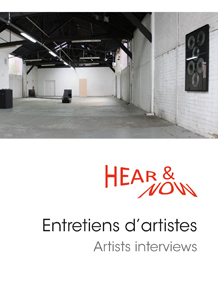
book + CD
COMPILATION
HEAR & NOW – ENTRETIEN D’ARTISTES
2013, bilingual edition (English / French), 14 x 19 cm (softcover), 168 pages (+audio CD). A series of interviews with 27 international artists/musicians, centered on the relation of sound to space. The book includes interviews with the 27 artists of Parisonic 2011 in an original way: each artist states The question he would like to be asked on his work. The set of questions is then proposed to each artist. Thus, Hear & Now, artists interviews emphasizes the words of the artists themselves rather than outside comment. A text by Laurent Catala, published in 2011 in the journal Mouvement, and photographs illustrating the book provide an overview of the exhibition. The included CD presents the works shown in the listening room Magnetic Traces (with Loic Blairon, Thomas Tilly, Camilla Hannan & Eamon Sprod, Eric La Casa & Philip Samartzis, Jean-Luc Guionnet, Marc Baron, Anthea Caddy & Thembi Soddell, Lizzie Pogson, Geoff Robinson, Yannick Dauby, Rosalind Hall & Alice Hui-Sheng Chang, Cédric Peyronnet, Kristian Mark Roberts, Rainier Lericolais, Pali Meursault). Published following the Parisonic sound art exhibition in 2011. Interviews with Marc Baron, Mélanie Berger, Loic Blairon, Dominique Blais, Charlotte Charbonnel, Yannick Dauby, Jean-Luc Guionnet, Luc Kerléo, Eric La Casa, Rainier Lericolais, Nicolas Maigret, Pali Meursault, Nicolas Montgermont, Cédric Peyronnet, Philippe F. Roux, Thomas Tilly, Anthea Caddy, Alice Hui-Sheng Chang, Rosalind Hall, Camilla Hannan, Marcia Jane, Lizzie Pogson, Kristian Mark Roberts, Geoff Robinson, Philip Samartzis, Thembi Soddell, TARAB/Eamon Sprod.
23,00€
Out of stock
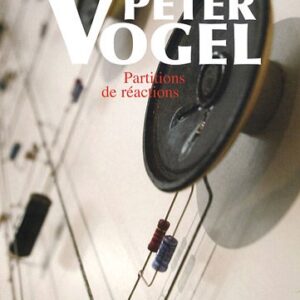
book + CD
Peter VOGEL
“Partitions de réactions”
French edition. Monograph. Peter Vogel (born 1937 in Freiburg) is a pioneer in the field of interactive electronic and musical sculpture. He was formally trained in physics, and has explored technology’s intersection with dance, musical composition, and visual art since the late 1960s. + one CD with different installations.
20,00€
In stock
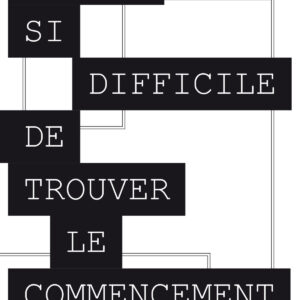
book + CD
Helen THORINGTON
“Il est si difficile de trouver le commencement.”
A book in French + CD about the radio artist Helen Thorington.
450 copies.
28,00€
In stock
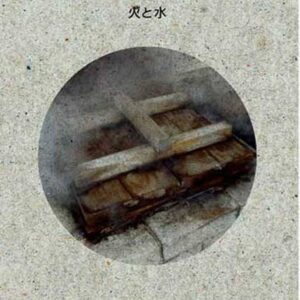
book + CD
Christian MARCLAY
“Fire & water”
In 2012, Christian Marclay was invited to create an artwork for “Mixed Bathing World”, a contemporary art festival held in the town of Beppu, Japan, famous for its onsen (hot springs). It has eight major geothermal hot spots, sometimes referred to as the “Eight Hells of Beppu”.
On a jetty near the harbor Marclay installed a field of 100 flags banners, 50 represented water and 50 fire. At the bottom corner of each flag he attached a small bell.
This ArtBook CD includes an innovative work made of sound and pictures. A perceptual process which allows us to experience the world around us.
French and English. Size: 6.5 x 8.5 inch. Format: paperback.
29,00€
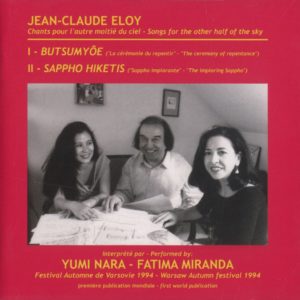
book + CD
Jean-Claude ELOY
“Butsumyôe” – “Sappho hiketis”
*** Book and CD edition ***
A book (English or french text) around the cycle “Songs for the other half of the sky” with the following pieces “Butsumyoê”, “Sappho hikètis”, “Erkos”, “Galaxies”, “Gaia-songs”. Interview, documents, technicazl specification, photos. A CD with “Butsumyoê” and “Sappho hikètis”.
“Butsumyôe” (1989). For voices, percussions and electroacoustic. With Yumi Nara and Fatima Miranda, voice and percussions. In “Butsumyôe” (”The ceremony of Repentance”) the singer Yumi Nara (soprano) occupies the function of a first solo voice, whereas Fatima Miranda (vocalist) assures the function of the second accompanying voice. In Sappho hiketis, it is the opposite: Fatima Miranda occupies the function of the first solo voice, and Yumi Nara assures the function of the second accompanying voice. But in practice, the vocal activities are mixed, creating an actual creative vocal duet. These two works are freely conceived and of pure imagination, which lean on not any pre-existent "model". Butsumyôe is a long monologue for voice that sings, speaks, shouts, and is modulated with a host of techniques, punctuated by the exclamations of the accompanying voice and by various percussion instruments played by the two female singers. Basing myself on Saïkaku’s beautiful text, I have worked in the original language (ancient Japanese from the area of Osaka), striving to magnify the expressive capacity of each word. The point is to cause Western vocal techniques to expand towards more expressive possibilities, particularly in the very difficult and rich space between “sung” and “spoken” texts. Curiously, the recent practice of electro-acoustic techniques sheds light on these issues, forcing us to rediscover the acoustic, whose perception and conception had been gradually obscured, standardized and diminished by our cultural certainties.
“Sappho hiketis” (1989). For voice, percussions and electroacoustic. With Yumi Nara and Fatima Miranda, voice. A vocal duet articulated from an electro-acoustic piece (realized during the production of Anâhata at the Electronic Studio of the Sweelinck Conservatory in Amsterdam). The basic material is composed of pre-recorded metallic percussion instruments (samplings realized in 1984 by Michael W. Ranta).
Prosody and vocal technique: unlike the previous piece, the text is used in a very broken up mode, with somewhat scattered phonemes, also integrating a listing of the names of Sappho’s most famous female lovers. The adaptation of the text (in modern Greek) is totally free and makes no reference to the metrics or musical modes allegedly used by Sappho.
Prosody and vocal technique: unlike the previous piece, the text is used in a very broken up mode, with somewhat scattered phonemes, also integrating a listing of the names of Sappho’s most famous female lovers. The adaptation of the text (in modern Greek) is totally free and makes no reference to the metrics or musical modes allegedly used by Sappho.
18,00€