
Out of stock

4 CD box
Joshua BONNETTA
“The Pines”
4xCDs housed in oversized digisleeves.
Hardcover slipcase.
12pp booklet with original text by Robert Macfarlane and foreward by jake moore
Sound artist and filmmaker Joshua Bonnetta wants to know what happens when a human listener exits a landscape. How might the soundscape differ? How is our presence affecting the recording? His ambitious long-form work The Pines I-IV, released on February 28, 2025 via Shelter Press and The Dim Coast, looks to interrogate some of these questions, capturing the sonic life of a single pine tree in upstate New York over the course of a year via remote recordings, edited into four hours of audio which will be released as a 4CD set with essay by acclaimed nature writer Robert Macfarlane and a foreword by curator jake moore, who suggests the forest knows when it is being listened to.
Macfarlane’s luminous essay proposes that this project offers an answer to the question of whether a tree in a forest makes any sound at all if nobody is there to hear it. Bonnetta turns that question around – entangling it in the surrounding environment, to ask what sort of noise it and other plants and animals make when there is no human listener; asking what sounds come to the fore when we step out of the frame, and in what ways a microphone might alter the way we listen in the environment.
A total of 8760 hours of audio were captured by a microphone strapped 10ft up a tree’s trunk in Tioga County, which was then reworked into a single hour of sound for each season, each of which captured events in and around the tree’s branches and immediate environment. We hear weather and wildlife; coyotes and owls; the creaking of branches under the weight of snow and ice – all act as a window into the sound of this place absent of humans; a time lapse of the audible world around the circumference of a single tree. The microphones used, and the methods of editing, are tech borrowed from conservation bioacoustics and passive acoustic monitoring, which offered Bonnetta a way to engage much more deeply than any standard field recording would.
The Pines I-IV is not bombastic sonic work, but is subtle, often contemplative and sometimes soothing, as when rushes of rain sweep over the landscape, or a flock of geese pass overhead. It is not about exotic renderings of place or or mythically veiled field recording, but about accessing a new way of listening to something familiar, by removing a human presence and extending the listening window beyond usual human capacities. Bonnetta purposefully chose a site he already knew, and which he had easy access to, but which might show itself differently when captured with durational sound recording technology. "For over a decade I taught in Ithaca" he says "and spent a lot of time exploring southern central New York, but never made any projects there. We decided to relocate to Munich a couple years back and before I left I wanted to document the sounds of this environment that I spent so much time in and had come to love. This technology afforded me the opportunity to be able to keep a record across a year and when I started to listen back I was surprised with results and began to devise a system to edit the work. There are several great bioacoustics applications which can analyze and interpret the data but I wanted to manually browse and edit the materials so that I could collect sounds outside of what the applications might traditionally identify: mainly weather and the sounds of the tree itself. The Dim Coast saw the potential in the work as an installation and publication and helped me realize that there might be a project outside of it just being a personal document."
He returned every few weeks to collect and replace storage cards and batteries, editing lengthy audio files using a combination of listening and looking at the visualized audio spectrum. He spent time listening to re-familiarize himself with the soundscape and then scanned the visual data for ‘events’ in the files, a method of analysis more typically used by scientists mapping bird and wildlife populations.
The draw of this type of recording Bonnetta locates in a childhood memory, of wolves captured on tape: “I grew up in a rural area in Ontario, and I have a very early memory of two brothers from our small school who had said they had made a recording of wolves, which were only rumoured to be as far south as we were. The previous evening they had taken their portable cassette recorder to the edge of their lane, which backed on to a large forest preserve, and claimed to have recorded wolves howling. They played it back at school the next day and I remember that the sound was primarily noise and hiss, but we were all listening intently and straining to hear something as they kept playing back the tape. Whether they were really there or this was just the collective imagination of a group of children, we started to hear wolves – or more likely coyotes. This project feels rooted in the initial wonder of that listening experience”.
45,00€
In stock

LP
Michelle Helene MACKENZIE & Stefan MAIER – Olivia BLOCK
“Orchid Mantis – Breach”
Orchid Mantis, by Michelle Helene Mackenzie and Stefan Maier, is a work that draws its inspiration from the history of the Sanzhi Pod City, in northern Taiwan. Sanzhi Pod City was built from 1978 onwards, made up of buildings constructed from assemblages of ‘pods’ inspired by the futuro houses of Finnish architect Matti Suuronen. The project was abandoned in 1980, following a number of accidents during construction and persistent rumours that the site was haunted. However, this wasteland of a city has allowed insects to proliferate, in particular five species of orchid mantis. It is this strange environment, made up of utopian buildings, proliferating insects and vegetation reclaiming the site, that serves as the imaginary space for Michelle Helene Mackenzie and Stefan Maier’s music, a music of carefully designed pace and progression, drawing, through resonance and stridulation, subtle sonic materials that guide and accompany us into multiple worlds with admirable ease and grace.
—
Breach, by American composer Olivia Block, engages in a dialogue between field recordings and synthesised sounds, creating a vibrant plea for wild spaces that face an ever-growing threat to their survival from human activities. The work is based on recordings collected in the San Ignacio lagoon in the Mexican part of Southern California. This lagoon is known as a breeding ground for eastern Pacific grey whales. With the help of precise electronics, the music unfolds like a drift, depicting the subjective soundscape of whales caught up in the noise of the Anthropocene. The composer uses otoacoustic emissions in particular, representing the sound saturation caused by humans in the habitat of these large marine mammals. Going beyond a merely descriptive dimension, Olivia Block manages to transcend her subject to offer a fascinating musical form that engages the listener in a constantly renewed way.
24,00€
In stock

LP
François J. BONNET – Sarah DAVACHI
“Banshee – Basse Brevis”
François J. Bonnet – Banshee
Banshee is an ear directed towards the edges of the old world, where these infinite fines terrae cut and fractalize into coasts, harbours, fjords, peninsulas and archipelagos. Drawing its raw material from recordings made in the Inner Hebrides, Banshee tightly weaves a fabric where the sonic avatars of fauna, flora and climate merge with the human presence, its tools and its culture. Thus, a small boat cleaving through a loch becomes the voice of the mountains and wilderness, and the howling of the wind on the moors becomes the lament of a Banshee, harbinger of death, messenger of the Other World.
Sarah Davachi – Basse Brevis
Co-commissioned by Radio France and INA grm, Basse Brevis by Canadian composer Sarah Davachi was premiered at the Présences 2024 festival, which was dedicated to Steve Reich. Drawing on her own minimalist approach, Sarah Davachi explores, with extreme care, the weavings and complex relationships between the timbral, spatial and durational components of music. Using developments that can be appreciated over time, the composer manages to create music that is extremely precise, subtle and lively. But what is striking, and particularly evident in Basse Brevis, is that such an approach, both abstract and restrained, is nonetheless at times utterly poignant. The work combines moments of formal exploration with moments of pure emotion in a perfectly mastered fashion, creating a gentle tension as it swings between two modes of listening that navigate indecisively within both instrumental and concrete approaches, tracing, in parallel, a diagonal of sound that unfolds around perception, sensation and feeling.
24,00€
In stock

LP
Lucy RAILTON
“Blue Veil”
The first release to document the solo cello work of musician and composer Lucy Railton, the 40-minute composition Blue Veil recorded at Église du Saint-Esprit in Paris invites listeners into the realm of precision-tuned states of resonance: states made manifest through Railton’s careful traversal of her cello's most subtle acoustic characteristics as they harmonically interlock with mind’s embodied modalities of attention and imagination.
Blue Veil arises out of, is sustained in and finally dissolves back into Railton’s momentary presence with her intimate connection to the cello, a way of hearing that allows for a deeper engagement with harmonic resonance, one that opens a space for immediate encounters of mind and sound.
Railton’s exploratory practice of harmonic perception emerges from a focus on the physical qualities of intervallic and chordal sounds, their textural qualities, degrees of friction, and inner pulsations. Composing in the moment guided by resonances within the cello’s body, her own, and their shared vibrational space, Railton moves through Blue Veil by giving sounds what they ask for: sounds of pure texture manifesting as a move through temporal transparency, sounds of rough texture marking regions of dimensionally dense space.
Railton’s creative and highly refined use of just intonation harmony deforms sound's inner movements in ways that suggest a mode of listening that actively supplies imagery of sounds implied or completely absent rather than merely savouring those fully present. This active mode of “listening-with”, playfully and semi-metaphorically referred to by Railton as “sing-along music”, allows listening to reflexively participate in the music’s movement as it gradually passes through richly saturated domains of harmonic imagination. And just as the precision-tuned tones of Blue Veil lose their individuality when fusing multifaceted uniformity, listening’s structures of reference and recognition dissolve into nameless waves of intensity, continuously unfolding themselves upon and merging with the listener.
Blue Veil is the result of a deep exploration of the inner worlds of tuning, an undertaking in turn informed by and emerging out of Railton’s realisations of the music of Catherine Lamb and Ellen Arkbro, her collaborative work with Kali Malone and Stephen O’Malley as well as her interpretive practice in performing the work of Maryanne Amacher, Morton Feldman and others.
29,50€
In stock
CD
Lucy RAILTON
“Blue Veil”
The first release to document the solo cello work of musician and composer Lucy Railton, the 40-minute composition Blue Veil recorded at Église du Saint-Esprit in Paris invites listeners into the realm of precision-tuned states of resonance: states made manifest through Railton’s careful traversal of her cello's most subtle acoustic characteristics as they harmonically interlock with mind’s embodied modalities of attention and imagination.
Blue Veil arises out of, is sustained in and finally dissolves back into Railton’s momentary presence with her intimate connection to the cello, a way of hearing that allows for a deeper engagement with harmonic resonance, one that opens a space for immediate encounters of mind and sound.
Railton’s exploratory practice of harmonic perception emerges from a focus on the physical qualities of intervallic and chordal sounds, their textural qualities, degrees of friction, and inner pulsations. Composing in the moment guided by resonances within the cello’s body, her own, and their shared vibrational space, Railton moves through Blue Veil by giving sounds what they ask for: sounds of pure texture manifesting as a move through temporal transparency, sounds of rough texture marking regions of dimensionally dense space.
Railton’s creative and highly refined use of just intonation harmony deforms sound's inner movements in ways that suggest a mode of listening that actively supplies imagery of sounds implied or completely absent rather than merely savouring those fully present. This active mode of “listening-with”, playfully and semi-metaphorically referred to by Railton as “sing-along music”, allows listening to reflexively participate in the music’s movement as it gradually passes through richly saturated domains of harmonic imagination. And just as the precision-tuned tones of Blue Veil lose their individuality when fusing multifaceted uniformity, listening’s structures of reference and recognition dissolve into nameless waves of intensity, continuously unfolding themselves upon and merging with the listener.
Blue Veil is the result of a deep exploration of the inner worlds of tuning, an undertaking in turn informed by and emerging out of Railton’s realisations of the music of Catherine Lamb and Ellen Arkbro, her collaborative work with Kali Malone and Stephen O’Malley as well as her interpretive practice in performing the work of Maryanne Amacher, Morton Feldman and others.
17,50€
In stock
In stock
LP
Willem de RIDDER & the RADIO ART FOUNDATION
“Radiola”
Between 1978 and 1984, Fluxus artist Willem de Ridder did a weekly radio show called De Radiola Improvisatie Salon. Listeners were invited to send in cassettes recorded at home and would get guaranteed airtime. Willem never listened to any of the tapes in advance. No censorship or personal taste were involved, just total artistic freedom. Long before social media existed, he understood that just providing a platform could ignite boundless creativity. Willem was a visionary, always pushing the boundaries of art and mainstream culture, while his interactive radio shows were breaking down the barriers between listeners and producers.
Unknown home tapers and independent artists would share their freshly recorded bedroom experiments with the world and Radiola became a catalyst for the rising Dutch tape scene. When the show gained popularity, broadcasts became open to the public and people would visit the salon to submit their latest cassettes in person. From these live events a network of independent labels emerged, releasing and exchanging cassettes. Punk was fading away but a new alternative to the mainstream was born.
Nobody seems to know what happened to the Radiola master cassettes, but somehow a few boxes survived and were archived by Marco van Dalfsen in 2022. We went through hours and hours of material and eventually compiled this album. A few names might sound slightly familiar, but our goal was to unearth the most obscure hidden gems of Dutch home taping culture. The result is an eclectic mix of ambient, industrial, lo-fi weirdness and experimental music and offers a unique glimpse into a very specific, but still relevant piece of the past.
23,00€
Out of stock

CD
FANATIC (FNTC)
“Europe in Flames”
The word Fanatic comes from the Latin fanum, temple. A fanatic is someone possessed, by God or the Devil. From 1985 until 1989 Willem de Ridder, Hessel Veldman, Cora Emens and Nick Nicole were the members of post-art ensemble FANATIC (or later FNTC). Willem and Hessel already worked together in the late 70s and early 80s on various radio shows and performed with musicians like Alvin Curran, Francis Marie Uitti and Jon Rose. Together with Cora and Nick they started FANATIC to focus on field recordings, intimate happenings and theatrical storytelling.
As a multi-media project FANATIC was not just obsessed by sound but dedicated to live rituals, producing videos, cassettes and radio plays like Europe in Flames, the pinnacle of this album. It’s a multi-layered piece for which the foundation was recorded by Willem on a boat trip to England. One of his spontaneous field recordings that sounded more like an intricate studio production. In a house near the North Sea on a windswept Autumn evening in 1985 percussion, voices, synthesizer and sound effects were added and when their friend and collaborator William Levy arrived, he listened to the freshly recorded wall of sound, took a short poem from 1978 out of his pocket and started reciting. This final layer of sound complemented the audio perfectly and the result was published on the Neuropa cassette in 1986 and is still chillingly relevant in 2025.
Their haunting, meditative and immersive audio pieces and challenging performances evoke comparisons with groups like COUM Transmissions and Throbbing Gristle. Bleak and raw, but also sensual and poetic. FANATIC released 3 cassettes in the 80s with more material to be discovered in the EXART archives. In addition to the classic Europe in Flames, we dug up 2 unreleased pieces from 87 for a long overdue conspectus.
200 copies. CD wallet with 8 page booklet including photos from a scrapbook, found in Willem de Ridder’s archive.
14,50€
In stock

LP
Robert TURMAN
“Distant Dosage”
2025 repress
Turman first came onto the industrial scene in the late 70’s as the ominous ‘other half’ of legendary noise outfit NON. Shortly after recording the classic 1977 single Mode of Infection, Turman went on to pursue his own unique vision as a solo artist. Fusing every possible influence at his disposal while laying his ideas down on self-released cassettes like Flux (1981), Spirals of Everlasting Change (1987), Way Down (1987) and the massive Chapter Eleven cassette box set (1988). After a hiatus Turman resurfaced in 2005 to team up with seminal noise musician Aaron Dilloway. Since then, he has been gradually adding new titled to his already impressive discography.
For this archival release Turman selected 7 tracks that were recorded between 1980 and 1984. A welcome supplement to his library of avantgarde music that was released in the 80s. This album fits in nicely between the early industrial noise, the long-form minimalism of Flux and the rhythmic industrial of Way Down. Focusing on slowly shifting hypnotic loop-based layers of sound, it covers a specific side of Turman. It feels like there’s a direct link to his earliest works but it’s also a precursor to some pieces that were recorded much later. A missing link that finally gives us the opportunity of a complete overview of his early audio work.
All 7 tracks on this album have a connection to the written word in the form of a poem. Scans of the original typewriter poems are included together with collages and drawings from this specific time frame to create an essential and singular piece of art.
250 copies on clear vinyl with insert.
21,00€
In stock

LP
NEUTRAL
“Lågliv”
Neutral is the no wave / anti-rock duo of Dan Johansson (Sewer Election, Ättestupa, Amateur Hour, etc.) and Sofie Herner (Leda, Enhet För Fri Musik), both with deep connections to the Swedish noise scene. As Neutral, the two smear voice, guitar, organ, and smoldering noise into narcoleptic songs that rewire the strategies of Dome by way of Gate and Mars. Lågliv translates to ‘lowlife,’ an apt metaphor for neutral’s subterranean murk and shambolic discontent that they languidly manifest as a punk dourness emptied of all rock ’n’ roll theatrics. Desperate, demolished, and dejected.
Lågliv was originally published as part of the instantly out of print boxset, On Corrosion - a 10 cassette anthology from 2019 that was housed in a handcrafted wooden box and featuring full albums from Kleistwahr, Neutral, Pinkcourtesyphone, Alice Kemp, She Spread Sorrow, G*Park, Relay For Death, Francisco Meirino, Fossil Aerosol Mining Project, and Himukalt. The collection also stood as the 50th release for The Helen Scarsdale Agency.
27,00€
In stock

CD
The DEAD MAURIACS
“L’énigme Du Parc”
"The mechanical gate, a rattling turnstile, opened onto the park, enclosed by symbolic gates just under a metre high, lined with hedges. Inside the park, sounds underwent a strange metamorphosis: they seemed muffled, as if unable to penetrate, as if repelled by the gates, the trees and the groves.
Outside, fireworks bounced between the buildings. The short duration of the reverberation gave the sound a tremor that derealised it, a short, stuttering vibration that isolated it and gave it a cold splendour.
The clamour of a parade showed the same alterations; snatches of voices emerged, a syllable, a word. The horizon of sound spiked, bristled, underwent a choppy friction that the wind shaped into jagged, torn jerks."
Music, daylife sounds & artworks by Olivier Prieur.
13,00€
In stock

LP
Tózé FERREIRA
“Música de Baixa Fidelidade”
Two records came out in 1988 that forever changed the perception of "experimental" or "serious" music produced in Portugal. These were "Plux Quba" by Nuno Canavarro and "Música de Baixa Fidelidade" by Tózé (António) Ferreira. Both were released by the same label - Ama Romanta -, an influential independent imprint closely linked to avantgarde pop band Pop Dell'Arte. Because those records appeared in what could be perceived as an "alternative pop" framework, they rescued this difficult music from Academia. It helps that Canavarro played in a successful new wave pop band (Street Kids) during the period 1980-83. By association, being a friend since 1976, António was in close contact with many of the musicians and bands that were part of the equally celebrated and detested Portuguese Rock Boom (roughly 79-82).
He was not a musician then but through his friendship with Canavarro, who had the means to acquire electronic equipment, António became involved with that equipment and shared Canavarro's passion for experimentation and curiosity for knowledge. They tried to get hold of as many technical magazines as possible and learn while testing ideas. In 1983, Street Kids were about to break up, young lives drafted into the Army and maybe, in Canavarro's case, a whole new passion for challenging music similar to his bandmate Nuno Rebelo, by then in the process of discovering a wide range of "other" music mainly through Jorge Lima Barreto. Barreto, who had started Telectu with Vítor Rua, possessed a huge book and record collection and, like Rua before them, Canavarro, Rebelo and Ferreira became fascinated by the pool of knowledge they now had access to by frequenting Barreto's house in Lisbon. He was roughly a decade older, had published several books and other writings throughout the 1970s, cultivated an anarchic stance and a penchant for cultural indoctrination. Rebelo was the first to be introduced via his contact with Rua (who had invited him to play in his other band GNR).
Overwhelmed, he felt the need to share his enthusiasm with friends and eventually took a few to the house in true pilgrimage fashion. To see the Light. Among the few he led there was even João Peste, founder of Ama Romanta. Canavarro and Ferreira preceded him.
Ferreira recalls an exciting learning process added to his experiments with Canavarro's array of synths such as the Korg Ms 20, Korg polysix, ARP Axxe, Roland SH-01, the Ensoniq Mirage sampler... He read in a magazine article about someone who had studied at the Institute of Sonology (then in Utrecht, Netherlands) and went there during a vacation trip in the Summer of 1983. He became excited by the prospect of studying at the Institute but money was a problem. Canavarro, on the other hand, was admitted there in the following year. Back in Portugal, Ferreira eventually abandoned his Chemical Engineering studies in Lisbon's Technical Institute in favour of a more focused music practice. He collaborated with Telectu during 1984 and 85 as a sort of technical engineer, implementing some recording solutions and background tapes and went to work at a thermoelectric power plant in Sines, hoping to make enough money to fund his musical studies. He did and proceeded with the paperwork for admission at the Institute of Sonology, now based in The Hague. António studied there in 1986-87 and the present album includes two compositions developed at the Institute: "More Adult Music" and "This Is Music, As It Was Expected", both featuring the voice of Rodney Waschka II. Among other activities and talents, Rodney is an expert in computer music and to António his voice sounded similar to Robert Ashley's, whose work he admired.
What happened at the Institute was a systematization of António's self-taught practice. Computer software, Musique Concrète, noise and silence, organisation of abstract ideas and sounds. The original notes on the back sleeve of the LP give some indication of process and thinking, but a more detailed account was given by António in the liner notes of the CD reissue in 2002, which are also included in this 2025 LP reissue.
The music sounds deep and detailed, despite the fact of António calling it low-fi ("Baixa Fidelidade"). It flows like an improvised performance where several musicians might be responding to each other, respectful of their mutual space. Drama occurs, as a natural emotional connection is sought by the listener. Piano, bells, drone, processed voices, even the clear narrative of Rodney Waschka II, contribute to create a sort of alternative perceptual reality. The sounds are almost tangible, more a part of the physical world than ethereal manifestations and thus it would not be correct to invoke "ambient music" as a selling point. But although "physical" and distinct, this music is still alien, more so in Portugal's 1988 environment. In March, helped by Canavarro, António set up a home studio and there he recorded the remaining material for this album: "Algumas Pessoas Olharam O Sul E Viram Deserto", "Um Som, Seguido De Uma Cena Negra E Malva" and "O Verão Nasceu Da Paixão De 1921".
"Música de Baixa Fidelidade" stands not only as a proof of great resilience but as one of those magnificent works of art coming from someone who balanced technical inclination and emotional sensibility. Because of that, Tózé Ferreira is able to decode the phantom world of sound for anyone who cares to experience the sensation of inhabiting a version of the Future. First ever vinyl reissue, reproduction of the original artwork with an additional insert. Made in collaboration with the artist and the support of Paulo Menezes (Plancton Music), who provided valuable assistance. Remastered by Taylor Deupree.
24,00€
In stock

7 CD box
Meredith YOUNG-SOWERS
“Agartha: Personal Meditation Music”
Agartha, Personal Meditation Music is a 7CD box set, originally released on cassette in 1986, at the height of New Age, as an aid for meditation and alignment. Bringing to mind 20th century composers like Eliane Radigue, La Monte Young or even Brian Eno's Shutov Assembly, the time-stopping, enveloping, electronic music contained in this series sounds eerily modern, mysterious and moving. Characterized by deep analog drones, rising overtones, floating frequencies surfing on sine-waves and intervals with mystic modulation, this is truly moving, vibrational music.
In Agartha, the individual notes of each Harmonic Triad proceed in a fashion that is neither improvisational nor chance-based, nor is it generative. Instead the music flows outward as if being transmitted— or channeled — from a place outside human consciousness. There is a profound sense of cosmic depth expanding ever outward as the music fills the listener with waves of emotion, and a palpable somatic response is felt, although there are subtle differences with each unique Triad.
Each disc is individually packaged in original replica sleeves and housed in a heavy duty cardboard clamshell box. Digitized and remastered by Jessica Thompson. Liner notes include extensive instructions for use from the original text and an essay by library music scholar David Hollander.
The original edition of Agartha, Personal Meditation Music, featured one 30 minute track per tape repeated on both sides. Subsequent editions had unique Side B tracks on all but two of the 7 volumes. We have included all tracks in this boxed set.
48,00€
In stock

LP
FLUTTER RIDDER
“Flutter Ridder”
Flutter Ridder is the duo of Norwegian multidisciplinary artists Espen Friberg and Jenny Berger Myhre, both of whom play important roles in Oslo’s contemporary art and music underground. The pair first collaborated during the production of Friberg’s debut solo record, “Sun Soon” (Hubro, 2022), quickly recognizing in one another a creative kinship rooted in a playful, intentionally naive approach towards making art. In November of 2023, the pair decamped to the coastal town of Hvisten in southeastern Norway to record what would become this debut, self-titled album in an ancient wooden church. Drawing from a palette of Friberg’s idiosyncratic Serge modular system and the church’s resident pipe organ and intoxicating acoustic reverb, they began recording and sculpting music informed by the notion that air and electricity share a common flow, a continuous current that can be directed through valves and potentiometers. The pair came to think of the Serge and pipe organ as sibling instruments, the former yielding characteristically unpredictable and complex timbres that complement the wooly, reedy drones and strange, microtonal overtones of the latter. At once sublime, liturgical, and whimsical, Flutter Ridder offers its listener a series of moving, cinematic natural landscapes, affirming the sensibilities of its makers and the indelible influence of the environment in which it was produced.
25,00€
In stock
LP
KMRU
“Forge”
On his new album 'forge’, ambient artist KMRU explores the blend of melody and noise, rhythm and drone. ‚forge’ marks the third release on Seil Records for the Nairobi born and Berlin based producer. Made up of 10 tracks, the album effortlessly wanders from intimate compositions over field recordings to deep and rich soundscapes.
The result feels like a living, breathing organism. Music you can immerse yourself in. Like few others, the 27 year old producer carved a niche of his own, capturing the essence of his raw live performances to form a highly unique listening experience that transcends what ambient music is known for.
'forge‘ can both exist in the background as well as front and center. Filled with intricate details and vast sonic vistas, it invites the listeners to lose themselves in the music. It’s gentle, yet uncompromising; soft and warm, yet growly and dense.
28,00€
In stock
LP
Hüma UTKU
“Dracones”
Hüma Utku returns to Editions Mego with her new album. The title Dracones makes reference to the mediaeval latin term "Hic sunt dracones" (Here be dragons), marking the unexplored, dangerous places on world maps, expressing the fear of chaos, the unexpected and the unknown.
This new work by the Istanbul sound artist is a sonic journal of an expedition into uncharted territory, one which occupies self and domesticity. Inspired by Utku’s experience of matrescence, Dracones explores the themes of familial demonology, metamorphosis and homecoming as well as human relationship to the experience of love woven layers of euphoria, alienation and consumption.
Musically, Dracones traverses a wide array of sonic tools whereby industrial sounds are imbedded with certain psychological angles, this is an album where, all matter meshes into a sly snapshot of the human experience with a tension and release exposure occurring frequently with dark corners opening up to bright layers of electronic experimentation.
The haunting opening track ‘A World Between Worlds’ tackles pregnancy, of which Utku was experiencing when making this record. The emotional, physical, spiritual and mental experience of this journey is all documented here.. This track features the ‘Lyraei’, an electromagnetic string instrument and modern interpretation of the ancient lyre, that was built and played by Mihalis Shammas. ‘Comfort of The Shadows’ moves from within to without, what was once hidden is now exposed. Utku’s ability to conjure the visual in the sonic is at the forefront as howling electronics give a distinct impression of movement. ‘A Familial Curse’ presents a desire to break the cycle of generational trauma with a creeping sense of dread that rolls into an industrial rhythm prior to landing in a beautiful place represented with shimmering guitar tones. ‘Here be Dragons’ is a rich and dark evocation, a spooked surrender to the themes of the record whereby Utku’s wildly distorted voice beckons all manner of phantasmagoria over cello and recordings of her ultrasound. ‘Care in Consume’ engages in further sonic exploration as a means of conjuring ‘matriphagy’, with its unique psychic energy coursing through electronic veins. ‘A House within a House’ could also be read as a body within a body as the pulse of ultrasound audio rattle amongst a cage of thudding rhythms and swirling electronics, one also ending in optimism as an exquisite melody is born from the prior fire. The striking journey ends with the more soothing ‘Ayaz’a’, a track embracing love and all the hardships that a period of fundamental metamorphosis brings, this is a heartfelt dedication to her son and concludes an album draped in life, experience, joy and pain.
Dracones is a deeply visual journey through inner and outer worlds, a space where symbolic evocation is supreme and passive listening is not an option.
26,00€
In stock

LP
HASWELL & HECKER
“UPIC Diffusion Session #23”
Russell Haswell and Florian Hecker have both a long history with Mego/Editions Mego. Individual releases have peppered the Mego catalogue since Haswell’s Live Salvage 1997->2000 cd release (MEGO 012) in 2001 and the debut Hecker release IT ISO161975 (MEGO 014) in 1998.
The individual exploration of sonic phenomena by these two practitioners has resulted in both being highly regarded for their uncompromising approach to sound as matter. Russell Haswell and Florian Hecker came together as a collaborative duo with the now-legendary record Blackest Ever Black, somewhat inexplicably, on the classical imprint of Warner Brothers.
In 2025, Hecker and Haswell return with a new album featuring the two-channel edit produced initially for their UPIC DIFFUSION SESSION #23, performed as a live diffusion across 8-channels at the X100 Festival, Berlin, 2023, celebrating the 100th anniversary of Xenakis' birth.
This record furthers the duo's exploration of Xenakis's UPIC system as the sole instrument. The UPIC is a computer music system that generates sound from visual input. The original intention of the system developed by Xenakis was to make a utopian tool for producing new sounds accessible to all, independent of formal training. One can locate footage of Xenakis and a group of children making drawings for the system in the 70's.
The duo set off experimenting with a diverse array of hand-drawn images to feed the UPIC system including news photographs of disasters and atrocities, "food porn" through to depictions of the natural world and microscopic images of molecular structures (including 'the blackest ever black'). The resulting eccentric audio from these images is claimed by the artists to heighten synaesthesia and is as mysterious as it is baffling.
Throughout UPIC DIFFUSION SESSION #23 frequency clusters move and morph in the most unusual manner, shifting and stretching into shapes that hint at some kind of magical process. What starts out deceptively simple soon unravels into a large array of sonic mayhem. Symbolic jet planes are shredded by a swarm of insects, a metal bowl howls into the void, a tiny tin toy crawls into a thicket with the resolute aura of a black hole. A burning geyser of laser forms liquid shrapnel. This is sound as an alchemical process, a constant chimerical flow into the netherworld and is the net result of the decades long radical investigations by the two artists involved. UPIC DIFFUSION SESSION #23 is a direct, rich and rewarding listen for those willing to invest time into the outer limits.
26,00€
In stock
LP
Peter REHBERG
“Liminal States”
Peter Rehberg is known for his pioneering electronic work with computer software which over time evolved into a modular set up alongside running MEGO and then Editions Mego labels.
Rehberg was a prolific collaborator, with other musicians and with contemporary dance and theatre productions, most notably with French artist and choreographer, Gisèle Vienne with whom he created a series of soundtracks from Showroomdummies, released under the name DACM in 2002 (Showroomdummies MEGO 056), to Crowd in 2017. A collection of Rehberg’s solo works for Vienne was released in 2008 (Work for GV 2004-2008 EMEGO 092). The outfit KTL, with Stephen O’Malley, was initiated by Gisèle Vienne for her work Kindertotenlieder and subsequently made a series of soundtracks for Vienne’s works branching off into a prolific series of live shows. The work Rehberg did for theatre and performance teased out aspects of his practice one may not have encountered in his own solo work as PITA or that of collaborations with other musicians.
Editions Mego is proud to present a previously unreleased theatre soundtrack made for Icelandic choreographer Margrét Sara Guðjónsdóttir, whom Rehberg had a decade long collaboration with until his untimely passing in 2021. The original composition for Liminal States was created by Rehberg for the performance Pervasive Magnetic Stimuli in 2018 and then revisited as a catalyst for the concepts behind Liminal States. This work is based on an ongoing artistic research conducted by the choreographer into altered states of perception through phenomenological embodiment. It is the last in a trilogy dealing with the notion of larger forces that act on us beyond our conscious mind. The trilogy consists of Pervasive Magnetic Stimuli (2018), Boundless Ominous Fields (2024) and now Liminal States (2024).
Rehberg's score for Liminal States is a vast canvas of spectral ambience at once tangible and unfathomable in its constantly shapeshifting lysergic dread. The results are a psychological journey through the mental effects of sound on space and subsequently the mind. The first part presents cascading waves of shimmering electronics laying the groundwork for the second part where the psychological illusion splinters into all manner of sonic effects taking the listener on a deep mental voyage. If references are witnessed the late period long form hallucinatory works of Coil, such as Time Machines and Constant shallowness leads to evil, are amongst a similar mind message delivered here. Unlike any other release in Rehberg’s output Liminal States is a single long form work which, despite the form, retains Rehberg’s idiosyncratic sound vision.
Guðjónsdóttir and Rehberg’s collaboration blurs that relationship into a greater force which truly enables the theme of liminal states to unfold in a brave new fashion. Rich in timbre and sonic invention this is powerful work easily holding its own outside of the intended performance whilst still complimenting the missions statement entirely. This profound collaboration has the cumulative effect where the concept and soundtrack are one and may be one of the strongest works in the entire Rehberg canon.
26,00€
In stock
LP
GENERAL MAGIC
“Bosko”
Editions Mego presents Bosko, landing exactly 30 years after the initial General Magic flights into the fantastic; the legendary first Mego release, a collaboration with Pita whereby all sounds were harnessed from the buzzing, drinking, humming sounds of fridges [MEGO 001 General Magic & Pita] and a 12” with Elin called Die Mondlandung (The Moon Landing) [MEGO 002] which embarked on a minimal techno template so austere and strange it was one of the historic progenitors of austere and wonky rhythms alongside Sakho and other European explorers.
The initial return of the playful and mystical Austrian outfit General Magic came with the 20th year anniversary vinyl reissue of their classic debut Frantz [eMEGO 010]. A record so audacious and playful it still baffles as much as it entertains. At some point whilst working on this reissue GM’s Ramon Bauer and Andi Pieper were spurred on to rummage around with ideas and tools once more and after more than two decades of inactivity sonic sorcery was conjured once again. Live shows in honour of Peter Rehberg were performed in Vienna and London. Softbop, a limited risograph collaboration with Tina Frank came with the first new recordings as a digital download came out discreetly online. The first full length album following Rechenkönig in 2000 [MEGO 032] “Nein Aber Ja” released in 2023 on Finlay Shakespeare’s GOTO Records on CD and cassette. An ongoing series of mix tapes online further highlights their interests encapsulating a new found angle on electronic mayhem. All of these elements retain the wildly eclectic and ecstatic glow that only they can harness and hand out to an unprepared world.
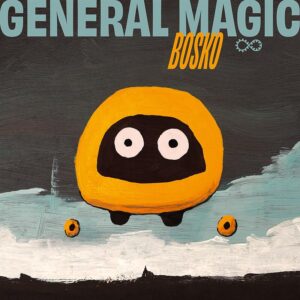
Now, we have General Magic’s second official full length comeback recording, Bosko. The new album is initially notable prior to the needle hitting the wax or the cursor identifying a track due to the artwork. Made by long term collaborator Tina Frank, this is Frank’s first analogue artwork, with a painting of a happy/nervous machine thing hovering in a landscape of no discernible identity. It’s quasi science fiction hovering amongst the potential for fun. Suited to the music? Natürlich.
Bosko sees Bauer and Pieper update and reframe their original investigations with a fresh supply of head scratching, heart racing tunes that hit the inexplicable with a wild mesh of drums, pianos, synthetic voices and all manner of immaterial sonic play. Startling sonics shock the ears on Club Duchamp which sounds like a conversation between synthetic adult ants in an environment still in development. Elfer features vocals supplied by a female-ish voice who, whilst grappling melody, has trouble executing a firm identity. Noorenhalt catapults along a mainframe of syncopation so unwieldy it feels like the voice, which is utterly alien, provides the only comfort. Seite 5 inhabits a fuzzy zone where a synthetic Horn of Jericho type ambience competes with rhythms never quite sure of who they are. Rise of the Ombré raises the spectral dread. Is this Science Fact? Absolutely nothing within Bosko is predictable.
The amount of change in the miasma of existence and the things we touch in order to make things has shifted so exponentially we are at the point where minds are starting to glaze over. All of this makes the return of the always original, always surprising, always fresh and exciting General Magic totally in tune with the artificial intelligent apocalyptic age we currently inhabit. The tools may have changed but the wonderfully warped gaze of Bosko offers a fresh new vision of perplexing funk and robotic punk.
26,00€
In stock

CD
NURSE WITH WOUND – SCANNER
“Contrary Motion”
A collaboration between Steven Stapleton (Nurse with Wound) and Robin Rimbaud (Scanner), exploring the darkest regions of the airwaves and live electronics.
It's an ominous trip into radio waves, processed voices, electronics, squeaky guitars and a mysterious labyrinth of echoing sonic disturbances.
15,50€
Out of stock

CD
NURSE WITH WOUND
“The Grave And Beautiful Name Of Sadness”
Featuring two archive mixes of the original 1984 recording. A 2007 epic variation recorded for possible inclusion in Peter Strickland's film 'Katalin Varga' and a unique 'psychedelic' version from 2012 which until now has never been heard.
14,00€
In stock
LP
NURSE WITH WOUND
“The Grave And Beautiful Name Of Sadness”
Featuring two archive mixes of the original 1984 recording. A 2007 epic variation recorded for possible inclusion in Peter Strickland's film 'Katalin Varga' and a unique 'psychedelic' version from 2012 which until now has never been heard.
28,50€
In stock

CD
Paul BRADLEY
“Vault”
ICR is delighted to release a 'new' CD from Paul, who has been quiet of late. And has been sorely missed. The origin of the music is detailed below, but suffice to say it's an excellent collection of what some might describe as 'cosmic'. That is to say that it's quite still, peaceful, droney but melodic, music to disappear into. Comes in a very nicely designed (by Jonathan Coleclough) 6-panel Ecopack. Highly recommended.
As the name suggests, 'Vault' is a collection of tracks that were recently discovered after languishing unheard for over a decade. Exactly when and why these were made is unknown, as unfortunately much of the details have been lost to time, however 'Anon' seems to be an edited version of a live performance that was part of Ciclo Herzios at La Clinica Mundana, Valencia in February of 2011 and 'Europa' might have been a rehearsal; so my best guess is that these tracks are from that time period as they all share an aesthetic.
Listening to the music with fresh ears I felt they should have an audience and the time seemed right to give them a little love.
The recordings were finessed a little and then sent to Colin Potter to get his input; he liked them and offered to release them. They were then polished up, mastered and well... here we are... a snapshot in time.
11,50€
In stock
Book - Livre
COMPILATION
“Pause”
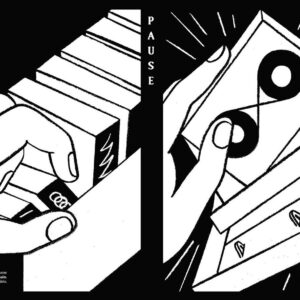
352-pages book (Bilingual: French/English) on the theme : cassettes, graphics, printing, screen printing, labels and music...1000 refs of cassettes jackets and interviews with: Tanzprocesz, Zad Kokar, Ultra Eczema, Zamzamrec, Rrrecords, Agraf'prod, Maître Selecto, Hästen & Korset, Notice Recordings, Zoomin'night, Hanson Records, Falt Records, Chocolate Monk, Tomaturj, Social Harmony, Third Type Tapes, Altered States Tapes, Animal Biscuit, Copy Pasta, Senufo Editions, Lal Lal Lal, Los Emes Del Oso, Scum Yr Earth, Fougère, Silo, Manoï, Papier Crash Test, Herberg Rustiek, Peace Noise. And an intro by JM Bertoyas. Cover art by L'Atelier McClane.
15,00€
In stock
LP
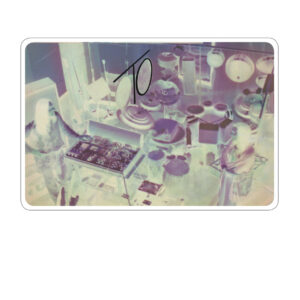
TO (Will JACKSON & Stefan “Z’EV” WEISSER)
“Manifestations Of Spirit From Within Electronic Electro-Acoustic & Acoustic Space”
Erratum Musical, Studio Forum and C.A.R.E. are very pleased to announce the release of this groundbreaking historical LP from 1976 recorded in Los Angeles. First ever recordings of sounds by Serge Modular System + Z’EV + Will Jackson!
TO was founded in 1976 in San Francisco by Will E. Jackson (1945-2019) & Stefan “Z’EV” Weisser (1951-2017), occasionally performing under the code name “Center for Inter-Species communication”.
The real missing link between works by California’s modular synthesizers pioneers, the industrial music explosion of the mid 70s and the early new age interspecies communication protocols.
This is a mesmerizing trip record at its finest, which original masters on magnetic tapes have just been rediscovered.
A collaborative effort, the heart of the TO project was heavily influenced by Will Jackson’s participation in the inaugural 1975 Greenpeace V campaign to save the whales. One of the objectives of the Greenpeace V expedition was to demonstrate the ability of cetaceans and humans to communicate through sound – an idea developed by Paul Spong and later perfected by Will’s friend, John C. Lilly with his “Project Janus”.
During the Greenpeace expedition against the barbarity of whaling off the coasts of Alaska, Will Jackson used his Serge#1 modular synthesizer (built under the supervision of Serge Tcherepnin at CalArts in 1973, and now in France at C.A.R.E. since 2023) and broadcast the electronic sounds on underwater speakers, recording these broadcasts as well as the reciprocating songs of the whales that came to investigate.
A symbolic melding of music and mission, TO has only ever released one vinyl during its existence, of which there are only a few dozen copies in the wild. That record has been restored with the original masters, whose magnetic tapes have just been rediscovered.
These miraculous encounters constitute the basic sound material of TO: communication by invocation.
TO ceased its activities during the summer of 1977.
Will Jackson joined Ether Ship, a pioneering group of “sonic xenolinguistics”, created in 1972 by Willard van de Bogart and Lemon DeGeorge. During this time, Will Jackson participated in several strange sound experiments including the legendary “Extraterrestrial Intelligence Ether Ship Transmission for Star Net Pilot Program”, which was recorded in the presence of Jacques Vallée in 1978.
Stefan Weisser then began his solitary adventure and soon after gave his first solo performance, “Sound of Wind and Limb”, with his “Analog Acoustic Assemblege” he devised for TO.
He created the pseudonym Z’EV and was instrumental in the conception of “industrial music” in the underground scene.
Will Jackson and Stefan Weisser would reunite later that same year, one last time, for Ether Ship’s performance of “A Cosmic Journey”, filmed with Gary Schroeder’s cutting-edge video synthesizer.
23,00€
Out of stock

LP
DEEAT PALACE
“Pièces pour Serge”
In 2021, Wilfried Wendling offered a 3-day residency to Marion Camy-Palou at the Muse en Circuit (Alfortville / Paris), a working time which then has evolved into a 2-year cruise dedicated to the Serge Modular System (offered by Jean Claude Eloy at the Muse). This search finally resulted in a concert in April 2023, and this record - Deeat Palace's debut album.
'Pièces pour Serge' offers two intense pieces, cut in 45 rpm for vinyl to allow a deeper sonic dive into the heart of the bowels of a synthesizer that has become legendary and which celebrated its 50th anniversary in 2023.
note : a series of albums produced with the 'Serge Modular Music System#1' (first Serge synth modules built at Cal Arts in 1973 by Will Jackson under the direction of Serge Tcherepnin and now restored and in use in Annecy/Fr at C.A.R.E.) will be published later.
Pièces pour Serge | composed by Marion Camy-Palou, 2022-2023 | mixed by Camille Jamain | mastered and cut by Frederic Alstadt at Mont Analogue | recorded at la Muse En Circuit, Alfortville | engineered by Camille Lezer | photography by Vincent Ducard | released by Erratum Musical - EM035, Paris 2024 | 300 copies.
23,00€
Out of stock

LP
Charmaine LEE
“KNVF”
Following the release of her 2018 solo tape, Ggggg (Anticausal Systems), vocalist Charmaine Lee returns with her debut LP, KNVF, for Erratum Musical (Paris, France). In just two years, the album marks a considerable evolution from the austere concentration of Ggggg towards expansive sonic worlds. Inspired by the arcs of popular music, Charmaine freely and fearlessly navigates a wide range of aesthetics, digging beneath each surface to disclose a highly personal sense of musicality. Microphones of varying fidelities, contact mics placed on the throat, and amplified hair combs are used to simulate polyphony and a dialogue between the inner and outer body. With Charmaine’s unique vocal articulations atop a bed of feedback and extreme frequencies, form follows expression in an ever-evolving context built on the traditions of noise, vocal, and improvised music. KNVF is a powerful statement in modern vocal music and a thrilling new development in Charmaine‘s artistry that will reward those who listen for the journey.
Charmaine Lee (b. 1991) is a New York-based vocalist from Sydney, Australia. Her music is predominantly improvised, favoring a uniquely personal approach to vocal expression concerned with spontaneity, playfulness, and risk-taking. Beyond extended vocal technique, Charmaine uses amplification, feedback, and microphones to augment and distort the voice. She has performed with leading improvisers Nate Wooley, id m theft able, C. Spencer Yeh, and Ikue Mori, and maintains ongoing collaborations with Conrad Tao, Victoria Shen, Zach Rowden, and Eric Wubbels. Charmaine has performed at ISSUE Project Room, the Kitchen, Roulette, The Poetry Project, and MoMA PS1, and participated in festivals including Resonant Bodies, Huddersfield Contemporary, and Ende Tymes. Her work has been featured in group exhibitions including The Moon Represents My Heart: Music, Memory and Belonging at the Museum of Chinese in America (2019). As a composer, Charmaine has been commissioned by the Wet Ink Ensemble (2018) and Spektral Quartet (2018). In 2019, she was an Artist-in-Residence at ISSUE Project Room and is currently a 2021 Van Lier Fellow at Roulette. Charmaine is a member of the Editorial Board of Sound American.
23,00€
In stock
CD
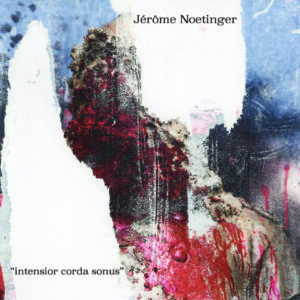
Jérôme NOETINGER
“Intensior corda sonus”
"In 2019, I was invited by Dylan Nyoukis and Karen Constance to play at the Colour out of Space festival in Brighton. A unique moment of incongruous music in a friendly international gathering of freaks of all kinds. Unforgettable. I played a solo on Revox B77 and then Dylan asked me to do a CD for his Chocolate Monk label. After some thought, I decided to offer three compositions rather than try to reproduce the past moment of an improvised concert. I'm talking here about the composition of fixed sounds (to quote Michel Chion) or musique concrète to use Pierre Schaeffer's original terminology. I think I've spent more time in my life improvising than composing, and no one has ever reproached me for it.
The Latin title refers to the equivalence between the tension of a string and the elevation of the sound, but also to the link between the intensity of the lived and of the musical. Will the intensity of the former influence that of the latter? But it's also the tension on the trigger and the intensity of the reaction to it. The tension-release form is one of the most classic in musique concrète, and even more so since the advent of computer-assisted music. In Les objets inaudibles [2018], I decided to politicise this form, to create a struggle between these elements. In Erase my head [2019], it is the accumulation, erasure and diversion of random fragments that is at play. Then in Eloge des ruines [2020], it's a return to the founding gesture of musique concrète, that of sampling existing material, in this case records from my personal record library.
This CD is dedicated to the memory of Kiko C. Esseiva."
- Jérôme Noetinger
“Les objets inaudibles”
Commissioned by INA-GRM, first played on 19th January 2019. Musique concrète in four parts composed in 2018 in the composer’s studio.
Starting with, a GRM commission received on 25th June 2018, and the urgent need to find a title. Ending with, a discursive journey through the art of concealment, with the discovery of unexpected voices in some of Pierre Schaeffer's Études aux Objets read at reduced speed, the use of Matthieu Saladin's application La Capture de l'Inaudible, an app which keeps only the frequencies removed by MP3 encoding (i.e. the inaudible, according to the ideology that governs this technology), the increase in police violence, the impact of a 357 Magnum, and not to mention the intense pleasure of destroying a piano.
“Erase my head”
A live-to-air performance originally commissioned for Radiophrenia, created in Glasgow on 19th May 2019.
30 minutes = 1 800 seconds and at the speed of 38 centimeters per second = 684 meters.
A loop of 570 cm, so that’s 15 seconds at the speed of 38 centimeters per second, i.e. a length of 2.85 meters. A mixing desk with several inputs like CD players, cassette players, radio… each played randomly. And then recording, processing, layering, erasing, hiss and tape delay on the live loop.
“Eloge des ruines”
Commissioned by Radio-France for Alla Breve by Anne Montaron. First broadcast on 30th August 2020. Musique concrète composed in the composer’s studio between January and May 2020. Dedicated to Sean Baxter (1970 - 2020).
A suite of five miniatures, each two minutes long, based on the idea of slowing down and collapsing, using sound samples taken from vinyl records, with the playback speed changed from 78 to 0 rpm, as well as accelerated playback of old magnetic tapes. The work on this material is the result of the accumulation, editing, mixing and filtering of all these materials.
Edition of 150
"Jérôme Noetinger delivers a haunting and immersive listening experience with this album, showcasing his expressive prowess with the humble Revox B77 reel-to-reel tape recorder. The album’s Latin title, which roughly translates to the sound of the heart becomes more intense, foregrounds the tensions and intensities contained on the three compositions featured on this release, blending musique concrète composition and improvisation via live tape manipulation.
It begins with “Les Objets Inaudibles”, a four-part suite that feels like a descent into a sonic abyss. Drawing from Pierre Schaeffer’s Études Aux Objets, Noetinger collages tape effects, gunshots and the violent destruction of a piano into a disquieting assemblage. Ghostly voices, filtered through an app that isolates the frequencies lost during MP3 encoding, mingle with slack piano wires and animalistic cries. Each movement ends with jarring gunshots, punctuating the chaos with a sense of finality. “Erase My Head” is a live performance from 2019, where Noetinger manipulates a tape loop in real time. Over 30 minutes, layers of sound accumulate, transform and are erased, creating a dynamic interplay of repetition and mutation. The piece shifts from violent, saturated noise to more spacious, delay-heavy textures, demonstrating Noetinger’s ability to craft effective structure from seeming randomness.
The album closes with “Eloge Des Ruines”, a suite of five two minute miniatures crafted from samples taken from vinyl records in Noetinger’s collection, often with the playback speed altered. Combined with the variable speed of the magnetic tape, these pieces revel in cacophonous jumble and temporal chaos. Across all three works, Noetinger creates evocative worlds as thought-provoking as they are sonically rich. “Les Objets Inaudibles” in particular, is a potent example of musique concrète at its most poetic and visceral."
- Leah Kardos, The Wire Magazine
16,00€
In stock

LP
GOLEM MÉCANIQUE
“Siamo tutti in pericolo”
"Siamo tutti in pericolo" is the third album by Golem Mecanique, the nom de plume of French multi-instrumentalist composer Karen Jebane, to be released on Ideologic Organ. Jebane works within the fringes of contemporary folk (aka La Novea community), microtonal and early modern spheres, as well as touching upon the ashes and fibres of back metal and the DNA of gothic music, literature, sorcery and most of all - poetry. Jebane's work with the "drone box" (a mechanised hurdy-gurdy) and zither as a smooth and rippling surface for her singing is immediately evident in a nearly ceremonial way, inviting into a space of clear-dark creativity-beauty. On "Siamo tutti in pericolo", Jebane works with her forms of composition in new ways, poetic and spare execution of her techniques, through her homage/hymns/meditations on the highly irregular circumstances and questions/mysteries of the passing of the soul of master artist Pier Paolo Pasolini. A perfect pairing with collage artist Julien Langendorff's cover art, "Siamo tutti in pericolo", presents a pure presentation of Jebane's "Golem Mecanique". –Stephen O'Malley, Brion, France, 1 Sept 2024
Voice, electric/processed hurdy-gurdy and zither by Golem Mecanique
Composed, performed and mixed by Golem Mecanique between November 2023 and May 2024
Mastered by Stephan Mathieu at Schwebung, July 2024
Cut by Andreas Kauffelt at Schnittstelle, Berlin, September 2024
27,50€
Out of stock

LP
Nina GARCIA
“Bye Bye Bird”
Nina Garcia has been actively moving the art of noise guitar into surprising and intriguing new spaces. She has been at it for some time now, a bit of a secret weapon all the while hiding in plain sight. As I listen to her music and ruminate upon seeing her perform it brings me to a realization which I have with very few musicians: the ego inherent in making art can be transcended through a purity of direct action. At least that’s the feeling I have when experiencing Nina’s music which comes across as serious and radical and wholly engaged in the moment of its creative impulse. With Bye Bye Bird she delivers her most exalted and sublime collection of recordings for all adventurous hearts to hear. A fantastic album.
Thurston Moore, London 2024
:::::
After a decade of performing concerts under the Mariachi guise, Nina Garcia has finally unveiled her unique approach in Bye Bye Bird, her first album under her name. Bye Bye Bird is her second solo album, to be released by Ideologic Organ in February 2025.
With no pretence or demonstration, the album is a captivating blend of chiaroscuro, melodies, and raw emotion.
Nina Garcia's album takes on an almost documentary-like quality by adopting a simple approach to gesture and sound recording. It offers a candid portrayal of a moment, a lack, a state, and a breathtaking energy. With ostinato as her only credo, Nina Garcia's music is an experiment in freedom, where the peaks answer the abysses, and the power of movement and the emotion of sound serves as her compass.
From very short (01:28) to never very long (07:34), the eight tracks that make up this set explore a moment, a space, a mechanism, an intention or a way of doing things. As a common feature of almost all these pieces (all but one, the last), Nina Garcia explores a new technique. She adds to her instrumentation, reduced to the essentials (a guitar, a pedal and an amp), an electromagnetic microphone which, when held in hand, makes it possible to listen in on the exact zones where the vibration of the string creates a sound amid vast spaces of silence. The guitar is unplugged, and the body/instrument relationship changes in dimension.
In this series of variations, you can get caught up in masses of noise seen from very, very close up, evocations of melodies in the making, feedback on ridgelines, pulsations that hold their own, modulations weakened by exhaustion and harmonic bursts that hint at better days to come.
Neither hopelessly chthonic nor beatifically ethereal, Bye Bye Bird is a sum of musical pieces that make a whole and give voice to echoes of what has been, the presence of what is and the hope of what will be, a record movement in the form of flight and salvation.
Since 2015, Nina Garcia has been researching and creating around the electric guitar, halfway between improvised music and noise.
On numerous stages in Europe and North America, she has played occasionally with Stephen O'Malley, Sophie Agnel, Fred Frith, Antoine Chessex, Louis Schild or with Luke Stewart and Leila Bordreuil's Feedback Ensemble, in addition to more regular formations in which she participates, such as the ensemble Le Un, mamiedaragon, Autoreverse (with Arnaud Rivière), duets with trombonist Maria Bertel and percussionist Camille Émaille, and the installation piece De Haut En Bas, De Bas En Haut Et Latéralement (with Christophe Cardoen, Jennifer Caubet, Etienne Foyer, Anna Gaïotti and Romain Simon).
–Arnaud Riviere, Paris November 2024
27,50€
In stock

LP
Judith HAMANN
“Aunes”
Aunes is a rare solo album from peripatetic Australian cellist-composer-performer Judith Hamann, presenting six pieces recorded across several years and countries. Developing the collage techniques and expanded sound palettes heard on their previous releases, Aunes makes use of synthesizers, organ, voice and location recordings alongside the dazzlingly pure, enveloping tones of Hamann’s cello. The record takes its name from an old French unit of measurement for fabric, varying around the country and from material to material. Unlike the platinum metre bar deposited in the National Archives after the Revolution as an immovable standard, an aune of silk differed from an aune of linen: the measure could not be separated from the material. In much the same way, in these six pieces—which Hamann thinks of as ‘songs’—formal aspects such as tuning, pacing, melodic shape and timbre are not abstractions applied universally to musical material but are inextricable from the instruments and sounds used, even from the places and communities in which the music was made.
Audible location sound embeds the music in its place of making, as in the delicate duet for church organ and wordless singing ‘schloss, night’, where shuffles and cluttering in the reverberant church space form a phantom accompaniment, gradually displaced by a uneasy shimmer of wavering tones from half-opened organ stops. ‘Casa Di Riposo, Gesu’ Redentore’ documents a walk up a hill to an outdoor mass in Chiusure, layering voices near and far with footsteps, insects and other incidental sounds. Like in the work of Moniek Darge or Luc Ferrari, location recordings are folded on themselves in space and time, their documentary function dislocated to dreamlike effect. On other pieces, it is the emphatic presence of the performing body that grounds the music, whether in the intimate fragility of Hamann’s softly sung and hummed vocal tones or the clothing that rustles across a microphone on the opening ‘by the line’. The idea of a music inextricable from its material conditions is perhaps most strikingly communicated on the album’s briefest piece ‘bruststärke (lung song)’, composed from layered whistling recorded while Hamann suffered through an asthma flare up, the results halfway between field recordings of an imaginary aviary and the audiopoems of Henri Chopin.
More than any of Hamann’s previous solo works, a strong melodic sensibility runs through Aunes, even when, like on ‘seventeen fabrics of measure’, the music hangs together by the merest thread. At other points, Hamann’s love of pop music is more obvious: the rich synth harmonies of ‘by the line’ could almost be a melting fragment of a backing track from Hounds of Love. The expansive closing piece ‘neither from nor toward’ exemplifies the highly personal musical language that Hamann has developed in recent years through constant solo performance (and a rigorous discipline of instrumental practice), pairing two overdubbed voices with the boundless depth and harmonic richness of just-intoned cello notes, calling up Ockegham or Linda Caitlin Smith in its elegiac slow motion arcs. Hamann’s most personal work yet, Aunes arrives in a striking sleeve reproducing a section of a painting made from sewn pieces of dyed wool by Wilder Alison, a friend and fellow resident at Akademie Schloss Solitude, one of the temporary homes where much of this music was recorded.
26,00€
In stock

LP
Carlos GIFFONI
“Dream Walker”
About 20 years ago, Carlos Giffoni quickly made a name for himself both as a noise guitarist and a laptop noisician upon arriving in New York (via Florida and Venezuela). His expertly curated annual No Fun Festival, as well as his No Fun label, further solidified him as a key figure in the international noise scene. The festival’s success proved the formula for experimental and improvised music fests could work with the noise underground as well, but it also capitalized on the faster rate of connections being made between geographically disparate artists as a result of the (still relatively nascent) internet. Back then Carlos would play his laptop like a pinball machine, in contrast to the static stage presence of most laptop performers, and his solo music, like many others’ at that time, expressed a less dark and dour vision of the implications of harsh noise. By the close of the 2000s, he had stopped doing the festival, switched gears musically to playing the lighter No Fun Acid sets, and moved to LA.
Now he has re-emerged in a big way with Dream Walker, his first full-length since 2018’s Vain (and only his second since 2010). Inspired by the masterful performances and diffusions he heard at the February 2023 GRM electronic music festival in Paris, particularly sets by old friends Lasse Marhaug, Jim O’Rourke, and Eiko Ishibashi, he began conceptualizing new music of his own in response, turning to synthesizers and other hardware to produce a work more firmly in the tradition of European electronic music than anything else he’s done. Intended as a late night listen that evokes the edge of consciousness, with Carlos getting as close as possible to a trance state during the actual recording and mixing, each of the eleven tracks transition into one another rather than being standalone discrete pieces, forming two side-long suites that proceed like stages of a dream.
Unabashedly tonal and repetitive, the glistening opener “Now Dream,” the droning “Sleep Walker,” and the closing triptych of “Lost in Descanso,” “Sunrise,” and “The Hidden Path” occupy a power electronics-ambient nexus that feels spiritually close to the Mego label. Elsewhere, “Ticking Clock” is reminiscent of Stereolab’s non-easy listening vintage electronic side, while the two-part arpeggiated “Euphoria” recalls early Oneohtrix Point Never (which Carlos released on No Fun). The contrast between “One Breath”’s crackling opening and its remarkably fluid and soaring sustained synthesized chords is a distillation of the album’s lingering tension between electronics’ ability to project mechanical rupture as well as the organic and the infinite —or “walking between dreams,” as Carlos himself puts it.
Produced by Lasse Marhaug (who also mastered Carlos’ first solo album, Welcome Home, back in 2005), released by Stephen O’Malley (who I remember DJing at the No Fun fest), with cover art and photos by personal friends, Carlos considers the album a family affair. But Dream Walker most of all heralds a maturation of the artist, and stands as a record that exists out of pure desire, rather than obligation or force of habit; a statement of reconnecting with music not by merely revisiting it, but by building on what’s come before, both in his own work and in the music he loves.
–Alan Licht, New York, December 2023
26,00€