
In stock
CD
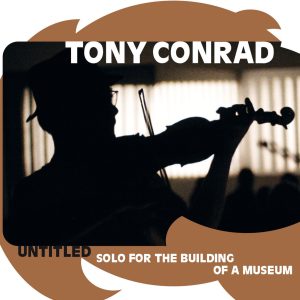
Tony CONRAD
“Untitled (Solo for the Building of a Museum)”
This recording (2002) captures the two instruments central to Conrad's practice at the time: his self-built Long String Instrument and his amplified violin. He performed hidden behind a large sheet, and the nature of what unfolded behind it was never disclosed to the audience.
Mudam
Recorded at the construction site of the future Mudam - Musée d'Art Moderne Grand-Duc Jean, Luxembourg, designed by I. M. Pei - during the Museum Night of October 12, 2002, by invitation of Marie-Claude Beaud. The concert was co-organized by Transhistorics, a coproduction by Sub Rosa and Philippe Franck's Transcultures. Conrad also performed several times in Europe alongside Charlemagne Palestine in the following years, including the October 2005 concert An Aural Symbiotic Mystery.
Short Bio
Tony Conrad (1940-2016) was an American musician, experimental
filmmaker, and composer, active across media since the early 1960s. A pioneer of drone music, he was a central figure in the New York scene of the 1960s and performed as part of the Theatre of Eternal Music. He became known as a filmmaker for his 1966 film The Flicker. Over the following decades he performed and collaborated with a wide range of artists.
Interview
The recording is accompanied by an extended interview conducted by Philippe Franck, published here as a tribute to him.
- Doesn't this relate to intensity - the kind of theatrical intensity largely absent from computer music performance?
- When I started performing again with the violin in the 1980s, some people described what I was doing as "expressionism." I was surprised at first - in my own arrogance I thought: this is mine, I invented it. But I took the criticism seriously, and it led me to ask what actually distinguishes expressionism from other forms of expression.
- Perhaps we should simply speak of expression, rather than 'Expressionism'?
- Exactly. In performance, I like to work at what I'd call the zero degree of sound - harmonic structure itself. I can be entirely satisfied with a pure open fifth: dance, meditation, heroism, all of it is contained within a fifth, provided I can find my way into that sonic space. Once, a student who admired La Monte Young told me I was playing out of tune. I remember thinking thinking: I'm playing music, not notes. I'm making music that speaks to people.
13,50€
In stock

CD
David TOUB
“Gendarme de la Libertad”
David Toub is a unique voice in American minimalism, a genre that has produced quite a few composers over the past 80 years. Our first contact dates back about fifteen years, and from the very beginning, David struck me as a committed composer, dedicated to building a coherent body of work. But he is also an engaged individual, deeply concerned with the challenges of our time and genuinely generous. In other words, a mensch—a rare kind of person. His music, in some ways, reflects today’s anxieties and uncertainties: repetitive, obsessive, often dark, and questioning.
This is the second album of his music that I have recorded, and this time, David has incorporated the human voice to feature a speech given by Che Guevara in 1964. The speech addresses the contradiction between a state's founding principles and its actions. How can a nation advocate for freedom year-round while deliberately acting against minorities, particularly those historically oppressed? The piece does not provide an answer—this question remains just as relevant today, 60 years later.
(Stephane Ginsburg)
David Toub (b. 1961, Newark, NJ) is largely self-taught, with the only formal composition education consisting of attending music school (Mannes College of Music; Juilliard Pre-College Division) during weekends while in high school.
He remains an active composer. While Toub composed serial and dodecaphonic music until 1982, his subsequent works have been described as “minimalist,” although the durations of a subset of his compositions are not at all minimal (1.5 to over 4 hours in some cases).
13,00€
In stock
CD
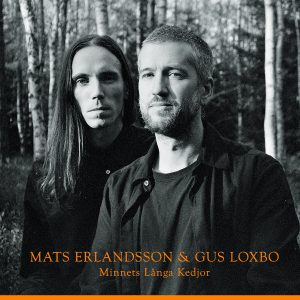
Mats ERLANDSSON & Gus LOXBO
“Minnets Långa Kedjor”
Minnets Långa Kedjor by Mats Erlandsson & Gus Loxbo is an intimately crafted musical topos moving through landscape of free improvised music, electroacoustic drone and doom metal according to an inherent dream logic. Their collaboration takes its starting point in a long friendship and a common frame of reference shaped by their upbringing environment in Bergslagen, with the specific moods that a shared past geographical location can give rise to. Through associations and memories - geographical, poetic and imaginary - immediate musical impulses shaped by an interplay that has developed over 25 years were captured instantly. These impulses formed the foundational material for a process of transformation where the music has been amplified, obscured and refined through extensive studio work carried out by Mats Erlandsson in the electroacoustic music tradition using editing and audio transformations through digital processing and analogue tape work.
As a composer, musician and sound artist, Mats Erlandsson is part of the vibrantly reemerging field of drone music in Stockholm, Sweden, and is associated with practices characterized by the extensive use of sustained sound. Erlandsson presents his work both as a solo artist and in various collaborations utilizing synthesized and recorded analog and digital sound, contaminated field-recordings and extensive tape processing.
Gus Loxbo has had a long career in improvised music primarily as a double bass player both solo and with groups such as Pombo and Silence Blossoms. His solo debut album Trådknaster was recorded by Mats Erlandsson and released in 2021 to much acclaim. The album contained nine solo compositions for double bass with no overdubs presenting the abstract sound of Loxbo’s extended performance techniques and a stark highly amplified light.
Mats Erlandsson and Gus Loxbo have been playing music together since before either one of them had any notion of the existence of experimental music, and their musical relationship was fundamental in helping each other transform and extend their respective ideas about what could constitute a valid musical expression. The album Minnets Långa Kedjor is their first recorded work presented in public.
17,50€
In stock
LP
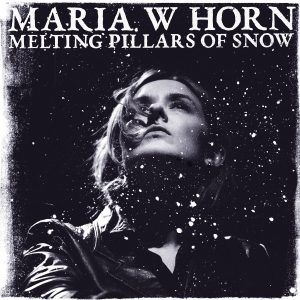
Maria W HORN
“Melting Pillars Of Snow”
XKatedral is proud to present a new full-length album by label co-founder Maria W Horn. Melting Pillars of Snow is a collection of new compositions from the renowned Swedish composer written for Contrabass Recorder, Shō, Percussion, Electric Guitar, Voice and Electronics performed by Horn together with a chamber ensemble consisting of Anna Petrini, Mattias Hållsten, Magdalena Meitzner and Mats Erlandsson. The album also features narration by Horn as well as a guest appearance by Michael Gira on the first single Scythe of Saturn.
Melting Pillars of Snow sees Maria drawing inspiration from W.G. Sebald’s novel The Rings of Saturn which is a poetic reflection following an unnamed narrator wandering along the Suffolk coast in England. As the landscape gradually shifts the text touches in various ways on the passage of time and the distance between past, present, and future, reflecting both vast temporal scales, such as the cycles of the seasons, deep historical time and microscopic moments and fragments. With the compositions contained in this release Maria evokes a similar sense of stillness - an environment in which the movement of time itself can be illuminated and observed.
The instrumentarium found on this album is Horn’s most ambitious to date and sees her adding a complex array of percussion instruments, wind instruments operating at each extreme of the musical range and
electric guitar paired with her regular palette of customized algorithmic synthesis and electronic processing to weave a spiraling spectral tapestry through the audio range. Percussionist Magdalena Meizner performs specialized techniques on the overtone triangle, dubachi, timpani and tam-tam, as well as pitched wine glasses and bowed crotales. The low end contrabass recorder played by Anna Petrini and the high frequency Shō performed by Mattias Hållsten add contrasting chordal arrangements set in strict metric structures. The ensemble is completed by Mats Erlandsson performing on electric and acoustic guitars moving from gentle arpeggiated figures to doom-laden drones and feedback howls.
Maria W Horn: Electronics, hurdy gurdy and narration
Anna Petrini: Contrabass recorder
Magdalena Meitzner: Overtone triangle, bowed crotales, tam-tam, dubachi, timpani, pitched wine glasses and
specialized percussion techniques
Mattias Hållsten: Shō
Mats Erlandsson: Electric and acoustic guitars, analog tape treatments
Michael Gira: Narration on Scythe of Saturn
27,50€
In stock
LP
Stephen O’MALLEY
“Avaeken”
American experimental composer Stephen O'Malley releases 'Avaeken', two sides of immense, immersive, self-annihilating music via Dais Records. The record preserves site-specific work: O'Malley installed 'Avaeken' as part of 'Wish You Were Here', the exhibition by renowned American artist Banks Violette, underscoring the tension between presence and absence, life and loss. O'Malley and Violette have developed a distinct language of sound, space, and sculpture over the past two decades, reverberating the walls of world-class institutions from The Guggenheim and Centre Pompidou to prominent galleries such as Maureen Paley in London, Gladstone Gallery in NYC, and Antwerp’s TICK TACK, the brutalist space where Wish You Were Here unfolded in early 2026. Emerging now as an LP, 'Avaeken' presents power and phenomena: low-frequency vibrations, deep oscillations, and phase cancellations that translate as innately effective in any environment. Violette’s visual expression — the impossibility of locating yourself within the loss of a friend and the broader decay of culture — now fills the LP sleeve and feels inextricable from O'Malley’s sound, both still without resolution.
The origins of 'Avaeken' date back to 2020, when O’Malley was commissioned by the ZWERM electric guitar quartet of Belgium. He rendered the piece, naming it after the millennium-plus-old oak tree on Sweden’s island of Fårö, for four guitarists on standard electric guitars, sustaining microtonal harmony produced with EBows and slides. "Natural harmonic tone coloured by the valves of the amplification is the one desired characteristic," reads the initial notes. "At first I asked, why would I write for another guitar player?" he says. "I realized how amazing it is to be a listener on the other side of the music; together we were able to try all these precisions with intonation, harmonics, specific microtonal ideas." The quartet performed 'Avaeken' several times before O'Malley joined them for a recording session in Muziekcentrum De Bijloke, a 13th-century former hospital with modern acoustics in Gent.
26,00€
In stock
CD
Kassel JAEGER
“Sub Re”
Kassel Jaeger (aka François J. Bonnet) returns to Shelter Press after Swamps / Things, Shifted in Dreams, and the recent reissue of the classic Zauberberg, co-composed with Akira Rabelais and Stephan Mathieu.
With this major new album, entitled Sub Re, Bonnet continues his long exploration of the musical possibilities of sound, extending the concrete approach developed at the Groupe de Recherches Musicales, the historic and essential Parisian studio that Bonnet has been directing since 2018.
Sub re, in Latin, can mean “under the thing, under the substance, under the matter.” It's precisely this direct approach to music, drawing on the extraction of raw sound material, that forms the basis of this album. Under the matter thus signals the concrete aspect of music, but not the concrete that is transfigured, becoming vapor and form, the substrate of an idea. Rather, it signals the concrete beneath the concrete, in the immanence of sounds, in their becoming, as a driving force, like a tide, like a vault of imperious and powerful matter. To achieve this, Bonnet draws on a multitude of sound sources (acoustic, electronic, natural or artificial, created on purpose or found by chance) and a multitude of contexts and occasions to give them form.
The movement, a shell, a bell, a spell, for example, was heard for the first time during a concert organized in Venice in connection with Latifa Echakhch's contribution to the Swiss Pavilion at the 2022 Art Biennale, while the last movement on the record, signalmirror, concluded a piece presented at the first Sound Biennale in Sion (Switzerland) in 2023. These elements, formed and detached from their original context of appearance, of the places and people who made them possible and listened to them, contribute to a complex layering of climates and sonic worlds and help create a contrasting album, where density and tenuity coexist in a succession of moving waves, sometimes laden with memories, sometimes filled with regrets, always set in motion by their own morphology.
Sub Re also refers to a chapter in Victor Hugo's Toilers of the Sea, a key passage in which the main character, faced with a colossal task, finds himself alone in the middle of the sea, beneath a gigantic shipwreck caught in the jaws of an isolated reef, surrounded by water, currents, and winds, alone to face the impossible. It is indeed beneath the surface that actions arise, decisions are made, and intuition guides us.
17,50€
In stock
LP
Kassel JAEGER
“Sub Re”
Kassel Jaeger (aka François J. Bonnet) returns to Shelter Press after Swamps / Things, Shifted in Dreams, and the recent reissue of the classic Zauberberg, co-composed with Akira Rabelais and Stephan Mathieu.
With this major new album, entitled Sub Re, Bonnet continues his long exploration of the musical possibilities of sound, extending the concrete approach developed at the Groupe de Recherches Musicales, the historic and essential Parisian studio that Bonnet has been directing since 2018.
Sub re, in Latin, can mean “under the thing, under the substance, under the matter.” It's precisely this direct approach to music, drawing on the extraction of raw sound material, that forms the basis of this album. Under the matter thus signals the concrete aspect of music, but not the concrete that is transfigured, becoming vapor and form, the substrate of an idea. Rather, it signals the concrete beneath the concrete, in the immanence of sounds, in their becoming, as a driving force, like a tide, like a vault of imperious and powerful matter. To achieve this, Bonnet draws on a multitude of sound sources (acoustic, electronic, natural or artificial, created on purpose or found by chance) and a multitude of contexts and occasions to give them form.
The movement, a shell, a bell, a spell, for example, was heard for the first time during a concert organized in Venice in connection with Latifa Echakhch's contribution to the Swiss Pavilion at the 2022 Art Biennale, while the last movement on the record, signalmirror, concluded a piece presented at the first Sound Biennale in Sion (Switzerland) in 2023. These elements, formed and detached from their original context of appearance, of the places and people who made them possible and listened to them, contribute to a complex layering of climates and sonic worlds and help create a contrasting album, where density and tenuity coexist in a succession of moving waves, sometimes laden with memories, sometimes filled with regrets, always set in motion by their own morphology.
Sub Re also refers to a chapter in Victor Hugo's Toilers of the Sea, a key passage in which the main character, faced with a colossal task, finds himself alone in the middle of the sea, beneath a gigantic shipwreck caught in the jaws of an isolated reef, surrounded by water, currents, and winds, alone to face the impossible. It is indeed beneath the surface that actions arise, decisions are made, and intuition guides us.
28,00€
In stock
2 LP
Eliane RADIGUE
“Triptych”
The final collaboration between Eliane Radigue and Important Records is this double LP edition of Triptych. Radigue insisted that her music only be released on vinyl if the pieces would fit without being edited or cut. Triptych met those requirements leaving room for an etching on the 4th side.
Back to music after three years of silence... On the suggestion of Robert Ashley, Douglas Dunn commissioned Triptych from Eliane Radigue for choreography. Only the first part of Triptych was staged at the premiere at the Dancehall/Theatre of Nancy on February 27 1978. Recorded in the composer's studio in Paris.
After the 1974 premiere of Adnos in San Francisco, a group of French students introduced Eliane Radigue to Tibetan Buddhism. When she returned to Paris, she†began to explore this spirituality in depth, which slowed her musical production up until 1978. Triptych marks her return to composition, and draws its inspiration from "the spirit of the fundamental elements, water, air, fire, earth" Eliane Radigue likes to add that this has often been useful to her in her moments of research and transitions.
This three-part composition, with its great humility and contemplative simplicity, heralded a new period of her work and was the first in a series of masterpieces inspired by Tibetan Buddhism: Adnos Trilogy (1980), Songs of Milarepa (1983) - with the voices of Lama Kunga Rinpoche and Robert Ashley , "Jetsun Mila"(1986), as well as the Trilogy of Death: Kyema (1988), Kailasha†(1991) and Koume†(1993).
45,00€
In stock
LP
Andrew CHALK
“Mystical Obscurant”
Over the course of more than four decades, Andrew Chalk has created one of ambient and experimental music's most distinctive, influential, and enduring bodies of work. Though his recordings have taken many forms—from the raw, post-Industrial sounds of Ferial Confine in the 1980s to the fragile guitar meditations, blurred keyboard studies, and richly textured collages that populate the Faraway Press catalogue—they remain united by a singular sensibility: an uncommon attentiveness to atmosphere, nostalgia, and the power of restraint.
Mystical Obscurant offers a rare opportunity to encounter the expansive character of that oeuvre in miniature. Rather than documenting a single period or methodology, it functions almost like a survey of Chalk's musical language—a collection of new music that illuminates the breadth of his practice while distilling the singular vision that unites it.
“The Seed of Sorrow” and “Peacemaker” feel cut from the same cloth as the sacred guitar minimalism of The River That Flows Into the Sands, while “Against the Tide” would sit naturally alongside the smudged and distant keys of Blue Eyes of the March. Other pieces draw upon environmental sound and loop-based constructions, hallmarks of Chalk's more recent, vignette-like compositions. Though these recordings emerge from different moments in his long creative journey, each inhabits a recognizable world: one where melodies drift in diffuse, unhurried forms and sound gathers with painterly grace.
What is most striking when these pieces are heard together is not their difference but their coherence. Across changing instruments, collaborators, and approaches, Chalk has consistently pursued a subjunctive music of suggestion rather than declaration, creating spaces where memory and imagination are allowed to unfold at their own pace.
25,50€
In stock
LP
ELEH
“Floating Frequencies / Intuitive Synthesis I”
When ELEH's debut "Floating Frequencies/Intuitive Synthesis I" was originally released it was praised as a powerful piece of new electronic minimalism. Twenty years later the artist's legacy has grown while ELEH continues to hypnotize new listeners with time stopping music. Critics, fans and neurologists have praised the music of ELEH as aiding attention and focus while seeming to slow time. Eleh's slow change drones are a state of flow hypnotizing listeners into meditative focus.
From the original packaging, "Pure Sound. Pure Volume. Pure Analog. Dedicated To La Monte Young"
ELEH began in 1999 as an exploration of analog synthesis, emphasizing low frequency difference tones and other resonant acoustic phenomena. ELEH highlights the physical presence of sound as it has been inspired by the physical world. There is also something ‘cathedral-like’ and cosmos-inducing in the sound constructed by ELEH.
This audiophile quality presentation of ELEH's debut album was mastered by Tom Eaton at Sounds And Substance and manufactured at Optimal in Germany for the lowest possible noise floor and the highest analog resolution. Packaged using a 5th color metallic shimmer ink on solid black board stock.
25,00€
In stock
LP
Bob BELLERUE
“Chaos Is A Law”
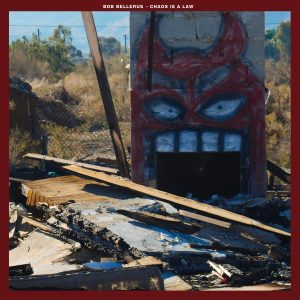
Avec Chaos Is A Law, Bob Bellerue fait du chaos une force créatrice. Feedback, cordes de piano, métal, électronique et drones s’entrechoquent dans une matière sonore en perpétuelle transformation, entre rugosité, dissonance et étranges éclats mélodiques.
Une musique physique et imprévisible, qui se construit, se fracture et renaît sans cesse. Ici, le bruit devient matière vivante, l’incontrôlable devient méthode, et le chaos, une forme de liberté.
27,50€
In stock

CD
Russell HASWELL
“Let It Go”
It has been twenty-five years since the seismic events of 2001—when twin towers collapsed under terrorist attack and Coventry's sonic insurgent Russell Haswell launched his inaugural salvo on the original Mego label with Live Salvage 1997–2000. The intervening era has delivered unrelenting turbulence: protracted wars, institutional corruption, a global pandemic, the resurgence of fascist currents, rampant media distortion, and omnipresent surveillance. For Haswell, a lifelong admirer of 1970s and 1980s dystopian cinema, the verdict is unequivocal: "Science Fiction is now!"
In the face of this darkening reality, LET IT GO arrives as both acknowledgment and antidote. This new full-length on Editions Mego extends an olive branch through defiant sonic diversity—an unpredictable mosaic that embraces everything from propulsive rhythms to radical abstraction and enveloping ambience. True to Haswell's core practice, the material draws from the same tactile, free-improvised electroacoustic framework that powers his live sets: immediate, powerful and unscripted.
The album weaves reverent echoes of 1990s Detroit techno's hypnotic pulse and the abrasive, metallic edge of the Birmingham sound into fractured generative territories. Haswell returns to his computer-generated origins while integrating his recent modular-synthesis experiments. During a residency at the Bergen Centre for Electronic Arts (BEK) in Norway, he harnessed the latest GRM Tools suite to conjure the volatile, "rapidly fluctuating pitched sounds" that characterized Iannis Xenakis' late electronic works—resulting in pieces such as Fall 3 and Fall 2, where instability becomes a form of vitality. The tracks Exit Downwards and The Anxieties Of Our Time whilst reflecting the currents of the release also offer surprisingly melodic patterns over jagged rhythms. The wryly titled Thu 25 Dec 2025, (recorded in Glasgow after a solitary post-Christmas-lunch walk home) is a vast drone which evolves according to the random walk model—known more evocatively as the drunken walk—each sonic step veering unpredictably, mirroring the disoriented lens of contemporary existence.
LET IT GO is liberation. Amid the cacophony of crumbling certainties, Haswell deploys a full arsenal of resistance: kinetic drive, disorienting rupture, quiet refuge, raw aggression, and tentative hope. In an age where dystopia has shifted from fiction to lived fact, this music asserts that possibility endures.
15,00€
Out of stock
LP
Klara LEWIS
“Opening”
Klara Lewis’ distinctive talent for disfiguring sound into forms that remain recognisably song-like reaches a new peak here. Her new album Opening is a deceptive recording with veiled melodies and clandestine bangers.
Lewis, creator of worlds, treats music as a mirror that reflects a perspective misaligned with the real image. Her music moves in unusual and often startling ways. Acoustic instruments such as ukulele and piano are subjected to processes of deconstruction and reconstruction, their original forms continually reshaped.
The tracks within Opening offer an array of disorientating tactics; damaged field recordings are suddenly sliced into ominous rhythmical patterns whilst deceptively simple tactics provide foreboding dread. Often alien on entry, the progression of a piece can land in a surprising tenderness, or the other way around. The momentum grows as a physical state but also one which is questioning, desiring, encapsulating a feeling, to explore a further way of expression and ultimately connecting: A new closeness, a new perspective.
Opening is an album in which the protagonist’s manipulation of sonic matter seems to extend beyond the music itself, resulting in a corresponding manipulation of the active listener. Sounds shift, dissolve, and re-emerge in altered forms, creating an experience that feels both intimate and disorienting. Lewis maintains a delicate balance between abstraction and emotional immediacy, drawing the listener into a world where familiar musical gestures are constantly reconfigured in surprising ways.
The works on Opening are refracted through an exploratory and transformative lens, suggesting an artist continuing to redefine the possibilities of musical language as a space where the instantaneous and the eternal come together.
26,00€
In stock

2 LP
KMRU
“Peel”
*2026 small repress*
KMRU is the moniker of Joseph Kamaru, a sound artist, and producer based in Nairobi. One of the leading exponents of the burgeoning experimental music scene in Nairobi and beyond he was listed by Resident Advisor as one of ’15 East African Artists You Need To Hear’ in 2018 and is a regular performer at the fabled Nyegenyege Festival having also presented live performances at CTM festival and Gamma Festival. Peel is KMRU’s first release for Editions Mego. exquisite mix of field recordings and electronics unravelling at a repetitive and leisurely pace to expose a rich tapestry of sound that has been revered for it’s ability to cross bordear with the sheer undertow of emotional content. The subtle calming atmosphere within Peel belies the compositional prowess as layers of delicate sounds wrap around each other creating a hybrid new form ambient musics both captivating through it’s textural depth and kaleidoscopic patterns. The track titles lend themselves to the themes and mood set within: Why are you here, Well, Solace, Klang, Insubstantial and the title track. This is a deep heartfelt journey with a new strong voice being expressed through the means of organically presented electronic ambient sounds, one which reveals further layers on repeat listens.
All tracks written and produced by KMRU
Recorded and produced in Rimpa, (Nairobi, KE)
Mastered by Stephan Mathieu at Schwebung Mastering, June 2020
27,00€
In stock
LP
AF URSIN
“Ad Fontes”
The first Af Ursin album in a decade, this release features extraordinary Belgian vocalist and performer Bénédicte Davin.
Ad Fontes is a personal response to the fractured reality of our time. Created in the wake of visible social decay, manipulation, and institutional control, the album serves as a sonic mirror to an era defined by corruption and systemic failure. Instead of preaching political manifestos or claiming to have answers, this work is an intimate personal statement – a silent call to embrace spiritual values as the vital, untainted source of human nature.
26,00€
Out of stock
LP
Pierre MARIETAN
“Musique d’été”
Pierre Mariétan (1935–2025) was a prolific Swiss composer, sound artist, and pioneer in acoustic ecology who spent most of his life working in France. Over his long career, he composed more than 300 instrumental, orchestral, vocal, and electronic pieces. Mariétan studied under avant-garde legends like Pierre Boulez, Karlheinz Stockhausen, and Bernd Alois Zimmermann. In 1966, he founded GERM (Groupe d’Étude et de Réalisation Musicales), a music collective that blurred the lines between strict composition and free improvisation. In 1969 the French BYG label released a GERM album and the same year GERM played at the legendary 5-day Festival in Amougies, Belgium, sharing stage with Pink Floyd, The Soft Machine, Frank Zappa, Don Cherry,…
In 1979 Mariétan founded the Laboratoire d’Acoustique Urbaine (Urban Acoustics Laboratory) to bridge environmental sounds, urban architecture, and musical composition.
Mariétan was also a professor at the University of Paris where he taught the relationship between sound and space. Later in life, he remained active as a director for the Movement of Environmental Sound and continued developing permanent, immersive sound installations across the globe. His album Musique d’été was originally released on cassette back in 1983 by Éditions Salabert and Costin Miereanu’s Poly-Art International, and it has been slightly tweaked for this LP reissue. The record splits his vision of “Summer Music” into two different vibes. Side A is a deep dive into an electronic, synthesizer-driven landscape, while Side B features raw acoustic field recordings of forests and traditional Swiss alphorns.
26,00€
In stock
LP
Robert NASVELD
“Robert Nasveld”
Robert Nasveld (born 1955) studied piano at the Utrecht Conservatory and specialized in the twentieth-century repertoire, with a particular focus on Dutch, Russian, and American music. He thoroughly immersed himself in the piano works of the American composer George Crumb with concerts in Europe, Russia, and the United States. As a composer he also studied electronic music with Ton Bruynèl and recorded a handful of tape pieces which are collected on this LP. They were created at Ton Bruynèl’s studio at the Utrecht Conservatory and the Institute for Sonology in Utrecht. Rather than using electronics for mere futuristic sound effects, he utilizes tape to create expansive acoustic environments. He expertly controls large, sweeping arches of sound, maintaining a continuous musical line while layering highly unpredictable and contrasting sonic elements. Nasveld also worked as a program producer for the Dutch National Radio and presented a series dedicated to electronic music pioneers.
26,00€
In stock
LP
Brunhild FERRARI – Eiko ISHIBASHI – Jim O’ROURKE
“L’Oreille Voleuse”
Persistence of Sound releases a new work by Brunhild Ferrari called »L’oreille Voleuse« (The Thieving Ear). The LP features an extraordinary live reinterpretation by Eiko Ishibashi and Jim O’Rourke, recorded in October 2025 in Paris.
“No, without listening at doors, the ear captures noises here and there and unexpected sounds without choice, but remains attentive to the messages of each one picked up over the years. It gathers surprises and impressions, bringing them together in a simple mix. In waking up these ear memories again, which were mostly recorded on magnetic tapes, I am very happy about the collaboration of Eiko Ishibashi and Jim O'Rourke in playing on this mix tape.”
Brunhild Ferrari
28,00€
In stock
LP
FRANCE
“Good Thoughts, Bad Thoughts”
Good Thoughts, Bad Thoughts captures the band in full flight during their very first English tour, recorded at The state51 Factory in East London. Until this tour, UK audiences had only witnessed France once before, at Liverpool Psych Fest some years back. This album documents what they've been missing. For this performance, the lineup featured Jérémie Sauvage on bass, Yann Gourdon on electrified hurdy-gurdy, and Cyril Bondi (La Tène, Cyril Cyril) stepping in on drums while longtime member Mathieu Tilly took a well-earned break.
29,00€
In stock
CD
Thomas TILLY
“Birds measuring space”
As a counterpoint to discourses about sound in nature, french sound artist Thomas Tilly continues his research on the use of noise by non humans. Following the noise walls of Codex Amphibia, Birds measuring space focuses on the strange rituals operating by the mysterious Guacharos de Cuevas, and its interpretation by humans and technology.
Thomas Tilly (FR) is a sound artist and composer of experimental music. His work is based on field experiments using microphones, loudspeakers, and acoustic analysis instruments. Developing a unique approach to phonography, influenced by biology, anthropology, and sound measurement, his creations, broadcasts, and installations open up a field of listening that extends beyond the naturalist paradigm.
13,50€
In stock
LP
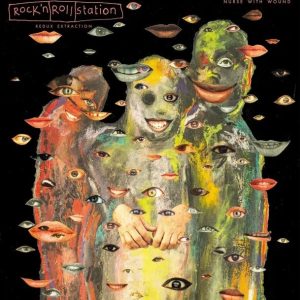
NURSE WITH WOUND
“Rock’N’Roll Station Redux Extraction”
At last Nurse With Wound’s classic masterpiece ‘Rock ‘n’ Roll Station’ gets it’s timely and well-deserved VIP treatment.
A much loved and firm favourite with fans and critics alike, this celebrated seminal work is here represented by 4 tracks, each unique with extended reworking and mixing.
This United Dirter 12” LP release is a forerunner to the imminent ‘The Iron Lung Gives Way To The Surgical Stocking’ 5CD boxset magnum opus to be released later this year. Featuring along side the usual suspects of Colin Potter, Matt Waldron, Andrew Liles, Diarmuid MacDiarmada is French pioneer and trail blazer of the ‘70’s, Jean Jacque Birge.
Black & pink vinyl
27,00€
In stock
2 CD
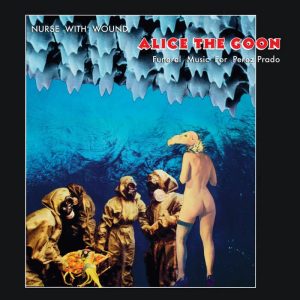
NURSE WITH WOUND
“Alice the Goon”
Experience the mesmerizing allure of Nurse With Wound's 'Alice the Goon' in an expanded edition 8 panel digipak, featuring original release art, alongside older renditions by Babs Santini! This enhanced version promises to captivate and intrigue both new listeners and avid fans. Contains several unique mixes by Colin Potter, Andrew Liles, Matt Waldron, Diarmuid MacDiarmada, Señor Coconut and unreleased material from the original sessions.
DISC ONE
I Yam What I Yam Intro Remix Diarmuid MacDiarmada
Pseudoacacia
(I don't want to have) Easy Listening Nightmares
Prelude to Alice the Goon
Coconut Mix Remix Señor Coconut
The Happy Wanderer Remix Andrew Liles,
Queasy Listening Remix Colin Potter
Impotence Out of Tune
DISC TWO
And That's All I Yam: Conclusion/Confusion Remix Diarmuid MacDiarmada
Afterthought to Prelude to Alice the Goon Remix Matt Waldron
27,50€
In stock
CD
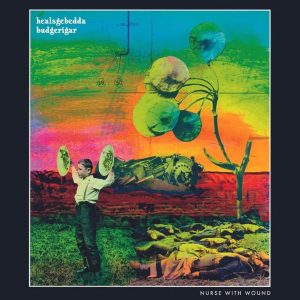
NURSE WITH WOUND
“”Healsgebedda Budgerigar”
A welcome expanded CD release for this album, which sold out very quickly when it was released on vinyl last year. It comes in a full colour 6-panel digipak of heavy gauge card in gloss laminate, with 2 unreleased tracks & an alternative mix of the title track.
On Healsgebedda Budgerigar, Nurse With Wound turn memory itself into a delirious tape loop: long, sample‑swollen excursions where pet chatter, phantom TV themes and street detritus melt into a woozy, psychedelic netherworld of half‑remembered sound.
16,50€
In stock
LP
Jim O’ROURKE & Jos SMOLDERS
“Albumin”
Jim O'Rourke and Jos Smolders teamed up again after their first collaboration, Additive Inverse from 2021. Over a period of three years, both artists worked in sessions of a day, each in their own studio.
The result is sometimes like a warm cloud of sounds, suddenly breaking up into a rhythmic, irregular pattern, after which it dives into introverted mindsets. The music is in constant flux
The project followed the same workflow, but this time Jim took the lead and kicked off with a salvo of sounds that he extracted from his Kyma System. Both Jos and Jim were quite interested in the spectral character of sounds. Jim applied Kyma algorithms while Jos granulated his basic recordings. That way, textures are built, quite slowly moving from warm to gritty, from hard surfaces to deep sonic wells.
22,00€
In stock
LP
ORPHAX
“Continuation”
Words have never been my strongest point. I have many ideas in my head, often too many. I can talk a lot about them, but putting them on paper is not really me. I rather just work on my ideas. ‘cause whatever your thoughts are, as soon as it is out there and people start to listen it becomes theirs. What I might have thought up before, and have as concept behind the music, might not be how someone else listens to it. And that’s okay.
If we keep in mind that my music is time focused, and I love it when it isn’t polished too much, so small errors become part of it, the music should speak enough for itself.
“Continuation” is my first studio album since “En de stilstaande tijd” (2019), and shows a rougher sound staying closer to my live sound. I see this as a continuation of my live performances, though this time with various multi-track recordings brought together as a whole, all done in my home studio “Studio De Baviaan” over the course of 8 months.
--- Sietse van Erve / Orphax, January 2026
22,00€
In stock
CD
Werner DURAND & John KRAUSBAUER
“Black Seraphim”
Separated by an ocean and a generation apart, German reedsman, Werner Durand and American stringsman, John Krausbauer, have both been devotees of the cosmic ur-drone for many decades. Their new recording on Moving Furniture Records, “Black Seraphim”, brings together for the first time their singular vision and approach in a half hour droning dirge. The setup finds Krausbauer on his oft-employed violin, while Durand continues to explore the possibilities of his self-invented reed instruments. The same foundations that lie at the heart of their musics: (electro)-acoustic instrumentation, long durations, alternate tuning systems, all can be found on the harmonically dense and rich offering. An unrelenting, buzzing choir of harmonics and overtones begets a timewarped hallucinatory trip into the black ooze of trance’d consciousness.
Werner Durand has been active as a saxophone player since the late 1970s. After studies of both indian as well as persian flutes, he has created his own unique wind instruments since the mid 80s, based on just intonation. He has collaborated with numerous composers and performers, including Amelia Cuni, David Behrman, Henning Christiansen, Catherine Christer Hennix, Arnold Dreyblatt and many others. Currently he performs as FLOCKS- a duo with multi-Instrumentalist Ulrich Hohmann as well as with singer Anna Clementi as ARTIFICIAL HIPSTERS. Together with Anna Clementi and Luciano Chessa he performs in the trio EFNI - performing on replicas of the Intona Rumori - futurist instruments invented by Luigi Russolo in early 20th century, Grants and residencies include Cité des Arts, Paris, 1989; Podewil, Berlin 1999; Worpswede artist colony, Germany 2004/5; AIR –Krems (Austria), 2011 & Civitella Ranieri (Italy)2013. He has curated festivals of traditional as well as avantgarde music in Berlin like "Urban und Aboriginal“, "Pipeline“ , "USArts“ , "Minimalisms" and "Intonations“ and "Musiksalon Berlin" at the Ethnological Museum.
John Krausbauer is an American musician, artist, and brend practitioner. As a tireless pursuer of the sonic arts for nearly 30 years, he’s had numerous recordings published, performed his musics in North America, Europe, and Asia, and has instigated and participated in countless musical group configurations. Since 2020 his wide ranging interests have led him to pursue critical writing and visual art as his primary activities, while occasionally engaging in solo and group musics. He has shown his A/V work around the globe and had his writings published in the US and New Zealand.
11,00€
In stock
LP
Gareth DAVIS & SCANNER
“Songlines”
When the ghost in the machine meets the breath in the reed, expect sparks. Electronic sound artist Robin Rimbaud – Scanner joins forces with acclaimed British bass clarinetist Gareth Davis to create an album where circuitry hums, wood vibrates, and the air between notes crackles with possibility.
This is no polite meeting of minds — it’s an elegant collision. Scanner’s intricate electronic textures weave around Davis’s deep, resonant tones, blurring the boundary between acoustic breath and digital pulse. The result is a sound world that’s at once intimate and expansive, familiar yet thrillingly unpredictable.
Think late-night conversations in abandoned buildings. Think fog rolling over neon. Think sound that slips through your fingers even as it takes hold of you.
The songlines in question , memories and distorted images of travels across various continents, form an imagined biography of places that might or might not have been but somehow seem to exist . Landscapes of blurred statements , lost words and echoes of meandering structures.
"If Miles Davis had been raised on shortwave radio static and midnight phone calls, it might have sounded like this."
22,00€
In stock
CD
Dario CALDERONE
“The Infinite Garden”
The Infinite Garden is a project by Dario Calderone for four musicians and a live soundscape, aiming to encourage a global way of listening through constant communication between different spaces and dimensions. For this release, Aurelie Nyrabikali, Naomi Sato, Gareth Davis and Dario Calderone have joined forces with the soundscape of the Amstelpark on a cloudy and partially rainy day at the end of January 2025. We kindly thank all the car drivers, pedestrians, birds, raindrops, aeroplanes, radio waves, spirits, trees, bushes, ghosts, subtle minds, earthworms, fallen leaves, moles, audience members, foxes, amphibians, water insects, fungi, memories, dreams, intuitions and meteorological events which have contributed to this recording.
Dario Calderone: Composition and Double Bass
Aurélie Nyirabikali Lierman: Vocals, Shruti Box, Percussions
Dario Calderone: Double Bass
Gareth Davis: Bass Clarinet
Naomi Sato: Sho
Amstelpark: Soundscape
11,00€
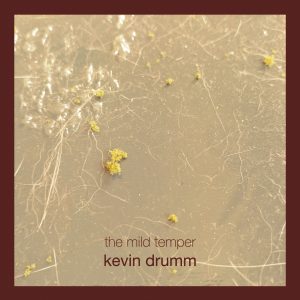
6 CD box
Kevin DRUMM
“The Mild Temper”
For more than thirty years, Kevin Drumm has developed a unique sonic language situated at the intersection of drone, electronics, improvisation and sound abstraction. Continuously evolving, his work has become one of the most distinctive voices in contemporary experimental music.
Comprising more than six hours of music, The Mild Temper presents an extensive collection of pieces built from gradual transformations, micro-acoustic events and frequency-based structures characteristic of Drumm's practice. Across six discs, the music explores varying states of density, resonance and spatiality, reflecting a sustained interest in the physical properties of sound and their perception over extended durations.
The title, The Mild Temper, suggests a quiet force rather than an overt gesture. Sonic materials often appear restrained, held in a delicate balance between stasis and motion. Small shifts gradually alter the acoustic landscape as layers of frequencies emerge, recede and recombine throughout the listening experience.
Avoiding narrative and dramatic development, these works offer immersion in highly detailed sonic environments where every element contributes to the construction of a deeply absorbing listening space. Attention to texture, depth and duration forms the connective thread throughout the collection.
With The Mild Temper, Kevin Drumm continues his exploration of sound as an autonomous phenomenon, presenting a body of work of remarkable coherence that reflects both the singularity and maturity of his artistic practice.
Mastering by Jim O'Rourke
Tracklisting :
1-1 01 Feb 1
1-2 Retina Check
1-3 Etc A
2-1 Eisegesis
2-2 Exegesis
2-3 New Old Card
3-1 The Blind Owl
3-2 Master Of Idealism
4-1 Achromic Pants
4-2 Odd Ways
5-1 Battles In The Snow I
5-2 Battles In The Snow II
6-1 Grey Screen
6-2 \&\\ : \
6-3 \&\\ : \\
45,00€
Out of stock
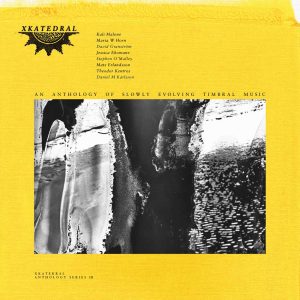
2 LP
COMPILATION
“Xkatedral Anthology Series III (An Anthology Of Slowly Evolving Timbral Music)”
XKatedral Anthology Series III is the third installment in a series of archival releases dedicated to presenting music by composers working within the realm of slowly evolving harmonic and timbral music. The pieces presented here focus on the use of synthetic and acoustic sound as well as algorithmic composition as tools for precise work within the realm of spectral exploration. This double-vinyl set is issued in celebration of the label’s decennalia and contains works from 2014 - 2025. It is released in conjunction with reissues of XKatedral Anthology Series I-II.
My Falling Sinks by Kali Malone is a sparse descending melody for justly tuned organ, cello and acoustic guitar featuring Lucy Railton and Stephen O’Malley. The piece is a compositional sketch in septimal just intonation made on an experimental tuning organ at La Temple de La Tour-de-Peilz while in residency at La Becque in 2021.
Empyrean Flare by Maria W Horn was composed in 2022 for The Dawn Chorus by choreographer Stina Nyberg. This piece uses the Tintinnabuli technique created by Arvo Pärt to animate four supersaw oscillators in slow diatonic arpeggiation, circling around a minor tonic triad, and destabilizing the harmonic framework by means of glissandi
and amplifying the sum of its parts by means of analog tape saturation.
Tessellation by David Granström was composed using generative synthesis methods in the summer of 2017. The musical periodicity and harmonic movement heard within the piece emerges as a result of fixed synthesized tape loops - exploring a space that opens up between antithetical worlds.
To Whoever Shall Inherit the Earth is the first piece of solo music made by Jessica Ekomane and it came together, according to the composer, almost by accident. The work was recorded late one night a decade ago and captures a fleeting, fragile, and unrepeatable moment preserved exactly as it happened.
Smoking Mother by Stephen O’Malley was created for Gisèle Vienne's Der Teich / L'Etang by Robert Walser. It was composed during a residency at the SMEM synthesis archive in Fribourg in 2018 and produced at EMS in August 2020. The piece draws from the works of Zia Mohuiddin Dagar, Krzysztof Penderecki and Popol Vuh while
exploring the roots of minimalism.
Att böja själarna by Mats Erlandsson was composed in 2018 and was included in On Eternity, a collection of four texts and four ten minute cassette loops released in the form of a limited edition box set in 2021 by Irrlicht Förlag. This work features performances by Gaianeh Pilossian and Sara Fors, on violin and voice respectively.
This will be my last piece for organ was composed by Theodor Kentros in 2025 and uses groups of clustered oscillators through resonant feedback to synthesize the fluctuating frequencies heard wandering through physical space when detuning an organ.
Fault Lines was composed by Daniel M Karlsson using generative methods with a deterministic and finite output solidified for this release. This piece features vocal performances by Sara Fors, Ansis Bētiņš and Artūrs Čukurs.
1. Kali Malone - My Falling Sinks 03:50
2. Maria W Horn - Empyrean Flare 15:00
3. David Granström - Tessellation 09:41
4. Jessica Ekomane - To Whoever Shall Inherit The Earth 08:04
5. Stephen O'Malley - Smoking Mother 08:16
6. Mats Erlandsson - Att Böja Själarna 10:12
7. Theodor Kentros - This Will Be My Last Piece For Organ 04:30
8. Daniel M Karlsson - Fault Lines 15:12
36,00€
Out of stock
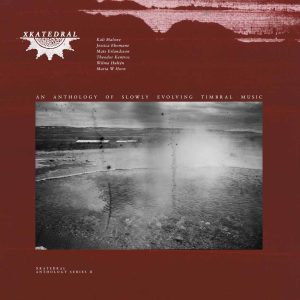
2 LP
COMPILATION
“XKatedral Anthology Series II (An Anthology Of Slowly Evolving Timbral Music)”
XKatedral Anthology II is the second installment in a series of archival releases dedicated to presenting music by composers affiliated with XKatedral working within the realm of slowly evolving harmonic and timbral music. This double-vinyl set contains an array of pieces written from 2018 to 2020 by composers Kali Malone, Jessica Ekomane, Mats Erlandsson, Theodor Kentros, Wilma Hultén and Maria W Horn. This collection of pieces focuses on the use of synthetic sound and algorithmic composition languages as tools for precise work within the realm of spectral exploration. In addition to this, the electronic instrumentation in many of the pieces is augmented by acoustic instruments.
1. Kali Malone - Music for Low Quartet 08:34
2. Jessica Ekomane - First Light 07:44
3. Mats Erlandsson - Hands Melt In The Sun 18:15
4. Theodor Kentros - Rough Draft v.7 06:09
5. Wilma Hultén - Inertia 14:03
6. Maria W Horn - Dies Irae (live) 22:04
36,00€
Out of stock
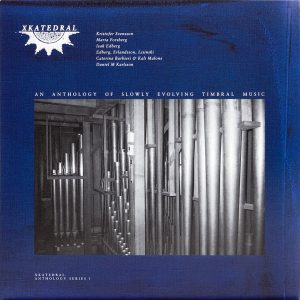
2 LP
COMPILATION
“XKatedral Anthology Series I (An Anthology Of Slowly Evolving Timbral Music)”
XKatedral Anthology I is the first in a series of archival releases dedicated to presenting music by XKatedral affiliated composers working within the realm of slowly evolving harmonic and timbral music. This double-vinyl set contains an array of pieces dating from 2010 - 2020.
Four of the works included here were originally released on cassette early on in the label's history, while the two remaining pieces are presented by the label for the first time.
1. Kristoffer Svensson - Ir Himinn, Groœn 04:09
2. Marta Forsberg - Disquiet (Heart) 17:40
3. Isak Edberg - Lamé 17:26
4. Edberg/Erlandsson/Lisinski - Dissolving Ceremony 07:05
5. Caterina Barbieri & Kali Malone - Glory 15:51
6. Daniel M Karlsson - Shipwrecks 20:00
36,00€