
In stock

LP
IDEA FIRE COMPANY
“Bathroom Electronics”
2023 marks the 35th year of Idea Fire Company’s ongoing commitment to the radical avant-garde. To mark the occasion, Horn of Plenty is proud to present the band’s latest campaign statement Bathroom Electronics.
IFCO’s core members are Scott Foust and Karla Borecky who operate from rural Massachusetts. Early despatches came via Scott’s Swill Radio imprint alongside titles by The Shadow Ring, RLW, and Asmus Tietchens. The last decade or so has seen them work with other notable labels including Kye, Recital, Feeding Tube and Ultra Eczema.
Early IFCO releases included mission statements like the Anti-Naturals manifesto where they outlined their pursuit of a new total-aesthetic to challenge the ongoing pervasion of the Spectacle. Their growing catalogue, although honouring these early intentions, also nodded to the sacrifices undertaken in their pursuit. References to being Lost At Sea, or coming Live From The Impossible Salon acknowledged a wry sense of resignation and a dogged romanticism.
By avoiding sequencers, computers and overdubs and focussing on drawing the most from their instruments and recording equipment their music carries a seductively human character that allows the music to breathe and puts the listener in the room with the band. Although rooted in their formative post-punk / early industrial years, IFCO have incorporated kosmische, minimalism, jazz, classical and avant-garde techniques into their always-the-same-but-always-different sound. Staying true to an original concept yet constantly pushing it in new directions is no easy task but IFCO can claim the mantle and show no signs of tiring.
On Bathroom Electronics Scott and Karla are joined on two of the four tracks by long-term compadres Matt Krefting and Timothy Shortell. As the title implies, the LP consists of electronic instruments recorded in bathrooms. The stark interior certainly plays a role here. Side A’s three tracks have a compellingly unsettling and claustrophobic feel. Side B’s The End of the Line (alternative versions of which appeared on a limited Recital tape in 2018) feels like a long, ambiguous goodbye. It’s what not said here that speaks the loudest though, this is much more of an odyssey than a comfort break.
Bathroom Electronics marks IFCO’s 35th year in confident and uncompromising fashion. Here's to the next 35 years and, as ever, here’s to love!
25,50€
In stock

LP
Francis PLAGNE
“Udge”
Melbourne-based Francis Plagne returns to Horn of Plenty with possibly his strongest statement to date, Udge.
Since his appearance on the Australian scene in the early 2000’s Francis has pursued a unique trajectory, bridging left-field song-craft, experimental electronic composition and improvisation. In addition to solo works issued by Black Truffle, Penultimate Press, and his own Mould Museum imprint, he has worked in various collaborations with Andrew Chalk, crys cole, James Rushford, and Joe Talia. Defining the entirety of his output is the pursuit of radical autonomy, sculpting musical gestures, spanning numerous idioms, which take nothing for granted and manage, in each iteration, to declare their own territory and terms while acknowledging their place within a long continuum of musical practice.
Udge takes us further along the path carved out on the Rural Objects LP. Employing a similar palette of sounds, including that wild guitar synth, and a cameo from Joe Talia on drums. The record takes the form of two untitled side-long suites built from a series of portastudio jams and miniatures. Played against bristling passages of acoustic and electronic textures, fragments of melody and rhythm thread their way across the album’s length only to be broken and undermined by interventions into the tape onto which they were laid. Similar to Teo Macero’s electric Miles tape treatments or John Oswald’s restitching of The Grateful Dead, Udge is a deceptive work of musique concrète that sits adjacent to some of the more singular prog / RIO records by Nascita della Sfera, Albergo Intergalattico Spaziale, Roberts Owen, and Look de Bouk.
27,00€
In stock

3 CD box
Michael Allen Z PRIME
“Bioelectrical Music”
We have not had a physical release by composer and ecologist Michael Prime since the release of Borneo in 2007. This new 3CD set brings us up to date with a series of recordings from across the years. It also sees a new refinement in his working practice as well as a new extension to his original name. Bioelectrical Music by Michael Allen Z Prime consists of recordings that fall into 3 defined categories - Bioelectrical Compositions, Bioelectrical Field Recordings and Bioelectrical Installations. All three use the bioelectrical potentials generated by plants and fungi, although these sound sources are now no longer purely seen as raw material available for multi-tracking or further electronic processing of the signal path. Now, the bioactivity signals themselves form the basis of the music. Following a framework of self imposed rules that restrict the extent that the source sounds can be altered, such that the essential voice of the living sound sources remain identifiable. The development of this framework is a direction that Prime’s music has been moving towards for some years now, and this box set collects various recordings made between 1990 and 2019 that fall into the remit of this new development. The pieces included here range from short sound studies to lengthy compositions and installation recordings made at a wide variety of locations. The 3CDs are accompanied by a 44 page booklet with an essay by Prime outlining the history and development of our understanding of plant neurophysiology. There is also a short piece written by author and fungal enthusiast Merlin Sheldrake.
42,00€
In stock

CD
Adam BOHMAN
“Music And Words 3”
Coming 8 years after Volume 2 and 23 years after the first installment, Volume 3 of Music And Words is the 4th solo release by Adam Bohman on Paradigm Discs. All 4 releases have focused on his earliest recordings, mostly from the 80s, mostly domestic and all using cassette recorders. There are 4 principle styles that are employed in this early phase of Adam’s work - most unexpectedly there are songs, often constructed with trumpet as the lead instrument, then more typically there are improvised experimental pieces using home made stringed instruments. Thirdly we have ‘pause pieces’ - consisting of rapid edit collages using found media (typically radio and bargain bin LPs), and the 4th element is Adam’s spoken word recordings. Anyone who has met Adam will have seen him recording his observations and thoughts onto a small tape recorder, documenting his way through life. In fact the Music And Words CD series is roughly 50% composed from these peripatetic ‘talking tapes’. On Music And Words 3 we hear him at the seaside in both Brighton and Clacton-On-Sea.
Overall the CD ranges widely over these various styles, and bursts with ideas and humour. In addition to the 4 solo releases on Paradigm Discs there is also a compilation track plus his contribution as a member of Morphogenesis on 3 further CDs. I’m proud to say that Adam is by far the most represented artist on the label.
14,50€
In stock
LP
William BURROUGHS
“Ali’s Smile”
**2023 stock**
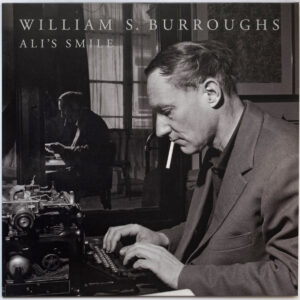
This record is divided into 2 sections. The first part is the title track and takes up most of side 1. Ali’s Smile was first published in 1971 and was privately released as a one sided LP, in an edition of 99 copies. It came in a plain sleeve with a hardback copy of the spoken text, and was sold exclusively through Unicorn Bookshop in Brighton, UK. Bill Butler, the bookshop owner, was still paying off a viciously punitive fine and associated court costs imposed in 1968 after a guilty verdict in an obscenity trial. Burroughs, a ‘fellow American’, was only too happy to help out by letting him have the rights to the recording. Rumours abound as to how many copies of the LP actually sold and how many were damaged after having been left on a heater, but, whatever the facts, this magnanimous gesture would still have been very handy. This is the first official reissue of this lost audio recording. A tale of revenge, heartless cruelty and amulet power, muddied with frequent recourse to Scientological references.
The rest of the LP is taken up with 30 minutes of audio tape supplied by Burroughs in answer to various questions mailed to him by a freelance journalist. It also includes several readings from material he was working on at the time. The recordings date from 1963, which places them as some of (if not the), earliest in depth recordings of his readings and thoughts. As this material dates from just before the publication of Nova Express, much of it serves as a useful companion and commentary on his Nova mythology. In the end only about 10 minutes of this material ever got broadcast, and was used as part of an illustrated talk on the BBC’s Third Programme.
Released in an edition of 1000 with sleeve notes on a numbered insert.
25,00€
In stock

3 CD box
GENTLE FIRE
“Explorations (1970 – 1973)”
**2023 stock**
You may have heard of Gentle Fire, but could be forgiven for not knowing much about them. They were a 6, then 5 member group of composers/improvisers/performers based in London and Yorkshire. Most of the writings that cover the pioneers of experimental, electronic and improvised music have given them scant attention. In addition to this, their recorded output is slim, the main item being a long out of print LP (for EMI Electrola), featuring their interpretations of graphic scores by Cage, Earle Brown and Christian Wolff. Despite recordings for BBC Radio 3 and many German radio stations, it seems extraordinary that there were no other substantial releases of their repertoire, or any of the 6 Group Compositions they created.
Most of the existing Gentle Fire archive was kept privately by Hugh Davies. After Hugh died in 2005 it was shared between various institutions. This release owes much to Hugh’s meticulous record keeping as well as the archives at the British Library and Special Collections at Goldsmiths, University of London. Listening sessions at the British Library were a revelation, it was like discovering a missing link in the evolution of experimental music, but above all it sounded so undated and fresh.
The release is divided into 3 sections. The first CD, recorded between 1970 and 1971 contains 4 studio and 2 concert recordings of graphic and text scores: 2 parts of Stockhausen’s Aus den sieben Tagen, and one piece each by Earle Brown, John Cage, Toshi Ichiyanagi and Christian Wolff. Gentle Fire were active between 1968 and 1974 and were especially active during the early 70s, appearing at numerous European avant garde festivals, playing their own Group Compositions and a wide variety of experimental scores. They even ended up in Iran playing in Stockhausen’s Sternklang, and improvising at dawn at Hafez’s tomb. The text and graphic scores that they were innately drawn towards have large elements of interpretive freedom to them, where the composer provides a skeleton and steps back allowing the players to give it flesh. They were in regular communication with the composers of these piece, so it’s no surprise that their interpretations were sought after by concert organisers and composers alike. There are very few examples of groups working at this time with direct contact to the composers, which makes these recordings especially precious.
CD2 and 3 focus on their own works, CD2 dates from 1973 and was recorded during a 2 day residency at Radio Bremen. The 5 pieces on this disc cover a wide variety of styles and include a 23 minute version of Group Composition VI which is their only text based piece and uses processed and filtered speech.
CD3 is a recording of their appearance at ICES 72, a legendary festival that took place at the Roundhouse in London. Over the course of 2 chaotic weeks a vast number of the world’s experimental musicians took to the stage. Miraculously the whole of the Gentle Fire concert has been preserved. It consists of a performance of their Group Composition IV, centred around a large metal sculpture that all members of the group could play at the same time. The piece actually had its première the previous year on the original pyramid stage at the first Glastonbury Fair. There are several photos of the event included in the booklet that accompanies the CDs.
At last it is possible to assess the importance of this group’s work, both their own work and their interpretations of scores, and to give them their proper place in the history of live experimental/electronic music as well as indeterminate and intuitive composition.
Released in an edition of 500 with a numbered 48 page booklet.
38,00€
In stock
LP
Ellen FULLMAN
“Music for the man who grew common in wisdom”
**2023 stock**
besom presse announces the release of Ellen Fullman’s Music for the Man Who Grew Common in Wisdom. Known prominently for her sculptural Long String Instrument (LSI), these musique concrete pieces showcase an underrecognized side of Fullman’s sound investigations. In two expansive works, Fullman voyages through the comic, the menacing and the blissful all while evoking the unique kinetic and timbral aesthetic for which she is widely praised. Composed between 1987-1989, while living in Austin, Texas, the music originally served as accompaniment to choreographer Deborah Hay's dance piece of the same name. The besom presse release presents the last two movements of the full composition.
In 1985, Hay, a founding member of the Judson Dance Theater, commissioned Fullman to collaborate on a new work. Hay was deeply influenced by her experience as a member of the Merce Cunningham Dance Company and to the way John Cage and Cunningham collaborated. As such, the only relationship planned between Fullman’s music and the choreography was timing. Inspired by Hay’s open-ended approach and encouraged to use a new set of musical implements, Fullman explained, “I found this way of working to be remarkably refreshing and respectful of my process. I felt free to delve into my attraction for absurdity, knowing that I would not be judged.” With a variety of acoustic sound sources, Music for the Man Who Grew Common in Wisdom finds Fullman exploring the possibilities of the Prophet sampler. Describing her experience of using this tool she explains: “I was fascinated by what could be done with the Prophet and worked in a way that could be seen as an outgrowth from the musique concrete approach that I had used with a reel-to-reel tape recorder in earlier years.”
One of the most interesting contextual aspects of Music for the Man Who Grew Common in Wisdom is the flux under which it was created. Recently relocated and using unfamiliar equipment after having dedicated so much of her time and energy to advancing her knowledge of the LSI, this record provides an ultra-rare snapshot of Fullman’s journey as a composer: a suspended moment wherein her earlier phase of sound collaging comes into direct contact with her sensibilities of movement and sound as refined by her work with the LSI.
The excursion rewards careful, repeated listening. Its musical events arrive spontaneously while striking a rare balance between the poetical and unaffected. While the work is time-stamped by its technology, it evades the quaintness that beleaguers so many novel releases from the past. On side A, titled Music for the Gardener, Fullman triggers an assortment of exquisitely recorded acoustic sounds from a variety of quotidian sources including bits of glass dropped on a concrete slab, the gentle clanking of suspended woodscraps, water swishing back and forth, and her own voice. The piece begins with the glass, arranged chromatically, which Fullman playfully improvises with by triggering individual notes from a series of chord shapes. The effervescent chime and bounce is punctuated with sudden cluster chords that explode like a six-pack against a brick wall. This gives way to the round and muted tones of the swinging timber—a generous sonic foil to the icy digital aliasing of the glass samples. Shifting focus again, we hear the hi-fi swishing of water in a tub reproduced in a dazzlingly wide stereo field made possible by microphones arranged at either end of the bath. Fullman’s sampled voice, played in a meditative modal melody, signifies a kind of coda anchored by the rhythmic pulsing of clanking wood.
Side B’s Music for the Aviator is rooted in Deborah’s directive: "We contain the mystery, but we don't know what it is." Like an alternative soundtrack to Jodorowsky’s Santa Sangre, starter guns, percolating bubbles, cheering crowds, and a calliope organ conjure a lysergic day at the circus. More or less abrupt disturbances take place throughout. The circus is consumed by cetaceous blowhole sounds, which in turn fade into something vaguely like the Hindewhu whistle of Ba-Benzélé Pygmy music (think the intro to Herbie Hancock’s Watermelon Man). Eventually the piece settles into a satisfying rhythmic pulse of tuned breath sounds set in a cloud of woozy voice loops while a tightly packed spectrum of overtones springs forth.
The Man Who Grew Common In Wisdom was performed in August 2019 at the Tanz im August Festival, Berlin, in their RE-Perspective Deborah Hay, Works from 1968 to the Present. Eva Mohn of the Cullberg Ballet, Stockholm, was the soloist, and the work has become part of their repertoire. Music from the first movement of this piece, The Navigator (aka “Staggered Stasis”), was made available earlier this year by Superior Viaduct on a reissue of Fullman's 1987 self-released cassette, In The Sea.
25,00€
In stock
LP
Tetuzi AKIYAMA
“Thaumaturgy”
**2023 stock**
The intimacy of Akiyama’s Thaumaturgy is immense. In nine short through-composed pieces written over a ten-year period, Akiyama captures something melodic, simple, and utterly transfixing. In his first instrumental solo acoustic guitar record in more than a decade, Akiyama, widely known for his improvisatory collaborations as well as his hypnotizing boogie-drone guitar pieces, here works without effects and maintains a strict harmonic palette throughout. Every note is given ample space to ring out and decay, together slowly and deliberately building the frame that is to become the completed structure. The resulting atmosphere of his pared down grammar threads each individual track to the next as the songs work together with the gravity of a single object. In fact, one might think of each track like a room in a house.
The record, as its name hints, is suffused with phenomenological magic. The pieces function architecturally, in a Bachelardian sense, sheltering the daydreamer and encouraging charged stillness. The record envelops like a long-vacant shelter, made sacred by memory. Repeated motifs, like building blocks, waft through the air, exacting the psycho-durational and transportive power of a music box. And while, like a music box, the music lends itself to the tracing of inner landscapes, critical listening reveals that this is no mere background music. The acoustic field is richly ornamented with combination tones that are intensified by a pacing in step with Rothko-philes, Morton Feldman and Loren Connors.
While the enclosure of home serves for many as refuge from the world, Akiyama’s Thaumaturgy speaks to a basic drive for a sense of place in an epoch dominated by the disassociation of global nowhere-culture. The simplicity-bordering naivete of the pieces evokes a discomfiting nostalgia and melancholy pointing us home or, as Bachelard would suggest, to the “miniscule phenomenon of the shimmering consciousness.”
25,00€
In stock

CD
Luciano MAGGIORE
“Self-talk”
Latest release by Italian London based musician Luciano Maggiore on his own edizioni luma.
Researched, written and recorded in London between March 2022 and March 2023
Mastered by Giuseppe Ielasi
14,50€
Out of stock

3 CD box
DDK Trio (Demierre / Dörner / Kocher)
“A Right to Silence”
On the impulse of Jacques Demierre, DDK trio was created in 2014 at the Festival Météo Mulhouse, France. Made up of three major figures on the international music scene, this trio plays music that is totally oriented towards the present moment. It continues the tradition of "instant composition" - going back to Lennie Tristano and passing through the legendary Jimmy Giuffre trio - and deploys an expressive palette ranging from silence to massive acoustic eruptions, while paying particular attention to the great precision of the articulation of musical discourse. An extreme care for sound and listening constitutes the core of this music, which draws from the sources of today's inventive music where multiple sound universes intersect.
The trio's third album, "A Right to Silence," consisting of three CDs, was recorded by Benjamin Maumus at Théâtre Le Colombier, Les Cabannes, France, June 21-25, 2021, on the occasion of a recording residency at GMEA-Centre National de Création Musicale d’Albi-Tarn. In choosing the music to be released, the three musicians decided to apply the principle of non-influence-in-each-other's-choice that they have been practicing for years as a trio. From there, they each made their own album from the same raw recordings, separately, each on their own. A previously unpublished text by researcher and sound artist Thibault Walter accompanies the 3-CD boxed set, highlighting the process carried out by the trio and described above.
30,00€
In stock

CD
Maeda YASUYUKI / Li SONG
“28th Dec, Arakawa”
Maeda Yasuyuki and Li Song are musicians and computer programmers based in Nagoya and London, respectively. They both improvise with their computers through code using SuperCollider, a real-time sound synthesis system. They first connected online in 2017 through OSC Hub, a computer music program for remote collaboration created by Tadashi Usami.
They self-released Two Laptops in February 2022, and later released it as a tape on Karma Detonation. It was recorded during Maeda's trip to London in the summer of 2019.
This release was recorded during Li's visit to Tokyo in the winter of 2022, all in one afternoon. One recording took place under a bridge by the river around 2 p.m., and the other in a small community park in the area around 5 p.m. They placed the portable recorder between two laptops. Along with the sounds coming from the laptops' built-in speakers, the sounds of the surroundings were also recorded, including the passing cars on highways, motorboats, waves, birds, and people passing by. One of the recordings captured someone saying "Stop it" in Japanese, though neither recalls hearing it during their time in the park.
10,50€
Out of stock

CD
Atsuko HATANO / Ryotaro MIYASAKA
“Dinosaur and Gems”
Atsuko Hatano plays viola, violin and cello; she also uses electronics. She has released numerous albums and attracted a great deal of attention both inside and outside Japan. Hatano also creates music for movies, TV dramas and commercials. She frequently collaborates with other musicians and artists, including Jim O'Rourke and Eiko Ishibashi.
Ryotaro Miyasaka, a percussionist active in genres ranging from pop to experimental music, has been extremely busy of late. In 2022, he released the CD Odd Jobs Are the High Road of Work (ftarri-967), an improvised duo performance with guitarist Tetuzi Akiyama, on the Ftarri label.
Dinosaur and Gems documents a duo concert held at Ftarri on February 27, 2023. The two tracks on this album (21 and 29 minutes) show Hatano (viola and electronics) and Miyasaka (percussion) crossing swords furiously, but at times playing calmly and in perfect synch.
10,50€
In stock

CD
Kanon AONAMI / Sean COLUM / Fumi ENDO
“Kanon Aonami Composed Works”
Born in Yokohama in 1994, Kanon Aonami is an alto saxophonist and composer who plays jazz and improvised music at performance venues mainly in Tokyo and Yokohama. She is also a talented composer, and at Ftarri she often performs her own compositions in addition to improvised music. In June 2021 Aonami started appearing periodically at Ftarri; she has performed with musicians including pianist Fumi Endo, alto sax player Masahide Tokunaga, and British guitarist and Tokyo resident Sean Colum.
Focusing on her compositions, this album includes performances of three of Aonami’s composed works. Two of them (1, 3) were performed by Aonami and Sean Colum, while the other (2) is a duo performance by Sean Colum and Fumi Endo. The bonus track at the end (4) is an improvised trio performance by Aonami, Colum and Endo. All were recorded live at Ftarri on February 6 (3) and April 24 (1, 2, 4), 2023.
10,50€
Out of stock

CD
Akira SAKATA / Toshimaru NAKAMURA / Raiga HAYASHI
“Kinjo no Tabibito”
Three musicians of different generations came together to form this unusual free jazz trio. Comprised of veteran musician Akira Sakata (alto sax, clarinet, narration), noted young drummer Raiga Hayashi, and Toshimaru Nakamura (no-input mixing board)—who has been active on the improvised music scene inside and outside Japan since the 1990s—this much-talked-about band performs mainly at live music venues in the Tokyo area.
Naturally, their performances contain the furiousness and wildness characteristic of free jazz, but they also pulsate in a phantasmagoric way as they move forward. And Nakamura’s effectively released electronic noise—unusual in free jazz—solidifies the trio’s distinctive character. The two tracks on this album document a live performance that took place at Apollo, Tokyo, on March 5, 2023.
10,50€
In stock

CD
Yumiko TANAKA
“Tayutauta [Remastered Edition]”
While continuously engaged in the field of traditional Japanese music, female-school gidayu shamisen player Yumiko Tanaka has since the 1990s been carrying out multifaceted musical activities including contemporary classical music, improvisation (in 1996-97 she was a member of Otomo Yoshihide's band Ground-Zero), experimental music, and theater performance/composition, performing and exchanging ideas with many musicians from Japan and other countries.
While Tanaka is regarded as one of the musicians representative of the improvised/experimental music scene in Japan, thus far she has only two solo releases: the CD Tayutauta (Improvised Music from Japan, 2004) and the DVD Music Performance (Meenna, 2017). In 2023, 19 years after its original release, her only solo CD--the widely acclaimed Tayutauta--has been remastered and reissued with greatly improved sound quality and a new design.
Tayutauta contains ten completely improvised tracks in which Tanaka uses the gidayu shamisen but departs boldly from the usual methods of playing the instrument. Incorporating a variety of experimental techniques including plucking, bowing and use of "prepared" objects, these performances are calm and sedate, but suffused throughout with a feeling of cohesion backed by Tanaka's distinctive musical artistry. This is improvised music of rare quality.
10,50€
Out of stock

CD
John BUTCHER
“The Very Fabric”
The Brønshøj Vandtårn is a concrete water tower, built almost a hundred years ago in the suburbs of Copenhagen. It's 20m wide and 34m high - smaller than some similar shapes I've played in, but with a large, lingering reverberation. Some sounds seem to float away as if through liquid, others acquire a shifting haze, and some just prefer to sit around. Thomas Buhl-Wiggers, of the Cejero festival and label, kindly invited me to play there in the summer of 2022 and arranged for Jesper Hviid to spend the day inside, recording these pieces.
The very resonant spaces I've worked in before include a giant gazometer, a hollowed-out Japanese mountain, an underground reservoir, a Victorian mausoleum and a massive World War II oil tank. I'm still fascinated by how different these massive environments all sounded and felt. They each inspired different approaches in trying to find the music for the actual space, and this recent experience within the extraordinary Brønshøj water tower was no exception. (John Butcher)
British saxophone player John Butcher, a leading figure on the contemporary improvised music scene, has released several CDs on Ftarri labels in which he performs with other musicians, including Rhodri Davies, Akio Suzuki, Eddie Prevost and John Russell. But The Very Fabric is Butcher’s first solo album release on a Ftarri label (Hitorri).
12,00€
In stock

CD
ELECTRIC POWERED MUSIC
“Kinetic Vision”
Composer Masamichi Kinoshita, cellist Tomoki Tai, and composer/computer musician Takumi Ikeda perform on electrical equipment and electronics in the electric noise project Electric Powered Music. Kinoshita and Tai started playing sessions together around 2008 and were joined by Ikeda soon thereafter.
This album includes two live improvised performances presented at Ftarri, Tokyo. The performance on track 1 (42 minutes) took place on February 26, 2023; the track 2 performance (31 minutes), on October 23, 2022. Kinoshita played commercial electronics, Tai used remodeled and self-made electric devices, and Ikeda played electronics. "Noisy" sound is tinged with splendor and opulence in this powerful, impressive recording.
10,50€
In stock

CD
Lance Austin OLSEN
“The Pit”
Born in 1943, Lance Austin Olsen is a Canadian artist and composer. He started painting in his youth and has continued his work as an artist up to the present. In the late 1990s, Olsen became fascinated by experimental music. He has released numerous CDs and digital recordings of both solo performances and collaborations with other musicians. In his creative process, composition and painting are closely related and draw inspiration from one another.
Olsen released a duo CD on the Ftarri label with French musician Bruno Duplant in 2022. His solo CD The Pit has just come out on the Ftarri sister label Hitorri. The two tracks (30 and 11 minutes) were created through the combination of a variety of sound sources including instrumental sound, noises, voice, field recordings, a wax cylinder recording, and a sample of a 1950s radio program. The album is filled with the contemplative quality characteristic of Lance Austin Olsen's work.
10,50€
In stock

LP
Alvin LUCIER
“Works for the Ever Present Orchestra Vol. II”
Works for the Ever Present Orchestra Vol. II continues Black Truffle’s documentation of the late work of legendary American experimental composer Alvin Lucier, who sadly passed away in 2021 at the age of 90. Like the first volume of the series, the two works recorded here were written for The Ever Present Orchestra, an ensemble founded in Zürich in 2016 to perform Lucier’s work exclusively. At the core of the music Lucier wrote for the ensemble is the electric guitar, an instrument he began to explore in 2013. Played with e-bows, in these works electric lap steel guitars take on roles akin to the slow sweep pure wave oscillators heard in many of Lucier’s works since the early 1980s. This strikingly elegant pair of compositions would serve as an ideal introduction to Lucier’s late music for a listener as yet unfamiliar with its graceful exploration of beating patterns and other acoustic phenomenon.
The two pieces have quite different characters, exemplifying Lucier’s ability to harvest a remarkable range of musical results from closely related compositional procedures and concerns. In Arrigoni Bridge (2019), Lucier uses a technique familiar from earlier works such as Still Lives (1995), where sine waves traced the shapes of household objects. Here, three lap steel electric guitars (played by Oren Ambarchi, Bernhard Rietbrock, and Jan Thoben) follow the form of the Arrigoni Bridge that connects Middletown and Portland, Connecticut. The bridge’s two enormous steel arcs become slowly sweeping pitches, alongside which alto saxophone (Joan Jordi Oliver Arcos), violin (Rebecca Thies) and cello (Lucy Railton) sustain long tones, creating a variety of audible beating patterns depending on their distance from or proximity to the guitars. With its stately pacing, warm middle register tones, and rich timbral variety in the sustaining instruments, Arrigoni Bridge is a beautiful example of compositional reduction producing immersive results. Flips (2020), on the other hand, is more austere. Scored for two lap steel electric guitars (Rietbock and Thoben), double bass (Ross Wightman) and glockenspiel (Trevor Saint), the two acoustic instruments played with bows, the piece zooms in on the range of a major second (two semitones). The two guitars sweep in opposite directions within the range, crossing every four minutes; the double bass and glockenspiel sustain long tones, producing beats of different speeds determined by their distance from the guitar tones. This limitation of the tonal range means the music is often dissonant and forces the phenomenon of audible beating to the surface, resulting in a paradoxical music composed entirely of long tones yet alive with pulsating rhythm. Exemplifying Lucier’s ability to uncover near-infinite complexity within seemingly simple materials, Works for the Ever Present Orchestra Vol. II is a fitting tribute to one of the major figures of the experimental music tradition and a testament to the continuing power of his work.
25,00€
In stock

2 LP
Ustad Zia Mohiuddin DAGAR
“Vrindavan 1982”
Black Truffle is thrilled to present a previously unheard performance by rudra veena master Ustad Zia Mohiuddin Dagar, recorded in the North Indian city of Vrindavan at the Druhpad Samaroh festival in 1982. Z.M. Dagar was a nineteenth-generation descendant of the Dagar family of musicians, famed for their profoundly meditative approach to the tradition of Hindustani court music. Perhaps the most revered members of the family were the brothers Mohinuddin and Aminuddin Dagar, who played a key role in reawakening interest in dhrupad in the mid-20th century. The great exponents of the tradition from whom Z.M. Dagar descended were all singers, and dhrupad is essentially vocal music. However, as Z.M. Dagar explained, the veena family of instruments plays an important role in the education and practice of dhrupad singers, especially as an aid to mastering the fine microtonal nuances of pitch essential to the genre. Introduced as a child by his father to the rudra veena, a large and low-pitched veena amplified by two enormous gourds, Z.M. Dagar became the first modern dhrupad musician to perform with it as an instrumental soloist, giving his first recital at the age of 16. Devoted to the instrument throughout his life, he made innovations to its design and materials, as well as introducing novel techniques (such as playing without the use of the traditional wire plectrum, resulting in the remarkable warmth of his tone). In the great Dagar family tradition, his approach to the various ragas that make up the dhrupad repertoire was stately, slow, and considered, with a great emphasis on the alap, the heavily improvised exposition section. True to form, in this recording of Dagar performing the night raga Yaman Kalyan, the alap section stretches out to more than forty minutes of slow-motion bliss, a frozen tanpura drone hovering above Dagar’s gracefully bent notes and elegantly twisting phrases. In the alap’s first half, Dagar’s figures are so intently focused on the lower reaches of the rudra veena’s range that they register more as shudders and moans than melodic patterns. As the performance continues, he slowly climbs in pitch, though continuing with the same intent focus on the articulation of single notes and subtle microtonal variations. This leads to the jod section of the performance, which, though still accompanied only by the tanpura, gradually takes on a more rhythmic character. Developing almost imperceptibly over the course of nearly thirty minutes, the jod moves from the stillness of the opening alap to a rapid pulse that announces the closing section of the piece, where Dagar is joined by Shrikant Mishra on the pakhawaj (a double headed hand drum). Where many performers use the final section of the raga as an exercise in unrestrained virtuosity, Dagar and Mishra subtly weave a web of finely shifting accents and hypnotic melodic variations, bringing the recording to a fitting conclusion while remaining within the meditative space occupied by the performance as a whole. Adorned with beautiful archival photographs of Dagar taken by Swedish percussion legend Bengt Berger and accompanied by detailed notes from Bradford Bailey, Vrindavan 1982 is a stunning document of music unmatched in its patient focus and mysterious emotional depth.
35,00€
Out of stock

LP
Eiko ISHIBASHI – Jim O’ROURKE
“Lifetime of a Flower”
For the exhibition “Flowers in 20th and 21st Century Art“, Eiko Ishibashi and Jim O‘Rourke had created the installation ”Lifetime of a Flower“ in which they set parameters but allowed the process itself to grow uncontrollably. Literally: in the garden of their Japanese house, they planted seeds and filmed the plant growing and thriving throughout the duration of the exhibition. Visitors were able to watch the stream in real time - and they heard a composition in which Ishibashi and O‘Rourke reflected the organic process in sound. The eponymous composition now available on LP, is an enigmatic and sophisticated layering of sounds, melodies and rhythms, noises from everyday life, all of which are repositories of associations, memories and expectations.
32,00€
In stock

CD
COMPILATION
“In Fractured Silence”
CD version.
Compilation curated by Steven Stapleton (of Nurse with Wound) of creative-experimental-unlikely music, originally released in 1984. Released on his United Dairies label that he had created with John Fothergill, he naturally called on Jean-Jacques Birgé and Francis Gorgé, who were then playing with Bernard Vitet in Un drame musical instantané. The compilation would be named In Fractured Silence. Alongside Nurse With Wound and Un drame musical instantané, could be heard Hélène Sage (whom Birgé introduced to Stapleton) and Sema, a project from the experimental British musician Robert Haigh who had participated in key records in the Nurse With Wound discography, such as Homotopy to Marie and Spiral Insana.
12,00€
In stock

LP
COMPILATION
“In Fractured Silence”
LP version.
Compilation curated by Steven Stapleton (of Nurse with Wound) of creative-experimental-unlikely music, originally released in 1984. Released on his United Dairies label that he had created with John Fothergill, he naturally called on Jean-Jacques Birgé and Francis Gorgé, who were then playing with Bernard Vitet in Un drame musical instantané. The compilation would be named In Fractured Silence. Alongside Nurse With Wound and Un drame musical instantané, could be heard Hélène Sage (whom Birgé introduced to Stapleton) and Sema, a project from the experimental British musician Robert Haigh who had participated in key records in the Nurse With Wound discography, such as Homotopy to Marie and Spiral Insana.
24,00€
In stock
LP
COMPILATION
“In Fractured Silence (Smoke Vinyl)”
LP version. Smoke color vinyl.
Compilation curated by Steven Stapleton (of Nurse with Wound) of creative-experimental-unlikely music, originally released in 1984. Released on his United Dairies label that he had created with John Fothergill, he naturally called on Jean-Jacques Birgé and Francis Gorgé, who were then playing with Bernard Vitet in Un drame musical instantané. The compilation would be named In Fractured Silence. Alongside Nurse With Wound and Un drame musical instantané, could be heard Hélène Sage (whom Birgé introduced to Stapleton) and Sema, a project from the experimental British musician Robert Haigh who had participated in key records in the Nurse With Wound discography, such as Homotopy to Marie and Spiral Insana.
26,00€
Out of stock
CD, Book
Annea LOCKWOOD
“Glass World”
“I have become fascinated by the complexity of the single sound.” - Annea Lockwood
A note from Lawrence English
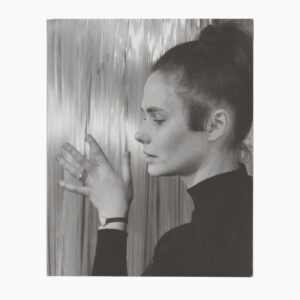
To attempt to summarise the journey of Annea Lockwood’s life, as a composer and performer, is difficult if not impossible. For six decades now, she has carved out a multifarious and fluid existence that has orbited various musical movements and approaches. Hers is a life led by intuition, curiosity and listening, one in which passion is paramount and wonderment abounds.
If you were to reflect upon one aspect of her way of being that holds the greatest gravity in her day to day, it is perhaps listening that resonates most vibrantly. It is a practice that she has sought to deepen, with an unwavering dedication across her life, and a it is practice that has sustained her in the absolute. It’s here that Glass World comes into focus for it documents some of her first significant studies into sound, object and listening. It is a recording that captures her in a moment of profound fascination with a rather familiar material, glass.
This recording celebrates many things, amongst them Lockwood’s willingness to allow single sounds to resonate, fully. Across each of the twenty three vignettes captured here, Annea Lockwood invites us to lean into the material nature of sound with her. Glass World shimmers with an almost fanatical incandescence. It radiates a vibrational intensity that holds as strongly today as it did upon its original release in 1970 on Tangent Records. I had the privilege to re-master these recordings, under the guidance of Annea, and sitting with them so intensely was nothing but a delight.
In tandem with this project, Annea and I have undertaken a long-form in conversation, which is collected in the book which sits alongside this edition. The conversation splays outward from Annea’s work on Glass World and it deliberately seeks to visit upon her interests and passions, and through doing so revel a certain perspective that has guided her ways of being, and ways of making.
It’s an honour to have the opportunity to share this edition with you. I hope you too can catch Annea’s resonate curiosity and be as captivated by these sounds as I (and many others) have been.
18,00€
In stock

CD
TENNISCOATS
“Totemo Aimasho (15th Anniversary Edition)”
A note from Lawrence English
Some time in the early 00s John Chantler, who was living in Japan at the time, sent me a couple of curious sound pieces he’d just recorded with musicians he’d met from Tokyo - Tenniscoats. This was my first introduction to Saya and Ueno, who have subsequently gone on to become longtime friends and a wellspring of sonic inspiration.
In 2005, through their connections to Guy Blackman in Melbourne, Tenniscoats under took a tour of Australia and as part of that visit I arranged a concert for them in Brisbane. Their show, held at Rics Cafe in Fortitude Valley, was a wildly-flowing flux of song, improvisation and sheer melodic freedom. Following the performance Saya, Ueno and drummer Yoshinari Kishida spent a few additional days in Brisbane, and it’s during this time that the majority of Totemo Aimasho was recorded.
The recording itself took place in a reappropriated office building, where my friend Heinz Riegler had set up a small recording space. We were able to use the various offices as somewhat isolated recording zones. The results were surprisingly rich, a testament to office room design I suppose.
For this special 15th anniversary edition, I spent some time going back over the recordings to remaster them. This version is perhaps a bit more faithful to the dynamics of those sessions. I also spent some days going through archival materials that were not included in the original Totemo Aimasho sessions. To my surprise I found a couple of demo versions of Cacoy, one of my favourite pieces from the record, as well as some variations of other album pieces and also a couple of experiments not included on the record.
There’s a certain radiant joy to this music. The record is equal parts curiosity, porousness and generosity. It's a mixed methodology that informed this collaboration, and equally the creation of Totemo Aimasho itself.
I want to send a special note of thanks to John, without whom this project, and many subsequent other connections, would not have occurred.
Produced by Lawrence English and John Chantler with Tenniscoats
Drums, Percussion, Tape, Synth – John Chantler
Flute – Carina Thorén
Guitar, Saxophone, Synthesizer [Unisynth], Vocals – Ueno Takashi
Synthesizer, Electronics, Effects [Field Recordings] – Lawrence English
Vocals, Piano, Keyboards, Bass – Saya
Drums - Yoshinari Kishida (2, 5, 6, 11)
Koji Shibuya - Melodica (15,16)
14,00€
In stock

LP
David TOOP & Lawrence ENGLISH
“The Shell That Speaks The Sea”
A note from Lawrence English
I first met David Toop some 20 years ago. I think we were in touch shortly before that, but our first meeting took place when I invited him to Australia to perform and to speak as part of REV, a festival held at Brisbane Powerhouse. It was a memorable meeting, I vividly remember his solo performance and the edition A Picturesque View, Ignored, documents an improvised meeting during that time.
Over the years, David and I have shared an interest in both the material and immaterial implications of sound (amongst other things). Moreover we’ve connected many times on matters which lie at the fringes of how we might choose to think about audition, our interests seeking in the affective realm that haunts, rather than describes, experience. The Shell That Speaks The Sea very much resonates from this shared fascination.
I’m not exactly sure when we first mooted this duet, but I sense its initial trace is now more than a decade ago. I tend to live by the motto of ‘right place, right time’ and I believe David likely also subscribes to this methodology. A couple of years ago, David and I reignited the duet conversation and began exchanging materials. As a jumping off point, I explored a series of field recordings that, for me at least, captured something of this affective haunting that I mentioned previously.
One such recording was of a Tawny Frogmouth at Nugum (White Rock) on the lands of the Yugarabul people. The frogmouth is an utterly elusive creature whose voice is like a modulating low frequency oscillator. They are a magical bird, and like the Potoo, have captivated David and I at various points in our lives. The recording seemed to suggest a whole way of approaching sound and, for me at least, it opened an entirely new range of sound worlds which are present in the final version of this recording.
This edition is the product of spontaneous burst of exchanges, buffered by periods of tempered silence. A patient work, charged with unexpected dynamics.
It’s with great pleasure we share this recording with you.
David Toop - Voice, digital electronics, Spanish, electric and lapsteel guitars, bowing, whistling, percussion, flutes.
Lawrence English - Electronics, field recordings, shortwave radio, bass drum, ghost flute, bamboo, stones.
24,00€
In stock

CD
Christina GIANNONE
“Reality Opposition”
A note from Christina Giannone
Dissociation is the driving force behind the composition. The act of surrendering, the attempt to observe our existence from the outside.
Giving in feels like giving up.
Acceptance feels like resignation.
The process included digital sound experimentation by means of observance and detail orientation and the idea of sound presenting itself in different identities depending on the listener. This attention to detail acts as a hologram, changing shapes depending on the angle. Ideas of multi-dimensional existences and indifference in its purest form. Slow, digital evaporation.
An attempt to recreate what ‘nothing’ means. It might be a gaze out the window, conversations in passing, an incomplete thought. Fleeting, meaningless moments that fill the gaps. Things we are only subconsciously aware of.
The periphery. The forgotten. The static in between.
14,00€
In stock

CD
Hyunhye SEO
“Eel”
A Note From Hyunhye Seo
Every year, the eels arrive in Sargasso. The eels that sprang to life when the sun god Atum warmed the Nile, the eels generated within the entrails of the earth, from the rubbing of the rocks and dew drops on riverbanks, they travel thousands of kilometres to Sargasso to breed.
Their larvae, eels of glass, move to freshwater homes, crawling across land or up waterfalls if necessary, breathing through their skins, to get to where they want to go, although no one knows exactly where or why. Sometimes, they eat snakes and birds. After decades, when they're ready to breed, they stop eating and develop sex organs, and they travel back to Sargasso. If they can't go back to Sargasso, they never fully mature. They just stop ageing.
No human has seen eels breed. Freud dissected over 400 eels in search of eel testicles. Aristotle thought they grew from earthworms in dirt. No one knows why they go where they go, or how they find their way back.
Creatures of mud and rain, fluid in time and age, unabashed in its metamorphosis, unknown yet always found.
14,00€
In stock

CD
Yann NOVAK
“The Voice of Theseus”
From Yann Novak
In Greek mythology, the legend of Theseus describes how the king-founder of ancient Athens rescues the children of his city from King Minos’ minotaur on the island of Crete. In commemoration, Athenians began a pilgrimage to honor his victory, taking the ship of Theseus and sailing it from Athens to Delos. It was with this tradition that a philosophical paradox about the historic ship was raised: As the ship was repaired, piece by piece, until it was no longer composed of any original parts, at what point could the ship no longer be considered the same entity?
In recent years, I’ve become interested in exploring the perceptual differences I experience. While some of these differences—partial color blindness and dyslexia—have been with me my entire life, tinnitus caused by hearing damage is a relatively new change to how I experience the world. It is these sensory challenges which have shaped my artistic practice by creating what I call a perceptual insecurity—an uncertainty of how accurately I discern the world around me.
The Voice of Theseus is my attempt to explore the obstacles I face in processing external sensory information. If I have trouble perceiving reds and greens, if I have trouble hearing certain frequencies, if I don’t interpret written language in a standard way, how closely can I experience reality in the way that others experience it? The album asks the listener to question how their unique means of perception and interpretation might differ from that of others.
For The Voice of Theseus, I asked two of my favorite vocalists to assist with this experiment. Both Dorian Wood and G.Brenner recorded vocals for me to manipulate throughout the album. If their original audio is Theseus’s ship, the changes I make to their voices are like the Athenians replacing each of the original vessel’s pieces. And so, how far can these vocals be pushed while still remaining attached to the vocalists’ identities? Where lies the separation between the source materials and the objects they’re used to create?
The myth of Theseus’ ship allowed me to tease at the nuances of how reality can be observed, interpreted, and altered in an indeterminate number of ways; it can be dismantled and rebuilt, many times over. And yet, because of my internal circumstances, a perceptual insecurity remains. As flexible as the true nature of an object or moment may be, inaccuracy looms. There’s no real way to know how great the disparity is between my observational experiences and another’s, and no clear limit of how many pieces of our shared reality can be altered—before it stops being just that.
14,00€
In stock

CD
Siavash AMINI
“Eidolon”
A note from Siavash Amini
Let me get this out of the way; I'm obsessed with Safi-al-din Urmavi’s theory of tuning, rhythm, and maqam. It started in my last year of high school, at the time there was a lot of back and forth between Iranian music scholars about his 17-tone scale and whether it had any use or relevance to Iranian music of that day.
I've been thinking about those discussions and more general discussions of tuning in the maqam system of the 13th century a lot in the past half-decade.
I didn't know how to approach these tunings, but I started to get a sense of it while making A Trail of Laughters. I decided that the relevance of these tunings couldn't be explored with conventional instruments and composition techniques. I do not want to approach them in a historical sense, either. I want to use these as my raw material and find my approach, borrowing from experimental and electronic music of our time.
The apparition, an image appearing and disappearing, taking shape in an instant and gone in the next, something you’re not sure you’ve seen, needs a particular setting to be experienced. Something seen or felt in an undetermined space like Redon's drawings. I tried to see if these tuning systems (mostly Urmavi’s 17-tone scale) could be a starting point for creating such a space for myself by letting their frequencies and intervals roll over each other, and letting the resulting sound and textures float, crash, spill and bleed.
Maybe my other obsessions, namely darkness, light, and death, can be at least in some sense contemplated in this shadowy undetermined space and just maybe something here and there makes its presence felt.
14,00€
Out of stock

CD
Jérôme NOETINGER
“Outside Supercolor”
A note from Jérôme Noetinger
Lionel Palun and I met in 2003 in a context of social struggle. Aware of an inevitable downfall, we decided to discuss our respective practices. Sound for me and image for him.
Then there were the basic questions: "What does it do if you connect a video output to a sound input?"; "What does a sound output do to a video input?" Then the tinkering that goes with it, like opening a SCART socket and plugging directly into it. And to finish, we discovered that as always, everything has already been done!
But in the end it's like rock music, it's always the same, and what counts is how to appropriate it, how to live it.
These discussions and first experiences led Lionel to develop his own video feedback software. He has a scientific background and a taste for computers which helps!
In this record, I wanted to draw inspiration from this work with Supercolor Palunar, the name of our duo, to better examine CRT parasites and virtual instruments whose purpose I still don't quite understand.
I dedicate this record to Lionel Palun who, afterwards, made two videos echoing the two pieces.
14,00€