
Out of stock

CD
Philip CORNER
“More from the Judson years Vol. 1”
Yet not to forget that extraordinary place where so much of the new and exciting performances at that most interesting time in New York, took place. There was a Theater there; and a place for the first Happenings. An Art Gallery... and later the famous Judson Dance Theater.
There was Philip Corner first performance. The concert was in early 1962, January 2nd, to be exact. Handwritten change on typescrpt: Yoko Ono’s studio, changed at the last moment to Judson Church. A lot of players; and a lot of pieces. Some of my old friends, like Toshi Ichiyanagi or Richard Maxfield. And a lot of new names from California, Dick Higgins and Alison Knowles, the connection between the old New York and this new scene.
The creation of the Dance Theater: Philip Corner involvement with it from the beginning. (that participation documented on Alga Maghen cd "On tape, from the Judson Years", as most of Corner electronic music was made for dancers associated to the Judson).
Excerpts from the liner notes of Volume One, written by Philip Corner:
"Passionate Expanse of the Law" (1959), extract from the first NY performance, featuring Charlotte Moorman, Philip Corner, Malcolm Goldstein. "I wrote this on an Army cot in Texas, in the Fall of 1959; a continuation of and a major development my exploration of maximum disjuction. It expresses the dynamic unity of the active and static forces in the universe, a characteristic in some degree of all my work".
"Air Effect" (1961), first performance, featuring Philip Corner, Alison Knowles, Malcolm Goldstein. "From 1961 already my music became characterised more and more by attention to the continuous quality of sound. A chamber ensemble, dedicated to directness of breathing. The rhythms and tone modulations of life-sustaining air, as projected through wind instruments bent back from an excess of art to express better a refinement more perfectly attuned to the basics of nature".
"OM emerging" (1971). "I have adopted the Hindu term OM as generic for all the variety of ways I have formulated possibilities of performances based on the prolongations of a single tone". This time it served as prelude to a contrasting form of expression, or "Lovely Music" (1962), "a piece were I let myself go all the way into an indulgence of gorgeous and voluptuous sounds".
"As pure to begin" (1963), Philip Corner, piano with preparations, objects and amplification. "The purety of keyboard sounds turn prograssively noisy, effected by the strings themselves being touched, and touched by objects which are then laid on them and magnified by microphones".
"Music, reserved untill now" (1963), recorded at Judson, 1965 and featuring A-yo, David Behrman, Philip Corner, Malcolm Goldstein, Dick Higgins, Joe Jones, Alison Knowles, Jackson Mac Low, Charlotte Moorman, Nam June Paik, Chieko Shiomi. "A score for non-traditional sound sources. Rough material becomes shaped into sense. A precarious edge where beauty passed out of control".
"Composition with or without Beverly" (1962), recorded at ONCE Festival in 1963; Philip Corner, piano with prepared tape sounds. "I have here extracted the piano improvisation I put over prerecorded tape sounds already derived from piano, and very bashy Korean gongs, all in all a quite marvellous mess".
Digipack first press of 1000 copies, including a 12 pages booklet with liner notes, scores and original documentation.
There was Philip Corner first performance. The concert was in early 1962, January 2nd, to be exact. Handwritten change on typescrpt: Yoko Ono’s studio, changed at the last moment to Judson Church. A lot of players; and a lot of pieces. Some of my old friends, like Toshi Ichiyanagi or Richard Maxfield. And a lot of new names from California, Dick Higgins and Alison Knowles, the connection between the old New York and this new scene.
The creation of the Dance Theater: Philip Corner involvement with it from the beginning. (that participation documented on Alga Maghen cd "On tape, from the Judson Years", as most of Corner electronic music was made for dancers associated to the Judson).
Excerpts from the liner notes of Volume One, written by Philip Corner:
"Passionate Expanse of the Law" (1959), extract from the first NY performance, featuring Charlotte Moorman, Philip Corner, Malcolm Goldstein. "I wrote this on an Army cot in Texas, in the Fall of 1959; a continuation of and a major development my exploration of maximum disjuction. It expresses the dynamic unity of the active and static forces in the universe, a characteristic in some degree of all my work".
"Air Effect" (1961), first performance, featuring Philip Corner, Alison Knowles, Malcolm Goldstein. "From 1961 already my music became characterised more and more by attention to the continuous quality of sound. A chamber ensemble, dedicated to directness of breathing. The rhythms and tone modulations of life-sustaining air, as projected through wind instruments bent back from an excess of art to express better a refinement more perfectly attuned to the basics of nature".
"OM emerging" (1971). "I have adopted the Hindu term OM as generic for all the variety of ways I have formulated possibilities of performances based on the prolongations of a single tone". This time it served as prelude to a contrasting form of expression, or "Lovely Music" (1962), "a piece were I let myself go all the way into an indulgence of gorgeous and voluptuous sounds".
"As pure to begin" (1963), Philip Corner, piano with preparations, objects and amplification. "The purety of keyboard sounds turn prograssively noisy, effected by the strings themselves being touched, and touched by objects which are then laid on them and magnified by microphones".
"Music, reserved untill now" (1963), recorded at Judson, 1965 and featuring A-yo, David Behrman, Philip Corner, Malcolm Goldstein, Dick Higgins, Joe Jones, Alison Knowles, Jackson Mac Low, Charlotte Moorman, Nam June Paik, Chieko Shiomi. "A score for non-traditional sound sources. Rough material becomes shaped into sense. A precarious edge where beauty passed out of control".
"Composition with or without Beverly" (1962), recorded at ONCE Festival in 1963; Philip Corner, piano with prepared tape sounds. "I have here extracted the piano improvisation I put over prerecorded tape sounds already derived from piano, and very bashy Korean gongs, all in all a quite marvellous mess".
Digipack first press of 1000 copies, including a 12 pages booklet with liner notes, scores and original documentation.
15,00€
In stock
CD
Max NEUHAUS
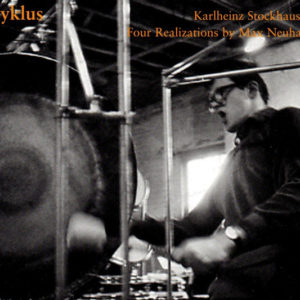
“Four realizations of Stockhausen’s Zyklus”
Zyklus was written in 1959 and is one of the first solo pieces to utilize such a large nember of percussion instruments (twenty one). When Neuhaus first started to play this piece there were only three percussionists in the world who could play it. Stockhausen’s idea was that a performer would play the piece spontaneosly, making its complex decisions n the fly. No one played it this way; it was too difficult. Everyone wrote out his own version of the score and played from it. Coming from the world of jazz Neuhaus decided he wanted to take up the challenge of playing it spontaneously. At that time percussionists generally played only one instrument at a time. Playing twenty one siultaneously was unheard of. Neuhaus quickly realized that the only way to do it, in fact, was to think of all them together as just one instrument, one multi-surfaced bank of timbre.
Neuhaus decided to travel to Europe and go to Darmstadt where Stockhausen was teaching. He wanted to talk to him about the piece. Stockhausen was interested in the idea that the twenty one instruments had to be physically formed into one instrument and that so much work had been done already. So he offered Neuhaus the big opportunity to perform Zyklus on the first American tour.
Stockhausen came over to New York to hear Neuhaus play, but he wasn’t satisfied with the improvisation version. It was too long. Neuhaus was determined to teach himself how to do it for this tour. He had another six months. He got down to seven minutes; and he was still improvising, not writing it out. He was ready to play that piece, and played it like nobody had ever heard it before.
Each of these four recorings is a document of a true solo performance, one person and two hands, with no additional live help and no overdubbing. This cd also offers four different kinds of beauty, four proofs that the latitude that Stockhausen allowed, when capitalized on by a performer with creative imagination, could validate Stockhausen as a composer and an entire aesthetec of freedom and control.
This edition includes a 12 pages booklet with original photos of both official concerts and performances for invited audinces, Max Neuhaus’ own comments on the original score and an editorial note by John Rockwell. Digipack first press of 1000 copies.
Neuhaus decided to travel to Europe and go to Darmstadt where Stockhausen was teaching. He wanted to talk to him about the piece. Stockhausen was interested in the idea that the twenty one instruments had to be physically formed into one instrument and that so much work had been done already. So he offered Neuhaus the big opportunity to perform Zyklus on the first American tour.
Stockhausen came over to New York to hear Neuhaus play, but he wasn’t satisfied with the improvisation version. It was too long. Neuhaus was determined to teach himself how to do it for this tour. He had another six months. He got down to seven minutes; and he was still improvising, not writing it out. He was ready to play that piece, and played it like nobody had ever heard it before.
Each of these four recorings is a document of a true solo performance, one person and two hands, with no additional live help and no overdubbing. This cd also offers four different kinds of beauty, four proofs that the latitude that Stockhausen allowed, when capitalized on by a performer with creative imagination, could validate Stockhausen as a composer and an entire aesthetec of freedom and control.
This edition includes a 12 pages booklet with original photos of both official concerts and performances for invited audinces, Max Neuhaus’ own comments on the original score and an editorial note by John Rockwell. Digipack first press of 1000 copies.
15,00€
Out of stock
CD
Max NEUHAUS
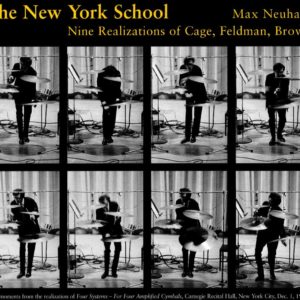
“The New York school. Nine realizations of Cage, Feldman, Brown”
The term “New York School” refers to a circle of composers in the 1950’s who orbited around John Cage: Morton Feldman, Earle Brown, Christian Wolff and David Tudor above all. Their music paralleled the music and events of the Fluxus group, and drew its name from the New York School of mostly Abstract Expressionist painters who had got their start in the 40’s: Motherwell, Pollock, de Kooning, Rothko, Kline. What brought these artists together was a faith in the liberation of the unconscious and an excitement drawn from the street energies of Manhattan.
This compact disc offers multiple realizations by the solo percussionist Max Neuhaus of scores by three key members of the New York School: Earle Brown (three realizations of "Four Systems - For Four Amplified Cymbals", recorded between 1964 and 1968), Morton Feldman (three realizations of "King of Denmark", recorded between 1965 and 1968) and John Cage (one realization ’64 and two realization ’65 of 27’10.554"). All three composers conformed to the ethos of the 60’s, not to the blend of hippie mysticism and pop commercialism that defined that decade towards its end, but to a broader notion of personal liberation. In this context Max Neuhaus was allowed to express himself, to revel in timbral color (including the use of electronics, as in the amplification of the cymbals in the Brown performances, or in the use of a FM tuner, of a self-built electronic mini-instrumet or of a tape with concrete sounds in the Cage performaces) and in giddy dialogues between notated compositional intention and performed expression. Each of the realizations on this disc is a valid response to the scores, yet each is different, almost a new piece of music.
This edition includes a 16 pages booklet with original photos and concert programs, Max Neuhaus’ own comments on the original scores, an editorial note by John Rockwell, reviews by Malcolm Goldstein and Theodore Strongin. Digipack first press of 1000 copies.
This compact disc offers multiple realizations by the solo percussionist Max Neuhaus of scores by three key members of the New York School: Earle Brown (three realizations of "Four Systems - For Four Amplified Cymbals", recorded between 1964 and 1968), Morton Feldman (three realizations of "King of Denmark", recorded between 1965 and 1968) and John Cage (one realization ’64 and two realization ’65 of 27’10.554"). All three composers conformed to the ethos of the 60’s, not to the blend of hippie mysticism and pop commercialism that defined that decade towards its end, but to a broader notion of personal liberation. In this context Max Neuhaus was allowed to express himself, to revel in timbral color (including the use of electronics, as in the amplification of the cymbals in the Brown performances, or in the use of a FM tuner, of a self-built electronic mini-instrumet or of a tape with concrete sounds in the Cage performaces) and in giddy dialogues between notated compositional intention and performed expression. Each of the realizations on this disc is a valid response to the scores, yet each is different, almost a new piece of music.
This edition includes a 16 pages booklet with original photos and concert programs, Max Neuhaus’ own comments on the original scores, an editorial note by John Rockwell, reviews by Malcolm Goldstein and Theodore Strongin. Digipack first press of 1000 copies.
15,00€
Out of stock

CD
Luc FERRARI
“Éphémère I & II”
“Presented here for the first time, "Ephemere I & II" (for tape, or to be played with various instruments) are two previously unpublished masterpieces which represent for several reasons a very specific moment in the creative life and catalogue of Luc Ferrari. Even if Luc Ferrari’s perfect skill in creating some of the most beautiful sonic works ever is now well known to the large audience appreciating his music, the undetermined character marking the two work present here for is quite surprising. Luc Ferrari was tempted in the mid-1970s by the idea of leaving the final realization of these pieces open to the performers intervention (a perspective he decided not to develop in future researches). "Exercises d’Improvisation", a score conceived in 1977 and unreleased for almost 35 years (first recorded this year by the GOL collective with Brunhild Meyer-Ferrari for an LP soon to be issued on PLANAM), directly comes from the two works presented here. "Ephemere I" (or "L’ordinateur ça sert à quoin?" i.e. "What’s the use of computers") is a 27 minutes piece for tape only created in 1974, conceived as a kind of electronic drone superimposed by fragments of multi-language whispered voices that creates the thrilling effect of a "sea-like" continuum. "Ephemere II" (or "Lyon 75" after the only recorded realization) is a 51 minutes tape piece with guitar improvisation. The electronic repetitive structure reminds some of the most radical works of American composer Terry Riley, while the guitar sounds, first resulting as live manipulated pointillistic impulses, develop into a blues sonority superimposing the tape drone and creating a heavy psychedelic atmosphere of the most sublime kind. The end of this long suite lead us back into more abstract and live-electronic sonorities. This very intense work can be placed in a context between scored music and totally improvised music. First press limited to 500 copies in tri-folded digipack sleeve. Please note: these 2 previously unpublished pieces revealing a hidden part of Luc Ferrari poetics are not included in the INA 10CD boxset. Only available on this CD edition.” label info
15,00€
Out of stock
CD
Jacques BERROCAL
“Catalogue”
“Catalogue released in 1979 in a limited edition on his own d’avantage label, catalogue, with its overt theatricality is every bit as wild as the previous paralleles. not really jazz, not rock, having nothing to do with contemporary music either, catalogue it’s a kind of sonic postcard which features not the group of the same name but instead numerous Berrocal associates including Potage (co-founder of the d’avantage label in 1976), Parle, Ferlet, Pauvros and recording engineer Daniel Deshays, plus many musicians from the french underground collective scene of the 1970s. first compact disc edition with the integral documentation. Graphics reproducing the special layout of the original lp record, with photo collages by Berrocal. Digipak first edition limited to 1000 copies.”
15,00€
In stock
CD
Jacques BERROCAL
“Parallèles”
“Jacques Berrocal has been very active since the beginning of the 1970s. No one in France could mix jazz, improvisation, rock’n’roll, punk, no wave, spoken words and industrial music like him. He also had a central position in the creation of d’Avantage, a collective record label that issued some of the most particular sessions of the mid-late Seventies. At the same time he was working on never ending sessions for records that were never issued. Jac and his band were the Apostles of the non-urgency, enjoying recording in unusual situations, with no rules, improvising on undefined structures or using non-musical material mixed with ethnic instrumental solos. In 1976 d’Avantage issued a wonderful record LP titled Parallèles featuring, among the others, Bernard Vitet, Roger Ferlet, Pierre Bastien, Michel Potage, Daniel Deshays, with the intervention of Vince Taylor, the dark diamond of rock’n’roll who inspired David Bowie’s Ziggy Stardust. Just a couple of years later Berrocal collaborated with Steven Stapleton to create the first Nurse with Would record LP. Parallèles features very different styles; acoustic solo and duo for trombone and cornet as well as a large ensemble 25 minutes long piece dedicated to the futurist Russolo (again, two years later, Mr.Stapleton dedicated his first NWW record to the same italian artist). Also to mention are ’Post-Card’, recorded in a Pigsty in 1976, and the legendary ’Rock’n’roll Station’, a mini-concert for voice (Vince Taylor), double bass (Roger Ferlet) and bicycle (Jac Berrocal). The remastered CD also includes five previously unreleased tracks that were actually left out of the original record: ’Villa Povera Naturale’ (1972) is a short piece for pocket trumpet and various concrete elements; ’Occupè’ by Michel Potage is an excerpt taken from an LP that d’Avantage never issued; ’Shorten’ and ’Lisylis Pavillon’ are the first experiments using electronics and ’Cryptea IV’, taken from the sessions of the early Futura LP. Thirty years later Jacques Berrocal is still there, where nothing is waiting for him, totally outside the rules, out of fashion thus indémodable. A digipack CD edition including a folded insert with very nice original photos and scores.”
15,00€
Out of stock
CD
Ghédalia TAZARTÈS
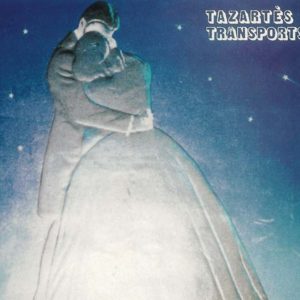
“Transports”
New remastered version ! New bonus tracks !
New remastered CD edition of “Tazartès’ Transports”, Ghédalia Tazartès second LP, presented here with new bonus tracks. Also included are “Assassins 1 to 4” (previously issued as “Les danseurs de la pluie” miniCD), as well as “Elie” featuring Ghédalia in duo with his daughter (previously issued on “Tazartès’ Transports” 1997 first CD edition).
“Tazartès' Transports” is the incredible second album by autodidact and outsider composer Tazartès. Originally released on vinyl in 1980, it probably represents the most original example of the artist's poetical and personal approach to sound organization. The tracks for “Tazartès' Transports” were recorded in 1977 at Ghédalia’s own studio in Paris, strafing stream-of-conscious between rippling electro rhythms to outer-national singing styles, collaged field recordings and musique concrete, to chants, tape loops and exotic atmospheres with a perpetual sense of drift and magical imagination. We're spellbound from the first to last, through the deeply evocative peal of church bells and swirling synthetic textures in track 2, via humid sci-fi scenes and alien avian chatter on track 5 and the lost zones of the closing stages.
Also included on this CD are four “Assassins” tracks previously issued as “Les danseurs de la pluie”. The first two tracks were recorded around the “Eclipse totale” sessions in 1977 and consist of banking guitar feedback, unhinged hollers, and an unsettling piece of children's screams looped against droning synth tones and electronic pulses. The other two were recorded in 2005. “Assassin 3” is a mystical piece of ecstatic ululations and plangent electric guitar riffs, while part 4 feels more opulent, plush synth pads set against strange, strafing distortion, rhythmic exhortations and percussions with a surreal cinematic quality. Yet again, Ghédalia provides us with some of the most compelling, weirdly life-affirming music we've heard in ages.
The disc concludes with "Elie", a charming piano piece performed in duo with the composer's young daughter.
New remastered CD edition of “Tazartès’ Transports”, Ghédalia Tazartès second LP, presented here with new bonus tracks. Also included are “Assassins 1 to 4” (previously issued as “Les danseurs de la pluie” miniCD), as well as “Elie” featuring Ghédalia in duo with his daughter (previously issued on “Tazartès’ Transports” 1997 first CD edition).
“Tazartès' Transports” is the incredible second album by autodidact and outsider composer Tazartès. Originally released on vinyl in 1980, it probably represents the most original example of the artist's poetical and personal approach to sound organization. The tracks for “Tazartès' Transports” were recorded in 1977 at Ghédalia’s own studio in Paris, strafing stream-of-conscious between rippling electro rhythms to outer-national singing styles, collaged field recordings and musique concrete, to chants, tape loops and exotic atmospheres with a perpetual sense of drift and magical imagination. We're spellbound from the first to last, through the deeply evocative peal of church bells and swirling synthetic textures in track 2, via humid sci-fi scenes and alien avian chatter on track 5 and the lost zones of the closing stages.
Also included on this CD are four “Assassins” tracks previously issued as “Les danseurs de la pluie”. The first two tracks were recorded around the “Eclipse totale” sessions in 1977 and consist of banking guitar feedback, unhinged hollers, and an unsettling piece of children's screams looped against droning synth tones and electronic pulses. The other two were recorded in 2005. “Assassin 3” is a mystical piece of ecstatic ululations and plangent electric guitar riffs, while part 4 feels more opulent, plush synth pads set against strange, strafing distortion, rhythmic exhortations and percussions with a surreal cinematic quality. Yet again, Ghédalia provides us with some of the most compelling, weirdly life-affirming music we've heard in ages.
The disc concludes with "Elie", a charming piano piece performed in duo with the composer's young daughter.
15,00€
Out of stock
CD
Ghédalia TAZARTÈS
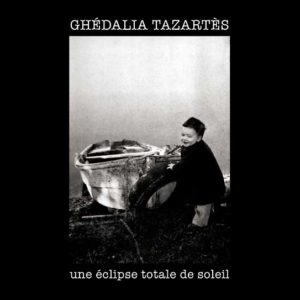
“Une éclipse totale de soleil”
“The first record released by Ghédalia Tazartès in 1979. Far away from contemporary music intellectualisms or from synthetical noise purists, this was certainly one of the most original and creative records of the 70s featuring a new form of musical expression... the value of this work was underestimated and only a few people had a chance to listen to its beautiful music. Now, due to the new growing interest, Alga Marghen has taken the decision to reprint all Tazartes records, starting with his first work. Originally conceived in two parts, Une Eclipse... has been remastered and is now integrated by a 25 minute new piece (’Part III’), composed expressly for this CD”.
15,00€
Out of stock

CD
Ghédalia TAZARTÈS
“Tazartès”
New catalogue number ! New remastered version ! New bonus tracks !
New remastered CD edition of “Tazartès”, Ghédalia Tazartès forth LP, presented here in its integral original length. Also included is the first CD edition of “Whatever Works Singing Wild My Rock Ghédalia” (previously issued as side B of “Granny Awards” LP), created in the early ‘80s in his anhydridic Paris.
Immersive, transporting and deeply arresting music from the revered autodidact and audio oddity. If you’ve never encountered Ghédalia before, this is an excellent place to start, welcoming you to a whole other world of exotic, electro and acoustic sounds, composed according to a genuinely far reaching and individual agenda.
The five bonus tracks opens to a comedic, exuberant vocal set to crackly 78 backing on “Whatever” and turns blind corners into ethno-noise trance-outs on “Singing”, hyper-rhythmic experiments on "Wild" and a jarring hardcore punk-out in “My Rock Ghédalia”. The freedom of expression and taste for exotic, arabesque tonalities is a mighty revelation and we assure you we’ll be digging much deeper into Ghédalia’s catalogue at the nearest opportunity.
New remastered CD edition of “Tazartès”, Ghédalia Tazartès forth LP, presented here in its integral original length. Also included is the first CD edition of “Whatever Works Singing Wild My Rock Ghédalia” (previously issued as side B of “Granny Awards” LP), created in the early ‘80s in his anhydridic Paris.
Immersive, transporting and deeply arresting music from the revered autodidact and audio oddity. If you’ve never encountered Ghédalia before, this is an excellent place to start, welcoming you to a whole other world of exotic, electro and acoustic sounds, composed according to a genuinely far reaching and individual agenda.
The five bonus tracks opens to a comedic, exuberant vocal set to crackly 78 backing on “Whatever” and turns blind corners into ethno-noise trance-outs on “Singing”, hyper-rhythmic experiments on "Wild" and a jarring hardcore punk-out in “My Rock Ghédalia”. The freedom of expression and taste for exotic, arabesque tonalities is a mighty revelation and we assure you we’ll be digging much deeper into Ghédalia’s catalogue at the nearest opportunity.
15,00€
Out of stock
CD
Ghédalia TAZARTÈS
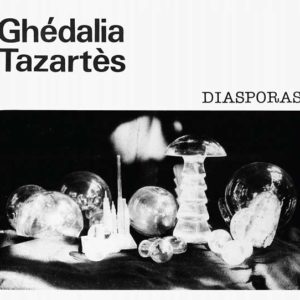
“Diaspora”
New catalogue number! New remastered version! New bonus track!
New remastered CD edition of “Diasporas”, Ghédalia Tazartès first LP, presented here in its integral original length. Also included is the first CD edition of “Ferme ta gueule, Zarathustra” (previously issued as side A of “Granny Awards” LP), largely based on materials pre-dating Ghédalia debut LP “Diasporas”.
In “Ferme ta gueule, Zarathustra” Ghédalia Tazartès is freely connecting the garbled “voix d'enfant” of Raphaël Glucksmann with intoxicating, slow moving and sustained synth chords, before jump-cutting into bird calls, dissonant arabesque strings and eccentric vocalizations with a blinding sense of freedom.
Ghédalia Tazartès is a nomad. He wanders through music from chant to rhythm, from one voice to another. He paves the way for the electric and the vocal paths, between the muezzin psalmody and the screaming of a rocker. He traces vague landscapes where the mitre of the white clown the plumes of the sorcerer, the helmet of a cop and Parisian anhydride collide into polyphonic ceremonies… The greatest trips were made in the deep end of the throat: the extra-European music open the ear to Ghédalia’s intra-European exoticism. Where was music before music halls? Where was the voice before it learned how to speak? Ghédalia is the orchestra and a pop group all in one person: the self is multitude and others. The author and his doubles work without a net, freely connecting the sounds, the rhythms, his voice, his voices. The permanent metamorphosis is a principle of composition, it escapes control, refuses classification. To hell with the technocrats of noise and the purists of synthetic culture. All art like all true mythology use a double clavier, playing nature and culture, feeling and the distance of the flesh, death. Off limits!
New remastered CD edition of “Diasporas”, Ghédalia Tazartès first LP, presented here in its integral original length. Also included is the first CD edition of “Ferme ta gueule, Zarathustra” (previously issued as side A of “Granny Awards” LP), largely based on materials pre-dating Ghédalia debut LP “Diasporas”.
In “Ferme ta gueule, Zarathustra” Ghédalia Tazartès is freely connecting the garbled “voix d'enfant” of Raphaël Glucksmann with intoxicating, slow moving and sustained synth chords, before jump-cutting into bird calls, dissonant arabesque strings and eccentric vocalizations with a blinding sense of freedom.
Ghédalia Tazartès is a nomad. He wanders through music from chant to rhythm, from one voice to another. He paves the way for the electric and the vocal paths, between the muezzin psalmody and the screaming of a rocker. He traces vague landscapes where the mitre of the white clown the plumes of the sorcerer, the helmet of a cop and Parisian anhydride collide into polyphonic ceremonies… The greatest trips were made in the deep end of the throat: the extra-European music open the ear to Ghédalia’s intra-European exoticism. Where was music before music halls? Where was the voice before it learned how to speak? Ghédalia is the orchestra and a pop group all in one person: the self is multitude and others. The author and his doubles work without a net, freely connecting the sounds, the rhythms, his voice, his voices. The permanent metamorphosis is a principle of composition, it escapes control, refuses classification. To hell with the technocrats of noise and the purists of synthetic culture. All art like all true mythology use a double clavier, playing nature and culture, feeling and the distance of the flesh, death. Off limits!
15,00€
Out of stock
CD
Dick HIGGINS
“The thousand symphonies”
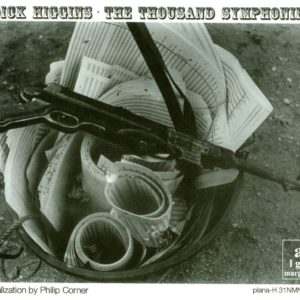
“Alga marghen presents the first edition ever issued of Dick Higgins’ music. Fluxus founding member, in 1958 Dick Higgins studied Composition and Experimental Music with John Cage in his class at the New School for Social Research in New York together with, among others, La Monte Young, Richard Maxfield, Toshi Ichiyanaghi, George Brecht, Allan Kaprow, Al Hansen, Jackson Mac Low. In the Spring of 1968 Geoffrey Hendricks and Robert Watts told Dick Higgins of a project that was afoot at Douglass College, where both were teaching at the time, to organize a show around guns. At that time the USA police seemed to have nothing better to do than to chase down teenagers for possessing miniscule amounts of marijuana and throwing them in jail, thus ruining their lives. Dick Higgins decided it would be more worthy if one could set all the policemen in the USA to composing symphonies themselves. So he proposed that the beautiful music paper be machine gunned and that symphonies be derived from the result. Geoffrey Hendricks arranged for Captain Toby of the South Brunswick Police to do this, which duly happened with a 9mm MP40 Schmeisser submachine gun, filmed by Alison Knowles. A volunteer orchestra, conducted by Philip Corner and including Charlotte Moorman, performed nine of the resulting symphonies at Douglass College on December 9th. The Douglass concert was taped, but the only copy disappeared when the Ars Viva! Gallery in Berlin, Germany, went bankrupt in 1984. The whole situation was documented with photographs in Source Magazine in 1970. As Philip Corner, conductor of the recordings presented here, said: “Leave it to Dick Higgins to come up with the most spectacular way to generate a page of patternless notes. Once over this dramatic gesture with machine-gun bullets leaves a stack of paper full of holes. I had not thought of this before but there must have been a conscious connection to the social turmoil of the 60’s - all too unfortunately, come back around to high relevance these days”. First press limited to 500 copies with digipack sleeve, also including a 16 page booklet with full documentation presenting 2 texts by Dick Higgins from the 1960s as well as a Philip Corner testimony, original photos and original scores.”
15,00€
Out of stock
CD
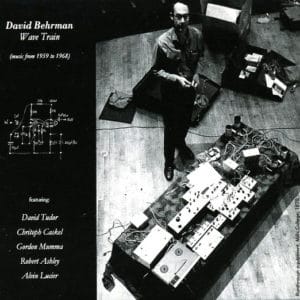
David BEHRMAN
“Wave train”
New remastered CD edition of David Behrman “Wave Train” CD, featuring Sonic Arts Union. A digipak CD with David Behrman experimental music from 1959 to 1968. “The CD starts with the short piece called “Canons” a product of a 3 weeks stage in Darmstadt (summer 1959) featuring David Tudor on piano and Christoph Caskel playing percussions. ’Ricercar’ is a prepared piano piece made in 1961 and has the flexible form of the kind favoured by European composers in the early 1960s, but also reflecting the work of Cowell and Cage. “Wave Train” (1966) marked the moment when something radical happened, in which established techniques were thrown away. A powerful feedback piece live performed with Gordon Mumma. “Players with Circuits” (1966) is an exploration of raw materials, here a combination of live electronics and amplified acoustic sound. “Sounds for a Film by Bob Watts” for outdoor environment recording and homemade synthesizer, was recorded at Stony Point, the artists’ cooperative which John Cage, David Tudor, Sari Dienes and other friends had established. The last piece, “Runthrough” was made for performance by members of the sonic Arts Union: Alvin Lucier, Gordon Mumma, Robert Ashley and, of course, David Behrman; two of them working the dials and switches of homemade synthesizers, and two others distributing sound in space with homemade photocell mixers; Time Records released a different version of this piece in 1969. All others are previously unreleased. The edition includes a 12 page booklet”.
15,00€
Out of stock
CD
Charlotte MOORMAN
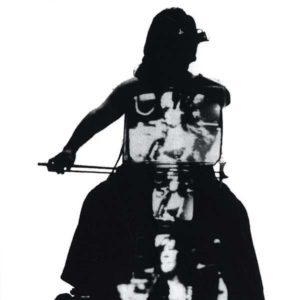
“TV cello”
Of the famous “TV Cello”, conceived by Nam June Paik for Charlotte Moorman as a living sculpture, this CD offers an in-situ recording released on one of the three days inaugurating the Paik retrospective at the Museum of Contemporary Art in Chicago, on the 11th, 12th and 14th September 1982.
This version contains respectively the “TV Cello Duets” with Paul Garrin and the “Concerto for TV Cello and Videotapes”, largely improvised, including a tape collage by Ornette Coleman prepared for Charlotte, also talking with audience.
Charlotte Moorman World Music Theatre!
One of the four Charlotte Moorman CDs originally included in the “Cello Anthology” box, now individually available for the first time.
This version contains respectively the “TV Cello Duets” with Paul Garrin and the “Concerto for TV Cello and Videotapes”, largely improvised, including a tape collage by Ornette Coleman prepared for Charlotte, also talking with audience.
Charlotte Moorman World Music Theatre!
One of the four Charlotte Moorman CDs originally included in the “Cello Anthology” box, now individually available for the first time.
15,00€
In stock
CD
Charlemagne PALESTINE
“CharleBelllzzz at Saint Thomas”
HelllszzzBelllszzz!
alga marghen proudly presents “CharleBelllzzz at Saint Thomas”, a CD in tri-folded digipak sleeve including the original Bells Studies by Charlemagne Palestine. Sixth chapter of the “Golden Research” series, these previously unreleased tracks are both some of the earliest recordings by Charlemagne and some of his darkest and most accomplished works ever.
“Bells Carillon” and “St Thomas Bells”, both recorded at unidentified dates between 1966 and 1968, are maximal bells pure resonating frontal attacks, building up in a structure that is already anticipating the later Strumming campaigns. Unique and clashing dissonances created like a spontaneous outburst, “instinctively” and “right away”. Charlemagne played the bells right next to his body. The sounds became physical, visceral, each crack of the clapper was like a small earthquake.
In 1963 while attending the high-school of music and art in NYC, 15 years old Charlemagne Palestine was asked if he’d be interested in playing a carillon with 26 bells at Saint Thomas Episcopal Church down the street from the Museum Of Modern Art. Charlemagne decided that he loved these voluptuous Taylor bells, high up in a tower and accessible only by a spiral staircase, that clanged all over 53rd Street and 5th Avenue… every day of the week from 1963 to 1970 when he left NYC to study and teach at CAL Arts.
Charlemagne soon became known as the “Quasimodo” of Midtown NYC, and his dissonant and “klanggdedangggebannggg” style of playing attracted a diverse group of fans from Moondog to John Cage to Tony Conrad among others. Charlemagne Palestine was able to continue to play his clanging bell soap operas for seven years dinggdonggingggg every late afternoon and sunday mornings!
World premier edition of these legendary seminal works!
alga marghen proudly presents “CharleBelllzzz at Saint Thomas”, a CD in tri-folded digipak sleeve including the original Bells Studies by Charlemagne Palestine. Sixth chapter of the “Golden Research” series, these previously unreleased tracks are both some of the earliest recordings by Charlemagne and some of his darkest and most accomplished works ever.
“Bells Carillon” and “St Thomas Bells”, both recorded at unidentified dates between 1966 and 1968, are maximal bells pure resonating frontal attacks, building up in a structure that is already anticipating the later Strumming campaigns. Unique and clashing dissonances created like a spontaneous outburst, “instinctively” and “right away”. Charlemagne played the bells right next to his body. The sounds became physical, visceral, each crack of the clapper was like a small earthquake.
In 1963 while attending the high-school of music and art in NYC, 15 years old Charlemagne Palestine was asked if he’d be interested in playing a carillon with 26 bells at Saint Thomas Episcopal Church down the street from the Museum Of Modern Art. Charlemagne decided that he loved these voluptuous Taylor bells, high up in a tower and accessible only by a spiral staircase, that clanged all over 53rd Street and 5th Avenue… every day of the week from 1963 to 1970 when he left NYC to study and teach at CAL Arts.
Charlemagne soon became known as the “Quasimodo” of Midtown NYC, and his dissonant and “klanggdedangggebannggg” style of playing attracted a diverse group of fans from Moondog to John Cage to Tony Conrad among others. Charlemagne Palestine was able to continue to play his clanging bell soap operas for seven years dinggdonggingggg every late afternoon and sunday mornings!
World premier edition of these legendary seminal works!
15,00€
In stock
CD
Charlemagne PALESTINE
“In-mid-air”
The first electronically generated sounds that Charlemagne Palestine ever heard came from the machines he encountered in ordinary daily urban life. Machines like the refrigerator electric motor, or electrical generators; but it was especialy the sounds of motion (race cars, motorcycles, war planes, rocket ships) that first excited his sonic imagination as a young teenager. Then he heard the elctronic music of Tod Dockstader, Pierre Henry and Pierre Schaeffer, the famous ’Podme Electronique’ of Varese, Xenakis and ’Gesang der Junglinge’ of Stockhausen. He immediately reacted buying a cheap reel to reel tape recorder, cutting and pasting recording tape and making collage sound experiments. Then, one day, Charlemagne Palestine experienced at an electronic music studio what electronically produced sounds waves looked and sunded like through an oscilloscope and he began studying Helmholtz’s on the sensation of tone. He started dreaming of an expressive continuous evermoving, everchanging sound form; an enormous sonorous, 3-dimensional sculptural canvas in mid-air using electronically produced sounds. The first experiments were done with simple sine tone generators emitting the purest sound waves without any overtones. With access to more complex systems the sound was constructed using the sine/sawtooth/square wave oscillators in a fluid everchanging mix of adding or filtering overtones and white niose to create sonorities constantly changing timbres and weight. Five early electronic compositions including ’Sine Tone Study’ (1967); ’Open Closing’ (1968), created through speed alterations of ’Holy 1+2’; ’Seven Organism Study’ (1968); ’Negative Sound Study’ (1969) and ’Timbral for Pran Nath’ (1970). Late night electronic sonorities created on the Buchlas 100 & 200 systems available at the New York University Intermedia Centre. All compositions previously unreleased. 3-folded digipak cover with original photos and liner notes written by the composer.
15,00€
Out of stock
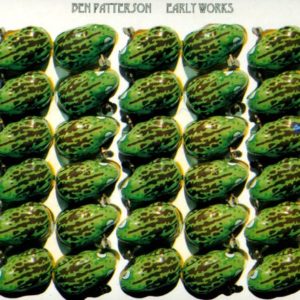
CD
Ben PATTERSON
“Early works”
Alga Marghen proudly presents the first record ever produced by Ben Patterson: ’This is not only my first CD, but also the first recordings of these works available to the general public.’ Starting as a virtuoso double-bass performer of classical music, Ben Patterson was one of the very first founders of the Fluxus Group in Wiesban. This digipak CD will introduce you to some American neo-avantgarde music classics, a crossover between John Cage exploding influences and the experimental art atmosphere of the early 1960s in Europe. The compact disc program includes two essential 1961 documents: ’Duo For Voice And A String Instrument’ and ’Variations for Double-bass,’ both recorded in concert at the Galerie Parnass in 1962; this event has special historic significance in that it included the first public presentation by George Maciunas of his Fluxus manifesto and plans for the Wiesbaden Fluxus Festival. ’Duo’ was Patterson’s most ambitious and lost attempt to combine graphic notation and chance operations for the realization of a performance score, while ’Variations’ represents the moment when, unexpectedly, out of some unknown place, something new entered the process -- humor! The other three tracks were recorded in Milano especially for this release; for this purpose a collaboration was asked to Philip Corner, Walter Marchetti, Davide Mosconi and a few more friends. These newly recorded pieces include ’A Simple Opera’ (1995), a repetitive hommage to Emmett Willons on his 70th birthday; ’Paper Piece’ (1960), the work that cut the umbilical cord to all of the author’s previous classical and contemporary musical training and experience, and ’Pond’ (1961), a piece that reminds of Richard Maxfield’s electronic music with voice collage. The edition includes a fold-out 16 page insert with original scores and photos.
15,00€
In stock
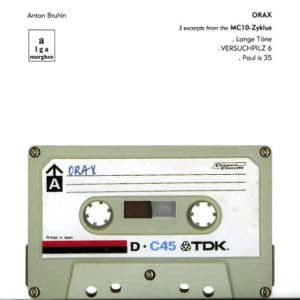
CD
Anton BRUHIN
“Rotomotor”
The new compact disc by Anton Bruhin issued by Alga Marghen is titled Rotomotor and covers two different areas of the artist’s research. The first one is represented by a group of works including the short and mysterious environmental recording ’Orax’ as well as ’Lange Tone’, ’Versuchpilz 6’ and ’Paul is 35’, three excerpts from the epic ’MC-10 zyklus’ created between 1976 and 1977 recording various layers of sound sources on two cassette recorders with loudspeakers. The complete zyklus consists of 12 different episodes (each one ten minutes long) which investigate the multi-layer ping-pong recording technique; the spatial illusion of the monoaural replay which moves away from the listener’s ears into the depth of space. Far away sounds coming from a cosmic dimension or from an abyssal space, moving fore and back. The loss of sound quality considered as stoned space improvement. ’r o t o m o t o r: ein motorische Idiotikon’, the title track, is a 28 minutes long reading, one of Bruhin’s major works. Rotomotor is a poetic Idiotikon of the swiss-german dialect where, instead of the straight alphabetical order, the words are organised according to the similarities of their letters (each word differ from the previous one by just one letter). For this reading a delay equipment which repeated the signal after 0.6 seconds was used and each word is superimposed to the echo of the preceding one. On one hand this echo generates the rhythm of the performance, on the other it supports the acoustic metamorphosis of the words. Again, a very simple concept perfectly accomplished. What results from the whole program is maybe difficult to describe, maybe more easily perceivable in a state of alternate consciousness. But surely a quite unique sense of acoustics approach; so no surprise to see him mentioned in the mythical Nurse With Wound reference list. Chance meeting in an Alpine chalet of a roto-Bruhin and an Akre.
15,00€
Out of stock
CD
Anton BRUHIN
“Vom Goldabfischer”
“The new compact disc by Anton Bruhin issued by Alga Marghen is titled Vom Goldabfisher and presents for the first time on cd the classic experimental folk recordings with the same title first issued on LP in 1969.”
15,00€
In stock
CD
N.A.D.M.A.
“Paura”
“NADMA was officially born between August and the beginning of September 1972 during the time spent in a little village in the Tuscan-Emilian Apennines. The identity and musical orientation of the collective centered on the convergence of heterogeneous interests and sentibilities coming from avant-garde jazz experiences liberated by post-free curents, from classical studies, or from musicians also active as visual artists, who had cultivated an instrumental practice utilising spontaneous expression. All the group members assimilated and creatively incorporated the most progressive influences of Afro-American music and the contemporary neo-avant-garde, but shifted noticeably in the direction of the contemplative and ecstatic vitality of non-European, especially African, musical cultures. The Natural Arkestra Da Maya Alta was, and still is, known to a limited group of devoted listeners on the merits of the only record released by RCA in 1973. The group, which represented one of the most innovative entities among the collectives of improvisers active in those years, perfectly expressed its musical virtues in a limited number of periodic live events. The concerts took place mostly in Milan during 1973-74. The CD starting this series, “Paura”, is named after the first track of the NADMA concert at Circolo Lepetit in Milan in March 1973, presented here in its entirety. In this concert, the very first live concert preserved on tape, NADMA already performs a well-established repertoire, integrating and expanding upon the material of the RCA LP. Davide Mosconi himself documents the aesthetic and existential horizons of NADMA in a typed text and handwritten notes presented here, which also include biographical data about all members of the group. The 16 pages booklet also includes and essay by Gabriele Bonomo as well as orignal documents and photos.”
15,00€
In stock

CD
ARIHA BRASS QUARTET
s/t
Axel Dörner trumpet. Franz Hautzinger trumpet. Mazen Kerbaj trumpet. Carl Ludwig Hübsch tuba. Recorded (on the 20th and 21st of november 2013). Artwork & design by Mazen Kerbaj.
15,00€
In stock

CD
“A” TRIO
“Music to our ears”
Mazen Kerbaj, trumpet. Sharif Sehnaoui, acoustic guitar. Raed Yassin, double bass. All music improvised by Kerbaj, Sehnaoui, Yassin. Recorded, mixed and mastered by Fadi Tabbal at tunefork studio on the 29th and 30th of september 2010. Artwork & design by Mazen Kerbaj.
14,00€
In stock

CD
SPILL
“Stockholm syndrome”
Magda Mayas, piano. Tony Buck, drums. All music by Magda Mayas and Tony Buck. Track 1 recorded live by teemu korpipää at kiasma theatre, helsinki, on the 12th of november 2010 during the äänen lumo festival for new sounds. Track 2 recorded live at nasjonal jazz scene, oslo, on the 20th of october 2010. Mixed and mastered by Tony Buck. Artwork & design by Mazen Kerbaj.
14,00€
In stock

CD
Stéphane RIVES
“Much remains to be heard”
All music by Stéphane Rives (soprano saxophone). Recorded in october 2007 at Villa Bustros, Beirut. Recording, mixing and mastering by Stéphane Rives.
“In my first solo record, Fibres (on Potlatch), the physicality of sound - meant in both dimensions of physics and corporality - made the listener instantaneously captive of the predominant high-pitches, the density of the textures and the stretched durations. It offered to hear a work in progress, where the assumed presence of labour took part in the process of the music itself, putting in question the very act of listening by forcefully imposing its occupation of place and time. For instance the process created by the combination of mechanical and acoustic factors proper to the saxophone could bring the totality of desired random events, but paradoxically also had the negative effect of constraining the sound field into a space that is very difficult to mould. Guided by this paradox, I was first drawn towards extending the duration of the solo to exhaust it’s intrinsic possibilities, but the repeated experience of live situations lead me to a transformed problematic. This new solo presents itself less as a continuity of Fibres, but rather as an "introspection" of the elements present there, emancipated from their agglomerated state. The progressive discontinuous density of this piece gives silence a its role of quasi existential questioning yet liberating the listener from its apparent formalism, allowing him to relocate his listening in a space and a temporality that is his own. This autonomy pushes, I believe, towards an increase of tension and expectation. This solo is neither an improvisation nor a composition. The sound elements created through improvising are not ordered according to a premeditated composition, but rather by a shaping of intuitions derived from concert experiences. The piece was built in a natural and continuous equilibrium where sounds seem to generate one another within their structural components - intensity, dynamics, duration, stability, thickness…” Stéphane RIVES - Beirut, January 2008
14,00€
In stock

CD
Nicholas CHRISTIAN-Matt MILTON-Eddie PREVOST-Bechir SAADE
“A church is only sacred to believers”
“Recorded on sunday 17th of june 2007 at Atomic studio London by Tim Adams. Mixed and mastered by Marc Codsi. Artwork and design by Mazen Kerbaj. Spontaneity is not mere impulse... It does not imply undeliberated behaviour or feeling. Spontaneity is behaviour, feeling and thought that is free of external constraint, of imposed restriction. It is not an an uncontrolled effluvium of passion and action. Insofar as the individual removes the fetters of domination that have stifled her or his self-activity, she or he is acting, feeling and thinking spontaneously. [...] Spontaneity does not preclude organization and structure... [It] ordinarily yields non-hierarchichal forms of organization.” Murray Bookchin, On Spontaneity and Organization, 1972. (quoted by Maurice Brinton in Solidarity Pamphlet 49, December 1975)
In 1999 I took part in the Guelph Jazz Festival Colloquium in Ontario, Canada. During this festival I presented a key-note talk, played some drums and presented some ideas in a music ’clinic.’ After my practical demonstration and discussion with the audience, LaDonna Smith a violinist and an improviser of long-standing, enquired whether I offered this ’workshop’ practice on a regular basis. To which I replied that I did not. To which she responded by saying that I should. On the long flight home from Canada to England I began to reflect upon LaDonna’s words. And, finally I resolved (given I was reaching a - let us say - maturer period in my life) that such an initiative might have some merit. I made myself the promise that I would start a workshop devoted to improvisation with an emphasis upon what I think of as an ’experimental’ kind. The promise included the caveat that I would continue to do this until people stopped coming. With the initial help of the London Musicians’ Collective I found a place to hold a weekly session in central London and, mostly through the grape-vine, people began to arrive. Nine years later they are still coming. And, I suppose it means that I will have to continue. But contrary to whatever vision I had of any outcome, the experience of being involved in the Friday night improvisation workshop in London has produced innumerable, unmeasurable and unexpected outcomes. Not least being meeting with some very remarkable people. For at the date of this CD, some three hundred people have been to this workshop, representing over twenty different nationalities. So, it is not particularly surprising that half of this ensemble are non British. Bechir Saade is from Lebanon and Nicolas Christian is from France. What is surprising however, is the seriousness of the engagement. For in this most informal and fragile of musical forms, in which the musicians are searching and simultaneously reviewing new sounds and new configurations and responses, it would be a surprise if there were no doubts about this practice and numerous failures. But of course, negotiating failure (whatever that might be!) can be the route to other kinds of success (whatever that might be!). One thing of which I do feel certain however, is that in an enquiring and open-minded engagement, of the kind that characterizes improvisations such as on this CD, requires the development of an unconventional intelligence. In the looking for new sounds and new musical (and social) relationships the mind accesses (and maybe thereby enhances) a cognitive fluidity. For to make music of meaning for the moment the musician has to go beyond what is understood as the ’musical’. Paradoxically, the ’notion of music’ is perhaps an inhibiting factor in making music. Music for the world at large had perhaps become a fixed idea and often institutionalised. Possibly forms of music have become kinds of a church that is subtly alluded to in this title for the CD. Whether or not we too are creating a church may be an open question. Certainly the way we work, individually and together, suggests and encourages methods and an ethos very different from any other kind of music I know of. If it is becoming ’a church’ (and co-incidently the weekly London workshop takes place in the school room of a Welsh Chapel), then it is extremely open and tolerant of all approaches. All that it seems to abhor is unthinking responses and intolerance itself.” Eddie Prévost - 30th September 2008
14,00€
In stock

CD
Mike COOPER – Chris ABRAHAMS
“Trace”
Veterans experimental musicians Mike Cooper (originally from the UK, now living in Italy) and Chris Abrahams (from Australia) first teamed up as a duo in Sydney in 2005 to record the album Oceanic Felling Like, released in 2007 on Australian label Room40 to critical acclaim. Their second album Live In Sydney was recorded in April 2009 at a Sydney Improvised Music Association (SIMA) concert in the Sound Lounge of Sydney University, and released on Turkish improv music label Re:Konstrukt in late 2009. Trace, the duo’s second studio album, was released by Lebanese experimental label Al-Maslakh in April 2014, during the 14th edition of the Irtijal Festival for improvised music. Mike Cooper, electroacoustic guitar, effects. Chris Abrahams, piano, organ and electric piano. All music improvised, recorded and mixed by Abrahams and Cooper in Sydney, Australia on the 9th of April 2009. Artwork and design by Mazen Kerbaj. Inside drawings by Mike Cooper.
14,00€
In stock

CD
Christine SEHNAOUI – Michel WAISVISZ
“Shortwave”
Edition of 500 numbered copies. About the recording : Christine Sehnaoui and Michel Waiswisz, met in Sweden in September 2006 when they performed a trio with percussionist Sven-Åke Johansson (this music can be heard on the Beirut-Ystad / Olof Bright CD16/17). They kept on working together until the present days whenever that was possible. The highlight of their collaboration could be several full days of recording at the famous GRM studios in Paris at 2 different periods during the year 2007. Selecting the music that you will hear on this CD has surely been the hardest part of the entire process. There was so much interesting and different material available that narrowing them down to an hour seemed an impossible task. There have been as much as 6 different versions of the recording, many of them with no single track in common, and all of them seemed perfect in the moment. The final decision was made after the artists gave the label this responsibility. We hope to have made the most out of the material at hand. About the musicians : Christine Sehnaoui has emerged in a short period as an innovative alto sax player, developing a personal language on her instrument. She has been involved in the Lebanese improvisation scene since its very first hours. Michel Waisvisz is a key figure in the live-electronics scene. He is one of the first live performers on synthesizers and the creator of many instruments, the most famous being the Crackle-Box and The Hands. Shortwave is his first studio recording to be released since the late seventies.
14,00€
Out of stock

CD
COMPILATION
THE GAMELAN OF THE WALKING WARRIORS
A fascinating immersion in the heart of a funeral ceremony live recorded in Bali, where gongs, cymbals, and drums give rhythm to the bewitching atmosphere of this mortuary procession.
The international audience’s interest into Balinese music and its gamelan orchestras dates back to the edition of large ethnographic series in the 1950s, 60s and 70s which largely encouraged the discovery of this music beyond Indonesia’s borders. Taking advantage of a more advanced technology compared to the vinyl golden era, the present field recordings produced in 2011 render at the closest the power of gamelans. They are presented here in two forms. The first one offers a display of Beleganjur music out of the ritual context, which can be differentiated by a more melodic form and a more dramatic and hypnotic aspect of the compositions. The second one presents the Beleganjur style in the ceremonial context of the Ngaben funerary rite in the village of Peliatan. The utmost vitality of these orchestras springs out throughout the different stages of these funerals, and the sound environment surrounding the musicians immerse the listener in the very heart of the procession following the corpse.
With The Gamelan of The Walking Warriors, Akuphone carries on its exploration of ritual and ceremonial music with those materials of rare intensity. These recordings were collected by Vincenzo Della Ratta, PhD in Ethnomusicology from the Sapienza University (Rome). As a specialist of the gongs music from the Austronesian cultures of Southeast Asia, Vincenzo Della Ratta is the author of numerous articles on the subject. His field researches have already been edited as a vinyl entitled Kwangkay: Funerary Music Of The Dayak Benuaq Of Borneo (Sublime Frequencies, 2016).
The international audience’s interest into Balinese music and its gamelan orchestras dates back to the edition of large ethnographic series in the 1950s, 60s and 70s which largely encouraged the discovery of this music beyond Indonesia’s borders. Taking advantage of a more advanced technology compared to the vinyl golden era, the present field recordings produced in 2011 render at the closest the power of gamelans. They are presented here in two forms. The first one offers a display of Beleganjur music out of the ritual context, which can be differentiated by a more melodic form and a more dramatic and hypnotic aspect of the compositions. The second one presents the Beleganjur style in the ceremonial context of the Ngaben funerary rite in the village of Peliatan. The utmost vitality of these orchestras springs out throughout the different stages of these funerals, and the sound environment surrounding the musicians immerse the listener in the very heart of the procession following the corpse.
With The Gamelan of The Walking Warriors, Akuphone carries on its exploration of ritual and ceremonial music with those materials of rare intensity. These recordings were collected by Vincenzo Della Ratta, PhD in Ethnomusicology from the Sapienza University (Rome). As a specialist of the gongs music from the Austronesian cultures of Southeast Asia, Vincenzo Della Ratta is the author of numerous articles on the subject. His field researches have already been edited as a vinyl entitled Kwangkay: Funerary Music Of The Dayak Benuaq Of Borneo (Sublime Frequencies, 2016).
14,50€
Out of stock
CD
Thomas LEHN-Marcus SCHMICKLER
“Navigation in hypertext”
“Lehn and Schmickler’s 1st recording BART is considered one of the best synth improv albums ever made. Since BART, dating back to 2000, the duo has toured frequently through Europe, Japan and the USA.This double-release, features some of the best performances the duo recorded over the course of 15 live concerts. A brilliant amalgam of the two musicians’ strengths, Navigation im Hypertext utilizes both improvisation and studio postproduction techniques to create a lasting work, combining the feel of a classic composed electronic music record with the raw, crackling energy of a free improv-session. Exciting and destabilizing, Navigation im Hypertext will surprise even the most hardcore Lehn fan : intertwined with Schmickler’s, his art never sounded this rich. If anything, Navigation im Hypertext takes electronic improvisation one step further. The arrangements range in tone from softer clusters of sound to more abrasive movements.” (label info) Comes in digipack, CD-only release.
12,00€
Out of stock

CD
Marcus SCHMICKLER – John TILBURY
“Timekeepers”
Ten years after their “variety” CD, A-Musik presents the brilliant second release by John Tilbury (piano) and Marcus Schmickler (computer). Recorded in January 2012 at Loft, Köln, mixed in December 2014 at Piethopraxis.
13,00€
Out of stock

CD
Marcus SCHMICKLER-John TILBURY
“Variety”
Musical events which are more or less alien to each other meet in a wide and harmonically differentiated space, which is explored in different directions. Briefly, they communicate - only to seperate again. Diverse actions form a clearly discernable foreground: the piano provides flageolets and piccicati, slow arpeggi and feldmanesque figures which move through the space supplied by the computer sounds while, at the same time combining with these. From time to time, little events rear their heads as if posing a question. A mutual pulse is an altogether rare occurance. The piano’s harmonic figures meet with computer sounds unexpectedly within a slowly changing acoustic environment. Piano pixies sing and dance serenely in a virtual space while the noises from the instrument insitage dialogues with the computer. The music ist tranquil, never aggressive and is at almost every moment polyphonic in the good old sense of the word. Pretty often, the two musicians play on two different planes so that in spite of the slowness of the whole thing, the resulting complex relationships offer a lot of surprises. Once the listener has become engaged in this process, he/she will remain so and become ever more curious. The sureness and the tranquility which emanats from these musical actions, figures, shapes and processes, acknowledges and asserts the ghost of Morton Feldman, who seems to hover benevolantly over these sounds: stop asking questions.” Johannes Fritsch (2005)7,5010,0012,00
A-MUSIKAllemagneMarcusSCHMICKLER“Wabi sabi”a 3CDVersion CD. “Wabi sabi” (1995) et “Param” (1995), deux pièces de musique électronique réduites à la stéréo du CD où Marcus Schmickler sculpte avec finesse et délicatesse les fréquences dans un flux abstrait et continu sous le regard de quelques êtres sonores.“Wabi Sabi is a staggering sounding, beautifully packaged and simply significant contemporary electronic album by marcus schmickler out of the thriving german underground music scene. schmickler has one release under his own name on the odd size label in france, and was a contributing member of pol and kontakta on the same label. most recently he released the exceptional pluramon pick up canyon album on the mille plateaux label (which featured the guest drumming of jaki liebezeit). this cd consists of two pieces: wabi sabi" -- a devastating 33 minute 2-channel spatial composition that mixes gorgeous flowing electronics ala francois bayle with moments radio-static density and transcending sound waves. "param" is a shorter work of 2-channel, powerfully droning electronics. "the pair of terms wabi and sabi are expressions of an attitude towards life that draw the power of artistic creation from silence and decay.”
12,00€
Out of stock

CD
TARAB
“Take all the ships from the harbour, and sail them straight into hell”
“The title to this album from Tarab (nee Eamon Sprod) is striking enough in its allusions of damnation, with a watery grave a potential outcome from human activity impacting the earth. So, it may be stating the obvious that the corroded locations where mankind has scarred the surface of the earth feature prominently in the work of this Melbourne based sound artist. The residual elements of these sites become the agents for metaphor and allegory in Tarab’s work, documented through field recording and sympathetic actions with found objects from those sites. One such location that features prominently in Take All of the Ships... is Angel Island in the San Francisco Bay. Once the home of an immigration station at the turn of the 20th Century and later a Nike Missile site for the US military, Angel Island now rests in the hands of the US National Park Service, which has left some of the buildings to succumb to the forces of decay. From the sounds culled from this site and others closer to his antepodean home, Tarab diligently overlays and stiches together a highly tactile composition with very little digital treatments to speak of.Take All of the Ships... opens with an ominous rumble whose frequencies appear to emerge from the center of the Earth and liquefying the surface upon impact. As these tones ebb and flow, Tarab unveils as revolving series of exaggerated details from a hyperbolic gash of two heavy pieces of metal grinding against themselves to a toxic chorale of nighttime insects to sand, wind, and surf detourned into sedimentary white noise. Tarab’s compositional sensibility shifts throughout the album, at first sparsely situating these sounds into shadowy vignettes. Gradually, Tarab coalesces this sublime opus into an arcing crescendo which exhibits sustained harmonics rarely heard in the best of the contemporary dronemusik technicians much less from the realm of sound ecology.”
12,00€
In stock
CD
Kiko ESSEIVA
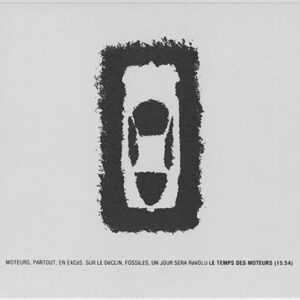
“Le temps des moteurs”
Three pieces of musique concrete. Unnerving and at times eerie soundscapes, a soundtrack of disquiet.
“Esseiva is a composer of musique concrete sound collages. Into the melting pot goes a fine blend of electronics, field recordings, recordings from around the house and a bit of instruments, of which I recognized the piano mostly. These sounds are probably processed in some way or another and layered together in a very fine way. Mostly these sounds are stretched out quite a bit and superimposed on each other; maybe Esseiva uses a bit of time stretching, maybe loops, I am not sure of either (or both) and acoustic elements are looped on top; sometimes they are cut out abruptly and something else happens. In ‘Amplitudes Des Serpents’ this is done with some delicate and excellent quality. It is a very mysterious world that he pictures in this piece of shimmering sustaining sounds versus acoustic loops. That is a great piece, but so are the other two. Here we have mild noise passages, slightly distorted organ sounds and looped field recordings. This is an excellent release”. (FdW in Vital)
7,00€