
In stock
LP
Phill NIBLOCK – Anna CLEMENTI – Thomas STERN
“Zound Delta 2”
A new piece by minimalist / experimental composer Phill Niblock (1933 – 2024), co-composed and performed by Anna Clementi & Thomas Stern. Intense, menacing layers of thick drones and alien sounds.
In summer 2022, within just a few weeks and by pure coincidence, 2 proposals regarding Phill Niblock albums arrived: one suggesting an overdue vinyl reissue of a CD release (more on that when the time has come for it), the other email was from Anna Clementi saying she and Thomas Stern were working on new pieces that Phill Niblock has written for her … when „Zound Delta 2“ was complete, Phill sent photographs for the two artworks, we met twice to discuss details, but unfortunately he died unexpectedly early january this year so the album now is, sad as it is, a posthumous release … an intense goodbye from one of 20th century most iconic composers.
Anna Clementi: voice
Thomas Stern: slide guitar, bass and soundprocessing
20,50€
In stock

LP
Richard PINHAS & RG ROUGH
“End of the line”
Richard Pinhas (creator of the legendary French band Heldon) is a key figure in the development of the treatment of rock music with electronic music. Together with the French-English multi-instrumentalist RG Rough, they create a soundscape emblematic of today's psychedelic rock.
20,00€
Out of stock

LP
Kathy ACKER & NOX
“Love, Emily”
The restored and remastered vinyl reissue of a sound performance by American writer Kathy Acker and French noise/experimental band Nox, published in 1987, with a poster and a previously unpublished set of documents, letters, texts and photos.
Originally released in a long sold-out edition of 50 cassette tapes, Love, Emily (Acte 3) was the third and final album of Michel Henritzi's industrial label AKT Production. Recorded in a Paris studio in 1987, this 25-minute collage of spoken word and noise saturations intersects two radical voices from literature and experimental music of the time: American author Kathy Acker reading excerpts from her book My Death My Life by Pier Paolo Pasolini, and Nox, mainstay of the French noise and industrial scene. Pulled from oblivion, restored and remastered for vinyl by Slow Moves, this archive gem crosses the clashing worlds of poetry and industrial music, melding Acker's thought-provoking words to absolute and inflexible industrial sounds. A lot of it is noise, but a lot of it is also play; research for a new mystique, generating unusual forms and unknown languages.
Published in a limited edition of 400 copies, this vinyl also comes with a long printed panel of previously unpublished photographs and letters from Kathy Acker, tracing the background exchanges that led to the collaboration between the groundbreaking writer, Henritzi and Nox, a poster of Kathy Acker with French translations and a download code featuring both music and extra archival material (interview and articles).
25,50€
In stock

LP
Michel HENRITZI
“Flowers Of Romance”
Listening to Harold Melvin & The Blue Notes’ “Wake Up Everybody”I get a sudden striking flash of Michel Henritzi at work. To me Michel is first and foremost a working man, be it in Dustbreeders the Metz originating so called “noise” outfit, or in his collabs with a wide and varied range of Japanese comrades such as Tetuzi Akiyama, Fukuoka Rinji and of course Junko, always retaining his name as the anchor point of a free man. Freed from the salaried workers yoke, the worker can claim his own name, Michel Henritzi; and paint the world and its ugly oppressive separation morphing into the future of an indescribable liberation. It takes time to do so and the work unravels here over 2 full sides recorded in a live situation. Against the “abat faim” (Guy Debord in “the Encyclopedia of Nuisances”) of canned music the work of Michel Henritzi creates a lived in situation that, in praxis, embodies the grinding destruction of exploitation and the struggle against it. Michel Henritzi works as Penelope hunched over his tool, a lapsteel, protected by his workers cap which is also a military attribute. When the work is done is it now made possible to be done again, always different, unlike mass produced commodities it is the work of a sole man working within the frame of a disjointed society, trying to weave it back together.
Michel Henritzi - Lapsteel & effects.
17,00€
In stock

LP
Anne GILLIS – Jac BERROCAL – Vincent EPPLAY – Timo van LUIJK
“Si()six”
Several years of mutual appreciation and encounters on- and off-stage have been the root of this chance meeting, resulting in an unplanned mysterious collaboration album where the aura of each individual is augmented by the magic osmosis of united forces. The 12-tracks display a collage of dreamy musique concrète with desolate instrumental and vocal interventions, masterfully balanced out by Vincent Epplay.
Anne Gillis: words, voice, noises
Jac Berrocal: words, voice, trumpet
Vincent Epplay: field recording, percussion, Synthi AKS
Timo van Luijk: sounds, strings
24,50€
In stock

LP
ANIMA MUSICA & R. CARLOS NAKAI
“Atlantic Crossing”
The strange thing about the music of Anima is that it’s often considered as strange, while it’s actually very natural. It has a free spirit, analog to nature. For this release the natural spirit is strengthened by the participation of indigenous American flute player and composer R. Carlos Nakai who did a series of concerts in the US and Europe with Paul and Limpe Fuchs in the 1980’s. As with almost all Anima work, the natural feel manifests itself not only by the musical approach but also through sounds generated by natural materials as metal, wood, stone and air, and of course the absence of electronic devices. This LP is a reissue of a rare privately released cassette from 1988 and was recorded by the Bayerischer Rundfunk. May this slice of timeless free spirit be a trigger to more awareness concerning our decaying freedom.
Performers: Limpe Fuchs, R. Carlos Nakai, Paul Fuchs
Recorded by Bayerischer Rundfunk at Münchener Freies Musikzentrum, October 8, 1988
22,00€
In stock

LP
Anne GILLIS
“Aha”
Since more than 40 years, Anne Gillis has discreetly unfolded her proper singular universe without any compromise. She playfully moves with determined restrictions, excavating contrasting forces; sensual and visceral, mechanical and organical, black and white, … She extends this personal expression in her visuals using self-portrait photos, handwritten text and her theatrical performances are equally aligned with this spirit. Her music can be considered as musique concrète using the tape machine as compositional tool, manipulating her recorded sources, mainly consisting of extended voice and different (instrumental) sounds with addition of electronics and treatments. In both her photography and her music, Anne Gillis works fully analog.
24,50€
In stock
LP
Mark GLYNNE & Bart ZWIER
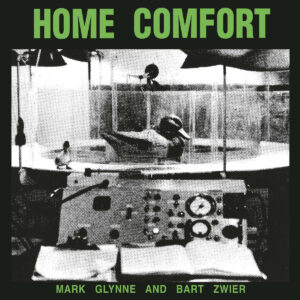
“Home Comfort”
Small 2024 repress.
Very pleased and grateful to announce this ‘Home Comfort’ reissue by Mark Glynne and Bart Zwier, originally self-released in 1980.
Maybe a bit of an unexpected title to appear in the LSD catalog but my love for this album goes back to my late teenage years and has had an addictive effect since, like a spleen infused magnet.
With this album Glynne and Zwier, based in the Netherlands and connected to the Ultra scene, drew an insular blend of intimate post-punk and chamber (bedroom) songs with surreal scenic reflections. Probably its naked singularity defying categorization has left it so unnoticed, even 43 years after the making. It also features a reciting Marlène Dumas still quite unknown at the time.
With biggest gratitude to Mark Glynne who instantly felt confident with my proposal to reissue this silent witness of lasting beauty.
My long time Japanese friend You Ishihara (White Heaven, The Stars) who bought the LP when it came out in 1980 still considers it as one of his all-time favourites. This is what he writes about ‘Home Comfort’:“Resignation and fear in a desolate mental landscape. This album, which exists like a shelter for those who have quietly escaped through the backdoor of the world, vividly reflects the inner depths of the devastated Amsterdam of the early 80’s. A beautiful and sad, unmistakable masterpiece.”
22,00€
Out of stock

LP
Laurel HALO / Jessica EKOMANE
“Octavia / Manifolds”
Laurel Halo: Octavia
Octavia, a piece for piano and electronics, explores the relationship between melodic motifs and textures in a singular way, intermittent moments of melody, harmony and sound materials connecting and disconnecting, to indicate a series of nets or webs, swaying in and out of one another. These sonic nets gently float, spin and merge, and the effect is one of gently floating over an abyss. The work is inspired by the “spiderweb city” of the same name in Italo Calvino’s Invisible Cities: “Below there is nothing for hundreds of feet: a few clouds glide past; further down you can glimpse the chasm’s bed....Suspended over the abyss, the life of Octavia’s inhabitants is less uncertain than in other cities. They know the net will last only so long.”
Jessica Ekomane: Manifolds
Entirely computer-generated, Manifolds is a work that explores the multiple possibilities of polyphonic writing, extending it to the “multiphonic” universe where sources and timbres diffract themselves in the listening space. The different voices of the composition no longer follow the traditional parallel trajectories of musical dialogue, but find themselves propelled as if into a particle accelerator, a “collider” freed from all formal rhetoric to reach a state of liberation of energies that is truly confounding. It is then that, in the multi-layered universe of sonic electrons, as if against its own will, a “chant” of overwhelming humanity is revealed.
—François J. Bonnet, 2023
23,00€
Out of stock
LP
Maria BERTEL & Nina GARCIA
“Knækket Smil”
In an exhilarating convergence of sonic exploration, experimental noise guitarist Nina Garcia and danish trombone virtuoso Maria Bertel have teamed up to create a heavy-hitting, collaborative record that pushes the boundaries between extreme improvisation and harsh noise. Both renowned in their respective fields, Garcia and Bertel bring their unique styles and influences to create a masterpiece of collaborative improvisation.
Known for her fearless approach to the guitar and her ability to conjure otherworldly sounds, Nina Garcia has carved a niche for herself in the experimental music scene. With a minimal setup consisting of only guitar, pedal & amp, constantly touring, collaborating and evolving, Garcia has established herself as a trailblazer, challenging conventional norms and redefining the possibilities of the guitar beyond tonality. There‘s as much free improvisation in her playing as it is informed by no wave and the energy of free jazz, but most of all, this is kinetic music.
And this might be the intersection where Garcia and Maria Bertel meet.
Bertel, an accomplished trombonist active in the free noise rock monolith Selvhenter and in the duo Gud Er Kvinde (God Is A Woman), is no stranger to pushing the limits of her instrument. Known for her dynamic performances and innovative approach, Bertel has earned international acclaim for her ability to seamlessly blend genres and traverse musical landscapes - from delivering the low end in Selvhenter to the drone explorations of G.E.K., or joining the Vladislav Delay Quintet on stage - together with Nina, she focuses on rhythmic possibilities of her instrument. The distorted, feedbacking trombone is as controlled and precise as it is sonically explorative.
KNÆKKET SMIL (meaning „broken smile“) is a living, breathing, moving entity. It‘s a testament to the raw and emotive power of these two players. Bertel and Garcia‘s practice of mutual listening, reacting and merging is as radically tender as lovers exploring each other‘s scars.
This approach to collaboration is also reflected in every other part of that record. It‘s a joint effort of three labels, french label No Lagos, which is a home to many of Garcia‘s ventures (and the graphic work of Helene Marian), germany‘s Otomatik Muziek, where Maria perviously released with G.E.K., and belgian experimental stalwarts Kraak as focal point.
25,00€
In stock
LP
Giuseppe IELASI
“Rhetorical Islands”
First vinyl edition of the album Rhetorical Islands, originally released by Giuseppe Ielasi in 2012 as a limited-edition CD on his Senufo Editions label, with recordings made in 2011 as a commission for l’Audible Festival, Paris.
The album’s ten tracks have neither titles nor accompanying text, standing for themselves as what Ielasi himself has called “isolated sound worlds”. They are nonetheless unparalleled in their plasticity, acoustic events with a rare degree of tangibility. Ielasi evokes physical objects, some of which seem to have been constructed out of paper and cardboard, others based on a mechanics of elastic materials. Of course these objects are hallucinations, and precisely because Ielasi constructs them so masterfully there’s no need for any further information. Here’s to everyone creating their very own sculptures while listening to Rhetorical Islands!
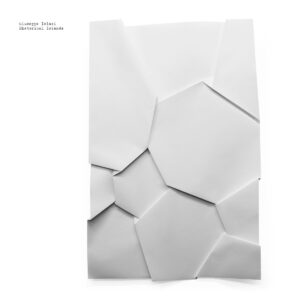
The front and back cover features 0.058, a work on paper by the artists Thomas & Renée Rapedius. They make sculptures whose form and artistic inspiration are defined by their materials. Like Ielasi’s acoustic islands, their impact derives from self-referentiality, resulting in paradoxical objects that embody both a detailed material study and a potential for free association.
24,50€
In stock
LP
Hanno LEICHTMANN
“Outerlands”
A quietly influential figure among electronic and experimental circles since the late 90s, Berlin based sound artist Hanno Leichtmann has been developing a sprawling and idiosyncratic vision both as a creator and curator.
With a keen sense for charting new territories, Leichtmann's work spawns a multitude of languages that go from delicate ambient excursions to techno explorations or abstract sceneries on numerous sound installations, releases on such esteemed labels like Entr’acte, Karl Records, Arbitrary or The Tapeworm and collaborations with artists like Valerio Tricoli or Jan Jelinek. A reflection of his keen sense of discovery.
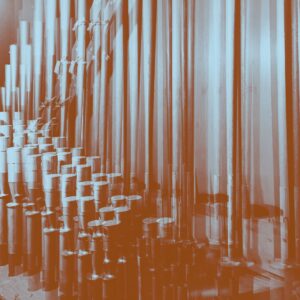
Centered around the Villa Aurora Organ, an intriguing and mostly unknown instrument built in 1928/29 by the Artcraft Organ Company in Santa Monica, California, 'Outerlands' presents a deeply personal approach to the instrument's particular properties, very much in line with Discrepant's ethos. Consisting of a pipe organ, a wall mounted marimba and a two octave tubular bells/chimes ensemble, remotely controllable by MIDI, the Villa Aurora Organ's rich palette of sounds is translated into 12 short tracks capable of conveying the mesmerising spirits of minimalism, exotica and devotional music.
Starting with the ecstatic sound of the pipe organ, 'Lucero' sets up the hypnotic mood for 'Outerland's excursions through moments of spiralling repetition - 'Tramonto' -, blissful contemplation - 'Sunset' or 'Notteargenta' - or underlying tension - ‘Coperto’. 'Espera' amps up the unease, with queasy organ tones lurking beneath marimba harmonic motifs that wouldn't sound out of of place on some survival horror movie, while 'Miramar' or 'Revello' bring an uncanny sense of familiarity through its repetitive melodies. Drifting seamlessly through a variety of moods that somehow feel connected - the outerlands are within you, if you allow yourself to let go.
25,00€
In stock

LP
NPVR
“33 34”
NPVR is the avant garde duo made up of the late Peter Rehberg and Nik Void. Editions Mego is proud to present their second and final release. No this is not some kind of Beatles synthetic AI that raises the dead reconstructed recordings but rather a new album made by the humans and their machines.
The initial meeting of Rehberg and Void was in London in 2016 and despite or due to their mutual awkwardness found solace and compatibility in the fact that they both had a similar electronic modular set up, along with matching cases to transport all. The idea to collaborate was an obvious and organic process as a means to connect their individual gear together and observe the outcome. The fruits of these initial experiments, recorded in London, resulted in the playful experimentation of their acclaimed 2017 release 33 33 (eMego 251).
Now in 2024 Editions Mego presents the logically titled follow up, 33 34. These sessions were recorded six months after the initial recordings at Peter’s home in Vienna. This was planned out as a mirror city release to the original London recordings. With Peter having access to his full studio set up this time around we encounter a rich audio landscape which organically folds together a variety of musical genres blurring any distinction between these forms so the resulting music hovers as a new cloud of sound. Any musical form, be it industrial, electro-acoustic, ambient, drone and techno all coexist and melt into the other as the ensuing result unveils a hypnotic swarm of divergent sounds (music). When active there were no lines or contexts with NPVR, either between sound or genre within these recordings or live where NPVR were at home playing at a techno club one night and an avant garde venue the next.
The initial session of these recordings was edited by Rehberg and sent to Void to further develop. Over time the final versions were agreed on and then shelved as other outside projects took over. The awkwardness had been surmounted and the two had become close friends. NPVR performed at a range of venues such as Tresor, Sutton House, Corsica, Blitz, Paris GRM #Focus2, LEV Festival and Rigas Skanumezs Festival. Following Rehberg’s untimely passing Void had difficulty listening back to the sessions but eventually thought it fit to complete and release this album, of which even the artwork (like 33 33, an image from Zurich photographer, Georg Gatsas) had been decided upon prior to Rehberg parting ways.
There is an unmistakable joy to these recordings. One encounters an enthralling exploration of their chosen machines which conveys the excitement of what can be randomly conjured when people speak through such devices. There is no grand statement or argument here, just the sheer thrill of creation and the recorded results of random encounters. The art of collaboration was always a mainstay of Rehberg’s practice from the advent of the MEGO adventure. Rehberg & Bauer was an initial collaboration with former business partner Ramon Bauer. Even at this stage one can hear a relaxed sense of delight in the sheer discovery of sound.
A mix made for the Wire magazine following the release of 33 33 hints at the freedom that comes with endless urge for exploration and discovery. Abstract tracks from Z'EV. Jérôme Noetinger and Jung An Tagen are included alongside British stalwarts The Fall and New Order. There were no lines between pop / academic / underground or mainstream in Rehberg’s world. All of it sat at the same table. It is just matter in the atmosphere, like the diverse exploration found in these recordings that comprise 33 34.
Towards the end of his life Rehberg was obsessing over the immense output of the German ambient musician Pete Namlook. An artist renowned for not only his sprawling catalogue of ambient masterpieces but one who often said his main inspiration was nature. This is apt with regards to the work of NPVR which also aligns with such thought as the intertwining of the two individual artists and their machines results in a natural symbiotic flow, as it happens, just like in the world around us.
24,50€
Out of stock
LP
COMPILATION
“Five Spanish Pioneers of Electronic and Experimental Music: 1953-1969”
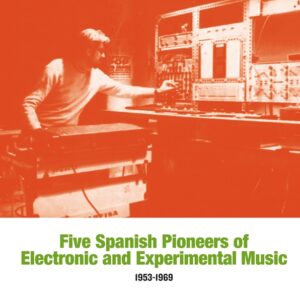
This LP reveals the extraordinary diversity of research -- almost all hidden -- by Spanish musicians in the '50s and '60s. Those pieces were composed while the country was under the tyranny of Francisco Franco. It is truly the ultimate grail, developed by musicologist Miguel Álvarez-Fernández: he is its curator, editor and commentator. This undoubtedly marks a major step in the approach and understanding of this music which had to fight to exist before the death of Franco in 1975. Miguel Álvarez-Fernández (Madrid, 1979) is a writer. He hosts the weekly radio broadcast Ars Sonora -- dedicated to sound art and experimental music, and offering hundreds of freely available podcasts on Radio Clásica (Spanish National Radio). Five Spanish Pionniers of Eletronic and Experimental Music aims to present five composers who most often work outside the rules and without the possibility of help from their own country. Jose Val del Omar (1904-1982) is essentially a creator, a filmmaker developing a dreamlike art -- not without links with Federico Garcia Lorca or Luis Buñuel. Eduardo Polonio (b. 1941) has published, in forty years, more than a hundred works. Josep Maria Mestres Quadreny (1929-2011) joined the Manuel de Falla Circle in 1952 and in 1974 he founded the Laboratori de Música Electroacústica Phonos. During his life he collaborated with Joan Miró and Antoni Tàpies. Juan Hidalgo (1927-2018) participated in the music festival XII Internationale Ferienkurse Fur Neue Musik in Darmstadt in 1957. The following year he met the American composers John Cage and David Tudor. A member of Fluxus, in 1966 he participated with Gustav Metzger, Otto Muehl, Wolf Vostell, and Hermann Nitsch in the Destruction in Art Symposium in London. Cristóbal Halffter (1930-2021) was soon considered one of the most important composers of his generation. As a lecturer at the Internationale Ferienkurse für Neue Musik in Darmstadt, he worked with Pierre Boulez, Karlheinz Stockhausen, and Luciano Berio.
16,00€
In stock

LP
COMPILATION
“Funeral Gongs Ceremonies in Ratanakiri, Cambodia”
Those recordings of gongs orchestras were produced in 2003 and 2004 during funeral ceremonies in two Kung villages and one Jaraï village in Ratanakiri province, Cambodia by Laurent Jeanneau (Kink Gong), during a time when the jungle had not been replaced by rubber plantations. Focusing on funeral ceremonies, these hypnotics pieces are intense and haunting sonic experiments.
16,00€
In stock
10"
Joe COLLEY
“Acting As If”
*** 2022 release ***
Joe Colley is a master of using mechanical object sounds and electronic static, but also strange lo-fi found sources and field recordings, creating alienating, surrealistic effects, similar to the likes of Small Cruel Party, Jim Haynes, Das Synthetische Mischgewebe, or even the more experimental side of Zoviet France.
His newer compositions are filled with electro-magnetic hummings, strange hissing and the pourings of metallic objects as a basis, but you never find the use real instruments, synths, or masses of effect procession. Thus a very own scent of mystery appears, as all of these radiations are not really from this planet, without any "cosmic" connotations.
For the creator, these sounds are connected with unreal emotions of "Being Lost", a mistrust in what may be called reality, and a general feeling of alienation. You can only wonder how this can result in such beautiful droning expanses. Through these strange 30 minutes of drones, the mind is thrown inside an unrecognizable and confusing realm of broken electricity and something like audible-made atmospheric pressure.
"His swarming masses, throttled rumbling, and smoldering tension are all encircling and folding in on themselves. Rhizomes of sound that speak poison. Drink up, if it doesn't kill you, it will only make you stronger" (Jim Haynes). Ltd x 300 copies with artwork by MEEUW, featuring special silver print on reverse board sleeve.
18,00€
Out of stock
LP
WERKBUND
“Scalpafloi”
From Discogs: "Enigmatic industrial/experimental band from Hamburg, Germany. The sound deals mainly with marine tales and myths from Northern Germany. So far it is not known who the artists are. It has been guessed that Felix Kubin and Uli Rehberg and other artists from Hamburg might be involved. Some people speculate that both Werkbund and Mechthild Von Leusch involve the collaboration of Asmus Tietchens and Uli Rehberg, though Asmus Tietchens has repeatedly denied any participation in the band."
The presentation once again suggests a maritime theme, immersed in mythical-historical fog, as we know it from all previous publications of the project.
25,00€
Out of stock
LP
COMPILATION
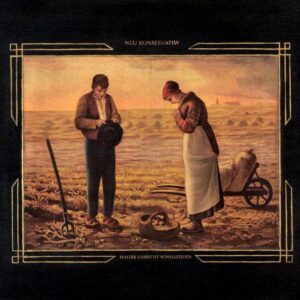
“Neu Konservatiw”
2024 stock
Originally released to celebrate the 33rd anniversary of Walter Ulbricht Schallfolien back in 2015, Neu Konservatiw comes in a beautifully designed sleeve with insert and postcards. The album features two unreleased Asmus Tietchens tracks plus other exclusive contributions by Werkbund, Column One, Evapori, Hyph, Pierce Warnecke, Ditterich von Euler-Donnersperg and Margitt Holzt.
23,00€
In stock

LP
Anne GILLIS
“Vhoysee”
The first Manon Anne Gillis release was a single-sided mini-album titled “Angebiguë”, which was Manon’s self-release in 1983. “Angebiguë” was 6-track mini-album in a cold-minimal-synth vein, and any track from “Angebiguë” were not included in her retrospective 5CD Box “Archives Box 1983-2005”, which Art into Life released in 2015. “Angebiguë” was privately released in tiny edition for her friends only and has been a highly sought-after item among collectors. “Vhoysee” is Manon’s long-awaited new album, and the album collects her latest six pieces and four re-worked / re-mixed tracks from “Angebiguë”. The latest six pieces are physical subject-based composition with minimum elements, whereas re-worked / re-mixed tracks from “Angebiguë” are simple rhythm-oriented pieces with her glacial sound texture. In “Vhoysee”, the past and present are interwoven and linked together in a kind of labyrinth.
29,00€
Out of stock

2 LP
CRANIOCLAST
“Arctic Salon”
Planned in the early 90's executed in the early 20's: The Arctic Salon. Another Cranioclast Expedition, this time to the Pole. A long time between planning and execution, but much shorter than the time between the first fake reports of having reached the North Pole on foot across the ice and the first expedition that really made it without motorization. But also a long time in which things in the Arctic and Antarctic got worse and worse and continue.
Double LP almost completely transparent like ice but hotter or cooler (we hope ;- ).
Cranioclast is a project which produces various artistic endeavours, most commonly music. Active since the 1980ies.
Icy clear vinyl in transparent pvc sleeves with sticker, 300 copies
28,00€
In stock
LP
N & Bu.d.d.A. (Bund des dritten Auges)
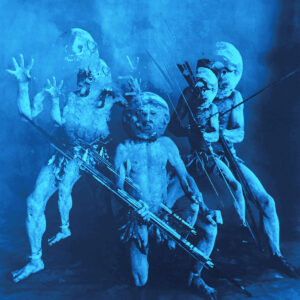
“0hne titel”
Hellmut Neidhardt, Chris Sigdell and Sascha Stadlmeier first met in 2020. They decided to record together and booked a studio in Dortmund. The recording session was spontaneous and somewhat chaotic. Thus it turned out, that only Hellmut’s tracks were really usable. Using some sections as a basis, Chris completely re-recorded his guitar, added a little bit of vocal here and there, and then sent a rough mix to Sascha, who in turn added violin and musique concrete. The final assembly was edited and mixed by Chris Sigdell.
N and Bu.d.d.A. have since toured together, and at three dates even performed as a trio. Future collaborations are a given possibility...
19,50€
Out of stock
LP
Konrad KRAFT
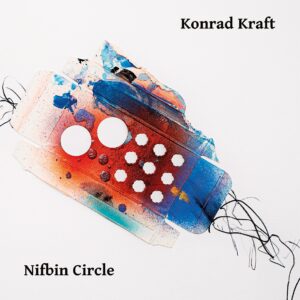
“Nifbin Circle”
Nifbin Circle is the fourth release by Detlef Funder, aka Konrad Kraft, on the Cologne label Aufabwegen.
Sounds generated with two apps on the iPad,provided the basic structures and the sound space. The strangely enraptured textures created in this way, with a subtle percussive touch, were partly combined with supporting beats in the course of further processing. Thus, after more than 30 years, tracks with rudimentary melodies and rhythms were created again.
19,50€
In stock

LP
Robert CAHEN
“La nef des fous”
In the 1970s, Robert Cahen turned to the burgeoning field of video art, where he became a pioneering artist. He was originally trained in musique concrète, his creative background, and joined the Groupe de Recherches Musicales in 1972. The pieces on this record were composed in the GRM studios between 1971 and 1974. They testify to a lively inspiration and imagination combined with a precocious formal mastery that already carries the seeds of later developments, which the artist cleverly and inventively deployed in the field of visual arts. (François Bonnet, Paris, 2022)
--
«La nef des fous» (1974), 12’00
There are pieces of music whose title is obviously a mere label given afterwards to a finished product. And others, on the contrary, which develop in spiral around a bundle of images and impressions condensed into a few words. This is the case indeed with La nef des fous. However, this work by Robert Cahen oddly wraps itself around its title, with bends, breaks, and an impetus driven further every time to close a new circle, for such is the very essence of the spiral. This, at least, is the way I perceive the form of the work, with its theme-chorus which, in part one, both ponctuates and disrupts the emerging musical curve in various ways and at irregular intervals, as well as its broader and more open second part, which closes with a recollection of the beginning of the work. The challenge of a musical form justified by the topic it illustrates, right down to its gaps, its wanderings and its twists, and which would confer upon it the necessity of a profound logic, that of insanity, is the challenge attempted by Robert Cahen. In such a genre as tape music, so careful with respect to form, one can appreciate its audacity. La nef des fous, or Unity through heterogeneity, or Each to their own madness, but all in the same boat. This means that if we can listen to each of these sound characters, “broken chants”, which create the work for themselves, through the singularity of their delirium, we can also, from one to the other, trace the continuous chanting of a music that is inherently and spontaneously poetic, a music that carries “the unconscious under its skin” (Christiane Sacco). (Michel Chion, January 1976)
«Masques 2» (1973), 08’34
Concert version (for tape only) of an audiovisual work entitled Masques, in which the faces of old dolls and «masks», filmed during the Basel Carnival, were projected in 16mm. Masques 2 is a metaphorical version of Masques in which music is featured in its arcane musicality.
Through its concrete and suggestive music Masques 2 aims to bring to light hidden memories, buried within us, thus enabling an awakening, the resurgence of events from our own history. (R. C.)
«Plurielles» (1971), 08’35
Premiered at the Paris Biennale, 24 September 1971. Suite based on the score of a TV film directed by Sophie Talmon.
«Persona» (1971), 08’34
Premiered at the Paris Biennale, 24 September 1971.
«Passé composé» (1971), 05’29
23,50€
In stock

LP
Horacio VAGGIONE
“Schall / Rechant”
A discreet but essential figure in the field of musical creation, Horacio Vaggione has been crafting an ambitious, precise and highly significant body of work for over the last fifty years, coupled with a demanding research activity. This disc offers four purely electroacoustic pieces which illustrate, each in their own way, this singular and fascinating grammar developed by Horacio Vaggione, a complex but fertile grammar which establishes a very special relationship between structure and texture, between matter and formula, to create a fascinating musical space, made up of polyphonies and metamorphoses. (François Bonnet, Paris, 2022)
--
«Schall» (1994), 07’30
Schall exclusively uses piano sounds sampled and processed with various digital techniques. The sound palette focuses on several shapes of various sizes which reiterate, altered to varying degrees, throughout the process. The granular paradigm is clearly assumed here, as is also that of the interactions between various temporal scales. Basically, there is a concern for the articulation of micro-events. The piece essentially plays with low-intensity frames, composed of various planes and punctuated by stronger objects, in a kind of polyphonic dialogue between proximity and distance. (H. V.)
«Rechant» (1995), 15’51
Initially, a few brief sounds of instrumental origin — percussions, flutes, strings. Processed by means of various digital techniques, projected on various temporal scales, analyzed and re-synthesized, worked in their parts (in their saliences), articulated in their edges as well as in their interactions, these sounds show, as Bachelard would say, «pluralism under identity». I thus tried to compose morphologies by targeting properties contained in the material and by projecting them on temporal perspectives of all sizes. The title, an allusion to the old polyphonic technique, refers to the iterative content of these morphologies as well as to the modalities of their interweaving. (H. V.)
«24 Variations» (2001), 09’50
The word «variations» applies here to the morphological transformations of the material, as well as to the various contexts in which these transformations appear. The result can be heard as a continuous interaction between sound particles of different sizes, composed of several layers, reflecting a preoccupation with detailed articulation spanning different time scales. (H. V.)
«Gymel» (2002), 09’25
In Gymel I tried to compose a space-trajectory using layered sounds, produced by morphological operations (splits, clusterings) that spread out from location to location in variously dense objects. The space was treated through phase-decorrelation, a technique which I use extensively, both to create spaces and to locate sounds and movements within a polyphonic (stratified) context. (H. V.)
26,00€
In stock

LP
Pierre BASTIEN & Mike COOPER
“Aquapelagos Vol.2: Índico”
Presenting the second thematic volume on the »Aquapelagos« series - a collection of split LPs where selected artists offer their own take into water surrounded cultures and communities. After the initial release of the Anthology compilation Aquapelago in 2022 (Discrepant ,CREP91) and the split LP Atlantico by Lagoss & Banha da Cobra (Keroxen, KRXN027) we proudly introduce an unique collaboration in the series in the shape of no other than two improvising giants, Mike Cooper and Pierre Bastien.
This second volume blows the lid wide open with a sound journey inspired by the equally majestic and mysterious Indian Ocean, a wide space of open ocean bounded by Africa, to the west, Asia to the north and north-west and Australia, to the south west.
From Philip Hayward and Matt Hill’s liner notes:
»The album opens with Return To Chagos by emphasising human presence in the oceanic space, opening with gentle percussive taps and distant looped male vocalisation that gradually come into sharper focus, layered and thickened, accompanied by thicker percussion and mouth harp. The sense of departure is taken up in Trincomalee, which lifts over the oceanic textures, opening with slow, struck and scraped metallic sounds before thick low pitched wind instrument sounds enter, oscillating around shifting microtonal frequencies. The shore returns on Side 2, with the miniature epic of Nicobar elaborated over looped ‘atmos’ sounds of birds and insects over which tonal, slightly distorted electric guitar lines enter before looped high pitched feedback squeals join the texture. Summoning tropical storms and the disruption to the region caused by western intrusion, strong and startling brass accents appear, melding with the looping guitar feedback, creating eeriness and a sense of alarm. Tuangku is permeated by restrained dynamics and an expressive, breathy, low pitched, animalistic melodic voice that offers intermittent and ambiguous utterances, as if rendered in a language essential to and evocative of a place and time but impossible to precisely comprehend – coming from an ocean-aquapelagic beyond that can only be glimpsed and rendered by affect.« Philip Hayward and Matt Hill, March 2022
24,50€
In stock

LP
Jim HAYNES
“Inauspicious”
In a recent interview, the California artist Jim Haynes was asked to name his top five noise albums. In quick fashion, he listed off Kill The King, Send, Desnos, Persona, and Carcinosi. Since then, he's equivocated on which albums to choose, but the artists behind such works remain as the adjacent signposts and landmarks to his own constructions of industrial noise. How those records connect to the output from Haynes is found in their unique combination of smoldering dynamism and psychological inquest. For over twenty five years, Haynes has been an autodidactic clinician into the processes of corrosion, decay, and rust, turning his attention away from visual practices and more to the metaphoric crucible of noise and sound. By now, it seems like a cliche that the pandemic changed everything; but since that viral encroachment, there is a noticeable shift in Haynes' work post 2020. It's more aggressive and yet more controlled: a rarification and telescoping of the research into decay for more potent noise and more potent metaphor.
The tools for Haynes' work remain limited: motors, electronics, shortwave radio, found objects, all applied with considerable pressure. Compositionally, Inauspicious is a very rough moire pattern from overlapping elliptical structures that can negate and obfuscate just as easily as they can compound and aggregate. The album surges and collapses upon the two twenty minute chunks of controlled noise that follow an internal logic that snakes from brooding power drones, spectral radio transmission, and an aktionist demolition cast upon metal, glass, and unfortunate wooden objects. Rupture and release. Purge and pulse.
26,00€
Out of stock

3 LP
Keiji HAINO – Jim O’ROURKE – Oren AMBARCHI
“With pats on the head, just one too few is evil …”
The heavyweight trio of Keiji Haino, Jim O’Rourke and Oren Ambarchi return with their 12th and most epic release to date, the triple LP With pats on the head, just one too few is evil one too many is good that's all it is. Documenting the entirety of their final performance at the dearly departed Roppongi home of Tokyo underground institution SuperDeluxe in November 2018, the music spread across these six sides splits the difference between the guitar-bass-drums power trio moves and experiments with novel instrumentation that have defined the trio’s decade of working together. Containing some of the most delicate music the three have committed to wax since the gorgeous 12-string acoustic guitar and dulcimer tones of Only wanting to melt beautifully away is it a lack of contentment that stirs affection for those things said to be as of yet unseen (BT011), this wide-ranging release also offers up some of their most blistering free rock performances yet.
The side-long opening piece finds Haino on a single snare drum in duet with O’Rourke on unamplified electric guitar, playing in the lovely post-Bailey vein heard on his classic 90s recordings with Henry Kaiser and Mats Gustafsson. Spiky dissonance and ringing harmonics interweave with flowing melodic fragments as Haino single-mindedly explores the resonance of the snare like an untutored Han Bennink. On ‘Right brain, left brain; right, left; right wing, left wing. Just how many combinations can be made from these?’, O’Rourke moves to synth and electronics, joined by Ambarchi on drums, who at first focuses on sizzle cymbals before hypnotic cycles of gentle tom rhythms combine with electronic burbles and flutters to suggest a dream collaboration between Masahiko Togashi and Jean Schwarz. Ambarchi’s percussion is then joined by Haino on wandering, overblown flute, before the man in black switches back to the snare for a bizarre, stuttering drum duet.
For the first trio performance, Haino makes another new addition to his seemingly infinite catalogue of instruments, this time a homemade contraption he refers to as ‘Strings of Dubious Reputation’. Joined by O’Rourke on increasingly spaced-out electric guitar and Ambarchi on skittering percussion, Haino’s wonky, slack strings adds a definite ‘musique brut’ edge to this side-long performance, certainly one of the most enchantingly odd in the trio’s discography. When the group reconvene for the second set, spread out across the final three sides, they seem ready to breathe fire from the first instant. O’Rourke slashes distorted chords on the six-string bass, Ambarchi breaks into his signature irregular caveman thump, and Haino squeals and squawks on heavily delayed oboe before unleashing an overpowering electrical storm when he first picks up the guitar. For over half an hour, the trio pound out one of their most relentless performances, a constantly rearranging kaleidoscope of tortured fuzz guitar, insanely busy bass riffing and propulsive, tumbling drums. A hushed atmosphere initially reigns on the final long piece, given the mournful title ‘There are always things I wish to say but I can only convey them in this language August 6 August 9’. Haino’s clean guitar strumming calls up the shimmering tones of his PSF classic Affection, gradually building to a surging wall of sound, bass and drums lumbering through a roar of jet-engine guitar. Arriving in a deluxe trifold package with photos by Lasse Marhaug alongside inner sleeves with extensive live images, this epic release is perhaps the most remarkable document yet of this unique trio’s stamina and continuing inventiveness.
48,00€
Out of stock

LP
NURSE WITH WOUND
“The Little Dipper Minus Two Plus (Echo Poeme Sequences)”
An editon of 300 copies on marbled green vinyl, in a spectacular Santini sleeve with a full-colour 12'' insert.
Back in 2005, 3 special performances took place featuring Steve Stapleton, Colin Potter, Andrew Liles, Matt Waldron and Diana Rogerson. The gigs were held on 6 & 7 May at The Anatomical Museum / Narrenturm, Vienna (Austria). Each concert was limited to 50 seats. Fun was had. Lab coats optional. To commemorate the event, a limited edition of 200 CDRs was released by ICR and Klanggalerie, only available at the Vienna live shows.
In 2023, ICR re-issued this on CD expanded to include 2 new tracks, adding an extra 54minutes. These 2 tracks were constructed from the original source material with some extra sounds & they have been editied to form the 2 sides of this record.
The download includes the track that appeared on the original CDR edition.
Thanks to Petr Vastl, Amantine, Isabelle, Doris & Walter Robotka of Klanggalerie.
Voices - Amantine, Isabelle & Doris. Recorded at IC Studio, Preston & London, 2005 & 2023 by Steven Stapleton & Colin Potter.
Mastered by Colin Potter at IC Studio.
Photography & graphic alterations by Sarah Redpath
Cover by Santini
28,00€
In stock

LP
MP HOPKINS
“Coupla Triples”
Coupla Triples is a collection of two recordings made by MP Hopkins in 2014. The first piece, "Spins, Groans, Tones," was previously self-released as part of a CDR/chapbook edition, while the second piece "Waves, Feedback, Thoughts," has remained unreleased until now. Both pieces were created using a simple compositional method, in which random word prompts were selected from a list of sounds and "interpreted' in an immediate manner with only basic recording equipment -- a microphone, a tape loop, a voice recorder and an amp. Three sounds, twice. Arranged carelessly but carefully. A coupla triples, nothing fancy. Recorded and mixed on the land of the Gadigal people, Sydney, 2014. Pressing info: 200 copies, black vinyl, A2 poster.
22,50€
Out of stock

LP
Henning CHRISTIANSEN
“Mediterranean Music Water”
Edition of 350 copies, 16 page book. Previously unreleased.
Mediterranean Music Water (Mare nostrum in moedium terrae) Op. 203, a never before issued tape composition, belongs to a body of work embarked upon during the 1980s and '90s connected to Sicily, the other most notable and available being Op. 201 L'Essere Umano Errabando, La Voca Errabando, issued by The Henning Christiansen Archive in 2020. These works were an extension of Ursula and Henning Christiansen's meeting and befriending the Sicily based couple Carlo Quartucci and Carla Tatò, with whom they regularly visited and collaborated. Like its predecessor, the aforementioned Op. 201, Mediterranean Music Water Op. 203 is a conceptualization of abstract theatricality at the connection of place and its relationship to the sea. Performed by Ursula Reuter Christiansen and Henning Christiansen and recorded at a small performing arts theatre in Erice, Sicily -- Teatro Gebel Hamed -- during December of 1991, the abstract for this work reads: "In the morning (after the storm), on the beach. The sea has thrown some things on the beach. Blue light -- some mist? On the ground. Ursula's slides on the wall. Henning is rolling from the background of the stage slowly, very slowly, towards, in a fish net. I come in looking for the things the sea has left and discover him. I roll him out of the net, he's nearly dead, and try to get life in him. Light in the background in rainbow colours. Ursula wears a partlett dress, as a siren." These images lay a foundation and context for the sounds that emerge over the album's two sides, a fascinating conjunction between the power of water and the human spirit. Through the processing of heavy delay and reverb, we encounter the howling utterances of violin tones, vocalizations, and countless unplayable instrumental and non-instrumental sound sources, gathering in a vast and sprawling serious of sonorous expanses that seem to echo the power, movements, and myths tied to the Mediterranean.
24,00€
In stock

LP
Henning CHRISTIANSEN
“Schafe statt Geigen – Verena Vogelzymphon”
Second edition of 250 copies, 20 page photographic book
“I have worked together with sheep before” - says Henning Christiansen - introducing the performance he did in front of the Brucknerhaus in Linz in July 1988. But this time he went beyond, building a “Concert-Castle” with hay blocks where thirty sheep could perform music. Another time the animals - Christiansen’s obsession and passion - become the musical instruments used for his compositions: “Originally most of instrumental sounds derived from animal voices or other sounds of natural phenomena. The violins, for instance: someone found out that stretched intestines, dried bowels, could produce a sound. This has simply been civilized, refined”.
Schafe statt Geigen (Sheep Instead of Violins, 1988) and “Verena” Vogelzymphon (Bird Symphony, 1990) first appeared as a small CD edition issued by Galerie Bernd Klüser in 1991. Both works, each one occupying a full side of this LP edition, extend from one of Christiansen’s long standing conceptual strategies - deploying recordings of animals as stand-ins for musical instruments, sheep and birds respectively. While each work allows these source to take the natural lead, at times masquerading as field recordings, both feature subtle tonal and electronic interventions by the composer, creating strange and brilliant compositions which shift the terms and subjects of music as they were long understood. Accompanied by a twenty page booklet featuring drawings and texts by Henning Christiansen, as well as pictures of the performance by René Block.
“The background, the space where music happens is what I want to put into the foreground.”
24,00€
In stock

LP
Giovanni Di DOMENICO
“Superlike”
Giovanni Di Domenico has now achieved a personal and unmistakable style within contemporary minimalism. His music always expresses a state of concentration, of recollection and contemplation toward a focal node. Repetition is experienced as alchemical state, as truth contained in the small nuances of change, in a crescendo that never reaches a climax. The atmosphere is intuition and is made up of a few compositional touches. To compose is to make synthesis, to unearth purity, simplicity and exactness. This new work for solo piano is almost an imaginary novel... the notes seem to tell of deserted streets, lonely walks in the night or runs down stairs. In this sense the musician is the writer of silence and the fleeting moment. And so, amid slow chords like Chopin or Satie, moods oscillate between brio and allegro, evoking the lightness of love, greater sadness and melancholy, as well as more restless and agitated ostinatos, the product of a more cathartic worldview.
21,50€