
In stock

LP
Felix KUBIN
“Der Tanz Aller”
Felix Kubin’s Der Tanz Aller is an energetic, rhythmically charged soundtrack created for the performance of the same title by the experimental arts collective LIGNA. The group specialized in site-specific, participatory works. Der Tanz Aller is based on Rudolf von Laban’s radical 1920s concept of ‘Bewegungschöre’ (movement choirs), collective dances in public space that aimed to reimagine social order through shared movement. Combining minimal electronics, acoustic percussion, and brass, Kubin’s compositions reflect both the experimental spirit of Laban and the political charge of mass choreography, inviting listeners to become dancers themselves.
22,50€
In stock

LP
STILLUPPSTEYPA
“Schokolino Choco Loco”
As I sit down to pen these words for Stilluppsteypa's latest vinyl release on the enigmatic Futura Resistenza label, I find myself jumping back a year or two, reminded of the profound impact this Icelandic ensemble has had on the northern landscape of experimental arts for four decades. Emerging in the early 1990s, Stilluppsteypa began their journey as a punk-oriented band with multiple members. However, their insatiable curiosity for the unconventional soon led them to explore more abstract and electronic terrains as a trio consisting of Heimir Björgúlfsson, Sigtryggur Berg Sigmarsson, and Helgi Thorsson. These Icelanders crafted sound experiments that were uniquely their own, defying the easy categorization and shaped by the distinct longitudes and latitudes they together called home.
Stilluppsteypa's early works, such as Reduce by Reducing (1998), showcased a dadaistic and multi-layered approach to sound sculpting that stood proudly apart from the existing trends of the era, such as Mille Plateaux and its contemporaries. By the time of albums like Not a Laughing Matter But Rather a Matter of Laughs (2000) and Stories Part Five (2001), the group had further solidified their reputation for crafting intricate sonic tapestries that continue to challenge and intrigue listeners drawn to the more abstract.
After Heimir’s departure around 2002, Sigtryggur and Helgi decided to continue as a duo, delving even deeper into the core of abstract and joyous electronic music. Their collaborations with artists such as Benny Nilsen, Melt-Banana and others resulted in critically acclaimed entities, such as Vikinga Brennivin (2005) and Drykkjuvísur Óhljóðanna (2006), celebrated for their innovative approaches to sound and spot on composition.
Now, with this new piece of wax on Futura Resistenza—a Brussels-Rotterdam-based label known for its eclectic, unpredictable, and forward-thinking catalog—Stilluppsteypa continues its admirable mission as the reliable workhorse of European experimentalism, pushing the boundaries of sound to infinity.
Without a shred of hesitation, I can say that the group's whimsical ap
preciation for chaos—the natural state of the universe—positions their music as a true beacon for a kinder future. The entirety of Schokolino Choco Loco stands as a testament to their commitment to embracing unpredictability, celebrating the disorderly beauty and humor that lies within chaos itself.
As you place the needle on the thang, please prepare yourself for a hazy trip through the sonics. These Icelanders invite you to embrace the unexpected — and like nice people they are, they gently give a welcoming smooch to your forehead while at it. Stilluppsteypa's music is not just to be heard but to be experienced, to be tasted, to be touched by.
Welcome to the Boundless Joy that arises when artists dare to venture into the uncharted.
28.1.2025, Pori, Finland
Juho Toivonen
21,00€
In stock

LP
Jules REIDY & Sam DUNSCOMBE
“Edge Games”
Although Berlin-based musical seekers Jules Reidy and Sam Dunscombe are friends who’ve worked together in numerous contexts over the last decade or so, Edge Games is their first, long overdue collaborative album. Over two expansive, mind-bending excursions the former’s microtonal guitar lines are woven into a gorgeously unstable mass of synthesis, field recordings, and clarinet produced by the latter, but it’s important to note that the recording process was deeply collaborative, with a rigorous yet generous back-and-forth between the duo’s sympathetic aesthetic tendencies. As Dunscombe earnestly jokes, “Think of it as being written by Jam Dundy, a synthetic person who exists when our powers combine.”
In recent years Dunscombe has pursued an adaptation of what she calls a “post-Romanian-spectralist idea of ‘Mass Plasma Synthesis,’” building a thick morass of churning sound from literally thousands of clustered sine waves that creep around using a set of pitch relations, only to be deftly subverted. It’s one of the many ways the project illuminates the album title, creatively and playfully straddling and skirting different edges. This decision gives that crushing din a delicious instability, “a sort of uncanny valley between the linear and the cyclical (the sacred and the profane),” as Dunscombe says. Reidy, playing a custom-made guitar with adjustable frets built by Berlin instrument maker and designer Sukandar Kartardinata, embraces the illusory dichotomy between static and active in the dense electronic foundation with ornate microtonal lines that alternately float atop and burrow within the churning tumult.
22,50€
In stock

LP
JEUGDBRAND
“3 × hullo, hullo”
"Somewhere beneath the meticulously trimmed lawns of conventional music, a mole is digging. “Huuh, there’s a little mole coming up!?” A small upheaval of dirt, a sudden rupture in order - this is "3 × hullo, hullo", the latest sonic burrow from Jeugdbrand, a project where the absurd meets the sincere, where the intuitive gestures of Dennis Tyfus (piano, organ, vocals, tapes) and Jeroen Stevens (percussion, melodica, organ) are reinforced by the magnetic disruptions of Sigtryggur Berg Sigmarsson (tapes) and Gerard Herman (loops). It is music that tunnels through genres, scattering soil in every direction, finding freedom in the subterranean.
From the first moments of "3 × hullo, hullo", there is a sense of slow, deliberate emergence - an unfolding, an unearthing. The mole, that ridiculous, poetic little blind worker, is an apt metaphor. “The creature is practically blind. In its head, a pair of eyes perfectly fit for the darkness it is usually stuffed in. Under the surface, there is no light, only smells and sounds.” And that’s exactly how this record operates: an exploration of textures and echoes, of lo-fi transmissions and improvisatory impulse, guided not by vision, but by feel.
Take, for instance, the sprawling “Tomorrow, Tomorrow? I’m Talking Now, Forget About It!” - a title that could be mistaken for an argument in a café, but here unfolds as a loose, almost dreamlike cascade of erratic tape loops and detuned keys, like an old radio losing its grip on the signal. There’s an air of miscommunication, of conversation gone slightly askew. The record often seems to speak in tongues, slipping between fractured melodies, fleeting drones, and the occasional unexpected utterance, as if someone left the microphone on during a séance.
Then there’s the insistence of the title “There’s No Word for Ambient in Dutch”. An ironic observation? A challenge? Or simply a statement of fact? Whatever the case, the track itself is anything but passive - its shifting textures and delicate pulses refuse to settle into the expected. Much like a mole scraping through earth packed too tightly with cement, the sounds on this album navigate a world increasingly resistant to improvisation."
Chain DLK magazine
Jeroen Stevens – Percussion, Melodica, Organ
Dennis Tyfus – Piano, Organ, Vocals, Tapes
Sigtryggur Berg Sigmarsson – Tapes
Gerard Herman – Loops
21,00€
In stock

LP
Arvo PÄRT
“Silentium”
Clear vinyl.
*
Four pieces by Estonian composer Arvo Pärt, a pioneer of “holy minimalism.” The album centers around a never-before-released rendition of “Silentium,” the second movement of Pärt’s most famous concerto, Tabula Rasa, performed by Boston-based chamber orchestra A Far Cry. The group plays “Silentium” at nearly half the speed of the best-known version, released on ECM in 1984. The piece, known for its healing properties for the dying and often used in palliative care facilities (one patient famously called it “angel music”), is breathtaking at half speed, seemingly stilling time itself.
The album compiles some of the most stunning renditions of Pärt’s music ever recorded. “Vater Unser (Arr. for trombone & string ensemble)” is somehow warm and austere at once. A miniature epic. Pianist Marcel Worm’s solo version of “Variationen zur Gesundung von Arinuschka” is as beautiful as anything we’ve ever heard. “Fratres for Strings and Percussion” is one of Arvo Pärt’s most celebrated works. The Hungarian State Opera Orchestra’s version is iconic, filled with emotional playing right on the verge of overly romantic, but never tipping over.
Pärt’s approach to both music and life is as sparse as the compositions he creates. He once said, “I have nothing to say… Music says what I need to say. And it is dangerous to say anything, because if I’ve said it already in words there might be nothing left for my music.” Silentium continues Mississippi Records’ fascination with this great contemporary composer
26,50€
Out of stock

LP
Kara-Lis COVERDALE
“From Where You Came” (clear)
From Where You Came unspools as a series of nocturnal transmissions, altered-state refinements, and vivid stories, rich in vibrant, illuminating qualities. Indexing 19th century programmatic music, mid-’70s jazz, and a distinctively colourful and multi-dimensional approach to composition that embraces improvisation, Coverdale alloys synthesis with live instrumentation in a gesture of reconnection with land and body through sound. Approaching composition as a diagnostic methodology to spiritual ends, she conducts emotional resonance like currents of charge, hard-wiring the purely felt into electronic signals.
Though written and recorded on several continents, including at the GRM Studio in Paris and the Elektronmusikstudion EMS in Stockholm, From Where You Came was completed in rural Ontario, Canada. Featuring contributions from multidisciplinary sound artist and cellist Anne Bourne and trombonist Kalia Vandever, the album’s 11 expansive yet condensed compositions incorporate strings, woodwind, brass, keys, software and modular synthesis, inscribing a musical language that resonates animations with unfiltered, striking clarity. Coverdale's own voice melts into air amidst the enveloping swell of the album’s opening prelude: “Everything you know is real,” she sings on “Eternity,” “I’m sorry, life is beautiful… .” As though in response, oscillating vividly between animism and animalism, the album that follows is brimming with life in all its stunning complexity.
Reckoning with the experience of grief, dislocation, and the pressure of total freedom and independence, Coverdale yields supernatural capacity to alchemize tribulation into highly imaginative and inspiring fantasy epics of sound. In the piloted flight of “Daze,” wind choruses dance and twirl in ornate punctuated cycles as dissonant portamentos annotate modulatory ascent to soaring heights, gliding and churning across turbulent gails to new pockets of harmonic plateaus, stabilizing periodically through rhythmic gait for rest. It feels like the joy of flight. In other spiritual quests, sound becomes a feat of physics; physical and subterranean, material, and even destructive, amongst highland drone figures in “Freedom.” Melancholic restlessness and will-summoning entrench furtive flurries of energy on “Coming Around,” skittish, tacit, and reluctantly yearning chimes illuminate a granular “Problem of No Name,” and ecstatic, messy-haired catharsis blurts release through the drummed sample-based sequences of “Offload Flip.”
Each new narrative finds rootedness in a changing environment, giving a sense this is ecological adaptation made into music, as a way to navigate being in the world. Speaking directly to the rootlessness and alienation of modernity while processing the thrill and pain of being alive, From Where You Came draws immense strength through a commitment to material groundedness, from where we are able to view the scale of our own mythology, the worlds we want to build, and the stories we are determined to tell.
25,00€
In stock
LP
Kara-Lis COVERDALE
“From Where You Came”
From Where You Came unspools as a series of nocturnal transmissions, altered-state refinements, and vivid stories, rich in vibrant, illuminating qualities. Indexing 19th century programmatic music, mid-’70s jazz, and a distinctively colourful and multi-dimensional approach to composition that embraces improvisation, Coverdale alloys synthesis with live instrumentation in a gesture of reconnection with land and body through sound. Approaching composition as a diagnostic methodology to spiritual ends, she conducts emotional resonance like currents of charge, hard-wiring the purely felt into electronic signals.
Though written and recorded on several continents, including at the GRM Studio in Paris and the Elektronmusikstudion EMS in Stockholm, From Where You Came was completed in rural Ontario, Canada. Featuring contributions from multidisciplinary sound artist and cellist Anne Bourne and trombonist Kalia Vandever, the album’s 11 expansive yet condensed compositions incorporate strings, woodwind, brass, keys, software and modular synthesis, inscribing a musical language that resonates animations with unfiltered, striking clarity. Coverdale's own voice melts into air amidst the enveloping swell of the album’s opening prelude: “Everything you know is real,” she sings on “Eternity,” “I’m sorry, life is beautiful… .” As though in response, oscillating vividly between animism and animalism, the album that follows is brimming with life in all its stunning complexity.
Reckoning with the experience of grief, dislocation, and the pressure of total freedom and independence, Coverdale yields supernatural capacity to alchemize tribulation into highly imaginative and inspiring fantasy epics of sound. In the piloted flight of “Daze,” wind choruses dance and twirl in ornate punctuated cycles as dissonant portamentos annotate modulatory ascent to soaring heights, gliding and churning across turbulent gails to new pockets of harmonic plateaus, stabilizing periodically through rhythmic gait for rest. It feels like the joy of flight. In other spiritual quests, sound becomes a feat of physics; physical and subterranean, material, and even destructive, amongst highland drone figures in “Freedom.” Melancholic restlessness and will-summoning entrench furtive flurries of energy on “Coming Around,” skittish, tacit, and reluctantly yearning chimes illuminate a granular “Problem of No Name,” and ecstatic, messy-haired catharsis blurts release through the drummed sample-based sequences of “Offload Flip.”
Each new narrative finds rootedness in a changing environment, giving a sense this is ecological adaptation made into music, as a way to navigate being in the world. Speaking directly to the rootlessness and alienation of modernity while processing the thrill and pain of being alive, From Where You Came draws immense strength through a commitment to material groundedness, from where we are able to view the scale of our own mythology, the worlds we want to build, and the stories we are determined to tell.
24,50€
In stock

LP
Beatrice DILLON – Hideki UMEZAWA
“Basho – Still Forms”
The title of this work by Beatrice Dillon is taken from the notion of ‘basho’, developed by Kitarō Nishida, Japanese philosopher and father of the Kyoto school. Kitaro’s ‘basho’ (場所) refers to a fundamental ‘place’ or ‘field’ where things exist and interact. Not just a physical location, but a more abstract space where all experiences, thoughts, and phenomena are interconnected. In Nishida’s philosophy, ‘basho’ is a dynamic, living ground where subject and object, self and world, are not separate but mutually interrelated. Inspired by this, Beatrice Dillon develops a music of a complex nature, that never ceases to constitute itself as pure presentation, constantly re-exposed, reactivating at every moment both the object of attention and the listener who aims at it. Borrowing both its sounds (which have no real origin or internal space) and its idioms from electronic music, Dillon's Basho is a diversion, a rearrangement that places us, through elements that are familiar but suddenly alien, back into a field of pure listening.
—
Still Forms, by Japanese composer Hideki Umezawa, draws its sound material from the exploration of Baschet sound structures, instruments developed by the brothers Bernard and François Baschet in the 1950s that have since been highly prized by the world of contemporary musical creation. These structures were presented at the 1970 Osaka World’s Fair, and some remained in Japan. Through various recording sessions, in Japan but also in France, Hideki Umezawa re-explores the fascinating sonic potential of these atypical instruments to include them in a highly mastered composition where sounds of acoustic origin and electronic textures respond to each other, as in the distorted reflection of the resonators of the Baschet structures. Still Forms is thus a tribute to, and a journey through time through, the incredible power of inspiration and invention of these sound structures, but also a sharpened proposal of contemporary electroacoustic composition that knows how to renew itself without denying its origins.
24,00€
In stock

LP
Charlemagne PALESTINE & Seppe GEBRUERS
“Beyondddddd The Notessssss” (Green)
Neon green vinyl (!)
*
In the depths of Geneva’s Fonderie Kugler red-lit-boudoir, stand four grand pianos surrounded by divinities. The two elder Erard brothers are tuned down a quarter tone lower than their neighbours, a twin pair of gleaming and valiant Yamaha’s. Charlemagne and Seppe both sit facing each other, managing the 428Hz tuning from the tip of their left hand, while the right hand controls the conventional 440Hz machine. This four-piano fantasy was born a few years ago, when these two gentlemen met around a carillon, and realised they had a common “passion for unusual tunings and the playing of multiple pianos”. This microtonal duo first premiered at the Bijloke in Ghent (2019), and has since remained slightly concealed until Konnekt provided the little spark to reignite this mystical-keyboard-beast. When the two pianists swap places, during a short moment of inhabited silence, we get a chance to taste what seems to lie beyond the notes. Perhaps the key to appreciating and sharing beauty is magicallyyy mysterioussss after all.
34,00€
In stock
LP
Charlemagne PALESTINE & Seppe GEBRUERS
“Beyondddddd The Notessssss”
In the depths of Geneva’s Fonderie Kugler red-lit-boudoir, stand four grand pianos surrounded by divinities. The two elder Erard brothers are tuned down a quarter tone lower than their neighbours, a twin pair of gleaming and valiant Yamaha’s. Charlemagne and Seppe both sit facing each other, managing the 428Hz tuning from the tip of their left hand, while the right hand controls the conventional 440Hz machine. This four-piano fantasy was born a few years ago, when these two gentlemen met around a carillon, and realised they had a common “passion for unusual tunings and the playing of multiple pianos”. This microtonal duo first premiered at the Bijloke in Ghent (2019), and has since remained slightly concealed until Konnekt provided the little spark to reignite this mystical-keyboard-beast. When the two pianists swap places, during a short moment of inhabited silence, we get a chance to taste what seems to lie beyond the notes. Perhaps the key to appreciating and sharing beauty is magicallyyy mysterioussss after all.
24,00€
In stock

LP
Mark VERNON
“The Dramaturgy of Decay”
Vernon composes a cinema for the ears. Something uniquely textured and immediately present. I think of The Dramaturgy of Decay as a sonic equivalent to the ruined films of Bill Morrison (Decasia, 2002) or Peter Delpeut (Lyrical Nitrate, 1991). I hear the tape, the sound of the medium – and I hear it disappearing – I see the end coming. And yet the disappearance is not tragic. There is a vein of humour gently running throughout the album. For all their eeriness, Vernon’s soundscapes carry with them something comfortingly familiar – something delicate and tender like the Super 8 films of Jonas Mekas.
Vernon has long been fascinated with home-recordings and the urgent poetry of the everyday. On The Dramaturgy of Decay we hear snippets of audio letters, messages left on answering machines (“Pouring From Hollow to Empty”, “The Years Simply Dissolved”). The messages get reworked and rearranged, slowed down and taken apart. Somewhere people are forever clapping, laughing. Tentatively playing the piano. Singing uncertainly. Vernon patiently excavates the real, revealing a soundscape of the forgotten, the buried, the invisible.
Everything in The Dramaturgy of Decay speaks of death – of the irreversible passing of time, of vanishing places and voices – of that which will not return. His work captures the infinitely slow yet resolute movement of erasure, the empty place where something used to be. It also reflects the wider destruction of our environment.
Yet there is no necrophilic impulse here. As Vernon converses with the lost, the transient and the dead, it seems to me he is tirelessly extracting life from them. And he reveals not their deadness but rather the quick, living eternity of instants. The Dramaturgy of Decay is a reflection on time through sound. But, most importantly, it is extremely beautiful music. Not quite of this world and, yet, not of any other world. It is music for the here and now.
Elodie A. Roy, January 2024
22,50€
In stock

LP
Gonçalo ALMEIDA & Pierre BASTIEN
“Dialogues and Shadows”
Among its many qualities, music relies on a special force: transcendence. When we listen, we are placed in a different reality, where sound is a vehicle for a much higher meaning. Naturally, not all music is capable of such a thing. But a few musicians clearly stand above as special – as soon as we hear them, we know that their music flows, floats and transcends.
Dialogues and shadows, the second recording by the duo of Gonçalo Almeida and Pierre Bastien emanates a distinct and intriguing sound from the beginning, inducing our listening toward a world that goes way beyond a succession of notes and timbres. We hear it and it's there, this mysterious matter that touches us. We hear a dialogue, a connection, and a shadow of luminescent presence.
Both musicians are based in Rotterdam, and they share an ethical common ground, with an endless list of collaborations, recordings and the same passion for a music that should always point in new directions. Throughout this recording, we are taken into a conversation where the listener plays a significant and active part. With constant changes in the mechanical instruments and a rich harmonic content of polyrhythmic counterpoint, the duo sets a base for subtle melodic phrases, that appear surprisingly from different sources – Bastien’s pocket trumpet, Almeida’s double bass, or their custom-made instruments and devices. As we listen, we move towards a personal fictional narrative, accompanied by these abstract sonic entities that guide us through the record. Their presence is highly visual too, as our imagination is immediately filled by Bastien’s instruments coming to life along with a multitude of strings played by erratic movements of the bows, almost like a tribal dance from a culture that never existed.
In this strange and beautiful world, we are constantly surprised by the next element that will face us and transcend its physical projection, in an elegant invitation to the unknown. The unknown we seek constantly throughout all our lives. So, let the sound be the light that guides us in our shadows.
— Gustavo Costa
24,00€
In stock

LP
Limpe FUCHS
“Pianoon”
Renowned for her percussion genius, Limpe Fuchs surprises with a rare venture into her classical roots – the piano. Despite her extensive musical career, documented piano performances have been scarce until now. In this album she transcends time and expectation, diving into the instrument's essence. Her rhythmic finesse as a percussionist leaves an indelible mark on each keystroke. Join Fuchs on this intriguing late venture into the world of piano and savour every note on this unique and raw artistic encounter.
24,00€
In stock

3 LP box
Octavian NEMESCU
“Passages … à travers le Temps”
3LP + 8 page booklet in silkscreen printed linen box.
*One of Romania's most important composers in the last half-century, Octavian Nemescu (1940-2020) is among the few that were not "part of the system", managing to survive and compose in a world that felt more and more "empty", fragile, confused and scarce in prophecies. The mystical approach to his art defines Octavian Nemescu as an essentialist who believed in the power of archetypes in which he found inspiration. His pieces always start from an idea that has spiritual, cosmogonic implications and involves synthesizers, samples from nature and the "ison" (drone) inherent in the spectral current. When defining "meta music" or "imaginary music", Nemescu was an advocate of looking from above, from the top of the mountain. Silence is very important in his work in order to keep the sound flowing and to reflect on the sound from before, as a space, as a pause for thinking. Nemescu put forward another kind of music: a song that has not yet surfaced through human voice, any musical instrument, orchestra or other electro-acoustic means: an intimate, interior, introverted inner sound that focuses on the individual and the imagination. Imaginary music is a reaction, it comes in contrast to the spectacular, it is anti-show. For him, music had a ritualistic function, it served no cultural purpose. This 3LP set collects eight pieces for variable ensemble, tape and electronics, composed between 1968 and 2015, selected together with Erica Nemescu, who also mastered the tracks. Most tracks have been previously released on different CD's but never before on vinyl.
110,00€
In stock
3 LP
Octavian NEMESCU
“Passages … à travers le Temps”
3LP + 8 page booklet in offset printed slipcase sleeve.
*One of Romania's most important composers in the last half-century, Octavian Nemescu (1940-2020) is among the few that were not "part of the system", managing to survive and compose in a world that felt more and more "empty", fragile, confused and scarce in prophecies. The mystical approach to his art defines Octavian Nemescu as an essentialist who believed in the power of archetypes in which he found inspiration. His pieces always start from an idea that has spiritual, cosmogonic implications and involves synthesizers, samples from nature and the "ison" (drone) inherent in the spectral current. When defining "meta music" or "imaginary music", Nemescu was an advocate of looking from above, from the top of the mountain. Silence is very important in his work in order to keep the sound flowing and to reflect on the sound from before, as a space, as a pause for thinking. Nemescu put forward another kind of music: a song that has not yet surfaced through human voice, any musical instrument, orchestra or other electro-acoustic means: an intimate, interior, introverted inner sound that focuses on the individual and the imagination. Imaginary music is a reaction, it comes in contrast to the spectacular, it is anti-show. For him, music had a ritualistic function, it served no cultural purpose. This 3LP set collects eight pieces for variable ensemble, tape and electronics, composed between 1968 and 2015, selected together with Erica Nemescu, who also mastered the tracks. Most tracks have been previously released on different CD's but never before on vinyl.
58,00€
In stock

LP
Corneliu CEZAR
“Ziua Fara Sfarsit”
Composer Corneliu Cezar (1937-1997) was a distinctive personality within the Romanian post 1960 avantgarde: a visionary of music, a thinker and a prophet, a richly gifted artist also active with writing, poetry, painting and astrology. Cezar was an activist rediscovering the natural resonance of sound within a different historical context, and he embraced the recovery of authenticity as a reaction against the artificialized culture of serial doctrines. When, after 1975, the spectral music trend became official in Paris, with much fuss and remarkable support from musicologists, nobody knew that this trend had already been practiced by a small group of Romanian composers led by Corneliu Cezar for ten years. The four electro-acoustic pieces on this album (privately released on CD in Romania in 2000), recorded with little means between 1967 and 1975, display the incredibly strong ideas of a truly visionary artist. Everything Corneliu Cezar has done during his short earthly life bares the shade of authenticity.
26,00€
Out of stock

LP
John DUNCAN – SCHEINTOT
“Split LP” [!!damaged cover!!]
Pochette abimée avec au minimum 2 coins pliés.
Damaged cover with at least 2 corners bumped / folded.
John Duncan's "SAXMIX" is one massive piece of contemporary experimental music, which lets noise collide with free jazz and extreme minimalism. Duncan is a master when it comes to these things, and he is an artists constantly evolving, mutating and challenging. The sax thing then? JD has invited some of his fav sax players to collaborate with him; Mats Gustafsson, Antoine Chessex, Martin Escalante, Dror Feiler and Ulrich Krieger. Did I say MASSIVE? Well, it is.
Scheintot is a new debuting trio consisting of Mats Gustafsson (sax/flute), Henrik Rylander (mixing desk) and myself on Korg MS20 which might be my fav synth ever, or right now at least. This is weird stuff. Not sure where this is going but I guess you will enjoy it if you are into stuff we have done before, but this sits comfortably in its own corner, and we are not smart enough to be ashamed over sounding so infected.
Nice cover by Tochnit Aleph boss Daniel Löwenbrück.
Hot stuff, basically!
Joachim Nordwall, November 28th 2024.
Edition: 200 on black/transparent splatter vinyl
Original price was: 20,00€.8,00€Current price is: 8,00€.
In stock

LP
Mats LINDSTRÖM
“Low Fidelity” [!!damaged cover!!]
Pochette abimée avec au minimum 2 coins pliés.
Damaged cover with at least 2 corners bumped / folded.
‘Low Fidelity’ was commissioned by Anna Koch / Weld with support from the Swedish Arts Council for the performance Insisting On. Sneak premiere for Issue Project Room, Saint Vitus Bar, Brooklyn, USA in December 2015. First performance at Weld, Stockholm, Sweden in February 2016.
‘Invocation I’ is an excerpt from a live recording at Inter Arts Center, Malmö, Sweden, January 2017 based on Lindström’s ‘giant electronic feedback set-up.’
‘The True Laptop Quartet’ is named after a set of instruments built on electromagnetic feedback principles. Both the instruments and the piece were commissioned by Bergen Assembly 2016 for Tarek Atoui’s Within project. Track recorded at Sentralbadet, Bergen, Norway, June 2016 with Mats Lindström overdubbing on all instruments. Official world premiere: September 1st 2016 with Tarek Atoui, Espen Sommer Eide, Mats Lindström and Kaya Molsen as the musicians.
‘Light Vessel 21’ was a collaboration with Anna Koch and presented as an A/V installation on board the historic LV21 vessel. LV21 saw most of her service off the Kent coast on the Varne and East Goodwin stations. The piece was commissioned by Töne Festival, Kent, England. World premiere: June 20th 2014.
‘Sotto il Ponte’ was recorded live, with Alba G. Corall on live video, at Huset Under Bron, Stockholm, Sweden in February 2014.
‘Shadow of the Dutchman’ was an overture to the Wagner opera in a version for three pianos and live electronics. The piece was commissioned by Folkoperan, Stockholm, Sweden. Its debut performance was in February 2013.
Original price was: 20,00€.8,00€Current price is: 8,00€.
In stock

LP
Bernard PARMEGIANI
“Lac Noir – La Serpente 1992”
Unreleased material composed by Bernard Parmegiani in 1992. Lac Noir - La Serpente is part of Emmanuel Raquin-Lorenzi's Lac Noir, a composite work inspired by a serpentine female creature or "snake-woman" that he saw in Transylvania in 1976, with a total of 33 pieces using various media, 24 by himself and 9 by other artists. All the materials used in Lac Noir were gathered on the land of the snake-woman between 1990 and 1992. The first coordinated broadcast ran from June to October 2019, like a theatrical display of media.
"At the end of May 1992, in Provence, in his Summer studio not far from the Montagne Sainte-Victoire, Bernard Parmegiani played the first musical moments he had worked on from the sounds he and Christian Zanési had collected in Negreni in October 1990. A few days after this listening session, on 4th June, I wrote him a letter. I didn't mean to take control of what was to become the ninth movement of his composition, but to share with him some of the resonances I had heard in what he had composed, which mingled with my dreams and memories of the Transylvanian snake-woman, and outlined possible concordances with the other pieces underway for Lac Noir. In the midst of the garish chaos of the fair and its spectacular stunts, there could spread out -- still, silent eye of the cyclone -- the long waters of a lake. Calm waters. Patches cool but sensitive as skin. Between the waters there flows and ripples, there shows up and dives again a snake-woman born of the still waters. A sweet, good serpent whose song -- strange and melodious, sensual, yet already tinged, as if bitten by the black depths, with bitterness; that of prescience, shading it with melancholy -- is her very undulation, the rings of which appear, together or in turn, the way translucent veins overlap, slither over one another in a moving braid of metamorphoses." (Extracts from notes by E. Raquin-Lorenzi)
17,00€
In stock

LP
COMPILATION
“Miao Mouthorgans & Other Rare Instruments In Guizhou, Sichuan, China”
"The term 'Miao' is a very ancient Chinese misleading pseudo-ethnic categorization, the Hmong in western languages, a term recognized by colonial French Indochina. Miao became a generic term which does not reveal the diversity of 38 subgroups or 9 million people, mostly in Southern China Guizhou Province. China, since having moved towards the market economy, now includes a large number of minority regions that are marketed a commodity available only to them: their ethnicity itself. Ethnic tourism has developed in a big way in China since the 1990s, for both Chinese and foreign tourists, and it is often promoted as the way to generate income in those areas for development. I usually stay away from Ethnotouristic shows and try to get music that is not a commodity! I was based in Dali, Yunnan, China between 2006 and 2013." --Laurent Jeanneau
Recorded by Laurent Jeanneau and Shi Tanding. Notes By Laurent Jeanneau. "Miao Three Mouthorgans In Guizhou China" features three men each using a different size lushen or gué and four women each blowing in a different mantong. Recorded in Paisha village. "Hua Miao Wedding Dance In Sichuan China" features an instrument called the lushen, the predominant kind of mouth organ being used for entertainment. "Hmoob Dongliang In Guizhou China" was recorded in Biasha village, composed of two reeds instruments and male and female singers, intended as love songs. "Hua Miao Hulushen In Sichuan China" was performed by one man. The main music instrument is the small mouth organ, hulushen, the predominant mouth organ used for entertainment, where the long tubes lushen is mounted on a wooden resonance box. "Hmoob Mouthorgans In Guizhou China" was recorded in Biasha village, and features a Miao (they call themselves Hmoob). This is part of musical demonstration for tourists. Armed with heavy cameras, six men using six lushen of various sizes. "Gelao Gupiaoqin In Guizhou China" was recorded in Songlong village, where people identify themselves not as Miao but as Gelao, using a very rare string instrument called the Gupiaoqin. "Gelao Canon Singing In Guizhou China" features two old ladies performing canon singing in Songlong village. "Shui Miao Travelling Song Guizhou China" features the Shui Miao (water Miao), a sub group of the Miaos of Guizhou, based in the Shidong area outside of Kali in Guizhou.
17,00€
In stock

2 LP
DEDALUS ENSEMBLE – Philip GLASS
“Music with Changing Parts”
Founding work of minimalism, Music with Changing Parts is a piece with free instrumentation. The musicians choose which part to play among the eight staves of the score. At each indicated cue, the musicians can change part, which produces an abrupt change of instrumentation. While the music is based on a melodic material limited to a few notes that are repeated in patterns that expand or contract, the changes in orchestration refresh the listening experience by producing sonic contrasts. These techniques at work in Music with Changing Parts, written in 1970, will lead Philip Glass to renew his language and move from the monochromatic works that precede it to more dramatic works such as music in 12 parts and especially the opera Einstein on the Beach. When Philip Glass began rehearsing the piece, he was surprised to hear long notes when everything was written in eighth notes. After making sure that none of the musicians were playing held notes, he realized that the fact that the same notes were played by all the instruments in the ensemble produced, through a psycho-acoustic effect, a harmonic substrate of resonant frequencies. He then decided to add to the score the possibility of playing long notes to reinforce this effect. "For this recording, we chose to record first the eighth notes, then the long notes in re-recording. This utopian version, with each musician playing short and long notes at the same time (!), illustrates the minimalist aesthetic that plays with our perception and allows us to reconcile opposites and cultivate the apparent paradox of a music that moves forward without Moving and changes constantly while remaining the same." --Dedalus Ensemble
20,00€
In stock

LP
Ahmed ESSYAD
“Moroccan Electroacoustic Music 1972-74”
Composer Ahmed Essyad was born in Salé, Morocco, in 1938. After studying music at the Rabat Conservatoire (Morocco) he moved to Paris in 1962, where he became a student of Max Deutsch and, later, his assistant. Trained in the avant-garde practices of Western musical composition, he also claimed the Amazigh folk music of Morocco as a fundamental source of inspiration for his work. In 1965, he was already incorporating elements of oral tradition in his work so as to question the language of his time, and therefore had to cope with the limits of musical notation and communication with musicians who did not share his cultural references. It was difficult to agree on what was implicit, "behind the notes," especially regarding the management of musical time and micro-intervals. In search of new compositional tools, he turned to electro-acoustic music. Working in a studio made it possible for him to be the interpreter of his own work, which ensured a certain continuity with music of oral tradition. The pieces presented here were produced between 1972 and 1974 in a studio dedicated to electro-acoustic music, the S.M.E.C.A, which was part of the Music Workshop founded by Jorge Arriagada in Paris. The studio was equipped with EMS and Minimoog synthesizers, a piano, a marimba, a xylophone, as well as various percussion instruments and a tape delay system. The practice of electro-acoustics may have been a mere parenthesis in Ahmed Essyad's long and prolific career as a composer of contemporary music, but the works presented here are nonetheless important. They show how strongly he both supported North African popular forms of expression and opposed its folklorizing through simplistic and "exotic" representations. It's not about fusing together East and West -- impossible, he says: "the real point is to open up an imaginary space where another modernity can exist outside the largely Eurocentric framework of avant-garde music. Synthesis means anticipation, knowledge. As for me, I'm increasingly ignorant. I write to discover what I don't know. Music feeds me, it pollinates me. It's my daily wine."
17,00€
In stock

2 LP
SISSY SPACEK
“Entrance”
Entering its 26th year of activity, the morphing, Los Angeles based experimental outfit, Sissy Spacek, joins Shelter Press with Entrance, among the project’s most captivating outings to date. Encountering the duo of John Wiese and Charlie Mumma joined in various configurations by an incredible cast of collaborators - Tim Barnes, Marco Fusinato, Aaron Hemphill, Brad Laner, Katsura Mouri, Ralf Wehowsky, and C Spencer Yeh - collectively transformed into a series a deeply intimate and delicate gestures of musique concrète, Entrance radically repositions the possibilities presented by group improvisation outside of time and place.
Founded at the end of the last millennium, the Los Angeles based project, Sissy Spacek, initially emerged from the knotted, fiery context 1990s American noise and grindcore, producing sheets of visceral sonority that quickly set the scene on its head. Going through numerous evolutions, before eventually settling as a duo of John Wiese and Charlie Mumma - joined by a rotating and often recurring cast collaborators - over the last 25 years the band has continuously entered states of evolution that have defied the expectations of its own context, seeding the sonic extremes noise with subtle and sophisticated approaches to free improvisation and musique concrète.
Fiercely positioning its efforts within the outer reaches of contemporary experimental music, while resisting the constraints of a singular sound or proximity, Wiese regards Sissy Spacek as being primarily centred around the practice of musique concrète and the pursuit of extremes. From its earliest releases - collage treatments of material gathered from the band’s full throttle practice sessions - the project’s conceptual framework has continuously evolved within a deeply engaged process of experimentation, not only reworking tactical approaches, but also definitions and perception regarding the location and action of their work. In recent years, this has led to an increasingly varied and diverse output. Percolating within, is a thread marked by a striking sense of delicacy and intimacy, driving forward while doubling as an unexpected challenge, in real time, to perceptions connected to the band’s past. Entrance is the most recent of these.
Embarking upon the four compositions that comprise the finalized four sides of Entrance, Wiese and Mumma enlisted longstanding collaborators, Tim Barnes, Marco Fusinato, Aaron Hemphill, Brad Laner, Katsura Mouri, and C Spencer Yeh, as well as new initiate, Ralf Wehowsky (of the seminal German electronic noise collective P16.D4), requesting a contribution of sounds from each, determined by a general set guidelines that dictated certain qualities the given sonorities, while allowing for the expression of each player’s distinct creative voice. The sets of resulting recordings were then chopped, harvested, manipulated, and reassembled as the four tape compositions that make up the album - Web Of Unfolding Appearance, Figure Of Reflected Light, Trancher And The Inheritors, True Dimension (From The Opaque - Spike) - each blurring the lines of authorship and clear creative proximity in remarkable ways.
Where historical gestures of musique concrète tend to draw upon non-instrumental sound sources - regarding its sonorous material as raw elements, unburdened by inherent meaning or association, to be transformed and imbued with musicality - Sissy Spacek turns this position on its head. Entrance comprises works of musique concrète that not only draw upon instrumental sound sources, with all their possible meanings or associations, but also individual characters and personalities of their players, crediting each resulting piece to its respective configuration of contributors.
As such, Entrance is an effort of sound collage defined by a rare sense of intimacy and humanity: four pieces that often take on the resemblance of group improvisation, but have, in fact, been assembled outside of time and place. Bent under the ever-present hand of Wiese’s tape treatments and manipulation, each of the album’s four compositions unfurl startling states of sonic abstraction and percolating texture, marked by a striking sense of hard-shifting structure, that culminate as tense, driven manifestations of ambient music: scrapes, squeals, rattles feedback, rolling drums, bouncing tones, whispers, bent electronics, electric artefacts, and seemingly everything else under the sun, configured into immersive, sublime mediations in sound from the most improbable events.
33,00€
In stock

LP
Chris ABRAHAMS – Oren AMBARCHI – Robbie AVENAIM
“Placelessness”
Following nearly 20 years of working together as a trio, and numerous cross-collaborations in different configuration between them, Ideologic Organ presents Placelessness, the debut full-length by Chris Abrahams, Oren Ambarchi, and Robbie Avenaim, comprising two long-form works at juncture of ambient music, minimalism, rigorous experimentalism and improvisation, and machine music.
Having carved distinct pathways across a diverse number of musical idioms for decades, Chris Abrahams, Oren Ambarchi, and Robbie Avenaim are each, respectively, among the most noteworthy and groundbreaking figures to have emerged from Australia’s thriving experimental music scene. Ambarchi and Avenaim first encountered Abrahams when seeing the Necks - the project that has served as the primary vehicle for his singular approach to the piano since its founding in 1987 - together during the late 1980s, not long after having met in Sydney’s underground music community. The pair’s collaborations date back more than 35 years, criss-crossing Ambarchi’s pioneering solo and ensemble work for guitar and Avenaim’s visionary efforts for SARPS (Semi Automated Robotic Percussion System), robotic and kinetic extensions to his drum kit.
In 2004, fate brought the three together in a trio performance at the What Is Music? Festival, the annual touring showcase of experimental music founded and run by Ambarchi and Avenaim between 1994-2012. For the nearly two decades since, Abrahams, Ambarchi, and Avenaim have intermittently reformed in exclusively live contexts, in Australia and abroad, cultivating and refining the fertile ground first tilled in that early meeting. Placelessness is the first album to present this remarkable trio’s efforts in recorded form.
Placelessness is the joining of three highly individualised streams, working in perfect harmony; the point at which friendship, mutual respect, and decades of creative exploration produce a singular spectrum of sound. Featuring Abrahams on piano, Ambarchi on guitar, and Avenaim on drums, the album’s two sides draw on each artist’s enduring dedication to long-form composition. Its two pieces, Placelessness I and Placelessness II, initially began as a single, 40 minute work, before being divided and reworked into distinct, complimentary gestures for the corresponding sides of the LP.
Beginning with restrained clusters of reverberant piano tones, Placelessness I progresses at an almost glacial pace, with Abrahams’ interventions increasing met by sparse responses, darting within vast ambiences, on guitar and percussion by Ambarchi and Avenaim. Remarkably conversational within its convergences of tonal, rhythmic, and textural abstraction, over the work’s duration a progressive sense of tension unfurls and contracts, refusing release, as each of the ensemble’s members contribute to an increasingly tangled sense of density at its resolve.
While an entirely autonomous work, Placelessness II rapidly realises a distillation of the energy hinted at across the length of its predecessor. Following a luring passage of harmonious calm, Abrahams’ launches into shimmering lines of repeating arpeggios, complimented at each escalation of tempo by Avenaim’s machine gun fire percussion work and Ambarchi’s masterful delivery of tonality and texture, as the trio collectively generate dense sheets of pointillistic ambience within which individual identity is almost lost, before slowly unspooling into unexpected abstractions and dissonances that deftly intervene with the work’s inner logic and calm.
What could easily be termed a maximalist take on Minimalism, Placelessness is a masterstroke of contemporary, real time composition, that blurs the boundaries between ambient music, experimentalism, free improvisation, and machine music. Drawing on Chris Abrahams, Oren Ambarchi, and Robbie Avenaim’s decades of respective solo and collaborative practice, and the culmination of nearly twenty years of working together as a trio, it’s two durational pieces - Placelessness I and Placelessness II - take form with a startling sense of effortlessness and grace, neither shying away from explicit beauty or rigorously tension within their forms.
29,50€
In stock

2 LP
Kali MALONE
“The Sacrificial Code (2025 edition)”
Kali Malone’s landmark album The Sacrificial Code emerged from a momentous confluence of dedication and inspiration. In 2019, Malone was finishing a master's thesis in electroacoustic composition at The Royal College of Music in Stockholm, having spent several years studying how sound and space interact, both academically and as a part of Sweden’s underground music community. An apprenticeship with the organ tuner Jan Börjeson opened up the instrument’s history as a laboratory for the development of various tuning systems, resonating with her interest in the sublime, uncanny soundworlds that exist beyond equal temperament. Countless hours were spent imagining new ways to conceptualize archaic compositional forms like canons, embracing their limitations as a way to peel away dramatic flourishes so only a stark core remains. A vision of music began to crystalize that was instilled with koan-like dualities of restraint and spectacle, stasis and variation, intimacy and grandeur.
Six years after its initial release, Ideologic Organ has reissued The Sacrificial Code, adorned with striking archival organ photography by Malone and including a new arrangement of the titular composition recorded in 2023 on the 16th-century meantone organ at Malmö Konstmuseum. The album remains one of the defining works of 21st-century minimalism, singular in its approach and impact. Its legacy has been defined by the revelatory experiences of those who encountered it, passed from listener to listener by word of mouth. The intensely personal experience of taking in these sounds, sitting with them for over an hour, absorbing each chordal shift in countless repetitions and finding oneself within them, became the driver of its slow cultural saturation. As she began regularly performing these pieces in churches and concert halls around the world, their impact deepened.
To produce the reissue, Malone went so far as to return to the copy machine at the legendary EMS studios in Stockholm to lay out the typography, revisiting the physical spaces in which it was created and remaining faithful to its DIY roots. The album’s first three pieces - “Spectacle of Ritual,” “Sacrificial Code,” and “Rose Wreath Crown (for CW)” - were captured voice by voice, each in single takes, on the Mats Arvidsson organ in Kirnberger III temperament as a part of her thesis. They were realized in isolation, and were originally presented as electroacoustic works on multi-channel speaker arrays in acousmoniums, speaker domes, and an abandoned iron mine. “Sacer Profanare,” “Litanic Cloth Wrung,” and “Fifth Worship II” were all recorded within two-hours of borrowed studio time on the Woehl organ at Studio Acusticum in Piteå; their patient and deliberate nature cutting through the hasty timeline of their capture. With each, Malone was developing and deploying self-taught close micing techniques to reproduce the most granular, air-filled sound of the instrument, bringing the listener into its stoically heaving guts.
The effect of all this careful work is a sense of time dilation, the physicality of the sound itself - the thunderous rolls of bass, the pitched hiss of the flue, the quivering dance of air molecules animated by dissonance - drawing attention away from the clock. Each piece cycles through purposefully constructed chord progressions, the repetition creating moments that can feel anthemic or mournful depending on the harmonic resonance and duration of the piece. These reiterations become so steady and expected that at the end of “Fifth Worship II,” when Malone switches off the organ mid-stream and the harmonics wither and fall, it feels like the ground slips away from under us. Repetition becomes the magnetic force shaping and stabilizing space and time.
Recurrence has also been a hallmark of Malone’s work on a larger scale, as evidenced by the third, new iteration of “Sacrificial Code” included on this reissue. She frequently returns to compositions, including multiple versions across various releases (“Fifth Worship” was originally heard on Organ Dirges 2016-2017, an experimental precursor to The Sacrificial Code), and they often change as they are performed over successive years and on different organs. Recorded five years after the two versions originally included on the album, “Sacrificial Code III” is absent the sense of sorrowful gravity heard in the previous versions, replaced by a sense of relative tranquility and performed in a higher register - an expressive shift that naturally occurred through years of repeated live performances. As The Sacrificial Code resurfaces, it retains its power but feels rejuvenated in this new context, inevitably changed by the years between then and now. Like any highly personal work, how those changes manifest depend on the listener, how they meet the sounds, and how those years have changed them in return.
–Jonathan Williger, February 2025
37,00€
In stock

LP
Michelle Helene MACKENZIE & Stefan MAIER – Olivia BLOCK
“Orchid Mantis – Breach”
Orchid Mantis, by Michelle Helene Mackenzie and Stefan Maier, is a work that draws its inspiration from the history of the Sanzhi Pod City, in northern Taiwan. Sanzhi Pod City was built from 1978 onwards, made up of buildings constructed from assemblages of ‘pods’ inspired by the futuro houses of Finnish architect Matti Suuronen. The project was abandoned in 1980, following a number of accidents during construction and persistent rumours that the site was haunted. However, this wasteland of a city has allowed insects to proliferate, in particular five species of orchid mantis. It is this strange environment, made up of utopian buildings, proliferating insects and vegetation reclaiming the site, that serves as the imaginary space for Michelle Helene Mackenzie and Stefan Maier’s music, a music of carefully designed pace and progression, drawing, through resonance and stridulation, subtle sonic materials that guide and accompany us into multiple worlds with admirable ease and grace.
—
Breach, by American composer Olivia Block, engages in a dialogue between field recordings and synthesised sounds, creating a vibrant plea for wild spaces that face an ever-growing threat to their survival from human activities. The work is based on recordings collected in the San Ignacio lagoon in the Mexican part of Southern California. This lagoon is known as a breeding ground for eastern Pacific grey whales. With the help of precise electronics, the music unfolds like a drift, depicting the subjective soundscape of whales caught up in the noise of the Anthropocene. The composer uses otoacoustic emissions in particular, representing the sound saturation caused by humans in the habitat of these large marine mammals. Going beyond a merely descriptive dimension, Olivia Block manages to transcend her subject to offer a fascinating musical form that engages the listener in a constantly renewed way.
24,00€
In stock

LP
François J. BONNET – Sarah DAVACHI
“Banshee – Basse Brevis”
François J. Bonnet – Banshee
Banshee is an ear directed towards the edges of the old world, where these infinite fines terrae cut and fractalize into coasts, harbours, fjords, peninsulas and archipelagos. Drawing its raw material from recordings made in the Inner Hebrides, Banshee tightly weaves a fabric where the sonic avatars of fauna, flora and climate merge with the human presence, its tools and its culture. Thus, a small boat cleaving through a loch becomes the voice of the mountains and wilderness, and the howling of the wind on the moors becomes the lament of a Banshee, harbinger of death, messenger of the Other World.
Sarah Davachi – Basse Brevis
Co-commissioned by Radio France and INA grm, Basse Brevis by Canadian composer Sarah Davachi was premiered at the Présences 2024 festival, which was dedicated to Steve Reich. Drawing on her own minimalist approach, Sarah Davachi explores, with extreme care, the weavings and complex relationships between the timbral, spatial and durational components of music. Using developments that can be appreciated over time, the composer manages to create music that is extremely precise, subtle and lively. But what is striking, and particularly evident in Basse Brevis, is that such an approach, both abstract and restrained, is nonetheless at times utterly poignant. The work combines moments of formal exploration with moments of pure emotion in a perfectly mastered fashion, creating a gentle tension as it swings between two modes of listening that navigate indecisively within both instrumental and concrete approaches, tracing, in parallel, a diagonal of sound that unfolds around perception, sensation and feeling.
24,00€
In stock

LP
Lucy RAILTON
“Blue Veil”
The first release to document the solo cello work of musician and composer Lucy Railton, the 40-minute composition Blue Veil recorded at Église du Saint-Esprit in Paris invites listeners into the realm of precision-tuned states of resonance: states made manifest through Railton’s careful traversal of her cello's most subtle acoustic characteristics as they harmonically interlock with mind’s embodied modalities of attention and imagination.
Blue Veil arises out of, is sustained in and finally dissolves back into Railton’s momentary presence with her intimate connection to the cello, a way of hearing that allows for a deeper engagement with harmonic resonance, one that opens a space for immediate encounters of mind and sound.
Railton’s exploratory practice of harmonic perception emerges from a focus on the physical qualities of intervallic and chordal sounds, their textural qualities, degrees of friction, and inner pulsations. Composing in the moment guided by resonances within the cello’s body, her own, and their shared vibrational space, Railton moves through Blue Veil by giving sounds what they ask for: sounds of pure texture manifesting as a move through temporal transparency, sounds of rough texture marking regions of dimensionally dense space.
Railton’s creative and highly refined use of just intonation harmony deforms sound's inner movements in ways that suggest a mode of listening that actively supplies imagery of sounds implied or completely absent rather than merely savouring those fully present. This active mode of “listening-with”, playfully and semi-metaphorically referred to by Railton as “sing-along music”, allows listening to reflexively participate in the music’s movement as it gradually passes through richly saturated domains of harmonic imagination. And just as the precision-tuned tones of Blue Veil lose their individuality when fusing multifaceted uniformity, listening’s structures of reference and recognition dissolve into nameless waves of intensity, continuously unfolding themselves upon and merging with the listener.
Blue Veil is the result of a deep exploration of the inner worlds of tuning, an undertaking in turn informed by and emerging out of Railton’s realisations of the music of Catherine Lamb and Ellen Arkbro, her collaborative work with Kali Malone and Stephen O’Malley as well as her interpretive practice in performing the work of Maryanne Amacher, Morton Feldman and others.
29,50€
In stock
In stock
LP
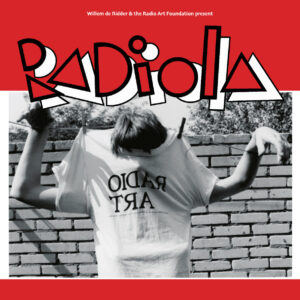
Willem de RIDDER & the RADIO ART FOUNDATION
“Radiola”
Between 1978 and 1984, Fluxus artist Willem de Ridder did a weekly radio show called De Radiola Improvisatie Salon. Listeners were invited to send in cassettes recorded at home and would get guaranteed airtime. Willem never listened to any of the tapes in advance. No censorship or personal taste were involved, just total artistic freedom. Long before social media existed, he understood that just providing a platform could ignite boundless creativity. Willem was a visionary, always pushing the boundaries of art and mainstream culture, while his interactive radio shows were breaking down the barriers between listeners and producers.
Unknown home tapers and independent artists would share their freshly recorded bedroom experiments with the world and Radiola became a catalyst for the rising Dutch tape scene. When the show gained popularity, broadcasts became open to the public and people would visit the salon to submit their latest cassettes in person. From these live events a network of independent labels emerged, releasing and exchanging cassettes. Punk was fading away but a new alternative to the mainstream was born.
Nobody seems to know what happened to the Radiola master cassettes, but somehow a few boxes survived and were archived by Marco van Dalfsen in 2022. We went through hours and hours of material and eventually compiled this album. A few names might sound slightly familiar, but our goal was to unearth the most obscure hidden gems of Dutch home taping culture. The result is an eclectic mix of ambient, industrial, lo-fi weirdness and experimental music and offers a unique glimpse into a very specific, but still relevant piece of the past.
23,00€
In stock
LP
Robert TURMAN
“Distant Dosage”
2025 repress
Turman first came onto the industrial scene in the late 70’s as the ominous ‘other half’ of legendary noise outfit NON. Shortly after recording the classic 1977 single Mode of Infection, Turman went on to pursue his own unique vision as a solo artist. Fusing every possible influence at his disposal while laying his ideas down on self-released cassettes like Flux (1981), Spirals of Everlasting Change (1987), Way Down (1987) and the massive Chapter Eleven cassette box set (1988). After a hiatus Turman resurfaced in 2005 to team up with seminal noise musician Aaron Dilloway. Since then, he has been gradually adding new titled to his already impressive discography.
For this archival release Turman selected 7 tracks that were recorded between 1980 and 1984. A welcome supplement to his library of avantgarde music that was released in the 80s. This album fits in nicely between the early industrial noise, the long-form minimalism of Flux and the rhythmic industrial of Way Down. Focusing on slowly shifting hypnotic loop-based layers of sound, it covers a specific side of Turman. It feels like there’s a direct link to his earliest works but it’s also a precursor to some pieces that were recorded much later. A missing link that finally gives us the opportunity of a complete overview of his early audio work.
All 7 tracks on this album have a connection to the written word in the form of a poem. Scans of the original typewriter poems are included together with collages and drawings from this specific time frame to create an essential and singular piece of art.
250 copies on clear vinyl with insert.
21,00€
In stock

LP
NEUTRAL
“Lågliv”
Neutral is the no wave / anti-rock duo of Dan Johansson (Sewer Election, Ättestupa, Amateur Hour, etc.) and Sofie Herner (Leda, Enhet För Fri Musik), both with deep connections to the Swedish noise scene. As Neutral, the two smear voice, guitar, organ, and smoldering noise into narcoleptic songs that rewire the strategies of Dome by way of Gate and Mars. Lågliv translates to ‘lowlife,’ an apt metaphor for neutral’s subterranean murk and shambolic discontent that they languidly manifest as a punk dourness emptied of all rock ’n’ roll theatrics. Desperate, demolished, and dejected.
Lågliv was originally published as part of the instantly out of print boxset, On Corrosion - a 10 cassette anthology from 2019 that was housed in a handcrafted wooden box and featuring full albums from Kleistwahr, Neutral, Pinkcourtesyphone, Alice Kemp, She Spread Sorrow, G*Park, Relay For Death, Francisco Meirino, Fossil Aerosol Mining Project, and Himukalt. The collection also stood as the 50th release for The Helen Scarsdale Agency.
27,00€