
Out of stock

LP
William BURROUGHS
“Call Me Burroughs”
Originally released in 1965 by The English Bookshop in Paris and later by ESP-Disk’ in New York, Call Me Burroughs marks not only the recorded debut of William Burroughs, but also for many the first encounter with his inimitable voice. While Burroughs has had pervasive influence on counterculture in the past 50 years – from the Beats to punk rock and even hip hop – no other figure today is so widely considered the epitome of cool.
Call Me Burroughs features the author reading from Naked Lunch and Nova Express, two of his best-known works that utilize the cut-up method developed by Burroughs and artist Brion Gysin. An eerie, deadpan drawl guides the listener through sci-fi innerscapes, narcotic nightmares, reports from the edge of the apocalypse. Phantasmagoric passages echo real experiences roaming the streets of Mexico, the West Village, Tangiers. Bradley the Buyer and other shadowy agents haunt our ears as Burroughs turns the page and pauses purposefully.
“Anything put out up till now is like pulling a figure out of the air – Enemy installations shattered – Personnel decimated – Board Books taken – Electric waves of resistance sweeping through mind screens of the earth – The message of Total Resistance on short wave of the world”.
20,00€
In stock

LP
Warner JEPSON
“Totentanz”
Considered as the first piece of electronic music to accompany a ballet, Totentanz is the arrestingly abstract and mightily expressive result of Warner Jepson’s experiments with tape and Don Buchla’s groundbreaking synthesizer, the Buchla 100. Totentanz, originally self-released in 1972, reveals a composer relieved of convention.
In the 1950s and 1960s, Jepson was part of an informal circle of Bay Area artists that included Pauline Oliveros, Terry Riley, La Monte Young, Morton Subotnick and Steve Reich. A fixture of the legendary San Francisco Tape Music Center, Jepson was among the performers who realized the world-premiere of Riley’s seminal minimalist composition In C and worked closely with postmodern dance figure Anna Halprin as well as the Welland Lathrop Dance Company.
Jepson’s affection for the performing arts meant that he was thrilled to be commissioned by the San Francisco Ballet Company to compose a piece to accompany Carlos Carvajal’s beguiling, danse macabre-inspired Totentanz. Jepson, who passed away in 2011, incorporated concrete sounds from his collection as well as creations on the Buchla 100, which had recently migrated to Mills College. As the composer once wrote, “Don Buchla’s box ... offered numerous sound possibilities without a map.”
First-time vinyl reissue. Limited edition of 500 numbered copies on clear vinyl.
In the 1950s and 1960s, Jepson was part of an informal circle of Bay Area artists that included Pauline Oliveros, Terry Riley, La Monte Young, Morton Subotnick and Steve Reich. A fixture of the legendary San Francisco Tape Music Center, Jepson was among the performers who realized the world-premiere of Riley’s seminal minimalist composition In C and worked closely with postmodern dance figure Anna Halprin as well as the Welland Lathrop Dance Company.
Jepson’s affection for the performing arts meant that he was thrilled to be commissioned by the San Francisco Ballet Company to compose a piece to accompany Carlos Carvajal’s beguiling, danse macabre-inspired Totentanz. Jepson, who passed away in 2011, incorporated concrete sounds from his collection as well as creations on the Buchla 100, which had recently migrated to Mills College. As the composer once wrote, “Don Buchla’s box ... offered numerous sound possibilities without a map.”
First-time vinyl reissue. Limited edition of 500 numbered copies on clear vinyl.
23,00€
Out of stock

LP
Tony CONRAD with FAUST
“Outside the dream syndicate”
Violinist, composer and filmmaker Tony Conrad started his career in New York in the early 1960s. As a member of the Theatre of Eternal Music (a.k.a. the Dream Syndicate) alongside John Cale, La Monte Young, Marian Zazeela and Angus MacLise, he participated in now-legendary and often legendarily loud drone performances with many pieces having no beginning and no end. During a fateful trip to Germany in 1972, Conrad met with avant-rock visionaries Faust and made the very first record to bear his name.
Outside The Dream Syndicate, originally released in Europe only in 1973, is a stunning debut. Two side-long tracks – “The Side Of Man And Womankind” and “The Side Of The Machine” – show just how far Conrad had moved beyond his minimalist peers. Werner Diermaier’s repetitive drum beat and Jean-Hervé Peron’s stripped-down bassline conjure a tense, ascetic groove, while Conrad’s seamless violin, initially so controlled, reveals a surprising adaptability. The music shifts almost on a subliminal level, pushing and pulling to the drone's internal pulse.
It is hard to imagine Conrad’s trajectory from downtown Manhattan to a farmhouse in the German countryside that ultimately resulted in Outside The Dream Syndicate, yet no other record captures – so completely and instantly – the intersection of avant-garde and rock forms. Outside The Dream Syndicate remains ahead of and bracingly outside of its time.
This first-time vinyl reissue has been carefully mastered from the original master tapes and includes liner notes by musician Jim O’Rourke and author Branden W. Joseph.
20,00€
Out of stock

LP
Remko SCHA
“Machine Guitars”
Gnashing, thrashing and teeming with enchanting microtones – Machine Guitars is the definitive recorded work of Remko Scha, although the late Dutch artist didn’t play a single note himself. Rather, Scha arranged a motorized, rotating wire brush and saber saw in front of suspended electric guitars and let these metallic torrents flow.
Scha was a linguist and generative artist, enamored of computers’ capacity for algorithmic creativity. A leading researcher at the University of Amsterdam, he also cofounded the famed arts-space Het Apollohuis in a former cigar-factory in 1980. This haven for intellectuals and underground autodidacts served as the recording studio for most of Machine Guitars (as well as Ellen Fullman’s brilliant The Long String Instrument), which originally appeared in 1982 on the small Dutch label Kremlin.
Machine Guitars, as the critic Byron Coley has noted, ranks among the best of the era’s minimalist-inspired, avant-garde guitar statements by Glenn Branca and Rhys Chatham. The semiautonomous sound-making sculptures also evoke contemporaneous work by Christian Marclay. Scha’s work falls somewhere between conceptual art and avant-garde music – a total revelation for minimalists and No Wave fans alike.
First-time vinyl reissue. Limited edition of 500 numbered copies on clear vinyl.
Scha was a linguist and generative artist, enamored of computers’ capacity for algorithmic creativity. A leading researcher at the University of Amsterdam, he also cofounded the famed arts-space Het Apollohuis in a former cigar-factory in 1980. This haven for intellectuals and underground autodidacts served as the recording studio for most of Machine Guitars (as well as Ellen Fullman’s brilliant The Long String Instrument), which originally appeared in 1982 on the small Dutch label Kremlin.
Machine Guitars, as the critic Byron Coley has noted, ranks among the best of the era’s minimalist-inspired, avant-garde guitar statements by Glenn Branca and Rhys Chatham. The semiautonomous sound-making sculptures also evoke contemporaneous work by Christian Marclay. Scha’s work falls somewhere between conceptual art and avant-garde music – a total revelation for minimalists and No Wave fans alike.
First-time vinyl reissue. Limited edition of 500 numbered copies on clear vinyl.
23,00€
Out of stock

LP
John DUNCAN
“Organic”
The inter-disciplinary maverick John Duncan emerged in 1970s Los Angeles as a confrontational performance artist and, as the decade progressed, aligned himself with the experimental-music collective Los Angeles Free Music Society. His sound art appeared on various self-released cassettes and alongside artists such as Jim Pomeroy and Yoshi Wada on the Los Angeles Institute of Contemporary Art’s influential compilation Sound.
Duncan’s debut album, Organic, released in a tiny edition on the artist’s own AQM imprint in 1979 and distributed through LAFMS, collects some of his earliest and most absorbing noise experiments. Recorded live, Organic is composed of two sidelong pieces: “Broken Promise,” a patient, murky dirge featuring Duncan on tape and percussion, plus Michael Le Donne-Bhennet on bassoon; and “Gala,” a kinetic, durational percussion piece featuring Duncan alone. The meditations on texture and unpredictability, realized with unconventional and found sounds, anticipate his later work with shortwave radio.
First-time standalone reissue.
Limited edition of 500 numbered copies on clear vinyl.
23,00€
Out of stock

LP
Joe JONES
“In Performance”
Very last copies on clear vinyl.
After studying with composers John Cage and Earle Brown, Joe Jones became a prominent figure in Fluxus, contributing to the movement's first “yearbox” alongside La Monte Young, György Ligeti and Nam June Paik. Beginning in late 1961, Jones began constructing his own music machines – drawing inspiration from the calliopes, automata and orchestrions of the 19th and early 20th century to create self-playing ensembles of stringed instruments, percussion and woodwinds – “played” through an elaborate (yet decidedly lo-tech) system of rubber bands, balls and tin foil.
Christened the Tone Deaf Music Company, this battery of automated musical instruments generates the sounds on In Performance (originally released in 1977 on the Harlequin Art imprint). With exacting conceptual precision and varied subtleties of natural motion – not unlike Harry Bertoia’s sounding sculptures – Jones' machines produce richly-textured strata of sound and serve as engines of paradox. While bringing the figure of the artist-composer to the foreground, the machines ultimately dispense with the need for the performer entirely – a cunning subversion of the fetish for virtuosity and individual genius.
Limited edition of 500 numbered copies on clear vinyl.
25,00€
Out of stock

LP
Jean DUBUFFET
“Musical Experiences”
The legendary French painter and sculptor Jean Dubuffet exalted naivety and spontaneity in visual art, and his brazenly experimental recordings on Musical Experiences evince the same spirit through sound. He once reflected, “Certain unexpected windfalls… come of improvising on an instrument one doesn’t really know how to use.”
Dubuffet, who famously founded the art brut (or outsider art) movement, began making music in the early 1960s with avant-garde figure Asger Jorn. With no training, they played a range of instruments: saxophone, bassoon, detuned piano, hurdy-gurdy, cabrette, bombarde and so on. Soon, Dubuffet reserved a room in his home for making music and bought two tape-recorders in order to manually edit the results. He wrote fondly of the recordings’ crudeness and the sense that they “had no beginning and no end but were simply extracts taken haphazardly from a ceaseless and ever-flowing score.”
Dubuffet’s discography begins in 1961 with the release Expériences Musicales, a six 10-inch record set produced in an edition of fifty with original artwork and lithographed sleeves. Musical Experiences, compiled by composer Ilhan Mimaroglu and released in 1973 on his Finnadar imprint, collects eight of the twenty pieces on the much sought-after Expériences Musicales.
First-time vinyl reissue. Limited edition of 500 numbered copies on clear vinyl.
23,00€
In stock

LP
Basil KIRCHIN
“Worlds Within Worlds”
Basil Kirchin was a pioneering British composer who blurred the lines between musical genres. While his career began in the '40s as a professional jazz drummer, in the ‘60s he started to make field-recordings, painstakingly splicing tapes and slowing-down sounds until the source material would be virtually unrecognizable.
Originally released on Island Records in 1974, Worlds Within Worlds juxtaposes Kirchin’s various tape manipulations – amplified insects, animals, engines, glossolalia of children – with traditional musical instruments to form an organic totality that has the overall effect of otherworldly, ambient soundscapes.
As Brian Eno writes in the liner notes on the original release, “Within the first couple of minutes it became obvious to me that Basil had not only discovered a whole new area of sound, but had exploited it with extreme skill and sensitivity, producing beautiful and evocative music as well.... So Basil Kirchin has made a double contribution: he has not only built the instrument, but has written and played the first successful works for it.”
Worlds Within Worlds remains a lost classic in sonic abstraction. This first-time reissue is recommended for fans of Broadcast, Aphex Twin and Nurse With Wound.
21,00€
Out of stock

LP
Arnold DREYBLATT AND THE ORCHESTRA OF EXCITED STRINGS
“Propellers In Love”
Arnold Dreyblatt has been called “the most rock’n’roll of all the composers to emerge from New York’s downtown scene in the 1970s.” Dreyblatt founded the Orchestra Of Excited Strings in 1979, harnessing unusual tuning intervals to an exuberant performance style. Propellers In Love, the Orchestra’s second album – originally released in 1986 on the Stasch imprint, in conjunction with the contemporary art space Künstlerhaus Bethanien – develops Dreyblatt’s rhythmically exacting exploration of the glittering resonances and overtones generated by an ensemble of uniquely-altered stringed instruments and drums.
On Propellers In Love, simple song titles – “Odd & Even,” “Harmonics,” “Bowing” – belie intricate harmonic structures. Dreyblatt’s modified instruments – a contrabass and miniature piano fitted with piano wire along with violin, all tuned in just intonation – undergo the Orchestra’s rapid, staccato attacks. Sparkling timbres dance above interlocking rhythmic patterns moored by sparse yet propulsive percussion (“Pedal Tone Dance” and the title track). Throughout, the Orchestra’s perpetual motion achieves a tremulous and exquisite density.
Thirty years since its initial release, Propellers In Love remains a peerless work of second-generation American minimalism. This first-time domestic release is recommended for fans of Glenn Branca, Ellen Fullman and Charlemagne Palestine.
19,00€
In stock

LP
Annea LOCKWOOD
“The Glass World”
New Zealand-born sound artist and composer Annea Lockwood received formal training at various institutions before exploring the sonorous potential of glass in a series of performances in the late 1960s. With plates of wired glass, glass discs, chunks of green cullet glass, glass tubing, sheets of micro-glass, glass jars and other incarnations of the material, Lockwood elicited a staggering array of sounds, some subtly uncanny and others as outlandish and alien as anything emitted from the era’s early synthesizers.
Lockwood’s glass concerts yielded a text-score published in Northern California new-music journal Source: Music of the Avant-Garde and attracted the attention of South African producer Michael Steyn, who encouraged her to record the glass pieces for his label Tangent. They worked for two years in a small, resonant church in London to document a veritable catalogue of the materials’ tone and timbre; Lockwood wished to present each sound as if it were a piece of music in and of itself. Glass World originally appeared on Tangent in 1970.
“I wanted to entice people into really listening intensively,” Lockwood once reflected. “Into really listening. I wanted a deep immersion in the sounds of themselves, for the audience.”
First-time vinyl reissue. Limited edition of 500 numbered copies on clear vinyl.
23,00€
In stock

LP
COMPILATION
YOKOMONO 03.5
“Staalplaat Soundsystem is releasing a series of artist vinyl release used in our own sound installations. This record is a second atempt to create random vinyl release. Our first atemt was the release of Yokomono 03 where we hoped to cut two tracks, one spiraling from outside in and the others from inside out. So that the nedle would move in different directions. This atempt failed (for reasons that we will not go in to at this moment). This is a record with three paralel soundtracks where the cutting needle was lifthen twice with short intervals, in order to make the nadle used during “wiedergabe” to jump tracks randomly. To play this record you must not see your turntable as a reproduction machine that reproduces the music on the record. You can not put it on and sit down to listen. You should see the record and turntable much more as a music instrument that with each turntable model and with each setting if your machine you will create a different sound and mix of this record. As with any instrument you have to learn how to play your turntable and find what setting you like best. Of vital influence are the skate settings en the wait on the tone arm, these and others you must very to experience the options of the record. Side A : Pure brown noise. Cynthia Zaven. Merzbow. Side B : Pure white noise. Mika Vainio. Jaap Blonk. Limited edition of 500.”
11,00€
In stock

LP
UNICORN HARD-ON
“Weird universe”
Valerie Martino’s Unicorn Hard-On project has been a long running staple in the American underground since it’s inception in 2003. Through her own Tangled Hares imprint, as well as many others, she’s built a strong, constantly evolving catalog of singular works that serves to many as a prototype of the current beat-oriented phenomena currently sweeping the nation. Martino’s vision, however,
remains unphased and flourishes accordingly to her own unique vision; standing outside of any trends and remaining loyal to the Unicorn Hard-On sound. Despite having been constantly touring, releasing music, booking shows and occupying various cities throughout the U.S. over the last 10 years, there has been no full length Unicorn Hard-On LP until now. "Weird Universe" delivers on all fronts, encompassing all styles of the projects past and present to create a cohesive and definitive debut album. The album pounds with Martino’s signature drum thud and percussive clatter, filing in the crevices with her signature electronic static and keen melodic phrasing. The album’s opening track, "Rock Salt", kicks in the door and unwinds itself into spiraling mania of ramping bass tones with only a steady rhythm keeping it from going off the rails completely. Many of Unicorn Hard-On’s classic elements remain intact, with a wide array of bizarre
modulations and deeply layered subconscious structures. Versatility and evolution are exhibited in tracks like "Houndstooth" or "Wet Pet", which play out like an extraterrestrial Rachmad cut, or perhaps like a classic Psyche styled Craig track with hypnotic, time altering melodic patterns and impeccably
calculated rhythm programming. All comparisons aside, this record thrives in it’s own "Weird Universe", making this a thrilling debut album 10 years in the works.
remains unphased and flourishes accordingly to her own unique vision; standing outside of any trends and remaining loyal to the Unicorn Hard-On sound. Despite having been constantly touring, releasing music, booking shows and occupying various cities throughout the U.S. over the last 10 years, there has been no full length Unicorn Hard-On LP until now. "Weird Universe" delivers on all fronts, encompassing all styles of the projects past and present to create a cohesive and definitive debut album. The album pounds with Martino’s signature drum thud and percussive clatter, filing in the crevices with her signature electronic static and keen melodic phrasing. The album’s opening track, "Rock Salt", kicks in the door and unwinds itself into spiraling mania of ramping bass tones with only a steady rhythm keeping it from going off the rails completely. Many of Unicorn Hard-On’s classic elements remain intact, with a wide array of bizarre
modulations and deeply layered subconscious structures. Versatility and evolution are exhibited in tracks like "Houndstooth" or "Wet Pet", which play out like an extraterrestrial Rachmad cut, or perhaps like a classic Psyche styled Craig track with hypnotic, time altering melodic patterns and impeccably
calculated rhythm programming. All comparisons aside, this record thrives in it’s own "Weird Universe", making this a thrilling debut album 10 years in the works.
9,00€
In stock

LP
DRAINOLITH
“Fighting !”
Alexander Moskos is a seasoned Canadian avant-garde musician active in projects such as Alterity Problem with Joel Taylor and the legendary Thames, who had an incredible 7" release on American Tapes in late 2011. Drainolith, his solo guise, has been active since the mid noughties but has remained relatively under the radar with mysterious private press cassette and cd-r releases. In 2009 Moskos picked up a heavy U.S. tour regiment and caught the attention of U.S. underground heads with impressive live sets. It was around this time that Moskos began to dial in songs for his debut "Fighting!" lp, which we are eager to present. It’s important to keep listeners on their toes and Spectrum Spools is fully psyched to hit you with an album of delusional blues - littered with fractured synth, feedback and seriously cryptic personal content. One of our first releases with strong lyrical focus, Alex knocks it out of the park with his synthetic voice resonating like a wasted Robert Ashley on Ambien. The tracks rage with a one man "Twin infinitives" style, with guitar riffs so fucked that they make Neil Haggerty sound like Les Paul. Damaged, random, syn-drum triggers and MS-10 crackling go fully ballistic over dark and personal narratives. Despite the chaotic nature of the music, there is a defined and cohesive song structure to each track which makes everything more confusing but also highly enjoyable to listen to.
If you miss bands like Shadow Ring and Royal Trux, but wonder where the logical next step would be in their absence: step in this direction - we promise you’ll be pleased. Mastered and Cut by Rashad Becker at D+M, Berlin.
If you miss bands like Shadow Ring and Royal Trux, but wonder where the logical next step would be in their absence: step in this direction - we promise you’ll be pleased. Mastered and Cut by Rashad Becker at D+M, Berlin.
9,00€
In stock

LP
HIVE MIND
“Elemental disgrace”
“Cut at Dubplates & Mastering, Berlin August 2011. “Elemental Disgrace” is an album that needs to happen now. Finally, the next phase has arrived - a stunning double side-long record of some of the U.S. best underground synthesizer music we have heard here at the Spectrum Spools headquarters. Whatever rise to the synthesizer came later on in the 00’s is hardly of any concern to Greh Holger and his Hive Mind project. Having released private press cassettes of solo synth works as far back as 2002, Hive Mind exists as enigmatic in world of new-jack synthheads and the title wave of "neo kosmische" that goes with it by flying far under it’s radar. The silence is now broken and here we are treated to some of the most unique sounds Spectrum Spools has yet presented. No blisscapes to be found here. No soaring latched arpeggios, no cosmic vistas. Not a single melody. This is two sides of ancestral ruin in its clearest and most focused presentation. The brutality of the Earth and the harsh reality of all that it holds. Unknowable sounds - that of the dawn of the Earth, or perhaps the sound of its demise. A toxic swamp of chemicals and mutated creatures left behind long after man has wiped himself away for good. Field recordings from the end of the world. While others are racing for the stars, Hive Mind’s tetonic plate shifting and brutal rumble will give you a brand new way to look at modern synthesizer composition. With a focus on textural sounds and shifting frequency registers, this album gives the listener the a full range of listening possibilities with infinite replay value. It’s worth noting that Spectrum Spools as a label would not exist without Hive Mind. An inspiration and a pioneer in the U.S. synthesizer circuit, it’s with pleasure and honor to release "Elemental Disgrace" into the world.”
14,00€
Out of stock

LP
SECOND WOMAN
“S-W”
Future music duo Second Woman’s sophomore full-length for Spectrum Spools further hones their distinctive fusion of shapeshifting software sculpture and tessellated footwork. Shivering digital textures oscillate with and against algorithmically mapped percussion samples; smeared synthetic chords levitate in the distance; stabs of digital noise punctuate the mix in twitchy, time-distorting patterns.
Their anamorphosis verges on ascetic: stark, splintered waveforms rendered into unique fiber optic hieroglyphs. Multi-instrumentalists Josh Eustis and Turk Dietrich share a deep history going back to their days in the New Orleans ambient electronic community, as part of Telefon Tel Aviv and Belong, respectively.
Even so, S/W pushes beyond their combined discographies to date, flexing impossibilities, building rhythms from arrhythmia, teasing veiled emotion from bold iterations of cold code. Digital version includes remix by experimental composer Gábor Lázár.
Their anamorphosis verges on ascetic: stark, splintered waveforms rendered into unique fiber optic hieroglyphs. Multi-instrumentalists Josh Eustis and Turk Dietrich share a deep history going back to their days in the New Orleans ambient electronic community, as part of Telefon Tel Aviv and Belong, respectively.
Even so, S/W pushes beyond their combined discographies to date, flexing impossibilities, building rhythms from arrhythmia, teasing veiled emotion from bold iterations of cold code. Digital version includes remix by experimental composer Gábor Lázár.
15,00€
In stock

LP
Michael POLLARD
“Translations 01”
Material Study 01 (Sand) is a recording from a stereo hydrophone buried under the sand in a lake. Standing on top of the transducer, holding the MiniDisc recorder in my hand, and monitoring the feed with a pair of in-ear earphones, I slowly shifted my weight and the sand beneath my feet. My younger brother was on the shore throwing firecrackers into the water; this was an ‘accidental’ aspect of the recording. Material Study 02 (Cello and jacket) is made from a cello as it is dropped onto a carpeted floor with a contact microphone taped to it’s bridge. The moment of impact was ‘frozen’ with an infinite sustain effect pedal. Both the sustained tone and the live feed from the contact microphone were played into the room at high volume while the contact mic was still attached to the cello. This was recorded. Roughly one year later year later this cello drop’ recording was amplitude modulated in a computer audio synthesis environment by a pair of stereo contact microphones taped to a wind breaker being blown by an air circulator as it hung from the ceiling by a string. Spatialisation Study 01 (One freeze from seven positions in a house) is made from four frozen tones generated from a file on my computer in a computer audio synthesis environment. The four tones were played back simultaneously in an arbitrary stereo spread at a high volume on a home entertainment system in the living room of a house with high ceilings. The stereo and computer were both left undisturbed for an afternoon, and their output was recorded to a portable SD card recorder via a matched pair of stereo omnidirectional condenser microphones mounted on a homemade disk baffle (for accurate stereo imaging) from seven positions within the house order of presentation: 01 in the dining room, 02 on the second floor landing, 03 in the middle of the upstairs hallway, 04 in the middle of the upstairs hallway close to the floor, 05 in the front room close to the floor, 06 in the living room facing the speakers close to the floor, 07 in the living room facing away from the speakers close to the floor). Using a DAW, two minutes from each recorded position in the house were combined into the eight minute track here; identical overlapping envelopes were superimposed on each two minute segment, fading in for one minute and then fading out for one minute, with the subsequent segment beginning to rise in amplitude as the previous begins to fall. Spatialisation Study 02 (Forty-nine tracks of isolated and overlayed clicks generated from the material and positions of the previous study) is made from the convolution of randomly generated stereo ‘clicks’ with the seven two minute segments (mentioned above) in a computer audio synthesis environment. Each of these seven tracks were individually convolved and played back into the house. The output was recorded to a portable SD card recorder via a matched pair of stereo omnidirectional condenser microphones mounted on a homemade baffle disk (for accurate stereo imaging). A recording was made from each of the seven source tracks in each of the seven positions (mentioned above), for a total of forty-nine recordings. Using a DAW, one second was excerpted from each of the forty-nine tracks, playing one click from each source-position pair; all forty-nine tracks then play simultaneously. A pencil rubbing for the album cover is made from a pencil rubbing of the texture of a wall. A 7 ” x 11” piece of rice paper was taped onto a wall with stereo contact microphones taped to the wall along the top and bottom edges of the paper. A pencil was slowly rubbed against the paper in vertical lines from top to bottom (or L to R according to the stereo configuration of the microphones) and recorded direct to computer. The rubbing produced from this process was scanned into the computer and can be seen on the cover of the album. Translations 01 was written, produced and recorded by Michael Pollard in the time between June 2011 and October 2012 in a variety of locations. The audio was mastered by Russell Haswell on October 2nd 2012 and cut by Rashad Becker at Dubplates and Mastering on October 17th 2012. It is intended for playback in a room via loudspeakers. Spectrum Spools released in association with Editions Mego.
9,00€
In stock

LP
Max EILBACHER
“Red anxiety tracers”
Max Eilbacher’s “Red Anxiety Tracers” is the debut long player from the multi-talented Baltimore, Maryland stalwart. Eilbacher has performed with various projects such as Matmos, Horse Lords, and the mind-altering underground Needle Gun aktionist unit. Despite years of busy touring and recording, “Red Anxiety Tracers” is the first vinyl artifact from this young mastermind. Crafted over the course of a year, “Tracers” is a labyrinth of shapes and sounds which glide through a complex and arcane environment of found sounds and synthesis. An expertly crafted maze of deja-vu, audio hallucinations, and dislocating atmospheric forms an audio obstacle course for the listener. Complex editing techniques and sound structures recalls the works of J.D. Robb or Owl Records era Tod Dockstader albeit with a radically fresh perspective and educated hindsight. “Red Anxiety Tracers” exhumes impeccable flow and careful attention to dynamic range, with it’s surgical placement of sound events challenging the deep listening abilities of it’s audience. Raw and manic tension overloads are cut with alien float and abstract aether transmissions with a constantly shifting palette of sounds spun from blasted modular electronics, vocoded terrestrialspeak, and glowing mellotron clouds. Eilbacher communicates a strange and beautiful dialect conceived through disciplined compositional structure and an intuitive improvisational style unparalleled in the current landscape. "Red Anxiety Tracers" breathes new life into modern electronic composition. Spectrum Spools released in association with Editions Mego.
15,00€
Out of stock
LP
COMPILATION
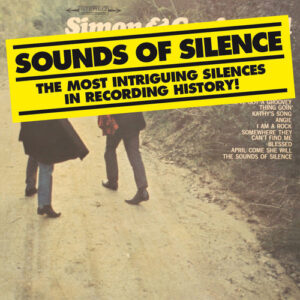
SOUNDS OF SILENCE
NEW EDITION limited to 200 copies !
“Sounds of Silence” is an anthology of some of the most intriguing silent tracks in recording history and includes rare works, among others, by Andy Warhol, John Lennon, Maurice Lemaitre, Sly & the Family Stone, Robert Wyatt, John Denver, Whitehouse, Orbital, Crass, Ciccone Youth, Afrika Bambaataa and of course Yves Klein. In their own quiet way, these silences speak volumes: they are performative, political, critical, abstract, poetic, cynical, technical, absurd… They can be intended as a memorial or a joke, a special offer, or something entirely undefined. The carefully chosen silences of this anthology are intrinsically linked to the medium of reproduction itself and reveal it’s nude materiality. They expose their medium in all its facets and imperfections, including the effect of time and wear. At the most basic level, these silences are surfaces. And it is in their materiality that they distinguish themselves from the conceptual experiments of John Cage with “4’33”. From the 1950s silence has found a place in the economic structure of the record industry and since then it would increasingly be appropriated by a vast array of artists is a vast array of contexts. Indeed, the silent tracks seems to know no boundaries. The LP presents the silences as they were originally recorded, preserving any imperfection that the hardware conferred upon the enterprise, without banning the possibility to satisfying the ear. The liner notes provide historical background for each track, revealing the stated (or presumed) motivations for these silences, while providing novel sound correspondences or interferences. This album is meant to be played loud (or not), at any time, in any place: a true aural experience ! Co-produced by alga marghen with Sound-Houses-FRAC Franche Comté.
22,00€
Out of stock

LP
Alessandro BOSETTI
“Renard”
Composed by Alessandro Bosetti. With Alessandro Bosetti (voice, oscillator), Laurent Bruttin (clarinet, bass clarinet), Seth Josel (classical guitar). Recorded at Börne45 by Roy Carroll, June 2012. Mixed by Alessandro Bosetti. Mastered Giuseppe Ielasi. A chamber music project on LP by the Italian composer, sound artist and performer, inspired by an African divination ritual. Renard is a chamber music project by composer Aleassandro Bosetti, commissioned on the occasion of this LP release by the regional fond for Contemporary art FRAC Franche-comté. The inspiration for the collection of pieces comprised in Renard came from a video that Alessandro Bosetti saw at the ethnological museum quai Branly in Paris. The video was showing an african woman divining the future by mean of throwing handfuls of objects on a table and reading their configuration in a relentless sequence of questions and answers to herself. Fascinated by the ritualized simplicity of this practice Bosetti and designer Annette Stahmer, selected a new pool of objects, devised an interpretation code and recorded several divination sessions with a few invited participants. Participants had been instructed on how to "read" the objects and they were able to elaborate answers to each other questions on matters as love, health, family, money, travels and whatever else they may have wished to receive advice on. Distilled fragments of those intimate and emotional exchanges were portrayed in this series of pieces for voice, guitar and clarinet. The ephemeral and conversational nature of the original recordings eventually transformed into its opposite and got frozen into stylized music compositions. All material was derived from the spoken interactions —as it is common practice in Bosetti’s work—although this time speech is often not heard as such but rather used as root material for the creation of geometric melodic patterns that eventually proliferate into thematic constructions.
While Alessandro Bosetti is used to incorporate fragments du reel in his compositions—in the tradition of composer and radio makers like Luc Ferrari and Yann Paranthoen—the particularity of his method this time resides in his avoidance of sampling and recorded reproduction while creating life size casts of the portrayed scenes for voice and instruments in a sort of hand made hyperrealism.
The chosen form is a chamber trio with classical guitar, clarinet and voice with the occasional insertion of sinusoidal waves. It that may loosely remind of Anton Webern’s three songs op. 18 (with piccolo clarinet and soprano swopping roles with bass clarinet and tenor voice ) or of Jimmy Giuffre trio explorations in the 60’s.
The instrumentalists—both adopted Berliners by now - are New Yorker Seth Josel - one of the most in demand new music interpreters on the guitar that has been closely collaborating with composers as Tristan Murail, Helmut Lachenmann, Richard Barret and Phill Niblock and Laurent Bruttin from Lausanne mostly know for his work with the Ensemble Contrechamps in Geneva.
The music—thoroughly notated—is naked, cristalline, highly formal and stripped down to the bone with instruments and voice completely exposed in both fragility and virtuosistic precision. The focus is shifted away from noise and extended techniques and pointed towards the unfolding of melodic and prosodic possibilities as if a speech-melody section would have been added to Nichlas Slonimsky’s thesaurus of scales and melodic patterns.
The name of the project, Renard, reminds of another african divination technique, that of the Dogon people, where the white fox, Renard pale in French, is interrogated overnight by tracing coded drawings on the sand and reading it’s tracks in the following morning.
12,00€
Out of stock
LP
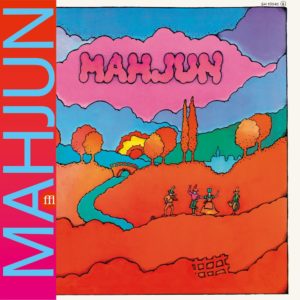
MAHJUN
“Mahjun (1973)”
500 copies on Black Vinyl. 350 gr. Gatefold Sleeve With Obi Strip – Matt Printing.
Mahjun, one of the most innovative French prog underground band, made their eponymous classic debut album on the very productive Saravah label in 1973. Their music, as you can hear on such tracks as « Les Enfants Sauvages » or « Chez Planos », is a subtle mix of spiritual jazz, pop music, folk and avant-garde reminding Full Moon Ensemble, Brigitte Fontaine or the Thêatre du Chêne Noir. First time vinyl reissue licenced by Saravah.
Mahjun, one of the most innovative French prog underground band, made their eponymous classic debut album on the very productive Saravah label in 1973. Their music, as you can hear on such tracks as « Les Enfants Sauvages » or « Chez Planos », is a subtle mix of spiritual jazz, pop music, folk and avant-garde reminding Full Moon Ensemble, Brigitte Fontaine or the Thêatre du Chêne Noir. First time vinyl reissue licenced by Saravah.
17,00€
Out of stock
LP
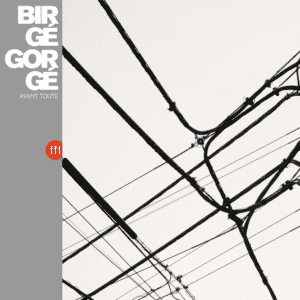
BIRGÉ GORGÉ
“Avant toute”
Have you ever imagined what a meeting between the Silver Apples and Sonny Sharrock would sound like?
In 1974, Jean-Jacques Birgé, one of the first French synthesizer players (ARP 2600) along with Francis Gorgé, virtuoso guitarist, created some unique improvised pop music. These unreleased and flamboyant recordings would be the source for the cult 1975 « Défense de » album by Birgé, Gorgé, Shiroc before founding “Un Drame Musical Instantané” with Bernard Vitet.
Ltd Edition 700 Black & White Vinyl, 350 gr. Sleeve – Reverse Printing- Obi Strip. Insert with photos + liner notes by Jean-Jacques Birgé & Francis Gorgé.
In 1974, Jean-Jacques Birgé, one of the first French synthesizer players (ARP 2600) along with Francis Gorgé, virtuoso guitarist, created some unique improvised pop music. These unreleased and flamboyant recordings would be the source for the cult 1975 « Défense de » album by Birgé, Gorgé, Shiroc before founding “Un Drame Musical Instantané” with Bernard Vitet.
Ltd Edition 700 Black & White Vinyl, 350 gr. Sleeve – Reverse Printing- Obi Strip. Insert with photos + liner notes by Jean-Jacques Birgé & Francis Gorgé.
18,00€
Out of stock
LP
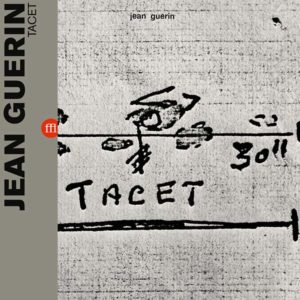
Jean GUERIN
“Tacet”
Fourth in a reissue series of the cult French underground Futura label.
Highly surreal and wonderfully futuristic, “Tacet”, one of the best kept secrets of the Futura catalogue is the soundtrack work of Jean Guérin for Claude Faraldo’s anarchic film “BOF, anatomie d’un livreur”. This avant-garde psychedelic jazz masterpiece is a blend of abstract vocals, unusual electronics, twisted sound envelopes and nervous brass instruments. First official vinyl reissue fully licenced by Futura founder Gérard Teronnès. Ltd Edition. 500 Black Vinyl. 350 gr. Gatefold Sleeve With Obi Strip.
Highly surreal and wonderfully futuristic, “Tacet”, one of the best kept secrets of the Futura catalogue is the soundtrack work of Jean Guérin for Claude Faraldo’s anarchic film “BOF, anatomie d’un livreur”. This avant-garde psychedelic jazz masterpiece is a blend of abstract vocals, unusual electronics, twisted sound envelopes and nervous brass instruments. First official vinyl reissue fully licenced by Futura founder Gérard Teronnès. Ltd Edition. 500 Black Vinyl. 350 gr. Gatefold Sleeve With Obi Strip.
16,50€
Out of stock

LP
Harry BERTOIA
“Clear Sounds – Perfetta”
Vinyl version reissued.
After nearly 40 years of silence, Harry Bertoia's Sonambient label has been resurrected in order to release the best of Bertoia’s unheard recordings from his recently preserved archive of 1/4" tapes. “Clear Sounds” b/w “Perfetta” (F/W 1033) was cut straight from the original reels and is a true analog pressing (AAA).
These two pieces were selected for their minimal, meditative and lush harmonic qualities; lacking in the abundance of dynamics and contrasts found on the original Sonambient records, these pieces show another approach to performance. Slow washes of shimmering metallic sculpture rustle thickly like the leaves of a white birch or tall grass in the summer sun. Gorgeous harmonics hover overhead, making audible measurements of the length and purity of Bertoia’s metal rod sculptures.
Both Harry Bertoia and his brother Oreste composed extensively in the Sonambient Barn deep in the woods of rural Pennsylvania where Harry kept over 100 Sonambient sculptures and gongs. The first Sonambient LP, released in 1970, contains a Harry Bertoia composition on side A and an Oreste Bertoia composition on side B. As an homage to the original Sonambient LP, Clear Sounds is a Harry Bertoia piece from June 30, 1973 and Perfetta is an Oreste Bertoia piece from June 28, 1971.
Background:
Harry Bertoia first came into artistic prominence in the late 1930’s and his sculptural, ergomonic chairs , produced by Knoll Furniture beginning in 1952, were soon modernist furniture classics. Inspired by the resonant sounds emanating from metals as he worked them and encouraged by his brother Oreste, whose passion was music, Harry restored a fieldstone "Pennsylvania Dutch" barn as the home for this experiment in sounding sculptures which he had begun in the 1950’s. Bertoia was an obsessive composer and relentless experimenter, often working late into the night and accumulating hundreds of tapes of his best performances; Oreste, too, would explore and record the sculptures’ sounds during his annual visits to his brother’s home in rural Pennsylvania.
Harry Bertoia’s recently dismantled Sonambient barn collection was an attentive listener’s paradise full of warm, expressive instruments that were gorgeous visually and audibly. Nothing could prepare you, even on return visits, for the overwhelming experience of entering the spacious wood and plaster interior where gongs, some of them giant, hung among the ranks of standing sculptures of various metals. Over nearly twenty years, adding, culling and rearranging, Bertoia carefully selected nearly 100 harmonious pieces ranging in height from under a foot to more than fifteen feet. He considered this barn a full experience, sights and sounds comprising not a collection of works, but one piece unto itself. It was here, deep in the woods, that his Sonambient recording work took place.
Learning by experimentation was common for Bertoia and he mastered the art of tape recording, turning the Sonambient barn into a sound studio with four overhead microphones hanging from the rafters in a square formation. He would experiment with overdubbing by performing along to previous recordings, sometimes backwards, constantly improving his methods while also honing his performance skills. Bertoia was a careful editor of his own work and only chosen recordings remained, each with a date and carefully considered observations written on a note included with each tape. Through these pieces of paper a greater logic can be uncovered, a careful approach to composition, ideas, feelings and forms. The story of Sonambient barn collection will slowly be told through the release of recordings from the archive as well as installations and performances built from Bertoia’s own recordings, lectures and a book.
After nearly 40 years of silence, Harry Bertoia's Sonambient label has been resurrected in order to release the best of Bertoia’s unheard recordings from his recently preserved archive of 1/4" tapes. “Clear Sounds” b/w “Perfetta” (F/W 1033) was cut straight from the original reels and is a true analog pressing (AAA).
These two pieces were selected for their minimal, meditative and lush harmonic qualities; lacking in the abundance of dynamics and contrasts found on the original Sonambient records, these pieces show another approach to performance. Slow washes of shimmering metallic sculpture rustle thickly like the leaves of a white birch or tall grass in the summer sun. Gorgeous harmonics hover overhead, making audible measurements of the length and purity of Bertoia’s metal rod sculptures.
Both Harry Bertoia and his brother Oreste composed extensively in the Sonambient Barn deep in the woods of rural Pennsylvania where Harry kept over 100 Sonambient sculptures and gongs. The first Sonambient LP, released in 1970, contains a Harry Bertoia composition on side A and an Oreste Bertoia composition on side B. As an homage to the original Sonambient LP, Clear Sounds is a Harry Bertoia piece from June 30, 1973 and Perfetta is an Oreste Bertoia piece from June 28, 1971.
Background:
Harry Bertoia first came into artistic prominence in the late 1930’s and his sculptural, ergomonic chairs , produced by Knoll Furniture beginning in 1952, were soon modernist furniture classics. Inspired by the resonant sounds emanating from metals as he worked them and encouraged by his brother Oreste, whose passion was music, Harry restored a fieldstone "Pennsylvania Dutch" barn as the home for this experiment in sounding sculptures which he had begun in the 1950’s. Bertoia was an obsessive composer and relentless experimenter, often working late into the night and accumulating hundreds of tapes of his best performances; Oreste, too, would explore and record the sculptures’ sounds during his annual visits to his brother’s home in rural Pennsylvania.
Harry Bertoia’s recently dismantled Sonambient barn collection was an attentive listener’s paradise full of warm, expressive instruments that were gorgeous visually and audibly. Nothing could prepare you, even on return visits, for the overwhelming experience of entering the spacious wood and plaster interior where gongs, some of them giant, hung among the ranks of standing sculptures of various metals. Over nearly twenty years, adding, culling and rearranging, Bertoia carefully selected nearly 100 harmonious pieces ranging in height from under a foot to more than fifteen feet. He considered this barn a full experience, sights and sounds comprising not a collection of works, but one piece unto itself. It was here, deep in the woods, that his Sonambient recording work took place.
Learning by experimentation was common for Bertoia and he mastered the art of tape recording, turning the Sonambient barn into a sound studio with four overhead microphones hanging from the rafters in a square formation. He would experiment with overdubbing by performing along to previous recordings, sometimes backwards, constantly improving his methods while also honing his performance skills. Bertoia was a careful editor of his own work and only chosen recordings remained, each with a date and carefully considered observations written on a note included with each tape. Through these pieces of paper a greater logic can be uncovered, a careful approach to composition, ideas, feelings and forms. The story of Sonambient barn collection will slowly be told through the release of recordings from the archive as well as installations and performances built from Bertoia’s own recordings, lectures and a book.
22,00€
Out of stock
LP
IN CAMERA
Back in stock! “In Camera, another duo project with Af Ursin’s Timo Van Luyck was started in 2004 and has produced two albums so far, the self titled first album (Some fine legacy) and Open Air (Robot), presenting yet another facet of Heemann’s ideas of textural electroacustica, this time with a focus on improvisation.”
16,00€
In stock

LP
MICROTUB
“Bite of the Orange”
Robin Hayward, Microtonal F-tuba. Peder Simonsen, Microtonal C-tuba. Martin Taxt, microtonal C-tuba.
Bite of the Orange is Microtub’s third album on SOFA. On ‘Bite of the Orange’ the three tuba players dig deeper into the sphere of just intonation. Robin Hayward has composed two new pieces for the group focusing on the 11th and 13th harmonics, resulting in a strong microtonal character. The canadian music critic Stuart Broomer picked Microtub as one of the highlights of the FIMAV festival inVictoriaville last year, and wrote
(…)Together they explored compositions that created tremendous temporal space using long tones, then found in their rare instruments very specific, previously unheard pitch intervals, distances that took close listening into new territory(…)
Bite of the Orange was recorded during Microtub’s one week residency at the Palazzo Stabile Art Center in Piemonte, Italy in January 2016. Mixed by Peder Simonsen and mastered by Mike Grinser at Dubplates & Mastering in Berlin.
17,00€
In stock

LP
Martin KÜCHEN
“Lieber Heiland, laß uns sterben”
Martin Küchen, saxophones, radio, iPod, electronic tambura.
“Poetry and reality.
The music goes in and out of, and away from, and into again. Reality and poetry. The music is uninterested in genre denominations and ideological markers. Music grows and is shaped by and out of realities, living and artistic. Sound is an audible reflection of you. Even you in silence. And you from sound, from the particular music that invaded your way of life; the ever-increasing global audible pressure chamber in which your spirit falls again and again in a Sisyfonian way ...
Titles, on the other hand, are single-living creatures. Sometimes pointing to other titles, other phenomena, but usually standing entirely solitary, like pillars of stone in a desert, like rocks in a forest area.
Over, under and around, the music is moving and moving unobtrusively.
On Leiber Heiland, Laß uns Sterben historical events intersect right into the contemporary sound making, slit through their titles sharp cuts in our listening present era and pry our eyes towards the seemingly inexplicable backyard of history; which nevertheless created the plateau of disintegration and opportunity that we now seem to live on. At the same time all the sounds on this recording - all the scrunching, the breathing, all the tones, all the composed-processed material - completely and fully give themselves to the listener, escaping all human epithet making and denominations, as the sound becomes manifest, becomes apparent.
This is my wish. To contemplate names and sounds, around music and the name of music.
A couple of measured hours during a wondrous and almost tropical evening in May 2016, Jakob Riis and myself were in the Crypt of the Lund Cathedral, while student orchestras rehearsed with open windows near the old monastery park, birds were screaming and hot spring -high people raved just outside the crypt’s small, low windows. The crypt is perhaps Sweden’s oldest room still existing.
And precisely in this mysteriously echoing room, we were still in a hair-rasing now, rinsed clean by the music as big and tiny sounds ran in rays along the stone floor from the year 1121 providing some relief.”- Martin Küchen, April 2017
17,00€
In stock
LP
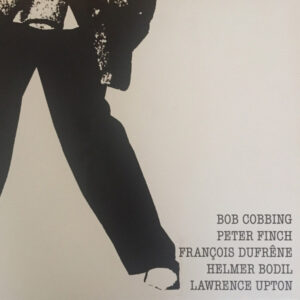
Bob COBBING – Peter FINCH – François DUFRÊNE – Helmer BODIL – Lawrence UPTON
Bob Cobbing & Helmer Bodil.
Bob Cobbing & Lawrence Upton.
Bob Cobbing & François Dufrêne
Peter Finch & Bob Cobbing
Peter Finch
Artwork cover taken from Big Band Dance Music by Peter Finch. Originally published as 3 separate cassettes on Balsam Flex (1977-1980). Edition of 220 copies + 30 AP.
25,00€
Out of stock
LP
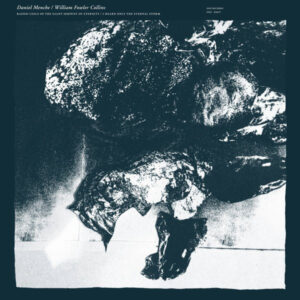
Daniel MENCHE – William FOWLER COLLINS
“I traversed the worlds, I ascended into the suns, and soared with the Milky Ways through the wastes of heaven; but there is no God. I descended to the last reaches of the shadows of Being, and I looked into the chasm and cried: ‘Father, where art thou?’ But I heard only the eternal storm ruled by none, and the shimmering rainbow of essence stood without sun to create it, trickling above the abyss.” So declares Christ in the opening section of Jean Paul’s 1796 text “Speech of the Dead Christ”. The text served as inspiration for the music presented on this split album by Daniel Menche and William Fowler Collins, and in the instance of the above quote, also functions as an apt description for it - immense, harrowing, and numinous. Like the procession of images conjured in Jean Paul’s twisting passages, the sounds made by Collins and Menche unfurl in a trail of drifting shadow punctuated by convulsive spasms of light.
Opening the album with a harmonious set of gently spiraling tones, Daniel Menche’s piece “Raised Coils of the Giant Serpent of Eternity” offers only this brief moment of serenity before a headlong dive into a cacophonous abyss of darker dimensions. Suspended in pools of liquid bass, layers of molten brass hover, dissolve and reappear. Pitches rise and fall, intersecting for brief periods of melodic convergence before crumbling again into heaving slabs of rumbling dissonance. Closing out the piece a low and solemn tone emerges from the roar of Menche’s spectral orchestra, seeming less like resolve, than the final flickering breath of a dying star.
Conversely, William Fowler Collins’ offering on the second side remains in a state of subdued tension for much of its duration. Primarily constructed around the emanations of decayed strings, these glimmering filaments seem in perpetual retreat from comfortable stasis or momentous upheaval. Swaying over a backdrop of inky black, disharmonious clusters gradually pile one over the other, pulling apart and recombining, eventually forming a jagged and unsettling crest. From here bilious clouds of humming static overtake the disintegrating strings, appearing long enough to set the stage for the conclusion of the narrative. Much like the opening Menche’s piece on the reverse side, Collins’ gently cascading sheaves of brushed guitar that close out the album serve as a small enclave of comfort in the otherwise lightless caverns through which he and Menche have driven the listener.
20,00€
In stock
LP
Aaron TURNER & Daniel MENCHE
“Nox”
Daniel Menche is a prolific musician whose work in the fields of noise and experimentalism displays both savage tactile expressionism and masterful studio
manipulations. Aaron Turner is an equally prolific artist whose output veers from
violent guitar architectures to textural meditations. Consequently, their collaborative album Nox could have been a brutish exercise in punishing frequencies and aural assaults. Instead, Nox is what Turner describes as “a combo of Daniel s more free-flowing form of impulsive music making and my more contemplative composition.”
Consisting of one lone track over the course of two sides of an LP, Nox uses its allowance of time to patiently wind and unravel around Menche s intuitive and free-associative vocal and drum treatments. Manipulated and wrought to the point of abstraction, this spontaneous underpinning served as the narrative backbone to Turner s orchestral vocal arrangements. Over the course of the year-long development process, the two musicians maintained a continual dialogue on the direction of the album, taking turns adding their accents and embellishments to the composition. Field recordings, found sounds, and auxiliary instrumentation fleshed out the recording until Nox developed into a final ruminative experience.
Menche and Turner had previously worked together on the Mamiffer/Menche collaborative album Crater, though Nox bears closer sonic relations to other endeavors in both artists canons. One can hear vestiges of Menche s more percussion-based albums like Concussions or Turner s more ethereal vocal-based work with Jodis on their most recent offering. And while the tactics and tools used for creating the album are very much of the modern age, the duo conjure the timeless elements of the transcendental hymns of Arvo Pärt or the tonal clusters of György Ligeti through their patient, economical approach. Ultimately, Nox creates a lush, inviting, and deeply dimensional world that belie the cold basements of Portland, OR and Vashon, WA where it was slowly brought to fruition.
LP edition of 400 copies. The LP is housed in a letterpressed jacket designed by Daniel Castrejon with photography by Faith Coloccia. Turner and Menche worked over a period of 2 years to complete the album using voice, field recordings, electronics, guitar, etc. The album was then mixed by Mell Dettmer (Earth, Eyvind Kang, Jessika Kenney, Sunn0))), etc).
manipulations. Aaron Turner is an equally prolific artist whose output veers from
violent guitar architectures to textural meditations. Consequently, their collaborative album Nox could have been a brutish exercise in punishing frequencies and aural assaults. Instead, Nox is what Turner describes as “a combo of Daniel s more free-flowing form of impulsive music making and my more contemplative composition.”
Consisting of one lone track over the course of two sides of an LP, Nox uses its allowance of time to patiently wind and unravel around Menche s intuitive and free-associative vocal and drum treatments. Manipulated and wrought to the point of abstraction, this spontaneous underpinning served as the narrative backbone to Turner s orchestral vocal arrangements. Over the course of the year-long development process, the two musicians maintained a continual dialogue on the direction of the album, taking turns adding their accents and embellishments to the composition. Field recordings, found sounds, and auxiliary instrumentation fleshed out the recording until Nox developed into a final ruminative experience.
Menche and Turner had previously worked together on the Mamiffer/Menche collaborative album Crater, though Nox bears closer sonic relations to other endeavors in both artists canons. One can hear vestiges of Menche s more percussion-based albums like Concussions or Turner s more ethereal vocal-based work with Jodis on their most recent offering. And while the tactics and tools used for creating the album are very much of the modern age, the duo conjure the timeless elements of the transcendental hymns of Arvo Pärt or the tonal clusters of György Ligeti through their patient, economical approach. Ultimately, Nox creates a lush, inviting, and deeply dimensional world that belie the cold basements of Portland, OR and Vashon, WA where it was slowly brought to fruition.
LP edition of 400 copies. The LP is housed in a letterpressed jacket designed by Daniel Castrejon with photography by Faith Coloccia. Turner and Menche worked over a period of 2 years to complete the album using voice, field recordings, electronics, guitar, etc. The album was then mixed by Mell Dettmer (Earth, Eyvind Kang, Jessika Kenney, Sunn0))), etc).
18,00€
Out of stock
LP
Felicia ATKINSON
“A readymade ceremony”
Edition of 500 copies.
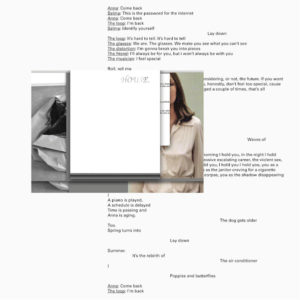
Relocated in the french Alps following a 5 years exile in Belgium, Felicia Atkinson returns on Shelter Press with A Readymade Ceremony, a concrete / post-digital oratorio in 5 parts.
Composed and recorded at home and on the Oregon coast, the opus documents a full range of bridges happening in Atkinson’s work. It documents the gather of her early-musical studies with her actual musical practice, the reunion of her two main projects - under her own name and Je Suis Le Petit Chevalier - and finally affirms the obvious link between her visual and sonic body of work.
Felicia Atkinson is a visual artist, a writer and musician graduated from Les Beaux-Arts de Paris. Her visual works - sculptures, paintings, installations and collages - includes a variety of media gathered together through the use of improvisation and its patterns such as delay, loop and saturations, with a chosen list of special tools : clay, silk, spray paint, watercolor, wood, or digital images…
Using the improvisation as a main technique to play music, write poetry and make art, her latest output is the book Improvising Sculpture as Delayed Fiction, a fiction / play published by Shelter Press in the fall of 2014.
Pursuing a radical position in the art world with the use of a publishing / economical autonomy as a very crucial element driving her carrier, this LP has been entirely recorded on her laptop using a super basic software. Felicia Atkinson reaffirms here the importance of the DIY in her creating process : the artist-run space as a place to exhibit, the studio space as a whole territory to record, the book as a score, the record itself as a proper documentation for a possible sculpture.
A readymade as the migration of one thing to another one’s context, involving a change of status, of genre, of politics. A ceremony as a possible gathering, a community shared moment, a happening, a celebration, a protest.
The first foundation of A Readymade Ceremony is the text, spread along the 5 tracks building the record. The text is a collage of extracts of Improvising Sculpture as Delayed Fictions (Félicia Atkinson, 2014), Recherche de la Base et du Sommet (René Char, 1955), and Madame Edwarda (Georges Bataille, 1937), and some random texts lying around while Atkinson was playing, mostly picked in the italian magazine Mousse.
16,00€
In stock
LP
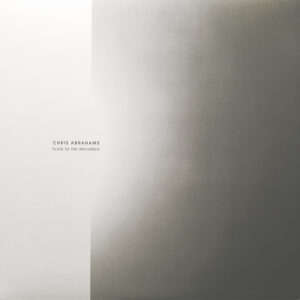
Chris ABRAHAMS
“Fluid to the influence”
Chris Abrahams returns in 2016 with a new edition for Room40, Fluid To The Influence. Building upon the foundation of his previous three editions, Abrahams charts out a divergent course through lilting piano flows, distended organ passages, thunderous electronic eruptions and focused concrète explorations. Fluid To The Influence spans a huge spectrum of sound, each movement calling forward to the next in a flowing motion that demonstrates Abrahams’ commitment to and interest in the album as an artistic form.
Known widely for his piano work with post-everything trio The Necks, Abrahams output as a composer orbits an otherly sonic sphere. Piano is just one element he draws upon, creating a deliberately expansive sound field within which the listener is invited to become lost. He is one of the most significant voices in Australian music, and arguably one of the most restless and original artists creating work today.
20,00€
In stock
LP
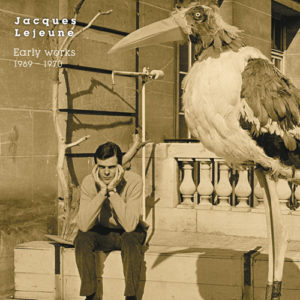
Jacques LEJEUNE
“Early Works 1969-1970”
This LP of early compositions by Jacques Lejeune features three seminal works: “D’une Multitude En Fête” and “Petite Suite”, originally released on the Perspective Musicales series in 1970, and a previously unpublished composition, “Géodes”, from the same period. These three pieces (not included in the recent Parages and other electroacoustic works 3CD set) are some of Lejeune's earliest music for tape and may be considered a "prequel" to his later, more thematic works. Still, his concise musical narrative is ever-present in these first recordings. The sidelong D'une Multitude En Fête (1969) refers to multitude, number, celebration and any crowd situation as a form of ceremony—all evoking a circular gaze, as topics of the different aural events and their anecdotal development emerge, leading to the dream, as a story we tell to ourselves. Géodes (1970) features percussion improvisations by Lauréat Dionne with Jacques' tapework inflecting prisms deep into its thundering, rhythmic core. This concert version appears on vinyl for the first time. Concluding the album is Petite Suite (1970), with each section referencing a traditional musical form using both anecdotal as well as instrumental flourishes. The original drum and guitar elements performed here by Michel Foudrinoy and Jean-Pierre Vassout. These pieces have been compared to Pierre Henry's bold rock themes in Messe Pour Le Temps Present and also recall the peculiar atmospheres of some of the great, early Nurse With Wound records that would follow. In contrast, Lejeune's early approach was heavily steeped in sonic narratives, combining unusual and ambiguous events to create a sound world uniquely his own. Early Works 1969-1970 explores the first precision splices by one of the true visionaries in musique concrète.
25,00€