
In stock

CD
BAUMSCHULE
s/t
Baumschule was formed following the meeting in 2019 of three musicians with already expansive experimental practice: pianist Raphael Loher, drummer Julian Sartorius and guitarist Manuel Troller (whose solo album Vanishing Points had been released a year earlier on three:four). While Troller and Sartorius had been performing as a duo for some time, and Loher and Troller were already playing together on a more occasional basis, piecing together these three players was a first. After playing entirely improvised concerts, the trio started to explore a seemingly simple idea in the studio: to engage with a limited musical material and let it slowly unfold. A bit like planting a seed and watching it germinate. By setting themselves a set of limitations and rules, which in turn raise new musical questions to be solved, the three musicians have turned Baumschule into a creative playground which exude the sheer pleasure of playing together and listening to others.
The music which came out of the studio session is imposing in appearance: the single piece of the record is close to 40 minutes long. But truth is, it is based on a skillful balance between composition and improvisation, repeated patterns and blossoming micro-variations resulting from individual decisions, phase shifts and resynchronizations, linear progression and tabular strokes. In order to fully perceive these permanent oscillations, the trio invites us somehow to develop two simultaneous ways of listening: one that would focus on the instantaneous development of musical motifs; the other, based on the memory of forms, that would focus on the slow unfolding of the piece.
Listening to Baumschule gives a fascinating impression of musical twisting, as if their music propelled itself through a helical and upward movement. Most likely, this has to do with the fact that, while constantly reacting to one other, the three musicians seem to play on different planes and tempi: Loher works his material in a sprawling manner, Sartorius imperceptibly proliferates like a cellular network, while Troller moves forward with the regularity of a natural cycle.
If the respective trajectories of the three members seem to place them in the footsteps of a reductionist approach, one can just as easily listen to their project as a record of improvised music exploring the canvas of an invisible plan. This is to say how much the trio constantly thwarts what one may expect or discern from it: no sooner are one’s ears caught by some clear guitar lines, some elaborate texture of bowed piano strings or some identifiable rhythmic units, than the two other thirds are already reconfiguring the trio's material. Behind its apparent immobility, Baumschule ("nursery") is teeming. Behind the tree lies the forest.
Raphael Loher: Piano
Julian Sartorius: Drums
Manuel Troller: Guitar
16,00€
In stock

LP
Sarah TERRAL (Clément VERCELLETTO)
“Le Ménisque Original”
Le ménisque original is Clément Vercelletto‘s (Orgue Agnès, kaumwald, Arlt, Les Sciences Naturelles, Tape Ensemble) first solo album under the Sarah Terral moniker.
The album was composed and played with a very small modular synthesizer in order to remain instinctive and minimal.
19,50€
In stock

LP
Yann GOURDON
s/t
One third of the drone trio France and part of the La Novia collective, Yann Gourdon's practice focuses on acoustic phenomena and dynamic relationships with the environment. Having learned to play traditional music from Auvergne by listening to field recordings, Gourdon re-orientates tradition via minimalism, honing in on a place or location's unique vibratory fields, volumes and surfaces.
Co-production La Nòvia / three:four records
19,50€
In stock

LP
Rafael TORAL & João Pais FILIPE
“Jupiter and beyond”
João Pais Filipe: Bass Drum, Gongs, Bells.
Rafael Toral: Feedback (modified MS-2 amplifier), Guitar.
Jupiter, the gas giant in our Solar System, with thunderstorms a thousand times more powerful than on Earth, rainfalls of diamonds in the atmosphere, temperatures below -100°C, plenty of hydrogen, 79 moons and a South pole that looks like an abstract painting, has just the kind of environment this music seems to emanate from.
Jupiter and Beyond, the second collaborative effort of composer/performer Rafael Toral and percussionist João Pais Filipe as a duo (after Saturn in 2016), is definitely not quite a record of Earth music. On the contrary, Jupiter and Beyond, is indeed gas music, unfolding over two long movements without solid body or any tangible outline, between ambient and noise. A music of sheer volume and beauty, icy, massive, in which the elements of Toral's signature, in particular his use of jazz-inspired electronics and feedback, dissolve to become a labile, nebulous, expansive material, occasionally struck by abyssal depressions and masterful densities, magnified by the return, after 17 years of silence, of the electric guitar in Rafael Toral's instrumentarium.
Towards the end of Beyond, the second piece on the record, lurking behind the volutes of feedback, a bell and a bass drum, one can detect from the distance... a barking dog, as a surreptitious and prosaic reminder of where we are here and now, a calling back to Earth. Between sadness and joy, anger and peace, movement and stillness, Jupiter and Beyond is indeed a mirror held out to us, music reflecting our times and that emotionally speaks first of all about us.
"While João Pais Filipe was drummer in the Space Quartet, we played a live duo set. During soundcheck we were jamming for a while on bowed gongs and feedback and lost track of time, it just flowed so well. I joked "we could make a whole record with this!". But later we took the idea seriously and set to record an improvised session at his cymbalsmith workshop (he made the gong on the cover and it was used in the recording). When we listened to the first take the mass of sound was amazing. At some point it reminded me of the complex clusters of sound in Ligeti's music as it appears on Kubrick's 2001 scene "Jupiter and Beyond the Infinite". In the end the title felt like an apt choice for Saturn's successor. Back at my studio I felt the need for some more layers of density in some sections. I thought of using trombones, but ended up picking up the electric guitar, which I hadn't used since 2003.” Rafael Toral
18,50€
Out of stock
CD
Rafael TORAL & João Pais FILIPE
“Jupiter and beyond”
João Pais Filipe: Bass Drum, Gongs, Bells.
Rafael Toral: Feedback (modified MS-2 amplifier), Guitar.
Jupiter, the gas giant in our Solar System, with thunderstorms a thousand times more powerful than on Earth, rainfalls of diamonds in the atmosphere, temperatures below -100°C, plenty of hydrogen, 79 moons and a South pole that looks like an abstract painting, has just the kind of environment this music seems to emanate from.
Jupiter and Beyond, the second collaborative effort of composer/performer Rafael Toral and percussionist João Pais Filipe as a duo (after Saturn in 2016), is definitely not quite a record of Earth music. On the contrary, Jupiter and Beyond, is indeed gas music, unfolding over two long movements without solid body or any tangible outline, between ambient and noise. A music of sheer volume and beauty, icy, massive, in which the elements of Toral's signature, in particular his use of jazz-inspired electronics and feedback, dissolve to become a labile, nebulous, expansive material, occasionally struck by abyssal depressions and masterful densities, magnified by the return, after 17 years of silence, of the electric guitar in Rafael Toral's instrumentarium.
Towards the end of Beyond, the second piece on the record, lurking behind the volutes of feedback, a bell and a bass drum, one can detect from the distance... a barking dog, as a surreptitious and prosaic reminder of where we are here and now, a calling back to Earth. Between sadness and joy, anger and peace, movement and stillness, Jupiter and Beyond is indeed a mirror held out to us, music reflecting our times and that emotionally speaks first of all about us.
"While João Pais Filipe was drummer in the Space Quartet, we played a live duo set. During soundcheck we were jamming for a while on bowed gongs and feedback and lost track of time, it just flowed so well. I joked "we could make a whole record with this!". But later we took the idea seriously and set to record an improvised session at his cymbalsmith workshop (he made the gong on the cover and it was used in the recording). When we listened to the first take the mass of sound was amazing. At some point it reminded me of the complex clusters of sound in Ligeti's music as it appears on Kubrick's 2001 scene "Jupiter and Beyond the Infinite". In the end the title felt like an apt choice for Saturn's successor. Back at my studio I felt the need for some more layers of density in some sections. I thought of using trombones, but ended up picking up the electric guitar, which I hadn't used since 2003.” Rafael Toral
11,00€
In stock
LP
Loup UBERTO
“Racconto Artigiano”
Music of indecisive ways, silent writing, white pictures, noise and songs. Loup Uberto founds the Bégayer trio with Alexis Vinéïs and Lucas Ravinale, explores the traditional melodies of northern Italy, records intriguing sound documents - Cuban "raw" music, Eastern European travel diaries, Kurdish songs from Syria -, initiates gestures for French "chanson" with Le Saule record label, questions the gaze and its fiction, the rough edges of language, documents exile and wandering through sound testimonies, writings and photographs.
Racconto artigiano, the artisanal tale, is inspired by Walter Benjamin's Experience and Poverty, where the author comments on the drying up of popular fables; it is the compendium of numerous attempts on various materials: mobile phones, percussion, short-circuited radio transistors, computer limiters, clarinet, medieval and popular songs from northern Italy, sound collages.
Recorded in the reformed church of Mens-en-Trièves, a village at the foot of the Obiou mountain range and digging towards the eastern slope of the Vercors, this album is the outcome of some three or four years of research, the account of a series of experiments, thus itself a sort of document, a repertoire of sketches delivered as they are, completely raw and made disturbing by their dryness, just as the folk tale - which refrains from speaking - is a view offered on the horizon of silence.
19,50€
Out of stock
LP
Delphine DORA
“L’inattingible”
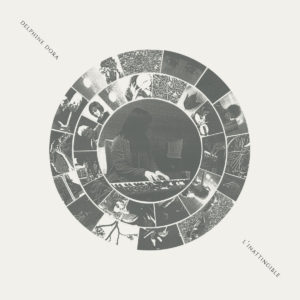
With L’Inattingible, Delphine Dora’s music unfolds by drawing upon a new palette of colors. It will not escape anyone, that after having sung, in foreign, invented languages, or through extended vocal techniques, the musician resorts for the first time, to solely using the French language; and that after having often set texts and poems by other authors to music, she authorizes herself here to sing her own texts and fragments.
But beyond these formal enrichments, the new musical ambitions developed through L'Inattingible are to be found in the very fabric of the record. If the previous albums had been conceived through improvisations or spontaneous compositions, the new pieces have found their definitive incarnations through a lengthy process of collation, rewriting, and a multitude of transformations. Moreover, the composition process now involves a complex montage of texts, sounds and instruments. If the keyboard remains the inextinguishable lung of the record, it is no longer rare to come upon Delphine's sung lines and have them echo into a lush instrumentation - where in voices and instruments create a language, and develop dialogues that have never been heard before.
17,00€
In stock
LP
Clément EDOUARD
“Dix ailes”
Dix Ailes is a musical proposal for 2 female voices, 1 percussionist, 1 electronic device and 1 place with high reverberation. Between minimalist music and pure pop, Dix Ailes plays on an acoustic illusion, that of making indistinguishable the origin of the sound (instrumental, loudspeaking or architectural), based on work on harmonics, frequency vibrations, the physical resonance of the place, psycho-acoustics.
Essentially centered on the voice, Dix Ailes addresses the notions of empty and full, of internal listening and silence, of liminarity and transformation. By a principle of initial composition based on symbols and archetypes, the music of Dix Ailes echoes universal rituals and myths, and shares with them a language that tempts to escape the sequences of rational logic, and thus to open up to an contemporary poetic landscape, made of archaic and invisible.
Clément Edouard: Composition & Electronics
Isabel Sörling & Linda Oláh: Voices
Julien Chamla: Percussions, Bass Harp
17,00€
In stock
CD
Clément EDOUARD
“Dix ailes”
Dix Ailes is a musical proposal for 2 female voices, 1 percussionist, 1 electronic device and 1 place with high reverberation. Between minimalist music and pure pop, Dix Ailes plays on an acoustic illusion, that of making indistinguishable the origin of the sound (instrumental, loudspeaking or architectural), based on work on harmonics, frequency vibrations, the physical resonance of the place, psycho-acoustics.
Essentially centered on the voice, Dix Ailes addresses the notions of empty and full, of internal listening and silence, of liminarity and transformation. By a principle of initial composition based on symbols and archetypes, the music of Dix Ailes echoes universal rituals and myths, and shares with them a language that tempts to escape the sequences of rational logic, and thus to open up to an contemporary poetic landscape, made of archaic and invisible.
Clément Edouard: Composition & Electronics
Isabel Sörling & Linda Oláh: Voices
Julien Chamla: Percussions, Bass Harp
10,00€
In stock
CD
MANINKARI
“L’océan rêve dans sa loisiveté – third session”
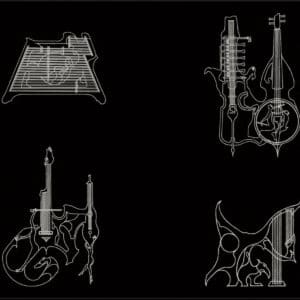
Maninkari's third session of L'océan rêve dans sa loisiveté.
All selections composed, improvised, recorded by Frédéric & Olivier Charlot : santoor, cimbalom, duduk, viola, synths, frame drums, percussions, cello, melodica, jaw, harp, voice, zither.
Claudie Ponget and Catherine Marmet : voice, drone
Drawings: Frédéric Charlot
9,00€
In stock
LP
Giovanni Di DOMENICO
“Zuppa di pazienza”
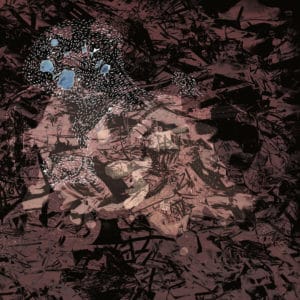
Insalata Statica (Silent Water, 2017), Giovanni Di Domenico's first solo album, allowed the Italian pianist based in Brussels to free himself from his abundant creativity by proposing 6 dense movements. It took him 5 years to record and produce this first record. With Zuppa di pazienza, recorded and produced in 5 months, Di Domenico worked much faster, but the result is that these compositions are more thorough. Reduced to two, the movements are more refined, taking the time to develop around the main melody, which is repeated at leisure in a multitude of additional tracks, thus giving several faces of the same theme.
Recorded using numerous analog keyboards at the Klangendum/Worm studio in Rotterdam, Zuppa di pazienza is entirely played by Di Domenico. The filed recordings and overdubs were recorded in a second time, without listening to the original base of the music. Di Domenico then edited the whole thing. The result is a tingling of sound material around the main theme.
If Zuppa di pazienza is only Giovanni Di Domenico's second, he is no stranger. He is involved in many projects (Going, Eggstream, and many collaborations) and is a regular contributor to Jim O'Rourke with whom he has released Arco (Die Schachtel, 2015).
Zuppa di pazienza is his third collaboration with three:four records after his participation in the Denki Udon trio (In ZDB, three:four, 2015) and the Oba Loba sextet (Sir Robert Williams, three:four, 2017).
15,50€
Out of stock
LP
ELG
“Les particules”
Label notes :
"Since our first listening, we've been obsessed by the strange beauty of this small pop track that seems to be fallen on a dark hole. After having the chance to see the film before its screening at Cannes Festival' La Quinzaine des Réalisateurs, we decided to release this music. The LP comes in a beautiful gatefold sleeve designed by Coline Sunier and Charles Mazé.
Since 2004, Èlg, has drawn concentric sound spirals made of musical pipes and entrails. He builds improbable bridges between concrete music and french song debris, between cryptic electronic tribal incantations and russian doll dancing in Plutonia. When not in french, language is reduced to alien babble of an old man, a child, a dusty revenant, an epileptic bard, a peaceful messenger...
Èlg, is 1/2 Opéra Mort, 1/3 Orgue Agnès, 1/3 Reines d'Angleterre, 1/2 Schultz et Èlg."
15,50€
Out of stock

LP
ORGUE AGNES
“A Une Gorge “
**** Back in stock, our favourite record since months ****
This is electrified ping-pong music. This music pings and pongs.
Ping-pong balls are commonly used in experimental piano music.
They are chancey things. And they are cheap; you can buy a wack of them for next to nothin’.
Orgue Agnès bounces in loose time and dances and reflects. It is reflective bouncing dance music.
With little effort - or little to no intention – ping-pong balls set off a derive of small detailed sounds.
They are lit alive - light and lighthearted.
They jump for joy. I am talking about Orgue Agnès and ping-pong balls.
A lot of A Une Gorge sounds like it was made with electrifc ping-pong balls bouncing inside of a throat or
a mouth.
A mouth-full of electricity.
A throat (like a mouth) is a filter.
« wah wah woah wow-wah. »
A mouth-throat is a wah. Une gorge is a dancehall.
Orgue Agnès A Une Gorge and this music sounds like it was made inside of one.
As strange and wonderful as it sounds."
Eric Chenaux
15,50€
In stock

LP
AMULETO
“Misztériumok”
"Misztériumok is the third full-length record - their first on three:four - of Italian duo Amuleto, composed of Francesco Dillon and his cousin and three:four’s artist Riccardo Wanke.
Following the route of previous releases this new album emerges as the fusion of composed and improvised forms and moves between contemporary and electronic music mixing acoustic, electronic and real world sounds. The music takes shapes from a progressive disclosure of sonic material that gradually manifests its nature: at times aggressive and distorted, other times ephemeral and intimate. Cello, electronics, field recordings and a large variety acoustic timbre merge into a unique sound. More intensively than before, Amuleto in these five pieces condenses their aesthetic within intense evolutions, concrete attacks and tight musical constructions.
This work takes inspiration from a series of old photos (as negative silver bromide glass plates) found in the 'Feira da Ladra' flea market in Lisbon. They depict scenes of middle-European family life at the start of the 20th century mixing what seems an ephemeral serenity with an imminent sense of crisis and loss."
15,50€
In stock
CD
LA TÈNE & Jacques PUECH et Louis JACQUES & Jérémie SAUVAGE et Guilhem LACROUX
“Abandonnée/Maléja”
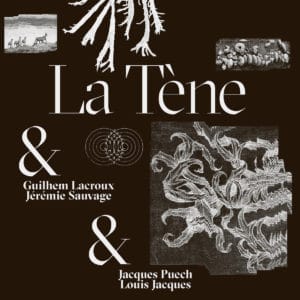
"La Tène is back with a double invitation to its third full length LP.
The hurdy-gurdy/harmonium/percussions trio welcomes two bagpipes (cabrettes and 23” to be exact), and a combo of string instruments (12-string guitar and electric bass).
Beyond the instrumentation, we’re looking at a gang of high esteemed guests: Jacques Puech, Louis Jacques, Guilhem Lacroux and Jérémie Sauvage, whom works are given their due credit (with the La Novià collective and its multiple variations, the France group, Super Parquet, the Standard-In-Fi label, etc.), are at ease with fuelling the traditional ball dance floor (literally in its wooden meaning) as well as questioning it, confortable with sparking dance moves as well as pushing instruments and their sound to their ultimate limits.
La Tène’s music doesn’t alter itself, it is always at the conjuncture between obsessive repetition and fragmented traditional music, hence developing a mineral depth on an obstinate pulse. Where one hears an instrument, its mirror unburdens until the confusion. One lies breathless, only whishing the end becomes an eternal resumption."
10,00€
Out of stock
2 LP
LA TÈNE & Jacques PUECH et Louis JACQUES & Jérémie SAUVAGE et Guilhem LACROUX
“Abandonnée/Maléja”
"La Tène is back with a double invitation to its third full length LP.
The hurdy-gurdy/harmonium/percussions trio welcomes two bagpipes (cabrettes and 23” to be exact), and a combo of string instruments (12-string guitar and electric bass).
Beyond the instrumentation, we’re looking at a gang of high esteemed guests: Jacques Puech, Louis Jacques, Guilhem Lacroux and Jérémie Sauvage, whom works are given their due credit (with the La Novià collective and its multiple variations, the France group, Super Parquet, the Standard-In-Fi label, etc.), are at ease with fuelling the traditional ball dance floor (literally in its wooden meaning) as well as questioning it, confortable with sparking dance moves as well as pushing instruments and their sound to their ultimate limits.
La Tène’s music doesn’t alter itself, it is always at the conjuncture between obsessive repetition and fragmented traditional music, hence developing a mineral depth on an obstinate pulse. Where one hears an instrument, its mirror unburdens until the confusion. One lies breathless, only whishing the end becomes an eternal resumption."
23,50€
Out of stock

LP
LA TÈNE
“Tardive-Issime”
Collaborative release between Les Disques Bongo Joe and three:four.
If this second opus relies on the same method of composition, it employs a decidedly richer timbral palette, combining long heavy descending harmonium sweeps, relentless percussion, and the ever more precise patterns and drones of the hurdy-gurdy.
‘Tardive/Issime’, something of a mirror to its predecessor, nevertheless reveals a few phantoms in the course of listening, prefiguring a music still to come.
La Tène is a tricephale beast discharging a singular energy in which one may detect echoes of traditional music, saturated repetition, ethereal harmonics or imaginary choreographies...
Alexis Degrenier: hurdy-gurdy. Cyril Bondi: percussions. D'incise: Indian harmonium, electronic.
16,50€
In stock

CD
LA TÈNE
“Vouerca – Fahy”
Alexis Degrenier, hurdy-gurdy. Cyril Bondi, percussions. D’incise, Indian harmonium, electronic. Recording : Insub.studio, Geneva, July 2015.
La Tène collect, listen and probe folk melodies and motifs of large territories, from the Jura to the mountains of Auvergne, weaving them to repetition and continuous sounds, electronics and frenzy until exhaustion. Their music, drones played with traditional and acoustic instruments is an invitation to the dance frantically, leading to euphoria or trance.
Cyril Bondi and d’incise are well-known Swiss experimental musicians. They have a huge panel of collaborative and solo records. Cyril Bondi is also known for his playing in the jazz improv trio Plaistow. They play together in Diatribes.
Alexis Degrenier is a French composer, specialist in tranditionnal and slanted music. He plays in Ensemble Minisym that perform Moondog music.
10,50€
In stock
LP
RAZEN
“The Xvoto Reels”
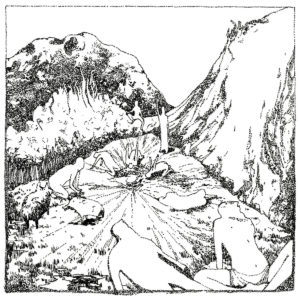
Brecht Ameel, church organ. Kim Delcour, shawm & recorders. Paul Garriau, hurdy gurdy. Pieter Lenaerts, 5string bass & sarangi. Suchet Malhotra, tabla.
“The Xvoto Reels provides additional proof (if necessary) that Razen is an audacious group. If the Belgian band led by the duo Brecht Ameel and Kim Delcour has explored different musical worlds with changing formations, the involuntary irruption of a sixth “member” has upset the content of this new album. Through these brutal and unpredictable interventions, it made an ambitious album - recording live improvisations in a church with an organ and a tabla - unique.”
The Xvoto Reels – a prayer in the halflight, a comforting sermon out of St Martin’s Church - is a version of Razen where the music played itself, and chance dictated what essence of this was allowed to be captured.
16,00€
In stock
LP
MANINKARI
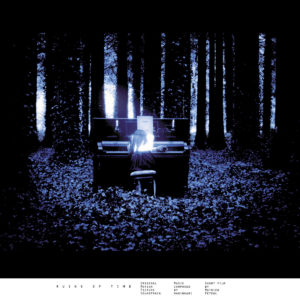
“Ruins of Time”
Following Phantasmes, released in 2014, Ruins of Time is a new original motion picture soundtrack of the short film “Ruins of Time” by Mathieu Peteul.
"Ruins of Time” is an experimental short film originating from the film Limbo.
Available on vinyl, the 4 tracks mixes various human voice and strings blending spacey dark drones and strange atmospheres.
Frédéric Charlot - Viola, cello, drones, voice. Olivier Charlot - Synth, drums, drones, voice. Nicolas Boyer - Field recordings. Sofia Atman - Voice. Recorded, mixed, designed by maninkari. Mastered by Julien Grandjean at Jetlag.
12,00€
Out of stock
LP
LA TÈNE
“Vouerca – Fahy”
Alexis Degrenier, hurdy-gurdy. Cyril Bondi, percussions. D’incise, Indian harmonium, electronic. Recording : Insub.studio, Geneva, July 2015.
La Tène collect, listen and probe folk melodies and motifs of large territories, from the Jura to the mountains of Auvergne, weaving them to repetition and continuous sounds, electronics and frenzy until exhaustion. Their music, drones played with traditional and acoustic instruments is an invitation to the dance frantically, leading to euphoria or trance.
Cyril Bondi and d’incise are well-known Swiss experimental musicians. They have a huge panel of collaborative and solo records. Cyril Bondi is also known for his playing in the jazz improv trio Plaistow. They play together in Diatribes.
Alexis Degrenier is a French composer, specialist in tranditionnal and slanted music. He plays in Ensemble Minisym that perform Moondog music.
16,00€
In stock
LP
David MARANHA & Helena ESPVALL
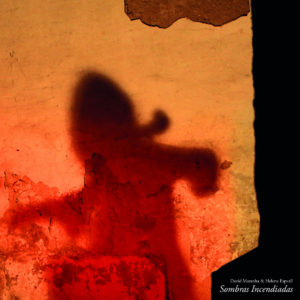
“Sombras incendiadas”
Helena Espvall first met David Maranha in 2006 when her band Espers played a show in Lisbon. They played two gigs the following year, and Espvall contributed to Maranha’s Marches of the New World. Since then they always had the intention of working together more extensively and once Espvall moved to Lisbon two years ago they had no more excuses.
Sombras Incendiadas (“Exploding Shadows”) features Espvall on amplified cello and Maranha on electric organ and amplified violin. Espvall has an amazing cello sound, kind of Velvet Underground, while David Maranha is in the vein of La Monte Young or Tony Conrad. As a duo, they create heavy drones with delicate harmonics behind the wall of sound. The textures are raw, the compositions are minimalistic, and the riffs are heady. The repetitive patterns played very loudly create a monolithic, hypnotic, and time stopping album.
Sombras Incendiadas is available on LP (with a download coupon) and digitally.
David Maranha, violin, electric organ. Helena Espvall, cello. Recorded in Violente do Céu by David Maranha between december 2012 and march 2013.
12,00€
Out of stock
CD
MANINKARI
“L’océan rêve dans sa loisiveté”
Around the theme of the ocean symbolising the subconscious, the hidden world and a very personal concept of “loisiveté” a combination of idleness “oisiveté” and law “loi”, Maninkari continues exploring a weird and dreamlike world.
As usual, the Charlot brothers (Frédéric & Olivier) resort almost exclusively to the use of acoustic instruments with oriental origins (bodhran, cymbalom, santoor, zurna).
Percussion instruments especially the bodhran play melodic or textural figures, whereas stringed instruments become repetitive to a point where they embody the rythmics.
The combination of repetition and oriental tones create a heady sound continuum providing the 10 nameless tracks with a mantra-like resonance. A short breathing in the middle of the album with an organ and birdsong is the only quiet moment of this tormented (but without violence), and meditative (but without bliss) record.
The permanent state of tension recalls the rigours of law and repetition provides the calm alternative of idleness “l’oisiveté”. (...)
7,00€