
Out of stock

LP
Kara-Lis COVERDALE
“From Where You Came” (clear)
From Where You Came unspools as a series of nocturnal transmissions, altered-state refinements, and vivid stories, rich in vibrant, illuminating qualities. Indexing 19th century programmatic music, mid-’70s jazz, and a distinctively colourful and multi-dimensional approach to composition that embraces improvisation, Coverdale alloys synthesis with live instrumentation in a gesture of reconnection with land and body through sound. Approaching composition as a diagnostic methodology to spiritual ends, she conducts emotional resonance like currents of charge, hard-wiring the purely felt into electronic signals.
Though written and recorded on several continents, including at the GRM Studio in Paris and the Elektronmusikstudion EMS in Stockholm, From Where You Came was completed in rural Ontario, Canada. Featuring contributions from multidisciplinary sound artist and cellist Anne Bourne and trombonist Kalia Vandever, the album’s 11 expansive yet condensed compositions incorporate strings, woodwind, brass, keys, software and modular synthesis, inscribing a musical language that resonates animations with unfiltered, striking clarity. Coverdale's own voice melts into air amidst the enveloping swell of the album’s opening prelude: “Everything you know is real,” she sings on “Eternity,” “I’m sorry, life is beautiful… .” As though in response, oscillating vividly between animism and animalism, the album that follows is brimming with life in all its stunning complexity.
Reckoning with the experience of grief, dislocation, and the pressure of total freedom and independence, Coverdale yields supernatural capacity to alchemize tribulation into highly imaginative and inspiring fantasy epics of sound. In the piloted flight of “Daze,” wind choruses dance and twirl in ornate punctuated cycles as dissonant portamentos annotate modulatory ascent to soaring heights, gliding and churning across turbulent gails to new pockets of harmonic plateaus, stabilizing periodically through rhythmic gait for rest. It feels like the joy of flight. In other spiritual quests, sound becomes a feat of physics; physical and subterranean, material, and even destructive, amongst highland drone figures in “Freedom.” Melancholic restlessness and will-summoning entrench furtive flurries of energy on “Coming Around,” skittish, tacit, and reluctantly yearning chimes illuminate a granular “Problem of No Name,” and ecstatic, messy-haired catharsis blurts release through the drummed sample-based sequences of “Offload Flip.”
Each new narrative finds rootedness in a changing environment, giving a sense this is ecological adaptation made into music, as a way to navigate being in the world. Speaking directly to the rootlessness and alienation of modernity while processing the thrill and pain of being alive, From Where You Came draws immense strength through a commitment to material groundedness, from where we are able to view the scale of our own mythology, the worlds we want to build, and the stories we are determined to tell.
25,00€
In stock
LP
Kara-Lis COVERDALE
“From Where You Came”
From Where You Came unspools as a series of nocturnal transmissions, altered-state refinements, and vivid stories, rich in vibrant, illuminating qualities. Indexing 19th century programmatic music, mid-’70s jazz, and a distinctively colourful and multi-dimensional approach to composition that embraces improvisation, Coverdale alloys synthesis with live instrumentation in a gesture of reconnection with land and body through sound. Approaching composition as a diagnostic methodology to spiritual ends, she conducts emotional resonance like currents of charge, hard-wiring the purely felt into electronic signals.
Though written and recorded on several continents, including at the GRM Studio in Paris and the Elektronmusikstudion EMS in Stockholm, From Where You Came was completed in rural Ontario, Canada. Featuring contributions from multidisciplinary sound artist and cellist Anne Bourne and trombonist Kalia Vandever, the album’s 11 expansive yet condensed compositions incorporate strings, woodwind, brass, keys, software and modular synthesis, inscribing a musical language that resonates animations with unfiltered, striking clarity. Coverdale's own voice melts into air amidst the enveloping swell of the album’s opening prelude: “Everything you know is real,” she sings on “Eternity,” “I’m sorry, life is beautiful… .” As though in response, oscillating vividly between animism and animalism, the album that follows is brimming with life in all its stunning complexity.
Reckoning with the experience of grief, dislocation, and the pressure of total freedom and independence, Coverdale yields supernatural capacity to alchemize tribulation into highly imaginative and inspiring fantasy epics of sound. In the piloted flight of “Daze,” wind choruses dance and twirl in ornate punctuated cycles as dissonant portamentos annotate modulatory ascent to soaring heights, gliding and churning across turbulent gails to new pockets of harmonic plateaus, stabilizing periodically through rhythmic gait for rest. It feels like the joy of flight. In other spiritual quests, sound becomes a feat of physics; physical and subterranean, material, and even destructive, amongst highland drone figures in “Freedom.” Melancholic restlessness and will-summoning entrench furtive flurries of energy on “Coming Around,” skittish, tacit, and reluctantly yearning chimes illuminate a granular “Problem of No Name,” and ecstatic, messy-haired catharsis blurts release through the drummed sample-based sequences of “Offload Flip.”
Each new narrative finds rootedness in a changing environment, giving a sense this is ecological adaptation made into music, as a way to navigate being in the world. Speaking directly to the rootlessness and alienation of modernity while processing the thrill and pain of being alive, From Where You Came draws immense strength through a commitment to material groundedness, from where we are able to view the scale of our own mythology, the worlds we want to build, and the stories we are determined to tell.
24,50€
Out of stock

LP
Lasse MARHAUG
“Context”
Lasse Marhaug is one of those characters that operates at the nexus of so much stuff that’s important to us here - working as a producer (over the last couple of years alone he’s helped shape albums by Jenny Hval, Kelly Lee Owens, Okkyung Lee, Hillary Woods etc etc), a mastering engineer (far too many releases to mention), a prolific sleeve designer (likewise), publisher (his occasional Personal Best magazine is still going strong) and, perhaps most importantly - a recording artist in his own right. ‘Context’ is his most substantial release in years - a crushing assembly of bone-dry/darkside drone/machine malfunctions that’s bursting with a visceral, throbbing, mass of feeling. If yr into anything on the spectrum from Mika Vainio to Grouper to Kevin Drumm or Deathprod - this one’s as good as it gets
Over almost three decades of activity, Marhaug has carved out notoriety as a solo performer, a prolific collaborator (working with everyone from Sunn O))) to Jim O’Rourke) and as a busy producer, who’s notched up credits on some of the most striking-sounding albums of the last few years. This new album was created as a swan song for the infamous Oslo studio that he’s inhabited for 17 years, prior to his move back to the Arctic Circle where he originally came from. Recorded over a 14-month period and painstakingly edited from hours upon hours of material, it might just be the most impressive, moving record we’ve heard from him so far.
The interplay between piercing softness and deafening noise is the key to “Context”, displaying a philosophy Marhaug has been exploring for years. Few other artists are able to balance chaos and harmony with such ease; Marhaug does it without grandstanding, it’s music that sounds as simultaneously beautiful and as daunting as the Arctic landscape he’s returning to. At any moment a sound can be alluring or treacherous, like the frozen sun reflecting on a snowy mountaintop. Marhaug’s deftness with rhythm and bass emerges on ‘Context 3’, as he pairs Vainio-esque low-end pulses with crumpled noise and widescreen tones; as disquieting music-box chimes absorbed into the blasted soundscape on ‘Context 5’, while we’re thrust into the freezing cold on ‘Context 6’, subjected to punctuating gusts of white noise and trapped string loops.
Trust it’s a rare and near-mythical beast, conjuring vast, treacherous soundscapes illuminated with pangs of sentiment that naturally weave strands of his non-musical practice in their psychosensual lustre and gritty attrition. As he steps into a new phase of his career, we’re left with a concluding chapter that stands as a summation and open-ended post-credits reveal.
26,00€
Out of stock

LP
Pauline OLIVEROS & REYNOLS
“Half a Dove in New York, Half a Dove in Buenos Aires”
Recorded back in 1999, ‘Half a Dove in New York, Half a Dove in Buenos Aires’ is the recorded debut of a NetCast improv between deep listening pioneer Pauline Oliveros and Argentinian free music trio Reynols >> a fascinating early example of the internet’s capacity to foster remote creativity in-the-moment that deploys the slowest electronics, accordion, voice, trombone and computer sounds on a next level ritual drone incantation recorded in another era, but made for our time.
As the story goes, Oliveros first met Reynols in the mid ‘90s at a Deep Listening workshop she held in their home city, Buenos Aires, where they impressed her with an improvised brass serenade. Years later, in 1999, they met again via NetCast - a series of very early online live improvisations - to explore the Internet’s potential for collaborations between artists thousands of miles apart. Finally mixed down in 2021 and mastered by Helge Sten (aka Deathprod) after marinating in the archive for 22 years, the album resonates with the late, great Oliveros’ legendary work in exploring alternate tunings, spatial dynamics and methods of intuitive performance - a remarkable slab of omnidirectional drone bearing traces of Miguel Tomasin’s vox and Oliveros’ just-intoned accordion embedded in its cosmic roil.
Broadcasting from fabled record shop The Thing in NYC, with Oliveros (Accordion) joined by Jennifer McCoy (ICR), Kevin McCoy (Computer processing), and Monique Buzzarté (Trombone), and Reynols revolving Miguel Tomasin (Electronics, subliminal voice & Alclorse drums), Rob Conlazo electronics, leather gloves & e-gtr), and Anla Courtis (electronics, rubber foot & e-gtr) and dialling-in from Florida 943 in Buenos Aires, the results are an incredibly absorbing and consistently surprising testament to vanguard, experimental spirits prizing the internet’s nascent, unprecedented ability to connect minds and art across continents, language barriers, and modalities.
The album’s first side, titled ‘Micro Macro Wind Dance’, puts Oliveros’ accordion under a microscope, enhancing it with lower case rumble and noise from Reynolds’ arsenal. Shifting glacially over 22-minutes, Oliveros plays subtly and slowly at first, letting the accordion breathe in-and-out like a sleeping mythical beast, before she transitions to fluttering bird-like phrases by the end of the side.
‘Astral Netcast Pigeon’ expands the dissonant drones to widescreen, submerging Oliveros’ trills and drones beneath layers of dirt and grit. It’s time-altering music that dissasembles yr head before you’ve completely worked out what’s happening >> basically the perfect mid-point between Oliveros’ deep listening practices and Reynols’ wildly inspirational free-noise-drone freakouts
26,00€
In stock
2 LP
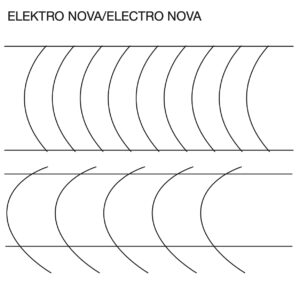
ELEKTRO NOVA
“Electro Nova”
Like a rediscovered Viking burial ship, Electro Nova compiles near-mythical drone recordings produced in 1998 and described by Helge Sten aka Deathprod as some of the most important music to ever come out of Norway. It’s the work of Kåre Dehlie Thorstad and compiles two of the earliest releases on Smalltown Supersound, back when it was basically no more than a bedroom operation. It’s taken over two decades, but finally the label have given the material a first ever proper release on vinyl, complete with mixing and mastering by Deathprod. If you’re into the ice cold swells of anyone from Thomas Köner to Harley Gaber, Biosphere, Kali Malone or, of course, Deathprod - this one’s as essential as they come.
Kaare Dehlie Thorstad’s Elektro Nova produced just two releases during the late ‘90s that have since slipped into drone lore - Trans-Inter-Ference and Elektro Nova/Electro Nova. Admired not only by Deathprod and Joakim Haugland of Smalltown, but also by his contemporaries Lasse Marhaug and Biosphere, his work has evaded pretty much any attention outside of Norway these last two decades. Following a chance meeting with Thorstad at Oslo airport a few years back, Smalltown were prompted to give the recordings a second wind, presenting what is essentially a captivating new release, and crucial addition to the Norsk drone canon.
As the story goes, Thorstad was studying photography in the late 90’s in Scotland, but instead of delivering a photo for his final exam he made a record - a double album (2CDs) and a 10” to be precise. That should provide some idea of the textural synaesthetic and landscaping qualities evoked by his music, which he ended up sending to a then-young Smalltown label, who were mostly issuing tapes at the time. With no proper distribution the records largely bypassed wider attention, and become a personal favourite of Smalltown’s Joakim Haugland, as well as avowed fan Helge Sten (Deathprod), who helped render its diaphanous scale in mix down, and Lasse Marhaug who describes them as “two perfect records that deserved much bigger attention”.
Between its jaw-dropping opener; the post-apocalyptic vision of its untitled part; and the cinematic white-out of the 10” tracks; Thorstad comes as close as we’ve ever heard to evoking the inhospitable nature and stark beauty of the wild far north. We can hear those landscapes palpably internalised and alchemically transmuted into its coarse grained textural swells and a reverberating multi-dimensionality, variously sustained to extents that evoke an abandonment of the senses, or likewise squashed and isolated to imply the relative anxiety relief of atmospheric flux, where a few degrees temperature rise or a drop in the wind speed can make the difference between life and death.
30,00€
Out of stock
LP
Mats GUSTAFSSON & Christian MARCLAY
“Link”
Christian Marclay: turntables
Mats Gustafsson: live electronics & slide, tenor and baritone saxes
Recorded and mixed April 2006 by Christoffer Roth and Olof Madsen at Studio Dubois, Stockholm
Mastered by Martin Siewert
Executive production by Joakim Haugland and Lasse Marhaug
500 copies
19,50€