
In stock
CD
KERNEL
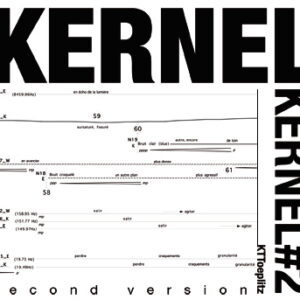
“Kernel #2 (second version)”
“The fourth CD of Kernel, september 2009, on R.O.S.A. Kernel
2 (second version) is a re-creation of their first CD, Kernel
2, two years later. Exactly the same score, but a differnet interpretation - a much longer one (53 minutes) and with much more density to it. Actually this CD defines very much what Kernel is about - live interpretation of written scores of electronic music. Comparing the 2 versions is something... !!”
8,00€
In stock

CD
Kasper T. TOEPLITZ
“Capture”
“A very micro-tonal score, played by 3 dancers/musicians whose infinitesimally slow movements are “captured” by web-cams and “mapped” to all the parameters of a real-time digital synthesis engine - frequency, amplitude, ambitus… No samples, no pre-recorded sounds, the sole sound source is a white noise generator, sculpted by filters, producing a polyphony of drones, oscillations, movements of electricity - a long electronic ascension”.
8,00€
In stock

CD
Kasper T. TOEPLITZ
“Almasty”
Solo bass played and composed by Kasper T. Toeplitz.
Layers of noise full of details like the voice of dead machines !
“A purely formal présentation of ALMASTY would point that it is a composition for solo bass – electric bass, which implies a few electric/electronc machines around the string instrument, which change or modifiy its résonances somehow, but nothing more that what is seen those days around any electric instrument. And ALMASTY is also a solo composition, as it is recorded and presented as it was played, live, one evening of november 2015, in Bagnolet, just outside of Paris (even if it was not the first time the piece was played) : no overdubs, re-recordings, no samples of the instrument replaced later in the final mix, no compositional work in the studio, except of the reduction of the original 4 tracks in a stereo, as the piece is written to be played on 4 speakers disposed in an arc in front of the audience.
And of course all this has no importance at all, it is not an "instrumental solo" which hopes to show a supposed virtuosity, nor is it an introspection of the musician facing himself : ALMASTY is best defined as a composition originating from an "electronic thought" of the music, which happens to be played on a basse just because the composer, which happens to also be the interpréter of the piece has some pleasure, or just a familiarity resulting from the years spend with the instrument, when playing the bass. But what Almasty is, is an electronic architecture, lasting just about one hour, layers of sounds, noises, textures, a constant attention to détails of the resulting sounds, dust or splinters, from the macroscopic to the powerful breathing of some machine, a never revealed presence – the Almasty. And the cover, a painting executed by Daria Gabriel, is of a similar density of texture.”
8,00€
In stock
CD
LE DÉPEUPLEUR
“ZKT”
“Le dépeupleur is the electronic project of Zbigniew Karkowski and Kasper T Toeplitz. Both musicians use computers, and create electronic sounds - no samples, no “found” sounds - it’s all “pure” electronic. Even if their names can (also) be found in the "noise" circles - they did collaborate with musicians such as Merzbow, Tetsuo Furudate, CCCC or Francisco Lopez, to name a few - they are both composers having done, and still doing fully written down pieces for orchestras, ensembles etc
If there have to be some reference to the work of Le dépeupleur, it only could be Xenakis
“ZKT” is a long, one-hour piece structured in two parts - it ending being an eternal resonance. Re-read Beckett.”
8,00€
In stock
CD
KERNEL
“D.R.”
“The third CD of Kernel - with still the same musicians - Eryck Abecassis, KTToeplitz & Wilfried Wendling - released in september 2009 on R.O.S.A. On this CD, two electronic compositions , and the first piece played by Kernel but written by someone else than KTT - which is for sure a “first” but is also the beginning of the “second phase” for Kernel. 1. “Dust reconstruction” (KTToeplitz) 2. “Drowning report” (E Abecassis).”
8,00€
In stock
CD
KERNEL
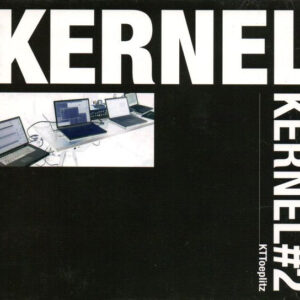
“Kernel #2”
“KERNEL is an ensemble of purely electronic music (no found sounds, no samples, no sound-files), which plays long, fully written compositions - electronic architectures. The musicians mostly play computers as real-time instruments, but some analog devices are used as well. Kernel 2, a composition by K T Toeplitz is a 40 minutes long "study in noises" as the only sources are electronic noises of different colors - from black to blue - and textures, filtred, granulated and mutated; reaching for the fragile moments between pitch and sound, between light and shadow. Musicians of Kernel are Eryck Abecassis, Kasper T Toeplitz & Wilfried Wendling.”
8,00€
Out of stock

2 CD
KERNEL
“Kernel #2” + “Kernel #2 (second version)”
A special offer to get the two versions of the same piece for 20 euros instead of 26 !
20,00€
In stock
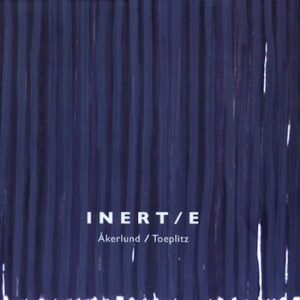
CD
AKERLUND – TOEPLITZ
“Inert-e”
Lars Akerlund : electronics. Kasper T. Toeplitz : bass & electronics.
After years of navigating in similar musical idioms - somewhere between noise, contemporary or experimental music - using as well traditional instruments that electronic or digital devices - Lars used to be a classical guitarist, Kasper composed many orchestral or ensemble pieces, now both work a lot on their computers - and having worked with the same musicians, such as Dror Feiler or Zbigniew Karkowski, among others, Those two musicians met during the summer of 2013 in Paris, at the GRM studios to create their INERT/E project, made of an organic accumulation of complex structures, an architecture of an electronic nature, made of different temporalities, with apparently no causalities, and in very slow, almost static, evolution - an electronic ecosystem.
A CD of two long tracks : 1. Les masses sont l’inertie, la puissance du neutre
and
2. To Describe the overwhelming life of a tropical forest just in terms of inert biochemistry and DNA didn’t seem to give a very full picture of the world.
8,00€
Out of stock
CD
Kasper T. TOEPLITZ
“Gris”
Music for live electronics, bass and lithophone. Played by Kasper T. Toeplitz (composition, live-electronics, bass) and Philippe Foch (lithophone). This music was written (and played live) for the dance piece named “GRIS” choreographed by Myriam Gourfink. Immobility by Margot Dorleans, Carole Garriga, Deborah Lary and Véronique Weil.
14,00€
Out of stock
CD
Kasper T. TOEPLITZ
“DATA_Noise”
Kasper T. Toeplitz, live electronics, generative video, lights. Myriam Gourfink, stillness.
Electronic composition played live by Kasper T. Toeplitz and Myriam Gourfink. Noise and stillness. Also generative video, and the noise of circulating data.
What it is not : DATA_Noise is certainly not a dance piece with musical accompaniment, using some sort of the so-called “new technology” - sensors, computers - to be more “modern”. DATA_Noise is a musical project, a composition written for synthesized electronic sounds, and meant to be played live, using the computer as the main instrument which creates by many means such as different synthesis or transformation techniques (scanned, granular, wave- terrain synthesis, waveshaping etc...). One of those techniques will be the use of a dancer, performing an extremely slow dance (of an entierely written choregraphy), and whose minimal movements, as seen by different sensors, will have a disruptive function on the behavior of the music-making computer - a way to introduce some “noise” in this very often too precise a machine, a way to maybe re-introduce some of the noisiness of the world into this electronic composition.
Electronic composition played live by Kasper T. Toeplitz and Myriam Gourfink. Noise and stillness. Also generative video, and the noise of circulating data.
What it is not : DATA_Noise is certainly not a dance piece with musical accompaniment, using some sort of the so-called “new technology” - sensors, computers - to be more “modern”. DATA_Noise is a musical project, a composition written for synthesized electronic sounds, and meant to be played live, using the computer as the main instrument which creates by many means such as different synthesis or transformation techniques (scanned, granular, wave- terrain synthesis, waveshaping etc...). One of those techniques will be the use of a dancer, performing an extremely slow dance (of an entierely written choregraphy), and whose minimal movements, as seen by different sensors, will have a disruptive function on the behavior of the music-making computer - a way to introduce some “noise” in this very often too precise a machine, a way to maybe re-introduce some of the noisiness of the world into this electronic composition.
14,00€
In stock

CD
Éliane RADIGUE
“Elemental II”
“Elemental II is the first ever piece Eliane Radigue wrote for an instrument, without any pre-recorded sounds, without the use of her ARP synthesiser. I took a very long time to convince her to do so, the piece was some two years or more in the making - discussing about the sound a mountain makes after the rain. The first recording was released just after the premiere of the piece, in 2004. In 2011, seven years later, after having played the piece more 30 times in concert, after having spend a long time with it, after having “domesticated” it, it seemed interesting to rerecord it - something very common in classical music, but almost inexistant in those “other”, electronic, musics. However those musics also live, change, evolve ; the same score another point of wiev”.
10,00€