
In stock
LP
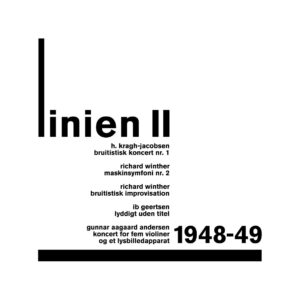
LINIEN II
“1948-49”
This release presents the earliest known Danish works of sound art. Five works from 1948-49 created by the visual artists Richard Winther (1926-2007), Hans “Bamse” Kragh-Jacobsen (1913-92), Niels Macholm (1915-1997), Ib Geertsen (1919-2009) and Gunnar Aagaard Andersen ( 1919-1982), all of whom were part of the artist group Linien II.
“This isn’t music; it is painters making noise paintings”
- Richard Winther
“One ought to be able to make a line that is free of the canvas, standing straight in the air – one ought to be able to do that with sounds”
- Gunnar Aagaard Andersen
The story of Linien II's sound experiments is a story about how a handful of young, idealistic, self-aggrandizing and silly Danish artist dandies in 1948 by a detour invented their own concrete sound art, almost exactly at the same time as radio technician and composer Pierre Schaeffer worked on developing his musique concréte in Paris – and even presented their concrete sound works to the public at an exhibition in Copenhagen before Schaeffer's first and landmark musique concréte work 'Cinq études de bruits' was premiered on French radio.
The release presents five experimental sound works that in different ways represent the artists’ attempts at finding new solutions to a set of formal aesthetic concerns in relation to concrete art by transposing them into the medium of sound. It is a story that hasn’t been told before, as the works until now have only existed in two sets of copies on the original fragile lacquer records, both of which have been locked deep inside museum archives. Now the historical sound works can finally be heard when the Institute for Danish Sound Archeology are releasing them on LP almost 75 years after their recording.
Accompanying the release, a comprehensive art historical text knits together the story about the creation and context of the experimental sound works.
25,00€
In stock
2 LP
Henning CHRISTIANSEN
“Peter der Große / Gudbrandsdal”
Two of Henning Christiansen’s tape works from the 1980’s, Peter der Große and Gudbrandsdal, are now released for the first time by the Institute for Danish Sound Archaeology. Originally composed for different contexts – Peter der Große as the score for a German radio feature and Gudbrandsdal for a performance in collaboration with Joseph Beuys and later Bjørn Nørgaard – the two works stand out in Christansen’s many-faceted oeuvre by employing almost entirely electronic sounds. Two absolutely enthralling and immersive pieces of tape music, now available for the first time. Background
With a career spanning six decades Henning Christiansen (1932-2008) was prolific as a composer, sound artist, and visual artist. Having studied composition at the Royal Danish Conservatory, Christiansen took a sharp turn towards the experimental art scene in the 1960’s and got involved with Fluxus and the Danish Experimental Art School, Eks-Skolen. In 1964, Christiansen met German artist Joseph Beuys, and they quickly started working together. During the sixties, Christiansen became a central collaborator for Beuys and created sounds for several of his actions using multiple tape machines, often on stage with Beuys, playing back mixes of his own compositions as well as recordings made specifically for the actions. In the seventies, Christiansen took another sharp turn: instead of Fluxus, performances and conceptually based art music, he began composing in a neo-romantic style with classical forms like waltzes, symphonies, and songs in the Danish song tradition. Return to tape music Around 1984, Christiansen returned to the artistic strategies he had left in the late sixties with a renewed commitment to his own vision of Fluxus. The following years were some of Christiansen’s most prolific – and also the period in which he composed some of his very best tape works. During these years, Christiansen also worked intensely as a visual artist, integrating performance art, sound, and visual art. During the eighties and nineties, Christiansen created tape music as commissions for theater productions, for radio, and performances – a large part of which have never been released. Neither of the two tape works on this release have been issued before. Peter der Große op. 174 (1986) and Gudbrandsdal op. 178 (1987) are close in time and both of them were created with the technical assistance of sound engineer Ernst Ludwig Kretzer, who worked on and contributed to several of Christiansen’s tape works and performances in the mid-to-late eighties. Peter der Große stands out in Christiansen’s body of work by involving electronic instruments like synthesizer and a crackle box, while Gudbrandsdal employs a more minimal approach and aesthetics through the heavy use of echo effects and manipulation of the tape speed. Gudbrandsdal was created for the performance Tiefland (– som det stiger frem) [Lowlands ( – as it rises up). Tiefland was a originally thought of as a series of performances that Christiansenhad been planning with Joseph Beuys since 1980, and when Beuys died in 1986, Christiansen instead collaborated with artist Bjørn Nørgaard on the project. Both of the tape works carry a heavy atmospheric tone and are set in a largely electronic sound world – something quite unprecedented in regard to Christiansen’s extensive and many-faceted oeuvre. First and foremost, these are two enthralling and immersive pieces of music, that now see their first release.
Double 180g LP + digital, housed in reverse-printed gatefold cover.
29,00€
In stock

LP
Bent LORENTZEN
“Electronic Music”
Bent Lorentzen is widely considered one of the key figures and pioneers of early Danish electronic music and he was one of a few classically trained composers seeking out the possibilities of the new technology in the 1960's. Lorentzen composed a fairly large number of electronic works, – mainly in the 60's and 70'es. Furthermore, he developed a significant educational practice in and around electronic music, conducted workshops, taught at courses, and published articles in both national and international journals, while also producing several educational records on electronic music.
'Electronic Music' was originally released in 1987 as a retrospective album, collecting three of Bent Lorentzen's electronic works from the 70'es. The thee works clearly demonstrate Lorentzen's close familiarity with his equipment and his great technical proficiency regarding the creation and manipulation of all sorts of electronic and recorded acoustic sounds – typically in the form of speed changes, reversed sounds, and reverb and filter effects. The music is often quite dramatic with distinct narratives and multiple dynamic layers of sound, but still with a clear sense of disposition and restraint, possibly stemming from Lorentzen's experience with classical instrumentation, and orchestration.
'The Bottomless Pit' (originally Afgrundens brønd) on side A was composed as the musical score for a ballet by the Norwegian dance company Høvik Ballett, commissioned by NOMUS (Nordic Music Commitee) and staged at Henie Onstad Kunstsenter in Oslo during the Nordic Music Days festival in 1972. The piece was originally composed for four channels, but mixed down to stereo for the 1987 release.
Side B's 'Visions' (originally Visione) and 'Cloud-Drift '(originally NUBES) were also both composed as 4-channel works. The back of the original LP-sleeve contains small prints of graphic notations accompanying the two compositions, here reproduced in enlarged versions for better readability.
The music on the record has been carefully remastered for this reissue. The Bottomless Pit and Visions are new stereo mixes made from 4-channel versions obtained from Gunner Møller Pedersen's private archive. These versions had much more clarity, detail, and depth than other masters we were able to find. The mix from four channels to stereo has been done with careful regard to how the stereo versions appear on the original record. Cloud-Drift was not to be found in its 4-channel version, but comes from the master tape for the 1987 release from OH Musik / Point Records. This piece appears a bit rougher and with less detail in the higher frequencies, but it is the exact same version, as the one on the original release from 1987.
21,50€
Out of stock
7"
Knud VIKTOR
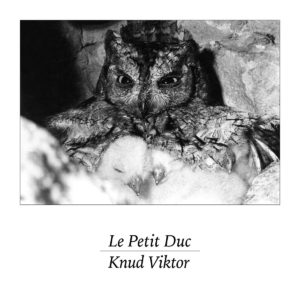
“Le Petit Duc”
Le Petit Duc' [The Little Scops Owl] is a sound work by Danish artist Knud Viktor, made between 1978 and 1983. Viktor was classically trained as a painter at The Royal Danish Academy of Fine Arts in the 1950’s. In 1961 he moved to France to live and work, but was overwhelmed by the sounds of the wildlife in Provence, and instead of painting began listening to and recording his surroundings. With these recordings, he composed what he called sound images – images sonores – and throughout the rest of his career, sound was his main medium.
12,50€
In stock
LP
Knud VIKTOR
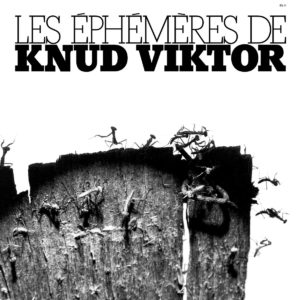
“Les Éphémères”
The lost masterpiece Les Éphémères by the self labeled ‘sound painter’ Knud Viktor (1924-2013) now sees its first ever release by Institute for Danish Sound Archaeology – 40 years after it was conceived. Viktor’s pioneering work – his Images Sonores – are composed of field recordings of insects, animals and his surroundings. His only earlier releases, the much sought-after Images and Ambiances from 1972, were re-issued by Institute for Danish Sound Archaeology in 2017 to great critical acclaim.
A finished master tape and even a complete cover layout for Les Éphémères was found in Viktor’s archives after he passed away in 2013. The phenomenal piece was originally commissioned by the French radio station France Musique in 1977. The twenty short ‘sound images’ of Les Éphémères were originally broadcast as vignettes in-between other radio programs. Working with Allo la Terre, the association in charge of the estate of Knud Viktor, we at Institute for Danish Sound Archaeology are thrilled to finally be able to release this central and evocative work.
From the middle of the 1970’s Viktor began composing almost exclusively for four channels. He invented his own intuitive quadraphonic mixer – the Tetramix – to realise his spatial visions for his Image VI – The Lubéron Symphony, and from then on worked with quadraphonic sound, thus making the release of his works difficult. Les Éphémères is close in time and also holds close ties to The Lubéron Symphony, which Viktor considered his magnum opus. Perhaps most strikingly is the shift in the way he uses the recordings of insects, birds and animals in both The Lubéron Symphony and Les Éphémères: Often untreated and clearly recognizable, the field recordings leave the inherent melody and rhythm of the animal sounds to sing for themselves, layering recordings to create simple and elegant sound images. In two of the twenty pieces Viktor’s own voice blends with the animals, as he recites two poems. One about the singing vineyard populated by musical crickets, the other painting an autumn picture with wine bubbling in the barrels as we hear the wine flies humming.
22,00€
In stock
2 LP
Knud VIKTOR
“Ambiances – Images”
*** New edition. Available before end january ***
Re-issue of rare releases by Danish sound artist Knud Viktor. The Institute for Danish Sound Archaeology is re-issuing the Danish sound artist Knud Viktor’s only two releases. Ambiances and Images – both released in 1972 – are longtime sought-after rare collector’s items.
These are now re-issued as a 2 LP from the original master tapes with liner notes by poet and sound artist Morten Søndergaard.
Overlooked and unheard Danish sound art Knud Viktor (1924-2013) graduated from The Royal Danish Academy of Fine Arts in Copenhagen as a painter. In the 1960’s he moved to the Luberon valley in southern France to paint the Provençal light and nature. However, Viktor left the painting and gradually moved towards filming and recording the sounds of nature. He used the field recordings as raw material for a series of abstract electronic compositions, which also served as soundtracks for his filmworks. A selection of these compositions were released in 1972 on the two records Images and Ambiances on the French label L’Oiseau Musicien. The records came in very limited editions, and therefore Knud Viktor’s works have remained largely unknown. With the re-issue of these records The Institute for Danish Sound Archaeology wishes to revitalize Knud Viktor and his contribution to the history of sound art.
The small sounds of nature Knud Viktor is recognized as an important figure in the field of sound art in France and he is regarded as a pioneer within field recording and acoustic ecology. During the 1970’s he turned his house in Provence into one large mixing desk with a myriad of homebuilt microphones and cables spiralling into the surrounding landscape. From here he would carefully record the sounds of snoring rabbits in their holes, the rhythmic songs of cicadas in the night – even termites gnawing through an old cupboard in the bedroom As the Danish poet Morten Søndergaard writes in the essay A Sonic Seismograph, which accompanies the release: “Light became sound. The most fascinating aspect of Knud Viktor’s world is perhaps that there is a universal coalescence of all things: of artistic expressions and natural science, of painting, sculpture and installation. A paintbrush becomes a microphone. Music becomes sound.”
By re-issuing Ambiances and Images, The Institute for Danish Sound Archaeology hopes to contribute to a revitalization of Knud Viktor’s important work, and that more listeners will engage and lend the deserved attention to these works.
The Institute for Danish Sound Archaeology is an independent association with the overall purpose of uncovering and releasing historical Danish electronic music and sound art.
29,00€
In stock

LP
COMPILATION
DANSKE BÄNDAMATORER // DANISH TAPE AMATEURS 1959-1976
The tape amateurs – a piece of forgotten Danish music history. The Institute for Danish Sound Archaeoloy is releasing a collection of tape works and electronic compositions, created by people who had reel-to-reel tape recorders as their hobby. The vinyl release Danish Tape Amateurs 1959-1976 brings to light a completely overlooked and unheard chapter of Danish music and sound history, making these amazing works available for the first time.
A swarm of tape hobbyists.
When the reel-to-reel tape recorder became commercially available in Denmark in the 1950s, having the tape recorder as a hobby became a widespread phenomenon and in the following decades thousands of people recorded sounds and music, and experimented with cutting and splicing tape, both at home and together in so-called tape amateur clubs. Some also made sound collages and experimental music, exploring the tape recorder as a musical instrument in itself.
On June 26th the Institute for Danish Sound Archaeology is releasing the compilation Danish Tape Amateurs 1959-1976. The release uncovers the history of the tape amateurs with a selection of tape works, as well as an extensive essay by Danish composer Jonas Olesen, who through a comprehensive work of ‘sonic excavation’ and countless phone calls has assembled the history of the tape amateur clubs and the sonic and musical experiments.
With Jesper Hendze, Mads-Erik Michaelsen, Ole Steen Petersen, Benny Jensen, Kaj Ellermann Christensen, Carsten Elbro, Arne Juul Jacobsen, Peter Henriksen & Carsten Elbro, Anders Møller, Poul Otto Udsen, Holger Sindbæk, Arne Juul Jacobsen.
24,00€