
In stock

CD
Russell HASWELL
“Let It Go”
It has been twenty-five years since the seismic events of 2001—when twin towers collapsed under terrorist attack and Coventry's sonic insurgent Russell Haswell launched his inaugural salvo on the original Mego label with Live Salvage 1997–2000. The intervening era has delivered unrelenting turbulence: protracted wars, institutional corruption, a global pandemic, the resurgence of fascist currents, rampant media distortion, and omnipresent surveillance. For Haswell, a lifelong admirer of 1970s and 1980s dystopian cinema, the verdict is unequivocal: "Science Fiction is now!"
In the face of this darkening reality, LET IT GO arrives as both acknowledgment and antidote. This new full-length on Editions Mego extends an olive branch through defiant sonic diversity—an unpredictable mosaic that embraces everything from propulsive rhythms to radical abstraction and enveloping ambience. True to Haswell's core practice, the material draws from the same tactile, free-improvised electroacoustic framework that powers his live sets: immediate, powerful and unscripted.
The album weaves reverent echoes of 1990s Detroit techno's hypnotic pulse and the abrasive, metallic edge of the Birmingham sound into fractured generative territories. Haswell returns to his computer-generated origins while integrating his recent modular-synthesis experiments. During a residency at the Bergen Centre for Electronic Arts (BEK) in Norway, he harnessed the latest GRM Tools suite to conjure the volatile, "rapidly fluctuating pitched sounds" that characterized Iannis Xenakis' late electronic works—resulting in pieces such as Fall 3 and Fall 2, where instability becomes a form of vitality. The tracks Exit Downwards and The Anxieties Of Our Time whilst reflecting the currents of the release also offer surprisingly melodic patterns over jagged rhythms. The wryly titled Thu 25 Dec 2025, (recorded in Glasgow after a solitary post-Christmas-lunch walk home) is a vast drone which evolves according to the random walk model—known more evocatively as the drunken walk—each sonic step veering unpredictably, mirroring the disoriented lens of contemporary existence.
LET IT GO is liberation. Amid the cacophony of crumbling certainties, Haswell deploys a full arsenal of resistance: kinetic drive, disorienting rupture, quiet refuge, raw aggression, and tentative hope. In an age where dystopia has shifted from fiction to lived fact, this music asserts that possibility endures.
15,00€
In stock
LP
Klara LEWIS
“Opening”
Klara Lewis’ distinctive talent for disfiguring sound into forms that remain recognisably song-like reaches a new peak here. Her new album Opening is a deceptive recording with veiled melodies and clandestine bangers.
Lewis, creator of worlds, treats music as a mirror that reflects a perspective misaligned with the real image. Her music moves in unusual and often startling ways. Acoustic instruments such as ukulele and piano are subjected to processes of deconstruction and reconstruction, their original forms continually reshaped.
The tracks within Opening offer an array of disorientating tactics; damaged field recordings are suddenly sliced into ominous rhythmical patterns whilst deceptively simple tactics provide foreboding dread. Often alien on entry, the progression of a piece can land in a surprising tenderness, or the other way around. The momentum grows as a physical state but also one which is questioning, desiring, encapsulating a feeling, to explore a further way of expression and ultimately connecting: A new closeness, a new perspective.
Opening is an album in which the protagonist’s manipulation of sonic matter seems to extend beyond the music itself, resulting in a corresponding manipulation of the active listener. Sounds shift, dissolve, and re-emerge in altered forms, creating an experience that feels both intimate and disorienting. Lewis maintains a delicate balance between abstraction and emotional immediacy, drawing the listener into a world where familiar musical gestures are constantly reconfigured in surprising ways.
The works on Opening are refracted through an exploratory and transformative lens, suggesting an artist continuing to redefine the possibilities of musical language as a space where the instantaneous and the eternal come together.
26,00€
In stock

2 LP
KMRU
“Peel”
*2026 small repress*
KMRU is the moniker of Joseph Kamaru, a sound artist, and producer based in Nairobi. One of the leading exponents of the burgeoning experimental music scene in Nairobi and beyond he was listed by Resident Advisor as one of ’15 East African Artists You Need To Hear’ in 2018 and is a regular performer at the fabled Nyegenyege Festival having also presented live performances at CTM festival and Gamma Festival. Peel is KMRU’s first release for Editions Mego. exquisite mix of field recordings and electronics unravelling at a repetitive and leisurely pace to expose a rich tapestry of sound that has been revered for it’s ability to cross bordear with the sheer undertow of emotional content. The subtle calming atmosphere within Peel belies the compositional prowess as layers of delicate sounds wrap around each other creating a hybrid new form ambient musics both captivating through it’s textural depth and kaleidoscopic patterns. The track titles lend themselves to the themes and mood set within: Why are you here, Well, Solace, Klang, Insubstantial and the title track. This is a deep heartfelt journey with a new strong voice being expressed through the means of organically presented electronic ambient sounds, one which reveals further layers on repeat listens.
All tracks written and produced by KMRU
Recorded and produced in Rimpa, (Nairobi, KE)
Mastered by Stephan Mathieu at Schwebung Mastering, June 2020
27,00€
In stock

2 LP
Kevin DRUMM
“Sheer Hellish Miasma”
Widely regarded as one of the most uncompromising works in experimental noise, Kevin Drumm’s Sheer Hellish Miasma is once again available on vinyl. First released on CD in 2002 on the original Mego label, the album remains a landmark in extreme electronic sound and is an essential and ferocious document of Drumm at his most inventive.
The history of Drumm’s Sheer Hellish Miasma is one of resilience to the twists of underground trends that have come and gone since its initial release. Using guitar, tape manipulation, microphones, pedals, analog synthesizers, and subtle computer processing, Sheer Hellish Miasma is an overwhelming experience: a sonic onslaught of storming feedback, fractured textures and an unrelenting energy. At once brutal and meticulously composed, the album offers a singular vision at the outermost edges of sound art.
For seasoned noise veterans, Sheer Hellish Miasma offers a bracing soundscape filled with exquisitely abrasive textures and more than enough hidden detail to warrant repeated listening – a distinct voice in the increasingly same-sounding world of abstract electronic noise. For everyone else, Drumm’s journey through the noisy underworld is likely to inspire fear or, in an optimistic case, fearful admiration.
Drumm’s Sheer Hellish Miasma is an abstract noise classic with this 2LP reissue being an artefact of eternal power.
Kevin Drumm Guitar, Tapes, Mics, Pedals, Analog Synthesizer, Computer Assistance
Greg Kelley trumpet on Inferno
Dedicated to Malachi Ritscher
Recorded in 2000-2001 Chicago
Mastered at Piethopraxis, Köln, December 2006
Cut at Clunk, Berlin 2025 by Rashad Becker
34,00€
In stock

2 CD
JUNG AN TAGEN
“Revenge of the Speaker People”
In 1978, at the University of London, the Physicist David T. Kemp made an unusual discovery. Kemp noticed that faint sounds, known as Otoacoustic emissions (OAEs), revealed the existence of the cochlear amplifier, a mechanism responsible for sound sensitivity and frequency resolution. This discovery proved that the ear is an active rather than passive organ.
Following this discovery the experimental music world embraced these findings by incorporating them into sound works. Maryanne Amacher was a notable early pioneer of this technique resulting in large scale sound works, the likes of which audiences had never encountered prior. Since these early explorations the use of OAEs has spread more widely in the experimental music landscape, notably by Editions Mego artists Florian Hecker and Marcus Schmickler.
“I believe the kick of techno can be an agent to shapeshift sounds and infiltrate settings” - Jung An Tagen
Stefan Juster aka Jung An Tagen is known for conceptual works and has a large back catalogue of intriguing ideas and sounds. Revenge of the Speaker People is another adventurous release, one which takes the Otoacoustic discoveries of David T. Kemp and applies them to a techno framework. OAEs are fragile and can collapse quickly when combined with other elements. Jung An Tagen’s success in combining OAEs with beats is therefore quite an achievement, without precedent.
The first CD comprises the results of Juster’s experiments, resulting in some of the strangest techno committed to digital since the initial burst of the Mego label. A series of head spinning, ear tickling extreme electronic miniatures bleed in a continuous form. This adventurous and playful music would likely have many a raver run to the bathroom. There is a tangible subversive delight in mixing in such sounds to what is ostensibly ‘club music’.
Because the record had this clear divide of beat + otoacoustics the idea came to see how the material would lend itself to a series of remixes. The second CD has remix contributions from a selection of artists from the Editions Mego stable alongside Juster’s own ETAT imprint along with DJ Nervoso from the Príncipe crew. The results are a headspinning variety of Otoacoustic mayhem as the likes of Evol, Thomas Brinkmann, Ellen Phan, Nik Colk Void and others fold these initial bizarre sounds into even more twisted shapes. Revenge of the Speaker People is a daring, playful and audacious release. One that will baffle your ears, neighbours and dancefloor clients.
21,00€
In stock

LP
Ilpo VAÏSÄNEN
“Asuma”
Editions Mego reissue the 2001 release Asuma by Finnish artist Ilpo Väisänen. Originally released on CD this is the first ever vinyl issue, remastered by Rashad Becker. 2001 is a landmark year for the artist following a wave of success from the notable outfit Väisänen formed alongside Mika Vanio, Pan Sonic (as they were now known then). Following a string of highly acclaimed and influential releases such as “Vakio”, “Kulma”, “A’ and “Aaltopiiri” Pan Sonic had toured the globe extensively leaving a trail of blown expectations and rumours of all manner of objects in venues cracking or falling apart due to the immense sound the duo concocted with their unique instruments.
Taking a break from the ecstatic cacophony of Pan Sonic, Väisänen retreated to work on a solo release which conjured the spirits of the former outfit whilst simultaneously carving out a more personal take on these new electronic forms.
Asuma is a precise study of drones, rhythms, clicks, ambience and gentle confusion. Whilst inhabiting a zone of abstraction the results also move in a natural field as Väisänen’s native Finland permeates these recordings as much as the idea of experimentation itself.
Autioitu 1 opens the album as delicate pinball rhythms bounce across the spectrum as a hairy drone hovers underneath. The mood is both intriguing and unsettling. Tukahduttaja is a delightfully disorientating sound sculpture that is hard to pinpoint what it actually is. Klikki is comparable to a microscopic version of Pink Floyd’s “Several Species Of Small Furry Animals Gathered Together In A Cave And Grooving With A Pict”. Asumaton is a foreboding miniature acting like a segway to Vallitseva which embraces the icy clicks that punctuates much of the Pan Sonic output. Arvioimaton Ongelma is an audio riddle whilst Jaettu jitters around a dancefloor crawl. Autioitu closes proceedings as a gentle ambient thumper. Asuma is awash with contradiction and mystery. This is time wrapped in twisted turns and rewards a neat payoff for those interested in the absolute fringes of electronic ‘dance’ music.
26,00€
In stock
LP
Hüma UTKU
“Dracones”
Hüma Utku returns to Editions Mego with her new album. The title Dracones makes reference to the mediaeval latin term "Hic sunt dracones" (Here be dragons), marking the unexplored, dangerous places on world maps, expressing the fear of chaos, the unexpected and the unknown.
This new work by the Istanbul sound artist is a sonic journal of an expedition into uncharted territory, one which occupies self and domesticity. Inspired by Utku’s experience of matrescence, Dracones explores the themes of familial demonology, metamorphosis and homecoming as well as human relationship to the experience of love woven layers of euphoria, alienation and consumption.
Musically, Dracones traverses a wide array of sonic tools whereby industrial sounds are imbedded with certain psychological angles, this is an album where, all matter meshes into a sly snapshot of the human experience with a tension and release exposure occurring frequently with dark corners opening up to bright layers of electronic experimentation.
The haunting opening track ‘A World Between Worlds’ tackles pregnancy, of which Utku was experiencing when making this record. The emotional, physical, spiritual and mental experience of this journey is all documented here.. This track features the ‘Lyraei’, an electromagnetic string instrument and modern interpretation of the ancient lyre, that was built and played by Mihalis Shammas. ‘Comfort of The Shadows’ moves from within to without, what was once hidden is now exposed. Utku’s ability to conjure the visual in the sonic is at the forefront as howling electronics give a distinct impression of movement. ‘A Familial Curse’ presents a desire to break the cycle of generational trauma with a creeping sense of dread that rolls into an industrial rhythm prior to landing in a beautiful place represented with shimmering guitar tones. ‘Here be Dragons’ is a rich and dark evocation, a spooked surrender to the themes of the record whereby Utku’s wildly distorted voice beckons all manner of phantasmagoria over cello and recordings of her ultrasound. ‘Care in Consume’ engages in further sonic exploration as a means of conjuring ‘matriphagy’, with its unique psychic energy coursing through electronic veins. ‘A House within a House’ could also be read as a body within a body as the pulse of ultrasound audio rattle amongst a cage of thudding rhythms and swirling electronics, one also ending in optimism as an exquisite melody is born from the prior fire. The striking journey ends with the more soothing ‘Ayaz’a’, a track embracing love and all the hardships that a period of fundamental metamorphosis brings, this is a heartfelt dedication to her son and concludes an album draped in life, experience, joy and pain.
Dracones is a deeply visual journey through inner and outer worlds, a space where symbolic evocation is supreme and passive listening is not an option.
26,00€
In stock
LP
HASWELL & HECKER
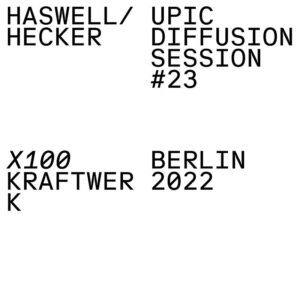
“UPIC Diffusion Session #23”
Russell Haswell and Florian Hecker have both a long history with Mego/Editions Mego. Individual releases have peppered the Mego catalogue since Haswell’s Live Salvage 1997->2000 cd release (MEGO 012) in 2001 and the debut Hecker release IT ISO161975 (MEGO 014) in 1998.
The individual exploration of sonic phenomena by these two practitioners has resulted in both being highly regarded for their uncompromising approach to sound as matter. Russell Haswell and Florian Hecker came together as a collaborative duo with the now-legendary record Blackest Ever Black, somewhat inexplicably, on the classical imprint of Warner Brothers.
In 2025, Hecker and Haswell return with a new album featuring the two-channel edit produced initially for their UPIC DIFFUSION SESSION #23, performed as a live diffusion across 8-channels at the X100 Festival, Berlin, 2023, celebrating the 100th anniversary of Xenakis' birth.
This record furthers the duo's exploration of Xenakis's UPIC system as the sole instrument. The UPIC is a computer music system that generates sound from visual input. The original intention of the system developed by Xenakis was to make a utopian tool for producing new sounds accessible to all, independent of formal training. One can locate footage of Xenakis and a group of children making drawings for the system in the 70's.
The duo set off experimenting with a diverse array of hand-drawn images to feed the UPIC system including news photographs of disasters and atrocities, "food porn" through to depictions of the natural world and microscopic images of molecular structures (including 'the blackest ever black'). The resulting eccentric audio from these images is claimed by the artists to heighten synaesthesia and is as mysterious as it is baffling.
Throughout UPIC DIFFUSION SESSION #23 frequency clusters move and morph in the most unusual manner, shifting and stretching into shapes that hint at some kind of magical process. What starts out deceptively simple soon unravels into a large array of sonic mayhem. Symbolic jet planes are shredded by a swarm of insects, a metal bowl howls into the void, a tiny tin toy crawls into a thicket with the resolute aura of a black hole. A burning geyser of laser forms liquid shrapnel. This is sound as an alchemical process, a constant chimerical flow into the netherworld and is the net result of the decades long radical investigations by the two artists involved. UPIC DIFFUSION SESSION #23 is a direct, rich and rewarding listen for those willing to invest time into the outer limits.
26,00€
In stock
LP
Peter REHBERG
“Liminal States”
Peter Rehberg is known for his pioneering electronic work with computer software which over time evolved into a modular set up alongside running MEGO and then Editions Mego labels.
Rehberg was a prolific collaborator, with other musicians and with contemporary dance and theatre productions, most notably with French artist and choreographer, Gisèle Vienne with whom he created a series of soundtracks from Showroomdummies, released under the name DACM in 2002 (Showroomdummies MEGO 056), to Crowd in 2017. A collection of Rehberg’s solo works for Vienne was released in 2008 (Work for GV 2004-2008 EMEGO 092). The outfit KTL, with Stephen O’Malley, was initiated by Gisèle Vienne for her work Kindertotenlieder and subsequently made a series of soundtracks for Vienne’s works branching off into a prolific series of live shows. The work Rehberg did for theatre and performance teased out aspects of his practice one may not have encountered in his own solo work as PITA or that of collaborations with other musicians.
Editions Mego is proud to present a previously unreleased theatre soundtrack made for Icelandic choreographer Margrét Sara Guðjónsdóttir, whom Rehberg had a decade long collaboration with until his untimely passing in 2021. The original composition for Liminal States was created by Rehberg for the performance Pervasive Magnetic Stimuli in 2018 and then revisited as a catalyst for the concepts behind Liminal States. This work is based on an ongoing artistic research conducted by the choreographer into altered states of perception through phenomenological embodiment. It is the last in a trilogy dealing with the notion of larger forces that act on us beyond our conscious mind. The trilogy consists of Pervasive Magnetic Stimuli (2018), Boundless Ominous Fields (2024) and now Liminal States (2024).
Rehberg's score for Liminal States is a vast canvas of spectral ambience at once tangible and unfathomable in its constantly shapeshifting lysergic dread. The results are a psychological journey through the mental effects of sound on space and subsequently the mind. The first part presents cascading waves of shimmering electronics laying the groundwork for the second part where the psychological illusion splinters into all manner of sonic effects taking the listener on a deep mental voyage. If references are witnessed the late period long form hallucinatory works of Coil, such as Time Machines and Constant shallowness leads to evil, are amongst a similar mind message delivered here. Unlike any other release in Rehberg’s output Liminal States is a single long form work which, despite the form, retains Rehberg’s idiosyncratic sound vision.
Guðjónsdóttir and Rehberg’s collaboration blurs that relationship into a greater force which truly enables the theme of liminal states to unfold in a brave new fashion. Rich in timbre and sonic invention this is powerful work easily holding its own outside of the intended performance whilst still complimenting the missions statement entirely. This profound collaboration has the cumulative effect where the concept and soundtrack are one and may be one of the strongest works in the entire Rehberg canon.
26,00€
In stock
LP
GENERAL MAGIC
“Bosko”
Editions Mego presents Bosko, landing exactly 30 years after the initial General Magic flights into the fantastic; the legendary first Mego release, a collaboration with Pita whereby all sounds were harnessed from the buzzing, drinking, humming sounds of fridges [MEGO 001 General Magic & Pita] and a 12” with Elin called Die Mondlandung (The Moon Landing) [MEGO 002] which embarked on a minimal techno template so austere and strange it was one of the historic progenitors of austere and wonky rhythms alongside Sakho and other European explorers.
The initial return of the playful and mystical Austrian outfit General Magic came with the 20th year anniversary vinyl reissue of their classic debut Frantz [eMEGO 010]. A record so audacious and playful it still baffles as much as it entertains. At some point whilst working on this reissue GM’s Ramon Bauer and Andi Pieper were spurred on to rummage around with ideas and tools once more and after more than two decades of inactivity sonic sorcery was conjured once again. Live shows in honour of Peter Rehberg were performed in Vienna and London. Softbop, a limited risograph collaboration with Tina Frank came with the first new recordings as a digital download came out discreetly online. The first full length album following Rechenkönig in 2000 [MEGO 032] “Nein Aber Ja” released in 2023 on Finlay Shakespeare’s GOTO Records on CD and cassette. An ongoing series of mix tapes online further highlights their interests encapsulating a new found angle on electronic mayhem. All of these elements retain the wildly eclectic and ecstatic glow that only they can harness and hand out to an unprepared world.
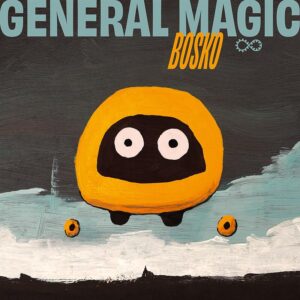
Now, we have General Magic’s second official full length comeback recording, Bosko. The new album is initially notable prior to the needle hitting the wax or the cursor identifying a track due to the artwork. Made by long term collaborator Tina Frank, this is Frank’s first analogue artwork, with a painting of a happy/nervous machine thing hovering in a landscape of no discernible identity. It’s quasi science fiction hovering amongst the potential for fun. Suited to the music? Natürlich.
Bosko sees Bauer and Pieper update and reframe their original investigations with a fresh supply of head scratching, heart racing tunes that hit the inexplicable with a wild mesh of drums, pianos, synthetic voices and all manner of immaterial sonic play. Startling sonics shock the ears on Club Duchamp which sounds like a conversation between synthetic adult ants in an environment still in development. Elfer features vocals supplied by a female-ish voice who, whilst grappling melody, has trouble executing a firm identity. Noorenhalt catapults along a mainframe of syncopation so unwieldy it feels like the voice, which is utterly alien, provides the only comfort. Seite 5 inhabits a fuzzy zone where a synthetic Horn of Jericho type ambience competes with rhythms never quite sure of who they are. Rise of the Ombré raises the spectral dread. Is this Science Fact? Absolutely nothing within Bosko is predictable.
The amount of change in the miasma of existence and the things we touch in order to make things has shifted so exponentially we are at the point where minds are starting to glaze over. All of this makes the return of the always original, always surprising, always fresh and exciting General Magic totally in tune with the artificial intelligent apocalyptic age we currently inhabit. The tools may have changed but the wonderfully warped gaze of Bosko offers a fresh new vision of perplexing funk and robotic punk.
26,00€
In stock

LP
NPVR
“33 34”
NPVR is the avant garde duo made up of the late Peter Rehberg and Nik Void. Editions Mego is proud to present their second and final release. No this is not some kind of Beatles synthetic AI that raises the dead reconstructed recordings but rather a new album made by the humans and their machines.
The initial meeting of Rehberg and Void was in London in 2016 and despite or due to their mutual awkwardness found solace and compatibility in the fact that they both had a similar electronic modular set up, along with matching cases to transport all. The idea to collaborate was an obvious and organic process as a means to connect their individual gear together and observe the outcome. The fruits of these initial experiments, recorded in London, resulted in the playful experimentation of their acclaimed 2017 release 33 33 (eMego 251).
Now in 2024 Editions Mego presents the logically titled follow up, 33 34. These sessions were recorded six months after the initial recordings at Peter’s home in Vienna. This was planned out as a mirror city release to the original London recordings. With Peter having access to his full studio set up this time around we encounter a rich audio landscape which organically folds together a variety of musical genres blurring any distinction between these forms so the resulting music hovers as a new cloud of sound. Any musical form, be it industrial, electro-acoustic, ambient, drone and techno all coexist and melt into the other as the ensuing result unveils a hypnotic swarm of divergent sounds (music). When active there were no lines or contexts with NPVR, either between sound or genre within these recordings or live where NPVR were at home playing at a techno club one night and an avant garde venue the next.
The initial session of these recordings was edited by Rehberg and sent to Void to further develop. Over time the final versions were agreed on and then shelved as other outside projects took over. The awkwardness had been surmounted and the two had become close friends. NPVR performed at a range of venues such as Tresor, Sutton House, Corsica, Blitz, Paris GRM #Focus2, LEV Festival and Rigas Skanumezs Festival. Following Rehberg’s untimely passing Void had difficulty listening back to the sessions but eventually thought it fit to complete and release this album, of which even the artwork (like 33 33, an image from Zurich photographer, Georg Gatsas) had been decided upon prior to Rehberg parting ways.
There is an unmistakable joy to these recordings. One encounters an enthralling exploration of their chosen machines which conveys the excitement of what can be randomly conjured when people speak through such devices. There is no grand statement or argument here, just the sheer thrill of creation and the recorded results of random encounters. The art of collaboration was always a mainstay of Rehberg’s practice from the advent of the MEGO adventure. Rehberg & Bauer was an initial collaboration with former business partner Ramon Bauer. Even at this stage one can hear a relaxed sense of delight in the sheer discovery of sound.
A mix made for the Wire magazine following the release of 33 33 hints at the freedom that comes with endless urge for exploration and discovery. Abstract tracks from Z'EV. Jérôme Noetinger and Jung An Tagen are included alongside British stalwarts The Fall and New Order. There were no lines between pop / academic / underground or mainstream in Rehberg’s world. All of it sat at the same table. It is just matter in the atmosphere, like the diverse exploration found in these recordings that comprise 33 34.
Towards the end of his life Rehberg was obsessing over the immense output of the German ambient musician Pete Namlook. An artist renowned for not only his sprawling catalogue of ambient masterpieces but one who often said his main inspiration was nature. This is apt with regards to the work of NPVR which also aligns with such thought as the intertwining of the two individual artists and their machines results in a natural symbiotic flow, as it happens, just like in the world around us.
24,50€
Out of stock
CD
KMRU
“Peel”
KMRU is the moniker of Joseph Kamaru, a sound artist, and producer based in Nairobi. One of the leading exponents of the burgeoning experimental music scene in Nairobi and beyond he was listed by Resident Advisor as one of ’15 East African Artists You Need To Hear’ in 2018 and is a regular performer at the fabled Nyegenyege Festival having also presented live performances at CTM festival and Gamma Festival. Peel is KMRU’s first release for Editions Mego. exquisite mix of field recordings and electronics unravelling at a repetitive and leisurely pace to expose a rich tapestry of sound that has been revered for it’s ability to cross bordear with the sheer undertow of emotional content. The subtle calming atmosphere within Peel belies the compositional prowess as layers of delicate sounds wrap around each other creating a hybrid new form ambient musics both captivating through it’s textural depth and kaleidoscopic patterns. The track titles lend themselves to the themes and mood set within: Why are you here, Well, Solace, Klang, Insubstantial and the title track. This is a deep heartfelt journey with a new strong voice being expressed through the means of organically presented electronic ambient sounds, one which reveals further layers on repeat listens.
All tracks written and produced by KMRU
Recorded and produced in Rimpa, (Nairobi, KE)
Mastered by Stephan Mathieu at Schwebung Mastering, June 2020
15,00€
Out of stock

2 LP
Mika VAINIO
“Last live”
*** Repress ****
This edition was produced and finalized in a particular context, Mika Vainio having left us on 12.04.2017 This material is the last concert he has gave. It took place at Cave12 on 02.02.2017. We needed time to listen to this archive again, which we did in situ in June 2020 with Cindy Van Acker.
After this listening, we felt invested in having to make this archive public.
In order to edit and work on this material, we asked Carl Michael von Hausswolff to do the mixing. At our request, this recording was organized in 4 movements. Stephen O’Malley kindly joined in the pre-edit process that took place on August 24 2020 at EMS Studios, Stockholm. Denis Blackham did the mastering.
This process was carried out in collaboration with Rikke Lundgreen.
Recorded 02.02.2017 at Cave12, Geneva by Benjamin Ephise
Edit by Stephen O'Malley & Carl Michael von Hausswolff at EMS, Stockholm.
Mastered by Denis Blackham
Vinyl cut by Andreas Kauffelt at Schnittstelle, Berlin
Artworks by Franz Graf, Mika Vainio Archive, Oslo and Cm von Hausswolff collection,
Cave12 / Editions Mego co-release
27,00€
In stock

LP
Marcus SCHMICKLER
“Sky Dice / Mapping the Studio”
Marcus Schmickler's music is designed for multi-channel sound projections and references German electronic music tradition, spectral music, experimentalism as well as 1990s club music. His artistic practice explores avant-garde trajectories in electronic music composition, formal systems, sonification and psychoacoustics. EMEGO 296 features two new major works from this audacious sound explorer.
Sky Dice / Mapping the Studio premiered at Donaueschinger Tage fur Neue Musik 10.20.2018 having being commissioned by SWR and realized at the Experimentalstudio (EXP) in Freiburg. This is a work for ARP 2500, Publison DHM89B, Publison Infernal Machine and Computer. Taking cues from Bruce Nauman's Mapping the Studio I (Fat Chance John Cage) (2001) the piece draws a fragmented acoustic map of the SWR facility itself; the studio serves as a source-model for the sonic display of historical signal flow graphs. Various acoustic and psychoacoustic effects come into play including the Larsen effect, as well as Style Transfer and Topological Sonification. The result is a daring and dizzying display of disorientating audio. Sound moves in most unusual ways, rising and falling simultaneously, appearing and disappearing like apparitions, nothing here behaves in expected ways. To paraphrase Albert Einstein’s now famous quote regarding quantum mechanics, this is spooky audio at a distance.
Fortuna Ribbon is a selection of sonic material that emerged from a research based on how DPOAEs (Distortion Product Otoacoustic Emission) can be designed in the context of musical frameworks, augmenting the compositional pallets in regard to spatial hearing. In this manifestation, the materials are presented without context. The resulting emissions from the ear that are excited in varying ways from the 6 examples on display here. Playback in undisturbed acoustic environments is recommended at >82 dB/A.
Schmickler’s ongoing investigation of sound matter conjures impossible audio that delight’s in the extremity of form and resulting effects on the listener. Schmickler’s audio invocations explore the capabilities of contemporary technology resulting in dizzying new worlds of sound.
20,50€
Out of stock
LP
François J. BONNET & Stephen O’MALLEY
“Cylene Suisse redux”
Cylene Suisse Redux documents François J. Bonnet and Stephen O'Malley's Switzerland tour in December 2019, following the release of their first album, Cylene.
The two musicians chose to entrust sound material recorded on the tour to the expert ears of two friends and great musicians Jim O'Rourke and Ryoji Ikeda, giving them carte blanche, and each in turn chose a distinct personal approach. For Ryoji Ikeda, it was a question of finding a moment, circumscribing a fragment of time through his listening, with minimal intervention. For Jim O'Rourke, on the other hand, the live recordings became material to be deconstructed and reassembled, to tell, according to his musical sensibility, a path of metamorphosis for Bonnet and O'Malley's music.
Cylene Suisse Redux is a prismatic substrate of a series of concerts surrounded by friendship, lakes, mountains, and by nightfall.
21,00€
In stock

2 LP
Caterina BARBIERI
“Fantas Variations”
Fantas is the epic opening track on Caterina Barbieri’s acclaimed 2019 release Ecstatic Computation. The original Fantas laid out a magical path of patterns leading the listener on a journey into the sound itself. Fantas Variations maps out eight new potentials sprung from this initial path as constructed by a diverse mix of artists lending to a wide spectrum of new works extrapolated from the original work. For this project Barbieri invited friends and long time collaborators from a variety of musical backgrounds to create a more sustainable and inclusive landscape in terms of stylistic, geographical, gender and generational balance. The results are a diverse array of approaches and instrumentation which blur the boundaries between the acoustic and electronic.
Fantas Variations embraces a platform for mutual exchange and support between like-minded artists, where active and collective re-imagination is prioritised over the traditional model of remixes, which is often strategic, functional and more passive.
Longtime friend and collaborator Kali Malone rearranged Fantas to a slowed-down, austere and eerie version for two Organs. Evelyn Saylor created a piece for a vocal ensemble consisting of her, Lyra Pramuk, Stine Janvin and Annie Garlid, joining forces to express the choral, psychedelic and vitalistic nature of the piece. Barbieri’s former guitar professor at the Conservatory in Bologna, Walter Zanetti, composes Fantas for electric guitar, by translating every single gesture of the original electronic piece into a personal, nuanced and detailed interpretation. Bendik Giske’s reinterpretation for Saxophone and Voice captures the atmospheric essence of Fantas and its psychic meteorology. Longtime collaborator and along with Barbieri the other half of the outfit Punctum, Carlo Maria, resynthesizes Fantas for TR808 and MC202, bringing a more club-oriented dimension of the piece to life whilst unveiling the sonic continuum between rhythm and pitch through a sensitive timbral approach. Jay Mitta’s Singeli reinterpretation of Fantas transpires with pitched-up percussion and turbo-fast polyrhythmic patterns unleashing the frenetic, shifting, transformative matter within the piece to a higher plain of euphoric dance. Baseck’s variation is a rave fantasia, where the prismatic trance of the original is channeled into fierce, uncompromising hardcore, whilst Kara-Lis Coverdale’s take is a phantasmagoria for piano that gently, yet inexorably, captures the relentlessness chimerical qualities of the original, unveiling its spectral backbone.
Evelyn Saylor (feat. Lyra Pramuk, Annie Garlid & Stine Janvin) - Fantas Variation for Voices (7’38’’)
Composed by Evelyn Saylor. Performed by Evelyn Saylor, Lyra Pramuk, Stine Janvin and Annie Garlid. Recording, mix and additional production by Bridget Ferrill at Real Surreal Studio, Berlin 2021.
Bendik Giske - Fantas for Saxophone and Voice (7'31'')
Adapted and performed by Bendik Giske. Recorded, mixed, and produced by Bendik Giske in Funkhaus, Berlin 2020.
Kali Malone - Fantas for two Organs (10'21'')
Arranged for The Utopa Baroque Organ, The Sauer Organ and tuned sine waves. Recorded by Benny Nilsen at Orgelpark, Amsterdam 2020.
Walter Zanetti - Fantas for Electric Guitar (7'27'')
Recorded by Walter Zanetti, Bologna 2020.
Jay Mitta - Singeli Fantas (12'03'')
Recorded by Jay Mitta in Sisso Studios, Dar Es Salaam 2020.
Baseck - Fantas Hardcore (4'44'')
Mixed by Anthony Baldino, Los Angeles 2020.
Carlo Maria - Fantas resynthesized for 808 and 202 (4'29'')
Recorded by Carlo Maria, Milano 2020.
Kara-Lis Coverdale - Fantas Morbida (3'04'')
Performed, recorded and mixed at The Shop in Valens, Ontario by Kara-Lis Coverdale, January 2021. Engineering assistance from Robert Coverdale and Adam Feingold.
27,00€
Out of stock
CD
Mika VAINIO
“Last live”
This edition was produced and finalized in a particular context, Mika Vainio having left us on 12.04.2017 This material is the last concert he has gave. It took place at Cave12 on 02.02.2017. We needed time to listen to this archive again, which we did in situ in June 2020 with Cindy Van Acker.
After this listening, we felt invested in having to make this archive public.
In order to edit and work on this material, we asked Carl Michael von Hausswolff to do the mixing. At our request, this recording was organized in 4 movements. Stephen O’Malley kindly joined in the pre-edit process that took place on August 24 2020 at EMS Studios, Stockholm. Denis Blackham did the mastering.
This process was carried out in collaboration with Rikke Lundgreen.
Recorded 02.02.2017 at Cave12, Geneva by Benjamin Ephise
Edit by Stephen O'Malley & Carl Michael von Hausswolff at EMS, Stockholm.
Mastered by Denis Blackham
Vinyl cut by Andreas Kauffelt at Schnittstelle, Berlin
Artworks by Franz Graf, Mika Vainio Archive, Oslo and Cm von Hausswolff collection,
Cave12 / Editions Mego co-release
16,00€
Out of stock

LP
Julia REIDY
“Vanish”
Since 2019, Julia’s bubbling 12-string guitar work - sighing streams of crystal plucks drawn closer or echoing on - has moored a tactile, ever-lusher sound. On ‘Guitar’, the Australian, Berlin-based musician melts down sharp synths; electric fuzz and flex; uncanny found sounds; and autotuned voice and harmonica in a heady, overpowering potion.
Reidy’s music sweeps you up. It’s restless, always travelling on. Lonesome tones into machine chorales into hesitant hum. The LP’s side-long cuts sway between scenes but are always rooted: Julia’s guitar and vocal lines seem mapped to the natural ebb and flow of breath and thought, they lull you as they push through vast and secret spaces.
Vanish completes a trio of releases begun with last year’s ‘brace, brace’ (Slip) and ‘In Real Life’ (Black Truffle). The delicious unease, the anxious burning of the preceding volumes has settled, becoming more wide-eyed and resolute. For all its poise, the album’s sense of build - electric licks rasping into glistening synths, punctured by distant kicks - feels freshest. When 'Oh Boy'’s smudged whistle comes, it has fought its way out of the thickets, and hits like heartbreak.
Music by Julia Reidy
Mixed and mastered by Joe Talia at Holding Pattern Berlin, June 2020.
18,00€
Out of stock

LP
KTL
VII
A new timley studio album from the duo of Peter Rehberg and Stephen O’Malley. Recorded and mixed during an unexpected extended stay in Berlin when the borders of the world suddenly closed. The claustrophobic urgency of this scenario is seared into the colossal vibrations set into this vinyl release.
Unlike many of their releases this is a studio record made unto itself as opposed to the many soundtracks they have made for theatre works and the like. It also stands as one of their most fully realised releases to date.
Proceedings are launched with The Director. Sitting somewhere between contemporary classical and doom this is a sliding and menacing mass of sound, more Masque of the Red Death than The Decameron. Silver lining is an alarming swooping buzzing track, looming and lowering only to rise and descend again. A delicate play with the Shepard-Risset glissando manifesting a delirious swarm of sound. Lee’s garlic orbits into a short fragmented zone with bursts of harsh feedback and crashing fx, all manner of audio enters and is discarded with an underlying sense of despair and frustration. Proceedings continue on Side B with Tea With Kali where a calmer plateau is embedded with oscillating guitar and fluttering electronics. Beating sine waves envelop the listener in a meditative thought piece of sound. Frostless concludes this epic dispatch as a subtle and gentle foray into twitching electronics as a light buzzsaw drone swirls as around your mind.
The interplay of sources (guitar, electronic equipment (hardware, software, speakers) is so entwined it’s often difficult to discern who is doing what amongst the broad sound field. KTL VII is instrumental music as visual narrative resulting in an exquisitely crafted release full of sophisticated and sublime illusory effects.
Written and produced by KTL, Stephen O’Malley & Peter Rehberg
Recorded & mixed at MOM Paraverse Studios, Berlin, March & May 2020
Engineer : Andi Toma (mix), 2nd Engineer : Constantin Carstens (recording)
Mastered at Zino Mikorey Mastering, Berlin, May 2020
18,00€
In stock

LP
Kassel JAEGER – Jim O’ROURKE
“in cobalt aura sleeps”
Second outing from Jaeger and O’Rourke following the release Wakes on Cerulean on Editions Mego in 2017. Covering a vast terrain with delicacy and poise this new release unveils a spectral showcase for all manner of deep abstraction. The first side positions itself somewhere between stoned komische synth and more nuanced electroacoustic tactics, all weighted by a melancholic undertow. The second side builds on the tension of the former as an undulating drone teases all variety of matter to rise and fall amongst the foreign space it inhabits. The effect creates an enormous sense of deep space before subsiding into a smaller more anxious flickering world. All manner of machines fold into play; digital machines, industrial and analogue machines. The seemingly random yet ordered nature of events is reminiscent of the behaviour of the natural world providing this machine driven release a convincing organic feel. Whether invoking mirrors, distant galaxies or a pond of frogs it is a delightful challenge to focus and locate what is nature and what is nurture. To play this loud is to immerse oneself in a fascinating journey which carries the listener through an array of dizzying emotional states.
18,00€
Out of stock

2 LP
The TRANSCENDENCE ORCHESTRA
“Feeling The Spirit”
“Like La Monte Young and The Incredible String Band stuck in an elevator."
In the process of relocating to Den Bosch's Willem Twee Studios, The Transcendence Orchestra let love slip deftly out of its gate and reverberate around the walls of the studio's main hall, a high ceilinged former synagogue in the city's old town. Working intensively to capture its echoes, they coaxed it to appear in pipes and strings, directed it through resonant circuits and shepherded it round the room with beaters, horns and rattles.
Having returned home with the recordings, a purpose began to emerge. Through a process of extensive reconfiguration and testing it became clear that the love contained within could transform perception. Under the right circumstances, and accompanied by appropriate technology, it could serve as a map for navigating beginnings and endings. Like some distant mesmerising chant or a psychedelic folk song, it could connect us and reassure us that we can pass through the boundaries and survive. Perhaps not intact but at least whole.
Here is that map, love soaked diligently into its lines, ready to guide those at a loss or reassure those willing to explore.
Written and produced by Anthony Child and Daniel Bean
Mastered by Stephan Mathieu at Schwebung Mastering, January 2020
Cut by Andreas Kauffelt at Schnitstelle, Berlin, February 2020
25,00€
Out of stock
CD
The TRANSCENDENCE ORCHESTRA
“Feeling The Spirit”
“Like La Monte Young and The Incredible String Band stuck in an elevator."
In the process of relocating to Den Bosch's Willem Twee Studios, The Transcendence Orchestra let love slip deftly out of its gate and reverberate around the walls of the studio's main hall, a high ceilinged former synagogue in the city's old town. Working intensively to capture its echoes, they coaxed it to appear in pipes and strings, directed it through resonant circuits and shepherded it round the room with beaters, horns and rattles.
Having returned home with the recordings, a purpose began to emerge. Through a process of extensive reconfiguration and testing it became clear that the love contained within could transform perception. Under the right circumstances, and accompanied by appropriate technology, it could serve as a map for navigating beginnings and endings. Like some distant mesmerising chant or a psychedelic folk song, it could connect us and reassure us that we can pass through the boundaries and survive. Perhaps not intact but at least whole.
Here is that map, love soaked diligently into its lines, ready to guide those at a loss or reassure those willing to explore.
Written and produced by Anthony Child and Daniel Bean
Mastered by Stephan Mathieu at Schwebung Mastering, January 2020
Cut by Andreas Kauffelt at Schnitstelle, Berlin, February 2020
15,00€
In stock

LP
CHRA
“Seamons”
Chra is the artist moniker for Austrian Christina Nemec (Bray, Shampoo Boy). Seamons is the latest missive in her ongoing exploration of suffocating abstract audio. At once designed and falling apart Seamons is rough and crude, a stumbling and staggering electronic expedition where nothing presents itself explicit in intent. It’s a tense obscure record that teases you into it’s peculiar vortex from it’s suggestive nature of exploring the enigma beyond it’s haunted facade.
Vicious Water Regimes stutters along as an ‘ugly’ mass of grey electronica. Cast(o)ro shines from light from the depths with it’s occasional foray into glistening tones. Colonia Marina Serenella is a dank squelching backdrop for a dark age. Cast twists tension with flickering electronics chaotic in their perpetual design of order confronting inevitable collapse. Let Sharks Sleep is not only a great title but a mind tickling adventure of descending/rising digital dance that builds in intensity with it's relentless repetition. Widow Walks gallops and creaks along a path veiled in whispers. Eenge lunges through time with an air of deep uncertainty. Seamons hovers on the outskirts, crawling out of the speakers with endless surprising turns, few of them comfortable.
Seamons is progressive ambient, not the kind that makes you escape, but rather one you can't escape from. Seamons crawls into the very guts of sound to uncover and unravel the uneasy and unsettling underbelly within.
18,00€
In stock

LP
France JOBIN
“Death is perfection, everything else is relative”
All sounds recorded at various locations in Europe, South America and at EMS, Stockholm using the Buchla 200 modular synthesizer. Mastered by Russell Haswell. January 2020.
The last two years have seen me maintaining an association with an unusual bedfellow, death. The loss of Mika Vainio, as well as three members of my own family, has had a profound effect on me and spurred a lengthy reflection on life, death, and everything in between. Parallelly, while studying the philosophy of science, I came across shadow photons: “Tangible photons are the ones we can see or detect with instruments whereas shadow photons are intangible (invisible) detectable only indirectly through the interference effects on the tangible photons.
There is no intrinsic difference between tangible and shadow photons: each photon is tangible in one universe and intangible in all the other parallel universes.
They travel at the speed of light, bounce off mirrors, are refracted by lenses, and are stopped by opaque barriers or filters of the wrong colour. Yet, they do not trigger even the most sensitive detectors. The only thing in the universe that a shadow photon can be observed to affect is the tangible photon that it accompanies.
This is the phenomenon of interference.
Shadow photons would go entirely unnoticed, were it not for this phenomenon and the strange pattern of shadows by which we observe it. Thus the existence of a seething, prodigiously complicated hidden world of shadow photons has been inferred.” (The fabric of reality, David Deutsch, Penguin Press 1997.
)
I have drawn a parallel between shadow photons and death. The interference phenomena, parallel universes, and how shadow photons affect tangible photons they accompany, offer, in my opinion, similarities, an unknown universe which is death and how we, remaining tangible human beings, are affected. This quest has led me to be more willing to accept chaos in my life and to conclude that Death is perfection, everything else is relative.
18,00€
In stock

LP
C. LAVENDER
“Myth of Equilibrium” [!!damaged cover!!]
Tranche du haut fendue.
Split at upper edge.
C. Lavender is a New York based sound artist and sound healing practitioner whose third full-length album explores meditative physical rituals of sound with binaural recordings from inside a geodesic dome in the Catskill Mountains of New York.
“The future is a choice between utopia and oblivion,” noted architect, futurist and geodesic dome theorist Buckminster Fuller. Myth of Equilibrium delves into these divergent paths by featuring equal parts of pastoral raw acoustic percussion combined with C. Lavender’s signature “devastating caustic drones” (Ad Hoc) via her custom bass guitar and synthesizers.
An assistant to the late pioneering electronic composer and Deep Listening founder Pauline Oliveros, C. Lavender’s astute editing and the binaural recording process places the listener within the heady fluctuating underworld she has created on this album. The recording environment of the geodesic dome allowed for sounds to transfer out beyond the confines of the walls as well as allowing outside sounds from the surrounding wilderness to permeate in like that of a mutating cell. The album suggests “headphone listening” for the full hypnotic experience Myth of Equilibrium presents to the listener.
C. Lavender is a 2020 Pioneer Works (New York) Music Artist-in-Residence.
Original price was: 17,00€.10,00€Current price is: 10,00€.
Out of stock

LP single-sided
Klara LEWIS
“Ingrid”
Following 2018's acclaimed collaboration with Simon Fisher Turner, "Care", Swedish sound artist Klara Lewis returns with "Ingrid", her third solo release for Editions Mego.
"Ingrid" is a departure from Lewis's previous solo outings, drifting from the eerie rhythmic variations of "Too" and "Ett" and moving assuredly into long-form experimentation. The piece retains those records' pulsing core and builds on a single cello loop that is steadily enveloped by a surge of distortion. It's almost like a voice or chant, shifting pointedly from a whisper into a scream before singing peacefully into the light.
At times, "Ingrid" reminds of William Basinski's looping melancholy or Steve Reich's controlled and innovative phase experiments, while at others, it recalls the chaotic Scandinavian physicality of black metal. Yet the entire composition is anchored in Klara Lewis's distinct emotional world. By dissolving familiar and beautiful strings in baths of noise, Lewis allows something violent but tender to grow in its place. In a society struck through by cynicism, "Ingrid" is a cathartic listening experience and a beacon of hope.
17,00€
Out of stock

LP
Stephen O’MALLEY
“Auflösung der Zeit”
Produced within the context of ‘The Guidebook of Church Burners’ publication release, this performance was recorded at visual arts institution LE BAL in Paris, May 4th 2018. Published by Païen in a limited edition, the book explores and transforms into an abstract narration the multiple facets of black metal iconography and history. Emerging from a dialogue between sound and image, the otherworldly piece created for that evening by Stephen O’Malley is a result of this collaboration. – Emilie Lauriola
Dedicated to Iancu Dumitrescu.
17,00€
Out of stock

LP
Jasmine GUFFOND
“Microphone Permission”
Editions Mego release the new album by Australian producer Jasmine Guffond. Developed over a two-year period, Microphone Permission is an unsettling musical journey utilizing contemporary tools of communication to display Guffond's ongoing research into online surveillance and sound as a method of investigation. Source material on Microphone Permission are from various projects Guffond has been working on; a commission to sonify the data of the city of Melbourne, a dance performance about the future sounds of an extinct forest, an installation that sonifies Twitter meta data in real time, a job as a composer for a theater work about music and feminism by five young female identifying performers in Western Sydney and a site specific installation at the Linachtalsperre dam that employed the harmonic frequencies of electric currents. The results are a stark, brooding, disorientating journey into a paranoid musical field that sits somewhere between ambient club music and a dystopian soundtrack. Elements of techno, classical music, and sound art form a dark intriguing masterwork that questions the nature of invasive, algorithmic, and computational listening practices. For example, Microphone Permission refers to the consent we routinely give when installing various apps onto our smart devices. Inspired by a 2018 scandal in which fans of Spain's most popular soccer team were effectively turned into unwitting spies by granting the La Liga application microphone permission. No matter which make or model, all smart devices are built with a microphone that is by default, forever listening. Listening in these situations often takes on an algorithmic form that enables tech developers to bypass public response to what is intuitively considered invasive practice, that is, traditional modes of eavesdropping such as using the microphone to listen and record audio. Composed, recorded, and produced by Jasmine Guffond. Image by Ilan Katin; layout by Nik Void.
17,00€
In stock

LP
Jan St. WERNER
“Molocular Meditation”
Molocular Meditation is a bespoke light and sound environment featuring the voice of the Fall’s Mark E Smith. Smith is heard making observations on mundane objects, events and a range of meditation techniques basically associating his discontent with an apolitical british upper class. His voice forms the narrative component of an electroacoustic composition by Jan St. Werner placed in a hyper-real scenario evoking a state of transformation and deceleration. Molecular Meditation premiered at Cornerhouse, Manchester in 2014. This album presents a re-edited stereo version of the original multi-channel installation. Voice and guitar feedbacks were recorded by Werner and Smith at Blueprint Studios Manchester, electronics in Werner’s Studio in Berlin.
The B-side consists of unreleased new work partly written around the same time as Molocular Meditation in context of Werner's Fiepblatter Catalogue on Thrill Jockey. Back to Animals is a non-metric rhythm exercise frantically hybridizing percussive accents with synthesized pulse. On the Infinite of Universe and Worlds is the layout for an electronic opera on Giordano Bruno’s Renaissance writings which Werner was asked to conceptionalize for Finish festival Musica Nova. VS Canceled finds Mark E. Smith reading an email from Domino Records explaining their discontinuation of Von Sudenfed, a band Mark E. Smith had founded with Mouse on Mars' Jan St. Werner and Andi Toma in 2006. Their debut album Tromatic Reflexxions came out on Domino in 2007.
The vinyl record, cut with a diamond needle, delivers as much dynamic range as the digital format.
Music & Production Jan St. Werner
Words Mark E Smith
Words B2 Giordano Bruno performed by Guiseppe Maria Zevola
17,00€
Out of stock

LP
DOME
“Dome 4”
"With the demise of the group Wire in 1980, founder members Bruce Gilbert and Graham Lewis joined forces to create Dome. With the assistance of engineer Eric Radcliffe and his Blackwing Studio Dome took the ethic of “using the studio as a compositional tool” and recorded and released three Dome albums on their own label in the space of 12 months: DOME (July 1980), DOME 2 (October 1980) and DOME 3 (October 1981). A final fourth album, WILL YOU SPEAK THIS WORD: DOME IV was released on the Norwegian Uniton label in May 1983. These albums represent some of the most beautifuly stark and above all timeless exercises in studio experimentation from early 1980s alternative music scene."
16,00€
In stock

LP
OTO HIAX
“Two”
"Second phantasmagorical audio outing from former Seefeel and Loops Haunt members, Mark Clifford and Scott Gordon. ‘Two’ expands the duo’s unique take on spectral synthesis incorporating a diverse amount of approaches to experimental sound. Two expounds a hybrid mix of acoustic based audio design, ambient tonality, sound effects, music, abstraction and world’s hybrid video game soundtrack.There is something of an onomatopoeia quality to the release as the six tracks take on the character of their individual title. Silt, Dapple, Overcurve, Scutter, Strain and Plates appear as extremely well executed versions of the inferred intent of their namesake. This inquisitive approach will appeal to those interested in the more exploratory end of sound production providing hope as newly formed methods and colours are exposed from the duo’s contemporary audio tactics.
Seasoned veterans can lie in a bed of laurels whereas ‘Two’ is an exemplary release revelling in the enthusiasm that comes from the joy of nabated exploration."
Original price was: 17,00€.10,00€Current price is: 10,00€.
In stock

2 LP
RENALDO AND THE LOAF
“The elbow is taboo / Elbonus”
The Elbow is Taboo was Renaldo & The Loaf's fourth and last album of their initial phase prior to their return in 2010. Released by Ralph in America and Some Bizzare in the UK in 1987 this work represents a development in the overall sound as they utilize an 8 track recorder along with early digital effects. A large arsenal of acoustic instrumentation gives the record an additional unsettling atmosphere. Recorded over a 3 year period this remains the definitive statement by the group in this early period.
As clarified by Brian from the band, the themes remain as obtuse and alluring as ever with each song containing it’s own story. “be it a child's desire to control (A Street Called Straight), the ridiculous purdah of an innocent part of the body (The Elbow is Taboo), a call for help in times of angst (Here's To the Oblong Boys), the rigours of a bread fetish (The Bread Song), the anger of a dance teacher to the terminally inept (Critical/Dance) or a ritual call to prayer, somewhere (Extracting the Re-re)”.
Disorientating and delightful this is a must for all fans of the Loaf and for those tickled by the more deranged spectrum of song.
Original price was: 24,00€.15,00€Current price is: 15,00€.