
Out of stock

LP
Jürg FREY
“Extended Circular Music”
Edition of 200. Swiss Wandelweiser master reimagined by virtuoso flutist Manuel Zurria in stunning solo interpretations. Frey's String Quartet No. 3 and four Extended Circular Music pieces (originally for various chamber ensembles) are transformed into ethereal soundscapes through Zurria's conceptual approach inspired by Japanese Kintsugi art. Interweaving minimalism with radical experimentalism, these recordings draw startling scope from minimal material means - breath-length utterances dance among complex harmonic clusters, provoking suspensions of time. Zurria aimed not for literal translation but free interpretation, highlighting critical points to make them shine in their uniqueness. Pantone color vinyl with exploratory liner notes by Bradford Bailey.
25,00€
Out of stock

3 CD
Jürg FREY (Reinier van HOUDT)
“Composer, alone”
‘Composer, alone’ is a collection of twelve solo piano pieces by Swiss composer Jürg Frey, performed by Dutch pianist/composer Reinier van Houdt. It is the sequel to the 2022 triple album 'lieues d'ombres' (elsewhere 020-3) and the third collaboration between Frey and van Houdt on elsewhere music. The two have cultivated a close rapport, first documented on 'l'air, l'instant - deux pianos' (elsewhere 014) in 2020.
This three-disc set features a wide range of Frey's solo piano compositions from 1990 to 2024, including his latest piano pieces 'Composer, alone (1)' and 'Composer, alone (2)'. This three-disc album traces Frey's journey over the past 30 years as he explores his voice as a composer through piano works. It reveals how his compositional style has evolved, while also demonstrating that the underlying essence of his compositions remains consistent.
As a pianist who has a deep connection to the music of Frey, van Houdt skillfully reveals the subtleties hidden in Frey's compositions, as he did in 'lieues d'ombres'. Staying true to the composer's vision, van Houdt captures the essence of Frey's diverse piano pieces from the past 34 years while achieving a perfect balance between fragility, warmth, and clarity.
All twelve pieces were recorded by Micha de Kanter at the Muziekcentrum van de Omroep (MCO) in Hilversum over three days in September 2024, in the presence of the composer, and mastered by Taku Unami.
28,00€
In stock

CD
Jürg FREY (Keiko SHICHIJO)
“Les Signes Passagers”
'Les signes passagers' is an album of seven pieces for solo fortepiano written by Jürg Frey in 2021, commissioned by the Amsterdam-based pianist Keiko Shichijo. It was premiered by Shichijo on February 5, 2022 at the Concertgebouw Brugge during the SLOW Festival. In the same year, Shichijo performed the piece again at the November Music 2022 and later recorded it for this album in April 2023 at the Concertgebouw Brugge in the presence of the composer.
“As a listener, I have experienced with music played on early piano instruments for many years. And it has become more and more clear to me how delicate the influence of the sound of the instrument is on the inspiration of the composer.
If the modern piano tries to get a constant brilliance over the whole keyboard, in the fortepiano there are worlds between the middle, the high and the low register. The whole construction of the instrument is so subtle, and every movement, the slightest change in registers and density of chords immediately opens a variety of colors, new perspectives and emotions.” – Jürg Frey
14,00€
In stock

CD
Jürg FREY
“L’air, l’instant – deux pianos”
Jürg Frey’s unique compositional approach places him at the cutting edge of contemporary classical music. Since the late 90's, Frey started to work with 'lists' as a basis of his compositions, sometimes words, sometimes chords, from which he developed and organized musical materials. In recent years, Frey's focus on 'lists' has extended more toward the connections of items with each other, forming melodies.
Frey wrote two compositions for two pianos in 2017-2019: ‘Entre les deux l'instant’ (2017/2018) and 'toucher l’air' (deux pianos) (2019). ‘Entre les deux l'instant’ was world-premiered by Dutch pianists Reinier van Houdt and Dante Boon at Splendor Amsterdam and was later recorded there together with 'toucher l’air' by the same two pianists in the presence of Frey in Amsterdam in 2019.
The first piece on this album,'toucher l’air (deux pianos)', was composed in close connection to Frey’s previous composition 'Entre les deux l'instant'. This piece consists of seven movements, written for two parts for piano 1 and piano 2, in which two pianists play each part at the same time with subtle similarities but in different tempos. The interaction between the two is only vaguely shown in the score, giving this piece a mixed sense of openness and closeness, separation (or aloneness) and intimacy.
The second piece on this album, 'Entre les deux l’instant', consists of two parts: ‘Melody’ and ‘List of Sounds’. Melody starts with pianist 1 (Van Houdt), then continues with pianist 2 (Boon), going back and forth between two pianists to the end. When one pianist plays Melody, the other plays a note(s) from List of Sounds given in order in the score. The pianist can also add extra notes to the Melody, to double these notes, but slightly later and softer than the sounds of Melody, like adding a slightly ‘off’ shade to it. Two parts are played simultaneously by two pianists but the timings are flexible, up to each pianist to decide, not pre-arranged nor intended to coincide precisely.
Van Houdt and Boon conveyed every fine nuance of Frey’s two piano pieces with their extraordinary sensitivity and masterful skills, organically filling the two pieces with clean tranquility and airy feeling.
15,00€
Out of stock

CD
Jürg FREY
“120 Pieces of Sound”
Jürg Frey's unique compositional approach places him at the cutting edge of contemporary classical music while simultaneously maintaining a touch of impressionistic/romantic aesthetics in its roots.
The album '120 Pieces of Sound' contains two of Frey's significant compositions: '60 Pieces of Sound' (2009) and 'L'âme est sans retenue II' (1997-2000). Frey and the Boston-based ensemble Ordinary Affects (Laura Cetilia, Morgan Evans-Weiler, J.P.A. Falzone, Luke Martin) performed and recorded '60 Pieces of Sound' in New England in 2017, in which Frey's clarinet and Cetilia's cello played the pitches in the two-part melody written in the score, while the rest played the open instrumentation part with undetermined sounds. The resulting music was a unique series of harmonies created by open instrumental sounds with a faintly recognizable melody hidden in the core of the ensemble's evenly tempered sounds. The impressions of the chords move along at the edge of consonance and dissonance with the afterglows of each chord in the subsequent silence, hovering somewhere between meditative calmness and disquieting shadow, while bringing an organic warmth and a feeling of breathable open air into a minimal musical structure.
'L'âme est sans retenue II' was written for field recordings and bass clarinet. Frey first edited the field recording parts from the materials he recorded in Berlin in 1997, and later added his bass clarinet sound with a certain pitch as an underlying tone that would blend with the field recordings. Frey's bass clarinet is discreet and almost unrecognizable, often hidden under the complex layers of the field recordings, and yet clarifying the harmonization of the field recordings from inside. Presenting these two pieces '60 Pieces of Sound' and 'L'âme est sans retenue II' back to back on this album brings out the fundamental aesthetic of Frey's compositions in regards to how he approaches the 'harmonization' and 'openness' of the music.
14,50€
Out of stock

CD
Jürg FREY
“Circles and Landscapes”
Works for solo piano played by Philip Thomas.
78 minutes of wonderful piano music by Jürg Frey: five new or recent pieces together with “In Memoriam Cornelius Cardew” from 1993.
“Philip Thomas presses the keys with such resonating deliberation that I felt I was at the piano with him. There is not only vibrant life in this music, but maturity….[Frey] is beyond the need to prove something, or make a point. His music just is.” (Debra Richards, Swissvibes)
14,00€
In stock
5 CD
Jürg FREY
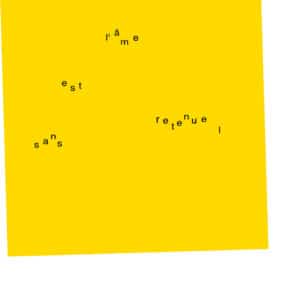
“L’âme est sans retenue I”
“L’âme est sans retenue I” (1997-98) for electronic tape.
Field recordings by Jürg Frey in Berlin, October - December 1997, composed and mixed in Aarau, Switzerland in 1998. Mastered by Taku Unami.
“There is music in which the time/space of sound and the time/space of silence appear in their own particular realms. Even if the sounds are often very soft, this music is not about failing into silence.. The sounds are clear, direct and precise. Since they have left musical rhetoric behind, there is instead a sensitivity for the presence of sound and for the physicality of silence. There are long periods of the presence of sound, and long periods of the absence of sound. The two together form the “time present” of the piece.” Jürg Frey from the liner notes.
Field recordings by Jürg Frey in Berlin, October - December 1997, composed and mixed in Aarau, Switzerland in 1998. Mastered by Taku Unami.
“There is music in which the time/space of sound and the time/space of silence appear in their own particular realms. Even if the sounds are often very soft, this music is not about failing into silence.. The sounds are clear, direct and precise. Since they have left musical rhetoric behind, there is instead a sensitivity for the presence of sound and for the physicality of silence. There are long periods of the presence of sound, and long periods of the absence of sound. The two together form the “time present” of the piece.” Jürg Frey from the liner notes.
43,00€
Out of stock

2 CD
Jurg FREY
“Collection Gustave Roud”
2 CD of pieces engaging with the work of the French-Swiss poet Gustave Roud.
“Paysage pour Gustave Roud” (2007 / 2008), Jürg Frey clarinet, Stefan Thut cello, Dante Boon piano. “Haut-Jorat” (2009), Andrew McIntosh violin, Jürg Frey clarinet, Dante Boon piano. “La présence, les silences” (2013-2016), Dante Boon piano. “Farblose Wolken, Glück, Wind” (2009-2011). Regula Konrad soprano, Stephen Altoft trumpet, Stefan Thut cello, Lee Ferguson percussion. “Ombre si fragile” (2007 / 2008 / 2010). Andrew McIntosh violin, Stefan Thut cello, Dante Boon piano.
“Paysage pour Gustave Roud” (2007 / 2008), Jürg Frey clarinet, Stefan Thut cello, Dante Boon piano. “Haut-Jorat” (2009), Andrew McIntosh violin, Jürg Frey clarinet, Dante Boon piano. “La présence, les silences” (2013-2016), Dante Boon piano. “Farblose Wolken, Glück, Wind” (2009-2011). Regula Konrad soprano, Stephen Altoft trumpet, Stefan Thut cello, Lee Ferguson percussion. “Ombre si fragile” (2007 / 2008 / 2010). Andrew McIntosh violin, Stefan Thut cello, Dante Boon piano.
23,00€
Out of stock

2 CD
Jurg FREY
“Grizzana and other pieces 2009-2014”
A 2 CD of beautiful chamber pieces by the wonderful Swiss composer and clarinetist Jurg Frey, who will be composer in residence at this year’s Huddersfield Contemporary Music Festival. Played by Ensemble Grizzana: Jurg Frey (clarinet), Ryoko Akama (organ & electronics), Mira Benjamin (violin), Richard Craig (flute), Emma Richards (viola), Philip Thomas (piano) and Seth Woods (cello).
The CD cover features a watercolour by Giorgio Morandi, whose work is one of the inspirations for the music.
The CD cover features a watercolour by Giorgio Morandi, whose work is one of the inspirations for the music.
23,00€