
In stock
CD
John CAGE
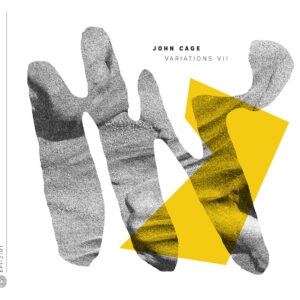
“Variations VII”
Variations VII was created by John Cage to be performed at a special event, 9 Evenings, Theatre & Engineering, held from 13th to 23rd October 1966 in New York and in which a team of engineers, led by Billy Klüver, worked with ten artists from the American “avant-garde”, with the aim of enabling them to extend their exploration of the possibilities of electronics in their own art. Here is how John Cage described this piece in the programme for the event:
« It is a piece of music, Variations VII, indeterminate in form and detail, making use of the sound system which has been devised collectively for this festival, further making use of modulation means organized by David Tudor, using as sound sources only those sounds which are in the air at the moment of performance, picked up via the communication bands, telephone lines, microphones together with, instead of musical instruments, a variety of household appliances, and frequency generators. »
Ten telephone lines connected to the sounds of ten different locations in New York City. History has taught us that one of the first uses of the telephone at the end of the 19th century was, besides transporting voices, the live re-transmission of concert performances of opera. A few privileged listeners could therefore listen to the music in their own homes. Several decades later, John Cage reversed this, so to speak, by inviting the sounds of several distant environments into the concert venue!
This recording of Variations VII by John Cage was made in public on 15th August 2020 as part of the 8th edition of Le Bruit de la Musique festival at Domeyrot (Creuse). 6 artists were present, supported by a sound engineer, and 17 others participated remotely.
John Cage did not really write a score for Variations VII. We therefore had to rely on the one hand, on precious documents from the time kindly sent to us by Julie Martin, and on the other, on our experience of performing other works by the composer.
The 6 participants present decided to use Andrew Culver’s IC and TIC programmes, available online, which allowed them to perform chance operations similar to those used by John Cage for the composition of all his musical, literary and pictural works from 1951 onwards.
There is no space here to enumerate all the questions that were put to these programmes for this performance, but the answers given included the total length of the piece, its division into sections for each participant, the order of the alternation between sound and silence, the families of objects and means used for each of these sections and even, when radios were used, their frequency range, etc.
Some used optical sensors which, when the audience moved, switched on various electrical devices. Moreover, the 6 artists had their own computer through which each received the audio of some of the online participants via videoconferencing software, each of these participants having received a time bracket score resulting from the same procedure, allowing them to turn the micro of their computer or smartphone on or off.
Although the context was very different from that of the 1966 evenings, we opted for simplicity by reproducing the same staging, that is, two long parallel tables on which all the equipment was placed, all subtly lit by Sébastien Daubord. The 6 stereo sources were mixed by Laurent Sassi and distributed over 6 loudspeakers arranged all around the audience.
The recording is presented in extenso with no editing, combining the action of the 6 live participants, the 17 remote participants and with the presence of the audience revealed by their remarks and comments and by their involuntary interaction with the optical sensors.
Lê Quan Ninh, translation by Elizabeth Guill
Artists live on location : Lê Quan Ninh, Nadia Lena, Aurélie Maisonneuve, Émilie Mousset, Jérôme Noetinger, Julien Rabin.
Artists live by distance : Brian Archinal, Victor Barceló, Fabien Bernard, Tiziana Bertoncini, Alexandre Chanoine, Ying-Hsueh Chen, Julien Desprez, Anna-Liisa Eller, eRikm, Jean-Christophe Feldhandler, Pauline Floury, Nathalie Forget, Miguel Ángel García Martín, Jared Gradinger, Bastian Pfefferli,
Angela Schubot, Séverin Valière.
Recorded live on August 15th, 2020 at the 8th edition of the festival Le Bruit de la Musique in Domeyrot (Creuse, France).
Recording : Lê Quan Ninh. Mix and mastering : Laurent Sassi
12,00€
Out of stock

CD
John CAGE
“The Works for Piano 11”
Cage – Satie – Feldman – Takahashi sums up the focus of this album. All of these works by Cage are influenced by Satie. Cage’s friend and colleague Morton Feldman made an arrangement of Cage’s solo piano “Cheap Imitation” for a trio of piano, flutes/piccolo and glockenspiel. Feldman’s admiration for the pianist Aki Takahashi caused him to gift this arrangement to her. And, full circle, we have the repertoire of this album.
The major discovery is Feldman’s arrangement of Cheap Imitation for this very Feldmanesque instrumental ensemble. It is unknown why Feldman made this arrangement in 1980. Knowing of Takahashi’s reputation as a pianist specializing in new music, Feldman had invited her to be an artist in residence at the university where he taught. When she was leaving, Feldman gave a musical score to Takahashi as a gift. It was a copy of John Cage’s solo piano piece Cheap Imitation with annotations by Feldman. He told her that this was an instrumental version of this piece: flute, piano, and glockenspiel. He signed the title page, just under the original title:
Instrumental Version (Fl, Pf, Glock)
Morton Feldman
Buffalo, N.Y. Winter 1980
Dedicated to Aki Takahashi
Cage was to create a two-piano transcription of Erik Satie’s Socrate for a Merce Cunningham choreography, but he was unable to get permission from the publisher. Even worse, he could not even get performance rights to use the published piano-vocal score of Socrate. Cage’s creative solution was to make a piano piece that maintained the exact metrical and phrase structure of Socrate, but with different notes to avoid copyright issues. He called this piece Cheap Imitation. Cunningham responded by calling his dance Second Hand.
The recital is completed by three short works under Satie’s influence. Perpetual Tango is derived from the “Tango” movement of Satie’s Sports et divertissements. Cage’s method was to take the rhythm of the original tango and erase parts of it. He does not specify pitches, but instead gives the pitch ranges of the original piece. The pianist chooses which pitches to play in the rhythm given. In 1989 he applied the same procedure on another piece from Sports et divertissements, “The swing;” he titled the result Swinging.
All sides of the small stone… is a composition with a completely unknown history, derived from Satie’s Gymnopédies. All we have is a page of musical manuscript written in the back of a score of a work by American composer James Tenney with the signature “John” and the date “7/78.” The manuscript was discovered when Tenney’s papers were being organized after his death. It has been attributed to Cage, but the handwriting doesn’t look like his. Neither Cage nor Tenney — nor anyone else, for that matter — said a word about this piece, so its definitive composer will remain a mystery. Aki Takahashi gives the first recording of this unpublished work.
Liner notes by James Pritchett.
16,50€
In stock
Out of stock

CD
John CAGE
“Music for Speaking Percussionist”
John Cage allowed for some of his works to be combined and performed simultaneously. Percussionist Bonnie Whiting has created uniquely virtuosic solo-simultaneous realizations of some of these works for “speaking percussionist.”
“A Flower” (1950).
“51’15.657” for a speaking percussionist (2010), a solo-simultaneous realization of 45’ for a speaker (1954) and 27’10.554” for a percussionist (1956). Realization by Bonnie Whiting.
“Music for Two (By One)” (2011), a solo-simultaneous realization of “Music for _____” (1984-1987) for solo voice and solo percussion. Realization by Bonnie Whiting.
“The Wonderful Widow of Eighteen Springs” (1942)
“Connecting Egypt to Madison through Columbus Ohio, Cage, and the History of the American Labor Movement” (2011) by Allen Otte and John Cage. Incorporating Music for Marcel Duchamp and Variations 2. Allen Otte, voice, prepared piano & frame drums.
Bonnie Whiting, voice, percussion, piano.
Original price was: 16,00€.10,00€Current price is: 10,00€.
In stock

blu-ray
John CAGE
“Music for Speaking Percussionist”
John Cage allowed for some of his works to be combined and performed simultaneously. Percussionist Bonnie Whiting has created uniquely virtuosic solo-simultaneous realizations of some of these works for “speaking percussionist.”
“A Flower” (1950).
“51’15.657” for a speaking percussionist (2010), a solo-simultaneous realization of 45’ for a speaker (1954) and 27’10.554” for a percussionist (1956). Realization by Bonnie Whiting.
“Music for Two (By One)” (2011), a solo-simultaneous realization of “Music for _____” (1984-1987) for solo voice and solo percussion. Realization by Bonnie Whiting.
“The Wonderful Widow of Eighteen Springs” (1942)
“Connecting Egypt to Madison through Columbus Ohio, Cage, and the History of the American Labor Movement” (2011) by Allen Otte and John Cage. Incorporating Music for Marcel Duchamp and Variations 2. Allen Otte, voice, prepared piano & frame drums.
Bonnie Whiting, voice, percussion, piano.
The Blueray version includes full HD video for all of the works directed by Anton Cabaliero, uncompressed PCM 48khz/24-bit audio, 73 minute video interview with Whiting and Otte, discussing Cage and his processes, the works and how they assembled them.
Original price was: 28,00€.12,00€Current price is: 12,00€.
Out of stock

2 CD
John CAGE
“Two2”
Landmark recording of Cage’s late work for two pianos, played by Mark Knoop and Philip Thomas. Uniquely for Cage’s number pieces, Two2 (1989) doesn’t use time brackets, so duration is open and left to the musicians’ ‘inner clock’. Previous recordings have lasted between 35 and 74 minutes, but this new version stretches across two CDs and lasts 128 minutes, revealing new depths and sonorities in the music. From two excellent early reviews: “This version is more intimate than a concert hall experience and also somehow larger than life, combining the potency of poetic invocation with the all-encompassing narrative arc of the finest stories. It will be some time before I have the pleasure of encountering either Cage or this piece to such revelatory effect.” Marc Medwin“128 minutes of pure, thought-compelling, perception-enhancing, down to earth bliss. Can’t ask for more. A major achievement.” Brian Olewnick
23,00€
In stock
book
John CAGE
“Silence”
New edition. The book of John Cage, “Silence” from 1961, translated into French by Vincent Barras.
28,00€
Out of stock
book
John CAGE
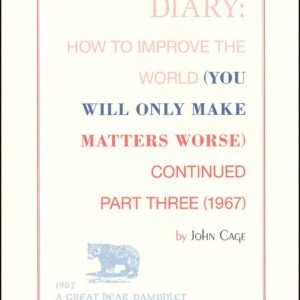
“Diary: How to Improve the World (You Will Only Make Matters Worse) Continued Part Three (1967)”
The third in Cage’s series of “Diary” essays (the other parts were published in different contexts), defined broadly as “collections of thoughts that develop out of working and being alive.” The text is formally and discursively roving: its margins, typeface, and color undergo continuous alteration by chance methods as Cage contemplates computers, Erik Satie; life on the road with Merce Cunningham; death; encounters with Mies van der Rohe, Duchamp, and Marshall McLuhan; books; cold remedies, and more. Above all, Diary seems to confront the problem of truly ecumenical thought. Dick Higgins, as the publisher’s original printing technician, meticulously engineered the variations in color, and as such, this may be the most outwardly beautiful of the Great Bears series.
Originally published by Something Else Press between 1965 and 1967, the Great Bear Pamphlet series was envisioned by founding editor Dick Higgins as a “poor man’s keys to the new art,” or a means of exposing the most vital work of the time to a mass-market audience, and vice versa. The series made uncompromisingly radical work maximally accessible, with slim, chapbook-like publications of a mostly uniform, pared down design. Taken together, the pamphlets constitute a firsthand survey of the sixties avant-garde (Higgins, Barbara Moore, and Emmett Williams all had a hand in the editorial process) that is both sweeping and utterly unique, transmitting a still-vibrant signal of expanded possibility in art, music, and poetry. Presented here in a facsimile edition, the Great Bears epitomize the utopian vision of Higgins and Something Else.
5 x 8 inches, 16 pages, Paperback, B&W.
7,50€
Out of stock

book
John CAGE
“A composer’s confessions – Confessions d’un compositeur”
An address given before the National Inter-Collegiate Arts Conference, Vassar College, Poughkeepsie, New York, 28 February 1948. “I am going to tell you the story of how I came to write music, and how my musical ideas and my ideas about music developed.” Bilingual edition. 100x170.
6,20€
In stock

CD
John CAGE
“Sonatas and interludes”
’Sonatas and interludes’ (1946-48) performed by Mario Bertoncini, recorded in december 1991.
15,00€
Out of stock
CD
John CAGE
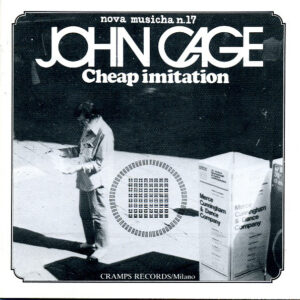
“Cheap imitation”
“Humbly engaged but never over-determined, Cheap Imitation remains John Cage’s most devotional and enduring homage to a lifelong contract between the Maestro of Stony Point and Erik Satie. Composed when he was refused permission to use the arrangement for Satie’s “Socrates” as the “accompaniment” to Merce Cunningham’s choreography, Cheap Imitation is a tempered, harmonically rich and wryly simple melodic examination. This newly remastered edition marks the first US release of this historic recording.”
13,00€
Out of stock

CD
John CAGE
“Four4”
“Four4 for four percussionists (1991). By Simon Allen, Chris Burn, Lee Patterson, Mark Wastell. A unique realisation of one of Cage’s late “number pieces” by an ensemble of musicians better known for their work as improvisers. The 72-minutes piece uses a system of flexible time brackets which were determined randomly according to a computer programme. Each musician chooses a number of sounds and assigns each of them them a number. Every time that number occurs above one of the time brackets, they play that sound.” label info
12,00€
In stock

CD
John CAGE
“Winter Music”
“Winter Music” (1957). Version for four pianos. With Mark Knoop, Catherine Laws, Philip Thomas & John Tilbury.
Winter Music was written in 1957 at a time when Cage was exploring different ways of using chance procedures in his composing. He was also interested in producing scores that were indeterminate and which required the performer to interpret and work out many aspects of how the music might actually sound in performance. Winter Music consists of 20 unbound pages, which can be played by any number of pianists from 1 to 20. Any number of pages can be used in a performance, and in any order. Each page contains notes, chords and clusters which are positioned in accordance with the imperfections in the paper on which Cage was working.
The pages of Winter Music are less a score in themselves than a means for producing a score. The pianists are required to make some form of realisation, usually in advance, as to pitch selection and points of occurrence.
For this realisation chance procedures were used to assign each of the pianists five of the twenty pages. The pianists agreed an overall duration of 40 minutes and prepared their parts independently. At the recording there was no rehearsal and the piece was played once only.
Winter Music was written in 1957 at a time when Cage was exploring different ways of using chance procedures in his composing. He was also interested in producing scores that were indeterminate and which required the performer to interpret and work out many aspects of how the music might actually sound in performance. Winter Music consists of 20 unbound pages, which can be played by any number of pianists from 1 to 20. Any number of pages can be used in a performance, and in any order. Each page contains notes, chords and clusters which are positioned in accordance with the imperfections in the paper on which Cage was working.
The pages of Winter Music are less a score in themselves than a means for producing a score. The pianists are required to make some form of realisation, usually in advance, as to pitch selection and points of occurrence.
For this realisation chance procedures were used to assign each of the pianists five of the twenty pages. The pianists agreed an overall duration of 40 minutes and prepared their parts independently. At the recording there was no rehearsal and the piece was played once only.
13,00€
In stock

3 CD
John CAGE
“Klang der Wandlungen”
3 Audio CDs in a Box & Booklet German / English.
“Seventy-Four” (1992) for orchestra. SWR Symphonic Orchester, direction by Jonathan Stockhammer. Recorded 2011 in Paris.
“103” (1991) for orchestra. WDR Symphonic Orchestra, direction by Arturo Tamayo. Recorded 1992. “Postcard from Heaven” (1982) for one to 20 harps. Gabriele Emde, harp. Recorded 1985. “In a Landscape” (1948) for keyboard oder harp. Gabriele Emde, harp. Recorded 1985. “Some of The Harmony of Maine” (1978) for organ. Jakob Ullmann, organ. Recorded 1990. “In retrospect, the references to the difference between Cage’s pieces and the (largely) European tradition, cultivated over years if not decades, seem to be based much more upon the creative process rather than the actual sonic results. What was important for Cage was not the “deviation” of certain sound shapes, an audible difference from European tradition, but rather liberation from restrictive bonds of interpretation and expression. Even when he was a student with Arnold Schoenberg, who he held in high esteem throughout his life, Cage had already been enquiring into traditions in music and art in this sense, in a highly productive way as it was mostly entirely non-polemic – long before
so-called “postmodernism” was in sight. Cage’s conclusion, namely to establish from Schoenberg’s principle of equality of all tones in a row their complete equivalence through chance operations also proved applicable to entirely different traditions and constellations.” Jakob Ullmann
“103” (1991) for orchestra. WDR Symphonic Orchestra, direction by Arturo Tamayo. Recorded 1992. “Postcard from Heaven” (1982) for one to 20 harps. Gabriele Emde, harp. Recorded 1985. “In a Landscape” (1948) for keyboard oder harp. Gabriele Emde, harp. Recorded 1985. “Some of The Harmony of Maine” (1978) for organ. Jakob Ullmann, organ. Recorded 1990. “In retrospect, the references to the difference between Cage’s pieces and the (largely) European tradition, cultivated over years if not decades, seem to be based much more upon the creative process rather than the actual sonic results. What was important for Cage was not the “deviation” of certain sound shapes, an audible difference from European tradition, but rather liberation from restrictive bonds of interpretation and expression. Even when he was a student with Arnold Schoenberg, who he held in high esteem throughout his life, Cage had already been enquiring into traditions in music and art in this sense, in a highly productive way as it was mostly entirely non-polemic – long before
so-called “postmodernism” was in sight. Cage’s conclusion, namely to establish from Schoenberg’s principle of equality of all tones in a row their complete equivalence through chance operations also proved applicable to entirely different traditions and constellations.” Jakob Ullmann
33,00€
In stock
2 CD mp3
John CAGE
“Empty words”
Four parts. Four times 2 hours and 30 minutes in mp3.
Sylvia Alexandra Schimag (speaking voice).
“begins by omitting sentences,
has only phrases, words, syllables and letters.
The second part omits the phrases,
has only words, syllables and letters.
The third part omits the words,
has only syllables and letters. And the last part ...
has nothing but letters and sounds.”
“A mix of words, syllables, and letters obtained by subjecting the Journal of Henry David Thoreau to a series of I Ching chance operations.
What was interesting to me was making English less understandable.
Because when it’s understandable, well, people control one another,
and poetry disappears.
A transition from language to music.
It’s bewildering at first, but it’s extremely pleasurable as time goes on. And that’s what I’m up to.”
10,50€
In stock
2 CD
John CAGE
“One 9”
Program: John Cage : One9
Performer: Edwin Alexander Buchholz, Accordion
“sounds brushed into existence as in oriental calligraphy" (Cage)
the sounds in one9 are single tones and chords, up to six part harmonies.
how do sounds come into existence, how do they gain focus, how do they resolve, how do they merge into one another, how can one quietly and attentively, in all modesty, follow their unfolding?
these are the questions that guided edwin alexander buchholz in his interpretation of the piece.
over the years he played one9 time and again - for himself and in concerts. gradually solutions manifested themselves which he never, at first, would have considered.
it is not simply the case, that this music, which was originally written for shô, the japanese mouth organ from gagaku music, may also be played on accordion.
much as the immemorial shô, originated about 4000 years ago, and the modern accordion are related, they are not interchangeable. one9 has been written specifically for shô and first has to find its way to the accordion, in order to become real accordion music.
the accordion is a wind instrument, but also a keyboard instrument, it has stops, its colours are eminently rich and its two sound sources, as long as they are sounding, are always moving: away from each other, towards each other.
for edwin alexander buchholz one9, in the course of time, grew into a music, that integrated all of this, a music entirely for his instrument: the accordion.
traditionally the sound of the shô is connected to the heavens’ gleam. I have no trouble hearing this quality here, in the sound of the accordion.” antoine beuger
17,00€
In stock

CD
John CAGE
“Number pieces 5. Two2 for 2 pianos”
The Complete John Cage Edition, Volume 39. The Number Pieces 5. “Two2” (1989). Rob Haskins, piano I. Laurel Karlik Sheehan, piano II. Laurel Karlik Sheehan gave the Canadian premiere of Two2 with Jack Behrens in 1990. Rob Haskins is a respected Cage expert and scholar. Together they bring an authority and expertise to this performance of Two2. In most of the Number Pieces, all the performers have some freedom through Cage’s use of time brackets, flexible measures that show a range of possible starting and ending times. The time bracket system of notation used in these works allows a certain amount of flexibility in the performance: individual notes or chords may always occur in the same general time frame, but their specific order and duration varies slightly and unpredictably from performance to performance. In this way Cage could create a new kind of harmony of "...several sounds...being noticed at the same time." Cage based Two2 on renga, a Japanese poetic design of five, seven, five, seven, and seven syllables expressed at least thirty-six times. Each line of music is divided into five measures, just like the five lines of the poetry. The first measure contains five separate musical events - chords or single tones, usually shared between the two pianists - which correspond to the five syllables of the first line; the second measure has seven events, and so on. There are a total of thirty-six such five-measure sections in the piece. While the pianists can take any amount of time to perform each measure, each pianist must wait until both have finished the same measure before proceeding to the next. Given this flexibility, Haskins and Karlik Sheehan’s performance is the longest of the recordings to date - emphasizing the sense of spaciousness and interest in harmony that marks many of Cage’s late pieces. Liner notes by Rob Haskins.
15,00€
In stock

CD
John CAGE
“Complete string quartets, volume 2”
The Complete String Quartets Vol. 2. “String Quartet in Four Parts” (1949-50). “Four” (1989). The Arditti Quartet. The second volume of Cage’s String Quartets features his first and last works in this repertoire. The well known and exquisitely beautiful, serenely Zen-like early quartet receives its first new recording in 16 years. It is a pivotal work in Cage’s oeuvre, showing the composer’s transition between the rhytmically complex percussion works before it and the chance works of the 1950s. Four was written for the Arditti Quartet, its "time-bracket" form opens a world of microtones, the four independent players forming constantly shifting textures. The pairing of these two quartets on this recording offers a striking demonstration that the silent compositional voice which Cage discovered in 1949 has remained with hin ever since. The booklet features another etching by Cage and extensive liner notes by Cage scholar James Pritchett. Composer supervised recordings.
15,00€
Out of stock

CD
John CAGE
“Freeman etudes (books 1 & 2)”
Reissued. By Irvine Arditti, violin. John Cage’s Freeman Etudes are the modern equivalent of Paganini’s virtuoso solo violin etudes. Each etude is completely notated down to the smallest detail, and the composer states "...are as intentionally as difficult as I can make them...So I think that this music, which is almost impossible, gives an instance of the practicality of the impossible." The detail and complexity of these etudes give them a unique and unusual spot in Cage’s oeuvre. These first two books (there are 8 etudes per book) were composed between 1977 and 1980 with the help of Paul Zukofsky, who answered Cage’s questions about what was (and wasn’t) possible to play on the violin. Cage also composed the 17th Etude in 1980, but abandoned writing the remaining fifteen, believing them to be "almost impossible" music. They were abandoned until 1990, that is, when Cage heard Irvine Arditti’s remarkable rendition of the first 16 Etudes. Once again, Cage had the inspiration and the impetus to complete the last two books, which Arditti has recorded on mode 37. A goal of the Etudes is to make each one the same duration: as fast as one can play the most difficult Etude with accuracy. Arditti’s performances are at blistering speed and center around three minutes per Etude, far faster than any other recorded version. Mode had the pleasure to record the first 2 books under Cage’s extremely pleased and helpful supervision. The booklet contains photos from the recording session. Liner notes are by Cage scholar James Pritchett, who helped Cage with the materials to complete books 3 & 4 of the Etudes.
15,00€
In stock

CD
John CAGE
“Freeman etudes books 3 & 4”
Reisued. By Irvine Arditti, violin. This CD presents the first recording of the second half of John Cage’s Freeman Etudes for violin. Those familiar with the previously-released volume of this work will already know what to expect: the bewildering complexity of the Etudes and the astonishing virtuosity of Irvine Arditti’s performance. Convinced that the later, more complex etudes were unplayable, Cage abandoned work on the Freeman Etudes in 1980, after completing the first sixteen and beginning the eighteenth Etude. It wasn’t until 1990, after hearing Irvine Arditti’s blistering performances that Cage was encouraged to complete the cycle with the last two books of sixteen etudes. Considering his role in the history of the Freeman Etudes, it is only fitting that Arditti should be the first to record them. This is the second release with Irvine Arditti in his traversal of The Complete Works for Violin by John Cage for Mode Records. Released 1989.
15,00€
Out of stock

2 CD
John CAGE
“44 harmonies from appartment house 1776”
Volume 32 of Mode’s Complete John Cage Edition. Features 2 long works: "Cheap Imitation" (1977, for solo violin; peformed by Irving Arditti); "44 Harmonies from Apartment House 1776" (1976, for string quartet, performed by Arditti Quartet). World Premiere Recording of "44 Harmonies" which is 103 minutes long. "Irvine Arditti completes his complete traversal of Cage’s works for solo violin with ’Cheap Imitation’ in this set. In 1969, John Cage transcribed a two piano version of Erik Satie’s 1918 music drama ’Socrate’ to accompany Merce Cunningham’s choreography ’Second Hand’. At the last minute, the French firm that held the copyright to Satie’s score refused to allow the performance. With an ingenious rewriting, Cage retained the rhythmical architecture of the musical lines, but replaced each note with a new tonal value, creating a melodically original work with an identical rhythmic structure."
26,00€
In stock

2 CD
John CAGE
“Roaratorio”
“Roaratorio is one of Cage’s most attractive larger assemblages...the piece is a landmark in the composer’s later output, and a credit to all involved in its elaborate realization.” - Peter Dickinson, Gramophone, 1994. Roaratorio was a commission from the West German Radio and IRCAM for Cage to realize a work based on his favorite book, Finnegans Wake by James Joyce. Cage began by making a text from the original (which became Writing for the Second Time Through Finnegans Wake, also issued here in its entirety), and cataloging the many sounds and locations mentioned in the book. A recording of each sound was made at the noted locations - virtually every sound/location was recorded. These were then laid out in the sequence in which they are mentioned in the Wake and mixed, along with Cage’s rendering of the text, into a massive collage of 62 tracks of tape lasting about an hour. Added to this is live accompaniment from leading Irish musicians on traditional instruments, performing traditional Irish music. The result is an enthralling stew of words, sound and music unlike anything you’ve encountered before. Because Cage’s beautiful reading of the text often gets submerged in the density of Roaratorio, the unadorned recording of Writing for the Second Time... is also included. Special insight on the works can be had from Laughtears, with Cage interviewed by Klaus Schöning of the WDR regarding the project. “Roaratorio: An Irish Circus on Finnegans Wake” (1976/79). First CD recording. John Cage, voice. Joe Heaney, singer. Seamus Ennis, Uillean pipes. Paddy Glackin, fiddle. Matt Malloy, flute. Peadher Mercier, Mell Mercier, bodhran with 62 track tape. “Laughtears: Conversation on Roaratorio” (1979). First CD recording. John Cage and Klaus Schöning, speakers. “Writing for the Second Time Through Finnegans Wake” (1976/79). First CD recording. John Cage, speaker.
26,00€