
Out of stock

DVD
Conor Mc GRADY / NURSE WITH WOUND
“Entering the Forbidden Zone”
An edition of 300 copies. 20 page colour zine. Fully recycled paper. Covers 250gm Shiro Echo paper. Photo pages on 160 Shiro echo paper. Uncoated and saddle stitched.
“Entering the Forbidden Zone” is a film by Conor McGrady, edited by John Buckley, with the soundtrack, “The Dream of Reason Brings Forth Monsters” by Nurse With Wound. The film was originally developed as a video projection for Nurse With Wound performances scheduled for Russia and for the Shepherds Bush Empire, London, but which were not able to take place due to the onset of the pandemic in 2020. The duration of the film corresponds with the duration of the planned performances. Imagery is taken from Conor McGrady’s artworks probing aspects of power or control. These often stark images have been combined with film footage to create a loose narrative journey into the dark, violent underbelly of contemporary society, generating a sense of unease or disquiet. Conor McGrady is an artist who has exhibited in New York, Chicago, Atlanta and Zagreb, Croatia. In 2022 his first solo museum exhibition “Entering the Control Zone” took place at the Museum of Fine Art, Split, Croatia. “Entering the Forbidden Zone” was premiered in conjunction with this exhibition.
29,00€
In stock

DVD
COMPILATION
LIQUIFIED SKY
Line is pleased to announce its latest edition featuring astoundingly detailed audio/visual works by six internationally recognized artists: Evelina Domnitch + Dmitry Gelfand, COH, Paul Prudence, Francisco López, and Asmus Tietchens.
The fluidity and even the granularity of light can be unfolded by the senses through active attunement coupled with meticulously orchestrated conditions. Though formerly considered impossible to imagine, let alone perceive, recently, a variety of quantum behavior
has been observed on macroscopic scales, from colloidal liquids to biological systems. Liquified Sky documents a series of artworks that pierce this slippery, mesoscopic threshold, departing from the antiquated cult of the illusory, solid-state image.
1. “Mucilaginous Omniverse, part 1”, installation & video documentation: Evelina Domnitch & Dmitry Gelfand / sound: COH.
2. “Mucilaginous Omniverse, part 2”, installation, video documentation & sound: Evelina Domnitch & Dmitry Gelfand.
3. “Hydro Acoustic Study”, video: Paul Prudence / sound: Francisco López.
4. “Memory Vapor”, installation & video documentation: Evelina Domnitch & Dmitry Gelfand / sound: Asmus Tietchens.
The sensorial demands of processing quantum behavior incite adaptive resonances, comprising a multidimensional perceptual navigator. Though brains have been compared to clocks, telegraphs, computers and holograms, they are “not like any artificial machine. If anything, they are like natural self-organizing processes such as stars and hurricanes.” [W. Freeman, Neurodynamics: An Exploration in Mesoscopic Brain Dynamics] Occurring on many different scales of time and space, cascades of standing and traveling waves outline the adaptively resonating lattice of intercellular communication. These resonances can be finely tuned through a mesoscopic self-observation system, which translates quantum harmonic pattern, phase and amplitude recognition across the cerebrospinal sea of neuromodulators.
Due to the detailed nature of these works, this edition is a data DVD containing high resolution audio-visual files. To ensure proper playback, these files will need to be transferred from the data dvd to a hard drive. They can then be viewed in a variety of programs including Itunes and Quicktime.
Original price was: 17,00€.9,00€Current price is: 9,00€.
In stock
DVD
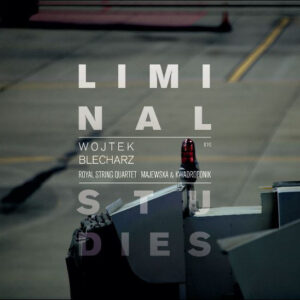
Wojtek BLECHARZ
“Liminal studies”
Wojciech Blecharz is somewhat an exhibitionist. An emotional one, of course.
With his music, he doesn’t create a vision of the contemporary world burdened with disasters, being neither a “digital indigent” nor a fan of algorithmic passages. He’s not even recognized as a political rebel who discloses his outlook on life between the notes. In the centre of his interest remains what’s closest to him – the human psychological condition in the context of experiencing crises and break-ups, traumatic memories. And he is not ashamed of deriving from life experiences, talking about them in interviews, private conversations, programmatic notes but also through musicians performing on stage. He, therefore, creates music that is emotional, even autobiographical and he has no problem with sharing it with the wider audience.
Born in Gdynia (Poland) in 1981, in 2006 he graduated with honors from Frederic Chopin Music Academy in Warsaw (Master of Arts), in 2015 received a Ph. D. in music composition at University of California San Diego. Since 2012 Blecharz has been curating the Instalakcje music festival at Warsaw’s Nowy Theater, featuring non-concert music: sound installations, performance installations, sound sculptures, music videos, music theater and Blecharz has also directed both of his opera-installations Transcryptum (2013) commissioned by Grand Theater National Opera in Warsaw and Park-Opera (2016) commissioned by Theater Powszechny in Warsaw. Currently preparing the third opera installation Body-Opera commissioned by Huddersfield Contemporary Music Festival (premiere November 2016).
Recently composed pieces for Kwadrofonik Ensemble (Warsaw), Forbidden City Chamber Orchestra (Beijing), Klangforum Wien (Vienna), Royal String Quartet (Warsaw), Aviva Endean (Melbourne), International Contemporary Ensemble (New York), Musiques Nouvelles (Brussels).
Original price was: 13,00€.5,00€Current price is: 5,00€.
In stock

DVD
Ivan PALACKY & VJ Vera LUKASOVA aka CARPETS CURTAINS
Ivan Palacky - dictaphones, MD, amplified knitting machine Dopleta 160. Filip Cenek aka VJ Vera Lukasova - real-time image manipulation in interaction with sound.
“Combining live audio "micro-improvisations" (refined by musician Ivan Palacky) with live video manipulations (by video and VJ-artist Filip Cenek aka VJ Vera Lukasova), Carpets Curtains express an engaging and nuanced interplay of audio and visual material. With live visuals being mostly based on self-made video sequences in which emphasis is placed on ambiguous "narration" whilst VJ software-mistakes are used to reach new amoebic image qualities, the result is a principle or method of remaining fixed to moving images while vacating the essential aspects for building concrete meaning. Such visual approaches find parallel in Palacky’s delicate musicalities, in which found objects and minimal electronics are fused to create elegantly small sound mixtures.
Ivan Palacky has (in the 80s and the beginning of the 90s) played with various groups and taken part in several music projects. He was a member of the guitar/doublebass/bassoon group "Slede, zive slede" (Herring, live herring) - and currently performs in a duo called "Tilko" (Singlet) and audiovisual project Koberce, zaclony (Carpets, Curtains). He "writes" a sound diary from all his journeys - collects excerpts of stories, weird sounds and various "acoustic mistakes". He likes to take part in one-shot improvisational groups or duos (with Cremaster, Ruth Barberán and Margarida Garcia, Will Guthrie, Andrea Neumann...) as well as playing solo performances. Since 2005 his main interest has been to "dig out" sounds from an amplified Dopleta 160 knitting machine from the 70s.
Filip Cenek (born 1976 in Jesenik, Czech Rep.) is educated projectionist, graduated from the Faculty of Fine Arts Brno, Video Studio (Keiko Sei), where he currently teaches. From 2004 he has been a postgraduate student at the FAMU Centre of Audiovisual Studies in Prague. He is the co-author (predominantly with Jiri Havlicek) of several short films and animations presented at various fine art exhibitions and experimental film festivals (Centre Pompidou, Paris. L’immagine leggera, Palermo. EMAF, Osnabruck. Wardrobe, Leeds. Parker`s Box, New York. MNAC, Bucurest. Among others). He is represented in the National Gallery Collection of Modern and Contemporary Art in Prague. He was awarded the Developmental Grant of Tranzit for his work in the field of visual media last year, which allowed him to realize "Carpets Curtains" DVD-Video disk, documenting his cooperation with musician Ivan Palacky.”
DVD Pal 4:3 Dolby digital 2.0 Region free.
5,00€
In stock

DVD
Patrick BOKANOWSKI
“Courts métrages”
Patrick Bokanowski : Short films. P. Bokanowski employs an extraordinary range of technical invention - combining live-action with optical experiments, drawing, performance, painting, and animation - to conjure magical forays into a parallel universe. All musics made by Michèle Bokanowski. “La Femme qui se Poudre” (1972), “Déjeuner du Matin” (1974), “La Plage” (1992), “Au Bord du Lac” (1994), “Flammes” (1998), “Le Canard à l’Orange” (2002), “Eclats d’Orphée” (2002), “Battements solaires” (2008). Bonus: Interviews with Patrick Bokanowski (English subtitles). Pal. Region Free. (We also have copies in NTSC, ask for it if you need).
29,00€
In stock

DVD
Anne MAREGIANO
“Charlemagne Palestine, The golden sound”
“Born in New York City, composer, performer, and visual artist Charlemagne Palestine was a contemporary of Steve Reich and Phillip Glass in the avantgarde classical music scene of the 1960s and 1970s. On stages filled with his own home-made stuffed animals, Palestine performs his trance-like strumming music. He is often referred to as a minimal composer, but rejects that in favour of "maximalism". Anne Maregiano’s documentary about Palestine, The Golden Sound (2011), allows the artist to tell his own story while putting his music and performance, in long, unedited takes, at the centre of the film…” - Michael Garrad, (Close Up)
Bonus Films: “The Red Suitcase” by Anne Maregiano (2011). “Body Music “by Charlemagne Palestine (1975). “Charlemagne 2 : Piltzer” by Pip Chodorov (2002).
“Sound Recording: March 7, 1975” by Charlemagne Palestine.
Book (44 pages) with texts written by Ingram Marshall, Roland Spekle, Pip Chodorov and Anne Maregiano. Photos by Kathleen Agnoli, Elaine Hartnett, James Lapine, Charlemagne Palestine.
English with French subtitles.
19,90€
Out of stock

DVD
Patrick BOKANOWSKI “L’Ange”
“L’Ange” (1982). “Dubbed ‘the artist-alchemist of celluloid’ avant-garde filmmaker Patrick Bokanowski’s legendary opus defies all categorisation, in its unique combination of experimental cinema, photography, animation and painting”. Bonus features: The Making of L’Ange & Interview with composer Michèle Bokanowski. (English subtitles). Pal. Region Free. (We also have copies in NTSC, ask for it if you need).
29,00€
In stock

DVD
Jeff MERTENS
“Borbetomagus : A Pollock of Sound”
Filmmaker Jef Mertens brings a raw, urgent, and unpolished vision focusing on a band that has spent almost four decades defining and redefining not just their music, but the boundaries of music itself. Band members Don Dietrich, Donald Miller, and Jim Sauter tell their story with the help of artists, writers, photographers, and filmmakers that include noted critic Byron Coley, drummer Chris Corsano, guitarist Thurston Moore, groundbreaking Japanese noise unit Hijokaidan, and Switzerland's masters of “cracked electronics,” Voice Crack. Includes never-before-seen archival footage, amazing photographic finds, and previously unreleased recordings.
“The group drive furiously into the promise of freedom offered by improvised music to build their own unpredictable edifice. if there's a lesson to be drawn, it's that borbetomagus's focused, lateral expansion is an endlessly fertile plane in itself, regardless of the specifics of form. Mertens's film deftly navigates this idea without ever being overly prescriptive or sentimental. By allowing the work and its ambiguities to stay firmly in the foreground, any conclusions about how to evaluate the music are left up to the audience. Borbetomagus have always thrived on precisely this physical and conceptual interaction. The questions are the answers and vice versa, like two bells locked together.” (Matt Krefting, The Wire)
Region 0. NTSC.
15,00€
In stock

DVD
Phill NIBLOCK
“Thir”
A milestone film from American composer and filmmaker Phill Niblock, presented for the first time in DVD with two alternate soundtracks. T H I R is a mesmerizing and hypnotic film from his Environments series shot in upstate New York in 1972. This film is one of Niblock’s finest and undiscovered jewels. A must have classic release.
18,00€
In stock

DVD
Thomas RIEDELSHEIMER
“Evelyn GLENNIE – Fred FRITH. Touch the sound”
“Subtitled "A Sound Journey with Evelyn Glennie," German director Thomas Riedelsheimer’s exquisite Touch the Sound is nominally a portrait of the Scottish musician known as "the first full-time solo percussionist." Glennie is certainly a fascinating subject. Profoundly deaf since childhood, she disdains the use of hearing aids and sign language, relying instead on lip reading and, more crucially, on the use of all of her senses, especially touch, to "hear" with her entire body. The film reveals Glennie’s extraordinary skills in a variety of settings: playing a snare drum for bemused New Yorkers in cavernous Grand Central Station; improvising with guitarist Fred Frith in an empty warehouse in Cologne, Germany (their final vibes-guitar duet is one of the film’s musical highlights); working with hearing-impaired students in her native Aberdeenshire; jamming with taiko drummers in Japan, and later delighting customers in a Tokyo bar with a spontaneous workout involving chopsticks, dishes, cans, and glassware (the woman can make music with virtually anything). But Riedelsheimer, who was also the film’s editor and cinematographer, has a broader agenda here--namely, to intensify our awareness of the sounds that surround us everywhere, in every moment. From the streets of New York to the beaches of Santa Cruz, from the rocky Scottish coastline to a tranquil Japanese rock garden, he links heightened audio, as clear and natural as the best ECM recordings, to a succession of gorgeous visual images to create a balance of complex detail and overall sparseness, resulting in a kind of Zen feast. Even more of the same is found in a "making of" featurette that’s the highlight of the bonus material, making Touch the Sound easily one of the most rewarding documentaries in recent years”. --Sam Graham
21,00€
In stock

DVD
Götz ROGGE+Frédéric LE JUNTER+Chiharu SHIOTA
“Streaming poesy-Urwald”
“Streaming poesy is devoted to environment and time. As a platform for multi-media collaborations, the project is an ongoing series realised at particular places; in 2006 Streaming poesy settled in the utopia of wilderness (Urwald). The commercial vice has been taking off what’s called a forest - a mere farmland for growing trees - that is now “allowed” to run to seeds. Thereby the sometimes graphical structures of cultural activity of hundreds of years are dissolving with the abstractions of scrubs and fallen trees (this even provocted regional political tensions). The painstaking subtlety in this work is a provocation to the conditioned eye of our time; it’s simplicity is akin to the japanese HAIKU. Though original aimed to be a stream on the internet in 3 parts, this dvd presents a unique version in one piece without interruption - it can be screened continuously. It presents sound recordings and visual mechanics on site by Frédéric le Junter (F) as well as the installation “Dialogue from DNA” by Chiharu Chiota (Jap): 500 shoes on red strings where exposed for the 3 month of autumn. Streaming poesy was commisioned by “URWALD vor den Toren der Stadt”, Saarbrücken-Germany and made possible by Deutsche Bundesstiftung Umwelt (DBU) as part of a innovative communication. DVD PAL length: 2h41min -16:9 HD (4:3 compatible).”
25,00€